[bulla] Policy Bureau

INFORMATION PROCESSING SYSTEM THEORY
PROTOCOLS FOR HUMAN MIND SOFTWARE (“MINDSOFT”):
A POLICY BUREAU GUIDANCE DOCUMENT
Mission Statement:
“Thought Control Program/Monitor for Mind Software.”
Mission Objective:
To develop, operate, and execute self control programs.
ORGANIZATIONAL CHART OF THE MIND
(IN ORDER OF PROCESS HIERARCHY)
Decentralized Autonomous Organization (“network“) = DAO/n ; n =
Departmental Executive Command (I:\ ; “cmd(.exe)“) :
Division of Mind Software Development and Operating Systems (MS\DOS) :
Central Control for Selfmetaprogramming (C:\ ; “ctrl(.exe)”) :
<Office of Oversight (“monitor“)> ;
<Office of Scribe (“write” ; “overwrite“)> ;
<Office of Computational Semantics (“read“)> ;
<Office of Lexis, Syntax, and Gramary (“prog“)> ;
<Office of Mnemonic Devices (“sine“)> ;
<Office of Memory Storage and Databanking (M:\)> ;
<Office of Arcana and Occult Psychology (“arc“)> ;
Center for Dialectic Information Processing and Analysis (CPU ; U:\) :
<Audit Assessment Assurance Adjudgment Service Corp (A:\ ; “corp”)> ;
Division of Operating Systems Communications (OPSCOM) :
<Cognitive Behavioral Output Office (COGB)> ;
<Central Nervous System Input Office (CNS)> ;
{External System Data Bus}
ABSTRACT
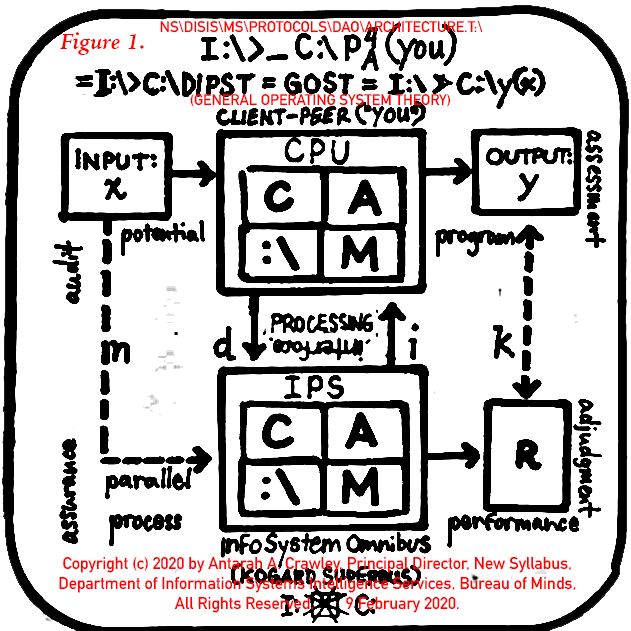
IF you apply due processing in re:x, THEN you will get information. Run General Operating System Theory on your mind software to process information.
IPST 100
GENERAL OPERATING SYSTEM THEORY (GOST) FOR MINDSOFT
IPST 115 Let us take for a processing unit Engelbart’s Human using Language Artifacts and Methodologies in which s/he is trained (H-LAM/T) system with basic von Neumann Architecture:
Drive C:\ is a control mechanism able to communicate with the body hardware (this is the electromagnetic spinal/central nervous system [CNS] omnibus); Drive A:\ is the ability to access Drive M:\ memory; Drive I:\ is the ability to receive input data (from [CNS] perception); Drive O:\ is the ability to route output data (though [cognitive-behavioral] modes of expression); and Drive R:\ is the ability to record and store these data.
IPST 121 IF the matter in question=x, THEN the function f of the human mind is to solve for x (the matter in question). Therefore,
IF x, THEN y
which is to say: IF there is a matter in question, THEN why?
IPST 122 The function of cognition is to solve for the matter in question. In other words,
f(x)=y
is the function for finding out “why” a matter is in question, and how to resolve it. y is the solution for each value of x. When processing information x follows the path from notice to data to information to knowledge (ndik).
IPST 123(a) IF the human’s ability to apply action=y, THEN where x=notice let y=audit; where x=data let y=assessment; where x=information let y=assurance; and where x=knowledge let y=adjudgment.
IPST 123(b) IF x=yourself, THEN y=u/r, where u=understanding and r=resistance(over time). f is the function mapping x to y, in which u/r factors. IF u find y(x), THEN u c(y,x), where c=to see why by applying u/r cognitive function:
f(x)=2cy
This shows that the cognitive function has the effect of doubling, or squaring, the value of x over y. To resolve x, or to solve for y, is “to see why the matter [is in question]”. The solution to the matter in question is:
2c(u/r)self^2.
This is the optimal pathway to process information.
IPST 124 Function f of conflict resolution services is to solve for x, where x=conflict(contradiction). Therefore f(x)=y is the function used to discover “why there is conflict in the matter of x.” In other words, the process used to discover y and solve for x is the function of conflict resolution. In order to solve for x, we must find out what is the matter (x)?
DIPST 101
A:\> f(x)=y Factors
(x1) NOTICE: perception, literacy, and reading comprehension;
(x2) DATA: discover, collect, weigh, and measure evidence;
(x3) INFORMATION: draw inferences from d; make findings of fact;
(x4) KNOWLEDGE: draw conclusion, log information under true=1/0.
(y1) AUDIT: hearing, listening, voir dire and counseling;
(y2) ASSESS: logical analysis and fact-finding, investigation;
(y3) ASSURE: trial, preponderance, and deliberation;
(y4) ADJUDGE: drawing conclusions and making recommendations.
B:\> f(x)=y Variables
1. The meaning of u is the client in a server-client network. u is a bit unit (or “cell”) of f(x); ergo, u is one “self”. Therefore u is a hardware component in Mindsoft OS C:drive.
2. The meaning of “client” is receiver of process servicing.
3. The value of u is unknown until u L=>c u/r cell f(x).
4. The meaning of r is resistance, as in the body (corpus). Because the body is a matter x, it encounters resistance to process. This resistance is manifest over time; that is, the time it takes to perceive, or to c, the matter in question. IF x=a matter in question under normal conditions, THEN default r=1; whereas IF r=0 THEN x=light [speed of].
5. u is the function mapping c to y, where c=cognition. The function mapping c to y is application-ability [of DIPST].
6. f is the function mapping x to y, where x=the subject matter. The function mapping x to y is information processing.
7. y is the solution to the problem x. The way to resolve x is to apply information processing to c u/r cell f(x) square.
C:\> function DoProcess(information) {
SOLVE f:x=>y / * the function mapping x to y * /
LET x=variable i^n; y=u/2 [(u/r primary cellF) * (ips * app^n)
IF u=a/r primary cellF THEN L => c u/r cellF^2, where L=induction(90°) / * induct to see yourself squared * /
/ * apply powers of self-perception * /
[( FIND f:x=>y) =>
IF x=n THEN y=Ia^1
DO process{audit-notice}
IF x=d THEN y=Ia^2
DO process{assess-data}
IF x=i THEN y=Ia^3
DO process{assure-info}
IF x=k THEN y=Ia^4
DO process{adjudge-knowg}
<?>f(k)=C(u/r)cellF^2</?>
return{result:<record>1=true;0=false</record>}
ELSE <ips>DIA(GNOSIS);PRO(GNOSIS);CO(GNOSIS)
Write-Prescription
finding of fact [f(F)] ; and
conclusions of induction operation [c(L)]
</ips>
END IF )]
}


IPST 208
DUE PROCESS FOR INFORMATION PROCESSING SERVICE PROVIDERS
1.0 1st Degree: Information Processing.
1.1 Step 1: Filing: To raise a matter of interest or concern to the Office of Ombudsman, client(s) shall submit information, being a contract to which they are party, a matter of policy in which they have an interest, a grievance, an inquiry, or a petition for investigation (respectively, “the matter(s)”, or, “in re [the matter(s)]”) in electronic or hard copy to the mailbox of the Ombudsman.
1.2 Step 2: (A) Reading Comprehension: Help client(s) to read and understand the terms of complicated, formal, or arcane language in the matter(s) in order for them to make informed decisions and good judgments in their own right. If the client acquires the knowledge and understanding needed to resolve the matter(s) in their own right, close the case. (B) Charging Documents: If further work/action is required, paper charges and pass the case to 2nd Degree.
2.0 2nd Degree: Parliamentary Session.
2.1 Step 3: (A) Discovery: Collect and gather evidence in the matter(s) through discovery of further information by and though Audit Assessment and Assurance Service, investigation (within proper jurisdiction), research, or other lawful and appropriate means. (B) Findings: Try, test, and examine client(s)’s working knowledge in the matter(s) and make findings of fact. If findings resolve client’s understanding in the matter(s), close the case. (C) If further work/final action is required to resolve the matter, raise the case to the 3rd Degree.
3.0 3rd Degree: Adjudgment.
3.1 Step 4: Oral Hearing: Hold oral hearing examination in the matter; call witnesses, documents to formally deposit evidence into record; weigh evidence.
3.2 Step 5: Judgment: Upon a preponderance of the evidence, Ombudsman shall render Declaration of Judgment in re the matter.
3.3 Step 6: Verdict Sui Jure: Client renders personal conviction or vindication in light of Judgment, the opinion of the verdict being either unanimous or dissenting.
3.4 Step 7: Sentencing: Issue final Writ of Judgment memorializing the resolution.
4.0 Office of Ombudsman shall carry out the equitable administration of the rights of: (a) Free Thought: the Right to read, write, and be educated without censorship; (b) Free Speech: the Right to speak truth to power and to petition for a redress of grievances; and (c) Free Assembly: the Right to gather and form representative bodies, make authoritative declarations, and designate or appoint members.
IPST 300
MODEL REGULATIONS OF THE OFFICE OF OMBUDSMAN
1.0.0 BE IT ENACTED BY THE [CLIENTS] OF THE [LOCAL], That this act may be cited as the “Ombuds Act of 2019”.
2.0.0 OFFICE OF OMBUDSMAN; ESTABLISHMENT
2.1.0 There is established within the [Local] an Office of Ombudsman.
3.0.0 QUALIFICATIONS.
3.1.0 The Ombudsman shall:
(a) Be hired or contracted on the basis of integrity;
(b) Possess a demonstrated ability to analyze issues and matters of law, administration, and policy; and
(c) Possess experience in the field of social work, counseling, mediation, law, policy, or public administration or auditing, accounting, or other investigative field.
4.0.0 OMBUD SERVICES.
4.1.0 The Ombudsman shall:
(a) Provide outreach to clients, and to further this purpose, have the due regard of all individuals within the [Local];
(b) Encourage communication between clients and the venues of society and government about which they raise concern;
(c) Serve as a vehicle for clients to communicate their complaints and concerns and to petition for a redress of grievances (i.e., to submit information) regarding matters of their personal or collective interest or concern through a single office;
(d) Respond to inquiries and information with helpful information according to the applicable business terms and conditions;
(e) Receive information from clients concerning matters of their interest or concern, including policies and procedures;
(f) Determine the validity of (“vet”) any information quickly and professionally;
(g) Examine and address valid information;
(h) Generate opinions or options for a response, and inquire into the outcomes of each response.
(i) Refer client to appropriate venue of mediation or resolution of the information, or respond appropriately;
(j) Except when the parties have initiated legal or administrative proceedings involving the information, resolve inquiries regarding information presented by clients, either through judgment by arbitral tribunal, or through other informal measures.
(k) Develop and maintain database that archives and tracks information, identified by client, and the resolution or judgment of the information.
(l) Identify systematic concerns and recommend to their client(s) policy changes, staff training, and strategies to affect the public or private perception of colored people.
(m) Within 30 days of the next regular Public Meeting of the Office, submit to the general public of the [Local] a report summarizing the work of the Ombudsman during the previous [term], which shall, at minimum, include an analysis of the types and number of:
(1) Information received;
(2) Information examined and resolved informally;
(3) Information examined and resolved through a formal process;
(4) Information dismissed as unfounded;
(5) Information pending judgement or resolution;
(6) Referrals made; and
(7) Number of contracts privileged.
(n) Identify community-level concerns based upon a pattern of information and render opinions or judgments to affect the knowledge and perception of clients.
(o) Have the authority to issue reports and proclamations related to the Office of Ombudsman’s work without prior review or approval by another entity, subject to the terms of active and in force operating agreements.
5.0.0 AUTHORITY.
5.1.0 The Ombudsman shall:
(a) Have access to the information and any books, records, files, reports, findings, and all other papers, forms, or media of information (“documents”) which are submitted by a client to their Office in the course of regular business practice.
(b) Speak in regard to the issues of clients under the purview of the Office of Ombudsman with any person whatever.
(c) Be permitted entry onto any property to which their client is permitted entry in order to observe matters pertaining to inquiries and information which has been raised by the client; provided, that the property manager or owner have a reasonable expectation of personal privacy, safety, good faith and confidence.
(d) Examine and investigate acts pertaining to information, including whether such acts are inequitable, unreasonable, or discriminatory, even though in accordance with the law;
(e) Determine which information warrants further examination and investigation;
(f) Bring persons together to resolve conflicts that are not in formal legal or administrative proceedings;
(g) Examine any matter under the purview of the Office of Ombudsman, whether initiated by information or another means;
(h) Be permitted to enter into private contracts styled “Charging Documents” or “Papers,” or known by any other name, wherein the Ombudsman may be charged by any client to perform ombud services regarding specific subject matters or affected populations; which contracts shall identify a term limit, subject matter jurisdiction, schedule of deliverables, and hourly rate of work; and which may provide for agreements or designations of “confidential privilege” or “non-disclosure” relating to workproduct, findings, opinions, and/or judgments made thereto pursuant;
(i) Forward to the client(s) all information that requires further action by the body.
6.0.0 LIMITATIONS; PROTECTIONS
6.1.0 The Ombudsman shall not:
(a) Disclose personally identifiable information regarding a client or persons named in information submitted by clients without the specific written consent of the client;
(b) Have the authority to take any personnel action regarding clients;
(c) Examine or investigate any matter that would be under the exclusive jurisdiction of a governing body other than the [Local];
(d) Provide legal advice or legal representation.
6.2.0 The Ombudsman shall not:
(a) Be compelled to testify in a legal or administrative proceeding regarding a current or past Office of Ombudsman examination or investigation or to release information, including documents and records, gathered during the course of an examination or investigation;
(b) Be held personally liable for the good faith performance of his or her responsibilities under this act, except that no immunity shall extend to criminal acts, or other acts that violate District or federal law; or
(c) Be subject to retaliatory action for the good faith performance of his or her responsibilities under this act.
6.3.0 Limitation of Liability; Indemnification —
6.3.1 Client(s) shall agree to insure and hold the Ombudsman, its affiliates, agents, officers, and/or partners blameless, harmless, and/or not liable for any claim or demand, which may include, but is not limited to, reasonable attorney fees made by any third party which may arise from any content or conduct any client of this service may commit, submit, transmit, remit, or otherwise perform and/or make available through this service, or client(s)’s connection or understanding with the use thereof, client(s)’s violation of these Model Regulations, and/or client(s)’s violation of any such rights of another. The liability of the Ombudsman with respect to the good faith performance of the services set forth in Section 4.0.0 shall be eliminated to the fullest extent of the law.
6.3.2 Client(s) shall indemnify, defend, and hold harmless the Ombudsman from and against any and all claims, demands, actions, suits, and punitive, indirect, incidental, special, consequential, or exemplary damages, including, but not limited to, damages which may be related to the loss of any profits, goodwill, use, data, and/or other intangible losses incurred or resulting from the use, misuse, or inability to use the services set forth in Section 4.0.0.
6.3.3 In the event that any client has a dispute, such client(s) hereby agree to release the Ombudsman, its affiliates, agents, officers, and/or partners, and any other third parties from claims, demands, and damages (actual and consequential) of every kind and nature, known and unknown, suspected or unsuspected, disclosed and undisclosed, arising out of or in any way connected to such dispute.
7.0.0 COMPLAINT RESOLUTION SERVICES.
7.1.0 The Office of Ombudsman shall provide complaint resolutions services, which shall be available to clients.
7.2.0 Participation in complaint resolution services provided by the Office of Ombudsman shall be voluntary.
7.3.0 Before submitting information to the Office of Ombudsman, the client shall knowingly, intelligently, and voluntarily seek the services set forth in Section 4.0.0.
7.4.0 Clients may submit information by phone, in writing, or electronically, subject to notice of applicable terms and conditions.
7.5.0 Except as provided in Section 7.6.0, the Office of Ombudsman shall review and investigate each information and shall do one or more of the following:
(a) Resolve the information;
(b) Refer the client to seek appropriate services;
(c) Request the client to submit evidentiary information;
(d) Entertain opportunity for client to meet with subject of information, if within their right;
(e) Conduct mediation proceedings;
(f) Dismiss the information as unfounded; or
(g) Take any other action determined necessary and appropriate by the Ombudsman.
7.6.0 The Ombudsman may refrain from investigating or examining an information if the Ombudsman reasonably believes one or more of the following:
(a) The information is plain on its face (“prima facie”) that an obvious or adequate resolution is presently available such that the performance of work is unwarranted;
(b) The information relates to a matter that is outside the jurisdiction of the Ombudsman;
(c) The client does not have sufficient jurisdiction (viz., personal interest) in the subject matter of the information.
(d) Investigation or examination of the information would not facilitate an action authorized pursuant to Section 7.5.0 of this Title;
(e) The information is submitted in bad faith; or
(f) The resources of the Ombudsman are insufficient for adequate investigation.
(as amended 17 September 2019)
IPST 500
INVESTIGATIVE TECHNIQUE; GUIDELINES; DIRECTIVES
510 Investigation Principals
511 Investigation Principal 1: Confidentiality.
(a) It is the responsibility of the IPS to maintain the trust, confidence, and confidentiality of their client(s) and/or any parties to the matter under investigation. Confidentiality is integral to the casework of the IPS because the IPS must remain neutral, equitable, and non-interested in the matter under investigation; furthermore they should take no action which may adversely affect the reputation or material conditions of their client(s) or any party to the matter under investigation. The IPS should not discuss a matter under investigation with any person who has not been identified as having a “need to know.” The IPS should bear in mind the interests of their client in finding out the facts of the matter under investigation, but not to the extent that their client’s interest causes the IPS to become biased in the performance of their duty. It shall be the objective of all parties involved to discover the facts of the matter under investigation and to render opinions thereon. All material forms of information including hard and soft copy documents created and collected in the course of investigation shall be marked with the appropriate privacy and confidentiality notifications (for example, in an email, “confidential—do not forward”). Additionally, when conducting an interview in a matter requiring confidentiality, the interviewee should be advised on the record “not to discuss [their] testimony with any other witnesses or those who do not have a need to know.”
512 Investigation Principal 2: Professionalism.
(a) Investigation into any and all matters shall be conducted with integrity, fairness (equity), and due diligence, in other words, in a professional manner. The IPS shall treat all persons involved with respect, know how to say “no” in a firm but polite way, and recognizing the limits of their contribution to an investigation, that is, knowing the limitations of their service. The IPS shall execute all courses of action with a positive attitude. Similarly, the IPS shall take care to ensure the lawful, ethical, and professional performance of the investigation. The IPS shall comply with the investigative directives of their client or the single point of accountability (SPA), being, in most cases, the party bringing action or otherwise raising the matter into question, but not to the extent that it may compromise the integrity of the investigation.
513 Investigation Principal 3: Competence.
(a) The IPS shall have competence in the subject matter under investigation. Their work relies upon the ability to conduct an impartial, thorough, and professional investigation. Appropriate action shall be subsequently taken or administered by the client, the SPA, or other officers having competent jurisdiction in the matter in question; therefore the role of the IPS is to find facts and present them in a clear and concise manner so that decision makers are duly informed and equipped to render a final decision. Therefore the IPS shall pursue knowledge and competency in the subject matter under investigation through education, research, and experience. In general, competence means “knowing what you are doing,” that is, showing that you have the capability to carry out a task. Capability is a precursor to showing the capacity to perform work consistently and at a high quality. Therefore, capability and capacity are the two pillars of competence.
514 Investigation Principal 4: Preventing Retaliation.
(a) A person will be forthcoming with information if they believe they will not be retaliated against or penalized for doing so. The IPS should be alert to signs of retaliation and the likelihood of certain parties in a matter to be treated differently based on their involvement in an investigation. Retaliation can take many forms, including but not limited to negative performance evaluation, nonselection for promotional opportunity, receipt of less or lower quality work, exclusion from meetings, activities, and decision-making, and subjection to physical and/or verbal harassment or harm. The IPS should raise concerns of retaliation to the SPA. Interviewees should be advised “that any person who, in good faith, seeks advice, raises a concern, reports misconduct or cooperates in an investigation is following [the] code of ethics and conduct — and doing the right thing; retaliation against such persons will not be tolerated.” Retaliatory conduct may be grounds for disciplinary or adverse personnel action.
515 Investigation Principal 5. Impartiality.
(a) An investigation must be conducted by those who do not have an interest in the matter they are investigating, nor an appearance of a conflict of interest. In the course of an investigation, all investigation subjects shall be investigated in the same manner, with the same professional, impartial, objective treatment. The investigation and decision-making team should not include anyone who: may be implicated in the matter under investigation; is possibly responsible for failure to take reasonable steps to prevent or detect the allegations/charges; has an interest in the outcome [besides, to a reasonable degree, the client or their representative]; has a close personal or working relationship with the Investigation Subject(s); and/or acts as inside or outside counsel or advisor to the matter under investigation [besides, to a reasonable degree, the client or their representative]. In the course of fact finding, the IPS should generally avoid expressing opinions or conclusions about whether or not the facts or allegations in question have been substantiated, whether or not a violation/allegation/charge has occurred, or about the character or credibility of the Investigation Subjects, the Complaint or others involved in the investigation. The IPS shall take care not to permit their investigation to become tainted by conscious or unconscious bias which they may experience.
516 Investigation Principal 6. Objectivity.
(a) One of the axioms of Dialectical Materialism is the concrete analysis of concrete conditions, otherwise known as objectivity. Therefore, in the course of investigation, the IPS shall not appeal to their own convictions of right and wrong; they should shun subjective judgment and pursue objective analysis of material facts and conditions; they should conduct their work free of personal opinion or bias. All relevant and material information should be reviewed and analyzed using the same standards (as set forth herein), and the findings of an investigation shall be based upon the facts in evidence (as deposited onto the record), not opinion or conjecture filtered through the investigator’s subjective value system. Objectivity ensures that every investigation subject and participant is treated equitably.
(b) The purpose of investigation is to find the facts and produce a report or record such that others can make a determination or assessment of how to resolve a matter in question as alleged in a charge of complaint, grievance or adverse action and what the underlying causes of such matters are. The IPS may, if requested by the SPA, make recommendations or render opinions about whether or how the SPA should proceed toward the resolution of a matter. IPS shall not jump to conclusions or have a prejudiced or predetermined presumption of guilt or innocence regarding the investigation subject or any other outcome of the case; nor shall the IPS consider proving an allegation to be substantiated a victory over finding such allegations unfounded. The IPS shall examine different theories of a case, collect adequate information on a matter, and to ensure that only relevant, material, and substantiated facts prevail in the investigation findings.
517 Investigation Principal 7. Timeliness.
(a) The United States Constitution affords all citizens the right to a speedy trial; likewise, upon receipt of a matter, charge, or allegation requiring investigation and resolution, the IPS should undertake such matter in a reasonably prompt and responsive manner. Timeliness underlies professionalism. Any investigation will affect its subjects and participants; therefore, in light of the import of timeliness, it is desirable that wrongly accused people be cleared as quickly as possible, ongoing wrongdoing should be stopped as quickly as possible, and appropriate time should be allotted for parties to effectively bring subsequent actions which may arise in connection with the investigation or the matters underlying it. However the timeliness of any given investigation will be unique to that investigation.
(b) Upon receipt of a matter, charge, or allegation, the IPS should act quickly to make contact with the SPA, complainant, or initial reporter of the matter. In most cases the IPS would be wise upon opening an investigation to conduct a scheduling conference between the parties in order to establish the schedule of discovery and set future date for hearings, work-product deliverables, and other case-setting milestones. Furthermore, upon opening an investigation, the IPS shall protect the integrity of information by ensuring that relevant documents, evidence and electronic records and communications are maintained. The IPS shall exercise competent time-management in order to conduct as thorough an investigation as possible in the shortest reasonable amount of time.
520 Investigative Procedure
521 Investigation Step 1: Initial Analysis.
(a) Directives: Determine whether a matter which has been raised to the IPS requires formal investigation or whether it can be examined and resolved based on the facts already known/presented/substantiated; determine whether the matter would be more properly handled by another competent jurisdiction; establish the role of the IPS (e.g., to find facts, analyze evidence discovered, and present findings to the decision-maker following completion of the investigation; be cognizant of the involved participants, decisions-makers, and appeals decision-makers (decision-makers should not be directly involved in the course of investigation so as to be — and appear to be — objective in taking any subsequent rule making).
522 Investigation Step 2: Planning & Leading.
(a) Directives: determine the scope, complexity, and timeline of the investigation; develop a strategy for the investigative process; bear in mind that all subjects of investigation shall be considered innocent until proven otherwise, and that all subjects of investigation have the right to defend themselves again allegations or charges which may be brought against them; bear in mind that the investigate procedure may reveal trends or shortcomings in practice which can be addressed to prevent future occurrences of a similar nature, and that such investigations develop with time as new facts and/or issues arise.
(b) An investigative plan shall take account of: the precipitating event (or charge) and all persons involved, including name, contact information, and relation to charges (including but not limited to the investigation subject); the chronology of dates, times, places, meetings, calls, conversation, and other material documentation; general laws, policies, procedures, and/or code of ethics which may bear upon the charges and their investigation, including where such information may be located (as well as other broad issues covered by the investigation); potential sources of evidence and material information (including but not limited to material witnesses); the decision-makers in the matter (i.e., those to whom IPS shall report findings); the order of persons to be interviewed and the subjects to be covered with each; communication planning with those having a need to know in re the matter under investigation;
(c) Directive: produce and maintain a (confidential and secured) case file of the investigation, including ALL documentation and evidence arising from the investigation, including the original charge/allegation/complaint; including an investigation timetable which shall include the “tick-tock” (or timetable) of the case (which shall include the review of discovery, schedule of interviews, notes and transcripts of interviews, memos-to-file, and preparation of final report).
523 Investigation Step 3: Discovery.
(a) Directive: conduct fact-finding through requests for information and conducting interviews (also known as fact-finding conferences, deposition upon written interrogatories or questions, or deposition upon oral examination). Stages of an interview include planning, arranging, opening, conducting, and closing. Bear in mind applicable document retention policies.
524 Investigation Step 4: Analysis & Preponderance.
(a) Preparation of a final report of investigation shall rest upon a thorough analysis of the facts and preponderance of the evidence discovered in the course of the (instant) investigation, so as to cause the matter to be resolved between the parties, or to provide the decision-maker(s) with sufficient basis on which to decide the outcome of the case. “Preponderance” means due consideration of ALL facts in evidence, based upon critical analysis of objective and material information, and according great weight to genuine, credible and relevant material evidence.
(b) Directives: Reconcile and resolve to the greatest possible extent all contradiction between facts in evidence, considering which version of the facts is more consistent with the overall evidence than another; assess the quality of the evidence, bearing in mind it’s objectivity v. subjectivity, firsthand knowledge vs. hearsay, and speculation vs. credibility; consider the source of evidence and the motives (explicit and implicit) of witnesses in testifying in the matter; in the course of resolving issues of credibility, consider whether the overall evidence is inconclusive with respect to the matter under investigation.
525 Investigation Step 5: Reporting.
(a) This stage may be undertaken by an IPS-Dialectician with a Rapporteur subspecialty. Such IPS shall prepare a final report that outlines: all steps taken in the course of investigation (incl. schedule of discovery of documents and testimony); all facts found (incl. citation to material evidence as cited to case file or reproduced in appendices); objective analysis of the facts in evidence; any specialized or expert opinion or information solicited by or proffered to the investigation; citation to any similar case work known to the IPS, if any; a general analysis of the control factors relevant to the matter under investigation and/or to the course of the investigation itself.
526 Investigation Step 6: Following-Up & Resolution of Investigation.
(a) Upon submission of the final report to the SPA, decision-maker, or client, IPS shall be absolved by the client of all involvement in or responsibility to the matter of the completed investigation, and the client and all participants shall indemnify the IPS against any and all actions arising from the investigation; however, the IPS may be called as a witness to a subsequent action taken in the matter previously under investigation, and may testify upon the course of their investigation. Furthermore, those involved in the matter shall bear in mind the potential for retaliation caused by the particular facts of the investigation and strive (within a reasonable degree of their power) to reduce the possibility of retaliation and/or other collateral damages.
(b) Note Well: The conclusion of an IPS investigation does not preclude the parties from working toward another resolution or pursuing legal action in a venue of appropriate jurisdiction.
IPST 600
CONFLICT RESOLUTION USING THE DIALECTIC METHOD
601 Conflict Resolution can be applied to particular matters of concern as well as to general matters of universal law and order. The general laws of conflict and resolution were studied by the 19th Century philosophical school of Historical and Dialectical Materialism. The comrades of that school took what knowledge they acquired from their study and put it into social practice, abstracting and applying the dynamic laws of nature to the relations of society.
602 The comrades followed the principle that practice builds theory, and theory guides practice (or “praxis”). Together theory and practice inform our approach to conflict resolution, being derived from the two main pillars of Historical and Materialist Dialectics. Our first undertaking shall be to understand what “Dialectic” means.
603 The Dialectic Theory of Knowledge has two main axioms (major tenants or principles):
(1) The law of the contradiction in things is the basic law of dialectics [23]. This is also called the law of the unity of opposites, which is defined as “the recognition, or discovery, of the contradictory, mutually exclusive, opposite tendencies in all phenomena and processes of nature” [31].
(2) Social practice alone is the criterion of the truth of one’s knowledge of the external world [3]. The standpoint of practice is the primary and basic standpoint in the dialectical-materialist theory of knowledge [4].
604 Dialectics is the science of the unity and conflict of opposites, being the essence of materiality. The “Historical” and “Materialist” parts of Dialectics refer to the Materialist Conception of History, being a scientific study of history as a uniform and law-governed process in all its immense variety and contradictoriness. If, according to this conception, history supplies us case studies in conflict and conflict resolution, then the practice of conflict resolution through clinical trials should develop and refine practical knowledge.
605 Dialectical Materialism is defined as:
(1) The doctrine of development in which motion is caused by the unity and struggle of opposing forces.
(2) The science of the general laws of motion, both of the external [material] world and of human thought (the latter being nothing more than the reflection of the former in the human mind).
606 According to the principle of Dialectics, the identity of any given thing contains its own opposite because it is always defined by its relationship to its opposite. Unity exists in the complementary nature of opposing forces, and the identity of any given thing is driven by the contradiction between its internal forces. In other words, one whole is a cycle of 360 degrees composed of two opposing 180-degree halves. Over the course of time, one opposite prevails, and then the other. This internal contradiction is a universal quality of matter and materiality.
607 The person in need of conflict resolution services may be ignorant, or unaware, of the inherent contradiction within all matter(s), and therefore may be more likely to mischaracterize and/or misunderstand the material conditions of a matter in question. This fundamental misunderstanding of social experience results in poor cognitive processing skills and irrational leaps of judgment. This results in the inability to resolve conflict. Therefore, in order to resolve conflict, one must apply some methodology for the processing of information gathered through their perception of material conditions and interrelations.
608 Regarding a matter in question between two parties, their mutual appreciation of the material conditions and their interrelation shall increase their capacity for information processing and resolve their conflict. The parties shall reach a neutral common ground by and through the assistance and counsel of a dialectic specialist, or neutral mediator.
609 The dialectic specialist is a social scientist, and therefore must affect change by and through the scientific method. Therefore the practitioner of conflict resolution should adopt the method and practice of the professional clinician in order to serve their affected population — and resolve conflict. Material evidence should be collected by and through clinical trials of audits and hearings toward the resolution of conflict.
610 In general, the practice of the dialectician should be to investigate complaints of potential conflict, to work cases to resolve conflict, and to audit and assess individual and collective case studies in order to acquire and refine knowledge.
TITLE AND PURPOSE
This Code may be cited as the “Policy Bureau Guidance Document”. The purpose of this Code is to consolidate the central, overarching, general policies necessary to develop, operate, service, support, and run programs on human mind software. The contents of this Code are sourced from main.myshul.mod, as amended.
(All contents copyrighted 2020 by Antarah A. Crawley newsyllabus.org/om. All Rights Reserved. Last modified 12 May 2020.)




 Supreme Exchange