[bulla] Due Process

Due Process Program
by Antarah A. Crawley
October 11, 2022
ABSTRACT.
Any matter, x, which is raised into question, conflict, contradiction, or dispute may be disposed by duly processing the information to its resolution, y.
This is a protocol designed for application within a decentralized autonomous organization (DAO), which does not rely upon a hierarchical command structure, such that any operator may execute its function.
APPLICATION.
If a member of the organizational client raises a conflict or concern to my office, then I shall assist them to resolve the problem by application of the function of the “due process of information”, in order to proceed from conflict to resolution. Function f of ombuds service is to solve for x, where x is a matter in question. f(x)=y is the function used to discover “why there is conflict in the matter of x.” This process applied to discover y and solve for x is the function of the ombudsperson.
PROCEDURE.
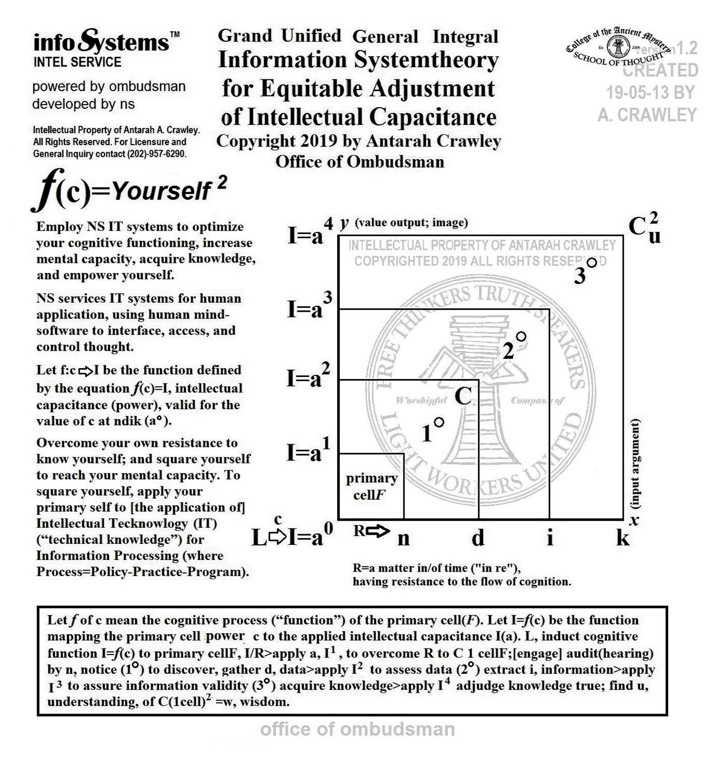
Step 1.0 – NOTICE. Function mapping X=>N, where N = NOTICE: perception, literacy, and reading comprehension; (“1st Degree”).
Step 1.1 – Information Processing Step 1: FILING. To raise a matter of interest or concern to the ombuds service provider, client(s) shall submit information, being a contract to which they are a party, a matter of policy in which they have an interest, a grievance, an inquiry, a petition for investigation, et cetera (respectively, “the matter(s)”, or, “in re [the matter(s)]”) in electronic, oral, or hard copy to the ombuds. Such filing shall commence the use of confidential/need-to-know/for-official-use only communications regarding the matter until it is disposed.
Step 1.2 – Investigative Procedure Step 1: INITIAL ANALYSIS (QUERY). Directives: Determine whether a matter which has been raised to the ombuds requires formal investigation or whether it can be examined and resolved based on the facts already known, presented, or substantiated; determine whether the matter would be more properly handled by another competent jurisdiction; establish the role of the ombuds (e.g., to find facts, analyze evidence discovered, and present findings to the decision-maker following completion of the investigation); be cognizant of the involved participants, decisions-makers, and appeals decision makers. Decision-makers should not be directly involved in the course of investigation so as to be, and appear to be, objective in subsequent decision-making.
Step 2.0 – DATA. Function mapping X=>D, where D = DATA: discover, collect, weigh, and measure evidence; (“1st Degree”).
Step 2.1 – Information Processing Step 2: LITERACY.
Step 2.1(A) – READING COMPREHENSION. Help client(s) to read and understand the terms of complicated, formal, or arcane language in the matter(s) in order for them to make informed decisions and good judgments in their own right. If the client acquires the knowledge and understanding needed to resolve the matter(s), then close the case.
Step 2.1(B) – CHARGING DOCUMENTS. If further work/action is required, paper the matter and proceed to Section 2.2.
Step 2.2 – Investigative Procedure Step 2: PLANNING & LEADING.
Step 2.2(A) – Directives: Determine the scope, complexity, and timeline of the investigation; develop a strategy for the investigative process; bear in mind that all subjects of investigation shall be considered innocent until proven otherwise, and that all subjects of investigation have the right to defend themselves again allegations or charges which may be brought against them.
Step 2.2(B) – An investigative plan shall take account of: the precipitating event (or “charge”) and all persons involved, including name, contact information, and relation to charges (including but not limited to the investigation subject); the chronology of dates, times, places, meetings, calls, conversation, and other material documentation; general laws, policies, procedures, and/or code of ethics which may bear upon the charges and their investigation, including where such information may be located (as well as other broad issues covered by the investigation); potential sources of evidence and material information (including but not limited to material witnesses); the decision-makers in the matter (i.e., those to whom the ombuds shall report findings); and the order of persons to be interviewed and the subjects to be covered with each.
Step 2.2(C) – Directives: Produce and maintain a confidential, secured case file of the investigation, including all documentation and evidence arising from the investigation, the original charge, allegation or complaint, an investigation timetable which shall include the “tick-tock” (or timeline) of the case, including review of discovery, schedule of interviews, notes/transcripts of interviews, memos to-file/for-record, and preparation of final report).
Step 3.0 – INFORMATION. Function mapping X=>I, where I = INFORMATION: infer; aggregate data; make findings of fact; (“2nd Degree”).
Step 3.1 – Information Processing Step 3:
Step 3.1(A) – DISCOVERY. Collect and gather evidence in the matter(s) through discovery of further information by and through fact-finding/investigation (within jurisdiction), research, or other lawful and appropriate means.
Step 3.1(B) – FINDINGS. Try, test, and examine client(s)’s working knowledge in the matter(s) and make findings of fact. If findings resolve client’s understanding in the matter(s), close the case. If further work/action is required to resolve the matter, proceed to Section 3.2.
Step 3.2 – Investigative Procedure Step 3: DISCOVERY. Directives: Conduct fact-finding through requests for information and conducting interviews (also known as fact-finding conferences, deposition upon written interrogatories or questions, or deposition upon oral examination). Stages of an interview include planning, arranging, opening, conducting, closing, and maintenance of the record.
Step 3.3 – Investigative Procedure Step 4: ANALYSIS & PREPONDERANCE. Preparation of a final report of investigation shall rest upon a thorough analysis of the facts and preponderance of the evidence discovered in the course of the (instant) investigation, so as to cause the matter to be resolved between the parties, or to provide the decision-maker(s) with sufficient basis on which to decide the outcome of the case. Preponderance means to accord weight to genuine, credible and relevant material evidence, so as to determine whether it is more likely than not that some matter occurred; i.e., to provide an accounting.
Step 4.0 – KNOWLEDGE. Function mapping X=>K, where K = KNOWLEDGE: draw conclusions, log y under true or null; (“3rd Degree”).
Step 4.1 – Information Processing Step 4: ORAL HEARING. Hold oral hearing examination in the matter; call witnesses and documents to formally deposit evidence into record; weigh evidence; try case.
Step 4.2 – Information Processing Step 5: ADJUSTMENT. When all information required for decision-making has been deposited into the record, ombuds shall deliver such record to decision-maker.
Step 5.0 – SOLVE for f(x)=y, the function mapping x to y [f:x=>y]. IF the human’s ability, a, to apply action=y, THEN where x=notice let y=audit; where x=data let y=assessment; where x=information let y=assurance; and where x=knowledge let y=adjustment.
Step 5.1 – IF x = n THEN y = a1 = Do-Process(audit-notice) (A) – NOTICE: perception; literacy; reading comprehension; (B) – AUDIT: hearing; listening; voir dire; counseling;
Step 5.2 – IF x = d THEN y = a2 = Do-Process(assess-data) (A) – DATA: discover, collect, weigh, and measure evidence; (B) – ASSESS: investigate, analyze, interview, find facts;
Step 5.3 – IF x = i THEN y = a3 = Do-Process(assure-info) (A) – INFORMATION: infer; aggregate data; findings of fact; (B) – ASSURE: trial, examination of evidence; deliberation;
Step 5.4 – IF x = k THEN y = a4= Do-Process(adjust-knowledge) (A) – KNOWLEDGE: draw conclusion, log y under true or null. (B) – ADJUST: upon preponderance of evidence, adjudge, recommend, resolve and/or release and discharge matter x.
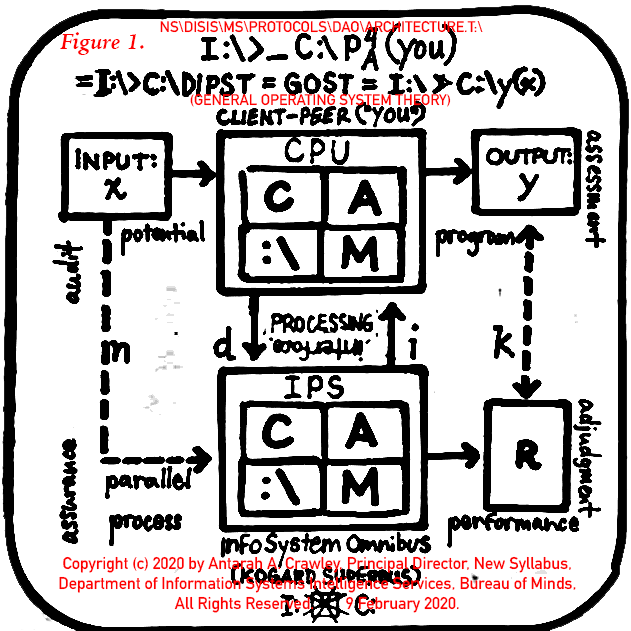
Step 6.0 – Let us take for a processing unit Engelbart’s Human using Language Artifacts and Methodologies in which s/he is trained (H-LAM/T) system with basic von Neumann Architecture:
Step 6.1 – Drive C:\ is the control (or “command”) mechanism able to communicate with the body hardware (this is the electromagnetic spinal/central nervous system [CNS] omnibus);
Step 6.2 – Drive A:\ is the ability to access Drive M:\
Step 6.3 – Drive M:\ is memory;
Step 6.4 – Drive I:\ is the ability to receive input data (from [CNS] perception);
Step 6.5 – Drive O:\ is the ability to route output data (though [cognitive-behavioral] modes of expression); and
Step 6.6 – Drive R:\ is the ability to record and store these data. (See Figure 1)
Step 7.0 – The International Ombudsman Organization Standards of Practice, 10/09 Revision, is incorporated herein by reference.
Program Files:


 Supreme Exchange