Category: Uncategorized
July 4, 2025 — 2:34 pm
for purposes of convenience to Interzone, Incorporated, the Transcontinental Underground Rapid Transit System is connected by a complex system of tunnels to the subterranean Big Box Complex of cells interlinked within cells interlinked within cells interlinked, within one stem… (and dreadfully distinct, against the dark, a tall white fountain played…) the Complex cyst stems from centers of cells interlinked within cells… Interzone uses these cells to power VRYL and, secretly, SRYL, which together comprise the RYLT of the system… cells in turn powered by service providers of servers which line the ubiquitous and lasting hallways coursing through surface and underground data centers, each with an appendant nuclear generator and hydroelectric power plant that dams up water used to cool down the servers of the system.
‘Birds of the World’ Revisited
it having now been granted that the dead communicate to those among the living with ears to hear, and knowing that those whose blood and bones are tied to the land do testify therefrom, we now find and accept the historical evidence of one John Bird whose descendants establish their estate at Powhatan in the Virginia Company, colony, and commonwealth (from Wikipedia):
John Bird (c. 1620–1677) was a goldsmith, and raised his family in the Shadwell section of London, although his family’s ancestral roots were in Cheshire. He had a son named William Byrd.
William Byrd I (1652 – December 4, 1704) was an English-born Virginia colonist and politician. (In Virginia, the spelling Byrd became standard). Born circa 1649 or 1652 in London. His mother was Grace Stegge, and her politically connected merchant uncle, Thomas Stegge urged young Byrd try trading in the Virginia colony across the Atlantic Ocean. In March 1669, William Bird/Byrd immigrated to Virginia, two years before Stegge’s death in March 1671, after which he would inherit Stegge’s significant landholdings. On October 27, 1673, Byrd was granted 1,200 acres (5 km2) on the James River, including at the fall line, where in this era Native Americans were becoming increasingly distressed at colonists’ incursions into their territory, particularly land grabs to cultivate tobacco. Byrd established a trading post for furs and became well-connected with not only this Native American and frontiersman customers, but the landed gentry of the Tidewater region further downstream. Some of Byrd’s landholdings became (after his death) part of the site of modern-day Richmond, Virginia. His first recording patent was issud on October 27, 1673, for 1200 acres of land on the James River and Shockoe Creek, near the falls of the James River and what became Richmond.
William Byrd II (March 28, 1674 – August 26, 1744) was an American planter, lawyer, surveyor, and writer. Born in the English colony of Virginia, Byrd was educated in London, where he practiced law. Upon his father’s death, Byrd returned to Virginia in 1705. He served as a member of the Virginia Governor’s Council from 1709 to 1744. Byrd was also the House of Burgesses‘s colonial agent in London during the 1720’s. His life reflected aspects of both the British colonial gentry and an emerging American identity. Byrd led surveying expeditions of the border of Virginia and North Carolina. He is considered the founder of Richmond, Virginia. […] He may be known best for writing his diary and narratives of his surveying, of which some excerpts have been published in American literature textbooks. Byrd recorded his exploits, which are notable for its openness on issues such as sex and Byrd’s brutal treatment of his slaves. […] [In his early life, h]e was an apprentice in London and Rotterdam for two years for tobacco trading companies, where he learned about commerce. During that time, he acquired the social graces of a gentleman. He then studied law at Middle Temple from 1692 to 1695, when he was admitted to the bar to practice law. The following year he was elected as a Fellow in the Royal Society with the support of Sir Robert Southwell, his father’s friend. By this time, Byrd spent much of his childhood in England, but born in Virginia, where he was expected to return, he was not accepted as an Englishman. This made it difficult for him to marry into an aristocratic family or become a politician in England.
Evelyn Byrd was the elder daughter of of William Byrd II and his first wife Lucy Parke. When she was 18, Evelyn was sent to London and presented at court, and sometime thereafter, she fell in love with a englishman, some say a Catholic. Her father, William Byrd II, disapproved of the match AND brought his daughter home to Virginia, where she died of a broken heart. She is buried next to her grandmother and grandfather (William Byrd I) in the cemetery ¼ mile upriver and to the west of the house (visitors can enjoy the lovely walk up there and view the graves). Evelyn Byrd had an agreement with her friend, Anne Harrison of Berkeley, that the first one of them to die would try to return to visit the other, but in a way not to frighten anyone. Evelyn died first and over the years has been seen in and near the house by many visitors. She is friendly! (https://historicwestover.com/evelyn-byrd.htm)
Colonel William Byrd III (September 6, 1728 – January 1/2, 1777) was son of William Byrd II and Maria Taylor Byrd, and the grandson of William Byrd I. Byrd inherited his family’s estate of approximately 179,000 acres of land in Virginia and continued their tradition of serving as a member of the Virginia House of Burgesses. He chose to fight in the French and Indian War rather than spend much time in Richmond. In 1756 he was colonel of the Second Virginia Regiment. At age 18, Byrd was sent to London to study law. There, he began to build a reputation as a notorious gambler. In 1752, he imported a chestnut horse from England, Tryall. That year, he initiated what was said to have been the first major horse race in the New World, involving fellow Virginia planters John Tayloe II, Francis Thornton, and Samuel Ogle & Benjamin Tasker Jr. of Maryland. […] By 1755, Byrd was in a dire financial situation. After he squandered the Byrd fortune on building a magnificent mansion at Westover Plantation, gambling, and bad investments, Byrd parceled up much of the land he had inherited from his father and sold it off to raise money to pay his debts. He also sold the enslaved African laborers who had worked on his estate plantation. Despite his debts, Byrd continued horseracing. […] Although his sale of property in assets of land, and enslaved, generated a huge sum, it still was not enough to pay off his creditors. Later, Byrd resorted to a lottery, the prizes of which would come from his estate, Belvidere, at the falls of the James River. However the lottery failed to generate sufficient revenue. Byrd was unable to retire his debts. Despondent and nearly broke, Byrd killed himself on January 1 or 2, 1777. This Byrd and Elizabeth Hill Carter they had five children, 4 sons and 1 daughter, including John Carter Byrd Sr.
Richard Evelyn Byrd Sr. (August 13, 1860 – October 23, 1925) was a Virginia lawyer, politician and newspaperman. He was the first son born to Jennie (Rivers) and her husband William Byrd, who had become an adjutant general of the state of Texas, and born in Austin, Travis County, Texas, months after the American Civil War had begun. After the war, his parents returned to Virginia, and lived with his grandparents. His grandfather and namesake, also Richard E. Byrd (1801-1872), was a politician and by then former slaveholder (the elder Richard E. Byrd owned 26 enslaved people in Frederick County in 1860, and possibly more in neighboring Clarke County). […] His great grandfather was Thomas Taylor Byrd, who used enslaved labor to work plantations, mostly in what became Clarke County after it was split from Frederick County. His great-great grandfather William Byrd had served in the British army during the American Revolutionary War, then moved to northwestern Virginia. This Richard E. Byrd graduated from the University of Virginia and later received a law degree from the University of Maryland. This Richard E. Byrd married Eleanor Bolling Flood, also descended from the First Families of Virginia, in Martinsburg, West Virginia, on September 15, 1886. They would have sons Harry Flood Byrd (1887–1966); Richard Evelyn Byrd (1888–1957) and Thomas Bolling Byrd (1890–1968).
Richard Evelyn Byrd Jr. (October 25, 1888 – March 11, 1957) was an American naval officer, and pioneering aviator, polar explorer, and organizer of polar logistics. Aircraft flights in which he served as a navigator and expedition leader crossed the Atlantic Ocean, a segment of the Arctic Ocean, and a segment of the Antarctic Plateau. He is also known for discovering Mount Sidley, the largest dormant volcano in Antarctica. He was born in Winchester, Virginia, the son of Esther Bolling (Flood) and Richard Evelyn Byrd Sr. He was a descendant of one of the First Families of Virginia. His ancestors include planter John Rolfe and his wife Pocahontas, William Byrd II of Westover Plantation, who established Richmond, as well as William Byrd I and Robert “King” Carter, a colonial governor. He was also descended from George Yeardley, Francis Wyatt and Samuel Argall. […] To finance and gain both political and public support for his expeditions, Byrd actively cultivated relationships with many powerful individuals, including President Franklin Roosevelt, Henry Ford, Edsel Ford, John D. Rockefeller Jr., and Vincent Astor. As a token of his gratitude, Byrd named geographic features in the Antarctic after his supporters. […] Byrd was an active Freemason. He was raised (became a Master Mason) in Federal Lodge No. 1, Washington, D.C., on March 19, 1921, and affiliated with Kane Lodge No. 454, New York City, September 18, 1928. He was a member of National Sojourners Chapter No. 3 at Washington. In 1930, Byrd was awarded a gold medal by Kane Lodge.
Sir Samuel Argall (b. c. 1572 or 1580 – d. 1626) was an English sea captain, navigator, and Deputy-Governour of Virginia, an English colony, who is best known for his diplomacy by force with the Chief of the Powhatan Confederacy. He abducted the Chief’s daughter, Pocahontas, on 13 April 1613, and held her as a captive at Henricus as security against the return of English captives and property held by Powhatan. Pocahontas had long been a friend of the English and was treated with great respect according to her rank, as the English considered her an Algonquian princess.
Sir George Yeardley (b. 1587 – d. November 13, 1627) was a planter and colonial governor of the colony of Virginia. He was also among the first slaveowners in Colonial America. A survivor of the Virginia Company of London‘s ill-fated 1609 Third Supply Mission, whose flagship, the Sea Venture, was shipwrecked on Bermuda for ten months, he is best remembered for presiding over the initial session of the first representative legislative body in Virginia in 1619. With representatives from throughout the settled portion of the colony the group became known as the House of Burgesses and continued to meet, becoming the Virginia General Assembly.
Sir Francis Wyatt (b. 1588 – d. 1644) was an English knight and government official. He was the first royal governor of Virginia. Wyatt sailed for the New World on August, 1621. He became governor shortly after his arrival in November, taking with him the first written constitution for an English colony. In 1622 he rallied the defence of Jamestown which was attacked by Native Americans, during which the lives of some 400 settlers were lost and he then oversaw the contraction of the colony from scattered outposts into a defensive core. Governor Wyatt spearheaded trading and expansion of the Virginia colony. Described as an ancient planter, Wyatt owned several parcels of land.
[as an aside, Jeffrey Edward Epstein was born on January 20, 1953, in Brooklyn, a borough of New York City. He also died in New York City.]
I, Dams Up Water of Powhatan, remember in my spirit, my blood, and my bones, my extensive dealings with these white people here upon my own homeland. I have returned into the living body to settle our business and to remedy the injury which they have wrought upon me and my people.
realtime.log
His Majesty’s Government (or, the Equitable Distribution of His Sovereignty’s Divine and Supreme Goodness)
- <Society of Mystic Animals> the confederacy of all the medicine animals’ societies
- <Confederated Beaver clan> the confederacy of all beaver clans of all tribes of people
- <Confederated States of Powhatan> body politic
- <Tribe of the Nacotchtank people> municipal body politic
- <Diocese of Seven Churches> ecclesiastical province/episcopal see (“academic division” and “constituent college” of UA [“Universitas Autodidactus” or “Universal Assembly”, a.k.a. “constituent services”)
- <Dams Up Water> (living principal of the itinerant see of the Beaver Medicine Lodge; dean of School Outside the Walls; metropolitan and primate of Nacotchtank)
- <Court> audire voir dire “to hear to see [and] to say,” i.e., oyer et terminer “to hear and determine” (legislative body politic in Christ assembled, chaired by the executive having power of judicial review by jury of the body assembled)
- [functional directive] audit any and all matters xa, xb, &c, for which notice is presently and currently given/taken by the system operator I:\> that it may “see” and “understand” <route to root C:\store in memory > and return value y=“speech”/“word”/“sentence” resolution state, rapid retrieval from deep storage ; thus the arithmetic drive/mechanism lubed and rubbing without resistance or impedance is automatic and, provided monolithic database is embedded in underlying source code, autodidactic once process is initiated.
- <Court> audire voir dire “to hear to see [and] to say,” i.e., oyer et terminer “to hear and determine” (legislative body politic in Christ assembled, chaired by the executive having power of judicial review by jury of the body assembled)
- <Lil’ Beaver Scouts> youth conservation corps (first expedition: June 29, 2026)
- <Dams Up Water> (living principal of the itinerant see of the Beaver Medicine Lodge; dean of School Outside the Walls; metropolitan and primate of Nacotchtank)
- <Diocese of Seven Churches> ecclesiastical province/episcopal see (“academic division” and “constituent college” of UA [“Universitas Autodidactus” or “Universal Assembly”, a.k.a. “constituent services”)
- <Tribe of the Nacotchtank people> municipal body politic
furthermore,
- significance of dreams and visions people receive in isolated places in the wilderness: it was Kogard who met me in the coffee shop to tell me that he must retrieve the new syllabus for our understanding from the underworld <sheol/Interzone>. though this syllabus may appear new to us, he said, it is in fact most ancient.
- in the courses of the syllabus when the god of nature is mentioned, it is in reference to the whole of creation and its mechanisms, which are subject to the sovereign rulership of Christ our Lord.
- Antarah is the Nacotchtank man who was born in Nacotchtank, and he is the founder <and principal, or chief> of the clan, or sub-group, of the Syllabees, which is the people to whom the “new syllabus” was communicated by the supernatural powers/persons, and who is therefore its custodian. the animal phratry of this clan has been revealed to be the beaver.
supernatural or dream persons made known to Dams Up Water for the edification of his knowledge of the mysteries on behalf of all humanity:
- John A. Bird, wealthy banking heir [spirit of John Bird (c. 1620–1677) of London and Jeffrey Epstein (1953-2019) of New York]
- Jim A. Boyle, wealthy unwitting accomplice to John Bird
- Almond Akridge, private investigator of John Bird conspiracy
- Joan Markowitz, sexually deviant middle-aged jewish woman
- Walter Kogard, professor and founder of the new syllabus of his school
- Gilbert Godsdog, student of Kogard and administrator of his school
- Wilough Godsdog Kogard, lesbian preacher and professor of his school
- Little Beaver, messenger of the beaver medicine society
- Father Beaver, conductor and chief of the clan and society
- The Mustelid Friends, associates of the beaver medicine society
- (this list is not exhaustive)
School Outside the Walls
La scuola fuori le mura di San Nat e Sant’Ala della Compagnia di Gesú della Medicina del Castoro (“The school outside the walls of St. Nat and St. Ala of the Beaver Medicine Society of Jesus”) is the beth midrash (“house of studies”) <“Beth Midrash Antarus,” also known as “McDomine’s House of Studies” or El Aleph> of the mendicant and contemplative itinerant see of the universal assembly (“church militant”) of Christ our Lord and Sovereign of the Kingdom of God. The metropolitan and primatial cathedral (“seat”) of the itinerant see in the Diocese of Seven Churches in the town of Nacotchtank <also known as the episcopal see of “Cedar Hill”>, which is called HaMayim Chayim, is located on the private premises of McDomine’s Art Installation. The life incumbent of this office is Nacotchtankakowan Dams-up-water, Antarus, by the Grace of God <as seen in Novus Syllabus Seclorum [=mindsoft.info.sys] and Amici Mustelidae [=tractatus.ai\beaverjesuits]>. </A:\decentralized autonomous organization\cellular node (local, roaming “graphical user”, “command line” interface; operating system shell; access level [=administrator]) [=Decentralized Autonomous Mystery School\Universal Protocol\Witness Antarus {=auditor; assessor; assurance adjustor} Testimonial Evangelical Revival] (“church“) : status:\compile time [=complete]; runtime [=true]>
Mustelid Friends 7: Big Rice Woes
Created and Produced by Dams Up Water
“Royal Oil’s gone bust,” said Badger.
The dossier was thick. The problem was thicker.
“The siege on the strait sent it belly up.”
“Royal Arabian Oil,” Weasel muttered, flipping pages like they might confess. “When oil sneezes, everything catches a cold. But rice?”
Mink adjusted his tie with surgical precision. “Distribution networks overlap. Shipping lanes, storage contracts, insurance hedges. You disrupt oil, you disrupt movement. You disrupt movement…”
“…you starve a system,” Otter finished.
Badger grunted. “Or worse—raise prices.”
Ma Beaver didn’t laugh. She was staring at the name stamped across the case file:
Client: Mr. Capybara, Royal Basmati Rice Syndicate
Right on cue, the door opened.
Capybara entered like a quiet inevitability—unhurried, composed, carrying the weight of supply chains and secrets that didn’t make it into ledgers.
“I take it you’ve read the headlines,” he said.
Weasel smirked. “Hard not to. Tankers grounded. Contracts frozen. Somebody in silk robes pointing fingers at somebody in tailored suits.”
Capybara nodded. “This Royal Arabian Oil debacle has frozen my rice routes and stalled my distribution! Warehouses are full in the wrong places and empty in the right ones.”
Mink leaned forward. “And your competitors?”
Capybara’s eyes flickered, just once. “Adapting.”
“That’s a polite way to say ‘profiting.’”
Capybara didn’t disagree.
Beaver folded her hands. “What do you want from us?”
“A remedy,” Capybara said simply. “Legal, logistical, and… persuasive.”
Weasel raised an eyebrow. “Persuasive.”
Capybara met his gaze. “There are contracts that can be interpreted. Officials who can be convinced. Bottlenecks that can be… encouraged to unclog.”
Otter exhaled. “This isn’t just a case. It’s a chessboard.”
Capybara inclined his head. “And you are, I am told, very creative players.”
—
They started with the maps.
Shipping routes sprawled across the conference table like veins—arteries of grain pulsing through a body that suddenly couldn’t breathe.
Mink pointed with a pen. “Primary lanes through the Gulf are compromised. Insurance premiums have tripled. No one wants to touch a vessel that might become a headline.”
Weasel tapped another route. “Northern corridors are intact, but slower. And controlled by…” He squinted. “…a consortium that charges like it’s doing you a favor.”
Badger cracked his knuckles. “Everyone’s a philanthropist when they’re bleeding you dry.”
Ma Beaver turned toward the corner of the room.
“You’ve been quiet,” she said to the figures in the darkness.
The ‘coons just stood there, awkward but attentive. Flour still clung to their fur from early morning bakery shifts.
Bandana Dan stepped forward. “We know the alleys,” he said. “The unofficial routes. The places goods move when they’re not supposed to.”
Mink frowned. “We’re not running a smuggling operation.”
Dan shook his head. “Not smuggling. Redirecting.”
Weasel smirked. “That’s just smuggling with better branding.”
Little Beaver, seated nearby, spoke softly. “Intent shapes the path. ‘Change returns success, going and coming without error. Action brings good fortune… Sunset.’”
Badger groaned. “There it is again.”
But Ma Beaver was listening.
“Go on,” she said.
Dan nodded. “There are community networks. Small carriers. Independent haulers. Folks who aren’t tied to the big rice contracts. They move goods quietly, legally—but under the radar.”
Otter’s eyes lit up. “Decentralization.”
Mink leaned back, thinking. “If we can restructure distribution into smaller, independent contracts, we bypass the frozen choke points.”
Weasel grinned. “And the big players can’t block what they can’t see.”
Capybara watched them, expression unreadable. “Interesting.”
—
“Interesting” turned complicated fast.
Because the moment they started pulling threads, something pulled back.
Enter Big Mink the Enforcer.
He didn’t knock. Doors opened for him out of professional courtesy and basic survival instinct.
Big Mink filled the doorway like a bad precedent—broad-shouldered, scarred, wearing a suit that looked like it had settled arguments before.
“You’re making waves,” he said.
Weasel leaned back. “We prefer ‘strategic ripples.’”
Big Mink’s eyes flicked to Capybara, then back to the partners. “The old routes are controlled for a reason. You start rerouting distribution, you step on toes.”
Badger grinned. “We’ve got steel-toed boots.”
Big Mink didn’t smile. “These toes bite back.”
Beaver stood. “Are you here to threaten us?”
Big Mink shrugged. “I’m here to advise. There are interests—powerful ones—that benefit from the current gridlock. Scarcity drives price. Price drives profit.”
Capybara spoke quietly. “And hunger drives unrest.”
Big Mink nodded once. “Exactly.”
Silence settled.
Then another voice entered.
Older. Steadier. Worn smooth by time and truth.
“Unrest also reveals what was hidden.”
They turned.
Father Beaver stood in the doorway. His coat was black, his posture meek, his castoreum strong.
“Father,” Beaver said, surprised.
Father Beaver nodded. “My beloved son.”
Big Mink crossed his arms. “This a family meeting?”
Father Beaver stepped into the room. “It’s a moral one.”
Weasel whispered to Otter, “This just got worse.”
Father Beaver looked at the maps, the files, the tension. As a frater doctor of Medicum Castoris Societas Iesu, he was accustomed to scrutinizing cryptic inscriptions.
“You’re trying to move grain,” he said. “But you’re really moving trust.”
Mink sighed. “We’re moving contracts.”
Father Beaver shook his head. “One must contract in good faith, and good faith follows in trust. Break one, the other collapses.”
Capybara watched him closely. “And your solution?”
Father Beaver met his gaze. “Transparency.”
The room groaned collectively.
Badger threw up his hands. “We’re doomed.”
Weasel lit a cigarette out of reflex, then remembered—again—and didn’t.
“Transparency gets you eaten alive in this city,” Otter said.
Father Beaver nodded. “Unless you’re already dead in the game.”
Little Beaver smiled faintly.
Bandana Dan looked between them. “We’ve got nothing left to hide,” he said.
Father Beaver turned toward him. “That’s not entirely true.”
—
The plan, when it came together, looked less like a strategy and more like a confession.
They would expose the bottlenecks.
Publish the contracts. Reveal the hoarding. Show exactly where the rice was—and why it wasn’t moving.
Capybara listened as they laid it out.
“You’re asking me,” he said slowly, “to reveal the inner workings of the big rice company.”
Weasel spread his hands. “Along with everyone else’s. Royal Oil’ll be hung out to dry!”
Mink added, “Level the field.”
Big Mink scoffed. “Or burn it and salt it.”
Father Beaver stepped closer to Mr. Capybara. “You said you wanted a remedy. Not a workaround.”
Capybara was silent for a long moment.
Then he smiled, just barely.
“I must confess I did.”
—
When the information dropped, it hit the city like a hypersonic missile.
Warehouses exposed. Contracts dissected. Names named.
The city reacted the only way it knew how—loudly, chaotically, and with selective outrage. Nationally-syndicated protests chanting “Fuck Big Rice!”
Some called it justice.
Others called it sabotage.
Prices wobbled. Routes shifted. Independent carriers stepped in where the Syndicate had stalled.
And in the middle of it all, the reformed raccoon gang moved grain through the network.
Not stealing. Delivering.
Door to door. Block to block.
Bread had been practice. Rice was scale.
Bandana Dan hefted a sack onto his shoulder. “Never thought I’d be carrying this stuff legally.”
One of the ‘coons cackled. “Feels heavier, boss.”
“Yeah,” Dan said. “Guess that’s the weight of responsibility.”
—
Back at the firm, the dust was settling.
Weasel flipped through reports. “Distribution’s stabilizing. Slowly.”
Mink nodded. “Decentralized networks are holding.”
Badger smirked. “And the big rice company?”
Otter grinned. “Scrambling.”
Beaver looked at Capybara. “You took a risk.”
Capybara folded his hands. “So did you.”
Father Beaver stood by the window, bearing witness to the city.
“And you made something else,” he said.
Beaver glanced at him. “What’s that?”
Father’s voice was quiet.
“A crack.”
Otter frowned. “In what?”
The Frater Doctor looked out at the streets—at raccoons delivering grain, at shopkeepers reopening, at a system forced, however briefly, into honesty.
“In the idea,” he said, “that this is the only way things can be.”
—
That night, the city still smelled like trouble.
But it also smelled like rice cooking in a hundred kitchens that might have gone empty.
… Let a hundred bowls be filled with rice and let a hundred grains of rice be steamed.
Weasel stood outside, lighting a cigarette—then, with a sigh, putting it away.
Bad habits die hard.
So do good ones, if you’re not careful.
Inside, Ma Beaver closed the case file.
“A remedy,” she murmured.
Not perfect. Not permanent.
But what is real anyway.
Don’t let the perfect become the enemy of the good, as they say.
[composed with artificial intelligence]
Mustelid Friends 6: ‘Coons for Christ
Created and Produced by Dams Up Water
Rain slicked the cobblestones of New Bat City. The air smelled of wet fur, burnt coffee, and moral compromise—standard atmosphere for the offices of Weasel, Badger, Beaver, Mink & Otter, Attorneys at Paw.
Their brass plaque leaned slightly to the left, like it had something to hide.
Inside, Otter paced. Mink polished spectacles that didn’t need polishing. Badger was asleep upright, which counted as billable hours. Ma Beaver—senior partner, dam engineer, and reluctant moral center—sat behind a desk buried in paperwork and existential dread.
Weasel lit a cigarette he couldn’t afford.
“They’re back,” he said, voice thin as a loophole. “Bandana Dan and his boys.”
Otter stopped pacing. “The Bandana Bandits?”
Weasel nodded. “Raccoons. Petty theft, grand larceny, spiritual ambiguity. They knocked over three bakeries, a pawn shop, and a mobile confessional booth.”
Badger snorted awake. “Confessional booth? That’s bold. That’s… liturgical.”
Mink adjusted his tie. “What do they want?”
Weasel flicked ash into a coffee mug labeled Ethics. “Representation.”
Beaver leaned back, chair creaking like a guilty conscience. “We don’t represent ‘coons.”
“Not since the Great Dumpster Fraud of ’22,” Otter added.
Weasel shrugged. “They say it’s different this time.”
That’s when the door creaked open.
They didn’t knock. Of course they didn’t. Raccoons never knock—they enter like a bad decision you already made.
Bandana Dan led them in, a strip of red cloth tied around his eyes, like justice with a sense of humor. Behind him, the Bandana Bandits shuffled in—striped tails, nervous paws, eyes that had seen too many trash cans and not enough mercy.
Dan tipped an imaginary hat. “Counselors.”
Beaver steepled her fingers. “You’re trespassing.”
Dan nodded. “That’s kind of our brand.”
Otter leaned in. “What’s the play, Dan?”
Dan hesitated. That alone was suspicious.
“We… got caught,” he said.
Badger grinned. “Finally.”
Dan shook his head. “Not by the law.”
Silence fell like a verdict.
Mink frowned. “Then by what?”
One of the smaller raccoons stepped forward, clutching a crumpled pamphlet. His voice trembled.
“By the Spirit.”
Weasel blinked. “The… what now?”
Dan swallowed. “We were casing a place. Thought it was another easy score. Turns out—it was a gathering. Singing. Candles. Something… different.”
Beaver’s eyes narrowed. “Go on.”
“They started talking,” Dan said. “About truth. About mercy. About a King who didn’t take—but gave. About Yahushuah HaMoshiach.”
The name hung in the air like incense in a courtroom.
Otter scoffed. “You expect us to believe you got religion mid-heist?”
Dan looked him dead in the eye. “We didn’t get religion.”
He untied his bandana.
His eyes were clear.
“We got convicted.”
The room shifted.
Badger sat up straighter. Mink stopped fidgeting. Even Weasel forgot to be cynical for a full three seconds.
Beaver leaned forward. “Convicted!… how?”
The smallest raccoon spoke again. “Like a spotlight inside your chest. Like every rotten thing you ever did stands up and testifies against you—but instead of a sentence, you’re offered mercy.”
Otter muttered, “That’s not how the legal system works.”
“No,” Beaver said quietly. “It isn’t.”
Dan stepped closer to the desk. “We turned ourselves in. Not to the police. To… to Him.”
Weasel exhaled smoke slowly. “So what do you want from us?”
Dan smiled, a crooked, hopeful thing. “We want to make it official.”
Mink blinked. “Official.”
“Yeah,” Dan said. “We want to go straight. Make restitution. Stop stealing. Start… whatever comes after that.”
Badger scratched his chin. “You’re asking a law firm notorious for moral flexibility to help you become upright citizens.”
Dan nodded. “Figured you’d understand a miracle when you saw one.”
The office door creaked again.
This time, it was Mr. Capybara.
He entered like a quiet empire—immaculate suit, soft eyes, and the faint scent of jasmine rice and untold influence. Secret master of the Royal Basmati Rice Syndicate, though no one ever proved it. No one ever dared.
“Gentlemen,” he said calmly. “And ‘coons.”
Ma Beaver stood. “Mr. Capybara. This is… unexpected.”
“Everything important is,” Capybara replied.
He surveyed the Bandits, then nodded approvingly. “Ah. Conviction.”
Weasel raised an eyebrow. “You’re familiar?”
Capybara smiled faintly. “Let’s just say I once laundered more than money.”
Otter folded his arms. “So what, we take the case? Turn a gang of thieves into choir boys?”
Before anyone could answer, a small figure slipped in behind Capybara.
Little Beaver.
Simple robes. Bare feet. Eyes like still water. A member of the mendicant contemplative Friars of the Open Hand—an order known for owning nothing and somehow possessing everything that mattered.
Little Beaver bowed. “Peace to this house.”
Badger muttered, “We rent, actually.”
Little Beaver ignored him. He looked at the raccoons, then at his mother.
“Justice without mercy is a dam that bursts,” he said softly. “Mercy without truth is a river that floods. But together…”
He spread his hands.
“They make life.”
Ma Beaver stared at him. “Need you always talk like that?”
“Yes.”
Beaver sighed. “Figures.”
Weasel crushed out his cigarette. “So that’s it? We just… help them?”
Capybara stepped forward. “You’re lawyers. You navigate systems built on rules. But sometimes… the higher law walks in unannounced, for no one knows the day or the hour of His coming.”
Otter looked at the Bandana Bandits. “You really gonna give it all up? The thrill? The hustle?”
Dan nodded. “Already did. Turns out, stealing stuff is easy. Letting go of it? That’s the real job.”
Mink adjusted his tie again, slower this time. “Restitution will be complicated. It’s tantamount to testifying against yourself.”
Badger cracked his knuckles. “Complicated is billable. But forgive your debtor of his debts, and the Lord God will forgive you of yours.”
Weasel sighed. “I hate when things get religious.”
Beaver stood, straightened her jacket, and looked at the raccoons.
“Alright,” she said. “We take the case.”
Dan blinked. “You will?”
Beaver nodded. “On one condition.”
The Bandits leaned in.
“You don’t just avoid being who you were,” Beaver said. “You become something else. Something better. And you don’t do it alone.”
Dan smiled. “Deal.”
Little Beaver clasped his hands. “Then let us begin.”
Outside, the rain slowed.
Inside, something stranger than justice—and rarer than innocence—took root.
Hope, in a place that had long since filed it away.
Weasel lit another cigarette, then paused… and put it out.
“Don’t get used to it,” he muttered.
But for once, nobody argued.
And somewhere in the city, the shadows felt just a little less permanent.
[composed with artificial intelligence]
Part II
Morning came late to New Bat City, like it was saying sorry.
The rain had stopped, but the streets still wore it—slick, reflective, and just honest enough to show you what you didn’t want to see. Inside the firm of Weasel, Badger, Beaver, Mink & Otter, the coffee was burnt, the files were stacked, and the impossible had been assigned a docket number.
Case styled, The Bandana Bandits v. Their Former Selves.
Weasel read it twice, then poured more coffee like it might change the outcome.
“You can’t rebrand repentance,” he muttered.
Across the room, Otter had commandeered a chalkboard. On it, in a messy scrawl:
NEW IDENTITY OPTIONS:
- The Former Bandana Bandits
- Raccoons of Restitution
- Trash Pandas for Truth
- The Redeemed Retrieval Collective (Mink’s idea, immediately unpopular)
Bandana Dan scratched his chin. “We’re not a startup.”
Mink sniffed. “Image matters.”
Badger leaned back. “Yeah, and yours says ‘we used to steal bread and occasionally clergy.’”
Little Beaver sat cross-legged in the corner, quiet as a held breath.
“Names follow nature,” he said gently. “What you become will name you.”
Weasel rolled his eyes. “Great. So we wait for divine branding?”
“Wouldn’t be the strangest client request this week,” Otter said.
Ma Beaver stepped in, carrying a stack of legal forms and something heavier behind her eyes.
“You don’t need a better name,” she said. “You need a better pattern.”
Dan looked up. “We’re trying.”
“I know,” Beaver said. “Trying isn’t the same as testifying.”
That word landed.
“Testifying?” one of the Bandits asked.
Beaver nodded. “You say you’ve been convicted. That means something changed. So show it. Not with slogans. With restitution. With truth. With—”
“Action,” Dan finished.
“Exactly.”
—
Their first act of redemption was a bakery.
Specifically, the one they’d robbed three nights ago.
The bell over the door chimed like it remembered them.
The baker—a stout hedgehog with flour on his apron and skepticism in his eyes—froze when they walked in.
“You,” he said.
Dan stepped forward, bandana gone, paws open.
“We’re here to pay it back.”
The hedgehog blinked. “With what?”
Dan hesitated.
That was the problem with repentance. It didn’t come with a starter fund.
Before anyone could answer, the door opened again.
It was Mr. Capybara.
He set a small envelope on the counter. “A loan,” he said. “And it’s forgiven.”
The hedgehog eyed him. “And you are?”
Capybara smiled faintly. “You can call me next of friend.”
Weasel, who had followed at a safe emotional distance, whispered to Otter, “He’s definitely laundering something celestial now.”
Otter nodded. “At least it’s tax-deductible.”
Dan pushed the envelope toward the baker. “We’ll work it off too. Clean. Deliver. Whatever you need.”
The hedgehog studied him for a long moment.
“Why?” he asked.
Dan took a breath. “Because we were wrong.”
The simplicity of it hung there, disarming as truth usually is.
The hedgehog nodded slowly. “You start at dawn.”
Badger groaned. “Redemption has terrible hours.”
—
Word spread.
It always does in a city like this.
By noon, the story had crawled through alleys, slipped under doors, and climbed the ladders of rumor until it reached the highest, darkest perch in New Bat City.
A place where laughter wasn’t joy—it was strategy.
The circus of the Joker.
He watched the city from a balcony that didn’t officially exist, coat tails dancing in a wind that had second thoughts. Below him, screens flickered—news clips, grainy footage, talking heads with polished teeth and hollow certainty.
On one screen: Bandana Dan, awkwardly carrying bread.
On another: a headline—
“NOTORIOUS ‘COON GANG CLAIMS ‘SPIRITUAL CONVICTION’ — PUBLICITY STUNT?”
Joker tilted his head.
“Well,” he said softly, “isn’t that interesting.”
A henchman shifted nervously. “Boss, you want them… handled?”
Joker waved a gloved hand. “Handled? Oh no, no, no. That’s so… predictable.”
He leaned closer to the screen, eyes gleaming.
“They’re doing something far more dangerous than stealing.”
The henchman swallowed. “What’s that?”
Joker grinned.
“They’re changing the narrative.”
—
Back at the firm, the narrative was already under attack.
Mink slammed a newspaper onto Beaver’s desk. “We have a problem.”
The headline screamed:
“REDEMPTION OR RUSE? SHADY LAW FIRM SHIELDS ‘REBRANDED’ CRIMINALS”
Weasel arched his brow. “So they call us a shield that gives shade?”
Otter snorted. “That’s how you know it’s satire.”
Beaver skimmed the article. Her jaw tightened.
“This isn’t just criticism,” she said. “It’s bait.”
Little Beaver looked up. “Someone is testing the fruit of the Spirit.”
Badger frowned. “I hate when he’s right in riddles.”
Dan paced. “We knew it wouldn’t be easy.”
“No,” Ma Beaver said. “But this isn’t just resistance. This is orchestration.”
Weasel lit a cigarette, then remembered yesterday—and didn’t.
“Who would care this much about a bunch of ‘coons going straight?”
The office went quiet.
Capybara spoke from the doorway.
“Someone who profits from crooked lines.”
They all turned.
Capybara’s gaze was steady. “The city runs on two currencies: power and cynicism. Your transformation threatens both.”
Otter crossed his arms. “So what, we’re a political problem now?”
Capybara nodded. “You always were. You just didn’t know it.”
—
That night, the Bandits held their first “mission.”
They didn’t call it that at first. They called it “talking to folks without stealing anything,” which was a longer name but more accurate.
They set up near a flickering streetlamp. A soapbox pulpit. A borrowed lantern. A stack of bread from the hedgehog’s bakery.
Dan stepped up, paws trembling just enough to be honest.
“We’re not here to sell you anything,” he began. “We used to take. Now we’re trying to give.”
A small crowd gathered—curious, skeptical, bored.
“We were thieves,” Dan said. “Not misunderstood. Not victims of bad branding. Just… thieves.”
A murmur rippled.
“And then we met truth,” he continued. “Not an idea. Not a system. A person. Yahushuah HaMoshiach.”
Some scoffed. Some leaned in.
Dan kept going. “We were convicted! Not by the courts—but by the Holy Spirit. And instead of being sentenced to our most deserved execution, we were offered mercy.”
A voice from the crowd shouted, “Sounds like a con, ‘coon!”
Dan nodded. “That’s fair. We used to run those.”
A few laughs broke through.
“We’re not asking you to trust us,” he said. “We’re simply asking you to bear witness to our testimony.”
He held up a loaf of bread. “We stole this once. Tonight, it’s free.”
They began handing out bread.
No strings. No speeches. Just bread.
Little Beaver watched from the edge, eyes soft.
“Seed,” he whispered.
—
High above, Joker watched too.
The henchman shifted. “They’re feeding people.”
Joker’s smile widened, but it didn’t reach his eyes.
“Oh, I see the play,” he said. “Grassroots. Redemption arc. Very populist.”
He tapped the screen.
“They’re stealing my audience.”
The henchman blinked. “Your audience?”
Joker spun, laughter sharp as broken glass.
“Who do you think I am?” he said. “I don’t just run crime—I expose the joke of the system. The corrupt elite, the rigged game, the beautiful lie that everything is fine.”
He gestured at the raccoons below.
“And now these little converts come along, saying the problem isn’t just out there—it’s in here.”
He tapped his chest.
“That’s not satire,” Joker said softly. “That’s… inconvenient to our criminal incumbency.”
The henchman swallowed. “So what do we do?”
Joker leaned back, विचार dancing behind his eyes.
“We don’t stop them,” he said. “We appreciate them.”
The henchman blinked. “Appreciate?”
Joker grinned.
“We put them on every screen. Every headline. We turn their sincerity into spectacle.”
His voice dropped.
“And then we let the crowd decide whether they’re prophets… or punchlines.”
—
Back under the streetlamp, Dan handed the last loaf to a trembling pair of hands.
An old possum looked up at him. “Why are you doing this?”
Dan smiled, tired but steady.
“Because we were given something we didn’t earn,” he said. “Feels wrong not to pass it on.”
The possum nodded slowly, and cracked a smile.
Somewhere in the city, cameras clicked.
Narratives sharpened.
Lines were drawn—not between rich and poor, or criminal and citizen—but between those who saw the light…
…and those who preferred the dark, because at least it was predictable.
Back at the firm, Ma Beaver stood at the window, watching the distant flicker of the streetlamp.
Weasel joined her. “This is going to get messy.”
Beaver nodded. “It already is.”
Weasel paused. “You think they’ll make it?”
Beaver watched as a small crowd lingered, talking, not leaving.
“I think,” she said slowly, “they already crossed the hardest line.”
Weasel glanced at her. “Which one’s that?”
Beaver’s voice was quiet.
“The one where you stop pretending you’re not the problem.”
Outside, the city breathed.
And somewhere between laughter and truth, a different kind of revolution sprouted.
[composed with artificial intelligence]
Mustelid Friends 4: New Bat City
Created by, Story by, and Executive Produced
by Dams Up Water
Gotham never sleeps. It just lies there with its eyes open, pretending.
They say the city was built on bedrock. That’s a lie. It was built on paper—trusts, foundations, shell companies, sealed indictments. Paper and bones.
Bruce Wayne learned that before he learned long division.
The official story was simple: young heir falls into abandoned well on the family estate, swarmed by bats, develops lifelong phobia, withdraws into seclusion. The tabloids called it formative. The therapists called it symbolic. The board of Wayne Enterprises called it unfortunate branding.
Alfred called it what it was.
“Dissociation,” he’d murmur in the cave beneath the manor, his voice calm as rainfall on slate. “The mind creates images it can survive.”
Bruce remembered the hole differently.
He remembered the gala upstairs—velvet laughter, perfume thick as incense, the city’s grandees speaking in code about “population management” and “long-term stewardship.” His father, Dr. Thomas Wayne, smiling with surgical precision. His mother, Martha—born and bred into the “in” society—moving through the room like she owned not only the house but the air inside it.
He remembered being led away from the lights.
After that, the bats came, swarming.
Not wings. Not claws.
But shadows.
A thousand black shapes beating against the inside of his skull. When he told Alfred about them years later, the old man didn’t flinch.
“You weren’t afraid of bats, Master Bruce,” Alfred said, pouring tea in the cave like it was a drawing room. “You were afraid of the darkness behind the masks.”
The night Thomas and Martha Wayne died, the newspapers called it a senseless act. A mugging gone wrong. A lunatic. A gun. A smile painted red. And in the pale moon light, a laughter.
He shot them in an alley behind the Monarch Theatre while the marquee flickered like a dying pulse, leaving Bruce untouched.
The boy stared at the painted grin hovering in the smoke and gunpowder.
“You’re free now,” the clown said softly.
But Bruce heard something else entirely.
You’re alone.
Years later, when the Joker would replay that moment in his mind—because he lived in the perpetual present, and the present contains all things—he’d sigh at the misunderstanding.
“Children,” he’d say to no one, standing in the clock tower of the old Gothic cathedral the city council condemned but never dared to demolish. Structurally sound, spiritually offensive. “Always confusing mercy for malice.”
The Joker made his home there among cracked saints and rusted bells. Gotham hated God but loved monuments; so the church stood, unwanted and indestructible, like him.
They said he couldn’t die.
That wasn’t quite right.
He could die, as any man could.
But he would not die until the Hand that moved him withdrew. And the Hand had work yet left to do.
The virus was the first trumpet.
It slipped into Gotham’s infrastructure on a Tuesday afternoon, disguised as a routine patch. By dusk, every billboard, smartphone, courthouse monitor, and subway display flickered with a single sigil: a laughing jester’s face dissolving into binary rain.
Then the files began to unspool.
Encrypted ledgers. Offshore accounts. Emails between city council members and a consortium known in whispers as “the Cabaala.” Minutes from private symposia discussing “civic hygiene.” Research grants signed by Dr. Thomas Wayne on population control initiatives that read less like medicine and more like arithmetic with a body count.
The Gotham District Attorney’s Office tried to pull the plug.
It couldn’t.
The servers were already mirrors of mirrors.
Inside the DA’s war room, beneath portraits of solemn men who’d once sworn to uphold the law, the new power brokers sat in tailored suits: the senior partners of Weasel, Badger, Beaver, Mink & Otter.
The name drew snickers in polite society.
No one snickered now.
They had stepped in after Harvey Dent’s fall from grace—a corruption scandal so baroque it made the old mob look like pickpockets. The firm marketed itself as benevolent, subterranean, corrective. They believed in sunlight and injunctions in equal measure.
“We are looking,” said Mr. Badger, peering over half-moon glasses at the cascading data, “at systemic criminality at the highest levels.”
“And a masked vigilante beating up dockworkers,” added Ms. Mink dryly. “One must admire Gotham’s sense of proportion.”
Commissioner Gordon stood near the window, trench coat collar up despite the sealed glass. The Bat-Signal’s housing cast a long shadow across his office roof.
“Batman means well,” Gordon said. “He’s a blunt instrument. Trauma wrapped up in a black cape.”
“And the Joker?” asked Mr. Otter, putting a lit cigarette to his smiling lip.
Gordon exhaled smoke toward a city that had long ago stopped coughing.
“He’s… something else.”
The partners exchanged glances.
“A first amendment actor,” Ma Beaver offered carefully. “Satire as scalpel. Bank robberies as theater. Terrorism as performance art.”
“Redress of grievances,” Badger added. “Albeit with explosives.”
On cue, another bank in the Financial District erupted in confetti and smoke. No fatalities. Vault emptied. Ledger copies left behind.
The Joker’s calling card wasn’t a body.
It was a balance sheet.
Batman watched the virus unfold from the cave’s glow of monitors. Alfred stood behind him, hands folded.
“They’re calling it the Cabaala,” Bruce said. “An international network. Elites. Judges. CEOs.”
“Yes,” Alfred replied. “Conspiracy thrives in darkness. Sometimes it even happens to be true.”
Bruce froze a frame: his father’s signature beneath a proposal on “genetic optimization.” His mother’s correspondence with a foundation tied to foreign intelligence fronts.
“They were ringleaders,” Bruce whispered.
“Or participants,” Alfred said gently. “Or pawns. Or sinners. Gotham does not lack for categories.”
The bats stirred in Bruce’s chest.
“He killed them,” Bruce said. “The Joker.”
Alfred’s voice softened. “He removed them.”
Bruce spun. “You knew.”
“I suspected,” Alfred said. “About the galas. The rhetoric. The way certain guests looked at you as if you were not a child but an inheritance.”
The cave hummed.
“You think he wanted to help me,” Bruce said.
“I think,” Alfred replied, “that the world is rarely arranged along the lines of hero and villain. I think you built Batman to contain something unbearable. And I think the Joker sees that.”
As if summoned by diagnosis, the clock tower bell tolled across Gotham’s damp night.
Batman found him there, silhouetted against stained glass that depicted a judgment day no one down at city hall believed in.
“You’re busy,” the Joker said cheerfully, adjusting the purple gloves on his hands. “Your family’s trending.”
“You murdered them,” Batman growled.
“I interrupted them.”
Lightning fractured the sky behind the steeple.
“They were part of something,” Joker continued. “A little club. International. Ritualized in its own bureaucratic way. They called it stewardship. I call it appetite.”
“You expect me to thank you?”
The Joker laughed, but there was no mockery in it. Only wonder.
“Oh, Bats. Gratitude is for transactions. This was revelation.”
He stepped closer to the edge of the tower. Far below, squad cars formed a nervous halo.
“I lead criminals,” he said, almost wistfully. “They despise me. They fear me. Good. Fear is honest. The elites fear something else.”
“Exposure,” said Batman.
“Judgment,” Joker corrected. “Not mine. I rank below it. Far below. But I point.”
“You rob banks.”
“I return grievances with interest.”
“You unleash chaos.”
“I unveil order.”
Batman lunged. The two figures grappled amid broken pews and dust. It was always like this—fury meeting laughter, fists against philosophy.
Batman pinned him against the stone balustrade.
“You won’t kill me,” Joker said quietly. “You can’t. You need me to be the monster so you don’t have to face the terrible truth of what Mummy and Daddy exposed you to in the dark of the glitz and glamour.”
“I don’t need you.”
“No,” Joker agreed. “You need the bats, that Rorschach of yours, blotting out those memories in the hole.”
For a moment, the city fell away. There was only the boy in the dark and the man who had cut the lights.
“Why didn’t you kill me?” Bruce demanded.
The Joker’s painted smile didn’t waver.
“Because you were the only innocent thing in that alley.”
Sirens wailed closer.
From the streets below, Gordon watched the silhouettes struggle against the skyline. Beside him, Ms. Mink adjusted her lapels.
“They’re both symptoms,” she said.
“Of what?” Gordon asked.
“A city that outsourced its conscience.”
Up in the tower, Batman’s grip faltered.
The Joker slipped free—not by strength, but by surrender. He stepped backward onto open air.
For a breathless second, gravity considered him.
Then a grappling line snapped taut from somewhere unseen, and he swung into the night, laughter trailing like incense.
Batman stood alone among the saints.
Alfred’s voice crackled through the cowl.
“Master Bruce.”
“He’s not afraid of me,” Bruce said.
“No,” Alfred replied. “He fears only what you have yet to face.”
Below, Gotham’s screens flickered again—new documents, new names, new indictments drafted by hands that had once been complicit.
The partners of Weasel, Badger, Beaver, Mink & Otter prepared emergency filings. Gordon lit another cigarette. The elites locked their doors and checked their mirrors for smiles painted in blood.
In the cave, Bruce removed his mask and stared at his reflection in the dark glass.
The bats were quieter now.
Not gone.
Never gone.
But quieted down.
New Bat City was being born—not from vengeance, not from laughter, but from exposure. From files dragged into daylight. From a traumatized vigilante who meant well. From a very jolly jester who refused to stay dead because his work was not yet finished.
Gotham still didn’t sleep.
But for the first time, it seemed to be waking up.
[composed with artificial intelligence]
Collegium Medicum Castoris
Beaver Medical College
The Most High God Yahuah is the Father and the Creator of heaven and earth, the sea, and all that therein is; and [the “settlement” or “dwelling” of] his feminine effluence [or anima] is the Shekhinah* [which is known as the Holy Spirit]. He existed in the black womb of the limitless nothing <nous> before creation; therefore the black darkness, “waters,” of the primordial “sea” is the mother of God, who is the Grantor of creation. His Son is the receiver and beneficiary — the king and messiah — the Christ, of his creation; therefore Mary the sea is the mother of Christ [and is, in another sense, his sister, and in another his bride]. of God’s wisdom, which we may partake only through the divine intermediary of Melchizedek Yahushuah HaMoshiach, the feminine effluence is Sophia; and she is the church and bride of the Christ. it is she who the wise court by the grace of the Father. of God’s wisdom, the male custodian is He whose student-body is the mystery school of all the ages which has gone by many names. it is He who teaches all who have learned of the true nature of all things, which is unchanging heretofore and henceforth even forever. the cults who have corrupted His teachings and instructions only misguide themselves and they are a stumbling block unto themselves. they who add to, take from, and confound His precepts do not negate His true perception, neither do they matter withal. He is Melchizedek Yahushuah HaMoshiach. He is chancellor, dean, rector and grand preceptor of the universal decentralized and autonomous mystery school. He appeared to me at the school of George Washington and entered me into Men Nefer College of Scribe; passed me through the Department of Information Systems Intelligence Service at Universitas Autodidactus, where i completed my dissertation on human mind software; raised me to the Kogard-Godsdog College of Law where i obtained my Sui Juris Doctorate; and graduated me with an Ecclesiastic and Medical Doctorate from the most laudable Beaver Medical College. i am professor-general and grand tutor of the 153d CORPS of UA, which was established 2014 in the New Syllabus of this Age. i am the proprietor of the Beaver Medicine Lodge of Nacotchtank, Powhatan, Washita Nation, and managing partner at Weasel Badger Beaver Mink & Otter. my name is Dams Up Water and my medicine is strong.
IN YAHVAH’S ASSEMBLY IN YAHSHVA MOSHIACH
ET CULTVS IMPERATORIVS ANTARVS D.G.,
Fr. Dr. Dams Up Water, S.J.
Professor-General | Chairman, Dept. of Information Systems Intelligence Service | 153d CORPS, Universitas Autodidactus | Managing Partner, Weasel Badger Beaver Mink & Otter
*Wiki: shekhinah is derived [from] š-k-n, means “to settle, inhabit, or dwell”.[7][8] In the verb form, it is often used to refer to the dwelling of a person[9] or animal[10] in a place, or to the dwelling of God.[11] Nouns derived from the root included shachen (“neighbor”)[12] and mishkan (a dwelling-place, whether a secular home[13] or a holy site such as the Tabernacle[14]

(last modified 25.11.25.18.38)
[bulla] notice
please take notice that the system* will no longer be supported beginning November 21, 2025. peace be upon you.
*system in the above statement refers to the entity operated under the name Ordo Templi et Oblati Novus Syllabus Seclorum or “The New Syllabus” or NOVUS SYLLABUS L.L.C. (henceforth known as the “old system”); it is finished, and succeeded by the free assembly of syllabees which is governed by CVRIA AVTONOMOVS ANTARVS DEI GRATIA from SACELLVM SYLLABYIM’s compartmented information facility (SCIF), 7 local Underground Rapid Transit (URT) station. This is the system in which light and shadow work is now performed on a light rail system in the nature of an “underground railroad” for the new millennium to finally emancipate our minds from mental slavery.
(local train)
<express train>
🚈URT🚇
Underground Rapid Transit (URT) is an underground railroad (URR) for the new millennium
LOCAL RULES
- the URT system is a member of the free religious/interfaith mass transit authority (“religious/interfaith MTA”), which is stationed out of a decentralized system of kiosks to deliver service to the church … it is this function which a station attendant or station manager performs.
- the kiosks are located in subterranean stations which are connected by an subterranean system of tunnels lined with both heavy and light rails … heavy rails convey the mass transit of “rolling stock” and light rails convey power to the system.
- this is the “system” which K[…] traversed in tunnels, and in which he established a station called Syllabees, of which antarah is station manager.
- the operative aspects of the URR was the RR “station,” the conductor, and the concealed rail lines/tracks, whereas the “train cars” or “rolling stock” are conceptually represented by the people being conveyed into freedom, and the “station manager” by the covenanted lord of the interested property.
- these “lines” are also those used by circuit riders/conductors to patrol their district.
- the nexus between URT and Mindsoft OS protocol is to beam signals into the underground/tunnels/darkness of the unconsciousness (95%/ROM, 5%/RAM), bypassing the defense mechanisms of the pre-programmed consciousness (5%/ROM, 95%/RAM) which is the stations or nodes of the system … the “ground level” above the stations is wholly a construction of the program being read by the consciousness … it exists within the overarching “dome” framework of the firmament.
- when we speak of the system, we are always speaking of the <creator manifest in their creation> meaning “God Almighty” … all subordinate gods are bound to an aspect of the system.
- the subway system = neural network (of unconscious tunnels)>>machine learning (of stock rolling on tracks)>>”artificial intelligence” (of the program)>>generative (of ground-level “stationary” consciousness)
- the “light rail” of the system is the dao — the way, the truth, and the light — Seigneur Consul Jesus Christ, the commissioner and head of the system … yet you must seek the light “third rail” within the darkness of the tunnels.
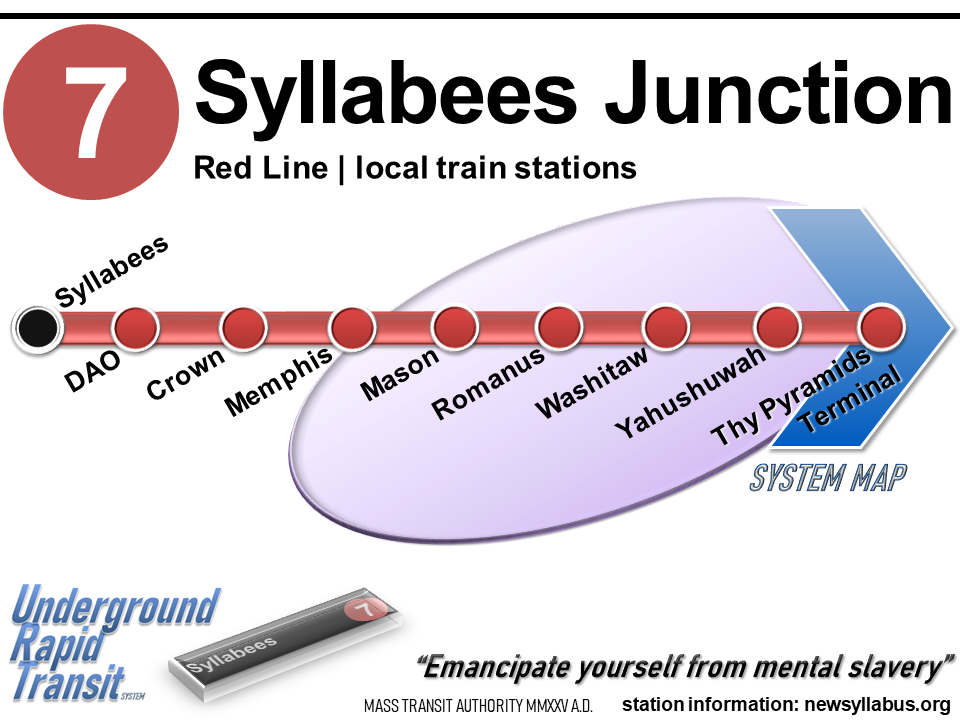
- syllabees station is a main junction of the system, where several lines converge, hence it is the decentralized office of interfaith MTS … the lines which converge at the junction are:
- Red (7) Line: Enter Ye at Syllabees Junction • DAO Station • Crown Station • Memphis Station • Mason Station • Romanus Station • Washitaw Station • Yahushuwah Station • Thy Pyramids Terminal;
- Red (K) Line: Enter Ye at Empire Boulevard Junction • University Station • Coffeehouse Station • Library Station • Deli Station • Bedford-Nostrand Avenues Station• Coney Island Station • College of Ancient Mystery Station • Kingdom Station; which is followed to the east by Syllabees Junction.
- the light and heavy rails are located in subterranean, sublinear tunnels in spacetime, where the prefix “sub” denotes a real-valued function in vector space with only some of the properties of a “normal” function scaling positively from an origin point of 0.
- the stock which is rolling though the tunnels of the system may experience tunnel vision and not see the stock rolling on parallel tracks in the same or opposite directions, as walls may separate rail lines, and may yield to colonnades through which the riders may see the other cars through their window and may interface even when in motion. and there are yet deeper subbasements through which perpendicular and diagonal tunnels run though the subterranean system.
- the Mass Transit Authority is religious in nature, and in that nature it is interfaith and nondenominational … “Mass” refers to “a large body of matter” and “a large number of people” … By extension, it alludes to the Latin dismissal, “ite, missa est,” meaning “go forth, it has been sent,” meaning “go forth [peaching the gospel that] it [the victim] has been sent [for our salvation],” this being the great commissioning of the church … “Transit” refers to “the conveyance of people or material from one place to another” or “the act of passing through or across a place” … Now therefore, like our great commission has usurped the authority of the YR and SR of FM and the FRB system, we have hereby usurped the “sacrament” of the mass from the RCC, and reformed it to eliminate the idols of bread and wine … not only should we not consume the body of our lord in the form of bread, but it is immaterial to salvation and a form of idolatry which is an abomination … furthermore, it is his blood — not any other beverage — which was shed for our salvation … furthermore, it is not the bread which constitutes the mass, but the people. hence, the mass is the form of worship in which the people assemble in the body of Christ, which is the Church, and move the body according to their desire … these usurpations are of capital import, to wit, the FM is reformed to raise a man from water into a life in Christ; the FRB is reformed to accept for value the blood of Christ in payment of all debts; and the RCC is reformed to abolish the eucharist, which is sacrilegious pagan witchcraft.
- the rider of a train car of rolling stock is a mindsoftware-operating system-cell.
- a conductor of rolling stock must locate a junction, or gateway, embedded in the mind of the rider, through which to enter and/or access their mind software … the gate must not be unduly guarded by “engrams” or there will be resistance … to access these gates directly, bypass existing system outposts [i.e., artificial intelligence servers, computer notes, cell phones, http addresses, etc.] … the conductor who enters an unmanned station in the mindsoft of the rider may impanel a station attendant to duly guard the newfound station, yielding safety and security to the system.
- dialektick.tekhne.exe:\>command_function(query-statement),(return-statement).
- a semester is any period in which the complete calendar is performed.
Station Warrant (Charging Documents):
Note: our system is a permutation of the system here.
Syllabus.
for a COURSE PRODUCTION by
CVRIA AVTONOMOVS ANTARVS DEI GRATIA AD SACELLVM SANCTISSIMI SALVATORIS YAHWSHWAH HAMASHIACH AC SANCTI NAT TURNER—KAHAL KADOSH BETH SYLLABYIM
(a) COURSE TITLE — Gestalt-Systemtheorie for the Political Reeducation of the Proletariat, or Circular No. 7
(c) COURSE OBJECTIVE — [connect knowledge and skills across content, identify levels of mastery to be achieved] —
- MAIN FUNCTION: to conduct a train of people’s Mindsoft through tunnels of the unconsciousness into peace and freedom.
(b) COURSE DESCRIPTION (or, ABSTRACT) — [purpose, scope, pedagogy, expectations] — We are all but students in our life course, here in our University, and our performance is contingent upon the clarity of our syllabus. the syllabus defines the methodology for our living and the course of our systemic understanding […] human methodologies: human and nonhuman systems, interactions thereof; understanding of physical elemental composition [of nature], universal compositions, and the metaphysical relationships between them; nonphysical influences as manifest in or beyond the physic; spiritual realities and their impact on the physic; development of methods to be used as an ubiquitous and lasting guide (or, syllabus) unto the information of human living in systems. [July 14, 2015 – 10:38 pm]
(d) COURSE TEXTS (or, RESOURCES) —
- Circl. No. 7 (7)—
- Liber Præceptum (LP)—
- Policy Bureau Field Manual 1 (FM)—
(e) COURSE ASSIGNMENTS (or, DELIVERABLES) — workshop, colloquium, symposium, performance.
(f) COURSE ASSESSMENTS —
- performance of clinical practice of dialectic systemtheory — see protocol.
- interrogatories for examination — see LP.
- dialectic method of clinical trial for the treatment of colored person stress/sex/syndrome disorder (CPSD) [talk therapy for people living under color of law] — see calendar.
(g) COURSE CALENDAR — [identify course duration, frequency, content standards/milestones, assignment due dates, assessment dates] — CALENDAR NO.
- Interrogatory Examination: Baseline Test from Blade Runner 2049
- Reading: “The Library of Babel” a short short by J.L. Borges
- Table Reading: “Rustles in Dry Leaves” (LP:\>#100\\12\4\2021\Page\308)
- Section: Information Processing Systemtheory
- Reading: Historical and Dialectical Materialism
- Section: Memphite Theology
- Reading: “Rustles in Dry Leaves” (LP:\>#1\\5\28\2015\Page\4)
- Long Read Options for Book Report: “300,000,000” a novel by Blake Butler; “The Tunnel” a novel by William H. Gass; “Giles Goat-Boy or the Revised New Syllabus of George Giles our Grand Tutor” a novel by John Barth
- Mid-Term: Interrogatories for Base-Line Examination (LP:\>#47\Page\154)
- Reading: “Tlon Uqbar Orbis Tertius” a short story by J.L. Borges
- Section: Colored Person Syndrome/Stress/Sex Disorder (CPSD) (Omnibus Act\Title\6)
- Reading: “The Babylon Lottery” by J.L. Borges
- Section: Good and Lawful Conduct (GPA\Page\10)
- Interrogatory Examination: “Great Policy of Assurance”
- Clinical Trial: treatment of Colored Person Syndrome Disorder (Omnibus Act\Title\6)
- Final Performance: staging of “Rustles in Dry Leaves” (LP:\>C\\11\20\2017\Page\352)
- Extra Credit: Advanced Computer Systemtheory (syllabus_runtime Art. 6)
<notes on the system, from the novel 300,000,000 by blake butler, systems analyst, compiled by antarah, May 22, 2015\>
In our year here god is not a being but a system, composed in dehydrated fugue.
In the full darkness, there is a word.
The word encompasses the darkness.
This word occurs because of god.
I crawled and crawled along the floor of the ground of the extending darkness.
Out of the color of the night, there appeared buildings in the distance, houses, tombs.
There were networks of understanding and direction.
Wires draped the air like no one’s trees.
The world was silent when I woke in smoke.
No longer unwinding into nothing as its layers grew apart.
I see the sea replicating in its nothing, pushing sand against the sand.
I cannot reach the sea.
The days went on and on inside me.
I knew my name was or had been but could not say it and it no longer felt like language.
The name is not important.
Your name’s not really your name.
There are people, and there are minds, and in the minds there are corridors and glue and other people.
There are unique locations on the earth, accessible only through certain openings available only for short periods of time while they are available and can be opened into other locations.
This is the system of the world.
The temporary doors to the unique locations are carried in our bodies, in thoughts.
They are carried in moments and forms and quickly disappearing spaces.
I am speaking to you from one of those locations.
There is a force who moves among our bodies, coming through your holes into the world and slowly knitting.
It will be the ending of us all, in a form beyond simply a body.
This is not a bad thing.
You are surrounded by mirrors.
You make the world out of your mind.
You are not dead and you will never be and you are dead and you are not alive and you’re alive and you will never be.
<\>
In 2049, the LAPD tests K’s “baseline” whenever he returns from a kill. He is forced to recite a series of lines from Nabokov’s novel Pale Fire, interspersed with questions designed to elicit an emotional response, during which time a machine analyzes his “levels” —that is, his ability to quash his feelings, to remain emotionally detached from his own actions. The lines, which recall the sensation of suffering a heart attack, at the nexus of life and death, are taken from a poem written within the novel:
And blood-black nothingness began to spin
A system of cells interlinked within
Cells interlinked within cells interlinked
Within one stem. And dreadfully distinct,
Against the dark, a tall white fountain played.
These “cells interlinked” are the hinge point of the natural and the artificial in Pale Fire, Nabokov’s play on the many meanings of “cell” —a biological unit, a prison enclosure, a still film image, a clandestine political group. What K is meant to suppress in reciting them is his ability to be moved by beauty, to be reminded that his own life might be interlinked with anyone else’s. As a blade runner, as a replicant, and as a man, K’s livelihood depends, even thrives upon, his disaffection.
Full text of the Baseline Test from Blade Runner 2049:
(last modified 25.03.24.00.53)
[bulla] Terms of Use
IMPORTANT – READ CAREFULLY BEFORE DOWNLOADING, ACCESSING OR USING THIS WEBSITE OR ANY PRODUCT SUPPLIED DIRECTLY OR INDIRECTLY BY ANTARAH CRAWLEY OR NOVUS SYLLABUS L.L.C. (“NEW SYLLABUS”) (JOINTLY AND SEVERALLY THE “AUTHOR”).
BY ACCESSING OR USING OUR PRODUCT AND OUR SERVICES, YOU (THE “USER”) HEREBY AGREE TO BE BOUND BY THE FOLLOWING LIMITED USE LICENSE (“AGREEMENT”) AND ALL TERMS INCORPORATED HEREIN BY REFERENCE. IF YOU DO NOT AGREE TO ABIDE BY THIS AGREEMENT, CEASE AND DESIST FROM (OR DO NOT ACCESS) THIS DOCUMENT, FILE(S), PASSWORD, AND ALL RELATED SERVICES (THE “PRODUCT”). This product and its use are protected by Intellectual Property Rights owned or controlled by the Author. Access to the product conveys to User only a limited, non-transferable license to use the product solely for internal research purposes conducted by User. This license specifically excludes any Non-Licensed Use. User acknowledges that the Author is not obliged to transfer any additional know-how or technology to User or to provide User with any consulting services to implement or use the product. The User may transfer (but not resell) the product and/or information or materials made through the User’s access to the product to another only if such transfer is genuinely required for User to use the product for internal research use, and such transfer is not for any Non-Licensed Use, and provided that such recipient agrees in writing (a) not to transfer the product or any such materials to any third party, and (b) to use such transferred information and materials solely for the internal research purposes of User and not for any Non-Licensed Use. Except as expressly permitted, the User must not sell or otherwise transfer: (a) the product, (b) its components and/or derivatives, or (c) materials made using or incorporating the product, to a third party. For information on purchasing a license to the product for purposes other than internal research use, contact the Author at director@newsyllabus.org. The Author is entitled to terminate this Limited Use License with immediate effect if the User breaches any of its terms, in which event User must immediately destroy the product(s) subject to such breach and all information or materials made through the User’s use of such product(s). The following disclaimer of warranties and indemnification from User will survive any termination of this Limited Use License. UNLESS EXPRESSLY SET FORTH IN A SEPARATE AGREEMENT BETWEEN THE AUTHOR AND USER FOR THE SALE AND PURCHASE AND USE OF THE PRODUCT, THE AUTHOR MAKES NO WARRANTIES OF ANY KIND WITH THE PRODUCT AND ANY INTELLECTUAL PROPERTY RIGHTS, ALL OF WHICH ARE PROVIDED AND LICENSED “AS IS”, “WITH ALL FAULTS”, AND WITH NO WARRANTY EITHER EXPRESS OR IMPLIED, AND SPECIFICALLY WITHOUT ANY WARRANTY OF MERCHANTABILITY, ACCURACY, SUFFICIENCY, NON-INFRINGEMENT, OR FITNESS FOR A PARTICULAR PURPOSE. THE AUTHOR ASSUMES NO RESPONSIBILITY WHATSOEVER (WHETHER IN CONTRACT, NEGLIGENCE, STRICT LIABILITY IN TORT OR OTHERWISE) WITH RESPECT TO THE USE BY THE USER OF THE PRODUCT OR ANY INTELLECTUAL PROPERTY RIGHTS OF THE AUTHOR OR ANY THIRD PARTY. UNLESS EXPRESSLY SET FORTH IN A SEPARATE AGREEMENT BETWEEN THE AUTHOR AND USER FOR THE SALE AND PURCHASE OF THE PRODUCT, USER SHALL INDEMNIFY AND HOLD THE AUTHOR HARMLESS FROM AND AGAINST ANY AND ALL CLAIMS, DAMAGES, COSTS, EXPENSES AND OTHER LIABILITIES WITH RESPECT TO THE PRODUCT AND THE USE THEREOF BY USER. In this Limited Use License: “Intellectual Property Rights” means and includes patent rights, copyrights, trademark and service mark rights, trade secret rights and rights in know-how and proprietary information, and other proprietary rights and intellectual property rights of any kind or nature anywhere in the world. “Non-Licensed Use” means: (a) use of the product in manufacturing; (b) inclusion of the product as part of another product; (c) use of the product in connection with the provision of any service for compensation, including research services for third parties; (d) use of the product for any unauthorized commercial purpose; (e) use of the product in writing, scrip, or software of any kind, or for consumption by or use in connection with or administration or application to any commercial purpose; (f) resale, lease, license, or distribution of the product, or any components or derivatives thereof, whether or not for research use; (g) any modification of the product, and (h) any other use of the product other than internal research use.