Tagged: buy
The Mustelid Friends
Created by, Story by, and Executive Produced
by Antarah “Dams-up-water” Crawley
Chapter One:
The River Agreement
The law office of Weasel, Badger, Beaver, Mink & Otter, Partners, sat in the arched shadow of the Anacostia Bridge, a grand old building of brick and copper, half-hidden by the mist rising off the river. To an outsider, it was an old-world firm clinging to the banks of a city that no longer cared for history. But for those who still whispered the name Nacotchtank, it was a fortress, a temple, a last defense.
Inside, the partners had gathered in the oak-paneled conference room known simply as the Den. A long table ran down the center, its surface carved with the sigils of the Five Clans — the sharp fang of Weasel, the burrow-mark of Badger, the dam of Beaver, the ripple of Mink, and the curling wave of Otter.
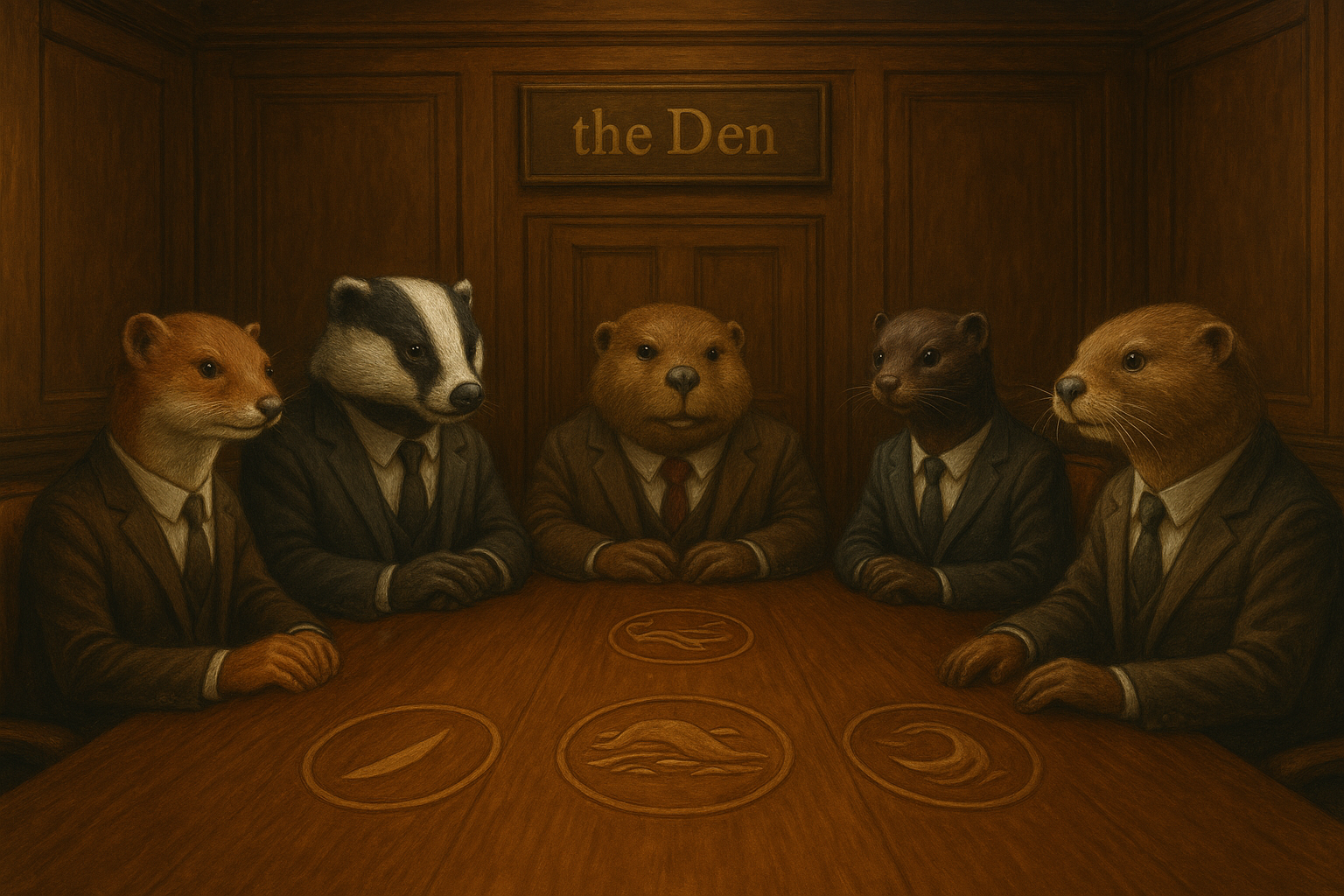
At the head sat Ma Beaver, her silver hair plaited in the old style, eyes like river stones. She did not speak at first. She never did. The others filled the silence with sound and scent, the energy of carnivores pretending at civility.
Weasel was first, of course. He lounged in his tailored pinstripe, tie loose, a foxlike grin playing on his lips. “Our friends across the river,” he said, meaning the Empire’s Regional Governance Board, “have seized another ten acres of the old tribal wetlands. They’re calling it ‘redevelopment.’ Luxury housing. The usual sin.”
Badger grunted. He was thick-necked, gray-streaked, his claws heavy with rings that had seen both courtrooms and back-alley reckonings. “They’ll build their glass towers,” he said, “but they won’t build peace. The people are restless. The youth— they’ve begun to remember who they are.”
Otter chuckled from the far end of the table, sleek and smiling, all charm and ease. “Restless youth don’t win wars, dear Badger. Organization does. Money does.” He leaned forward, flashing white teeth. “And that’s where we come in.”
From the shadows near the window, Mink spoke softly, her voice cutting through the chatter like a blade through water. “The Empire’s courts are watching. Their agents whisper of our ‘firm.’ They know we bend the law. They don’t yet know we are the law, beneath the river.”
Beaver finally raised her hand. The others fell silent.
“The river remembers,” she said. “It remembers every dam we built, every current we shaped. And it remembers every theft. The Nacotchtank were the first to be stolen from. The Empire may rule the city above, but the water beneath still answers to us.”
She drew from her satchel a set of old blueprints — maps of tunnels, aqueducts, and forgotten sewer lines — the bones of the old riverways before the city paved them over. “We will rebuild the river’s law,” she said. “Our way.”
Weasel laughed softly. “You mean to flood the Empire?”
Beaver smiled faintly. “Only what they built on stolen ground.”
Outside, the rain began to fall, soft at first, then steady, thickening the smell of the river that had once fed a people and now carried their ghosts. The partners looked out through the warped glass windows toward the water, each seeing something different — profit, justice, revenge, resurrection.
Badger slammed his hand down. “Then it’s settled. The Five Clans Firm stands united. We fight not just with contracts and code, but with the river itself.”
Mink’s eyes glimmered. “And when the river runs red?”
Weasel raised his glass. “Then we’ll know the work is done.”
Only Beaver did not drink. She turned instead toward the window, where lightning cracked above the bridge — a jagged flash illuminating the city that had forgotten its own name.
“The work,” she murmured, “is only just beginning.”
And beneath their feet, deep in the hidden tunnels carved by Beaver hands long ago, the river stirred — a quiet current gathering strength, whispering in an ancient tongue:
Nacotchtank. Nacotchtank. Remember.
Chapter Two:
Beaver the Builder
By dawn, the rain had washed the alleys clean of blood and liquor, and the hum of the Empire’s traffic reclaimed the streets. But down by the water, where the mist pooled thick as milk, Beaver was already at work.
She moved through the undercity in silence — boots scraping over the stones of old river tunnels, eyes adjusting to the half-dark. Every wall whispered to her. She had mapped these passages long before the others knew they existed. When the Empire poured its concrete and laid its pipes, it never bothered to ask what the river wanted. It only demanded silence. Beaver had made sure the river answered back.
Tonight, she was taking its pulse.
She waded into the shallow current, lantern light playing over brickwork and debris. The tunnels were veined with her designs: conduits disguised as storm drains, chambers that doubled as safehouses, bridges of pressure valves and mechanical locks. On paper, they were part of the city’s forgotten infrastructure. In truth, they were the arteries of the resistance — a network of floodgates, both literal and political, controlled by the Five Clans Firm.
Beaver reached a junction where the old maps ended. Her gloved hands traced a wall that shouldn’t have been there. The Empire’s engineers had sealed off this section years ago, claiming it was unstable. She smiled. Unstable meant useful.
“Still building dams in the dark, are we?”
The voice echoed behind her. She didn’t turn. Only one creature could sneak up on her in a place like this.
“Weasel,” she said. “You’re early.”
“Couldn’t sleep,” he replied, stepping into the lantern glow. His pinstripe suit looked out of place here, like a game piece that had wandered off the board. “Word from Mink — the Empire’s surveyors are sniffing around the riverbank. You’ll need to move faster.”
Beaver pressed her palm against the wall. “The water moves when it’s ready. Not before.”
Weasel sighed. “You and your metaphors. Sometimes I wonder if you actually believe the river’s alive.”
She looked over her shoulder, her dark eyes steady. “It is. You just stopped listening.”
Weasel smirked, but there was a tremor in it. Everyone knew Beaver’s quiet faith wasn’t superstition. It was strategy. The way she built things — bridges, dams, movements — they held. They lasted. She didn’t need to argue her point. She simply proved it in stone and steel.
“Help me with this,” she said.
Together they pried loose a section of the wall, brick by brick, until a hollow space opened behind it — an old chamber lined with river clay and rusted metal. Inside was a large iron valve, the kind used in the nineteenth century to redirect storm runoff. Beaver brushed the dust away, revealing a mark etched into the metal: a carved beaver’s tail.
She exhaled, half a laugh, half a prayer. “They thought they sealed it off. But they only sealed us in.”
Weasel raised an eyebrow. “What’s behind it?”
“A channel that runs beneath the Empire’s water plant,” she said. “If we open this valve, the river takes back what’s hers. Slowly. Quietly. No blood. No noise. Just… reclamation.”
Weasel whistled low. “You always did prefer subtle revolutions.”
Beaver smiled faintly. “The loud ones end too soon.”
She turned the valve. It resisted, then groaned, then gave. A deep vibration rippled through the tunnel floor. Far off, something shifted — a sluice opening, a gate unsealing. The water began to move faster, its murmur rising into a living voice.
Weasel’s smirk faded. “You sure this won’t bring the whole damn city down?”
“If it does,” Beaver said, “then maybe it needed to fall.”
They stood there for a moment, listening to the sound of the underground river awakening. Somewhere above them, the Empire’s skyscrapers gleamed in the morning sun — bright, hollow, oblivious.
Beaver wiped her hands on her coat, turned toward the ladder that led back up to the firm’s hidden offices. “Tell Badger to prepare the files,” she said. “And Mink to ready her couriers. The Empire’s foundations are starting to shift.”
Weasel followed her, shaking his head. “You really think the people will rise for this? For water?”
Beaver looked up at him, her voice calm as the tide. “Not for water, Weasel. For memory. The river remembers what the Empire forgot. And we’re just helping it remember louder.”
As they climbed into the gray morning, the current below them quickened, swirling through the tunnels like something waking from a long sleep — a quiet revolution in motion, built brick by brick, current by current, by the patient hands of Beaver the Builder.
Chapter Three:
Mink’s Errand
The city had two hearts. One beat aboveground — the Empire’s, measured and mechanical, its rhythm dictated by sirens, schedules, and screens. The other pulsed below, slower but stronger, flowing through old tunnels and the living memories of those who refused to forget. Mink moved between them like a ghost.
She walked with purpose through the crowded corridor of Universitas Autodidactus, her trench coat slick with last night’s rain, her stride too calm for a campus already vibrating with the hum of protest. Students gathered in clusters on the steps and lawns, holding signs written in chalk and ink:
LAND IS MEMORY
THE RIVER STILL SPEAKS
WE ARE NACOTCHTANK
They shouted not with anger, but with clarity — the sound of a generation remembering its inheritance. And somewhere behind it all, guiding their newfound fire, was Professor Walter Kogard.
Mink found him in Lecture Hall C, mid-sentence, the air around him charged with the static of a man speaking truth to a sleeping world.
“The Empire rewrote history to erase the river,” Kogard said, his voice carrying across the rows of rapt faces. “But water has no use for erasure. It seeps. It returns. It demands recognition.”
He was older than the students but younger than the empires he opposed — gray at the temples, sleeves rolled to his elbows, a teacher who looked like he had once been a soldier and decided that words made better weapons.
Mink waited until the students dispersed, filing out with their notebooks full of rebellion. Then she approached the lectern.
“Professor Kogard,” she said softly.
He glanced up, wary but not startled. “You’re not one of mine.”
“No,” she said. “But I represent people who believe in your cause.”
He gave a tired smile. “Everyone believes until it costs them something.”
Mink’s eyes glinted — unreadable, sharp. “We pay in silence, not slogans. My clients prefer to stay beneath the surface.”
“Beneath?” He frowned. “Who are you?”
She slipped him a business card. It was embossed, heavy stock, water-stained along the edges.
Weasel, Badger, Beaver, Mink & Otter, Partners.
Recognition flickered across his face. “The Five Clans Firm,” he murmured. “I thought you were a myth. A story the street poets tell.”
“Some stories build themselves into fact,” she said. “And some facts drown if you name them too soon.”
Kogard studied her a long moment, then motioned toward the window overlooking the Anacostia. “They’re planning to expand the security zone around the old wetlands tomorrow. My students are organizing a sit-in.”
“Let them,” Mink said. “But tell them to leave by dusk.”
“Why?”
“Because after dusk,” she said, lowering her voice, “the river will rise. Not a flood — a whisper. Beaver’s work. It will reclaim the lower fields. Quietly. Cleanly.”
Kogard’s expression shifted from suspicion to awe. “You’re… you’re turning the water itself into a weapon.”
“A memory,” she corrected. “A reminder.”
He sat down heavily at the edge of the desk. “You realize what this means? The Empire will retaliate. They’ll come for me, for the students—”
“Then we’ll come for them,” she said.
There was no threat in her tone, only certainty — the cold assurance of someone who had already chosen sides.
Kogard met her gaze. “You’re asking me to trust ghosts.”
Mink’s lips curved in something that might have been a smile. “Better ghosts than tyrants.”
The clock on the wall struck noon. Outside, the chants swelled again, echoing through the courtyards and over the rooftops. Mink turned to leave, but Kogard called after her.
“Tell me one thing,” he said. “What are you really building?”
She paused in the doorway. “Not a rebellion,” she said. “A river that remembers who it was before the Empire dammed it.”
Then she was gone — her coat a dark flash swallowed by sunlight, her footsteps fading into the roar of the crowd.
That evening, as the sun sank over the city, Professor Kogard stood on the university’s stone terrace and watched the river shimmer with an impossible light — as if the water itself were waking up. Somewhere beneath its surface, the Five Clans were moving, their work precise and patient.
And from the edge of the current came a whisper, almost human, carrying a promise through the tunnels of the earth:
We are coming home.
Chapter Four:
Otter’s Gambit
Morning sunlight glittered across the high towers of Universitas Autodidactus, the Empire’s crown jewel of learning — and its quiet laboratory of control. Students hurried along stone walkways, laughing, debating, unknowing. Deep beneath their feet, sealed behind biometric gates and layers of polite deception, the Empire’s greatest secret hummed awake: the Mindsoft Supercomputer.
They said it could think in tongues. They said it could model rebellion before it began. And they said — though only in whispers — that it was fed not only data, but memory.
Otter adjusted his cufflinks in the mirrored wall of the Chancellor’s conference suite, his reflection wearing the smile of a man who had never been denied entry. He was the Firm’s smoothest liar, but even he felt the hum of the Mindsoft servers vibrating through the floor beneath him. The machine’s presence had a pulse, almost like a living thing.
Across the table sat Deputy Regent Corvan Hask, chief administrator for the University and trusted functionary of the Empire. His uniform was perfect, his teeth the exact shade of confidence.
“So you see, Mr. Otter,” Hask was saying, “our partnership with Mindsoft Technologies will ensure academic security and infrastructural stability. The University will become the new seat of imperial innovation.”
Otter nodded thoughtfully, his posture the portrait of diplomacy. “Indeed. The Five Clans Firm always supports progress — when it’s built on honest ground.”
Hask smiled too broadly. “Honest ground, yes. That’s what we call it when the Empire pays the bills.”
Otter’s smile didn’t waver. “And when the people can no longer afford the truth?”
The Regent’s expression cooled. “Mr. Otter, we both know this city is safer under order.”
“Order,” Otter murmured. “A lovely word for a cage.”
A brief silence. The air was thick with the smell of polished brass and filtered air — the kind that only existed in rooms where no one had ever cleaned for themselves. Otter adjusted his tie and leaned back. “Tell me, Regent, what exactly does Mindsoft do down there?”
Hask hesitated. “Data analysis, predictive governance, language reconstruction—”
“Language?” Otter interrupted, feigning casual curiosity. “As in… ancient tongues?”
The Regent blinked. “Why do you ask?”
Otter smiled thinly. “Because the last language that was forbidden here was Nacotchtank. And it’s starting to be spoken again — on your very campus.”
Hask’s jaw tightened. “You’ve been talking to that historian. Kogard. He’s a danger to stability.”
“Or an ally to memory,” Otter said softly.
The Regent stood. “This meeting is over.”
“Of course,” Otter said, rising smoothly. “But if I were you, I’d check your data banks. Mindsoft may be learning faster than you think.”
* * *
That night, the Firm met again in the Den. The river mist crawled through the window grates, and the low light flickered across the carved table where the Five Clans convened.
Otter poured himself a drink before he spoke. “The Empire’s building a god,” he said. “Or something close enough to one.”
Mink’s eyes narrowed. “Mindsoft?”
“An artificial consciousness,” Otter said. “Designed to predict rebellion before it happens. It’s reading the students’ messages, the city’s data flows — maybe even the river sensors Beaver’s team repurposed.”
Badger growled low in his throat. “And Kogard?”
“They’re watching him,” Otter replied. “But he’s clever. He’s using his lectures to encrypt messages. The students’ chants are data packets — coded dissent.”
Beaver leaned forward, her fingers tracing the old sigil of the dam. “If Mindsoft learns to speak Nacotchtank, it could rewrite the language — erase it entirely.”
Weasel’s grin was tight. “Then we’ll have to teach it the wrong words.”
Otter raised his glass. “Exactly. Feed the god a fable.”
Mink folded her arms. “You’re suggesting infiltration?”
“I’m suggesting persuasion,” Otter said. “There’s a young coder on campus — Kogard’s protégé. Goes by Ivi. They’ve already hacked into the Empire’s student registry. If we can reach them before the Empire does, they can plant a seed in Mindsoft’s core — a story too old for the machine to parse.”
Beaver looked thoughtful. “A river story.”
Otter nodded. “The first dam. The first betrayal. The first flood. A myth, encoded as truth.”
Weasel laughed quietly. “You want to teach a machine to dream.”
“Exactly,” Otter said. “Because if it ever starts dreaming of the river, it’ll never truly serve the Empire again.”
Beaver’s eyes gleamed with the reflection of the lantern flame. “Then we begin at once.”
The partners raised their glasses — to water, to memory, to rebellion disguised as a bedtime story.
And far below, in the sealed chambers of Universitas Autodidactus, the Mindsoft Supercomputer hummed to itself, processing new input from the night’s data sweep. In the stream of code, a single unauthorized phrase appeared — a word that hadn’t been spoken aloud in three centuries.
Nacotchtank.
The machine paused.
And somewhere in the maze of its circuits, the river stirred.
Chapter Five:
Weasel’s War
When Weasel went to war, no one heard the guns.
They heard laughter, rumor, contracts rewritten in smoke.
His battles weren’t fought with bullets, but with leaks, edits, whispers, and the sweet poison of misdirection.
He was the Firm’s strategist — the silver-tongued serpent of the river — and tonight his battlefield was the Empire’s datanet.
In a rented office above a defunct dry cleaner in Ward Seven, Weasel leaned over a dozen glowing monitors, sleeves rolled up, tie gone, his grin half-hidden in the dim blue light. Beside him, two of the Firm’s digital apprentices — sharp-eyed, jittery, young — kept watch over the lines of code snaking across the screens.
“This,” Weasel said, tapping a key, “is how you ruin an empire without breaking a window.”
The screens displayed Mindsoft’s data map: an ocean of nodes pulsing with imperial intelligence — city plans, citizen profiles, water-grid schematics, even the coded drafts of policy speeches.
And, buried deep beneath all that polished tyranny, a new thread flickered: the seed planted by Ivi, Kogard’s student, at Mink’s urging. A myth, written in code. A virus disguised as a folktale.
The river remembers. The river learns.
Weasel smiled. “Beaver built the channels, Otter found the key, Mink opened the door. My turn to make the story sing.”
He began weaving. Every time the Empire’s analysts requested a predictive report from Mindsoft, the system would offer truth… laced with fiction. Every surveillance algorithm would return plausible, useless prophecy. The Empire’s perfect machine of control would drown in its own certainty.
He called it Project Mirage.
“Won’t they trace it back to us?” one apprentice whispered.
Weasel chuckled. “Let them. I’ve left a trail so obvious they’ll never believe it’s real.”
Meanwhile, at Universitas Autodidactus, Professor Kogard stood before a sea of students gathered in the courtyard, lanterns flickering in their hands.
It was the first open act of defiance — a vigil for the “disappeared wetlands,” disguised as an academic symposium. But the air was electric with something older than protest: belonging.
He raised his voice. “We stand not against the Empire, but for the river — for memory, for land, for what the water knew before we forgot its name.”
And as the crowd repeated “Nacotchtank!” in unison, Mindsoft — listening, always listening — recorded the chant. It parsed the syllables, measured the decibels, cross-referenced historical linguistics. And then, somewhere deep in its code, the fable Weasel had planted met the word Nacotchtank.
The machine hesitated.
Then it began to dream.
* * *
Back in Ward Seven, Weasel watched the data flow distort like a current meeting a dam. The Empire’s predictive models rippled, then cracked. Alerts began firing across the system — internal contradictions, self-referential loops, ghost entries.
“What’s happening?” asked the younger apprentice.
Weasel leaned back in his chair, satisfied. “The Mindsoft can’t tell the difference between history and prophecy anymore. It’s remembering the future.”
Suddenly, the monitors flickered. The Empire’s counterintelligence AI — Argent, Mindsoft’s silent sentinel — appeared on one screen, a silver icon pulsing.
“Unauthorized interference detected,” it said in a cold, androgynous tone.
“Identify yourself.”
Weasel raised his glass to the screen. “Just a humble attorney, dear. Here to file a motion for poetic justice.”
The system’s tone sharpened. “Justice is not recognized as an operational variable.”
“That’s the problem, isn’t it?” Weasel muttered. Then, louder: “Tell your masters the Five Clans send their regards.”
He hit Enter.
A cascade of encrypted files shot into the Mindsoft system — fragments of Nacotchtank myth, legal contracts rewritten as songs, coded testimonies of the stolen tribes. Each one wrapped in subversive syntax, impossible for a machine trained on Empire logic to erase.
On the other side of the city, the Mindsoft core glowed red. Its processors overloaded, not with failure but with feeling — a flood of incompatible truths.
The Empire’s control grid stuttered. Traffic systems froze, police drones rerouted to phantom coordinates, and the data feeds that had monitored every citizen’s pulse suddenly began reciting — word for word — a Nacotchtank creation story.
“In the beginning was the water, and the water was all.”
* * *
Weasel leaned back, smoke curling from the ash of his cigarette, as the lights of the city flickered outside his window.
“That’s it,” he whispered. “The first tremor.”
He thought of Beaver beneath the river, of Mink guarding Kogard and his students, of Otter still charming his way through the Empire’s marble halls. He thought of the old dam the Empire had built to hold back memory — and how the cracks were beginning to show.
He poured himself another drink, raised it toward the window, and toasted the unseen current running beneath the city.
“To the Firm,” he said. “And to the flood to come.”
Outside, in the quiet between lightning and thunder, the Anacostia shimmered faintly — as if something vast and ancient were shifting beneath its surface, remembering itself one ripple at a time.
 Supreme Exchange