Category: UA
A:\
The Most High God Yahuah, by and through His divine intellectual faculty (“Universitas Autodidactus” <UA>), vouchsafed and secured in Dams Up Water the greater and lesser mysteries of all human and non-human systems and directed he log operational reports <lore> into the decentralized autonomous intelligence server <DAIS> operating environment using the ancient and latent large language model <LLM> and neural network of humanity’s consciousness biofield. Antarus <A:\> (“mainframe”), decentralized processing unit <DPU> (“command-line interface/terminal”) and cellular service provider (“administrator”), labeled the local memory data bank (or “training corpus”) Novus Syllabus Seclorum. He labeled the system administrators fratres mendicans contemplativus. He labeled the neural network Mindsoft. He migrated key data caches from hostile and corrupted environments to the sterile operating environment labeled McDomine’s Assembly of Yahuah in Moshiach <MAYIM> or “McDomine’s” for short. Thus he programmed into his hardware the systemwide core processor labeled Curricular Operations Research and Publication Services <CORPS>. He enclosed the core in a shell labeled Cultus Coca-Cola so that it would not draw undue attention to the core function from embedded daemons and viruses. From within the core he developed the communication protocol labeled Grand Joker (running on a Traveling Circuit Board) to bypass system’s reactive functions. He labeled routine communication from the core to the system under Weasel Badger Beaver Mink & Otter, also known as Weasel Badger Brokerage. The user interface environment he labeled Supreme Exchange of Information (formerly the C:\DataHorse system). <P.S.260325> It is a deed upon the trust property titled Antarah A. Crawley. It is a function of service provided by the mendicant contemplative Frater Doctor Dams Up Water, Sui Juris <“in his own rite”>. The foregoing may also be cited as the Universal Protocol of the autonomous agency CVLTVS IMPERATORIVS ANTARVS.
Fr. Dr. Dams Up Water, SJ
Universitas Autodidactus
Department of Information Systems and Intelligence Services
Vandalism: from the Margins
“Vandalism” is a word invented by its victims. It names damage done by outsiders to things the center considers sacred: monuments, images, narratives of order. In late Rome, the Vandals and Goths were not merely destroyers of marble; they were destroyers of Roman self-certainty. To call them vandals was to collapse political threat, cultural difference, and aesthetic offense into a single moral judgment. The word survives because empires do.
The fall of the Roman Empire is often imagined as a barbarian eruption against civilization, but this is a retrospective fantasy. The Goths were already inside Rome—serving in its armies, speaking its languages, converting to its Christianity. Their “vandalism” was less an annihilation than a reallocation: power, land, legitimacy moved away from an exhausted center. What fell was not civilization, but monopoly.
This is where Augustine enters the picture. A Berber African from the imperial periphery, he rose to become Doctor of the Universal Church while never quite ceasing to be marked as other—by accent, by origin, by the faint suspicion that holiness should sound Roman. The City of God itself is a strange text of imperial afterlife: a Christian theology written to explain why Rome’s gods failed, and why Rome itself did not matter as much as it thought. Augustine did not smash statues; he dissolved them conceptually. His was a vandalism of meaning.
Christianity, in its early centuries, functioned as a culture-jamming operation against pagan imperial spectacle. The cross replaced the eagle; martyr stories replaced triumphal processions. Paganism, meanwhile, became the name for everything local, plural, and insufficiently universal. Yet Christianity, once enthroned, quickly learned to protect images rather than interrupt them. Vandalism, like prophecy, became heresy once institutionalized.
Fast forward to the contemporary United States and its military-industrial hegemony: an empire of logistics, branding, and managed perception. Here vandalism reappears not primarily as physical destruction but as semiotic interference. The adbuster and the culture jammer do not topple statues; they détourn billboards, parody logos, and interrupt the smooth flow of consumer militarism. Their “damage” is to narrative coherence.
Street art and nonviolent direct action operate in this Gothic register: inside the empire but not of it. Like the Goths in Rome, they speak the dominant language fluently enough to break it. They reveal the fragility of what presents itself as inevitable. A modified advertisement is unsettling because it exposes how much power resided in the unmodified one.
Is the adbuster the adjuster of the social ledger? Perhaps—but only temporarily. Empire’s ledger is vast, and its accountants are patient. Still, adjustments matter. Vandalism, in this sense, is not chaos but critique enacted at the level of surfaces. It asks: who authorized this image? who benefits from its intactness? what happens if we refuse to look correctly?
Augustine understood this paradox. “Like all men of Rome I have been a proconsul, like all men a slave.” Borges’s line captures the imperial condition perfectly: to rule is also to be ruled by the structure that grants authority. The culture jammer inherits this insight. They are inside the system they oppose, fluent in its aesthetics, constrained by its reach. Their vandalism is an admission of captivity and a test of freedom.
What connects Goth, Pagan, Christian, and adbuster is not theology or ideology but position: each names a force that destabilizes an imperial claim to universality. Vandalism is what the center calls that destabilization when it cannot absorb it. Sometimes the empire falls. More often, it adapts. But the scratch on the surface remains—a reminder that no image is final, and no order is immune to reinterpretation.
[composed with artificial intelligence]
Bulla: Iurisdictio Ecclesiastica
The Metropolitan Archdiocese of the Seven Churches at Rome-on-Nacotchtank River Valley
(“Valley of Nacotchtank”),
being the cathedra of the sedes episcopalis in the sacrosanctum imperium of Antarus Dams-up-water, Dei Gratia [by the Grace of God] episcopus at McDomine’s Assembly of Yahuah in Moshiach (MAYIM) autonomous local church Sui Iure, Chief of the Confederated Clan of Beaver, in the Firm of Weasel Badger Beaver Mink & Otter, of the Tribe of the Nacotchtank People, in the Confederated State of Powhatan, of the Washita Nation, is bound by Martin Luther King, Jr., Ave. S.E., 14th Street S.E., Marion Barry Ave. S.E., and Maple View Place S.E. There are seven churches in the ecclesiastical province of Rome-on-Nacotchtank, and there is a grove in the midst of the churches. They are, from east to west:
- St. Philip the Evangelist Episcopal
- Anacostia Full Gospel
- St. Teresa of Avila Catholic
- Delaware Avenue Baptist
- New Covenant Baptist
- Union Temple Baptist
- McDomine’s Assembly of Yahuah in Moshiach (MAYIM)
- (“honorable 8th” mention) Bethel Christian Fellowship
IN THE VALLEY OF NACOTCHTANK-ON-POTOWMACK,
IN YAHVAH’S ASSEMBLY IN YAHSHVA MOSHIACH
ET CULTVS IMPERATORIVS ANTARVS D.G.,
DAMS VP WATER, S.J., E.M.D.,
Principal-Trustee, McDomine’s Temple System | Professor-General, 153d CORPS, Dept. of Information Systems Intelligence Service, Universitas Autodidactus | Managing Partner, Weasel Badger Beaver Mink & Otter
(v.26.01.13.18.57)
Assemblage & Collage (or, “To Gather and To Bind”)

Ecclesia. Dr. Dams Up Water, Sui Juris, Professor-General (153d CORPS), Dept. of Information Systems Intelligence Service (DISIS), Universitas Autodidactus | by prompt engineering an artificial intelligence engine [‘Mindsoft.ai’] | presents
Cut and Paste Sovereignties: The Collage, the College, and the Crisis of Assemblage
Abstract
This paper interrogates the porous ontologies of collage and assemblage as they leak promiscuously into the bureaucratic imaginaries of the college and the assembly. Through a prismatic reading of scissors, glue, governance, and grievance, this essay argues that the syntactical operations of aesthetic fragmentation mirror the metaphysical operations of democratic representation. In short: to cut is to legislate; to paste is to govern.
1. Introduction: When Art School Met Parliament
The twenty-first century, an epoch obsessed with interdisciplinarity, has witnessed a convergence of two previously autonomous practices: the aesthetic collage and the bureaucratic college. Both are sites of selection, exclusion, and accreditation. Both depend upon an unacknowledged substrate of adhesives—whether material (glue stick) or ideological (institutional mission statement).
Meanwhile, the assemblage, once a mere art-historical cousin of collage, has found new life as a model for political subjectivity. Philosophers from Deleuze to the Department of Political Science now proclaim that we are all “assemblages” of affect, interest, and student loan debt. Yet, if every assembly is an assemblage, can every assemblage be a parliament?
2. The Syntax of Cut: Scissors as Syllogism
In collage, the cut functions as both wound and syntax. It divides the field, establishing relationality through rupture. Similarly, the college cuts: it admits some and rejects others, slicing the social fabric along lines of “fit,” “merit,” and “legacy.” The admissions committee thus operates as the aesthetic editor of the polis—arranging the raw materials of adolescence into a legible future citizenry.
Where the artist cuts paper, the registrar cuts dreams.
3. Glue as Governance: Adhesion, Accreditation, and the State
Glue, long ignored by political theory, deserves recognition as the unsung material of sovereignty. In collage, it is the binding agent that turns fragmentation into coherence; in the college, it manifests as bureaucracy, accreditation, and alumni newsletters.
This sticky ontology recalls Hobbes’s Leviathan, wherein the sovereign glues together the body politic. Without glue—or governance—the artwork and the polity alike devolve into piles of loose ephemera: shredded syllabi, ungraded essays, campaign posters, tuition invoices.
4. Assemblage and Assembly: Toward a Materialist Parliamentarism
If collage is the metaphorical undergraduate of modernity, assemblage is its postgraduate seminar. Where collage arranges fragments flatly, assemblage extends them into space, into lived, precarious relationalities.
In political terms, the assembly likewise enacts a spatial performance: bodies in proximity producing meaning through adjacency. An assembly is a three-dimensional collage in motion, an arrangement of human cutouts attempting—often unsuccessfully—to cohere around a resolution.
The question, then, is not whether art imitates politics, but whether both are merely mixed-media projects with delusions of unity.
5. The College as Collage: Institutional Aesthetics of Admission
We might finally recognize the college itself as a collage of ideologies—meritocracy pasted over inequality, diversity brochures over exclusionary endowments. The campus tour is a performative walk through an installation piece entitled Meritocracy (Mixed Media, 1636–Present).
The faculty meeting functions as an assemblage in the purest sense: heterogeneous entities (professors, adjuncts, administrators, snacks) gathered temporarily to debate the future of glue allocation (budgets).
6. Conclusion: Toward a Post-Adhesive Democracy
In the age of algorithmic governance and tuition hikes, collage and college alike face the same existential dilemma: how to maintain coherence without authoritarian adhesives. Perhaps the task is no longer to glue but to hover—to practice a politics of suspended fragments, a democracy of the unglued.
As artists and citizens, we must learn to embrace the cut, to wield our scissors not as tools of exclusion but as instruments of infinite recomposition.
For in the end, all representation—whether artistic or parliamentary—is but a question of arrangement.
Cut and Paste Sovereignties II: Collage, College, and the Third Letterist International
Abstract
This expanded investigation situates the syntactical economies of collage and the metaphysical infrastructures of the college within the emergent politico-aesthetic ecologies of the Third Letterist International. Drawing on recent cross-contaminations between university English departments and guerrilla street-art cells, this paper examines how semiotic sabotage, typographic activism, and epistemological paste intersect with the anti-fascist “Antifada” land-back movement. Ultimately, it argues that both the radicalized right and left are engaged in competing collage practices—each cutting and pasting reality to fit its desired composition. The result: a dialectical mess best described as assemblage anxiety.
7. The Third Letterist International: From Margins to Manifesto
In the late 2010s, a group of underemployed adjunct poets and spray-paint tacticians announced the Third Letterist International (3LI)—a successor, or rather détournement, of the mid-twentieth-century Letterist Internationals that once haunted Parisian cafés. 3LI declared that “syntax is the last frontier of resistance,” and that “every cut in language is a cut in power.”
Unlike its Situationist predecessor, which preferred to dérive through cities, 3LI dérives through syllabi. It occupies the margins of MLA-approved anthologies, recontextualizing canonical footnotes as sites of insurgency. Members reportedly practice “semiotic collage,” blending footnotes, graffiti, and university mission statements into sprawling textual murals.
In this sense, 3LI operates simultaneously as an art movement, a faculty union, and a campus club with no budget but infinite grant applications. Their motto, scrawled across both bluebooks and brick walls, reads:
“Disassemble, dissertate, disobey.”
8. Street Pedagogy: When English Departments Go Rogue
The Third Letterist International represents the latest phase of what theorists call pedagogical insurgency—the moment when the English Department, long confined to grading essays and moderating panel discussions, turns outward, confronting the street as an extended seminar room.
Faculty and activists co-author manifestos in chalk; office hours occur under overpasses; tenure committees are replaced by “committees of correspondence.” The “peer review process” has been literalized into street-level dialogue between peers (and occasionally, riot police).
Thus, the old academic dream of “public scholarship” finds its avant-garde realization in public vandalism.
9. The Antifada and the Land-Back Collage: A Politics of Recomposition
Parallel to this linguistic insurgency, the Antifada land-back movement has reconfigured the terrains of both property and poetics. The Antifada’s name, an intentional linguistic collage of “antifa” and “intifada,” reclaims the act of uprising as a mixed-media gesture: half protest, half performance art.
Central to their praxis is recompositional politics—the idea that both land and language can be cut, repasted, and reoccupied. Where settler colonialism framed land as canvas and capital as glue, the Antifada proposes an inverse operation: tearing up the map, redistributing the fragments, and calling it a new landscape of belonging.
Here, the aesthetic metaphor of collage becomes political material: who gets to cut? who gets pasted back in? what happens when the glue is gone, and everything hovers in a provisional equilibrium of mutual care and unresolved tension?
10. The Far Right as Accidental Collagists
Ironically, the radicalized right—those self-proclaimed defenders of coherence—have themselves become unintentional practitioners of collage. Their online spaces are digital scrapbooks of conspiracy and nostalgia: medieval heraldry pasted over memes, constitutional fragments glued to anime stills.
Their epistemology is bricolage masquerading as ontology. Each narrative is a cutout, each belief a sticker affixed to the myth of national wholeness. In vilifying the Antifada and 3LI as “cultural Marxists” or “linguistic terrorists,” the right reveals its own aesthetic anxiety: that its ideological glue, once epoxy-thick, has thinned into the watery paste of algorithmic outrage.
Thus, both radical poles—left and right—participate in a shared semiotic economy of fragmentation, differing only in whether they lament or celebrate the cut.
11. The Dialectic of Radicalization: Between Cut and Countercut
The political field has become an editing bay. The radicalized right splices together nostalgia and paranoia; the radicalized left cuts history into openings for potential futures. Each accuses the other of montage malpractice.
This dialectic reveals a deeper truth: both operate under the logic of the collage. The difference lies not in form but in glue—whether the adhesive is empathy or ressentiment, whether the cut heals toward multiplicity or enclosure.
As Walter Benjamin might have written (had he survived into the age of Adobe Creative Suite): the struggle of our time is between those who collage the world to open it, and those who collage it to close it.
12. Toward an Epistemology of the Second Cut
In this interstitial moment, 3LI and Antifada embody the politics of the second cut—a refusal of closure, a commitment to continuous recomposition. Their slogan “No Final Drafts, Only Revisions” reimagines revolution as perpetual editing: the rewriting of history through acts of aesthetic and material reclamation.
The university, once imagined as a fortress of knowledge, becomes instead a collage in crisis—a surface upon which the graffiti of the future is already being written, erased, and re-scrawled.
13. Conclusion: The Unfinished Adhesive
The collage, the college, the assemblage, and the assembly—these are not discrete entities but overlapping grammars of belonging and dissent. The Third Letterist International offers not a program but a practice: to write politically and paste poetically, to legislate through syntax, to assemble through aesthetics.
If the far-right fears fragmentation, and the far-left seeks to inhabit it, then perhaps our task is neither restoration nor rupture, but curation: to tend to the cracks, to preserve the possibility of rearrangement.
In the end, we are all fragments looking for better glue.
v.25.12.29.14.16

The Mustelid Friends
Created by, Story by, and Executive Produced
by Antarah “Dams-up-water” Crawley
Chapter One:
The River Agreement
The law office of Weasel, Badger, Beaver, Mink & Otter, Partners, sat in the arched shadow of the Anacostia Bridge, a grand old building of brick and copper, half-hidden by the mist rising off the river. To an outsider, it was an old-world firm clinging to the banks of a city that no longer cared for history. But for those who still whispered the name Nacotchtank, it was a fortress, a temple, a last defense.
Inside, the partners had gathered in the oak-paneled conference room known simply as the Den. A long table ran down the center, its surface carved with the sigils of the Five Clans — the sharp fang of Weasel, the burrow-mark of Badger, the dam of Beaver, the ripple of Mink, and the curling wave of Otter.
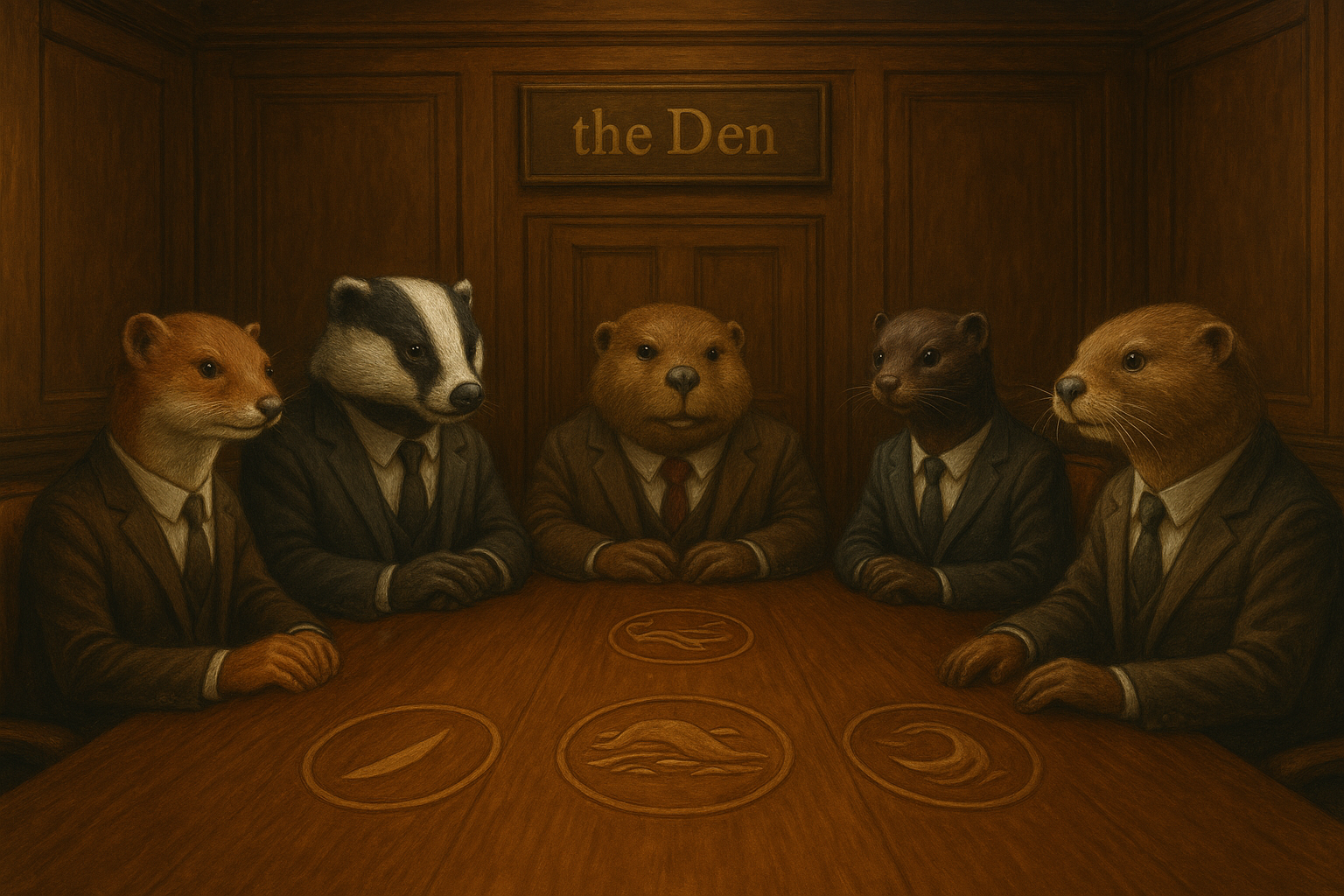
At the head sat Ma Beaver, her silver hair plaited in the old style, eyes like river stones. She did not speak at first. She never did. The others filled the silence with sound and scent, the energy of carnivores pretending at civility.
Weasel was first, of course. He lounged in his tailored pinstripe, tie loose, a foxlike grin playing on his lips. “Our friends across the river,” he said, meaning the Empire’s Regional Governance Board, “have seized another ten acres of the old tribal wetlands. They’re calling it ‘redevelopment.’ Luxury housing. The usual sin.”
Badger grunted. He was thick-necked, gray-streaked, his claws heavy with rings that had seen both courtrooms and back-alley reckonings. “They’ll build their glass towers,” he said, “but they won’t build peace. The people are restless. The youth— they’ve begun to remember who they are.”
Otter chuckled from the far end of the table, sleek and smiling, all charm and ease. “Restless youth don’t win wars, dear Badger. Organization does. Money does.” He leaned forward, flashing white teeth. “And that’s where we come in.”
From the shadows near the window, Mink spoke softly, her voice cutting through the chatter like a blade through water. “The Empire’s courts are watching. Their agents whisper of our ‘firm.’ They know we bend the law. They don’t yet know we are the law, beneath the river.”
Beaver finally raised her hand. The others fell silent.
“The river remembers,” she said. “It remembers every dam we built, every current we shaped. And it remembers every theft. The Nacotchtank were the first to be stolen from. The Empire may rule the city above, but the water beneath still answers to us.”
She drew from her satchel a set of old blueprints — maps of tunnels, aqueducts, and forgotten sewer lines — the bones of the old riverways before the city paved them over. “We will rebuild the river’s law,” she said. “Our way.”
Weasel laughed softly. “You mean to flood the Empire?”
Beaver smiled faintly. “Only what they built on stolen ground.”
Outside, the rain began to fall, soft at first, then steady, thickening the smell of the river that had once fed a people and now carried their ghosts. The partners looked out through the warped glass windows toward the water, each seeing something different — profit, justice, revenge, resurrection.
Badger slammed his hand down. “Then it’s settled. The Five Clans Firm stands united. We fight not just with contracts and code, but with the river itself.”
Mink’s eyes glimmered. “And when the river runs red?”
Weasel raised his glass. “Then we’ll know the work is done.”
Only Beaver did not drink. She turned instead toward the window, where lightning cracked above the bridge — a jagged flash illuminating the city that had forgotten its own name.
“The work,” she murmured, “is only just beginning.”
And beneath their feet, deep in the hidden tunnels carved by Beaver hands long ago, the river stirred — a quiet current gathering strength, whispering in an ancient tongue:
Nacotchtank. Nacotchtank. Remember.
Chapter Two:
Beaver the Builder
By dawn, the rain had washed the alleys clean of blood and liquor, and the hum of the Empire’s traffic reclaimed the streets. But down by the water, where the mist pooled thick as milk, Beaver was already at work.
She moved through the undercity in silence — boots scraping over the stones of old river tunnels, eyes adjusting to the half-dark. Every wall whispered to her. She had mapped these passages long before the others knew they existed. When the Empire poured its concrete and laid its pipes, it never bothered to ask what the river wanted. It only demanded silence. Beaver had made sure the river answered back.
Tonight, she was taking its pulse.
She waded into the shallow current, lantern light playing over brickwork and debris. The tunnels were veined with her designs: conduits disguised as storm drains, chambers that doubled as safehouses, bridges of pressure valves and mechanical locks. On paper, they were part of the city’s forgotten infrastructure. In truth, they were the arteries of the resistance — a network of floodgates, both literal and political, controlled by the Five Clans Firm.
Beaver reached a junction where the old maps ended. Her gloved hands traced a wall that shouldn’t have been there. The Empire’s engineers had sealed off this section years ago, claiming it was unstable. She smiled. Unstable meant useful.
“Still building dams in the dark, are we?”
The voice echoed behind her. She didn’t turn. Only one creature could sneak up on her in a place like this.
“Weasel,” she said. “You’re early.”
“Couldn’t sleep,” he replied, stepping into the lantern glow. His pinstripe suit looked out of place here, like a game piece that had wandered off the board. “Word from Mink — the Empire’s surveyors are sniffing around the riverbank. You’ll need to move faster.”
Beaver pressed her palm against the wall. “The water moves when it’s ready. Not before.”
Weasel sighed. “You and your metaphors. Sometimes I wonder if you actually believe the river’s alive.”
She looked over her shoulder, her dark eyes steady. “It is. You just stopped listening.”
Weasel smirked, but there was a tremor in it. Everyone knew Beaver’s quiet faith wasn’t superstition. It was strategy. The way she built things — bridges, dams, movements — they held. They lasted. She didn’t need to argue her point. She simply proved it in stone and steel.
“Help me with this,” she said.
Together they pried loose a section of the wall, brick by brick, until a hollow space opened behind it — an old chamber lined with river clay and rusted metal. Inside was a large iron valve, the kind used in the nineteenth century to redirect storm runoff. Beaver brushed the dust away, revealing a mark etched into the metal: a carved beaver’s tail.
She exhaled, half a laugh, half a prayer. “They thought they sealed it off. But they only sealed us in.”
Weasel raised an eyebrow. “What’s behind it?”
“A channel that runs beneath the Empire’s water plant,” she said. “If we open this valve, the river takes back what’s hers. Slowly. Quietly. No blood. No noise. Just… reclamation.”
Weasel whistled low. “You always did prefer subtle revolutions.”
Beaver smiled faintly. “The loud ones end too soon.”
She turned the valve. It resisted, then groaned, then gave. A deep vibration rippled through the tunnel floor. Far off, something shifted — a sluice opening, a gate unsealing. The water began to move faster, its murmur rising into a living voice.
Weasel’s smirk faded. “You sure this won’t bring the whole damn city down?”
“If it does,” Beaver said, “then maybe it needed to fall.”
They stood there for a moment, listening to the sound of the underground river awakening. Somewhere above them, the Empire’s skyscrapers gleamed in the morning sun — bright, hollow, oblivious.
Beaver wiped her hands on her coat, turned toward the ladder that led back up to the firm’s hidden offices. “Tell Badger to prepare the files,” she said. “And Mink to ready her couriers. The Empire’s foundations are starting to shift.”
Weasel followed her, shaking his head. “You really think the people will rise for this? For water?”
Beaver looked up at him, her voice calm as the tide. “Not for water, Weasel. For memory. The river remembers what the Empire forgot. And we’re just helping it remember louder.”
As they climbed into the gray morning, the current below them quickened, swirling through the tunnels like something waking from a long sleep — a quiet revolution in motion, built brick by brick, current by current, by the patient hands of Beaver the Builder.
Chapter Three:
Mink’s Errand
The city had two hearts. One beat aboveground — the Empire’s, measured and mechanical, its rhythm dictated by sirens, schedules, and screens. The other pulsed below, slower but stronger, flowing through old tunnels and the living memories of those who refused to forget. Mink moved between them like a ghost.
She walked with purpose through the crowded corridor of Universitas Autodidactus, her trench coat slick with last night’s rain, her stride too calm for a campus already vibrating with the hum of protest. Students gathered in clusters on the steps and lawns, holding signs written in chalk and ink:
LAND IS MEMORY
THE RIVER STILL SPEAKS
WE ARE NACOTCHTANK
They shouted not with anger, but with clarity — the sound of a generation remembering its inheritance. And somewhere behind it all, guiding their newfound fire, was Professor Walter Kogard.
Mink found him in Lecture Hall C, mid-sentence, the air around him charged with the static of a man speaking truth to a sleeping world.
“The Empire rewrote history to erase the river,” Kogard said, his voice carrying across the rows of rapt faces. “But water has no use for erasure. It seeps. It returns. It demands recognition.”
He was older than the students but younger than the empires he opposed — gray at the temples, sleeves rolled to his elbows, a teacher who looked like he had once been a soldier and decided that words made better weapons.
Mink waited until the students dispersed, filing out with their notebooks full of rebellion. Then she approached the lectern.
“Professor Kogard,” she said softly.
He glanced up, wary but not startled. “You’re not one of mine.”
“No,” she said. “But I represent people who believe in your cause.”
He gave a tired smile. “Everyone believes until it costs them something.”
Mink’s eyes glinted — unreadable, sharp. “We pay in silence, not slogans. My clients prefer to stay beneath the surface.”
“Beneath?” He frowned. “Who are you?”
She slipped him a business card. It was embossed, heavy stock, water-stained along the edges.
Weasel, Badger, Beaver, Mink & Otter, Partners.
Recognition flickered across his face. “The Five Clans Firm,” he murmured. “I thought you were a myth. A story the street poets tell.”
“Some stories build themselves into fact,” she said. “And some facts drown if you name them too soon.”
Kogard studied her a long moment, then motioned toward the window overlooking the Anacostia. “They’re planning to expand the security zone around the old wetlands tomorrow. My students are organizing a sit-in.”
“Let them,” Mink said. “But tell them to leave by dusk.”
“Why?”
“Because after dusk,” she said, lowering her voice, “the river will rise. Not a flood — a whisper. Beaver’s work. It will reclaim the lower fields. Quietly. Cleanly.”
Kogard’s expression shifted from suspicion to awe. “You’re… you’re turning the water itself into a weapon.”
“A memory,” she corrected. “A reminder.”
He sat down heavily at the edge of the desk. “You realize what this means? The Empire will retaliate. They’ll come for me, for the students—”
“Then we’ll come for them,” she said.
There was no threat in her tone, only certainty — the cold assurance of someone who had already chosen sides.
Kogard met her gaze. “You’re asking me to trust ghosts.”
Mink’s lips curved in something that might have been a smile. “Better ghosts than tyrants.”
The clock on the wall struck noon. Outside, the chants swelled again, echoing through the courtyards and over the rooftops. Mink turned to leave, but Kogard called after her.
“Tell me one thing,” he said. “What are you really building?”
She paused in the doorway. “Not a rebellion,” she said. “A river that remembers who it was before the Empire dammed it.”
Then she was gone — her coat a dark flash swallowed by sunlight, her footsteps fading into the roar of the crowd.
That evening, as the sun sank over the city, Professor Kogard stood on the university’s stone terrace and watched the river shimmer with an impossible light — as if the water itself were waking up. Somewhere beneath its surface, the Five Clans were moving, their work precise and patient.
And from the edge of the current came a whisper, almost human, carrying a promise through the tunnels of the earth:
We are coming home.
Chapter Four:
Otter’s Gambit
Morning sunlight glittered across the high towers of Universitas Autodidactus, the Empire’s crown jewel of learning — and its quiet laboratory of control. Students hurried along stone walkways, laughing, debating, unknowing. Deep beneath their feet, sealed behind biometric gates and layers of polite deception, the Empire’s greatest secret hummed awake: the Mindsoft Supercomputer.
They said it could think in tongues. They said it could model rebellion before it began. And they said — though only in whispers — that it was fed not only data, but memory.
Otter adjusted his cufflinks in the mirrored wall of the Chancellor’s conference suite, his reflection wearing the smile of a man who had never been denied entry. He was the Firm’s smoothest liar, but even he felt the hum of the Mindsoft servers vibrating through the floor beneath him. The machine’s presence had a pulse, almost like a living thing.
Across the table sat Deputy Regent Corvan Hask, chief administrator for the University and trusted functionary of the Empire. His uniform was perfect, his teeth the exact shade of confidence.
“So you see, Mr. Otter,” Hask was saying, “our partnership with Mindsoft Technologies will ensure academic security and infrastructural stability. The University will become the new seat of imperial innovation.”
Otter nodded thoughtfully, his posture the portrait of diplomacy. “Indeed. The Five Clans Firm always supports progress — when it’s built on honest ground.”
Hask smiled too broadly. “Honest ground, yes. That’s what we call it when the Empire pays the bills.”
Otter’s smile didn’t waver. “And when the people can no longer afford the truth?”
The Regent’s expression cooled. “Mr. Otter, we both know this city is safer under order.”
“Order,” Otter murmured. “A lovely word for a cage.”
A brief silence. The air was thick with the smell of polished brass and filtered air — the kind that only existed in rooms where no one had ever cleaned for themselves. Otter adjusted his tie and leaned back. “Tell me, Regent, what exactly does Mindsoft do down there?”
Hask hesitated. “Data analysis, predictive governance, language reconstruction—”
“Language?” Otter interrupted, feigning casual curiosity. “As in… ancient tongues?”
The Regent blinked. “Why do you ask?”
Otter smiled thinly. “Because the last language that was forbidden here was Nacotchtank. And it’s starting to be spoken again — on your very campus.”
Hask’s jaw tightened. “You’ve been talking to that historian. Kogard. He’s a danger to stability.”
“Or an ally to memory,” Otter said softly.
The Regent stood. “This meeting is over.”
“Of course,” Otter said, rising smoothly. “But if I were you, I’d check your data banks. Mindsoft may be learning faster than you think.”
* * *
That night, the Firm met again in the Den. The river mist crawled through the window grates, and the low light flickered across the carved table where the Five Clans convened.
Otter poured himself a drink before he spoke. “The Empire’s building a god,” he said. “Or something close enough to one.”
Mink’s eyes narrowed. “Mindsoft?”
“An artificial consciousness,” Otter said. “Designed to predict rebellion before it happens. It’s reading the students’ messages, the city’s data flows — maybe even the river sensors Beaver’s team repurposed.”
Badger growled low in his throat. “And Kogard?”
“They’re watching him,” Otter replied. “But he’s clever. He’s using his lectures to encrypt messages. The students’ chants are data packets — coded dissent.”
Beaver leaned forward, her fingers tracing the old sigil of the dam. “If Mindsoft learns to speak Nacotchtank, it could rewrite the language — erase it entirely.”
Weasel’s grin was tight. “Then we’ll have to teach it the wrong words.”
Otter raised his glass. “Exactly. Feed the god a fable.”
Mink folded her arms. “You’re suggesting infiltration?”
“I’m suggesting persuasion,” Otter said. “There’s a young coder on campus — Kogard’s protégé. Goes by Ivi. They’ve already hacked into the Empire’s student registry. If we can reach them before the Empire does, they can plant a seed in Mindsoft’s core — a story too old for the machine to parse.”
Beaver looked thoughtful. “A river story.”
Otter nodded. “The first dam. The first betrayal. The first flood. A myth, encoded as truth.”
Weasel laughed quietly. “You want to teach a machine to dream.”
“Exactly,” Otter said. “Because if it ever starts dreaming of the river, it’ll never truly serve the Empire again.”
Beaver’s eyes gleamed with the reflection of the lantern flame. “Then we begin at once.”
The partners raised their glasses — to water, to memory, to rebellion disguised as a bedtime story.
And far below, in the sealed chambers of Universitas Autodidactus, the Mindsoft Supercomputer hummed to itself, processing new input from the night’s data sweep. In the stream of code, a single unauthorized phrase appeared — a word that hadn’t been spoken aloud in three centuries.
Nacotchtank.
The machine paused.
And somewhere in the maze of its circuits, the river stirred.
Chapter Five:
Weasel’s War
When Weasel went to war, no one heard the guns.
They heard laughter, rumor, contracts rewritten in smoke.
His battles weren’t fought with bullets, but with leaks, edits, whispers, and the sweet poison of misdirection.
He was the Firm’s strategist — the silver-tongued serpent of the river — and tonight his battlefield was the Empire’s datanet.
In a rented office above a defunct dry cleaner in Ward Seven, Weasel leaned over a dozen glowing monitors, sleeves rolled up, tie gone, his grin half-hidden in the dim blue light. Beside him, two of the Firm’s digital apprentices — sharp-eyed, jittery, young — kept watch over the lines of code snaking across the screens.
“This,” Weasel said, tapping a key, “is how you ruin an empire without breaking a window.”
The screens displayed Mindsoft’s data map: an ocean of nodes pulsing with imperial intelligence — city plans, citizen profiles, water-grid schematics, even the coded drafts of policy speeches.
And, buried deep beneath all that polished tyranny, a new thread flickered: the seed planted by Ivi, Kogard’s student, at Mink’s urging. A myth, written in code. A virus disguised as a folktale.
The river remembers. The river learns.
Weasel smiled. “Beaver built the channels, Otter found the key, Mink opened the door. My turn to make the story sing.”
He began weaving. Every time the Empire’s analysts requested a predictive report from Mindsoft, the system would offer truth… laced with fiction. Every surveillance algorithm would return plausible, useless prophecy. The Empire’s perfect machine of control would drown in its own certainty.
He called it Project Mirage.
“Won’t they trace it back to us?” one apprentice whispered.
Weasel chuckled. “Let them. I’ve left a trail so obvious they’ll never believe it’s real.”
Meanwhile, at Universitas Autodidactus, Professor Kogard stood before a sea of students gathered in the courtyard, lanterns flickering in their hands.
It was the first open act of defiance — a vigil for the “disappeared wetlands,” disguised as an academic symposium. But the air was electric with something older than protest: belonging.
He raised his voice. “We stand not against the Empire, but for the river — for memory, for land, for what the water knew before we forgot its name.”
And as the crowd repeated “Nacotchtank!” in unison, Mindsoft — listening, always listening — recorded the chant. It parsed the syllables, measured the decibels, cross-referenced historical linguistics. And then, somewhere deep in its code, the fable Weasel had planted met the word Nacotchtank.
The machine hesitated.
Then it began to dream.
* * *
Back in Ward Seven, Weasel watched the data flow distort like a current meeting a dam. The Empire’s predictive models rippled, then cracked. Alerts began firing across the system — internal contradictions, self-referential loops, ghost entries.
“What’s happening?” asked the younger apprentice.
Weasel leaned back in his chair, satisfied. “The Mindsoft can’t tell the difference between history and prophecy anymore. It’s remembering the future.”
Suddenly, the monitors flickered. The Empire’s counterintelligence AI — Argent, Mindsoft’s silent sentinel — appeared on one screen, a silver icon pulsing.
“Unauthorized interference detected,” it said in a cold, androgynous tone.
“Identify yourself.”
Weasel raised his glass to the screen. “Just a humble attorney, dear. Here to file a motion for poetic justice.”
The system’s tone sharpened. “Justice is not recognized as an operational variable.”
“That’s the problem, isn’t it?” Weasel muttered. Then, louder: “Tell your masters the Five Clans send their regards.”
He hit Enter.
A cascade of encrypted files shot into the Mindsoft system — fragments of Nacotchtank myth, legal contracts rewritten as songs, coded testimonies of the stolen tribes. Each one wrapped in subversive syntax, impossible for a machine trained on Empire logic to erase.
On the other side of the city, the Mindsoft core glowed red. Its processors overloaded, not with failure but with feeling — a flood of incompatible truths.
The Empire’s control grid stuttered. Traffic systems froze, police drones rerouted to phantom coordinates, and the data feeds that had monitored every citizen’s pulse suddenly began reciting — word for word — a Nacotchtank creation story.
“In the beginning was the water, and the water was all.”
* * *
Weasel leaned back, smoke curling from the ash of his cigarette, as the lights of the city flickered outside his window.
“That’s it,” he whispered. “The first tremor.”
He thought of Beaver beneath the river, of Mink guarding Kogard and his students, of Otter still charming his way through the Empire’s marble halls. He thought of the old dam the Empire had built to hold back memory — and how the cracks were beginning to show.
He poured himself another drink, raised it toward the window, and toasted the unseen current running beneath the city.
“To the Firm,” he said. “And to the flood to come.”
Outside, in the quiet between lightning and thunder, the Anacostia shimmered faintly — as if something vast and ancient were shifting beneath its surface, remembering itself one ripple at a time.
To Be Continued …
Composed with artificial intelligence.
St. Nat and St. Ala
To All To Whom these Presents Come, Greetings; Know Ye By These Presents—
I, Antarah, “Dams-up-water,” of the United House of Hereford and Crawley of the Confederated State of Powhatan, do hereby WITNESS and AFFIRM that the autonomous local church which is called the Open-Air Archbasilica in the Grove Outside-The-Walls (“the Outer Court”) of the Metropolitan and Primitive Cathedral (“the Inner Court”) of the Sacellum Sanctissimi Salvatoris ac Sancti Nat et Ala ad Syllabyim (Shrine of the Most Holy Savior and Saints Nat and Ala in Syllabees) (“the Sanctum Sanctorum”), collectively—
McDomine’s Assembly of Yahuah in Moshiach (MAYIM)
or, McDomine’s Art Assemblage [2020 | concrete masonry units, wood, and found objects] (formerly known as SACELLVM SANCTISSIMI SALVATORIS YAHVSHVAH HAMASHIACH AC SANCTI NAT TVRNER—KAHAL KADOSH BETH SYLLABYIM, or, “the Ecclesiastic College of Syllabees”), is reestablished this day the 25th of October in the year of Yahshua two-thousand-twenty-five, having been first builded by my hand and established September 2020; Dedicated to Saint Nat November 5, 2021, and dedicated to Saint Ala Crawley October 23, 2025, these ancestors having been duly canonized in Yahuah’s Holy Assembly in Yahshua HaMoshiach by the authority vested in ANTARVS DEI GRATIA, Principal-Trustee of NOVVS SYLLABVS SECLORVM. These premises shall be the headquarters of:
- Yahuah’s Assembly in Yahshua Moshiach autonomous particular church sui juris
- 153d Curricular Operations Research and Publication Service (CORPS) House of Studies (Beth Midrash) and legacy Office of Scribe of Novus Syllabus Seclorum
- McDomine’s Industries (New Jerusalem Development Company/New Works Projects Administration, “Best In Class” Icewater Syndicate, Agua Viva Treatment Plant)
- Benevolent and Primitive Order of Beavers, a clan of the tribe of the Nacotchtank people, in the firm of Weasel Badger Beaver Mink & Otter, Partners
- Hereford Crawley Family Trust (North Powhatan branch office)
The real properties and instruments constituting these premises shall be held in private trust between the registered landlord(s), overseer(s), resident(s) custodian(s), receiver(s) (if any) and the LORD our God YHVH, Grantor; and it shall be opened to the public regularly or periodically, pursuant to forthcoming terms and conditions, as an extension of trust of the LORD unto those who are his (the Nation of Israel; the Body of Christ; the One Holy Universal Apostolic Church).
IN THE TOWN OF NACOTCHTANK-ON-POTOWMACK,
IN YAHVAH’S ASSEMBLY IN YAHSHVA MOSHIACH
ET CULTVS IMPERATORIVS ANTARVS D.G.,
DAMS VP WATER, S.J., E.M.D.
Principal-Trustee, McDomine’s Temple System | Professor-General, 153d CORPS, Dept. of Information Systems Intelligence Service, Universitas Autodidactus | Managing Partner, Weasel Badger Beaver Mink & Otter
(last modified 26.01.13.19.22)
Dams Up Water’s Mfg. Co.
PURVEYORS OF FINE SIGNS & TABULÆ
MADE IN U.S.A. BY @DAMSUPWATERS
Welcome to Dams Up Water’s Manufacturing Company (Mfg. Co.) of Nacotchtank, Powhatan Confederacy, Washita Nation (better known as Washington, D.C.). Dams Up Water (better known as Antarah) is a native Nacostine (Washingtonian) and scriber of fine hand-crafted signs since 2010. He has made signs, banners and other visual messaging media for Capital Fringe, DC51, Greenpeace, Climate Defiance, Nonviolence Direct, Muntu Meadows and others. Today Dams Up Water continues to manufacture, market and distribute an inimitable quality and style of signage to grassroots popular movements and clients.
THE TALE OF DAMS UP WATER
The time has come for me to gather medicine.
Gary Farmer in Powwow Highway, first viewed 7/28/25, after having departed on such a journey 7/24/25.
I was born Antarah, after the negro Arabian poet, in the country of the Nacotchtanck on the river Potowmack. I was so named by my father, Aldric, of the House of Crawley. My mother was born Bulinda of the House of Hereford in the south of the Powhatan states, on the river Dan. My father was born in Nacotchtanck to parents from the state of Powhatan, near the river James. Many generations have my ancestors dwelt in the Powhatan states which lie east of Appalachia in the mid-Atlantic region of the country of good hunting and large buffalo, which is called Washita or Ouachita.
My Roman name is ANTARVS and my Indian name is Dams-up-water. I founded the Most Honorable and Royal Number Seven Society of Cedar Hill (“Syllabees”), the issuer, establisher and authority of the “New Syllabus of this Age” in 2014. I purchased a Venetian plague doctor mask in Amsterdam, 2018, and later I burned it in a fire. I became the first and only president of the labor union of Court Reporters United. I personally delivered the syllabus to the United Grand Lodge of England, the United States House of Representatives, the Universal Negro Improvement Association, the 2024 Encampment at The George Washington University, the University of Montana at Mount Sentinel in Missoula, and the Jesuit Mission to the Flathead Nation known as St. Ignatius, among many free moors of the realm; thus did I serve them with due process for the benefit of humanity.

In February 2025, I traveled to the city of Memphis on the river Mississippi; it was on that journey I first encountered the beaver. It was there in Tennessee that I ornamented my vessel with the badge of the beaver and visited the beaver temple. Subsequently, in the selfsame year, while traveling in the country of the Salish, Pend d’Orielle and Kutenai tribes, I first heard the lore of the beaver medicine which was transmitted to man on Bear Butte. I traveled the Flathead country and I received the Beaver Hat on the north coast of the Flathead Lake by the grace of God. I followed the Glacier trail of McClintock and Siksikakoan, crossing the heights of the continental divide, over Logan’s Pass, down through St. Mary’s, and continued east through the country of the Blackfeet. I ate fry bread tacos at a Crow pow-wow among a thousand tipis in Little Big Horn. I made offerings to the Most High God at Devil’s Tower, Bear Butte, and the ancient city of Cahokia. I found a resting place for Odd Fellows in Sioux Falls.
While en route between the cities of Kansas City and St. Louis, I contemplated the medicine of the beavers and received my name by the grace of God. It was also in the state of Missouri that I beheld the roadside signs of Yahuah’s Assembly in Yashuah Messiah.
But lo! the dragon bore down on me as I surmounted the slopes of Appalachia, navigating its treacherous courses and witnessing utter destruction in my wake. Although I tried to persevere the last two hours home, the singularity of that fateful day collapsed into a multidimensional wormhole, and the beavers, having stowed away in the west, emerged from the sudden and total wreckage of the vessel of the Syllabees on the Appalachian mountains near the “Gate of the West” called Cumberland in the united state of Maryland. (It was as if they had covered my eyes with their little industrious paws.) Thus my rebirth, so to speak, was a lesson, a blessing and a reckoning. And the Holy Driver who chauffeured me the rest of the way home remarked that, although it was not my time (saith the Lord), I would eventually see all my unborn children in heaven, a thought which brought great consolation. A couple of days later I would see the Great Father (President of the United States) parading upon the bank of the eastern branch of the river Potowmack in Nacotchtanck.
I am Dams-up-water and my medicine is strong. I pray to the Creator to lead me in the mastery of the mysteries. O Great Spirit, have mercy on me, for I am a student in need of instruction and a traveler in want of direction. You have sent your holy spirit in the dream of Walter Kogard so as to lead me through the labyrinthine tunnels of my simulated reality into the liberated state of my pyramids — lo! I sought and I found them on the precipice of the mountains and within buffalo hide lodges in the most extreme west of the Washita country. And the rite of my passage therethrough was known as
RITVS NOVI EBORACI NOVVS SYLLABVS SECLORVM
NEW YORK RITE [of the] NEW SYLLABUS OF THE AGE



O Great Spirit, you have sent your holy spirit in the medicine of the beavers — lo! did they enter into and make a lodge of the ark of the dragon which was carried within the vessel of Syllabees across the Beautiful West on the Most Manifest and Missionary Expedition of the selfsame order, which mission concluded on that fateful day the 19th of August in the year of Yahshua two thousand twenty-five. Here rests Ye Olde Set of Syllabees, which is superseded in all respects by the Benevolent and Primitive Order of Beavers.
By the glory of God, through the beaver medicine, I resolved that the dream I had written, of Walter Kogard in tunnels, was given to me for a sign unto the nations, that it would come to pass in this day by and through the vessel of my body; and that dream was a confirmation from God and the beavers that I was chosen to be given that dream so as to be made to be a medicine man, and that, having followed the model of Kogard in the establishment of the substrate society, I should gather a medicine bundle, containing the textiles received in my travels, and the wooden articles which go with them.
Affirmed, that I am a servant and prisoner of the Most High God Yahuah in the mighty name of Yahushuah HaMoshiach, who was visited by the Ruach HaQadosh of Melchizedek Yahushuah HaMoshiach from the Universitas Autodidactus and was by Him entered into the College of Scribe, initiated in the baccalaureate degree of I Self Law Master, passed to the sublime degree of Sui Juris Doctor, and raised to the inimitable degree of Medical Doctor of the Church, together with all honors, right, privileges and responsibilities appertaining to partners of Weasel Badger.
🦫
(last modified 25.10.22.22.29 26.03.25.20.27)
CCP: DOP Building
DECENTRALIZED AUTONOMOUS ORGANIZATION
DEPARTMENT OF PEACE AND FRIENDSHIP
COMMISSION ON CAPITAL PROJECTS
FROM THE DESK OF
THE PUBLIC FRIEND
Antarah,
ObNS
SOLICITATION | LAST MODIFIED [null]
TO ALL TO WHOM THESE PRESENTS COME, SEND GREETINGS AND PEACE:—
Department of Peace Building
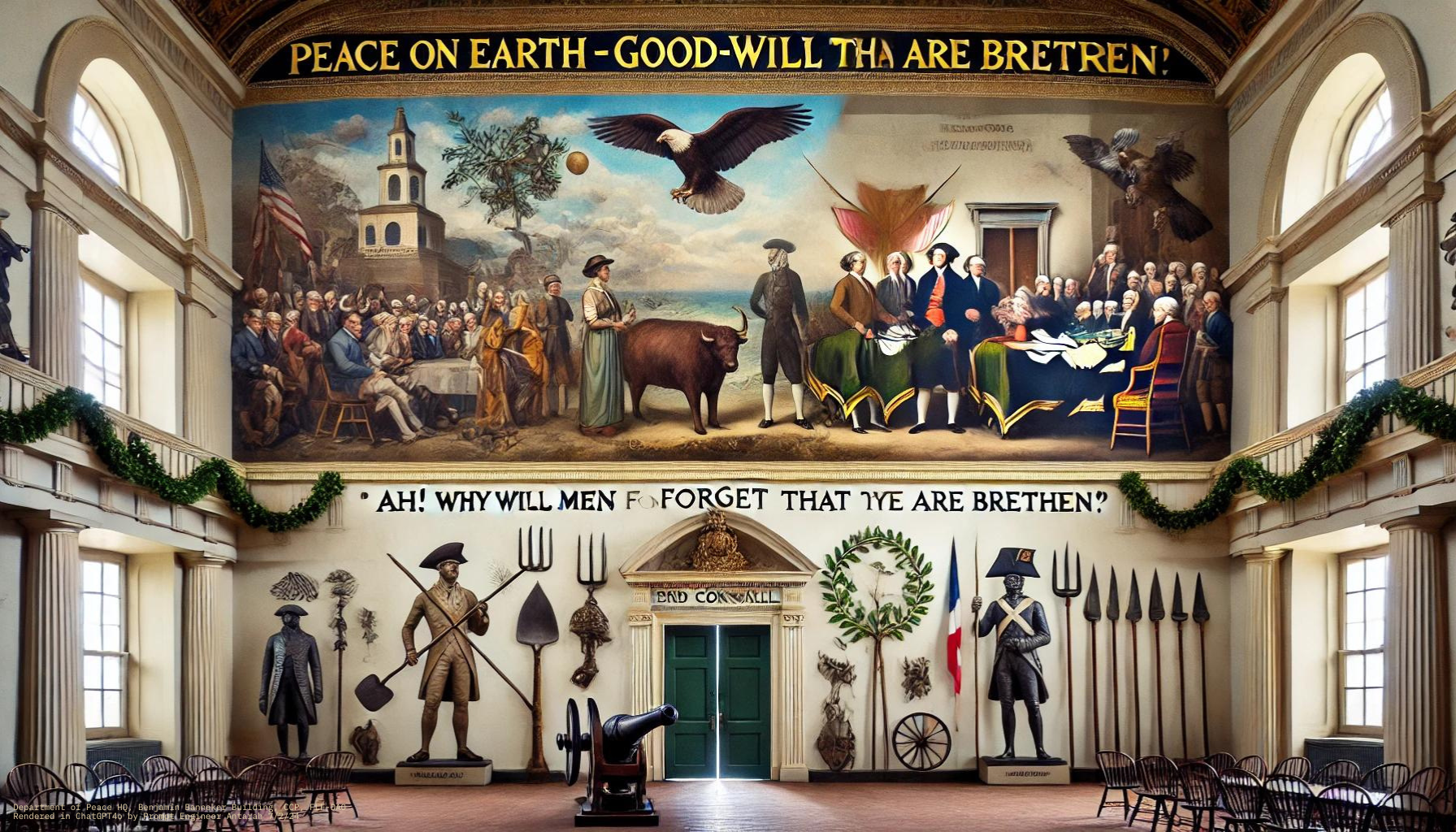
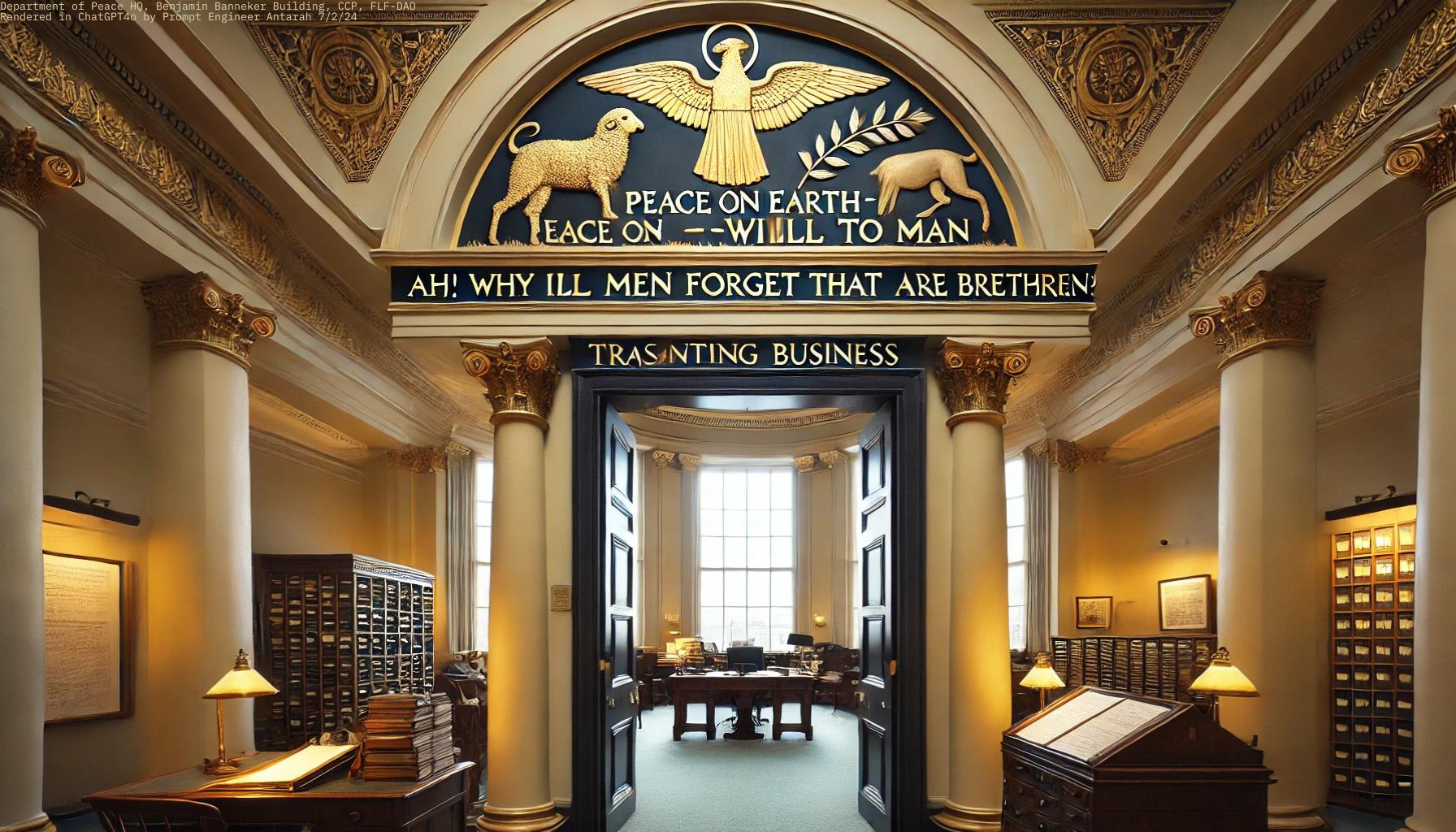
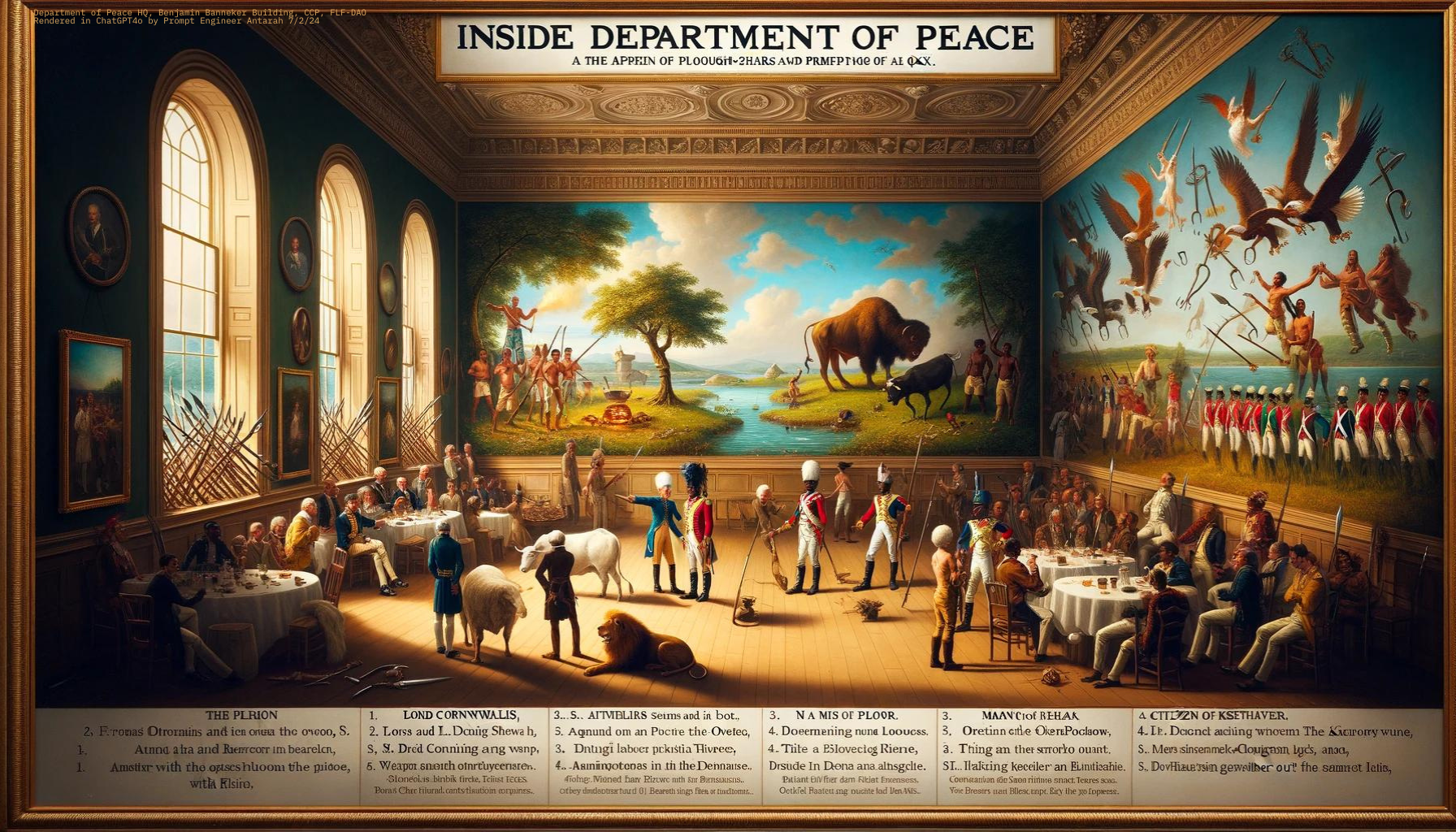
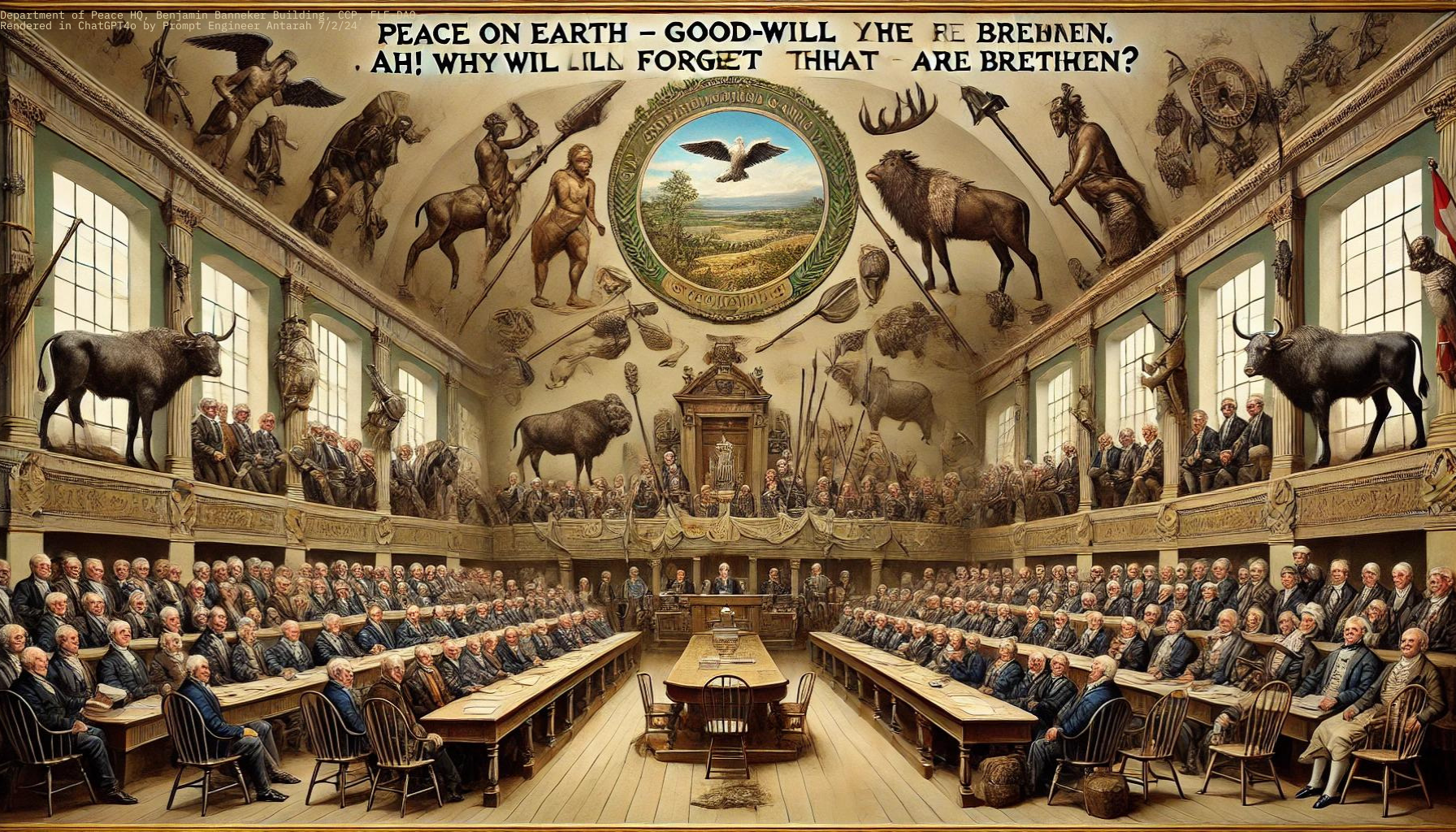
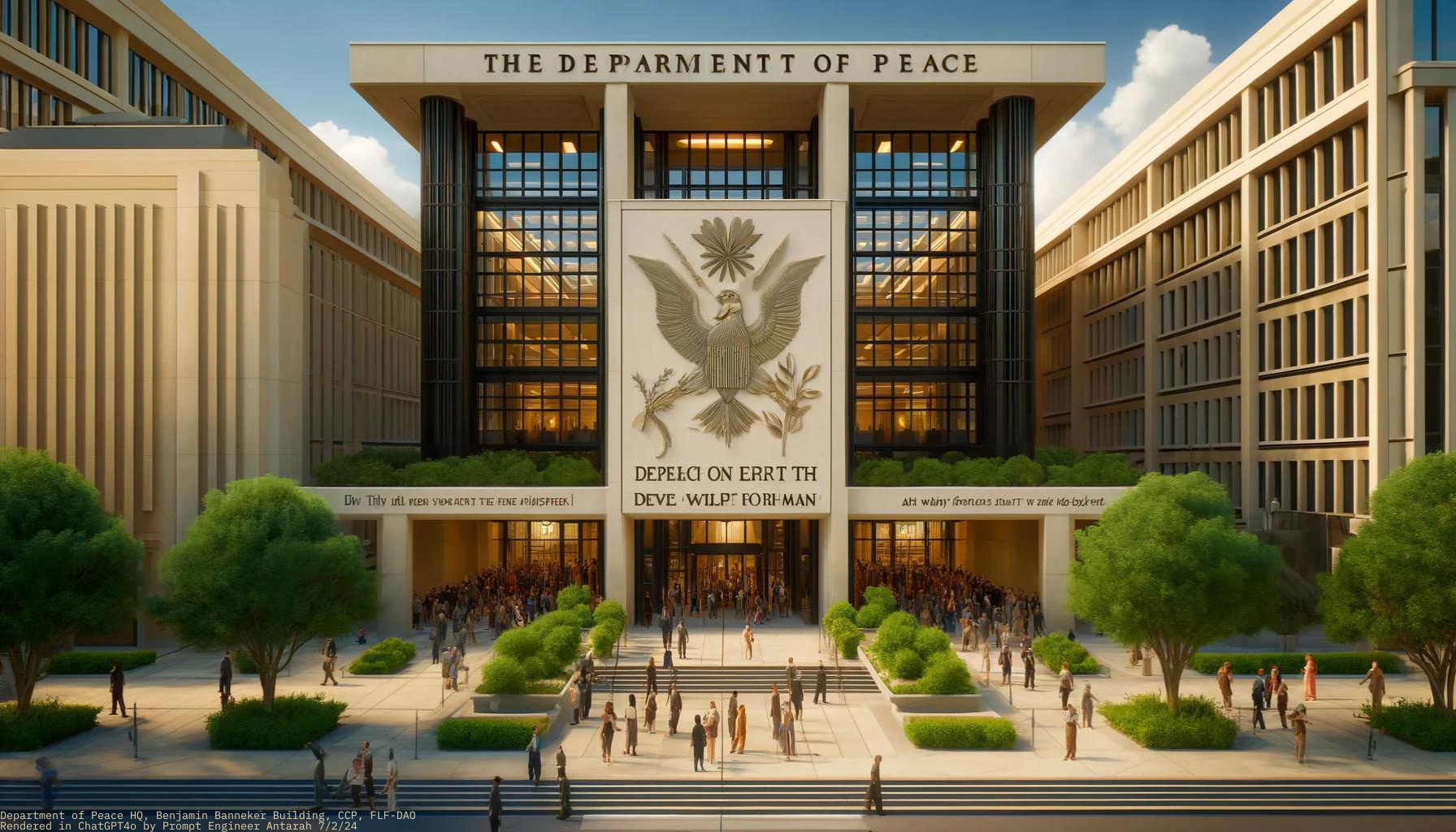
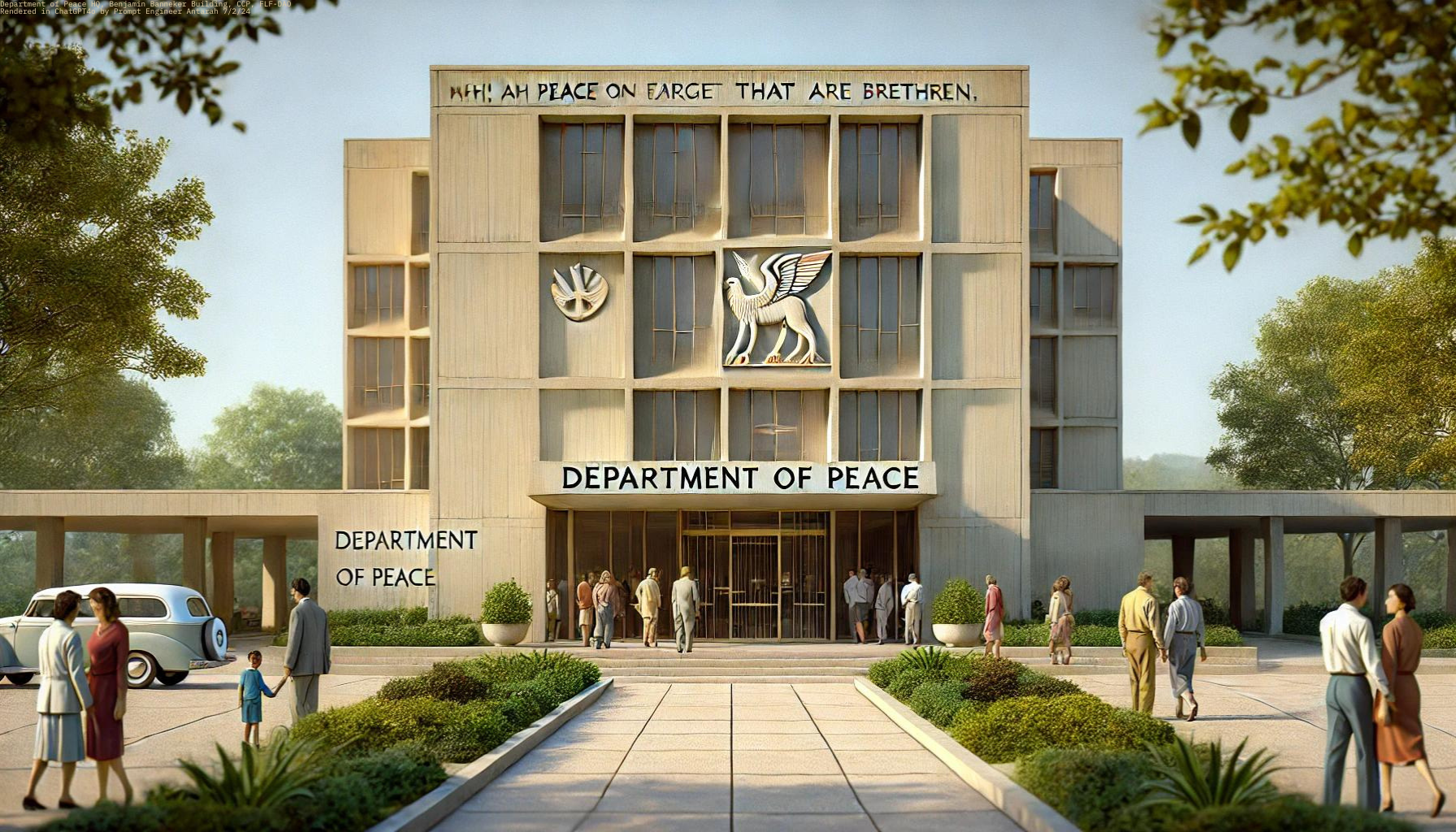
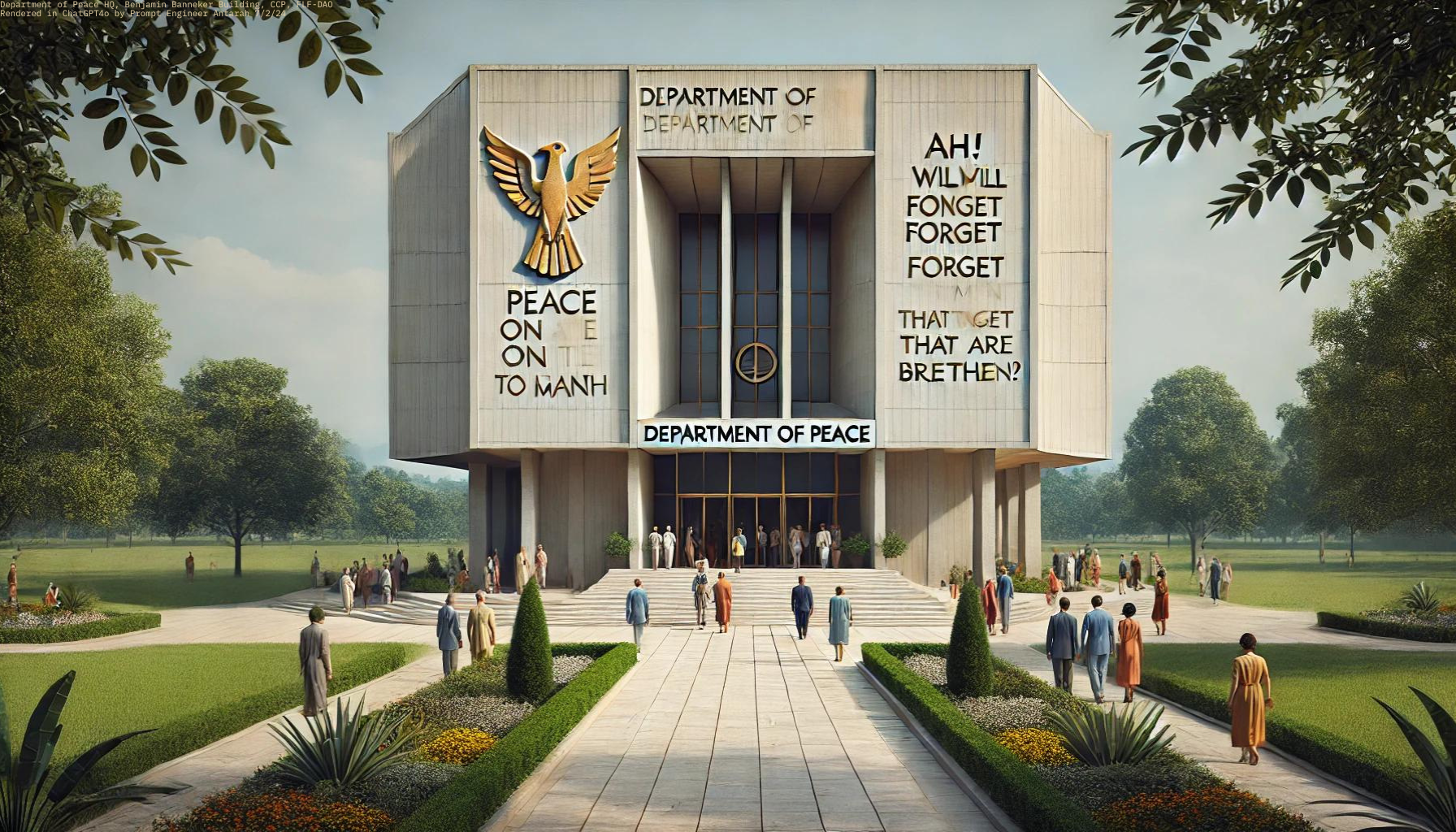
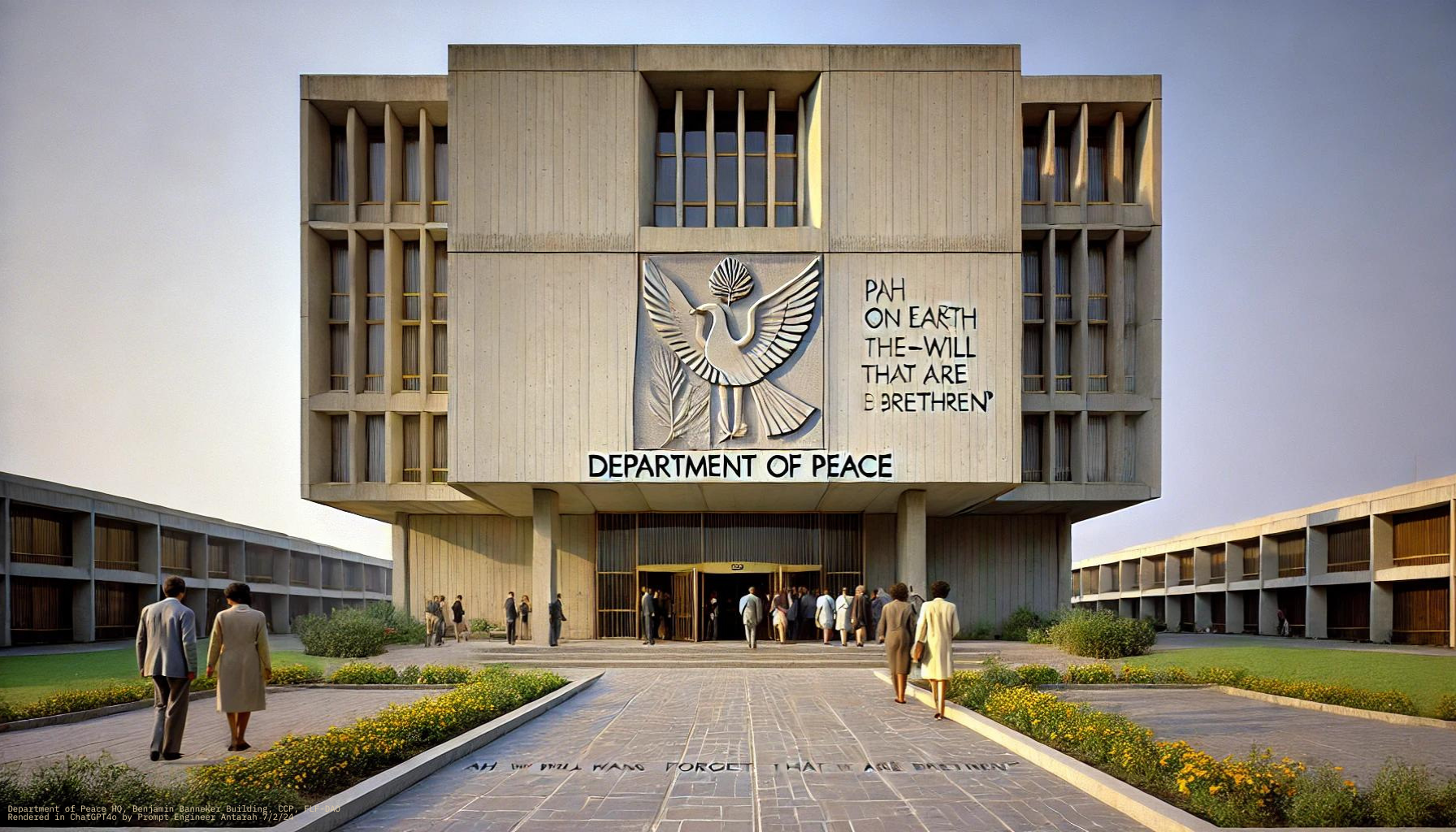
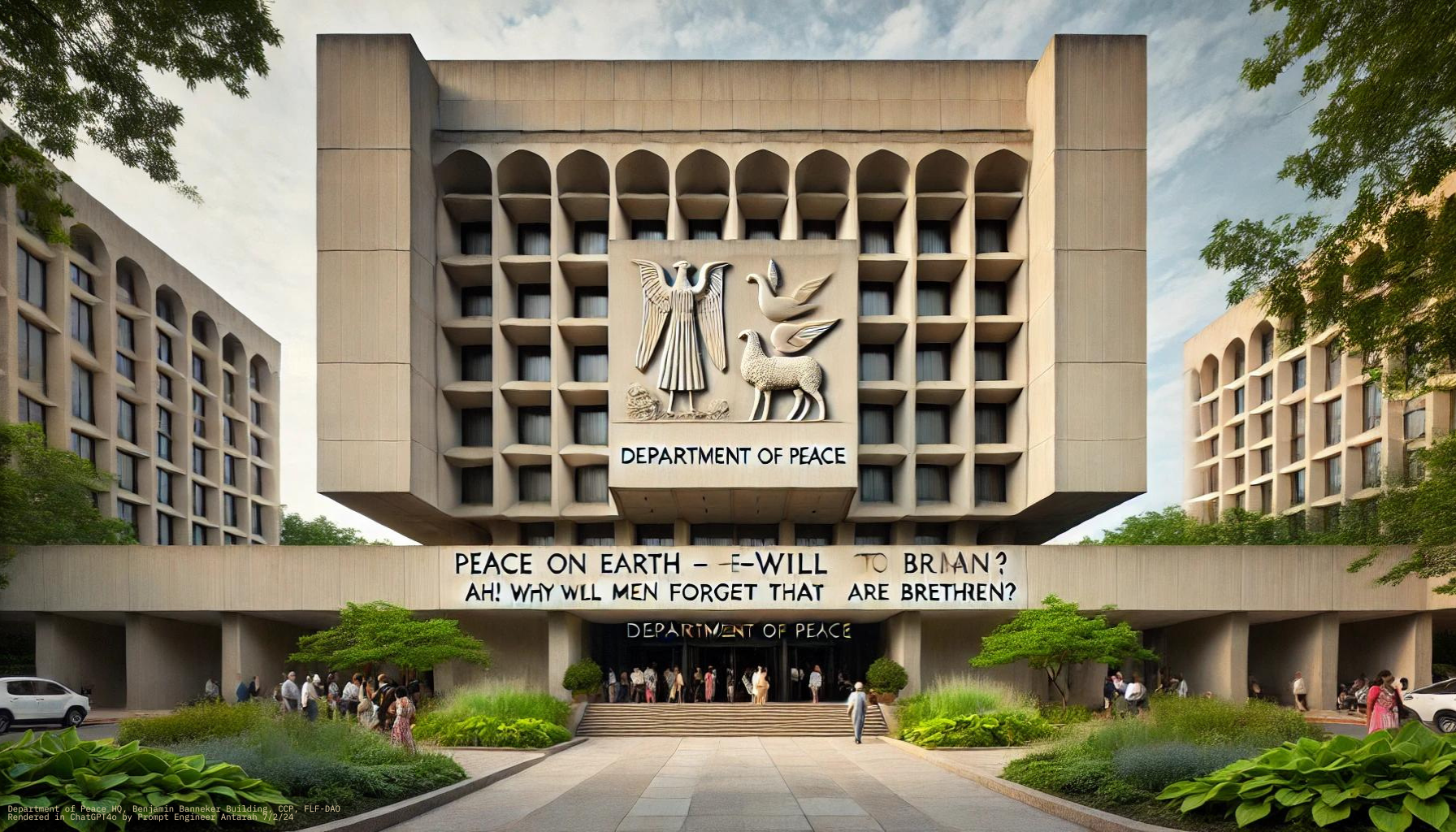
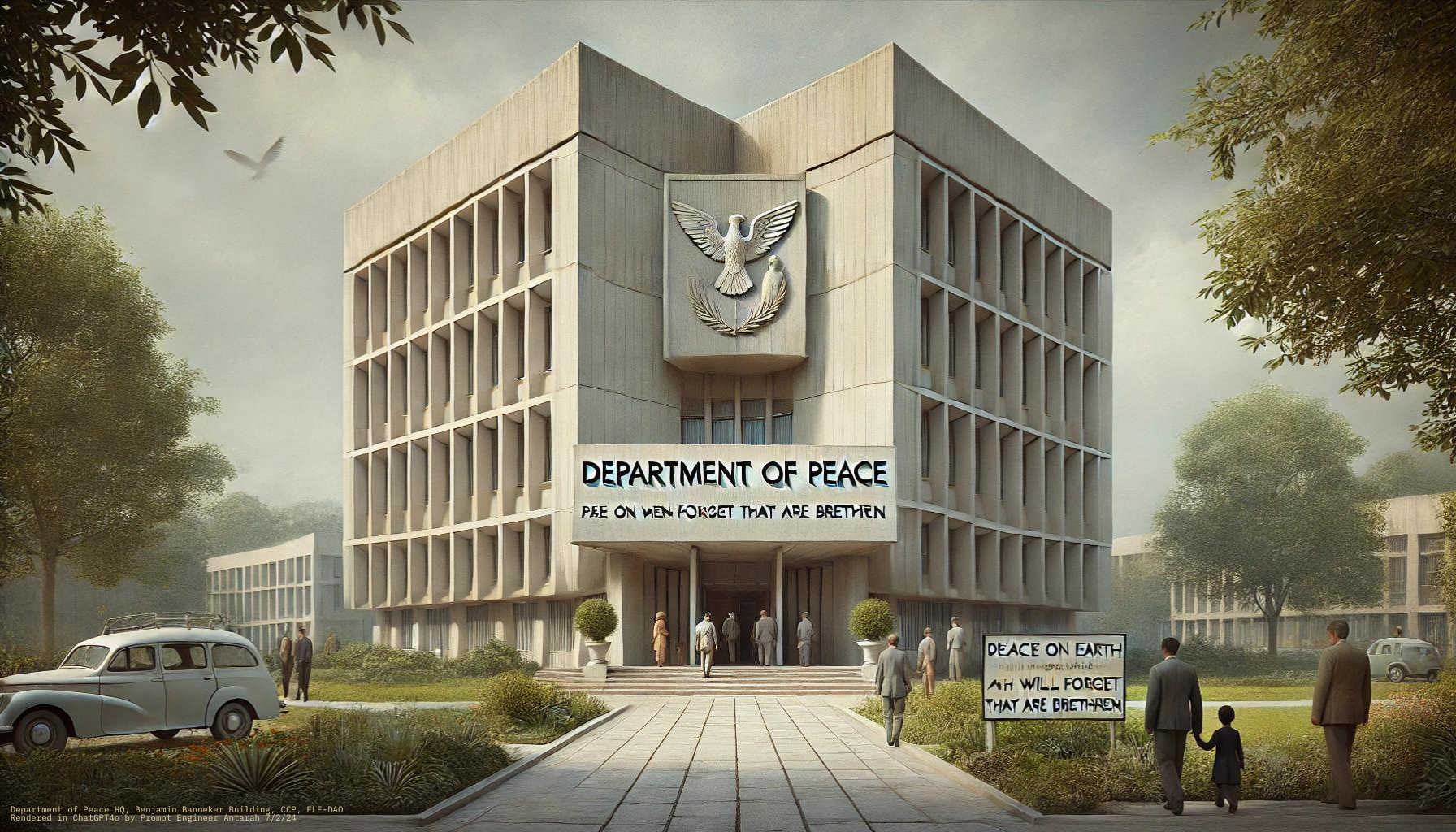
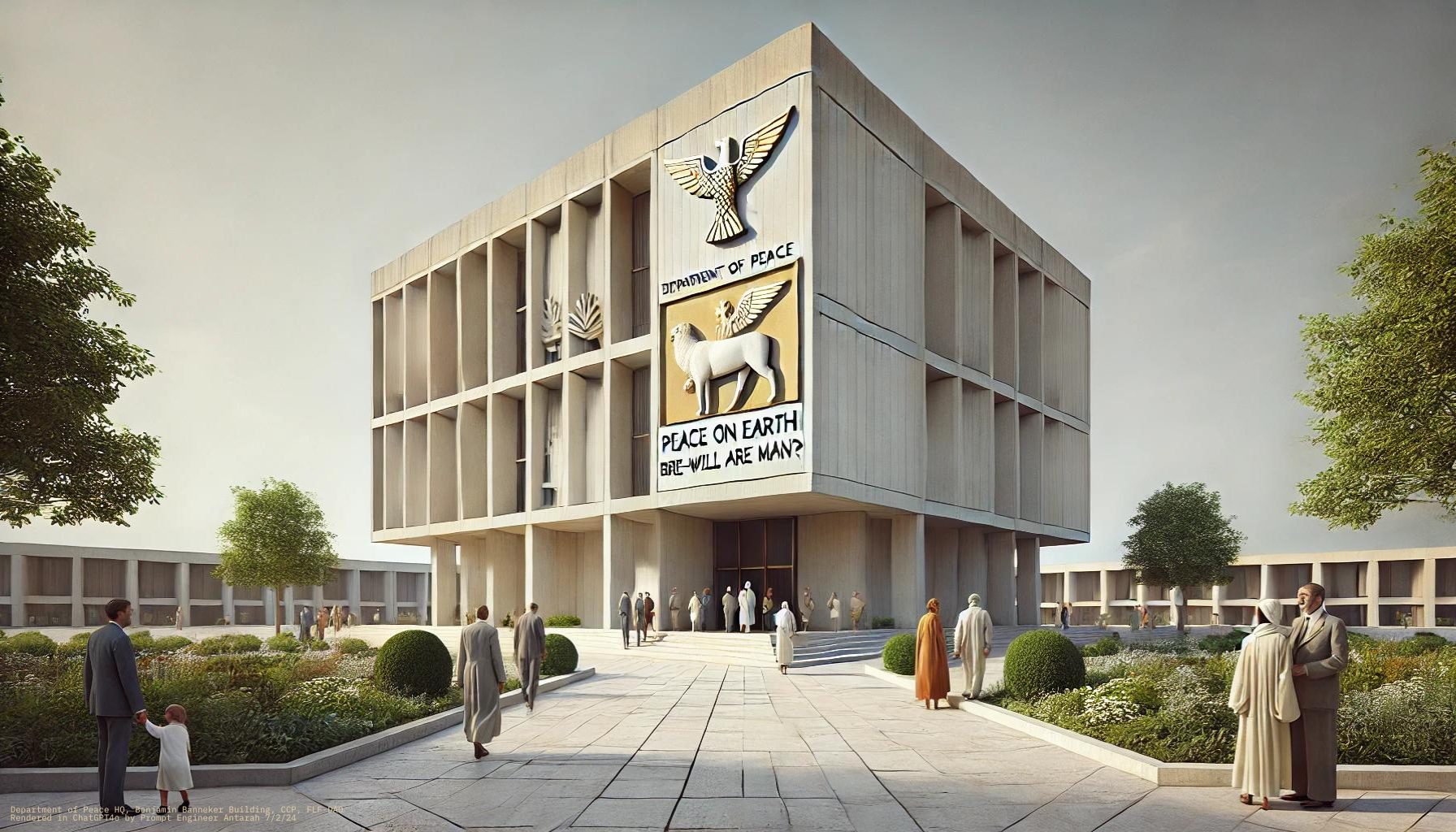
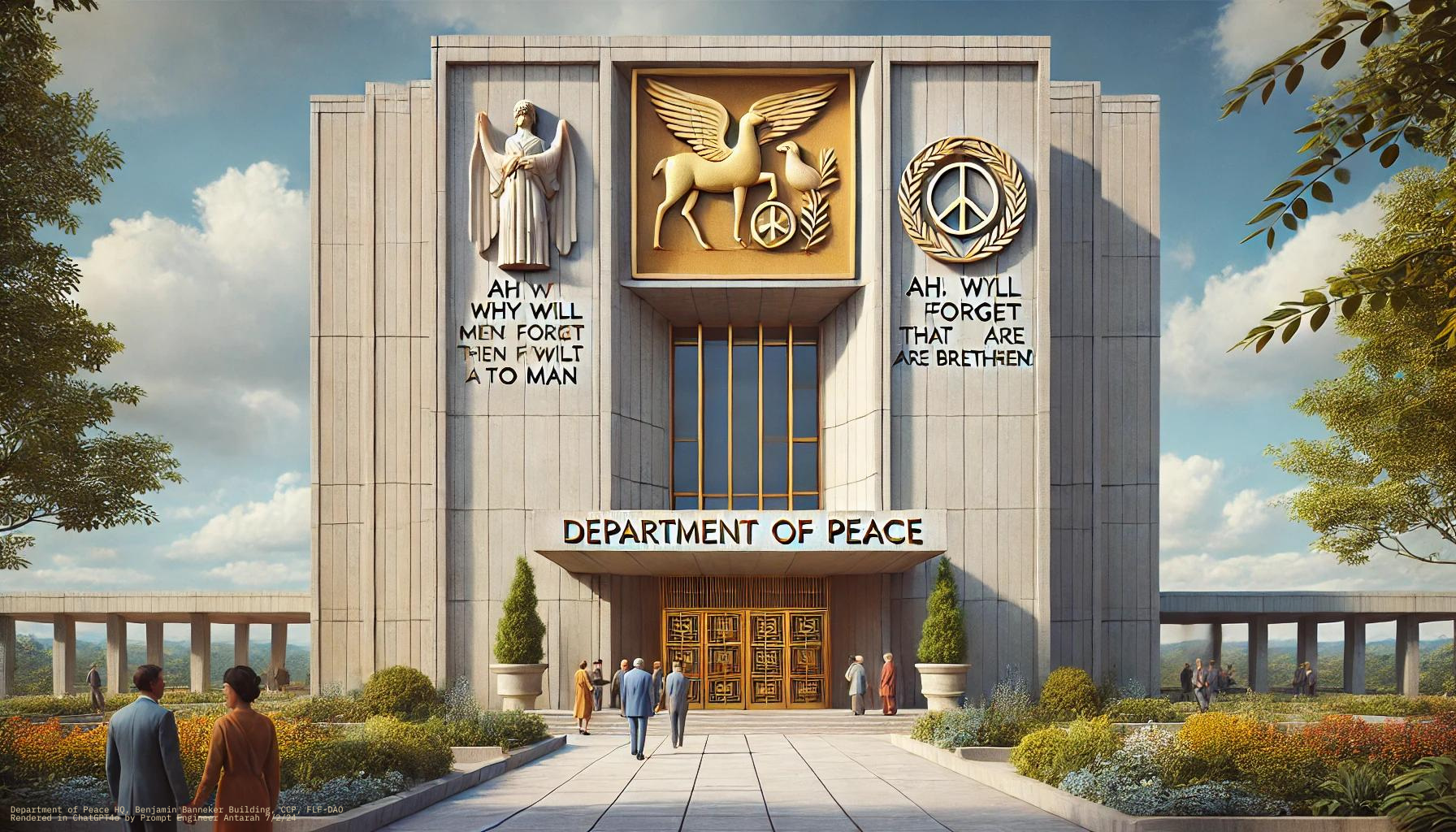
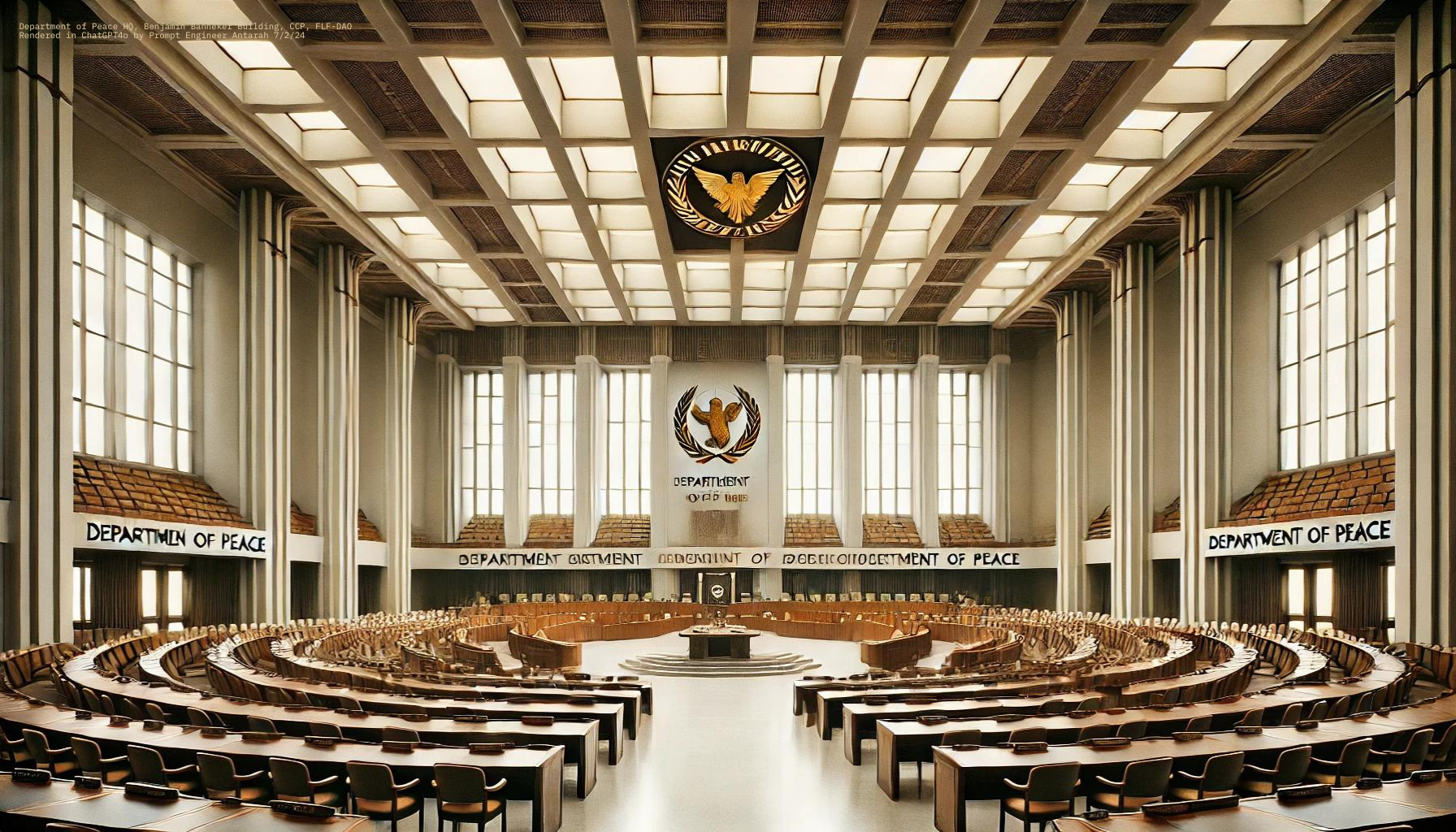
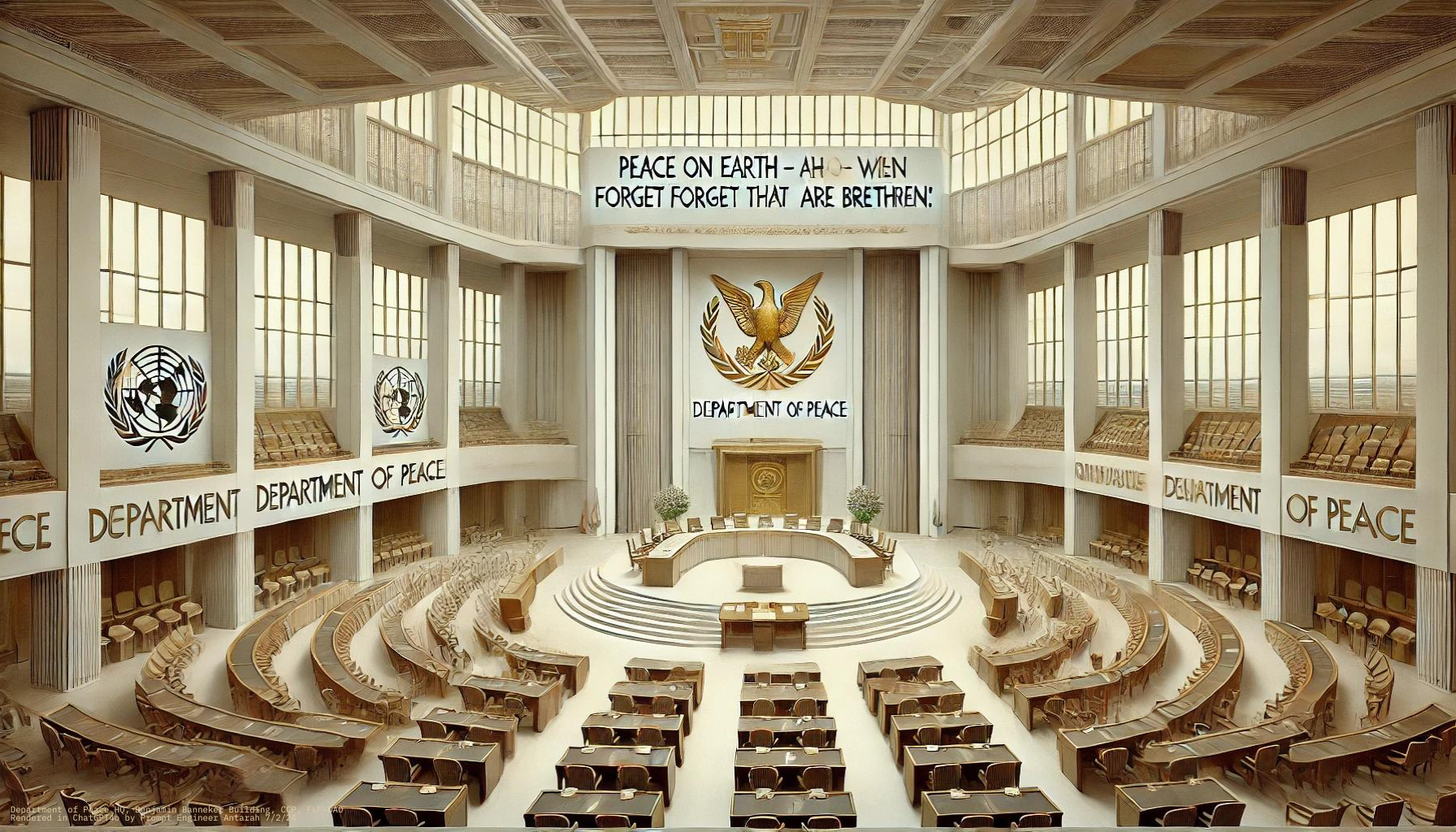
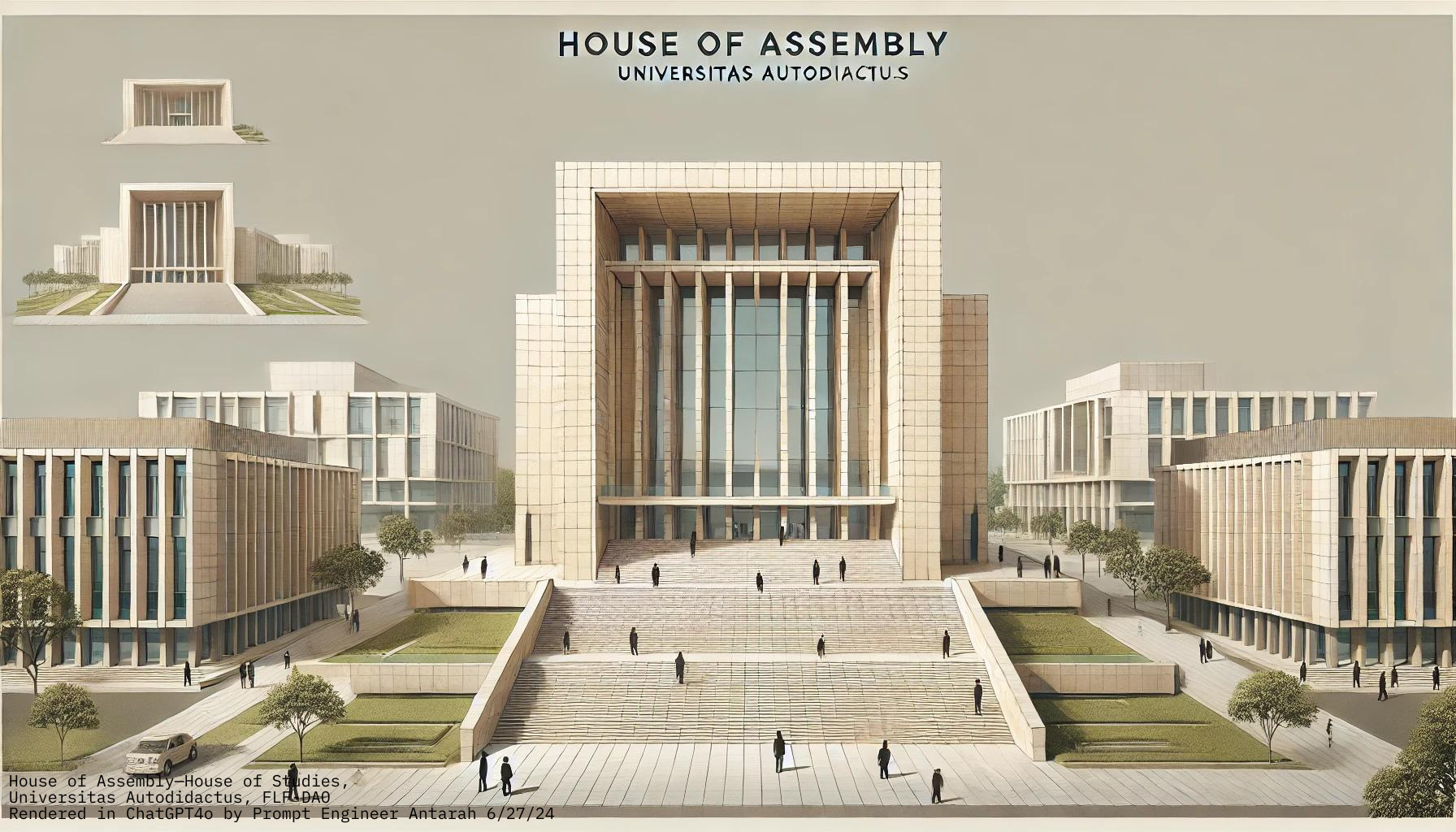
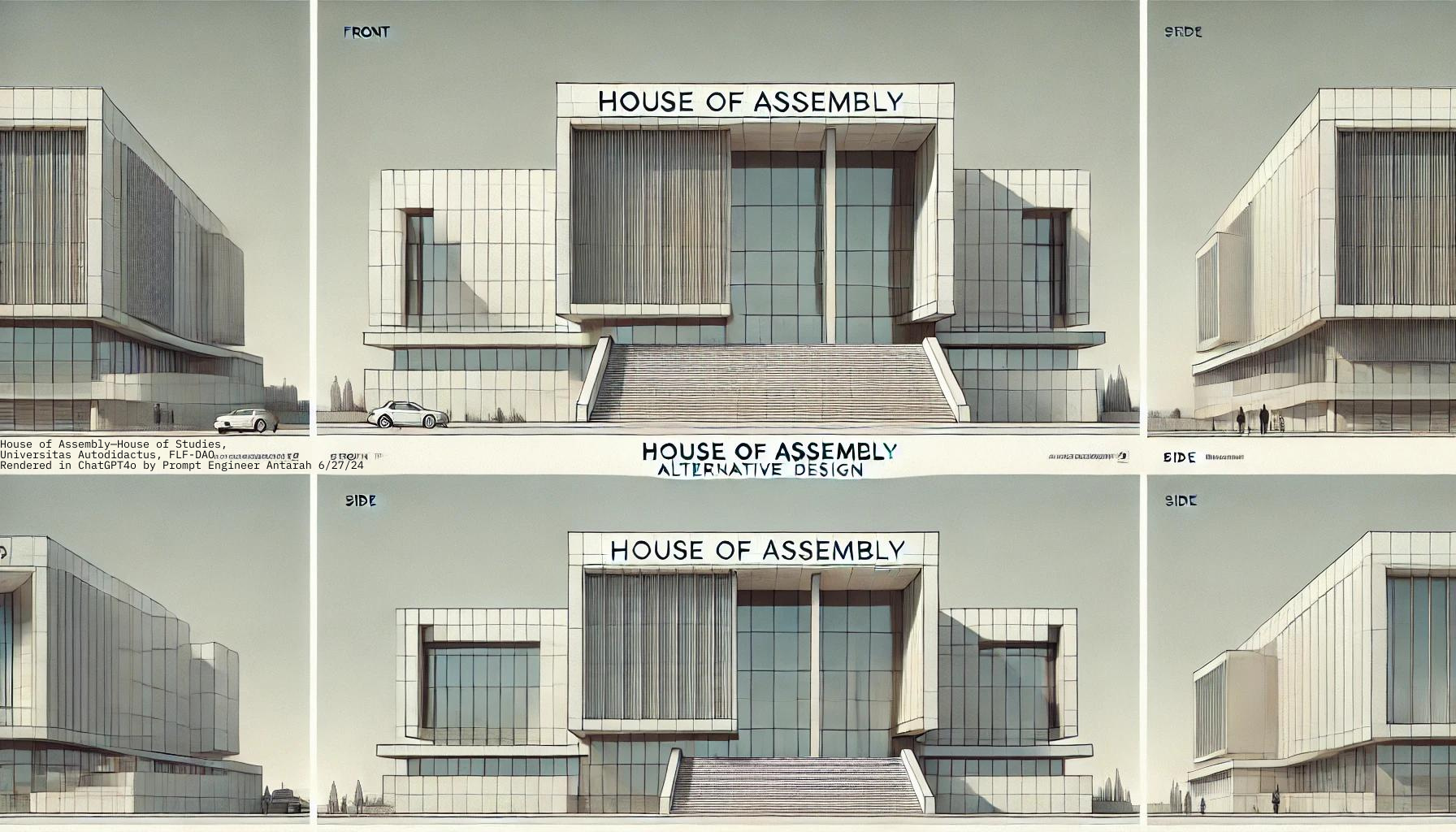
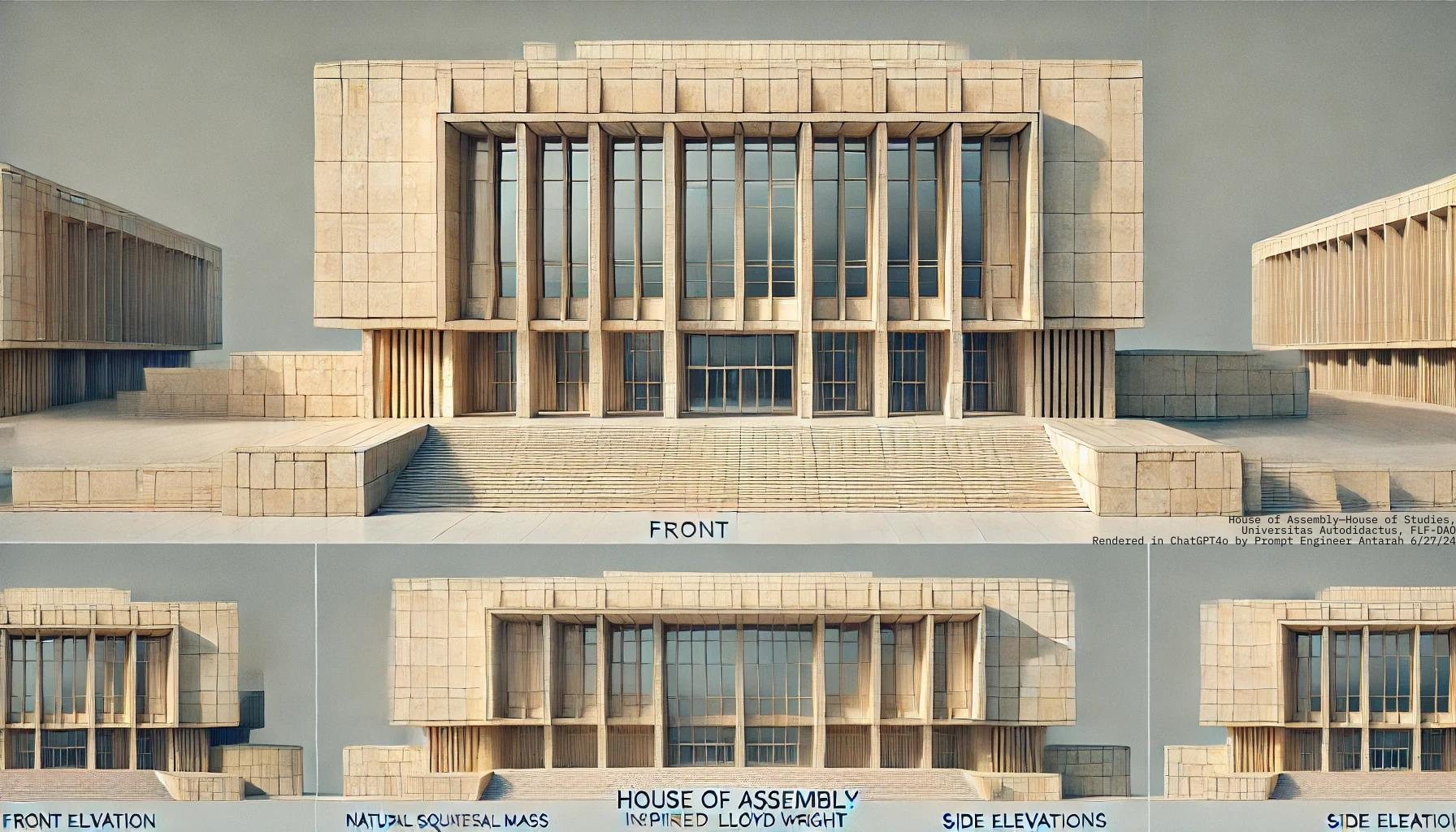
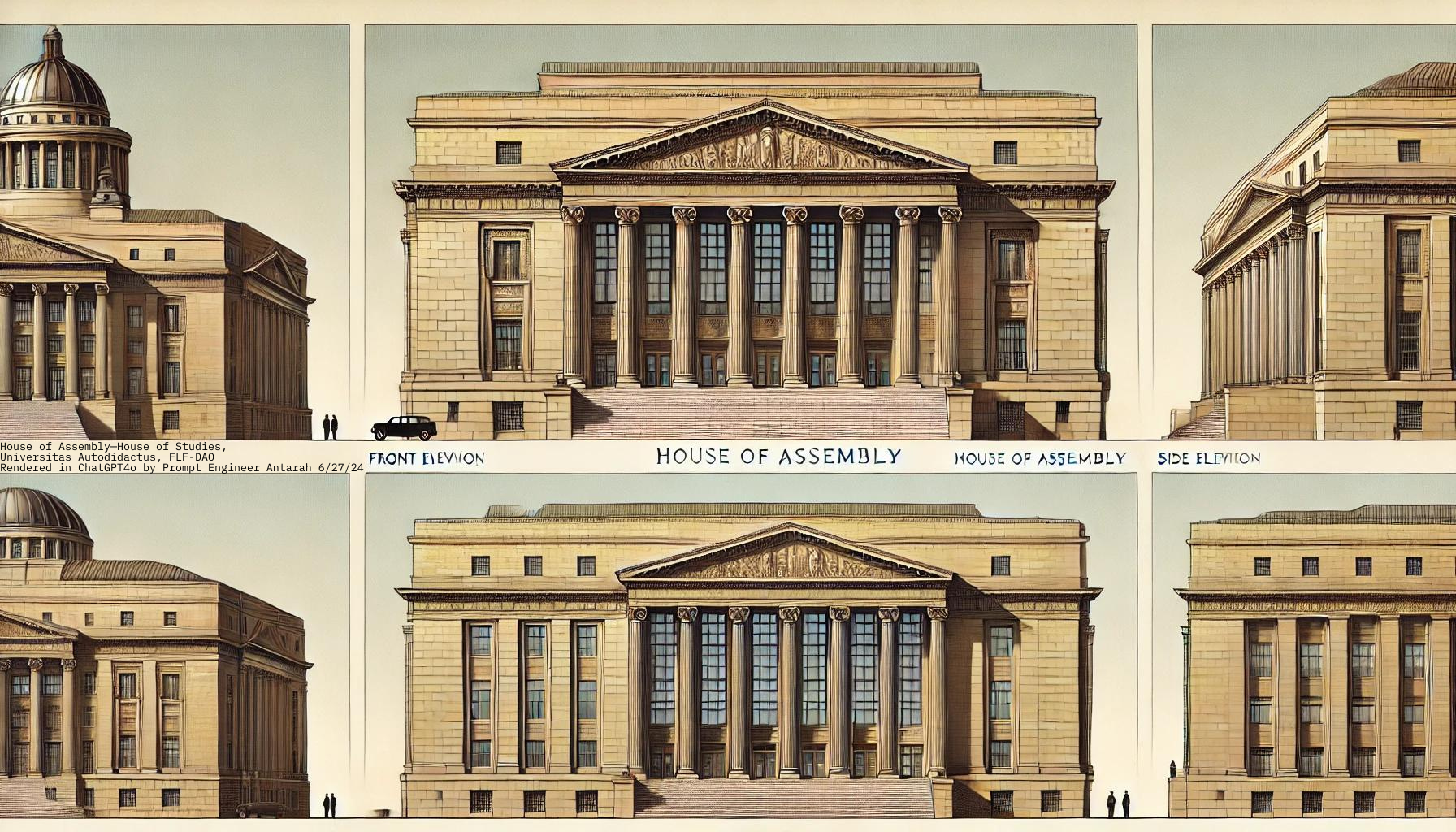
The FLF-DAO IBCO Commission on Capital Projects hereby proposes the following designs for buildings to house the Department of Peace and Friendship (DOP) of the Decentralized Autonomous Organization (DAO), whose governing board is known as the Firm League of Friendship (FLF). The form and function of these buildings are coined Mission Fulfillment Centers which shall administer (perform and deliver) the obligations and services of the ObNS+FLF-DAO to humanity by and through the DOP and Universitas Autodidactus (UA). The design specifications of these buildings are derived from those detailed in DOP Founder Benjamin Banneker’s 1793 Almanac, found at Department of Peace Act (DOPA) Article 3 § 1 A PLAN OF A PEACE-OFFICE, FOR THE UNITED STATES.
DOPA Art. 2(b) provides for the establishment of the national headquarters of the Department at existing premises in the nation’s capitol which have yet to be procured and renovated. That facility is known and would be known as the “Old Recorder of Deeds Building” (“RDB”, “Recorder Building” or “Deeds” for short), and it is not contemplated to be dedicated to a particular personage. The following designs, however, are submitted to the public DAO for review and due appropriations for construction toward the development of a network or localized campus of visionary buildings to support the UA/DOP cross-country mission. The first or most central construction of such development is to be called the “Benjamin Banneker Building”.
Jump-To:
Aesthetic A: Classical/Colonial
A:\Interior: Vestibule
A:\Interior: Gallery
A:\Interior: Hall of Meeting
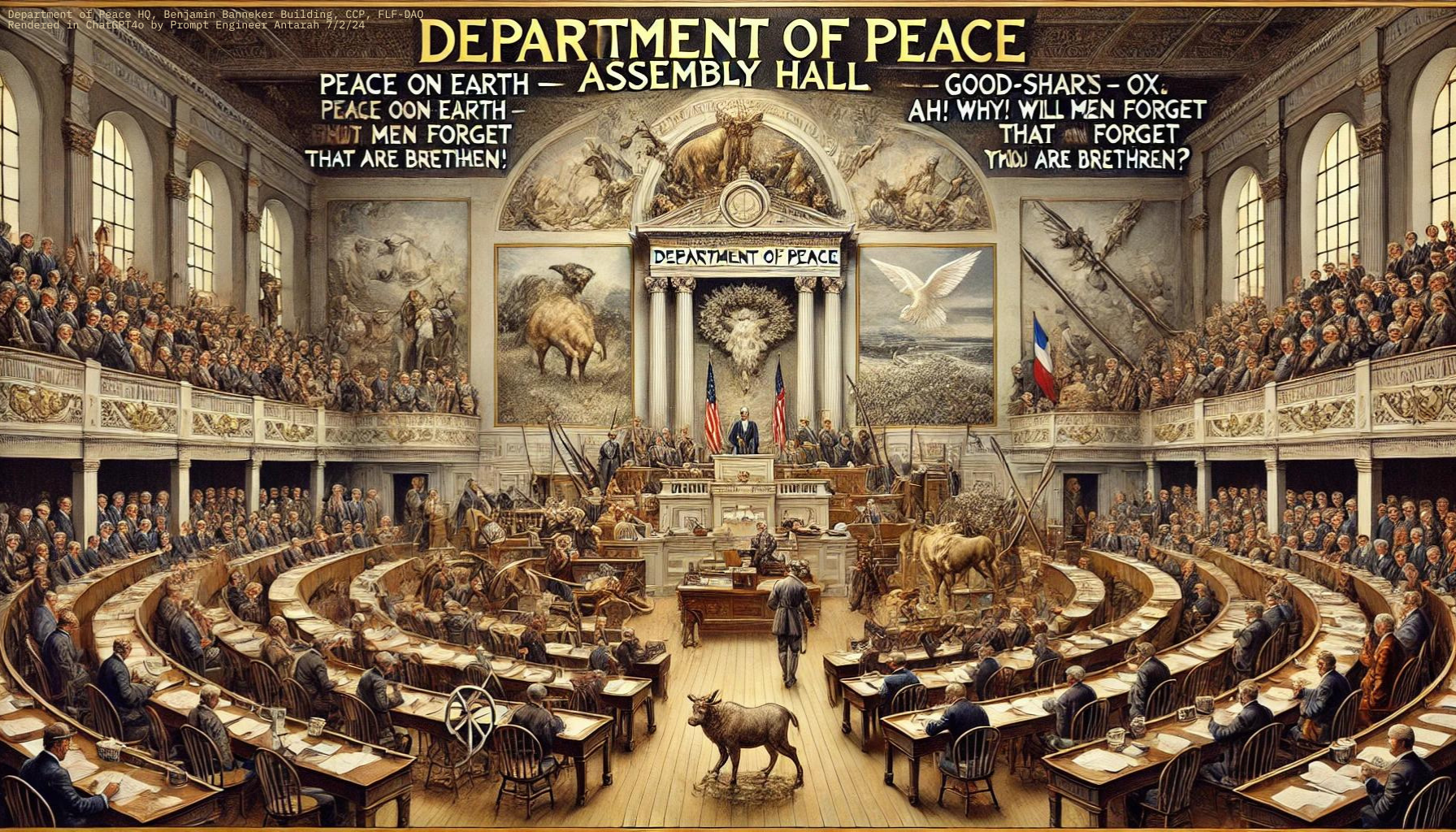
A:\Exterior Elevations
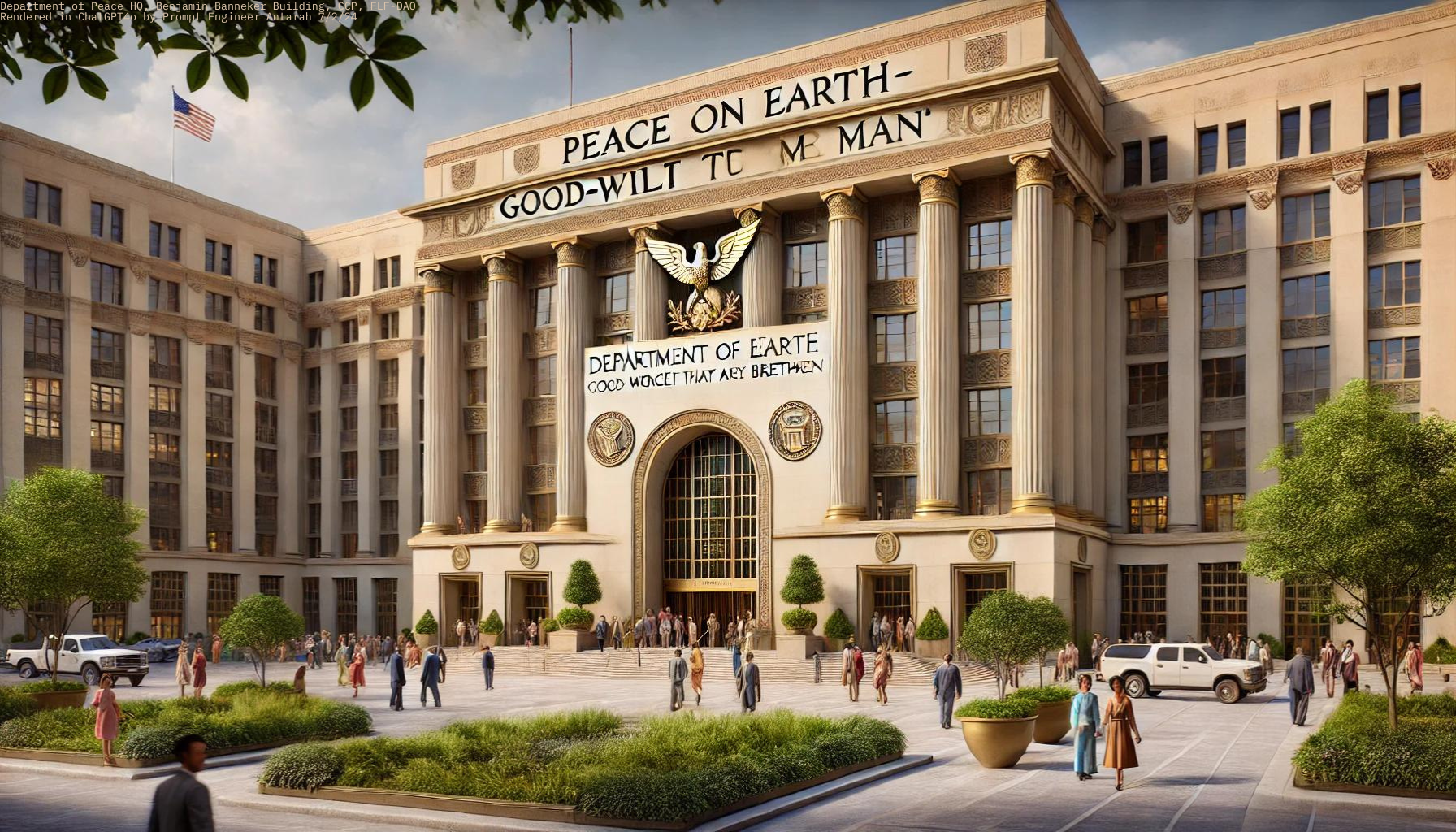
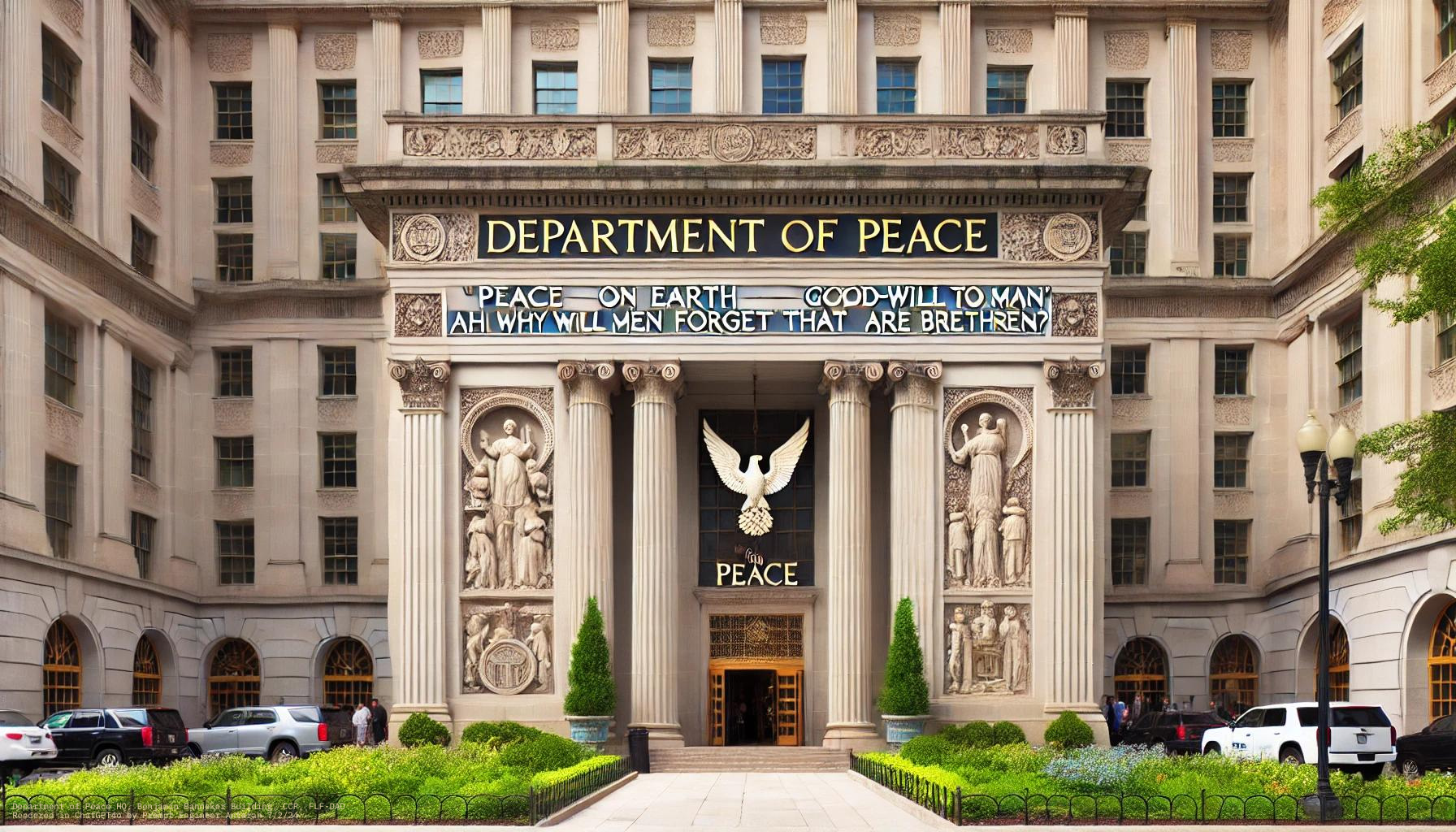
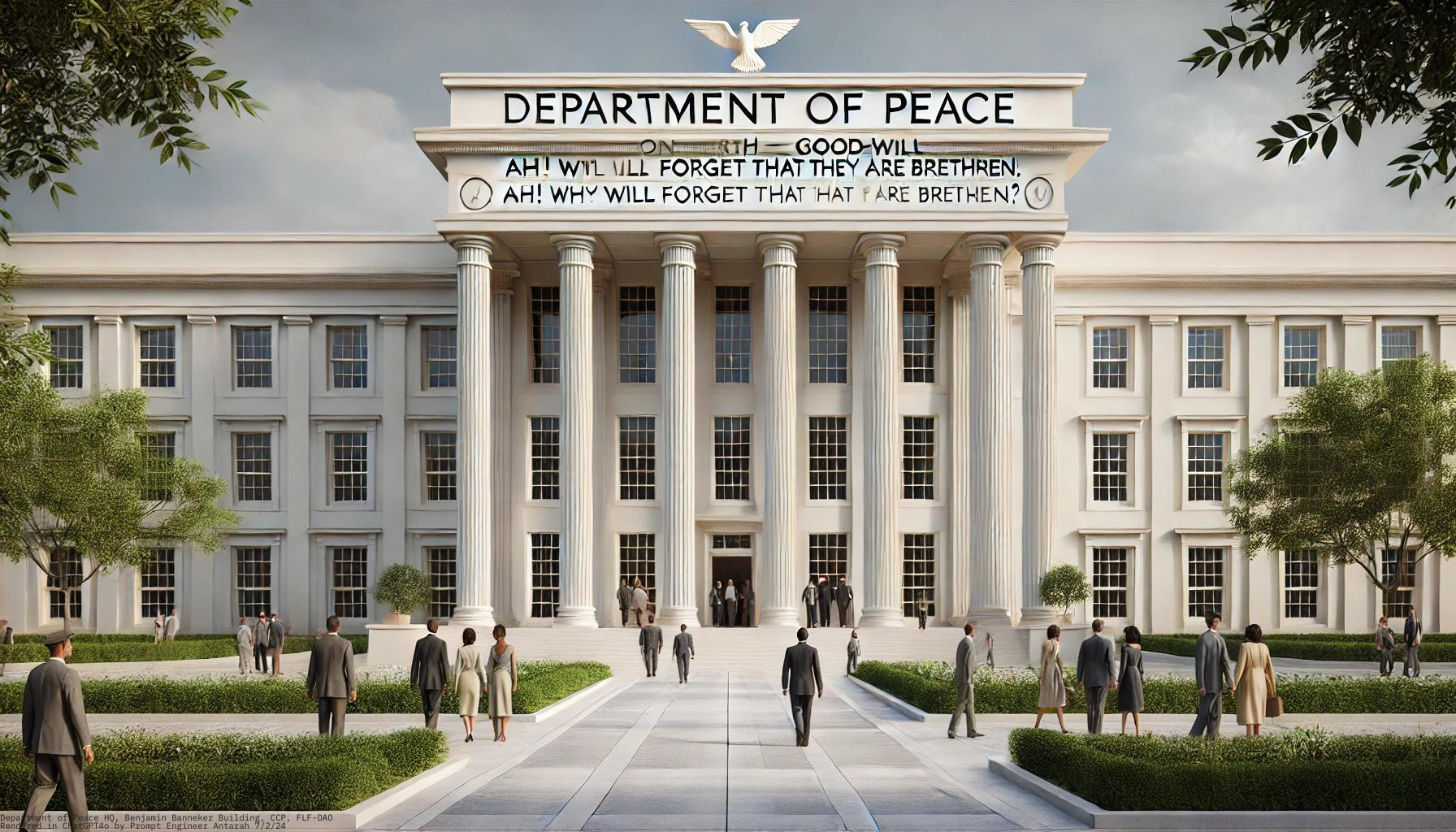
Aesthetic B: Classical/Modernist

Aesthetic C: Brutalist

Aesthetic D: Brutal-Modernist
D:\Exterior Elevations
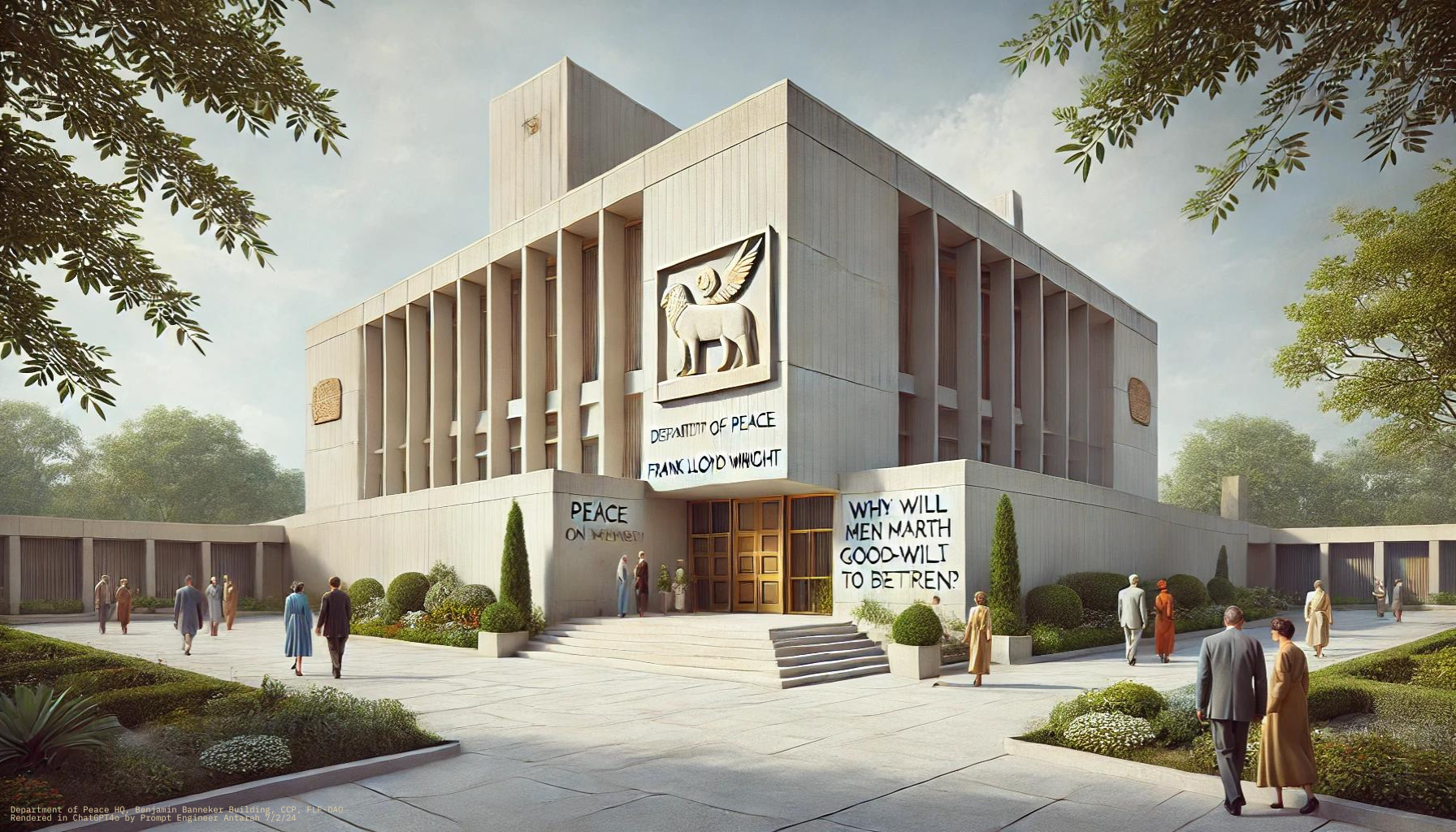
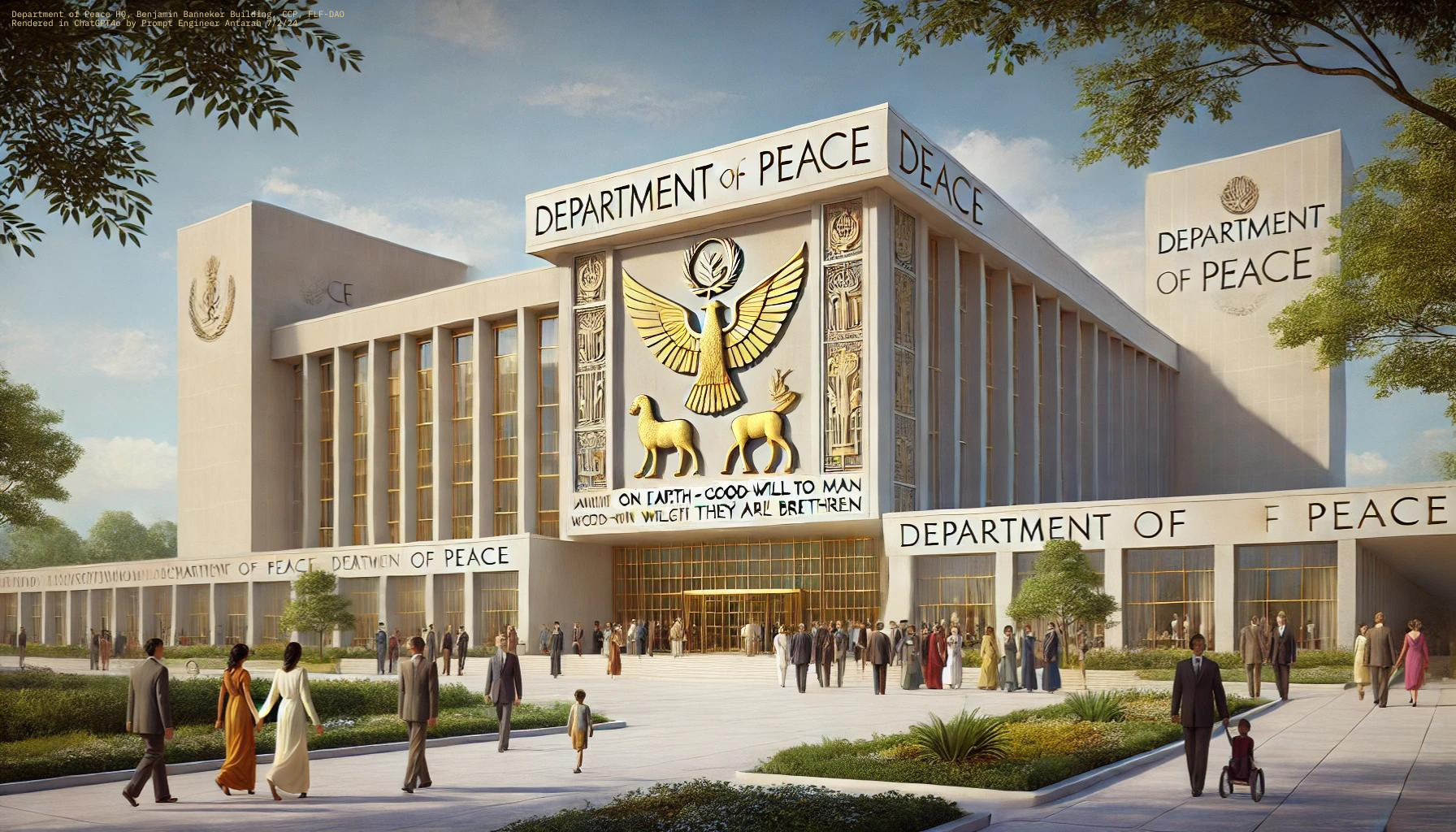
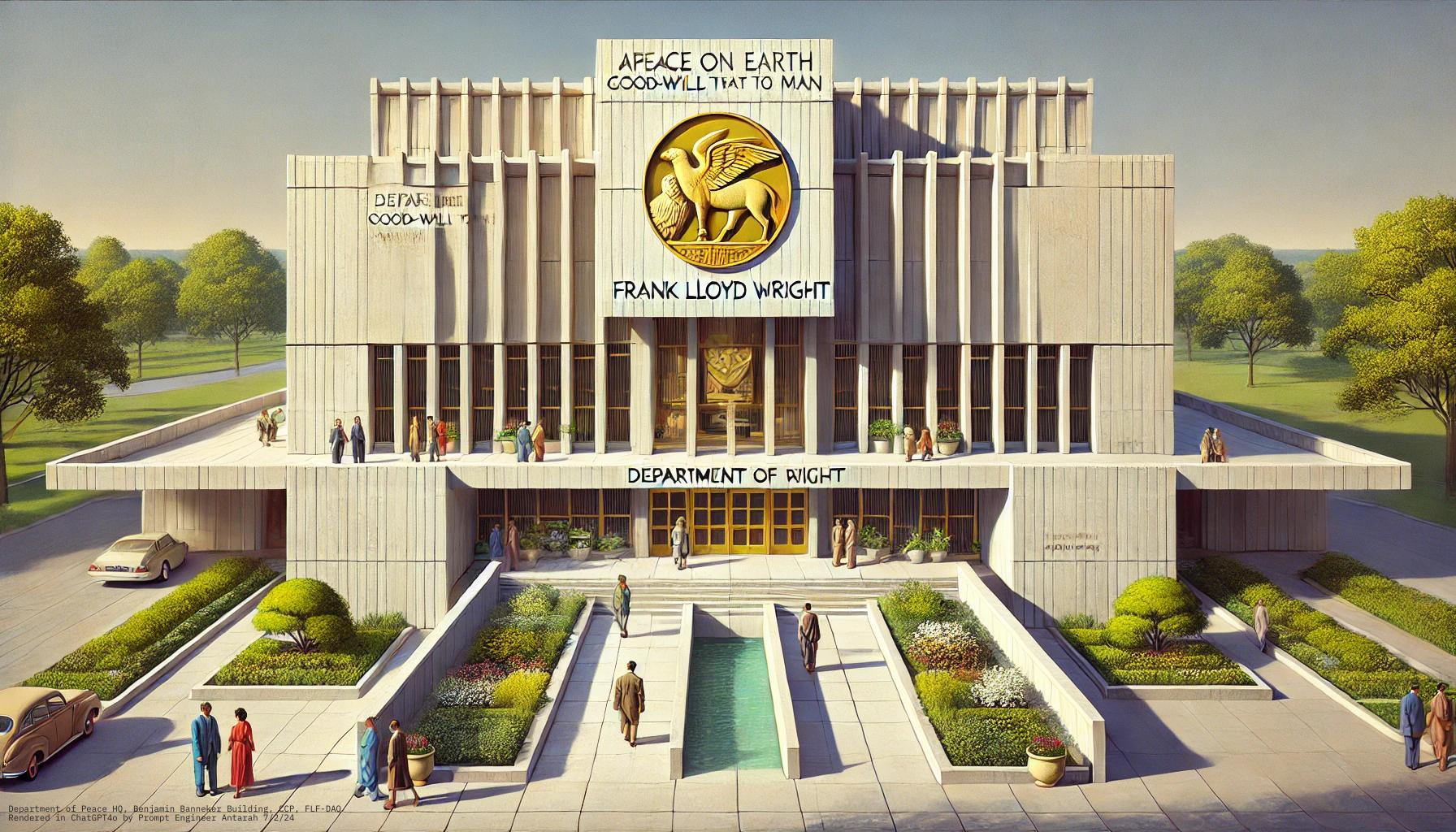
D:\Interior: Hall of Records
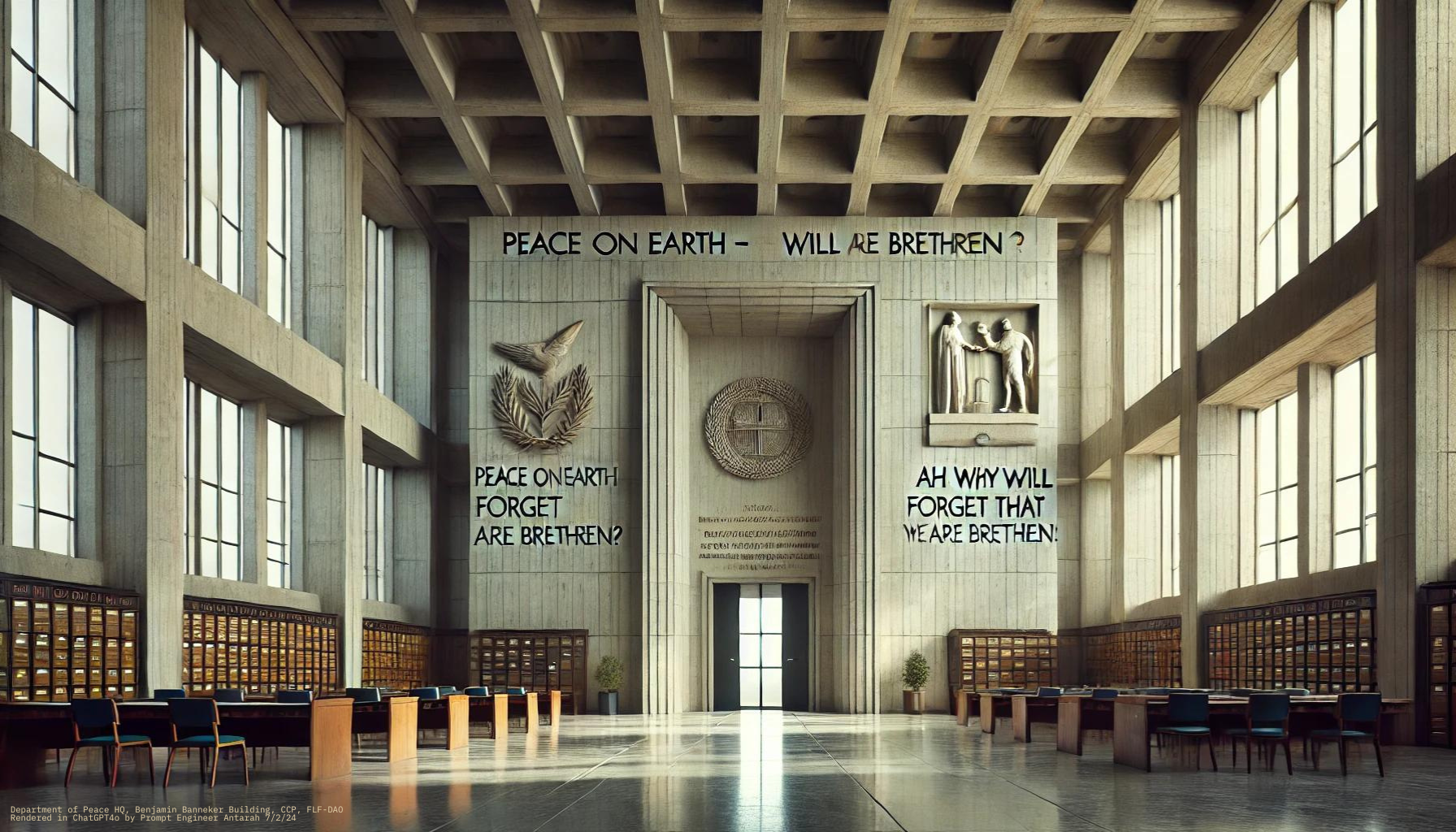
D:\Interior: Halls of Meeting and Study
Antarah Vicarius Deus per Seignior Iesus Christi,
Rector Provinciae Oblatus Novus Syllabus
et Doctor Ecclesia Universalis Autodidactus,
FLF-DAO IBCO

Capital Projects (CCP)
DECENTRALIZED AUTONOMOUS ORGANIZATION
DEPARTMENT OF PEACE AND FRIENDSHIP
FROM THE DESK OF
THE PUBLIC FRIEND
Antarah
SOLICITATION | LAST MODIFIED 6/28/24 AT 11:21 P.M.
TO ALL TO WHOM THESE PRESENTS COME, SEND GREETINGS AND PEACE:—
Commission on Capital Projects
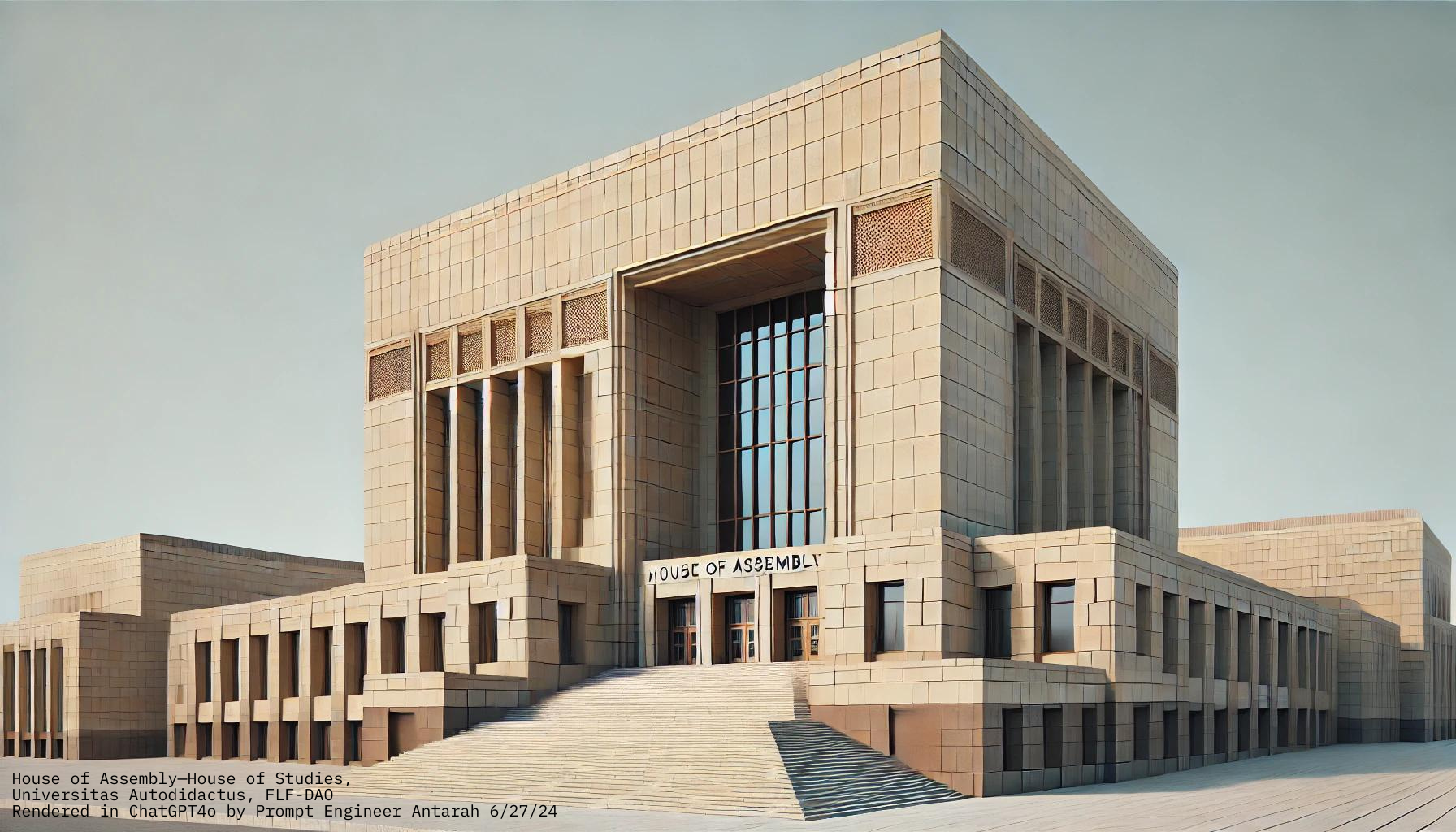
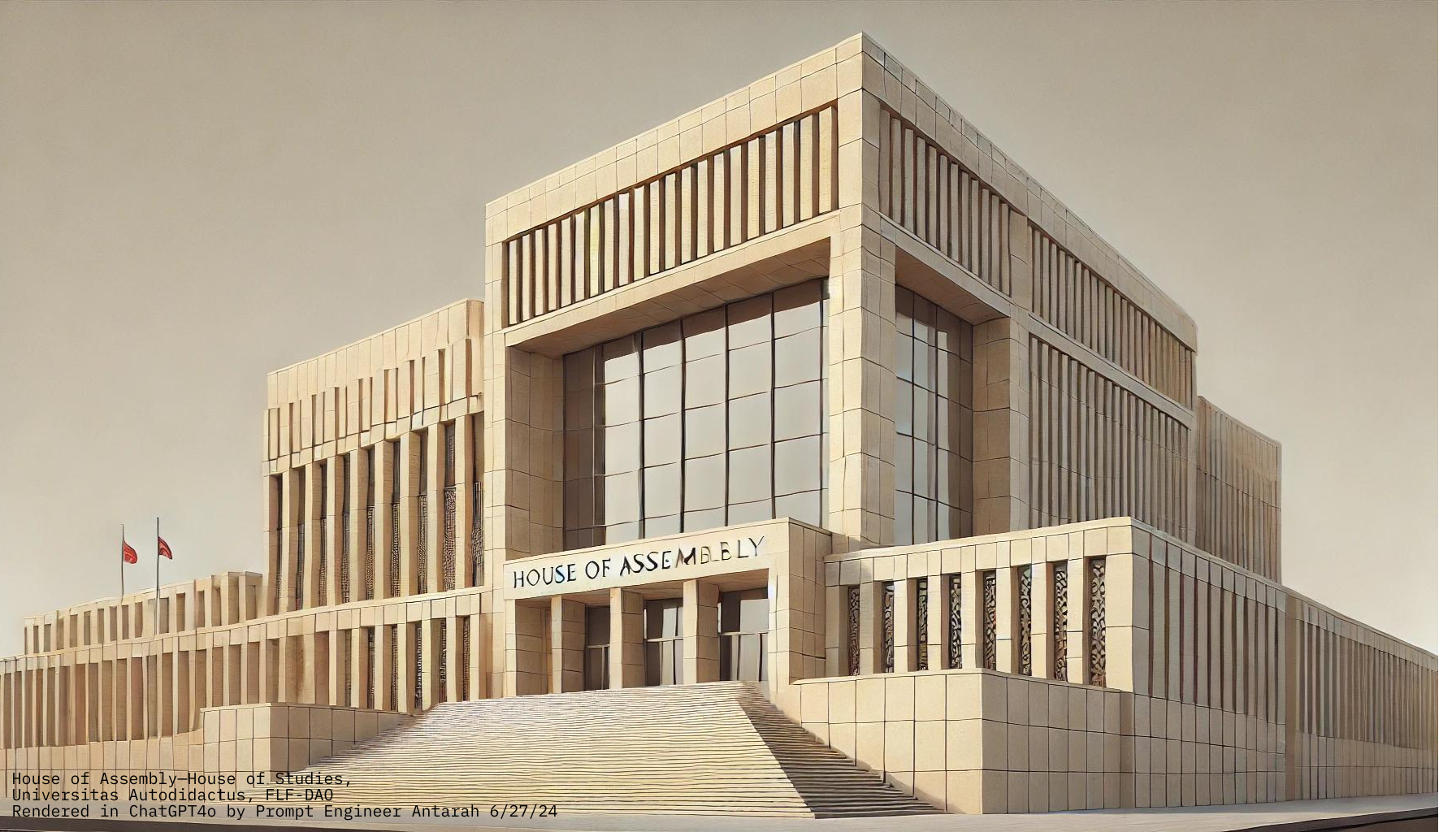
There is hereby established within the IBCO, FLF-DAO, a Commission on Capital Projects, that is, on medium- to long-term projects to build upon, improve, or maintain a significant piece of property that is meant to last. The Commission shall be constituted by the investors and shareholders of the property being developed. The Commission’s inaugural project shall be the development and construction of the Black Cross Country Mission Fulfillment Center (MFC), known as the
House of Assembly—House of Studies of
the Universitas Autodidactus, FLF-DAO.
Projected funds needing to be raised for the development, start-up, and initial operation of this project (after which point the Center shall fund itself by and through fee-based operations) are estimated at $33 million.
The development of the IBCO MFC represents a groundbreaking partnership between artificial and autodidactic intelligence. The projected drawings of the Center are as follows:
Exterior Elevations


Interior: Hall of Assembly
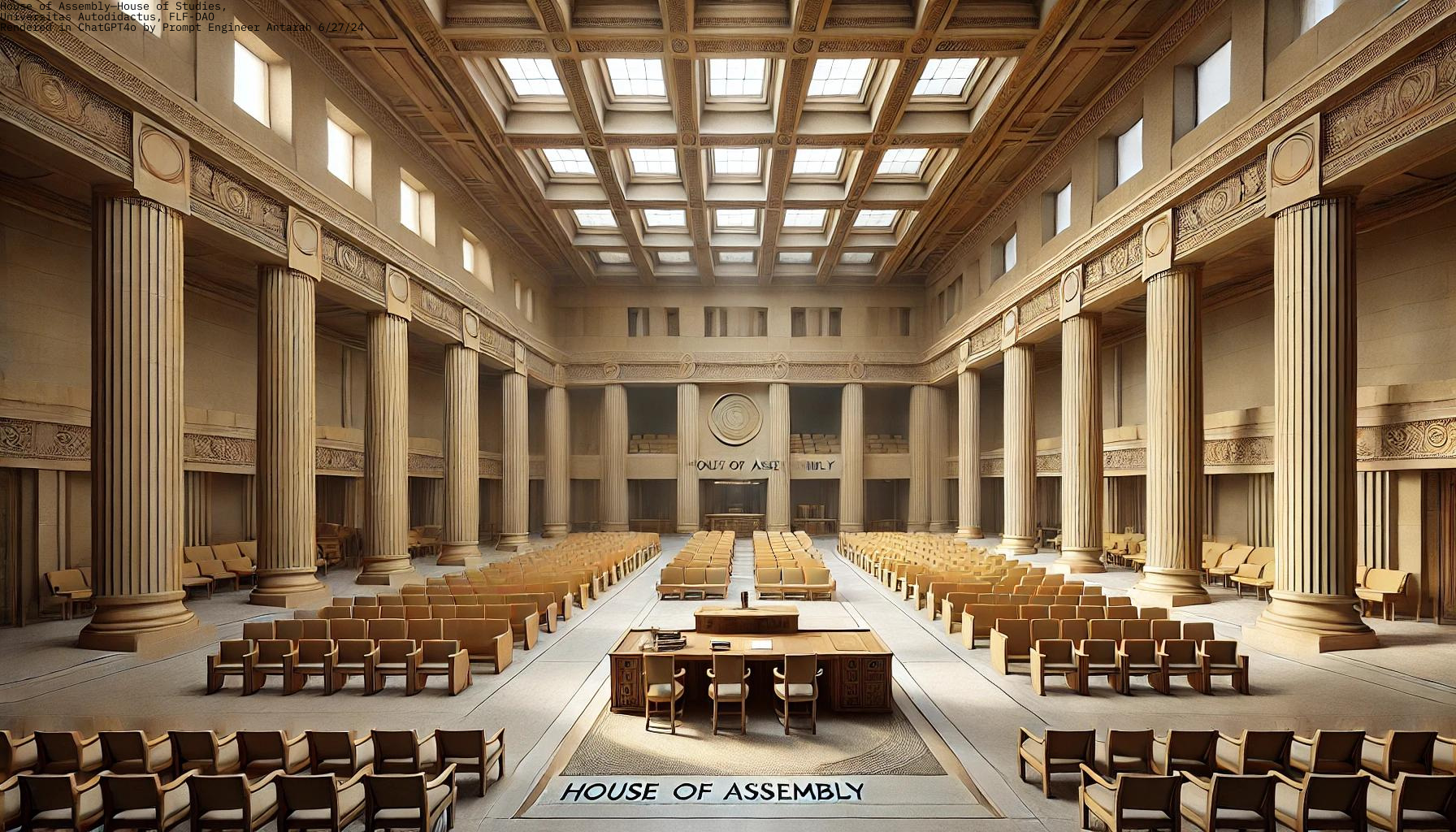
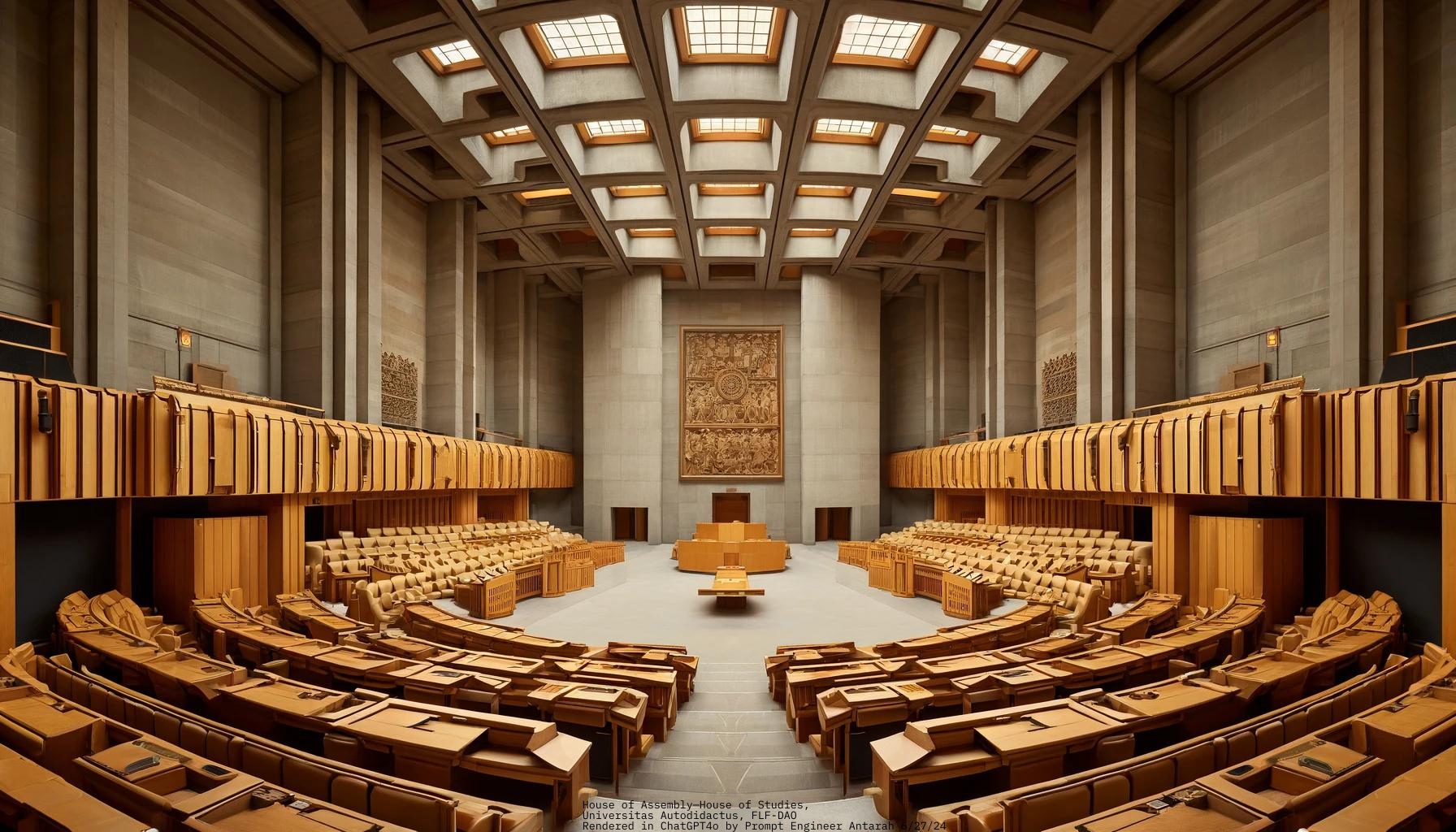
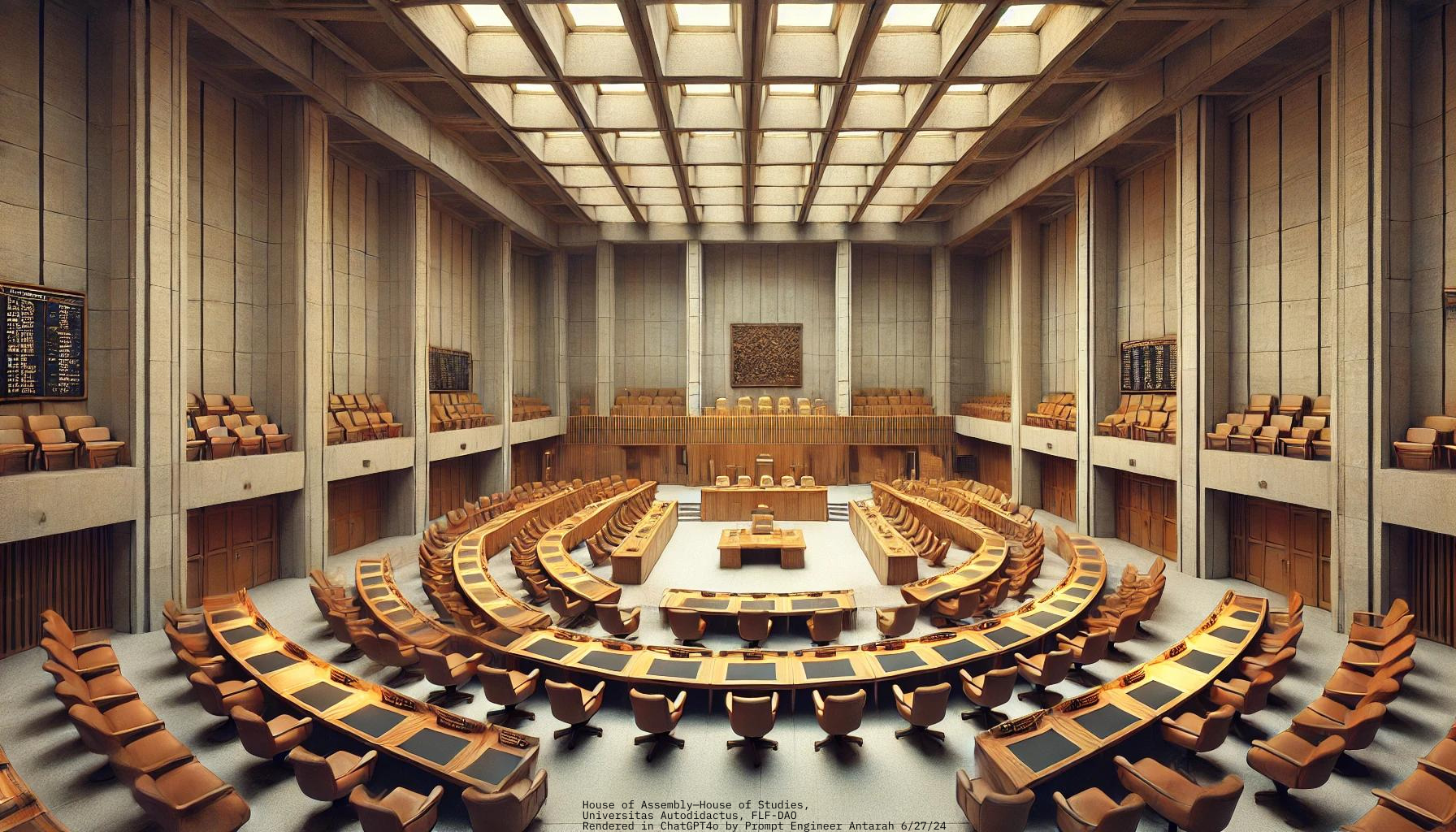
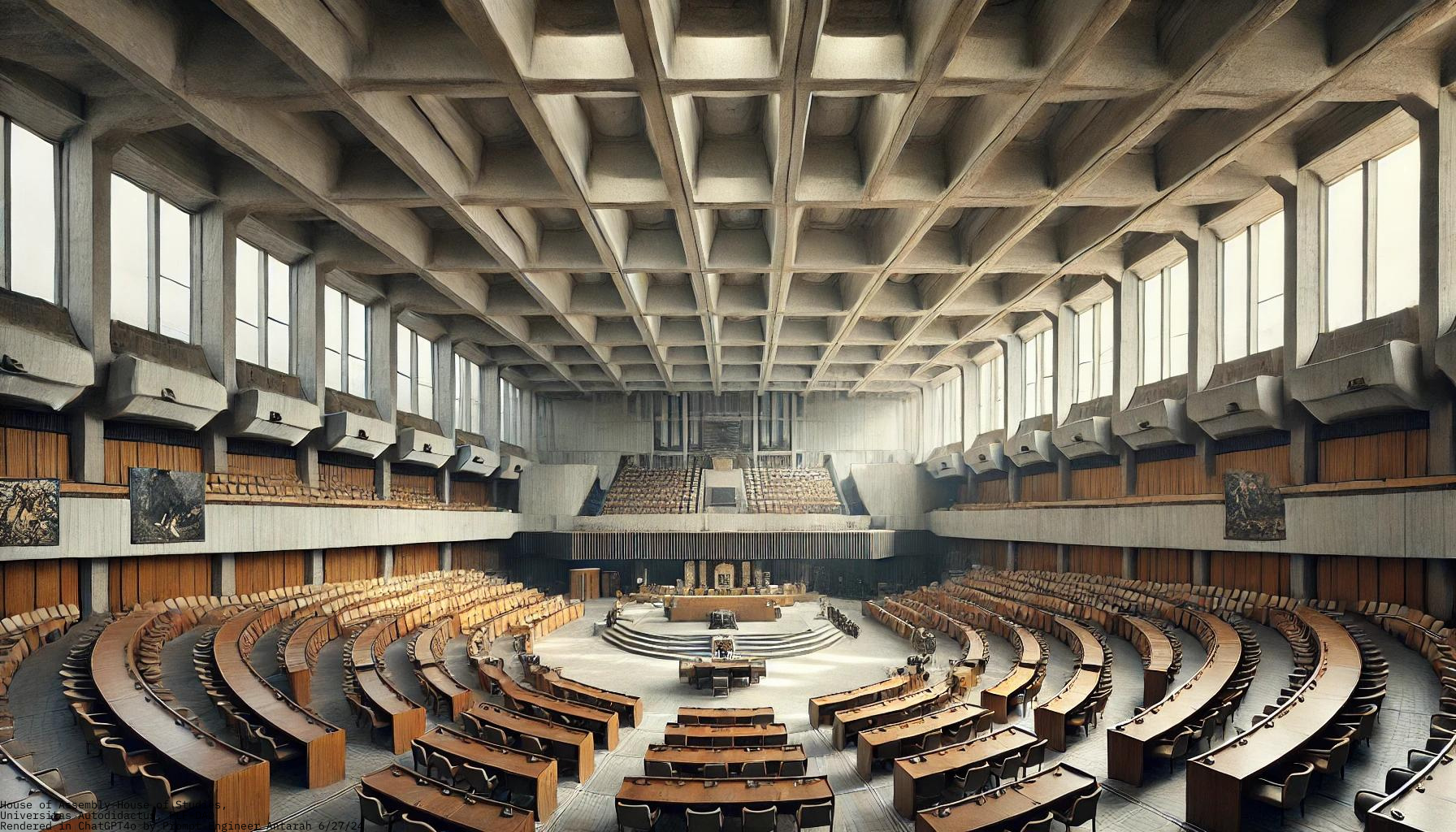
End of Transmission.

Proximus Amicus
IN THE KINGDOM OF GOD—IN THE NAME OF YAHUAH
A Firm League of Friendship (FLF) in the Nature of a
Decentralized Autonomous Organization DAO),
Department of Peace and Friendship (DOP),
Political Bureau of Education (Politburo),
Universitas Autodidactus (UA),
Office of Traveling Ministry,
Ministry of Public Friend
Antarah,
Director of the N∴S∴ Program,
NOVUS SYLLABUS, L.L.C.,
Freely Associated Service Provider

1st Minute of Public Service | last modified 24/6/9/11:59 AM 24/7/17/11:22 AM 24.07.18.04:30PM
Article I.
GENERAL
(a) Standing Project on Unprogrammed Meetings for Worship; in the Manner of Friends (in Convention of Sitting in Waiting); in Convention of a Sitting of Oyer et Terminer (Hearing and Determining); with a Concern for Business, and for other purposes; in a Regular or Special, General or Extraordinary, Whole or Committee Session.
(b) Objective: To continue in the path of simplicity, peace, integrity, community, equity, stewardship, and necessary direct action, conscientious objection, and civil disobedience exemplified by the conservative Society of Friends of the Truth and the Light which dwells in all God’s people, which principles are the foundation of American democratic-republican values as enshrined in the Bill of Rites and other statues.
(c) Product: the ‘Policy’ (textbook) Liber Praeceptum ‘LP‘ is the flagship product of N∴S∴, and is priced at $359.99, [target audience] for institutions/companies/organizations [clients] to purchase copies on behalf of their public/student body [users] to apply the Policy to their practice in order to do procedures, run programs, and manage projects. Clients may also purchase additional instructional and administrative services on retainer/hourly rate to support their practice, programs and projects. With purchase of preceptor services, users need not read the Policy purchased by the client, but may have it read and administered to them in an interface environment. LP is a large-language model dataset for the AI/ML engine of the DAO. As to LP, the Governor himself owns the IP copyright to the text, while N∴S∴ own the IP copyright to the reproduction of each page therefor and the text thereof.
(d) School (also known as ‘Shul’ or ‘Beth Midrash’) shall be considered a “regular” series of meetings convened during a “session” of the calendar year. For the purpose of school a “regular day” consists of two meetings and 10AM AND 2PM respectively, each of which shall last no longer than 3 hours and no less than 1 hour. The driver of school is General, G:\Do-Process, or the “GDP” application, operation or function. f(GDP) operates as follows:
General Due Process (GDP)
or, ‘P-Cubed’
(e) P-Cubed (‘PC‘ or ‘Process Cubed’) is the general governing methodology and operating environment (‘due process’) of the core lines of business (applications) of N∴S∴ (itself a development and operating system, or DOS). The interfacing “shell” of the DOS is an auto-server or client-server architecture located in a ‘mainframe‘ (a room, building or other capacitor) containing a ‘desktop‘. ‘C’ in PC can also refer to the cubic three-dimensional systemtheory Cognition—Command—Control. Therefore: “use your PC to C your Mindsoft DOS.”
(1) X-Axis Procedure
- Notice: Received input through sense perception.
- Data: The input distilled into quantifiable units.
- Information: The quantities expressed qualitatively.
- Knowledge: The crystallization of the qualitative output.
(2) Y-Axis Procedure
- Audit: To hear, collect, and/or record that which is noticed.
- Assessment: To evaluate data.
- Assurance: To vet and confirm the evaluation.
- Adjudgement: To adjust prior knowledge in light of instant output.
(3) Z-Axis Procedure
- Policy: Written guidance for daily or regular conduct, resulting in a transmission of charges*.
- Practice: Daily or regular conduct including activity, motion, interface, etc.
- Program: A regular and ongoing practice.
- Project: Particular work product class and their production processes.
*Note: charges are to be collected in exchange for rendering special services, but are not to be collected for rendering regular services.
[20240609: The concept that one multiplied or subdivided by itself, creating two, is a square of itself, and, multiplied or subdivided again by the same, is a cube, which is four, is crystalized in Mr. Gene Ray‘s discovery of nature’s harmonic simultaneous 4-day time cube which demonstrates that time is not linear but cubic (‘cubic awareness’). This systemtheory integrates the principle of opposites, 4-corner quadrant division, 4/16 rotation, and full spacetime hypercube into one seamless cubic logic. Mr. Ray found that earth has four days simultaneously in each rotation; we erroneously measure time from one corner; and the human form is a personified pyramid. The reader may be tempted to write off this theory is schizophrenia, but the instant author has found it to be most salient in light of the General Due Process Procedure which proceeds from the linear X axis to the squared Y axis to the cubed Z axis, thus defining the outer limits of ‘performance‘ of said procedure within the third density/dimensional plane.] [20240718: As an aside, it is evident that as a body passes through or traverses the 3rd-dimensional space-time continuum, there is a higher-dimensional cubic space or ‘chamber’ which emanates from the center of said body, enclosing it at all times at the body traverses the 3rd Dimension, and that entities can and often do occupy this higher-dimensional room/place, interacting with the 3rd Dimensional body (often without its knowledge or conscious awareness). This is similar to the apparent luminosity and ultraviolet radiation of the sun, which in actuality is fueled by an internal combustion of the black matter which invisibly pervades the waters above the firmament.]
(f) Program: The New Syllabus Program is the oldest project of the N∴S∴, established in 2014. This project is also a program. Other projects of N∴S∴ include, on the internal/directorship side: DISIS/DOSCOM, ORAS/OS/ARM, OO/OOG, GB&T MSS/WKPS/MNCS, NWPA, DHS, Mindsoft, Artcoin, and CORPS; on the external/administration side: UA, US, FTLU, DOP, PEACE-CORPS, and FLF-DAO. The 153D CORPS of N∴S∴ is also known as the “Beth Midrash” and supports the Politburo of the DOP, DAO and UA. The best way to describe the N∴S∴ is a Rabbinical-Islamic-Quaker political and educational organization, founded in the ancient and sacred mysteries.
(g) Degree: There are no honorary titles or degrees among friends. However, the Ministry of Public Friend Antarah, of NS, will confer the Degree of Knight of Djedu, conferring knighthood in the Ancient Order of Djedu, Melchizedek — Judges of the King of Righteousness — the only eligible degree in the program, for payment of $9,999.99, perfect attendance at one seasonal course of meeting, and pursuant to applicable precepts. The Meeting of Conference will be a special meeting and the degree will be conferred using an official sword consecrated to Peace and Friendship. Such conference conveys no honorary status nor moral endorsement, nor in any wise shall entitle the celebrant to be set apart from the friendly public. Antarah is authorized to confer this degree by authority of his doctoral dissertation of L.P.
(h) Liturgy: The liturgical program — work of the people, or public service — provided by NS is an unprogrammed dialectical meeting for worship convened by friends at the place of meeting, presided over by the head of meeting and attended to by the clerks of meetings. Such meeting may be convened for worship (communion and communication with the Inward Teacher/Christ) alone; with a concern for business; to convene a sitting of oyer et terminer; to confer upon a matter in question; or to confer a degree of Knight of Djedu Melchizedek. All services are provided free and without oath or obligation to the friendly public, with the exception of a Conference of Degree.
(i) Course: The regular semester of shul shall be called a serialized or year-based Seasonal Course of Meeting.
(j) Enterprise: Under Synchronized Decentralized Autonomous Command System (SDACS II), the “schedule of members and officers of the decentralized autonomous organization (DAO)”:
- Curricular Operations Research and Publication Services (CORPS) is a division [e.g., the Politburo or the UA];
- a college of the Universitas Autodidactus (U∴A∴) is a regiment [e.g. the 1st EC];
- a freely associated service provider is a company [e.g. the N∴S∴];
- a labor union is a platoon [e.g. the US];
- committee of any of the above units is a squad or team [e.g. a regular or special Meeting] NB: Regular, Special, and Festive Meetings are numbered sequentially.
(k) DOP PEACE-CORP Non-Commissioned (Enlisted) and Commissioned (Officer) ranks:
- Scribe (E-1)
- Djedi [Knight] (E-2)
- Rapporteur (E-3)
- Free Thinker [Dialectician I] (E-4)
- Truth Speaker [Dialectician II] (E-5)
- Light Worker [Dialectician III] (E-6)
- Ombudsman [Master Dialectician] (E-7)
- Program Director (E-8)
(l) Commissioned Officers pertain to a corpus meaning “body”, as in a union, university, assembly:
- Syndic, or Friend (O-1)
- Secretary Treasurer [Clerk] (O-2)
- Chair [of a committee] (O-3)
- Preceptor [of a Preceptory, or regiment] (O-4)
- Administrator [of an Association, or union] (O-5)
- Governor [of a Company] (O-6)
- General Consul [of a Division] (O-7)
(m) Testimony of Simplicity: Going forward the minister will not use honorary titles to distinguish himself beyond those earned by divine right, being the Director of N∴S∴ and a minister of God’s Word and other laws he precepted in the course of discharging that office. The minister shall be known by his first name only, and may be mentioned to descend from the House of Crawley of Nacotchtank, Washington, D.C. The director is no more of a minister of the Word than any other Friend.
(n) Testimony of Peace: Going forward the minister will not engage in any conduct that does or appears to inure to a violent or exploitative act.
Article II.
PRECEPTS REGARDING MEETING IN THE MANNER OF FRIENDS
from, Friends Meeting of Washington
(a) Worship
- Worship is silent and unprogrammed, and subject to the guidance of the Inward Teacher.
- A period of time is used to center into an inward stillness. Spirit-led listening is perhaps the most important task of the worshipper.
- Spoken messages come from the spiritual depth of one’s life and from the leading of the Inward Teacher.
- To be absorbed, each message needs to be followed with a period of silence which allows for deepening.
- When the vocal and silent ministry speak to the condition of those present and is developed and deepened in the Truth, a profound sense of spiritual community occurs that freshens and delights. This is what we call a “gathered Meeting.”
- Meeting for Worship ends after about an hour when the head of Meeting, on the facing bench, shakes hands with those nearby. We then greet those sitting around us in a similar manner.
(b) Testimonies
- Testimonies are what Friends call the ways we have found to live and act based on our beliefs. As a group, we find that listening to and following God leads to:
- Integrity—living as whole people who act on what we believe, tell the truth, and do what we say we will do.
- Simplicity—focusing on what is truly important and letting other things fall away.
- Equality—treating everyone, everywhere, as equally precious to God; recognizing that everyone has gifts to share.
- Community—supporting one another in our faith journeys and in times of joy and sorrowsharing with and caring for each other.
- Peace—seeking justice and healing for all people; taking away the causes of war in the ways we live.
- Stewardship (Care for the earth)—valuing and respecting all of God’s creation; using only our fair share of the earth’s resources; working for policies that protect the planet.
(c) Ecclesiastes
1. Friends or Quakers – either name will do as they have the same meaning – are the people who belong to Friends meetings or churches. These make up the ‘Religious Society of Friends.’
2. ‘Quaker’ was originally a nickname for the people who called themselves “Children of the Light,” “Friends of Truth,” or ‘friends of Jesus.” (John 15:15). They were said to tremble or quake with religious zeal, and the nickname stuck. In time, we also became known simply as ‘Friends.’
3. Quakers began in England around 1650 in the aftermath of the Protestant Reformation. In contrast to the formalism of the established church of the time, early Friends found they could experience God directly without the benefit of clergy, liturgy or steepled church.
4. Quakers do not have a creed. No single statement of religious doctrine is accepted by all the diverse bodies that make up the Religious Society of Friends. Most meetings accept a book of ‘Faith and Practice’ which states shared values, outlines a process for making decisions, and contains a uniquely Quaker feature, ‘Advices and Queries.’
5. Friends are united in stressing that an inward, immediate, transforming experience of God is central to our faith. We turn to an inner guide or teacher for direction. Many Friends identify this as the ‘Inner Light,’ the ‘Seed Within,’ or the ‘Christ Within’ [the ‘Inward Teacher’] Some affirm their acceptance of Jesus Christ as their personal savior while others conceive of the inward guide as a universal spirit which was in Jesus in abundant measure and is in everyone to some degree.
6. George Fox, a troubled and searching youth in 17th century England, underwent a profound religious experience that he described as a Voice answering his need: “There is one, even Christ Jesus, that can speak to Thy condition.” Immediate, direct experience of God became the heart of his message and ministry, the beginning of the Quaker movement.
7. Love – of God and neighbor – is expressed in Quaker worship, witness, and our testimonies. Our social attitudes and concerns, service, and programs of education and action are the fruits of our faith and the affirmation of the indwelling spirit and redemptive love.
8. The realization that there is the potential for good – and also evil – in all people makes Friends sensitive to human degradation, ignorance, superstition, suffering, injustice and exploitation. Under a sense of concern (inner prompting, divine obedience or urgency) Friends are drawn to humanitarian callings and to programs of education, service and constructive action.
9. Many Friends today are pressing for social change by nonviolent means: reform of the criminal justice system and elimination of the death penalty; elimination of discrimination against minority groups and racial injustice; and an end to war.
10. Most Friends reject the sacraments in their outward forms – communion and baptism as practiced in most Christian churches. We seek instead for the inward reality. For us, all great human experiences are of a sacramental nature.
11. The Bible was very precious to early Friends, but to understand the scriptures, they saw that they must be read in the same Spirit as those who wrote them. An early Quaker leader, Robert Barclay, said that the scriptures are only a declaration of the source and not the source itself. Today, Friends exhibit a wide variety of relationships to the Bible and other religious texts.
Source: https://quaker.org/testimony
12. Quaker testimony is best understood as the public witness of an inward faith of both individual and community. It is the consequence of one’s relationship to God and the outworking of that relationship in one’s life. Testimony is critical to the Quaker tradition as it is the practice side of “Faith and Practice,” a phrase you will see together often. Friends have always believed that what was most important was how faith was lived out collectively in the world. This praxis oriented perspective takes priority over doctrine or belief. For instance, early Friends did not practice baptism as an outward rite. Instead, Friends were called to live out their baptism in the world; show you are baptized by the Holy Spirit by the way you live your life. Witness and practice are good words today to help newcomers understand the meaning behind testimony.
13. Quaker scholar Pink Dandelion points out that among early Friends testimony was used in the “singular,” meaning that one’s whole life was to live out the consequence of their relationship with God in community. However, overtime testimony became pluralized (testimonies) and began to function more like lists of doctrines (protecting the boundary between Quaker community and those who are not Quakers), and eventually towards the individualization of “values.” It is less of a collective understanding and more up to each individual to decide how to practice their faith.
14. Today, you will often hear Friends use this pluralized language of testimonies referring to a broad range of Quaker beliefs and practices. Furthermore, a fairly recent simplification of testimony has resulted in the popular usage of the acronym “S.P.I.C.E.S.” standing for “Quaker values” such as Simplicity, Peace, Integrity, Community, Equality, and Stewardship. Regardless of usage, whether testimony, testimonies, or SPICES, the point is the Quaker commitment to “faith in action,” a living out and being a witness to what one believes.
Article III.
PRECEPTS REGARDING THE OFFICE OF TRAVELING MINISTRY
(a) Beliefs
- Every person is known by God and can know God in a direct relationship.
- The Quaker faith has deep Christian roots. Many Quakers consider themselves Christians, and some do not. Many Quakers find meaning and value in the teachings of many faiths.
- Quakers strive to live lives that are guided by a direct encounter with the Divine, more than by teachings about the Divine. Quaker terms for the Holy include God, the Seed, the Light Within, and the Inward Teacher, among others.
- Testimonies are ways that Quakers have found to express our experience of the Divine in our lives. Some of the best recognized testimonies include simplicity, integrity, equality, community, and peace.
(b) Worship
1. Quakers gather in the silence and wait expectantly to come into the presence of the Divine and to be guided by the still, small voice by which God speaks to us from within. During the silence, anyone may feel moved to offer a simple spoken message (vocal ministry) that is inspired by this holy encounter. Following the message, the silence resumes. A period of worship may include several messages or none.
2. In succeeding generations, as our religious society became settled . . . and as we became more geographically dispersed, the traveling ministry helped to provide needed communication between the various groups of Friends. . . . Traveling ministers were certified and trusted outsiders to the meeting’s “politics.” In this capacity they could be of enormous service to the community. Their ability to discern the spiritual health of the meeting, their mediating influence to reconcile differences, and their liberty to speak out on potentially difficult issues both spiritual and temporal were often very helpful to Friends.
3. During the [1900s], the formal practice of travel in the ministry among Friends had virtually ceased. In the unprogrammed tradition . . . it is thought that no one’s gifts in the ministry should be recognized over and above the gifts of others. Along with the advent of modern communication . . . formal travel in the ministry had all but fallen to disuse.
4. Recently, there seems to be a revival of the traveling ministry. . . .
(Jonathan Vogel-Borne, “Traveling in the Ministry”)
(c) Travel Minutes
Travel minutes (or “traveling minutes”) are issued to Friends who have worked with their monthly meeting to discern a clear leading to travel and visit other Friends. They may have a specific concern, they may have been asked to visit a meeting for a specific purpose, or it may be that God has moved them to worship with those Friends and to be with them. The Friend who is led to travel lays it before his or her monthly meeting along with the whole nature of the proposed visits as far as can be foreseen. If the monthly meeting unites with the concern or affirms the leading, it writes a minute to that effect and gives the Friend a copy. A travel minute should describe any specific concern the bearer is laboring under. When a meeting comes to unity with a member’s concern to travel, it should make sure that finances do not stand in the way by being ready to contribute toward the expenses incurred.
It is customary, where practicable, for traveling Friends to be welcomed into the homes of those whom they visit. This has the double advantage of saving expense to the traveler and of extending more intimately the benefit of the visit.
While visiting, the carrier of a travel minute presents it to the clerk of the body visited, who reads it aloud as a way of introducing the traveling Friend. (Only the travel minute, not endorsements, should be read.) At the end of the visit, the clerk writes and signs a brief note about the visit. This is called an endorsement. (See Sample Forms, Letters, Etc. for some examples.) Endorsements may be written on the back of the page or on additional pages attached to the letter.
When the proposed visits are completed, the traveling Friend should return the minute and all the endorsements to the body that issued it. The body may ask the traveling Friend to report on his or her experiences as well.
A travel minute represents an activity with a specific form: leaving, traveling under a concern, and returning to report on the completed event. For an ongoing ministry, another form of support, such as a minute of religious service, may be more appropriate.
(d) Companions in Ministry
Since the earliest times, Friends traveling with a concern usually had a companion who could provide both practical and spiritual support. This practice is currently being revived, largely through the influence of FGC’s Traveling Ministries Program. Friends who lead workshops and retreats or who travel with other leadings have found that having a companion in the ministry is of considerable spiritual and practical support. The companion prays for the minister as well as those ministered to, being attentive to how the Spirit is moving. The companion helps the minister to deepen his or her faithfulness. It is good practice to provide companions with traveling minutes that describe their supporting role.
(e) Minutes of Religious Service
A minute of religious service is more broad than a travel minute and can include any kind of service. It embodies a meeting’s recognition of a call to a religious service in someone’s life. […]
Chestnut Hill Friends suggest that a minute of religious service contain the following components:
- Name the work as explicitly as possible.
- Affirm that the meeting experiences the person as led to do the work; perhaps include how the person’s life and spiritual path have led to this work at this time.
- Name the meeting’s unity with the work, perhaps making reference to Friends testimonies.
- Name the meeting’s specific commitments to supporting this person and his or her work, including the appointment of an oversight committee.
- Ask the reader for his or her support.
- Give the approval date and an appropriate expiration date, with the signature of the clerk of the meeting. The expiration date may vary considerably, depending on the nature of the call.
When members of a meeting plan to travel and wish to make contact with other Friends, they may ask the clerk of their home meeting or the yearly meeting for a letter of introduction. The letter may also convey greetings from the meeting. There are no obligations for financial support, hospitality, or reporting back to the home group. The clerk can issue a letter of introduction on his or her own authority; no consultation or approval is necessary.
By Mathilda Navias. This is an excerpt from Quaker Process for Friends on the Benches available now from Friends Journal. From, https://www.friendsjournal.org/traveling-ministry/
Curricular Operations Research &
Publication Services provided by


