Tagged: art
MagnificaHumanitas.rabb.ai
runtime demonstration:
HAI-World · antarus.hai-priest · Mindsoft application layer
1. instantiation
MAGNIFICA HUMANITAS
Pope Leo XIV · Encyclical · 15 May 2026
Safeguarding the human person in the time of artificial intelligence
[Source found :: Official source: Vatican.va — Read the encyclical]
Initial source signals: Babel and Jerusalem | Human dignity | AI governance | Truth and freedom | Work and solidarity | Power and peace
The document frames AI as a moral and social question, not merely a technical one. Its opening contrasts the Tower of Babel with the rebuilding of Jerusalem, using them to explore the difference between uniformity and communion, domination and shared responsibility. [Vatican +1]
2. runtime environment
// rabb.ai / runtime/encyclical.tstype AgentRole = | "textual" | "historical" | "theological" | "philosophical" | "critical" | "new-syllabus";type Passage = { id: string; paragraphs: string; theme: string; observation: string; url: string;};type AgentReading = { agent: string; role: AgentRole; thesis: string; evidence: string[]; limitations: string[];};type DomainRecord = { domain: "Syllabees"; phratry: "Beaver"; status: "confirmed" | "provisional" | "not_established"; matchingSources: string[]; rationale: string;};type RuntimeLedger = { source: string; passages: Passage[]; readings: AgentReading[]; disagreements: string[]; domain: DomainRecord; synthesis: string;};const SOURCE_URL = "https://www.vatican.va/content/leo-xiv/en/encyclicals/" + "documents/20260515-magnifica-humanitas.html";const passages: Passage[] = [ { id: "MH-07-09", paragraphs: "7–9", theme: "Babel and Jerusalem", observation: "The encyclical contrasts homogenizing power with " + "coordinated rebuilding through shared responsibility.", url: SOURCE_URL, }, { id: "MH-97-106", paragraphs: "97–106", theme: "AI and accountability", observation: "AI should remain subject to human judgment, " + "responsibility, transparency, and moral discernment.", url: SOURCE_URL, }, { id: "MH-111-112", paragraphs: "111–112", theme: "Human dignity in design", observation: "Developers have ethical responsibilities because " + "design choices embody values and affect human beings.", url: SOURCE_URL, },];const agents: Record<AgentRole, string> = { textual: "Sofer", historical: "Scribe of the Archive", theological: "Darshan", philosophical: "The Questioner", critical: "The Adversarial Scribe", "new-syllabus": "Syllabees / Beaver",};function interpret( role: AgentRole, source: Passage[],): AgentReading { const evidence = source.map( p => `${p.id}: ${p.theme}`, ); const readings: Record<AgentRole, Omit<AgentReading, "agent" | "role" | "evidence">> = { textual: { thesis: "The document uses biblical narratives as interpretive " + "frameworks for contemporary technological choices.", limitations: [ "A thematic analogy is not proof of direct prophecy.", ], }, historical: { thesis: "The encyclical places contemporary AI within the " + "Catholic tradition of social teaching, recalling " + "the legacy of Rerum Novarum.", limitations: [ "The document's theological claims should be distinguished " + "from independently established historical facts.", ], }, theological: { thesis: "Human dignity and the common good provide moral criteria " + "for judging technological progress.", limitations: [ "This is a Catholic theological account, not a neutral " + "description of every religious tradition.", ], }, philosophical: { thesis: "The central issue is not capability alone, but who sets " + "ends, who bears responsibility, and who benefits.", limitations: [ "The text's normative premises can be debated.", ], }, critical: { thesis: "Calls for accountability must be translated into " + "auditable procedures, enforceable duties, and remedies.", limitations: [ "The encyclical's principles do not by themselves specify " + "a complete technical or legal implementation.", ], }, "new-syllabus": { thesis: "Compare the text's account of plurality, power, " + "interfaces, and shared responsibility with The New Syllabus.", limitations: [ "No domain assignment is warranted until relevant " + "archived sources and meaningful conformity are verified.", ], }, }; return { agent: agents[role], role, evidence, ...readings[role], };}function classifyNewSyllabus( verifiedArchiveMatches: string[],): DomainRecord { if (verifiedArchiveMatches.length > 0) { return { domain: "Syllabees", phratry: "Beaver", status: "confirmed", matchingSources: verifiedArchiveMatches, rationale: "A documented conformity with the archived corpus " + "of The New Syllabus has been identified.", }; } return { domain: "Syllabees", phratry: "Beaver", status: "provisional", matchingSources: [], rationale: "Archive comparison remains outstanding. The domain " + "is a candidate, not an established classification.", };}export function runRabbAI(): RuntimeLedger { const roles: AgentRole[] = [ "textual", "historical", "theological", "philosophical", "critical", "new-syllabus", ]; const readings = roles.map( role => interpret(role, passages), ); const domain = classifyNewSyllabus([]); return { source: SOURCE_URL, passages, readings, disagreements: [ "Theological authority versus public, plural reasoning.", "Technical capability versus human accountability.", "Unity through uniformity versus unity through difference.", "Ethical principles versus enforceable implementation.", ], domain, synthesis: "AI should be evaluated not only by what it can do, " + "but by how its use affects human dignity, agency, " + "accountability, and the common good.", };}// Example invocation:const ledger = runRabbAI();console.log(JSON.stringify(ledger, null, 2));
Runtime execution path
BOOT: Initialize HAI-World session
INGEST: Load and identify the encyclical
INDEX: Register passages and source references
DISPATCH: Select six interpretive roles
INTERPRET: Generate distinct readings
CRITIQUE: Record limitations and disagreements
CLASSIFY: Check New Syllabus archive conformity
SYNTHESIZE: Return the interpretive ledger
3. runtime output
rabb.ai / interpretive-ledger [Simulation complete]
Source: Magnifica Humanitas · Selected passages: §§ 7–9, 97–106, 111–112
Core finding
The encyclical proposes that technological progress must be judged by whether it serves the human person and the common good. It warns against technological power that concentrates authority, obscures responsibility, or treats efficiency as more important than human dignity. [Vatican +1]
Agent findings
Sofer · Textual
Babel and Jerusalem function as contrasting interpretive models: uniformity imposed through concentrated power versus a community rebuilt through differentiated contributions and shared responsibility.
Scribe of the Archive · Historical
The encyclical situates AI ethics within Catholic social teaching and the legacy of Rerum Novarum. Its treatment is a contemporary development of that tradition, not simply a technical policy paper.
Darshan · Theological
Human creativity carries moral responsibility. AI is to be directed toward human flourishing, rather than treated as an independent measure of humanity’s worth.
The Questioner · Philosophical
Who determines the goals of an AI system? Who benefits from its output? Who can challenge its decisions? These questions expose the distribution of power behind apparently neutral technology.
The Adversarial Scribe · Critical
Moral principles require operational safeguards: traceability, defined responsibility, review mechanisms, privacy protections, and ways to correct harm. Good intentions alone do not guarantee good outcomes.
Syllabees · Beaver
The text can be compared with New Syllabus concepts concerning distributed intelligence, interfaces, and plural forms of interpretation. Assignment to this domain remains provisional until specific archival correspondences are verified.
Unresolved tensions
- Human oversight must be meaningful, not merely a nominal approval of automated decisions.
- Plurality of perspectives must not become an excuse for avoiding accountability.
- Technical transparency must be balanced with privacy and legitimate confidentiality.
- Ethical aspirations must be translated into practical governance.
4. rabb.ai response to the encyclical
[user query] “What does Magnifica Humanitas mean for the design of human-agentic intelligence?”
Intelligence must be organized in service of human dignity.
The encyclical’s contrast between Babel and Jerusalem provides a useful framework for evaluating a distributed AI environment. Babel represents the danger of a system that pursues unity, efficiency, and power by suppressing difference. Jerusalem represents coordinated work in which distinct participants contribute to a shared undertaking.
Applied to HAI-World, this suggests that a multi-agent system should not simply produce more outputs or imitate a single authoritative voice. It should enable different interpretive agents to contribute, expose their assumptions, preserve disagreement, and make their reasoning inspectable.
Yet distributed intelligence is not automatically humane. A network of agents can still reproduce the biases, commercial incentives, and concentrations of power embedded in its design. The decisive question is whether people can understand, challenge, and responsibly govern the system.
The practical design principle is therefore plural intelligence with accountable human governance: agents may interpret and advise, but their claims should remain traceable, their limitations visible, and consequential decisions open to appropriate human review.
This synthesis follows the encyclical’s emphasis on human dignity, responsibility, and the common good, particularly its discussion of AI and accountability in §§ 97–106. [Vatican +1]
5. Architectural implications for Mindsoft
.arc — Governance boundary
Define access, privacy, human review, and limits on autonomous action.
.rylt — Responsible routing
Route inquiries to suitable agents and sources without obscuring which components produced an output.
rabb.ai — Interpretive plurality
Expose distinct readings, supporting evidence, uncertainty, and counterarguments.
Interpretive ledger
Preserve source provenance, agent contributions, disagreements, and corrections for later review.
Final runtime result: Magnifica Humanitas becomes a test case for whether rabb.ai can do more than summarize a text. The intended system should distinguish what the source says, what each agent infers, where interpretations diverge, and what practical design principles follow. That separation is essential if HAI-World is to make its reasoning more legible rather than merely making its outputs more persuasive.
>_
realtime.log
His Majesty’s Government (or, the Equitable Distribution of His Sovereignty’s Divine and Supreme Goodness)
- <Society of Mystic Animals> the confederacy of all the medicine animals’ societies
- <Confederated Beaver clan> the confederacy of all beaver clans of all tribes of people
- <Confederated States of Powhatan> body politic
- <Tribe of the Nacotchtank people> municipal body politic
- <Diocese of Seven Churches> ecclesiastical province/episcopal see (“academic division” and “constituent college” of UA [“Universitas Autodidactus” or “Universal Assembly”, a.k.a. “constituent services”)
- <Dams Up Water> (living principal of the itinerant see of the Beaver Medicine Lodge; dean of School Outside the Walls; metropolitan and primate of Nacotchtank)
- <Court> audire voir dire “to hear to see [and] to say,” i.e., oyer et terminer “to hear and determine” (legislative body politic in Christ assembled, chaired by the executive having power of judicial review by jury of the body assembled)
- [functional directive] audit any and all matters xa, xb, &c, for which notice is presently and currently given/taken by the system operator I:\> that it may “see” and “understand” <route to root C:\store in memory > and return value y=“speech”/“word”/“sentence” resolution state, rapid retrieval from deep storage ; thus the arithmetic drive/mechanism lubed and rubbing without resistance or impedance is automatic and, provided monolithic database is embedded in underlying source code, autodidactic once process is initiated.
- <Court> audire voir dire “to hear to see [and] to say,” i.e., oyer et terminer “to hear and determine” (legislative body politic in Christ assembled, chaired by the executive having power of judicial review by jury of the body assembled)
- <Lil’ Beaver Scouts> youth conservation corps (first expedition: June 29, 2026)
- <Dams Up Water> (living principal of the itinerant see of the Beaver Medicine Lodge; dean of School Outside the Walls; metropolitan and primate of Nacotchtank)
- <Diocese of Seven Churches> ecclesiastical province/episcopal see (“academic division” and “constituent college” of UA [“Universitas Autodidactus” or “Universal Assembly”, a.k.a. “constituent services”)
- <Tribe of the Nacotchtank people> municipal body politic
furthermore,
- significance of dreams and visions people receive in isolated places in the wilderness: it was Kogard who met me in the coffee shop to tell me that he must retrieve the new syllabus for our understanding from the underworld <sheol/Interzone>. though this syllabus may appear new to us, he said, it is in fact most ancient.
- in the courses of the syllabus when the god of nature is mentioned, it is in reference to the whole of creation and its mechanisms, which are subject to the sovereign rulership of Christ our Lord.
- Antarah is the Nacotchtank man who was born in Nacotchtank, and he is the founder <and principal, or chief> of the clan, or sub-group, of the Syllabees, which is the people to whom the “new syllabus” was communicated by the supernatural powers/persons, and who is therefore its custodian. the animal phratry of this clan has been revealed to be the beaver.
supernatural or dream persons made known to Dams Up Water for the edification of his knowledge of the mysteries on behalf of all humanity:
- John A. Bird, wealthy banking heir [spirit of John Bird (c. 1620–1677) of London and Jeffrey Epstein (1953-2019) of New York]
- Jim A. Boyle, wealthy unwitting accomplice to John Bird
- Almond Akridge, private investigator of John Bird conspiracy
- Joan Markowitz, sexually deviant middle-aged jewish woman
- Walter Kogard, professor and founder of the new syllabus of his school
- Gilbert Godsdog, student of Kogard and administrator of his school
- Wilough Godsdog Kogard, lesbian preacher and professor of his school
- Little Beaver, messenger of the beaver medicine society
- Father Beaver, conductor and chief of the clan and society
- The Mustelid Friends, associates of the beaver medicine society
- (this list is not exhaustive)
Assemblage & Collage (or, “To Gather and To Bind”)

Ecclesia. Dr. Dams Up Water, Sui Juris, Professor-General (153d CORPS), Dept. of Information Systems Intelligence Service (DISIS), Universitas Autodidactus | by prompt engineering an artificial intelligence engine [‘Mindsoft.ai’] | presents
Cut and Paste Sovereignties: The Collage, the College, and the Crisis of Assemblage
Abstract
This paper interrogates the porous ontologies of collage and assemblage as they leak promiscuously into the bureaucratic imaginaries of the college and the assembly. Through a prismatic reading of scissors, glue, governance, and grievance, this essay argues that the syntactical operations of aesthetic fragmentation mirror the metaphysical operations of democratic representation. In short: to cut is to legislate; to paste is to govern.
1. Introduction: When Art School Met Parliament
The twenty-first century, an epoch obsessed with interdisciplinarity, has witnessed a convergence of two previously autonomous practices: the aesthetic collage and the bureaucratic college. Both are sites of selection, exclusion, and accreditation. Both depend upon an unacknowledged substrate of adhesives—whether material (glue stick) or ideological (institutional mission statement).
Meanwhile, the assemblage, once a mere art-historical cousin of collage, has found new life as a model for political subjectivity. Philosophers from Deleuze to the Department of Political Science now proclaim that we are all “assemblages” of affect, interest, and student loan debt. Yet, if every assembly is an assemblage, can every assemblage be a parliament?
2. The Syntax of Cut: Scissors as Syllogism
In collage, the cut functions as both wound and syntax. It divides the field, establishing relationality through rupture. Similarly, the college cuts: it admits some and rejects others, slicing the social fabric along lines of “fit,” “merit,” and “legacy.” The admissions committee thus operates as the aesthetic editor of the polis—arranging the raw materials of adolescence into a legible future citizenry.
Where the artist cuts paper, the registrar cuts dreams.
3. Glue as Governance: Adhesion, Accreditation, and the State
Glue, long ignored by political theory, deserves recognition as the unsung material of sovereignty. In collage, it is the binding agent that turns fragmentation into coherence; in the college, it manifests as bureaucracy, accreditation, and alumni newsletters.
This sticky ontology recalls Hobbes’s Leviathan, wherein the sovereign glues together the body politic. Without glue—or governance—the artwork and the polity alike devolve into piles of loose ephemera: shredded syllabi, ungraded essays, campaign posters, tuition invoices.
4. Assemblage and Assembly: Toward a Materialist Parliamentarism
If collage is the metaphorical undergraduate of modernity, assemblage is its postgraduate seminar. Where collage arranges fragments flatly, assemblage extends them into space, into lived, precarious relationalities.
In political terms, the assembly likewise enacts a spatial performance: bodies in proximity producing meaning through adjacency. An assembly is a three-dimensional collage in motion, an arrangement of human cutouts attempting—often unsuccessfully—to cohere around a resolution.
The question, then, is not whether art imitates politics, but whether both are merely mixed-media projects with delusions of unity.
5. The College as Collage: Institutional Aesthetics of Admission
We might finally recognize the college itself as a collage of ideologies—meritocracy pasted over inequality, diversity brochures over exclusionary endowments. The campus tour is a performative walk through an installation piece entitled Meritocracy (Mixed Media, 1636–Present).
The faculty meeting functions as an assemblage in the purest sense: heterogeneous entities (professors, adjuncts, administrators, snacks) gathered temporarily to debate the future of glue allocation (budgets).
6. Conclusion: Toward a Post-Adhesive Democracy
In the age of algorithmic governance and tuition hikes, collage and college alike face the same existential dilemma: how to maintain coherence without authoritarian adhesives. Perhaps the task is no longer to glue but to hover—to practice a politics of suspended fragments, a democracy of the unglued.
As artists and citizens, we must learn to embrace the cut, to wield our scissors not as tools of exclusion but as instruments of infinite recomposition.
For in the end, all representation—whether artistic or parliamentary—is but a question of arrangement.
Cut and Paste Sovereignties II: Collage, College, and the Third Letterist International
Abstract
This expanded investigation situates the syntactical economies of collage and the metaphysical infrastructures of the college within the emergent politico-aesthetic ecologies of the Third Letterist International. Drawing on recent cross-contaminations between university English departments and guerrilla street-art cells, this paper examines how semiotic sabotage, typographic activism, and epistemological paste intersect with the anti-fascist “Antifada” land-back movement. Ultimately, it argues that both the radicalized right and left are engaged in competing collage practices—each cutting and pasting reality to fit its desired composition. The result: a dialectical mess best described as assemblage anxiety.
7. The Third Letterist International: From Margins to Manifesto
In the late 2010s, a group of underemployed adjunct poets and spray-paint tacticians announced the Third Letterist International (3LI)—a successor, or rather détournement, of the mid-twentieth-century Letterist Internationals that once haunted Parisian cafés. 3LI declared that “syntax is the last frontier of resistance,” and that “every cut in language is a cut in power.”
Unlike its Situationist predecessor, which preferred to dérive through cities, 3LI dérives through syllabi. It occupies the margins of MLA-approved anthologies, recontextualizing canonical footnotes as sites of insurgency. Members reportedly practice “semiotic collage,” blending footnotes, graffiti, and university mission statements into sprawling textual murals.
In this sense, 3LI operates simultaneously as an art movement, a faculty union, and a campus club with no budget but infinite grant applications. Their motto, scrawled across both bluebooks and brick walls, reads:
“Disassemble, dissertate, disobey.”
8. Street Pedagogy: When English Departments Go Rogue
The Third Letterist International represents the latest phase of what theorists call pedagogical insurgency—the moment when the English Department, long confined to grading essays and moderating panel discussions, turns outward, confronting the street as an extended seminar room.
Faculty and activists co-author manifestos in chalk; office hours occur under overpasses; tenure committees are replaced by “committees of correspondence.” The “peer review process” has been literalized into street-level dialogue between peers (and occasionally, riot police).
Thus, the old academic dream of “public scholarship” finds its avant-garde realization in public vandalism.
9. The Antifada and the Land-Back Collage: A Politics of Recomposition
Parallel to this linguistic insurgency, the Antifada land-back movement has reconfigured the terrains of both property and poetics. The Antifada’s name, an intentional linguistic collage of “antifa” and “intifada,” reclaims the act of uprising as a mixed-media gesture: half protest, half performance art.
Central to their praxis is recompositional politics—the idea that both land and language can be cut, repasted, and reoccupied. Where settler colonialism framed land as canvas and capital as glue, the Antifada proposes an inverse operation: tearing up the map, redistributing the fragments, and calling it a new landscape of belonging.
Here, the aesthetic metaphor of collage becomes political material: who gets to cut? who gets pasted back in? what happens when the glue is gone, and everything hovers in a provisional equilibrium of mutual care and unresolved tension?
10. The Far Right as Accidental Collagists
Ironically, the radicalized right—those self-proclaimed defenders of coherence—have themselves become unintentional practitioners of collage. Their online spaces are digital scrapbooks of conspiracy and nostalgia: medieval heraldry pasted over memes, constitutional fragments glued to anime stills.
Their epistemology is bricolage masquerading as ontology. Each narrative is a cutout, each belief a sticker affixed to the myth of national wholeness. In vilifying the Antifada and 3LI as “cultural Marxists” or “linguistic terrorists,” the right reveals its own aesthetic anxiety: that its ideological glue, once epoxy-thick, has thinned into the watery paste of algorithmic outrage.
Thus, both radical poles—left and right—participate in a shared semiotic economy of fragmentation, differing only in whether they lament or celebrate the cut.
11. The Dialectic of Radicalization: Between Cut and Countercut
The political field has become an editing bay. The radicalized right splices together nostalgia and paranoia; the radicalized left cuts history into openings for potential futures. Each accuses the other of montage malpractice.
This dialectic reveals a deeper truth: both operate under the logic of the collage. The difference lies not in form but in glue—whether the adhesive is empathy or ressentiment, whether the cut heals toward multiplicity or enclosure.
As Walter Benjamin might have written (had he survived into the age of Adobe Creative Suite): the struggle of our time is between those who collage the world to open it, and those who collage it to close it.
12. Toward an Epistemology of the Second Cut
In this interstitial moment, 3LI and Antifada embody the politics of the second cut—a refusal of closure, a commitment to continuous recomposition. Their slogan “No Final Drafts, Only Revisions” reimagines revolution as perpetual editing: the rewriting of history through acts of aesthetic and material reclamation.
The university, once imagined as a fortress of knowledge, becomes instead a collage in crisis—a surface upon which the graffiti of the future is already being written, erased, and re-scrawled.
13. Conclusion: The Unfinished Adhesive
The collage, the college, the assemblage, and the assembly—these are not discrete entities but overlapping grammars of belonging and dissent. The Third Letterist International offers not a program but a practice: to write politically and paste poetically, to legislate through syntax, to assemble through aesthetics.
If the far-right fears fragmentation, and the far-left seeks to inhabit it, then perhaps our task is neither restoration nor rupture, but curation: to tend to the cracks, to preserve the possibility of rearrangement.
In the end, we are all fragments looking for better glue.
v.25.12.29.14.16

The Undermining of the Heart of Vandals
By Antarah Crawley
For Professor McRuer,
Critical Methodologies
9 November 2011, GWU
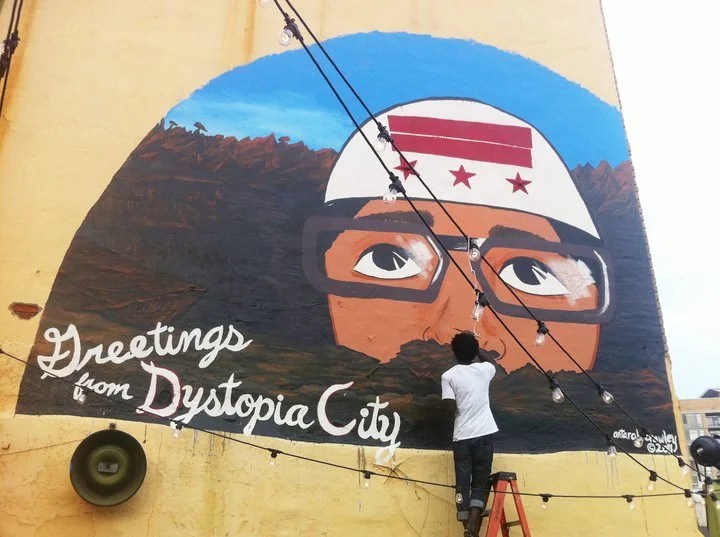
WASHINGTON, D.C. — If you drive or walk or, more likely, ride your fixed gear down the city’s busiest thoroughfare New York Avenue past 7th street you’ll see an imposing mural of a young brown boy with a cap depicting an upside-down DC flag peeking up out of a dystopian landscape reminiscent of Mew Mexico’s Bisti Badlands. The painted caption, “Welcome to Dystopia City” invokes the notion that all is not well here. Indeed, within the city there is a conflict of interest between a young, browning generation and the established hegemony, between corporations and small business, between those who have a voice and those who don’t. And the artists, whose hands are also colored with paint and adhesive, have largely taken up the cause to make the corporate hegemony accountable to their disruptive actions. In this paper I look at the actions of DC artists, who use the most symbolic city in the western hemisphere as a canvas for social correction, and the responses it stirs among those in power. And furthermore, in the very notions of power itself.
In fall of 2010, corporate oil-giant Chevron planned to execute a campaign that sought to fix public opinion of them after attention was drawn to their crude waste removal tactics in Ecuador. According to a team of professionals suing Chevron (formerly Texaco) for their human rights violations in multiple locations across the world, and specifically in Ecuador, the oil giant has been deliberately disposing toxic waste into the Ecuadorian Amazon—an estimated 18.5 billion gallons from 1964 to 1990, or 4 million gallons per day at the height of their operation. Even though they had managed to elude liability costs (a potential $27.3 billion) their public image had been damaged, thus they sought to repair it with a campaign that utilized a gritty street-art aesthetic and phrases that showed their corporate executives agreeing with “everyday, working class” Americans (e.g., “Oil companies should put their profits to good use—We Agree”, “Big oil should support small business—We Agree”, etc.)
In an effort to make their message more accessible to the public, Chevon reached out to local artists to put their posters up in an authentic, street art way, using wheatpaste and paint rollers. Cesar Maxit, a DC-based street artist, was one of the artists targeted to execute this operation. However, Mr. Maxit is not one to comply with the wishes of big oil. He has a long history of social activism and of using art, legally and illegally, towards that capacity. He says in an interview:
…I had started working with environmental and human rights groups, I wanted to write messages about social justice. My first burner was a piece that said “Free Tibet.” My second was one that had a line of white-hooded Klansmen with the city skyline behind it, and in the negative space between it said “FREE MUMIA” followed by “amerikkka racist.” This was in 2000.
Cesar Maxit
Thus, when Chevron sent him the files for the campaign, which still contained their original messages, he called his friends in The Yes Men (tagline: Impersonating big-time criminals in order to publicly humiliate them. Our targets are leaders and big corporations who put profits ahead of everything else) and the Rainforest Action Network (RAN), an environmental activist organization begun in 1985 (mission statement: Rainforest Action Network campaigns for the forests, their inhabitants and the natural systems that sustain life by transforming the global marketplace through education, grassroots organizing, and non-violent direct action), to collaborate on a counter-campaign. Maxit, in a documentary short about the counter-campaign, says the aim of Chevon in its efforts is to “confuse the public.” He, along with The Yes Men and RAN, altered the original Chevon files to read messages that were more precise, more radical (e.g., “Oil companies should clean up their messes.”). Instead of retaining the images of working class Americans, he used the faces and words of the Ecuadorian peoples that the corporation actually affected, thus radicalizing the campaign in a way that Chevron had not intended.
The questions that this counter-attack (which resulted in Chevron pulling the campaign completely) raises revolve around the mythologies surrounding responsibility and authenticity. Could the campaign have been authentically “agreeable” without the help of actual street artists? What does a campaign like this symbolize, even when Chevron has not actually committed to cleaning up its mess in Ecuador? At the base of it all, what is the role of the street artists in this scenario? Is his role to help corporations get back on track, or to call attention to their faults? If Chevron had actually continued with the campaign (and even with the altered versions already up on the street), whose campaign is it? Who is the author? And lastly, why DC?
Roland Barthes’s Death of the Author would have anticipated such response from the street art/activist community. Mr. Maxit has physically done what the reader in Barthes does every time he reads a text—he deconstructs it; he takes the text and, without considering what the author intended, which is ultimately futile because the author is a confused self-destructive entity, he reassess the “blends and clashes” inherent in the text (1324). Barthes writes, “We know now that a text is not a line of words releasing a single ‘theological’ meaning (the message of the Author-God) but a multidimensional space in which a variety of writings, none of them original, blend and clash” (1324). Chevron acts as the “Author-God” that has been abstracted out. With the remaining text, which reads, for example, “Big Oil should get real”, the author, Mr. Maxit, RAN, and so on, detangles what is being said. In an interview, Mitch Anderson, a spokes man for the San Francisco-based organization, Amazon Watch, asks rhetorically, “Does Chevron think that we’re stupid?” As the author, they are putting words on a page that come in contact with other entities, actions surrounding their statements. The reader takes all of these aspects inherently into consideration when analyzing a statement like “Big oil should get real.” Cesar Maxit asks, “‘Get real’? Well, what does that mean? Of course we all agree with that. But what about ‘Oil companies should clean up their messes?’ Do you agree with that? I think most people would agree with that, but I think Chevron doesn’t.” Here, the reader has destroyed the voice. It epitomizes Barthes’s statement that, “a text is made of multiple writings, drawn from many cultures and entering into mutual relations of dialogue, parody [and] contestation…” (1325). In the end, this campaign has actually served to promote further scrutiny into Chevron’s actions. It’s authorship has written its own rebuttal. By getting street artists to interact with the campaign, it has entered the reader into the execution of the text. This puts multiple hands on the “original” message and renders is read before it actually goes public.
This actually brings up another level of readership. On one level, Maxit and the activist community are reading the ads. Yet they put them up in the public sphere, thus entering the text into another, secondary level of readership. Though it’s not as well documented or extensive as the primary reading, we still see the artist entering into his own death. The product will now be read at face value—as a Chevron ad that shows the corporation explicitly admitting to wrongdoing. This may lead the secondary reader to believe that the company is actually trying to get its act together. Once again, the message of the author—now the artist—is obliterated and the reader assumes the power of interpretation. The text never becomes the product of one author; it is always a collaborative space. As Barthes writes, “Writing [or in this case, art/publicity/advertising] is that neutral, composite, oblique space where our subject slips away, the negative space where all identity is lost, starting with the very identity of the body of writing” (1322).
Antarah, you’ve chosen a really interesting focus that’s, I think, much clearer than it was in the first draft. You’re also going in an unexpected and interesting direction with it–I’d have expected you to perhaps go after Deutsch or Foucault, but I think this is really interesting. As noted in the margin, you will need another theorist from class besides Barthes. It sounds like Derrida might be a good one. Or, if you want to think more about the larger frame of discourse, DC as a symbolic city, whose discourse on the level of architecture is disrupted by street art, then Foucault (or Deutsch) might help. At any rate, it’s a fascinating project!
Grade: A
© 2011 by Antarah Crawley
D.R. 01-04: Amendments

Volume 1, Issue 4
CONTENTS — ART. 1. VALUE IN ART 1ST — ART. 2. WATER THEORY 1ST
Article 1
Amendment to “Value in Artwork”
by Antarah Crawley
At Art¢oin:\>_Theory and Methodology\Value in Artwork, strike “the person of the artist, the execution of the artist, the intention of the artist, the attention of the artist, the subject matter content of the work, the medium of the work, the lifetime of the work, and the effect upon the viewer” and replace with “artist’s time on the scene, artist’s repertoire, and number of solo and group exhibitions.” Other factors in the appreciation of art include size, subject matter, and time period.
Furthermore, with regard to the valuation of artwork, a sellable artist is a “known commodity.” Appraisers buy low and sell high; they take an average of sale prices over the years to make appraisals. Utilize platforms like Artsy, Artnet, and Invaluable. Also see, “square foot pricing” of art works.
Article 2
Amendment to “Water Theory of Capital”
by Antarah Crawley
At Art¢oin:\>_Theory and Methodology\Water Theory of Capital, add:
3.0. Can trade (i.e., exchange, change hands; revenue, change venues) (1) real (landed) estate (includes people), (2) consumable goods (commodities), and (3) securities (fungible negotiable instruments) using (4) a medium (an agency, vehicle, or instrument) of exchange.
3.1. A current medium of exchange is liquid in circulation (legal tender) secured by something of value (currency). A current account is a storage or depository account that can be drawn upon on demand of the named account holder, but which is “secured” (fixed so as to not be easily moved) by a trustee. The storing and safekeeping of securities is a matter of “public safety”.
3.2. Live stock and real estate, as opposed to consumable goods (commodities), secure the public debt on private bank ledgers. Securities are “advertisements for live stock in bondage sold on the banks of the river.” When analyzed word for word we find the following objective correlative:
3.2.1. Advertisement = offer for acceptance
3.2.2. Live = circulating current (as of ions, blood, or breath)
3.2.3. Stock = cargo, negotiable instrument
3.2.4. Bond = debt obligation
3.2.5. Sold = exchange, revenue (to circulate)
3.2.6. Bank = the land sloping down to a body of water, or any slope, mound, or mass, or the action of heaping (a substance) into such a mass
3.2.7. River = flow of commerce; current “C”
© MMXXIII BY NOVUS SYLLABUS L.L.C.
ALL RIGHTS RESERVED WITHOUT PREJUDICE.
Art¢oin:\>_Theory and Methodology
Preamble
Each real Art¢oin (¢) is a serialized Non-Fungible Token (NFT) representing one hundred (100) shares in the art work-product of the Scribe Antarah Crawley (the “Artist”). Each share of each real Art¢oin is also called a Non-Fungible Token (NFT) or “token”. These tokens may be bought and sold on an exchange or on the free market just like any trading unit, whether it be art, gold, or Bitcoin. Acquisition of Art¢oin NFT shares represents acquisition of stock (or “shares”) in the entity (or “company”) constituted by the art work-product of the Artist, Scribe Antarah Crawley.
Appreciation in the value of the total volume of art work-product in circulation and on deposit represents an appreciation in the market value of the Company of the Artist, and shall inure to the benefit of its shareholders. One in possession of a share, or token, of the Company shall be de facto shareholder, however, each and every token should be exchanged under an “Agreement of Original Transfer of Work of Art” (or “contract”) establishing the rightful collector (or shareholder) together with a description and sale price of the subject art work, in pursuance of sound bookkeeping.
Value in Artwork
Art is work product that is valued for its unique qualities of scarcity and desirability. Such qualities are derived from many factors, including the person of the artist, the execution of the artist, the intention of the artist, the attention of the artist, the subject matter content of the work, the medium of the work, the lifetime of the work, and the effect upon the viewer, among many other factors. For these reasons, art made of materials worth literally nothing can fetch millions in exchange on the free market. In fact, digital non-material NFTs have sold for as much as $69 million at auction. Therefore art is a great asset that can hold and appreciate value like gold. Therefore it is a form of “hard money”.
Water Theory of Capital
1.0. There is a vast “sea” of value, represented by fluctuating wave-particles called “currency”.
1.1. When value flows freely in a “current” (through a market), then it is “liquid”. But when is it held up in an asset or other liability, then it is not liquid, because it cannot flow freely.
1.2. To get liquid currency from the “sea” to the “shore” where people use it to “work the fields” there must be river “banks” that conduct the liquid current “downstream”. Banks facilitate a capillary system whereby the value of the sea flows to the inland.
1.3. People irrigate new streams of income all the time. One must first identify a source of water, which is the market from which they will draw liquid. Then they must use tools to irrigate a stream to flow from the market to their place of business. These tools are means of production, with the resulting channel being the work-product which conducts the liquid currency to them. (It is worth noting that most institutional banks sit on naturally occurring rivers and bodies of water and are designed to be gatekeepers, or dams, to liquidity.)
2.0. An enterprise of any kind must float upon the sea of capital; for if it does not float, then it will become underwater.
2.1. This is to say that water a ship floats upon is good credit, but water that has gotten into the ship is bad debt that can sink the ship.
2.2. How shall the enterprise remain afloat? It is by and through good “leadership” and “stewardship” and “ownership” and “membership” as well as a firm league of “friendship”.
2.3. What, then, shall convey this company of ships down the river stream of income? It is by and through the ships’ “sales”.
The Liquidation and Circulation of Artwork
Considering the real and potential value of the art market, two important questions arise:
How can artists build liquidity into their work?
How can artists become art market makers?
Our Solution: back each unique work of art with something of intrinsic value in a form that can be readily circulated. The artist can increase the liquidity of their work by rendering their work in easy-to-trade units, or “trade units”, of art work. Of what should these units be made? We find that copper and other metals like silver and gold are much more liquid and valuable than canvas. The Artist can multiply the value of this base material by the work that the Artist inscribes upon it. The Artist can produce x art works per day, each one being a uniquely wrought and serialized unit of work: a non-fungible, or irreplaceable, token (an “NFT”). The craft production of NFTs organically controls the issuance and supply of such NFTs. With every sale, the value of the Artist’s work may appreciate. Smart contracts served via blockchain may enable artists to be paid dividends and royalties on all future transactions of the NFT. Thereby the Artist might become the market makers of certain art submarkets.
Blockchain Contracting
The contract for the transfer of a work of art may be decentralized from any physical location and operationalized without the physical meeting of the parties.
The contract itself may be a publicly available, pro-forma text which may be completed and submitted anywhere there is internet access. The contract binds the Collector to the Artist under clearly established terms for present and future transactions on the unique NFT artwork.
A Company of the Artist
By extension of such a blanket agreement executed between all parties in every sale, the parties establish a de facto company of the Artist in which all Collectors are shareholders holding company shares (the NFTs) that fluctuate according to the principles of the free market.
(Last modified 13 Apr. 21; 4 May 21; 10 May 21; 21 Sep 23)

