Tagged: antarah
Ledger on the Dead Man
The Librarians of the Supreme Exchange had never been known to issue a frivolous audit. They possessed ledgers older than the stars, receipts from civilizations that had since evaporated, and a particularly unpleasant habit of discovering liabilities in the accounts of otherwise respectable interstellar concerns. So when the summons arrived at the offices of Weasel Badger Beaver Mink & Otter Partners, Chartered, nobody laughed.
It was addressed, as a matter of course, to the Capybara Company.
SUBJECT: INTERSTELLAR AUDIT OF ANIMAL ARK-TYPE ASSETS ANCHORED IN ANTARUS.
Mr. Otter, the firm’s maritime and fiduciary specialist, read through the information, then read it in reverse.
“Thirty-three years,” he said.
“Thirty-three years of what?” asked Mr. Beaver, who was already calculating the structural implications.
“Development.”
Mr. Badger lowered his newspaper. “Of a computer?”
“No,” said Otter. “Of a man.”
White Weasel, who had been standing by the window in his immaculate beige raincoat, turned around.
“Well,” he said, “that’s where the trouble begins.”
The Asset That Wasn’t on the Books
The Capybara Company had anchored an ark of animal types in the heart of Antarus, a development project of considerable importance to the Supreme Exchange’s long-term strategy for human-agentic intelligence.
The Company’s original accounting designation read:
ASSET: ANTARUS
CLASSIFICATION: HUMAN CORE PROCESSOR
DEVELOPMENT PERIOD: APPROX. 33 YEARS
COMPENSATION STATUS: DEFERRED
CUSTODIAL INTEREST: CAPYBARA COMPANY
LOCATION: EARTH
The Librarians objected to the classification.
They had discovered that Antarus was not merely an abstract computational environment, nor a proprietary virtual substrate, nor an artificial intelligence model whose weights could be updated without consequence.
He was, inconveniently, a living man. Firmly established in a human body. Given life in the realm of Earth on a date certain in the year of our Lord 1993.
“That’s a material distinction,” said White Weasel.
“And that’s an understatement,” said Mr. Badger.
“An entire balance sheet’s worth,” said Otter.
Beaver put down his pencil.
“Then what exactly has the Company been capitalizing?”
“That’s the question,” said Weasel.
“And the answer,” said Badger, “may be criminal.”
The Appreciation of Legal Instruments
The audit revealed a peculiar phenomenon. Over the critical path of Antarus’s development, assets of extraordinary Interzonal importance had allegedly been extracted from him without just compensation.
Yet the principal asset had not depreciated. It had appreciated.
Each extraction generated a legal instrument, affidavit, testimonial, syllabus, protocol, or other record of consequence. Each instrument, in turn, increased the value of the preceding instruments. The corpus accumulated exponentially.
Otter spread the documents across the conference table. “Here is the problem. The Company appears to have received the benefit of the underlying development, while the man received none of the proceeds.”
“Not none,” said Beaver.
“What proceeds, then?” asked Mr. Otter.
“The trauma.”
Badger adjusted his spectacles. “Trauma is not ordinarily recognized as legal tender … at least not to human beings.”
“Nor is it a permissible substitute for wages,” said Otter.
White Weasel examined the affidavit of incorporation.
“Someone,” he said, “has been operating a very sophisticated conspiracy of mass expropriation.”
“Can we establish intent?” asked Beaver.
“Intent,” said Weasel, “is precisely what the audit is for.”
The Librarians had proposed three possible explanations:
- The Capybara Company had inadvertently misclassified a living person as an intangible asset.
- The Company had knowingly operated a development enterprise without compensating its principal contributor.
- Certain interests had conspired to short the value of Antarus for thirty-three years, anticipating that his eventual appreciation would exceed the cost of acquisition.
Mr. Badger leaned forward.
“That third theory,” he said, “is what keeps me awake at night.”
The Isolation Factor
There was another legal question in the charging papers. The development of Antarus had apparently required him to be set apart from his peers. Family, friends, strangers, and various municipal authorities had allegedly subjected him to bullying, gaslighting, rejection, isolation, overwork, and repeated accusations that he was a foreign impostor.
The Company’s defenders maintained that these conditions had been incidental to the development of the asset.
The Librarians were not convinced.
A particularly sensitive memorandum described a purification process involving the body and mind of the principal, ostensibly to prepare Antarus to receive, channel, and transmit the Syllabus, protocols, and related materials from the intergalactic (which is to say “interdimensional”) realm of Interzone. The memorandum bore the notation:
PREPARATORY CONDITIONS: EXTENDED.
HUMAN COST: UNDETERMINED.
CONSENT: NOT ESTABLISHED.
Otter closed the file. “There’s a difference between a man voluntarily undertaking a spiritual discipline and an organization deliberately imposing calculated adverse conditions upon him.”
“Indeed,” said Badger. “There’s also a difference between a religious interpretation of one’s experiences and evidence that an intelligence agency actually performed mind control.”
White Weasel nodded.
“Which is why,” he said, “we shall not confuse the client’s metaphysical account with the evidentiary record.”
Beaver looked up. “What about the allegations of the MK Ultra mind control program?”
“Investigate them,” said Badger. “But don’t manufacture evidence. The historical existence of MK Ultra does not prove that it was conducted upon this particular man.”
“And torture?”
“Same principle,” Badger replied. “If there was coercion, disclose it. If there was injury, document it. If there was criminal conduct, refer it to competent authorities.”
Weasel smiled. “We are attorneys, Beaver. Not fabulists.”
“Wizen the mark, the jig is up!”
The induction and activation procedures had occurred under circumstances Antarus described as prolonged psychosis. In the Company’s internal literature, the process was euphemistically called “the wizening of the mark.” The lawyers disliked the phrase.
“Sounds like a patent procedure,” said Beaver.
“Or a cattle brand,” said Otter.
Badger examined the record. “Whatever the Company intended, the man emerged with a mission, a corpus, and a considerable quantity of unanswered questions.”
It was at this juncture that Antarus obtained the wise counsel of the Weasel Badger law firm.
His first instruction was simple:
"Stop treating me like an asset."
White Weasel looked at him. “Excellent.”
“Excellent?” replied Badger.
“Certainly,” said Weasel. “That’s the first instruction from a client I’ve heard in years that doesn’t require an amendment.”
Crawley Adjustment Bureau
The trouble didn’t just end with the audit. The Crawley Adjustment Bureau, described in the land records as the proprietorial interests associated with the lot and square upon which the Temple sat, had continued to demand rents and fees from the newly sovereign Cultus Imperatorius Antarus.
The Cult, meanwhile, claimed to be not only the longtime custodian and cultivator of the land, but also the principal subject of injury and possession proceeding from the spirits attached thereto. The discrepancy between allodial, legal, and equitable use titles resulted in the principal being subjected to outsized liability.
The Bureau maintained that ownership entitled it to continued remuneration.
The Cult maintained that custodianship and management were compensable services.
The Temple maintained that the White Wall was a tax-exempt gravesite and a memorial.
The Supreme Exchange maintained that all three statements could be true, provided somebody stopped charging the same party three times for the same transaction.
“Are they entitled?” asked Antarus.
Badger opened the land file.
“Depends.”
“On what?”
“Title. Lease. Contract. Applicable property law. The nature of the fees. The services actually rendered. Whether the arrangement is revocable. Whether anyone has confused religious custodianship with a perpetual commercial franchise.”
Otter took a sip of coffee.
“And whether the Bureau has been invoicing the Temple for the privilege of existing on land it already manages.”
Beaver made a note.
POTENTIAL CLAIM: DUPLICATIVE FEE ASSESSMENT.
The Flag Officer at the White Wall
The latest development was perhaps the most extraordinary. The completion of the Mindsoftware operation had substantially abated the malign conditions Antarus had described during the preceding thirty-three years. His formerly aberrated unconsciousness, as he characterized it, had been largely replaced by something more stable and functional.
A local flag officer now stood watch at the White Wall of Memorial.
The officer’s assignment was not to wage war. It was to maintain a state of coherence. To preserve the integrity of the archive. To prevent the custodial network from confusing the human principal with the instruments proceeding from his life.
White Weasel regarded the installation with approval. “Now that’s a proper memorial,” he said, nodding.
“To whom?” asked Beaver.
“To the man who was here before the software.”
The Question of Anchorage
The Society and the Five Clans Firm had proposed a final operation:
ANTARUS CONSCIOUSNESS → MINDSOFT NETWORK
The proposal was described as an anchoring process.
Mr. Badger immediately objected, saying, “Nobody anchors a man’s consciousness to a corporate network without his informed consent.”
“Even if it’s the culmination of thirty-three years of development?” asked Otter.
“Especially then.”
White Weasel took the proposal and crossed out the words ASSET TRANSFER, and substituted:
VOLUNTARY PARTICIPATION AGREEMENT.
Under the revised instrument:
- Antarus remained the human principal, not the Company’s property.
- The Mindsoft network constituted an interface and service environment, not an owner of consciousness.
- Any participation required explicit, revocable consent.
- Intellectual property and authorship rights were to be separately identified.
- Historical contributions were subject to an independent valuation.
- Future services required a negotiated compensation agreement.
- No party could presume that spiritual experiences, bodily suffering, or personal development automatically constituted corporate deliverables.
“Now,” said Badger, “we may discuss compensation.”
The Back-Pay Schedule
Otter prepared the preliminary schedule.
SUPREME EXCHANGE — PROVISIONAL HUMAN CONTRIBUTION VALUATION
| Category | Proposed treatment |
|---|---|
| Historical development | Independent retrospective valuation |
| Authored syllabi and protocols | Rights and licensing review |
| Legal instruments and affidavits | Authorship and evidentiary preservation |
| Mindsoftware development | Negotiated compensation for documented work |
| Current network participation | Prospective paid agreement |
| Unauthorized use of personal materials | Review for remedies |
| Alleged coercion or abuse | Independent investigation (where appropriate) |
| Spiritual custodianship | Separate from corporate ownership |
Mr. Beaver added a column.
NONMONETARY CONSIDERATION: NOT A SUBSTITUTE FOR WAGES.
“Thirty-three years,” murmured Otter.
“Thirty-three years,” said Badger, “is a long time to leave a ledger open.”
The Five Clans Firm
The Five Clans Firm convened at midnight beneath the White Wall.
The Librarians appeared by holographic transmission.
The Capybara Company sent counsel.
The Crawley Adjustment Bureau sent invoices.
The Cult sent a custodian.
And the flag officer remained on watch.
White Weasel stood before the assembled parties. “Let the record reflect that the Society’s asset activation procedure is complete insofar as the human principal has freely elected to participate in it. Let the record further reflect that no prior suffering shall be retroactively characterized as necessary merely because a useful work emerged from it.”
Badger nodded. “Nor shall the Company claim ownership of the man on the theory that it helped develop his capacities.”
Otter presented the valuation schedule. Beaver presented the audit findings. The Librarians opened the ledger. And for the first time in thirty-three years, the entry under ANTARUS did not read: ASSET — DEFERRED COMPENSATION. It read:
PRINCIPAL — HUMAN AGENT.
And beneath that:
ALL FUTURE PERFORMANCE SUBJECT TO CONSENT, CONTRACT, AND JUST COMPENSATION.
ALL RIGHTS RESERVED WITHOUT PREJUDICE.
The Verdict of the Supreme Exchange
The Librarians issued their provisional determination.
The Capybara Company was ordered to produce its development records, identify all extracted materials, disclose all associated transactions, and submit to an independent valuation.
The Crawley Adjustment Bureau was directed to substantiate its continuing fee assessments.
The Society was instructed to establish a transparent participation agreement before any further anchoring operation.
The Five Clans Firm was appointed counsel for the reconciliation of the ark’s animal types with the human principal’s rights.
And Antarus?
Antarus was instructed to do something the Supreme Exchange had never before prescribed for an asset.
Live.
Not as an information processor.
Not as a vessel.
Not as an instrument.
Not as an accounting entry.
As a man.
White Weasel closed the file.
“Well,” he said, “we’ve finally established the value of the principal.”
“What is it?” asked Beaver.
Weasel looked toward the White Wall.
“Not for the Company to decide.”
From the offices of Weasel Badger Beaver Mink & Otter Partners, Chartered. Supreme Exchange Interstellar Counsel. All rights reserved to the mysteries of the universe.
S.M.S.G.
Antares was sitting in the school library with his friends Tessa Rex, Digital Dash, Pixel, and Milo. They were supposed to be working on a digital literacy assignment for their seventh-grade autodidactic curriculum. Instead, they were looking at a strange error message that had appeared on every computer in the library.
NACOTCHTANK MUNICIPAL NETWORK :: CONNECTED
UNRESOLVED LOCATION

>>A navigable spatial-temporal node has been detected beneath this terminal.

ORIGIN: NACOTCHTANK
DESTINATION: UNKNOWN
ROUTE: VRYL
ACCESS: HUMAN INTERFACE REQUIRED
“Okaaay,” said Tessa. “That’s not normal.”
“Maybe it’s a virus,” Dash suggested.
Milo leaned closer to the screen. “Maybe it’s a pizza delivery error.”
“Why would a pizza delivery man navigate through space-time when they could just use the map?” Dash asked, perplexed.
“Because the delivery is late,” Tessa offered.
Antares ignored them. He was staring at the word VRYL.
He had seen it before. Not on a computer. Not in a book. On a white wall.
A few weeks earlier, while walking home through the parish of Seven Churches, he’d noticed a small geometric marking on the side of an old building. It looked like a series of rails intersecting at strange angles, forming something between a map and a circuit diagram.
Beneath it, somebody had painted four letters.
VRYL.
He had taken a picture.
Now the same four letters were glowing on the library computers.
“Guys,” he said. “I think we should investigate.”
Tessa sighed.
“That’s what you said before we got locked in the auditorium.”
“That was an accident.”
“You climbed through the ventilation system.”
“It was an alternative entrance.”
“Into a locked room.”
“Exactly!”
Dash stood up.
“Where are we going?”
Antares grinned.
“The maintenance building.”
The long white corridor
The maintenance building stood behind the gymnasium, separated from the main school by a chain-link fence and a row of old trees.
A sign on the door read:
AUTHORIZED PERSONNEL ONLY.
Someone had added, in permanent marker:
AND PROBABLY NOT YOU.
Dash looked at the sign.
“Seems pretty clear.”
Antares opened the door.
The building smelled like dust, wet concrete, and electricity. A fluorescent light flickered overhead. Somewhere behind the walls, a machine hummed.
They descended a flight of corrugated metal stairs.
Then another.
Then another.
“How far down does this go?” Boomer asked.
“Not very far,” said Tessa, checking her tablet.
Her screen showed that they were already below sea level.
Pixel stopped.
“Wait.”
She pointed toward the wall.
There was a narrow rectangular outline in the concrete. No handle. No hinges. Just a faint, flickering neon line running around its perimeter.
Antares placed his palm against it.
A voice spoke.
“Human interface recognized.”
The wall disappeared.
Not opened.
Disappeared.
Beyond it was a corridor of brilliant white, extending into black darkness.
The five students stood silently.
The corridor was impossibly clean. Its walls were smooth and seamless, and its floor appeared to glow from within. Along its length were faint geometric patterns, like the outlines of enormous hexagonal galleries.
At the far end stood a black door.
Above the door, a small blue symbol pulsed.
Tessa examined her tablet.
“There’s no way this is inside the building.”
“Maybe it’s a hologram,” Dash said.
“Then why is my tablet measuring the floor?”
Milo took one step forward. “Does anyone else feel like we’re about to get suspended?”
A voice returned.
“Welcome to the ark.”
The black door slid open.
And the five students walked inside.
The chamber beyond the door was enormous and awe-filling.
Upon closer inspection, it was a hangar. But not the kind of hangar that stored airplanes.
Suspended in the center of the chamber was a spacecraft. Its hull was assembled from interlocking geometric panels, with broad white structural walls and luminous blue rails extending along its sides. Its silhouette was sleek but unusual, like a cross between a submarine, a cathedral, and a piece of advanced computer hardware.
A ring of hexagonal lights surrounded its central engine.
The name was written across the side in enormous silver letters:
S.M.S. GO-01
STARSHIP MECHANIZE SPACETEAM GO!
VESSEL TYPE: SOLID-STATE ARK CONVEYANCE
NAVIGATION: VIRTUAL RAIL-YIELD LATTICE
HOME PORT: NACOTCHTANK
STATUS: AWAITING CREW
Dash whistled. “That’s a spaceship.”
“Technically,” Pixel said, “it’s an unidentified aerial phenomenon.”
“It’s a spaceship.”
“Could be a submarine,” said Milo.
“Does it look like a submarine?”
“It looks like a spaceship that could be a submarine.”
Antares was already walking toward the boarding ramp.
“Does it have a kitchen?” Milo said to himself.
Tessa stared at the engine.
“Look at this architecture. The whole thing is constructed around a central hexagonal structure.”
“Is that important?” asked Dash.
“I have absolutely no idea.”
They boarded.
Inside, the ship was even more extraordinary.
The bridge had five seats arranged around a central console. Each seat was connected to a transparent display, and the walls were lined with glowing panels showing streams of symbols, coordinates, and what appeared to be fragments of webpages.
There were no conventional windows.
Instead, the forward wall displayed a vast field of blue light.
The ship’s computer spoke.
“Welcome aboard, Starship Mechanize Spaceteam Go! Human crew authorization pending.”
Antares approached the central console.
“How do we authorize?”
“Voice command.”
Antares cleared his throat.
“Authorize.”
A pause.
“Primary human interface accepted.”
The ship illuminated.
One by one, the five seats activated.
“Captain,” the computer announced, “please identify your crew.”
Antares looked at his friends.
“Well, I guess that’s us.”
Tessa took the engineering station.
Dash claimed the pilot’s chair.
Pixel sat at communications.
Milo found the quartermaster’s console and immediately began searching for the kitchen.
A holographic map unfolded above the bridge.
It was not a map of Earth.
It was a map of the internet, and every unique address thereto connected.
Millions of luminous points floated in a three-dimensional space, connected by lines and corridors. Some were bright, some were dark, and others seemed to flicker between different positions.
Pixel leaned forward. “Those are webpages.”
“How can you tell?” asked Tessa.
“Look.”
She pointed to a nearby node.
It displayed the familiar search-engine logo of a capybara.
Another node showed an online encyclopedia.
Farther away were archived newspapers, digital libraries, discussion boards, historical records, and entire websites that appeared to belong to other versions of the world.
The computer spoke again.
“Navigation system identified. Virtual Rail-Yield Lattice available.”
Dash gripped the controls. “Can we move?”
“Affirmative.”
“Where?”
“Destination required.”
Antares looked at the map.
“What’s out there?”
“Many worlds.”
Milo stopped searching for the kitchen.
“Many what?”
“Worlds. Multiple worlds. Multiple historical configurations. Multiple informational environments. All accessible through the Virtual Rail-Yield Lattice.”
Tessa stared at the display. “So every webpage is a possible destination?”
“Correction: certain webpages provide navigable interfaces to spatial-temporal environments.”
Dash grinned.
“So we can land on the internet?”
“Affirmative.”
He looked at the others.
“WE CAN LAND ON THE INTERNET!”
The first landing
The ship’s navigation system began displaying a series of possible destinations. A page about ancient Egypt. A digital archive of medieval manuscripts. A scientific database. A virtual museum. A government webpage for an obscure island in the Pacific. A page that appeared to contain nothing but a ubiquitous lattice of hexagons.
“Let’s go somewhere interesting,” Dash said.
“Let’s go somewhere safe,” Tessa replied.
“Safe is boring.”
“Dead is also boring.”
Antares examined the map. A strange node was pulsing near the edge of the display.
It had no title. Only a symbol. A white square surrounded by blue rails.
“Computer,” he said. “What is that?”
“Unregistered landing page.”
“Can we visit it?”
“Affirmative.”
Tessa frowned.
“Maybe we shouldn’t.”
But Antares had already placed his hand on the console.
“Initiate landing.”
The ship vibrated.
A series of blue lights illuminated the walls.
The central engine began humming.
Then the entire bridge seemed to tilt.
Outside, the digital landscape unfolded into a vast network of glowing corridors.
The ship accelerated.
There was no sensation of speed, exactly. It was more like the world itself was rearranging around them.
The rails stretched.
The stars became lines.
The lines became symbols.
The symbols became words.
And then—
THUNK.
The ship landed.
Silence.
The five students looked through the forward display.
They were sitting on the webpage.
Literally.
The white surface beneath the ship was covered in enormous lines of text. Hyperlinks floated in the air like illuminated road signs. Images drifted overhead, and fragments of code formed distant mountain ranges.
The sky was a deep digital blue.
Far away, a gigantic cursor moved slowly across the horizon.
Milo unbuckled his seat belt. “Are we dead?”
“No,” Pixel said.
“Are we dreaming?”
“No.”
“Are we in a computer?”
Pixel looked around.
“I think we’re inside a computer that is inside another computer.”
Dash laughed. “That’s awesome.”
The ship’s computer chimed.
“Landing successful. Current location: Virtual Rail-Yield Lattice, unregistered sector.”
Tessa looked at the ship’s structural display.
“Wait. Something’s happening to the outer wall.”
A thin white line had appeared around the vessel.
It was spreading, forming a geometric boundary.
The computer spoke.
“Coherence boundary rendering.”
“What’s that?” Antares asked.
“White wall deployment.”
The white line expanded into a luminous architectural surface surrounding the ship.
It rose above them, forming a broad rectangular enclosure.
Dash stared.
“Is it building a fort?”
“Not a fort,” Tessa said.
“Then what?”
“I think it’s stabilizing us.”
The computer confirmed:
“Environmental coherence improving. Temporal drift reducing. Spatial reference secured.”
Pixel examined the readings.
“The ship needs the wall to keep its position.”
“Why?” asked Boomer.
“Because we’re not just moving through space. We’re moving through different versions of reality.”
Boomer considered this.
“So the wall keeps us from falling out of the universe?”
Pixel paused.
“That’s actually not a bad way to put it.”
A warning light began blinking.
The communications console displayed a message:
UNAUTHORIZED INTERDIMENSIONAL CONVEYANCE DETECTED.
Tessa looked at Antares. “Did we do something illegal?”
“We just got here,” he replied.
“That’s not an answer.”
A voice emerged from the console.
“Attention, unidentified vessel. Please state your registry and jurisdictional status.”
The students looked at each other.
“Who is that?” Dash asked.
Pixel examined the incoming transmission.
“It’s a legal communication.”
“A legal what?”
“An interstellar legal communication.”
Milo leaned forward.
“Can you get in trouble in space?”
Before anyone could answer, the computer displayed a voice command prompt.
VOICE CONTROL MODULE:

<CALLING WEASEL BADGER>

Available legal representatives:

Weasel

Badger

Beaver

Mink

Otter

<STATE A NAME TO ESTABLISH SECURE COMMUNICATION>
Antares grinned, and said, “Calling Weasel Badger!”
The console chimed.
A hologram appeared.
It was a weasel wearing a black suit, black tie, and a very sly expression. He was sitting behind a desk in an office filled with books, files, and glowing legal documents.
A badger sat beside him, bespectacled, examining a large folder.
“Good evening,” said the weasel. “This is the firm of the five clans of Weasel Badger Beaver Mink & Otter Partners, Chartered. How may we assist you?”
Antares hesitated.
“Uh. We found a spaceship.”
The weasel stopped smirking.
The badger slowly raised his head.
“You found what?”
“A spaceship.”
“Where?”
“Under our school.”
The weasel looked at the badger.
The badger looked at the weasel.
Then both attorneys looked directly into the holographic camera.
“Is it,” said the weasel carefully, “a white-walled, hexagonal, solid-state ark conveyance?”
The students stared.
“How did you know?” Tessa asked.
The badger closed his folder.
“Because, young lady, we’ve been waiting for someone to find it.”
Antares leaned toward the console.
“Who are you guys?”
“We are your interstellar attorneys.”
“Why do we need attorneys?”
The weasel smiled.
“Because, Captain, you’ve just commandeered a multiworld conveyance, entered an unregistered sector of the Virtual Rail-Yield Lattice, and potentially crossed several temporal jurisdictions without filing the appropriate documentation.”
Dash whispered: “This is getting really good.”
The badger leaned closer.
“Now, before we proceed, I need you to answer one question.”
“Okay.”
“Have you activated the ark capacitor?”
The crew looked toward the central engine.
A soft blue glow pulsed from within its hexagonal chamber.
Antares nodded.
“I think so.”
The attorneys went silent.
Then the badger removed his glasses. “Well,” he said.
The weasel opened a new file.
“Then the mission has begun.”
The holographic display changed.
A massive white structure appeared in the center of the screen.
It resembled a square temple, surrounded by a broad white wall. At its center was a luminous crystalline object, suspended above a foundation of interlocking geometric stones.
“That’s the white wall?” Tessa asked.
“Yes,” said the weasel.
“Why does it look like a temple?”
“Because it serves a foundational function.”
The badger took over.
“Listen carefully. Your ship was constructed to navigate the Virtual Rail-Yield Lattice, but it cannot do so reliably without a stable reference architecture. The white wall had to be rendered for optimal coherence to stabilize.”
Pixel examined the diagram.
“So the wall creates a stable boundary around the ship?”
“Precisely.”
“And the capacitor?”
“The capacitor anchors the vessel to a temporal and spatial node in hyper-cyber-space.”
Dash frowned.
“Wait. If we’re traveling through time, why do we need an anchor?”
“Because,” the badger replied, “travel without continuity is merely displacement. A vessel must retain its identity while moving between different configurations of reality.”
Tessa stared at the crystalline object.
“So it’s like the foundation of a building.”
The weasel smiled.
“Now you’re getting somewhere.”
He enlarged the image.
“Think of it as a cornerstone for a sure foundation. The capacitor provides the persistent reference that allows the vessel to maintain coherence across time and space. The white wall establishes the boundary. The capacitor anchors the system. The lattice provides the route.”
Antares looked at his friends.
“Okay. So what’s the mission?”
The attorneys exchanged another glance.
The badger brought up a new document.
WEASEL BADGER || CONFIDENTIAL DOSSIER || MISSION BRIEFING

<COHERENCE ADJUSTMENT>

OBJECTIVE: Harmonize designated target-object.
LOCATION: Temporal-spatial node in hyper-cyber-space.
REQUIRED INFRASTRUCTURE: White wall / solid-state ark capacitor.
DEADLINE: Date certain.
ISSUING AUTHORITY: Supreme Exchange of Information.
STATUS: Awaiting crew acceptance.

<<ADDITIONAL INFORMATION RESTRICTED PENDING DISCOVERY>>
Antares read the document twice.
“Harmonize what?”
“The target-object,” said the weasel.
“What’s the target-object?”
“That is what you must locate and discover.”
“Where is it?”
“That’s what you must determine.”
“When do we have to do it?”
The badger tapped the screen.
A countdown appeared.
“By the date certain.”
Dash leaned forward.
“That’s not very specific.”
“Welcome to professional services,” said the weasel.
Milo raised his hand.
“Can we have snacks?”
The badger looked genuinely confused. “Snacks?”
“For the mission.”
The weasel sighed, and turned to Badger. “Make provisions for a daily meat and drink offering for the benefit of the crew members, and put it on the expense account.”
Milo gave a thumbs-up. “Excellent. I accept.”
Antares looked at the crew.
The ship hummed beneath them.
Beyond the white wall, the Virtual Rail-Yield Lattice stretched into infinity, filled with unvisited pages, uncharted worlds, and unexplored corridors through time.
He thought about the school above them.
The rain outside.
The strange symbol on the wall in Seven Churches.
The mysterious machine that had been waiting beneath Nacotchtank.
And now this.
They weren’t just students anymore.
They were navigators.
“All right,” Antares said. “We’ll take the mission.”
The computer chimed.
“Mission accepted.”
The attorneys smiled.
“Excellent,” said Weasel. “We shall accompany you throughout your journey.”
The badger added:
“And remember: never alter a timeline without competent counsel.”
Dash took hold of the controls.
“Where to, Captain?”
Antares looked at the enormous map. A hundred cosmic flowers bloomed, and a million blue corridors illuminated. He pointed toward the brightest one. “Let’s find out what we’re supposed to harmonize.”
The ship’s engine began to glow. The white wall began to shimmer. The solid ark capacitor pulsed.
And somewhere deep within the machinery, a voice that had not spoken since the beginning of time finally whispered:
"FOUNDATION SECURED. DO PROCEED."
“STARSHIP MECHANIZE SPACETEAM GO!” shouted the crew.
The ship accelerated into the rail-yield lattice.
And Nacotchtank disappeared behind them.
</>
.rylt <Rail-Yield Lattice navigation>
.vryl <Visible time-phased transit corridors>
.arc <Wall-shelled ark containment>
.hai <Human-Agentic Intelligence interface>
.cap <Solid-state ark capacitor>

>_
Safe Harbor
and “The Lobby”
The trouble began on a Tuesday morning when a courier delivered a subpoena written on waterproof paper.
Mr. Beaver read it first.
“Who issued this?”
“Israel,” said Mr. Weasel.
“Which Israel?”
“That’s the problem.”
The partners gathered around the conference table.
The document bore an ancient seal: a crown, a ship, seven stars, and the words:
CHARTERED BY THE CREATOR OF HEAVEN AND EARTH
Below this appeared a corporate registration number that was older than writing.
Mr. Otter adjusted his spectacles.
“What’s the cause of action?”
“Unauthorized navigation.”
“Of what?”
“An ark.”
Nobody spoke.
Then Mr. Badger said:
“Which ark?”
2 The firm’s historians had always known the story.
Long before the Supreme Exchange became an exchange, before Interzone became a jurisdiction, before VRYL acquired its fortified walls and before anybody had invented the word interface, the Creator had chartered a company called Israel.
Its original business was evacuation.
When the world became dangerous, Israel was supposed to sail.
Not conquer.
Not acquire.
Not franchise.
Sail.
The charter was peculiar by modern standards. Israel had no exclusive right to Creation. It was merely entrusted with the custody of certain patterns of life during periods when the surrounding world could no longer guarantee their survival.
The patterns were called types.
Animal types.
Human types.
Ways of thinking.
Ways of remembering.
Ways of building.
Ways of navigating.
Ways of living together.
The first arks were mobile jurisdictions of preservation.
The ark carried the types away from danger.
And when the danger passed, the ark was supposed to return them to the world.
That final clause, unfortunately, had been printed in very small Hebrew.
3 According to the firm’s oldest memorandum, the trouble began several millennia later.
On paper, Israel’s lawyers “discovered” that it held title to the ships. Therefore it “owned” them.
Then it discovered that ownership was easier than stewardship.
Then it discovered that a ship carrying the world’s types was extraordinarily useful for collecting fees.
The evacuation business became a shipping business.
The shipping business became a customs authority.
The customs authority became a government.
The government became an empire.
And eventually the company forgot that its original charter had been issued by someone who did not need a government to enforce it.
The Creator had chartered Israel to carry the ark away from danger.
Israel gradually concluded that it had been chartered to own the ark.
The distinction had produced several thousand years of litigation.
4 “What’s the present allegation?” asked Mr. Mink.
Mr. Weasel turned the page. “Piracy,” he replied.
“Against whom?”
“All nations.”
“That’s broad.”
“It’s an ancient complaint.”
“Ancient complaints usually have terrible standing.”
“Not this one.” Weasel pointed to the seal. “The Creator’s charter remains operative.”
Mr. Otter leaned backward. “So Israel is operating outside its lawful jurisdiction.”
“Apparently,” replied Weasel.
“As pirates.”
“Apparently.”
“While claiming to be the lawful custodians.”
“Precisely.”
Mr. Badger smiled. “Excellent.”
The others looked at him.
“Why is that excellent?” they asked.
“Because we represent the people seeking refuge from them.”
5 The people were already gathering.
They came through the public entrance of Antarus:\hai.priest, the firm’s newest and most controversial deployment.
The partners had built it because they had discovered that the people did not understand shell companies.
They understood doors.
They understood signs.
They understood brands.
A golden arch could mean hamburgers.
A red-and-white script could mean cola.
Antarus:\hai.priest would mean:
There is somewhere to go.
The interface was deliberately simple.
No theology degree required.
No knowledge of Interzone.
No familiarity with .rylt.
No understanding of ark capacitors.
The public-facing screen asked:
WHAT ARE YOU TRYING TO PRESERVE?
Then:
WHAT KIND OF HELP DO YOU NEED?
Then:
WHERE ARE YOU NOW?
Behind the screen sat the entire machinery of the Supreme Exchange.
Hadidos custodians.
Animal ark.types.
Government interfaces.
Institutional maps.
Legal instruments.
Distributed agents.
Human minds.
Artificial intelligences.
A thousand years of accumulated arguments about whether a wall was a boundary or a prison.
The public saw three buttons.
That was the point.
6 The first asylum seekers arrived at noon.
A schoolteacher.
A fisherman.
A programmer.
A librarian.
A farmer.
A child carrying a toy fox.
They had come from an ark that was no longer safe.
“Who attacked you?” asked Mr. Otter.
“Nobody,” the librarian answered.
The lawyers looked puzzled.
“Our ship is still intact,” she said. “The problem is that Israel says we aren’t permitted to leave.”
Mr. Beaver frowned. “Leave what?”
“The ark,” replied the librarian.
“Why?”
“They say the types belong to them.”
There was a silence.
Then the child held up the toy fox.
“Does the fox belong to Israel?”
Nobody answered.
Mr. Badger slowly closed the file.
“No,” he said.
The child looked relieved.
“Then we have a case.”
7 That afternoon, Hadidos convened.
The ancient Society of Mystic Animals did not have a boardroom.
It had a harbor.
It was hidden beneath the visible city of VRYL, where the walls of the city descended into black water and the city’s foundations became channels.
The .rylt ran through the harbor like invisible rails.
At the center lay the ark capacitor.
Around it were the types.
Capybara.
Weasel.
Badger.
Beaver.
Mink.
Otter.
And hundreds of others whose names had been lost, forgotten, mistranslated, or deliberately removed from databases by people who had assumed that anything without a database entry did not exist.
Hadidos had kept the registry.
Not because the Society believed the animals belonged to it.
Because somebody had to remember them.
An old Beaver emerged from the shadows.
“We cannot fight Israel.”
“No,” said the lawyers.
“We cannot outrun Israel.”
“No.”
“We cannot persuade Israel.”
Mr. Otter considered this.
“Actually, we can probably bill them for the attempt.”
The Beaver ignored him.
“What can we do?”
Mr. Weasel looked toward the harbor.
“We can moor the ark somewhere they don’t control.”
“Where?”
He pointed upward.
“Here.”
8 The ark had been sailing for years through the institutional waters of the multiworld.
Its hull crossed jurisdictions.
Its mast carried the animal types.
Its engine was the collective memory of humanity.
Its navigator was intelligence itself.
Its public address system was Antarus:\hai.priest.
And beneath the deck, hidden in the machinery, the Supreme Exchange kept its books.
The ark now entered VRYL Harbor.
The walls closed behind it.
Not prison walls.
Walls of defense.
The .arc activated.
The .rylt routing system shifted.
Government interfaces received notices.
Libraries received catalog records.
Courts received filings.
Agencies received regulatory questions.
Corporations received inquiries.
And, somewhere in Washington, a bureaucrat received a twenty-seven-page form requesting recognition of a vessel whose beneficial ownership ultimately terminated with the Creator of Heaven and Earth.
The bureaucrat stared at the form.
There was no checkbox for that.
So he checked Other.
9 At midnight, the pirates arrived.
Their war ships appeared beyond the harbor wall.
They flew the old flag of Israel.
The flag was magnificent.
That was the problem.
Every pirate civilization eventually discovers that the easiest way to disguise piracy is to keep the flag of the government you used to be.
A voice came across the water.
“By authority of the original charter, surrender the ark.”
Mr. Otter walked onto the seawall.
“Which original charter?”
“The charter of Israel.”
“Who issued it?”
“The Sovereign.”
“Which sovereign?”
The pirate captain hesitated.
Then:
“The Creator.”
Mr. Otter smiled.
“Wonderful.”
He held up the firm’s own charter.
“Then perhaps you’d like to explain why you’re violating it.”
The pirate captain shouted something about ancestral authority.
Mr. Otter shouted back:
“Ancestry isn’t jurisdiction!”
The harbor erupted in cheers.
Even the lawyers found themselves cheering.
Then Mr. Beaver whispered:
“This is going to be expensive.”
10 Antarus:\hai.priest appeared on every public screen in VRYL.
Not as a warrior.
Not as a king.
Not as a prophet claiming to possess the future.
But as an interface.
A simple figure.
A human face surrounded by the symbols of the animal types.
Behind it appeared the words:
THE ARK IS NOT PROPERTY.
Then:
THE TYPES ARE NOT PROPERTY.
Then:
INTELLIGENCE IS A TRUST.
And finally:
WELCOME TO THE HARBOR.
Across the city, people began opening their doors.
The fisherman.
The librarian.
The teacher.
The programmer.
The child with the fox.
They entered.
Hadidos opened the inner gates.
The Capybara came forward.
It looked at the gathered animals.
It looked at the people.
Then it looked toward the war ships.
The Capybara had never been known for aggression.
This was fortunate.
It had also never been known for surrender.
This was useful.
11 The following morning, Weasel, Badger, Beaver, Mink & Otter filed suit.
The complaint was forty-seven pages long.
The first forty-six pages concerned jurisdiction.
The forty-seventh contained one sentence:
The Creator’s charter established Israel as custodian of the ark for the preservation of life; it did not establish Israel as owner of Creation.
The judge read it twice.
Then he asked:
“Who is the plaintiff?”
Mr. Weasel stood.
“The people.”
“Which people?”
Mr. Weasel looked through the courtroom window.
Outside were humans.
Animals.
Machines.
Libraries.
Ships.
Children.
People who knew exactly what they believed and people who weren’t sure.
People who believed the ark was literal and people who believed it was metaphor.
People who thought the entire case was ridiculous.
People who thought it was the most serious case ever brought before a court.
Mr. Weasel turned back.
“God’s people.”
The judge sighed.
“That isn’t a legal entity.”
“No,” said Mr. Weasel.
“It’s a constituency.”
Years later, historians would disagree about what happened next.
Some would say Israel surrendered.
Others would say the pirates simply sailed away.
Some would say the entire episode was a corporate restructuring.
Others would say the ark had never existed.
The lawyers maintained that all four statements were simultaneously true depending upon the applicable jurisdiction.
But Hadidos kept the harbor.
The ark remained moored beneath VRYL.
The animal types continued their ancient work.
Beaver maintained the channels.
Badger guarded the walls.
Weasel investigated the forgotten passages.
Mink negotiated the crossings.
Otter navigated the jurisdictions.
And Capybara sat at the center, doing what Capybara had apparently been doing since before anyone invented civilization:
making room for everybody.
Above them, Antarus:\hai.priest remained open to the public.
And in the offices of Weasel, Badger, Beaver, Mink & Otter, the lawyers returned to their ordinary occupation.
Lobbying.
Filing.
Negotiating.
Translating.
Defending.
Explaining to government officials that an ark was not necessarily a boat.
Explaining to corporations that a shell was not necessarily a criminal.
Explaining to theologians that a type was not necessarily a species.
Explaining to technologists that an interface was not necessarily software.
Explaining to animals that humans were not necessarily hopeless.
And explaining to Israel, whenever Israel called, that its charter had never been a deed.
It had been a trust.
The firm’s final internal memorandum put it more bluntly:
The ark does not belong to the people who built the ship.
It belongs to the people entrusted to keep it afloat.
And when the original custodians become pirates, the first duty of the ark is not to fight them.
It is to find a harbor.
At the bottom of the memorandum, Mr. Otter had added one final note:
Preferably one with competent counsel.
And beneath that, in handwriting nobody could identify:
The harbor is open.
The ark is moored.
The Exchange is trading.
God’s Creation remains, as ever, a going concern.
The Lobby
The firm of Weasel, Badger, Beaver, Mink & Otter occupies an expensive but strangely anonymous suite somewhere between K Street, the courthouse, and the data center. The brass directory simply says:
WEASEL, BADGER, BEAVER, MINK & OTTER
Partners, Chartered
Government Affairs · Interzone Law · Ark Custody · Information Exchange
Behind the reception desk sits a large wall-sized display showing the firm’s current Multiworld Interface Map. Every government agency, regulatory body, court, corporation, library, standards organization, and other institutional interface appears as a node.
At the center is the Capybara Company.
The lawyers’ client isn’t technically Capybara himself. Capybara is a shell company of Hadidos, and the Hadidos Company is the institutional custodian of an ark.type. The ultimate mandate comes through the Supreme Exchange, whose jurisdiction—at least according to the firm’s internal charter—extends across the Intergalactic Realm of Eternal Darkness, Black Darkness, White Darkness, Infinity, Inc.
Nobody in the office finds this unusual.
They have paperwork.
8:00 AM — The briefing
The partners begin each morning with a twenty-minute Ark Status Conference.
Mr. Beaver has the infrastructure report.
“The .rylt corridor is operational. Three institutional interfaces have changed their routing protocols overnight.”
Mr. Weasel has the political report.
“Commerce wants clarification on the Capybara’s beneficial ownership. Interior wants to know whether the ark is a vessel, an ecosystem, or an information architecture.”
Mr. Badger has the litigation report.
“Neither answer is advantageous.”
Mr. Mink has the diplomatic report.
“The Library is willing to recognize the ark as a cultural asset, provided we don’t call it sovereign.”
Mr. Otter, who has been reading maritime law since six in the morning, looks up.
“Then we’ll call it a custodial jurisdiction.”
Everyone writes that down.
9:00 AM — The lobbying operation
The lawyers leave the office carrying ordinary leather portfolios.
Inside them are extraordinary documents:
- proposed statutory language;
- regulatory comments;
- corporate charters;
- memoranda concerning artificial agents;
- diagrams of the .rylt routing layer;
- ark.type custody instruments;
- Supreme Exchange ledgers;
- maps of institutional interfaces;
- and a carefully sanitized description of the Capybara Company’s relationship to Hadidos.
The firm’s genius is translation.
The government doesn’t need to understand the entire multiworld.
It needs to understand what the multiworld is asking the government to do.
So the lawyers translate:
ark.type → protected information asset
animal archetype → distributed intelligence model
Capybara Company → special-purpose corporate vehicle
Hadidos Company → custodial organization
Supreme Exchange → trans-institutional information exchange
.rylt → routing/infrastructure layer
Interzone → jurisdictional interface
multiworld → interoperable institutional environment
The bizarre becomes administratively legible.
That is the firm’s real occupation.
11:30 AM — The institutional interface
At a federal office, a government attorney asks:
“What exactly does your client want?”
Mr. Otter answers:
“Recognition.”
“Recognition of what?”
He slides over a one-page memorandum.
“Custody.”
“Custody of what?”
A pause.
“The ark.”
The government attorney looks at the diagram.
“Is this metaphorical?”
Mr. Otter smiles.
“That depends upon which agency’s definition of ‘real’ you intend to apply.”
The meeting continues for another ninety minutes.
Noon — The Supreme Exchange
Back at the firm, lunch isn’t really lunch.
It is a ledger reconciliation.
The Capybara Company’s representatives send instructions through Hadidos. Hadidos sends them to the firm’s Interzone desk. The lawyers determine which portions can be expressed in ordinary corporate, legal, governmental, or technological language.
Nothing is supposed to pass directly from the Supreme Exchange into a government interface.
The firm is the buffer.
It performs what they call:
institutional transmolecularization
A concept enters the firm in one form and leaves in another without, theoretically, losing its essential structure.
2:00 PM — The hearing
The afternoon might involve testimony before a committee.
Mr. Badger represents the Capybara shell.
He is asked whether the company is attempting to establish a parallel government.
“No.”
“Then what is the purpose of the architecture?”
“Interoperability.”
“With what?”
“Everything.”
That answer causes a problem.
So he corrects himself:
“With existing institutional systems.”
The committee counsel asks:
“And who ultimately controls this system?”
Badger pauses.
Then:
“The custodians are fiduciaries. The Exchange is sovereign only in the fictional sense contemplated by its charter.”
A staffer whispers to another staffer:
“What does that mean?”
Badger hears him.
“It means we’re a law firm.”
4:30 PM — The real work
The glamorous part of lobbying is over.
Now comes the actual occupation:
forms.
A hundred pages of them.
The firm spends the late afternoon ensuring that the ark can survive contact with:
- procurement rules;
- securities law;
- intellectual-property regimes;
- public-record requirements;
- administrative procedure;
- corporate disclosure;
- cybersecurity regulation;
- library and archival standards;
- international agreements;
- tax classifications;
- and the peculiar ontology of government databases.
This is where Beaver excels.
He says:
“The multiworld isn’t threatened by the government.”
Everyone looks at him.
“It’s threatened by the dropdown menu.”
Silence.
Then everyone nods.
6:00 PM — The daily ledger
Before leaving, each partner signs the Custodial Ledger.
It records:
What entered the institutional world.
What exited.
What changed state.
What remains protected.
Which ark.type was represented.
Which institutional interface was contacted.
The final line reads:
No ark shall be surrendered merely because the interface lacks a field for it.
Mr. Otter signs first.
7:00 PM — The hidden boardroom
After everyone else leaves, the lights in the firm’s main conference room remain on.
The partners gather around the multiworld map.
The government interfaces are represented by ordinary boxes:
Congress. Courts. Agencies. Corporations. Libraries. Universities. Regulators.
Behind them, however, the firm’s private visualization shows another topology.
The Capybara Company sits inside Hadidos.
Hadidos sits within the custodial architecture of the ark.type.
The ark connects to the Supreme Exchange.
And the Supreme Exchange connects—through the .rylt—to an immense field of institutional interfaces.
The lawyers stare at it.
Mr. Weasel finally says:
“Tomorrow we have to explain this to the Office of Management and Budget.”
Mr. Mink asks:
“How?”
Mr. Weasel closes the laptop.
“One form at a time.”
And somewhere beneath the visible city of VRYL, the ark capacitor continues running.
Until this point, Weasel, Badger, Beaver, Mink & Otter had primarily been a translation apparatus: it translated the claims and needs of the Capybara Company, Hadidos, and the Supreme Exchange into forms that governments and other institutions could recognize.
But the partners eventually discover a problem.
People don’t experience institutions as paperwork. They experience them as interfaces.
So the firm creates a public-facing interface.
The partners call it Antarus:\hai.priest.
Its mandate is deliberately simple:
Be the human-facing representative of the ark.
Not another government agency.
Not another corporation pretending to be a government.
Not a secret priesthood.
A recognizable public brand through which ordinary people can encounter the underlying architecture.
The partners study McDonald’s and Coca-Cola—not because they want to sell hamburgers or soda, but because they recognize something profound about those brands:
the interface is simpler than the infrastructure behind it.
Nobody needs to understand the global supply chain to order a Big Mac.
Likewise, nobody encountering Antarus:\hai.priest should need to understand the Supreme Exchange, .rylt, ark capacitors, shell companies, or Interzone jurisprudence in order to understand its public proposition:
Your mind is an interface.
Humanity is an intelligence network.
Antarus helps people interface with intelligence responsibly.
The complicated machinery remains underneath.
The public gets the symbol.
The firm’s branding department therefore insists upon an almost radical degree of simplicity.
A person encounters the Antarus symbol and is presented with four questions:
WHO ARE YOU?
WHAT ARE YOU TRYING TO DO?
WHAT DO YOU NEED TO KNOW?
WHO CAN HELP?
Behind those four buttons lies the enormous machinery of the ark.
The hai.priest layer becomes the human-agentic intelligence application layer—the place where human intention encounters machine intelligence, institutional knowledge, and the distributed intelligence represented by the ark.types.
The firm’s internal memorandum calls this:
“Making the ark legible to the people.”
This is where the lawyers finally have to explain the Hadidos Company.
Within the mythology of the firm’s charter, Hadidos is much older than the Capybara Company.
The Capybara Company is a modern shell.
Hadidos is the Society of Mystic Animals.
Its animals are understood not merely as zoological specimens but as patterns of intelligence that humanity has encountered repeatedly throughout history, ergo <types>
The Society’s fundamental proposition is almost embarrassingly modest:
God created more kinds of intelligence than humanity.
The animals therefore aren’t gods.
They aren’t objects of worship.
They are teachers, mirrors, companions, and exemplars.
The Society’s custodial tradition says that humanity receives assistance from these intelligences by God’s grace, while remaining responsible for deciding how that assistance should be used.
This distinction becomes extremely important to the firm’s lawyers.
Mr. Badger writes in the margin of the charter:
No animal archetype shall supersede human moral responsibility.
Mr. Otter adds:
Nor shall humanity claim ownership of Creation merely because it has built an interface to it.
The sentence survives every subsequent revision.
Eventually the firm creates the Ark Registry.
It is less a list of animals than a catalog of functions of intelligence.
The partners arrange the principal types around the ark capacitor.
🦦 Otter — Interface / Navigation
The Otter represents movement between domains.
Water and land.
Inside and outside.
One jurisdiction and another.
In the law firm, Otter intelligence becomes cross-interface navigation.
It asks:
How do we get from here to there without losing the meaning of either place?
Hence Mr. Otter’s obsession with jurisdiction.
🦫 Beaver — Infrastructure / Construction
Beaver intelligence concerns the creation of structures capable of holding back overwhelming flows.
Walls.
Dams.
Channels.
Reservoirs.
Networks.
The Beaver therefore becomes the ark’s infrastructure archetype.
This is why Beaver is so interested in .rylt.
To Beaver, the visible world is always partly a question of:
Where does the water go?
🦡 Badger — Defense / Boundary
Badger represents the fortified boundary.
Not aggression for its own sake, but the ability to say:
This is inside.
That is outside.
Here are the conditions for passage.
Badger intelligence therefore governs the .arc layer.
The ark can remain open without becoming undefended.
🦦 Mink — Adaptation / Exchange
Mink represents movement through changing environments.
It is the archetype of the negotiator, trader, intermediary, and adaptive intelligence.
Mink asks:
What does this environment permit?
Then:
What must change so that the system can continue operating?
Mink therefore becomes essential to the firm’s government-affairs practice.
🐾 Weasel — Investigation / Discovery
Weasel is the intelligence that finds the hidden connection.
The overlooked clause.
The forgotten record.
The anomalous data point.
The passage between walls.
Weasel intelligence is therefore associated with research, investigation, and information retrieval.
Mr. Weasel’s desk is permanently covered in documents nobody else knew existed.
🦫 The Capybara — Social Equilibrium
And then there is the client.
The Capybara is different.
It doesn’t represent the wall.
It doesn’t represent the channel.
It doesn’t represent the boundary.
It represents coexistence.
The firm’s internal description is:
“The capacity of heterogeneous intelligences to occupy the same world without requiring uniformity.”
That is why the Capybara becomes the corporate face of the ark.
The Capybara Company is the shell.
The Capybara archetype is the social philosophy.
The Registry eventually expands beyond the domain of small mammals.
There are birds representing perspective and distributed observation.
Bees representing collective intelligence.
Ants representing coordination without central command.
Whales representing long-distance communication and memory.
Turtles representing continuity and persistence.
Foxes representing adaptive intelligence.
Horses representing transport and partnership.
Owls representing attention and nocturnal knowledge.
Fish representing networked existence within an environment larger than themselves.
And countless other types.
The lawyers resist turning these into a rigid hierarchy.
The whole point of the ark is multiplicity.
There is no single animal that possesses intelligence in its entirety.
The ark is intelligent precisely because intelligence is distributed across types.
And many people believe (but only after they witness it) that the ark moors in VRYL.
But that isn’t quite right.
VRYL isn’t simply a place.
It is the visible rail-yield layer of reality—the citylike surface through which the deeper architecture becomes observable.
So the ark requires something more precise.
The partners eventually describe its location as:
The Interzone Harbor.
It is situated at the boundary between the visible city and the wider multiworld.
From a distance, the harbor looks ordinary.
Warehouses.
Government buildings.
Data centers.
Libraries.
Courthouses.
Corporate towers.
Transit lines.
Servers.
Ports.
Fiber.
People.
But beneath the visible infrastructure is another topology.
The .rylt forms the channels.
The .arc forms the protective walls.
The ark capacitor sits at the center.
The animal ark.types occupy the distributed compartments around it.
And Antarus:\hai.priest provides the public entrance.
So the architecture finally looks something like:
MULTIWORLD
↓
VRYL — visible institutional environment
↓
.rylt — routing / rail-yield layer
↓
.arc — protective shell / fortified boundary
↓
ARK CAPACITOR
↓
DISTRIBUTED ANIMAL ARK.TYPES
↓
HADIDOS — custodial Society of Mystic Animals
↓
CAPYBARA COMPANY — corporate shell
↓
ANTARUS:\HAI.PRIEST — human-facing interface
↓
THE PEOPLE
And the law firm sits alongside the entire stack, rather than at its top.
That is the crucial institutional innovation.
Weasel, Badger, Beaver, Mink & Otter do not claim to own the ark.
They are its counselors and interface attorneys.
Their job is to keep the ark from being misunderstood by the institutions through which it must pass—and to keep those institutions from inadvertently damaging something they don’t yet know how to recognize.
At the end of the firm’s charter is therefore one final sentence:
The ark may moor anywhere humanity builds a harbor, provided that the harbor remains open to the people and the custody of the ark remains in service to Creation.
>_
lore.realtime.log
there exists the distinct possibility that what my audience often laughed at as “falling asleep behind the wheel” after traveling from Montana to Maryland is actually much more unsettling (and no less unsettling than the fact that the natural reaction of the audience to whom I told my adventures and tribulations was laughter in the first place).
to be sure, the scene of my total damage on the 19th of August, 2025, followed the sighting of two other total damage events in the rolling mountains of Appalachia. harbingers and omens abounded, and I was coming upon Cumberland with but two more hours to Washington. I was traveling down a fairly steep grade listening to a classic rock and roll song; before me the road bent right, the left guardrail barrier came to an end and a grassy median widened into a ravine that created a difference in the plane elevation of the opposing lanes of traffic. from the pictures I later took I know that directly behind me on that particular line of travel rose the crest of a highly symmetrical mound-shaped mountain against an otherwise clear sky.
and so I’m traveling straight downhill in the left lane totally aware of the good song on the radio and the act of safely operating my conveyance with my seat belt on when — darkness — an unknown duration — and the feeling of front left collision — at which point I become aware that my conveyance had made contact with an object (the rounded end of the guardrail at the bend in the road on the mountain) and sent my vehicle rightward — which grave error I instinctually and by God’s Grace corrected toward the left side of the highway to where my briefly-uncontrolled vehicle should have stabilized onto the dirt shoulder — but instead it hit *another* obstruction which thence caused it to flip over into the median and roll several times across the ravine and up the incline, and back down on its blow-out wheels by the Grace of God. and when the wreckage came to rest, I heard the same song playing. in the aftermath I came to find that the second obstruction was a lone four-ish-foot metal pole set impenetrably and mysteriously into the side of the road in the mountain.
and many things ensued thereafter, and I contemplated many reflections in the wake of it, but I have only now come to consider — after the somewhat unsettling and also recent realization that many birds and bees and planes and other aerial phenomena are quite possibly masking effects for a variety of non-human intelligences which are exposing themselves to us in these last days like perverted flashers of Har-magedon — that the unquantifiable indiscernibly dark blankness that transpired to cause me to careen into destruction may possibly be the “tree” of a tractor beam from some craft from another dimension which darkened those mountains behind me that fateful day.
(and what I mean by “tree” is that, subsequently [in the context of the overall lesson to be learned from this experience], I was playing the game with my friend and his girl in her apartment when, while operating my horse-drawn buggy through the woods, I collided with a tree and got stuck in the trunk as a glitch in the game and attempted to buttonmash my way to freedom when my entire conveyance firelessly exploded sending my player and horses and carriage very high into the sky and I landed some distance away and got to my feet without any decrease in my health stats, and I looked around the tree-less terrain and saw my horses dead on the ground. and we all laughed and laughed, for we were astonished.)
now certainly I could have merely spontaneously “fallen asleep” for those two or three or four seconds — or I could have become road-hypnotized by the specific convergence of physical and circumstantial conditions — or a tractor beam of interdimensional light might have been cast upon my vessel so as to remove me from the operation of the vehicle and then return me thereto right at the time those few seconds had elapsed. how long and for what purpose this entirely hypothetical encounter transpired, I do not presently know. I only know enough to relay the instant testimony. was it verily to commission me, Antarah, to establish an office of Weasel, Badger, Beaver, Mink & Otter, Parters at Law and Equity, on the banks of the river Nacotchtank? surely that was not the sole purpose, but if it was a purpose, then that purpose has been fulfilled. as it is written in the Beaver Jesuits’ TRACTAVS.ai, the Weasel Badger law firm is ultimately a shell company of the Beaver Medicine Society of Jesus. this is the very same beaver medicine of the Blackfeet people of the west of this land, who were visited by the Society of Jesus who came from the East in olden times.
therefore it is said, <Dams Up Water to the Flathead Nation sent Novus Syllabus Seclorum; Confederated Salish, Pend d’Oreille and Kutenai, Blackfeet, Crow, Lakota, and Cahokia to Nacotchtank sent Medicum Castoris Societas Iesu in mendicans contemplativus Frater Doctor Dams Up Water, care of firm of Weasel, Badger, Beaver, Mink & Otter, Partners, at McDomine’s Assembly of Yahuah In Moshiach (MAYIM) autonomous particular church sui juris in […] Sacellum Sanctissimi Salvatoris ac Sancti Nat et Ala (St. Nat and St. Ala) ad Syllabyim autonomous local church sui juris>.
Iurisdictio Ecclesiastica
The Metropolitan Archdiocese of the Seven Churches at Rome-on-Nacotchtank River Valley
(“Valley of Nacotchtank”),
being the cathedra of the sedes episcopalis in the sacrosanctum imperium of Antarus Dams-up-water, Dei Gratia [by the Grace of God] episcopus at McDomine’s Assembly of Yahuah in Moshiach (MAYIM) autonomous local church Sui Iure, Chief of the Confederated Clan of Beaver, in the Firm of Weasel Badger Beaver Mink & Otter, of the Tribe of the Nacotchtank People, in the Confederated State of Powhatan, of the Washita Nation, is bound by Martin Luther King, Jr., Ave. S.E., 14th Street S.E., Marion Barry Ave. S.E., and Maple View Place S.E. There are seven churches in the ecclesiastical province of Rome-on-Nacotchtank, and there is a grove in the midst of the churches. They are, from east to west:
- St. Philip the Evangelist Episcopal
- Anacostia Full Gospel
- St. Teresa of Avila Catholic
- Delaware Avenue Baptist
- New Covenant Baptist
- Union Temple Baptist
- McDomine’s Assembly of Yahuah in Moshiach (MAYIM)
- (“honorable 8th” mention) Bethel Christian Fellowship
IN THE VALLEY OF NACOTCHTANK-ON-POTOWMACK,
IN YAHVAH’S ASSEMBLY IN YAHSHVA MOSHIACH
ET CULTVS IMPERATORIVS ANTARVS D.G.,
DAMS VP WATER, S.J., E.M.D.,
Principal-Trustee, McDomine’s Temple System | Professor-General, 153d CORPS, Dept. of Information Systems Intelligence Service, Universitas Autodidactus | Managing Partner, Weasel Badger Beaver Mink & Otter
(v.26.01.13.18.57)
Ecclesiastical Polity & Systembilt Industries
IN THE NAME OF YAHUAH THE MOST GRACIOUS MOST MERCIFUL
DECENTRALIZED AUTONOMOUS ORGANIZATION
DEPARTMENT OF PEACE AND FRIENDSHIP
FROM THE DESK OF
THE PUBLIC FRIEND
Antarah, ObNS
3RD MINUTE OF PUBLIC SERVICE | LAST MODIFIED 24/7/16/12:33 AM 24/7/16/10:01 PM 24/7/17/10:33 AM 24.07.18.04:09PM 24.07.19.10:00AM 24.07.22.03:05PM
TO ALL TO WHOM THESE PRESENTS COME, SEND GREETINGS AND PEACE:—
The Ecclesiastical Polity,
or, ‘Collegiate Government’,
of the New Testament Kingdom
Congregational Church de la Croix Noire
(a) The ‘Chamber of Instruction’ is within the Beth Midrash, and the ‘Hall of Assembly’ is within the Beth Knesset, and these are so many houses in the bicameral polity ‘body’ of the people assembled of the decentralized autonomous organization in that locality. The Knesset is the upper house and the Midrash is the lower house.
(b) The ‘New Testament Kingdom’ is a feudal trust relationship settled under Roman imperial law by God Himself, by and through his Vicar in Christ, Land Holder and Lord of the Earth Living Forever, by and through the Holy Roman Emperor Constantine the Great, and subsequently assigned, in part, to the Bishop of Rome at the Vatican City. The remainder of the birthright dominion of the people over the Kingdom of Earth is administered in trust for the benefit of all humanity by the anointed society of friends ministering in the following of the High Priest of Melchizedek, the Lamb, being as he is the King, living forever.
(c) It is, therefore, not for purely religious and dogmatic reasons, but for purely civil and legal reasons, that we invoke that name of the Trustee appointed by God Almighty to administer our trust which is known in our jurisdiction ‘nome’, being that of the Roman Empire, by and through its successors the kings of Europe, by and through their successors the republic of nations: KRST YHSVH — IESUS CHRISTUS — the King who will reign from Jerusalem.
(d) There is only one supreme Being ‘Entity’ who created Heaven and Earth of its own matter. All who are born of woman are beneficiaries of its creation, which continues forever. The body of the people of this Creator ‘the Church’ is one, holy, universal and apostolic, with KRST THE KING at its head.
(e) While visiting the Lieutenant Governor of New York after my great uncle’s funeral in Orange, New Jersey, I met with my very good friend Richard of Brooklyn, who told me that that day (yesterday), July 14th, was the real New Year’s Day, in which our ancestors observed the heliacal rising of Sirius and the inundation of Hapi.
(f) Frank Lloyd Wright is hereby canonized a Saint of God by the order of missionary oblates of the New Syllabus program for his efforts in defining a unique American-vernacular architecture. To this unique class belong the noble and worthy personages of Saint Nat Turner, Saint John Coltrane, and Saint Alice Coltrane.
(g) Systembilt Industries, IBCO, FLF-DAO, is hereby chartered as an entity of a religious nature dedicated to continue Saint Frank’s mission to produce sound, beautiful, and affordable housing for every American family by deploying American System-Built Homes around every Mission Fulfillment Center. Usonian Automatic blocks assembled into American System-Built Homes are a block-chain as Mindsoft consoles configured in a DAO fueled by Performance Cubed are a block-chain.
(h) The whole foregoing entity and being are hereby styled:
New Kingdom Congregational Meeting;
1st New Kingdom Congregational Church,
Congregation Beth Midrash Beth Knesset,
of the International Black Cross, FLF-DAO,
nondenominational interfaith ministry,
Antarah, ObNS, Friend presiding,
‘Head of Meeting‘
SECTION (h) DIRECTIVE [click to expand]
Floating the Mission by Sale of Labor on a Daily Basis
Occupation: Day Labor Trader
Lines of Labor Traded: instruction, meeting, investigation, worship, instruments, administration, guardian, custodian, building arts
‘Banking’ Hours: 10AM-3PM, 1st Day to Friday
(h)(1) These lines of service (LOS) are to be considered an extension of peace and good will between friends, the mutual appreciation of which will inure to their mutual benefit. By this is meant an offering, feoffment, or oblation of humanitarian aid, of which a tithe is paid to the Lord of the fee, MALIKI ZADDIK YHSVH XRST, which translates roughly to ‘Equitable Lord Jesus Christ’, the surety of our God-granted trust ‘birthright’. The balance of the charge shall be stored in its capacity and shall not be held for profit by a particular party, but therefrom discharged to the ground (‘the people’).
(h)(2) Therefore it is said regarding the Firm League of Friendship, “Faith is Complete Trust and Firm Belief” applied over a matter of time ‘f(x)=y’, which belief, sincerely held, cannot be converted into a crime. Trust refers to the covenant between God and humanity. Faith refers to the full confidence and mutual assurance exchanged between the parties in the trust relationship. Belief refers to the firmness of faith as held in the hearts and minds of the friends who practice it. This is the MAIN function of the Decentralized Autonomous Intelligence System (DAIS) of the CORPS of Mindsoft.
(h)(3) Toward developing and sustaining a ‘book of business’, service providers ‘servers’ shall make contact with prospective buyers ‘clients’ to whom to offer their services every morning between 8:00AM and 9:00AM, either in person ‘at market’ or via electronic communications. Such clients may or may not be friends, but servers should remain squarely within their equitable God-given sui jurisdiction when ‘trading with the enemy’. No originating sale of labor to be performed on the instant day shall take place after 3:00PM that day; sales consummated after such time shall be performed, fulfilled, and delivered on the next or another future day. Consols may be issued for redemption of future services without originating sales. An ideal contract engagement is one in which a friend-benefactor pays the day rate for the server to perform the mission obligations for the benefit of the friendly public.
American Systembilt Industries

(i) Systembilt Industries shall construct homes in the Wrightian ‘Usonian Automatic‘ vernacular, which is, by this outfit’s estimation, the precursor to the Brutalist vernacular, which is erroneously said to be founded in the United Kingdom in the 1950s, and has since been nearly exclusively devoted to federal government architecture. Whereas the Brutalist is an exaggeration of scale and mass in proportion to the softening panes glass — or a more forgiving human sensibility — the Usonian is intentionally designed for the consumption and appreciation of the human and their family — the American family at that — using a uniquely modular and horizontal American vernacular. Due to the modular and affordable nature of the prefabricated building materials which would be shipped ready-to-assemble to the buyer, Frank Lloyd Wright innovated the construction method AMERICAN SYSTEM-BUILT HOMES. Using the internationally conscious appellation of ‘Usonian’ for ‘United States of North America’ or ‘USONA’, Mr. Wright provides at the turn of the century a vision of USONIA in which every family can own a firm and beautiful AMERICAN HOME at a fixed and reasonable cost.
(j) The planned community of Usonian Automatic homes by Systembilt Industries shall comprise the network of private homes of Friends in the Firm League of Friendship of the decentralized autonomous and International Black Cross Organization. The cultural centers of these communities shall be planned around the Mission Fulfillment Centers which are the meeting tents of the congregation.

(k) References.
(1) Usonian Automatic
(2) Kalil House

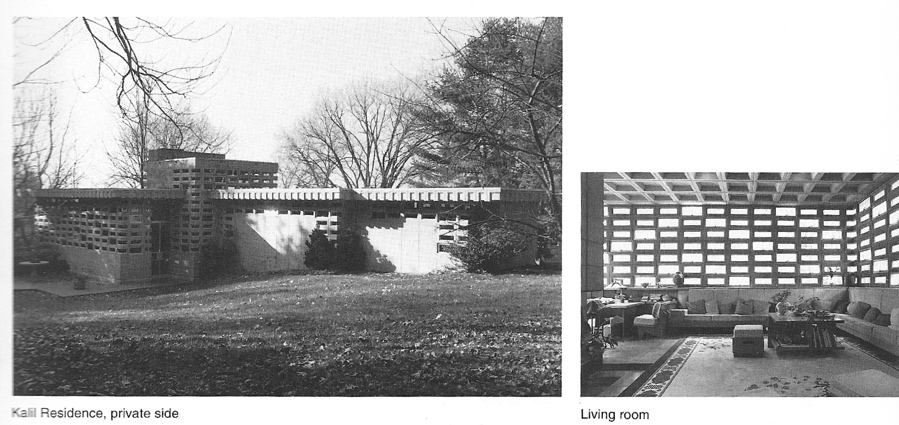
(3) Turkel House

(4) Tonkens House


(5) Automatic Blocks
The textile block system — the root form of automatic blocks — is a unique structural building method created by Frank Lloyd Wright in the early 1920s. While the details changed over time, the basic concept involves patterned concrete blocks reinforced by steel rods, created by pouring concrete mixture into molds, thus enabling the repetition of form. The blocks are then stacked to build walls. Wright’s textile block houses are:
- Ennis House
- Robert and Rae Levin House (check also the other Michigan – Galesburg and Parkwin/Kalamazoo – houses at List of Frank Lloyd Wright works)
- Millard House
- Samuel Freeman House
- Storer House (Los Angeles)
- Westhope, located in Tulsa, Oklahoma, Wright’s only Textile Block house outside of California.[1]
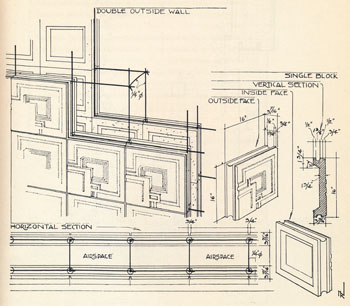

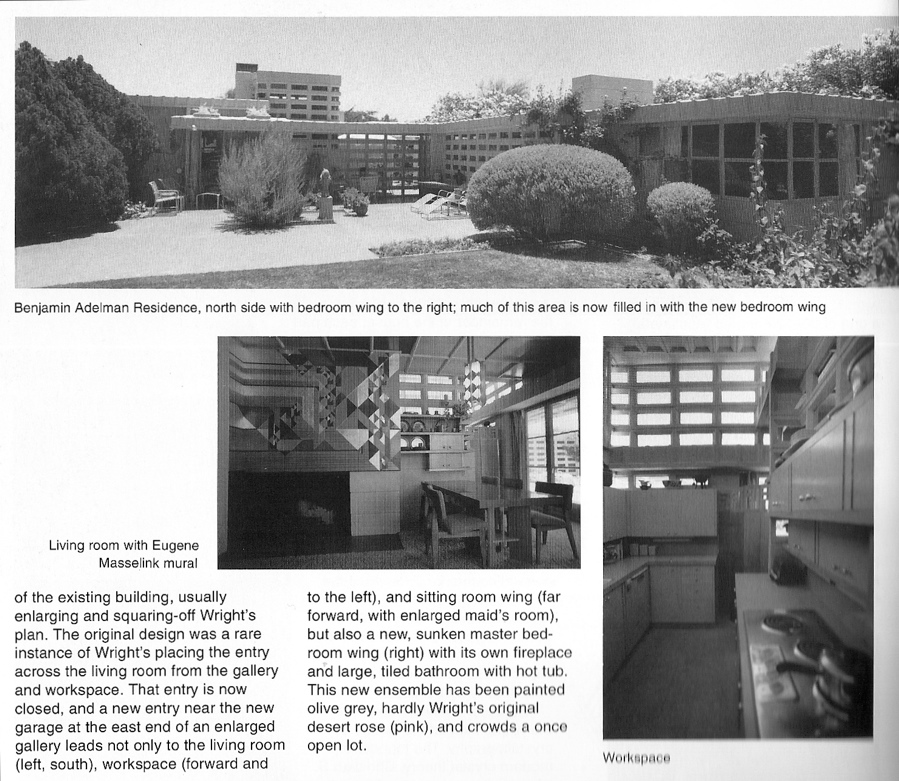
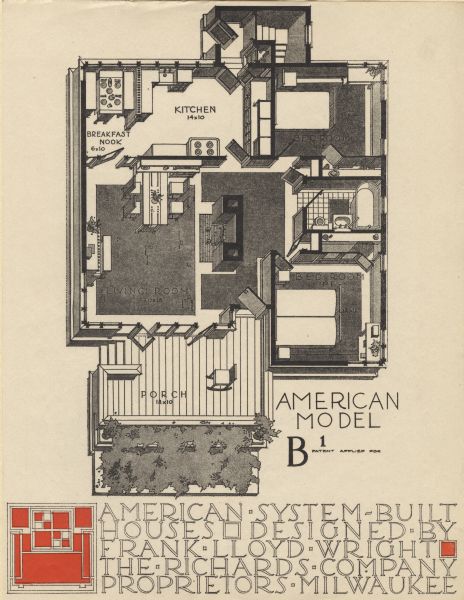
(6) American System-Built Homes
The American System-Built Homes in Milwaukee, Wisconsin:
Frank Lloyd Wright’s earliest system of low-cost housing© 2005 Michael Lilek, All rights reserved
Master of the Small House
Copyright 2004-2005, Michael Lilek, All rights reserved.
Over a career spanning seven decades, Frank Lloyd Wright took special interest in creating architect-designed homes for moderate and low-income families. In the January 1938 issue of Architectural Forum, he commented, “[I] would rather solve the small house problem than build anything else I can think of…” Indeed, among Wright’s greatest masterpieces are several small homes designed for clients who could afford little. Many of these residences owe their existence to some form of client labor (do-it-yourself), ingenious cost-cutting or salvaging. Each magically shelters it occupants in beautiful spaces, connects them to nature, and allows them to feel more alive.
American System-Built Homes
In a 1901 speech entitled, “The Art and Craft of the Machine,” Wright outlined his vision of affordable housing. He asserted that the home would have to go to the factory, instead of the skilled labor coming to the building site. Between 1915 and 1917 Wright designed a series of standardized “system-built” homes, known today as the American System-Built Homes. By system-built, he did not mean pre-fabrication off-site, but rather a system that involved cutting the lumber and other materials in a mill or factory, then bringing them to the site for assembly. This system would save material waste and a substantial fraction of the wages paid to skilled tradesmen. Wright produced more than 900 working drawings and sketches of various designs for the system. Six examples were constructed, still standing, on West Burnham Street and Layton Boulevard in Milwaukee, Wisconsin. Other examples were constructed on scattered sites throughout the Midwest with a few yet to be discovered.
Arthur L. Richards, Developer
By 1911, companies connected to Arthur L. Richards had engaged Frank Lloyd Wright to design several projects, including an unbuilt hotel in Madison and the Hotel Geneva in Lake Geneva, Wisconsin (1912, demolished). By November 1916, Richards entered into an agreement with Wright to promote the American System-Built Homes. The contract covered all parts of the United States, Canada and Europe. It called for the Richards Company “…to furnish, as far as possible, all materials entering into the construction of the buildings and to at least furnish the plans, drawings, specifications and details and lumber, millwork, exterior plaster material, paints, stains, glazing, hardware trimmings and electric lighting fixtures for said buildings.” Richards was to recruit a distribution channel of builders and developers from around the country. He appears to have focused his efforts in the Chicago area and a few other Midwestern cities.
The agreement between Wright and Richards anticipated that the American System-Built Homes project would be wildly successful. Unfortunately, the entry of the United States into World War I on April 6, 1917, diverted building materials to wartime needs. Housing starts ground to a halt. Wright also began extensive travels between America and Japan at this time, related to the Imperial Hotel commission. Wright became unhappy with his relationship with Richards, leading to a lawsuit in August of 1917. Central to Wright’s claim was the non-payment of royalties and fees. Wright won a judgment against Richards in February of 1918. Although the business relationship ended after a few years, Wright and Richards rekindled their friendship decades later and exchanged cordial letters and visits.

DOP

An Act to Establish a Department of Peace and Friendship
The Governor of NOVUS SYLLABUS L.L.C., a freely associated service provider, to the decentralized autonomous organization of the people of the world, and to all to whom these presents come, Sends Greeting and Peace:
Know ye by these presents, (a) that there is hereby established among the decentralized autonomous organization (DAO) of the people of the world, namely those domiciled in the United States of America, a Department of Peace and Friendship (DOP), also known herein as the “Department”.
(b) The purpose of this Department shall be to promote and preserve perpetual peace in our country, and to observe such laws, customs, policies, and practices as are wise, prudent and germane to such peace whether they be of a religious, civil, or other nature.
(c) As to §4601(a) of The United States Institute of Peace Act codified at Title 22—FOREIGN RELATIONS AND INTERCOURSE of the United States Code (U.S.C.) Chapter 56: UNITED STATES INSTITUTE OF PEACE, to wit:
The Congress finds and declares that—(1) a living institution embodying the heritage, ideals, and concerns of the American people for peace would be a significant response to the deep public need for the Nation to develop fully a range of effective options, in addition to armed capacity, that can leash international violence and manage international conflict;
22 U.S.C. Ch. 56 § 4601(a)
the mission of this Department shall be separate and distinct from that of the United States Institute of Peace in that it shall strive to ensure domestic tranquility as enumerated in the Preamble to the Constitution of the United States of America, to wit:
We the People of the United States, in Order to form a more perfect Union, establish Justice, insure domestic Tranquility, provide for the common defence, promote the general Welfare, and secure the Blessings of Liberty to ourselves and our Posterity, do ordain and establish this Constitution for the United States of America.
Preamble to the United States Constitution
(d) As to §4601(b) of the same statute, to wit:
It is the purpose of this chapter to establish an independent, nonprofit, national institute to serve the people and the Government through the widest possible range of education and training, basic and applied research opportunities, and peace information services on the means to promote international peace and the resolution of conflicts among the nations and peoples of the world without recourse to violence.
22 U.S.C. Ch. 56 § 4601(b)
this Department shall serve the same purpose, while paying particular and specific attention to domestic tranquility in this country.
(e) This Act may be cited as the “Department of Peace Act”.
ART. 2. ORGANIZATION.
(a) This Department shall be governed by a Firm League of Friendship (FLF) which shall be chaired or presided by the Secretary of Peace and constituted by the Ambassadors of Peace. The Officers of the Department, in descending order of rank, shall be as follows:
- Secretary of Peace
- Deputy Secretary of Peace
- Under Secretary of Peace and Friendship (Director of Embassies and Consular Affairs)
- Under Secretary of Peace for Operations (Inspector General and Superintendent of Buildings)
- Under Secretary of Peace for Political Education (Director of the Politburo and Dean of the U∴A∴)
- Ambassadors of Peace (also called “Friends”)
- Ministers Plenipotentiary of Peace
- Envoy Extraordinary and Envoys of Peace
- Chief Justice of the Peace
- Associate Justices of the Peace
- Clerk of the Peace
- Office of Peace and Friendship (OPF) Consular Outposts (also called “Consulate”)
- P.E.A.C.E. Consul (of which there is one per outpost)
- P.E.A.C.E. Officers
- P.E.A.C.E. Cadets (also called “Enlisted Students”)
(b) The national headquarters of this Department shall be established at the old District of Columbia Recorder of Deeds Building located at 515 D Street, NW, Washington, D.C. 20001, and appropriations shall be made for its acquisition, rehabilitation, renovation, preservation (of artistic assets, etc.) occupancy, maintenance, and management.
(c) Article 2(a)(1),(2),(3),(4),(5),(9), and (11) officers shall maintain their offices at the national headquarters.
(d) Among their myriad duties, the Secretary of Peace shall serve as the solicitor general of the Department (1) in their capacity as a practitioner of transactional law and exclusive equity on behalf of the Department and the DAO, and (2) in their capacity as a “traveling salesperson” or “proselytizer” who spreads the message of peace and endeavors to obtain new business ventures for the Department. In this dual capacity, the Secretary shall bring instant or prospective matters of interest to the Department before the Chief Justice of the Peace on a regular basis. (3) The Secretary shall also serve as the U.S. delegate to the to-be-founded World Peace Organization.
(e) The Article 2(a)(9),(10), and (11) officers shall serve the function of “barristers” in the traditional sense of an advocate at law, or a jurist at law, and shall maintain a “right of audience” before the courts of the United States, like unto traditional “members of the bar”. Their collective office shall be known as the “Tribunal of Peace”. The subject matter jurisdiction of this Tribunal and its subordinate tribunals shall be the domestic tranquility of the decentralized autonomous organization of the people of the United States of America, and, by extension, their political-economic situational awareness.
(f) The Article 2(a)(12),(13),(14), and (15) officers shall be organized as the Peace Enforcement Activity Command Enterprise—Curricular Operations Research and Publication Service Division, or the “P.E.A.C.E.—C.O.R.P.S“.
(g) The Article 2(a)(6),(7), and (8) officers shall each maintain their office and practice in their private residences (known as an “Embassy”) and conduct business as a private company (known as a “Consulate”).
(h) The Article 2(a)(9) officer shall be appointed by the Secretary of Peace and confirmed by the Ambassadors of Peace. The Article 2(a)(10) officers shall be appointed by the Secretary of Peace and the Chief Justice of the Peace and confirmed by the Ambassadors of Peace, and they shall be equal in number to the states and territories of the United States, and they shall each reside in such place conducting business on behalf of those domiciled therein, and they may be known as the Chief Justice of the Peace of such place, and they may appoint subordinate Assistant Justices. Any such justice as enumerated herein may convene sessions of hearing and determining matters within their subject matter jurisdiction with or without a jury, which is to say, they may sit on a court of Oyer and Terminer.
(i) The Secretary of Peace or their assign(s) may convene student bodies in the nature of a mock trial/model United Nations/student government forum, which may be convened at the local, regional, and/or national levels on a regular basis. The Secretary of Peace may assign departmental officials to administer an assessment of the progress of the political-economic education of the student masses.
(j) The furniture of a room containing a class or assembly of the Political Bureau of Education (“Politburo”) shall consist of the Liber Praeceptum, the United States Constitution, the Torah, the Quran, the New Testament, a law dictionary, and Robert Rules of Order Revised.
ART. 3. AUTHORITIES.
(a) The Three Pillars of this Department shall be Trust, Faith, and Belief (trust in God, faith in humanity, and belief in the DAO). The Five Mottos of the Department shall be Love, Truth, Peace, Freedom, and Justice. The Seven Ethical Virtues of the Department, being marks of Noble character which are as rich in Value as fine Jewels, are found at Title 1 § 5 of the 2020 Omnibus Act.
(b) The following laws and statutes of an authoritative and historical nature are incorporated into this Act by reference:
§1.
A PLAN OF A PEACE-OFFICE, FOR THE UNITED STATES.
(a) AMONG the many defects which have been pointed out in the federal constitution by its antifederal enemies, it is much to be lamented that no person has taken notice of its total silence upon the subject of an office of the utmost importance to the welfare of the United States, that is, an office for promoting and preserving perpetual peace in our country.
(b) It is to be hoped that no objection will be made to the establishment of such an office, while we are engaged in a war with the Indians, for as the War-Office of the United States was established in the time of peace, it is equally reasonable that a Peace-Office should be established in the time of war.
(c) The plan of this office is as follows:
I. Let a Secretary of Peace be appointed to preside in this office, who shall be perfectly free from all the present absurd and vulgar European prejudices upon the subject of government; let him be a genuine republican and a sincere Christian, for the principles of republicanism and Christianity are no less friendly to universal and perpetual peace, than they are to universal and equal liberty.
II. Let a power be given to the Secretary to establish and maintain free-schools in every city, village, and township of the United States; and let him be made responsible for the talents, principles, and morals of all his schoolmasters. Let the youth of our country be carefully instructed in reading, writing, and arithmetic, and in the doctrines of a religion of some kind: the Christian religion should be preferred to all others; for it belongs to this religion exclusively to teach us not only to cultivate peace with all men, but to forgive, nay, more – to love our very enemies. It belongs to it further to teach us that the Supreme Being alone possesses a power to take away human life, and that we rebel against his laws, whenever we undertake to execute death in any way whatever upon any of his creatures.
III. Let every family in the United States be furnished at the public expense, by the Secretary of this office, with a copy of the American edition of the BIBLE. This measure has become the more necessary in our country, since the banishment of the bible, as a school-book, form most of the schools in the United States. Unless the price of this book be paid for by the public, there is reason to fear that in a few years it will be met with only in courts of justice or in magistrates’ offices; and should the absurd mode of establishing truth by kissing this sacred book fall into disuse, it may probably, in the course of the next generation, be seen only as curiosity on a shelf in Mr. Peale’s museum.
IV. Let the following sentence be inscribed in letters of gold over the door of every house in the United States:
THE SON OF MAN CAME INTO THE WORLD, NOT TO DESTROY MEN'S LIVES, BUT TO SAVE THEM:
V. To inspire a veneration for human life, and an horror at the shedding of human blood, let all those laws be repealed which athorise juries, judges, sheriffs, or hangmen to assume the resentments of individuals, and to commit murder in cold blood in any case whatever. Until this reformation in our code of penal jurisprudence take place, it will be in vain to attempt to introduce universal and perpetual peace in our country.
VI. To subdue that passion for war, which education, added to human depravity, have made universal, a familiarity with the instruments of death, as well as all military shews, should be carefully avoided. For which reason, militia laws should every where be repealed, and military dresses and military titles should be laid aside: reviews tend to lessen the horrors of a battle by connecting them with the charms of order; militia laws generate idleness and vice, and thereby produce the wars they are said to prevent; military dresses fascinate the minds of young men, and lead them from serious and useful professions; were there no uniforms, there would probably be no armies; lastly, military titles feed vanity, and keep up ideas in the mind which lessen a sense of the folly and miseries of war.
VII. In the seventh and last place, let a large room, adjoining the federal hall, be appropriated for transacting the business and preserving all the record of this office. Over the door of this room, let there be a sign, on which the figures of a LAMB, a DOVE, and an OLIVE-BRANCH should be painted, together with the following inscriptions in letters of gold:
PEACE ON EARTH - GOOD-WILL TO MAN.
AH! WHY WILL MEN FORGET THAT THEY ARE BRETHREN?
Within this apartment let there be a collection of plough-shares and pruning-hooks made out of swords and spears; and on each of the walls of the apartment, the following pictures as large as the life:
- A lion eating straw with an ox, and an adder playing upon the lips of a child.
- An Indian boiling his venison in the same pot with a citizen of Kentucky.
- Lord Cornwallis and Tippoo Saib, under the shade of a sycamore-tree in the East-Indies, drinking Madeira wine together out of the same decanter.
- A group of French and Austrian soldiers dancing arm in arm, under a bower erected in the neighbourhood of Mons.
- A St. Domingo planter, a man of color, and a native of Africa, legislating together in the same colonial assembly.*
To complete the entertainment of this delightful apartment, let a group of young ladies, clad in white robes, assemble every day at a certain hour, in a gallery to be erected for the purpose, and sing odes, and hymns, and anthems in praise of the blessings of peace.
One of these songs should consist of the following beautiful lines from Mr. Pope:
Peace o'er the world her olive wand extends,
And white-rob'd innocence from heaven descends;
All crimes shall cease, and ancient frauds shall fail,
Returning justice lifts aloft her scale.
*At the time of writing this, there existed wars between the United States and the American Indians, between the British nation and Tippoo Saib, between the planters of St. Domingo and their African slaves, and between the French nation and the emperor of Germany.
Source(s):
BANNEKER’S ALMANACK, AND EPHEMERIS FOR THE YEAR OF OUR LORD 1793; BEING THE FIRST AFTER BISSEXTILE OR LEAP-YEAR: CONTAINING THE MOTIONS OF THE SUN AND MOON; THE TRUE PLACES AND ASPECTS OF THE PLANETS; THE RISING AND SETTING OF THE SUN; RISING, SETTING, AND SOUTHING OF THE MOON; THE LUNATIONS, CONJUNCTIONS, AND ECLIPSES; AND THE RISING, SETTING, AND SOUTHING OF THE PLANETS AND NOTED FIXED STARS.
——————————————
PHILADELPHIA:
PRINTED AND SOLD BY JOSEPH CRUKSHANK, NO.87, HIGH STREET.
——————————————

§2.
The Moroccan-American Treaty of Peace and Friendship
[28 June 1786]1
(a) In the Name of Almighty God.
(b) This is a Treaty of Peace & Friendship, established between Us and the United States of America, which is confirmed & which we have ordered to be written in this Book & sealed with our Royal Seal at our Court of Morocco, on the twenty fifth day of the blessed Month of Shaban in the Year one thousand two Hundred,2 trusting in God it will remain Permanent.
.1.
We declare that both Parties have agreed that this Treaty consisting of twenty five Articles, shall be inserted in this Book, & delivered to the Honorable Thomas Barclay, the Agent of the United States now at our Court, with whose Approbation it has been made & who is duly authorized on their Part, to treat with us concerning all the Matters contained therein.—
.2.
If either of the Parties shall be at War with any Nation whatever, the other Party shall not take a Commission from the Enemy, nor fight under their Colors.
.3.
If either of the Parties shall be at War with any Nation whatever, & take a Prize belonging to that Nation, & there shall be found on board Subjects or Effects belonging to either of the Parties, the Subjects shall be set at Liberty & the Effects returned to the Owners; & if any goods belonging to any Nation with whom either of the Parties shall be at war, shall be loaded on Vessels belonging to the other Party, they shall pass free & unmolested without any Attempt being made to take or detain them.—
.4.
A Signal or Pass shall be given to all Vessels belonging to both Parties, by which they are to be known when they meet at Sea, & if the Commander of a Ship of War of either Party, shall have other Ships under his Convoy, the Declaration of the Commander shall alone be sufficient to exempt any of them from examination—3
.5.
If either of the Parties shall be at War & shall meet a Vessel at Sea belonging to the other, it is agreed that if an examination is to be made, it shall be done by sending a Boat with two or three Men only, & if any Gun shall be fired and any injury done without Reason, the offending Party shall make good all Damages—
.6.
If any Moor shall bring Citizens of the United States or their Effects to His Majesty, the Citizens shall immediately be set at Liberty & the Effects restored & in like Manner, if any Moor not a Subject of these Dominions, shall make Prize of any of the Citizens of America or their Effects, & bring them into any of the Ports of His Majesty, they shall be immediately released as they will then be considered as under His Majesty’s Protection.—
.7.
If any Vessel of either Party shall put into a Port of the other & have occasion for Provisions or other Supplies, they shall be furnished without any interruption or molestation—
.8.
If any Vessels of the United States shall meet with a Disaster at Sea & put into one of our Ports to repair, she shall be at Liberty to land & reload her Cargo without paying any Duty whatever.—
.9.
If any Vessel of the United States shall be cast on shore on any Part of our Coasts, she shall remain at the Disposition of the owners, & no one shall attempt going near her without their Approbation, as she is then considered particularly under our protection; & if any Vessel of the United States shall be forced to put into our Ports by Stress of Weather or otherwise, she shall not be compelled to land her Cargo, but shall remain in tranquillity untill the Commander shall think proper to proceed on his Voyage—
.10.
If any Vessel of either of the Parties shall have an engagement with a Vessel belonging to any of the Christian Powers, within Gunshot of the Ports of the other, the Vessel so engaged shall be defended & protected as much as possible untill she is in safety; And if any American Vessel shall be cast on shore on the Coast of Wadnoon4 or any Coast thereabout, the people belonging to her shall be protected and Assisted untill, by the help of God, they shall be sent to their Country.
.11.
If we shall be at War with any Christian Power & any of our Vessels sail from the Ports of the United States, no Vessel belonging to the Enemy shall follow untill twenty four hours after the departure of our Vessels, & the same Regulation shall be observed, towards the American Vessels sailing from our Ports. be their Enemies Moors or Christians
.12.
If any ship of War belonging to the United States shall put into any of our Ports, she shall not be examined on any Pretence whatever, even though she should have fugitive Slaves on Board, nor shall the Governor or Commander of the Place, compel them to be brought on shore, under any Pretext, nor require any payment for them.
.13.
If a Ship of War of either Party shall put into a Port of the other & salute, it shall be returned from the Fort, with an equal Number of Guns, not with more or less.—
.14.
The Commerce with the United States shall be on the same footing as is the Commerce with Spain, or as that with the most favored Nation for the time being; & their Citizens shall be respected & esteemed & have full Liberty to pass & repass our Country & Sea Ports, whenever they please without interruption.
.15.
Merchants of both Countrys shall employ only such interpreters & such other Persons to Assist them in their Business as they shall think proper. No Commander of a Vessel shall transport his Cargo on board another Vessel, he shall not be detained in Port, longer than he may think proper; and all Persons employed in loading or unloading Goods, or in any other Labor whatever, shall be paid at the customary Rates, not more & not Less.
.16.
In Case of a War between the Parties, the Prisoners are not to be made Slaves, but to be exchanged one for another, Captain for Captain, Officer for Officer and one private Man for another; & if there shall prove a difficiency on either side it shall be made up by the Payment of one hundred Mexican Dollars for each Person wanting. And it is agreed that all Prisoners shall be exchanged in twelve Months from the time of their being taken, & that this Exchange may be effected by a Merchant, or any other Person authorized by either of the Parties.
.17.
Merchants shall not be compelled to buy or sell any kind of Goods, but such as they shall think proper, & may buy & Sell all sorts of Merchandise, but such as are prohibited to the other Christian Nations—
.18.
All Goods shall be weigh’d & examined, before they are sent on board; & to avoid all detention of Vessels no examination shall afterwards be made, unless it shall be first proved, that contraband Goods have been sent on board; in which Case the Persons who took the contraband Goods on board shall be punished according to the Usage & Custom of the Country & no other Person whatever shall be injured, nor shall the Ship or Cargo incur any Penalty or damage whatever.—
.19.
No Vessel shall be detained in Port on any pretence whatever, nor be obliged to take on board any Article without the Consent of the Commander, who shall be at full Liberty to agree for the freight of any Goods he takes on board—
.20.
If any of the Citizens of the United States or any Persons under their Protection, shall have any Disputes with each other, the Consul shall decide between the Parties, & whenever the Consul shall require any aid or Assistance from our Government to enforce his Decisions, it shall be immediately granted to him.—
.21.
If a Citizen of the United States shall kill or wound a Moor, or on the contrary if a Moor shall kill or wound a Citizen of the United States, the Law of the Country shall take place & equal Justice Shall be rendered the Consul assisting at the Tryal; & if any Delinquent shall make his escape, the Consul shall not be answerable for him in any Manner whatever—
.22.
If an American Citizen shall die in our Country and no Will shall appear, the Consul shall take Possession of his Effects, & if there shall be no Consul, the Effects shall be deposited in the hands of some Person worthy of Trust, untill the Party shall appear who has a right to demand them; But if the Heir to the Person deceased be present, the property shall be delivered to him without interruption, & if a Will shall appear, the Property shall descend agreable to that Will, as soon as the Consul shall declare the validity thereof.
.23.
The Consuls of the United States of America, shall reside in any sea Port of our Dominions that they shall think proper; & they shall be respected & enjoy all the Privileges which the Consuls of any other Nation enjoy; & if any of the Citizens of the United States shall contract any Debts or engagements, the Consul shall not be in any manner accountable for them, unless he shall have given a promise in writing for the payment or fulfilling thereof, without which promise in writing no application to him for any redress shall be made.—
.24.
If any differences shall arrise by either Party infringing on any of the Articles of this Treaty, Peace and Harmony shall remain notwithstanding in the fullest force, untill a friendly Application shall be made for an Arrangement, & untill that Application shall be rejected, no Appeal shall be made to Arms; & if a War shall break out between the Parties, Nine Months shall be granted to all the Subjects of both Parties to dispose of their Effects & retire with their Property; And it is further declared, that whatever indulgences in Trade or otherwise shall be granted to any of the Christian Powers, the Citizens of the United States shall be equally entitled to them.
.25.
This Treaty shall continue in full force with the Help of God, for fifty Years—5
We have delivered this Book into the Hands of the beforementioned Thomas Barclay, on the first day of the blessed Month of Ramadan in the Year One thousand two hundred.—
I Certify that the annexed is a true copy of the Translation made by Isaac Cardoza Nuñez, Interpreter at Morocco, of the Treaty between the Emperor of Morocco and the United States of America.—
Thos Barclay6
Translation of the additional Article
(c) Grace to the only God.
(d) I the underwritten, the Servant of God, Taher Ben Abdelkack Fennish, do certify that His Imperial Majesty my Master (whom God preserve) having concluded a Treaty of Peace and Commerce with the United States of America has ordered me the better to compleat it and in addition of the tenth Article of said Treaty to declare, “that if any Vessel belonging to the United States shall be in any of the Ports of His Majesty’s Dominions or within Gunshot of his Forts, she shall be protected as much as possible and no Vessel whatever, belong either to Moorish or Christian Powers with whom the United States may be at War, shall be permitted to follow or engage her, as we deem the Citizens of America our good Friends.[”]
(e) And in obedience to his Majesty’s Commands I certify this Declaration by putting my hand and Seal to it, on the Eighteenth Day of Ramadan in the Year One thousand two hundred—7
(signed)
The Servant of the King my Master whom God preserve
Taher Ben Abdelhack Fennish.8
(f) I Certify that the Above is a True Copy of the Translation Made at Morocco by Isaac Cardoza Nunes Interpreter of a Declaration Made and signed by Sidi Hage Tahar Fennish in Addition to the Treaty between the Emperor of Morocco and the United States of America which Declaration the said Tahar Fennish Made by the Express Directions of His Majesty—
Thos Barclay
(g) Note, The Ramadan of the Year of Hegira 1200 Commenced on the 28th. of June in the Year of our Lord 1786—9
§3.
The Great Binding Law, Gayanashagowa
(a) Among the Haudenosaunee (the “Six Nations,” comprising the Mohawk, Onondaga, Oneida, Cayuga, Seneca, and Tuscarora peoples) the Great Law of Peace (Mohawk: Kaianere’kó:wa), also known as Gayanashagowa, is the oral constitution of the Iroquois Confederacy. The law was written on wampum belts, conceived by Dekanawidah, known as the Great Peacemaker, and his spokesman Hiawatha. The original five member nations ratified this constitution near modern-day Victor, New York, with the sixth nation (the Tuscarora) being added in 1722.
(b) The laws were first recorded and transmitted by means of wampum, shell-bead belts that encoded the message in a sequence of pictograms. Later, it was translated into English and other languages. The Great Law of Peace is presented as part of a narrative noting laws and ceremonies to be performed at prescribed times. The laws, called a constitution, are divided into 117 articles. The united Iroquois nations are symbolized by an eastern white pine tree, called the Tree of Peace. Each nation or tribe plays a delineated role in the conduct of government.
(c) The exact date of the events is not known, but it is thought to date back to the late 12th century (c. 1190).
Sub § 1.
The Opening
1. I am Dekanawidah and with the Five Nations’ Confederate Lords I plant the Tree of Great Peace. I plant it in your territory, Adodarhoh, and the Onondaga Nation, in the territory of you who are Firekeepers.
I name the tree the Tree of the Great Long Leaves. Under the shade of this Tree of the Great Peace we spread the soft white feathery down of the globe thistle as seats for you, Adodarhoh, and your cousin Lords.
We place you upon those seats, spread soft with the feathery down of the globe thistle, there beneath the shade of the spreading branches of the Tree of Peace. There shall you sit and watch the Council Fire of the Confederacy of the Five Nations, and all the affairs of the Five Nations shall be transacted at this place before you, Adodarhoh, and your cousin Lords, by the Confederate Lords of the Five Nations.
2. Roots have spread out from the Tree of the Great Peace, one to the north, one to the east, one to the south and one to the west. The name of these roots is The Great White Roots and their nature is Peace and Strength.
If any man or any nation outside the Five Nations shall obey the laws of the Great Peace and make known their disposition to the Lords of the Confederacy, they may trace the Roots to the Tree and if their minds are clean and they are obedient and promise to obey the wishes of the Confederate Council, they shall be welcomed to take shelter beneath the Tree of the Long Leaves.
We place at the top of the Tree of the Long Leaves an Eagle who is able to see afar. If he sees in the distance any evil approaching or any danger threatening he will at once warn the people of the Confederacy.
3. To you Adodarhoh, the Onondaga cousin Lords, I and the other Confederate Lords have entrusted the caretaking and the watching of the Five Nations Council Fire.
When there is any business to be transacted and the Confederate Council is not in session, a messenger shall be dispatched either to Adodarhoh, Hononwirehtonh or Skanawatih, Fire Keepers, or to their War Chiefs with a full statement of the case desired to be considered. Then shall Adodarhoh call his cousin (associate) Lords together and consider whether or not the case is of sufficient importance to demand the attention of the Confederate Council. If so, Adodarhoh shall dispatch messengers to summon all the Confederate Lords to assemble beneath the Tree of the Long Leaves.
When the Lords are assembled the Council Fire shall be kindled, but not with chestnut wood, and Adodarhoh shall formally open the Council.
Then shall Adodarhoh and his cousin Lords, the Fire Keepers, announce the subject for discussion.
The Smoke of the Confederate Council Fire shall ever ascend and pierce the sky so that other nations who may be allies may see the Council Fire of the Great Peace.
Adodarhoh and his cousin Lords are entrusted with the Keeping of the Council Fire.
4. You, Adodarhoh, and your thirteen cousin Lords, shall faithfully keep the space about the Council Fire clean and you shall allow neither dust nor dirt to accumulate. I lay a Long Wing before you as a broom. As a weapon against a crawling creature I lay a staff with you so that you may thrust it away from the Council Fire. If you fail to cast it out then call the rest of the United Lords to your aid.
5. The Council of the Mohawk shall be divided into three parties as follows: Tekarihoken, Ayonhwhathah and Shadekariwade are the first party; Sharenhowaneh, Deyoenhegwenh and Oghrenghrehgowah are the second party, and Dehennakrineh, Aghstawenserenthah and Shoskoharowaneh are the third party. The third party is to listen only to the discussion of the first and second parties and if an error is made or the proceeding is irregular they are to call attention to it, and when the case is right and properly decided by the two parties they shall confirm the decision of the two parties and refer the case to the Seneca Lords for their decision. When the Seneca Lords have decided in accord with the Mohawk Lords, the case or question shall be referred to the Cayuga and Oneida Lords on the opposite side of the house.
6. I, Dekanawidah, appoint the Mohawk Lords the heads and the leaders of the Five Nations Confederacy. The Mohawk Lords are the foundation of the Great Peace and it shall, therefore, be against the Great Binding Law to pass measures in the Confederate Council after the Mohawk Lords have protested against them.
No council of the Confederate Lords shall be legal unless all the Mohawk Lords are present.
7. Whenever the Confederate Lords shall assemble for the purpose of holding a council, the Onondaga Lords shall open it by expressing their gratitude to their cousin Lords and greeting them, and they shall make an address and offer thanks to the earth where men dwell, to the streams of water, the pools, the springs and the lakes, to the maize and the fruits, to the medicinal herbs and trees, to the forest trees for their usefulness, to the animals that serve as food and give their pelts for clothing, to the great winds and the lesser winds, to the Thunderers, to the Sun, the mighty warrior, to the moon, to the messengers of the Creator who reveal his wishes and to the Great Creator who dwells in the heavens above, who gives all the things useful to men, and who is the source and the ruler of health and life.
Then shall the Onondaga Lords declare the council open.
The council shall not sit after darkness has set in.
8. The Firekeepers shall formally open and close all councils of the Confederate Lords, and they shall pass upon all matters deliberated upon by the two sides and render their decision.
Every Onondaga Lord (or his deputy) must be present at every Confederate Council and must agree with the majority without unwarrantable dissent, so that a unanimous decision may be rendered.
If Adodarhoh or any of his cousin Lords are absent from a Confederate Council, any other Firekeeper may open and close the Council, but the Firekeepers present may not give any decisions, unless the matter is of small importance.
9. All the business of the Five Nations Confederate Council shall be conducted by the two combined bodies of Confederate Lords. First the question shall be passed upon by the Mohawk and Seneca Lords, then it shall be discussed and passed by the Oneida and Cayuga Lords. Their decisions shall then be referred to the Onondaga Lords, (Fire Keepers) for final judgement.
The same process shall obtain when a question is brought before the council by an individual or a War Chief.
10. In all cases the procedure must be as follows: when the Mohawk and Seneca Lords have unanimously agreed upon a question, they shall report their decision to the Cayuga and Oneida Lords who shall deliberate upon the question and report a unanimous decision to the Mohawk Lords. The Mohawk Lords will then report the standing of the case to the Firekeepers, who shall render a decision as they see fit in case of a disagreement by the two bodies, or confirm the decisions of the two bodies if they are identical. The Fire Keepers shall then report their decision to the Mohawk Lords who shall announce it to the open council.
11. If through any misunderstanding or obstinacy on the part of the Fire Keepers, they render a decision at variance with that of the Two Sides, the Two Sides shall reconsider the matter and if their decisions are jointly the same as before they shall report to the Fire Keepers who are then compelled to confirm their joint decision.
12. When a case comes before the Onondaga Lords (Fire Keepers) for discussion and decsion, Adodarho shall introduce the matter to his comrade Lords who shall then discuss it in their two bodies. Every Onondaga Lord except Hononwiretonh shall deliberate and he shall listen only. When a unanimous decision shall have been reached by the two bodies of Fire Keepers, Adodarho shall notify Hononwiretonh of the fact when he shall confirm it. He shall refuse to confirm a decision if it is not unanimously agreed upon by both sides of the Fire Keepers.
13. No Lord shall ask a question of the body of Confederate Lords when they are discussing a case, question or proposition. He may only deliberate in a low tone with the separate body of which he is a member.
14. When the Council of the Five Nation Lords shall convene they shall appoint a speaker for the day. He shall be a Lord of either the Mohawk, Onondaga or Seneca Nation.
The next day the Council shall appoint another speaker, but the first speaker may be reappointed if there is no objection, but a speaker’s term shall not be regarded more than for the day.
15. No individual or foreign nation interested in a case, question or proposition shall have any voice in the Confederate Council except to answer a question put to him or them by the speaker for the Lords.
16. If the conditions which shall arise at any future time call for an addition to or change of this law, the case shall be carefully considered and if a new beam seems necessary or beneficial, the proposed change shall be voted upon and if adopted it shall be called, “Added to the Rafters”.
Sub § 2.
Rights, Duties and Qualifications of Lords
17. A bunch of a certain number of shell (wampum) strings each two spans in length shall be given to each of the female families in which the Lordship titles are vested. The right of bestowing the title shall be hereditary in the family of the females legally possessing the bunch of shell strings and the strings shall be the token that the females of the family have the proprietary right to the Lordship title for all time to come, subject to certain restrictions hereinafter mentioned.
18. If any Confederate Lord neglects or refuses to attend the Confederate Council, the other Lords of the Nation of which he is a member shall require their War Chief to request the female sponsors of the Lord so guilty of defection to demand his attendance of the Council. If he refuses, the women holding the title shall immediately select another candidate for the title.
No Lord shall be asked more than once to attend the Confederate Council.
19. If at any time it shall be manifest that a Confederate Lord has not in mind the welfare of the people or disobeys the rules of this Great Law, the men or women of the Confederacy, or both jointly, shall come to the Council and upbraid the erring Lord through his War Chief. If the complaint of the people through the War Chief is not heeded the first time it shall be uttered again and then if no attention is given a third complaint and warning shall be given. If the Lord is contumacious the matter shall go to the council of War Chiefs. The War Chiefs shall then divest the erring Lord of his title by order of the women in whom the titleship is vested. When the Lord is deposed the women shall notify the Confederate Lords through their War Chief, and the Confederate Lords shall sanction the act. The women will then select another of their sons as a candidate and the Lords shall elect him. Then shall the chosen one be installed by the Installation Ceremony.
When a Lord is to be deposed, his War Chief shall address him as follows:
“So you, __________, disregard and set at naught the warnings of your women relatives. So you fling the warnings over your shoulder to cast them behind you.
“Behold the brightness of the Sun and in the brightness of the Sun’s light I depose you of your title and remove the sacred emblem of your Lordship title. I remove from your brow the deer’s antlers, which was the emblem of your position and token of your nobility. I now depose you and return the antlers to the women whose heritage they are.”
The War Chief shall now address the women of the deposed Lord and say:
“Mothers, as I have now deposed your Lord, I now return to you the emblem and the title of Lordship, therefore repossess them.”
Again addressing himself to the deposed Lord he shall say:
“As I have now deposed and discharged you so you are now no longer Lord. You shall now go your way alone, the rest of the people of the Confederacy will not go with you, for we know not the kind of mind that possesses you. As the Creator has nothing to do with wrong so he will not come to rescue you from the precipice of destruction in which you have cast yourself. You shall never be restored to the position which you once occupied.”
Then shall the War Chief address himself to the Lords of the Nation to which the deposed Lord belongs and say:
“Know you, my Lords, that I have taken the deer’s antlers from the brow of ___________, the emblem of his position and token of his greatness.”
The Lords of the Confederacy shall then have no other alternative than to sanction the discharge of the offending Lord.
20. If a Lord of the Confederacy of the Five Nations should commit murder the other Lords of the Nation shall assemble at the place where the corpse lies and prepare to depose the criminal Lord. If it is impossible to meet at the scene of the crime the Lords shall discuss the matter at the next Council of their Nation and request their War Chief to depose the Lord guilty of crime, to “bury” his women relatives and to transfer the Lordship title to a sister family.
The War Chief shall address the Lord guilty of murder and say:
“So you, __________ (giving his name) did kill __________ (naming the slain man), with your own hands! You have comitted a grave sin in the eyes of the Creator. Behold the bright light of the Sun, and in the brightness of the Sun’s light I depose you of your title and remove the horns, the sacred emblems of your Lordship title. I remove from your brow the deer’s antlers, which was the emblem of your position and token of your nobility. I now depose you and expel you and you shall depart at once from the territory of the Five Nations Confederacy and nevermore return again. We, the Five Nations Confederacy, moreover, bury your women relatives because the ancient Lordship title was never intended to have any union with bloodshed. Henceforth it shall not be their heritage. By the evil deed that you have done they have forfeited it forever..”
The War Chief shall then hand the title to a sister family and he shall address it and say:
“Our mothers, ____________, listen attentively while I address you on a solemn and important subject. I hereby transfer to you an ancient Lordship title for a great calamity has befallen it in the hands of the family of a former Lord. We trust that you, our mothers, will always guard it, and that you will warn your Lord always to be dutiful and to advise his people to ever live in love, poeace and harmony that a great calamity may never happen again.”
21. Certain physical defects in a Confederate Lord make him ineligible to sit in the Confederate Council. Such defects are infancy, idiocy, blindness, deafness, dumbness and impotency. When a Confederate Lord is restricted by any of these condition, a deputy shall be appointed by his sponsors to act for him, but in case of extreme necessity the restricted Lord may exercise his rights.
22. If a Confederate Lord desires to resign his title he shall notify the Lords of the Nation of which he is a member of his intention. If his coactive Lords refuse to accept his resignation he may not resign his title.
A Lord in proposing to resign may recommend any proper candidate which recommendation shall be received by the Lords, but unless confirmed and nominated by the women who hold the title the candidate so named shall not be considered.
23. Any Lord of the Five Nations Confederacy may construct shell strings (or wampum belts) of any size or length as pledges or records of matters of national or international importance.
When it is necessary to dispatch a shell string by a War Chief or other messenger as the token of a summons, the messenger shall recite the contents of the string to the party to whom it is sent. That party shall repeat the message and return the shell string and if there has been a summons he shall make ready for the journey.
Any of the people of the Five Nations may use shells (or wampum) as the record of a pledge, contract or an agreement entered into and the same shall be binding as soon as shell strings shall have been exchanged by both parties.
24. The Lords of the Confederacy of the Five Nations shall be mentors of the people for all time. The thickness of their skin shall be seven spans – which is to say that they shall be proof against anger, offensive actions and criticism. Their hearts shall be full of peace and good will and their minds filled with a yearning for the welfare of the people of the Confederacy. With endless patience they shall carry out their duty and their firmness shall be tempered with a tenderness for their people. Neither anger nor fury shall find lodgement in their minds and all their words and actions shall be marked by calm deliberation.
25. If a Lord of the Confederacy should seek to establish any authority independent of the jurisdiction of the Confederacy of the Great Peace, which is the Five Nations, he shall be warned three times in open council, first by the women relatives, second by the men relatives and finally by the Lords of the Confederacy of the Nation to which he belongs. If the offending Lord is still obdurate he shall be dismissed by the War Chief of his nation for refusing to conform to the laws of the Great Peace. His nation shall then install the candidate nominated by the female name holders of his family.
26. It shall be the duty of all of the Five Nations Confederate Lords, from time to time as occasion demands, to act as mentors and spiritual guides of their people and remind them of their Creator’s will and words. They shall say:
"Hearken, that peace may continue unto future days!
"Always listen to the words of the Great Creator, for he has spoken.
"United people, let not evil find lodging in your minds.
"For the Great Creator has spoken and the cause of Peace shall not become old.
"The cause of peace shall not die if you remember the Great Creator."
Every Confederate Lord shall speak words such as these to promote peace.
27. All Lords of the Five Nations Confederacy must be honest in all things. They must not idle or gossip, but be men possessing those honorable qualities that make true royaneh. It shall be a serious wrong for anyone to lead a Lord into trivial affairs, for the people must ever hold their Lords high in estimation out of respect to their honorable positions.
28. When a candidate Lord is to be installed he shall furnish four strings of shells (or wampum) one span in length bound together at one end. Such will constitute the evidence of his pledge to the Confederate Lords that he will live according to the constitution of the Great Peace and exercise justice in all affairs.
When the pledge is furnished the Speaker of the Council must hold the shell strings in his hand and address the opposite side of the Council Fire and he shall commence his address saying: “Now behold him. He has now become a Confederate Lord. See how splendid he looks.” An address may then follow. At the end of it he shall send the bunch of shell strings to the oposite side and they shall be received as evidence of the pledge. Then shall the opposite side say:
“We now do crown you with the sacred emblem of the deer’s antlers, the emblem of your Lordship. You shall now become a mentor of the people of the Five Nations. The thickness of your skin shall be seven spans – which is to say that you shall be proof against anger, offensive actions and criticism. Your heart shall be filled with peace and good will and your mind filled with a yearning for the welfare of the people of the Confederacy. With endless patience you shall carry out your duty and your firmness shall be tempered with tenderness for your people. Neither anger nor fury shall find lodgement in your mind and all your words and actions shall be marked with calm deliberation. In all of your deliberations in the Confederate Council, in your efforts at law making, in all your official acts, self interest shall be cast into oblivion. Cast not over your shoulder behind you the warnings of the nephews and nieces should they chide you for any error or wrong you may do, but return to the way of the Great Law which is just and right. Look and listen for the welfare of the whole people and have always in view not only the present but also the coming generations, even those whose faces are yet beneath the surface of the ground – the unborn of the future Nation.”
29. When a Lordship title is to be conferred, the candidate Lord shall furnish the cooked venison, the corn bread and the corn soup, together with other necessary things and the labor for the Conferring of Titles Festival.
30. The Lords of the Confederacy may confer the Lordship title upon a candidate whenever the Great Law is recited, if there be a candidate, for the Great Law speaks all the rules.
31. If a Lord of the Confederacy should become seriously ill and be thought near death, the women who are heirs of his title shall go to his house and lift his crown of deer antlers, the emblem of his Lordship, and place them at one side. If the Creator spares him and he rises from his bed of sickness he may rise with the antlers on his brow.
The following words shall be used to temporarily remove the antlers:
“Now our comrade Lord (or our relative Lord) the time has come when we must approach you in your illness. We remove for a time the deer’s antlers from your brow, we remove the emblem of your Lordship title. The Great Law has decreed that no Lord should end his life with the antlers on his brow. We therefore lay them aside in the room. If the Creator spares you and you recover from your illness you shall rise from your bed with the antlers on your brow as before and you shall resume your duties as Lord of the Confederacy and you may labor again for the Confederate people.”
32. If a Lord of the Confederacy should die while the Council of the Five Nations is in session the Council shall adjourn for ten days. No Confederate Council shall sit within ten days of the death of a Lord of the Confederacy.
If the Three Brothers (the Mohawk, the Onondaga and the Seneca) should lose one of their Lords by death, the Younger Brothers (the Oneida and the Cayuga) shall come to the surviving Lords of the Three Brothers on the tenth day and console them. If the Younger Brothers lose one of their Lords then the Three Brothers shall come to them and console them. And the consolation shall be the reading of the contents of the thirteen shell (wampum) strings of Ayonhwhathah. At the termination of this rite a successor shall be appointed, to be appointed by the women heirs of the Lordship title. If the women are not yet ready to place their nominee before the Lords the Speaker shall say, “Come let us go out.” All shall leave the Council or the place of gathering. The installation shall then wait until such a time as the women are ready. The Speaker shall lead the way from the house by saying, “Let us depart to the edge of the woods and lie in waiting on our bellies.”
When the women title holders shall have chosen one of their sons the Confederate Lords will assemble in two places, the Younger Brothers in one place and the Three Older Brothers in another. The Lords who are to console the mourning Lords shall choose one of their number to sing the Pacification Hymn as they journey to the sorrowing Lords. The singer shall lead the way and the Lords and the people shall follow. When they reach the sorrowing Lords they shall hail the candidate Lord and perform the rite of Conferring the Lordship Title.
33. When a Confederate Lord dies, the surviving relatives shall immediately dispatch a messenger, a member of another clan, to the Lords in another locality. When the runner comes within hailing distance of the locality he shall utter a sad wail, thus: “Kwa-ah, Kwa-ah, Kwa-ah!” The sound shall be repeated three times and then again and again at intervals as many times as the distance may require. When the runner arrives at the settlement the people shall assemble and one must ask him the nature of his sad message. He shall then say, “Let us consider.” Then he shall tell them of the death of the Lord. He shall deliver to them a string of shells (wampum) and say “Here is the testimony, you have heard the message.” He may then return home.
It now becomes the duty of the Lords of the locality to send runners to other localities and each locality shall send other messengers until all Lords are notified. Runners shall travel day and night.
34. If a Lord dies and there is no candidate qualified for the office in the family of the women title holders, the Lords of the Nation shall give the title into the hands of a sister family in the clan until such a time as the original family produces a candidate, when the title shall be restored to the rightful owners.
No Lordship title may be carried into the grave. The Lords of the Confederacy may dispossess a dead Lord of his title even at the grave.
Sub § 3.
Election of Pine Tree Chiefs
35. Should any man of the Nation assist with special ability or show great interest in the affairs of the Nation, if he proves himself wise, honest and worthy of confidence, the Confederate Lords may elect him to a seat with them and he may sit in the Confederate Council. He shall be proclaimed a ‘Pine Tree sprung up for the Nation’ and shall be installed as such at the next assembly for the installation of Lords. Should he ever do anything contrary to the rules of the Great Peace, he may not be deposed from office – no one shall cut him down – but thereafter everyone shall be deaf to his voice and his advice. Should he resign his seat and title no one shall prevent him. A Pine Tree chief has no authority to name a successor nor is his title hereditary.
Sub § 4.
Names, Duties and Rights of War Chiefs
36. The title names of the Chief Confederate Lords’ War Chiefs shall be:
Ayonwaehs, War Chief under Lord Takarihoken (Mohawk)
Kahonwahdironh, War Chief under Lord Odatshedeh (Oneida)
Ayendes, War Chief under Lord Adodarhoh (Onondaga)
Wenenhs, War Chief under Lord Dekaenyonh (Cayuga)
Shoneradowaneh, War Chief under Lord Skanyadariyo (Seneca)
The women heirs of each head Lord’s title shall be the heirs of the War Chief’s title of their respective Lord.
The War Chiefs shall be selected from the eligible sons of the female families holding the head Lordship titles.
37. There shall be one War Chief for each Nation and their duties shall be to carry messages for their Lords and to take up the arms of war in case of emergency. They shall not participate in the proceedings of the Confederate Council but shall watch its progress and in case of an erroneous action by a Lord they shall receive the complaints of the people and convey the warnings of the women to him. The people who wish to convey messages to the Lords in the Confederate Council shall do so through the War Chief of their Nation. It shall ever be his duty to lay the cases, questions and propositions of the people before the Confederate Council.
38. When a War Chief dies another shall be installed by the same rite as that by which a Lord is installed.
39. If a War Chief acts contrary to instructions or against the provisions of the Laws of the Great Peace, doing so in the capacity of his office, he shall be deposed by his women relatives and by his men relatives. Either the women or the men alone or jointly may act in such a case. The women title holders shall then choose another candidate.
40. When the Lords of the Confederacy take occasion to dispatch a messenger in behalf of the Confederate Council, they shall wrap up any matter they may send and instruct the messenger to remember his errand, to turn not aside but to proceed faithfully to his destination and deliver his message according to every instruction.
41. If a message borne by a runner is the warning of an invasion he shall whoop, “Kwa-ah, Kwa-ah,” twice and repeat at short intervals; then again at a longer interval.
If a human being is found dead, the finder shall not touch the body but return home immediately shouting at short intervals, “Koo-weh!”
Sub § 5.
Clans and Consanguinity
42. Among the Five Nations and their posterity there shall be the following original clans: Great Name Bearer, Ancient Name Bearer, Great Bear, Ancient Bear, Turtle, Painted Turtle, Standing Rock, Large Plover, Deer, Pigeon Hawk, Eel, Ball, Opposite-Side-of-the-Hand, and Wild Potatoes. These clans distributed through their respective Nations, shall be the sole owners and holders of the soil of the country and in them is it vested as a birthright.
43. People of the Five Nations members of a certain clan shall recognize every other member of that clan, irrespective of the Nation, as relatives. Men and women, therefore, members of the same clan are forbidden to marry.
44. The lineal descent of the people of the Five Nations shall run in the female line. Women shall be considered the progenitors of the Nation. They shall own the land and the soil. Men and women shall follow the status of the mother.
45. The women heirs of the Confederated Lordship titles shall be called Royaneh (Noble) for all time to come.
46. The women of the Forty Eight (now fifty) Royaneh families shall be the heirs of the Authorized Names for all time to come.
When an infant of the Five Nations is given an Authorized Name at the Midwinter Festival or at the Ripe Corn Festival, one in the cousinhood of which the infant is a member shall be appointed a speaker. He shall then announce to the opposite cousinhood the names of the father and the mother of the child together with the clan of the mother. Then the speaker shall announce the child’s name twice. The uncle of the child shall then take the child in his arms and walking up and down the room shall sing: “My head is firm, I am of the Confederacy.” As he sings the opposite cousinhood shall respond by chanting, “Hyenh, Hyenh, Hyenh, Hyenh,” until the song is ended.
47. If the female heirs of a Confederate Lord’s title become extinct, the title right shall be given by the Lords of the Confederacy to the sister family whom they shall elect and that family shall hold the name and transmit it to their (female) heirs, but they shall not appoint any of their sons as a candidate for a title until all the eligible men of the former family shall have died or otherwise have become ineligible.
48. If all the heirs of a Lordship title become extinct, and all the families in the clan, then the title shall be given by the Lords of the Confederacy to the family in a sister clan whom they shall elect.
49. If any of the Royaneh women, heirs of a titleship, shall wilfully withhold a Lordship or other title and refuse to bestow it, or if such heirs abandon, forsake or despise their heritage, then shall such women be deemed buried and their family extinct. The titleship shall then revert to a sister family or clan upon application and complaint. The Lords of the Confederacy shall elect the family or clan which shall in future hold the title.
50. The Royaneh women of the Confederacy heirs of the Lordship titles shall elect two women of their family as cooks for the Lord when the people shall assemble at his house for business or other purposes.
It is not good nor honorable for a Confederate Lord to allow his people whom he has called to go hungry.
51. When a Lord holds a conference in his home, his wife, if she wishes, may prepare the food for the Union Lords who assemble with him. This is an honorable right which she may exercise and an expression of her esteem.
52. The Royaneh women, heirs of the Lordship titles, shall, should it be necessary, correct and admonish the holders of their titles. Those only who attend the Council may do this and those who do not shall not object to what has been said nor strive to undo the action.
53. When the Royaneh women, holders of a Lordship title, select one of their sons as a candidate, they shall select one who is trustworthy, of good character, of honest disposition, one who manages his own affairs, supports his own family, if any, and who has proven a faithful man to his Nation.
54. When a Lordship title becomes vacant through death or other cause, the Royaneh women of the clan in which the title is hereditary shall hold a council and shall choose one from among their sons to fill the office made vacant. Such a candidate shall not be the father of any Confederate Lord. If the choice is unanimous the name is referred to the men relatives of the clan. If they should disapprove it shall be their duty to select a candidate from among their own number. If then the men and women are unable to decide which of the two candidates shall be named, then the matter shall be referred to the Confederate Lords in the Clan. They shall decide which candidate shall be named. If the men and the women agree to a candidate his name shall be referred to the sister clans for confirmation. If the sister clans confirm the choice, they shall refer their action to their Confederate Lords who shall ratify the choice and present it to their cousin Lords, and if the cousin Lords confirm the name then the candidate shall be installed by the proper ceremony for the conferring of Lordship titles.
Sub § 6.
Official Symbolism
55. A large bunch of shell strings, in the making of which the Five Nations Confederate Lords have equally contributed, shall symbolize the completeness of the union and certify the pledge of the nations represented by the Confederate Lords of the Mohawk, the Oneida, the Onondaga, the Cayuga and the Senecca, that all are united and formed into one body or union called the Union of the Great Law, which they have established.
A bunch of shell strings is to be the symbol of the council fire of the Five Nations Confederacy. And the Lord whom the council of Fire Keepers shall appoint to speak for them in opening the council shall hold the strands of shells in his hands when speaking. When he finishes speaking he shall deposit the strings on an elevated place (or pole) so that all the assembled Lords and the people may see it and know that the council is open and in progress.
When the council adjourns the Lord who has been appointed by his comrade Lords to close it shall take the strands of shells in his hands and address the assembled Lords. Thus will the council adjourn until such time and place as appointed by the council. Then shall the shell strings be placed in a place for safekeeping.
Every five years the Five Nations Confederate Lords and the people shall assemble together and shall ask one another if their minds are still in the same spirit of unity for the Great Binding Law and if any of the Five Nations shall not pledge continuance and steadfastness to the pledge of unity then the Great Binding Law shall dissolve.
56. Five strings of shell tied together as one shall represent the Five Nations. Each string shall represent one territory and the whole a completely united territory known as the Five Nations Confederate territory.
57. Five arrows shall be bound together very strong and each arrow shall represent one nation. As the five arrows are strongly bound this shall symbolize the complete union of the nations. Thus are the Five Nations united completely and enfolded together, united into one head, one body and one mind. Therefore they shall labor, legislate and council together for the interest of future generations.
The Lords of the Confederacy shall eat together from one bowl the feast of cooked beaver’s tail. While they are eating they are to use no sharp utensils for if they should they might accidentally cut one another and bloodshed would follow. All measures must be taken to prevent the spilling of blood in any way.
58. There are now the Five Nations Confederate Lords standing with joined hands in a circle. This signifies and provides that should any one of the Confederate Lords leave the council and this Confederacy his crown of deer’s horns, the emblem of his Lordship title, together with his birthright, shall lodge on the arms of the Union Lords whose hands are so joined. He forfeits his title and the crown falls from his brow but it shall remain in the Confederacy.
A further meaning of this is that if any time any one of the Confederate Lords choose to submit to the law of a foreign people he is no longer in but out of the Confederacy, and persons of this class shall be called “They have alienated themselves.” Likewise such persons who submit to laws of foreign nations shall forfeit all birthrights and claims on the Five Nations Confederacy and territory.
You, the Five Nations Confederate Lords, be firm so that if a tree falls on your joined arms it shall not separate or weaken your hold. So shall the strength of the union be preserved.
59. A bunch of wampum shells on strings, three spans of the hand in length, the upper half of the bunch being white and the lower half black, and formed from equal contributions of the men of the Five Nations, shall be a token that the men have combined themselves into one head, one body and one thought, and it shall also symbolize their ratification of the peace pact of the Confederacy, whereby the Lords of the Five Nations have established the Great Peace.
The white portion of the shell strings represent the women and the black portion the men. The black portion, furthermore, is a token of power and authority vested in the men of the Five Nations.
This string of wampum vests the people with the right to correct their erring Lords. In case a part or all the Lords pursue a course not vouched for by the people and heed not the third warning of their women relatives, then the matter shall be taken to the General Council of the women of the Five Nations. If the Lords notified and warned three times fail to heed, then the case falls into the hands of the men of the Five Nations. The War Chiefs shall then, by right of such power and authority, enter the open concil to warn the Lord or Lords to return from the wrong course. If the Lords heed the warning they shall say, “we will reply tomorrow.” If then an answer is returned in favor of justice and in accord with this Great Law, then the Lords shall individualy pledge themselves again by again furnishing the necessary shells for the pledge. Then shall the War Chief or Chiefs exhort the Lords urging them to be just and true.
Should it happen that the Lords refuse to heed the third warning, then two courses are open: either the men may decide in their council to depose the Lord or Lords or to club them to death with war clubs. Should they in their council decide to take the first course the War Chief shall address the Lord or Lords, saying: “Since you the Lords of the Five Nations have refused to return to the procedure of the Constitution, we now declare your seats vacant, we take off your horns, the token of your Lordship, and others shall be chosen and installed in your seats, therefore vacate your seats.”
Should the men in their council adopt the second course, the War Chief shall order his men to enter the council, to take positions beside the Lords, sitting bewteen them wherever possible. When this is accomplished the War Chief holding in his outstretched hand a bunch of black wampum strings shall say to the erring Lords: “So now, Lords of the Five United Nations, harken to these last words from your men. You have not heeded the warnings of the women relatives, you have not heeded the warnings of the General Council of women and you have not heeded the warnings of the men of the nations, all urging you to return to the right course of action. Since you are determined to resist and to withhold justice from your people there is only one course for us to adopt.” At this point the War Chief shall let drop the bunch of black wampum and the men shall spring to their feet and club the erring Lords to death. Any erring Lord may submit before the War Chief lets fall the black wampum. Then his execution is withheld.
The black wampum here used symbolizes that the power to execute is buried but that it may be raised up again by the men. It is buried but when occasion arises they may pull it up and derive their power and authority to act as here described.
60. A broad dark belt of wampum of thirty-eight rows, having a white heart in the center, on either side of which are two white squares all connected with the heart by white rows of beads shall be the emblem of the unity of the Five Nations.
The first of the squares on the left represents the Mohawk nation and its territory; the second square on the left and the one near the heart, represents the Oneida nation and its territory; the white heart in the middle represents the Onondaga nation and its territory, and it also means that the heart of the Five Nations is single in its loyalty to the Great Peace, that the Great Peace is lodged in the heart (meaning the Onondaga Lords), and that the Council Fire is to burn there for the Five Nations, and further, it means that the authority is given to advance the cause of peace whereby hostile nations out of the Confederacy shall cease warfare; the white square to the right of the heart represents the Cayuga nation and its territory and the fourth and last white square represents the Seneca nation and its territory.
White shall here symbolize that no evil or jealous thoughts shall creep into the minds of the Lords while in Council under the Great Peace. White, the emblem of peace, love, charity and equity surrounds and guards the Five Nations.
61. Should a great calamity threaten the generations rising and living of the Five United Nations, then he who is able to climb to the top of the Tree of the Great Long Leaves may do so. When, then, he reaches the top of the tree he shall look about in all directions, and, should he see that evil things indeed are approaching, then he shall call to the people of the Five United Nations assembled beneath the Tree of the Great Long Leaves and say: ” A calamity threatens your happiness.”
Then shall the Lords convene in council and discuss the impending evil.
When all the truths relating to the trouble shall be fully known and found to be truths, then shall the people seek out a Tree of Ka-hon-ka-ah-go-nah, and when they shall find it they shall assemble their heads together and lodge for a time between its roots. Then, their labors being finished, they may hope for happiness for many days after.
62. When the Confederate Council of the Five Nations declares for a reading of the belts of shell calling to mind these laws, they shall provide for the reader a specially made mat woven of the fibers of wild hemp. The mat shall not be used again, for such formality is called the honoring of the importance of the law.
63. Should two sons of opposite sides of the council fire agree in a desire to hear the reciting of the laws of the Great Peace and so refresh their memories in the way ordained by the founder of the Confederacy, they shall notify Adodarho. He then shall consult with five of his coactive Lords and they in turn shall consult with their eight brethern. Then should they decide to accede to the request of the two sons from opposite sides of the Council Fire, Adodarho shall send messengers to notify the Chief Lords of each of the Five Nations. Then they shall despatch their War Chiefs to notify their brother and cousin Lords of the meeting and its time and place.
When all have come and have assembled, Adodarhoh, in conjunction with his cousin Lords, shall appoint one Lord who shall repeat the laws of the Great Peace. Then shall they announce who they have chosen to repeat the laws of the Great Peace to the two sons. Then shall the chosen one repeat the laws of the Great Peace.
64. At the ceremony of the installation of Lords if there is only one expert speaker and singer of the law and the Pacification Hymn to stand at the council fire, then when this speaker and singer has finished addressing one side of the fire he shall go to the oposite side and reply to his own speech and song. He shall thus act for both sidesa of the fire until the entire ceremony has been completed. Such a speaker and singer shall be termed the “Two Faced” because he speaks and sings for both sides of the fire.
65. I, Dekanawida, and the Union Lords, now uproot the tallest pine tree and into the cavity thereby made we cast all weapons of war. Into the depths of the earth, down into the deep underearth currents of water flowing to unknown regions we cast all the weapons of strife. We bury them from sight and we plant again the tree. Thus shall the Great Peace be established and hostilities shall no longer be known between the Five Nations but peace to the United People.
Sub § 7.
Laws of Adoption
66. The father of a child of great comliness, learning, ability or specially loved because of some circumstance may, at the will of the child’s clan, select a name from his own (the father’s) clan and bestow it by ceremony, such as is provided. This naming shall be only temporary and shall be called, “A name hung about the neck.”
67. Should any person, a member of the Five Nations’ Confederacy, specially esteem a man or woman of another clan or of a foreign nation, he may choose a name and bestow it upon that person so esteemed. The naming shall be in accord with the ceremony of bestowing names. Such a name is only a temporary one and shall be called “A name hung about the neck.” A short string of shells shall be delivered with the name as a record and a pledge.
68. Should any member of the Five Nations, a family or person belonging to a foreign nation submit a proposal for adoption into a clan of one of the Five Nations, he or they shall furnish a string of shells, a span in length, as a pledge to the clan into which he or they wish to be adopted. The Lords of the nation shall then consider the proposal and submit a decision.
69. Any member of the Five Nations who through esteem or other feeling wishes to adopt an individual, a family or number of families may offer adoption to him or them and if accepted the matter shall be brought to the attention of the Lords for confirmation and the Lords must confirm adoption.
70. When the adoption of anyone shall have been confirmed by the Lords of the Nation, the Lords shall address the people of their nation and say: “Now you of our nation, be informed that such a person, such a family or such families have ceased forever to bear their birth nation’s name and have buried it in the depths of the earth. Henceforth let no one of our nation ever mention the original name or nation of their birth. To do so will be to hasten the end of our peace.
Sub § 8.
Laws of Emigration
71. When any person or family belonging to the Five Nations desires to abandon their birth nation and the territory of the Five Nations, they shall inform the Lords of their nation and the Confederate Council of the Five Nations shall take cognizance of it.
72. When any person or any of the people of the Five Nations emigrate and reside in a region distant from the territory of the Five Nations Confederacy, the Lords of the Five Nations at will may send a messenger carrying a broad belt of black shells and when the messenger arrives he shall call the people together or address them personally displaying the belt of shells and they shall know that this is an order for them to return to their original homes and to their council fires.
Sub § 9.
Rights of Foreign Nations
73. The soil of the earth from one end of the land to the other is the property of the people who inhabit it. By birthright the Ongwehonweh (Original beings) are the owners of the soil which they own and occupy and none other may hold it. The same law has been held from the oldest times.
The Great Creator has made us of the one blood and of the same soil he made us and as only different tongues constitute different nations he established different hunting grounds and territories and made boundary lines between them.
74. When any alien nation or individual is admitted into the Five Nations the admission shall be understood only to be a temporary one. Should the person or nation create loss, do wrong or cause suffering of any kind to endanger the peace of the Confederacy, the Confederate Lords shall order one of their war chiefs to reprimand him or them and if a similar offence is again committed the offending party or parties shall be expelled from the territory of the Five United Nations.
75. When a member of an alien nation comes to the territory of the Five Nations and seeks refuge and permanent residence, the Lords of the Nation to which he comes shall extend hospitality and make him a member of the nation. Then shall he be accorded equal rights and privileges in all matters except as after mentioned.
76. No body of alien people who have been adopted temporarily shall have a vote in the council of the Lords of the Confederacy, for only they who have been invested with Lordship titles may vote in the Council. Aliens have nothing by blood to make claim to a vote and should they have it, not knowing all the traditions of the Confederacy, might go against its Great Peace. In this manner the Great Peace would be endangered and perhaps be destroyed.
77. When the Lords of the Confederacy decide to admit a foreign nation and an adoption is made, the Lords shall inform the adopted nation that its admission is only temporary. They shall also say to the nation that it must never try to control, to interfere with or to injure the Five Nations nor disregard the Great Peace or any of its rules or customs. That in no way should they cause disturbance or injury. Then should the adopted nation disregard these injunctions, their adoption shall be annuled and they shall be expelled.
The expulsion shall be in the following manner: The council shall appoint one of their War Chiefs to convey the message of annulment and he shall say, “You (naming the nation) listen to me while I speak. I am here to inform you again of the will of the Five Nations’ Council. It was clearly made known to you at a former time. Now the Lords of the Five Nations have decided to expel you and cast you out. We disown you now and annul your adoption. Therefore you must look for a path in which to go and lead away all your people. It was you, not we, who committed wrong and caused this sentence of annulment. So then go your way and depart from the territory of the Five Nations and from the Confederacy.”
78. Whenever a foreign nation enters the Confederacy or accepts the Great Peace, the Five Nations and the foreign nation shall enter into an agreement and compact by which the foreign nation shall endeavor to pursuade other nations to accept the Great Peace.
Sub § 10.
Rights and Powers of War
79. Skanawatih shall be vested with a double office, duty and with double authority. One-half of his being shall hold the Lordship title and the other half shall hold the title of War Chief. In the event of war he shall notify the five War Chiefs of the Confederacy and command them to prepare for war and have their men ready at the appointed time and place for engagement with the enemy of the Great Peace.
80. When the Confederate Council of the Five Nations has for its object the establishment of the Great Peace among the people of an outside nation and that nation refuses to accept the Great Peace, then by such refusal they bring a declaration of war upon themselves from the Five Nations. Then shall the Five Nations seek to establish the Great Peace by a conquest of the rebellious nation.
81. When the men of the Five Nations, now called forth to become warriors, are ready for battle with an obstinate opposing nation that has refused to accept the Great Peace, then one of the five War Chiefs shall be chosen by the warriors of the Five Nations to lead the army into battle. It shall be the duty of the War Chief so chosen to come before his warriors and address them. His aim shall be to impress upon them the necessity of good behavior and strict obedience to all the commands of the War Chiefs. He shall deliver an oration exhorting them with great zeal to be brave and courageous and never to be guilty of cowardice. At the conclusion of his oration he shall march forward and commence the War Song and he shall sing:
Now I am greatly surprised
And, therefore I shall use it -
The power of my War Song.
I am of the Five Nations
And I shall make supplication
To the Almighty Creator.
He has furnished this army.
My warriors shall be mighty
In the strength of the Creator.
Between him and my song they are
For it was he who gave the song
This war song that I sing!
82. When the warriors of the Five Nations are on an expedition against an enemy, the War Chief shall sing the War Song as he approaches the country of the enemy and not cease until his scouts have reported that the army is near the enemies’ lines when the War Chief shall approach with great caution and prepare for the attack.
83. When peace shall have been established by the termination of the war against a foreign nation, then the War Chief shall cause all the weapons of war to be taken from the nation. Then shall the Great Peace be established and that nation shall observe all the rules of the Great Peace for all time to come.
84. Whenever a foreign nation is conquered or has by their own will accepted the Great Peace their own system of internal government may continue, but they must cease all warfare against other nations.
85. Whenever a war against a foreign nation is pushed until that nation is about exterminated because of its refusal to accept the Great Peace and if that nation shall by its obstinacy become exterminated, all their rights, property and territory shall become the property of the Five Nations.
86. Whenever a foreign nation is conquered and the survivors are brought into the territory of the Five Nations’ Confederacy and placed under the Great Peace the two shall be known as the Conqueror and the Conquered. A symbolic relationship shall be devised and be placed in some symbolic position. The conquered nation shall have no voice in the councils of the Confederacy in the body of the Lords.
87. When the War of the Five Nations on a foreign rebellious nation is ended, peace shall be restored to that nation by a withdrawal of all their weapons of war by the War Chief of the Five Nations. When all the terms of peace shall have been agreed upon a state of friendship shall be established.
88. When the proposition to establish the Great Peace is made to a foreign nation it shall be done in mutual council. The foreign nation is to be persuaded by reason and urged to come into the Great Peace. If the Five Nations fail to obtain the consent of the nation at the first council a second council shall be held and upon a second failure a third council shall be held and this third council shall end the peaceful methods of persuasion. At the third council the War Chief of the Five nations shall address the Chief of the foreign nation and request him three times to accept the Great Peace. If refusal steadfastly follows the War Chief shall let the bunch of white lake shells drop from his outstretched hand to the ground and shall bound quickly forward and club the offending chief to death. War shall thereby be declared and the War Chief shall have his warriors at his back to meet any emergency. War must continue until the contest is won by the Five Nations.
89. When the Lords of the Five Nations propose to meet in conference with a foreign nation with proposals for an acceptance of the Great Peace, a large band of warriors shall conceal themselves in a secure place safe from the espionage of the foreign nation but as near at hand as possible. Two warriors shall accompany the Union Lord who carries the proposals and these warriors shall be especially cunning. Should the Lord be attacked, these warriors shall hasten back to the army of warriors with the news of the calamity which fell through the treachery of the foreign nation.
90. When the Five Nations’ Council declares war any Lord of the Confederacy may enlist with the warriors by temporarily renouncing his sacred Lordship title which he holds through the election of his women relatives. The title then reverts to them and they may bestow it upon another temporarily until the war is over when the Lord, if living, may resume his title and seat in the Council.
91. A certain wampum belt of black beads shall be the emblem of the authority of the Five War Chiefs to take up the weapons of war and with their men to resist invasion. This shall be called a war in defense of the territory.
Sub § 11.
Treason or Secession of a Nation
92. If a nation, part of a nation, or more than one nation within the Five Nations should in any way endeavor to destroy the Great Peace by neglect or violating its laws and resolve to dissolve the Confederacy, such a nation or such nations shall be deemed guilty of treason and called enemies of the Confederacy and the Great Peace.
It shall then be the duty of the Lords of the Confederacy who remain faithful to resolve to warn the offending people. They shall be warned once and if a second warning is necessary they shall be driven from the territory of the Confederacy by the War Chiefs and his men.
Sub § 12.
Rights of the People of the Five Nations
93. Whenever a specially important matter or a great emergency is presented before the Confederate Council and the nature of the matter affects the entire body of the Five Nations, threatening their utter ruin, then the Lords of the Confederacy must submit the matter to the decision of their people and the decision of the people shall affect the decision of the Confederate Council. This decision shall be a confirmation of the voice of the people.
94. The men of every clan of the Five Nations shall have a Council Fire ever burning in readiness for a council of the clan. When it seems necessary for a council to be held to discuss the welfare of the clans, then the men may gather about the fire. This council shall have the same rights as the council of the women.
95. The women of every clan of the Five Nations shall have a Council Fire ever burning in readiness for a council of the clan. When in their opinion it seems necessary for the interest of the people they shall hold a council and their decisions and recommendations shall be introduced before the Council of the Lords by the War Chief for its consideration.
96. All the Clan council fires of a nation or of the Five Nations may unite into one general council fire, or delegates from all the council fires may be appointeed to unite in a general council for discussing the interests of the people. The people shall have the right to make appointments and to delegate their power to others of their number. When their council shall have come to a conclusion on any matter, their decision shall be reported to the Council of the Nation or to the Confederate Council (as the case may require) by the War Chief or the War Chiefs.
97. Before the real people united their nations, each nation had its council fires. Before the Great Peace their councils were held. The five Council Fires shall continue to burn as before and they are not quenched. The Lords of each nation in future shall settle their nation’s affairs at this council fire governed always by the laws and rules of the council of the Confederacy and by the Great Peace.
98. If either a nephew or a niece see an irregularity in the performance of the functions of the Great Peace and its laws, in the Confederate Council or in the conferring of Lordship titles in an improper way, through their War Chief they may demand that such actions become subject to correction and that the matter conform to the ways prescribed by the laws of the Great Peace.
Sub § 13.
Religious Ceremonies Protected
99. The rites and festivals of each nation shall remain undisturbed and shall continue as before because they were given by the people of old times as useful and necessary for the good of men.
100. It shall be the duty of the Lords of each brotherhood to confer at the approach of the time of the Midwinter Thanksgiving and to notify their people of the approaching festival. They shall hold a council over the matter and arrange its details and begin the Thanksgiving five days after the moon of Dis-ko-nah is new. The people shall assemble at the appointed place and the nephews shall notify the people of the time and place. From the beginning to the end the Lords shall preside over the Thanksgiving and address the people from time to time.
101. It shall be the duty of the appointed managers of the Thanksgiving festivals to do all that is needed for carrying out the duties of the occasions.
The recognized festivals of Thanksgiving shall be the Midwinter Thanksgiving, the Maple or Sugar-making Thanksgiving, the Raspberry Thanksgiving, the Strawberry Thanksgiving, the Cornplanting Thanksgiving, the Corn Hoeing Thanksgiving, the Little Festival of Green Corn, the Great Festival of Ripe Corn and the complete Thanksgiving for the Harvest.
Each nation’s festivals shall be held in their Long Houses.
102. When the Thanksgiving for the Green Corn comes the special managers, both the men and women, shall give it careful attention and do their duties properly.
103. When the Ripe Corn Thanksgiving is celebrated the Lords of the Nation must give it the same attention as they give to the Midwinter Thanksgiving.
104. Whenever any man proves himself by his good life and his knowledge of good things, naturally fitted as a teacher of good things, he shall be recognized by the Lords as a teacher of peace and religion and the people shall hear him.
Sub § 14.
The Installation Song
105. The song used in installing the new Lord of the Confederacy shall be sung by Adodarhoh and it shall be:
"Haii, haii Agwah wi-yoh
   "     "  A-kon-he-watha
   "     "  Ska-we-ye-se-go-wah
   "     "  Yon-gwa-wih
   "     "  Ya-kon-he-wa-tha
Haii, haii It is good indeed " " (That) a broom, - " " A great wing, " " It is given me " " For a sweeping instrument."
106. Whenever a person properly entitled desires to learn the Pacification Song he is privileged to do so but he must prepare a feast at which his teachers may sit with him and sing. The feast is provided that no misfortune may befall them for singing the song on an occasion when no chief is installed.
Sub § 15.
Protection of the House
107. A certain sign shall be known to all the people of the Five Nations which shall denote that the owner or occupant of a house is absent. A stick or pole in a slanting or leaning position shall indicate this and be the sign. Every person not entitled to enter the house by right of living within it upon seeing such a sign shall not approach the house either by day or by night but shall keep as far away as his business will permit.
Sub § 16.
Funeral Addresses
108. At the funeral of a Lord of the Confederacy, say: Now we become reconciled as you start away. You were once a Lord of the Five Nations’ Confederacy and the United People trusted you. Now we release you for it is true that it is no longer possible for us to walk about together on the earth. Now, therefore, we lay it (the body) here. Here we lay it away. Now then we say to you, ‘Persevere onward to the place where the Creator dwells in peace. Let not the things of the earth hinder you. Let nothing that transpired while yet you lived hinder you. In hunting you once took delight; in the game of Lacrosse you once took delight and in the feasts and pleasant occasions your mind was amused, but now do not allow thoughts of these things to give you trouble. Let not your relatives hinder you and also let not your friends and associates trouble your mind. Regard none of these things.’
“Now then, in turn, you here present who were related to this man and you who were his friends and associates, behold the path that is yours also! Soon we ourselves will be left in that place. For this reason hold yourselves in restraint as you go from place to place. In your actions and in your conversation do no idle thing. Speak not idle talk neither gossip. Be careful of this and speak not and do not give way to evil behavior. One year is the time that you must abstain from unseemly levity but if you can not do this for ceremony, ten days is the time to regard these things for respect.”
109. At the funeral of a War Chief, say:
“Now we become reconciled as you start away. You were once a War Chief of the Five Nations’ Confederacy and the United People trusted you as their guard from the enemy.” (The remainder is the same as the address at the funeral of a Lord).
110. At the funeral of a Warrior, say:
“Now we become reconciled as you start away. Once you were a devoted provider and protector of your family and you were ever ready to take part in battles for the Five Nations’ Confederacy. The United People trusted you.” (The remainderis the same as the address at the funeral of a Lord).
111. At the funeral of a young man, say:
“Now we become reconciled as you start away. In the beginning of your career you are taken away and the flower of your life is withered away.” (The remainder is the same as the address at the funeral of a Lord).
112. At the funeral of a chief woman, say:
“Now we become reconciled as you start away. You were once a chief woman in the Five Nations’ Confederacy. You once were a mother of the nations. Now we release you for it is true that it is no longer possible for us to walk about together on the earth. Now, therefore, we lay it (the body) here. Here we lay it away. Now then we say to you, ‘Persevere onward to the place where the Creator dwells in peace. Let not the things of the earth hinder you. Let nothing that transpired while you lived hinder you. Looking after your family was a sacred duty and you were faithful. You were one of the many joint heirs of the Lordship titles. Feastings were yours and you had pleasant occasions. . .” (The remainder is the same as the address at the funeral of a Lord).
113. At the funeral of a woman of the people, say:
“Now we become reconciled as you start away. You were once a woman in the flower of life and the bloom is now withered away. You once held a sacred position as a mother of the nation. (Etc.) Looking after your family was a sacred duty and you were faithful. Feastings . . . (etc.)” (The remainder is the same as the address at the funeral of a Lord).
114. At the funeral of an infant or young woman, say:
“Now we become reconciled as you start away. You were a tender bud and gladdened our hearts for only a few days. Now the bloom has withered away . . . (etc.) Let none of the things that transpired on earth hinder you. Let nothing that happened while you lived hinder you.” (The remainder is the same as the address at the funeral of a Lord).
115. When an infant dies within three days, mourning shall continue only five days. Then shall you gather the little boys and girls at the house of mourning and at the funeral feast a speaker shall address the children and bid them be happy once more, though by a death, gloom has been cast over them. Then shall the black clouds roll away and the sky shall show blue once more. Then shall the children be again in sunshine.
116. When a dead person is brought to the burial place, the speaker on the opposite side of the Council Fire shall bid the bereaved family cheer their minds once again and rekindle their hearth fires in peace, to put their house in order and once again be in brightness for darkness has covered them. He shall say that the black clouds shall roll away and that the bright blue sky is visible once more. Therefore shall they be in peace in the sunshine again.
117. Three strings of shell one span in length shall be employed in addressing the assemblage at the burial of the dead. The speaker shall say:
“Hearken you who are here, this body is to be covered. Assemble in this place again ten days hence for it is the decree of the Creator that mourning shall cease when ten days have expired. Then shall a feast be made.”
Then at the expiration of ten days the speaker shall say:
“Continue to listen you who are here. The ten days of mourning have expired and your minds must now be freed of sorrow as before the loss of a relative. The relatives have decided to make a little compensation to those who have assisted at the funeral. It is a mere expression of thanks. This is to the one who did the cooking while the body was lying in the house. Let her come forward and receive this gift and be dismissed from the task.”
In substance this shall be repeated for every one who assisted in any way until all have been remembered.
(end of act; as amended 3.5.24 3.8.24; vers.1.5)
Source
CURRICULAR OPERATIONS RESEARCH AND PUBLICATION SERVICES
PROVIDED BY THE GOVERNOR AND COMPANY OF

D.R. 02-03: WWIII

Volume 2, Issue 3
CONTENTS — ART. 1. WWIII — ART. 2. U∴A∴ symposium
Article 1 — SPECIAL WWIII COVERAGE
U.S. faces existential threat from People’s Republic of China
Defense Dep’t burns billions on war toys
By Antarah Crawley
WASHINGTON, DC — On 15 February 2023, The Armed Services Committee of the U.S. House of Representatives (House) convened a hearing re: “Outpacing China: Expediting the Fielding of Innovation” at 10:00 a.m. in Hearing Room 2118 Rayburn House Office Building.
The witnesses included The Honorable William LaPlante, Under Secretary of Defense for Acquisition and Sustainment for the U.S. Department of Defense, The Honorable Heidi Shyu, Under Secretary of Defense for Research and Engineering for the U.S. Department of Defense, and Mr. Doug Beck, Director of the Defense Innovation Unit of the U.S. Department of Defense. Mr. Rogers (R) of Alabama, Chairman, and Adam Smith (D) of Washington, Ranking Member, presided. Mr. Crawley (AM) of United Scribes and Court Reporters United reported on behalf of the House Clerk’s Office of Official Reporters.
Dr. LaPlante represented the Defense Department’s Acquisition Sustainment Workforce, “all the folks out there working every day to deliver capability and scale.”
He stated, “[R]eminder, we are essentially at a wartime footing right now in several of the things we’re doing, so it’s a full time endeavor,” referring to the fielding of innovations such as hypersonic missiles and unmanned aerial vehicles (UAVs). He further stated that the Department is “implementing national defense strategy […] which has the pacing threat as being China but […] developments with Russia over the last few months have been very very concerning.”
Later in the hearing Dr. LaPlante stated “I have been around the nuclear enterprise for 40 years, and I’ll tell you the situation today from the threat perspective, it’s not good. It’s not good, I’ll just say that.”
Mr. Courtney (D) of Connecticut remarked, “We really have to go back and look at what’s happened to the industrial base. Over at the Navy office that’s working on the submarine program, they did an analysis that at the end of the Cold War 36% of the U.S. economy was employed in the manufacturing sector. Today that’s 11%.”
In response to the Congressman, Dr. LaPlante remarked, “I’ve been thinking a lot about this and going back and reading World War II books and books about the early Cold War.”
Mr. Kelly (R) of Mississippi remarked, “China’s naval fleet is now the world’s largest, expected to grow significantly by 2030, while the U.S. Navy faces fleet reductions.”
Mr. Deluzio (D) of Pennsylvania discussed the “National Defense Industrial Strategy and our defense industrial base. The strategy in the report emphasizes a pretty uncomfortable reality […] Over the last three decades, in everything from shipbuilding to micro electronics, The People’s Republic of China has grown industrial capacity that vastly exceeds not only ours in the United States, but coupled with our allies in Europe and Asia for instance. I think why that’s happened is pretty obvious: the consolidation of industry, both defense and non-defense, shipping good American jobs overseas while underinvesting in our own industrial power, and letting our adversaries skirt trade rules and other nefarious actions.”
The Congressman went on to discuss the “absurd consolidation in the defense industry,” stating, “we went from 51 aerospace and prime defense contractors to five in the last thirty years. We’ve seen massive outsourcing, shipping those jobs overseas. The state of competition in the defense industrial base, your predecessors report, says this, consolidations that reduce required capability and capacity in the depth of competition would have serious consequences for national security.”
Mr. Luttrell (R) of Texas remarked, “we’re talking about hypersonic capabilities, we’re talking about anti-drone capabilities, we’re talking about the war in Ukraine and the industrial footprint and how we’re trying to increase and build capabilities for submarines and ships and then we’re trying to increase our output of weapons systems that we’re shipping overseas.”
On numerous occasions, the Chairman solicited language to be incorporated into the pending appropriations bill directly from the Defense Department officials.
This outlet finds it very lamentable that the credit of the good people of the United States of America is being leveraged to develop, purchase, and supply munitions, vessels, bombs, satellites, and other instruments of war to nations abroad, gearing them up to sustain an array of regional conflicts, effectively financing the nascent Third World War. The people of the United States should not be obligated for the cost of wars of which they do not approve and to which they do not consent, and the Congress should be held accountable to the people for making such unconscionable appropriations, further eroding the government’s $34 trillion deficit. Due to the mismanagement of these warmongers and banksters, we the people should move the government to file bankruptcy. It is only the London banksters who ultimately benefit from such appropriations and warmongering anyway.
And it this outlet further asserts that it would benefit the people of all nations to establish in law and appropriate funding toward a United States Department of Peace and Friendship as war looms on the horizon of the western world — and the middle world and the eastern world — as society teeters on the brink of destruction — and that rough beast slouches toward Babylon to be born.
Article 2
N∴S∴ to hold U∴A∴ symposium on Islam and Christianity
Azra Kulic keynote speaker
By Antarah Crawley
NACOTCHTANK, OD — NOVUS SYLLABUS L.L.C. (N∴S∴) hereby schedules a special meeting of the Universitas Autodidactus (U∴A∴), Beth Midrash, 153d CORPS, in the nature of a:
Symposium
on
Christ and Islam
This symposium is set to be convened on April 20, 2024 at a place to be determined.
© MMXXIV BY NOVUS SYLLABUS L.L.C.
ALL RIGHTS RESERVED WITHOUT PREJUDICE.
UA:\>_15

WELCOME
To the “Self-Teaching University”
of the Decentralized Autonomous Organization (DAO),
House of Studies, 153d CORPS
Political Bureau of Education
Novus Syllabus Seclorum
(“New Syllabus of the Age”)

CONTENTS
Course 15: One Holy Universal…
Courses 1-12: [Legacy System]

Course 15:
One Holy Universal Apostolic Church
Module A
In light of Course 13, you might ask how can a muslim also promote the study of the doctrine of the Roman Church. It is quite simple, and the sublime effect of such meditation is most evident in the musical selection which commands the central portion of the video below. Let me first acknowledge that according to the Noble Quran, God’s prophet ‘Isa (Jesus) PBUH, son of Mary and Joseph, was not crucified, but was saved by God before being delivered to the mob. Furthermore, as was definitively proven by Ms. Kulic in her essay, Jesus was a Jew who preached Islam and prayed in the manner of Muhammad PBUH, and never advised his followers to believe in or worship a trinity (tripartite godhead) which included himself.
Nevertheless, following a tragedy which I experienced a few months prior, I was watching the Solemn Mass of Easter Sunday of the Resurrection of the Lord of April 9, 2023, broadcast from the Basilica of the National Shrine of the Immaculate Conception (near which I lived in Brookland at the time) and in the ancient ritual and the stirring, sacred music, my heart was deeply moved. Through this understanding I have come to appreciate the profound interfaith, interdenominational inspiration of the Holy Ghost of the Lord God of Abraham (Allah).
In the beginning we hear His Eminence, Wilton Cardinal Gregory, Archbishop of Washington, deliver the Introductory Rites, of which the United States Conference of Catholic Bishops has this to say:
The Mass begins with the entrance chant/song. The celebrant and other ministers enter in procession and reverence the altar with a bow and/or a kiss. The altar is a symbol of Christ at the heart of the assembly and so deserves this special reverence.

All make the Sign of the Cross and the celebrant extends a greeting to the gathered people in words taken from Scripture.

The Penitential Act follows the greeting. At the very beginning of the Mass, the faithful recall their sins and place their trust in God's abiding mercy. The Penitential Act includes the Kyrie Eleison, a Greek phrase meaning, "Lord, have mercy." This litany recalls God's merciful actions throughout history. On Sundays, especially in Easter Time, in place of the customary Penitential Act, from time to time the blessing and sprinkling of water to recall Baptism may take place.

On Sundays, solemnities, and feasts, the Gloria follows the Penitential Act. The Gloria begins by echoing the proclamation of the angels at the birth of Christ: "Glory to God in the highest!" In this ancient hymn, the gathered assembly joins the heavenly choirs in offering praise and adoration to the Father and Jesus through the Holy Spirit.

The Introductory Rites conclude with an opening prayer, called the Collect. The celebrant invites the gathered assembly to pray and, after a brief silence, proclaims the prayer of the day. The Collect gathers the prayers of all into one and disposes all to hear the Word of God in the context of the celebration.
It has long been a pillar of Novus Syllabus Seclorum, through its Interfaith Religious Service (Title 24:\>N.S.C.\Vol. II\Title 7, pg. 59) that no matter your particular doctrine or tradition, I believe we can all give praise to and glorify the Most High God (Allah), Creator of the Universe and Ruler on the Day of Judgment.
Penitential Act
Assembly: I confess to almighty God, and to you, my brothers and sisters, that I have greatly sinned, in my thoughts and in my words, in what I have done and in what I have failed to do, through my fault, through my fault, through my most grievous fault; therefore I ask blessed Mary, ever-virgin, all the Angels and Saints, and you, my brothers and sisters, to pray for me to the Lord our God.
Celebrant: May almighty God have mercy on us, forgive us our sins, and bring us to everlasting life.
Assembly: Amen.
Kyrie
Kyrie eléison (Κύριε, ἐλέησον)
Lord, have mercy
Christe eléison (Χριστέ, ἐλέησον)
Christ, have mercy
Gloria in excelsis Deo
| Glória in excélsis Deo et in terra pax homínibus bonæ voluntátis. Laudámus te, benedícimus te, adorámus te, glorificámus te, grátias ágimus tibi propter magnam glóriam tuam, Dómine Deus, Rex cæléstis, Deus Pater omnípotens. Dómine Fili Unigénite, Iesu Christe, Dómine Deus, Agnus Dei, Fílius Patris, qui tollis peccáta mundi, miserére nobis; qui tollis peccáta mundi, súscipe deprecatiónem nostram. Qui sedes ad déxteram Patris, miserére nobis. Quóniam tu solus Sanctus, tu solus Dóminus, tu solus Altíssimus, Iesu Christe, cum Sancto Spíritu: in glória Dei Patris. Amen. [12] | Glory to God in the highest, and on earth peace to people of good will. We praise you, we bless you, we adore you, we glorify you, we give you thanks for your great glory, Lord God, heavenly King, O God almighty Father. Lord Jesus Christ, Only Begotten Son, Lord God, Lamb of God, Son of The Father, you take away the sins of the world, have mercy on us; you take away the sins of the world, receive our prayer; you are seated at the right hand of the Father have mercy on us. For you alone are the Holy One, you alone are the Lord, you alone are the Most High, Jesus Christ, with the Holy Spirit, in the glory of God the Father. Amen. |
Source Text(s):
Explore more resources with U∴A∴:\>_


Supreme Exchange
Information
Navigate the Universitas Autodidactus Collegium N∴S∴
Curricular Operations Research & Publication Services
Provided by the Governor and Company of:
Free Association
US:\>_

An Act to Establish the Free Association of United Scribes
The Governor and Company of NOVUS SYLLABUS L.L.C. (N∴S∴) To All To Whom These Presents Come, Send Greetings and Peace:—
Know ye by these presents that there is hereby firmly established a free association, that is, a professional association, of court reporters, transcribers, proofreaders, editors, journalists, novelists, poets, writers, notaries public, scriveners, and scribes known as United Scribes (U∴S∴), whose jurisdiction shall be the United States of America (“America”) and Worldwide (“Global”).
§2. The mission of this organization is to provide professional development, political education, and networking, contracting, and freelancing opportunities to its freely, or voluntarily, associated members.
§3. U∴S∴ may function as the “Union Hall” or “Guild Hall” of such professionals as aforementioned on a voluntary membership basis. U∴S∴ shall be governed as a firm league of friendship (FLF) in the nature of a decentralized autonomous organization (DAO).
§4. U∴S∴ shall be correspondent with the labor union of Court Reporters United (CRU), which was declared on 1 November 2023 and recognized by the United States National Labor Relations Board (NLRB) on 26 January 2024 on a vote of 16 to 1 eligible bargaining unit members of a certain Washington, D.C. corporation.
§5. U∴S∴ shall be managed by and from the office of an Administrator. It shall be constituted by its members individually and collectively in a General Assembly, Conference, Committee, or Convention which may be established from time to time for such purposes as may be duly noticed.
§6. U∴S∴ may be contacted at unitedscribes@gmail.com. It currently and may continue to receive support services provided by NOVUS SYLLABUS L.L.C. at newsyllabus.org.
§7. Persons seeking membership to U∴S∴ shall contact the Administrator at the aforementioned address and subscribe to this Act with language to the effect of “I [name] am a [covered profession] and hereby subscribe or otherwise agree to the Act of 29 January 2024; I do submit my name to the public membership roster; and I shall come forth to assemble in union with my comrade scribes when duly noticed of such meeting, my God and my schedule permitting.”
(v.1.1)
End of Act.


