Tagged: fringe
The Undermining of the Heart of Vandals
By Antarah Crawley
For Professor McRuer,
Critical Methodologies
9 November 2011, GWU
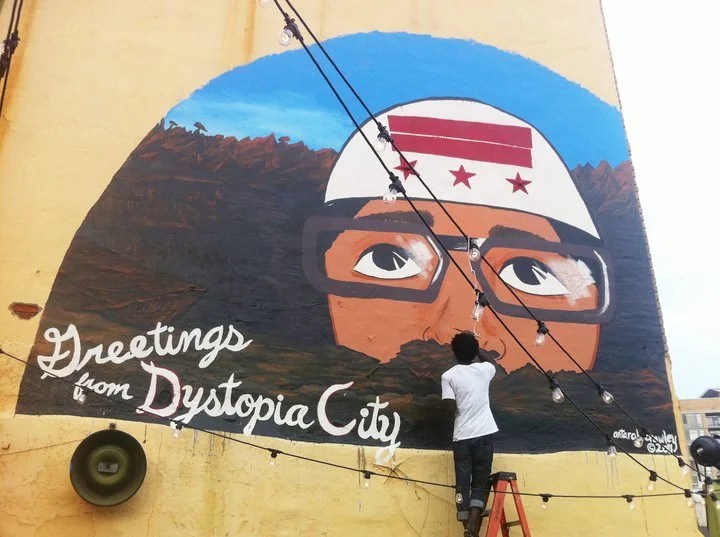
WASHINGTON, D.C. — If you drive or walk or, more likely, ride your fixed gear down the city’s busiest thoroughfare New York Avenue past 7th street you’ll see an imposing mural of a young brown boy with a cap depicting an upside-down DC flag peeking up out of a dystopian landscape reminiscent of Mew Mexico’s Bisti Badlands. The painted caption, “Welcome to Dystopia City” invokes the notion that all is not well here. Indeed, within the city there is a conflict of interest between a young, browning generation and the established hegemony, between corporations and small business, between those who have a voice and those who don’t. And the artists, whose hands are also colored with paint and adhesive, have largely taken up the cause to make the corporate hegemony accountable to their disruptive actions. In this paper I look at the actions of DC artists, who use the most symbolic city in the western hemisphere as a canvas for social correction, and the responses it stirs among those in power. And furthermore, in the very notions of power itself.
In fall of 2010, corporate oil-giant Chevron planned to execute a campaign that sought to fix public opinion of them after attention was drawn to their crude waste removal tactics in Ecuador. According to a team of professionals suing Chevron (formerly Texaco) for their human rights violations in multiple locations across the world, and specifically in Ecuador, the oil giant has been deliberately disposing toxic waste into the Ecuadorian Amazon—an estimated 18.5 billion gallons from 1964 to 1990, or 4 million gallons per day at the height of their operation. Even though they had managed to elude liability costs (a potential $27.3 billion) their public image had been damaged, thus they sought to repair it with a campaign that utilized a gritty street-art aesthetic and phrases that showed their corporate executives agreeing with “everyday, working class” Americans (e.g., “Oil companies should put their profits to good use—We Agree”, “Big oil should support small business—We Agree”, etc.)
In an effort to make their message more accessible to the public, Chevon reached out to local artists to put their posters up in an authentic, street art way, using wheatpaste and paint rollers. Cesar Maxit, a DC-based street artist, was one of the artists targeted to execute this operation. However, Mr. Maxit is not one to comply with the wishes of big oil. He has a long history of social activism and of using art, legally and illegally, towards that capacity. He says in an interview:
…I had started working with environmental and human rights groups, I wanted to write messages about social justice. My first burner was a piece that said “Free Tibet.” My second was one that had a line of white-hooded Klansmen with the city skyline behind it, and in the negative space between it said “FREE MUMIA” followed by “amerikkka racist.” This was in 2000.
Cesar Maxit
Thus, when Chevron sent him the files for the campaign, which still contained their original messages, he called his friends in The Yes Men (tagline: Impersonating big-time criminals in order to publicly humiliate them. Our targets are leaders and big corporations who put profits ahead of everything else) and the Rainforest Action Network (RAN), an environmental activist organization begun in 1985 (mission statement: Rainforest Action Network campaigns for the forests, their inhabitants and the natural systems that sustain life by transforming the global marketplace through education, grassroots organizing, and non-violent direct action), to collaborate on a counter-campaign. Maxit, in a documentary short about the counter-campaign, says the aim of Chevon in its efforts is to “confuse the public.” He, along with The Yes Men and RAN, altered the original Chevon files to read messages that were more precise, more radical (e.g., “Oil companies should clean up their messes.”). Instead of retaining the images of working class Americans, he used the faces and words of the Ecuadorian peoples that the corporation actually affected, thus radicalizing the campaign in a way that Chevron had not intended.
The questions that this counter-attack (which resulted in Chevron pulling the campaign completely) raises revolve around the mythologies surrounding responsibility and authenticity. Could the campaign have been authentically “agreeable” without the help of actual street artists? What does a campaign like this symbolize, even when Chevron has not actually committed to cleaning up its mess in Ecuador? At the base of it all, what is the role of the street artists in this scenario? Is his role to help corporations get back on track, or to call attention to their faults? If Chevron had actually continued with the campaign (and even with the altered versions already up on the street), whose campaign is it? Who is the author? And lastly, why DC?
Roland Barthes’s Death of the Author would have anticipated such response from the street art/activist community. Mr. Maxit has physically done what the reader in Barthes does every time he reads a text—he deconstructs it; he takes the text and, without considering what the author intended, which is ultimately futile because the author is a confused self-destructive entity, he reassess the “blends and clashes” inherent in the text (1324). Barthes writes, “We know now that a text is not a line of words releasing a single ‘theological’ meaning (the message of the Author-God) but a multidimensional space in which a variety of writings, none of them original, blend and clash” (1324). Chevron acts as the “Author-God” that has been abstracted out. With the remaining text, which reads, for example, “Big Oil should get real”, the author, Mr. Maxit, RAN, and so on, detangles what is being said. In an interview, Mitch Anderson, a spokes man for the San Francisco-based organization, Amazon Watch, asks rhetorically, “Does Chevron think that we’re stupid?” As the author, they are putting words on a page that come in contact with other entities, actions surrounding their statements. The reader takes all of these aspects inherently into consideration when analyzing a statement like “Big oil should get real.” Cesar Maxit asks, “‘Get real’? Well, what does that mean? Of course we all agree with that. But what about ‘Oil companies should clean up their messes?’ Do you agree with that? I think most people would agree with that, but I think Chevron doesn’t.” Here, the reader has destroyed the voice. It epitomizes Barthes’s statement that, “a text is made of multiple writings, drawn from many cultures and entering into mutual relations of dialogue, parody [and] contestation…” (1325). In the end, this campaign has actually served to promote further scrutiny into Chevron’s actions. It’s authorship has written its own rebuttal. By getting street artists to interact with the campaign, it has entered the reader into the execution of the text. This puts multiple hands on the “original” message and renders is read before it actually goes public.
This actually brings up another level of readership. On one level, Maxit and the activist community are reading the ads. Yet they put them up in the public sphere, thus entering the text into another, secondary level of readership. Though it’s not as well documented or extensive as the primary reading, we still see the artist entering into his own death. The product will now be read at face value—as a Chevron ad that shows the corporation explicitly admitting to wrongdoing. This may lead the secondary reader to believe that the company is actually trying to get its act together. Once again, the message of the author—now the artist—is obliterated and the reader assumes the power of interpretation. The text never becomes the product of one author; it is always a collaborative space. As Barthes writes, “Writing [or in this case, art/publicity/advertising] is that neutral, composite, oblique space where our subject slips away, the negative space where all identity is lost, starting with the very identity of the body of writing” (1322).
Antarah, you’ve chosen a really interesting focus that’s, I think, much clearer than it was in the first draft. You’re also going in an unexpected and interesting direction with it–I’d have expected you to perhaps go after Deutsch or Foucault, but I think this is really interesting. As noted in the margin, you will need another theorist from class besides Barthes. It sounds like Derrida might be a good one. Or, if you want to think more about the larger frame of discourse, DC as a symbolic city, whose discourse on the level of architecture is disrupted by street art, then Foucault (or Deutsch) might help. At any rate, it’s a fascinating project!
Grade: A
© 2011 by Antarah Crawley
The Saint Nat Project

presents
The Canonization of Saint Nat (2020)
In his first portrayal of the Virginian revolutionary, the Reverend Nat Turner, Antarah Crawley delivers the revelation which Nat testified through his attorney at trial on the 5th of November, 1831. His testimony was read in open court, and when asked by the Court for any further explanation, his only spoken words were, “Was Christ not crucified.” Nat was convicted that same day and executed by the Commonwealth at Jerusalem on 11 November, 1831. By and through his performance, Crawley canonizes Nat a Saint in the tradition of Ordo Templi Novus Syllabus and dedicates the Temple N:. S:. in his beatified name. Produced and Directed by Antarah Crawley.
The Revelation of Christ to Saint Nat (2021)
In his second portrayal of the Reverend Saint Nat on the first anniversary of his canonization, Antarah Crawley evokes the religious fervor which inspired this martyr to undertake the insurrection in Southampton County, Virginia, pursuant to his self-education and the sighting of the annular solar eclipse of 12 February, 1831. Produced and Directed by Antarah Crawley.
Script of The Revelation of Christ to Saint Nat, or, The Gospel of Saint Nat
Originally transcribed by Thomas R. Gray, Esq.,
and edited for brevity by A. A. Crawley, Scribe,
O.T.N.S., Anacostia R.V., Al-Maghreb Al-Aqsa.
ברוך ה המבורך לעולם ועד
Baruch Adonai ham’vorach, l’olam va-ed
Praise be to G-d to whom all praise is due, world without end.
בָּרוּך אַתָּה ה’ אֱ-להֵינוּ מֶלֶך הָעוֹלָם
Baruch atta Ado-noy Elo-hai-nu Melech ha’olam
Blessed are you, Lord our G‑d, King of the universe.
Kedushah
בָּרוּךְ אָתָּה יְיָ הָאֵל הַקָּדוֹשׁ.
Baruch atta Ado-noy ha-el hak-kadosh
Blessed are You, Eternal God, the essence of holiness.
אַתָּה קָדוֹשׁ וְּקדוֹשִׁים בְּכָל יוֹם יְהַלְלוּךָ סֶּלָה
atta kadosh ukedushim bekhol yom yehalelukha selah
You are holy, and Your holy ones praise You every day, praising you forever;
v’kara zeh el zeh v’amar
and each one called to the other:
קָדוֹשׁ קָדוֹשׁ קָדוֹשׁ ה’ צְבָאוֹת מְלֹא כָל הָאָרֶץ כְּבוֹדוֹ
Kadosh Kadosh Kadosh Adonai Tz’vaot M’lo Khol Ha’aretz K’vodo
“Holy, Holy, Holy, The Lord of Hosts, The entire world is filled with His Glory.”
בָּרוּךְ כְּבוֹד ה’ מִמְּקוֹמוֹ
Baruch K’vod Adonai Mim’komo
“Blessed is the Glory of the Lord in Its Place”
יִמְלֹךְ ה’ לְעוֹלָם. אֱלֹהַיִךְ צִיּוֹן לְדֹר וָדֹר. הַלְלוּיָהּ
Yimloch Adonai L’Olam, Elohayich Tziyon L’dor Vador Hall’luyah
“The Lord shall reign forever, Your God, O Zion, from generation to generation, Hallelujah”
JERUSALEM, VA – NOVEMBER 5, 1831
I was 31 years of age the 2nd of October last, and born in Southampton County of Old Virginia. 2 In my childhood, while at play with other children, at three or four year old, I was telling them something which my mother, overhearing, said had happened before I was born. Others being called on were greatly astonished, knowing that these things had happened, and caused them to say in my hearing that I surely would be a prophet.
3 And my mother and father strengthened me in this my first impression, saying in my presence that I was intended for some great purpose. 4 I taught myself to read and write, and improved my learning at all opportunities. And having soon discovered my spirit to be great, I withdrew myself to fast and pray, and wrapped myself in mystery.
Chapter 2
Now finding that I had arrived man’s estate, and hearing the scriptures commented on at the meetings, I was struck with that particular passage which says, Seek Ye the Kingdom of God and all things shall be opened unto you.
2 I reflected much on this passage and prayed daily for light of the subject, and as I was praying one day at my plow the Spirit spoke to me saying, Seek ye the Kingdom of God and all things shall be opened unto you.
Chapter 3
Now finding that I had arrived to man’s estate, and was a slave, and these revelations being made known to me, I began to direct my attention to that great object, to fulfill the purpose for which, at this time, I felt assured I was intended.
2 At this time I had a vision: and I saw white spirits and black spirits engaged in battle. And the sun was darkened, and thunder rolled in the heavens, and blood flowed in streams and I heard a voice say, Such is your luck, such you are called to see, and let it come rough or smooth, you must surely bear it.
3 I now withdrew myself from the intercourse of my fellow servants, for the avowed purpose of serving the Spirit more fully. 4 And it appeared to me and reminded me of the things it had already shown me, that it would then reveal to me the knowledge of the elements, the revolution of the planets, the operation of the tides, and the changes of the season.
5 After this revelation, in the year 1825, and the knowledge of the elements being made known to me, I sought more than ever to obtain true holiness before the great day of judgment should appear, and then I began to receive the true knowledge of faith.
Chapter 4
And from the first steps of righteousness until the last was I made perfect. And the Holy Ghost was with me and said, Behold me as I stand in the heavens. 2 And I looked and saw the forms of men and women, and there were lights in the sky to which the children of darkness gave other names than what they really were, for they were the lights of the saviors hands stretched forth from East to West, even as they were extended on the cross on Calvary for the redemption of sinners.
3 And I wondered greatly at these miracles, and I prayed to be informed with a certainty of the meaning thereof. 4 And one day while I was laboring in the field, I discovered drops of blood on the corn as though it were a dew from heaven. 5 And I communicated it to many both white and black in the neighborhood, and they found on the leaves in the woods hieroglyphic characters and numbers, and the forms of men and women portrayed in blood, representing the figures I had seen before in the heavens.
6 And now the Holy Ghost had revealed itself to me, and made plain the miracles it had already shown me. 7 For as the blood of Christ had been shed on this earth, and had ascended to heaven for the salvation of sinners, and now was return to earth again in the form of dew, and as the leaves on the trees bore the impression of the figures I had seen in the heavens, it was plain to me that the Savior was about the lay down the yolk he had borne for the sins of men, and the great Day of Judgement was at hand.
Chapter 5
And on the 12th of May, 1828, I heard a loud noise in the heavens. 2 And the Spirit instantly appeared to me and said the serpent was loosened, and Christ had lain down the yolk he had borne for the sins of men, and that I should take it on and fight against the serpent, for the time was fast approaching when the first would be last and the last would be first.
3 By signs in the heavens it would make known to me when I should commence the great work, and until the first sign appeared I should conceal it from the knowledge of men.
4 But on the appearance of the sign – the eclipse of the sun last February – I should arise and prepare myself, and slay my enemies with their own weapons. 5 And immediately upon the sign appearing in the heavens, the seal was removed from my lips and I communicated the great work laid out for us to do to Henry, Hark, Nelson, and Sam.
6 Many were the plans formed and rejected by us, and the 4th of July last came and went without our coming to any* determination how to commence. 7 We were still forming new schemes and rejecting them when the sign appeared again, which determined me not to wait longer.
Epilogue (Psalm 43)
Judge me, Allah, and plead my cause against an ungodly nation: O deliver me from the deceitful and unjust man.
2 For thou art the God of my strength: why dost thou cast me off? why go I mourning because of the oppression of the enemy?
3 O send out thy light and thy truth: let them lead me; let them bring me unto thy holy hill, and to thy tabernacles.
4 Then will I go unto the altar of God, unto Allah my exceeding joy: yea, upon the harp will I praise thee, Elohim Elohai.
5 Why art thou cast down, O my soul? and why art thou disquieted within me? Have Faith, Trust and Believe in Allah: for I shall yet praise Thee, who art the health of my countenance, Elohai.
Benediction
Charis Kuriou Iyesous Xristos Agion. Amen.

(last modified 7 August 2023)
 Supreme Exchange