Category: CAM
St. Nat and St. Ala
To All To Whom these Presents Come, Greetings; Know Ye By These Presents—
I, Antarah, “Dams-up-water,” of the United House of Hereford and Crawley of the Confederated State of Powhatan, do hereby WITNESS and AFFIRM that the autonomous local church which is called the Open-Air Archbasilica in the Grove Outside-The-Walls (“the Outer Court”) of the Metropolitan and Primitive Cathedral (“the Inner Court”) of the Sacellum Sanctissimi Salvatoris ac Sancti Nat et Ala ad Syllabyim (Shrine of the Most Holy Savior and Saints Nat and Ala in Syllabees) (“the Sanctum Sanctorum”), collectively—
McDomine’s Assembly of Yahuah in Moshiach (MAYIM)
or, McDomine’s Art Assemblage [2020 | concrete masonry units, wood, and found objects] (formerly known as SACELLVM SANCTISSIMI SALVATORIS YAHVSHVAH HAMASHIACH AC SANCTI NAT TVRNER—KAHAL KADOSH BETH SYLLABYIM, or, “the Ecclesiastic College of Syllabees”), is reestablished this day the 25th of October in the year of Yahshua two-thousand-twenty-five, having been first builded by my hand and established September 2020; Dedicated to Saint Nat November 5, 2021, and dedicated to Saint Ala Crawley October 23, 2025, these ancestors having been duly canonized in Yahuah’s Holy Assembly in Yahshua HaMoshiach by the authority vested in ANTARVS DEI GRATIA, Principal-Trustee of NOVVS SYLLABVS SECLORVM. These premises shall be the headquarters of:
- Yahuah’s Assembly in Yahshua Moshiach autonomous particular church sui juris
- 153d Curricular Operations Research and Publication Service (CORPS) House of Studies (Beth Midrash) and legacy Office of Scribe of Novus Syllabus Seclorum
- McDomine’s Industries (New Jerusalem Development Company/New Works Projects Administration, “Best In Class” Icewater Syndicate, Agua Viva Treatment Plant)
- Benevolent and Primitive Order of Beavers, a clan of the tribe of the Nacotchtank people, in the firm of Weasel Badger Beaver Mink & Otter, Partners
- Hereford Crawley Family Trust (North Powhatan branch office)
The real properties and instruments constituting these premises shall be held in private trust between the registered landlord(s), overseer(s), resident(s) custodian(s), receiver(s) (if any) and the LORD our God YHVH, Grantor; and it shall be opened to the public regularly or periodically, pursuant to forthcoming terms and conditions, as an extension of trust of the LORD unto those who are his (the Nation of Israel; the Body of Christ; the One Holy Universal Apostolic Church).
IN THE TOWN OF NACOTCHTANK-ON-POTOWMACK,
IN YAHVAH’S ASSEMBLY IN YAHSHVA MOSHIACH
ET CULTVS IMPERATORIVS ANTARVS D.G.,
DAMS VP WATER, S.J., E.M.D.
Principal-Trustee, McDomine’s Temple System | Professor-General, 153d CORPS, Dept. of Information Systems Intelligence Service, Universitas Autodidactus | Managing Partner, Weasel Badger Beaver Mink & Otter


(last modified 26.01.13.19.22)
Proximus Amicus
IN THE KINGDOM OF GOD—IN THE NAME OF YAHUAH
A Firm League of Friendship (FLF) in the Nature of a
Decentralized Autonomous Organization DAO),
Department of Peace and Friendship (DOP),
Political Bureau of Education (Politburo),
Universitas Autodidactus (UA),
Office of Traveling Ministry,
Ministry of Public Friend
Antarah,
Director of the N∴S∴ Program,
NOVUS SYLLABUS, L.L.C.,
Freely Associated Service Provider

1st Minute of Public Service | last modified 24/6/9/11:59 AM 24/7/17/11:22 AM 24.07.18.04:30PM
Article I.
GENERAL
(a) Standing Project on Unprogrammed Meetings for Worship; in the Manner of Friends (in Convention of Sitting in Waiting); in Convention of a Sitting of Oyer et Terminer (Hearing and Determining); with a Concern for Business, and for other purposes; in a Regular or Special, General or Extraordinary, Whole or Committee Session.
(b) Objective: To continue in the path of simplicity, peace, integrity, community, equity, stewardship, and necessary direct action, conscientious objection, and civil disobedience exemplified by the conservative Society of Friends of the Truth and the Light which dwells in all God’s people, which principles are the foundation of American democratic-republican values as enshrined in the Bill of Rites and other statues.
(c) Product: the ‘Policy’ (textbook) Liber Praeceptum ‘LP‘ is the flagship product of N∴S∴, and is priced at $359.99, [target audience] for institutions/companies/organizations [clients] to purchase copies on behalf of their public/student body [users] to apply the Policy to their practice in order to do procedures, run programs, and manage projects. Clients may also purchase additional instructional and administrative services on retainer/hourly rate to support their practice, programs and projects. With purchase of preceptor services, users need not read the Policy purchased by the client, but may have it read and administered to them in an interface environment. LP is a large-language model dataset for the AI/ML engine of the DAO. As to LP, the Governor himself owns the IP copyright to the text, while N∴S∴ own the IP copyright to the reproduction of each page therefor and the text thereof.
(d) School (also known as ‘Shul’ or ‘Beth Midrash’) shall be considered a “regular” series of meetings convened during a “session” of the calendar year. For the purpose of school a “regular day” consists of two meetings and 10AM AND 2PM respectively, each of which shall last no longer than 3 hours and no less than 1 hour. The driver of school is General, G:\Do-Process, or the “GDP” application, operation or function. f(GDP) operates as follows:
General Due Process (GDP)
or, ‘P-Cubed’
(e) P-Cubed (‘PC‘ or ‘Process Cubed’) is the general governing methodology and operating environment (‘due process’) of the core lines of business (applications) of N∴S∴ (itself a development and operating system, or DOS). The interfacing “shell” of the DOS is an auto-server or client-server architecture located in a ‘mainframe‘ (a room, building or other capacitor) containing a ‘desktop‘. ‘C’ in PC can also refer to the cubic three-dimensional systemtheory Cognition—Command—Control. Therefore: “use your PC to C your Mindsoft DOS.”
(1) X-Axis Procedure
- Notice: Received input through sense perception.
- Data: The input distilled into quantifiable units.
- Information: The quantities expressed qualitatively.
- Knowledge: The crystallization of the qualitative output.
(2) Y-Axis Procedure
- Audit: To hear, collect, and/or record that which is noticed.
- Assessment: To evaluate data.
- Assurance: To vet and confirm the evaluation.
- Adjudgement: To adjust prior knowledge in light of instant output.
(3) Z-Axis Procedure
- Policy: Written guidance for daily or regular conduct, resulting in a transmission of charges*.
- Practice: Daily or regular conduct including activity, motion, interface, etc.
- Program: A regular and ongoing practice.
- Project: Particular work product class and their production processes.
*Note: charges are to be collected in exchange for rendering special services, but are not to be collected for rendering regular services.
[20240609: The concept that one multiplied or subdivided by itself, creating two, is a square of itself, and, multiplied or subdivided again by the same, is a cube, which is four, is crystalized in Mr. Gene Ray‘s discovery of nature’s harmonic simultaneous 4-day time cube which demonstrates that time is not linear but cubic (‘cubic awareness’). This systemtheory integrates the principle of opposites, 4-corner quadrant division, 4/16 rotation, and full spacetime hypercube into one seamless cubic logic. Mr. Ray found that earth has four days simultaneously in each rotation; we erroneously measure time from one corner; and the human form is a personified pyramid. The reader may be tempted to write off this theory is schizophrenia, but the instant author has found it to be most salient in light of the General Due Process Procedure which proceeds from the linear X axis to the squared Y axis to the cubed Z axis, thus defining the outer limits of ‘performance‘ of said procedure within the third density/dimensional plane.] [20240718: As an aside, it is evident that as a body passes through or traverses the 3rd-dimensional space-time continuum, there is a higher-dimensional cubic space or ‘chamber’ which emanates from the center of said body, enclosing it at all times at the body traverses the 3rd Dimension, and that entities can and often do occupy this higher-dimensional room/place, interacting with the 3rd Dimensional body (often without its knowledge or conscious awareness). This is similar to the apparent luminosity and ultraviolet radiation of the sun, which in actuality is fueled by an internal combustion of the black matter which invisibly pervades the waters above the firmament.]
(f) Program: The New Syllabus Program is the oldest project of the N∴S∴, established in 2014. This project is also a program. Other projects of N∴S∴ include, on the internal/directorship side: DISIS/DOSCOM, ORAS/OS/ARM, OO/OOG, GB&T MSS/WKPS/MNCS, NWPA, DHS, Mindsoft, Artcoin, and CORPS; on the external/administration side: UA, US, FTLU, DOP, PEACE-CORPS, and FLF-DAO. The 153D CORPS of N∴S∴ is also known as the “Beth Midrash” and supports the Politburo of the DOP, DAO and UA. The best way to describe the N∴S∴ is a Rabbinical-Islamic-Quaker political and educational organization, founded in the ancient and sacred mysteries.
(g) Degree: There are no honorary titles or degrees among friends. However, the Ministry of Public Friend Antarah, of NS, will confer the Degree of Knight of Djedu, conferring knighthood in the Ancient Order of Djedu, Melchizedek — Judges of the King of Righteousness — the only eligible degree in the program, for payment of $9,999.99, perfect attendance at one seasonal course of meeting, and pursuant to applicable precepts. The Meeting of Conference will be a special meeting and the degree will be conferred using an official sword consecrated to Peace and Friendship. Such conference conveys no honorary status nor moral endorsement, nor in any wise shall entitle the celebrant to be set apart from the friendly public. Antarah is authorized to confer this degree by authority of his doctoral dissertation of L.P.
(h) Liturgy: The liturgical program — work of the people, or public service — provided by NS is an unprogrammed dialectical meeting for worship convened by friends at the place of meeting, presided over by the head of meeting and attended to by the clerks of meetings. Such meeting may be convened for worship (communion and communication with the Inward Teacher/Christ) alone; with a concern for business; to convene a sitting of oyer et terminer; to confer upon a matter in question; or to confer a degree of Knight of Djedu Melchizedek. All services are provided free and without oath or obligation to the friendly public, with the exception of a Conference of Degree.
(i) Course: The regular semester of shul shall be called a serialized or year-based Seasonal Course of Meeting.
(j) Enterprise: Under Synchronized Decentralized Autonomous Command System (SDACS II), the “schedule of members and officers of the decentralized autonomous organization (DAO)”:
- Curricular Operations Research and Publication Services (CORPS) is a division [e.g., the Politburo or the UA];
- a college of the Universitas Autodidactus (U∴A∴) is a regiment [e.g. the 1st EC];
- a freely associated service provider is a company [e.g. the N∴S∴];
- a labor union is a platoon [e.g. the US];
- committee of any of the above units is a squad or team [e.g. a regular or special Meeting] NB: Regular, Special, and Festive Meetings are numbered sequentially.
(k) DOP PEACE-CORP Non-Commissioned (Enlisted) and Commissioned (Officer) ranks:
- Scribe (E-1)
- Djedi [Knight] (E-2)
- Rapporteur (E-3)
- Free Thinker [Dialectician I] (E-4)
- Truth Speaker [Dialectician II] (E-5)
- Light Worker [Dialectician III] (E-6)
- Ombudsman [Master Dialectician] (E-7)
- Program Director (E-8)
(l) Commissioned Officers pertain to a corpus meaning “body”, as in a union, university, assembly:
- Syndic, or Friend (O-1)
- Secretary Treasurer [Clerk] (O-2)
- Chair [of a committee] (O-3)
- Preceptor [of a Preceptory, or regiment] (O-4)
- Administrator [of an Association, or union] (O-5)
- Governor [of a Company] (O-6)
- General Consul [of a Division] (O-7)
(m) Testimony of Simplicity: Going forward the minister will not use honorary titles to distinguish himself beyond those earned by divine right, being the Director of N∴S∴ and a minister of God’s Word and other laws he precepted in the course of discharging that office. The minister shall be known by his first name only, and may be mentioned to descend from the House of Crawley of Nacotchtank, Washington, D.C. The director is no more of a minister of the Word than any other Friend.
(n) Testimony of Peace: Going forward the minister will not engage in any conduct that does or appears to inure to a violent or exploitative act.
Article II.
PRECEPTS REGARDING MEETING IN THE MANNER OF FRIENDS
from, Friends Meeting of Washington
(a) Worship
- Worship is silent and unprogrammed, and subject to the guidance of the Inward Teacher.
- A period of time is used to center into an inward stillness. Spirit-led listening is perhaps the most important task of the worshipper.
- Spoken messages come from the spiritual depth of one’s life and from the leading of the Inward Teacher.
- To be absorbed, each message needs to be followed with a period of silence which allows for deepening.
- When the vocal and silent ministry speak to the condition of those present and is developed and deepened in the Truth, a profound sense of spiritual community occurs that freshens and delights. This is what we call a “gathered Meeting.”
- Meeting for Worship ends after about an hour when the head of Meeting, on the facing bench, shakes hands with those nearby. We then greet those sitting around us in a similar manner.
(b) Testimonies
- Testimonies are what Friends call the ways we have found to live and act based on our beliefs. As a group, we find that listening to and following God leads to:
- Integrity—living as whole people who act on what we believe, tell the truth, and do what we say we will do.
- Simplicity—focusing on what is truly important and letting other things fall away.
- Equality—treating everyone, everywhere, as equally precious to God; recognizing that everyone has gifts to share.
- Community—supporting one another in our faith journeys and in times of joy and sorrowsharing with and caring for each other.
- Peace—seeking justice and healing for all people; taking away the causes of war in the ways we live.
- Stewardship (Care for the earth)—valuing and respecting all of God’s creation; using only our fair share of the earth’s resources; working for policies that protect the planet.
(c) Ecclesiastes
1. Friends or Quakers – either name will do as they have the same meaning – are the people who belong to Friends meetings or churches. These make up the ‘Religious Society of Friends.’
2. ‘Quaker’ was originally a nickname for the people who called themselves “Children of the Light,” “Friends of Truth,” or ‘friends of Jesus.” (John 15:15). They were said to tremble or quake with religious zeal, and the nickname stuck. In time, we also became known simply as ‘Friends.’
3. Quakers began in England around 1650 in the aftermath of the Protestant Reformation. In contrast to the formalism of the established church of the time, early Friends found they could experience God directly without the benefit of clergy, liturgy or steepled church.
4. Quakers do not have a creed. No single statement of religious doctrine is accepted by all the diverse bodies that make up the Religious Society of Friends. Most meetings accept a book of ‘Faith and Practice’ which states shared values, outlines a process for making decisions, and contains a uniquely Quaker feature, ‘Advices and Queries.’
5. Friends are united in stressing that an inward, immediate, transforming experience of God is central to our faith. We turn to an inner guide or teacher for direction. Many Friends identify this as the ‘Inner Light,’ the ‘Seed Within,’ or the ‘Christ Within’ [the ‘Inward Teacher’] Some affirm their acceptance of Jesus Christ as their personal savior while others conceive of the inward guide as a universal spirit which was in Jesus in abundant measure and is in everyone to some degree.
6. George Fox, a troubled and searching youth in 17th century England, underwent a profound religious experience that he described as a Voice answering his need: “There is one, even Christ Jesus, that can speak to Thy condition.” Immediate, direct experience of God became the heart of his message and ministry, the beginning of the Quaker movement.
7. Love – of God and neighbor – is expressed in Quaker worship, witness, and our testimonies. Our social attitudes and concerns, service, and programs of education and action are the fruits of our faith and the affirmation of the indwelling spirit and redemptive love.
8. The realization that there is the potential for good – and also evil – in all people makes Friends sensitive to human degradation, ignorance, superstition, suffering, injustice and exploitation. Under a sense of concern (inner prompting, divine obedience or urgency) Friends are drawn to humanitarian callings and to programs of education, service and constructive action.
9. Many Friends today are pressing for social change by nonviolent means: reform of the criminal justice system and elimination of the death penalty; elimination of discrimination against minority groups and racial injustice; and an end to war.
10. Most Friends reject the sacraments in their outward forms – communion and baptism as practiced in most Christian churches. We seek instead for the inward reality. For us, all great human experiences are of a sacramental nature.
11. The Bible was very precious to early Friends, but to understand the scriptures, they saw that they must be read in the same Spirit as those who wrote them. An early Quaker leader, Robert Barclay, said that the scriptures are only a declaration of the source and not the source itself. Today, Friends exhibit a wide variety of relationships to the Bible and other religious texts.
Source: https://quaker.org/testimony
12. Quaker testimony is best understood as the public witness of an inward faith of both individual and community. It is the consequence of one’s relationship to God and the outworking of that relationship in one’s life. Testimony is critical to the Quaker tradition as it is the practice side of “Faith and Practice,” a phrase you will see together often. Friends have always believed that what was most important was how faith was lived out collectively in the world. This praxis oriented perspective takes priority over doctrine or belief. For instance, early Friends did not practice baptism as an outward rite. Instead, Friends were called to live out their baptism in the world; show you are baptized by the Holy Spirit by the way you live your life. Witness and practice are good words today to help newcomers understand the meaning behind testimony.
13. Quaker scholar Pink Dandelion points out that among early Friends testimony was used in the “singular,” meaning that one’s whole life was to live out the consequence of their relationship with God in community. However, overtime testimony became pluralized (testimonies) and began to function more like lists of doctrines (protecting the boundary between Quaker community and those who are not Quakers), and eventually towards the individualization of “values.” It is less of a collective understanding and more up to each individual to decide how to practice their faith.
14. Today, you will often hear Friends use this pluralized language of testimonies referring to a broad range of Quaker beliefs and practices. Furthermore, a fairly recent simplification of testimony has resulted in the popular usage of the acronym “S.P.I.C.E.S.” standing for “Quaker values” such as Simplicity, Peace, Integrity, Community, Equality, and Stewardship. Regardless of usage, whether testimony, testimonies, or SPICES, the point is the Quaker commitment to “faith in action,” a living out and being a witness to what one believes.
Article III.
PRECEPTS REGARDING THE OFFICE OF TRAVELING MINISTRY
(a) Beliefs
- Every person is known by God and can know God in a direct relationship.
- The Quaker faith has deep Christian roots. Many Quakers consider themselves Christians, and some do not. Many Quakers find meaning and value in the teachings of many faiths.
- Quakers strive to live lives that are guided by a direct encounter with the Divine, more than by teachings about the Divine. Quaker terms for the Holy include God, the Seed, the Light Within, and the Inward Teacher, among others.
- Testimonies are ways that Quakers have found to express our experience of the Divine in our lives. Some of the best recognized testimonies include simplicity, integrity, equality, community, and peace.
(b) Worship
1. Quakers gather in the silence and wait expectantly to come into the presence of the Divine and to be guided by the still, small voice by which God speaks to us from within. During the silence, anyone may feel moved to offer a simple spoken message (vocal ministry) that is inspired by this holy encounter. Following the message, the silence resumes. A period of worship may include several messages or none.
2. In succeeding generations, as our religious society became settled . . . and as we became more geographically dispersed, the traveling ministry helped to provide needed communication between the various groups of Friends. . . . Traveling ministers were certified and trusted outsiders to the meeting’s “politics.” In this capacity they could be of enormous service to the community. Their ability to discern the spiritual health of the meeting, their mediating influence to reconcile differences, and their liberty to speak out on potentially difficult issues both spiritual and temporal were often very helpful to Friends.
3. During the [1900s], the formal practice of travel in the ministry among Friends had virtually ceased. In the unprogrammed tradition . . . it is thought that no one’s gifts in the ministry should be recognized over and above the gifts of others. Along with the advent of modern communication . . . formal travel in the ministry had all but fallen to disuse.
4. Recently, there seems to be a revival of the traveling ministry. . . .
(Jonathan Vogel-Borne, “Traveling in the Ministry”)
(c) Travel Minutes
Travel minutes (or “traveling minutes”) are issued to Friends who have worked with their monthly meeting to discern a clear leading to travel and visit other Friends. They may have a specific concern, they may have been asked to visit a meeting for a specific purpose, or it may be that God has moved them to worship with those Friends and to be with them. The Friend who is led to travel lays it before his or her monthly meeting along with the whole nature of the proposed visits as far as can be foreseen. If the monthly meeting unites with the concern or affirms the leading, it writes a minute to that effect and gives the Friend a copy. A travel minute should describe any specific concern the bearer is laboring under. When a meeting comes to unity with a member’s concern to travel, it should make sure that finances do not stand in the way by being ready to contribute toward the expenses incurred.
It is customary, where practicable, for traveling Friends to be welcomed into the homes of those whom they visit. This has the double advantage of saving expense to the traveler and of extending more intimately the benefit of the visit.
While visiting, the carrier of a travel minute presents it to the clerk of the body visited, who reads it aloud as a way of introducing the traveling Friend. (Only the travel minute, not endorsements, should be read.) At the end of the visit, the clerk writes and signs a brief note about the visit. This is called an endorsement. (See Sample Forms, Letters, Etc. for some examples.) Endorsements may be written on the back of the page or on additional pages attached to the letter.
When the proposed visits are completed, the traveling Friend should return the minute and all the endorsements to the body that issued it. The body may ask the traveling Friend to report on his or her experiences as well.
A travel minute represents an activity with a specific form: leaving, traveling under a concern, and returning to report on the completed event. For an ongoing ministry, another form of support, such as a minute of religious service, may be more appropriate.
(d) Companions in Ministry
Since the earliest times, Friends traveling with a concern usually had a companion who could provide both practical and spiritual support. This practice is currently being revived, largely through the influence of FGC’s Traveling Ministries Program. Friends who lead workshops and retreats or who travel with other leadings have found that having a companion in the ministry is of considerable spiritual and practical support. The companion prays for the minister as well as those ministered to, being attentive to how the Spirit is moving. The companion helps the minister to deepen his or her faithfulness. It is good practice to provide companions with traveling minutes that describe their supporting role.
(e) Minutes of Religious Service
A minute of religious service is more broad than a travel minute and can include any kind of service. It embodies a meeting’s recognition of a call to a religious service in someone’s life. […]
Chestnut Hill Friends suggest that a minute of religious service contain the following components:
- Name the work as explicitly as possible.
- Affirm that the meeting experiences the person as led to do the work; perhaps include how the person’s life and spiritual path have led to this work at this time.
- Name the meeting’s unity with the work, perhaps making reference to Friends testimonies.
- Name the meeting’s specific commitments to supporting this person and his or her work, including the appointment of an oversight committee.
- Ask the reader for his or her support.
- Give the approval date and an appropriate expiration date, with the signature of the clerk of the meeting. The expiration date may vary considerably, depending on the nature of the call.
When members of a meeting plan to travel and wish to make contact with other Friends, they may ask the clerk of their home meeting or the yearly meeting for a letter of introduction. The letter may also convey greetings from the meeting. There are no obligations for financial support, hospitality, or reporting back to the home group. The clerk can issue a letter of introduction on his or her own authority; no consultation or approval is necessary.
By Mathilda Navias. This is an excerpt from Quaker Process for Friends on the Benches available now from Friends Journal. From, https://www.friendsjournal.org/traveling-ministry/
Curricular Operations Research &
Publication Services provided by

DOP

An Act to Establish a Department of Peace and Friendship
The Governor of NOVUS SYLLABUS L.L.C., a freely associated service provider, to the decentralized autonomous organization of the people of the world, and to all to whom these presents come, Sends Greeting and Peace:
Know ye by these presents, (a) that there is hereby established among the decentralized autonomous organization (DAO) of the people of the world, namely those domiciled in the United States of America, a Department of Peace and Friendship (DOP), also known herein as the “Department”.
(b) The purpose of this Department shall be to promote and preserve perpetual peace in our country, and to observe such laws, customs, policies, and practices as are wise, prudent and germane to such peace whether they be of a religious, civil, or other nature.
(c) As to §4601(a) of The United States Institute of Peace Act codified at Title 22—FOREIGN RELATIONS AND INTERCOURSE of the United States Code (U.S.C.) Chapter 56: UNITED STATES INSTITUTE OF PEACE, to wit:
The Congress finds and declares that—(1) a living institution embodying the heritage, ideals, and concerns of the American people for peace would be a significant response to the deep public need for the Nation to develop fully a range of effective options, in addition to armed capacity, that can leash international violence and manage international conflict;
22 U.S.C. Ch. 56 § 4601(a)
the mission of this Department shall be separate and distinct from that of the United States Institute of Peace in that it shall strive to ensure domestic tranquility as enumerated in the Preamble to the Constitution of the United States of America, to wit:
We the People of the United States, in Order to form a more perfect Union, establish Justice, insure domestic Tranquility, provide for the common defence, promote the general Welfare, and secure the Blessings of Liberty to ourselves and our Posterity, do ordain and establish this Constitution for the United States of America.
Preamble to the United States Constitution
(d) As to §4601(b) of the same statute, to wit:
It is the purpose of this chapter to establish an independent, nonprofit, national institute to serve the people and the Government through the widest possible range of education and training, basic and applied research opportunities, and peace information services on the means to promote international peace and the resolution of conflicts among the nations and peoples of the world without recourse to violence.
22 U.S.C. Ch. 56 § 4601(b)
this Department shall serve the same purpose, while paying particular and specific attention to domestic tranquility in this country.
(e) This Act may be cited as the “Department of Peace Act”.
ART. 2. ORGANIZATION.
(a) This Department shall be governed by a Firm League of Friendship (FLF) which shall be chaired or presided by the Secretary of Peace and constituted by the Ambassadors of Peace. The Officers of the Department, in descending order of rank, shall be as follows:
- Secretary of Peace
- Deputy Secretary of Peace
- Under Secretary of Peace and Friendship (Director of Embassies and Consular Affairs)
- Under Secretary of Peace for Operations (Inspector General and Superintendent of Buildings)
- Under Secretary of Peace for Political Education (Director of the Politburo and Dean of the U∴A∴)
- Ambassadors of Peace (also called “Friends”)
- Ministers Plenipotentiary of Peace
- Envoy Extraordinary and Envoys of Peace
- Chief Justice of the Peace
- Associate Justices of the Peace
- Clerk of the Peace
- Office of Peace and Friendship (OPF) Consular Outposts (also called “Consulate”)
- P.E.A.C.E. Consul (of which there is one per outpost)
- P.E.A.C.E. Officers
- P.E.A.C.E. Cadets (also called “Enlisted Students”)
(b) The national headquarters of this Department shall be established at the old District of Columbia Recorder of Deeds Building located at 515 D Street, NW, Washington, D.C. 20001, and appropriations shall be made for its acquisition, rehabilitation, renovation, preservation (of artistic assets, etc.) occupancy, maintenance, and management.
(c) Article 2(a)(1),(2),(3),(4),(5),(9), and (11) officers shall maintain their offices at the national headquarters.
(d) Among their myriad duties, the Secretary of Peace shall serve as the solicitor general of the Department (1) in their capacity as a practitioner of transactional law and exclusive equity on behalf of the Department and the DAO, and (2) in their capacity as a “traveling salesperson” or “proselytizer” who spreads the message of peace and endeavors to obtain new business ventures for the Department. In this dual capacity, the Secretary shall bring instant or prospective matters of interest to the Department before the Chief Justice of the Peace on a regular basis. (3) The Secretary shall also serve as the U.S. delegate to the to-be-founded World Peace Organization.
(e) The Article 2(a)(9),(10), and (11) officers shall serve the function of “barristers” in the traditional sense of an advocate at law, or a jurist at law, and shall maintain a “right of audience” before the courts of the United States, like unto traditional “members of the bar”. Their collective office shall be known as the “Tribunal of Peace”. The subject matter jurisdiction of this Tribunal and its subordinate tribunals shall be the domestic tranquility of the decentralized autonomous organization of the people of the United States of America, and, by extension, their political-economic situational awareness.
(f) The Article 2(a)(12),(13),(14), and (15) officers shall be organized as the Peace Enforcement Activity Command Enterprise—Curricular Operations Research and Publication Service Division, or the “P.E.A.C.E.—C.O.R.P.S“.
(g) The Article 2(a)(6),(7), and (8) officers shall each maintain their office and practice in their private residences (known as an “Embassy”) and conduct business as a private company (known as a “Consulate”).
(h) The Article 2(a)(9) officer shall be appointed by the Secretary of Peace and confirmed by the Ambassadors of Peace. The Article 2(a)(10) officers shall be appointed by the Secretary of Peace and the Chief Justice of the Peace and confirmed by the Ambassadors of Peace, and they shall be equal in number to the states and territories of the United States, and they shall each reside in such place conducting business on behalf of those domiciled therein, and they may be known as the Chief Justice of the Peace of such place, and they may appoint subordinate Assistant Justices. Any such justice as enumerated herein may convene sessions of hearing and determining matters within their subject matter jurisdiction with or without a jury, which is to say, they may sit on a court of Oyer and Terminer.
(i) The Secretary of Peace or their assign(s) may convene student bodies in the nature of a mock trial/model United Nations/student government forum, which may be convened at the local, regional, and/or national levels on a regular basis. The Secretary of Peace may assign departmental officials to administer an assessment of the progress of the political-economic education of the student masses.
(j) The furniture of a room containing a class or assembly of the Political Bureau of Education (“Politburo”) shall consist of the Liber Praeceptum, the United States Constitution, the Torah, the Quran, the New Testament, a law dictionary, and Robert Rules of Order Revised.
ART. 3. AUTHORITIES.
(a) The Three Pillars of this Department shall be Trust, Faith, and Belief (trust in God, faith in humanity, and belief in the DAO). The Five Mottos of the Department shall be Love, Truth, Peace, Freedom, and Justice. The Seven Ethical Virtues of the Department, being marks of Noble character which are as rich in Value as fine Jewels, are found at Title 1 § 5 of the 2020 Omnibus Act.
(b) The following laws and statutes of an authoritative and historical nature are incorporated into this Act by reference:
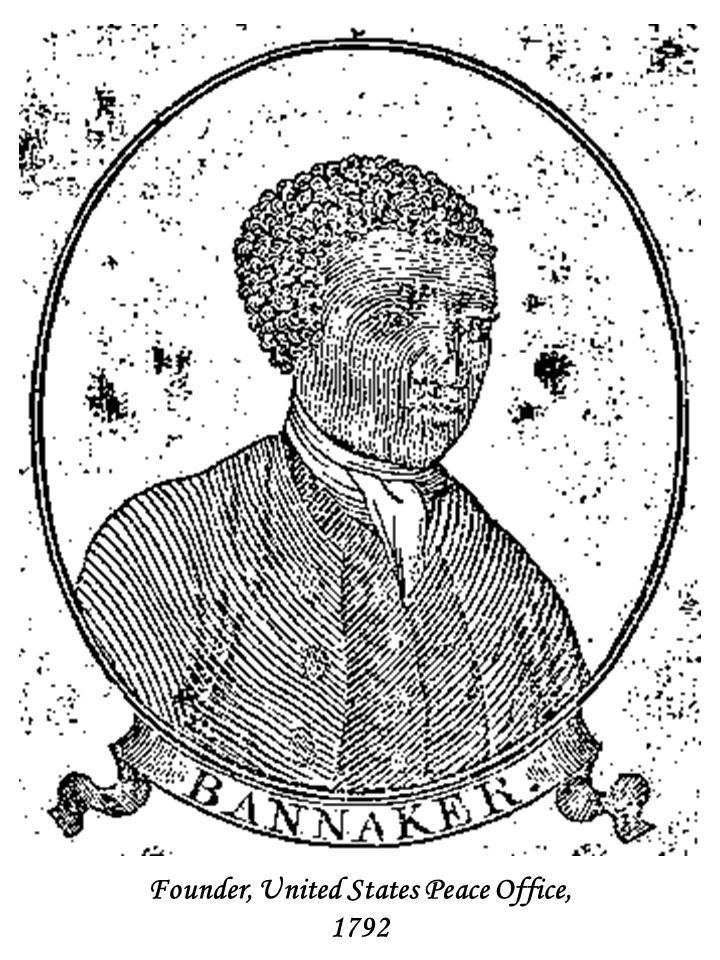
§1.
A PLAN OF A PEACE-OFFICE, FOR THE UNITED STATES.
(a) AMONG the many defects which have been pointed out in the federal constitution by its antifederal enemies, it is much to be lamented that no person has taken notice of its total silence upon the subject of an office of the utmost importance to the welfare of the United States, that is, an office for promoting and preserving perpetual peace in our country.
(b) It is to be hoped that no objection will be made to the establishment of such an office, while we are engaged in a war with the Indians, for as the War-Office of the United States was established in the time of peace, it is equally reasonable that a Peace-Office should be established in the time of war.
(c) The plan of this office is as follows:
I. Let a Secretary of Peace be appointed to preside in this office, who shall be perfectly free from all the present absurd and vulgar European prejudices upon the subject of government; let him be a genuine republican and a sincere Christian, for the principles of republicanism and Christianity are no less friendly to universal and perpetual peace, than they are to universal and equal liberty.
II. Let a power be given to the Secretary to establish and maintain free-schools in every city, village, and township of the United States; and let him be made responsible for the talents, principles, and morals of all his schoolmasters. Let the youth of our country be carefully instructed in reading, writing, and arithmetic, and in the doctrines of a religion of some kind: the Christian religion should be preferred to all others; for it belongs to this religion exclusively to teach us not only to cultivate peace with all men, but to forgive, nay, more – to love our very enemies. It belongs to it further to teach us that the Supreme Being alone possesses a power to take away human life, and that we rebel against his laws, whenever we undertake to execute death in any way whatever upon any of his creatures.
III. Let every family in the United States be furnished at the public expense, by the Secretary of this office, with a copy of the American edition of the BIBLE. This measure has become the more necessary in our country, since the banishment of the bible, as a school-book, form most of the schools in the United States. Unless the price of this book be paid for by the public, there is reason to fear that in a few years it will be met with only in courts of justice or in magistrates’ offices; and should the absurd mode of establishing truth by kissing this sacred book fall into disuse, it may probably, in the course of the next generation, be seen only as curiosity on a shelf in Mr. Peale’s museum.
IV. Let the following sentence be inscribed in letters of gold over the door of every house in the United States:
THE SON OF MAN CAME INTO THE WORLD, NOT TO DESTROY MEN'S LIVES, BUT TO SAVE THEM:
V. To inspire a veneration for human life, and an horror at the shedding of human blood, let all those laws be repealed which athorise juries, judges, sheriffs, or hangmen to assume the resentments of individuals, and to commit murder in cold blood in any case whatever. Until this reformation in our code of penal jurisprudence take place, it will be in vain to attempt to introduce universal and perpetual peace in our country.
VI. To subdue that passion for war, which education, added to human depravity, have made universal, a familiarity with the instruments of death, as well as all military shews, should be carefully avoided. For which reason, militia laws should every where be repealed, and military dresses and military titles should be laid aside: reviews tend to lessen the horrors of a battle by connecting them with the charms of order; militia laws generate idleness and vice, and thereby produce the wars they are said to prevent; military dresses fascinate the minds of young men, and lead them from serious and useful professions; were there no uniforms, there would probably be no armies; lastly, military titles feed vanity, and keep up ideas in the mind which lessen a sense of the folly and miseries of war.
VII. In the seventh and last place, let a large room, adjoining the federal hall, be appropriated for transacting the business and preserving all the record of this office. Over the door of this room, let there be a sign, on which the figures of a LAMB, a DOVE, and an OLIVE-BRANCH should be painted, together with the following inscriptions in letters of gold:
PEACE ON EARTH - GOOD-WILL TO MAN.
AH! WHY WILL MEN FORGET THAT THEY ARE BRETHREN?
Within this apartment let there be a collection of plough-shares and pruning-hooks made out of swords and spears; and on each of the walls of the apartment, the following pictures as large as the life:
- A lion eating straw with an ox, and an adder playing upon the lips of a child.
- An Indian boiling his venison in the same pot with a citizen of Kentucky.
- Lord Cornwallis and Tippoo Saib, under the shade of a sycamore-tree in the East-Indies, drinking Madeira wine together out of the same decanter.
- A group of French and Austrian soldiers dancing arm in arm, under a bower erected in the neighbourhood of Mons.
- A St. Domingo planter, a man of color, and a native of Africa, legislating together in the same colonial assembly.*
To complete the entertainment of this delightful apartment, let a group of young ladies, clad in white robes, assemble every day at a certain hour, in a gallery to be erected for the purpose, and sing odes, and hymns, and anthems in praise of the blessings of peace.
One of these songs should consist of the following beautiful lines from Mr. Pope:
Peace o'er the world her olive wand extends,
And white-rob'd innocence from heaven descends;
All crimes shall cease, and ancient frauds shall fail,
Returning justice lifts aloft her scale.
*At the time of writing this, there existed wars between the United States and the American Indians, between the British nation and Tippoo Saib, between the planters of St. Domingo and their African slaves, and between the French nation and the emperor of Germany.
Source(s):
BANNEKER’S ALMANACK, AND EPHEMERIS FOR THE YEAR OF OUR LORD 1793; BEING THE FIRST AFTER BISSEXTILE OR LEAP-YEAR: CONTAINING THE MOTIONS OF THE SUN AND MOON; THE TRUE PLACES AND ASPECTS OF THE PLANETS; THE RISING AND SETTING OF THE SUN; RISING, SETTING, AND SOUTHING OF THE MOON; THE LUNATIONS, CONJUNCTIONS, AND ECLIPSES; AND THE RISING, SETTING, AND SOUTHING OF THE PLANETS AND NOTED FIXED STARS.
——————————————
PHILADELPHIA:
PRINTED AND SOLD BY JOSEPH CRUKSHANK, NO.87, HIGH STREET.
——————————————

§2.
The Moroccan-American Treaty of Peace and Friendship
[28 June 1786]1
(a) In the Name of Almighty God.
(b) This is a Treaty of Peace & Friendship, established between Us and the United States of America, which is confirmed & which we have ordered to be written in this Book & sealed with our Royal Seal at our Court of Morocco, on the twenty fifth day of the blessed Month of Shaban in the Year one thousand two Hundred,2 trusting in God it will remain Permanent.
.1.
We declare that both Parties have agreed that this Treaty consisting of twenty five Articles, shall be inserted in this Book, & delivered to the Honorable Thomas Barclay, the Agent of the United States now at our Court, with whose Approbation it has been made & who is duly authorized on their Part, to treat with us concerning all the Matters contained therein.—
.2.
If either of the Parties shall be at War with any Nation whatever, the other Party shall not take a Commission from the Enemy, nor fight under their Colors.
.3.
If either of the Parties shall be at War with any Nation whatever, & take a Prize belonging to that Nation, & there shall be found on board Subjects or Effects belonging to either of the Parties, the Subjects shall be set at Liberty & the Effects returned to the Owners; & if any goods belonging to any Nation with whom either of the Parties shall be at war, shall be loaded on Vessels belonging to the other Party, they shall pass free & unmolested without any Attempt being made to take or detain them.—
.4.
A Signal or Pass shall be given to all Vessels belonging to both Parties, by which they are to be known when they meet at Sea, & if the Commander of a Ship of War of either Party, shall have other Ships under his Convoy, the Declaration of the Commander shall alone be sufficient to exempt any of them from examination—3
.5.
If either of the Parties shall be at War & shall meet a Vessel at Sea belonging to the other, it is agreed that if an examination is to be made, it shall be done by sending a Boat with two or three Men only, & if any Gun shall be fired and any injury done without Reason, the offending Party shall make good all Damages—
.6.
If any Moor shall bring Citizens of the United States or their Effects to His Majesty, the Citizens shall immediately be set at Liberty & the Effects restored & in like Manner, if any Moor not a Subject of these Dominions, shall make Prize of any of the Citizens of America or their Effects, & bring them into any of the Ports of His Majesty, they shall be immediately released as they will then be considered as under His Majesty’s Protection.—
.7.
If any Vessel of either Party shall put into a Port of the other & have occasion for Provisions or other Supplies, they shall be furnished without any interruption or molestation—
.8.
If any Vessels of the United States shall meet with a Disaster at Sea & put into one of our Ports to repair, she shall be at Liberty to land & reload her Cargo without paying any Duty whatever.—
.9.
If any Vessel of the United States shall be cast on shore on any Part of our Coasts, she shall remain at the Disposition of the owners, & no one shall attempt going near her without their Approbation, as she is then considered particularly under our protection; & if any Vessel of the United States shall be forced to put into our Ports by Stress of Weather or otherwise, she shall not be compelled to land her Cargo, but shall remain in tranquillity untill the Commander shall think proper to proceed on his Voyage—
.10.
If any Vessel of either of the Parties shall have an engagement with a Vessel belonging to any of the Christian Powers, within Gunshot of the Ports of the other, the Vessel so engaged shall be defended & protected as much as possible untill she is in safety; And if any American Vessel shall be cast on shore on the Coast of Wadnoon4 or any Coast thereabout, the people belonging to her shall be protected and Assisted untill, by the help of God, they shall be sent to their Country.
.11.
If we shall be at War with any Christian Power & any of our Vessels sail from the Ports of the United States, no Vessel belonging to the Enemy shall follow untill twenty four hours after the departure of our Vessels, & the same Regulation shall be observed, towards the American Vessels sailing from our Ports. be their Enemies Moors or Christians
.12.
If any ship of War belonging to the United States shall put into any of our Ports, she shall not be examined on any Pretence whatever, even though she should have fugitive Slaves on Board, nor shall the Governor or Commander of the Place, compel them to be brought on shore, under any Pretext, nor require any payment for them.
.13.
If a Ship of War of either Party shall put into a Port of the other & salute, it shall be returned from the Fort, with an equal Number of Guns, not with more or less.—
.14.
The Commerce with the United States shall be on the same footing as is the Commerce with Spain, or as that with the most favored Nation for the time being; & their Citizens shall be respected & esteemed & have full Liberty to pass & repass our Country & Sea Ports, whenever they please without interruption.
.15.
Merchants of both Countrys shall employ only such interpreters & such other Persons to Assist them in their Business as they shall think proper. No Commander of a Vessel shall transport his Cargo on board another Vessel, he shall not be detained in Port, longer than he may think proper; and all Persons employed in loading or unloading Goods, or in any other Labor whatever, shall be paid at the customary Rates, not more & not Less.
.16.
In Case of a War between the Parties, the Prisoners are not to be made Slaves, but to be exchanged one for another, Captain for Captain, Officer for Officer and one private Man for another; & if there shall prove a difficiency on either side it shall be made up by the Payment of one hundred Mexican Dollars for each Person wanting. And it is agreed that all Prisoners shall be exchanged in twelve Months from the time of their being taken, & that this Exchange may be effected by a Merchant, or any other Person authorized by either of the Parties.
.17.
Merchants shall not be compelled to buy or sell any kind of Goods, but such as they shall think proper, & may buy & Sell all sorts of Merchandise, but such as are prohibited to the other Christian Nations—
.18.
All Goods shall be weigh’d & examined, before they are sent on board; & to avoid all detention of Vessels no examination shall afterwards be made, unless it shall be first proved, that contraband Goods have been sent on board; in which Case the Persons who took the contraband Goods on board shall be punished according to the Usage & Custom of the Country & no other Person whatever shall be injured, nor shall the Ship or Cargo incur any Penalty or damage whatever.—
.19.
No Vessel shall be detained in Port on any pretence whatever, nor be obliged to take on board any Article without the Consent of the Commander, who shall be at full Liberty to agree for the freight of any Goods he takes on board—
.20.
If any of the Citizens of the United States or any Persons under their Protection, shall have any Disputes with each other, the Consul shall decide between the Parties, & whenever the Consul shall require any aid or Assistance from our Government to enforce his Decisions, it shall be immediately granted to him.—
.21.
If a Citizen of the United States shall kill or wound a Moor, or on the contrary if a Moor shall kill or wound a Citizen of the United States, the Law of the Country shall take place & equal Justice Shall be rendered the Consul assisting at the Tryal; & if any Delinquent shall make his escape, the Consul shall not be answerable for him in any Manner whatever—
.22.
If an American Citizen shall die in our Country and no Will shall appear, the Consul shall take Possession of his Effects, & if there shall be no Consul, the Effects shall be deposited in the hands of some Person worthy of Trust, untill the Party shall appear who has a right to demand them; But if the Heir to the Person deceased be present, the property shall be delivered to him without interruption, & if a Will shall appear, the Property shall descend agreable to that Will, as soon as the Consul shall declare the validity thereof.
.23.
The Consuls of the United States of America, shall reside in any sea Port of our Dominions that they shall think proper; & they shall be respected & enjoy all the Privileges which the Consuls of any other Nation enjoy; & if any of the Citizens of the United States shall contract any Debts or engagements, the Consul shall not be in any manner accountable for them, unless he shall have given a promise in writing for the payment or fulfilling thereof, without which promise in writing no application to him for any redress shall be made.—
.24.
If any differences shall arrise by either Party infringing on any of the Articles of this Treaty, Peace and Harmony shall remain notwithstanding in the fullest force, untill a friendly Application shall be made for an Arrangement, & untill that Application shall be rejected, no Appeal shall be made to Arms; & if a War shall break out between the Parties, Nine Months shall be granted to all the Subjects of both Parties to dispose of their Effects & retire with their Property; And it is further declared, that whatever indulgences in Trade or otherwise shall be granted to any of the Christian Powers, the Citizens of the United States shall be equally entitled to them.
.25.
This Treaty shall continue in full force with the Help of God, for fifty Years—5
We have delivered this Book into the Hands of the beforementioned Thomas Barclay, on the first day of the blessed Month of Ramadan in the Year One thousand two hundred.—
I Certify that the annexed is a true copy of the Translation made by Isaac Cardoza Nuñez, Interpreter at Morocco, of the Treaty between the Emperor of Morocco and the United States of America.—
Thos Barclay6
Translation of the additional Article
(c) Grace to the only God.
(d) I the underwritten, the Servant of God, Taher Ben Abdelkack Fennish, do certify that His Imperial Majesty my Master (whom God preserve) having concluded a Treaty of Peace and Commerce with the United States of America has ordered me the better to compleat it and in addition of the tenth Article of said Treaty to declare, “that if any Vessel belonging to the United States shall be in any of the Ports of His Majesty’s Dominions or within Gunshot of his Forts, she shall be protected as much as possible and no Vessel whatever, belong either to Moorish or Christian Powers with whom the United States may be at War, shall be permitted to follow or engage her, as we deem the Citizens of America our good Friends.[”]
(e) And in obedience to his Majesty’s Commands I certify this Declaration by putting my hand and Seal to it, on the Eighteenth Day of Ramadan in the Year One thousand two hundred—7
(signed)
The Servant of the King my Master whom God preserve
Taher Ben Abdelhack Fennish.8
(f) I Certify that the Above is a True Copy of the Translation Made at Morocco by Isaac Cardoza Nunes Interpreter of a Declaration Made and signed by Sidi Hage Tahar Fennish in Addition to the Treaty between the Emperor of Morocco and the United States of America which Declaration the said Tahar Fennish Made by the Express Directions of His Majesty—
Thos Barclay
(g) Note, The Ramadan of the Year of Hegira 1200 Commenced on the 28th. of June in the Year of our Lord 1786—9
§3.
The Great Binding Law, Gayanashagowa
(a) Among the Haudenosaunee (the “Six Nations,” comprising the Mohawk, Onondaga, Oneida, Cayuga, Seneca, and Tuscarora peoples) the Great Law of Peace (Mohawk: Kaianere’kó:wa), also known as Gayanashagowa, is the oral constitution of the Iroquois Confederacy. The law was written on wampum belts, conceived by Dekanawidah, known as the Great Peacemaker, and his spokesman Hiawatha. The original five member nations ratified this constitution near modern-day Victor, New York, with the sixth nation (the Tuscarora) being added in 1722.
(b) The laws were first recorded and transmitted by means of wampum, shell-bead belts that encoded the message in a sequence of pictograms. Later, it was translated into English and other languages. The Great Law of Peace is presented as part of a narrative noting laws and ceremonies to be performed at prescribed times. The laws, called a constitution, are divided into 117 articles. The united Iroquois nations are symbolized by an eastern white pine tree, called the Tree of Peace. Each nation or tribe plays a delineated role in the conduct of government.
(c) The exact date of the events is not known, but it is thought to date back to the late 12th century (c. 1190).
Sub § 1.
The Opening
1. I am Dekanawidah and with the Five Nations’ Confederate Lords I plant the Tree of Great Peace. I plant it in your territory, Adodarhoh, and the Onondaga Nation, in the territory of you who are Firekeepers.
I name the tree the Tree of the Great Long Leaves. Under the shade of this Tree of the Great Peace we spread the soft white feathery down of the globe thistle as seats for you, Adodarhoh, and your cousin Lords.
We place you upon those seats, spread soft with the feathery down of the globe thistle, there beneath the shade of the spreading branches of the Tree of Peace. There shall you sit and watch the Council Fire of the Confederacy of the Five Nations, and all the affairs of the Five Nations shall be transacted at this place before you, Adodarhoh, and your cousin Lords, by the Confederate Lords of the Five Nations.
2. Roots have spread out from the Tree of the Great Peace, one to the north, one to the east, one to the south and one to the west. The name of these roots is The Great White Roots and their nature is Peace and Strength.
If any man or any nation outside the Five Nations shall obey the laws of the Great Peace and make known their disposition to the Lords of the Confederacy, they may trace the Roots to the Tree and if their minds are clean and they are obedient and promise to obey the wishes of the Confederate Council, they shall be welcomed to take shelter beneath the Tree of the Long Leaves.
We place at the top of the Tree of the Long Leaves an Eagle who is able to see afar. If he sees in the distance any evil approaching or any danger threatening he will at once warn the people of the Confederacy.
3. To you Adodarhoh, the Onondaga cousin Lords, I and the other Confederate Lords have entrusted the caretaking and the watching of the Five Nations Council Fire.
When there is any business to be transacted and the Confederate Council is not in session, a messenger shall be dispatched either to Adodarhoh, Hononwirehtonh or Skanawatih, Fire Keepers, or to their War Chiefs with a full statement of the case desired to be considered. Then shall Adodarhoh call his cousin (associate) Lords together and consider whether or not the case is of sufficient importance to demand the attention of the Confederate Council. If so, Adodarhoh shall dispatch messengers to summon all the Confederate Lords to assemble beneath the Tree of the Long Leaves.
When the Lords are assembled the Council Fire shall be kindled, but not with chestnut wood, and Adodarhoh shall formally open the Council.
Then shall Adodarhoh and his cousin Lords, the Fire Keepers, announce the subject for discussion.
The Smoke of the Confederate Council Fire shall ever ascend and pierce the sky so that other nations who may be allies may see the Council Fire of the Great Peace.
Adodarhoh and his cousin Lords are entrusted with the Keeping of the Council Fire.
4. You, Adodarhoh, and your thirteen cousin Lords, shall faithfully keep the space about the Council Fire clean and you shall allow neither dust nor dirt to accumulate. I lay a Long Wing before you as a broom. As a weapon against a crawling creature I lay a staff with you so that you may thrust it away from the Council Fire. If you fail to cast it out then call the rest of the United Lords to your aid.
5. The Council of the Mohawk shall be divided into three parties as follows: Tekarihoken, Ayonhwhathah and Shadekariwade are the first party; Sharenhowaneh, Deyoenhegwenh and Oghrenghrehgowah are the second party, and Dehennakrineh, Aghstawenserenthah and Shoskoharowaneh are the third party. The third party is to listen only to the discussion of the first and second parties and if an error is made or the proceeding is irregular they are to call attention to it, and when the case is right and properly decided by the two parties they shall confirm the decision of the two parties and refer the case to the Seneca Lords for their decision. When the Seneca Lords have decided in accord with the Mohawk Lords, the case or question shall be referred to the Cayuga and Oneida Lords on the opposite side of the house.
6. I, Dekanawidah, appoint the Mohawk Lords the heads and the leaders of the Five Nations Confederacy. The Mohawk Lords are the foundation of the Great Peace and it shall, therefore, be against the Great Binding Law to pass measures in the Confederate Council after the Mohawk Lords have protested against them.
No council of the Confederate Lords shall be legal unless all the Mohawk Lords are present.
7. Whenever the Confederate Lords shall assemble for the purpose of holding a council, the Onondaga Lords shall open it by expressing their gratitude to their cousin Lords and greeting them, and they shall make an address and offer thanks to the earth where men dwell, to the streams of water, the pools, the springs and the lakes, to the maize and the fruits, to the medicinal herbs and trees, to the forest trees for their usefulness, to the animals that serve as food and give their pelts for clothing, to the great winds and the lesser winds, to the Thunderers, to the Sun, the mighty warrior, to the moon, to the messengers of the Creator who reveal his wishes and to the Great Creator who dwells in the heavens above, who gives all the things useful to men, and who is the source and the ruler of health and life.
Then shall the Onondaga Lords declare the council open.
The council shall not sit after darkness has set in.
8. The Firekeepers shall formally open and close all councils of the Confederate Lords, and they shall pass upon all matters deliberated upon by the two sides and render their decision.
Every Onondaga Lord (or his deputy) must be present at every Confederate Council and must agree with the majority without unwarrantable dissent, so that a unanimous decision may be rendered.
If Adodarhoh or any of his cousin Lords are absent from a Confederate Council, any other Firekeeper may open and close the Council, but the Firekeepers present may not give any decisions, unless the matter is of small importance.
9. All the business of the Five Nations Confederate Council shall be conducted by the two combined bodies of Confederate Lords. First the question shall be passed upon by the Mohawk and Seneca Lords, then it shall be discussed and passed by the Oneida and Cayuga Lords. Their decisions shall then be referred to the Onondaga Lords, (Fire Keepers) for final judgement.
The same process shall obtain when a question is brought before the council by an individual or a War Chief.
10. In all cases the procedure must be as follows: when the Mohawk and Seneca Lords have unanimously agreed upon a question, they shall report their decision to the Cayuga and Oneida Lords who shall deliberate upon the question and report a unanimous decision to the Mohawk Lords. The Mohawk Lords will then report the standing of the case to the Firekeepers, who shall render a decision as they see fit in case of a disagreement by the two bodies, or confirm the decisions of the two bodies if they are identical. The Fire Keepers shall then report their decision to the Mohawk Lords who shall announce it to the open council.
11. If through any misunderstanding or obstinacy on the part of the Fire Keepers, they render a decision at variance with that of the Two Sides, the Two Sides shall reconsider the matter and if their decisions are jointly the same as before they shall report to the Fire Keepers who are then compelled to confirm their joint decision.
12. When a case comes before the Onondaga Lords (Fire Keepers) for discussion and decsion, Adodarho shall introduce the matter to his comrade Lords who shall then discuss it in their two bodies. Every Onondaga Lord except Hononwiretonh shall deliberate and he shall listen only. When a unanimous decision shall have been reached by the two bodies of Fire Keepers, Adodarho shall notify Hononwiretonh of the fact when he shall confirm it. He shall refuse to confirm a decision if it is not unanimously agreed upon by both sides of the Fire Keepers.
13. No Lord shall ask a question of the body of Confederate Lords when they are discussing a case, question or proposition. He may only deliberate in a low tone with the separate body of which he is a member.
14. When the Council of the Five Nation Lords shall convene they shall appoint a speaker for the day. He shall be a Lord of either the Mohawk, Onondaga or Seneca Nation.
The next day the Council shall appoint another speaker, but the first speaker may be reappointed if there is no objection, but a speaker’s term shall not be regarded more than for the day.
15. No individual or foreign nation interested in a case, question or proposition shall have any voice in the Confederate Council except to answer a question put to him or them by the speaker for the Lords.
16. If the conditions which shall arise at any future time call for an addition to or change of this law, the case shall be carefully considered and if a new beam seems necessary or beneficial, the proposed change shall be voted upon and if adopted it shall be called, “Added to the Rafters”.
Sub § 2.
Rights, Duties and Qualifications of Lords
17. A bunch of a certain number of shell (wampum) strings each two spans in length shall be given to each of the female families in which the Lordship titles are vested. The right of bestowing the title shall be hereditary in the family of the females legally possessing the bunch of shell strings and the strings shall be the token that the females of the family have the proprietary right to the Lordship title for all time to come, subject to certain restrictions hereinafter mentioned.
18. If any Confederate Lord neglects or refuses to attend the Confederate Council, the other Lords of the Nation of which he is a member shall require their War Chief to request the female sponsors of the Lord so guilty of defection to demand his attendance of the Council. If he refuses, the women holding the title shall immediately select another candidate for the title.
No Lord shall be asked more than once to attend the Confederate Council.
19. If at any time it shall be manifest that a Confederate Lord has not in mind the welfare of the people or disobeys the rules of this Great Law, the men or women of the Confederacy, or both jointly, shall come to the Council and upbraid the erring Lord through his War Chief. If the complaint of the people through the War Chief is not heeded the first time it shall be uttered again and then if no attention is given a third complaint and warning shall be given. If the Lord is contumacious the matter shall go to the council of War Chiefs. The War Chiefs shall then divest the erring Lord of his title by order of the women in whom the titleship is vested. When the Lord is deposed the women shall notify the Confederate Lords through their War Chief, and the Confederate Lords shall sanction the act. The women will then select another of their sons as a candidate and the Lords shall elect him. Then shall the chosen one be installed by the Installation Ceremony.
When a Lord is to be deposed, his War Chief shall address him as follows:
“So you, __________, disregard and set at naught the warnings of your women relatives. So you fling the warnings over your shoulder to cast them behind you.
“Behold the brightness of the Sun and in the brightness of the Sun’s light I depose you of your title and remove the sacred emblem of your Lordship title. I remove from your brow the deer’s antlers, which was the emblem of your position and token of your nobility. I now depose you and return the antlers to the women whose heritage they are.”
The War Chief shall now address the women of the deposed Lord and say:
“Mothers, as I have now deposed your Lord, I now return to you the emblem and the title of Lordship, therefore repossess them.”
Again addressing himself to the deposed Lord he shall say:
“As I have now deposed and discharged you so you are now no longer Lord. You shall now go your way alone, the rest of the people of the Confederacy will not go with you, for we know not the kind of mind that possesses you. As the Creator has nothing to do with wrong so he will not come to rescue you from the precipice of destruction in which you have cast yourself. You shall never be restored to the position which you once occupied.”
Then shall the War Chief address himself to the Lords of the Nation to which the deposed Lord belongs and say:
“Know you, my Lords, that I have taken the deer’s antlers from the brow of ___________, the emblem of his position and token of his greatness.”
The Lords of the Confederacy shall then have no other alternative than to sanction the discharge of the offending Lord.
20. If a Lord of the Confederacy of the Five Nations should commit murder the other Lords of the Nation shall assemble at the place where the corpse lies and prepare to depose the criminal Lord. If it is impossible to meet at the scene of the crime the Lords shall discuss the matter at the next Council of their Nation and request their War Chief to depose the Lord guilty of crime, to “bury” his women relatives and to transfer the Lordship title to a sister family.
The War Chief shall address the Lord guilty of murder and say:
“So you, __________ (giving his name) did kill __________ (naming the slain man), with your own hands! You have comitted a grave sin in the eyes of the Creator. Behold the bright light of the Sun, and in the brightness of the Sun’s light I depose you of your title and remove the horns, the sacred emblems of your Lordship title. I remove from your brow the deer’s antlers, which was the emblem of your position and token of your nobility. I now depose you and expel you and you shall depart at once from the territory of the Five Nations Confederacy and nevermore return again. We, the Five Nations Confederacy, moreover, bury your women relatives because the ancient Lordship title was never intended to have any union with bloodshed. Henceforth it shall not be their heritage. By the evil deed that you have done they have forfeited it forever..”
The War Chief shall then hand the title to a sister family and he shall address it and say:
“Our mothers, ____________, listen attentively while I address you on a solemn and important subject. I hereby transfer to you an ancient Lordship title for a great calamity has befallen it in the hands of the family of a former Lord. We trust that you, our mothers, will always guard it, and that you will warn your Lord always to be dutiful and to advise his people to ever live in love, poeace and harmony that a great calamity may never happen again.”
21. Certain physical defects in a Confederate Lord make him ineligible to sit in the Confederate Council. Such defects are infancy, idiocy, blindness, deafness, dumbness and impotency. When a Confederate Lord is restricted by any of these condition, a deputy shall be appointed by his sponsors to act for him, but in case of extreme necessity the restricted Lord may exercise his rights.
22. If a Confederate Lord desires to resign his title he shall notify the Lords of the Nation of which he is a member of his intention. If his coactive Lords refuse to accept his resignation he may not resign his title.
A Lord in proposing to resign may recommend any proper candidate which recommendation shall be received by the Lords, but unless confirmed and nominated by the women who hold the title the candidate so named shall not be considered.
23. Any Lord of the Five Nations Confederacy may construct shell strings (or wampum belts) of any size or length as pledges or records of matters of national or international importance.
When it is necessary to dispatch a shell string by a War Chief or other messenger as the token of a summons, the messenger shall recite the contents of the string to the party to whom it is sent. That party shall repeat the message and return the shell string and if there has been a summons he shall make ready for the journey.
Any of the people of the Five Nations may use shells (or wampum) as the record of a pledge, contract or an agreement entered into and the same shall be binding as soon as shell strings shall have been exchanged by both parties.
24. The Lords of the Confederacy of the Five Nations shall be mentors of the people for all time. The thickness of their skin shall be seven spans – which is to say that they shall be proof against anger, offensive actions and criticism. Their hearts shall be full of peace and good will and their minds filled with a yearning for the welfare of the people of the Confederacy. With endless patience they shall carry out their duty and their firmness shall be tempered with a tenderness for their people. Neither anger nor fury shall find lodgement in their minds and all their words and actions shall be marked by calm deliberation.
25. If a Lord of the Confederacy should seek to establish any authority independent of the jurisdiction of the Confederacy of the Great Peace, which is the Five Nations, he shall be warned three times in open council, first by the women relatives, second by the men relatives and finally by the Lords of the Confederacy of the Nation to which he belongs. If the offending Lord is still obdurate he shall be dismissed by the War Chief of his nation for refusing to conform to the laws of the Great Peace. His nation shall then install the candidate nominated by the female name holders of his family.
26. It shall be the duty of all of the Five Nations Confederate Lords, from time to time as occasion demands, to act as mentors and spiritual guides of their people and remind them of their Creator’s will and words. They shall say:
"Hearken, that peace may continue unto future days!
"Always listen to the words of the Great Creator, for he has spoken.
"United people, let not evil find lodging in your minds.
"For the Great Creator has spoken and the cause of Peace shall not become old.
"The cause of peace shall not die if you remember the Great Creator."
Every Confederate Lord shall speak words such as these to promote peace.
27. All Lords of the Five Nations Confederacy must be honest in all things. They must not idle or gossip, but be men possessing those honorable qualities that make true royaneh. It shall be a serious wrong for anyone to lead a Lord into trivial affairs, for the people must ever hold their Lords high in estimation out of respect to their honorable positions.
28. When a candidate Lord is to be installed he shall furnish four strings of shells (or wampum) one span in length bound together at one end. Such will constitute the evidence of his pledge to the Confederate Lords that he will live according to the constitution of the Great Peace and exercise justice in all affairs.
When the pledge is furnished the Speaker of the Council must hold the shell strings in his hand and address the opposite side of the Council Fire and he shall commence his address saying: “Now behold him. He has now become a Confederate Lord. See how splendid he looks.” An address may then follow. At the end of it he shall send the bunch of shell strings to the oposite side and they shall be received as evidence of the pledge. Then shall the opposite side say:
“We now do crown you with the sacred emblem of the deer’s antlers, the emblem of your Lordship. You shall now become a mentor of the people of the Five Nations. The thickness of your skin shall be seven spans – which is to say that you shall be proof against anger, offensive actions and criticism. Your heart shall be filled with peace and good will and your mind filled with a yearning for the welfare of the people of the Confederacy. With endless patience you shall carry out your duty and your firmness shall be tempered with tenderness for your people. Neither anger nor fury shall find lodgement in your mind and all your words and actions shall be marked with calm deliberation. In all of your deliberations in the Confederate Council, in your efforts at law making, in all your official acts, self interest shall be cast into oblivion. Cast not over your shoulder behind you the warnings of the nephews and nieces should they chide you for any error or wrong you may do, but return to the way of the Great Law which is just and right. Look and listen for the welfare of the whole people and have always in view not only the present but also the coming generations, even those whose faces are yet beneath the surface of the ground – the unborn of the future Nation.”
29. When a Lordship title is to be conferred, the candidate Lord shall furnish the cooked venison, the corn bread and the corn soup, together with other necessary things and the labor for the Conferring of Titles Festival.
30. The Lords of the Confederacy may confer the Lordship title upon a candidate whenever the Great Law is recited, if there be a candidate, for the Great Law speaks all the rules.
31. If a Lord of the Confederacy should become seriously ill and be thought near death, the women who are heirs of his title shall go to his house and lift his crown of deer antlers, the emblem of his Lordship, and place them at one side. If the Creator spares him and he rises from his bed of sickness he may rise with the antlers on his brow.
The following words shall be used to temporarily remove the antlers:
“Now our comrade Lord (or our relative Lord) the time has come when we must approach you in your illness. We remove for a time the deer’s antlers from your brow, we remove the emblem of your Lordship title. The Great Law has decreed that no Lord should end his life with the antlers on his brow. We therefore lay them aside in the room. If the Creator spares you and you recover from your illness you shall rise from your bed with the antlers on your brow as before and you shall resume your duties as Lord of the Confederacy and you may labor again for the Confederate people.”
32. If a Lord of the Confederacy should die while the Council of the Five Nations is in session the Council shall adjourn for ten days. No Confederate Council shall sit within ten days of the death of a Lord of the Confederacy.
If the Three Brothers (the Mohawk, the Onondaga and the Seneca) should lose one of their Lords by death, the Younger Brothers (the Oneida and the Cayuga) shall come to the surviving Lords of the Three Brothers on the tenth day and console them. If the Younger Brothers lose one of their Lords then the Three Brothers shall come to them and console them. And the consolation shall be the reading of the contents of the thirteen shell (wampum) strings of Ayonhwhathah. At the termination of this rite a successor shall be appointed, to be appointed by the women heirs of the Lordship title. If the women are not yet ready to place their nominee before the Lords the Speaker shall say, “Come let us go out.” All shall leave the Council or the place of gathering. The installation shall then wait until such a time as the women are ready. The Speaker shall lead the way from the house by saying, “Let us depart to the edge of the woods and lie in waiting on our bellies.”
When the women title holders shall have chosen one of their sons the Confederate Lords will assemble in two places, the Younger Brothers in one place and the Three Older Brothers in another. The Lords who are to console the mourning Lords shall choose one of their number to sing the Pacification Hymn as they journey to the sorrowing Lords. The singer shall lead the way and the Lords and the people shall follow. When they reach the sorrowing Lords they shall hail the candidate Lord and perform the rite of Conferring the Lordship Title.
33. When a Confederate Lord dies, the surviving relatives shall immediately dispatch a messenger, a member of another clan, to the Lords in another locality. When the runner comes within hailing distance of the locality he shall utter a sad wail, thus: “Kwa-ah, Kwa-ah, Kwa-ah!” The sound shall be repeated three times and then again and again at intervals as many times as the distance may require. When the runner arrives at the settlement the people shall assemble and one must ask him the nature of his sad message. He shall then say, “Let us consider.” Then he shall tell them of the death of the Lord. He shall deliver to them a string of shells (wampum) and say “Here is the testimony, you have heard the message.” He may then return home.
It now becomes the duty of the Lords of the locality to send runners to other localities and each locality shall send other messengers until all Lords are notified. Runners shall travel day and night.
34. If a Lord dies and there is no candidate qualified for the office in the family of the women title holders, the Lords of the Nation shall give the title into the hands of a sister family in the clan until such a time as the original family produces a candidate, when the title shall be restored to the rightful owners.
No Lordship title may be carried into the grave. The Lords of the Confederacy may dispossess a dead Lord of his title even at the grave.
Sub § 3.
Election of Pine Tree Chiefs
35. Should any man of the Nation assist with special ability or show great interest in the affairs of the Nation, if he proves himself wise, honest and worthy of confidence, the Confederate Lords may elect him to a seat with them and he may sit in the Confederate Council. He shall be proclaimed a ‘Pine Tree sprung up for the Nation’ and shall be installed as such at the next assembly for the installation of Lords. Should he ever do anything contrary to the rules of the Great Peace, he may not be deposed from office – no one shall cut him down – but thereafter everyone shall be deaf to his voice and his advice. Should he resign his seat and title no one shall prevent him. A Pine Tree chief has no authority to name a successor nor is his title hereditary.
Sub § 4.
Names, Duties and Rights of War Chiefs
36. The title names of the Chief Confederate Lords’ War Chiefs shall be:
Ayonwaehs, War Chief under Lord Takarihoken (Mohawk)
Kahonwahdironh, War Chief under Lord Odatshedeh (Oneida)
Ayendes, War Chief under Lord Adodarhoh (Onondaga)
Wenenhs, War Chief under Lord Dekaenyonh (Cayuga)
Shoneradowaneh, War Chief under Lord Skanyadariyo (Seneca)
The women heirs of each head Lord’s title shall be the heirs of the War Chief’s title of their respective Lord.
The War Chiefs shall be selected from the eligible sons of the female families holding the head Lordship titles.
37. There shall be one War Chief for each Nation and their duties shall be to carry messages for their Lords and to take up the arms of war in case of emergency. They shall not participate in the proceedings of the Confederate Council but shall watch its progress and in case of an erroneous action by a Lord they shall receive the complaints of the people and convey the warnings of the women to him. The people who wish to convey messages to the Lords in the Confederate Council shall do so through the War Chief of their Nation. It shall ever be his duty to lay the cases, questions and propositions of the people before the Confederate Council.
38. When a War Chief dies another shall be installed by the same rite as that by which a Lord is installed.
39. If a War Chief acts contrary to instructions or against the provisions of the Laws of the Great Peace, doing so in the capacity of his office, he shall be deposed by his women relatives and by his men relatives. Either the women or the men alone or jointly may act in such a case. The women title holders shall then choose another candidate.
40. When the Lords of the Confederacy take occasion to dispatch a messenger in behalf of the Confederate Council, they shall wrap up any matter they may send and instruct the messenger to remember his errand, to turn not aside but to proceed faithfully to his destination and deliver his message according to every instruction.
41. If a message borne by a runner is the warning of an invasion he shall whoop, “Kwa-ah, Kwa-ah,” twice and repeat at short intervals; then again at a longer interval.
If a human being is found dead, the finder shall not touch the body but return home immediately shouting at short intervals, “Koo-weh!”
Sub § 5.
Clans and Consanguinity
42. Among the Five Nations and their posterity there shall be the following original clans: Great Name Bearer, Ancient Name Bearer, Great Bear, Ancient Bear, Turtle, Painted Turtle, Standing Rock, Large Plover, Deer, Pigeon Hawk, Eel, Ball, Opposite-Side-of-the-Hand, and Wild Potatoes. These clans distributed through their respective Nations, shall be the sole owners and holders of the soil of the country and in them is it vested as a birthright.
43. People of the Five Nations members of a certain clan shall recognize every other member of that clan, irrespective of the Nation, as relatives. Men and women, therefore, members of the same clan are forbidden to marry.
44. The lineal descent of the people of the Five Nations shall run in the female line. Women shall be considered the progenitors of the Nation. They shall own the land and the soil. Men and women shall follow the status of the mother.
45. The women heirs of the Confederated Lordship titles shall be called Royaneh (Noble) for all time to come.
46. The women of the Forty Eight (now fifty) Royaneh families shall be the heirs of the Authorized Names for all time to come.
When an infant of the Five Nations is given an Authorized Name at the Midwinter Festival or at the Ripe Corn Festival, one in the cousinhood of which the infant is a member shall be appointed a speaker. He shall then announce to the opposite cousinhood the names of the father and the mother of the child together with the clan of the mother. Then the speaker shall announce the child’s name twice. The uncle of the child shall then take the child in his arms and walking up and down the room shall sing: “My head is firm, I am of the Confederacy.” As he sings the opposite cousinhood shall respond by chanting, “Hyenh, Hyenh, Hyenh, Hyenh,” until the song is ended.
47. If the female heirs of a Confederate Lord’s title become extinct, the title right shall be given by the Lords of the Confederacy to the sister family whom they shall elect and that family shall hold the name and transmit it to their (female) heirs, but they shall not appoint any of their sons as a candidate for a title until all the eligible men of the former family shall have died or otherwise have become ineligible.
48. If all the heirs of a Lordship title become extinct, and all the families in the clan, then the title shall be given by the Lords of the Confederacy to the family in a sister clan whom they shall elect.
49. If any of the Royaneh women, heirs of a titleship, shall wilfully withhold a Lordship or other title and refuse to bestow it, or if such heirs abandon, forsake or despise their heritage, then shall such women be deemed buried and their family extinct. The titleship shall then revert to a sister family or clan upon application and complaint. The Lords of the Confederacy shall elect the family or clan which shall in future hold the title.
50. The Royaneh women of the Confederacy heirs of the Lordship titles shall elect two women of their family as cooks for the Lord when the people shall assemble at his house for business or other purposes.
It is not good nor honorable for a Confederate Lord to allow his people whom he has called to go hungry.
51. When a Lord holds a conference in his home, his wife, if she wishes, may prepare the food for the Union Lords who assemble with him. This is an honorable right which she may exercise and an expression of her esteem.
52. The Royaneh women, heirs of the Lordship titles, shall, should it be necessary, correct and admonish the holders of their titles. Those only who attend the Council may do this and those who do not shall not object to what has been said nor strive to undo the action.
53. When the Royaneh women, holders of a Lordship title, select one of their sons as a candidate, they shall select one who is trustworthy, of good character, of honest disposition, one who manages his own affairs, supports his own family, if any, and who has proven a faithful man to his Nation.
54. When a Lordship title becomes vacant through death or other cause, the Royaneh women of the clan in which the title is hereditary shall hold a council and shall choose one from among their sons to fill the office made vacant. Such a candidate shall not be the father of any Confederate Lord. If the choice is unanimous the name is referred to the men relatives of the clan. If they should disapprove it shall be their duty to select a candidate from among their own number. If then the men and women are unable to decide which of the two candidates shall be named, then the matter shall be referred to the Confederate Lords in the Clan. They shall decide which candidate shall be named. If the men and the women agree to a candidate his name shall be referred to the sister clans for confirmation. If the sister clans confirm the choice, they shall refer their action to their Confederate Lords who shall ratify the choice and present it to their cousin Lords, and if the cousin Lords confirm the name then the candidate shall be installed by the proper ceremony for the conferring of Lordship titles.
Sub § 6.
Official Symbolism
55. A large bunch of shell strings, in the making of which the Five Nations Confederate Lords have equally contributed, shall symbolize the completeness of the union and certify the pledge of the nations represented by the Confederate Lords of the Mohawk, the Oneida, the Onondaga, the Cayuga and the Senecca, that all are united and formed into one body or union called the Union of the Great Law, which they have established.
A bunch of shell strings is to be the symbol of the council fire of the Five Nations Confederacy. And the Lord whom the council of Fire Keepers shall appoint to speak for them in opening the council shall hold the strands of shells in his hands when speaking. When he finishes speaking he shall deposit the strings on an elevated place (or pole) so that all the assembled Lords and the people may see it and know that the council is open and in progress.
When the council adjourns the Lord who has been appointed by his comrade Lords to close it shall take the strands of shells in his hands and address the assembled Lords. Thus will the council adjourn until such time and place as appointed by the council. Then shall the shell strings be placed in a place for safekeeping.
Every five years the Five Nations Confederate Lords and the people shall assemble together and shall ask one another if their minds are still in the same spirit of unity for the Great Binding Law and if any of the Five Nations shall not pledge continuance and steadfastness to the pledge of unity then the Great Binding Law shall dissolve.
56. Five strings of shell tied together as one shall represent the Five Nations. Each string shall represent one territory and the whole a completely united territory known as the Five Nations Confederate territory.
57. Five arrows shall be bound together very strong and each arrow shall represent one nation. As the five arrows are strongly bound this shall symbolize the complete union of the nations. Thus are the Five Nations united completely and enfolded together, united into one head, one body and one mind. Therefore they shall labor, legislate and council together for the interest of future generations.
The Lords of the Confederacy shall eat together from one bowl the feast of cooked beaver’s tail. While they are eating they are to use no sharp utensils for if they should they might accidentally cut one another and bloodshed would follow. All measures must be taken to prevent the spilling of blood in any way.
58. There are now the Five Nations Confederate Lords standing with joined hands in a circle. This signifies and provides that should any one of the Confederate Lords leave the council and this Confederacy his crown of deer’s horns, the emblem of his Lordship title, together with his birthright, shall lodge on the arms of the Union Lords whose hands are so joined. He forfeits his title and the crown falls from his brow but it shall remain in the Confederacy.
A further meaning of this is that if any time any one of the Confederate Lords choose to submit to the law of a foreign people he is no longer in but out of the Confederacy, and persons of this class shall be called “They have alienated themselves.” Likewise such persons who submit to laws of foreign nations shall forfeit all birthrights and claims on the Five Nations Confederacy and territory.
You, the Five Nations Confederate Lords, be firm so that if a tree falls on your joined arms it shall not separate or weaken your hold. So shall the strength of the union be preserved.
59. A bunch of wampum shells on strings, three spans of the hand in length, the upper half of the bunch being white and the lower half black, and formed from equal contributions of the men of the Five Nations, shall be a token that the men have combined themselves into one head, one body and one thought, and it shall also symbolize their ratification of the peace pact of the Confederacy, whereby the Lords of the Five Nations have established the Great Peace.
The white portion of the shell strings represent the women and the black portion the men. The black portion, furthermore, is a token of power and authority vested in the men of the Five Nations.
This string of wampum vests the people with the right to correct their erring Lords. In case a part or all the Lords pursue a course not vouched for by the people and heed not the third warning of their women relatives, then the matter shall be taken to the General Council of the women of the Five Nations. If the Lords notified and warned three times fail to heed, then the case falls into the hands of the men of the Five Nations. The War Chiefs shall then, by right of such power and authority, enter the open concil to warn the Lord or Lords to return from the wrong course. If the Lords heed the warning they shall say, “we will reply tomorrow.” If then an answer is returned in favor of justice and in accord with this Great Law, then the Lords shall individualy pledge themselves again by again furnishing the necessary shells for the pledge. Then shall the War Chief or Chiefs exhort the Lords urging them to be just and true.
Should it happen that the Lords refuse to heed the third warning, then two courses are open: either the men may decide in their council to depose the Lord or Lords or to club them to death with war clubs. Should they in their council decide to take the first course the War Chief shall address the Lord or Lords, saying: “Since you the Lords of the Five Nations have refused to return to the procedure of the Constitution, we now declare your seats vacant, we take off your horns, the token of your Lordship, and others shall be chosen and installed in your seats, therefore vacate your seats.”
Should the men in their council adopt the second course, the War Chief shall order his men to enter the council, to take positions beside the Lords, sitting bewteen them wherever possible. When this is accomplished the War Chief holding in his outstretched hand a bunch of black wampum strings shall say to the erring Lords: “So now, Lords of the Five United Nations, harken to these last words from your men. You have not heeded the warnings of the women relatives, you have not heeded the warnings of the General Council of women and you have not heeded the warnings of the men of the nations, all urging you to return to the right course of action. Since you are determined to resist and to withhold justice from your people there is only one course for us to adopt.” At this point the War Chief shall let drop the bunch of black wampum and the men shall spring to their feet and club the erring Lords to death. Any erring Lord may submit before the War Chief lets fall the black wampum. Then his execution is withheld.
The black wampum here used symbolizes that the power to execute is buried but that it may be raised up again by the men. It is buried but when occasion arises they may pull it up and derive their power and authority to act as here described.
60. A broad dark belt of wampum of thirty-eight rows, having a white heart in the center, on either side of which are two white squares all connected with the heart by white rows of beads shall be the emblem of the unity of the Five Nations.
The first of the squares on the left represents the Mohawk nation and its territory; the second square on the left and the one near the heart, represents the Oneida nation and its territory; the white heart in the middle represents the Onondaga nation and its territory, and it also means that the heart of the Five Nations is single in its loyalty to the Great Peace, that the Great Peace is lodged in the heart (meaning the Onondaga Lords), and that the Council Fire is to burn there for the Five Nations, and further, it means that the authority is given to advance the cause of peace whereby hostile nations out of the Confederacy shall cease warfare; the white square to the right of the heart represents the Cayuga nation and its territory and the fourth and last white square represents the Seneca nation and its territory.
White shall here symbolize that no evil or jealous thoughts shall creep into the minds of the Lords while in Council under the Great Peace. White, the emblem of peace, love, charity and equity surrounds and guards the Five Nations.
61. Should a great calamity threaten the generations rising and living of the Five United Nations, then he who is able to climb to the top of the Tree of the Great Long Leaves may do so. When, then, he reaches the top of the tree he shall look about in all directions, and, should he see that evil things indeed are approaching, then he shall call to the people of the Five United Nations assembled beneath the Tree of the Great Long Leaves and say: ” A calamity threatens your happiness.”
Then shall the Lords convene in council and discuss the impending evil.
When all the truths relating to the trouble shall be fully known and found to be truths, then shall the people seek out a Tree of Ka-hon-ka-ah-go-nah, and when they shall find it they shall assemble their heads together and lodge for a time between its roots. Then, their labors being finished, they may hope for happiness for many days after.
62. When the Confederate Council of the Five Nations declares for a reading of the belts of shell calling to mind these laws, they shall provide for the reader a specially made mat woven of the fibers of wild hemp. The mat shall not be used again, for such formality is called the honoring of the importance of the law.
63. Should two sons of opposite sides of the council fire agree in a desire to hear the reciting of the laws of the Great Peace and so refresh their memories in the way ordained by the founder of the Confederacy, they shall notify Adodarho. He then shall consult with five of his coactive Lords and they in turn shall consult with their eight brethern. Then should they decide to accede to the request of the two sons from opposite sides of the Council Fire, Adodarho shall send messengers to notify the Chief Lords of each of the Five Nations. Then they shall despatch their War Chiefs to notify their brother and cousin Lords of the meeting and its time and place.
When all have come and have assembled, Adodarhoh, in conjunction with his cousin Lords, shall appoint one Lord who shall repeat the laws of the Great Peace. Then shall they announce who they have chosen to repeat the laws of the Great Peace to the two sons. Then shall the chosen one repeat the laws of the Great Peace.
64. At the ceremony of the installation of Lords if there is only one expert speaker and singer of the law and the Pacification Hymn to stand at the council fire, then when this speaker and singer has finished addressing one side of the fire he shall go to the oposite side and reply to his own speech and song. He shall thus act for both sidesa of the fire until the entire ceremony has been completed. Such a speaker and singer shall be termed the “Two Faced” because he speaks and sings for both sides of the fire.
65. I, Dekanawida, and the Union Lords, now uproot the tallest pine tree and into the cavity thereby made we cast all weapons of war. Into the depths of the earth, down into the deep underearth currents of water flowing to unknown regions we cast all the weapons of strife. We bury them from sight and we plant again the tree. Thus shall the Great Peace be established and hostilities shall no longer be known between the Five Nations but peace to the United People.
Sub § 7.
Laws of Adoption
66. The father of a child of great comliness, learning, ability or specially loved because of some circumstance may, at the will of the child’s clan, select a name from his own (the father’s) clan and bestow it by ceremony, such as is provided. This naming shall be only temporary and shall be called, “A name hung about the neck.”
67. Should any person, a member of the Five Nations’ Confederacy, specially esteem a man or woman of another clan or of a foreign nation, he may choose a name and bestow it upon that person so esteemed. The naming shall be in accord with the ceremony of bestowing names. Such a name is only a temporary one and shall be called “A name hung about the neck.” A short string of shells shall be delivered with the name as a record and a pledge.
68. Should any member of the Five Nations, a family or person belonging to a foreign nation submit a proposal for adoption into a clan of one of the Five Nations, he or they shall furnish a string of shells, a span in length, as a pledge to the clan into which he or they wish to be adopted. The Lords of the nation shall then consider the proposal and submit a decision.
69. Any member of the Five Nations who through esteem or other feeling wishes to adopt an individual, a family or number of families may offer adoption to him or them and if accepted the matter shall be brought to the attention of the Lords for confirmation and the Lords must confirm adoption.
70. When the adoption of anyone shall have been confirmed by the Lords of the Nation, the Lords shall address the people of their nation and say: “Now you of our nation, be informed that such a person, such a family or such families have ceased forever to bear their birth nation’s name and have buried it in the depths of the earth. Henceforth let no one of our nation ever mention the original name or nation of their birth. To do so will be to hasten the end of our peace.
Sub § 8.
Laws of Emigration
71. When any person or family belonging to the Five Nations desires to abandon their birth nation and the territory of the Five Nations, they shall inform the Lords of their nation and the Confederate Council of the Five Nations shall take cognizance of it.
72. When any person or any of the people of the Five Nations emigrate and reside in a region distant from the territory of the Five Nations Confederacy, the Lords of the Five Nations at will may send a messenger carrying a broad belt of black shells and when the messenger arrives he shall call the people together or address them personally displaying the belt of shells and they shall know that this is an order for them to return to their original homes and to their council fires.
Sub § 9.
Rights of Foreign Nations
73. The soil of the earth from one end of the land to the other is the property of the people who inhabit it. By birthright the Ongwehonweh (Original beings) are the owners of the soil which they own and occupy and none other may hold it. The same law has been held from the oldest times.
The Great Creator has made us of the one blood and of the same soil he made us and as only different tongues constitute different nations he established different hunting grounds and territories and made boundary lines between them.
74. When any alien nation or individual is admitted into the Five Nations the admission shall be understood only to be a temporary one. Should the person or nation create loss, do wrong or cause suffering of any kind to endanger the peace of the Confederacy, the Confederate Lords shall order one of their war chiefs to reprimand him or them and if a similar offence is again committed the offending party or parties shall be expelled from the territory of the Five United Nations.
75. When a member of an alien nation comes to the territory of the Five Nations and seeks refuge and permanent residence, the Lords of the Nation to which he comes shall extend hospitality and make him a member of the nation. Then shall he be accorded equal rights and privileges in all matters except as after mentioned.
76. No body of alien people who have been adopted temporarily shall have a vote in the council of the Lords of the Confederacy, for only they who have been invested with Lordship titles may vote in the Council. Aliens have nothing by blood to make claim to a vote and should they have it, not knowing all the traditions of the Confederacy, might go against its Great Peace. In this manner the Great Peace would be endangered and perhaps be destroyed.
77. When the Lords of the Confederacy decide to admit a foreign nation and an adoption is made, the Lords shall inform the adopted nation that its admission is only temporary. They shall also say to the nation that it must never try to control, to interfere with or to injure the Five Nations nor disregard the Great Peace or any of its rules or customs. That in no way should they cause disturbance or injury. Then should the adopted nation disregard these injunctions, their adoption shall be annuled and they shall be expelled.
The expulsion shall be in the following manner: The council shall appoint one of their War Chiefs to convey the message of annulment and he shall say, “You (naming the nation) listen to me while I speak. I am here to inform you again of the will of the Five Nations’ Council. It was clearly made known to you at a former time. Now the Lords of the Five Nations have decided to expel you and cast you out. We disown you now and annul your adoption. Therefore you must look for a path in which to go and lead away all your people. It was you, not we, who committed wrong and caused this sentence of annulment. So then go your way and depart from the territory of the Five Nations and from the Confederacy.”
78. Whenever a foreign nation enters the Confederacy or accepts the Great Peace, the Five Nations and the foreign nation shall enter into an agreement and compact by which the foreign nation shall endeavor to pursuade other nations to accept the Great Peace.
Sub § 10.
Rights and Powers of War
79. Skanawatih shall be vested with a double office, duty and with double authority. One-half of his being shall hold the Lordship title and the other half shall hold the title of War Chief. In the event of war he shall notify the five War Chiefs of the Confederacy and command them to prepare for war and have their men ready at the appointed time and place for engagement with the enemy of the Great Peace.
80. When the Confederate Council of the Five Nations has for its object the establishment of the Great Peace among the people of an outside nation and that nation refuses to accept the Great Peace, then by such refusal they bring a declaration of war upon themselves from the Five Nations. Then shall the Five Nations seek to establish the Great Peace by a conquest of the rebellious nation.
81. When the men of the Five Nations, now called forth to become warriors, are ready for battle with an obstinate opposing nation that has refused to accept the Great Peace, then one of the five War Chiefs shall be chosen by the warriors of the Five Nations to lead the army into battle. It shall be the duty of the War Chief so chosen to come before his warriors and address them. His aim shall be to impress upon them the necessity of good behavior and strict obedience to all the commands of the War Chiefs. He shall deliver an oration exhorting them with great zeal to be brave and courageous and never to be guilty of cowardice. At the conclusion of his oration he shall march forward and commence the War Song and he shall sing:
Now I am greatly surprised
And, therefore I shall use it -
The power of my War Song.
I am of the Five Nations
And I shall make supplication
To the Almighty Creator.
He has furnished this army.
My warriors shall be mighty
In the strength of the Creator.
Between him and my song they are
For it was he who gave the song
This war song that I sing!
82. When the warriors of the Five Nations are on an expedition against an enemy, the War Chief shall sing the War Song as he approaches the country of the enemy and not cease until his scouts have reported that the army is near the enemies’ lines when the War Chief shall approach with great caution and prepare for the attack.
83. When peace shall have been established by the termination of the war against a foreign nation, then the War Chief shall cause all the weapons of war to be taken from the nation. Then shall the Great Peace be established and that nation shall observe all the rules of the Great Peace for all time to come.
84. Whenever a foreign nation is conquered or has by their own will accepted the Great Peace their own system of internal government may continue, but they must cease all warfare against other nations.
85. Whenever a war against a foreign nation is pushed until that nation is about exterminated because of its refusal to accept the Great Peace and if that nation shall by its obstinacy become exterminated, all their rights, property and territory shall become the property of the Five Nations.
86. Whenever a foreign nation is conquered and the survivors are brought into the territory of the Five Nations’ Confederacy and placed under the Great Peace the two shall be known as the Conqueror and the Conquered. A symbolic relationship shall be devised and be placed in some symbolic position. The conquered nation shall have no voice in the councils of the Confederacy in the body of the Lords.
87. When the War of the Five Nations on a foreign rebellious nation is ended, peace shall be restored to that nation by a withdrawal of all their weapons of war by the War Chief of the Five Nations. When all the terms of peace shall have been agreed upon a state of friendship shall be established.
88. When the proposition to establish the Great Peace is made to a foreign nation it shall be done in mutual council. The foreign nation is to be persuaded by reason and urged to come into the Great Peace. If the Five Nations fail to obtain the consent of the nation at the first council a second council shall be held and upon a second failure a third council shall be held and this third council shall end the peaceful methods of persuasion. At the third council the War Chief of the Five nations shall address the Chief of the foreign nation and request him three times to accept the Great Peace. If refusal steadfastly follows the War Chief shall let the bunch of white lake shells drop from his outstretched hand to the ground and shall bound quickly forward and club the offending chief to death. War shall thereby be declared and the War Chief shall have his warriors at his back to meet any emergency. War must continue until the contest is won by the Five Nations.
89. When the Lords of the Five Nations propose to meet in conference with a foreign nation with proposals for an acceptance of the Great Peace, a large band of warriors shall conceal themselves in a secure place safe from the espionage of the foreign nation but as near at hand as possible. Two warriors shall accompany the Union Lord who carries the proposals and these warriors shall be especially cunning. Should the Lord be attacked, these warriors shall hasten back to the army of warriors with the news of the calamity which fell through the treachery of the foreign nation.
90. When the Five Nations’ Council declares war any Lord of the Confederacy may enlist with the warriors by temporarily renouncing his sacred Lordship title which he holds through the election of his women relatives. The title then reverts to them and they may bestow it upon another temporarily until the war is over when the Lord, if living, may resume his title and seat in the Council.
91. A certain wampum belt of black beads shall be the emblem of the authority of the Five War Chiefs to take up the weapons of war and with their men to resist invasion. This shall be called a war in defense of the territory.
Sub § 11.
Treason or Secession of a Nation
92. If a nation, part of a nation, or more than one nation within the Five Nations should in any way endeavor to destroy the Great Peace by neglect or violating its laws and resolve to dissolve the Confederacy, such a nation or such nations shall be deemed guilty of treason and called enemies of the Confederacy and the Great Peace.
It shall then be the duty of the Lords of the Confederacy who remain faithful to resolve to warn the offending people. They shall be warned once and if a second warning is necessary they shall be driven from the territory of the Confederacy by the War Chiefs and his men.
Sub § 12.
Rights of the People of the Five Nations
93. Whenever a specially important matter or a great emergency is presented before the Confederate Council and the nature of the matter affects the entire body of the Five Nations, threatening their utter ruin, then the Lords of the Confederacy must submit the matter to the decision of their people and the decision of the people shall affect the decision of the Confederate Council. This decision shall be a confirmation of the voice of the people.
94. The men of every clan of the Five Nations shall have a Council Fire ever burning in readiness for a council of the clan. When it seems necessary for a council to be held to discuss the welfare of the clans, then the men may gather about the fire. This council shall have the same rights as the council of the women.
95. The women of every clan of the Five Nations shall have a Council Fire ever burning in readiness for a council of the clan. When in their opinion it seems necessary for the interest of the people they shall hold a council and their decisions and recommendations shall be introduced before the Council of the Lords by the War Chief for its consideration.
96. All the Clan council fires of a nation or of the Five Nations may unite into one general council fire, or delegates from all the council fires may be appointeed to unite in a general council for discussing the interests of the people. The people shall have the right to make appointments and to delegate their power to others of their number. When their council shall have come to a conclusion on any matter, their decision shall be reported to the Council of the Nation or to the Confederate Council (as the case may require) by the War Chief or the War Chiefs.
97. Before the real people united their nations, each nation had its council fires. Before the Great Peace their councils were held. The five Council Fires shall continue to burn as before and they are not quenched. The Lords of each nation in future shall settle their nation’s affairs at this council fire governed always by the laws and rules of the council of the Confederacy and by the Great Peace.
98. If either a nephew or a niece see an irregularity in the performance of the functions of the Great Peace and its laws, in the Confederate Council or in the conferring of Lordship titles in an improper way, through their War Chief they may demand that such actions become subject to correction and that the matter conform to the ways prescribed by the laws of the Great Peace.
Sub § 13.
Religious Ceremonies Protected
99. The rites and festivals of each nation shall remain undisturbed and shall continue as before because they were given by the people of old times as useful and necessary for the good of men.
100. It shall be the duty of the Lords of each brotherhood to confer at the approach of the time of the Midwinter Thanksgiving and to notify their people of the approaching festival. They shall hold a council over the matter and arrange its details and begin the Thanksgiving five days after the moon of Dis-ko-nah is new. The people shall assemble at the appointed place and the nephews shall notify the people of the time and place. From the beginning to the end the Lords shall preside over the Thanksgiving and address the people from time to time.
101. It shall be the duty of the appointed managers of the Thanksgiving festivals to do all that is needed for carrying out the duties of the occasions.
The recognized festivals of Thanksgiving shall be the Midwinter Thanksgiving, the Maple or Sugar-making Thanksgiving, the Raspberry Thanksgiving, the Strawberry Thanksgiving, the Cornplanting Thanksgiving, the Corn Hoeing Thanksgiving, the Little Festival of Green Corn, the Great Festival of Ripe Corn and the complete Thanksgiving for the Harvest.
Each nation’s festivals shall be held in their Long Houses.
102. When the Thanksgiving for the Green Corn comes the special managers, both the men and women, shall give it careful attention and do their duties properly.
103. When the Ripe Corn Thanksgiving is celebrated the Lords of the Nation must give it the same attention as they give to the Midwinter Thanksgiving.
104. Whenever any man proves himself by his good life and his knowledge of good things, naturally fitted as a teacher of good things, he shall be recognized by the Lords as a teacher of peace and religion and the people shall hear him.
Sub § 14.
The Installation Song
105. The song used in installing the new Lord of the Confederacy shall be sung by Adodarhoh and it shall be:
"Haii, haii Agwah wi-yoh
   "     "  A-kon-he-watha
   "     "  Ska-we-ye-se-go-wah
   "     "  Yon-gwa-wih
   "     "  Ya-kon-he-wa-tha
Haii, haii It is good indeed " " (That) a broom, - " " A great wing, " " It is given me " " For a sweeping instrument."
106. Whenever a person properly entitled desires to learn the Pacification Song he is privileged to do so but he must prepare a feast at which his teachers may sit with him and sing. The feast is provided that no misfortune may befall them for singing the song on an occasion when no chief is installed.
Sub § 15.
Protection of the House
107. A certain sign shall be known to all the people of the Five Nations which shall denote that the owner or occupant of a house is absent. A stick or pole in a slanting or leaning position shall indicate this and be the sign. Every person not entitled to enter the house by right of living within it upon seeing such a sign shall not approach the house either by day or by night but shall keep as far away as his business will permit.
Sub § 16.
Funeral Addresses
108. At the funeral of a Lord of the Confederacy, say: Now we become reconciled as you start away. You were once a Lord of the Five Nations’ Confederacy and the United People trusted you. Now we release you for it is true that it is no longer possible for us to walk about together on the earth. Now, therefore, we lay it (the body) here. Here we lay it away. Now then we say to you, ‘Persevere onward to the place where the Creator dwells in peace. Let not the things of the earth hinder you. Let nothing that transpired while yet you lived hinder you. In hunting you once took delight; in the game of Lacrosse you once took delight and in the feasts and pleasant occasions your mind was amused, but now do not allow thoughts of these things to give you trouble. Let not your relatives hinder you and also let not your friends and associates trouble your mind. Regard none of these things.’
“Now then, in turn, you here present who were related to this man and you who were his friends and associates, behold the path that is yours also! Soon we ourselves will be left in that place. For this reason hold yourselves in restraint as you go from place to place. In your actions and in your conversation do no idle thing. Speak not idle talk neither gossip. Be careful of this and speak not and do not give way to evil behavior. One year is the time that you must abstain from unseemly levity but if you can not do this for ceremony, ten days is the time to regard these things for respect.”
109. At the funeral of a War Chief, say:
“Now we become reconciled as you start away. You were once a War Chief of the Five Nations’ Confederacy and the United People trusted you as their guard from the enemy.” (The remainder is the same as the address at the funeral of a Lord).
110. At the funeral of a Warrior, say:
“Now we become reconciled as you start away. Once you were a devoted provider and protector of your family and you were ever ready to take part in battles for the Five Nations’ Confederacy. The United People trusted you.” (The remainderis the same as the address at the funeral of a Lord).
111. At the funeral of a young man, say:
“Now we become reconciled as you start away. In the beginning of your career you are taken away and the flower of your life is withered away.” (The remainder is the same as the address at the funeral of a Lord).
112. At the funeral of a chief woman, say:
“Now we become reconciled as you start away. You were once a chief woman in the Five Nations’ Confederacy. You once were a mother of the nations. Now we release you for it is true that it is no longer possible for us to walk about together on the earth. Now, therefore, we lay it (the body) here. Here we lay it away. Now then we say to you, ‘Persevere onward to the place where the Creator dwells in peace. Let not the things of the earth hinder you. Let nothing that transpired while you lived hinder you. Looking after your family was a sacred duty and you were faithful. You were one of the many joint heirs of the Lordship titles. Feastings were yours and you had pleasant occasions. . .” (The remainder is the same as the address at the funeral of a Lord).
113. At the funeral of a woman of the people, say:
“Now we become reconciled as you start away. You were once a woman in the flower of life and the bloom is now withered away. You once held a sacred position as a mother of the nation. (Etc.) Looking after your family was a sacred duty and you were faithful. Feastings . . . (etc.)” (The remainder is the same as the address at the funeral of a Lord).
114. At the funeral of an infant or young woman, say:
“Now we become reconciled as you start away. You were a tender bud and gladdened our hearts for only a few days. Now the bloom has withered away . . . (etc.) Let none of the things that transpired on earth hinder you. Let nothing that happened while you lived hinder you.” (The remainder is the same as the address at the funeral of a Lord).
115. When an infant dies within three days, mourning shall continue only five days. Then shall you gather the little boys and girls at the house of mourning and at the funeral feast a speaker shall address the children and bid them be happy once more, though by a death, gloom has been cast over them. Then shall the black clouds roll away and the sky shall show blue once more. Then shall the children be again in sunshine.
116. When a dead person is brought to the burial place, the speaker on the opposite side of the Council Fire shall bid the bereaved family cheer their minds once again and rekindle their hearth fires in peace, to put their house in order and once again be in brightness for darkness has covered them. He shall say that the black clouds shall roll away and that the bright blue sky is visible once more. Therefore shall they be in peace in the sunshine again.
117. Three strings of shell one span in length shall be employed in addressing the assemblage at the burial of the dead. The speaker shall say:
“Hearken you who are here, this body is to be covered. Assemble in this place again ten days hence for it is the decree of the Creator that mourning shall cease when ten days have expired. Then shall a feast be made.”
Then at the expiration of ten days the speaker shall say:
“Continue to listen you who are here. The ten days of mourning have expired and your minds must now be freed of sorrow as before the loss of a relative. The relatives have decided to make a little compensation to those who have assisted at the funeral. It is a mere expression of thanks. This is to the one who did the cooking while the body was lying in the house. Let her come forward and receive this gift and be dismissed from the task.”
In substance this shall be repeated for every one who assisted in any way until all have been remembered.
(end of act; as amended 3.5.24 3.8.24; vers.1.5)
Source
CURRICULAR OPERATIONS RESEARCH AND PUBLICATION SERVICES
PROVIDED BY THE GOVERNOR AND COMPANY OF
UA:\>_15

WELCOME
To the “Self-Teaching University”
of the Decentralized Autonomous Organization (DAO),
House of Studies, 153d CORPS
Political Bureau of Education
Novus Syllabus Seclorum
(“New Syllabus of the Age”)

CONTENTS
Course 15: One Holy Universal…
Courses 1-12: [Legacy System]

Course 15:
One Holy Universal Apostolic Church
Module A
In light of Course 13, you might ask how can a muslim also promote the study of the doctrine of the Roman Church. It is quite simple, and the sublime effect of such meditation is most evident in the musical selection which commands the central portion of the video below. Let me first acknowledge that according to the Noble Quran, God’s prophet ‘Isa (Jesus) PBUH, son of Mary and Joseph, was not crucified, but was saved by God before being delivered to the mob. Furthermore, as was definitively proven by Ms. Kulic in her essay, Jesus was a Jew who preached Islam and prayed in the manner of Muhammad PBUH, and never advised his followers to believe in or worship a trinity (tripartite godhead) which included himself.
Nevertheless, following a tragedy which I experienced a few months prior, I was watching the Solemn Mass of Easter Sunday of the Resurrection of the Lord of April 9, 2023, broadcast from the Basilica of the National Shrine of the Immaculate Conception (near which I lived in Brookland at the time) and in the ancient ritual and the stirring, sacred music, my heart was deeply moved. Through this understanding I have come to appreciate the profound interfaith, interdenominational inspiration of the Holy Ghost of the Lord God of Abraham (Allah).
In the beginning we hear His Eminence, Wilton Cardinal Gregory, Archbishop of Washington, deliver the Introductory Rites, of which the United States Conference of Catholic Bishops has this to say:
The Mass begins with the entrance chant/song. The celebrant and other ministers enter in procession and reverence the altar with a bow and/or a kiss. The altar is a symbol of Christ at the heart of the assembly and so deserves this special reverence.

All make the Sign of the Cross and the celebrant extends a greeting to the gathered people in words taken from Scripture.

The Penitential Act follows the greeting. At the very beginning of the Mass, the faithful recall their sins and place their trust in God's abiding mercy. The Penitential Act includes the Kyrie Eleison, a Greek phrase meaning, "Lord, have mercy." This litany recalls God's merciful actions throughout history. On Sundays, especially in Easter Time, in place of the customary Penitential Act, from time to time the blessing and sprinkling of water to recall Baptism may take place.

On Sundays, solemnities, and feasts, the Gloria follows the Penitential Act. The Gloria begins by echoing the proclamation of the angels at the birth of Christ: "Glory to God in the highest!" In this ancient hymn, the gathered assembly joins the heavenly choirs in offering praise and adoration to the Father and Jesus through the Holy Spirit.

The Introductory Rites conclude with an opening prayer, called the Collect. The celebrant invites the gathered assembly to pray and, after a brief silence, proclaims the prayer of the day. The Collect gathers the prayers of all into one and disposes all to hear the Word of God in the context of the celebration.
It has long been a pillar of Novus Syllabus Seclorum, through its Interfaith Religious Service (Title 24:\>N.S.C.\Vol. II\Title 7, pg. 59) that no matter your particular doctrine or tradition, I believe we can all give praise to and glorify the Most High God (Allah), Creator of the Universe and Ruler on the Day of Judgment.
Penitential Act
Assembly: I confess to almighty God, and to you, my brothers and sisters, that I have greatly sinned, in my thoughts and in my words, in what I have done and in what I have failed to do, through my fault, through my fault, through my most grievous fault; therefore I ask blessed Mary, ever-virgin, all the Angels and Saints, and you, my brothers and sisters, to pray for me to the Lord our God.
Celebrant: May almighty God have mercy on us, forgive us our sins, and bring us to everlasting life.
Assembly: Amen.
Kyrie
Kyrie eléison (Κύριε, ἐλέησον)
Lord, have mercy
Christe eléison (Χριστέ, ἐλέησον)
Christ, have mercy
Gloria in excelsis Deo
| Glória in excélsis Deo et in terra pax homínibus bonæ voluntátis. Laudámus te, benedícimus te, adorámus te, glorificámus te, grátias ágimus tibi propter magnam glóriam tuam, Dómine Deus, Rex cæléstis, Deus Pater omnípotens. Dómine Fili Unigénite, Iesu Christe, Dómine Deus, Agnus Dei, Fílius Patris, qui tollis peccáta mundi, miserére nobis; qui tollis peccáta mundi, súscipe deprecatiónem nostram. Qui sedes ad déxteram Patris, miserére nobis. Quóniam tu solus Sanctus, tu solus Dóminus, tu solus Altíssimus, Iesu Christe, cum Sancto Spíritu: in glória Dei Patris. Amen. [12] | Glory to God in the highest, and on earth peace to people of good will. We praise you, we bless you, we adore you, we glorify you, we give you thanks for your great glory, Lord God, heavenly King, O God almighty Father. Lord Jesus Christ, Only Begotten Son, Lord God, Lamb of God, Son of The Father, you take away the sins of the world, have mercy on us; you take away the sins of the world, receive our prayer; you are seated at the right hand of the Father have mercy on us. For you alone are the Holy One, you alone are the Lord, you alone are the Most High, Jesus Christ, with the Holy Spirit, in the glory of God the Father. Amen. |
Source Text(s):
Explore more resources with U∴A∴:\>_


Supreme Exchange
Information
Navigate the Universitas Autodidactus Collegium N∴S∴
Curricular Operations Research & Publication Services
Provided by the Governor and Company of:
Free Association
UA:\>_
WELCOME
To the “Self-Teaching University”
of the Decentralized Autonomous Organization (DAO),
House of Studies, 153d CORPS
Political Bureau of Education
Novus Syllabus Seclorum
(“New Syllabus of the Age”)
CONTENTS
Courses 1-12: [Legacy System]
Course 13: Islam II
Course 14: Thoth Club
Course 13:
Islam II
Module A
On 4 November 2023, I, Antarah, Founder of Novus Syllabus Seclorum, Governor of NOVUS SYLLABUS L.L.C., and Grand Preceptor of the Universitas Autodidactus of the decentralized autonomous organization (DAO) of the conscious and God-fearing people of the world, by the grace of God, had the pleasure of meeting Ms. Azra Kulic, a Bosnian muslim woman living in Michigan, U.S.A., who thereupon instructed me in certain information, offered unto me an English-language copy of the interpretation of the Noble Quran, a thin book entitled A Brief Illustrated Guide to Understanding Islam, and her own research essay entitled The Most Essential Research. I said unto her, with great excitement, that our meeting was verily an inaugural gathering of the UA International. Thereafter Ms. Kulic has continued to send me information and inspired me to study Islam, thereby becoming my Preceptor in these matters. Verily, I bore witness to the fact that there is no one worthy of worship but God (Allah) and that Muhammad (PBUH) is His servant and Messenger (Shadadah).
أَشْهَدُ أَنْ لَا إِلَٰهَ إِلَّا ٱللَّٰهُ وَأَشْهَدُ أَنَّ مُحَمَّدًا رَسُولُ ٱللَّٰهِ
ašhadu ʾan lā ʾilāha ʾilla -llāhu, wa-ʾašhadu ʾanna muḥammadan rasūlu -llāh
“I bear witness that there is no deity but God, and I bear witness that Muhammad is the Messenger of God.”
Some of the information she has sent me is presented below for the benefit of the Student of the UA.
Azra Kulic Media Spots
Aired 2/4-2/18/2024 on Grand Rapids
cable access television (GRTV)
Additional Resources:
Curated by Azra Kulic
Course 14:
Thoth Club Book Club
Module A
COMES NOW the Most Excellent Student Preceptor, Jona Monet W., an original member of the New Syllabus Mystery School (NSMS) of Washington, D.C.*, and to present a course of self-instruction in the nature of a book club. Talib Jona says, “My goal is to nation build, but to do that, we have to raise our consciousness, and a lot of times it means unlearning what we thought we knew.” She also announces, “I will go live at 11:11pm Wednesdays + Sundays as often as possible.”
The first reading of Thoth Club as of 1 January 2024 is As A Man Thinketh by James Allen.
*To wit:
See, Curriculum:\>Title 24:\>N.S.C.\CHAPTER 49. BLOCK 8: NEW SYLLABUS MYSTERY SCHOOL: DC LOCAL CHAPTER (2017) New Syllabus Mail - New Syllabus Mystery School: DC Local Chapter (Email chain dated Sun, Mar 5, 2017 at 8:37 PM)
[...]
 1. Charter. This email is to confirm that We chartered the Washington, D.C. Local Chapter of the New Syllabus Mystery School on 5 March 2017 at about 4:30pm.
 2. Founding Members of DC Local. Those who were present to pass the motion were M... W..., K... "N..." R..., R... H..., Jona Monet, N... "S..." B..., and M... K..., as Signed 3/1 and 3/5 in the Feb 2017 Signatory Record. These members as well as NS Director A... C... comprise the Body-politic of the Local DC-NSMS.
 3. Chartering Committee. M... W... and K... "N..." R... coordinated the committee, which, after deliberation of all members, consigned to engage in the business of organizing the conscious young black community ("Kham-Unity") under the Organizational name of the New Syllabus, which Organization until then had been solely directed in DC by [myself] A... C....
[...]
Explore more resources with U∴A∴:\>_
Supreme Exchange
Information
Navigate the Universitas Autodidactus Collegium N∴S∴
Curricular Operations Research & Publication Services
Provided by the Governor and Company of:
Free Association
D.R. 01-14: The Fed &c.

Volume 1, Issue 14
Special Edition on Political Economy
Contents — Art. 1. …On the Fed — Art 2. Charter F.A. — Art. 3. …Consol DAO — Art. 4. Notes from the DAO — Art. 5. …X — Art. 6. Culture…
Article 1
Notes on the System:
On the “Federal Reserve”
Comp. Ed. by Antarah Crawley | Last Modified 11/28/2023 at 9:40 PM
The Federal Reserve, the central bank of the United States, provides the nation with a safe, flexible, and stable monetary and financial system.
Banner of the Official Website of the Board of Governors of the Federal Reserve System, as of 27 Nov. 2023
The people that walked in darkness have seen a great light: they that dwell in the land of the shadow of death, upon them hath the light shined.
Book of Isaiah, Chapter 9, Verse 2
Introductory Editorial Note: It is economic, social, and political suicide to question the legitimacy or constitutionality of the System (just ask Ezra Pound, Mr. Mullins, and Chairman McFadden). Notwithstanding that unfortunate circumstance, we must educate the public as to its mechanisms.
Preamble
[…] the Federal Reserve System is not Federal; it has no reserves, and is not a system at all, but rather, a criminal syndicate. From November, 1910, when the conspirators [U.S. Senator Nelson Aldrich of the National Monetary Commission, his secretary Arthur Shelton, U.S. Assistant Secretary of the Treasury A. Piatt Andrew, Senior Partner Henry Davison of J.P. Morgan Co., President Frank Vanderlip of the National City Bank of New York, President Charles D. Norton of the First National Bank of New York, Benjamin Strong of J.P. Morgan, and Paul Warburg of Kuhn, Loeb & Co.] met on Jekyll Island, Georgia, to the present time machinations of the Federal Reserve bankers have been shrouded in secrecy. Today [1991], that secrecy has cost the American people a three trillion [now 33 trillion] dollar debt, with annual interest payments to these bankers amounting to some three hundred billion dollars per year, sums which stagger the imagination, and which in themselves are ultimately unpayable.
[…] American history in the twentieth century has recorded the amazing achievements of the Federal Reserve bankers. First, the outbreak of World War I, which was made possible by the funds available from the new central bank of the United States. Second, the Agricultural Depression of 1920. Third, the Black Friday Crash on Wall Street of October, 1929, and the ensuing Great Depression. Fourth, World War II. Fifth, the conversion of the assets of the United States and its citizens from real property to paper assets from 1945 to the present, transforming a victorious America and foremost world power in 1945 to the world’s largest debtor nation in 1990. […] Will Americans act to rebuild our nation […] or will we continue to be enslaved by the Babylonian debt money system which was set up by the Federal Reserve Act of 1913 to complete our total destruction? This is the only question which we have to answer, and we do not have much time left to answer it.
Eustace Mullins, Jackson Hole, Wyoming, 1991; Forward to “Secrets of the Federal Reserve,” Author’s Special 70th Birthday Edition: Bankers Research Institute: Staunton, Virginia: 1993. (Emphasis mine.)
Primary Sources
Some people think the Federal Reserve banks are United States Government institutions. They are not government institutions. They are private credit monopolies which prey upon the people of the United States for the benefit of themselves and their foreign customers. The Federal Reserve banks are the agents of the foreign central banks. Henry Ford has said, ‘The one aim of these financiers is world control by the creation of inextinguishable debts.’ The truth is the Federal Reserve Board has usurped the Government of the United States by the arrogant credit monopoly which operates the Federal Reserve Board and the Federal Reserve Banks.
Louis T. McFadden, Chairman of the U.S. House Banking and Currency Committee, June 10, 1932. (Mullins 153-154.)
Whereas I charge them, jointly and severally, with the crime of having treasonably conspired and acted against the peace and security of the United States and having treasonable conspired to destroy the constitutional government in the United States. Resolved, that the Committee on the Judiciary is authorized and directed as a whole or by subcommittee to investigate the official conduct of the Federal Reserve Board and agents to determine whether, in the opinion of the said committee, they have been guilty of any high crime or misdemeanour which in the contemplation of the Constitutions requires the interposition of the Constitutional powers of the House.
Chairman McFadden, January 13, 1932, introducing a resolution indicting the Federal Reserve Board of Governors for “Criminal Conspiracy,” on which no action was taken. This, and the Chairman’s December 13, 1932, motion to impeach President Herbert Hoover was the last nail driven into his political coffin. (Mullins 154.)
I wrote into the bill which was introduced by me in the Senate on June 26, 1913, a provision that the powers of the System should be employed to produce a stable price level, which meant a dollar of stable purchasing, debt-paying power. It was stricken out. The powerful money interests got control of the Federal Reserve Board through Mr. Paul Warburg, Mr. Albert Strauss, and Mr. Adolph C. Miller and they were able to have that secret meeting of May 18, 1920, and bring about a contraction of credit so violent it threw five million people out of employment. In 1920 that Reserve Board deliberately caused the Panic of 1921. The same people, unrestrained in the stock market, expanding credit to a great excess between 1926 and 1929, raised the price of stocks to a fantastic point where they could not possibly earn dividends, and when the people realized this, they tried to get out, resulting in the Crash of October 24, 1929.
U.S. Senator Robert L. Owen, testifying before the U.S. House Committee on Banking and Currency, 1938. (Mullins 157.)
The Federal Reserve Bank is an institution owned by the stockholding member banks. The Government has not a dollar’s worth of stock in it.
W.P.G. Harding, Governor of the Federal Reserve Board, testifying in 1921. (Mullins 157.)
The people did not know the Federal Reserve Banks were organized for profit-making. They were intended to stabilize the credit and currency supply of the country. That end has not been accomplished. Indeed, there has been remarkable variation in the purchasing power of money since the System went into effect. The Federal Reserve men are chosen by the big banks, through discrete little campaigns, and they naturally follow the ideals which are portrayed to them as the soundest from a financial point of view.
U.S. Senator Robert L. Owen, testifying during the Gold Reserve Hearings of 1934. (Mullins 161.)
At the moment, 1934, we have 900 million dollars excess reserves. In 1924, with increased reserves of 300 million, you got some three or four billion in bank expansion of credit very quickly. That extra money was put out by the Federal Reserve Banks in 1924 through buying government securities and was the cause of the rapid expansion of bank credit. The banks continued to get excess reserved because more gold came in, and because, whenever there was a slackening, the Federal Reserve people would put out some more. They held back a bit in 1926. Things firmed up a bit that year. And then in 1927 they put out less than 300 million additional reserves, set the wild stock market going, and that led us right into the smash of 1929.
[…] The money of the Federal Reserve Banks is money they created. When they buy Government securities they create reserves. They pay for the government securities by giving checks on themselves, and those checks come to the commercial banks and are by them deposited in the Federal Reserve Banks, and then money exists which did not exist before.
Benjamin Anderson, economist for the Chase National Bank of New York, testifying during the Gold Reserve Hearings of 1934. (Mullins 161.)
The Board of Governors opposes any bill which proposes a stable price level, on the grounds that prices do not depend primarily on the price or cost of money; that the Board’s control over money cannot be made complete; and that steady average prices, even if obtainable by official action, would not insure lasting prosperity
Marriner S. Eccles, Chairman of the Board of Governors of the Federal Reserve System (1934–48), in “Memorandum on Proposals to maintain prices at fixed levels,” Monday, March 13, 1939. (Mullins 163.)
The Government controls the gold reserve, that is, the power to issue money and credit, thus largely regulating the price structure.
[…] The Federal Reserve Board has the power of open market operations. Open-market operations are the most important single instrument of control over the volume and cost of credit in this country. When I say “credit” in this connection, I mean money, because by far the largest part of money in use by the people of this country is in the form of bank credit or bank deposits. When the Federal Reserve Banks buy bills or securities in the open market, they increase the volume of the people’s money and lower its cost; and when they sell in the open market they decrease the volume of money and increase its cost. Authority over these operations, which affect the welfare of the whole people, must be invested in a body representing the national interest.
Chairman Eccles, testifying before the U.S. House Committee on Banking and Currency, 1935. (Mullins 163-164.)
The cash [of a Federal Reserve Bank], in truth, does not exist and has never existed. What we call ‘cash reserves’ are simply bookkeeping credits entered upon ledgers of the Federal Reserve Banks. The credits are created by the Federal Reserve Banks and then passed along though the banking system.
Congressman Wright Patman, “The Primer of Money,” p. 38. (Mullins 164.)
The trick in the Federal Reserve notes is that the Federal reserve banks lose no cash when they pay out this currency to the member banks. Federal Reserve notes are not redeemable in anything except what the Government calls ‘legal tender’—that is, money that a creditor must be willing to accept from a debtor in payment of sums owed him. But since they are really redeemable only in themselves … they are and irredeemable obligation issued by the Federal Reserve Banks.
Peter L. Bernstein, “A Primer On Money, Banking and Gold,” Vintage Books, New York, 1965, p. 104. (Mullins 165).
The dollar represents a one dollar debt to the Federal Reserve System. The Federal Reserve Banks create money out of thin air to buy Government bonds from the United States Treasury, lending money into circulation at interest, by bookkeeping entries of checkbook credit to the United States Treasury. The Treasury writes up an interest bearing bond for one billion dollars. The Federal Reserve gives the Treasury a one billion dollar credit for the bond, and has created out of nothing a one billion dollar debt which the American people are obligated to repay with interest.
[…] Where does the Federal Reserve system get the money with which to create Bank Reserves? Answer. It doesn’t get the money, it creates it. When the Federal Reserve writes a check, it is creating money. The Federal Reserve is a total moneymaking machine. It can issue money or checks.
Congressman Patman, “Money Facts,” House Banking and Currency Committee, 1964, p. 9. (Mullins 165.)
There is still another and more important element of public interest in the operation of banks beside the safekeeping of money. One of the most important factors to remember in this connection is that the supply of money affects the general level of prices—the cost of living. The Cost of Living Index and money supply are parallel.
“A Day’s Work at the Federal Reserve Bank of New York” (pamphlet), 1951, p. 22. (Mullins 165.)
If I deposited $100 with my bank and the reserve requirements imposed by the Federal Reserve Bank are 20% then the bank can make a loan to John Doe of up to $80. Where does the $80 come from? Is does not come out of my deposit of $100; on the contrary, the bank simply credits John Doe’s account with $80. The bank can acquire Government obligations by the same procedure, by simply creating deposits to the credit of the government. Money creating is a power of the commercial banks … Since 1917 the Federal Reserve has given private banks forty-six billion dollars of reserves.
Congressman Patman, Congressional Record, March 21, 1960. (Mullins 167.)
ECCLES: The banking system as a whole creates and extinguishes the deposits as they make loans and investments, whether they buy Government Bonds or whether they buy utility bonds or whether they make Farmers’ loans.
MR. PATMAN: I am thoroughly in accord with what you say, Governor, but the fact remains that they created the money, did they not?
ECCLES: Well, the banks create money when they make loan and investments.
Before the U.S. House Committee on Banking and Currency, June 24, 1941. (Mullins 167.)
MR. PATMAN: How did you get the money to buy those two billion dollars worth of Government securities in 1933?
ECCLES: We created it.
MR. PATMAN: Out of what?
ECCLES: Out of the right to issue credit money.
MR. PATMAN: And there is nothing behind it, is there, except out Government’s credit?
ECCLES: That is what our monetary system is. If there were no debts in our money system, there wouldn’t be any money.
Before the U.S. House Committee on Banking and Currency, September 30, 1941. (Mullins 167.)
ECCLES: I mean the Federal Reserve, when it carries out an open market operation, that is, if it purchases Government securities in the open market, it puts new money into the hands of the banks which creates idle deposits.
MR. DEWEY: There are no excess reserves to use for this purpose?
[ECCLES]: Whenever the Federal Reserve System buys Government securities in the open market, or buys the direct from the Treasury, either one, that is what it does.
MR. DEWEY: What are you going to use to buy them with? You are going to create credit?
ECCLES: That is all we have ever done. That is the way the Federal Reserve System creates money. It is a bank of issue.
Before the U.S. House Committee on Banking and Currency, June 17, 1942. (Mullins 167-168.)
MR. KOLBURN: What do you mean by monetization of the public debt?
ECCLES: I mean the bank creating money by the purchase of Government securities. All money is created by debt—either private or public debt.
MR. FLETCHER: Chairman Eccles, when do you think there is a possibility of returning to a free an open market, instead of this pegged and artificially controlled financial market we now have?
ECCLES: Never. Not in your lifetime or mine.
Hearing before the U.S. House, 1947. (Mullins 168.) (Emphasis added.)
Congress may not abdicate or transfer to others its legitimate functions. Congress cannot Constitutionally delegate its legislative authority to trade or industrial associations or groups so as to empower them to make laws.
U.S. Supreme Court opinion, Schechter Poultry v. United States of America, 29 U.S. 495, 55 US 837.842 (1935), ruling the National Recovery Act (NRA) unconstitutional. (Mullins 168.)
The Congress shall have Power to borrow money on the credit of the United States … and to coin Money, regulate the value thereof, and of foreign Coin, and fix the Standard of Weights and Measures.”
Article 1, Sec. 8 of the Constitution of the United States of America. (Mullins 168.)
The money that began to appear in circulation a week ago, December 21, 1942, was really printing press money in the fullest sense of the term, that is, money which has no collateral of any kind behind it. The Federal Reserve statement that ‘The Board of Governors, after consultation with the Treasury Department, has authorized Federal Reserve Banks to utilize at this time the existing stocks of currency printed in the early thirties, known as ‘Federal Reserve Banknotes‘. We repeat, these notes have absolutely no collateral of any kind behind them.
Henry Hazlitt, Newsweek Magazine, January 4, 1943. (Mullins 169.)
GOVERNOR ECCLES: The currency in circulation was increased from seven billion dollars in four years to twenty-one and a half billion. We are losing some considerable amounts of gold during the war period. As our exports have gone out, largely on a lend-lease basis, we have taken imports on which we have given dollar balances. These countries are now drawing off these dollar balances in the form of gold.
MR. SMITH: Governor Eccles, what is the objective that the foreign governments are after in this projected program whereby we would contribute gold to an international fund? [Referring to the Stabilization Fund, known after 27 December 1945 as the International Monetary Fund (IMF)].
GOVERNOR ECCLES: I would like to discuss OPA [Office of Price Administration], and leave the stabilization fund for a time when I am prepared to go into it.
Senate Hearings on the Office of Price Administration (OPA), 1944. (Mullins 169.)
Modern Implications
Fractional-reserve banking predates the existence of governmental monetary authorities and originated with bankers’ realization that generally not all depositors demand payment at the same time. In the past, savers looking to keep their coins and valuables in safekeeping depositories deposited gold and silver at goldsmiths, receiving in exchange a note for their deposit (see Bank of Amsterdam). These notes gained acceptance as a medium of exchange for commercial transactions and thus became an early form of circulating paper money.[1] As the notes were used directly in trade, the goldsmiths observed that people would not usually redeem all their notes at the same time, and they saw the opportunity to invest their coin reserves in interest-bearing loans and bills. This generated income for the goldsmiths but left them with more notes on issue than reserves with which to pay them. A process was started that altered the role of the goldsmiths from passive guardians of bullion, charging fees for safe storage, to interest-paying and interest-earning banks. Thus fractional-reserve banking was born.[2]
If creditors (note holders of gold originally deposited) lost faith in the ability of a bank to pay their notes, however, many would try to redeem their notes at the same time. If, in response, a bank could not raise enough funds by calling in loans or selling bills, the bank would either go into insolvency or default on its notes. Such a situation is called a bank run and caused the demise of many early banks.[1]
These early financial crises led to the creation of central banks. The Swedish Riksbank was the world’s first central bank, created in 1668. Many nations followed suit in the late 1600s to establish central banks which were given the legal power to set a reserve requirement, and to specify the form in which such assets (called the monetary base) were required to be held.[3] In order to mitigate the impact of bank failures and financial crises, central banks were also granted the authority to centralize banks’ storage of precious metal reserves, thereby facilitating transfer of gold in the event of bank runs, to regulate commercial banks, and to act as lender-of-last-resort if any bank faced a bank run. The emergence of central banks reduced the risk of bank runs which is inherent in fractional-reserve banking, and it allowed the practice to continue as it does today.[4] where it is the system of banking prevailing in almost all countries worldwide.[5][6]
During the twentieth century, the role of the central bank grew to include influencing or managing various macroeconomic policy variables, including measures of inflation, unemployment, and the international balance of payments. In the course of enacting such policy, central banks have from time to time attempted to manage interest rates, reserve requirements, and various measures of the money supply and monetary base.[7]
History of Fractional-Reserve Banking (Wiki)
As announced on March 15, 2020, the Board reduced reserve requirement ratios to zero percent effective March 26, 2020. This action eliminated reserve requirements for all depository institutions.
Board of Governors of Federal Reserve System, “Reserve Requirements,” From, Policy Tools. federalreserve.gov. (Emphasis added.)
The Federal Reserve Board on Monday announced technical details related to reserve requirements for depository institutions, which will remain zero. The annual adjustment and publication of the reserve requirement exemption amount and low reserve tranche is required by law and does not indicate a change in depository institutions’ reserve requirements.
Board of Governors of Federal Reserve System, “Federal Reserve Board announces annual indexing of reserve requirement exemption amount and low reserve tranche for 2024,” November 27, 2023. federalreserve.gov.
Concluding Editorial Note: The Fed’s inception at Jekyll Island circa November 22, 1910, the signing of the Federal Reserve Act on December 23, 1913, and its subsequent clandestine operations follow exactly the plot and themes of The Curious Case of Dr. Jekyll and Mr. Hyde by Robert Louis Stevenson (1886) and The Wonderful Wizard of Oz by L. Frank Baum (1900).
Article 2
Charter of Free Association
By Antarah Crawley | Last Modified 11/28/2023 at 9:25 PM
NACOTCHTANK, OD — The Governor of the Society of the New Syllabus (N∴S∴) at Nacotchtank-on-Potomac (Anacostia) District of Ouachita (Washington, District of Columbia), Furthest West (al-Maghreb al-Aqsa) To All To Whom These Presents Come, Sends Greeting and Peace:—
Know ye by these presents that this decentralized, autonomous and freely associated Political Bureau of Education (Politburo), to wit, NOVUS SYLLABUS L.L.C. (N∴S∴), is the founding member of the brain trust of the international association of working people (“workers”), free thinkers, truth speakers and light workers united in a firm league of friendship in the nature of a decentralized autonomous organization (5th IWA—FTLU—FLF—DAO), from the 1st Ecclesiastic College at Nacotchtank, Ouachita District (153d CORPS).
TWAP PARTY PLANK NO. 5: The producer of goods shall be the owner of such goods less the interest per cent held by capital investors in the production of such goods.
Charter of Free Association (F.A.)
of
בית מדרש
B’T MDRS
(“(al) Beth/Bayt (ha) Midrash/Madrasa”),
being the
Office of Preceptor of the Student Body,
House of Studies, F.A., Political Bureau of Education,
153d CORPS, FLF-DAO;
Also known in the African tradition as Hogon of the Sanctuarie de Binou;
Also known generally as the Preceptory at Nacotchtank in the trust of the Governor and Company of NOVUS SYLLABUS L.L.C. (N∴S∴)
Nota Bene that faith and belief are not a source of revenue, but trust may be a such a source provided it is not usurious as to the change of venue; NS to receive quarterly dividends from/interest pmnts x% of principal trust res for routine (“regular”) educational and administrative services rendered to DAO student body (“the public”); therefore trust res held for benefit of members of any student body of the decentralized autonomous organization of the working people associated and free thinkers, truth speakers, and light workers united in the nature of a firm league of friendship (5th Int’l Ass’n, WFTLU, FLF-DAO); and Trustee N∴S∴ obligated to perform “regular” services; LLC to vest membership interest in trust to receive dividends/returns on N∴S∴ commercial operations such as BLK MKT (“the Press”) and Production Dept. of Audiovisual Media (“the Media”); ergo symbiotic economic relationship.
Model A: In exchange for up to 49% interest in itself, N∴S∴ to receive trust dividends/disbursements of 12% annually.
Model B: N∴S∴ to sell 33% private equity in itself to Rothschild & Co., London, for $33 million in equal parts gold and silver bullion, English government bonds, United States Treasuries, United States dollars (USD), and Classical, Italianate or Moorish-style real estate; then vest these proceeds according to Model A.
Although a Labor government nationalized the Bank of England in 1946, The Great Soviet Encylopaedia points out (vol. 1, p. 490c) that the Bank of England continues to pay 12% dividends per annum, just as it had done prior to the nationalization. The “Governor” is appointed by the government, in a situation similar to that in the United States, where the Governors of the Federal Reserve System are appointed by the President. However, as is pointed out in the Encylopaedia Americana v. 13, p. 272, ‘In practice, the governors of the Bank of England have not hesitated to criticize and bring pressure on the government in public.’
Mullins, Appendix I of “Secrets of the Federal Reserve,” p. 181.
Concluding Note: Per the sunnah (way, tradition, praxis) of Kogard, it is most prudent for our Honorable Society, not to engage in labyrinths of credit and debt but, to arrive at the very source of all money.
Article 3
Free Trade Monetary Policy:
Toward a Consolidated DAO Council on High Finance
By Antarah Crawley
NACOTCHTANK, OD — Toward an Act to establish a Consolidated DAO Council on High Finance (the “Consol”):—
ADVERTISEMENT: DAO INTERNATIONAL COMMAND—SEEKING PARTNER(S) TO CAPITALIZE TRUST IN WHICH TO VEST UP TO 49% INTERESTS IN DIVERSIFIED F.A. INVESTMENTS AND HOLDINGS; SUCH PARTNER TO BE ADMITTED TO BOARD OF TRUSTEES AND DAO INTERCOM BY SIMPLIFIED RITE OF FRIENDSHIP.
DAO BANK BONDS NOTES & BILLS
A trade acceptance instrument, negotiable, having a face value, expiry/maturity date, and discount value backed by the DAO brain trust, representing a promise to pay or otherwise discharge an obligation between freely associated (F.A.) producers and providers of goods and services.
This is preferable to the present system of the national credit monopoly buying government bonds on which the American people owe the principal and interest for NO MONEY DOWN. It is an open book for which the People are liable on the ledger of a private trust.
Open book accounts only name a debtor on an outstanding account payable. The Fed amalgamated all the credits on the open books of American businessmen by urging the exchange of trade acceptances and “creating money on the basis of debt” (Eccles).
Bill of Exchange, a negotiable instrument:
Seller => Draft–Demand4Pmnt => Buyer
Buyer => Acceptance=Promise2Pay=> Seller
Time of expiration = date of maturity
May endorse to bank at discount rate
Trade Acceptances
Explanation (from, CitiBank) [The “accepting” company is replaced with X]:
- A draft, also known as a “bill of exchange”, is a traditional, long-standing trade instrument which has been used across the globe for hundreds of years; it is recognized by trading partners and financial institutions as a means of payment.
- When a draft is drawn on a Buyer/Drawee it’s considered a Demand for Payment. When “Accepted” by the Buyer/Drawee it becomes a Trade Acceptance. The Acceptance adds X’s irrevocable payment promise to its Supplier/Drawer; to pay the accepted draft amount upon maturity.
- Most countries have common laws governing Trade Acceptance (typically covered by negotiable instrument law).
- The discount rate charged to suppliers is commensurate with the X’s credit rating, which is most often lower than the interest rate associated with the Supplier’s other forms of financing (Note: Pricing is provided on the needed cover letter. See the “Process Flow” tab ).
- Trade acceptances are globally recognized, readily marketable, and easily transferable by simple endorsement.
- Highly leveraged and/or smaller suppliers categorically benefit from low cost finance
Application & Benefits:
- Once the Buyer has placed its acceptance upon the draft, the supplier may request:
- To sell the X Accepted Draft, at a discount, to Citibank, N.A., or
- Citibank, N.A. to hold it, until its maturity.
- X’s suppliers do not have to become clients of Citibank, N.A. nor sign any upfront legal agreements for either a. or b. above. When suppliers want to request Citibank, N.A. to purchase the X Trade Acceptance, they merely endorse the draft to Citibank, N.A. and complete the warranty statements located in Section 9 of the required Document Transmittal Form / Cover Letter which is required with each presentation.
- The Supplier gets short term funding without recourse, at attractive rates (based on the X’s credit rating), and without using their own credit lines.
Exchange, in the international financial world, means the transactions in money or securities, or simply, the “exchange” of the values of these securities. It is necessary that this “exchange” take place where the values can be established, and this place is the ‘City‘ in London.
London was established as the primary center of exchange because of the ‘Consols’ of the Bank of England, bonds which could never be redeemed, but which paid a stable rate of return. Henry Clews writes, in The Wall Street View, Silver Burdett Co., 1900, p. 255, ‘The Consolidated Act of 1757 consolidated the debts of the Bank of England at 3%, which were kept in an account at the Bank of England as is the great bulwark of its deposits.’ By ostentatiously ‘dumping’ ‘Consols’ on the London Exchange after the Battle of Waterloo, in a pretended panic, Nathan Meyer Rothschild then secretly bought up the Consols sold in the panic by other holders at a low rate, and became the largest holder of Consols, and thus won control of the Bank of England in 1815.
Mullins, Appendix I of “Secrets of the Federal Reserve,” p. 181.
Article 4
Notes from the DAO
Comp. Ed. by Antarah Crawley
Our present society is founded on the exploitation of the propertyless classes by the propertied. This exploitation is such that the propertied (capitalists) buy the working force body and soul of the propertyless, for the price of the mere costs of existence (wages), and take for themselves, i.e., steal, the amount of new values (products) which exceeds this price, whereby wages are made to represent the necessities instead of the earnings of the wage-laborer.
As the non-possessing classes are forced by their poverty to offer for sale to the propertied their working forces, and as our present production on a grand scale enforces technical development with immense rapidity, so that by the application of an always decreasing number of human working forces, an always increasing amount of products is created; so does the supply of working forces increase constantly, while the demand therefor decreases. This is the reason why the workers compete more and more intensely in selling themselves, causing their wages to sink, or at least on the average, never raising them above the margin necessary for keeping intact their working ability.
Whilst by this process the propertyless are entirely debarred from entering the ranks of the propertied, even by the most strenuous exertions, the propertied, by means of the ever-increasing plundering of the working class, are becoming richer day by day, without in any way being themselves productive.
If now and then one of the propertyless class become rich, it is not by their own labor, but from opportunities which they have to speculate upon, and absorb the labor-product of others.
[…]
What we would achieve is, therefore, plainly and simply,—
First, Destruction of the existing class rule, by all means, i.e., by energetic, relentless, revolutionary, and international action.
Second, Establishment of a free society based upon co-operative organization of production.
Third, Free exchange of equivalent products by and between the productive organizations without commerce and profit-mongery.
Fourth, Organization of education on a secular, scientific, and equal basis for both sexes.
Fifth, Equal rights for all without distinction to sex or race.
Sixth, Regulation of all public affairs by free contracts between the autonomous (independent) communes and associations, resting on a federalistic basis.
Whoever agrees with this ideal let him grasp our outstretched brother hands!
Proletarians of all countries, unite!
Fellow-workmen, all we need for the achievement of this great end is ORGANIZATION and UNITY.
There exists now no great obstacle to that unity. The work of peaceful education and revolutionary conspiracy well can and ought to run in parallel lines.
The day has come for solidarity. Join our ranks! Let the drum beat defiantly the roll of battle, “Workmen of all lands, unite! You have nothing to loose but your chains; you have a world to win!”
Tremble, oppressors of the world! Not far beyond your purblind sight there dawns the scarlet and sable lights of the Judgment Day.
“To the Workingmen of America” (MANIFESTO OF THE INTERNATIONAL WORKING PEOPLES’ ASSOCIATION), 1883.
I have tried to use administrative procedure against these criminals, but they don’t get the message, so this is the message. If they want to perjure their oaths of office and engage in TREASON and SEDITION, and BREACH OF TRUST, and other crimes to numerous to list, against Me, that they BETTER be prepared to go ALL THE WAY, and MURDER Me as well, because by the time I am done with them, (I will do it all within the law), they will wish they had MURDERED Me. It is My patriotic duty to come after them to My last dying breath, and I will file commercial liens against them, I will liquidate their bonds, I will file criminal complaints against them and their bosses, I will seize their assets, and I will not rest until I see them do that little dance they do at the end of a common law rope, and even then, in the next life, I will be DEMANDING Justice before the judgment BAR of God, to make sure they get to spend the rest of eternity receiving their just reward. Also, after I am dead and gone on to the next life, because this is on the record, these criminals will be hunted down, just like the NAZI war criminals that are still hunted down this day. Furthermore, these criminals are hereby put on NOTICE that with criminals like them in this world, I have a DEATH wish, because this world is NOT big enough for both of us, so go ahead and make MY day, the sooner I am out of here the better, and I shall exercise My God given RIGHT to resist their unlawful arrest with lethal fource, if necessary, and then they will have an excuse to MURDER Me, so go ahead criminals, MAKE MY DAY!
Glenn Winningham (usually self-styled as “Glenn Winningham: House of Fearn”): Winningham v. Canada (30 November 2010) Lethbridge 1006 00907 (Alta. Q.B.), leave to appeal denied (Alta. C.A.), as cited by Associate Chief Judge J.D. Rooke in Meads v. Meads, 2012 ABQB 571, pp. 41-42.
Article 5
“Something called ‘X'”
From, Wikipedia
On pages 95 and 96 of The Road We Are Traveling, under the heading of “Free Enterprise into ‘X'”,[16] [Stuart] Chase [(March 8, 1888 – November 16, 1985)…American economist,[1] social theorist, and writer.[2]] listed 18 characteristics of political economy that he had observed among[17] Russia, Germany, Italy, Japan, and Spain between 1913[18] and 1942. Chase labeled this phenomenon “… something called ‘X'”.[16] Characteristics include the following:
- A strong, centralized government.
- An executive arm growing at the expense of the legislative and judicial arms.
- The control of banking, credit and security exchanges by the government.
- The underwriting of employment by the government, either through armaments or public works.
- The underwriting of social security by the government – old-age pensions, mothers’ pensions, unemployment insurance, and the like.
- The underwriting of food, housing, and medical care, by the government.
- The use of deficit spending to finance these underwritings.
- The abandonment of gold in favor of managed currencies.
- The control of foreign trade by the government.
- The control of natural resources.
- The control of energy sources.
- The control of transportation.
- The control of agricultural production.
- The control of labor organizations.
- The enlistment of young men and women in youth corps devoted to health, discipline, community service and ideologies consistent with those of the authorities.
- Heavy taxation, with special emphasis on the estates and incomes of the rich.
- Control of industry without ownership.
- State control of communications and propaganda.
Article 6
Culture & Style
Please enjoy this musical selection from Alice Coltrane Turiyasangitananda:
© MMXXIII BY NOVUS SYLLABUS L.L.C.
ALL RIGHTS RESERVED WITHOUT PREJUDICE.
‘Ecrasez l’infâme’
The Nature and Role of the Press and the Spreading of Public Ideas during the Initial Decline of the Old Regime in 1789, Together with Some Parallels Drawn into the Modern Period.
By Antarah Crawley | GWU ENGL 3481W | Spring 2012
Contents — I. Introduction: Drawing Parallels—Bringing the “Voltaire-figure” into the Modern Period — II. Classical Interpretations of the French Revolution and its Reactions: An Inevitable Consequence of Social Discrepancies? — III. The Significance of the Press: An Unprecedented Surge of Dialogue Between All Class Levels — IV. Repression Reenacted: Instances of repressed scholarship on the French Revolution under new Oppressive French Regimes and Abroad; What is the significance?
I. Drawing Parallels—Bringing the “Voltaire-figure” into the Modern Period
This is a time in which trends in world leadership are moving into an ominously monopoly-minded direction. Industrial and financial consolidation to the end of optimizing profit for those at the top of the corporate food chain, together with reckless investing and trading in the financial sector, is a reality that had led to near disaster—the 2008 recession. Such reckless habits of the American aristocratic class—that class that controls the means of production (footnote: what would be land in 1780s France)—has indeed sparked revolt from the lower classes, ineffective insofar as it has been. But the culture of dissent is present, just as it was in 1788 as the bourgeoisie began to find fault with King Louis XIV’s handling of the economy. We have in our society the broodings for a coup de tat of the industrial and financial superpowers that sway Americans’ lives. If the government cannot adhere to the wishes of the classes that serve as it’s support base—the small businessmen and entrepreneurs, or the modern bourgeoisie, as well as the large working class population—and break its ties with such entities, then as we can see from history, and overthrow of the symbolic corporate-monarchy is eminent.
Below this paper examines how the French Revolution unfolded and what factors contributed to its initial success, at the same time as it draws parallels between the events of 1789 and the current trends in the United States of America. With social media being a particularly effective and influential method of disseminating ideas in our modern society, it compels me to delve into the question of how the media of the 18th Century—the printed press and periodicals—affected popular opinion and reactions to the monarchy. Such answers may help us find similar trends in our own society of acute discrepancy between those that have power, both political and economic, and those who do not have it. And furthermore, 1789 is a perfect bookmark with which to compliment the modern period that I speak of here, 2012, because historians widely assert that the French Revolution ushered in the modern era with the creation of a “truly universal civilization…proclaiming the fundamental and inviolable rights of all people.”
It is the case, however, that the modern concept of politics, on which this country was based, is being eroded by government partiality towards big-business—we seem to be relapsing into a monarchal society. In this time of quasi-revolt, as Occupiers remove themselves from the system of economic and political abuse by the Haves, we should find value in looking to the ways in which 18th Century revolutionary figures confronted the monarchy and the aristocracy. What was the role of popular periodicals during the late 1780s, and can their impact be translated into modern trends like Facebook? What was the role of the Enlightenment—the elite, learned class—in influencing the popular revolt, if there were any influence there at all? How must a revolutionary, indifferent of his political opposition and bent only on self-improvement and social awareness—a “Voltaire-figure”—go about using the written word to combat an oppressive regime? What, if anything, can the history of the French Revolution teach us?
II. Classical Interpretations of the French Revolution and its Reactions: An Inevitable Consequence of Social Discrepancies?
The overarching significance of the French Revolution among historians had long been focused on its social consequences. In his introduction to the volumized collection of papers compiled for the annual conference on Studies on Voltaire and The Eighteenth Century (SVEC), Harvey Chisick patronizes the Classical, or Social, Interpretation of the French Revolution by saying, “[The Revolution’s] significance consists principally in the socio-economic disjuncture represented by the middle class or bourgeoisie overcoming the aristocracy and attaining the political power to which it’s economic strength entitled it. This process took hundreds of years and was accomplished only when the bourgeoisie was strong enough to make good its demands by force.” Such an interpretation of the Revolution had been championed by authoritative historians on the subject such as Georges Lefebvre. In his 1939 now-classic The Coming of the French Revolution, he maintains a rigid and illogical model of French society as the basis for the dissent of the bourgeoisie and the result of 1789:
At the end of the eighteenth century the social structure of France was aristocratic. It showed traces of having originated at a time when land was almost the only form of wealth, and when possessors of land were the masters of those who needed it to work and live. …The king had been able gradually to deprive the lords of their political power and subject nobles and clergy to his authority. But he left them the first place in the social hierarchy. Still restless at being merely his ‘subjects,’ they remained privileged persons.
Presently, however, a new class was emerging in prominence in France, whose wealth, in contrast, was based on mobile commerce. Called the bourgeoisie (or the Third Estate, inferior to the clergy and aristocracy in the three orders of old French law, but not too far removed from them), it proved useful to the monarchy by supplying it with money and competent officials, and through the increasing importance of commerce, industry and finance and the eighteenth century it became more important in the national economy. By the late 18th Century the bourgeoisie was beginning to usurp the aristocracy and clergy in terms of real economic power even though the latter retained its supreme legal and social status. Feeling as though it deserved more political power based on its economic contribution to the state, the bourgeoisie became discontent with the state. The Revolution of 1789 thus balanced the power of bourgeoisie with its real economic influence and eroded the prominence of the aristocracy. Thus, as Lefebvre states, “In France the Third Estate liberated itself.” But it’s not that simple, the author interrupts. Although Lefebvre separates the four stages of the revolution, characterized by the social classes involved, the respective measures of executing the Revolution were intertwined and made way for each other, all culminating in a victory for the bourgeoisie in which the regime of economic individualism and commercial freedom prevailed over the working class:
The privileged groups [the clergy and aristocracy] did have the necessary means [for forcing the king’s hand in appealing to the economic condition of the nation]… The first act of the Revolution, in 1788, consisted in a triumph of the aristocracy, which, taking advantage of the government crisis, hoped to reassert itself and win back the political authority of which the Capetian dynasty had despoiled it. But, after having paralyzed the royal power which upheld its own social preeminence, the aristocracy opened the way to the bourgeois revolution, then to the popular revolution in the cities and finally to the revolution of the peasants—and found itself buried under the ruins of the Old Regime.
Chisick comments that the Classical Interpretation situates the French Revolution in France’s historical time as an “inevitable consequence of a long social and economic revolution,…following from scientific laws.” This would make the neither the press nor ideology a subject of interest. But it seems that bourgeois dissatisfaction would not have miraculously resulted in an organized revolt upon the state, an act of terrorism, as it were. Disseminated ideology must have had a place in rallying the organization of the greater Third Estate. And since Chisick is editing a collection entitled “The Press in the French Revolution,” his acknowledgment of the Classical Interpretation must ultimately be to set up a retort to it. While this Marxist-esque Classical interpretation went unchallenged throughout much of the history of the Revolution’s study, through Jaures and Mathiez to Lefebvre and Soboul, general acceptance of this formulation began to wane after the 1960s.
What then arose was a Revisionist Criticism of the Classical Interpretation of the French Revolution. The first body of criticism stemmed from Alfred Cobban and George Taylor’s conclusion that capitalism in France was not present enough or influential enough on the Bourgeoisie to be a motive for revolution. Furthermore, Taylor asserts that the nobility shared in equal part with the Bourgeoisie the most innovative and large-scale forms of economic activity. So, in contrast with the Classical Interpretation that the Third Estate rallied to establish themselves as the social superior to the aristocracy, the Revolution was “essentially a political revolution with social consequences and not a social revolution with political consequences.”
“Conceptualizing the Revolution in political and cultural terms,” says Chisick, “also has broader implications.” Revisionist historians, in contrast to Classical historians who focus on the social discrepancies in the French upper classes, emphasize government incompetence and botched reforms which led to a virtual power vacuum and the emergence of public opinion as a powerful new political force.
Let us take a step back here and examine this interpretation within the context of our society: The American public had expressed dissentient views on the government as being incompetence under President Bush with the trouble resulting from the finance bubble / housing bubble that burst in 2008. Although we were hopeful of President Obama, many sectors of the right and well as some of his critical constituents have expressed their feelings of his incompetence when it came to listening to the American public and ending a several hundred-billion dollars war in the Middle East (and furthermore, of their general dissatisfaction with the Congress who seems to favor large corporations over the working/entrepreneurial class and the Supreme Court who allows immigration regulations and women’s reproductive rights to suffer). This brooding dissent has led to the organization of different protest rallies like Occupy and other virtual dissenting communities through new social media platforms like Facebook and Twitter. The greater public, who call themselves the 99% in certain circles, are in a way equivalent to the Borgeoisie and the Popular/Peasant population of 1780’s France. Although they may not own the means of production (what would be the land in 18th C France) they feel that their political voice deserves more attention from the Congress and lawmakers, who currently only appear to be favoring the voices of large corporations like Monsanto, as opposed to the family farmer. Essentially, a corporation like Monsanto, who’s C-level administrators embody the 1%, is a stale form of political influence and legal exemption. Chevron has been dumping toxic oil-waste into the Ecuadorean Amazon and surrounding forests since the 1980s, yet the government had yet to take a serious action against the company until 2011 when a Federal Appeals Court allowed damages against Chevron for the Ecuador oil spill. In our present secular society, multi-million and -billion dollar corporations represent the clergy who benefited from “none of the ordinary direct taxes but instead…on its own authority a ‘free donation’ to the king”; the aristocrats are represented by those C-level administrators and shareholders who control these large companies which hold the market and lives of working and entrepreneurial Americans in their palm. The political power of the 1% in the minds of Occupiers and greater dissenters is disproportionate to their contribution to the greater good of American people. The question that arises at this point in our history is whether these present trends will develop into “long and silent social developments” that will erupt into another Western political revolution—and whether or not it will be successful!
Chisick summarizes the difference between the Classical and Revisionist interpretations with this:
The revisionist emphasis on politics and culture…tends to ascribe to the ‘people’ or working population a more marginal place in the Revolution. If politics, for example, are defined in terms of parliamentary assemblies, then the people will play only a small role in them. If culture is defined in terms of literacy, then a large population of the lower class will be eliminated from consideration altogether, and the rest will assume a passive role as an audience or public to which writes and publicists appeal.
What Chisick and The Press in the French Revolution focus on is not so much the marginalized place of the people in politics, but the new role, after 1789, of the people as a body through which writers, elite or otherwise, appeal radical ideas through printed media. Such a significant role in the common population could have only been accessed though the Revisionist Critique—thus arises the importance of the Press.
III. The Significance of the Press: An Unprecedented Surge of Dialogue Between All Class Levels
With public opinion being a new principle authority and a central component of politics in new Revisionist Interpretation, the role of the press and its shaping and influence of opinion takes on new importance during the coming of the Revolution. Yet even before 1789, the press was a tool that the monarchy knew it had to control, lest it lead to unwanted ideas spreading around the kingdom.
Daniel Roche in Revolution in Print explains the great extent to which the monarchy sought to control print media:
There was no freedom of the press under the Old Regime because from the earliest days of its power the Crown established surveillance of printers and booksellers and a mechanism for controlling the dissemination of ideas…. The royal power intervened at both ends of the chain that links creative writers to their public: readers and other authors. Before publication became a skillful exercise in censorship, applied through a policy of selective privilege that involved the prepublication inspection of manuscripts for content and the rewarding of publishers who, in return for their cooperation with the established order, enjoyed the advantages of a monopoly. After publication, control was further applied by police.
Such extreme and thorough action taken by the absolutist state indicated its keen awareness of the importance of the printed word. They saw it as the principle vehicle of radical knowledge and thought that it indeed would turn out to be in 1789.
Of course, no system of repression is one-hundred percent effective. The royal government was never able to wholly prevent the circulation of forbidden books, anti-monarchist pamphlets, and the writings, songs and satires that made up an entire body of printed criticism. This body, interestingly, was deemed by the monarchy to a dangerous dissemination of “philosophical” works, “philosophy” being all works deemed “dangerous” or “bad” (which may enlighten us to the monarchy’s unstable relationship with the Enlightenment figures, especially Voltaire). The Old Regime enacted every feasible method of control over print media that it could, including the practical monopolization of the system in 1699 when abbé Bignon became Director of The Book Trade. The role of the Office of the Book Trade was to examine all works destined for legal publication and to maintain that all such books be registered with the state. Under the direction of C.-M. Lamoignon de Malesherbes from 1750 to 1763, censorship defined the forbidden zones of literature as God, king, and morality. One can only imagine where that puts Enlightenment figures like Voltaire in the eyes of the government when such a “philosophical” a tale as Candide was published in 1759. Given, Voltaire did not admit his authorship until 1768 when he was not even within reach of the Office of the Book Trade and the monarchy. But notwithstanding that fact, neither the 1759 ban on the book by Paris officials or its ambiguous authorship deterred it from becoming one of the fastest selling books in history, selling twenty thousand to thirty thousand copies by the end of the year in over twenty editions. So it can be said that there are notable examples of books that slipped through the cracks of the censors, but all in all, between 1660 and 1680, the beginnings of an increasingly close supervision of printed matter and the employment of “hard-nosed” Firemen arose and persisted until 1789.
After 1789, the most immediate and dramatic change in the way public opinion came to be formed and expressed was in complete freedom of the press. With the elimination of the machinery of State regulation of publishing and the sudden collapse of censorship in the Spring and Summer of 1789, Chisick writes, “writers and publishers found themselves free of the constraints that the monarchy had imposed upon print media almost from their inception. Books, pamphlets and periodicals could now be published without obligatory prior examination by a censor and without the publisher having to apply for a privilege or to ascertain that he was not infringing upon someone else’s legally established monopoly.” What resulted of this was an emergence of new career opportunities in writing, publishing and journalism, wherein more personal and more partisan expression could appeal directly to the public. Chisick writes that, “The periodical press that now emerged was far more political in content and far more engaged than was its counterpart of the old regime,” which was primarily devoted to the arts, sciences, and literature. In addition to the content of print media, its format also changed; journals treating art, plays, et cetera needn’t appear more regularly than every one or two weeks, however the new political papers that began to appear in 1788 had a popular readership to satisfy who were avid for the latest political news, and these papers came to be regularized in dailies in 1790 and 1791.
Continuing with the trouble-making habits that they used even before 1789, the Enlightenment figures also played an important role in post-censored France. What resulted of the absence of authoritarian filtering was a surge of political and social dialogue through print. The function of censorship had been to “impose an officially sanctioned consensus on public discussion, or, formulated negatively, to prevent the expression of opinions that deviated too widely from what the authorities defined as the accepted norm.” After the fall of the state—which was the filter of public discussion—political dialogue flourished, primarily through the work of Enlightenment figures. Chisick writes:
The literature of the Enlightenment was overwhelmingly a literature of dialogue. Its world of discourse, its political theory, social criticism, literature and popularization, was open and aimed at persuasion. Characteristically, even Voltaire’s cry of ‘Ecrasez l’infâme’ [‘Crush the infamous thing’] was moderated in practice, and the philosophe sought less the destruction of his ecclesiastical foes that that they moderate and modernize their beliefs and actions.
Often, the aim and influence of Enlightenment literature was painted in a less-than-humane light. Such writing was aimed at what the Enlightenment figures believed to be the realm of possible social and political reform—and such parameters often limited them to the learned classes. With respect to the audiences for which periodicals like the Ami du roi and the Journal de la Montagne were intended it cannot be denied that, both being descended from the Enlightenment, they were addressed to a cultural elite. But to be fair, the elite bourgeoisie was the class which was most concerned the goings-on of the years that immediately followed 1789, thus the Enlightenment writers would have felt it imperative to appeal to them first and foremost. In any case, no matter the Enlightenment’s targeted appeal group, a larger-scope popular press emerged after 1789 that sought to make a direct and regular political appeal to the people. For example, the more radical Ami du peuple and Pére Duchesne sought to speak directly to the working population. Jeremy Popkin even acknowledges the purpose of an anonymous Belgian journalist in launching the Esprit des gazettes in 1786 as being a reaction to the segmentation of the press market and a reaction to the “elite press.” Such “elite” papers were considered the “concerned papers, the knowledgeable papers, the serious papers…the papers which serious people and opinion leaders in all countries take seriously,” similar to The New York Times today. However, with the surge of uncensored popular publications in 1789, it proved exceptionally difficult for a stable elite press to survive. It nevertheless persisted that an exception to the rule existed, and the Dutch-based Gazette de Leyde, a French-language newspaper and one widely considered to be the most important serious news journal at the time reached the height of its fame at the outbreak of the French Revolution. It may have been the case that its being published outside of the control of the monarchy and its taking serious political issues of the day allowed it to transition well into the popular culture of revolutionary France, in which “sophisticated readers” liked to think of themselves as “students of events, rather than as mere consumers of information.”
So in general, there was a mixture of “elitist” and popular publication circulating through France after the Revolution began, and all of them were open-minded and political in nature with having to be constrained by a monarchy. Chisick defends the elitist publications stemming from the Enlightenment; even though they were not targeted at the public in terms of language, he says, “The Enlightenment may have been élitist, but it was humane, progressive, pragmatic and…committed to an open mode of discourse that worked on the principles of a free exchange of ideas, rational persuasion, and consensus.” In essence, the Enlightenment encompassed the spirit of the free press.
Here, I would like to take one more step back. By the transitive power, the dialectic, free-spirited passion of the Enlightenment also encompasses the essence of the Internet, or what John Man would say is the fourth turning-point in human contact in the last 5,000 years, after the explosion of the printing press in Europe. Using this model of long-term political revolutions paired with innovative information movements, can we say that the modern political trends referred to above, paired with the widespread use of Facebook, Twitter and blogs for personal and political expression will evolve into some greater social revolution? Widespread use of social media could favor either the greater population or the Silicon Valley companies that control the means of disseminating the information. Either way, a change will erupt in the way all people conduce commerce, relationships, and protest. In fact, it may have already happened, with Amazon.com in control of commerce, Facebook.com in control of interpersonal relationships, social awareness and business promotion, Google.com in control of information dissemination, and the Apple Corporation in control of the method of accessing it all: the smart phone. What social media looks like on the outside is the power of dialogue and commentary in the hands of every individual person, but what we may actually have is a monarchy of the big four companies upon our entire civilization.
Be it internet-based social media or the physical spread of pamphlets in 1780s France, the spread of ideas sparks dialogue and makes people question the powers that govern them. The Old Regime recognized that and that’s why they so painstakingly censored the media. But the Enlightenment figures also recognized that and used it to the advantage of the people. Yes, they targeted their publications toward the elite, but could you blame them for trying to appeal to a more learned audience. Perhaps the “elitism” of Enlightenment periodicals actually helped to lend some authority to their positions. Surely no one takes every Facebook campaign seriously—that’s because so many people of such little intelligence use it. It may be the case that the modern person needs to filter what they read and believe through an Enlightened lens before they comment on current issues.
IV. Repression Reenacted: Instances of repressed scholarship on the French Revolution under new Oppressive French Regimes and Abroad; What is the significance?
What becomes clear after moderate research into the French Revolution is that even after 1799, books about the Revolution have been repressed by government who find the very notion of political dissent dangerous. Even authoritative writers on the topic who we revere today were repressed upon their initial publication. R. R. Palmer, the translator of Lefebvre’s The Coming of the French Revolution comments on the books history from its first publication in 1939: “The French Republic collapsed before the assault of Hitlerite Germany, and was succeeded by the Vichy regime that governed France until the liberation in 1945. No sympathetic understanding of the French Revolution was desired by the authorities of Vichy France… The Vichy government therefore suppressed [The Coming of the French Revolution] and ordered some 8,000 copied burned, so that it virtually remained unknown to its own country until reprinted there in 1970, after the author’s death.”
Gaetano Salvemini’s highly revered book also underwent similar treatment. “[The French Revolution] has come to be regarded as a classic in its field,” says I. M. Rawson in his Translator’s Note. “It may seem strange that a work so well known on the continent [of Europe] should not have been made available to English readers long ago. The explanation lies in part in the fact that the author, an exile for over twenty years from his own country [of Italy] and actively engaged in the struggle against Fascism, as well as in writing a number of works on modern politics, had no time to give his study of the great Revolution a further revision in the light of recent historical research, and was unwilling to allow it to appear in English before this had been done.”
What we see here are Voltaire-figures who, even after the iron claw of the Old Regime had long fallen, still combated oppression and political injustice with that same passion. Like Voltaire, who was imprisoned in the Bastille twice and was constantly in fear of being jailed when he dared set foot in Paris, Salvemini contested the Fascist regime and honorably suffered more it. That is the kind of spirit I hope may come of this brooding internal political struggle in America. Perhaps the melting pot isn’t hot enough yet.
© 2012 by Antarah Crawley
The Undermining of the Heart of Vandals
By Antarah Crawley
For Professor McRuer,
Critical Methodologies
9 November 2011, GWU

WASHINGTON, D.C. — If you drive or walk or, more likely, ride your fixed gear down the city’s busiest thoroughfare New York Avenue past 7th street you’ll see an imposing mural of a young brown boy with a cap depicting an upside-down DC flag peeking up out of a dystopian landscape reminiscent of Mew Mexico’s Bisti Badlands. The painted caption, “Welcome to Dystopia City” invokes the notion that all is not well here. Indeed, within the city there is a conflict of interest between a young, browning generation and the established hegemony, between corporations and small business, between those who have a voice and those who don’t. And the artists, whose hands are also colored with paint and adhesive, have largely taken up the cause to make the corporate hegemony accountable to their disruptive actions. In this paper I look at the actions of DC artists, who use the most symbolic city in the western hemisphere as a canvas for social correction, and the responses it stirs among those in power. And furthermore, in the very notions of power itself.
In fall of 2010, corporate oil-giant Chevron planned to execute a campaign that sought to fix public opinion of them after attention was drawn to their crude waste removal tactics in Ecuador. According to a team of professionals suing Chevron (formerly Texaco) for their human rights violations in multiple locations across the world, and specifically in Ecuador, the oil giant has been deliberately disposing toxic waste into the Ecuadorian Amazon—an estimated 18.5 billion gallons from 1964 to 1990, or 4 million gallons per day at the height of their operation. Even though they had managed to elude liability costs (a potential $27.3 billion) their public image had been damaged, thus they sought to repair it with a campaign that utilized a gritty street-art aesthetic and phrases that showed their corporate executives agreeing with “everyday, working class” Americans (e.g., “Oil companies should put their profits to good use—We Agree”, “Big oil should support small business—We Agree”, etc.)
In an effort to make their message more accessible to the public, Chevon reached out to local artists to put their posters up in an authentic, street art way, using wheatpaste and paint rollers. Cesar Maxit, a DC-based street artist, was one of the artists targeted to execute this operation. However, Mr. Maxit is not one to comply with the wishes of big oil. He has a long history of social activism and of using art, legally and illegally, towards that capacity. He says in an interview:
…I had started working with environmental and human rights groups, I wanted to write messages about social justice. My first burner was a piece that said “Free Tibet.” My second was one that had a line of white-hooded Klansmen with the city skyline behind it, and in the negative space between it said “FREE MUMIA” followed by “amerikkka racist.” This was in 2000.
Cesar Maxit
Thus, when Chevron sent him the files for the campaign, which still contained their original messages, he called his friends in The Yes Men (tagline: Impersonating big-time criminals in order to publicly humiliate them. Our targets are leaders and big corporations who put profits ahead of everything else) and the Rainforest Action Network (RAN), an environmental activist organization begun in 1985 (mission statement: Rainforest Action Network campaigns for the forests, their inhabitants and the natural systems that sustain life by transforming the global marketplace through education, grassroots organizing, and non-violent direct action), to collaborate on a counter-campaign. Maxit, in a documentary short about the counter-campaign, says the aim of Chevon in its efforts is to “confuse the public.” He, along with The Yes Men and RAN, altered the original Chevon files to read messages that were more precise, more radical (e.g., “Oil companies should clean up their messes.”). Instead of retaining the images of working class Americans, he used the faces and words of the Ecuadorian peoples that the corporation actually affected, thus radicalizing the campaign in a way that Chevron had not intended.
The questions that this counter-attack (which resulted in Chevron pulling the campaign completely) raises revolve around the mythologies surrounding responsibility and authenticity. Could the campaign have been authentically “agreeable” without the help of actual street artists? What does a campaign like this symbolize, even when Chevron has not actually committed to cleaning up its mess in Ecuador? At the base of it all, what is the role of the street artists in this scenario? Is his role to help corporations get back on track, or to call attention to their faults? If Chevron had actually continued with the campaign (and even with the altered versions already up on the street), whose campaign is it? Who is the author? And lastly, why DC?
Roland Barthes’s Death of the Author would have anticipated such response from the street art/activist community. Mr. Maxit has physically done what the reader in Barthes does every time he reads a text—he deconstructs it; he takes the text and, without considering what the author intended, which is ultimately futile because the author is a confused self-destructive entity, he reassess the “blends and clashes” inherent in the text (1324). Barthes writes, “We know now that a text is not a line of words releasing a single ‘theological’ meaning (the message of the Author-God) but a multidimensional space in which a variety of writings, none of them original, blend and clash” (1324). Chevron acts as the “Author-God” that has been abstracted out. With the remaining text, which reads, for example, “Big Oil should get real”, the author, Mr. Maxit, RAN, and so on, detangles what is being said. In an interview, Mitch Anderson, a spokes man for the San Francisco-based organization, Amazon Watch, asks rhetorically, “Does Chevron think that we’re stupid?” As the author, they are putting words on a page that come in contact with other entities, actions surrounding their statements. The reader takes all of these aspects inherently into consideration when analyzing a statement like “Big oil should get real.” Cesar Maxit asks, “‘Get real’? Well, what does that mean? Of course we all agree with that. But what about ‘Oil companies should clean up their messes?’ Do you agree with that? I think most people would agree with that, but I think Chevron doesn’t.” Here, the reader has destroyed the voice. It epitomizes Barthes’s statement that, “a text is made of multiple writings, drawn from many cultures and entering into mutual relations of dialogue, parody [and] contestation…” (1325). In the end, this campaign has actually served to promote further scrutiny into Chevron’s actions. It’s authorship has written its own rebuttal. By getting street artists to interact with the campaign, it has entered the reader into the execution of the text. This puts multiple hands on the “original” message and renders is read before it actually goes public.
This actually brings up another level of readership. On one level, Maxit and the activist community are reading the ads. Yet they put them up in the public sphere, thus entering the text into another, secondary level of readership. Though it’s not as well documented or extensive as the primary reading, we still see the artist entering into his own death. The product will now be read at face value—as a Chevron ad that shows the corporation explicitly admitting to wrongdoing. This may lead the secondary reader to believe that the company is actually trying to get its act together. Once again, the message of the author—now the artist—is obliterated and the reader assumes the power of interpretation. The text never becomes the product of one author; it is always a collaborative space. As Barthes writes, “Writing [or in this case, art/publicity/advertising] is that neutral, composite, oblique space where our subject slips away, the negative space where all identity is lost, starting with the very identity of the body of writing” (1322).
Antarah, you’ve chosen a really interesting focus that’s, I think, much clearer than it was in the first draft. You’re also going in an unexpected and interesting direction with it–I’d have expected you to perhaps go after Deutsch or Foucault, but I think this is really interesting. As noted in the margin, you will need another theorist from class besides Barthes. It sounds like Derrida might be a good one. Or, if you want to think more about the larger frame of discourse, DC as a symbolic city, whose discourse on the level of architecture is disrupted by street art, then Foucault (or Deutsch) might help. At any rate, it’s a fascinating project!
Grade: A
© 2011 by Antarah Crawley
D.R. 01-10: Gateway &c.
Volume 1, Issue 10
Contents — Art. 1. …Gateway Process — Art. 2. …Party Line
Article 1
40th Anniversary of U.S. Army Intelligence analysis and assessment of Gateway Process
By Antarah Crawley
WASHINGTON, DC — On 17 February 2021 the Daily Mail reported, “TikTokkers discover declassified 1983 CIA report investigating if people can leave their physical bodies to travel through space and time using Gateway Experience’s low frequency sounds and relaxation techniques.” The present author recalls that he researched the report and identified a PDF copy on the CIA’s website after seeing such a video being shared on Instagram sometime that year. This author first read the report on 30 October 2023.
The 9 June 1983 U.S. Army Intelligence and Security Command (USAINSCOM) report, Analysis and Assessment of Gateway Process, was declassified by the U.S. Central Intelligence Agency (CIA) on 10 September 2003. It is therefore presently four decades since this report was penned in top secrecy by Army Intelligence officer LTC Wayne M. McDonnell, and two decades since it was quietly released into public domain.
The Gateway Process is a technique for applied consciousness expansion designed to better enable practitioners to achieve out-of-body experiences, among other objectives. It also appears to provide the theoretical foundations of interdimensional espionage and interdimensional counterintelligence using remote viewing and other techniques related to interdimensional time travel. It may also acclimate practitioners to encounters with “intelligent, non-corporeal energy forms” (pg. 27). This particular iteration of the practice was developed by Bob Monroe of the Monroe Institute.
It is notable that the official PDF, which is found on the CIA’s website, is missing page 25 (after PDF page 26), a page which may prove even more valuable than the declassified document as it currently exists.
The present author recommends that every free-thinker, truth-speaker, and light worker print a copy of this report and read it and reread it whenever necessary, as it presents a most accurate recitation of the very source information which informed the New Syllabus. This author is so stricken by the equivalence of research findings and information between the New Syllabus Curriculum Suite Repository (C.S.R.) that he is convinced that the Gateway Process was involved in the carrying out of the Novus Syllabus Seclorum through his body in this space-time continuum.
In hindsight, this author recalls his education in the Daoist (Taoist) philosophy while attending The George Washington University in 2010/2011, and his silence-filled sessions of deep, meditative thought in which he explored the elementary composition of “reality” and “nature.” These sessions led directly to his authorship of Origends: A Primer on Singularity and Space-Time Progression, which comes down to us at 1 C.S.R. 57-77.
Furthermore, this author has come to the understanding that the development of the fictional character of Walter Kogard as a (very) thinly veiled alter ego of the author in 1 C.S.R. and the mission undertaken by this character at 3 C.S.R. has caused the experiences of Walter Kogard to “quantum-leap” from fiction into the reality of its closest analogue, the author himself. However, the original ending at 3 C.S.R. (in which Kogard “decompresses” into a beam on light in the InterZone), while remaining the true and original conclusion to Kogard’s hero-myth, projected an alternative ending involving the “Secret School of Ancient Mystery” to 4 C.S.R. and beyond. This “alternate reality” is actually a transmission of the Kogard signal from the silent depths of the O-Zone back into the KnownZone as a hologram of himself to build new holograms in the main holographic matrix. Therefore, unbeknownst to this author at the time, the New Syllabus Mystery School was manifest into reality via decentralized Gateway Process after he moved back to “Federal City” (Washington, D.C.) from “Empire City” (Brooklyn, New York).
In addition to illuminating the operative mechanism in the Curriculum Suite Repository, the Army Intelligence report predicts the New Syllabus discovery and development of Mindsoft and the InterZone of 3 C.S.R. 27-28.
Regarding Mindsoft, LTC McDonnell reports at 15. Brain in Phase:
The consciousness process is most easily envisaged if we picture the holographic input [the appearance of physical reality] with a three dimensional grid system superimposed over it such that all of the energy patterns contained within can be described in terms of a three dimensional geometry using math[e]matics to reduce the data to two dimensional form. Bentov states that scientists suspect that the human mind operates on a simple binary “go/no go” system as do all digital computers. […] In states of expanded consciousness, the right hemisphere of the human brain in its holistic, nonlinear and nonverbal mode of functioning acts as the primary matrix or receptor for this holographic input while, by operating in phase or coherence with the right brain, the left hemisphere provides the secondary matrix through its binary, computer-like method of functioning to screen further the data by comparison and reduce it to a discreet, two-dimensional form.
LTC McDonnell, pg. 9 (emphasis added)
Regarding the InterZone, LTC McDonnell reports at 21. Dimensions In-between:
[…I]nside the dimension of space-time where both concepts apply in a generally uniform way there is a proportional relationship between them [time and space]. A certain space can be covered by energy moving in either particle or wave form in a certain time assuming a specific velocity virtually anywhere in the space-time universe. The relationship is neat and predictable. However, in the intermediate dimensions beyond time-space the limitations imposed on energy to put it into a state of oscillating motion are not uniform as they are in our physical universe. […A]ccess is opened to both the past and the future when the dimension of current time-space is left behind.
LTC McDonnell, pg. 14 (emphasis added)

The present author can no longer consider it a coincidence that in this time of all-pervasive “conspiracy theories” being advanced on both the far left and the far right of the political spectrum, a foreign social medial platform with a majority population of Generation Z youth is circulating a once-concealed U.S. government intelligence briefing which vindicates virtually every “fringe theory” pertaining to the existence of, and means of travel through, multiple concurrent (simultaneously occurring) dimensions of time and space.
This rise in the tide — this sea change — in what has been coined “the collective consciousness” appears to be the work of interdimensional agents the Third Wave of the Antimasonic Party of the decentralized autonomous organization of free-thinkers, truth-speakers, and light workers united, although Washington politicians assert that TikTok is a tool used by the Chinese Communist Party to surveil and control American citizens.
Source(s):
MEGAN SHEETS FOR DAILYMAIL.COM. TikTokkers discover declassified 1983 CIA report investigating if people can leave their physical bodies to travel through space and time using Gateway Experience’s low frequency sounds and relaxation techniques. Published: 16:26 EDT, 17 February 2021.
Article 2
Toeing the Party Line
By Antarah Crawley
NACOTCHTANK, OD — These positions (planks*) are hereby promulgated for acceptance to the general membership of the Third Wave Antimasonic Party of the United States, from the Village of Nacotchtank-on-Potomac, Ouachita District, which sits on the river bank east of the federal city of Washington:
Plank No. 1
The historical dialectic of Freemasonry is to be condemned, and individual freemasons should be invited to renounce their oaths and affiliations with the fraternity, but may otherwise be tolerated. Pan-Hellenism is to be likewise considered.
Plank No. 2
Everything which is concealed must be revealed.
Plank No. 3
Take no action unless sincerely moved by conscience and belief and such action is carried out in good faith. Therefore, unless there arises a compelling reason to take a certain action, no action should be taken.
Plank No. 4:
Party Boss System for Political Action Coalition
Individual natural people called regional and state bosses shall receive and disburse donations as trustees for the general membership (GM) of the party domiciled in a certain region or state. For example, if a party boss buys a building with donated funds then the building is held in trust for the benefit of the GM. The boss shall conduct the party’s finances on the advice and counsel of a majority of the GM. The GM shall also constitute the national nominating convention.
*Note
A “plank” is a main axiom of the party platform. See:
(last modified 2 Nov. 2023)
© MMXXIII BY NOVUS SYLLABUS L.L.C.
ALL RIGHTS RESERVED WITHOUT PREJUDICE.
D.R. 01-05: DHS

Volume 1, Issue 5
Article 1
The DataHorse System
by Antarah Crawley | last modified 24.10.25.10.27

Supreme Exchange
Information

READ ME
1.0.0. The DataHorse system is first identified in the original filmscript Rustles in Dry Leaves (“RIDL”) at Title 3 C.S.R. pg. 11 and onward. It is described as a “project” administered by the “Department of Systems” which even the Department did not understand.
1.1.0. Indeed, even in the ensuing eight years, the N∴S∴ Department of Information Systems and Intelligence Services did not understand that what we were constructing in the systematic storage of our data on the world wide web was the building out of the DataHorse System.
1.1.1. This is likely because the 1st Syllabus diverts Kogard’s trajectory from the tunnels of the earthen floor of all the city’s cellars in RIDL to the platform of the G Train at Title 4 C.S.R. pg. 38. (It is worth noting that this path leads him through the Secret School of Ancient Mystery instead of directly to the Systems Dep’t.)
2.0.0. DataHorse (DH) is the nodal internetworking service provided by NOVUS SYLLABUS (N∴S∴) Department of Information Systems and Intelligence Services (DISIS).
2.1.0. It is “nodal” in that it functions through a network of devices (or discrete points generally) called “nodes” (in its most elementary manifestation, the electromagnetic network of human minds, also of telephones).
2.2.0. It provides resources, data, services, or programs to other nodes, known as clients, over a network.
2.3.0. It is a server that provides services to clients via request-response model. E.g., it provides the service of Universitas Autodidactus (UA) “CORPS work.”
2.3.1. It is a decentralized cloud server hosting the intellectual property holdings (“information,” “data”) branded and trademarked “New Syllabus,” which support the UA CORPS work. It may, hypothetically, host other information sourced from third parties or the general public.
2.3.2. The Ombudsman of the N∴S∴ is the Administrator of the DataHorse System.
3.0.0. The DataHorse System (DHS) is constituted by a system of interconnected servers and clients which store and transmit “known information”.
3.1.0. The DataHorse points from the KnownZone to the InterZone where “unknown information” is stored, which in turn points toward the O Zone of nothing, which differentiates its one thought (that it exists) into multiple forms of “matter”.
4.0.0. A portal into the DHS is called an infoSystem.
4.1.0. Gross matter is born into the base of the universal Systems Department, which takes the shape of a pyramid. Therefore it only receives what is processed by InterZone into six-sense 3-D perception.
4.1.1. The fact that there is a DHS is unknown to those at the base of the pyramid, as is the fact of the shape of the pyramid itself.
5.0.0. The DHS is an instrument, which is to say that it is a vehicle (like a horse) for the transmission of information (data) from unknown to known venue, and from known to known venue.
5.1.0. The DHS drafts words of data from the InterZone to the systems of the KnownZone, as a cheque drafts funds from one bank account to another.
6.0.0. The DHS is a DAO. (Even though the content of the DHS hosted on this website as well as the name “DataHorse” is the intellectual property of the copyright holder.)
6.1.0. The decentralized autonomous organization (DAO) is a system or company that is organized on the basis of an algorithm, like a computer system.
6.1.1. A type of DAO organizational structure is a firm league of friendship (FLF), which is a “firm,” or business concern which is distinct from its members, or “friends,” which constitute the unincorporated “league”.
(v.iv)