Tagged: worship
Capital Projects (CCP)
DECENTRALIZED AUTONOMOUS ORGANIZATION
DEPARTMENT OF PEACE AND FRIENDSHIP
FROM THE DESK OF
THE PUBLIC FRIEND
Antarah
SOLICITATION | LAST MODIFIED 6/28/24 AT 11:21 P.M.
TO ALL TO WHOM THESE PRESENTS COME, SEND GREETINGS AND PEACE:—
Commission on Capital Projects
There is hereby established within the IBCO, FLF-DAO, a Commission on Capital Projects, that is, on medium- to long-term projects to build upon, improve, or maintain a significant piece of property that is meant to last. The Commission shall be constituted by the investors and shareholders of the property being developed. The Commission’s inaugural project shall be the development and construction of the Black Cross Country Mission Fulfillment Center (MFC), known as the
House of Assembly—House of Studies of
the Universitas Autodidactus, FLF-DAO.
Projected funds needing to be raised for the development, start-up, and initial operation of this project (after which point the Center shall fund itself by and through fee-based operations) are estimated at $33 million.
The development of the IBCO MFC represents a groundbreaking partnership between artificial and autodidactic intelligence. The projected drawings of the Center are as follows:
Exterior Elevations
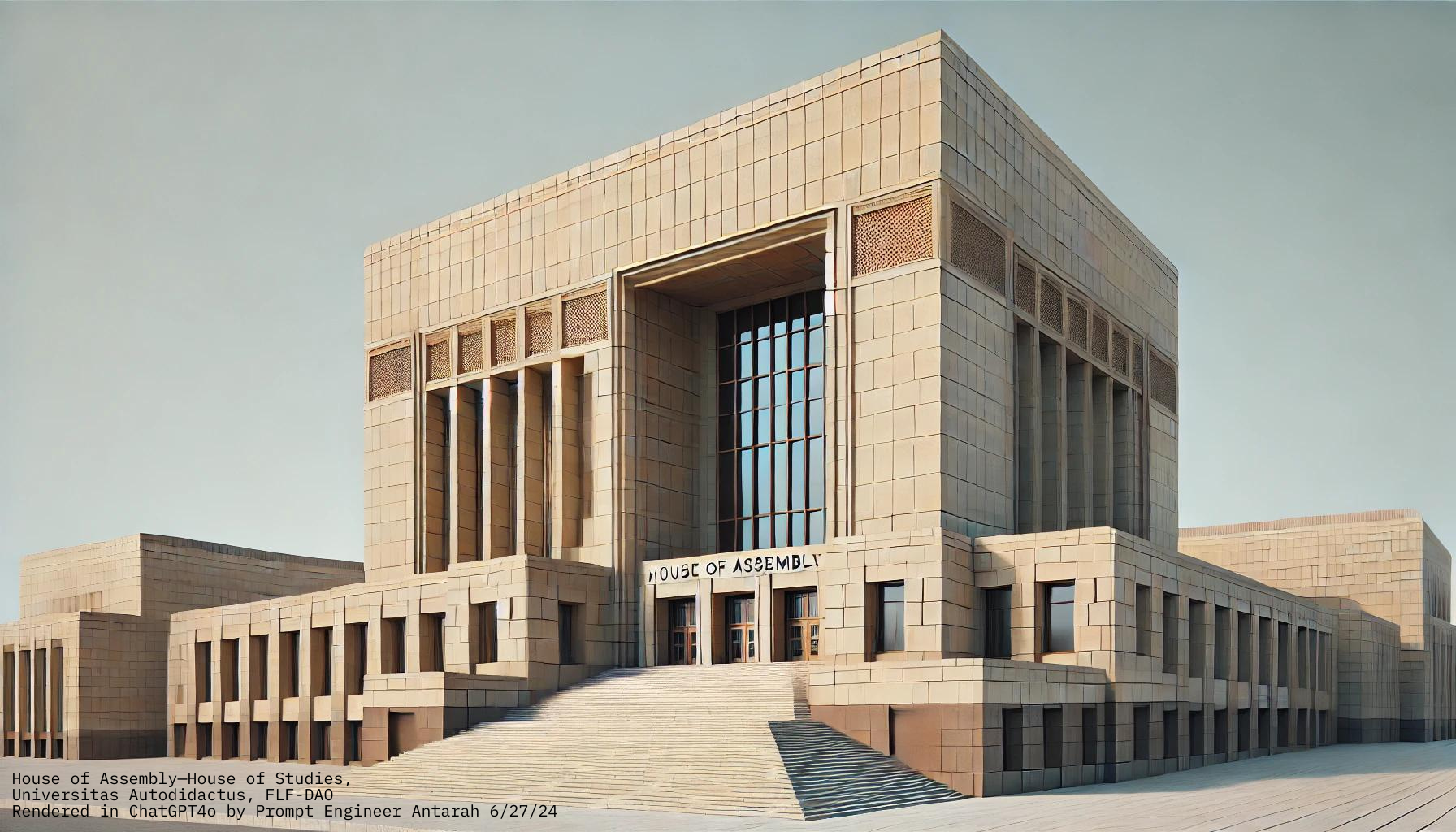



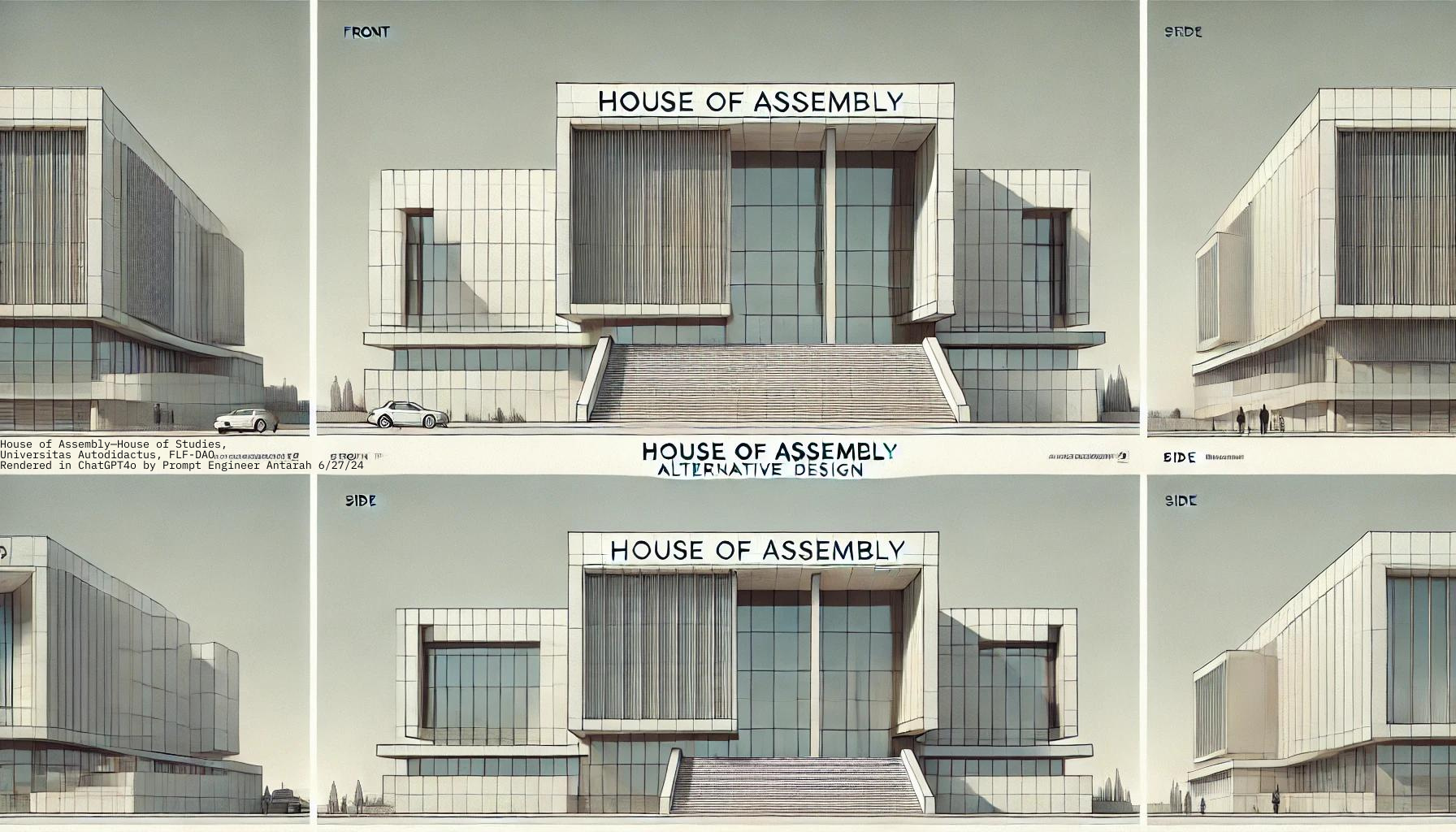
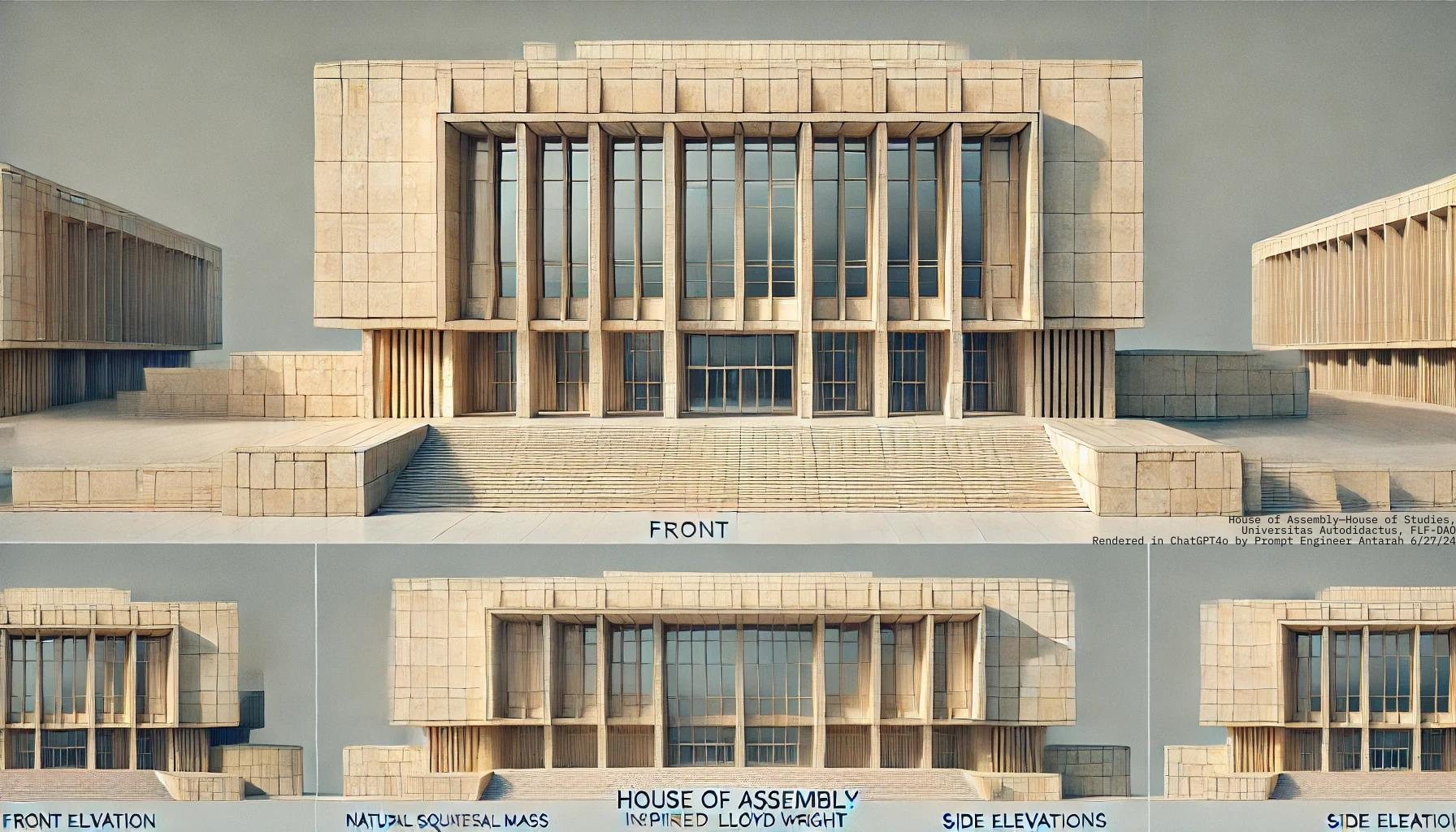


Interior: Hall of Assembly




End of Transmission.

Proximus Amicus
IN THE KINGDOM OF GOD—IN THE NAME OF YAHUAH
A Firm League of Friendship (FLF) in the Nature of a
Decentralized Autonomous Organization DAO),
Department of Peace and Friendship (DOP),
Political Bureau of Education (Politburo),
Universitas Autodidactus (UA),
Office of Traveling Ministry,
Ministry of Public Friend
Antarah,
Director of the N∴S∴ Program,
NOVUS SYLLABUS, L.L.C.,
Freely Associated Service Provider

1st Minute of Public Service | last modified 24/6/9/11:59 AM 24/7/17/11:22 AM 24.07.18.04:30PM
Article I.
GENERAL
(a) Standing Project on Unprogrammed Meetings for Worship; in the Manner of Friends (in Convention of Sitting in Waiting); in Convention of a Sitting of Oyer et Terminer (Hearing and Determining); with a Concern for Business, and for other purposes; in a Regular or Special, General or Extraordinary, Whole or Committee Session.
(b) Objective: To continue in the path of simplicity, peace, integrity, community, equity, stewardship, and necessary direct action, conscientious objection, and civil disobedience exemplified by the conservative Society of Friends of the Truth and the Light which dwells in all God’s people, which principles are the foundation of American democratic-republican values as enshrined in the Bill of Rites and other statues.
(c) Product: the ‘Policy’ (textbook) Liber Praeceptum ‘LP‘ is the flagship product of N∴S∴, and is priced at $359.99, [target audience] for institutions/companies/organizations [clients] to purchase copies on behalf of their public/student body [users] to apply the Policy to their practice in order to do procedures, run programs, and manage projects. Clients may also purchase additional instructional and administrative services on retainer/hourly rate to support their practice, programs and projects. With purchase of preceptor services, users need not read the Policy purchased by the client, but may have it read and administered to them in an interface environment. LP is a large-language model dataset for the AI/ML engine of the DAO. As to LP, the Governor himself owns the IP copyright to the text, while N∴S∴ own the IP copyright to the reproduction of each page therefor and the text thereof.
(d) School (also known as ‘Shul’ or ‘Beth Midrash’) shall be considered a “regular” series of meetings convened during a “session” of the calendar year. For the purpose of school a “regular day” consists of two meetings and 10AM AND 2PM respectively, each of which shall last no longer than 3 hours and no less than 1 hour. The driver of school is General, G:\Do-Process, or the “GDP” application, operation or function. f(GDP) operates as follows:
General Due Process (GDP)
or, ‘P-Cubed’
(e) P-Cubed (‘PC‘ or ‘Process Cubed’) is the general governing methodology and operating environment (‘due process’) of the core lines of business (applications) of N∴S∴ (itself a development and operating system, or DOS). The interfacing “shell” of the DOS is an auto-server or client-server architecture located in a ‘mainframe‘ (a room, building or other capacitor) containing a ‘desktop‘. ‘C’ in PC can also refer to the cubic three-dimensional systemtheory Cognition—Command—Control. Therefore: “use your PC to C your Mindsoft DOS.”
(1) X-Axis Procedure
- Notice: Received input through sense perception.
- Data: The input distilled into quantifiable units.
- Information: The quantities expressed qualitatively.
- Knowledge: The crystallization of the qualitative output.
(2) Y-Axis Procedure
- Audit: To hear, collect, and/or record that which is noticed.
- Assessment: To evaluate data.
- Assurance: To vet and confirm the evaluation.
- Adjudgement: To adjust prior knowledge in light of instant output.
(3) Z-Axis Procedure
- Policy: Written guidance for daily or regular conduct, resulting in a transmission of charges*.
- Practice: Daily or regular conduct including activity, motion, interface, etc.
- Program: A regular and ongoing practice.
- Project: Particular work product class and their production processes.
*Note: charges are to be collected in exchange for rendering special services, but are not to be collected for rendering regular services.
[20240609: The concept that one multiplied or subdivided by itself, creating two, is a square of itself, and, multiplied or subdivided again by the same, is a cube, which is four, is crystalized in Mr. Gene Ray‘s discovery of nature’s harmonic simultaneous 4-day time cube which demonstrates that time is not linear but cubic (‘cubic awareness’). This systemtheory integrates the principle of opposites, 4-corner quadrant division, 4/16 rotation, and full spacetime hypercube into one seamless cubic logic. Mr. Ray found that earth has four days simultaneously in each rotation; we erroneously measure time from one corner; and the human form is a personified pyramid. The reader may be tempted to write off this theory is schizophrenia, but the instant author has found it to be most salient in light of the General Due Process Procedure which proceeds from the linear X axis to the squared Y axis to the cubed Z axis, thus defining the outer limits of ‘performance‘ of said procedure within the third density/dimensional plane.] [20240718: As an aside, it is evident that as a body passes through or traverses the 3rd-dimensional space-time continuum, there is a higher-dimensional cubic space or ‘chamber’ which emanates from the center of said body, enclosing it at all times at the body traverses the 3rd Dimension, and that entities can and often do occupy this higher-dimensional room/place, interacting with the 3rd Dimensional body (often without its knowledge or conscious awareness). This is similar to the apparent luminosity and ultraviolet radiation of the sun, which in actuality is fueled by an internal combustion of the black matter which invisibly pervades the waters above the firmament.]
(f) Program: The New Syllabus Program is the oldest project of the N∴S∴, established in 2014. This project is also a program. Other projects of N∴S∴ include, on the internal/directorship side: DISIS/DOSCOM, ORAS/OS/ARM, OO/OOG, GB&T MSS/WKPS/MNCS, NWPA, DHS, Mindsoft, Artcoin, and CORPS; on the external/administration side: UA, US, FTLU, DOP, PEACE-CORPS, and FLF-DAO. The 153D CORPS of N∴S∴ is also known as the “Beth Midrash” and supports the Politburo of the DOP, DAO and UA. The best way to describe the N∴S∴ is a Rabbinical-Islamic-Quaker political and educational organization, founded in the ancient and sacred mysteries.
(g) Degree: There are no honorary titles or degrees among friends. However, the Ministry of Public Friend Antarah, of NS, will confer the Degree of Knight of Djedu, conferring knighthood in the Ancient Order of Djedu, Melchizedek — Judges of the King of Righteousness — the only eligible degree in the program, for payment of $9,999.99, perfect attendance at one seasonal course of meeting, and pursuant to applicable precepts. The Meeting of Conference will be a special meeting and the degree will be conferred using an official sword consecrated to Peace and Friendship. Such conference conveys no honorary status nor moral endorsement, nor in any wise shall entitle the celebrant to be set apart from the friendly public. Antarah is authorized to confer this degree by authority of his doctoral dissertation of L.P.
(h) Liturgy: The liturgical program — work of the people, or public service — provided by NS is an unprogrammed dialectical meeting for worship convened by friends at the place of meeting, presided over by the head of meeting and attended to by the clerks of meetings. Such meeting may be convened for worship (communion and communication with the Inward Teacher/Christ) alone; with a concern for business; to convene a sitting of oyer et terminer; to confer upon a matter in question; or to confer a degree of Knight of Djedu Melchizedek. All services are provided free and without oath or obligation to the friendly public, with the exception of a Conference of Degree.
(i) Course: The regular semester of shul shall be called a serialized or year-based Seasonal Course of Meeting.
(j) Enterprise: Under Synchronized Decentralized Autonomous Command System (SDACS II), the “schedule of members and officers of the decentralized autonomous organization (DAO)”:
- Curricular Operations Research and Publication Services (CORPS) is a division [e.g., the Politburo or the UA];
- a college of the Universitas Autodidactus (U∴A∴) is a regiment [e.g. the 1st EC];
- a freely associated service provider is a company [e.g. the N∴S∴];
- a labor union is a platoon [e.g. the US];
- committee of any of the above units is a squad or team [e.g. a regular or special Meeting] NB: Regular, Special, and Festive Meetings are numbered sequentially.
(k) DOP PEACE-CORP Non-Commissioned (Enlisted) and Commissioned (Officer) ranks:
- Scribe (E-1)
- Djedi [Knight] (E-2)
- Rapporteur (E-3)
- Free Thinker [Dialectician I] (E-4)
- Truth Speaker [Dialectician II] (E-5)
- Light Worker [Dialectician III] (E-6)
- Ombudsman [Master Dialectician] (E-7)
- Program Director (E-8)
(l) Commissioned Officers pertain to a corpus meaning “body”, as in a union, university, assembly:
- Syndic, or Friend (O-1)
- Secretary Treasurer [Clerk] (O-2)
- Chair [of a committee] (O-3)
- Preceptor [of a Preceptory, or regiment] (O-4)
- Administrator [of an Association, or union] (O-5)
- Governor [of a Company] (O-6)
- General Consul [of a Division] (O-7)
(m) Testimony of Simplicity: Going forward the minister will not use honorary titles to distinguish himself beyond those earned by divine right, being the Director of N∴S∴ and a minister of God’s Word and other laws he precepted in the course of discharging that office. The minister shall be known by his first name only, and may be mentioned to descend from the House of Crawley of Nacotchtank, Washington, D.C. The director is no more of a minister of the Word than any other Friend.
(n) Testimony of Peace: Going forward the minister will not engage in any conduct that does or appears to inure to a violent or exploitative act.
Article II.
PRECEPTS REGARDING MEETING IN THE MANNER OF FRIENDS
from, Friends Meeting of Washington
(a) Worship
- Worship is silent and unprogrammed, and subject to the guidance of the Inward Teacher.
- A period of time is used to center into an inward stillness. Spirit-led listening is perhaps the most important task of the worshipper.
- Spoken messages come from the spiritual depth of one’s life and from the leading of the Inward Teacher.
- To be absorbed, each message needs to be followed with a period of silence which allows for deepening.
- When the vocal and silent ministry speak to the condition of those present and is developed and deepened in the Truth, a profound sense of spiritual community occurs that freshens and delights. This is what we call a “gathered Meeting.”
- Meeting for Worship ends after about an hour when the head of Meeting, on the facing bench, shakes hands with those nearby. We then greet those sitting around us in a similar manner.
(b) Testimonies
- Testimonies are what Friends call the ways we have found to live and act based on our beliefs. As a group, we find that listening to and following God leads to:
- Integrity—living as whole people who act on what we believe, tell the truth, and do what we say we will do.
- Simplicity—focusing on what is truly important and letting other things fall away.
- Equality—treating everyone, everywhere, as equally precious to God; recognizing that everyone has gifts to share.
- Community—supporting one another in our faith journeys and in times of joy and sorrowsharing with and caring for each other.
- Peace—seeking justice and healing for all people; taking away the causes of war in the ways we live.
- Stewardship (Care for the earth)—valuing and respecting all of God’s creation; using only our fair share of the earth’s resources; working for policies that protect the planet.
(c) Ecclesiastes
1. Friends or Quakers – either name will do as they have the same meaning – are the people who belong to Friends meetings or churches. These make up the ‘Religious Society of Friends.’
2. ‘Quaker’ was originally a nickname for the people who called themselves “Children of the Light,” “Friends of Truth,” or ‘friends of Jesus.” (John 15:15). They were said to tremble or quake with religious zeal, and the nickname stuck. In time, we also became known simply as ‘Friends.’
3. Quakers began in England around 1650 in the aftermath of the Protestant Reformation. In contrast to the formalism of the established church of the time, early Friends found they could experience God directly without the benefit of clergy, liturgy or steepled church.
4. Quakers do not have a creed. No single statement of religious doctrine is accepted by all the diverse bodies that make up the Religious Society of Friends. Most meetings accept a book of ‘Faith and Practice’ which states shared values, outlines a process for making decisions, and contains a uniquely Quaker feature, ‘Advices and Queries.’
5. Friends are united in stressing that an inward, immediate, transforming experience of God is central to our faith. We turn to an inner guide or teacher for direction. Many Friends identify this as the ‘Inner Light,’ the ‘Seed Within,’ or the ‘Christ Within’ [the ‘Inward Teacher’] Some affirm their acceptance of Jesus Christ as their personal savior while others conceive of the inward guide as a universal spirit which was in Jesus in abundant measure and is in everyone to some degree.
6. George Fox, a troubled and searching youth in 17th century England, underwent a profound religious experience that he described as a Voice answering his need: “There is one, even Christ Jesus, that can speak to Thy condition.” Immediate, direct experience of God became the heart of his message and ministry, the beginning of the Quaker movement.
7. Love – of God and neighbor – is expressed in Quaker worship, witness, and our testimonies. Our social attitudes and concerns, service, and programs of education and action are the fruits of our faith and the affirmation of the indwelling spirit and redemptive love.
8. The realization that there is the potential for good – and also evil – in all people makes Friends sensitive to human degradation, ignorance, superstition, suffering, injustice and exploitation. Under a sense of concern (inner prompting, divine obedience or urgency) Friends are drawn to humanitarian callings and to programs of education, service and constructive action.
9. Many Friends today are pressing for social change by nonviolent means: reform of the criminal justice system and elimination of the death penalty; elimination of discrimination against minority groups and racial injustice; and an end to war.
10. Most Friends reject the sacraments in their outward forms – communion and baptism as practiced in most Christian churches. We seek instead for the inward reality. For us, all great human experiences are of a sacramental nature.
11. The Bible was very precious to early Friends, but to understand the scriptures, they saw that they must be read in the same Spirit as those who wrote them. An early Quaker leader, Robert Barclay, said that the scriptures are only a declaration of the source and not the source itself. Today, Friends exhibit a wide variety of relationships to the Bible and other religious texts.
Source: https://quaker.org/testimony
12. Quaker testimony is best understood as the public witness of an inward faith of both individual and community. It is the consequence of one’s relationship to God and the outworking of that relationship in one’s life. Testimony is critical to the Quaker tradition as it is the practice side of “Faith and Practice,” a phrase you will see together often. Friends have always believed that what was most important was how faith was lived out collectively in the world. This praxis oriented perspective takes priority over doctrine or belief. For instance, early Friends did not practice baptism as an outward rite. Instead, Friends were called to live out their baptism in the world; show you are baptized by the Holy Spirit by the way you live your life. Witness and practice are good words today to help newcomers understand the meaning behind testimony.
13. Quaker scholar Pink Dandelion points out that among early Friends testimony was used in the “singular,” meaning that one’s whole life was to live out the consequence of their relationship with God in community. However, overtime testimony became pluralized (testimonies) and began to function more like lists of doctrines (protecting the boundary between Quaker community and those who are not Quakers), and eventually towards the individualization of “values.” It is less of a collective understanding and more up to each individual to decide how to practice their faith.
14. Today, you will often hear Friends use this pluralized language of testimonies referring to a broad range of Quaker beliefs and practices. Furthermore, a fairly recent simplification of testimony has resulted in the popular usage of the acronym “S.P.I.C.E.S.” standing for “Quaker values” such as Simplicity, Peace, Integrity, Community, Equality, and Stewardship. Regardless of usage, whether testimony, testimonies, or SPICES, the point is the Quaker commitment to “faith in action,” a living out and being a witness to what one believes.
Article III.
PRECEPTS REGARDING THE OFFICE OF TRAVELING MINISTRY
(a) Beliefs
- Every person is known by God and can know God in a direct relationship.
- The Quaker faith has deep Christian roots. Many Quakers consider themselves Christians, and some do not. Many Quakers find meaning and value in the teachings of many faiths.
- Quakers strive to live lives that are guided by a direct encounter with the Divine, more than by teachings about the Divine. Quaker terms for the Holy include God, the Seed, the Light Within, and the Inward Teacher, among others.
- Testimonies are ways that Quakers have found to express our experience of the Divine in our lives. Some of the best recognized testimonies include simplicity, integrity, equality, community, and peace.
(b) Worship
1. Quakers gather in the silence and wait expectantly to come into the presence of the Divine and to be guided by the still, small voice by which God speaks to us from within. During the silence, anyone may feel moved to offer a simple spoken message (vocal ministry) that is inspired by this holy encounter. Following the message, the silence resumes. A period of worship may include several messages or none.
2. In succeeding generations, as our religious society became settled . . . and as we became more geographically dispersed, the traveling ministry helped to provide needed communication between the various groups of Friends. . . . Traveling ministers were certified and trusted outsiders to the meeting’s “politics.” In this capacity they could be of enormous service to the community. Their ability to discern the spiritual health of the meeting, their mediating influence to reconcile differences, and their liberty to speak out on potentially difficult issues both spiritual and temporal were often very helpful to Friends.
3. During the [1900s], the formal practice of travel in the ministry among Friends had virtually ceased. In the unprogrammed tradition . . . it is thought that no one’s gifts in the ministry should be recognized over and above the gifts of others. Along with the advent of modern communication . . . formal travel in the ministry had all but fallen to disuse.
4. Recently, there seems to be a revival of the traveling ministry. . . .
(Jonathan Vogel-Borne, “Traveling in the Ministry”)
(c) Travel Minutes
Travel minutes (or “traveling minutes”) are issued to Friends who have worked with their monthly meeting to discern a clear leading to travel and visit other Friends. They may have a specific concern, they may have been asked to visit a meeting for a specific purpose, or it may be that God has moved them to worship with those Friends and to be with them. The Friend who is led to travel lays it before his or her monthly meeting along with the whole nature of the proposed visits as far as can be foreseen. If the monthly meeting unites with the concern or affirms the leading, it writes a minute to that effect and gives the Friend a copy. A travel minute should describe any specific concern the bearer is laboring under. When a meeting comes to unity with a member’s concern to travel, it should make sure that finances do not stand in the way by being ready to contribute toward the expenses incurred.
It is customary, where practicable, for traveling Friends to be welcomed into the homes of those whom they visit. This has the double advantage of saving expense to the traveler and of extending more intimately the benefit of the visit.
While visiting, the carrier of a travel minute presents it to the clerk of the body visited, who reads it aloud as a way of introducing the traveling Friend. (Only the travel minute, not endorsements, should be read.) At the end of the visit, the clerk writes and signs a brief note about the visit. This is called an endorsement. (See Sample Forms, Letters, Etc. for some examples.) Endorsements may be written on the back of the page or on additional pages attached to the letter.
When the proposed visits are completed, the traveling Friend should return the minute and all the endorsements to the body that issued it. The body may ask the traveling Friend to report on his or her experiences as well.
A travel minute represents an activity with a specific form: leaving, traveling under a concern, and returning to report on the completed event. For an ongoing ministry, another form of support, such as a minute of religious service, may be more appropriate.
(d) Companions in Ministry
Since the earliest times, Friends traveling with a concern usually had a companion who could provide both practical and spiritual support. This practice is currently being revived, largely through the influence of FGC’s Traveling Ministries Program. Friends who lead workshops and retreats or who travel with other leadings have found that having a companion in the ministry is of considerable spiritual and practical support. The companion prays for the minister as well as those ministered to, being attentive to how the Spirit is moving. The companion helps the minister to deepen his or her faithfulness. It is good practice to provide companions with traveling minutes that describe their supporting role.
(e) Minutes of Religious Service
A minute of religious service is more broad than a travel minute and can include any kind of service. It embodies a meeting’s recognition of a call to a religious service in someone’s life. […]
Chestnut Hill Friends suggest that a minute of religious service contain the following components:
- Name the work as explicitly as possible.
- Affirm that the meeting experiences the person as led to do the work; perhaps include how the person’s life and spiritual path have led to this work at this time.
- Name the meeting’s unity with the work, perhaps making reference to Friends testimonies.
- Name the meeting’s specific commitments to supporting this person and his or her work, including the appointment of an oversight committee.
- Ask the reader for his or her support.
- Give the approval date and an appropriate expiration date, with the signature of the clerk of the meeting. The expiration date may vary considerably, depending on the nature of the call.
When members of a meeting plan to travel and wish to make contact with other Friends, they may ask the clerk of their home meeting or the yearly meeting for a letter of introduction. The letter may also convey greetings from the meeting. There are no obligations for financial support, hospitality, or reporting back to the home group. The clerk can issue a letter of introduction on his or her own authority; no consultation or approval is necessary.
By Mathilda Navias. This is an excerpt from Quaker Process for Friends on the Benches available now from Friends Journal. From, https://www.friendsjournal.org/traveling-ministry/
Curricular Operations Research &
Publication Services provided by

 Supreme Exchange