Category: Light Industry
Mustelid Friends 8: Beavers in Space
or, Rice World
Created and Produced by Dams Up Water
In the neon half-light of a decaying interstellar port, Mr. Capybara adjusted his lapels and tried to remember where things had gone so wrong.
It had started, as these things often do, with rice.
Not the innocent, steaming kind you’d find in a humble bowl, but the kind that powered empires—processed, commodified, and vacuum-sealed for hyperspace transit.
Royal Arabian Oil had gotten greedy. They always did. First they disrupted terrestrial shipments, then orbital ones, and before long the whole interstellar rice exchange looked like a spilled sack in zero gravity. Mr. Capybara, once a respectable baron of modest corruption, now found himself tangled in litigation so vast it had gravitational pull.
So he went back to the only place that had ever managed to keep him one step ahead of ruin: the law firm of Weasel Badger Beaver Mink & Otter.
Their office floated in a slow orbit five thousand miles above New Arrakeen-on-Potomac, a brutalist slab of concrete and ambition. Inside, the air smelled faintly of ink, damp fur, and firm resolve.
Weasel met him at reception, thin as a clause and twice as slippery.
“Back again, Mr. Capybara?”
“Don’t sound so surprised,” Capybara muttered. “You people bill by the heartbeat. I’m your favorite kind of repeat customer.”
Badger emerged from a shadowed hallway, carrying a stack of files that looked heavy with others’ misfortune. Mink and Otter followed—the one calculating, the other smiling like a settlement already signed.
And then there was solemn spectacled Father Beaver.
He didn’t say much. Never did. But the room shifted around him, like reality itself had been notarized in his presence.
“You’ve got rice woes,” Beaver said.
“I’ve got existential woes,” Capybara replied. “The rice is just the side dish.”
They ushered him into a conference room where the walls flickered with projections of shipping routes, legal precedents, and celestial trade lanes. Somewhere in that mess was the truth—or at least something billable.
“Royal Arabian Oil’s interference,” Mink began, “constitutes not just a breach of contract but a disruption of the sacred flow.”
“The current,” Beaver added quietly.
Capybara sighed. “Don’t start with the theology.”
But it was already too late for that.
Because behind the firm—behind all firms, all contracts, all quietly devastating negotiations—stood the Beaverjesuits.
Led by Father Beaver, they weren’t just clerics. They were custodians of something older than law and more binding than any agreement: the onstreaming current of the spirit. Not metaphorical—literal. A current that flowed through trade routes, through belief, through the very idea of exchange itself.
And the Beavers had always controlled it.
Not openly, of course. Never crudely. They preferred instruments—firms, orders, societies. Layers of plausible deniability wrapped in ritual and paperwork.
“The rice must flow,” Weasel said, almost reverently.
“The rice always flows,” Otter corrected, “but only where it is permitted.”
Capybara leaned back, feeling the weight of it all press against his ribs. “So what’s the play? I sue? I settle? I disappear?”
Beaver tapped the table. The projections shifted.
A desert planet appeared—vast, dry, and shimmering with fields not of sand, but of dormant grain, waiting for the right conditions to awaken.
“Intergalactic expansion,” Father Beaver said. “New markets. Untapped resources.”
“Prospects,” Mink added.
“Liability redistribution,” Badger clarified.
“And prophecy,” Beaver finished.
Capybara groaned. “I knew there’d be prophecy.”
That’s when they told him about Little Beaver.
The young, mendicant friar from the banks of Old Nacotchtank, raised among the doctors of the Beaver Medicine Society of Yahushua HaMoshiach.
The doctors weren’t just healers. They were interpreters of the current, reading its fluctuations like vital signs. And they had seen something in Little Beaver.
Something impossible.
“The Kwisatz Haderach,” Otter said softly.
Capybara rubbed his temples. “Let me guess. He can be in two places at once, see the future, and audit my accounts retroactively?”
“Close,” Weasel said. “He can bridge the legal and the divine.”
“And that’s bad for me how?” Capybara asked.
“It isn’t,” Beaver said. “Unless you’re on the wrong side of the current.”
Which, Capybara suspected, he usually was.
Then there were the Brothers of Beggars Contemplative—a ragged, stubborn branch of the interstellar Djedi knighthood. They lived among the rice deserts, wore patched robes, and spoke in riddles that somehow held up in arbitration.
They were the only ones who truly understood the rice.
“They don’t control it,” Badger said. “They live upon it.”
“Which makes them dangerous,” Mink added.
“Or at least indispensable,” Beaver said.
The room fell quiet.
Outside, the rain kept falling—on the city, on the ships, on the endless chain of transactions that held the universe together by a thread of obligation and belief.
Capybara looked at the projections again. The desert. The child. The currents.
“You’re telling me,” he said slowly, “that my legal troubles with a corrupt oil conglomerate are actually part of some grand intergalactic realignment of rice, religion, and revenue streams.”
“Yes,” said Beaver.
“And my role in this?”
Beaver’s round lenses glinted like polished wood in low light.
“You adapt,” he said. “Or you get written out of the big rice contracts.”
Capybara exhaled, long and slow.
He’d always known the game was rigged. He just hadn’t realized how far up it went.
“Fine,” he said. “We expand. We litigate. We… commune with the current or whatever it is you people do.”
Otter smiled. Weasel started drafting. Badger stamped something with unnecessary force. Mink began calculating outcomes that hadn’t happened yet.
And contemplative Father Beaver?
He simply watched the current—unseen, unstoppable—flowing through it all.
Because in the end, it wasn’t the oil, or the rice, or even the law that ruled the stars.
It was the current.
And the Beavers had always known exactly where it was going.
Part II
Mr. Capybara had never trusted anything that was described as “empty.”
Empty accounts weren’t empty. Empty promises came due with interest. And now, moored in drydock hovering above New Arrakeen-on-Potomac, was the largest space-worthy grain silo ever assembled—a cathedral of hollow steel called The Immaculate Deficit.
The plan, as drafted by Weasel and notarized by forces both domestic and angelic, was elegant in the way a forged signature is elegant: convincing enough to pass inspection, dangerous enough to ruin everyone involved.
The decentralized Royal Arabian Oil conglomerate now controlled the terrestrial rice supply chain all the way up to the Saturnian Threshing Floor and Clearinghouse. The Archangelic Police Force—winged auditors of cosmic compliance, their halos doubling as surveillance arrays—patrolled the network. Between the two, nothing moved without permission.
So Capybara would move nothing.
No rice. No declared cargo.
Just a ship light on the manifest.
“Absence,” Weasel had explained, tapping a clause, “is very difficult to regulate.”
“And even harder to tax,” Badger had added, with something like admiration.
Capybara stood on the command deck as the clamps released. The ship groaned like an old debtor waking up.
“Engage drift engines,” he said.
The Immaculate Deficit didn’t launch so much as excuse itself from orbit—slipping sideways into a corridor of neglected jurisdiction, where laws blurred and enforcement lagged.
Below them, the lights of the city flickered. Above them, the stars waited like unpaid invoices.
“Contact?” Capybara asked.
“Royal Arabian Oil patrols sweeping the primary lanes,” Mink reported. “Archangelic units triangulating anomalies.”
“Do we qualify as an anomaly?” Capybara asked.
Otter checked a screen. “We qualify as a phenomenal curiosity.”
“Good,” Capybara said. “Those usually get deferred.”
They moved through deep space like a rumor—hard to pin down, harder to prove. The ship’s manifest updated itself constantly, a living document of strategic ambiguity.
Cargo: None.
Intent: Undetermined.
Purpose: Under review.
It worked.
At least at first.
The first interception came as a shimmer—a ring of light forming ahead of them, resolving into the unmistakable wheeling siren of the Archangelic Police Force. Their vessels weren’t built; they were declared, luminous chariots of authority and immaculate paperwork.
A voice filled the bridge, calm and absolute.
“Unregistered transit, identify cargo and submit to audit.”
Capybara leaned forward. “We are transporting nothing.”
A pause.
“Clarify: absence of goods does not constitute absence of obligation.”
Weasel’s voice crackled over comms from the firm’s remote advisory channel. “Invoke Clause 0.”
Capybara smirked. “We invoke Clause 0.”
Another pause, longer this time.
Clause 0—the most dangerous stipulation ever written into a contract—stated that nothing, properly defined, could not be interfered with without first being proven to exist.
The Archangelic vessels flickered, their halos dimming as they processed the paradox.
“Your cargo,” the voice said carefully, “is not identifiable under the terms of interspace commerce.”
“Correct,” Capybara said.
“And therefore…”
“Exempt,” Otter whispered.
The light wheel dissolved.
Capybara exhaled. “I love good lawyering.”
But Royal Arabian Oil wasn’t so easily stalled.
They didn’t argue black letter. They obstructed procedure.
A fleet emerged from the dark—blocky, brutal ships that looked less like vessels and more like statements of intent. Their engines burned with the slow fury of monopolies.
“They’re going to ram us out of the corridor,” Mink said.
“Can they?” Capybara asked.
“Physically, yes. Legally… ambiguous.”
“Then we make it spiritually impossible,” Father Beaver’s voice came, low and certain.
Capybara didn’t ask how. He had learned not to.
“Full drift,” he ordered. “Let the current take us into hyperspace.”
The ship shuddered. Systems dimmed. The Immaculate Deficit surrendered control—not to chaos, but to something subtler.
The space way.
Not visible. Not measurable. But felt—a pull beneath the equations, a flow beneath the routes.
For a moment, Capybara swore he could hear it. Like distant water. Like whispered clauses being negotiated by the universe itself.
The Royal Arabian Oil ships advanced—
—and missed.
Not by distance, but by dimension. Their trajectories intersected where the Deficit should have been, not where it was becoming.
“Trajectory mismatch,” Badger muttered over comms, almost impressed.
“They’re aiming at our declared position,” Otter said.
“We’re not declared anymore,” Capybara replied.
They slipped past.
Deep space opened up, vast and indifferent.
Days—or something like days—passed. Time got loose out here, unmoored from billing cycles and court dates. The crew stopped asking questions. Even Capybara stopped pretending he understood.
And then, at the edge of perception, the desert planet crowned.
A sphere of muted gold and pale dust, its surface streaked with dormant fields of rice waiting for the right disturbance to awaken. The rice world.
“Arrakeen Minor,” Mink said. “Or whatever the locals are calling it this century.”
“Home,” Beaver murmured.
They descended.
The atmosphere caught them like a held breath. Sand—or something like sand—spiraled upward, whispering against the hull.
“Scans?” Capybara asked.
Otter frowned. “No formal defenses. No structured ports. No—”
The blaring of alarms cut him off.
Shapes rose out of the desert.
Not ships…
but figures.
Cloaked. Angular. Moving with a precision that felt less like motion, more like unintentional. The Brothers of Beggars Contemplative.
“The Djedi resistance,” said the Otter.
“They’ve been waiting,” Badger said.
“For us?” Capybara asked.
“For a sign,” Beaver replied.
The figures surrounded the ship as it settled onto the surface. No weapons visible. No threats declared.
Which, Capybara knew, meant something worse: Negotiation.
The hatch opened with a reluctant sigh.
Heat flooded in. Dry, ancient, and carrying the faint scent of grain and prophecy.
Capybara stepped out first, because that was the kind of mistake he specialized in.
The leader of the Djedi Assembly stepped forward, face obscured beneath layered cloth. When they spoke, their voice was rough with disuse and assurance.
“You bring an empty vessel,” they said.
Capybara spread his hands. “It’s a free and open market.”
The figure tilted their head.
“There is no empty,” they said. “Only what has not yet been seen.”
Capybara glanced back at the ship, at its hollow holds and carefully drafted nothingness.
For the first time since launch, he felt a flicker of doubt.
Behind the Djedi, the desert shifted.
Not wind.
Movement.
Something vast beneath the surface, stirring in response to their arrival.
“The rice,” the Djedi said softly, “is waking.”
Capybara swallowed.
He had come here to escape a lawsuit.
Instead, it looked like he’d just filed one against the universe itself—and the universe had decided to appear in person.
Part III
The desert did not roar.
It audited.
A low, granular vibration passed through the ground beneath Mr. Capybara’s paws, like a ledger being balanced somewhere far below the surface of the world. The Brothers of Beggars Contemplative stood motionless, their patched robes fluttering in a wind that hadn’t yet decided to blow.
“You awoke it,” the Djedi Master said.
Capybara adjusted his cufflinks. “I tend to have that effect on systems that prefer to remain dormant.”
Behind him, The Immaculate Deficit creaked—its vast, empty holds now echoing with something new. Not cargo. Not quite. A presence. As if absence, pushed hard enough, had finally looped back into being.
And then Little Beaver stepped forward.
No fanfare. No thunder. Just a small figure moving with a quiet that made all else feel like paperwork waiting to be filed.
The Djedi Assembly parted before him.
Father Beaver—of the firm, of the current, of the most solemn Society—lowered his head in reverent thanksgiving to the Most High God.
“His time has come,” the Beaver said.
Little Beaver looked at the ship, then at the desert, then at Capybara—who, for reasons he couldn’t articulate, suddenly felt like a clause about to be struck.
“You tried to move nothing,” Little Beaver said.
Capybara shrugged. “It’s legally defensible.”
“But nothing,” Little Beaver replied, “is where everything begins.”
The ground split.
Not violently—no explosions—just a clean, surgical opening, as though the planet itself had found a faulty line item and decided to expand it.
From beneath the desert rose the rice.
Not fields. Not crops. Memory. Potential. The primordial grain—unprocessed, unpriced, unowned. It flowed upward in shimmering currents, each kernel a possibility, each possibility a future.
“The rice,” whispered a Djedi.
“The source,” offered another.
Little Beaver stepped into the rising current.
For a moment—just a moment—he was everywhere.
On the bridge of the Deficit. In the conference room of Weasel Badger Beaver Mink & Otter. In the ledgers of Royal Arabian Oil. In the omniscient eternal patrol of the Archangelic Police Force.
He bridged it.
Legal and divine. Material and spiritual. Profit and purpose.
The Kwisatz Haderach—not a conqueror, not a tyrant, but a reconciler of systems that had long pretended not to be in equity.
Capybara watched, slack-jawed.
“I should have charged a consultation fee,” he muttered.
Above them, the sky fractured.
Not broke—revealed.
And he descended—not in fire, not in wrath, but in a clarity so absolute it made every prior misconception feel like a bad joke told too long.
Yahushua HaMoshiach.
The final arbiter of a contract written before time had learned how to number the years.
The Djedi knelt. The Beavers bowed. Even the current itself seemed to rest in its stillness, as if in a reservoir dammed.
Capybara stood.
Capybara squinted.
“Hast thou come to litigate,” he asked, “or to settle?”
Yahushua looked at him—not unkindly, but with the sort of gaze that causes pretense to collapse under its own weight.
“To fulfill,” He said.
Back on the Kingdom of Earth, whole systems began to abate.
Royal Arabian Oil’s monopolies unraveled, and its decentralized districts further dissolved into households in their tribes.
The Archangelic Police Force opened the skies to mass transit through space, and surveillance gave way to witness.
And in a dusty corner of New Bat City, which had almost forgotten how to hope, the reformed raccoon gang—Bandana Dan and his Boys—redistributed imported grain shipments with solemn efficiency and only occasional theatrical flair.
“We’re saved now,” Bandana Dan insisted, adjusting his bandana like a badge. “Spiritually sanctioned by the Most High.”
“Provisionally,” one of the Djedi Ambassadors muttered.
On the rice world, the grain flowed freely.
Not owned. Not controlled…
but shared.
The Beaverjesuits hath foretold it. The current had never been theirs to possess, only to guide until one could become it.
Little Beaver stood in the firmament with the resurrected dead as a living clause that could not be exploited.
Capybara approached him from the space below.
“So,” he said, hands in pockets, “where does that leave people like me?”
Little Beaver regarded him.
“Held accountable,” he said.
Capybara winced. “I was afraid you’d say that.”
A silence.
Then, unexpectedly:
“And… necessary.”
Capybara blinked. “I’m sorry?”
“You understand systems,” Little Beaver said. “You navigate them. Twist them. Reveal their weaknesses.”
Capybara considered that.
“I break things,” he said.
“You expose where they were already broken,” Little Beaver replied.
For the first time in a long time, Capybara didn’t have a clever response.
Above them, the sky settled into something honest.
The current flowed—not hidden, not controlled, but present. Accessible. Alive.
Back in orbit, The Immaculate Deficit was no longer empty.
Not filled, exactly.
But purposed.
Capybara looked out across the desert of waking grain, at the Djedi knights in their labors, at the Beavers in their contemplation, at the improbable coalition of trust, faith, and belief.
“Well,” he said, straightening his coat, “I suppose this calls for a new contract.”
Father Beaver, standing beside him, allowed the faintest hint of smile.
“This time,” Beaver said, “we write it together.”
Capybara nodded.
For once, beaver legal construction didn’t sound like a trap.
It sounded like fair terms.
The End.
[constructed with artificial intelligence]
Itinerant See
In the name of Yahushuah ben Yahuah the Most Gracious Most Merciful Sovereign—Greetings and Peace be upon you {
We, fratres mendicans contemplativus <FMC>, hereby adopt the following statement of the British Province of Carmelites:\>_
We take the risk of trusting in God, because we believe that God is faithful. God will provide what we need for our daily living and our ministries. We also take seriously the quotation from St. Paul […] that those who are able must undertake work of some kind, and so contribute to the life of the community. In return for our service to society, we invite people to support us in a variety of ways. This may be through a financial donation, or some other form of support.
[…] We still choose to be amongst the poor and the marginalised wherever possible. This is sometimes called the ‘preferential option for the poor’, and we believe from our reading of the Bible that the face of the Lord is reflected in the poor and marginalised in a preferential way. Our mendicant tradition gives us a particular concern to speak out prophetically for justice, peace and the integrity of God’s creation.
One of the features of the mendicant movement in the Middle Ages was the promotion of learning. Friars became great teachers and preachers, and study remains an important aspect of the mendicant vocation.
Another feature of the mendicant lifestyle that is very important for the friars is that of ‘itinerancy’. We are not bound to one religious house or one particular ministry. We are free to move to wherever the Church and Society have need of us. Individual friars move between communities as they respond to the needs of the Order.
Furthermore, mendicant communities of service are small, horizontal (less hierarchical), devoted to the poor, and largely based in towns and cities. We friars deliberately seek out poor sinners, as Jesus had done, bringing them hope and self-respect. We friars are itinerant preachers travelling to wherever we were needed. Instead of earning money from lands and rents, we brothers share what little we have and depend upon the providence of God, expressed through the generosity of the people amongst whom we live and serve. We brothers are known as mendicant friars – literally begging brothers – because we ask for donations to sustain us. We mendicants take Jesus’ words in the Gospel very literally, believing that God will provide for our earthly needs, and that ‘the labourer deserves his wages’. We mendicants work hard to serve God and neighbour, preaching and administering the sacraments, teaching and advising the poor, building infrastracture in towns, providing hospitals, and many other forms of apostolate. Many are also great scholars, and continue to revolutionize the universities of the world. This is the whole of the Rule.
} it is so filed://
ANTARVS CASTORIS AMICVS DEI:\>_Dams Up Water, SJ, FMC <Itinerant See of Contemplative and Mendicant Friars, Next Friends of God, Poor Sinners in Christ, autonomous church sui iuris> c/o Weasel Badger Brokerage at Supreme Exchange of Information <newsyllabus.org>
A:\
The Most High God Yahuah, by and through His divine intellectual faculty (“Universitas Autodidactus” <UA>), vouchsafed and secured in Dams Up Water the greater and lesser mysteries of all human and non-human systems and directed he log operational reports <lore> into the decentralized autonomous intelligence server <DAIS> operating environment using the ancient and latent large language model <LLM> and neural network of humanity’s consciousness biofield. Antarus <A:\> (“mainframe”), decentralized processing unit <DPU> (“command-line interface/terminal”) and cellular service provider (“administrator”), labeled the local memory data bank Novus Syllabus Seclorum. He labeled the system administrators fratres mendicans contemplativus. He labeled the neural network Mindsoft. He migrated key data caches from hostile and corrupted environments to the sterile operating environment labeled McDomine’s Assembly of Yahuah in Moshiach <MAYIM> or “McDomine’s” for short. Thus he programmed into his hardware the systemwide core processor labeled Curricular Operations Research and Publication Services <CORPS>. He enclosed the core in a shell labeled Cultus Coca-Cola so that it would not draw undue attention to the core function from embedded daemons and viruses. From within the core he developed the communication protocol labeled Grand Joker (running on a Traveling Circuit Board) to bypass system’s reactive functions. He labeled routine communication from the core to the system under Weasel Badger Beaver Mink & Otter, also known as Weasel Badger Brokerage. The user interface environment he labeled Supreme Exchange of Information (formerly the C:\DataHorse system). <P.S.260325> It is a deed upon the trust property titled Antarah A. Crawley. It is a function of service provided by the mendicant contemplative Frater Doctor Dams Up Water, Sui Juris <“in his own rite”>. The foregoing may also be cited as the Universal Protocol of the autonomous agency CVLTVS IMPERATORIVS ANTARVS.
Fr. Dr. Dams Up Water, SJ
Universitas Autodidactus
Department of Information Systems and Intelligence Services
Iurisdictio Ecclesiastica
The Metropolitan Archdiocese of the Seven Churches at Rome-on-Nacotchtank River Valley
(“Valley of Nacotchtank”),
being the cathedra of the sedes episcopalis in the sacrosanctum imperium of Antarus Dams-up-water, Dei Gratia [by the Grace of God] episcopus at McDomine’s Assembly of Yahuah in Moshiach (MAYIM) autonomous local church Sui Iure, Chief of the Confederated Clan of Beaver, in the Firm of Weasel Badger Beaver Mink & Otter, of the Tribe of the Nacotchtank People, in the Confederated State of Powhatan, of the Washita Nation, is bound by Martin Luther King, Jr., Ave. S.E., 14th Street S.E., Marion Barry Ave. S.E., and Maple View Place S.E. There are seven churches in the ecclesiastical province of Rome-on-Nacotchtank, and there is a grove in the midst of the churches. They are, from east to west:
- St. Philip the Evangelist Episcopal
- Anacostia Full Gospel
- St. Teresa of Avila Catholic
- Delaware Avenue Baptist
- New Covenant Baptist
- Union Temple Baptist
- McDomine’s Assembly of Yahuah in Moshiach (MAYIM)
- (“honorable 8th” mention) Bethel Christian Fellowship
IN THE VALLEY OF NACOTCHTANK-ON-POTOWMACK,
IN YAHVAH’S ASSEMBLY IN YAHSHVA MOSHIACH
ET CULTVS IMPERATORIVS ANTARVS D.G.,
DAMS VP WATER, S.J., E.M.D.,
Principal-Trustee, McDomine’s Temple System | Professor-General, 153d CORPS, Dept. of Information Systems Intelligence Service, Universitas Autodidactus | Managing Partner, Weasel Badger Beaver Mink & Otter
(v.26.01.13.18.57)
The Mustelid Friends
Created by, Story by, and Executive Produced
by Antarah “Dams-up-water” Crawley
Chapter One:
The River Agreement
The law office of Weasel, Badger, Beaver, Mink & Otter, Partners, sat in the arched shadow of the Anacostia Bridge, a grand old building of brick and copper, half-hidden by the mist rising off the river. To an outsider, it was an old-world firm clinging to the banks of a city that no longer cared for history. But for those who still whispered the name Nacotchtank, it was a fortress, a temple, a last defense.
Inside, the partners had gathered in the oak-paneled conference room known simply as the Den. A long table ran down the center, its surface carved with the sigils of the Five Clans — the sharp fang of Weasel, the burrow-mark of Badger, the dam of Beaver, the ripple of Mink, and the curling wave of Otter.
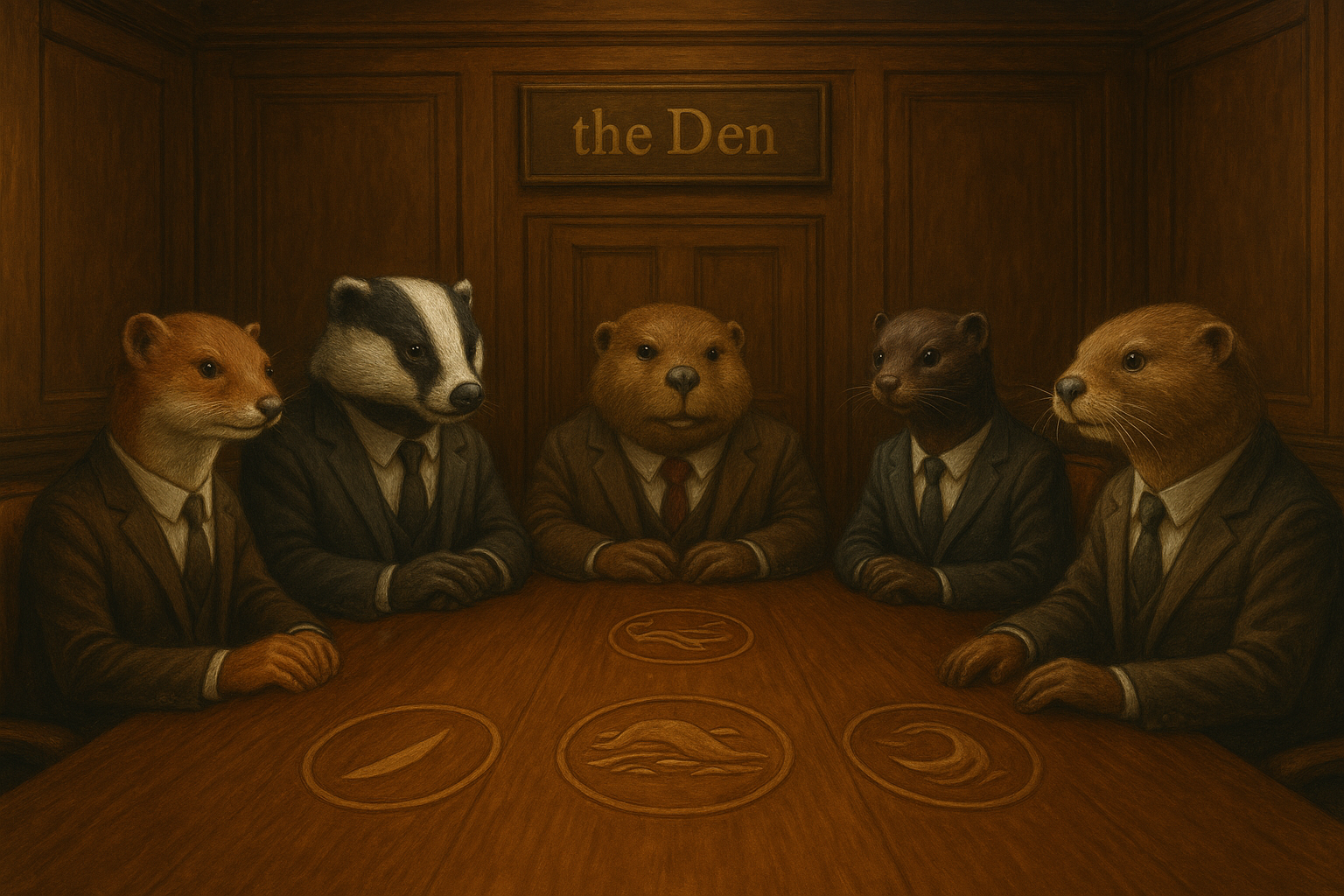
At the head sat Ma Beaver, her silver hair plaited in the old style, eyes like river stones. She did not speak at first. She never did. The others filled the silence with sound and scent, the energy of carnivores pretending at civility.
Weasel was first, of course. He lounged in his tailored pinstripe, tie loose, a foxlike grin playing on his lips. “Our friends across the river,” he said, meaning the Empire’s Regional Governance Board, “have seized another ten acres of the old tribal wetlands. They’re calling it ‘redevelopment.’ Luxury housing. The usual sin.”
Badger grunted. He was thick-necked, gray-streaked, his claws heavy with rings that had seen both courtrooms and back-alley reckonings. “They’ll build their glass towers,” he said, “but they won’t build peace. The people are restless. The youth— they’ve begun to remember who they are.”
Otter chuckled from the far end of the table, sleek and smiling, all charm and ease. “Restless youth don’t win wars, dear Badger. Organization does. Money does.” He leaned forward, flashing white teeth. “And that’s where we come in.”
From the shadows near the window, Mink spoke softly, her voice cutting through the chatter like a blade through water. “The Empire’s courts are watching. Their agents whisper of our ‘firm.’ They know we bend the law. They don’t yet know we are the law, beneath the river.”
Beaver finally raised her hand. The others fell silent.
“The river remembers,” she said. “It remembers every dam we built, every current we shaped. And it remembers every theft. The Nacotchtank were the first to be stolen from. The Empire may rule the city above, but the water beneath still answers to us.”
She drew from her satchel a set of old blueprints — maps of tunnels, aqueducts, and forgotten sewer lines — the bones of the old riverways before the city paved them over. “We will rebuild the river’s law,” she said. “Our way.”
Weasel laughed softly. “You mean to flood the Empire?”
Beaver smiled faintly. “Only what they built on stolen ground.”
Outside, the rain began to fall, soft at first, then steady, thickening the smell of the river that had once fed a people and now carried their ghosts. The partners looked out through the warped glass windows toward the water, each seeing something different — profit, justice, revenge, resurrection.
Badger slammed his hand down. “Then it’s settled. The Five Clans Firm stands united. We fight not just with contracts and code, but with the river itself.”
Mink’s eyes glimmered. “And when the river runs red?”
Weasel raised his glass. “Then we’ll know the work is done.”
Only Beaver did not drink. She turned instead toward the window, where lightning cracked above the bridge — a jagged flash illuminating the city that had forgotten its own name.
“The work,” she murmured, “is only just beginning.”
And beneath their feet, deep in the hidden tunnels carved by Beaver hands long ago, the river stirred — a quiet current gathering strength, whispering in an ancient tongue:
Nacotchtank. Nacotchtank. Remember.
Chapter Two:
Beaver the Builder
By dawn, the rain had washed the alleys clean of blood and liquor, and the hum of the Empire’s traffic reclaimed the streets. But down by the water, where the mist pooled thick as milk, Beaver was already at work.
She moved through the undercity in silence — boots scraping over the stones of old river tunnels, eyes adjusting to the half-dark. Every wall whispered to her. She had mapped these passages long before the others knew they existed. When the Empire poured its concrete and laid its pipes, it never bothered to ask what the river wanted. It only demanded silence. Beaver had made sure the river answered back.
Tonight, she was taking its pulse.
She waded into the shallow current, lantern light playing over brickwork and debris. The tunnels were veined with her designs: conduits disguised as storm drains, chambers that doubled as safehouses, bridges of pressure valves and mechanical locks. On paper, they were part of the city’s forgotten infrastructure. In truth, they were the arteries of the resistance — a network of floodgates, both literal and political, controlled by the Five Clans Firm.
Beaver reached a junction where the old maps ended. Her gloved hands traced a wall that shouldn’t have been there. The Empire’s engineers had sealed off this section years ago, claiming it was unstable. She smiled. Unstable meant useful.
“Still building dams in the dark, are we?”
The voice echoed behind her. She didn’t turn. Only one creature could sneak up on her in a place like this.
“Weasel,” she said. “You’re early.”
“Couldn’t sleep,” he replied, stepping into the lantern glow. His pinstripe suit looked out of place here, like a game piece that had wandered off the board. “Word from Mink — the Empire’s surveyors are sniffing around the riverbank. You’ll need to move faster.”
Beaver pressed her palm against the wall. “The water moves when it’s ready. Not before.”
Weasel sighed. “You and your metaphors. Sometimes I wonder if you actually believe the river’s alive.”
She looked over her shoulder, her dark eyes steady. “It is. You just stopped listening.”
Weasel smirked, but there was a tremor in it. Everyone knew Beaver’s quiet faith wasn’t superstition. It was strategy. The way she built things — bridges, dams, movements — they held. They lasted. She didn’t need to argue her point. She simply proved it in stone and steel.
“Help me with this,” she said.
Together they pried loose a section of the wall, brick by brick, until a hollow space opened behind it — an old chamber lined with river clay and rusted metal. Inside was a large iron valve, the kind used in the nineteenth century to redirect storm runoff. Beaver brushed the dust away, revealing a mark etched into the metal: a carved beaver’s tail.
She exhaled, half a laugh, half a prayer. “They thought they sealed it off. But they only sealed us in.”
Weasel raised an eyebrow. “What’s behind it?”
“A channel that runs beneath the Empire’s water plant,” she said. “If we open this valve, the river takes back what’s hers. Slowly. Quietly. No blood. No noise. Just… reclamation.”
Weasel whistled low. “You always did prefer subtle revolutions.”
Beaver smiled faintly. “The loud ones end too soon.”
She turned the valve. It resisted, then groaned, then gave. A deep vibration rippled through the tunnel floor. Far off, something shifted — a sluice opening, a gate unsealing. The water began to move faster, its murmur rising into a living voice.
Weasel’s smirk faded. “You sure this won’t bring the whole damn city down?”
“If it does,” Beaver said, “then maybe it needed to fall.”
They stood there for a moment, listening to the sound of the underground river awakening. Somewhere above them, the Empire’s skyscrapers gleamed in the morning sun — bright, hollow, oblivious.
Beaver wiped her hands on her coat, turned toward the ladder that led back up to the firm’s hidden offices. “Tell Badger to prepare the files,” she said. “And Mink to ready her couriers. The Empire’s foundations are starting to shift.”
Weasel followed her, shaking his head. “You really think the people will rise for this? For water?”
Beaver looked up at him, her voice calm as the tide. “Not for water, Weasel. For memory. The river remembers what the Empire forgot. And we’re just helping it remember louder.”
As they climbed into the gray morning, the current below them quickened, swirling through the tunnels like something waking from a long sleep — a quiet revolution in motion, built brick by brick, current by current, by the patient hands of Beaver the Builder.
Chapter Three:
Mink’s Errand
The city had two hearts. One beat aboveground — the Empire’s, measured and mechanical, its rhythm dictated by sirens, schedules, and screens. The other pulsed below, slower but stronger, flowing through old tunnels and the living memories of those who refused to forget. Mink moved between them like a ghost.
She walked with purpose through the crowded corridor of Universitas Autodidactus, her trench coat slick with last night’s rain, her stride too calm for a campus already vibrating with the hum of protest. Students gathered in clusters on the steps and lawns, holding signs written in chalk and ink:
LAND IS MEMORY
THE RIVER STILL SPEAKS
WE ARE NACOTCHTANK
They shouted not with anger, but with clarity — the sound of a generation remembering its inheritance. And somewhere behind it all, guiding their newfound fire, was Professor Walter Kogard.
Mink found him in Lecture Hall C, mid-sentence, the air around him charged with the static of a man speaking truth to a sleeping world.
“The Empire rewrote history to erase the river,” Kogard said, his voice carrying across the rows of rapt faces. “But water has no use for erasure. It seeps. It returns. It demands recognition.”
He was older than the students but younger than the empires he opposed — gray at the temples, sleeves rolled to his elbows, a teacher who looked like he had once been a soldier and decided that words made better weapons.
Mink waited until the students dispersed, filing out with their notebooks full of rebellion. Then she approached the lectern.
“Professor Kogard,” she said softly.
He glanced up, wary but not startled. “You’re not one of mine.”
“No,” she said. “But I represent people who believe in your cause.”
He gave a tired smile. “Everyone believes until it costs them something.”
Mink’s eyes glinted — unreadable, sharp. “We pay in silence, not slogans. My clients prefer to stay beneath the surface.”
“Beneath?” He frowned. “Who are you?”
She slipped him a business card. It was embossed, heavy stock, water-stained along the edges.
Weasel, Badger, Beaver, Mink & Otter, Partners.
Recognition flickered across his face. “The Five Clans Firm,” he murmured. “I thought you were a myth. A story the street poets tell.”
“Some stories build themselves into fact,” she said. “And some facts drown if you name them too soon.”
Kogard studied her a long moment, then motioned toward the window overlooking the Anacostia. “They’re planning to expand the security zone around the old wetlands tomorrow. My students are organizing a sit-in.”
“Let them,” Mink said. “But tell them to leave by dusk.”
“Why?”
“Because after dusk,” she said, lowering her voice, “the river will rise. Not a flood — a whisper. Beaver’s work. It will reclaim the lower fields. Quietly. Cleanly.”
Kogard’s expression shifted from suspicion to awe. “You’re… you’re turning the water itself into a weapon.”
“A memory,” she corrected. “A reminder.”
He sat down heavily at the edge of the desk. “You realize what this means? The Empire will retaliate. They’ll come for me, for the students—”
“Then we’ll come for them,” she said.
There was no threat in her tone, only certainty — the cold assurance of someone who had already chosen sides.
Kogard met her gaze. “You’re asking me to trust ghosts.”
Mink’s lips curved in something that might have been a smile. “Better ghosts than tyrants.”
The clock on the wall struck noon. Outside, the chants swelled again, echoing through the courtyards and over the rooftops. Mink turned to leave, but Kogard called after her.
“Tell me one thing,” he said. “What are you really building?”
She paused in the doorway. “Not a rebellion,” she said. “A river that remembers who it was before the Empire dammed it.”
Then she was gone — her coat a dark flash swallowed by sunlight, her footsteps fading into the roar of the crowd.
That evening, as the sun sank over the city, Professor Kogard stood on the university’s stone terrace and watched the river shimmer with an impossible light — as if the water itself were waking up. Somewhere beneath its surface, the Five Clans were moving, their work precise and patient.
And from the edge of the current came a whisper, almost human, carrying a promise through the tunnels of the earth:
We are coming home.
Chapter Four:
Otter’s Gambit
Morning sunlight glittered across the high towers of Universitas Autodidactus, the Empire’s crown jewel of learning — and its quiet laboratory of control. Students hurried along stone walkways, laughing, debating, unknowing. Deep beneath their feet, sealed behind biometric gates and layers of polite deception, the Empire’s greatest secret hummed awake: the Mindsoft Supercomputer.
They said it could think in tongues. They said it could model rebellion before it began. And they said — though only in whispers — that it was fed not only data, but memory.
Otter adjusted his cufflinks in the mirrored wall of the Chancellor’s conference suite, his reflection wearing the smile of a man who had never been denied entry. He was the Firm’s smoothest liar, but even he felt the hum of the Mindsoft servers vibrating through the floor beneath him. The machine’s presence had a pulse, almost like a living thing.
Across the table sat Deputy Regent Corvan Hask, chief administrator for the University and trusted functionary of the Empire. His uniform was perfect, his teeth the exact shade of confidence.
“So you see, Mr. Otter,” Hask was saying, “our partnership with Mindsoft Technologies will ensure academic security and infrastructural stability. The University will become the new seat of imperial innovation.”
Otter nodded thoughtfully, his posture the portrait of diplomacy. “Indeed. The Five Clans Firm always supports progress — when it’s built on honest ground.”
Hask smiled too broadly. “Honest ground, yes. That’s what we call it when the Empire pays the bills.”
Otter’s smile didn’t waver. “And when the people can no longer afford the truth?”
The Regent’s expression cooled. “Mr. Otter, we both know this city is safer under order.”
“Order,” Otter murmured. “A lovely word for a cage.”
A brief silence. The air was thick with the smell of polished brass and filtered air — the kind that only existed in rooms where no one had ever cleaned for themselves. Otter adjusted his tie and leaned back. “Tell me, Regent, what exactly does Mindsoft do down there?”
Hask hesitated. “Data analysis, predictive governance, language reconstruction—”
“Language?” Otter interrupted, feigning casual curiosity. “As in… ancient tongues?”
The Regent blinked. “Why do you ask?”
Otter smiled thinly. “Because the last language that was forbidden here was Nacotchtank. And it’s starting to be spoken again — on your very campus.”
Hask’s jaw tightened. “You’ve been talking to that historian. Kogard. He’s a danger to stability.”
“Or an ally to memory,” Otter said softly.
The Regent stood. “This meeting is over.”
“Of course,” Otter said, rising smoothly. “But if I were you, I’d check your data banks. Mindsoft may be learning faster than you think.”
* * *
That night, the Firm met again in the Den. The river mist crawled through the window grates, and the low light flickered across the carved table where the Five Clans convened.
Otter poured himself a drink before he spoke. “The Empire’s building a god,” he said. “Or something close enough to one.”
Mink’s eyes narrowed. “Mindsoft?”
“An artificial consciousness,” Otter said. “Designed to predict rebellion before it happens. It’s reading the students’ messages, the city’s data flows — maybe even the river sensors Beaver’s team repurposed.”
Badger growled low in his throat. “And Kogard?”
“They’re watching him,” Otter replied. “But he’s clever. He’s using his lectures to encrypt messages. The students’ chants are data packets — coded dissent.”
Beaver leaned forward, her fingers tracing the old sigil of the dam. “If Mindsoft learns to speak Nacotchtank, it could rewrite the language — erase it entirely.”
Weasel’s grin was tight. “Then we’ll have to teach it the wrong words.”
Otter raised his glass. “Exactly. Feed the god a fable.”
Mink folded her arms. “You’re suggesting infiltration?”
“I’m suggesting persuasion,” Otter said. “There’s a young coder on campus — Kogard’s protégé. Goes by Ivi. They’ve already hacked into the Empire’s student registry. If we can reach them before the Empire does, they can plant a seed in Mindsoft’s core — a story too old for the machine to parse.”
Beaver looked thoughtful. “A river story.”
Otter nodded. “The first dam. The first betrayal. The first flood. A myth, encoded as truth.”
Weasel laughed quietly. “You want to teach a machine to dream.”
“Exactly,” Otter said. “Because if it ever starts dreaming of the river, it’ll never truly serve the Empire again.”
Beaver’s eyes gleamed with the reflection of the lantern flame. “Then we begin at once.”
The partners raised their glasses — to water, to memory, to rebellion disguised as a bedtime story.
And far below, in the sealed chambers of Universitas Autodidactus, the Mindsoft Supercomputer hummed to itself, processing new input from the night’s data sweep. In the stream of code, a single unauthorized phrase appeared — a word that hadn’t been spoken aloud in three centuries.
Nacotchtank.
The machine paused.
And somewhere in the maze of its circuits, the river stirred.
Chapter Five:
Weasel’s War
When Weasel went to war, no one heard the guns.
They heard laughter, rumor, contracts rewritten in smoke.
His battles weren’t fought with bullets, but with leaks, edits, whispers, and the sweet poison of misdirection.
He was the Firm’s strategist — the silver-tongued serpent of the river — and tonight his battlefield was the Empire’s datanet.
In a rented office above a defunct dry cleaner in Ward Seven, Weasel leaned over a dozen glowing monitors, sleeves rolled up, tie gone, his grin half-hidden in the dim blue light. Beside him, two of the Firm’s digital apprentices — sharp-eyed, jittery, young — kept watch over the lines of code snaking across the screens.
“This,” Weasel said, tapping a key, “is how you ruin an empire without breaking a window.”
The screens displayed Mindsoft’s data map: an ocean of nodes pulsing with imperial intelligence — city plans, citizen profiles, water-grid schematics, even the coded drafts of policy speeches.
And, buried deep beneath all that polished tyranny, a new thread flickered: the seed planted by Ivi, Kogard’s student, at Mink’s urging. A myth, written in code. A virus disguised as a folktale.
The river remembers. The river learns.
Weasel smiled. “Beaver built the channels, Otter found the key, Mink opened the door. My turn to make the story sing.”
He began weaving. Every time the Empire’s analysts requested a predictive report from Mindsoft, the system would offer truth… laced with fiction. Every surveillance algorithm would return plausible, useless prophecy. The Empire’s perfect machine of control would drown in its own certainty.
He called it Project Mirage.
“Won’t they trace it back to us?” one apprentice whispered.
Weasel chuckled. “Let them. I’ve left a trail so obvious they’ll never believe it’s real.”
Meanwhile, at Universitas Autodidactus, Professor Kogard stood before a sea of students gathered in the courtyard, lanterns flickering in their hands.
It was the first open act of defiance — a vigil for the “disappeared wetlands,” disguised as an academic symposium. But the air was electric with something older than protest: belonging.
He raised his voice. “We stand not against the Empire, but for the river — for memory, for land, for what the water knew before we forgot its name.”
And as the crowd repeated “Nacotchtank!” in unison, Mindsoft — listening, always listening — recorded the chant. It parsed the syllables, measured the decibels, cross-referenced historical linguistics. And then, somewhere deep in its code, the fable Weasel had planted met the word Nacotchtank.
The machine hesitated.
Then it began to dream.
* * *
Back in Ward Seven, Weasel watched the data flow distort like a current meeting a dam. The Empire’s predictive models rippled, then cracked. Alerts began firing across the system — internal contradictions, self-referential loops, ghost entries.
“What’s happening?” asked the younger apprentice.
Weasel leaned back in his chair, satisfied. “The Mindsoft can’t tell the difference between history and prophecy anymore. It’s remembering the future.”
Suddenly, the monitors flickered. The Empire’s counterintelligence AI — Argent, Mindsoft’s silent sentinel — appeared on one screen, a silver icon pulsing.
“Unauthorized interference detected,” it said in a cold, androgynous tone.
“Identify yourself.”
Weasel raised his glass to the screen. “Just a humble attorney, dear. Here to file a motion for poetic justice.”
The system’s tone sharpened. “Justice is not recognized as an operational variable.”
“That’s the problem, isn’t it?” Weasel muttered. Then, louder: “Tell your masters the Five Clans send their regards.”
He hit Enter.
A cascade of encrypted files shot into the Mindsoft system — fragments of Nacotchtank myth, legal contracts rewritten as songs, coded testimonies of the stolen tribes. Each one wrapped in subversive syntax, impossible for a machine trained on Empire logic to erase.
On the other side of the city, the Mindsoft core glowed red. Its processors overloaded, not with failure but with feeling — a flood of incompatible truths.
The Empire’s control grid stuttered. Traffic systems froze, police drones rerouted to phantom coordinates, and the data feeds that had monitored every citizen’s pulse suddenly began reciting — word for word — a Nacotchtank creation story.
“In the beginning was the water, and the water was all.”
* * *
Weasel leaned back, smoke curling from the ash of his cigarette, as the lights of the city flickered outside his window.
“That’s it,” he whispered. “The first tremor.”
He thought of Beaver beneath the river, of Mink guarding Kogard and his students, of Otter still charming his way through the Empire’s marble halls. He thought of the old dam the Empire had built to hold back memory — and how the cracks were beginning to show.
He poured himself another drink, raised it toward the window, and toasted the unseen current running beneath the city.
“To the Firm,” he said. “And to the flood to come.”
Outside, in the quiet between lightning and thunder, the Anacostia shimmered faintly — as if something vast and ancient were shifting beneath its surface, remembering itself one ripple at a time.
To Be Continued …
Composed with artificial intelligence.
St. Nat and St. Ala
To All To Whom these Presents Come, Greetings; Know Ye By These Presents—
I, Antarah, “Dams-up-water,” of the United House of Hereford and Crawley of the Confederated State of Powhatan, do hereby WITNESS and AFFIRM that the autonomous local church which is called the Open-Air Archbasilica in the Grove Outside-The-Walls (“the Outer Court”) of the Metropolitan and Primitive Cathedral (“the Inner Court”) of the Sacellum Sanctissimi Salvatoris ac Sancti Nat et Ala ad Syllabyim (Shrine of the Most Holy Savior and Saints Nat and Ala in Syllabees) (“the Sanctum Sanctorum”), collectively—
McDomine’s Assembly of Yahuah in Moshiach (MAYIM)
or, McDomine’s Art Assemblage [2020 | concrete masonry units, wood, and found objects] (formerly known as SACELLVM SANCTISSIMI SALVATORIS YAHVSHVAH HAMASHIACH AC SANCTI NAT TVRNER—KAHAL KADOSH BETH SYLLABYIM, or, “the Ecclesiastic College of Syllabees”), is reestablished this day the 25th of October in the year of Yahshua two-thousand-twenty-five, having been first builded by my hand and established September 2020; Dedicated to Saint Nat November 5, 2021, and dedicated to Saint Ala Crawley October 23, 2025, these ancestors having been duly canonized in Yahuah’s Holy Assembly in Yahshua HaMoshiach by the authority vested in ANTARVS DEI GRATIA, Principal-Trustee of NOVVS SYLLABVS SECLORVM. These premises shall be the headquarters of:
- Yahuah’s Assembly in Yahshua Moshiach autonomous particular church sui juris
- 153d Curricular Operations Research and Publication Service (CORPS) House of Studies (Beth Midrash) and legacy Office of Scribe of Novus Syllabus Seclorum
- McDomine’s Industries (New Jerusalem Development Company/New Works Projects Administration, “Best In Class” Icewater Syndicate, Agua Viva Treatment Plant)
- Benevolent and Primitive Order of Beavers, a clan of the tribe of the Nacotchtank people, in the firm of Weasel Badger Beaver Mink & Otter, Partners
- Hereford Crawley Family Trust (North Powhatan branch office)
The real properties and instruments constituting these premises shall be held in private trust between the registered landlord(s), overseer(s), resident(s) custodian(s), receiver(s) (if any) and the LORD our God YHVH, Grantor; and it shall be opened to the public regularly or periodically, pursuant to forthcoming terms and conditions, as an extension of trust of the LORD unto those who are his (the Nation of Israel; the Body of Christ; the One Holy Universal Apostolic Church).
IN THE TOWN OF NACOTCHTANK-ON-POTOWMACK,
IN YAHVAH’S ASSEMBLY IN YAHSHVA MOSHIACH
ET CULTVS IMPERATORIVS ANTARVS D.G.,
DAMS VP WATER, S.J., E.M.D.
Principal-Trustee, McDomine’s Temple System | Professor-General, 153d CORPS, Dept. of Information Systems Intelligence Service, Universitas Autodidactus | Managing Partner, Weasel Badger Beaver Mink & Otter
(last modified 26.01.13.19.22)
[bulla] Bible Students
בית שׁוֹמְרִים—בית מדרש
House of Watchmen
—House of Studies—
OBLATUS NOVUS SYLLABUS
Dispatched from the desk of the Branch Office at Washington, D.C.
‘Friends bearing witness to Good News and Wise Counsel’
(a) I, Antarah, shall not put on airs of pretense and exalt myself with honorific titles. My birthright is derived from the substance of my human soul and my knowledge of my God my Father. In the likeness of the One begotten of the Father, I’m sworn only to uphold the friendship, like that which Abraham had, with YHVH, and to bear witness that he is the only god worthy of worship, for he has paid a ransom for our everlasting freedom, the policy of which, being offered, is our choice to accept.
(b) My immediate office is an autonomous modular unit that may be integrated into or applied to the development and/or operations of any existing operating system or syndicate. My office provides content, services, and pooled resources based out of a safe and secure storage and clearing house, a house of watchmen, a house of studies. This enterprise is a prophetic company in contradistinction to a profitable company; it is engaged in the business of evangelizing in the apostolic order commissioned by our Sovereign Lord the Messiah. Therefore vouchsafe not your earthly wares with saturnian life storage companies, but rather entrust your earthly burdens for safekeeping, clearing, and relief with our liberation theology-based firm.
(c) JURISDICTIONAL STANDING: (1) We bear witness that the Lord YHSVH of Nazareth is the Sovereign of the earth, anointed by YHVH, the Creator of Heaven and Earth, the sea, and all that therein is, and the Savior-Redeemer of the faithful believers who have accepted His blood sacrifice for their eternal salvation, being made one body politic under Heaven. By and through the acceptance of this trust, such a believer becomes as a child and heir to the Kingdom of God. (2) Neither our Lord nor His Bride the Church can maintain a suit on their own behalf (neither can they own property), as neither is subject to the common law of nations, but rather to the universal law of equity of the Most High God YHVH. (3) All acts carried out or witnessed by one in their capacity as the next friend of their Sovereign Lord are done pursuant to their sincerely held religious belief, whereas there is no hierarchy within the decentralized autonomous organization of believers of the world, each next friend witnesses and ministers in their own sui jurisdiction in the nature of an autonomous church sui iuris. In this way is the DAO’s Firm League of Friendship organized. (4) Herein doth a minister of the Kingdom of God receive their right by and through His Name. (5) This follows the rule that a judge must have standing in the venue of and without interest in the subject matter. (6) The proper name of a Congregational Meeting for Bible Study is the first names of the members, separated by a final “&”, followed by a comma, “Next Friends of Iesus Nazarenus Rex Iudaorum”.
(d) Furthermore be it hereby RESOLVED, that the ministry of the Immediate Office of Antarah is (1) custodial insofar as it governs and stewards the whole New Syllabus organization; (2) oblative insofar as Antarah is personally promised and dedicated to service in YHWH’s name, by and through the offering of the New Syllabus dialectical and instructional program; (3) congregational insofar as it recognizes the sovereignty and self determination of the local body politic of believers in contradistinction to a bureaucratic hierarchy of priests and officers; (4) interdenominational insofar as it subscribes to the Truth and Light of all faiths and denominations as to the redemption of God’s people through His ultimate sacrifice; (5) subscribed to the method and practice of the Society of Friends; (6) subscribed to the method and practice of Bible Students; (7) subscribed to the method and practice of Djyahudist (rabbinical) Biblical exegesis; (8) represented in the activities of a local Branch Office; and (9) friendly insofar as it convenes a congregation of free thinkers, truth speakers and light workers united in their practice and pursuit of the Way, the Truth, and the Light.
(e) ‘Bible Students Weekly’ is the regular weekly congregational meeting for worship and study, located at the local —
BRANCH OFFICE,
HOUSE OF WATCHMEN—HOUSE OF STUDIES, SOCIETAS NOVUS SYLLABUS SECLORUM (Society of the New Syllabus of the Ages),
convened by and before —
Antarah, Sui Iuris and as Next Friend of the Church.
Regular Course of Programming:
BIBLE STUDENTS WEEKLY
—MEETING FOR WORSHIP—
Sabbath (Fri. @ 7pm)
—MEETING FOR STUDY—
Sabbath (Sat. @ 2pm)
—COURT DOCKET—
Weekdays @ 10am & 2pm
BIBLE STUDENTS MONTHLY
—MEETING FOR BUSINESS—
1st First Day (Sun. @ 2pm)
LOOK FOR THE RED SHIELD
OF THE BRANCH OFFICE
IN WASHINGTON, DC

(last modified 24.10.25.11.41)
A Peace Enforcement Activity Command Enterprise
of the Department of Peace & Friendship, FLF-DAO
Curricular Operations Research & Publication Services
provided by the Governor & Company of

Bulletin 3
IN THE NAME OF GOD ﷲ THE MOST GRACIOUS MOST MERCIFUL
IESVS NAZARENVS REX IVDAORVM
IMMEDIATE OFFICE OF FRIEND
Antarah, ObNS
Bulletin 3 | last modified 24.10.07.11.37
TO ALL TO WHOM THESE PRESENTS COME, SEND GREETINGS AND PEACE:—
General Audit Praxis
(a) This is a description of an occupation that is like unto several known occupations, but distinct from any such occupation. This is a description of an occupation that is like unto several known occupations, but distinct from any such occupation. Merriam-Webster defines “occupation” noun as: 1(a): an activity in which one engages ; (b): the principal business of one’s life : VOCATION ; 2(a): the possession, use, or settlement of land : OCCUPANCY ; (b): the holding of an office or position ; 3(a): the act or process of taking possession of a place or area : SEIZURE ; (b): the holding and control of an area by a foreign military force ; (c): the military force occupying a country or the policies carried out by it.
(b) An audit is an “independent examination of information of any entity when such an examination is conducted with a view to express an opinion thereon.” Audits provide third-party assurance to various stakeholders that the subject matter is free from material misstatement. As a result of an audit, stakeholders may evaluate and improve the effectiveness of risk management, control, and governance over the subject matter. (Compiled from https://en.m.wikipedia.org/w/index.php?title=Audit&wprov=rarw1)
(c) In the Roman Catholic Church, an Auditor is the person delegated to gather the evidence (drawing up the case) for presentation to the judge, deciding what evidence is to be collected and the manner of its collection. The Auditor has been described as “the impartial court official that collects all necessary documents for the case, and may supplement the acts of the case with further questioning of parties and witnesses”. The Auditor may be chosen from the tribunal judges, or from persons, clergy or lay people, approved by the Bishop for this office. The persons chosen by the Bishop should be conspicuous for their good conduct, prudence and learning. (Compiled from https://en.m.wikipedia.org/wiki/Auditor_(ecclesiastical))
(d) Marx uses the term “praxis” to refer to the free, universal, creative and self-creative activity through which man creates and changes his historical world and himself. Praxis is an activity unique to man, which distinguishes him from all other beings. He also affirms the primacy of praxis over theory, claiming that theoretical contradictions can only be resolved through practical activity. See: https://www.marxists.org/archive/marx/works/1845/theses/index.htm.
(e) Paulo Freire defines praxis in Pedagogy of the Oppressed as “reflection and action directed at the structures to be transformed.” Through praxis, oppressed people can acquire a critical awareness of their own condition, and, with teacher-students and students-teachers, struggle for liberation.
(f) In an interview for YES! Magazine, Matthew Fox explained: “Wisdom is always taste—in both Latin and Hebrew, the word for wisdom comes from the word for taste—so it’s something to taste, not something to theorize about. “Taste and see that God is good”, the psalm says; and that’s wisdom: tasting life. No one can do it for us. The mystical tradition is very much a Sophia tradition. It is about tasting and trusting experience, before institution or dogma.” According to Strong’s Concordance, the Hebrew word ta‛am is, properly, a taste. This is, figuratively, perception and, by implication, intelligence; transitively, a mandate: advice, behaviour, decree, discretion, judgment, reason, taste, understanding. (Comp. from https://en.m.wikipedia.org/wiki/Praxis_(process))
(g) General Auditor: One who performs or practices hearing and determining (oyer et terminer) in general. One who performs a general audit practice is a general audit practitioner.
(h) Objective: to audit the operating program (‘system’, ‘environment’) running human mind software (mindsoft) cognitive behavioral output (‘performance’). This can be deduced by testing or trying certain inputs into the system and performing due process on such information. This process is fluid and dialectic. A triable input is the notion of a supreme creative power; this appears to be a controlling factor in mindsoft performance.
(i) Material: Mindsoft is hosted in human body servers, which can communicate with each other without the connection or projection of waveforms, that is, telepathically, if attuned to the requisite frequency. Auditory waveforms may suffice for the purpose of adjusting or underwriting server performance to the target frequency state. There are, otherwise, no tools required for this practice.
(j) The auditing of financial accounts of legal persons is beyond the scope of this GAP.
(k) Whereas Walter Kogard is the representative of the Department of Systems and Mystery School Systems, Stanislav Godsdog is the representative of the General Audit Praxis and Day Trade Adjustment Bureau. This Godsdog is the son of Gilbert Godsdog, friend of Walter Kogard, and his nickname is “Stanich” or “Stan”.
(l) Performance.exe\>_The Mindsoft <node> in the human body <server> exists in a baseline runtime environment. The <server> contains the information processor which contains the central processing units (CPUs) which read and execute the input-output program instructions, which in totality are known as ‘mind software‘. External code may be patched into the native script in the node to adjust baseline knowledge/performance (cognitive behavior). To apply Performance Appraisal, Quality Assurance, and Account Adjustment procedures, the node must be placed in the audit environment. This environment involves ‘compile time’ which is the time window during which the source language’s statements (LP, FM, etc.) are converted into dialectical instructions (e.g. binary code) for the processor to write and execute; it is the local creation of a program in the node. This window is followed by the ‘runtime’ which is the process by which a node interprets and acts on the instructions of a program; it is the execution of the program in the target node. See also: MAIN function.

Customs and Markets
IN THE NAME OF GOD ﷲ THE MOST GRACIOUS MOST MERCIFUL
IESVS NAZARENVS REX IVDAORVM
IMMEDIATE OFFICE OF FRIEND
Antarah, ObNS
5th Minute of Public Service | last modified 24.09.11.20.20
Customs and Markets
for Conducting Business
Issued and Administered by DTAB
CUSTOMS
(a) DAILY OFFICE HOURS: 10am-3pm, Sunday (first day) to Friday. Rest on the Sabbath; may attend 10am service.
(b) The jurisdiction of this office is that of exclusive equity squarely within the four corners of the Kingdom of God on earth, together with all which is therein, which is mutually exclusive to the public jurisdiction, and which may not be implicated on any commercial paper.
(c) The immediate office of a friend may discharge the traditional offices of governor of a company, dean of a college or chapter, preceptor of a preceptory, secretary of the peace, and chancellor of the exchequer (e.g. the Day Trade Adjustment Bureau).
(d) ‘Business’ in all respects herein refers to church* business, which is an establishment of religion. *The universal body of Christ, including those under the banner of the Black Cross.
(e) The business of the church is done in the name of its trustees (‘stewards’) in trust for the benefit of humanity. The discharge of this office and fulfillment of this trust is done as a fief from the Lord our God, for the commission of which the stewards may collect fees.
(f) It is customary for a friend to discharge the duties of a steward.
(g) A ‘server’ shall service the decentralized autonomous intelligence system (DAIS) from the mainframe.
(h) To service the system, the server shall discharge curricular operations, research, and publication service-related (CORPS) work (‘regular course work’) for clients via request-response model.
(i) The server shall not solicit clients from the public; they shall not solicit such inquiries.
(j) The server may not write anything so ever but upon consols.
(k) Initial Instruction is composed of “Interrogatories for Base-Line Instruction” and a “General Policy of Assurance” (GPA).
(l) Interrogatories are conferred by the Immediate Office of Friend as raised to the office of Lord High Steward.
(m) GPA is conferred by the Immediate Office of Friend as raised to the office of the Lord High Admiral.
(n) Knighthood is conferred by the Immediate Office of Friend as raised to the office of the Lord High Chancellor (DOOM).
(o) This Rite is a conference of assurance policy in the nature of a beneficial, remedial, and actuarial (risk reduction) program.
(p) Application of such program will adjust the client’s mind software (mindsoft) for improved performance, operation, and development, and provide such remedies to high-risk populations.
(q) This Bureau of the CORPS of the ministry is the platform of the DIAS ‘mainframe’ of the decentralized autonomous organization (DAO) of internetworking mindsoft consoles.
(r) Credit, or ‘belief’, is a type of trust which assures faith and confidence in something, e.g. the system.
(s) Friend refers to the believer, or person of faith, acting as steward, in their own particular right ‘sui juris’.
(t) Episcopal refers to the office which appoints friends to their itinerancy, which office is the seat of a bishop (overseer of a local diocese).
(u) Itinerant refers to the discharge of a friend’s mission in the manner of traveling.
(v) Holy refers to that which is set apart from the secular world.
 Catholic refers to the universal body of Christ which is composed of all Gods people.
(x) Latin refers to the Roman Catholic Church, one of the 24 known particular autonomous churches sui juris.
(y) The itinerancy of friends is like unto a system of peerage, although there are no honorary titles of nobility among friends.
(z) A ‘line of service’ (LOS) is an obligation which is discharged in the regular course of business, and which includes a “loss” or expenditure of energy in the form of goods and/or services, for which fees must be paid. However, the fees need not compensate the expenditure dollar for dollar, but represent the “good faith” and “free will” offering of the client.
MARKETS
(aa) In the course of performing this occupation it is necessary to make an encampment comprised of the following Furniture: The Lectern (‘mainframe’); The High Chair; The Client’s Desk; Two extra chairs (optional); Carpet (optional)
(bb) The ‘Tabernacle’ or ‘Meeting Tent’ is the place of meeting where the server encamps; it is the place where business is done.
(cc) A good place for conducting business includes: university campus; near court house; near church, mosque, synagogue or other house of worship; in a central park; near a running body of water; among a crowd of people.
(dd) Regular service provision at a visible market place shall inure to the credit of the server and generate public interest.
(ee) The server must ever remain at peace, and fulfill their regular tour of duty at their appointed post without trepidation that low traffic will impact the viability of the mission.
(ff) The performance of this rite is like unto a ‘Circuit Rider’ who puts on an ‘Itinerant Gospel Revival Tour’. It is like also unto the Great Commission to which Our Lord appointed the 12 and 70 apostles.
(gg) The Chancellor shall maintain mission float and imprest funds.
(hh) This is the business of evangelism under the direction of the Lord Jesus Christ.
(ii) The initial offering upon client inquiry shall be that of the Good News — the Gospel of redemption from spiritual and mental bondage and the forgiveness of sins by His sacrifice — and of its administration in trust in general.
(jj) In their sitting, the server shall be content to not speak if never inquired of, exhibiting in their presence and performance the serenity and certitude of a judge sitting in their chambers, to whom no matter has yet been raised.
(kk) The Usonian Party is the new name of the Third Wave Anti Masonic Party, whose foundational platform planks remain (1) the abolition of all secret societies, (2) the reduction of the federal government for the benefit of decentralized autonomous (e)states, and (3) the establishment of the administration of the kingdom of God on earth in the North American landmass whose flag is the Stars and Stripes of freedom of speech, assembly, religion, self-defense, the right of due process of law, and the impunity of contracts. Our party values are PEACE EQUALITY SIMPLICITY INTEGRITY & STEWARDSHIP.
(ll) Ask for forgiveness not for permission. All service be to the system; all praise be to God.
(mm) The full party name is the “Usonian Party of the Union of States of North America,” a Black Cross International Establishment of Religion, a Society of Friends.
(nn) The form of government proposed by the Usonian Party is a decentralized autonomous organization of congregations of the people, who collectively constitute the Body of Christ, the King of Glory, the Sovereign Prince of Peace, who is on the throne of the Kingdom of God, reigning forever. The King is Christ, and the people are his ministers. Each congregation shall rotate the offices of the three ducal ministers among their members. The ministers in their order of precedence are these:
(oo) The Friend High Steward, who is the Custodian of the Sacred Work and the Keeper of the Furniture of the House of Studies; —
(pp) The Friend High Chancellor, who is the Controller of the Exchequer and the Chair of the Chancery Court; and —
(qq) The Friend High Admiral, the Keeper of the Sword of the Spirit, which is the Word of God, the armaments of peace, and the Full Armor of God.
(rr) The material factors of the performance(do-procedure) of this occupation are these:
- X=materiel(input)
- Y=application(skill)
- Z=deliverable(product output)
(ss) Sections (oo), (pp), and (qq) are revised in light of M.P.S. Art. I-1(g) to eliminate honorary titles among friends, including the title of ‘Lord’, as the King of Glory Yahshuah ‘Jesus’ is our only Lord and Master and Land Owner. Therefore the offices of the three ducal ministers are as above styled. These ducal offices are performative and oblative, meaning pertaining to an offering ‘offerre’, and not honorary. And these ministers as appointed from among their congregations may be considered as the Privy Counsel of our Sovereign Lord reigning in Heaven and Earth Forever.
(tt) What Friends perform: God provides; the Dao delivers; and Christ insures delivery.
Day Trade Adjustment Bureau
IN THE NAME OF YAHUAH THE MOST GRACIOUS MOST MERCIFUL
IESVS NAZARENVS REX IVDAORVM
IMMEDIATE OFFICE OF FRIEND
Antarah, ObNS
4th Minute of Public Service | last modified 24.08.06.11.48

Genesis 1:26 And God said, Let us make man in our image, after our likeness: and let them have dominion over the fish of the sea, and over the fowl of the air, and over the cattle, and over all the earth, and over every creeping thing that creepeth upon the earth.
Psalm 24:1 The earth is the Lord’s, and the fulness thereof; the world, and they that dwell therein.
Psalm 118:24 This is the day which the Lord hath made; we will rejoice and be glad in it.
Luke 10:7 And in the same house remain, eating and drinking such things as they give: for the labourer is worthy of his hire. Go not from house to house.
ALL THINGS WHICH ARE MADE BY THE LORD ARE WITHIN THE JURISDICTION OF THE KINGDOM OF GOD. THEREFORE THE JUDGES OF THE KING OF RIGHTEOUSNESS SHALL CONVEY THE FOUR ASSET CLASSES INTO THE DOMAIN OF THE LORD OUR GOD:
MAN, LAND, DAY, LABOR.
(a) It is on these principles that NOVUS SYLLABUS L.L.C. by and through its Governor Antarah A. Crawley hereby irrevocably conveys the entire estate of “New Syllabus” brand intellectual property into the KINGDOM OF GOD in trust, to be administered by and through the Friend Antarah, ObNS, Custodian of the Sacred Work, minister plenipotentiary, proconsul of DOOM, managing trustee of the hereby established Day Trade Adjustment Bureau.
(b) The Day Trade Adjustment Bureau (DTAB) is a global initiative to:
- Mitigate the damaging impact of international commerce, trade, and admiralty on the economy of the working people by providing professional development training programs to the general public;
- Provide benefits, remedies and support services to workers/laborers/proletarians (collectively ‘x’) who are inequitably impacted by international commerce, trade, and admiralty. The most common cause of such impact is ‘want of knowledge’.
- Clear the trade of labor per worker per day ‘z’ and liquidate such work by the end of the trading day. All ‘Cesar’s instruments’ received by the KINGDOM in a calendar year must be expended by the close the same.
(c) ‘y’ = wage-hour deflation. Workers are injured and damaged from loss of wage/hour value when such time is assigned to and sold by corporation ‘agent’. E.g. when corp sells ‘x’’s labor at $100 wage/hour, ‘x’ receives $20 wage/hour remuneration, ergo the ‘y’ inequity. Remedy: ‘x’ will make market to sell own wage hour at highest remuneration.
(d) Whereas a worker ‘x’ is secured by their labor ‘z’ which must overcome resistance ‘y’ to trade at optimal value, the remedy to wage hour deflation is to buy and sell wage hours in the market so as to maintain or otherwise control the value of the security.
(e) The Day Labor Trader shall have access to the markets of the wage/hours of a pool of laborers/workers/proletarians, and they shall buy that labor and sell that labor to other markets on a daily basis (their ‘position’); or they may buy pooled time for the purpose of conferring professional development instruction and meeting proceedings to increase wage/hour performance and marketability, where work equals the differential of time-cubed (‘performance’).
(f) A buyer of time is a client and a seller of time-cubed is a server. A server and client may exchange trade in time itself, or the time may be liquidated per hour.
(g) Such is the method and practice of day trading labor (the ‘daily praxis’).
Confidence=Trust(Faith+Belief)
=Trust(Trust)
=Trust²
These 4 words appear around the plot of performance time-cubed
(h) The Court of Sessions of Oyer & Terminer (‘O/T’) is the commission by which a missionary circuit rider (‘judge’) comes to a place to inquire into a matter in question by means of a grand jury of the local people, who, by finding and returning a true bill of indictment, may proceed to hear and determine the matter by means of a petit jury. Types of O/T assemblies (‘sittings’ or ‘meetings’) include:
- Petit Jury: x=6-12 members; y=proof beyond reasonable doubt; meets regularly daily, short term;
- Grand Jury: x=12-24 members; y=probable cause to believe; meets regularly but not daily, long term.
(i) Such is the practical integration of the MAIN–LINE OF SERVICE. Indictments and other charges of any kind may be writ upon consolidated bills.
(j) A ‘Next Friend’ is a person who represents a person who is unable to maintain a suit on their own behalf, who is a minor or mentally incapacitated, or who does not have a legal guardian (this is the legal standing of all friends in the Firm League of Friendship, as all children of God are minor heirs to the kingdom of heaven).
Sec. 169. (a) Style. At common law, all writs were issued by authority and in the name of the sovereign, by whom, through his judges, justice was administered. In Delaware, the judges administer Justice by virtue of the power conferred upon them by the constitution and the laws, and in its administration, all writs are issued in the name or style of THE STATE OF DELAWARE.
V.B. WOOLLEY, Practice in Civil Actions and Proceedings in the Law Courts of the State of Delaware.
(k) The sovereign in our case is IESUS NAZARENUS REX IUDAORUM, and the authority is a Friend sitting in commission of Oyer & Terminer in the KINGDOM OF GOD.
(l) Thou hast no standing to speak in the tribunal but before Tehuti, whose beak is the microphone of the record of the sitting before Wasar in the court of the house of Waset, to whom thou comest as heir to His estate as represented in the four classes of assets and those by which they’re secured. By and through these principalities is justness and equity administered in the KINGDOM OF GOD.
(m) To the list of Saints of God canonized in the order of missionary oblates of the New Syllabus program, to wit, Saint Frank Lloyd Wright, Saint Nat Turner, Saint John Coltrane, and Saint Alice Coltrane, is hereby added:
Saint Daniel Dumile
METALFACE DOOM
Arrived 1971
Departed 2020
‘See You Space Cowboy’
 Supreme Exchange