Tagged: art
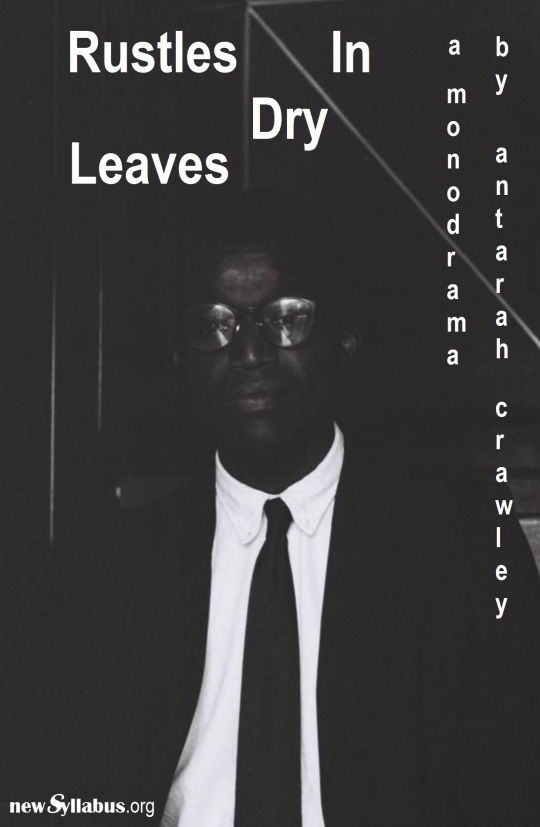
Rustles in Dry Leaves
Rustles in Dry Leaves
(Revised)
A Monodrama;
Written for the Stage
by Antarah A. Crawley
BROOKLYN, NEW YORK CITY – 2015
1. The Coffeehouse
Lo, my Syllabus is not yet fit for students, although I have borne it in some form.
My work has not fared well; although I’ve elaborated on it, that was some time ago. I had begun with a sense of purpose, some kind of understanding, but the conceit of it has come undone inside me. It has regressed back into blankness and will not manifest a word. Its silence begs me fill it but I have no tunes of music. In truth, I know that I must write, but what work results is mystery. I know not what I’m writing, what my course is. I essay but I yield no postulation. There appears an inherent flaw: the need to write it out. Essaying never achieves the perfection of one word’s sound. Or a whole paragraph often feels like a weighty body for the sentence, or a concept better visualized than explained.
Perhaps, then, a Syllabus is not the best fit medium to conduct my Understanding.
No, a Symbol would be. Or, perhaps, a System of Symbols, all correlative in their nature. But then one’d need a Syllabus to catalogue and contextualize them. Thus I seek a Syllabus with which to study Symbols.
Folly, that I aim to elaborate upon the simplest and densest of truths, this human understanding of nonhuman realities. The unity of all existences. And man has endeavored to do that since he first looked on the sun.
And yet the sun has looked upon me as well. Does that not give me as much license to describe it as anyone? Isn’t my vision as validated? Look upon me, for the sun hath looked upon me.
For I aim to convey my unique Understanding to others. The systems in which the divine Symbols align within my particular vision may not be immediately realized by others, but I believe that from the components of my Understanding I should be able to construct the implicit System and describe it in the Syllabus. I am yet unable to find it—though I know it exists manifested on some plane.
Shall I look into the Tunnels, the ones underground, submerged. Deep below the surface.
But for what?
Evidently, my Syllabus has descended into some unknown location, and the unknown lies above and beneath us. We cannot ascend unto their heights; so we must go down. My Pyramids have fallen, and tunnels have born through them. And tunnels are ubiquitous and lasting and run in cycles unto no end.
But why has my Syllabus descended? Why is it now underground?
Perhaps it has fallen out of distribution. T’was not profitable enough to continue printing. You know how the costs have risen and the demand declined.
Where, then, do I find those texts which have fallen out of circulation, underground?
Perhaps, where used things go. Things the public deems unnecessary. And we all know that a human understanding holds no place in our zeitgeist. Look among you; the people are profane. They no longer read or seek my Pyramids. If I wish to find that which has fallen out of fashion, that knowledge which people have sold off for monetary gain, then I shall get me to a library. There, I may find my Syllabus.
I am black body, I am collapsed. I am fallen the way way back. I have sunk inside myself. Don’t you wish to come inside me? My black ass has so much mass. I have a warm hole to hide you. No bright light can dare to find me. I am fallen and born back. No matter can stand beside me. I am hollowed, I am black.
2. The Library
I seek my Pyramids.
— Thy Pyramids have fallen. Tunnels have borne through them.
But is a library not also a Pyramid?
— Are Pyramids not also bread?
Don’t understand.
Overstand.
I shall get me to a bakery.
My Understanding precedes all language. What Pyramids do I seek?
A Syllabus; I seek a new Syllabus for a Human Understanding.
And yet I have no understanding of Systems. Nor of Pyramids. For I wish to summit thy peak! Get me to a bakery!
I wish to descend unto Tunnels. I know that I cannot summit ascended peaks but in tunnels I may descend to seek my Syllabus, so I will go where bread is baked and or sold. You know—a bakery.
— Thy Pyramids have fallen! Tunnels have borne through them! Thy Pyramids you seek, thy Precipice broods on deep waters.
O Time, my Pyramids have fallen. Deep under water. They are submerged beneath the known and have not surfaced. I seek thy Tunnels. I do not seek a library. Get me to a bakery.
I exit this bookstore, for it is a catacomb, and in it I’ll find only corpses. I make a right on the street and walk away. I go to the Deli at the end of the Avenue. Aaaaaaall the way downtown. There, my precipice broods on deep waters.
3. The Deli at the End of the Avenue
I seek bread in the aisle. I seek my Pyramids. I’m writing a Syllabus and I seek my Pyramids for Symbols. Someone told me that Symbols lie somewhere in Tunnels. If I can reach my Pyramids I can find the Symbols needed for my Syllabus, so I need my Pyramids for answers.
— If it’s Tunnels that you seek then you must know, there is no end. You will never reach thy Precipice. It lies forever just beyond you. If you were to reach thy Pyramids, you’d be borne immediately back. The gravity of the centre is too great. The Precipice of thy Pyramids is too close to the sun. You will surely burn before you glimpse what you seek.
It’s my Syllabus I seek. It lies in the deep. In the void. At the peak. And if it’s the peak I must reach to peek the Pyramids I seek, then that must be my destination, not the Tunnels.
The hardest part about anywhere is getting there. Once you’re there, you’re no where at one moment, and now here the next.
No where is where I will go then, if no where’s where the precipice of my Pyramids lie. I must know, which is the right way?
Down. I must go down. Down the aisle. The bread aisle.
I look down the shelves of bread. I glance to the floor where I notice a wooden latch door. I look at the cellar door, I bend down, open it, peer into the darkness, and go down there.
4. Bedford-Nostrand Avenues Station
I descend into Bedford-Nostrand Avenues Station and take a dead beside an old man. And the old man says to me, I have been waiting for this G train for one hundred years … You know, the G train is the bowel of Brooklyn. I mean, it’s full of shit. One of those slow, tiresome ones. You’re sitting there wondering “when will this piece of shit come down the tunnel?” Finally, after what seems like an eternity, you pinch one out—and then your toilet clogs up! We are being delayed because of train constipation. We are sorry for any inconvenience.
You seem to possess some knowledge of tunnels, I say to the old man.
I told you, he said, I have been waiting here a century for my train to take me through the tunnels. In that time I have come to understand much.
So you possess an understanding!? I seek understanding. I’ve come here in search of my Syllabus. I seek my Pyramids.
— Thy Pyramids have fallen. Tunnels have born through them.
We are fallen. Tunnels are born through here.
— You seek that which has no form. There is no Syllabus for you here. There is nothing of use to you here underground. There is only so far you can get through these tunnels. You see, the Stations you pass through will not dispel to you any answers in this form. Thus passing through the submerged Systems in search of the true Systems of Knowledge is fundamentally flawed. You will never reach thy Precipice. Thy Pyramids have fallen.
I was told that the Tunnels lead to my Pyramids. The Void around which aethers fog.
— Though the Void you seek is not physical, but beyond the physic; it is nothing. You can’t access it. You will wait in this station for a hundred years. And maybe your train will come and bear you down the borough’s bowels. But no Pyramids lies at the end of thy line. Only silent waters.
O Time, thy Pyramids, where art thou? Reveal the Syllabus I seek. I’ve traversed city corridors and monoliths of antiquated tomes—of catacombs and dusty halls; I have breathed in noxious gases. I have ventured down the Avenue in search of bread. I have descended into burrows, passed throughout their halls, and sunk the earthen floors of cellars with the treading of my soles. I have passed through tunnels like a train, a cell in the blood of city’s veins. I have passed through yonic doorways into wombs. But I will not be satisfied with shallow water. I’ve heard that thy precipice broods on deep. I will seek further through thy hollows ‘neath the cellar floors of earth. O hollowed Pyramids, thy peak, submerged deep beneath the street, thy Systems will not keep my waves at bay.
A G train burrows into the station and comes to a steaming halt. I leave the old man at the bench and board the car, the doors close, and the train makes its departure down the Tunnel.
5. Coney Island
I exit the train station, I walk to the water’s edge, and I brood on the deep, the horizon, the sunset on the water.
At length, I am approached by a bather in a swimsuit, but I continues to look into the horizon.
The bather says to me, You look silly.
What? I reply.
Your clothes, says the bather. They’re silly. Do you know where you are? Your clothes enclose you. They block out the light of the sun. They obstruct the flow of the water. The sea cannot wash over you. The sun cannot look upon you. I presume that’s why you’re here, at this beach. And yet you merely look on the water, and stand below the sun. You do not delve into them. You do not let them come inside you.
The sun has looked upon me. The sea has come, and come inside me. From in the light I’ve touched the light. I knew the light grew mold inside me. I do not wish to bathe here, for I seek my Syllabus. I was told it peaks thy Pyramids, Pyramids which lie at the Center of Systems, Systems which are traversed by tunnels. But tunnels have brought me here to the end of the line, and emptied me at thy sea. But as I seek the sea, I see inside. O Time, thy Pyramids, to me are nothing novel; they are fallen to the bottom of the silence of the sea, and having reached the farthest East that West can bring me, I can feel the wind that rustles in dry leaves.
Fin.
Art¢oin:\>_MyFiles
Art¢oin:\>_Theory and Methodology
Preamble
Each real Art¢oin (¢) is a serialized Non-Fungible Token (NFT) representing one hundred (100) shares in the art work-product of the Scribe Antarah Crawley (the “Artist”). Each share of each real Art¢oin is also called a Non-Fungible Token (NFT) or “token”. These tokens may be bought and sold on an exchange or on the free market just like any trading unit, whether it be art, gold, or Bitcoin. Acquisition of Art¢oin NFT shares represents acquisition of stock (or “shares”) in the entity (or “company”) constituted by the art work-product of the Artist, Scribe Antarah Crawley.
Appreciation in the value of the total volume of art work-product in circulation and on deposit represents an appreciation in the market value of the Company of the Artist, and shall inure to the benefit of its shareholders. One in possession of a share, or token, of the Company shall be de facto shareholder, however, each and every token should be exchanged under an “Agreement of Original Transfer of Work of Art” (or “contract”) establishing the rightful collector (or shareholder) together with a description and sale price of the subject art work, in pursuance of sound bookkeeping.
Value in Artwork
Art is work product that is valued for its unique qualities of scarcity and desirability. Such qualities are derived from many factors, including the person of the artist, the execution of the artist, the intention of the artist, the attention of the artist, the subject matter content of the work, the medium of the work, the lifetime of the work, and the effect upon the viewer, among many other factors. For these reasons, art made of materials worth literally nothing can fetch millions in exchange on the free market. In fact, digital non-material NFTs have sold for as much as $69 million at auction. Therefore art is a great asset that can hold and appreciate value like gold. Therefore it is a form of “hard money”.
Water Theory of Capital
1.0. There is a vast “sea” of value, represented by fluctuating wave-particles called “currency”.
1.1. When value flows freely in a “current” (through a market), then it is “liquid”. But when is it held up in an asset or other liability, then it is not liquid, because it cannot flow freely.
1.2. To get liquid currency from the “sea” to the “shore” where people use it to “work the fields” there must be river “banks” that conduct the liquid current “downstream”. Banks facilitate a capillary system whereby the value of the sea flows to the inland.
1.3. People irrigate new streams of income all the time. One must first identify a source of water, which is the market from which they will draw liquid. Then they must use tools to irrigate a stream to flow from the market to their place of business. These tools are means of production, with the resulting channel being the work-product which conducts the liquid currency to them. (It is worth noting that most institutional banks sit on naturally occurring rivers and bodies of water and are designed to be gatekeepers, or dams, to liquidity.)
2.0. An enterprise of any kind must float upon the sea of capital; for if it does not float, then it will become underwater.
2.1. This is to say that water a ship floats upon is good credit, but water that has gotten into the ship is bad debt that can sink the ship.
2.2. How shall the enterprise remain afloat? It is by and through good “leadership” and “stewardship” and “ownership” and “membership” as well as a firm league of “friendship”.
2.3. What, then, shall convey this company of ships down the river stream of income? It is by and through the ships’ “sales”.
The Liquidation and Circulation of Artwork
Considering the real and potential value of the art market, two important questions arise:
How can artists build liquidity into their work?
How can artists become art market makers?
Our Solution: back each unique work of art with something of intrinsic value in a form that can be readily circulated. The artist can increase the liquidity of their work by rendering their work in easy-to-trade units, or “trade units”, of art work. Of what should these units be made? We find that copper and other metals like silver and gold are much more liquid and valuable than canvas. The Artist can multiply the value of this base material by the work that the Artist inscribes upon it. The Artist can produce x art works per day, each one being a uniquely wrought and serialized unit of work: a non-fungible, or irreplaceable, token (an “NFT”). The craft production of NFTs organically controls the issuance and supply of such NFTs. With every sale, the value of the Artist’s work may appreciate. Smart contracts served via blockchain may enable artists to be paid dividends and royalties on all future transactions of the NFT. Thereby the Artist might become the market makers of certain art submarkets.
Blockchain Contracting
The contract for the transfer of a work of art may be decentralized from any physical location and operationalized without the physical meeting of the parties.
The contract itself may be a publicly available, pro-forma text which may be completed and submitted anywhere there is internet access. The contract binds the Collector to the Artist under clearly established terms for present and future transactions on the unique NFT artwork.
A Company of the Artist
By extension of such a blanket agreement executed between all parties in every sale, the parties establish a de facto company of the Artist in which all Collectors are shareholders holding company shares (the NFTs) that fluctuate according to the principles of the free market.
(Last modified 13 Apr. 21; 4 May 21; 10 May 21; 21 Sep 23)
Sapientia No. 1
POLICY BUREAU SAPIENTIAL DOCUMENT No. 001. JULY 19, 2020.
A BILL
To establish a moral and ethical philosophy.
Be it adjudged by the Policy Bureau of the People’s Body Politic, How good and how pleasant it is for friends to dwell together in union, when each extends a hand, embracing love and light, and speak truly of things on earth and in the hereafter; to visit the sick, relieve the distressed, bury the dead, and teach the youth. How odd it is in a world of wrong to do what is right. Therefore, the self-made man is said to be his own past master.
SEC. 2. Regarding the Constitution of the Self, these are the elements constituting the self, and their meanings:
- Soma: body; physic;
- Nous: reason; logos, intellect; conscious mind;
- Psyche: soul; heart; unconscious (ie the parts of the self of which the self is not conscious).
SEC. 3. The means, or method, by which the self applies abstract knowledge to practice is as follows:
Dialectic: (a) the process of making known what is unknown; (b) a philosophical method describing the discursive-rational-intuitive process by which oneself individualizes itself, which is to say, becomes aware of, or able to recognize, itself as an entity of and apart from its environs (mere animals being integrally a part of their environs without the self-awareness to chose otherwise). [See, SEC. 6]
SEC. 4. It is said, Great is Justice (Wr Maat); that is to say, of paramount importance is the concept of order, universal balance (harmony), cosmic regulation (of force-in-opposition), justice (justness), truth (materiality), truth-in-justice (equity), rectitude and moral uprightness (righteousness and good standing). Ma’at brings peace (hetep) and condemns crime (djayit) and evil (djut), for whosoever breaks the law (hepu) is punished (khsf). Surely that law is that which is articulated in truth (maa kheru). This is to say, the concept of Ma’at applies on:
- The universal level, in which it expresses the harmony of the elements and bodies as clearly established, each in its right place as an ordered whole;
- The political level, in which it expresses the pursuit of justice, equity, truth, and rightness in the dispensation of the law; and
- The individual level, in which it expresses the rules for living in concert with moral principles of balance, harmony, and the golden rule, for the most accomplished, useful and appropriate human actions are circumscribed in the cosmological order.
SEC. 5. Regarding the Rules of Ma’at which apply to the individual, There are Seven Ethical Virtues, marks of Noble character, rich in Value as fine Jewels. The first three are ecclesiastical (See, 1 Corinthians 13:13) and the last four are cardinal (See, Niomachean Ethic of Aristotle and Republic of Plato Book IV, 426–435, etc.). They are:
- Friendship, and Charity: to dwell together in union and extend a helping hand to those in need. Sign: hand in hand.
- Love, and Hope: to treat others as oneself; to maintain hope in humanity. Sign: heart in hand.
- Truth, and Faith: that which accords to reality; faith means to vouchsafe your trust in the process of divine nature. Sign: hand over eyes.
- Temperance, or continentia: to exercise restraint; self control, self mastery; soundness of mind. Sign: hotep (peace offering) [Ii em Htp, Who Comes In Peace]; and
- Fortitude, or fortitudo: to exercise courage and strength. Sign: djed (stabilizing column) [Djedi, Who Is Established].
- Prudence, or prudentia: to exercise discernment; wisdom; Sophia; sapientia. Sign: wudjat (eye of providence) [Useer, Who Seeth Clearly]; and
- Justice, or iustitia: to exercise equity and righteousness; or that which concords with the law. Sign: ma’at (ostrich plume) [Maa’khru, Who Speaketh Truth].
SEC. 6. Regarding the Ethical Virtues of Maat, and their application in practice, the “dianoetic virtue” of critical thought entails development and progress as a result of some kind of learning process. This is to say, virtue can be taught as a subject of instruction. A teacher may focus the students attention by using proverbs and maxims. This moral system constitutes a scholarly discipline. It is a pedagogy of teaching, complete with a methodology for learning, that is, for processing information.
dianoetic (ˌdaɪənəʊˈɛtɪk)
adj
- (Philosophy) of or relating to thought, esp to discursive reasoning rather than intuition.
- relating to the operation of the mind through logical rather than intuitive thought processes; intellectual activity.
- proceeding to a conclusion by reason or argument rather than intuition; (synonym) discursive.
- (Philosophy) the rational investigation of questions about existence and knowledge and ethics.
- (logical) capable of or reflecting the capability for correct and valid reasoning; “a logical mind”.
[from Greek dianoētikos, from dianoia the thinking process, an opinion, from dia- + noein to think]
SEC. 7. A method (tep-heseb) is an abstract model of the correct procedure to be performed with regard to any matter in question, which is to say, the best example for demonstrating a logical process, or any other intellectual procedure, with exactitude. The method takes into account the best, correct procedure. Method involves the right way. It is said that thoughtful speech teaches the ignorant about knowledge, science, and the method of eloquence (tches seba khem er rehk tep-heseb en medet neferet). A synonym is algorithm; or knowledge in practice. Furthermore it is said, stick to the facts; do not exaggerate. In the last analysis, what prevails is Ma’at. Only the will of almighty God, ruler of the universe, comes to pass. The wishes of human beings do not always come true. Therefore man proposes, and God disposes. The disposition of any matter of nature is with God; but it is wise to control oneself by moderating ones heart.
SEC. 8. The body of god (netjer), whose members are all gods (netjeru), is like the body of the king (nesubity), whose members are an assembly of the bodies assembled therein. Now when the King — life prosperity and health (ankh wudja seneb) be upon him — assembles towns into districts and districts into nomes and nomes of the south with those of the north into one federation, its is like the great god who created himself out of the one who preceded him (Nun), and fashioned for himself his own members. The self-created god (kheper djesef) dwells in and over the divine nature (pautiu netjeru), as the sovereign king dwells in and over the state (per ah), his many members governing his many domains. It is said, the prime minister (tchaty, djedi) in the pharaonic (per ah) administrative establishment summons his children in order to teach them virtue. This love facilitates the dissemination of moral and spiritual instruction, whose mission is to do Ma’at on earth as it is in heaven.
SEC. 9. Let them go in and come out of the Land of the Blessed Dead (Duat) and join the Venerable Deified Ancestors (Aakhu) who ensure that the living practice Ma’at; and let the king come forth from the East and go into the Hall of the 42 Ma’at Deities which is presided over by Osiris (Wasir), Lord of the Two Ma’at Qualities, and let him be vindicated true of voice (maa kheru) by that Tribunal on the Day of his Judgment, to be found pure and at one with Osiris; he will Come In Peace (ii em hetep) and he will join that God at the Head of the Company of the Beloved Ancestors in the Blessed and Beautiful West (Amenti).
(9 modification(s))
Mindsoft MAIN
THE GAME
Civil Syllabus
by
The New Syllabus Administration,
Game Master (GM)
vers. NS-CS082817
large-scale live-action role playing (LARP) installation re:
the self-identity & the body politic in the end of days in america
***play anywhere, any time. (you’re already playing)
INSTRUCTIONS
You are a member of a Nation of people whose land was conquered one thousand years ago by a radical minority of Deceivers.
The Land was exploited and transformed into a multi-national corporation called the Euro:. U:.S:.A:. Fed:., or ISFED. This is the government under which the People live.
The real name of your (the Peoples’) Nation is Ta (meaning, “Land”) MeR (meaning, “Magnetic Resonance, of a crystalline semi-conductor such as carbon, or melanin; light-bearing”).
The sovereign jurisdiction of the Nation is anywhere there is a MaR (meaning, “a marsh or low-lying wetland, fertile ground; a dockport”).
Those who are descendant from ancestors native to these “Moors” are the People of the Land of Tamoor – But ISFED has put a spell on you!!!
ISFED has enslaved your bodies and called you white and colored and usurped the right of the Land of Tamares.
Today you ensure that you will find your Self and thence your Land by seeking out the other natives of Tamares to form a civil contract.
In the Far Western Moor’s Land in the Potomac River Valley there has been found a Maatocratic Republic in the name of the Beloved Ancestors slain in Al’Moraka and those drowned in Atlantis.
The Western Tamares Maatocratic Republic, WEST:.M:.R:., was founded by the New Syllabus Administration under the Season of Sirius in 12517 at the Dawn of Hapi, and has set the Bar of Maat Law in the Court of the District of Syllabus.
The Syllabus Department of Information Systems Intelligence Service is the authority over all communications of knowledge, wisdom, and understanding, Director Antarah A. Crawley presiding (director@newsyllabus.org).
In this capacity, A:.A:.C:. presides over the Court and the Bar of Western Tamoor’s Maatocratic Republic in the District of Syllabus, or, simply, Westmorland, D:.S:.
The border of the District is Westmorland, P.A., to the north-west and Westmorland, V.A., to the south-east.
The Circuit of the Court’s jurisdiction runs up the King’s Co., N.Y., in the North Gate and down to Richmond, V.A., in the South Gate.
The Seat of the District Circuit Government is in Washington, D:.C:.
Although Westmorland is founded, ISFED rules over the Land of Moors’.
You must seek out those who have knowledge of Westmorland and forge a Lodge with them and initiate them into the Civil Service of Syllabus. Direct them and all people to the Director so that they may receive the Seba (wisdom) of Syllabus.
Communications which you make among sworn MaaKheru Moors and the New Syllabus Administration (NSA) constitute a record which may entitle you to degrees of knowledge and wisdom to be conferred by the Bar, toward enabling you to practice Maat Law as a MaaKheru Djedi Knight all across the jurisdiction of the Syllabus.
Inquire Within for more Info:. and may the Force of Ra be with you here in the Wilderness.
COPY PASTE & SHARE THIS NOTICE WITH ALL IN THE SERVICE OF CIVIL SYLLABUS TO CALL ALL PEOPLE INTO THE RIGHT MOST ANCIENT AND WORSHIPFUL FREE MOORS NATION.
A:.A:.C:.,Sov:.Gr:.Com:.,082812517
 Supreme Exchange