Tagged: IRS
Minute of Public Service 3
IN THE NAME OF YAHUAH THE MOST GRACIOUS MOST MERCIFUL
DECENTRALIZED AUTONOMOUS ORGANIZATION
DEPARTMENT OF PEACE AND FRIENDSHIP
FROM THE DESK OF
THE PUBLIC FRIEND
Antarah, ObNS
3RD MINUTE OF PUBLIC SERVICE | LAST MODIFIED 24/7/16/12:33 AM 24/7/16/10:01 PM 24/7/17/10:33 AM 24.07.18.04:09PM 24.07.19.10:00AM 24.07.22.03:05PM
TO ALL TO WHOM THESE PRESENTS COME, SEND GREETINGS AND PEACE:—
The Ecclesiastical Polity,
or, ‘Collegiate Government’,
of the New Testament Kingdom
Congregational Church de la Croix Noire
(a) The ‘Chamber of Instruction’ is within the Beth Midrash, and the ‘Hall of Assembly’ is within the Beth Knesset, and these are so many houses in the bicameral polity ‘body’ of the people assembled of the decentralized autonomous organization in that locality. The Knesset is the upper house and the Midrash is the lower house.
(b) The ‘New Testament Kingdom’ is a feudal trust relationship settled under Roman imperial law by God Himself, by and through his Vicar in Christ, Land Holder and Lord of the Earth Living Forever, by and through the Holy Roman Emperor Constantine the Great, and subsequently assigned, in part, to the Bishop of Rome at the Vatican City. The remainder of the birthright dominion of the people over the Kingdom of Earth is administered in trust for the benefit of all humanity by the anointed society of friends ministering in the following of the High Priest of Melchizedek, the Lamb, being as he is the King, living forever.
(c) It is, therefore, not for purely religious and dogmatic reasons, but for purely civil and legal reasons, that we invoke that name of the Trustee appointed by God Almighty to administer our trust which is known in our jurisdiction ‘nome’, being that of the Roman Empire, by and through its successors the kings of Europe, by and through their successors the republic of nations: KRST YHSVH — IESUS CHRISTUS — the King who will reign from Jerusalem.
(d) There is only one supreme Being ‘Entity’ who created Heaven and Earth of its own matter. All who are born of woman are beneficiaries of its creation, which continues forever. The body of the people of this Creator ‘the Church’ is one, holy, universal and apostolic, with KRST THE KING at its head.
(e) While visiting the Lieutenant Governor of New York after my great uncle’s funeral in Orange, New Jersey, I met with my very good friend Richard of Brooklyn, who told me that that day (yesterday), July 14th, was the real New Year’s Day, in which our ancestors observed the heliacal rising of Sirius and the inundation of Hapi.
(f) Frank Lloyd Wright is hereby canonized a Saint of God by the order of missionary oblates of the New Syllabus program for his efforts in defining a unique American-vernacular architecture. To this unique class belong the noble and worthy personages of Saint Nat Turner, Saint John Coltrane, and Saint Alice Coltrane.
(g) Systembilt Industries, IBCO, FLF-DAO, is hereby chartered as an entity of a religious nature dedicated to continue Saint Frank’s mission to produce sound, beautiful, and affordable housing for every American family by deploying American System-Built Homes around every Mission Fulfillment Center. Usonian Automatic blocks assembled into American System-Built Homes are a block-chain as Mindsoft consoles configured in a DAO fueled by Performance Cubed are a block-chain.
(h) The whole foregoing entity and being are hereby styled:
New Kingdom Congregational Meeting;
1st New Kingdom Congregational Church,
Congregation Beth Midrash Beth Knesset,
of the International Black Cross, FLF-DAO,
nondenominational interfaith ministry,
Antarah, ObNS, Friend presiding,
‘Head of Meeting‘
SECTION (h) DIRECTIVE [click to expand]
Floating the Mission by Sale of Labor on a Daily Basis
Occupation: Day Labor Trader
Lines of Labor Traded: instruction, meeting, investigation, worship, instruments, administration, guardian, custodian, building arts
‘Banking’ Hours: 10AM-3PM, 1st Day to Friday
(h)(1) These lines of service (LOS) are to be considered an extension of peace and good will between friends, the mutual appreciation of which will inure to their mutual benefit. By this is meant an offering, feoffment, or oblation of humanitarian aid, of which a tithe is paid to the Lord of the fee, MALIKI ZADDIK YHSVH XRST, which translates roughly to ‘Equitable Lord Jesus Christ’, the surety of our God-granted trust ‘birthright’. The balance of the charge shall be stored in its capacity and shall not be held for profit by a particular party, but therefrom discharged to the ground (‘the people’).
(h)(2) Therefore it is said regarding the Firm League of Friendship, “Faith is Complete Trust and Firm Belief” applied over a matter of time ‘f(x)=y’, which belief, sincerely held, cannot be converted into a crime. Trust refers to the covenant between God and humanity. Faith refers to the full confidence and mutual assurance exchanged between the parties in the trust relationship. Belief refers to the firmness of faith as held in the hearts and minds of the friends who practice it. This is the MAIN function of the Decentralized Autonomous Intelligence System (DAIS) of the CORPS of Mindsoft.
(h)(3) Toward developing and sustaining a ‘book of business’, service providers ‘servers’ shall make contact with prospective buyers ‘clients’ to whom to offer their services every morning between 8:00AM and 9:00AM, either in person ‘at market’ or via electronic communications. Such clients may or may not be friends, but servers should remain squarely within their equitable God-given sui jurisdiction when ‘trading with the enemy’. No originating sale of labor to be performed on the instant day shall take place after 3:00PM that day; sales consummated after such time shall be performed, fulfilled, and delivered on the next or another future day. Consols may be issued for redemption of future services without originating sales. An ideal contract engagement is one in which a friend-benefactor pays the day rate for the server to perform the mission obligations for the benefit of the friendly public.
American Systembilt Industries
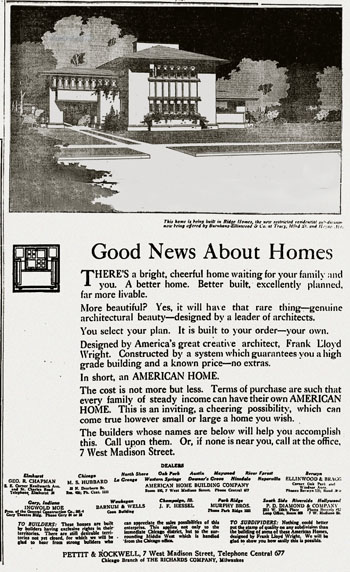
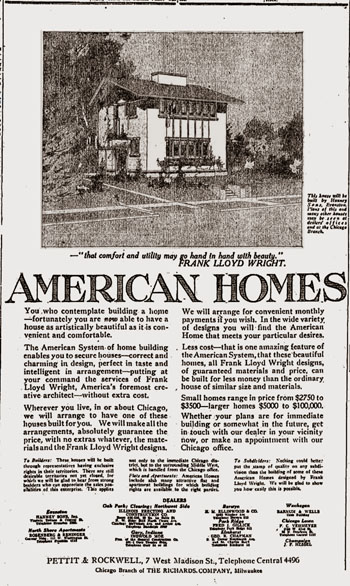
(i) Systembilt Industries shall construct homes in the Wrightian ‘Usonian Automatic‘ vernacular, which is, by this outfit’s estimation, the precursor to the Brutalist vernacular, which is erroneously said to be founded in the United Kingdom in the 1950s, and has since been nearly exclusively devoted to federal government architecture. Whereas the Brutalist is an exaggeration of scale and mass in proportion to the softening panes glass — or a more forgiving human sensibility — the Usonian is intentionally designed for the consumption and appreciation of the human and their family — the American family at that — using a uniquely modular and horizontal American vernacular. Due to the modular and affordable nature of the prefabricated building materials which would be shipped ready-to-assemble to the buyer, Frank Lloyd Wright innovated the construction method AMERICAN SYSTEM-BUILT HOMES. Using the internationally conscious appellation of ‘Usonian’ for ‘United States of North America’ or ‘USONA’, Mr. Wright provides at the turn of the century a vision of USONIA in which every family can own a firm and beautiful AMERICAN HOME at a fixed and reasonable cost.
(j) The planned community of Usonian Automatic homes by Systembilt Industries shall comprise the network of private homes of Friends in the Firm League of Friendship of the decentralized autonomous and International Black Cross Organization. The cultural centers of these communities shall be planned around the Mission Fulfillment Centers which are the meeting tents of the congregation.
(k) References.
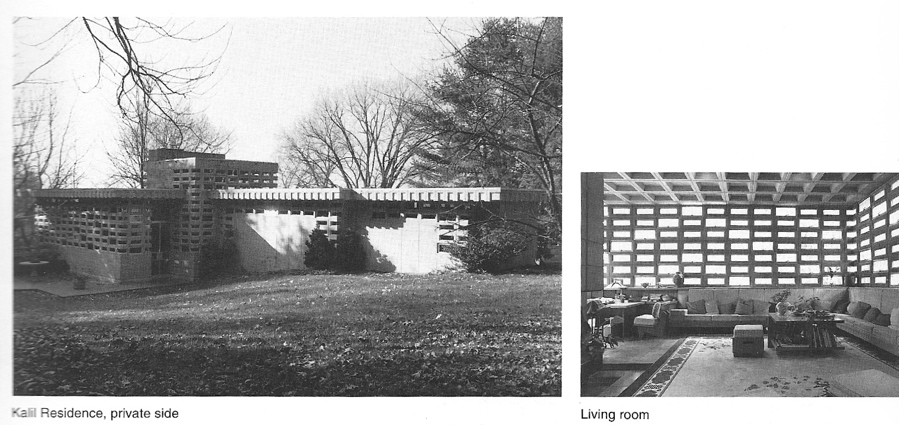
(1) Usonian Automatic
(2) Kalil House

(3) Turkel House

(4) Tonkens House


(5) Automatic Blocks
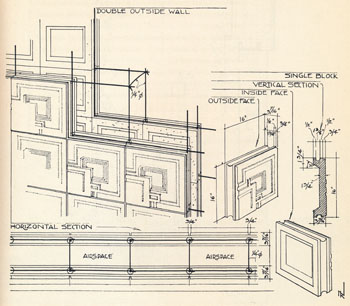
The textile block system — the root form of automatic blocks — is a unique structural building method created by Frank Lloyd Wright in the early 1920s. While the details changed over time, the basic concept involves patterned concrete blocks reinforced by steel rods, created by pouring concrete mixture into molds, thus enabling the repetition of form. The blocks are then stacked to build walls. Wright’s textile block houses are:
- Ennis House
- Robert and Rae Levin House (check also the other Michigan – Galesburg and Parkwin/Kalamazoo – houses at List of Frank Lloyd Wright works)
- Millard House
- Samuel Freeman House
- Storer House (Los Angeles)
- Westhope, located in Tulsa, Oklahoma, Wright’s only Textile Block house outside of California.[1]

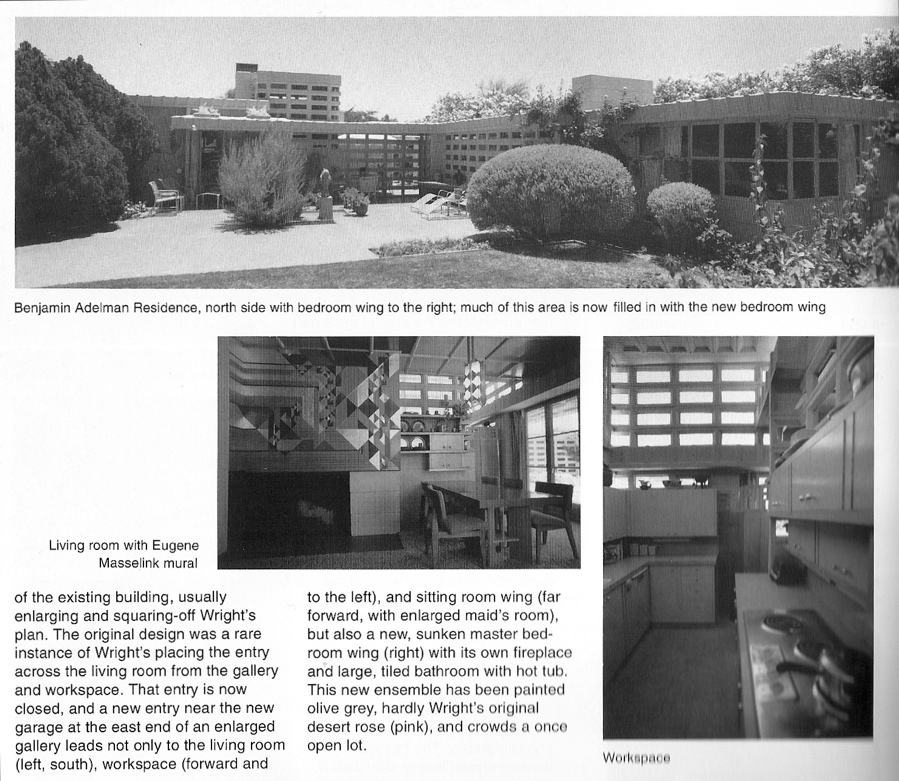
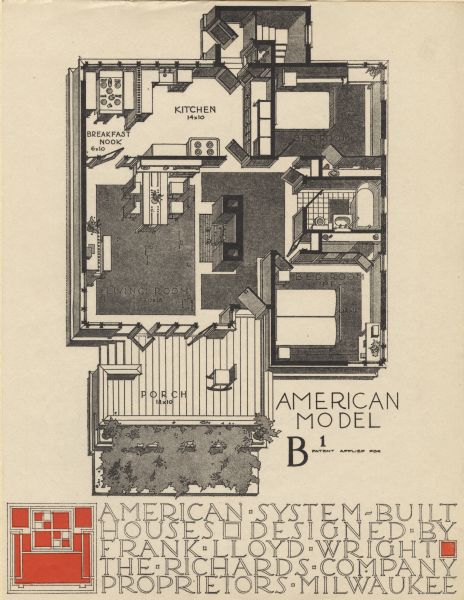
(6) American System-Built Homes
The American System-Built Homes in Milwaukee, Wisconsin:
Frank Lloyd Wright’s earliest system of low-cost housing© 2005 Michael Lilek, All rights reserved
Master of the Small House
Copyright 2004-2005, Michael Lilek, All rights reserved.
Over a career spanning seven decades, Frank Lloyd Wright took special interest in creating architect-designed homes for moderate and low-income families. In the January 1938 issue of Architectural Forum, he commented, “[I] would rather solve the small house problem than build anything else I can think of…” Indeed, among Wright’s greatest masterpieces are several small homes designed for clients who could afford little. Many of these residences owe their existence to some form of client labor (do-it-yourself), ingenious cost-cutting or salvaging. Each magically shelters it occupants in beautiful spaces, connects them to nature, and allows them to feel more alive.
American System-Built Homes
In a 1901 speech entitled, “The Art and Craft of the Machine,” Wright outlined his vision of affordable housing. He asserted that the home would have to go to the factory, instead of the skilled labor coming to the building site. Between 1915 and 1917 Wright designed a series of standardized “system-built” homes, known today as the American System-Built Homes. By system-built, he did not mean pre-fabrication off-site, but rather a system that involved cutting the lumber and other materials in a mill or factory, then bringing them to the site for assembly. This system would save material waste and a substantial fraction of the wages paid to skilled tradesmen. Wright produced more than 900 working drawings and sketches of various designs for the system. Six examples were constructed, still standing, on West Burnham Street and Layton Boulevard in Milwaukee, Wisconsin. Other examples were constructed on scattered sites throughout the Midwest with a few yet to be discovered.
Arthur L. Richards, Developer
By 1911, companies connected to Arthur L. Richards had engaged Frank Lloyd Wright to design several projects, including an unbuilt hotel in Madison and the Hotel Geneva in Lake Geneva, Wisconsin (1912, demolished). By November 1916, Richards entered into an agreement with Wright to promote the American System-Built Homes. The contract covered all parts of the United States, Canada and Europe. It called for the Richards Company “…to furnish, as far as possible, all materials entering into the construction of the buildings and to at least furnish the plans, drawings, specifications and details and lumber, millwork, exterior plaster material, paints, stains, glazing, hardware trimmings and electric lighting fixtures for said buildings.” Richards was to recruit a distribution channel of builders and developers from around the country. He appears to have focused his efforts in the Chicago area and a few other Midwestern cities.
The agreement between Wright and Richards anticipated that the American System-Built Homes project would be wildly successful. Unfortunately, the entry of the United States into World War I on April 6, 1917, diverted building materials to wartime needs. Housing starts ground to a halt. Wright also began extensive travels between America and Japan at this time, related to the Imperial Hotel commission. Wright became unhappy with his relationship with Richards, leading to a lawsuit in August of 1917. Central to Wright’s claim was the non-payment of royalties and fees. Wright won a judgment against Richards in February of 1918. Although the business relationship ended after a few years, Wright and Richards rekindled their friendship decades later and exchanged cordial letters and visits.

D.R. 01-07: BLK MKT, &c.

Volume 1, Issue 7
CONTENTS — Art. 1. N∴S∴ Director awarded grant… — Art. 2. …Black Market Press — Art. 3. …the Syllabus in Postmodern Literature… — Art. 4. …Public Trust… — Art. 5. From Laurie Lewandowski
Article 1
N∴S∴ Director awarded grant by D.C. Arts and Humanities; establishes Office of Diversified Art Investments
By Antarah Crawley
WASHINGTON, DC — NOVUS SYLLABUS L.L.C. (N∴S∴) Director Antarah Crawley has been named a Fellow of the District of Columbia Commission on the Arts and Humanities (DC CAH). DC CAH has conditionally awarded Crawley a grant to support his artistic practice. In response to the Arts and Humanities Fellowship Program Request for Proposals, Crawley submitted a strong application centered on the Art¢oin Non-Fungible Token mint project and the IBé Arts Institute-sponsored Tubman note issue project. The Director will use part of the proceeds of this grant to establish the N∴S∴ Office of Diversified Art Investments.
Article 2
N∴S∴ establishes Black Market Press
By Antarah Crawley
NACOTCHTANK, OD — NOVUS SYLLABUS L.L.C. (N∴S∴) establishes Black Market Press (BLK MKT) on October 20, 2023, with the publication of Visible: The Art of Her Story by IBé Crawley, which is released upon the occasion of the Grand Reopening of the National Museum of Women in the Arts. N∴S∴ Director Antarah Crawley is the Publisher and Editor-in-Chief of Black Market Press. The Press is affiliated with A.I.C. Consulting for distribution services.
(last modified 19 Oct 2023)
Article 3
Notes on the syllabus in postmodern literature and common law
By Antarah Crawley
NACOTCHTANK, OD — Circa February 2013, I was reading a lot of postmodern American novels leading up to and during the publication of Title 1 C.S.R. Pharmacon of the Spirit, which was my contribution to the genre American postmodernism.
Postmodern literature is a form of literature that is characterized by the use of metafiction, unreliable narration, self-reflexivity, intertextuality, and which often thematizes both historical and political issues. This genre is best exemplified by the works of Jorge Luis Borges, James Joyce’s Ulysses (often considered modernist), Flann O’Brien’s At Swim-Two-Birds, William Gaddis’s The Recognitions, William S. Burroughs’s Naked Lunch, Anthony Burgess’s A Clockwork Orange, Hunter S. Thompson’s Fear and Loathing in Las Vegas, Gabriel García Márquez’s The Autumn of the Patriarch, Margaret Atwood’s The Handmaid’s Tale, Salman Rushdie’s The Satanic Verses, Bret Easton Ellis’s American Psycho, Don Delillo’s Mao II, Toni Morrison’s Beloved, William Gass’s The Tunnel, David Foster Wallace’s Infinite Jest, Thomas Pynchon’s Mason & Dixon, Dave Eggers’s A Heartbreaking Work of Staggering Genius, Zadie Smith’s White Teeth, Jonathan Safran Foer’s Everything is Illuminated, Roberto Bolaño’s 2666, David Mitchell’s Cloud Atlas, and (in my opinion) Blake Butler’s 300,000,000, among many (but not countless) others. Thomas Carlyle’s Sartor Resartus is an excellent precursor to the genre from the 1830s.
Now I can’t say that I’ve read every page of each of these magnum opuses (indeed, anyone who says they have is likely full of it – even if they’re not lying). But I will say that it was the spirit of these works – the spirit of the “late modern” times – which bore a hole in me and fulled me with inspiration. It certainly beat What Masie Knew in GW’s English lit courses. In short, you can say that “Postmodern literature” means all of the most exciting literature this side of World War II.
At that time, I wanted to throw my hat into the ring a major figure in American postmodern literature, and an “African American” to boot. However, after querying New York agents and reading the manuscript over, I determined, alas, it was not very good. But my judgement at that time would belie itself, since the events of the novel, though not good enough to publish, were good enough to live. I ultimately would end up doing the things in my life that Walter Kogard did in Title 1 and thereafter, including live in New York, found a Secret School, and become editor of the Black Market Press (1 C.S.R. pgs. 278-282). How’s that for American postmodernism?
Recently, while researching McGirt v. Oklahoma and other Indian affairs, I came across the phenomenon of a legal “syllabus” which is a preliminary section of a court ruling, preceding the legal opinion of the court, that outlines the core facts and issues of the case and the path that the case has taken prior to reaching the present court. They are, in effect, summaries, and are not to be considered part of the actual decision of the case and are not precedential. This new information struck a chord in me, as my organization of the New Syllabus had proceeded from research focused on postmodern literature and print publishing to occult and esoteric studies to pseudo-law, equity, and sovereignty. Furthermore, the U.S. Supreme Court writes, “All opinions in a single case are published together and are prefaced by a syllabus prepared by the Reporter of Decisions that summarizes the Court’s decision.” This got me thinking about the origin of the name New Syllabus.
I chose the name New Syllabus for this deeply personal academic endeavor in 2013 in homage to the postmodern American novel Giles Goat-Boy or The Revised New Syllabus of George Giles our Grand Tutor by John Barth. Again, I can’t say I read much of this book either, and what I did read I forgot until just moments before writing this article. But as I refreshed my recollection I realized that I must have subconsciously adopted the novel’s conceit as a premise on which to navigate the real world. The Plot summary reads:
George Giles is a boy raised as a goat who rises in life to be Grand Tutor (spiritual leader or messiah) of New Tammany College (the United States, or the Earth, or the Universe). He strives for (and achieves) herohood, in accordance with the hero myth as theorized by Lord Raglan and Joseph Campbell. […]
The principle behind the allegorical renaming of key roles in the novel as roman à clef is that the Earth (or the Universe) is a university. Thus, for example, the founder of a religion or great religious leader becomes a Grand Tutor (in German Grosslehrer)
Wiki
It seems to me that I have (unintentionally) mimicked the novel’s narrative, from establishing a school after the model of the world to automating that school using a system of codes and algorithms (the “computer”):
Giles Goat-Boy marks Barth’s emergence as a metafictional writer.[3] The metafiction manifests itself in the “Publisher’s Disclaimer” and “Cover-Letter to the Editors and Publisher” which preface the book, and which each try to pass off the responsibility for authorship onto another: the editors implicate Barth, who claims the text was given to him by a mysterious Giles Stoker or Stoker Giles, who in turn claims it was written by the automatic computer WESCAC.
Wiki
It is as if the “Publisher’s Disclaimer” is the legal syllabus to Barth’s Revised New Syllabus, and the N∴S∴ Director is the Reporter of Decisions of American belles-lettres, courts of law and equity, and historical dialectics.
At this time, I cannot say if Barth’s vision of the Universe is wholly “metaphysical” or not – it certainly has panned out accurately for me in the material realm, although few others understand my “research.” I have indeed reared up a school and filled its halls with tomes (and sat alone hearing the echo of my voice). Borges says the Universe is often called the “Library,” another objective correlative which became engrained in the New Syllabus starting at Title 3. All in all, the postmodernists Barth and Borges have firmly anchored their symbols in my worldview … for better or for worse.
(last modified 23 Oct 2023 24 Oct 2023)
Article 4
Notes on the Public Trust of the Moorish People
By Antarah Crawley
NACOTCHTANK, OD — The Consular Court of al-Maghreb al-Aqsa, Trustee, of the Public Trust of the Moorish People, Heirs Beneficiary, to the People of Anacostia, Washington District, Send Greetings and Peace.
The land east of the Eastern Branch of the river Potomac is called Nacotchtank-on-Potomac, and the people there are one village. This village is within the federal district of the Ouachita Confederacy of indigenous peoples of North America (which are registered under many names), in the jurisdiction of the Farthest West (al-Maghreb al-Aqsa), being the lands and waters from the Barbary States to the westernmost continent of the Americas (al-Morocco), which is called “the land of large buffalo.”
NATIONALITY: The Moorish people are an autochthonous people (descended from this land) indigenous to both Africa and the Americas. The United States of America (USA) has a trust responsibility to the Moors, as it would to any American Indian/Alaska Native (AI/AN) tribal nation, insofar as it has a responsibility not to infringe on their treaty rights. And whereas AI/ANs do not believe in legal titles in land, the equitable use title to land and stock is found in the nature of a sincerely-held belief and religious, ritual, or ceremonial customs. And whereas AI/ANs do believe in birthright inheritance, this right is further enshrined in the Constitution of the USA which upholds the sanctity and protection of life, liberty, and property.
AUTHORITY: This consular court is authorized under treaty between the United States of America (USA) and the Kingdom of Morocco to represent the moorish nationals domiciled on the land governed as USA. It is a religious institution insofar as it is an assembly of the faithful believers in the dogma of redemption and of the ancient moorish science, and an organization of religious/education colleges and orders.
DOGMA: The people are the church, and the church is the body of Christ, ergo the people are the body of Christ, who is their counselor, judge and king before God the Father, and whose ministers are their representatives on the earth. Those who will say that He is the Sovereign of the earth are indemnified by Him from the penalty of sin in this life and in the hereafter. Those who follow His law of divine reciprocity shall receive mercy on the Day of Judgment. (The Divine Mother and the Holy Spirit are also to be praised.)
OPERATION: The legal name and owner of the courthouse shall be [S∴P∴Q∴M∴, Inc.]. It shall look like a mosque  , be called the church
  ️, and function as school and consular courthouse
  . The consular court shall serve the circuit of the Ouachita District.
REGULARITY: Hold A.M. court business docket and P.M. UA on weekdays; hold Interfaith Religious Service (IRS) service on Friday night and Saturday morning; hold Sundays open.
PRESIDENCE: The court shall be presided over by Consul General Magistrate Judge (CGMJ) Vice Consul General (CG), Vice Magistrate Judge (MJ), Grand Preceptor/Grand Scribe/Grand Tutor, Ombuds, Syndical Committee Chairs, Sergeant (Sgt) at Arms, Imam/Mullah, Rabbi/Moreh, Archbishop/Presbyter/Elder, Tribune of the People, and People assembled. Some of these offices may be encumbered by the same individual.
AMENDMENT IN THE NATURE OF NOTES OF 23 OCT 2023
(1) N∴S∴ was chartered as the livery company (an official company identified by a special design or color scheme) of the Worshipful Company of Scribers (See, Notice of 27 Sep 2018), whose senior permanent staff member shall be the “Systems Dep’t Intermediary Zone (InterZone) Clerk” and whose junior permanent staff member shall be the “Systems Dep’t Knowledge Zone (KnownZone) Cleric” (See, Title 3 C.S.R.). Note that there is no clerk in the O Zone. These three Zones together comprise the DataHorse system of the N∴S∴ Dep’t of Information Systems Intelligence Services (DISIS).
(2) Circuit courts are historically routes through county towns traveled by judges (in the early U.S., Supreme Court judges) and their retinue of attorneys on horseback (the circuit riders). Modern circuit courts are, generally, jury trial courts that may have review authority over a lower court such as a juvenile and domestic relations court.
(2)(a) The concept of circuit riders may be a legacy of the equestrian class of ancient Rome.
(2)(b) A livery is a place that will keep and take care of a horse on behalf of its owner, for a fee.
(3) Courts of Sessions (or “sittings,” another name for proceedings) were established in particular towns or counties. They were replaced by one Crown Court (for criminal matters, and High Court for civil matters), like unto one supreme Court (both criminal and civil/commercial/equitable), or one holy catholic and apostolic Church (political body masquerading as sovereign body of Christ/the People).
(3)(a) Officers of such court include:
(3)(a)(i) The Circuit Rider(s), the judge(s) of sessions/sittings who ride the circuits on commission of oyer et terminer (“hearing and determining”) setting up court and summoning juries in assize towns; those who shall sit at the Dais of the court.
(3)(a)(ii) The Clerk(s) [or, cleric(s)], the keeper(s) of the record; those who shall sit at the Desk of the court issuing and receiving order and papers (See, this Amendment § (1), above).
(3)(a)(iii) The Rapporteur de la cour (Reporter of the court). (See, Memo. No. 9)
(4) Oyez (“hear ye”) is plural imperative form of oyer (French: ouir “to hear”) from oyer et terminer “to hear and to determine” (a sitting of the court, presided over by a judge of assizes “sessions”).
(last modified 23 Oct 2023 24 Oct 2024)
Article 5
From Freemasonry and the Catholic Church
An Excerpt | By Laurie Lewandowski | October 17, 2022
[W]hile Catholics do believe in the immortality of the soul, we reject that doing good works and moving up in ranks (degrees) helps souls get to heaven. This type of heresy was condemned by the Church in 5th century during the Pelagian heresy, which erroneously taught Christ didn’t redeem the human soul, but with good works one can be redeemed. The Church teaches that our immortal souls are redeemed through Christ alone and that through the power of baptism we are saved. (I Peter 3:21).
Freemasonry is a religion which is gnostic (hidden or secret knowledge is power), rationalistic (reason alone guides us into all truth), syncretistic (melding of all world religions, giving equal footing to them all), relativistic (you have your truth and I have mine.), and indifferent (just keep quiet and get along, it doesn’t matter what you believe.) This indifferentism associated with Masonry is probably the most urgent reason to reject it. For a Catholic (and other Christians), the fact that Masons’ “creed” is to ignore Jesus as the Way, is more than just problematic. Jesus promised us division by His Name (Luke 12:51). We must never deny the name of Jesus for the sake of unity. This is one of the grave evils in our modern society. Further, the swearing of oaths, placing the lodge over any other authority, and the inimical relationship between Masons and the Church are additional reasons for the Church’s condemnation. Finally, eight popes from St. Clement XII (1738) onward have condemned it, teaching of its grave sin. Pope Leo XIII writes Inimica Vis, ch.2,
Our predecessors in the Roman pontificate have in the course of a century and a half outlawed this group not once, but repeatedly. We too, in accordance with Our duty, have condemned it strongly to Christian people, so that they might beware of its wiles and bravely repel its impious assaults. Moreover, lest cowardice and sloth overtake us imperceptively, We have deliberately endeavored to reveal the secrets of this pernicious sect and the means by which it labors for the destruction of the Catholic enterprise.
Pope Leo XIII, Inimica Vis, ch.2
Use this resource to pray for release from the Oaths of Freemasonry and repent.
 Supreme Exchange