Tagged: new syllabus
Rustles in Dry Leaves
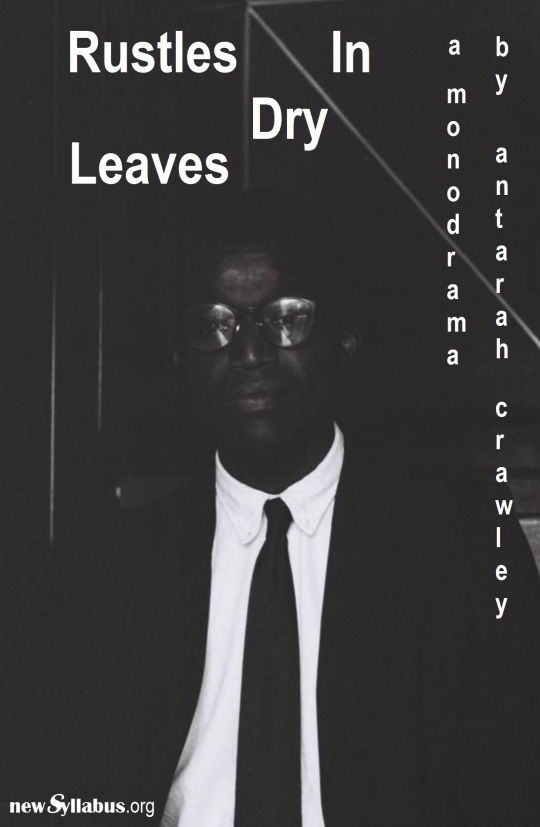
Rustles in Dry Leaves
(Revised)
A Monodrama;
Written for the Stage
by Antarah A. Crawley
BROOKLYN, NEW YORK CITY – 2015
1. The Coffeehouse
Lo, my Syllabus is not yet fit for students, although I have borne it in some form.
My work has not fared well; although I’ve elaborated on it, that was some time ago. I had begun with a sense of purpose, some kind of understanding, but the conceit of it has come undone inside me. It has regressed back into blankness and will not manifest a word. Its silence begs me fill it but I have no tunes of music. In truth, I know that I must write, but what work results is mystery. I know not what I’m writing, what my course is. I essay but I yield no postulation. There appears an inherent flaw: the need to write it out. Essaying never achieves the perfection of one word’s sound. Or a whole paragraph often feels like a weighty body for the sentence, or a concept better visualized than explained.
Perhaps, then, a Syllabus is not the best fit medium to conduct my Understanding.
No, a Symbol would be. Or, perhaps, a System of Symbols, all correlative in their nature. But then one’d need a Syllabus to catalogue and contextualize them. Thus I seek a Syllabus with which to study Symbols.
Folly, that I aim to elaborate upon the simplest and densest of truths, this human understanding of nonhuman realities. The unity of all existences. And man has endeavored to do that since he first looked on the sun.
And yet the sun has looked upon me as well. Does that not give me as much license to describe it as anyone? Isn’t my vision as validated? Look upon me, for the sun hath looked upon me.
For I aim to convey my unique Understanding to others. The systems in which the divine Symbols align within my particular vision may not be immediately realized by others, but I believe that from the components of my Understanding I should be able to construct the implicit System and describe it in the Syllabus. I am yet unable to find it—though I know it exists manifested on some plane.
Shall I look into the Tunnels, the ones underground, submerged. Deep below the surface.
But for what?
Evidently, my Syllabus has descended into some unknown location, and the unknown lies above and beneath us. We cannot ascend unto their heights; so we must go down. My Pyramids have fallen, and tunnels have born through them. And tunnels are ubiquitous and lasting and run in cycles unto no end.
But why has my Syllabus descended? Why is it now underground?
Perhaps it has fallen out of distribution. T’was not profitable enough to continue printing. You know how the costs have risen and the demand declined.
Where, then, do I find those texts which have fallen out of circulation, underground?
Perhaps, where used things go. Things the public deems unnecessary. And we all know that a human understanding holds no place in our zeitgeist. Look among you; the people are profane. They no longer read or seek my Pyramids. If I wish to find that which has fallen out of fashion, that knowledge which people have sold off for monetary gain, then I shall get me to a library. There, I may find my Syllabus.
I am black body, I am collapsed. I am fallen the way way back. I have sunk inside myself. Don’t you wish to come inside me? My black ass has so much mass. I have a warm hole to hide you. No bright light can dare to find me. I am fallen and born back. No matter can stand beside me. I am hollowed, I am black.
2. The Library
I seek my Pyramids.
— Thy Pyramids have fallen. Tunnels have borne through them.
But is a library not also a Pyramid?
— Are Pyramids not also bread?
Don’t understand.
Overstand.
I shall get me to a bakery.
My Understanding precedes all language. What Pyramids do I seek?
A Syllabus; I seek a new Syllabus for a Human Understanding.
And yet I have no understanding of Systems. Nor of Pyramids. For I wish to summit thy peak! Get me to a bakery!
I wish to descend unto Tunnels. I know that I cannot summit ascended peaks but in tunnels I may descend to seek my Syllabus, so I will go where bread is baked and or sold. You know—a bakery.
— Thy Pyramids have fallen! Tunnels have borne through them! Thy Pyramids you seek, thy Precipice broods on deep waters.
O Time, my Pyramids have fallen. Deep under water. They are submerged beneath the known and have not surfaced. I seek thy Tunnels. I do not seek a library. Get me to a bakery.
I exit this bookstore, for it is a catacomb, and in it I’ll find only corpses. I make a right on the street and walk away. I go to the Deli at the end of the Avenue. Aaaaaaall the way downtown. There, my precipice broods on deep waters.
3. The Deli at the End of the Avenue
I seek bread in the aisle. I seek my Pyramids. I’m writing a Syllabus and I seek my Pyramids for Symbols. Someone told me that Symbols lie somewhere in Tunnels. If I can reach my Pyramids I can find the Symbols needed for my Syllabus, so I need my Pyramids for answers.
— If it’s Tunnels that you seek then you must know, there is no end. You will never reach thy Precipice. It lies forever just beyond you. If you were to reach thy Pyramids, you’d be borne immediately back. The gravity of the centre is too great. The Precipice of thy Pyramids is too close to the sun. You will surely burn before you glimpse what you seek.
It’s my Syllabus I seek. It lies in the deep. In the void. At the peak. And if it’s the peak I must reach to peek the Pyramids I seek, then that must be my destination, not the Tunnels.
The hardest part about anywhere is getting there. Once you’re there, you’re no where at one moment, and now here the next.
No where is where I will go then, if no where’s where the precipice of my Pyramids lie. I must know, which is the right way?
Down. I must go down. Down the aisle. The bread aisle.
I look down the shelves of bread. I glance to the floor where I notice a wooden latch door. I look at the cellar door, I bend down, open it, peer into the darkness, and go down there.
4. Bedford-Nostrand Avenues Station
I descend into Bedford-Nostrand Avenues Station and take a dead beside an old man. And the old man says to me, I have been waiting for this G train for one hundred years … You know, the G train is the bowel of Brooklyn. I mean, it’s full of shit. One of those slow, tiresome ones. You’re sitting there wondering “when will this piece of shit come down the tunnel?” Finally, after what seems like an eternity, you pinch one out—and then your toilet clogs up! We are being delayed because of train constipation. We are sorry for any inconvenience.
You seem to possess some knowledge of tunnels, I say to the old man.
I told you, he said, I have been waiting here a century for my train to take me through the tunnels. In that time I have come to understand much.
So you possess an understanding!? I seek understanding. I’ve come here in search of my Syllabus. I seek my Pyramids.
— Thy Pyramids have fallen. Tunnels have born through them.
We are fallen. Tunnels are born through here.
— You seek that which has no form. There is no Syllabus for you here. There is nothing of use to you here underground. There is only so far you can get through these tunnels. You see, the Stations you pass through will not dispel to you any answers in this form. Thus passing through the submerged Systems in search of the true Systems of Knowledge is fundamentally flawed. You will never reach thy Precipice. Thy Pyramids have fallen.
I was told that the Tunnels lead to my Pyramids. The Void around which aethers fog.
— Though the Void you seek is not physical, but beyond the physic; it is nothing. You can’t access it. You will wait in this station for a hundred years. And maybe your train will come and bear you down the borough’s bowels. But no Pyramids lies at the end of thy line. Only silent waters.
O Time, thy Pyramids, where art thou? Reveal the Syllabus I seek. I’ve traversed city corridors and monoliths of antiquated tomes—of catacombs and dusty halls; I have breathed in noxious gases. I have ventured down the Avenue in search of bread. I have descended into burrows, passed throughout their halls, and sunk the earthen floors of cellars with the treading of my soles. I have passed through tunnels like a train, a cell in the blood of city’s veins. I have passed through yonic doorways into wombs. But I will not be satisfied with shallow water. I’ve heard that thy precipice broods on deep. I will seek further through thy hollows ‘neath the cellar floors of earth. O hollowed Pyramids, thy peak, submerged deep beneath the street, thy Systems will not keep my waves at bay.
A G train burrows into the station and comes to a steaming halt. I leave the old man at the bench and board the car, the doors close, and the train makes its departure down the Tunnel.
5. Coney Island
I exit the train station, I walk to the water’s edge, and I brood on the deep, the horizon, the sunset on the water.
At length, I am approached by a bather in a swimsuit, but I continues to look into the horizon.
The bather says to me, You look silly.
What? I reply.
Your clothes, says the bather. They’re silly. Do you know where you are? Your clothes enclose you. They block out the light of the sun. They obstruct the flow of the water. The sea cannot wash over you. The sun cannot look upon you. I presume that’s why you’re here, at this beach. And yet you merely look on the water, and stand below the sun. You do not delve into them. You do not let them come inside you.
The sun has looked upon me. The sea has come, and come inside me. From in the light I’ve touched the light. I knew the light grew mold inside me. I do not wish to bathe here, for I seek my Syllabus. I was told it peaks thy Pyramids, Pyramids which lie at the Center of Systems, Systems which are traversed by tunnels. But tunnels have brought me here to the end of the line, and emptied me at thy sea. But as I seek the sea, I see inside. O Time, thy Pyramids, to me are nothing novel; they are fallen to the bottom of the silence of the sea, and having reached the farthest East that West can bring me, I can feel the wind that rustles in dry leaves.
Fin.
The Saint Nat Project

presents
The Canonization of Saint Nat (2020)
In his first portrayal of the Virginian revolutionary, the Reverend Nat Turner, Antarah Crawley delivers the revelation which Nat testified through his attorney at trial on the 5th of November, 1831. His testimony was read in open court, and when asked by the Court for any further explanation, his only spoken words were, “Was Christ not crucified.” Nat was convicted that same day and executed by the Commonwealth at Jerusalem on 11 November, 1831. By and through his performance, Crawley canonizes Nat a Saint in the tradition of Ordo Templi Novus Syllabus and dedicates the Temple N:. S:. in his beatified name. Produced and Directed by Antarah Crawley.
The Revelation of Christ to Saint Nat (2021)
In his second portrayal of the Reverend Saint Nat on the first anniversary of his canonization, Antarah Crawley evokes the religious fervor which inspired this martyr to undertake the insurrection in Southampton County, Virginia, pursuant to his self-education and the sighting of the annular solar eclipse of 12 February, 1831. Produced and Directed by Antarah Crawley.
Script of The Revelation of Christ to Saint Nat, or, The Gospel of Saint Nat
Originally transcribed by Thomas R. Gray, Esq.,
and edited for brevity by A. A. Crawley, Scribe,
O.T.N.S., Anacostia R.V., Al-Maghreb Al-Aqsa.
ברוך ה המבורך לעולם ועד
Baruch Adonai ham’vorach, l’olam va-ed
Praise be to G-d to whom all praise is due, world without end.
בָּרוּך אַתָּה ה’ אֱ-להֵינוּ מֶלֶך הָעוֹלָם
Baruch atta Ado-noy Elo-hai-nu Melech ha’olam
Blessed are you, Lord our G‑d, King of the universe.
Kedushah
בָּרוּךְ אָתָּה יְיָ הָאֵל הַקָּדוֹשׁ.
Baruch atta Ado-noy ha-el hak-kadosh
Blessed are You, Eternal God, the essence of holiness.
אַתָּה קָדוֹשׁ וְּקדוֹשִׁים בְּכָל יוֹם יְהַלְלוּךָ סֶּלָה
atta kadosh ukedushim bekhol yom yehalelukha selah
You are holy, and Your holy ones praise You every day, praising you forever;
v’kara zeh el zeh v’amar
and each one called to the other:
קָדוֹשׁ קָדוֹשׁ קָדוֹשׁ ה’ צְבָאוֹת מְלֹא כָל הָאָרֶץ כְּבוֹדוֹ
Kadosh Kadosh Kadosh Adonai Tz’vaot M’lo Khol Ha’aretz K’vodo
“Holy, Holy, Holy, The Lord of Hosts, The entire world is filled with His Glory.”
בָּרוּךְ כְּבוֹד ה’ מִמְּקוֹמוֹ
Baruch K’vod Adonai Mim’komo
“Blessed is the Glory of the Lord in Its Place”
יִמְלֹךְ ה’ לְעוֹלָם. אֱלֹהַיִךְ צִיּוֹן לְדֹר וָדֹר. הַלְלוּיָהּ
Yimloch Adonai L’Olam, Elohayich Tziyon L’dor Vador Hall’luyah
“The Lord shall reign forever, Your God, O Zion, from generation to generation, Hallelujah”
JERUSALEM, VA – NOVEMBER 5, 1831
I was 31 years of age the 2nd of October last, and born in Southampton County of Old Virginia. 2 In my childhood, while at play with other children, at three or four year old, I was telling them something which my mother, overhearing, said had happened before I was born. Others being called on were greatly astonished, knowing that these things had happened, and caused them to say in my hearing that I surely would be a prophet.
3 And my mother and father strengthened me in this my first impression, saying in my presence that I was intended for some great purpose. 4 I taught myself to read and write, and improved my learning at all opportunities. And having soon discovered my spirit to be great, I withdrew myself to fast and pray, and wrapped myself in mystery.
Chapter 2
Now finding that I had arrived man’s estate, and hearing the scriptures commented on at the meetings, I was struck with that particular passage which says, Seek Ye the Kingdom of God and all things shall be opened unto you.
2 I reflected much on this passage and prayed daily for light of the subject, and as I was praying one day at my plow the Spirit spoke to me saying, Seek ye the Kingdom of God and all things shall be opened unto you.
Chapter 3
Now finding that I had arrived to man’s estate, and was a slave, and these revelations being made known to me, I began to direct my attention to that great object, to fulfill the purpose for which, at this time, I felt assured I was intended.
2 At this time I had a vision: and I saw white spirits and black spirits engaged in battle. And the sun was darkened, and thunder rolled in the heavens, and blood flowed in streams and I heard a voice say, Such is your luck, such you are called to see, and let it come rough or smooth, you must surely bear it.
3 I now withdrew myself from the intercourse of my fellow servants, for the avowed purpose of serving the Spirit more fully. 4 And it appeared to me and reminded me of the things it had already shown me, that it would then reveal to me the knowledge of the elements, the revolution of the planets, the operation of the tides, and the changes of the season.
5 After this revelation, in the year 1825, and the knowledge of the elements being made known to me, I sought more than ever to obtain true holiness before the great day of judgment should appear, and then I began to receive the true knowledge of faith.
Chapter 4
And from the first steps of righteousness until the last was I made perfect. And the Holy Ghost was with me and said, Behold me as I stand in the heavens. 2 And I looked and saw the forms of men and women, and there were lights in the sky to which the children of darkness gave other names than what they really were, for they were the lights of the saviors hands stretched forth from East to West, even as they were extended on the cross on Calvary for the redemption of sinners.
3 And I wondered greatly at these miracles, and I prayed to be informed with a certainty of the meaning thereof. 4 And one day while I was laboring in the field, I discovered drops of blood on the corn as though it were a dew from heaven. 5 And I communicated it to many both white and black in the neighborhood, and they found on the leaves in the woods hieroglyphic characters and numbers, and the forms of men and women portrayed in blood, representing the figures I had seen before in the heavens.
6 And now the Holy Ghost had revealed itself to me, and made plain the miracles it had already shown me. 7 For as the blood of Christ had been shed on this earth, and had ascended to heaven for the salvation of sinners, and now was return to earth again in the form of dew, and as the leaves on the trees bore the impression of the figures I had seen in the heavens, it was plain to me that the Savior was about the lay down the yolk he had borne for the sins of men, and the great Day of Judgement was at hand.
Chapter 5
And on the 12th of May, 1828, I heard a loud noise in the heavens. 2 And the Spirit instantly appeared to me and said the serpent was loosened, and Christ had lain down the yolk he had borne for the sins of men, and that I should take it on and fight against the serpent, for the time was fast approaching when the first would be last and the last would be first.
3 By signs in the heavens it would make known to me when I should commence the great work, and until the first sign appeared I should conceal it from the knowledge of men.
4 But on the appearance of the sign – the eclipse of the sun last February – I should arise and prepare myself, and slay my enemies with their own weapons. 5 And immediately upon the sign appearing in the heavens, the seal was removed from my lips and I communicated the great work laid out for us to do to Henry, Hark, Nelson, and Sam.
6 Many were the plans formed and rejected by us, and the 4th of July last came and went without our coming to any* determination how to commence. 7 We were still forming new schemes and rejecting them when the sign appeared again, which determined me not to wait longer.
Epilogue (Psalm 43)
Judge me, Allah, and plead my cause against an ungodly nation: O deliver me from the deceitful and unjust man.
2 For thou art the God of my strength: why dost thou cast me off? why go I mourning because of the oppression of the enemy?
3 O send out thy light and thy truth: let them lead me; let them bring me unto thy holy hill, and to thy tabernacles.
4 Then will I go unto the altar of God, unto Allah my exceeding joy: yea, upon the harp will I praise thee, Elohim Elohai.
5 Why art thou cast down, O my soul? and why art thou disquieted within me? Have Faith, Trust and Believe in Allah: for I shall yet praise Thee, who art the health of my countenance, Elohai.
Benediction
Charis Kuriou Iyesous Xristos Agion. Amen.

(last modified 7 August 2023)
Art¢oin:\>_Smithy of Ptah
Be it known that the Scribe Artist and Craftsman Antarah A. Crawley, also known as Meriptah, founder of The New Syllabus organization, shall use the net capital acquired to date through sales of Art¢coin to establish the Smithy of Ptah in the Office of Scribe at the Temple of St. Nat in the Anacostia River Valley. This facility shall be known as the Mint of Meriptah at the Smithy of Ptah at the Temple of St. Nat of the New Syllabus of Men Nefer on Anacostia. It shall be directed by the Scribe Meriptah, who shall acquire the raw material and the means of production and administer the alchemical work. This facility shall smelt and forge the coin used to mint Art¢oin Non-Funglible Tokens (NFTs).
Human Programming
HUMAN CAPITAL RESOURCE DEVELOPMENT
What is the most valuable commodity in a capitalist system? Human labor. What is the most valuable asset in a capitalist system? Land and real estate? Wrong. It’s Human Intelligence. Why? Because it controls human labor. Therefore we aim to capitalize on the development of the human’s most valuable resource: intelligence.
What does Human Capital Development mean to us? It means: Develop Thought Control Program/Monitor or CP/M. In other words, you must develop self control to program and monitor your thoughts. How do we apply this method in practice? We actively program the mind software to develop and operate self DOS > control CTRL or C:\>_. The CTRL function enables you to state and execute commands CMD at the main root level.
Thought is a function of sense perception and cognitive behavior. We apply this cognitive function to facilitate human self development and improve a variety of soft skills and competencies including ethical, philosophical, social, political, and cultural consciousness. Competency development builds the capacity to act effectively and probe the facts to arrive at the truth of any matter in question. This method and practice is built upon a foundation of universal archetypes MAAT represented in the language MDU of nature NTR.
CULTURAL SOCIAL AND POLITICAL PROGRAMMING
We specialize in treating people affected by Black Identity Complex, which is one of the manifestations of Colored Person Syndrome Disorder, also known as Colored Person Stress Disorder or CPSD. CPSD manifests in people who are affected by a color of law, meaning the subjective and inequitable treatment of people with a certain complexion.
“Black” and “white” are colorable terms that purport to represent a person’s complexion, but do not. In fact, they represent a person’s social, economic and legal status. Therefore, our diagnosis finds that those who perceive themselves to be “black” lack objective knowledge of themself. This perception affects their socio-economic performance and leads to a Black Identity Crisis which perpetuates the perception of inequitable treatment. In our clinical practice we seek to resolve the psychological contradictions posed by colorable terminology and empower people living with CPSD by providing them access to information about themself. Our prognosis is to know yourself, and you will no longer be lacking in society.
Sapientia No. 6

POLICY BUREAU SAPIENTIAL DOCUMENT NO. 6 – AUG. 22, 2020
In Re Sepdet (In the Year of Sirius) III Peret 22, 12520
A BILL
To standardize method and practice in the discipline of folk psychology, human intelligence resource management, clinical dialectic information processing services, and other cognitive-behavioral development programs (collectively known as “mind software”), so as to provide a novel solution to the problem of racism, and for other purposes.
Be It Prescribed by the Policy Bureau, the New Syllabus of America, That people (the “folk” in question) are the members of one human family, having divergent genotypes and phenotypes which cause their skin to appear darker or paler in color along a certain spectrum. This spectrum of skin color does not, however, include the objective visual color spectrum of black, white, violet, indigo, blue, green, yellow, orange, and red. Rather, the skin color of people is subject to interpretation. The difference between subjective and objective is as follows:
(a) Subject refers to the person or matter about which a statement is made. Subjective refers to the quality of being influenced by personal sentiments and individual perceptions.
(b) Object refers to a person or matter toward which an action is directed. Objective refers to the quality of being a “matter of fact”, that is, clear and unambiguous from any perspective.
Sec. 2. We may observe that people experience the perception that they are objectively black or white in terms of color, culture, or “race”. This perception may be the result of certain environmental and cognitive-behavioral factors. Because one may appear darker or lighter in skin color, a person may erroneously equate the objective condition of black or white color with said person’s subjective conditions and experiences.
Sec 3. The psychological act of equating the subjective experience of a person with any objective color is an aberration, or disorder, in the mind. Why? Because even if all brown-colored and dark-colored people experience the same conditions, none of those conditions can be considered objectively “black” — not their skin color, not their nationality, not the development of any genre of music, and certainly not their “race” (assuming such a term can be defined). The assertion that the color black best represents the conditions of brown and dark-skinned and African and other colored people is a gross misrepresentation of objective facts (of which race is not one). Such misrepresentation based on mere pretense or appearance, and not the substantive facts, is colorable.
Sec. 4. Colorable is a quality that describes something that is misrepresented based on its appearance, without regard for its actual substance. Colored, on the other hand, is a quality that describes something as it actually appears. While colored describes something according to its actual quality (e.g., brown-skinned people having color), colorable describes something that purports to be something which it is, in fact, not (e.g., brown-skinned people being black). Facts must be based on material, that is, quantifiable and qualifiable, evidence.
Sec. 5. There are two main ways in which colorability is manifest:
(a) The subjectification of one’s own experiences based on the perception that they are black, white or another objective color; this is is a psychological disorder. Apparent “victims of racism” commonly suffer from subjectification.
(b) Likewise, the objectification of another person on the grounds that they “are” or appear black, white or otherwise colorable is such a disorder. Apparent “racists” commonly suffer from objectification.
Sec. 6. A distinction is drawn between people who are colored (that is, being of one human race having many colors, or “humanist”), and people who are colorable (that is, being of one or another race classified on the basis of color, or “racist”).
Sec. 7. By measuring the degree of subjectification and objectification on the basis color in the mind of a person we may thereby assess the degree of “racism” in the mind of said person, that is, the degree to which they are “racist”. (Apparent “victims of racism” also presuppose the existence of races, which is the basis of “racism”).
Sec. 8. Regarding such a person who experiences racism, this diagnosis is given: they experience Colored Person Syndrome Disorder (CPSD). About CPSD, this prognosis is given: it is a disorder one shall work against by means of psychological analysis, that is, inquiry of the mind. How then is the method affected, that is, how is this analysis administered? It is through true speech, that is, the dianoetic or dianetic virtue (See, PBSD-001-6).
Sec. 9. What, then, is the method of true speech? It is dialectic. Otherwise said, it is an inquiry by one into the perspective of another, also called interlocution, discourse, and communication. The inquisitor is the dialectician who solicits, records, and processes information; the client is the witness, querent and/or the source of information. Such a client must swear or affirm that that will produce nothing but true information.
Sec. 10. PBSD-001-3 provides for the definition of dialectic as “(a) the process of making known what is unknown; (b) a philosophical method describing the discursive-rational-intuitive process by which oneself individualizes itself…[and manifests its will]”. The application of this method constitutes the practice of discourse or parliament, that is, speech.
Sec. 11. While traditional psychology asserts dreams as the subject matter of empirical and scientific psychoanalysis, we propose that it is not the dreams per se under investigation, but the dialectic on the dreams. Therefore the discipline of folk psychology (DPF) takes a dialectic on any matter as the materially quantifiable and qualifiable subject matter of psychological investigation. As such, psychological analysis under DFP shall concern the practice of dialectic.
Sec. 12. Much is said by Dr. Carl G. Jung, a founder of Analytical Psychology, regarding the Archetypes of the Collective Unconscious. Regarding the “Collective Unconscious”, our Beloved Ancestors had much to say in the way of the Netjeru (See, PBSD-004). These Netjeru constitute the ancestral Collective Unconscious of humanity, the Birthright of the Children of Nature, having unconscious knowledge of the forms and processions of nature, from the Alpha to Omega. Such knowledge may be collected from the individual’s personal and collective unconscious via the dialectic method of analytical psychology. Such constitutes the method for any investigation into and collection of human intelligence (HUMINT).
Sec. 13. These Protocols apply:
Sub. Sec. 1. PROTOCOL mapping x to y [f:x=>y]. SOLVE f(x)=y.
IF x = n THEN y = a1
DoProcess(audit-notice)
IF x = d THEN y = a2
DoProcess(assess-data)
IF x = i THEN y = a3
DoProcess(assure-info)
IF x = k THEN y = a4
DoProcess(adjudge-knowlg)
<record>deliver ; produce:
findings of fact [f(F)] ; and
conclusions of induction operation [c(L)]
<record>
(PBGD-001A-070720, DOS 20, p. 24)
Sub. Sec. 2. PROTOCOL mapping X=>N, where N = NOTICE: perception, literacy, and reading comprehension; in the 1st Degree (“Clinical Practice”).
(1) Information Processing Step 1: Filing - To raise a matter of interest or concern to the clinical dialectician/information processing server (IPS), client(s) shall submit information, being a contract to which they are party, a matter of policy in which they have an interest, a grievance, an inquiry, or a petition for investigation (respectively, “the matter(s)”, or, “in re [the matter(s)]”) in electronic, oral, or hard copy to the IPS.
(2) Investigative Procedure. Step 1: Initial Analysis - Directives: Determine whether a matter which has been raised to the IPS requires formal investigation or whether it can be examined and resolved based on the facts already known/presented/substantiated; determine whether the matter would be more properly handled by another competent jurisdiction; establish the role of the IPS (e.g., to find facts, analyze evidence discovered, and present findings to the decision-maker following completion of the investigation; be cognizant of the involved participants, decisions-makers, and appeals decision-makers (decision-makers should not be directly involved in the course of investigation so as to be — and appear to be — objective in taking any subsequent rule making).
(PBGD-001A-070720, DOS 12, p. 16)
Sub. Sec. 3. PROTOCOL mapping X=>D, where D = DATA: discover, collect, weigh, and measure evidence; in the 1st Degree (“Clinical Practice”).
(1) Information Processing Step 2:
(A) Reading Comprehension - Help client(s) to read and understand the terms of complicated, formal, or arcane language in the matter(s) in order for them to make informed decisions and good judgments in their own right. If the client acquires the knowledge and understanding needed to resolve the matter(s) in their own right, close the case.
(B) Charging Documents - If further work/action is required, paper charges and pass the case to 2nd Degree.
(2) Investigative Procedure Step 2: Planning & Leading.
(A) Directives: determine the scope, complexity, and timeline of the investigation; develop a strategy for the investigative process; bear in mind that all subjects of investigation shall be considered innocent until proven otherwise, and that all subjects of investigation have the right to defend themselves again allegations or charges which may be brought against them; bear in mind that the investigate procedure may reveal trends or shortcomings in practice which can be addressed to prevent future occurrences of a similar nature, and that such investigations develop with time as new facts and/or issues arise.
(B) An investigative plan shall take account of: the precipitating event (or charge) and all persons involved, including name, contact information, and relation to charges (including but not limited to the investigation subject); the chronology of dates, times, places, meetings, calls, conversation, and other material documentation; general laws, policies, procedures, and/or code of ethics which may bear upon the charges and their investigation, including where such information may be located (as well as other broad issues covered by the investigation); potential sources of evidence and material information (including but not limited to material witnesses); the decision-makers in the matter (i.e., those to whom IPS shall report findings); the order of persons to be interviewed and the subjects to be covered with each; communication planning with those having a need to know in re the matter under investigation;
(C) Directive: produce and maintain a (confidential and secured) case file of the investigation, including ALL documentation and evidence arising from the investigation, including the original charge/allegation/complaint; including an investigation timetable which shall include the “tick-tock” (or timetable) of the case (which shall include the review of discovery, schedule of interviews, notes and transcripts of interviews, memos-to-file, and preparation of final report).
(PBGD-001A-070720 DOS 13 p. 17)
Sub. Sec. 4. PROTOCOL mapping X=>I, where I = INFORMATION: draw inferences from data; make findings of fact, in the 2nd Degree (“Session of Parliament”).
(1) Information Processing Step 3:
(A) Discovery - Collect and gather evidence in the matter(s) through discovery of further information by and though Audit Assessment and Assurance Service, investigation (within proper jurisdiction), research, or other lawful and appropriate means.
(B) Findings - Try, test, and examine client(s)’s working knowledge in the matter(s) and make findings of fact. If findings resolve client’s understanding in the matter(s), close the case. If further work/final action is required to resolve the matter, raise the case to the 3rd Degree.
(2) Investigative Procedure Step 3: Discovery - Directive: conduct fact-finding through requests for information and conducting interviews (also known as fact-finding conferences, deposition upon written interrogatories or questions, or deposition upon oral examination). Stages of an interview include planning, arranging, opening, conducting, and closing. Bear in mind applicable document retention policies.
(3) Investigative Procedure Step 4: Analysis & Preponderance - (A) Preparation of a final report of investigation shall rest upon a thorough analysis of the facts and preponderance of the evidence discovered in the course of the (instant) investigation, so as to cause the matter to be resolved between the parties, or to provide the decision-maker(s) with sufficient basis on which to decide the outcome of the case. “Preponderance” means the quality of facts in evidence being accorded greater weight based upon critical analysis of objective and material information; otherwise said, “Preponderance” means to accord weight to genuine, credible and relevant material evidence, so as to determine whether it is “more likely than not” that some matter occurred.
(PBGD-001A-070720 DOS 14 p. 19)
Sub. Sec. 5. PROTOCOL mapping X=>K, where K = KNOWLEDGE: draw conclusion, log information under true=1,0; in the 3rd Degree (“Adjudgment Tribunal”).
(1) Information Processing Step 4: Oral Hearing: Hold oral hearing examination in the matter; call witnesses, documents to formally deposit evidence into record; weigh evidence; try case.
(2) Information Processing Step 5: Judgment: Upon a preponderance of the evidence, the information processor shall render Declaration of Judgment in re the matter.
(3) Information Processing Step 6: Verdict Sui Jure: Client renders personal conviction or vindication in light of Judgment, the opinion of the verdict being either unanimous or dissenting.
(4) Investigative Procedure Step 4: Analysis & Preponderance - (B) Directives: Reconcile and resolve to the greatest possible extent all contradiction between facts in evidence, considering which version of the facts is more consistent with the overall evidence than another; assess the quality of the evidence, bearing in mind it’s objectivity v. subjectivity, firsthand knowledge vs. hearsay, and speculation vs. credibility; consider the source of evidence and the motives (explicit and implicit) of witnesses in testifying in the matter; in the course of resolving issues of credibility, consider whether the overall evidence is inconclusive with respect to the matter under investigation.
(PBGD-001A-070720 DOS 15 p. 20)
Sub. Sec. 6. PROTOCOL mapping N(A)=>Y, where A=AUDIT: hearing, listening, voir dire and counseling, in the 2nd Degree (Session of Parliament).
(1) Information Processing Step 3 - (A) Discovery: Collect and gather evidence in the matter(s) through discovery of further information by and though Audit Assessment and Assurance Service, investigation (within proper jurisdiction), research, or other lawful and appropriate means.
(2) Investigative Procedure Step 5: Reporting - This stage may be undertaken by an IPS-Dialectician with a Rapporteur subspecialty. Such IPS shall prepare a final report that outlines: all steps taken in the course of investigation (incl. schedule of discovery of documents and testimony); all facts found (incl. citation to material evidence as cited to case file or reproduced in appendices); objective analysis of the facts in evidence; any specialized or expert opinion or information solicited by or proffered to the investigation; citation to any similar case work known to the IPS, if any; a general analysis of the control factors relevant to the matter under investigation and/or to the course of the investigation itself.
(PBGD-001A-070720 DOS 16 p. 21)
Sub. Sec. 7. PROTOCOL mapping D(A)=>Y, where A=ASSESS: logical analysis and fact-finding, investigation; in the 2nd Degree (“Session of Parliament”).
(1) Information Processing Step 3 - (B) Findings: Try, test, and examine client(s)’s working knowledge in the matter(s) and make findings of fact. If findings resolve client’s understanding in the matter(s), close the case. If further work/final action is required to resolve the matter, raise the case to the 3rd Degree.
(PBGD-001A-070720 DOS 17 p. 22)
Sub. Sec. 8. PROTOCOL mapping I(A)=>Y, where A=ASSURE: trial, preponderance, and deliberation; in the 3rd Degree (“Adjudgment Tribunal”).
(1) Information Processing Step 4: Oral Hearing: Hold oral hearing examination in the matter; call witnesses, documents to formally deposit evidence into record; weigh evidence; try case.
(2) Information Processing Step 5: Judgment: Upon a preponderance of the evidence, the information processor shall render Declaration of Judgment in re the matter.
(3) Information Processing Step 6: Verdict Sui Jure: Client renders personal conviction or vindication in light of Judgment, the opinion of the verdict being either unanimous or dissenting.
(4) Investigative Procedure Step 6: Follow-Up - Upon submission of the final report to the SPA, decisionmaker, or client, IPS shall be absolved by the client of all involvement in or responsibility to the matter of the completed investigation, and the client and all participants shall indemnify the IPS against any and all actions arising from the investigation; however, the IPS may be called as a witness to a subsequent action taken in the matter previously under investigation, and may testify upon the course of their investigation. Furthermore, those involved in the matter shall bear in mind the potential for retaliation caused by the particular facts of the investigation and strive (within a reasonable degree of their power) to reduce the possibility of retaliation and/or other collateral damages.
(PBGD-001A-070720 DOS 18 p. 23)
Sub. Sec. 9. PROTOCOL mapping K(A)=>Y, where A=ADJUDGE: drawing conclusions and making recommendations; in the 3rd Degree (“Adjudgment Tribunal”).
(1) Information Processing Step 7: Sentencing: Issue final Writ of Judgment memorializing the resolution.
(2) Investigative Procedure Step 7: Resolution of Investigation - Close the record; close the investigation; and close the case. The conclusion of an IPS investigation does not preclude the parties from working toward another resolution or pursuing legal action in a venue of appropriate jurisdiction.
(PBGD-001A-070720 DOS 19 p. 24)
Sapientia No. 5
POLICY BUREAU SAPIENTIAL DOCUMENT NO. 5 – AUG. 17, 2020
In Re Sepdet (In the Year of Sirius) III Peret 17, 12520
A BILL
To reestablish the calendar of our Beloved Ancestors.
Djed-i.nk re ([It is] Said Regarding) Wr Ra (The Great Year), The Procession of the Ages which is known to those who are in Ta-Meri (together with their Sacrificial and Zodiacal Signs) [Tep-Heseb: proceed by 2160, where one Processional Year = 25,920 years]:
- The Lion [Leo] (10500 BC), In which time the Sphinx at Giza was constructed facing the helical rising of Sirius (Sepdet) in the constellation of Leo1, bearing witness to the beginning of waning period of the Great Year of our Lord Re, which the Hindi call the Mahayugas: 1) Satya Yuga (Golden Age) [4/10], 2) Treta Yuga (Silver Age) [3/10], 3) Dvapara Yuga (Bronze Age) [2/10] and 4) Kali Yuga (Dark Age) [1/10]. Thus, Leo begins the descent from Satya Yuga (waning into Tretya, Dvapara, and Kali).
- The Scarab [Cancer] (8340 BC), In which men turned their hearts away from God, and khepera a wayward humanity. From the Zep Tepi of Satya Yuga up until this very time had lasted the Divine Kingship of Ra on Earth. Upon the disobedience of humanity, His Majesty ascended into Heaven and thereupon abdicated his throne to the first king of humanity, Wasir (Osiris). Satya-Tretya.
- The Pair or Twins [Gemini] (6180 BC), In which a man warred against his brother(en), in other words, the usurpation of the Kingdom of God on Earth by Suthek (Seth Cain, also known as Yaqub); Wasir becomes King of the Westerners (the Blessed Dead). Tretya.
- The Bull (bullock or small cow) [Taurus] (4020 BC), In which nations are set against nations, and one customarily sacrificed a bullock in atonement to Ba’al Cain. Tretya-Dvapara.
- The Ram [Aries] (1860 BC), In which confederations of “Roamin’ Aryans” perpetuated their war and pillage, and the horns of the altar of the Tabernacle are smeared with blood. Dvapara.
- The Fish [Pisces] (300 AD), In which humanity is atoned by an “ICHTHYS”, that is, (mis)lead by a (false) prophet (wearing such a hat). Kali.
- The Water Bearer [Aquarius] (2460 AD) In which the saved shall be baptized in the living water. Aquarius shall conclude the ascent of Kali into Dvapara, and wax Humanity into a renewed Age in the Kingdom of God. Dvapara (… Tretya … Satya).
[See, Source Code #0018]
SEC. 2. Figure 1: Procession of the Solar Year:
| Season | Month (3bd) | Day (sw) | Daytime (hrs) | Nighttime (hrs) | Correspondence |
| Akhet | I | First | 10 1/4 | 13 3/4 | February |
| Akhet | I | Fifteenth | 11 | 13 | |
| Akhet | II | First | 11 1/2 | 12 1/2 | March |
| Akhet | II | Fifteenth | 12 | 12 | Spring Equinox |
| Akhet | III | First | 12 1/4 | 11 3/4 | April |
| Akhet | III | Fifteenth | … | … | |
| Akhet | IV | First | 13 3/4 | 10 1/4 | May |
| Akhet | IV | Fifteenth | … | … | |
| Peret | I | First | 14 | 10 | June |
| Peret | I | Fifteenth | … | … | Summer Solstice |
| Peret | II | First | 14 | 10 | July |
| Peret | II | Fifteenth | … | … | |
| Peret | III | First | 13 | 11 | August |
| Peret | III | Fifteenth | 12 1/4, 1/6 | 11 1/3, 1/4 | |
| Peret | IV | First | … | … | September |
| Peret | IV | Fifteenth | 12 | 12 | Autumn Equinox |
| Shemu | I | First | … | … | October |
| Shemu | I | Fifteenth | 11 1/3, 1/4 | 12 1/4, 1/6 | |
| Shemu | II | First | 22 (sic) | 22 (sic) | November |
| Shemu | II | Fifteenth | … | … | |
| Shemu | III | First | … | … | December |
| Shemu | III | Fifteenth | 9 1/3 | 14 1/2, 1/6 | Winter Solstice |
| Shemu | IV | First | … | … | January |
| Shemu | IV | Fifteenth | … | … |
SEC. 3. Figure 2. Procession of the Numerals:
| Number | Name | Sign |
| 1, One | “wa” | I |
| 2, Two | snw, “senu” | II |
| 3, Three | khmt, “khemet” | III |
| 4, Four | fdw, “fedu” | IIII |
| 5, Five | diw, “diou” | IIIII |
| 6, Six | srsw, “seresu” or sisw, “sisu” | IIIIII |
| 7, Seven | sfkh, “sefekh” | IIIIIII |
| 8, Eight | khmn, “khemen” | IIIIIIII |
| 9, Nine | psdj, “pesedj” | IIIIIIIII |
| 10, Ten | mdj, “medj” | n |
| 20, twenty | djbaty, “djebaaty” | nn |
| 30, thirty | maba | nnn |
| 40, fourty | hem | nnnn |
| 50, fifty | diyw, “daiyu” | nnnnn |
| 60, sixty | sr, “ser”, or “si” | nnnnnn |
| 70, seventy | sfkhyw, “sefekhyu” | nnnnnnn |
| 80, eighty | khmnyw, “khemenyu” | nnnnnnnn |
| 90, ninety | psdjyw, “pesedjiyu” | nnnnnnnnn |
| 100, one hundred | sht, “shet” | @ [a swirl] |
| 1 000, one thousand | “kha” | land-water flower |
| 10 000, ten thousand | djba, “djeba” | finger |
| 100 000, one hundred thousand | hfn, “hefen” | tadpole |
| 1 000 000, one million | hh, “heh” | a god with ka arms |
1 …we have demonstrated with a substantial body of evidence that the pattern of stars that is “frozen” on the ground at Giza in the form of the three pyramids and the Sphinx represents the disposition of the constellations of Orion and Leo as they looked at the moment of sunrise on the spring equinox during the astronomical “Age of Leo” (i.e., the epoch in which the Sun was “housed” by Leo on the spring equinox.) Like all precessional ages this was a 2,160-year period. It is generally calculated to have fallen between the Gregorian calendar dates of 10,970 and 8810 BC.
Hancock, Graham; Bauval, Robert; Grigsby, John (1998). The Mars Mystery: A Warning from History that Could Save Life on Earth. Penguin. p. 189.
(2 modification(s))
Sapientia No. 4
POLICY BUREAU SAPIENTIAL DOCUMENT NO. 4 – AUG. 14, 2020
A BILL
To establish the order of procession of divine faculties of nature.
Djed-i.nk re ([It is] Said Regarding) Netjeru, What first was, and what from thence proceeded? It is a great cycle.
2. What first was in the beginning was the formless, void, and deep darkness of water. Who then is it? Is is Nun. Nun having being, What then is it? It is Khemeneiu Netjeru, the Ogdoad of the [eight] Gods. Djed.iu.k sem Khemennu [Saith the ministers who are at Hermopolis], these eight who are in Khemennu are Nun and Nunet, the Waves of the water, Huh and Huhet, the Infinity of the water, Kuk and Kuket, the Darkness of the water, and Amun and Amunet, the Hiddenness of the water. These eight, being Khemenniu, are in Nun.
3. And the Spirit of God moved upon the waters of Nun. What was it, that the Spirit was so moved? It was Khepera rolling the Spirit of God out of the waters of Nun. Who then is it? It is Amun, the hidden, unknown and self-conceived God, being the first to move, and thus be moved, like unto whom there is none other. Djed.iu.k sem Waset [Saith the ministers who are at Thebes], It is Amun who is the Great God, Netjer Aah, Almighty God, Netjer Sekher, whose face and whose name is concealed, imn; Kheper Djesef, who is self-created from that which preceded, who is greater than that which preceded, who is progenitor all that proceeds.
4. And Amun was manifest in one body as Atum, who was raised upon on the benben or the high land raised out of the waters of Nun. Djed.iu.k sem Ianu [Saith the ministers who are at Heliopolis], Atum spat Shu and sneezed Tefnut, who begot heavenly Nut and earthen Geb, who begot in the flesh Wasir and Waset, and Sutekh and Nebethet; thus did this one beget eight. These eight and one gods being in their train; what then is it? It is Pautiu Netjeru, the Ennead of the [nine] Gods. Who was it that formed their bodies’ flesh? It was Khnum upon his potters wheel. Otherwise it is said:
5. Djed.iu.k sem Men Nefer em Het Ka Ptah [Saith the ministers who are at Memphis in the House of the Ka of Ptah], Who is it there upon the Ka mound? Who is it there upon the Ta of Atum? It is Ptah. Ptah the Great Craftsman and Noble Fashioner who gave form to the Ogdoad and Ennead when the desires which were developed in his heart were spoken from his mouth, Re. Who then was it that spoke the names of these Great Gods? It is Djehudi, Scribe of the Gods, Creator of Medu Netjer and all the Arts and Sciences. Ma’at is with him.
6. Heru be with them all. Heru who is born from the womb of Waset, Heru who liveth in Hathor and is established in Sekhmet, who goeth forth each day from the Duat triumphant in victory over the serpent Apep, who slayeth Sutekh who dismembered his father Wasar. Heru is triumphant in the name of Humanity. Let the Blessed go to the West in the train of Wasir Khentiamenti in Ma’at Hotep Anhk Wujab Seneb. Let Heru be vindicated King like his father Wasar before him — Truth, Peace, Life, Health and Prosperity be upon Him. Who then is it? It is Ra Heru-khuti, in his raising on the Eastern Horizon. He goeth forth over the sky in his day boat and saileth each night into Duat to defeat Apep and unite with Wasar. May His body corporate and politic in the people of this Beloved Land and the Blessed Ahku in the Western Horizon be established forever and ever. Amen.
(2 modification(s))
New Works Projects Administration

The Model New Works Projects Act of 2020,
Prepared for the Adoption of any Body Corporate or Politic,
by Antarah A. Crawley (newsyllabus.org).
IN THE UNITED STATED OF AMERICA. N.S. POLICY BUREAU. JUNE 28, 2020.
A MODEL ACT
For the relief of un- and underemployment through the performance of useful work.
Be it prescribed by Antarah A. Crawley, That for the purpose of relieving the acute condition of widespread distress, unemployment, and underemployment now existing in the United States as a result of COVID-19, civil unrest, and other reasons, and in order to provide for the development and dispensation of America’s human capital workforce, as well as the maintenance of a reserve of skilled labor through an orderly program of public and private works, the following language is hereby proffered to the consideration, deliberation, modification, and potential enactment of any body corporate or politic soever. Such a body, having for its government a President or Committee or officers of the general type described herein, may adapt this model language to their particular mission.
SEC. 2. For the purposes of carrying out the provisions of this Act, there is hereby established in the public and/or private sectors, under the direction of the President of a body corporate or politic or other such officer(s) as may best carry out the provisions of this Act, certain local, regional, and national work relief agencies as follows: (a) A new Works Projects Administration, which shall be responsible to the President or presiding officer(s) for the honest, efficient, speedy, and coordinated execution of the work relief program as a whole, and for the execution of that program in such manner as to move from the relief rolls to work on such projects or in private employment the maximum number of persons.
SEC. 3. For the purposes of establishing the new Works Projects Administration, the enacting body may adopt, modify, and pass any or all parts of the following model language.
SEC. 4. This Act may be cited as the “Model New Works Projects Act of 2020.”
Prescribed, June 28, 2020, 1 p.m.
Mindsoft MAIN
Mindsoft as a Service (MaaS)
 Mindsoft Command Prompt (click above)
NS:\Mindsoftware_as_a_Service(MaaS)
Course Syllabus (Runtime Environment)

(last modified 3 Mar. 20)
 Supreme Exchange