Tagged: governor
Commission 153
NACOTCHTANK’S
153d CORPS
“The Fighting 153d”
REGULAR MEETING
بيت مدرسة
בית מדרש
The Preceptory of
The 1st Ecclesiastic College at
Nacotchtank, Ouachita District
5th International Worker’s Association
& 3rd Wave Anti-Masonic Party (TWAP)
Curricular Operations Research & Publications Services (CORPS)
Division of the Political Bureau of Education (Politburo), FLF-DAO

The Governor of the Society of the New Syllabus (N∴S∴) at Nacotchtank-on-Potomac (Anacostia) District of Ouachita (Washington, District of Columbia), Furthest West (al-Maghreb al-Aqsa) To All To Whom These Presents Come, Sends Greeting and Peace:—
Know ye by these presents that there is a decentralized autonomous organization (DAO) of people, in the nature of firm league of friendship (FLF), which is engaged in the business of self-education, -operation, and -development (Autodidactus), and that this society (Universitas) is organized into associations (Collegia) constituted by assemblies (Ecclesia) committed to certain trades or subject matters (Syndici). These committees, or syndicates, may be constituted in the nature of a public or private meeting, sitting, session, hearing, congress, congregation of worshippers, or other deliberative or collective body having a shared interest (polity). The individual members, or units, of this DAO shall be working people — free thinkers, truth speakers, and light workers united (FTLU) by the collective consciousness and love of their neighbor. Any individual may rise through the ranks of the DAO by acclamation of their polity. Any unit of the DAO may order services from a known service provider, meaning a freely associated firm who is known to supply the DAO, in a client-server—request-response interface.
(b) And Furthermore, that there is hereby established an ecclesiastic college (meaning, assembly of a society) of the members of the DAO who are domiciled in this region, which shall sit and meet in Nacotchtank, and which is empowered to commission syndicates for various purposes.

Notes on Jurisdiction
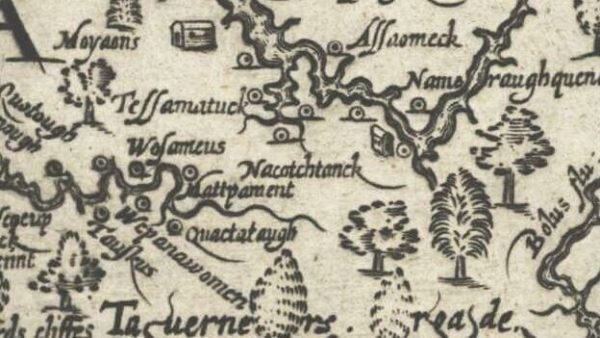
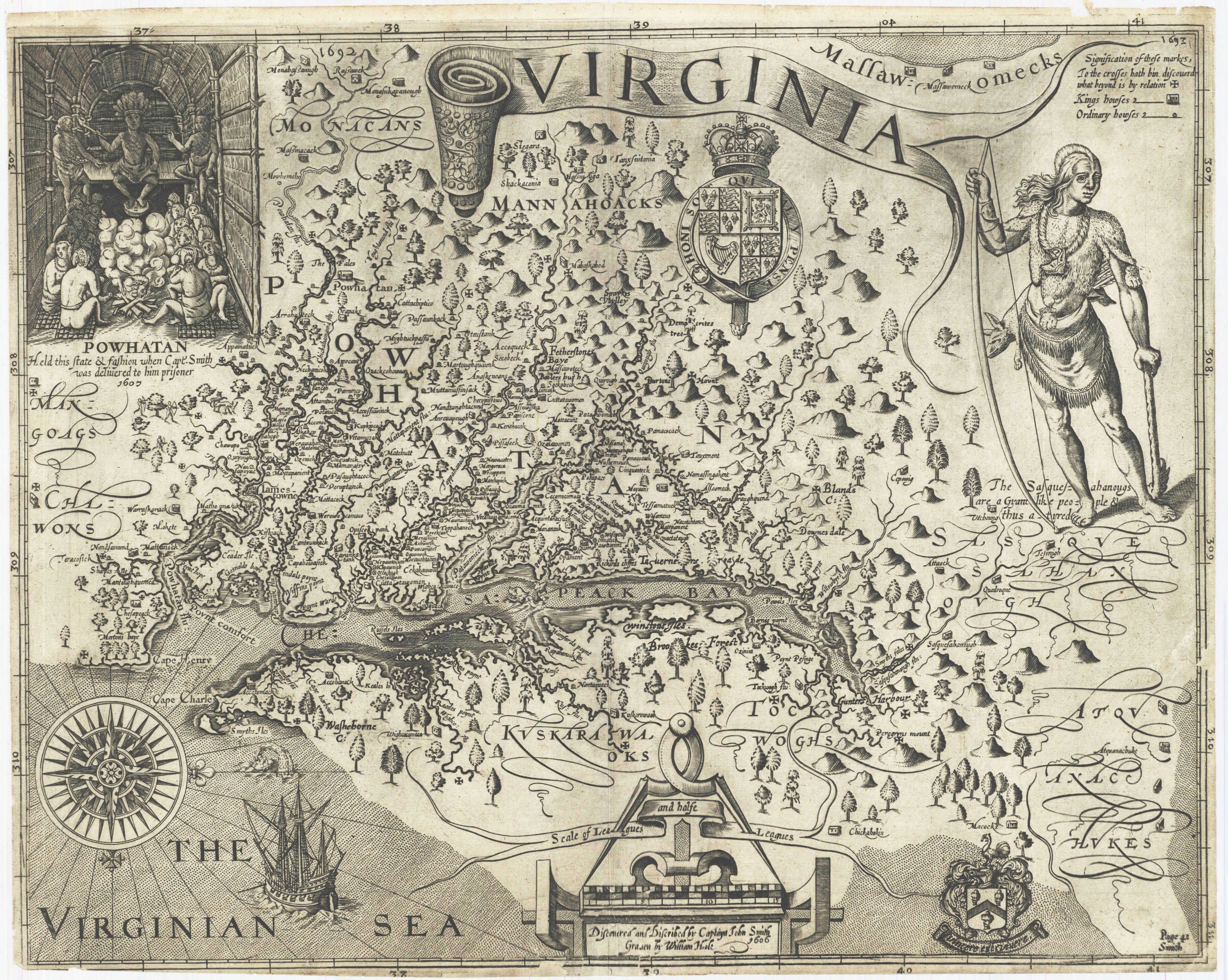
A famous, centuries-old map of the Chesapeake Bay region appears beautiful at first glance, but Anacostia Unmapped contributor John Johnson sees foreboding and destruction. The map, created by Capt. John Smith and first published in 1612, was heavily used by English settlers. It shows a Native American village, Nacotchtank, on the bank of a river. Variations on spelling and pronunciation eventually turned the name of the area — and the river — into Anacostia. The tribe is officially extinct, but a resident of Anacostia, Jason Anderson, tells Johnson about his deep links to it.
The village of Nacotchtank (from which the name Anacostia is derived) was the largest of the three American Indian villages located in the Washington area and is believed to have been a major trading center. The people of Nacotchtank, or Anacostans, were an Algonquian-speaking people that lived along the southeast side of the Anacostia River in the area between today’s Bolling Air Force Base and Anacostia Park, in the floodplain below the eastern-most section of today’s Fort Circle Parks. A second town, Nameroughquena, most likely stood on the Potomac’s west bank, opposite of what today is Theodore Roosevelt Island. Another village existed on a narrow bluff between today’s Chesapeake and Ohio Canal and MacArthur Boulevard in the northwest section of the city.
National Park Service (NPS), “Native Peoples of Washington, DC”
The Anacostans’ name is a Latin version of their original name, the Nacotchtanks. The name came from the Indian word “anaquashatanik,” which means “a town of traders.” They were known for trading throughout the Chesapeake area, even trading fur with the Iroquois of New York.
Museum officials [note] that the Anacostans are mentioned at an exhibit on Native Americans in the Chesapeake Bay area.
Ann McMullen, a supervisory museum curator, said exhibits are designed to “focus on living people and not on Anacostans who have been absorbed into other tribes.” She said the museum works with tribes in the Mid-Atlantic region, including the Pamunkeys and Piscataways, who are “descendants of people who were once here.”
Dana Hedgpeth. “A Native American tribe once called D.C. home. It’s had no living members for centuries: As the number of Anacostans dwindled, they merged with larger tribes in the region.” The Washington Post: Retropolis. November 22, 2018
CURRICULAR OPERATIONS RESEARCH AND PUBLICATION SERVICES
PROVIDED BY The Governor and Company of

A Freely Associated Service Provider, Fiscal Agent, & Member,
FTLU — CES — UA — FLF — DAO
An independent Political Bureau of Education (Politburo), Free Association of Independent Politburos (FAIP), Commissioned and Charted, General Ministry of Information, FTLU

(last modified 21 Nov. 2023; 2 Jan. 2024 when were stricken the words “The Preceptor & Student Body of the Consular Syndicate of” and replaced with “The Preceptory of”; 15 Feb. 2024 as to multiple changes.)
D.R. 01-06: FPPM, &c.

Volume 1, Issue 6
CONTENTS — ART. 1. FIDES PUBLICA… — ART. 2. WATER THEORY 2ND
Article 1
Fides Publica Populi Mauretani
By Antarah Crawley
NACOTCHTANK, OD — The Village of Nacotchtank on Potomac (River Valley) Eastern Branch, Ouachita District, Northwest Gate, Al Moroc, which is called “Anacostia, Washington, District of Columbia, United States of America (U.S.A.)” is an internationally sovereign federal city-state which is not a member of the union of states of North America, but like unto the city of Rome’s political and administrative successor, the Vatican City (which pretends to be the Body of Christ, or Universal Church) or the City of London (the one-square-mile ancient Roman trade capital Londinium).
Note that “Ouachita” is composed of the Choctaw words ouac meaning “buffalo” and chito meaning “large,” together meaning “country of large buffaloes” (Louis R. Harlan, 1834). It may also come from the French transliteration of the Caddo word washita meaning “good hunting grounds.” Ouachita is often miswritten as Washitaw and Washington, which, notably, also comes from the name wassa, “hunting,” + the locative suffix -thn, “settlement” (Kimberly Powell, 2019). It may be deduced that the Roman method is to add to the indigenous name of a place or people a corresponding Latin name, or to simply adopt the indigenous name into Roman usage. We may assert that the “land of the large buffalo” extends from the Eastern Sea Board to the Western Sea Board of the land mass Northwest of the prime meridian.
The descendants of the indigenous people of the earth (“marked” with melanated skin) who are moored on the Northwest land mass have current vested international treaty rights with the resident colonial government (U.S.A.) by and through His Majesty the Sultan of Morocco (and by decision of Chief Justice Taney that such persons could not be citizens of the USA, See Dred Scott v. Sanford). They are, in effect, hereditary blood nationals of the Kingdom of Morocco (the modern-day successor of the ancient Roman Province of Mauretania), having civil rights as Romans born within the resident colonial government (U.S.A.), but retaining God-given birthright as ministers and consuls in the lineage of the ancients who crossed from East Africa to West Africa upon the proliferation of the Hyksos-Canaanite-Greco-Roman civilization in Egypt which was anticipated to colonize the world over. The Memphite Pharaohcy which departed west from Egypt after the 25th Dynasty gradually divided into the isolationist Dogon village of Mali, and the progressively-Arabized Berber tribes in the Roman province of Mauretania (the future Moorish Empire), the latter of which remains the rightful heir to the world’s waterways from the ancient Nubians who sailed down the Nile to Men Nefer in antiquity.
It is only by and through this Afro-Roman Moroccan-American treaty that Europe and U.S.A. have a charter right to trade on the world’s waterways. This treaty, as a document, speaks for itself, is in perpetual effect, and need not require any other authority to effect its purpose, being to establish international trust relations between the sovereign African descendants (moors, called “Moroccans”) and the children of the Diaspora (“dispersions of the spirit of Ra”). Therefore the title of “moor” is a hereditary title of consular nobility and the birthright inheritance of people of indigenous and African descent living in Crown estates, which include the Unites States of America. It was the prerogative of Templar-backed mercantile pirates operating under illuminated charters to prevent the moor from ever learning this information.
CONSUL (International Law): An officer of a commercial character, appointed by the different states to watch over the mercantile interests of the appointing state and of its subjects in foreign countries. There are usually a number of consuls in every maritime country, and they are usually subject to a chief consul, who is called a “consul general.” Schunior v. Russell, 18 S.W. 484, 83 Tex. 83. (Source: Al Moroccan Empire Consulate at New Jersey state republic, https://treatyrights.org/about-us/)
Note that “states“ are to the United States as “peoples and nations” are to the Roman Empire. However the “nations” are provincial members of the Empire. Whereas Rome constituted a martial federal government, its “citizens” were soldiers (which could be interpreted to mean “employee” in the modern sense) who were organized into classes by heredity and performance. The function of the federal empire was and is the mobilization of troops (police power) and the collection of taxes (power of the purse); all administrative divisions of estates (people, land, and stock) were and are to that end. Therefore, the essential character of this Empire is mercantile and missionary.
Praetors, or counsels, may be interpreted to mean “officer of the law” or “officer of the court” in the modern sense. They are a class of administrative officers akin to tribunes (representatives of the people or soldiers), magistrates (representatives of the state), senators (representatives of the landed gentry), and governors (administrative heads of state). Ancient Roman social classes, which also pertain to military rank, include plebeians and proletarii (the working class tax-payer, whose labor power is their only possession of significant economic value), landed equities and equities publicani (the “equestrian” class, who originally constituted the Roman cavalry as commissioned knights, whose economic holdings were second only to the patrician class, and who were engaged in tax farming/collecting and eventually money-lending/changing), and patricians (the hereditary land-holding aristocracy). A civil diocese is a regional grouping of provinces administered or managed by a vicarius, these numbering 12 or 14 in the whole Empire. The Department of Information Systems and Intelligence Services (DISIS) serves as the diocese of N∴S∴.
See, Officuim Tribunus Plebis.
(last modified 13 Oct 2023 18 Oct 2023 23 Oct 2023)
Article 2
2nd Amendment to “Water Theory of Capital”
by Antarah Crawley
At Art¢oin:\>_Theory and Methodology\Water Theory of Capital:\>_1st Amendment, add:
4.0.0. Cash is money in coins or notes, as distinct from checks, money orders, or credit. Cache is a collection of items stored in a hidden or inaccessible place, usually for high-speed retrieval on demand.
4.1.0. Cash is to negotiable instruments (NIs) as cache is to a computer’s memory; that is, the cash is more fungible, movable, and/or liquid than the NIs, as the cache is a rapid-retrieval database. Cached data is rapidly drawn from memory, as cash is readily withdrawn from banks.
4.2.0. To write a note, you draw it up on the principle that it be paid down; and if you default on your note then you will go under the water and drown.
5.0.0. We pay bills with unpayable bills. A bill on the public side is a note on the private, hence dollar bills are Federal Reserve System (Fed) notes.
5.1.0. Unpayable bills are drawn up on the principal of the People’s landed estates. The People’s representatives pass these bills through acts of Congress. The People’s estate is assessed and taxed every year by the People’s government in the form of IOUs (notes) to the People.
5.2.0. The IOU notes underwritten by the government with the People’s Treasury securities are issued, held, and ordered by the Fed pursuant to Act of Congress. Therefore the government owes the holders of the notes the interest on their due value, which is secured by the People’s estate, and the government then takes the estate tax to pay the interest on the Treasury bonds held by the Fed’s shareholders.
5.3.0. The separate and distinct venues of public and private obligate the users of these notes to repay the tax (or premium) to the underwriter to pay interest to its bondholders each time a note is exchanged. Thus, IOUs secured by the estate of the People circulate from the People’s extension of credit to the public venue and back into the private venues of persons which are held in “public” or “national” coffers which are in fact private Fed-member banks.
5.4.0. Why then do the People pay the interest on the government’s invoices which are withdrawn before payment and then billed to us, creating a $33 trillion+ deficit in our name? Who then, in fact, is the beneficiary of this trust agreement, and who is the trustee? Who then repays the grantor of the estate (the People), and what then is the maturity date of the securities?
(last modified 13 Oct 2023)
 Supreme Exchange