Tagged: education
UA:\>_

WELCOME
To the “Self-Teaching University”
of the Decentralized Autonomous Organization (DAO),
House of Studies, 153d CORPS
Political Bureau of Education
Novus Syllabus Seclorum
(“New Syllabus of the Age”)
CONTENTS
Courses 1-12: [Legacy System]
Course 13: Islam II
Course 14: Thoth Club

Course 13:
Islam II
Module A
On 4 November 2023, I, Antarah, Founder of Novus Syllabus Seclorum, Governor of NOVUS SYLLABUS L.L.C., and Grand Preceptor of the Universitas Autodidactus of the decentralized autonomous organization (DAO) of the conscious and God-fearing people of the world, by the grace of God, had the pleasure of meeting Ms. Azra Kulic, a Bosnian muslim woman living in Michigan, U.S.A., who thereupon instructed me in certain information, offered unto me an English-language copy of the interpretation of the Noble Quran, a thin book entitled A Brief Illustrated Guide to Understanding Islam, and her own research essay entitled The Most Essential Research. I said unto her, with great excitement, that our meeting was verily an inaugural gathering of the UA International. Thereafter Ms. Kulic has continued to send me information and inspired me to study Islam, thereby becoming my Preceptor in these matters. Verily, I bore witness to the fact that there is no one worthy of worship but God (Allah) and that Muhammad (PBUH) is His servant and Messenger (Shadadah).
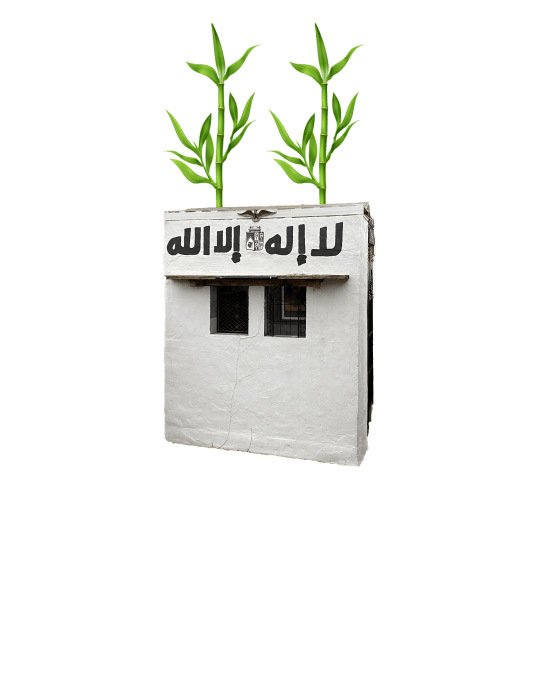
أَشْهَدُ أَنْ لَا إِلَٰهَ إِلَّا ٱللَّٰهُ وَأَشْهَدُ أَنَّ مُحَمَّدًا رَسُولُ ٱللَّٰهِ
ašhadu ʾan lā ʾilāha ʾilla -llāhu, wa-ʾašhadu ʾanna muḥammadan rasūlu -llāh
“I bear witness that there is no deity but God, and I bear witness that Muhammad is the Messenger of God.”
Some of the information she has sent me is presented below for the benefit of the Student of the UA.
Azra Kulic Media Spots
Aired 2/4-2/18/2024 on Grand Rapids
cable access television (GRTV)
Additional Resources:
Curated by Azra Kulic
Course 14:
Thoth Club Book Club
Module A
COMES NOW the Most Excellent Student Preceptor, Jona Monet W., an original member of the New Syllabus Mystery School (NSMS) of Washington, D.C.*, and to present a course of self-instruction in the nature of a book club. Talib Jona says, “My goal is to nation build, but to do that, we have to raise our consciousness, and a lot of times it means unlearning what we thought we knew.” She also announces, “I will go live at 11:11pm Wednesdays + Sundays as often as possible.”
The first reading of Thoth Club as of 1 January 2024 is As A Man Thinketh by James Allen.
*To wit:
See, Curriculum:\>Title 24:\>N.S.C.\CHAPTER 49. BLOCK 8: NEW SYLLABUS MYSTERY SCHOOL: DC LOCAL CHAPTER (2017) New Syllabus Mail - New Syllabus Mystery School: DC Local Chapter (Email chain dated Sun, Mar 5, 2017 at 8:37 PM)
[...]
 1. Charter. This email is to confirm that We chartered the Washington, D.C. Local Chapter of the New Syllabus Mystery School on 5 March 2017 at about 4:30pm.
 2. Founding Members of DC Local. Those who were present to pass the motion were M... W..., K... "N..." R..., R... H..., Jona Monet, N... "S..." B..., and M... K..., as Signed 3/1 and 3/5 in the Feb 2017 Signatory Record. These members as well as NS Director A... C... comprise the Body-politic of the Local DC-NSMS.
 3. Chartering Committee. M... W... and K... "N..." R... coordinated the committee, which, after deliberation of all members, consigned to engage in the business of organizing the conscious young black community ("Kham-Unity") under the Organizational name of the New Syllabus, which Organization until then had been solely directed in DC by [myself] A... C....
[...]
Explore more resources with U∴A∴:\>_


Supreme Exchange
Information
Navigate the Universitas Autodidactus Collegium N∴S∴
Curricular Operations Research & Publication Services
Provided by the Governor and Company of:

Free Association
D.R. 01-01: To Publish…, &c.

Volume 1, Issue 1
CONTENTS — ART. 1. N∴S∴ TO PUBLISH ART BOOK… — ART. 2. ORGANIZATION OF N∴S∴
Article 1
N∴S∴ to publish art book for IBé Arts Institute
By Antarah Crawley

WASHINGTON, DC — IBé Arts Institute of Historic City Point in Hopewell, VA, has partnered with NOVUS SYLLABUS L.L.C. (N∴S∴) to publish the first artist’s book cataloging the work of master teaching artist and storyteller IBé Bulinda Hereford Crawley.

New Syllabus Director Antarah Crawley and IBé Crawley have maintained an arts education partnership since September of 2016, when the New Syllabus relocated from New York to DC. At about that time, IBé Arts and Education LLC was established in Historic Anacostia, Washington, DC. Together, IBé Crawley and the Director have published the SSTEM curriculum and the ParenTeacher program.
The opportunity to publish IBé Crawley’s first artist’s book presents a great opportunity for N∴S∴ to communicate its overarching mission, vision, and values through its commitment to honoring our elders and ancestors, and amplifying the voices of Black Woman artists.

The IBé Arts Institute is an art space dedicated to visual and oral storytelling. The historically significant building was built in 1830 as a schoolhouse for white men, and later used as a hospital for soldiers during the Civil War.
Today, it serves as IBé Crawley’s private studio gallery and workshop. Consistent with the mission to preserve and document stories, the exhibition hall, art studios, and residency space are available for individuals to host workshops, family events, and professional development programs. IBé Crawley assists in planning preservation projects and leads intimate and informative tours of the Institute and the surrounding City Point Historic District.
Contact ibe.crawley@gmail.com or visit ibearts.org for more information and to coordinate an event.

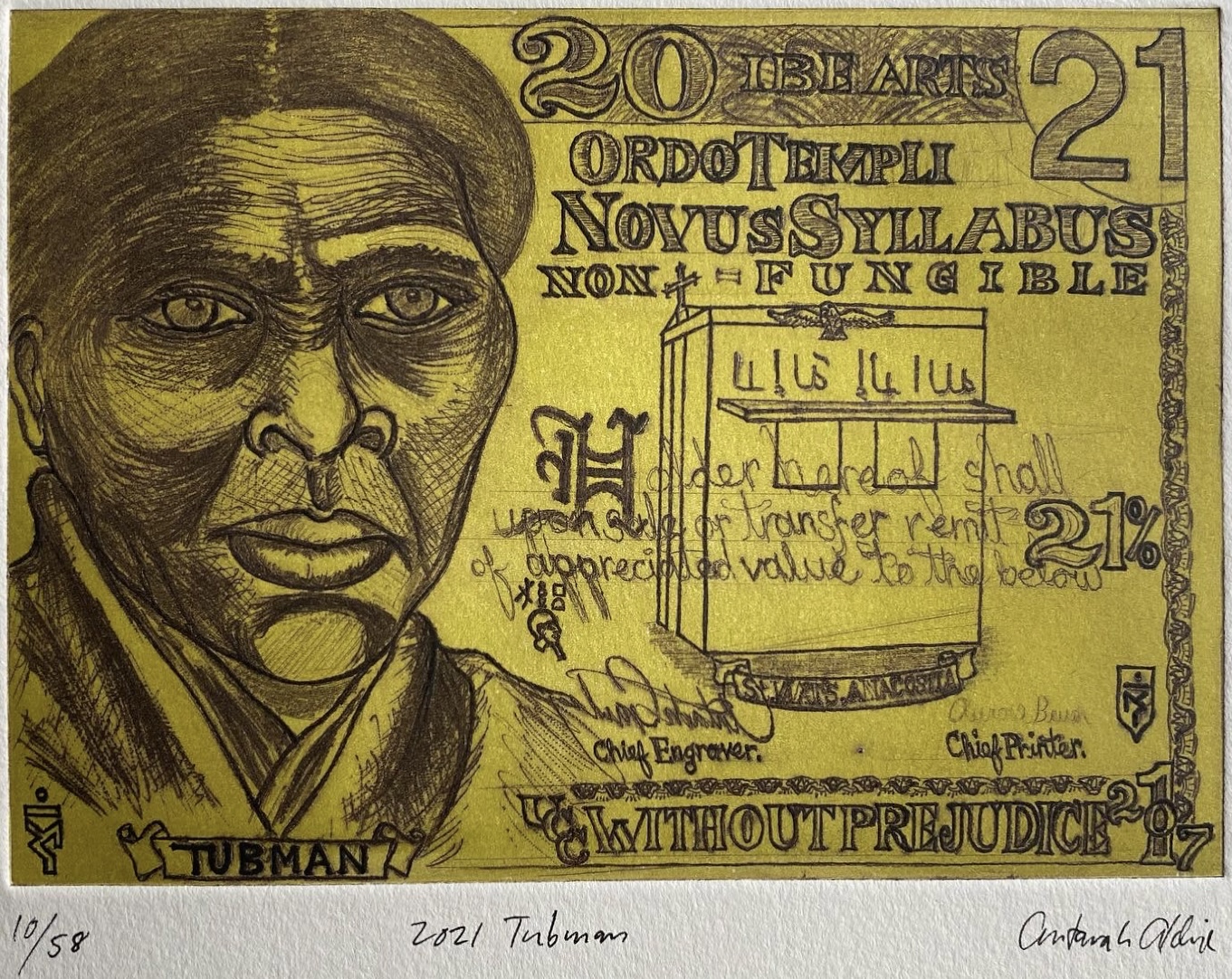
In 2022, IBé Crawley printed a 58-copy edition of Antarah Crawley’s Harriet Tubman 2021 Non-Fungible Note from a copper plate he engraved by hand. Printer Aurora Brush assisted IBé Crawley in the intaglio printing process during her residency at the Women’s Studio Workshop (WSW) in Rosendale, New York.
The IBé Crawley publication will coincide with the 2023 fall exhibitions Holding Ground at the National Museum of Women in the Arts’s (NMWA) in Washington, DC, and The Calling at City Lore in New York City. Within its pages will be catalogued four of Crawley’s artist’s books: 11033, Delia Posey, Bearing Witness, and A Dwelling for Her Story. Each chapter will present a different category of art work, together with descriptions, articles, quotes, and images.
Into Fall 2023 and beyond, IBé Arts Institute will strategically focus on:
- Paper making
- Print making
- Book binding
IBé Arts Institute aspires to become a Virginia folk book press “center of excellence”. This is the first initiative in what the Institute and N∴S∴ plan to be a bright new era of programs, projects, and partnerships.

Article 2
The Organization of the New Syllabus
By Antarah Crawley
1. HISTORY
WASHINGTON, DC — In 2014 AD, I, Antarah, had a vision of one new syllabus for humanity. This syllabus would chart a course for human understanding of ubiquitous and lasting systems established since time immemorial. I sojourned to Brooklyn, New York, in pursuit of my syllabus, developed a discipline, and professed a doctrine toward the development and operation of human mind software, individually and collectively, and I returned to the Federal City.
Being in possession of such valuable information, I began to process this knowledge and offer certain products and services to the public, toward the establishment of a society of free thinkers, truth speakers, and light workers united (FTLU) in a firm league of friendship called a decentralized autonomous organization (FLF-DAO). To that end, I wrote and recommend policy positions to the FTLU stakeholders. This practice has resulted in the production of a robust and diverse body of multimedia intellectual property which we, the Director and Company, shall distribute throughout the world under the motto of Novus Syllabus Seclorum, meaning “the New Syllabus of the Age.”
2. ORGANIZATION
Established 2022, NOVUS SYLLABUS L.L.C. (N∴S∴) is a liberal arts and humanities intellectual property holding company specializing in diversified arts investments and management.
Our flagship brand, New Syllabus (est. 2014), is a knowledge management system (KMS) that creates, codifies, organizes, stores, and disseminates information to the public from newsyllabus.org. To that end, it conducts research and development in the broad field of Historic and Ancient Mysteries, Economy, Theology, Informatics, and Systemtheorie (HAMETICS).
N∴S∴ operates the Department of Information Systems and Intelligence Services (DISIS, pronounced “Diocese”), which is divided into the Archival Records Management (ARM) Division and the Mind Software (Mindsoft) Development and Operating Systems Command (DOSCOM). These are our Curricular Operations, Research, and Publication Services (CORPS) which supply information to the New Syllabus (now known as the DataHorse System or “DHS“).
N∴S∴ also operates the Ombud Service Bureau (OmbudService, or Office of Ombudsman) for administrative due process, and Syllabus Media Group for audiovisual production and distribution.
3. VISION
Our Vision is a world of free thinkers, truth speakers, and light workers united under one new syllabus for STEM, arts, and humanities research, development and operations; one new syllabus for the ages!
4. VALUES
Our Values are Love, Truth, Peace, Freedom, and Equity; these are our foundation. Our Three Great Pillars which support our institution are Trust, Faith, and Belief; as it is said, Faith is complete Trust and firm Belief, the acceptance of truth divine, which Belief, sincerely held, cannot be converted into a crime.
5. MISSION
Our mission is to reveal truths which have been hidden and to keep a record of knowledge and wisdom.
N∴S∴ conducts, manages, and supports curriculum research and development. We represents FTLU through its Office of Ombudsman. We administer intellectual property and copyrights as custodial superintendent for their creator.
Our mission-oriented service lines are:
- DISIS (now DHS) for recordkeeping and CORPS operations
- Mindsoft for cognitive, behavioral, and professional development
- OmbudService for administrative operations
- Other operations (OPS) include Granary Bank & Trust/Artcoin Mint of Meriptah, New Works Projects Administration, St. Nat’s/O∴T∴N∴S∴, FTLU, FLF-DAO, and the Syllabus Free Press.
(Last modified 20 Sep 2023 4 Oct 2023 13 Oct 2023)
© MMXXIII by NOVUS SYLLABUS L.L.C.
ALL RIGHTS RESERVED WITHOUT PREJUDICE.
English Syllabus
AN ENGLISH SYLLABUS
“…to obtain power over any given material one need only understand the causal laws to which it is subject.”
—Bertrand Russell, as quoted in Cleanth and Brooks’ “Introduction,” Understanding Poetry, p. 191
The following paper represents the Author’s second attempt to convey the Occult Systems at work in Literary Theory as presented in the Course of Professor Antonio Lopez’s design, commenced and completed in Fall 2015 at The George Washington University. The initial mission of the Author in his commencement of the Course, being to illuminate the god-workings of author and the textual manifestation of its will as perceived by eye & I via a Cabalistic pattern, was poorly embodied in the First Paper; it was much too Occult and not Disciplined enough in the ways demanded by Academic Literary Theory as a school (i.e., it did not accurately enough translate its esoteric significance into academic vocabulary as we have been learning it). The Author remains of the opinion that Occult working are not only present in the Theory, but inherently warranted in their exposition due to the practical way that they (to say “it”: the Cabala) structures this and every other discipline, like a skeleton to a body, or a syllabus to a school. The present paper will more pointedly align the texts of the syllabus of the Course along the ancient Cabalistic pathway to unveil the (con)text-to-author / human-to-god / matter-to-spirit / solid-to-ethereal / being-to-nothingness / condition-to-absolute / phenom-to-nous relationship inherent in all disciplines. The author has had success applying the Cabalistic pathway to various real-world systems—even to those as dry and bureaucratic as the New York City Department of Health—and herein wishes to apply this pattern again to the present system of Literary Theory, with text being at the bottom of the system, being the densest, most matter-full, and author (or writing, the act) being at the very top, the crown, the most ineffable, the most ethereal; and with “meaning” as an absolute pool, encompassing the whole system, we shall elucidate the metaphysical condensation which takes place when the absolution of uniform universal meaning is channeled through an author whose creative process begets a text of new form and invention: a literary text.
A brief priming in the Cabala is required. Without the use of visuals, we may structure the Pattern in a 3-by-7 grid, also a matrix. The matrix describes the relationship of numbers, themselves beholden of certain values. Row 0: 000; Row 1: 010; Row 2: 302; Row 3: 504; Row 4: 060; Row 5: 807; Row 6: 090; Row 7: 010. The 7th Row is naturally the bottom, the 0 Row the Absolute above the peak, Row 1. The 7th Row is matter; the 0 Row absolute spirit. All elements of the disciplines may be plotted on this graph. Below we will examine where the theories within the texts of the Course’s syllabus fall along these coordinates. In our present application, Row 7 represents apprehending the literary act through its evidence in physical text and Row 1 represents the apprehension of the literary act through the act of writing out the text, mediating the absolute spirit of “meaning” through the I / 1 / eye of the author / the point of the pen / into the solidity of text, which in turn (“as above so below”) represents the 0 plane of absolute meaning married to the 1 plane of the authorial ego: together being “10”. To use the eye / I to guide the text from the 7th to the 1st Row (which is to undo the “10” into the “1” and, ultimately, the “0”) is called reading. The numerical spectrum which lies between the 10 and the 0 is arranged according to proximity between matter and spirit, or, here, text and meaning; below, the examination of each “number,” or “emanation,” [Hebrew: sephirah] of meaning will correspond to a text in our Course’s syllabus.
Herein I am not performing reading to support evidence, neither exploiting evidence to support theories (as they have been presented in the Course), but using theories to support Science: the Occult Systems at work in all. Let it be reiterated that Occult Science, the here-defined Undiscipline of Disciplines, or that system which may undiscipline other disciplines to illuminate their commonality, is a malleable application-based System which is as (and more) useful to Academic Critical Theory as Marxist, Feminist, Neo-Colonial, Crip, Queer, or any other application-based theory.
The Cabala may be apprehended, as a structure, through the similar diagram of I. A. Richards’ design, as explained in his “The Analysis of a Poem”. To preface its design, and to explain its need, Richards says “The critic is, throughout, judging of experiences, of states of mind; but too often he is needlessly ignorant of the general […] form of the experiences with which he is concerned. He has no clear ideas as to the elements present or as to their relative importance. Thus, an outline or schema of the mental events which make up the experience of … ‘reading’ a poem, can be of great assistance” (The Lyric Theory Reader, 166). This author is of the same opinion, except that where psychology is employed as the backbone of critical judgement (at the ellipses), this author generalizes the pattern to an Occult one, but it is beholden of the same characteristics; as where a New Criticism was founded upon Richards’ system, so a New Syllabus is erected upon the Occult Systems.
The diagram on page 167 of the Lyric Theory Reader is remarkable, not merely for its simplicity and practicality in visually representing and alining the elements of reading for the education of the new student, but also in its striking resemblance to the ancient Cabalistic pattern of spirit-to-matter manifestation. Richard’s diagram is composed of the words “Arcadia, Night, a Cloud, Pan, and the Moon” being each drawn together by individual lines which taper, or condense, into the center of an eye, from which the same number of lines expand outward and cascade down a six-fold plane. Several things must be observed here. (1) The list forms the base of an inverted triangle whose peak lies at the eye (note all connotations: eyes see, I see, I, 1, phallic, ego, exterior-to-interior transitions); (2) The eye also forms the peak of a triangle which descends unto the six-fold pattern which is its base and earth and depth [note that the Cabalistic pattern contains three triangles, only the highest being upright, the lower two being inverted and pointing to “10,” the earth]; (3) The eye, or the ego, represents a singularity, such as that which lies within a scientific black hole, wherein matter in condensed unto one [1] ultimate point from which it then manifests anew on a different plane of existence: herein the information of text is shown to be being consumed by the eye and regenerated on the interior of the mental landscape, which is the six-fold pattern; (4) Richards’ design can be read Cabalistically both backwards and forwards: “Arcadia, Night, a Cloud, Pan, and the Moon” is the absolute abstract “meaning” at Row 0 being drawn and condensed into the eye (the I) (the 1) at Row 1 and manifested on the subsequent six descending planes unto the base level of text—and it is also the surface of the text, the 10, the base, the words themselves, which are then siphoned by the eye of the reading ego into the system which ascends the number line unto the 000 plane of that text’s absolute meaning. In either design, Richards and Cabala each maintain one absolute plane and seven planes of manifestation, of which one is a 1 / I / eye / subjective ego: first manifestation of differentiation and numerical progression, i.e. time. Richards’ planes are designated {by row number: [mine (his)]}: [0 (0)] “Arcadia, Night, a Cloud, Pan, and the Moon”; [1 (unnumbered)] eye; [2 (1)] visual sensations; [3 (2)] tied imagery; [4 (3)] free imagery; [5 (4)] references; [6 (5)] emotions; [7 (6)] attitudes. The Cabalisitc planes and their syllabic correspondences are listed further below.
Richards later, in “The Definition of a Poem,” defines that structure as “a class of experiences which do not differ in any character more than a certain amount, varying for each character, from a standard experience” (176). He later defines the “standard experience” as that of the poet in the completion of the composition; the text of the composition being merely the evidence that the experience was had, what form in which it was experienced, and those qualities of form which will lend the experience to others as readers reëxperiencing the event. Therefore, within the parameters of this spectrum, the base-matter 7-plane of the poem is the form which the event (to be subjectively experienced by the reader) is conveyed in, the phenomenal evidence of it, and the high-ineffable 1-plane is the “standard,” or perfect, or absolute, experience of it, as aggregated form the multitude of experiences which it may inform, the whole of these being called “meaning,” or, in Occult terms, God.
Row 7 [010] is matter, is text, and in theory is understanding the text at the level of its words alone, the evidence of its manifestation alone, without considering the elementary composition or the etymology or the depth or the implications thereof. The text of our Course which most exactly emulates this nature is Stephen Best and Sharon Marcus’s Surface Reading: An Introduction. Row 7 lies upon the plane of solid matter and is most dense, sitting upon the surface of the earth while on high Row 1 rests ethereal in the heavens. Similarly, Best and Marcus’s theory only accounts for the surface of text, considering the excavation of deep-rooted meaning a fallacy, or, at the very least, unnecessary to good criticism. They first align themselves with Fredric Jameson’s conceit upon Symptomatic Reading that “interpretation should … seek ‘a latent meaning behind a manifest one’” (3) which is as well the Occult thesis; but then they depart on the basis that latent meaning may be apparent from the gaps in the surface of the matter of the text, and thus requires no probing as is required herein. This is fallacious as it assumes that what the text does not say may be glimpsed from a surface observation of it, but requires no investigation of those hollow depths to make use of them. Surface is thus rendered to mean what is “evident, perceptible, apprehensible in texts; what is neither hidden nor hiding”; surface as “materiality”; surface as “intricate verbal structure”; surface as the “location of patterns…within and across texts”, to say that this theory of reading looks for patterns “in order to break free of and reach beyond them to a deep truth too abstract to be visible or even locatable in a single text” (9-11). Symptomatic Surface Reading thus advocates for a look at the superficial aggregate of many texts rather than a probing investigation of the esoterism in one to evoke deep meaning via a critical system. Not only is this oxymoronic due to the desire of these theorists to evoke depth solely from the surface, but it pointedly ignores the obvious nature of every singular text to span the spectrum from matter to spirit, from text to the highest depths of absolute meaning. Remaining in the realm of that which is obvious and perceptible may lay plain the landscape but excavate nothing that cannot be better excavated by localized plumbing. And so in the base-10-kingdom of matter, we either choose to plumb the depths and perhaps risk intention fallacy on part of some divine persona (which we feel to know to exist, and must thus delve in search of) or remain on the surface of matter and merely describe, account, aggregate, accurately, as like a computer. This latter method is all well and good should the reader will to remain in the Kingdom of earth, but we as critics will to ascend up to the heights of absolute meaning, and so remaining upon the Surface will serve us unwell. If surface is “materiality,” then materiality is merely the evidence of deeper Cause which must be excavated to understand the result in any scientific way. The surface of the text should be used to obtain a foundation for summiting the system of literary meaning.
Row 6 [090] is the foundation of ascension from text unto absolute meaning. Since the foundation lies securely upon the surface, the 6th Row accounts for the generative nature of the text proper, i.e., how the physical word is able to conjure in the mind impressions of some other reality. The methods of apprehension inherent in this practice are best represented in our New Criticism readings, foregoing Richards since his model serves as an analogue to our present one. The latter New Critics (specifically, for our purposes, T.S. Eliot, Cleanth Brooks, and Robert Penn Warren) used Richards’ model to imperfect affect as they vehemently crusaded against Intentional Fallacy and insisted on apprehending the text at the level of its impressions and sensations upon the reader. This focus on the text as matter—as syntax, word choice, meter/rhythm patterns, etc. (not much better than the Surface Critics)–emphasizes the bottom of the Cabalistic Pattern, the 6, 7, 8, 9, and 10, or the 4th, 5th, 6th, and 7th Rows, at the expense of the higher cognitive will and mercy and the trinity of consciousness of the god-author persona at the higher Rows of the pattern. Therefore New Criticism lies at the Foundation-9 of the Occult methodology in terms of its mission to illuminate the base-10 of text with the major comprehensive faculties of the 8-intellect and 9-emotion and spans up to the Harmonious-6, but ascends no further than that. But what furthermore entrenches New Criticism at the Foundation of a Cabalistic Interpretation of Literary Theory is its concern with the scientific method of reading and criticizing. While “the language of science represents an extreme degree of specialization of language in the direction of a certain kind of precision,” it must “forego, because of its methods, matters of attitude and interpretation,” matters with which literature is consumed (Cleanth and Brooks, 179); it thus became the necessity of New Critics to impose a scientific methodology of provable interpretation of subjective feelings as based on objective and concrete textual evidence of syntax, meter, etc. In this way they have already begun the work of the Occult Science; similarly as texts are mapped from their form to their impression upon the mind, Occult Science is primarily concerned with mapping the relationship between that which we can perceive (phenomena, matter) to that which we cannot perceive (noumenon, spirit) in the evocation of an objective system of interpretation. Furthermore is it useful to note that Cleanth and Brooks write, “both the impulse and methods of poetry are rooted very deep in human experience, and that formal poetry itself represents, not a distinction from, but a specialization of, thoroughly universal habits of human thinking and feeling” (182). Note the emphasis on depth, and the necessary departure from surface reading via this New Critical Methodology unto the submerged, esoteric, systems of relation. Note also the emphasis upon poetry’s ability to convey, or to conduct, “universal habits” of humanity into unique form; this represents the transition from an Occult absolute meaning of consciousness to its apparent manifestation in form via author. Text, just as Earth, is the result of Divine Cognizance, which is the Cause, the Pattern being the means, or, the methodology. New Critics imply the objectivity of the result without accounting for the Cause; thus necessitating further investigation through the Pattern.

