Tagged: subcommitte
Commission 153
NACOTCHTANK’S
153d CORPS
“The Fighting 153d”
REGULAR MEETING
بيت مدرسة
בית מדרש
The Preceptory of
The 1st Ecclesiastic College at
Nacotchtank, Ouachita District
5th International Worker’s Association
& 3rd Wave Anti-Masonic Party (TWAP)
Curricular Operations Research & Publications Services (CORPS)
Division of the Political Bureau of Education (Politburo), FLF-DAO
The Governor of the Society of the New Syllabus (N∴S∴) at Nacotchtank-on-Potomac (Anacostia) District of Ouachita (Washington, District of Columbia), Furthest West (al-Maghreb al-Aqsa) To All To Whom These Presents Come, Sends Greeting and Peace:—
Know ye by these presents that there is a decentralized autonomous organization (DAO) of people, in the nature of firm league of friendship (FLF), which is engaged in the business of self-education, -operation, and -development (Autodidactus), and that this society (Universitas) is organized into associations (Collegia) constituted by assemblies (Ecclesia) committed to certain trades or subject matters (Syndici). These committees, or syndicates, may be constituted in the nature of a public or private meeting, sitting, session, hearing, congress, congregation of worshippers, or other deliberative or collective body having a shared interest (polity). The individual members, or units, of this DAO shall be working people — free thinkers, truth speakers, and light workers united (FTLU) by the collective consciousness and love of their neighbor. Any individual may rise through the ranks of the DAO by acclamation of their polity. Any unit of the DAO may order services from a known service provider, meaning a freely associated firm who is known to supply the DAO, in a client-server—request-response interface.
(b) And Furthermore, that there is hereby established an ecclesiastic college (meaning, assembly of a society) of the members of the DAO who are domiciled in this region, which shall sit and meet in Nacotchtank, and which is empowered to commission syndicates for various purposes.

Notes on Jurisdiction
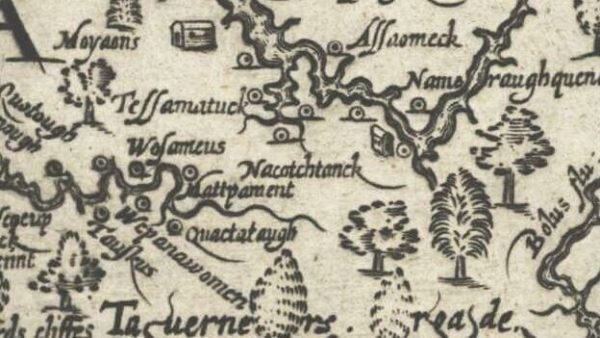
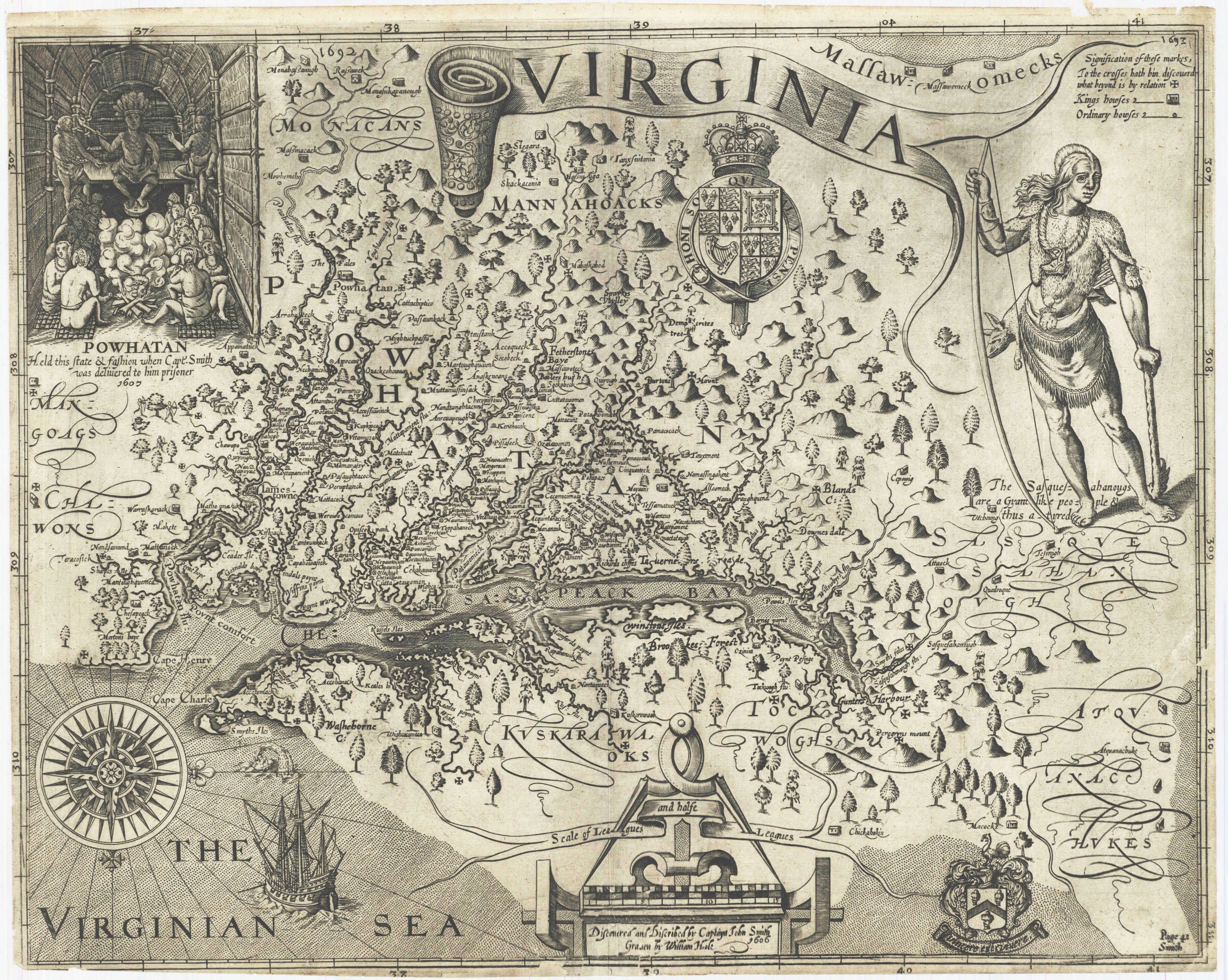
A famous, centuries-old map of the Chesapeake Bay region appears beautiful at first glance, but Anacostia Unmapped contributor John Johnson sees foreboding and destruction. The map, created by Capt. John Smith and first published in 1612, was heavily used by English settlers. It shows a Native American village, Nacotchtank, on the bank of a river. Variations on spelling and pronunciation eventually turned the name of the area — and the river — into Anacostia. The tribe is officially extinct, but a resident of Anacostia, Jason Anderson, tells Johnson about his deep links to it.
The village of Nacotchtank (from which the name Anacostia is derived) was the largest of the three American Indian villages located in the Washington area and is believed to have been a major trading center. The people of Nacotchtank, or Anacostans, were an Algonquian-speaking people that lived along the southeast side of the Anacostia River in the area between today’s Bolling Air Force Base and Anacostia Park, in the floodplain below the eastern-most section of today’s Fort Circle Parks. A second town, Nameroughquena, most likely stood on the Potomac’s west bank, opposite of what today is Theodore Roosevelt Island. Another village existed on a narrow bluff between today’s Chesapeake and Ohio Canal and MacArthur Boulevard in the northwest section of the city.
National Park Service (NPS), “Native Peoples of Washington, DC”
The Anacostans’ name is a Latin version of their original name, the Nacotchtanks. The name came from the Indian word “anaquashatanik,” which means “a town of traders.” They were known for trading throughout the Chesapeake area, even trading fur with the Iroquois of New York.
Museum officials [note] that the Anacostans are mentioned at an exhibit on Native Americans in the Chesapeake Bay area.
Ann McMullen, a supervisory museum curator, said exhibits are designed to “focus on living people and not on Anacostans who have been absorbed into other tribes.” She said the museum works with tribes in the Mid-Atlantic region, including the Pamunkeys and Piscataways, who are “descendants of people who were once here.”
Dana Hedgpeth. “A Native American tribe once called D.C. home. It’s had no living members for centuries: As the number of Anacostans dwindled, they merged with larger tribes in the region.” The Washington Post: Retropolis. November 22, 2018
CURRICULAR OPERATIONS RESEARCH AND PUBLICATION SERVICES
PROVIDED BY The Governor and Company of

A Freely Associated Service Provider, Fiscal Agent, & Member,
FTLU — CES — UA — FLF — DAO
An independent Political Bureau of Education (Politburo), Free Association of Independent Politburos (FAIP), Commissioned and Charted, General Ministry of Information, FTLU
(last modified 21 Nov. 2023; 2 Jan. 2024 when were stricken the words “The Preceptor & Student Body of the Consular Syndicate of” and replaced with “The Preceptory of”; 15 Feb. 2024 as to multiple changes.)
 Supreme Exchange