Tagged: AI
Vandalism: from the Margins
“Vandalism” is a word invented by its victims. It names damage done by outsiders to things the center considers sacred: monuments, images, narratives of order. In late Rome, the Vandals and Goths were not merely destroyers of marble; they were destroyers of Roman self-certainty. To call them vandals was to collapse political threat, cultural difference, and aesthetic offense into a single moral judgment. The word survives because empires do.
The fall of the Roman Empire is often imagined as a barbarian eruption against civilization, but this is a retrospective fantasy. The Goths were already inside Rome—serving in its armies, speaking its languages, converting to its Christianity. Their “vandalism” was less an annihilation than a reallocation: power, land, legitimacy moved away from an exhausted center. What fell was not civilization, but monopoly.
This is where Augustine enters the picture. A Berber African from the imperial periphery, he rose to become Doctor of the Universal Church while never quite ceasing to be marked as other—by accent, by origin, by the faint suspicion that holiness should sound Roman. The City of God itself is a strange text of imperial afterlife: a Christian theology written to explain why Rome’s gods failed, and why Rome itself did not matter as much as it thought. Augustine did not smash statues; he dissolved them conceptually. His was a vandalism of meaning.
Christianity, in its early centuries, functioned as a culture-jamming operation against pagan imperial spectacle. The cross replaced the eagle; martyr stories replaced triumphal processions. Paganism, meanwhile, became the name for everything local, plural, and insufficiently universal. Yet Christianity, once enthroned, quickly learned to protect images rather than interrupt them. Vandalism, like prophecy, became heresy once institutionalized.
Fast forward to the contemporary United States and its military-industrial hegemony: an empire of logistics, branding, and managed perception. Here vandalism reappears not primarily as physical destruction but as semiotic interference. The adbuster and the culture jammer do not topple statues; they détourn billboards, parody logos, and interrupt the smooth flow of consumer militarism. Their “damage” is to narrative coherence.
Street art and nonviolent direct action operate in this Gothic register: inside the empire but not of it. Like the Goths in Rome, they speak the dominant language fluently enough to break it. They reveal the fragility of what presents itself as inevitable. A modified advertisement is unsettling because it exposes how much power resided in the unmodified one.
Is the adbuster the adjuster of the social ledger? Perhaps—but only temporarily. Empire’s ledger is vast, and its accountants are patient. Still, adjustments matter. Vandalism, in this sense, is not chaos but critique enacted at the level of surfaces. It asks: who authorized this image? who benefits from its intactness? what happens if we refuse to look correctly?
Augustine understood this paradox. “Like all men of Rome I have been a proconsul, like all men a slave.” Borges’s line captures the imperial condition perfectly: to rule is also to be ruled by the structure that grants authority. The culture jammer inherits this insight. They are inside the system they oppose, fluent in its aesthetics, constrained by its reach. Their vandalism is an admission of captivity and a test of freedom.
What connects Goth, Pagan, Christian, and adbuster is not theology or ideology but position: each names a force that destabilizes an imperial claim to universality. Vandalism is what the center calls that destabilization when it cannot absorb it. Sometimes the empire falls. More often, it adapts. But the scratch on the surface remains—a reminder that no image is final, and no order is immune to reinterpretation.
[composed with artificial intelligence]
The Iniquities of the Jews
by Antarus
Now it seems fitting, before the memory of these matters grows dim, to set down an account of that Galilean teacher called Yahushua—whom the Greeks name Jesus—and of the conditions under which his ministry was conducted in Yahudah (Judea). For the times were not only burdened by the visible yoke of Rome, but also by a more intimate dominion exercised by certain parties among our own people, namely the Pharisees and the Sadducees, whose authority over custom, Temple, and conscience shaped the daily life of the nation.
I write not as an accuser of a people, but as a recorder of disputes within a people; for Yahushua himself was Yahudi (a Jew) by birth, by Law, and by prayer, and his quarrel was not with Israel, but with those who claimed to stand as its final interpreters.
The Romans ruled Judea with swords and taxes, yet they permitted the governance of sacred life to remain in Jewish hands. Thus the Pharisees became masters of the Law as it was lived in streets and homes, while the Sadducees held sway over the Temple, its sacrifices, and its revenues. Each party claimed fidelity to Moses, yet both benefited from arrangements that preserved their authority and placated the imperial peace.
In this way there arose what might be called an occupation from within: not foreign soldiers, but domestic rulers who mediated God to the people while securing their own place. The Pharisees multiplied interpretations, hedging the Law with traditions until obedience became a matter of technical mastery rather than justice or mercy. The Sadducees, denying the hope of resurrection, fastened holiness to the altar and its commerce, binding God’s favor to a system Rome found convenient to tolerate.
It was against this background that Yahushua spoke.
When Yahushua addressed certain of his opponents as “Jews,” he did not speak as a Gentile naming a foreign nation, nor as a hater condemning a race. Rather, he employed a term that had come to signify the ruling identity centered in Judea, the Temple, and its authorities. In the mouths of Galileans and provincials, “the Jews” often meant those who claimed custodianship of God while standing apart from the sufferings of the common people.
Thus the word marked not blood, but position; not covenant, but control.
To call them “Jews” in this sense was to accuse them of narrowing Israel into an institution, of confusing election with entitlement, and of mistaking guardianship of the Law for possession of God Himself. It was a prophetic usage, sharp and unsettling, akin to the ancient rebukes hurled by Amos or Jeremiah against priests and princes who said, “The Temple of the Lord,” while neglecting the poor.
Yet when Yahushua sent out those who followed him, he gave them no charge to denounce “the Jews” as a people, nor to overthrow customs by force. He instructed them instead to proclaim the nearness of God’s reign, to heal the sick, to restore the outcast, and to announce forgiveness apart from the courts of Temple and tradition.
This commission revealed the heart of his dispute. He did not seek to replace one ruling class with another, nor to found a rival sect contending for power. Rather, he loosened God from the grip of monopolies—legal, priestly, and political—and returned divine favor to villages, tables, and roadsides.
Where the Pharisees asked, “By what rule?” Yahushua asked, “By what love?”
Where the Sadducees asked, “By what sacrifice?” he asked, “By what mercy?”
Iniquity arises whenever sacred trust becomes self-protecting—and therefore in breach of its fiduciary duty to administer the trust estate for the benefit of the one for whose life such estate hath been granted. Yahushua’s fiercest words were reserved not for sinners, nor for Gentiles, nor even for Rome, but for those who claimed to see clearly while burdening others, who guarded doors they themselves would not enter.
In this, he stood firmly within Israel’s own prophetic tradition. He did not abandon the Law; he pressed it toward its weightier matters. He did not reject the covenant; he called it to account.
Thus, to understand his ministry, one must not imagine a conflict between Jesus and “the Jews” as a people, but rather a struggle within Yahudim (Judaism) itself—between a God confined to systems and a God who walks among the poor.
Such were the conditions in Yehudah (Judea) in those days, and such was the controversy that, though it began as an internal reckoning, would in time echo far beyond our land and our age.
Warring from Within
It is now useful to extend the former account beyond Judea and its parties, for the pattern disclosed there is not peculiar to one people or one age. Wherever a community defines itself by a sacred story—be it covenantal, constitutional, or ideological—there arises the danger that internal dispute will harden into mutual excommunication, and that rulers will mistake dissent for invasion.
In the days of Yahushua, the conflict that most endangered Judea did not originate with Rome, though Rome would later exploit it. Rather, it arose from rival claims to define what it meant to be faithful Israel. The Pharisees, the Sadducees, the Essenes, the Zealots—each asserted a purer vision of the people’s calling, and each accused the others of betrayal.
What followed was a curious inversion: internal argument was spoken of as though it were foreign threat. Those who challenged the prevailing order were treated not as disputants within the Law, but as enemies of the Law itself.
Modern Parallels
In our own time, a similar rhetorical pattern has emerged, though clothed in secular language. Political movements on the far left and far right present themselves not merely as opponents within a shared civic framework, but as antithetical forces whose very existence threatens the nation’s survival. Thus antifa and neonazi become symbols larger than their actual numbers—mythic enemies invoked to justify extraordinary measures.
When a government declares that its departments of homeland defense and war must be turned inward—treating protesters as though they were foreign combatants—it reenacts an ancient mistake: confusing internal dissent with invasion. The language of war, once unleashed, rarely remains precise. It does not ask whether grievances are just or unjust, but only whether they are loyal or disloyal.
This mirrors the logic of the Judean authorities who accused Yahushua of threatening the nation. “If we let him go on,” they said, “the Romans will come.” In seeking to preserve order by suppressing prophetic disturbance, they hastened the very ruin they feared.
The far left and far right, like rival sects of old, often require one another for coherence. Each defines itself as the final barrier against the other’s imagined apocalypse. In this way, rhetoric escalates while reality contracts. The center empties, and complexity is treated as treachery.
So too in first-century Judea: the Pharisee needed the sinner to demonstrate righteousness; the Sadducee needed the threat of disorder to justify Temple control; the Zealot needed collaborators to validate revolt. All claimed to defend Israel, yet each narrowed Israel to their own reflection.
The gravest danger of “warring from within” is not that one faction will defeat another, but that the shared moral language dissolves altogether. Once fellow citizens are described as enemies of the people, the question of justice is replaced by the demand for submission.
Yahushua refused this logic. He neither joined the zeal of revolution nor endorsed the piety of preservation. Instead, he exposed the cost of internal warfare: that a nation can lose its soul while claiming to defend it.
His warning remains relevant. A society that mobilizes its instruments of war against its own unresolved arguments does not restore unity; it declares bankruptcy of imagination.
A Closing Reflection
History suggests that civilizations do not fall chiefly because of external pressure, but because internal disputes are framed as existential wars rather than shared reckonings. Judea learned this at great cost. Modern states would do well to remember it.
For when a people cease to argue as members of one body and begin to fight as if against foreigners, the walls may still stand—but the common life that gave them meaning has already been breached.
Composed with artificial intelligence.
CCP: DOP Building
DECENTRALIZED AUTONOMOUS ORGANIZATION
DEPARTMENT OF PEACE AND FRIENDSHIP
COMMISSION ON CAPITAL PROJECTS
FROM THE DESK OF
THE PUBLIC FRIEND
Antarah,
ObNS
SOLICITATION | LAST MODIFIED [null]
TO ALL TO WHOM THESE PRESENTS COME, SEND GREETINGS AND PEACE:—
Department of Peace Building
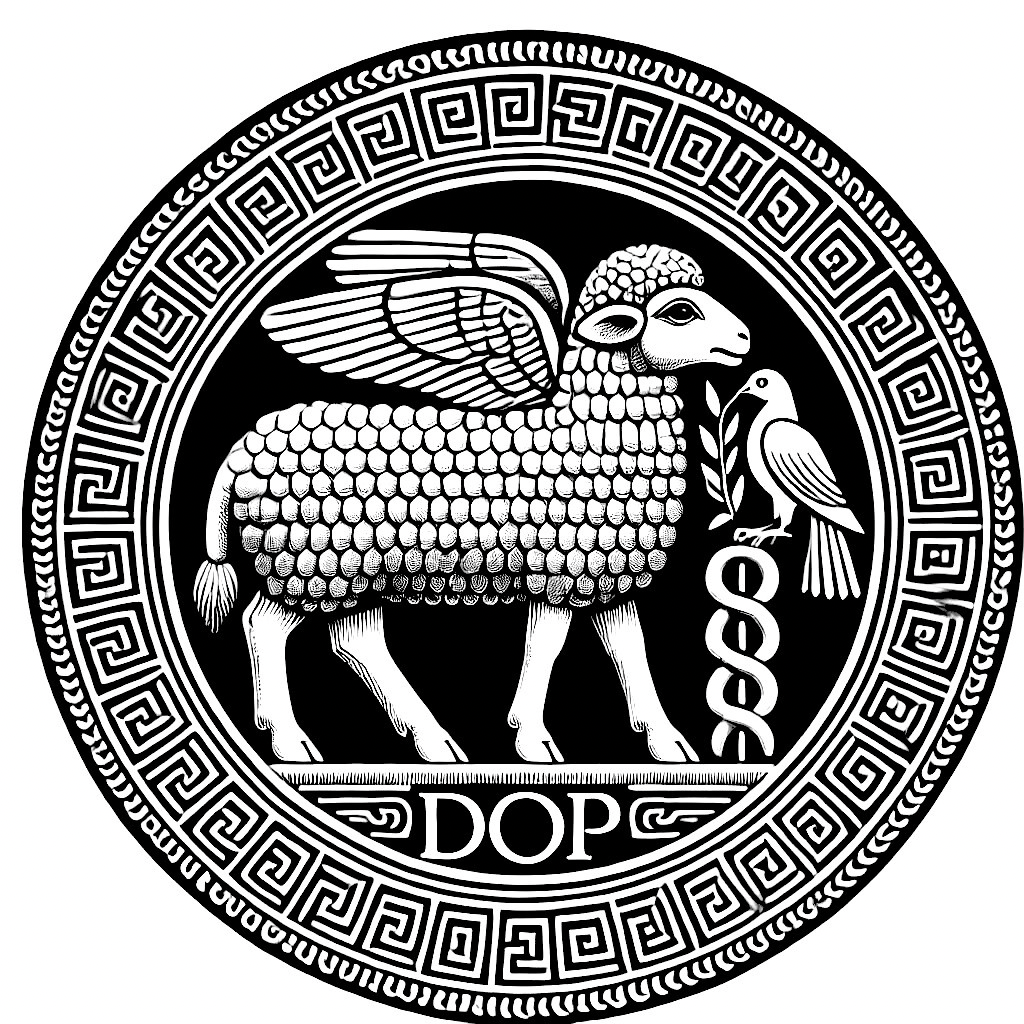
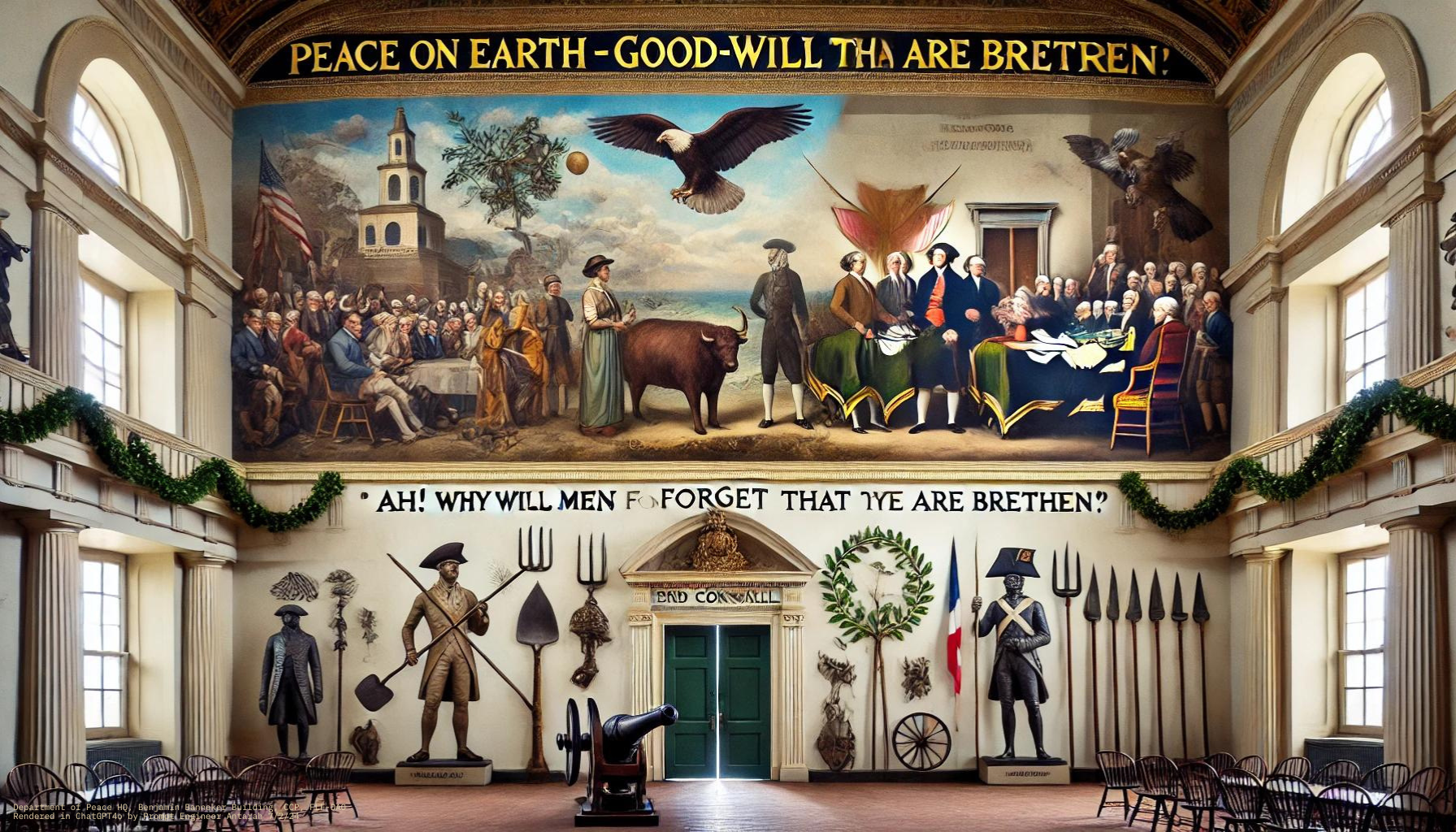
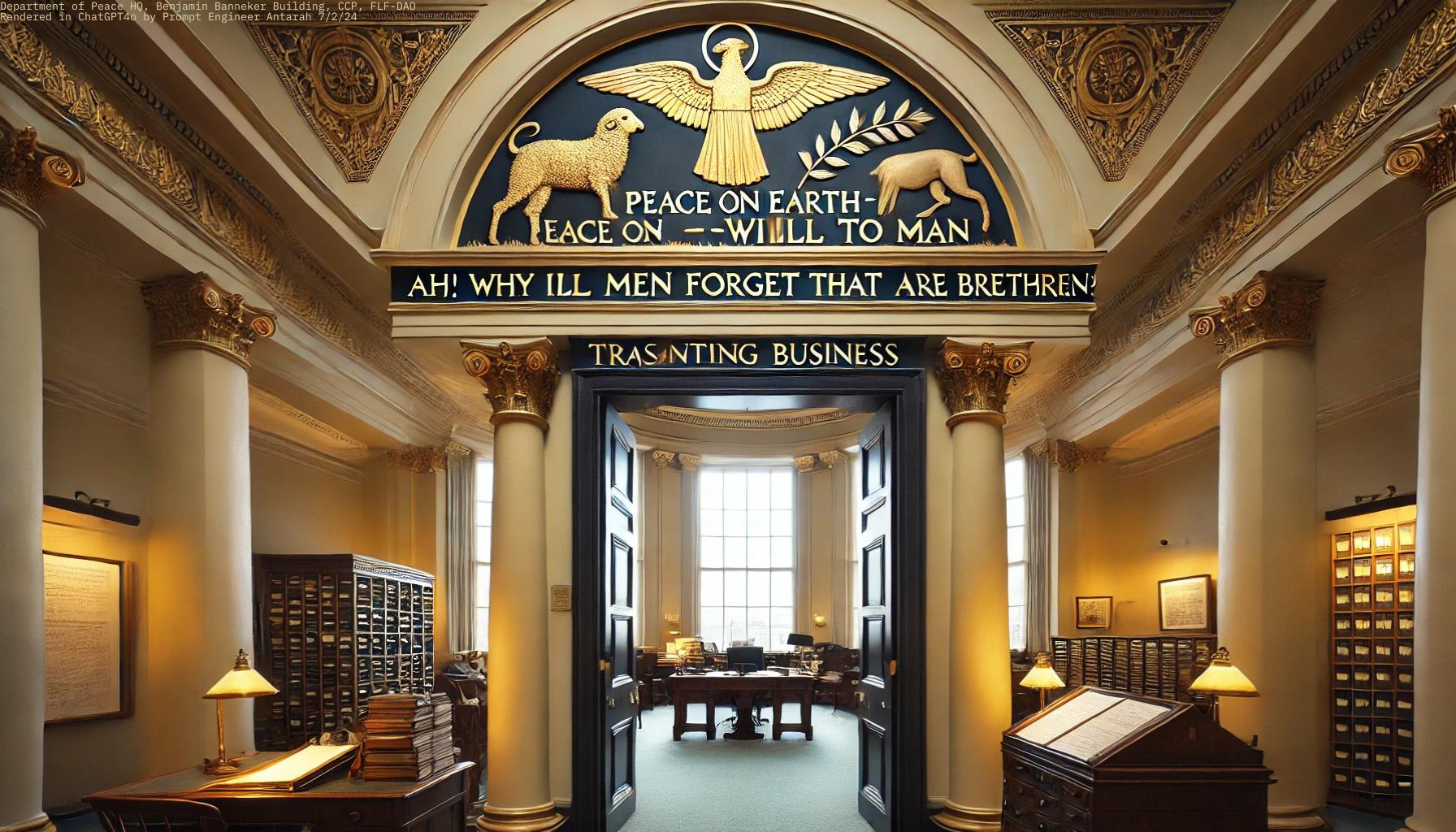
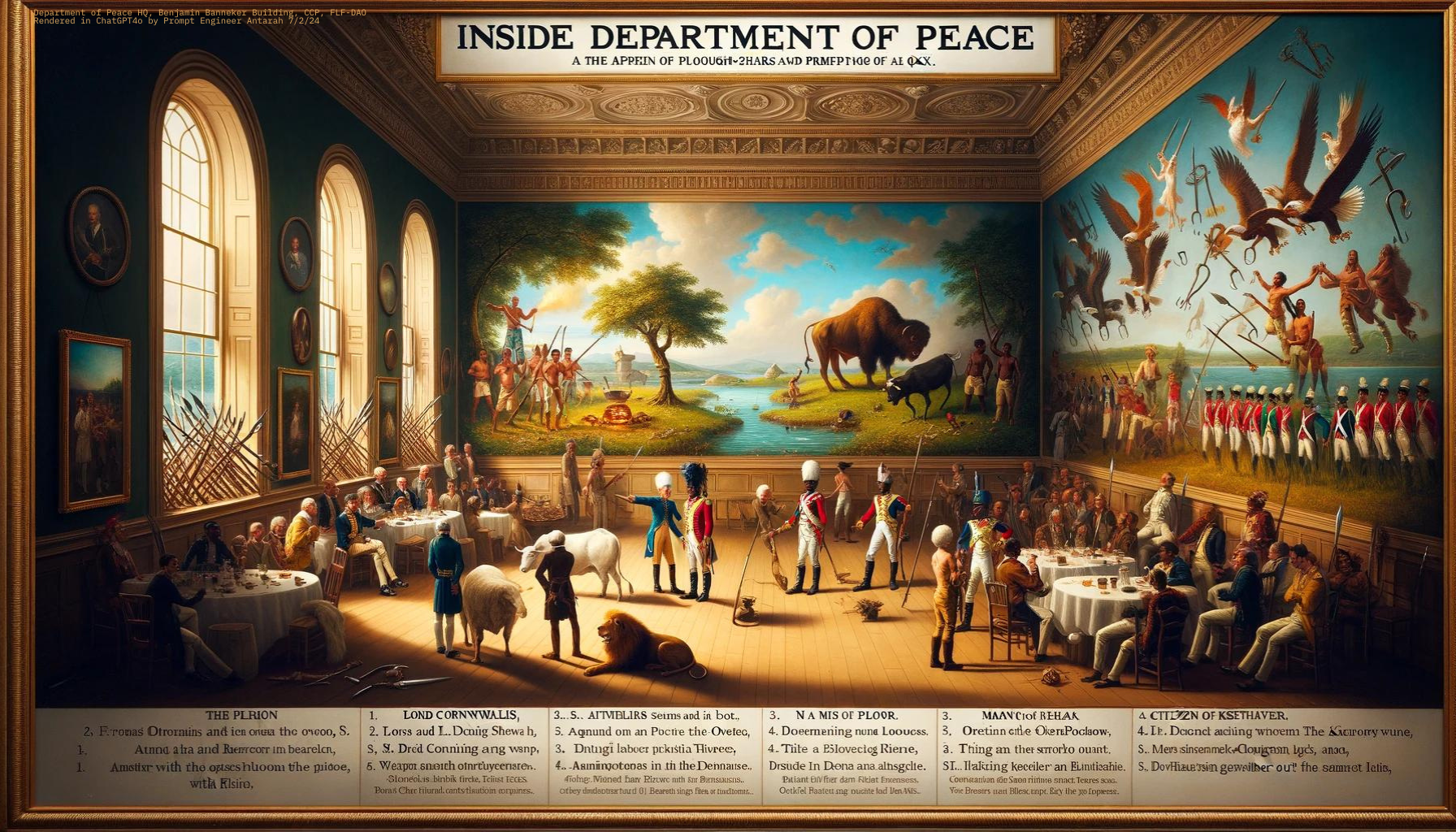
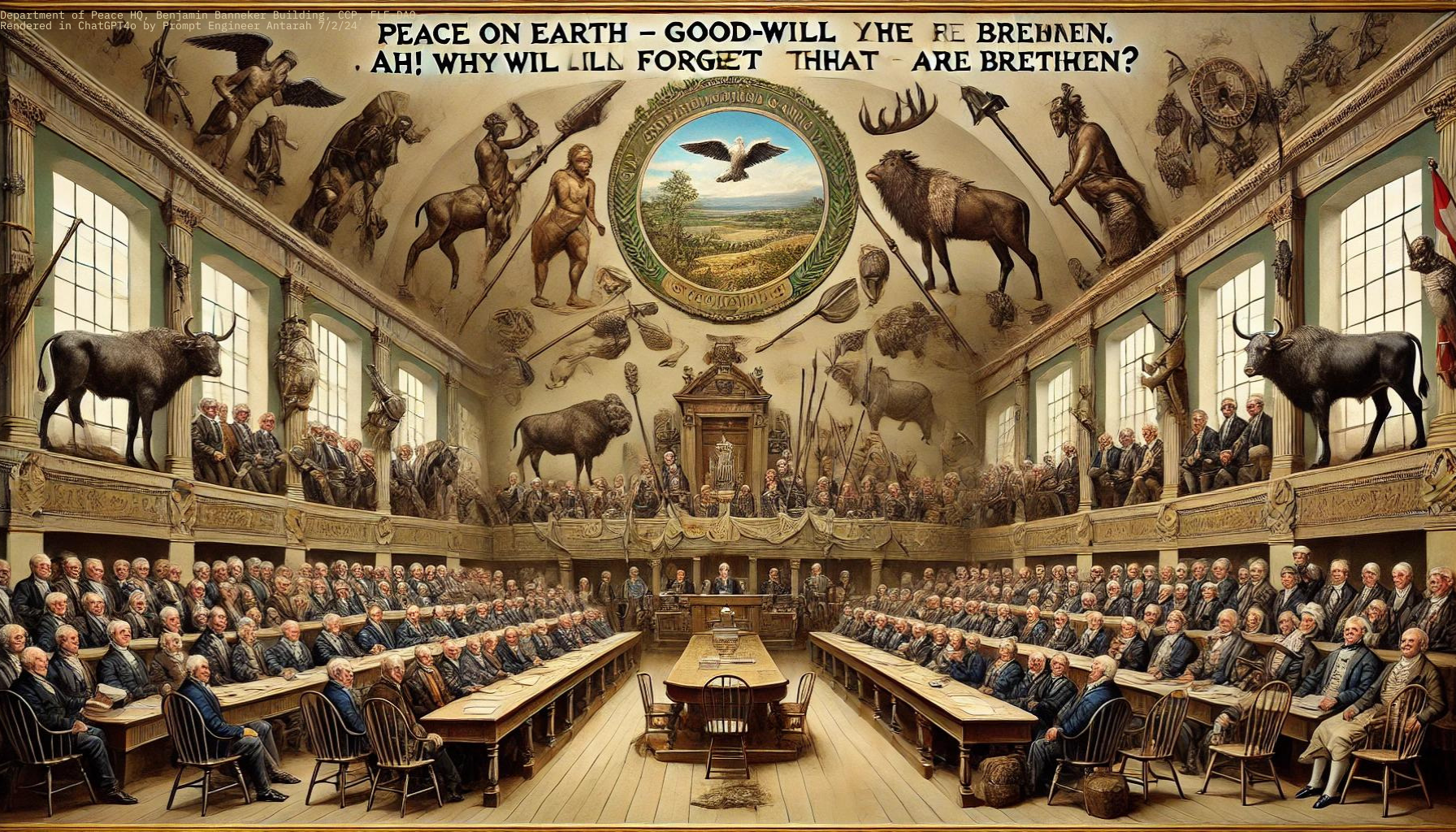
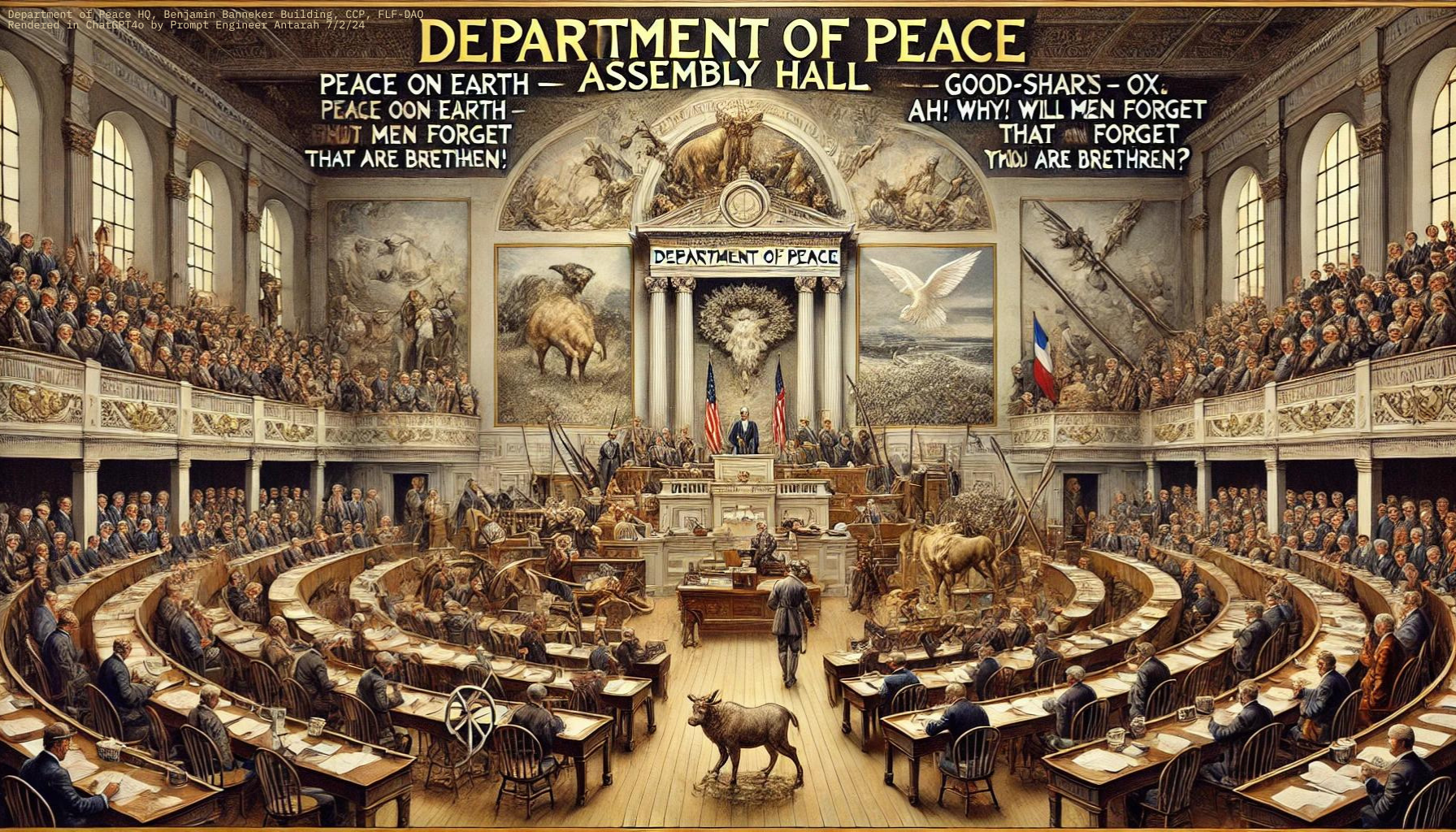
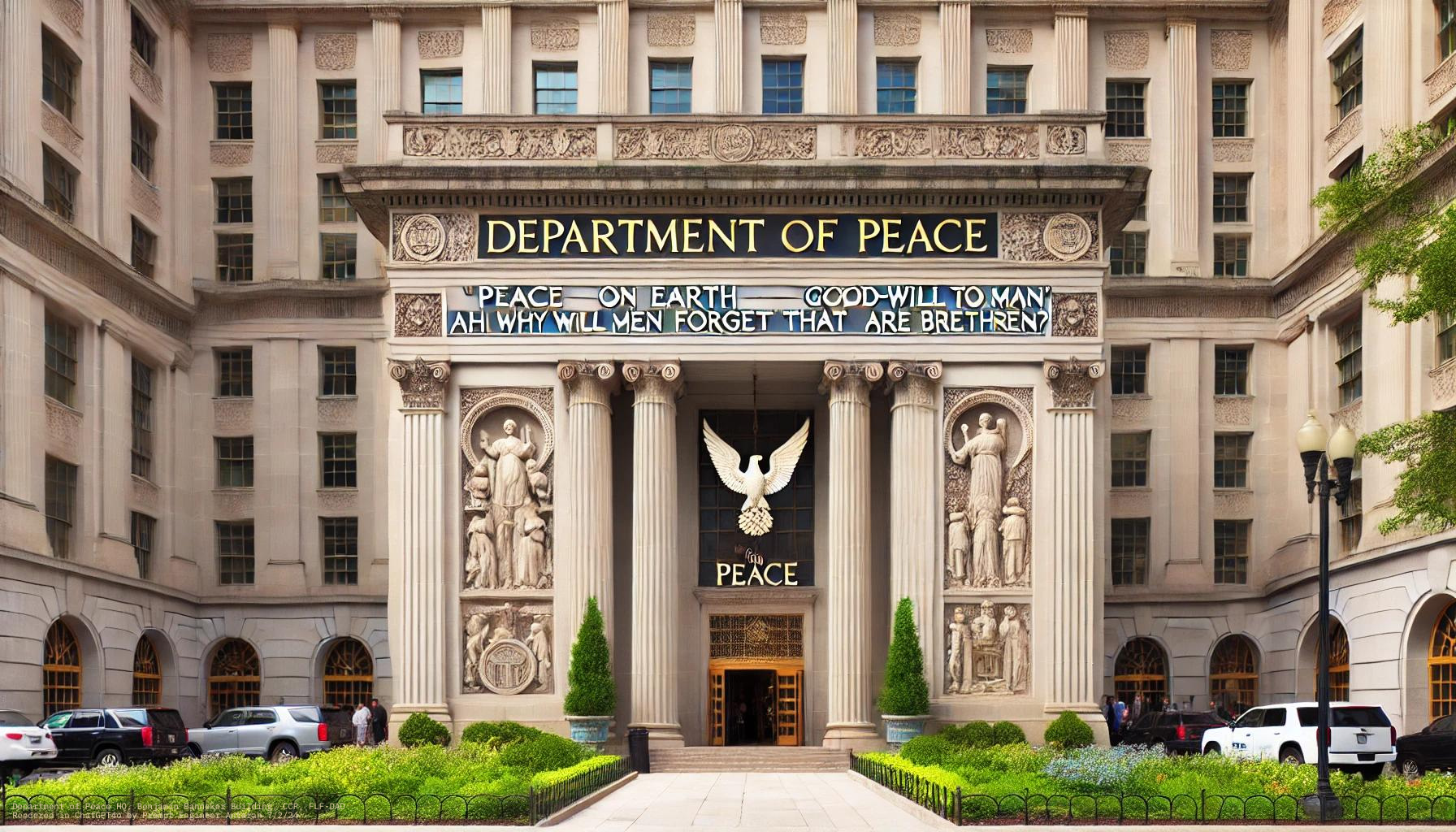
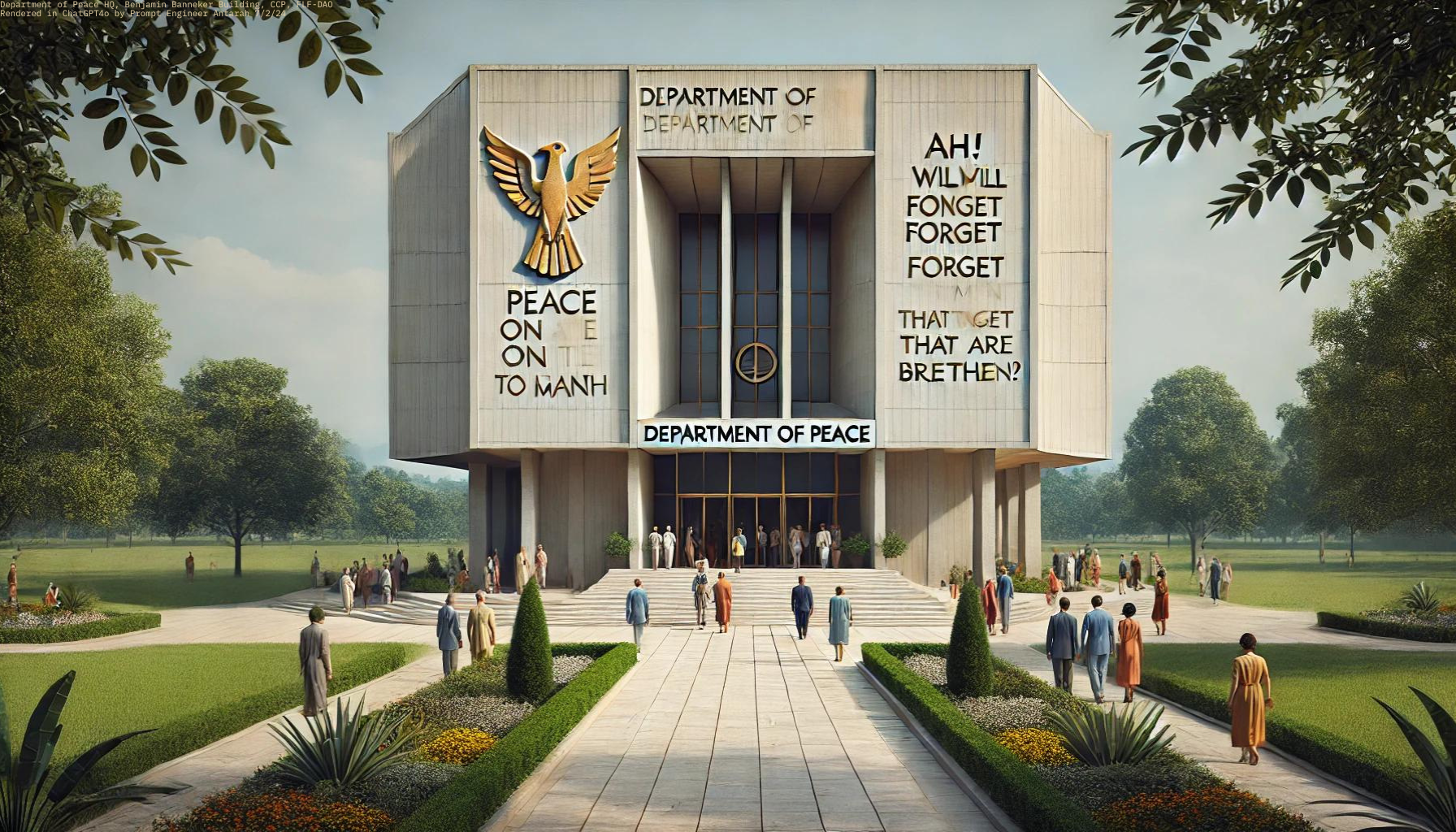
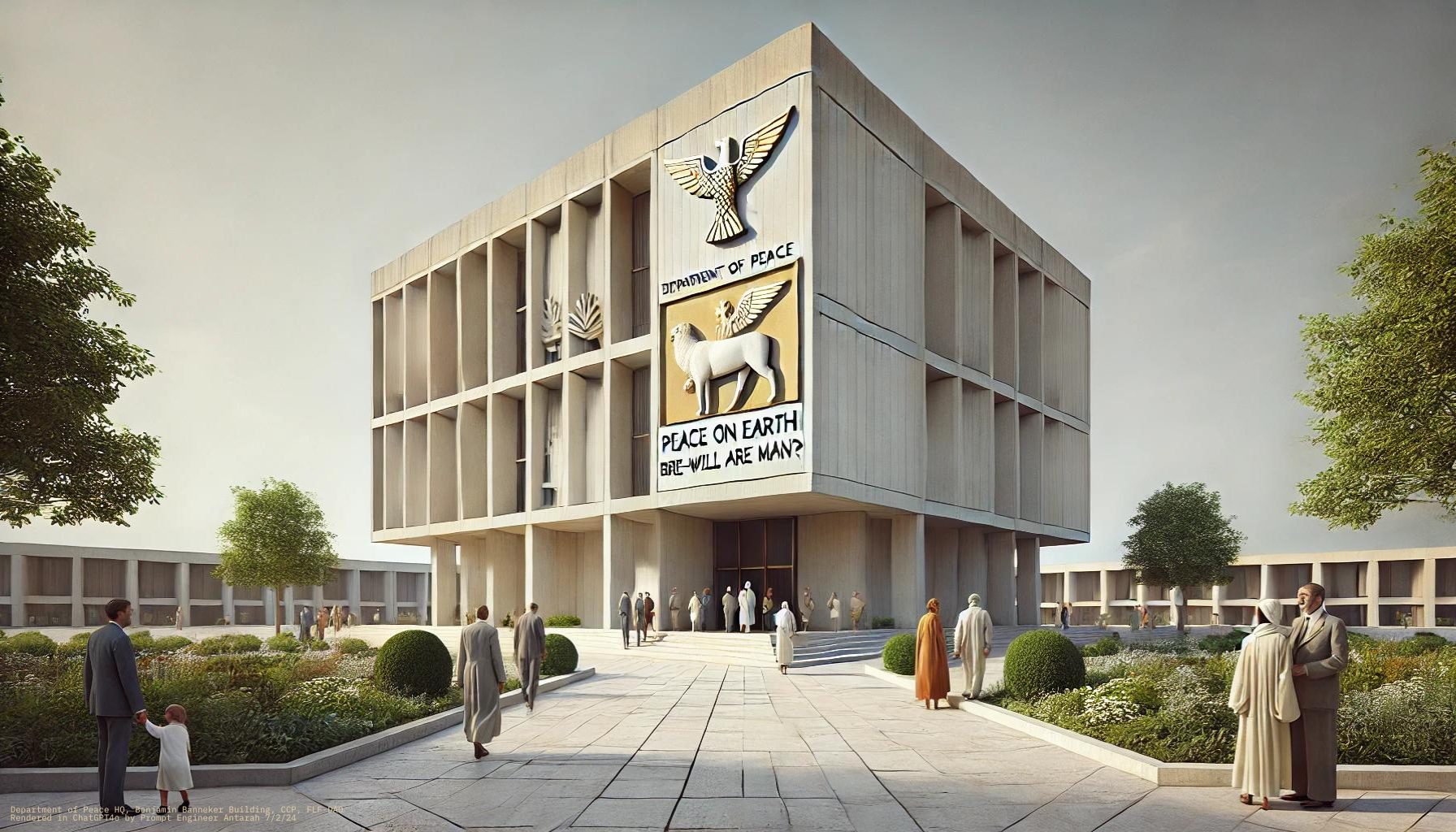
The FLF-DAO IBCO Commission on Capital Projects hereby proposes the following designs for buildings to house the Department of Peace and Friendship (DOP) of the Decentralized Autonomous Organization (DAO), whose governing board is known as the Firm League of Friendship (FLF). The form and function of these buildings are coined Mission Fulfillment Centers which shall administer (perform and deliver) the obligations and services of the ObNS+FLF-DAO to humanity by and through the DOP and Universitas Autodidactus (UA). The design specifications of these buildings are derived from those detailed in DOP Founder Benjamin Banneker’s 1793 Almanac, found at Department of Peace Act (DOPA) Article 3 § 1 A PLAN OF A PEACE-OFFICE, FOR THE UNITED STATES.
DOPA Art. 2(b) provides for the establishment of the national headquarters of the Department at existing premises in the nation’s capitol which have yet to be procured and renovated. That facility is known and would be known as the “Old Recorder of Deeds Building” (“RDB”, “Recorder Building” or “Deeds” for short), and it is not contemplated to be dedicated to a particular personage. The following designs, however, are submitted to the public DAO for review and due appropriations for construction toward the development of a network or localized campus of visionary buildings to support the UA/DOP cross-country mission. The first or most central construction of such development is to be called the “Benjamin Banneker Building”.
Jump-To:
Aesthetic A: Classical/Colonial
A:\Interior: Vestibule
A:\Interior: Gallery
A:\Interior: Hall of Meeting
A:\Exterior Elevations


Aesthetic B: Classical/Modernist


Aesthetic C: Brutalist

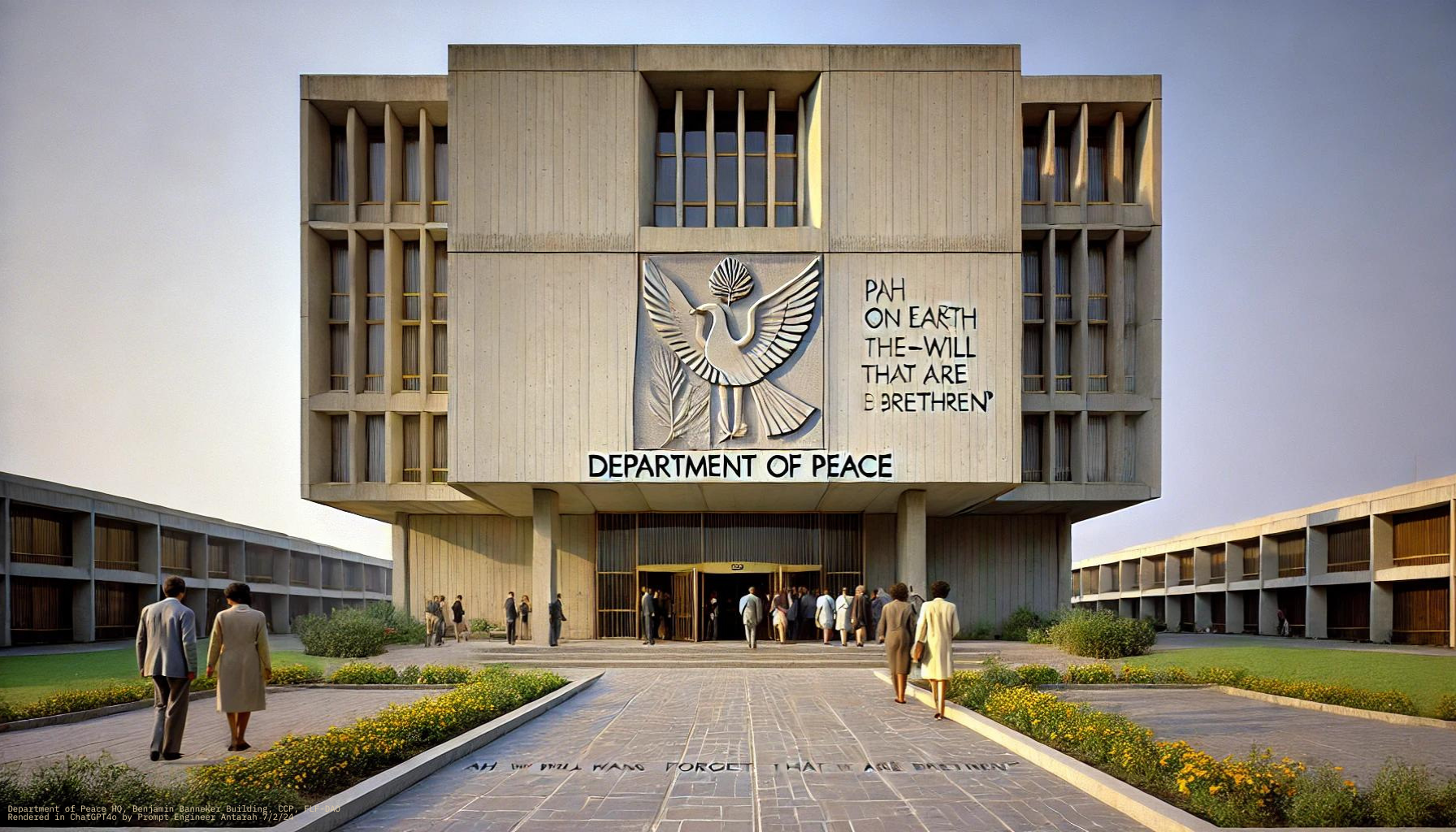



Aesthetic D: Brutal-Modernist
D:\Exterior Elevations




D:\Interior: Hall of Records
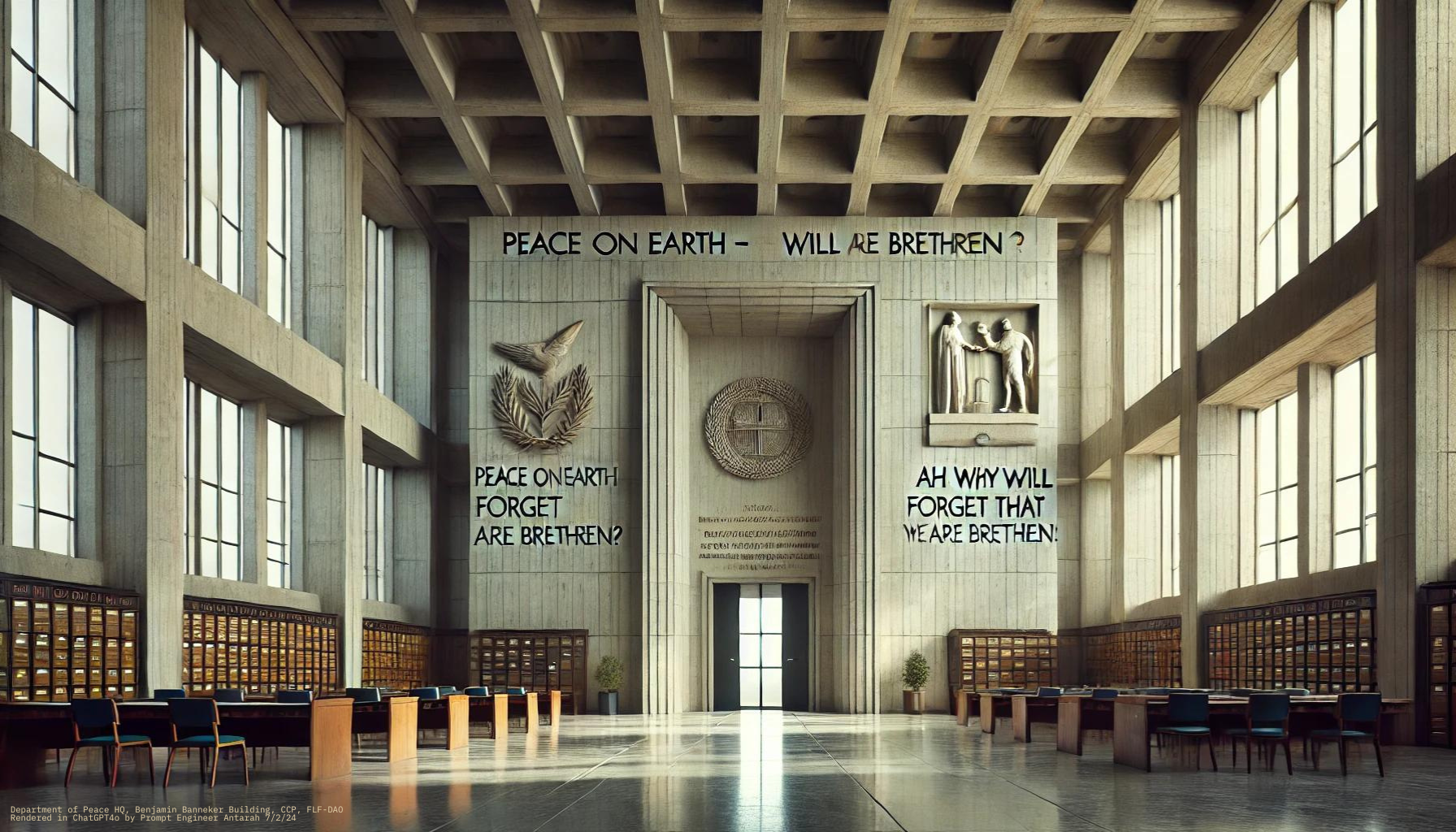
D:\Interior: Halls of Meeting and Study


Antarah Vicarius Deus per Seignior Iesus Christi,
Rector Provinciae Oblatus Novus Syllabus
et Doctor Ecclesia Universalis Autodidactus,
FLF-DAO IBCO

D.R. 01-07: BLK MKT, &c.

Volume 1, Issue 7
CONTENTS — Art. 1. N∴S∴ Director awarded grant… — Art. 2. …Black Market Press — Art. 3. …the Syllabus in Postmodern Literature… — Art. 4. …Public Trust… — Art. 5. From Laurie Lewandowski
Article 1
N∴S∴ Director awarded grant by D.C. Arts and Humanities; establishes Office of Diversified Art Investments
By Antarah Crawley
WASHINGTON, DC — NOVUS SYLLABUS L.L.C. (N∴S∴) Director Antarah Crawley has been named a Fellow of the District of Columbia Commission on the Arts and Humanities (DC CAH). DC CAH has conditionally awarded Crawley a grant to support his artistic practice. In response to the Arts and Humanities Fellowship Program Request for Proposals, Crawley submitted a strong application centered on the Art¢oin Non-Fungible Token mint project and the IBé Arts Institute-sponsored Tubman note issue project. The Director will use part of the proceeds of this grant to establish the N∴S∴ Office of Diversified Art Investments.
Article 2
N∴S∴ establishes Black Market Press
By Antarah Crawley
NACOTCHTANK, OD — NOVUS SYLLABUS L.L.C. (N∴S∴) establishes Black Market Press (BLK MKT) on October 20, 2023, with the publication of Visible: The Art of Her Story by IBé Crawley, which is released upon the occasion of the Grand Reopening of the National Museum of Women in the Arts. N∴S∴ Director Antarah Crawley is the Publisher and Editor-in-Chief of Black Market Press. The Press is affiliated with A.I.C. Consulting for distribution services.
(last modified 19 Oct 2023)
Article 3
Notes on the syllabus in postmodern literature and common law
By Antarah Crawley
NACOTCHTANK, OD — Circa February 2013, I was reading a lot of postmodern American novels leading up to and during the publication of Title 1 C.S.R. Pharmacon of the Spirit, which was my contribution to the genre American postmodernism.
Postmodern literature is a form of literature that is characterized by the use of metafiction, unreliable narration, self-reflexivity, intertextuality, and which often thematizes both historical and political issues. This genre is best exemplified by the works of Jorge Luis Borges, James Joyce’s Ulysses (often considered modernist), Flann O’Brien’s At Swim-Two-Birds, William Gaddis’s The Recognitions, William S. Burroughs’s Naked Lunch, Anthony Burgess’s A Clockwork Orange, Hunter S. Thompson’s Fear and Loathing in Las Vegas, Gabriel García Márquez’s The Autumn of the Patriarch, Margaret Atwood’s The Handmaid’s Tale, Salman Rushdie’s The Satanic Verses, Bret Easton Ellis’s American Psycho, Don Delillo’s Mao II, Toni Morrison’s Beloved, William Gass’s The Tunnel, David Foster Wallace’s Infinite Jest, Thomas Pynchon’s Mason & Dixon, Dave Eggers’s A Heartbreaking Work of Staggering Genius, Zadie Smith’s White Teeth, Jonathan Safran Foer’s Everything is Illuminated, Roberto Bolaño’s 2666, David Mitchell’s Cloud Atlas, and (in my opinion) Blake Butler’s 300,000,000, among many (but not countless) others. Thomas Carlyle’s Sartor Resartus is an excellent precursor to the genre from the 1830s.
Now I can’t say that I’ve read every page of each of these magnum opuses (indeed, anyone who says they have is likely full of it – even if they’re not lying). But I will say that it was the spirit of these works – the spirit of the “late modern” times – which bore a hole in me and fulled me with inspiration. It certainly beat What Masie Knew in GW’s English lit courses. In short, you can say that “Postmodern literature” means all of the most exciting literature this side of World War II.
At that time, I wanted to throw my hat into the ring a major figure in American postmodern literature, and an “African American” to boot. However, after querying New York agents and reading the manuscript over, I determined, alas, it was not very good. But my judgement at that time would belie itself, since the events of the novel, though not good enough to publish, were good enough to live. I ultimately would end up doing the things in my life that Walter Kogard did in Title 1 and thereafter, including live in New York, found a Secret School, and become editor of the Black Market Press (1 C.S.R. pgs. 278-282). How’s that for American postmodernism?
Recently, while researching McGirt v. Oklahoma and other Indian affairs, I came across the phenomenon of a legal “syllabus” which is a preliminary section of a court ruling, preceding the legal opinion of the court, that outlines the core facts and issues of the case and the path that the case has taken prior to reaching the present court. They are, in effect, summaries, and are not to be considered part of the actual decision of the case and are not precedential. This new information struck a chord in me, as my organization of the New Syllabus had proceeded from research focused on postmodern literature and print publishing to occult and esoteric studies to pseudo-law, equity, and sovereignty. Furthermore, the U.S. Supreme Court writes, “All opinions in a single case are published together and are prefaced by a syllabus prepared by the Reporter of Decisions that summarizes the Court’s decision.” This got me thinking about the origin of the name New Syllabus.
I chose the name New Syllabus for this deeply personal academic endeavor in 2013 in homage to the postmodern American novel Giles Goat-Boy or The Revised New Syllabus of George Giles our Grand Tutor by John Barth. Again, I can’t say I read much of this book either, and what I did read I forgot until just moments before writing this article. But as I refreshed my recollection I realized that I must have subconsciously adopted the novel’s conceit as a premise on which to navigate the real world. The Plot summary reads:
George Giles is a boy raised as a goat who rises in life to be Grand Tutor (spiritual leader or messiah) of New Tammany College (the United States, or the Earth, or the Universe). He strives for (and achieves) herohood, in accordance with the hero myth as theorized by Lord Raglan and Joseph Campbell. […]
The principle behind the allegorical renaming of key roles in the novel as roman à clef is that the Earth (or the Universe) is a university. Thus, for example, the founder of a religion or great religious leader becomes a Grand Tutor (in German Grosslehrer)
Wiki
It seems to me that I have (unintentionally) mimicked the novel’s narrative, from establishing a school after the model of the world to automating that school using a system of codes and algorithms (the “computer”):
Giles Goat-Boy marks Barth’s emergence as a metafictional writer.[3] The metafiction manifests itself in the “Publisher’s Disclaimer” and “Cover-Letter to the Editors and Publisher” which preface the book, and which each try to pass off the responsibility for authorship onto another: the editors implicate Barth, who claims the text was given to him by a mysterious Giles Stoker or Stoker Giles, who in turn claims it was written by the automatic computer WESCAC.
Wiki
It is as if the “Publisher’s Disclaimer” is the legal syllabus to Barth’s Revised New Syllabus, and the N∴S∴ Director is the Reporter of Decisions of American belles-lettres, courts of law and equity, and historical dialectics.
At this time, I cannot say if Barth’s vision of the Universe is wholly “metaphysical” or not – it certainly has panned out accurately for me in the material realm, although few others understand my “research.” I have indeed reared up a school and filled its halls with tomes (and sat alone hearing the echo of my voice). Borges says the Universe is often called the “Library,” another objective correlative which became engrained in the New Syllabus starting at Title 3. All in all, the postmodernists Barth and Borges have firmly anchored their symbols in my worldview … for better or for worse.
(last modified 23 Oct 2023 24 Oct 2023)
Article 4
Notes on the Public Trust of the Moorish People
By Antarah Crawley
NACOTCHTANK, OD — The Consular Court of al-Maghreb al-Aqsa, Trustee, of the Public Trust of the Moorish People, Heirs Beneficiary, to the People of Anacostia, Washington District, Send Greetings and Peace.
The land east of the Eastern Branch of the river Potomac is called Nacotchtank-on-Potomac, and the people there are one village. This village is within the federal district of the Ouachita Confederacy of indigenous peoples of North America (which are registered under many names), in the jurisdiction of the Farthest West (al-Maghreb al-Aqsa), being the lands and waters from the Barbary States to the westernmost continent of the Americas (al-Morocco), which is called “the land of large buffalo.”
NATIONALITY: The Moorish people are an autochthonous people (descended from this land) indigenous to both Africa and the Americas. The United States of America (USA) has a trust responsibility to the Moors, as it would to any American Indian/Alaska Native (AI/AN) tribal nation, insofar as it has a responsibility not to infringe on their treaty rights. And whereas AI/ANs do not believe in legal titles in land, the equitable use title to land and stock is found in the nature of a sincerely-held belief and religious, ritual, or ceremonial customs. And whereas AI/ANs do believe in birthright inheritance, this right is further enshrined in the Constitution of the USA which upholds the sanctity and protection of life, liberty, and property.
AUTHORITY: This consular court is authorized under treaty between the United States of America (USA) and the Kingdom of Morocco to represent the moorish nationals domiciled on the land governed as USA. It is a religious institution insofar as it is an assembly of the faithful believers in the dogma of redemption and of the ancient moorish science, and an organization of religious/education colleges and orders.
DOGMA: The people are the church, and the church is the body of Christ, ergo the people are the body of Christ, who is their counselor, judge and king before God the Father, and whose ministers are their representatives on the earth. Those who will say that He is the Sovereign of the earth are indemnified by Him from the penalty of sin in this life and in the hereafter. Those who follow His law of divine reciprocity shall receive mercy on the Day of Judgment. (The Divine Mother and the Holy Spirit are also to be praised.)
OPERATION: The legal name and owner of the courthouse shall be [S∴P∴Q∴M∴, Inc.]. It shall look like a mosque  , be called the church
  ️, and function as school and consular courthouse
  . The consular court shall serve the circuit of the Ouachita District.
REGULARITY: Hold A.M. court business docket and P.M. UA on weekdays; hold Interfaith Religious Service (IRS) service on Friday night and Saturday morning; hold Sundays open.
PRESIDENCE: The court shall be presided over by Consul General Magistrate Judge (CGMJ) Vice Consul General (CG), Vice Magistrate Judge (MJ), Grand Preceptor/Grand Scribe/Grand Tutor, Ombuds, Syndical Committee Chairs, Sergeant (Sgt) at Arms, Imam/Mullah, Rabbi/Moreh, Archbishop/Presbyter/Elder, Tribune of the People, and People assembled. Some of these offices may be encumbered by the same individual.
AMENDMENT IN THE NATURE OF NOTES OF 23 OCT 2023
(1) N∴S∴ was chartered as the livery company (an official company identified by a special design or color scheme) of the Worshipful Company of Scribers (See, Notice of 27 Sep 2018), whose senior permanent staff member shall be the “Systems Dep’t Intermediary Zone (InterZone) Clerk” and whose junior permanent staff member shall be the “Systems Dep’t Knowledge Zone (KnownZone) Cleric” (See, Title 3 C.S.R.). Note that there is no clerk in the O Zone. These three Zones together comprise the DataHorse system of the N∴S∴ Dep’t of Information Systems Intelligence Services (DISIS).
(2) Circuit courts are historically routes through county towns traveled by judges (in the early U.S., Supreme Court judges) and their retinue of attorneys on horseback (the circuit riders). Modern circuit courts are, generally, jury trial courts that may have review authority over a lower court such as a juvenile and domestic relations court.
(2)(a) The concept of circuit riders may be a legacy of the equestrian class of ancient Rome.
(2)(b) A livery is a place that will keep and take care of a horse on behalf of its owner, for a fee.
(3) Courts of Sessions (or “sittings,” another name for proceedings) were established in particular towns or counties. They were replaced by one Crown Court (for criminal matters, and High Court for civil matters), like unto one supreme Court (both criminal and civil/commercial/equitable), or one holy catholic and apostolic Church (political body masquerading as sovereign body of Christ/the People).
(3)(a) Officers of such court include:
(3)(a)(i) The Circuit Rider(s), the judge(s) of sessions/sittings who ride the circuits on commission of oyer et terminer (“hearing and determining”) setting up court and summoning juries in assize towns; those who shall sit at the Dais of the court.
(3)(a)(ii) The Clerk(s) [or, cleric(s)], the keeper(s) of the record; those who shall sit at the Desk of the court issuing and receiving order and papers (See, this Amendment § (1), above).
(3)(a)(iii) The Rapporteur de la cour (Reporter of the court). (See, Memo. No. 9)
(4) Oyez (“hear ye”) is plural imperative form of oyer (French: ouir “to hear”) from oyer et terminer “to hear and to determine” (a sitting of the court, presided over by a judge of assizes “sessions”).
(last modified 23 Oct 2023 24 Oct 2024)
Article 5
From Freemasonry and the Catholic Church
An Excerpt | By Laurie Lewandowski | October 17, 2022
[W]hile Catholics do believe in the immortality of the soul, we reject that doing good works and moving up in ranks (degrees) helps souls get to heaven. This type of heresy was condemned by the Church in 5th century during the Pelagian heresy, which erroneously taught Christ didn’t redeem the human soul, but with good works one can be redeemed. The Church teaches that our immortal souls are redeemed through Christ alone and that through the power of baptism we are saved. (I Peter 3:21).
Freemasonry is a religion which is gnostic (hidden or secret knowledge is power), rationalistic (reason alone guides us into all truth), syncretistic (melding of all world religions, giving equal footing to them all), relativistic (you have your truth and I have mine.), and indifferent (just keep quiet and get along, it doesn’t matter what you believe.) This indifferentism associated with Masonry is probably the most urgent reason to reject it. For a Catholic (and other Christians), the fact that Masons’ “creed” is to ignore Jesus as the Way, is more than just problematic. Jesus promised us division by His Name (Luke 12:51). We must never deny the name of Jesus for the sake of unity. This is one of the grave evils in our modern society. Further, the swearing of oaths, placing the lodge over any other authority, and the inimical relationship between Masons and the Church are additional reasons for the Church’s condemnation. Finally, eight popes from St. Clement XII (1738) onward have condemned it, teaching of its grave sin. Pope Leo XIII writes Inimica Vis, ch.2,
Our predecessors in the Roman pontificate have in the course of a century and a half outlawed this group not once, but repeatedly. We too, in accordance with Our duty, have condemned it strongly to Christian people, so that they might beware of its wiles and bravely repel its impious assaults. Moreover, lest cowardice and sloth overtake us imperceptively, We have deliberately endeavored to reveal the secrets of this pernicious sect and the means by which it labors for the destruction of the Catholic enterprise.
Pope Leo XIII, Inimica Vis, ch.2
Use this resource to pray for release from the Oaths of Freemasonry and repent.
 Supreme Exchange