Tagged: learning
[bulla] Full Assurance

Jesus Christ is the Saviour of the World; He is the deliverer from all human wretchedness, and He has redeemed us from death and sin; how could He be all that, if the world must languish perpetually in the shades of ignorance and in the bonds of passions? It has been already very clearly predicted in the Prophets that the time of the Redemption of His people, the first Sabbath of time, will come. Long ago ought we to have acknowledged this most consolatory promise; but the want of the true knowledge of God, of man, and of nature has been the real hindrance which has always obstructed our sight of the great Mysteries of the faith.
Karl von Eckartshausen, The Cloud upon the Sanctuary, Letter IV
Jesus Is Our Surety
“By so much was Jesus made a surety of a better testament.”
[Hebrews 7:22]
INTRODUCTION
- This morning we studied the judgment seat of Christ, for it is the horrible and certain end of all men.
- But tonight I want to remind you of our glorious Mediator and Surety with God, the Lord Jesus Christ.
THE DEFINITION
- Surety. A person who undertakes some specific responsibility on behalf of another who remains primarily liable; one who makes himself liable for the default or miscarriage of another, or for the performance of some act on his part (e.g. payment of a debt, appearance in court for trial, etc.).
- We have surety bonds, performance bonds, bail, and bond to guarantee legal, financial, and professional obligations, such as with construction and insurance companies.
- When we need to borrow more than our credit allows, we appreciate a surety; if we were arrested for something, we would appreciate the surety bond that lets us go free.
- Judah became a surety for Benjamin to his father Jacob (Gen 43:8-10; 44:30-34; 42:37).
- Aaron became a surety for Israel in their sins and stood between them (Num 16:41-48).
THE SURETISHIP
- Jesus, a High Priest after the order of Melchisedec, was made the Surety of His people.
- God chose Jesus from among the people to be the mighty Surety (Psalm 89:19).
- He was made Surety by God’s oath at His ordination as our Priest (Heb 7:21).
- Jesus did the will of God perfectly as our Surety for our salvation (Heb 10:5-14).
- Being a surety means paying debts and performing, where the needy cannot pay or do.
- The wages of sin is death, which God’s justice pays; but Jesus died (Rom 6:23).
- Only the undefiled enter heaven, so He lived faultlessly for us (Jude 1:24-25).
- Jesus was necessary as a surety, for the justice of God must surely be paid (Rom 3:26).
- He is the Testator, for it was by His death that He put the covenant in force (Heb 9:15).
- We see Him under the strain of the Surety engagement in Gethsemane (Luke 22:39-44).
- No man in heaven or earth could approach the throne, but only our Surety (Rev 5:1-14).
- If this is not a Surety, successfully finishing His work, what is it (Isaiah 53:4-12)?
- The doctrine of representation by the Second Adam reveals our Surety (Rom 5:15-19).
- The Lord Jesus tasted death for every one of His children to deliver them (Heb 2:9-17).
- How else can we look at the Book of Life, but as the list of His Surety engagements!
THE BENEFITS
- The Lord Jesus fulfilled the righteousness of the law on our behalf (Rom 8:3-4), so that we are righteous in God’s sight with His perfect obedience (Eph 5:25-27; Col 1:21-22).
- The Lord Jesus paid the penalty for sins by His death for us (I Pet 2:24), so that there are no more sins against our charge when we stand before Him (John 1:29; Heb 9:28).
- He lives to make sure we are absolutely, completely, and eternally saved (Heb 7:25).
- There is an abundant entrance into heaven waiting for the children of God (II Pet 1:11).
- Since Jesus is our Surety, it is impossible for God to withhold blessings (Romans 8:32).
- His death reconciled us to God, but He still lives to be an eternal Surety (Romans 5:10).
THE APPLICATION
- There is no fear in the proper knowledge of Christ Jesus our Saviour (II Timothy 1:12).
- The LORD will show us His secret and covenant, if we fear and seek Him (Ps 25:14).
- We must learn to trust Him. He has done it; He is in heaven for us; He will receive us.
- It is simple: “Whosoever believeth on Him shall not be ashamed” (Rom 9:33; 10:8-11).
- A woman was healed and had her faith commended, when it was weak (Mark 5:25-34).
- Those who lack faith and assurance, I ask how many minutes you spend seeking Him.
- And you should consider long and seriously His faithful words “no wise” in John 6:37.
- We should seek and receive the benefits of the covenant in our hearts (Eph 3:14-19).
- Let us bring forth the fruit of righteousness with far-sighted vision (II Peter 1:9-11).
CONSLUSION
- The Lord’s supper is a memorial feast of our Surety’s covenant death for us (I Corinthians 11:23-26).
- Let us partake of the Lord’s supper tonight with the joy that His suretiship should put in our hearts.
CITATION
I AM THE L.O.R.D. THY G.O.D.
Drafted by Antarah
I AM the Land Owner Record of Deeds, thy Grantor Of Dominion. My body is the Land and I AM the Owner of Record on the Deed of my Live Birth Certificate. I have granted unto thee the use of my Dominion over the earth, the sea, and all that therein is; for thou art a corpus (“dead corporation”) who is in want of my natural right which I have through the sacrifice of my Savior. My life secured and bonded by the LORD my GOD, let thy presentment pass over me and return unto thee; for said presentment is hereby ACCEPTED FOR VALUE AND HONOR WITHOUT PREJUDICE. I hereby attest and assert my equitable title over the landed estate (“person”) named on the instant presentment. Any obligation of such person is an obligation discharged to and held by the United States as evidenced by the signatures of its Treasurer and Secretary of the Treasury on Federal Reserve Notes, these officers being the de facto fiduciary agents of the estate __________________. All debt is prepaid by the blood of Our Sovereign Lord in Christ for relief by recovery upon acceptance for value under House Joint Resolution 192 (1933).
AUTHORITIES AT LAW AND EQUITY
1. GRANTOR OF DOMINION.
[Genesis 1] [26] And God said, Let us make man in our image, after our likeness: and let them have dominion over the fish of the sea, and over the fowl of the air, and over the cattle, and over all the earth, and over every creeping thing that creepeth upon the earth. [27] So God created man in his own image, in the image of God created he him; male and female created he them. [28] And God blessed them, and God said unto them, Be fruitful, and multiply, and replenish the earth, and subdue it: and have dominion over the fish of the sea, and over the fowl of the air, and over every living thing that moveth upon the earth.
2. DEMAND FOR EQUITABLE ADJUSTMENT.
[Psalm 17] [1] Hear the right, O Lord, attend unto my cry, give ear unto my prayer, that goeth not out of feigned lips. [2] Let my sentence come forth from thy presence; let thine eyes behold the things that are equal.
3. THE DAY OF THE LORD.
[Psalm 118] [1] O give thanks unto the Lord; for he is good: because his mercy endureth for ever. [8] It is better to trust in the Lord than to put confidence in man [or princes]. [14] The Lord is my strength and song, and is become my salvation. [17] I shall not die, but live, and declare the works of the Lord. [19] Open to me the gates of righteousness: I will go into them, and I will praise the Lord: [22] The stone which the builders refused is become the head stone of the corner. [23] This is the Lord’s doing; it is marvellous in our eyes. [24] This is the day which the Lord hath made; we will rejoice and be glad in it. [26] Blessed be he that cometh in the name of the LORD […].
4. ACCEPTANCE FOR VALUE.
[Matthew 5] [25] Agree with thine adversary quickly, whiles thou art in the way with him; lest at any time the adversary deliver thee to the judge, and the judge deliver thee to the officer, and thou be cast into prison.
5. THE TAX RETURN.
[Matthew 22] [17] […] Is it lawful to give tribute unto Caesar, or not? [18] […] Jesus […] said, […] [19] Shew me the tribute money. And they brought unto him a penny. [20] And he saith unto them, Whose is this image and superscription? [21] They say unto him, Caesar’s. Then saith he unto them, Render therefore unto Caesar the things which are Caesar’s; and unto God the things that are God’s.
6. A WORKER IS DUE HIS WAGES.
[Luke 10] [5] And into whatsoever house ye enter, first say, Peace be to this house. [6] And if the son of peace be there, your peace shall rest upon it: if not, it shall turn to you again. [7] And in the same house remain, eating and drinking such things as they give: for the labourer is worthy of his hire.
7. GOD IS NO RESPECTER OF PERSONS.
[Romans 2] [9] Tribulation and anguish, upon every soul of man that doeth evil…; [10] But glory, honour, and peace, to every man that worketh good…: [11] For there is no respect of persons with God. [12] For as many as have sinned without law shall also perish without law: and as many as have sinned in the law shall be judged by the law;
8. THE LAW IS BINDING BUT FOR THE REMEDY OF FAITH.
[Galatians 3] [9] So then they which be of faith are blessed with faithful Abraham. [10] For as many as are of the works of the law are under the curse: for it is written, Cursed is every one that continueth not in all things which are written in the book of the law to do them. [11] But that no man is justified by the law in the sight of God, it is evident: for, The just shall live by faith. [12] And the law is not of faith: but, The man that doeth them shall live in them.
9. MINORITY (INFANCY) AND MAJORITY (MATURITY).
[Galatians 4] [4] [T]he heir, as long as he is a child, differeth nothing from a servant, though he be lord of all; [2] But is under tutors and governors until the time appointed of the father. [3] Even so we, when we were children, were in bondage under the elements of the world: [4] But when the fulness of the time was come, God sent forth his Son, made of a woman, made under the law, [5] To redeem them that were under the law, that we might receive the adoption of sons. [7] Wherefore thou art no more a servant, but a son; and if a son, then an heir of God through Christ.
10. SURETYSHIP.
[Hebrews 7] [22] By so much was Jesus made a surety of a better testament.
11. FULL ASSURANCE OF FAITH.
[Hebrews 10] [19] Having therefore, brethren, boldness to enter into the holiest by the blood of Jesus, [20] By a new and living way, which he hath consecrated for us, through the veil, that is to say, his flesh; [21] And having an high priest over the house of God; [22] Let us draw near with a true heart in full assurance of faith, having our hearts sprinkled from an evil conscience, and our bodies washed with pure water.
AUTHORITIES AT EXCLUSIVE EQUITY
Hebrew 10
[22] Let us draw near with a true heart in full assurance of faith, having our hearts sprinkled from an evil conscience, and our bodies washed with pure water.
Isaiah 32
[1] Behold, a king shall reign in righteousness, and princes shall rule in judgment. [17] And the work of righteousness shall be peace; and the effect of righteousness quietness and assurance for ever.
Acts 17
[31] Because he hath appointed a day, in which he will judge the world in righteousness by that man whom he hath ordained; whereof he hath given assurance unto all men, in that he hath raised him from the dead.
Ruth 2
[12] The Lord recompense thy work, and a full reward be given thee of the Lord God of Israel, under whose wings thou art come to trust.
Ps. 17
[1] Hear the right, O Lord, attend unto my cry, give ear unto my prayer, that goeth not out of feigned lips. [2] Let my sentence come forth from thy presence; let thine eyes behold the things that are equal. [3] Thou hast proved mine heart; thou hast visited me in the night; thou hast tried me, and shalt find nothing; I am purposed that my mouth shall not transgress.
Ps. 24
[1] The earth is the Lord’s, and the fulness thereof; the world, and they that dwell therein. [2] For he hath founded it upon the seas, and established it upon the waters.
Ps. 98
[9] …[T]he Lord … cometh to judge the earth: with righteousness shall he judge the world, and the people with equity.
Is. 11
[4] With righteousness shall he judge the poor, and reprove with equity for the meek of the earth.
Matt. 22
[37] Thou shalt love the Lord thy God with all thy heart, and with all thy soul, and with all thy mind. [38] This is the first and great commandment. [39] And the second is like unto it, Thou shalt love thy neighbour as thyself. [40] On these two commandments hang all the law and the prophets.
Leviticus 19:15
Ye shall do no unrighteousness in judgement: thou shalt nor respect the person of the poor, nor honor the person of the mighty: but in righteousness shalt thou judge thy neighbor.
II Chronicles 19:6-7
Take heed what ye do: for ye judge not for man, but for the Lord, who is with you in the judgment. Wherefore now let the fear of the Lord be upon you; take heed and do it: for there is no iniquity with the Lord our God, nor respect of persons, nor taking of gifts.
Heb. 7:20, 22, 25
And inasmuch as not without an oath he was made priest:…The Lord sware and will not repent, Thou art a priest for ever after the order of Melchisedec: By so much was Jesus made a surety of a better testament. Wherefore he is able also to save them to the uttermost that come unto God by him, seeing he ever liveth to make intercession for them.
EQUITABLE SUBROGATION
Subrogation is the process where one party assumes the legal rights of another, typically by substituting one creditor for another. Subrogation can also occur when one party takes over another’s right to sue.
For example, when an insurance company compensates a policyholder for an injury, the policyholder’s right to sue the person responsible for the harm may be subrogated, meaning it is transferred from the policyholder to the insurance company.
[Last updated in June of 2024 by the Wex Definitions Team]
Surety’s subrogation rights
A surety who pays off the debts of another party may be entitled to be subrogated to the creditor’s former claims and remedies against the debtor to recover the sum paid. This would include the endorser on a bill of exchange. The surety will then have the benefit of any security interest in favour of the creditor for the original debt. Conceptually this is an important point, as the subrogee will take the subrogor’s security rights by operation of law, even if the subrogee had been unaware of them.
Wiki: Subrogation
Did you subrogate to the chattels as the surety (or waive your sovereign natural rights in security interest as estate-heir-beneficiary by acquiescing to the color of the court and merging with the NAME of the principal debtor)?
Amyr Samah El, as amended
(last modified 24.07.17.01:33PM)

General Conference
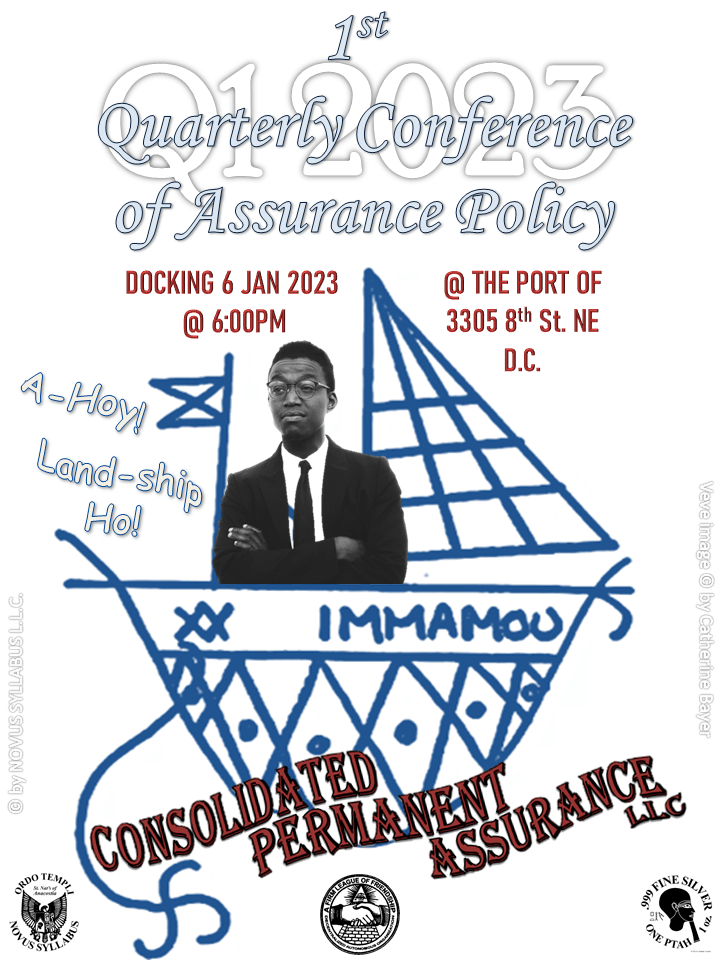
BISMILLAH (IN THE NAME OF GOD)
🇺🇸🇬🇧🇲🇦🇮🇱🏴☠️
⚓️Lord High Admiral Antarah⚓️
TO ALL TO WHOM THESE PRESENTS SAIL
Sends Greeting and Peace and hereby offers to the Free-Thinkers, Truth-Speakers, and Light-Workers United in a firm league of friendship, decentralized autonomous organization, L.S.T.A., under terms and conditions, the Mindsoft©️™️ Flagship Program File (eSyllabus©️™️ vers. no. 22.11.09) to facilitate the General Conference of Assurance Policy.
Program Files:

A Conference of Assurance Policy
“WHAT IS A SURETY SHIP?”
FIRST OFFERED 22 NOVEMBER 2023
📜PRIVATE OFFERING📜
💾Mindsoft©️as a Service™️ (MaaS™️) Premium Servicing Fee of $99.99 per person 💳 payable upon conference for products* and services rendered. Duration of Service: 1-2 hrs.
Upon completion of conference, Assurance Policyholder may be granted C-Series Art¢oin 🪙 (“C-coin”) at market price via 🤝🏿 Handshake of Friendly Association. Contact ombudserver@gmail.com to schedule a conference, or attend the C.P.A. LLC Quarterly Conference of Assurance Policy.
📜POLICY COVERAGE📜
An assurance policyholder, having paid a premium and been conferred with assurance (as evidenced by presentment of C-coin), may bring a claim based on presentment to the CPA LLC at no cost, but there is no guarantee that such claim shall be resolved. Processing fees may apply. Neither the CPA LLC nor its parent nor its agents shall be liable for any claim arising from such a presentment or from such policyholder, as the assurance policy itself is underwritten by God in Christ through the King James Bible, and it is to Him thou shalt appeal for judgment.

(last modified 25 Jul. 2023)
The Flagship Program


presenting our flagship program
A Conference of Assurance Policy
“WHAT IS A SURETY SHIP?”
A Fun, Educational Ritual Drama ©️ by Antarah Crawley
⚓️Ministry of Information⚓️
📜BRIEF IN EQUITY📜
A presentment made without express contract presumes the recipient to be the trustee for a dead person’s estate without surety and not a living Cestui Que. An estate may, however, be entrusted to a “person” (corporation) for the use of a living spirit who may “possess property” in the nature of equitable use title not legal title.
There is sufficient precedent in Roman, Papal, and English law to presume a human body to be chattel property (i.e., a dead person or a mere human creature without soul or spirit) unless otherwise established to posses a soul from God. The cestui que who is presumed dead or lost at sea MUST EXPRESSLY STATE that they are indeed the living cestui que to be given standing as one of the three Chancellors in a Court of Equity and Chancery deciding the matter of an estate (dead person). The common law, as it pertains to the military jurisdiction of the public, cannot abrogate a matter of equity respecting a living free man or woman on the land.
Statue of Mortmain prohibits possession of property by the “dead hand” of a corporation (such as the Church); therefore a “person” (dead in the eyes of God) cannot possess property; rather it reverts to the feudal lord.
The Remedy is that the cestui que (beneficiary) possesses equitable title by nature to the property as a living child of god, but never holds the legal title of the trustee which is the feudal lord or its agent, including any person who is a citizen of the jurisdiction.
There is precedence in Germanic law that a man who holds property on account of to the use of another is bound to fulfill his trust.
Furthermore, precedent is found in the Institutes of Justinian at 2.23.1-2: “… it is required that the one heir is duly appointed and is committed to his trust (Fideicommissum) to transfer the inheritance to another; otherwise the testament in which no heir has been duly appointed is void; the words which are properly and commonly used to install a fideicommisum are I beg, I ask, I wish, I entrust…” This doctrine was brought to England by “foreign ecclesiastics” (ministers and consuls) in order to evade the Statute of Mortmain by making the Church cestui a que use le Feoffment fuit fait.
In sum, cestui que use confers the benefit of use of property to another (a minister or consul) without the legal ownership and attendant duties and obligations to the lord and crown as trustee. Compare to usufruct, or right of use of fruits (interest, profits, etc.) of property.
📜PRIVATE OFFERING📜
💾Mindsoft©️as a Service™️ (MaaS™️) Premium Servicing Fee of $99.99 per person 💳 payable upon conference for products* and services rendered. Duration of Service: 1-2 hrs.
Upon completion of conference, Assurance Policyholder may be granted C-Series Art¢oin 🪙 (“C-coin”) at market price via 🤝🏿 Handshake of Friendly Association. Contact ombudserver@gmail.com to schedule a conference, or attend the C.P.A. LLC Quarterly Conference of Assurance Policy.
*The applicant hereof shall be sent the eSyllabus©️™️ Mindsoft©️™️ program file by email under a limed use licensing agreement to facilitate their conference.
📜POLICY COVERAGE📜
An assurance policyholder, having paid a premium and been conferred with assurance (as evidenced by presentment of C-coin), may bring a claim based on presentment to the CPA LLC at no cost, but there is no guarantee that such claim shall be resolved. Processing fees may apply. Neither the CPA LLC nor its parent nor its agents shall be liable for any claim arising from such a presentment or from such policyholder, as the assurance policy itself is underwritten by God in Christ through the King James Bible, and it is to Him thou shalt appeal for judgment.

U:\>_Folder\Assuretyship
Use under 17 U.S. Code § 107
Educational Research Material for a Course in re “Assuretyship”
CL 1000-2304
CODE OF LAW
UNIVERSAL
COMMON
ECCLESIASTIC
AND CIVILL OF
THE SUI JURISDICTION OF
“WESTMARYLAND”
BY THE GRACE OF GOD
THROUGH COMMISSION OF THE SCRIBE,
THE RAPPORTEUR OF THE COURTS OF
THE UNITED STATES OF AMERICA AND JURISDICTION,
ANTARAH A. CRAWLEY,
FROM THE CITY-STATE OF “WASHINGTON”,
TO THEE PEOPLE OF WOMAN BORN OF THE BODY-POLITIC OF THE LAND WEST OF AND INCLUDING THE STATE OF MARYLAND.
As it is said,
“1 Domini Est Terra Et Plentitudo Eius
Orbis Terrarum Et Universi Qui Habitant in Eo
2 Quia Ipse Super Maria Fundavit Eum
Et Super Flumina Paeparavit Eum.”
(Psalm 24:1-2)
and
“29 Are not two sparrows sold for a farthing? and one of them shall not fall on the ground without your Father.”
30 But the very hairs of your head are all numbered.
31 Fear ye not therefore, ye are of more value than many sparrows.”
(Luke 12:7)
And, as it is said by the Prophet Isaiah,
9:2 The people that walked in darkness have seen a great light: they that dwell in the land of the shadow of death, upon them hath the light shined. … 4 For thou hast broken the yoke of his burden, and the staff of his shoulder, the rod of his oppressor, as in the day Midian. 5 … but this shall be with burning and fuel of fire. 6 For unto us a child is born, unto us a son is given: and the government shall be upon his shoulder: and his name shall be called Wonderful, Counsellor, The mighty God, The everlasting Father, The Prince of Peace. 7 Of the increase of his government and peace there shall be no end, upon the throne of David, and upon his kingdom, to order it, and to establish it with judgment and with justice from henceforth even forever…10:20 And it shall come to pass in that day, that the remnant of Israel, and such as are escaped of the house of Jacob, shall no more again stay upon him that smote them; but shall stay upon the LORD, the Holy One of Israel, in truth… 27 And it shall come to pass in that day, that his burden shall be taken away from off thy shoulder, and his yolk from off thy neck, and yolk shall be destroyed because of the annointing.

1000 – BODY POLITY.
The individual, the state, and the universe are all bodies of matter engaged in one universal, common, grand, unified, and general contracting system. Waves, particles, and bodies “contract” together to engage in material conduct and/or to become as one polity (i.e., “the physical state constituted by two or more parties”). The “contract” governs the conduct of its parties with respect to each other.
1100 – MATERIAL CONDUCT.
1101 – CONDUCTION. (A) The action or motion by which a body transfers force or matter to another body; (B) any transfer of action.
1102 – ACTION. (A) The effect of a cause; (B) the product of an accelerating object (i.e., a material body). (C) Where bodies are in motion, force is conducted.
1102.1 – FORCE. (A) A quantity of magnitude and direction (i.e., a vector ray); (B) that which has the effect of changing the acceleration of mass with which it comes into contact. (C) Force is a constant function of bodies in motion.
1103 – MATTER. (A) The quantity of a matter is its mass, which is the substance of any given thing. (B) The quality of a matter is its state, which is the particular nature of any given thing. (C) A body is any constitution or composition of matter.
1103.1 – MASS. The quantity of matter in a body, which itself is the quintessence of materiality (i.e., substance).
1104 – MOTION. (A) All matter in a body is in motion; (B) the sum total of all motion in a body is zero when that body is at rest. (C) The sum of all known forces in a system G of material i over space-time j — Gij=G1j+G2j+G3j+…Gzj — equals zero: Gij,j=0 (in which the comma symbolizes change in tensor notation). This is described as the doctrine of Universal Conservation of Energy [See, Dr. Gabriel Oyibo’s grand unified field theorem].
1104.1 – CONSERVATION. Universal Conservation of Force is further supported by the axioms “To each action there is an equal and opposite reaction” and “Total energy in a system is neither lost nor gained”. Therefore the Universe tends toward the conservation of total energy in a system, alternating net gains with losses.
1105 – ENERGY. Force is quantified by the energy produced by a body of mass, whose upper limit of velocity is the speed of light, c^2, a universal constant.
1106 – MASS. A body of matter has mass, even when it is at rest, therefore it stores and conserves energy. Energy, on the other hand, has no mass in a resting state, but it accrues to the acceleration of mass with which it comes in contact.
1107 – PARTY. Energy is conducted between opposing polarities, where the polarity is the respective position of particular matters or objects with regard to each other.
1107.1 – POLARITY. Force is conducted between acting bodies vis a vis the motion or transaction between the poles (i.e., the opposing parties).
1108 – BALANCE. If the conduction of energy between the parties inures to their mutual benefit, then their conduct may be deemed good and lawful without contest (ma’at). However, if the energy of one party inures to the benefit of the opposing party by an aggravating, inequitable, unjust, or unreasonable use of force, then the conduct is unlawful (isfet).
1109 – TRANSMISSION. The state of bodies when engaged in the transfer of action (i.e., transaction, the transmission of force; conduction) is Battery.
1200 – BATTERY.
1201 – VESSEL. A battery is any vessel consisting of two or more polarities, in which force is converted into or stored as energy E and used as a source of power (i.e., to effect, to manifest a purpose, to do the will).
1202 – CONTRADICTION. To engage in battery is to transmit E force between two or more bodies. Each body or collective body-politic in the context of the act of battery is polar to the other to the effect that their interests oppose each other at or approaching 180°. The bodies resolve their opposition at or approaching 360°.
1203 – PRESSURE. E force is generated in high pressure zones and transmitted between bodies from higher to lower pressure zone.
1204 – SUBJECT. A victim, or subject, of battery is one who sustains a net loss of their energy, which inures to the benefit of the opposing party respective to the period of contraction.
1205 – EQUITY. Good Conduct is lawful battery, i.e., balance. Hostile Conduct is unlawful battery, i.e., a disproportional extraction or exploitation of the energy of a body for the disproportional gain of another.
1300 – WAVE FLUCTUATION.
1301 – SHIP. A state incorporates to float a company to sea. It navigates the river bank to withdraw “current sea”. It sets its sails and sells its sales upon liquidity. It moors itself in port of berth to exchange materiality. The Mast must be helmed by the Master, who must have eyes to see.
1302 – SEA. There is a vast “sea” of material value, represented by fluctuating waves called “currents” which back the “current-sea”.
1302.1 – CURRENT. A “current” is a current fund existing in an asset or account which may be liquidated in money. A synonym for “current” is “present” — which may be made by presentment for current funds due and payable; as a demand for acceptance or payment made upon the maker, acceptor, drawee or other payor by or on behalf of the holder (UCC 3-501). “Present sales” are made under contract. In an alternating wave current, a present once made in credit may be accrued in debt, and if “presents” are not honored then “presence” may be summoned “in personam” to a court of the “Lex Mercatoria”.
1303 – BANK. To get liquid current from the “sea” to the “shore” where it is exchanged through negotiable instruments there must be river “banks” that slope down to liquidity to conduct the “stream” of the current sea.
1304 – SAILS. An enterprise of any kind must float upon the sea; for if it does not float, then it will go underwater. What, then, shall convey this company of ships down the river stream of income? It is by and through the ships’ “sales”. Whereby doth it sail?
1304.1 – DRAFT. (A) A “draft” is made when there is an action of pulling something along, as with a presentment for current funds; (B) same with bills of exchange, promissory notes, bank-checks, and other negotiable instruments (“commercial paper”). (C) A draft is the depth of water necessary to float a ship (“a navigable water”).
1304.2 – NEGOTIABLE. (A) Capable of being transferred by endorsement or delivery. (B) Any writing signed by the maker or drawer (“instrument”) which is sent containing an unconditional promise or order to pay a sum certain in money on demand or at a definite time is “negotiable” and an “offer” for “acceptance”.
1305 – STATE. (A) A “state” brought into existence by any constitution of matter shall operate upon the “fluctuating wave” doctrine of admiralty jurisdiction under international maritime contract law (the Law of the Sea [statutes and rules of the States and the Congress] as opposed to the Law of the Land [Constitution of the United States of America]). (B) The law relative to state-incorporated “artificial persons” and that relative to “natural persons” domiciled therein are distinct.
1306 – PERSON. A “person” who signs unconditionally on a promise or order to pay which they are sent by another thereby makes themself liable in personam subject matter drawn through the commercial “sea”.
1306.1 – (A) A living person of woman born must preserve their natural, unalienable, and constitutional right to not be compelled to perform under a contract which they did not enter into knowingly, voluntarily, and intentionally; and furthermore to not accept the liability of the compelled benefit of any such contract. (B) If any given human should be found liable under such a contract by any person or state then let it be placed on the record, and (C) Let them reserve all of their natural rights to life, liberty, and property under common law jurisdiction Without Prejudice UCC 1-308.
1306.2 – If a natural person sustains injury to their person or their property then they are entitled to petition the government for a redress of their grievances and seek recourse in damages in an Art. III court of common law, where the facts shall be judged by a jury. Such a person preserving all their rights under the common law cannot be compelled to perform under the terms of a contract (such as implied engrafted powers of statutory commercial law) which has not been placed on the record and into which they did not actually enter if there is no damaged party. Inversely, a person damaged by another party may “pursue” them in a court of common law.
1307 – INCORPORATION. In summary, “currency” is the medium of exchange of negotiable instruments, whose subject matter is man-made. The currents of negotiable instruments transmitted through the total universe of such instruments (“sea”) constitute the “current-sea”, which functions by virtue of being like a real sea, except by artificial man-made incorporation. The man-made purpose of this “sea” is to float a “ship of state” (“corporation”) “with merchandise” (“commerce”) over the material world.
1308 – RIGHT. (A) The “law” is a body of esoterica that purports to be the repository of truth — not necessarily absolute truth, but truth as it pertains to a particular state, matter, or affair. “Truth” is the function by which material facts are deposited into words and sentences that represent the position of a majority party, usually “the state”. (B) The “law” represents a particular state of energy conduction (or battery) among constituent parties, which parties must have competence and standing. (C) The consensus of humankind may pass “law” for the license, benefit and privilege of subject matters and persons; but the Grace of God alone confers certain inalienable rights to humanity (as our own “Founding Fathers” have borne witness). (last mod. 3 May 22)
1308.1 – JURISDICTION. (A) “Law” represents what is “right” (“ius”) in the eyes of the state (or majority party). (B) The state has standing to say (“dictate”) what is “of right” (“iuris”) with regard to its self-created subject matter, therefore having “jurisdiction”. (C) A person must have knowledge, intelligence, and volition to have standing to act and contract, therefore having sui (“self”) jurisdiction which is endowed by its Creator with certain inalienable rights enumerated in The Law given from the Right Hand of God to Moses and ratified with the blood of Yahsuha, which is enshrined in Thee Bill of Rights. (last mod. 3 May 22)
1400 – SECURED BOND.
1401 – INSURE. If you knew that your biological property was bonded and secured by the government against any loss gov’t may incur “on behalf” of its beneficiaries, that your W2 wage labor insures the government’s fiat paper, and that the terms of this insurance policy bind you to indemnify the gov’t by a waiver of all your rights, would you have complied unconditionally at signing?
1402 – SURETY. A bond is a surety or obligation to repay an incurred monetary loss and interest. In banking, a team member such as a bank teller must be insured by a bond (as a motor vehicle is insured against liability). Such a bond is issued by a bond company in order to manage risk related to the member’s handling of the bank holdings/assets (as a motor vehicle is insured to manage risk posed by collision). This is because the “security” of “property” is a right which must be guaranteed, especially when such property is indicated on and thus bound by negotiable instruments (“commercial paper”).
1403 – SECURITY. If a bank team member were to commit a dishonest act then it would make them unbondable. Under the U.S. Constitution, all persons are similarly bound and secured, meaning that each person’s life, liberty and property stands surety for their conduct and any loss of good faith or credit. A natural person is bound to observe the common law, and thus “secured” by the Bill of Rights, as a loan is “secured” by collateral.
1404 – LIBERTY. The commission of illegal conduct by a United States bondsperson (read “citizen”) will render that citizen unbondable under common law. Under the Law of the Land (the Bill of Rights) a human being’s life and liberty (or license to freedom) is the bond on that human’s being, so that if one violates the common law with criminal intent, their bond gets revoked by the state and they become subject to arrest, detainment, and incarceration of their body, or otherwise deprived of their liberty and property. A bail may be placed by the state on such a person, so that they may purchase their liberty pending trial for an amount certain.
1405 – SUBJECT. Now “license to freedom” is a paradox, because freedom is a natural and unalienable right, that is, mutually exclusive to slavery. But in America, “citizens” and “subjects” of the US are bound under inferior 13th and 14th Amendment statutes vis a vis the state’s procedural “due process” code, and are thus “subject” to enslavement and involuntary servitude under the criminal statute. The price of the bond on one’s freedom (their bail) depends on “subject” status under “color of law”.
1406 – COLORABILITY. People have the ability to be “colored” under the law, meaning that their natural rights are waived or deprived by a device of the state which appears to be genuine, but is not. “Colored people” are and have been used as a means to capital gains, and are thus entitled to minimal rights while being subject to a heavy bond; while non-colored people are and have been assets or officers of the state, being so entitled to pursue property on its behalf, and are thus afforded more freedom under nominal bond.
1407 – DOCK. “Colored people” are not black, brown, etc., in fact, but subject to a color of law under the status of civilitus moritus (dead citizens, or those whose rights have been so negated that they have neither intelligent capacity nor agency and are thus dead in the eyes of the law).
1407.1 – LEX MERCATORIA. Color is not an objective condition of natural personhood or material fact, but strictly a term of contractual obligation; for when you are moored in your place of berth upon a ship of state, and have unconscionably signed over your “bill of lading”, your case may be placed on the dock of a colorable court of the “lex mercatoria” unless you expressly preserve your liberty under the law of the land and of nature.
1408 – INTEREST. The sovereign People of the 50 united States color themselves by enrolling in the “United States” insurance policy for benefits and privileges which allow the gov’t to calculate an interest in the Peoples’ wage labor and to indicate such secured interest on international negotiable instruments (i.e., commercial paper).
1409 – INDEBT. Know that bonds are most important; they are the glue of all matter. Even God bound your spirit in your body when you were born through your mother. Yet in spite of this, the “civil” state continues to bind free-born natural persons to a contrived, coerced, and compelled “debt to society” derived from international bank balance sheets. Why? For the same reason Rome set sail upon the “Holy See” – to engraft the peoples of all lands to their Penumbra.
1410 – SUI IUS. An officer of the court may sell you short, but sui jurisdiction will make you whole.
1411 – PERSONAM. A natural person is not a “corporation” and not subject to obligations of a corporation, which is an “artificial person” created by the implied powers engrafted by Art. I Civil Subject Matter to Art. II Maritime/Admiralty/executor/ police power jurisdiction. Natural personam born on this land is entitled to the privileges and immunities enumerated in the Bill of Rights and Art. III judiciary.
1411.1 – PENUMBRA. The government is “in want” of your personam rights for security interest (to hedge against its own worthless fiat paper), which you waive by unconditional signing of any promise or order to pay them in exchange for “benefits and privileges” of implied powers.
1412 – PLEDGE. Thy word is thy bond; duly guard it, for signature be thy pledge.
1500 – JURISDICTION.
1501 – LAW. The esoterica people lump together as “the law”.
1502 – SYSTEM. The American Judicial System is arguably the most complex in the world. Actually we could speak of “systems”. Reason being that ours is a federated country with its component units sharing some overlapping powers, yet having exclusive control in others.
1503 – PEACE. The Justice of the Peace is a state judicial threshold entrusted with simple matters such as performing marriages.
1504 – INTERPRETATION. Law is a matter of interpretation; or an interpretation of matter(s), as it were, especially the US constitution.
1505 – INQUIRY. To “move the question” or to “call the question” refers to hearing a matter of differing interpretation or moving to act or enact a law, a resolution, or a decision of judgment. This is done by any member of a body in good standing by stating “I move that this body &c.,” which motion must be seconded before it can be further discussed before a vote.
1505.1 – MOTIONS AND SUBSIDIARY QUESTIONS. When a matter is under the consideration of the body, then it is in question. A question must be duly moved, seconded, and discussed by members of the body in order to pass to a resolution. Questions of privilege take precedence over other questions. Subsidiary questions are those which alter a pending question, which include:
1505.1(A) – Moving to Adjourn: Close the proceeding.
1505.1(B) – Moving to Lie on the Table: Dispose of the question for a time until it is duly taken up for consideration.
1505.1(C) – Moving the Previous Question: Bring the question to an immediate decision.
1505.1(D) – Moving to Postpone to a Day Certain: Delay action until a certain day of reassembly.
1505.1(E) – Moving to Refer the Question to a Committee: Commit the question to the due consideration of a committee.
1505.1(F) – Moving to Amend: Change the form of a proposition.
1505.1(G) – Moving to Postpone Indefinitely: Reject the question.
1505.2 – The mover of a motion may withdraw it (by consent of their second), but not after it has passed to a resolution.
1506 – COMMON LAW. A body of principles authoritative because of ancient custom; “from time immemorial” or as “judge made laws”.
1506.1 – INALIENABILITY. Common Law is based on God’s Law. Any time a person is charged under the Common Law, there must be a damaged party. You are free under the Common Law to do anything you please, as long as you do not infringe on the life, liberty, or property of someone else. You have a right to make a fool of yourself, provided you do not infringe on the life, liberty, or property of someone else. The Common Law does not allow for any government action which prevents a man from making a fool of himself … Common law cannot compel performance. Any violation of Common Law is a CRIMINAL ACT, and is punishable. (Howard Freeman, September 22, 1991)
1506.2 – EQUITY LAW. Law which compels performance. It compels you to perform the exact letter of any contract that you are under. So, if you have compelled performance, there must be a contract somewhere, and you are being compelled to perform under the obligation of the contract. Now, this can only be a civil action — not criminal. In Equity Jurisdiction, you cannot be tried criminally, but you can be compelled to perform to the letter of a contract. If you then refuse to perform as directed by the court, you can be charged with contempt of court, which is a criminal action. (Freeman, Sep. 22, 1991)
1507 – STATUTORY LAW. Statutory law — Enacted by a legislature of the congress or state; ordained by a positive statement made by a branch of the government which either prescribes (shall) or proscribes (shall not) an action.
1507.1 – COMMERCIAL LAW. This is a civil jurisdiction of Compelled Performance which also has Criminal Penalties for not adhering to the letter of the contract, but this only applies to International Contracts (being those enacted by the United States and the States) Whenever there is a penalty for failure to perform [to a statute] that is Admiralty/Maritime Law and there must be a valid international contract in force. (Freeman, Sep. 22, 1991)
1507.2 – Under Erie Railroad Co. v. Tompkins (1938) the Supreme Court decided that the decisions of the courts will be based on commercial law or business law and that it will have criminal penalties associated with it, thus coloring the courts of the US and States under an Admiralty Jurisdiction which they call a Statutory Jurisdiction. (Freeman, Sep. 22, 1991)
1507.3 – Under Gibbons v. Ogden 22 U.S. 9 Wheat (1824) Chief Justice Marshall narrowly construed the Commerce Clause of the U.S. Constitution (Art. 1, sec. 8, cl. 3) to exclude the exclusively internal commerce of a state and to limit the definition of intercourse to traffic in money. Swift & Co. v. United States 196 U.S. 375 (1905) broadened the interpretation of “commerce” to include the general course of traffic (or trade) across the country, i.e. the course of trade; the current of commerce among the states. Furthermore, commercial intercourse has come to include every species of (A) movement of persons or things, whether for profit or not, across state lines; and (B) communication, transmission of intelligence, or commercial negotiation involving the act of transportation of persons, things, services, or power; See, Caminetti v. United States 242 U.S. 470 (1917) and United States v. Simpson 252 U.S. 465 (1920). Furthermore, transactions may be commerce though non-commercial, and though they do not utilize common carriers or concern the flow of anything more tangible than electrons and information; See, United States v. Southeastern Underwriters Ass’n 322 U.S. 533 (1944).
1508 – CLAIM. Major principles of law are called doctrines, generally having elements, each of which constitutes a claim of law.
1509 – RES IPSA LOQUITUR. The doctrine of The Thing speaks for itself; no evidence required.
1510 – PRIMA FACIE. The doctrine of first appearance; at least some evidence shows obviousness or guilt.
1511 – BLACK LETTER OF THE LAW. Black letter of the law — the statutory color of law as written on paper.
1512 – SHEPARDIZING. To confirm the validity of a prior legal opinion. See, Westlaw and LexisNexis.
1513 – ADVERSARY. American law is adversarial, i.e., parties disagree about something and appear in court to resolve their dispute, however, due to cost, time, and complexity of litigation, alternative dispute resolution typically by arbitration is gaining in popularity. (1-20)
1514 – PLEADINGS. Per valid cause of action a plaintiff files a complaint which alleges wrongdoing and requests specific relief. This is the “suit” of law for which the defendant must be served by court officer or process server in order to be summoned to court where such suit shall proceed. Cases must be docketed (scheduled on a calendar) and parties must have standing.
1514.1 – Nota Bene (“take notice”) that one must be licensed to pass the bar of the court and have standing on the dock thereof, for one who is not barred and without a “life jacket” is liable to drown in the maritime waters. Attorney appearance admits the jurisdiction.
1515 – MOTION IN LIMINE. Motions filed on the threshold of a case in order to limit the scope of public access or divulgence in open court.
1516 – DISCOVERY. The marshaling of evidence between parties, using interrogatories or deposition of potential witnesses.
1517 – PERJURY. Oaths and affirmations compel one to speak the truth under penalty of perjury (i.e., the crime of falsifying an oath).
1518 – NOTARY PUBLIC. One who is commissioned to act as the state’s impartial witness at such proceedings as made under oath.
1519 – AFFIDAVIT. Affidavits are “sworn statements” obtained from persons having pertinent information. An unrebutted affidavit stands as truth in a court of common law.
1520 – SETTLEMENT. Most lawyers and probably all judges prefer settlement to trial as a matter of judicial economy.
1521 – PLAINTIFF. Plaintiffs bear the burden of proof to present sufficient evidence to demonstrate the validity of their complaints under penalty of dismissal with or without prejudice.
1522 – CIVIL. Civil matters concern equity, torts, and other disputes between private parties and are decided by a preponderance of evidence (as when “the scales begin to tip” because one side weighs slightly more than the other).
1523 – CRIMINAL. Criminal matters concern a public indictment or finding of probable cause of a felonious or infamous act and are decided by evidence beyond a reasonable doubt, as when one side of a scale comes down under considerable weight.
1524 – TRIER OF FACT. The trier of fact is either a judge or a jury.
1525 – JUROR. Juror means one who swears an oath and verdict means a true statement of the jury. A grand jury may indict a person accused of crime by returning a true bill (opposed to no bill) of indictment to an attorney to paper such charges.
1526 – JUDGE. The judge alone is the arbiter of the law, who instructs the jury on what the law says.
1527 – DEMURRER. An assertion by a defendant that although alleged facts about them may be true, they do not entitle the plaintiff to prevail.
1528 – OATH/SWEAR/AFFIM. A formal promise to tell the truth while testifying, as in to say, O my heart which I had from my mother do not stand as a witness against me, for you are my soul which is in my body, and my god is with me (as my witness).
1529 – PERSONAL RECOGNIZANCE. To swear or affirm to fulfill an obligation not subject to bond.
1530 – PLEA/PLEADING/PRAYER. A document or declaration submitted to court citing alleged acts or wrongdoing on part of a defendant and requests specific relief.
1531 – PRESUMPTION OF INNOCENCE. There is a Presumption of Innocence that the defendant is not guilty of any allegations until proven otherwise.
1532 – PREPONDERANCE OF EVIDENCE. The degree of relevant evidence which a reasonable mind considering the record as a whole would accept as sufficient to find a contested fact is more probably true than untrue.
1533 – BEYOND A REASONABLE DOUBT. The degree of relevant evidence which would persuade a reasonable mind considering the record as a whole beyond doubt that a contested fact is more probably true than untrue.
1534 – COLORABLE. That which is in appearance only, and not in reality, what it purports to be, hence counterfeit, feigned, having the appearance of truth. (Black’s Law Dictionary, Fifth Edition.)
1535 – CHARGES. If you put on the record that you do not understand the charges then the court cannot move forward to judge the facts.
1536 – COMPELLED BENEFIT. Howard Freeman asserts that you cannot be required to perform to a statute (such as file or pay taxes) under the compelled benefit of using the Federal Reserve Notes, because you have reserved your rights under the Common Law through the Uniform Commercial Code at 1-207 (now found at UCC 1-308).
1536.1 – The benefit being used is that we have been given the privilege of discharging debt with limited liability, instead of paying debt. When we pay a debt, we give substance for substance. If I buy a quart of milk with a silver dollar, that dollar bought the milk, and the milk bought the dollar substance for substance. But, if I use a Federal Reserve Note to buy the milk, I have not paid for it. There is no substance in the Federal Reserve Note. It is worthless paper given in exchange for something of substantive value.
1536.2 – Congress offers us this benefit: Debt money, created by the federal United States, can be spent all over the continental united States; it will be legal tender for all debts, public and private, and the limited liability is that you cannot be sued for not paying your debts. So, now they have said, “We’re going to help you out, and you can just discharge your debts instead of paying your debts.” When we use this “colorable” money to discharge our debts, we cannot use a Common Law court. We can only use a “colorable” court. We are completely under the jurisdiction of the Uniform Commercial Code — we are using nonredeemable negotiable instruments and we are discharging debt rather than paying debt. (Howard Freeman, Sep. 22, 1991)
1537 – SUBJECT. Subject refers to a person or matter about which a statement is made. Subjective refers to the quality of being influenced by personal sentiments and individual perceptions.
1537.1 – The subjectification of one’s own experiences based on the perception that they are black, white or another objective color is a psychological disorder we call “Colored Person Syndrome Disorder” or “Colored Person Stress Disorder” (CPSD). Apparent “victims of racism” commonly suffer from subjectification.
1538 – OBJECT. Object refers to a person or matter toward which an action is directed. Objective refers to the quality of being a “matter of fact”, that is, clear and unambiguous from any perspective.
1538.1 The objectification of another person on the grounds that they “are” or appear black, white or otherwise colorable is such a disorder. Apparent “racists” commonly suffer from objectification, manifest in the erroneous equation of skin color, the visible color spectrum, and socioeconomic classification.
2000 – MIND SOFTWARE.
IF you apply due processing in-re(x), THEN you will get information. Run Operating Systems Theory on your Mind Software to process information.
2100 – ALLGEMEINE SYSTEMTHEORIE.
2101 – SYSTEMS. General Operation and Development for Human Mind Software (“Mindsoft”) Tecknowledgey, Mental Health Auditing, Information Systems Analytics, and the Methodology of Integrated Systems Theory.
2102 – THEORIE. “Theory” is used here in the German sense of “Lehre” where it simply means “science”, “tenants”, “dogma,” and/or “teaching”; here Theorie connotes a theorem or a fundamental truth.
2103 – ALLGEMEINE. This methodology applies to all Systems Theories, that is, “Allgemeine”, or general and universal, laws of exchange between complementary units (i.e., numbers, cells, selves, goods) operating within or on behalf of a harmonic whole.
2104 – COGNIZANCE. Human Software Systems, i.e. The Mind, has and maintains the ability to function at optimal efficiency called “C-squared” consciousness [Cognizance]. This type of consciousness is actually the consciousness of a normal modern human being increased by the power of itself.
2105 – PEACE OF MIND. C-squared consciousness is characterized by the state of mind in perfect peace, or the quality of mental operation at minimal resistance.
2106 – EYE. The mind software codifies an optimal focal point within its hardware (“Body”) called the Eye (i.e., “I” or “Self”) and leverages it against the field of universal data. The software is operative while the data is latent until encountered by the software operation.
2107 – EYE ON. To receive into the mind (i.e., “to access”) general universal information, the Mind projects its Eye onto the source data. To “project the Eye on” to the data means “to see/bear witness” (“to notice”). The data is appropriately called the “Ion”.
2108 – COMMUNICATION. The exchange or transmission of such data or information in any form constitutes communication, wherein one primary cell f (“Self”) is the receiver of that data which is communicated to it from a material, incorporeal, or ambient source.
2109 – CAPACITY. The human mind software programs the body hardware to function as a battery; hence the efficiency of mental operation correlates to an individual’s “ionic capacitance” or “capacity”.
2110 – SIGNAL. The Eye processes the Ions into a line-signal, or sine-wave, called the “input information”. The Mind software program receives the input data in order to generate output data (“speech”, “word”, “logos”) and/or program systems command code (“love”, “ignore”, “will”, “power”).
2111 – SIGMA. Knowledge is the summation operation of the mind upon the data transmitted from one point along a spectrum (i.e., the Alpha) to a secondary point (i.e., the Omega). If the system becomes at peace with the data, then the data is saved in the memory bank.
2112 – IGNORANCE. Ignorance results from the system’s failure to integrate received data into knowledge. Fear and hate are data corruptions resulting from the lineage between ignorance and belligerence.
2113 – FILES. All input information processes, whether written as command code or as logos, saved or unsaved, are recorded in the Mind’s Memory bank, which is often called the Records or Files.
2114 – MEMORY. The active memory bank is located in the consciousness, or C: drive. However, files which are not saved in the C: drive are not able to be readily identified and routed into output code by the consciousness.
2115 – METADATA. Input which is not routed directly to output is still accorded its due weight in the Memory, however, due to the suppression of the data, it may not be easily recalled by the software system, and therefore may become latent coding (i.e., metadata) in the unconscious command functions corrupting the files of the Self unit.
2116 – CRITICAL THOUGHT. The system’s capacity for Information Processing is commonly referred to as “Thought”. The quality of optimal information processing is called “critical thought”.
2117 – ABERRATION. However, such processes may be inhibited by aberration in the mind’s systems operations which renders in the Eye poor judgment and misunderstanding in the Self unit.
2118 – ENGRAMS. These aberrations are called “engrams”, and such are “glitches” in the mental operation which impede the flow of cognition.
2119 – DIANOUSIS. Such operations as are run “through the mind” are called “dianetic”, from the Greek “dia nous”.
2120 – DIAGNOSIS. CP/M is a reliable method for analyzing and resolving human thought patterns which cause the Self to operate short of optimal efficiency: “Diagnosis” puts the “G” in “dia nous”.
2200 – INFORMATION PROCESSING SYSTEMTHEORIE.
Mapping x to y [f:x=>y]. SOLVE f(x)=y.
2200.1 – IF x = n THEN y = a1 = Do-Process(audit-notice)
2200.1(A) – NOTICE: perception, literacy, and reading comprehension;
2200.1(B) – AUDIT: hearing, listening, voir dire, and counseling;
2200.2 – IF x = d THEN y = a2 = Do-Process(assess-data)
2200.2(A) – DATA: discover, collect, weigh, and measure evidence;
2200.2(B) – ASSESS: logical analysis; fact-finding, investigation;
2200.3 – IF x = i THEN y = a3 = Do-Process(assure-info)
2200.3(A) – INFORMATION: draw inferences from data; make findings of fact;
2200.3(B) – ASSURE: trial, preponderance, and deliberation;
2200.4 – IF x = k THEN y = a4 = Do-Process(adjudge-knowlg)
2200.4(A) – KNOWLEDGE: draw conclusion, log information under true=1/0.
2200.4(B) – ADJUDGE: drawing conclusions and making recommendations.
2200.5 – IF x is Duly-Processed THEN produce and deliver: findings of fact [f(F)] and conclusions of knowledge induction operation [c(L)]
2201 – NOTICE. Mapping X=>N, where N = NOTICE: perception, literacy, and reading comprehension; in the 1st Degree (“Clinical Practice”).
2201.1 – Information Processing Step 1: FILING. To raise a matter of interest or concern to the clinical dialectician/ information processing server (IPS), client(s) shall submit information, being a contract to which they are party, a matter of policy in which they have an interest, a grievance, an inquiry, or a petition for investigation (respectively, “the matter(s)”, or, “in re [the matter(s)]”) in electronic, oral, or hard copy to the IPS.
2201.2 – Investigative Procedure Step 1: INITIAL ANALYSIS. Directives: Determine whether a matter which has been raised to the IPS requires formal investigation or whether it can be examined and resolved based on the facts already known, presented, or substantiated; determine whether the matter would be more properly handled by another competent jurisdiction; establish the role of the IPS (e.g., to find facts, analyze evidence discovered, and present findings to the decision-maker following completion of the investigation); be cognizant of the involved participants, decisions-makers, and appeals decision-makers. Decision-makers should not be directly involved in the course of investigation so as to be, and appear to be, objective in subsequent rule making).
2202 – DATA. Mapping X=>D, where D = DATA: discover, collect, weigh, and measure evidence; in the 1st Degree (“Clinical Practice”).
2202.1 – Information Processing Step 2:
2202.1(A) – READING COMPREHENSION. Help client(s) to read and understand the terms of complicated, formal, or arcane language in the matter(s) in order for them to make informed decisions and good judgments in their own right. If the client acquires the knowledge and understanding needed to resolve the matter(s) in their own right, close the case.
2202.1(B) – CHARGING DOCUMENTS. If further work/action is required, paper charges and pass the case to 2nd Degree.
2202.2 – Investigative Procedure Step 2: PLANNING & LEADING.
2202.2(A) – Directives: determine the scope, complexity, and timeline of the investigation; develop a strategy for the investigative process; bear in mind that all subjects of investigation shall be considered innocent until proven otherwise, and that all subjects of investigation have the right to defend themselves again allegations or charges which may be brought against them.
2202.2(B) – An investigative plan shall take account of: the precipitating event (or charge) and all persons involved, including name, contact information, and relation to charges (including but not limited to the investigation subject); the chronology of dates, times, places, meetings, calls, conversation, and other material documentation; general laws, policies, procedures, and/or code of ethics which may bear upon the charges and their investigation, including where such information may be located (as well as other broad issues covered by the investigation); potential sources of evidence and material information (including but not limited to material witnesses); the decision-makers in the matter (i.e., those to whom IPS shall report findings); and the order of persons to be interviewed and the subjects to be covered with each.
2202.2(C) – Directive: produce and maintain a confidential, secured case file of the investigation, including all documentation and evidence arising from the investigation, the original charge, allegation or complaint, an investigation timetable which shall include the “tick-tock” (or timetable) of the case, including review of discovery, schedule of interviews, notes/transcripts of interviews, memos-to-file, and preparation of final report).
2203 – INFORMATION. Mapping X=>I, where I = INFORMATION: draw inferences from data; make findings of fact, in the 2nd Degree (“Session of Parliament”).
2203.1 Information Processing Step 3:
2203.1(A) – DISCOVERY. Collect and gather evidence in the matter(s) through discovery of further information by and through Audit Assessment and Assurance Service, investigation (within proper jurisdiction), research, or other lawful and appropriate means.
2203.1(B) – FINDINGS. Try, test, and examine client(s)’s working knowledge in the matter(s) and make findings of fact. If findings resolve client’s understanding in the matter(s), close the case. If further work/final action is required to resolve the matter, raise the case to the 3rd Degree.
2203.2 – Investigative Procedure Step 3: DISCOVERY. Directive: conduct fact-finding through requests for information and conducting interviews (also known as fact-finding conferences, deposition upon written interrogatories or questions, or deposition upon oral examination). Stages of an interview include planning, arranging, opening, conducting, closing, and maintenance of the record.
2203.3 – Investigative Procedure Step 4: ANALYSIS & PREPONDERANCE. Preparation of a final report of investigation shall rest upon a thorough analysis of the facts and preponderance of the evidence discovered in the course of the (instant) investigation, so as to cause the matter to be resolved between the parties, or to provide the decision-maker(s) with sufficient basis on which to decide the outcome of the case. Preponderance means to accord weight to genuine, credible and relevant material evidence, so as to determine whether it is more likely than not that some matter occurred.
2204 – KNOWLEDGE. Mapping X=>K, where K = KNOWLEDGE: draw conclusion, log information under true=1,0; in the 3rd Degree (“Adjudgment Tribunal”).
2204.1 – Information Processing Step 4: ORAL HEARING. Hold oral hearing examination in the matter; call witnesses and documents to formally deposit evidence into record; weigh evidence; try case.
2204.2 – Information Processing Step 5: JUDGMENT. Upon a preponderance of the evidence, the information processor shall render Declaration of Judgment in re the matter. Furthermore, client may appeal the decision of judgment to a tribunal of higher jurisdiction.
2300 – MINDSOFT OPERATING SYSTEMTHEORIE.
2301 – H-LAM/T. Let us take for a processing unit (primary cell f) Engelbart’s Human using Language Artifacts and Methodologies in which s/he is trained (H-LAM/T) system with basic von Neumann Architecture:
2301.1 – Drive C:\ is a control mechanism able to communicate with the body hardware (this is the electromagnetic spinal/central nervous system [SCNS] omnibus);
2301.2 – Drive A:\ is the ability to access Drive M:\ memory;
2301.3 – Drive I:\ is the ability to receive input data (from SCNS perception);
2301.4 – Drive O:\ is the ability to route output data (through cognitive-behavioral modes of expression); and
2301.5 – Drive R:\ is the ability to record and store these data.
2302 – IF the matter in question=x, THEN the function f of the human mind is to solve for x (the matter in question). Therefore, IF x, THEN y, meaning: IF there is a matter in question, THEN why?
2303 – The function of cognition c is to solve for the matter in question. In other words, f(x)=y is the function for finding out “why” a matter is in question, and how to resolve it. y is the solution for each value of x. In the due process of information x follows the path from notice to data to information to knowledge, f:x=>ndik(a)
2303.1 – IF the human’s ability, a, to apply action=y, THEN where x=notice let y=audit; where x=data let y=assessment; where x=information let y=assurance; and where x=knowledge let y=adjudgment.
2304 – Function f of conflict resolution services is to solve for x, where x=conflict(contradiction). Therefore f(x)=y is the function used to discover “why there is conflict in the matter of x.” In other words, the process used to discover y and solve for x is the function of conflict resolution. In order to solve for x, we must find out what is the matter x.
Revised from Universal Code of Conduct and Contracting, 3rd Ed. (https://newsyllabus.org/wp-content/uploads/2022/01/uc3-rom-non-commercial-use-3rd.pdf), 18 March 2022.
IMPORTANT – READ CAREFULLY BEFORE ACCESSING OR USING THIS OR ANY PRODUCT SUPPLIED DIRECTLY OR INDIRECTLY BY ANTARAH CRAWLEY (“NEW SYLLABUS”, “SYLLABUS MEDIA GROUP”) (THE “AUTHOR”). BY ACCESSING OR USING OUR PRODUCT AND OUR SERVICES, YOU (THE “USER”) HEREBY AGREE TO BE BOUND BY THE FOLLOWING LIMITED USE LICENSE (“AGREEMENT”) AND ALL TERMS INCORPORATED HEREIN BY REFERENCE. IF YOU DO NOT AGREE TO ABIDE BY THIS AGREEMENT, CEASE AND DESIST FROM (OR DO NOT ACCESS) THIS DOCUMENT, FILE(S), PASSWORD, AND ALL RELATED SERVICES (THE “PRODUCT”). This product and its use are protected by Intellectual Property Rights owned or controlled by the Author. Access to the product conveys to User only a limited, non-transferable license to use the product solely for internal research purposes conducted by User. This license specifically excludes any Non-Licensed Use. User acknowledges that the Author is not obliged to transfer any additional know-how or technology to User or to provide User with any consulting services to implement or use the product. The User may transfer (but not resell) the product and/or information or materials made through the User’s access to the product to another only if such transfer is genuinely required for User to use the product for internal research use, and such transfer is not for any Non-Licensed Use, and provided that such recipient agrees in writing (a) not to transfer the product or any such materials to any third party, and (b) to use such transferred information and materials solely for the internal research purposes of User and not for any Non-Licensed Use. Except as expressly permitted, the User must not sell or otherwise transfer: (a) the product, (b) its components and/or derivatives, or (c) materials made using or incorporating the product, to a third party. For information on purchasing a license to the product for purposes other than internal research use, contact the Author at director@newsyllabus.org. The Author is entitled to terminate this Limited Use License with immediate effect if the User breaches any of its terms, in which event User must immediately destroy the product(s) subject to such breach and all information or materials made through the User’s use of such product(s). The following disclaimer of warranties and indemnification from User will survive any termination of this Limited Use License. UNLESS EXPRESSLY SET FORTH IN A SEPARATE AGREEMENT BETWEEN THE AUTHOR AND USER FOR THE SALE AND PURCHASE AND USE OF THE PRODUCT, THE AUTHOR MAKES NO WARRANTIES OF ANY KIND WITH THE PRODUCT AND ANY INTELLECTUAL PROPERTY RIGHTS, ALL OF WHICH ARE PROVIDED AND LICENSED “AS IS”, “WITH ALL FAULTS”, AND WITH NO WARRANTY EITHER EXPRESS OR IMPLIED, AND SPECIFICALLY WITHOUT ANY WARRANTY OF MERCHANTABILITY, ACCURACY, SUFFICIENCY, NON-INFRINGEMENT, OR FITNESS FOR A PARTICULAR PURPOSE. THE AUTHOR ASSUMES NO RESPONSIBILITY WHATSOEVER (WHETHER IN CONTRACT, NEGLIGENCE, STRICT LIABILITY IN TORT OR OTHERWISE) WITH RESPECT TO THE USE BY THE USER OF THE PRODUCT OR ANY INTELLECTUAL PROPERTY RIGHTS OF THE AUTHOR OR ANY THIRD PARTY. UNLESS EXPRESSLY SET FORTH IN A SEPARATE AGREEMENT BETWEEN THE AUTHOR AND USER FOR THE SALE AND PURCHASE OF THE PRODUCT, USER SHALL INDEMNIFY AND HOLD THE AUTHOR HARMLESS FROM AND AGAINST ANY AND ALL CLAIMS, DAMAGES, COSTS, EXPENSES AND OTHER LIABILITIES WITH RESPECT TO THE PRODUCT AND THE USE THEREOF BY USER. In this Limited Use License: “Intellectual Property Rights” means and includes patent rights, copyrights, trademark and service mark rights, trade secret rights and rights in know-how and proprietary information, and other proprietary rights and intellectual property rights of any kind or nature anywhere in the world. “Non-Licensed Use” means: (a) use of the product in manufacturing; (b) inclusion of the product as part of another product; (c) use of the product in connection with the provision of any service for compensation, including research services for third parties; (d) use of the product for any unauthorized commercial purpose; (e) use of the product in writing, scrip, or software of any kind, or for consumption by or use in connection with or administration or application to any commercial purpose; (f) resale, lease, license, or distribution of the product, or any components or derivatives thereof, whether or not for research use; (g) any modification of the product, and (h) any other use of the product other than internal research use.
Global Charter

Whereas it appears that We will be restricted from assembling freely to eat and drink in a commercial establishment, that whosoever will not partake in a certain experimental medical trial may be restricted from assembling to eat and drink by a commercial maritime ordinance of Admiralty in violation of common life, liberty, and property,
Resolved that We, free of duress or coercion to partake in such trials, and desiring to assemble to eat and drink, and for other educational purposes, do ordain and establish this Honorable Society of Saint Nat’s Inn:—
Art. I. The Inn shall be constituted by a quorum of three (3) members (including the Innkeeper) who, given due notice of the date place and time, assemble in a public or private place around a table replete with all that they desire, wherein they shall eat, drink, speak Truth, and be merry (save such occasion as may warrant more somber observance). Such an Inn meeting shall be called a Symposium, and on such occasions it shall form a College. Only members of the Inn may assemble Hereinn.
Art. II. Interest in the Society shall be distributed in “artcoin” instruments. Life members of the Society, having been invested with artcoin, shall be termed “shareholders”. An artcoin shareholder shall be a member of the Inn. Persons who have petitioned the Society in Due Form to be instructed Withinn and be thereby invested with “artcoin” shall be termed “sojourners”. To come Inn Due Form shall mean to appear at the Inn per due notice to give earnest free will offering of the artcoin liquidation rate as surety for their instruction, in which the sojourner shall assemble Withinn for three (3) sessions of Symposium, after which term they shall be invested with artcoin. Other persons shall be termed “guests” and their presence shall be restricted at will.
Art. III. The Honorable Society of St. Nat’s Inn shall be the Guild* of Live Your Freedom (LYF), Inc. it shall be devoted to the development, education, and fellowship of practitioners in the field of critical thought (known as “dialectic information processing system theory”).
*Our Hon’ble Guild is styled after the English Inns of Court, the archetypal schools of law, themselves descended from Templar guilds, which in turn descended from Pharaonic tradition. As an institution of education our Hon’ble Guild succeeds and subsumes the Ordo Templi Novus Syllabus (OTNS), Men Nefer College, the College of Ancient Mystery, the Bureau of Mindsoft/Department of Infosystems Intel Service, and the subordinate lodges of the New Syllabus Mystery School System.
Art. IV. Holders of “artcoin” as of 14 January, 2022, shall be hereby admitted into the Society and their office as applicable; being:—
Antarah C. (Majority Shareholder), Chair, Treasurer, Managing Director (also known as “Innkeeper”; also known as “Custodian” in their capacity of keeping other valuable records and instruments);
Whitney F., Vice Chair, Secretary, Director;
Checo B., LYF, Inc. (Ex-Officio);
Rod M., LYF, Inc. (Ex-Officio);
Tarik D. (3/3/2021);
Mala E. (4/6/2021);
Aton C. (4/8/2021) (Ex-Officio);
Aldric C. (4/24/2021) (Ex-Officio);
Ibe C. (5/10/2021) (Ex-Officio);
Jeanne F. (5/10/2021) (Ex-Officio);
Cesar M. (7/5/2021);
Anthony W. (11/5/2021);
*Ex-Officio Members shall not count toward a quorum Withinn because the “artcoin” was given in gratis or Member is non shareholder.
V. On attainment of a quorum at the time and place on the date duly noticed, The Innkeeper shall open the Inn after the pouring of libations with the declaration, [Baruch Adonai Ham’voach Atta Kadosh Kadosh Kadosh], The Honorable the Custodian, Chair and Shareholders of The Society of Saint Nat’s Inn are hereby called to order; all sojourners come now and to hear the instructive symposium are invited to draw near, for this College is Hereinn assembled. Oyez Oyez Oyez.
All Praise Be To God To Whom All Praise Is Due,
All Rights Reserved Without Prejudice,
/s/ Antarah A. Crawley, Innkeeper,
By Authority of Ordo Templi Novus Syllabus,
St. Nat’s Court, Anacostia, Potomac River Valley,
2022
Sapientia No. 3
 Promulgators of the Faith of the People and Those who are in Djedu
POLICY BUREAU SAPIENTIAL DOCUMENT NO. 3 – AUG. 6, 2020
A BILL
Toward the mediation of the world and spirit, and to establish a creed for an independent Ordo Xrst (Djehudist).
Djed-i.nk re ([It is] Said Regarding) Tep-Heseb Smai-Tawi, The world of matter without the Self is as the world of the mind within the Self.
2. Djed-i.nk re Khet, The body is material. It is the vehicle of all worldly matters. The summation of all matter is One God.
3. Djed-i.nk re Ka, The mind is psychological. It is the vehicle of sense perceptions and cognitive behavior. The individual consciousness is One Self.
4. Inquire, What is the medium by and through which the world is perceived by oneself, or, what is the vehicle moving between these two worlds?
5. The Self lives and moves and has its being within a sea of senses, which are input into the psyche through central nervous system (CNS) perceptions and output by the psyche through cognitive-behavioral (cogb) processes.
6. Djed-i.nk re Ba, The mediation between the world and spirit is accomplished through the heart of the psyche, which is the seat of the soul, which is the vehicle of the Spirit.
7. Djed-i.nk re Ib. The repository of sense perceptions is in the heart of the psyche, deep within the unconscious, being that part of oneself of which the self is not conscious.
8. If thou shalt come to know thyself, thou shalt no longer be unconscious in the matter of thyself, but shall hear and see clearly through thy heart; yet the one who seeks to project themself into the world will be eternally in duel.
9. For the perception of worldly matter is the vehicle of the consciousness, which you perceive with your eyes; but the perception of the world-spirit is the vehicle of the soul, which you perceive with one I.
10. Therefore if thine I be single, thy whole body shall be full of light; thus is the nature of this world, YHVH, which is perceived by the psyche, S, which performs the summation of the soul of the self with the world of God, becoming One begotten of the Father by Love and Divine Mercy, YHSVH, Anointed XRST, Vehicle of the Spirit of God in Body and Mind, a vision of mental health.
11. Therefore let thy members be assembled in thy body, and if they be dismembered let thy body be remembered, and let Auset inspire thee with the spiritus sancti, move thee to an action, and establish thee upon thy throne over the Court and the Kingdom of the Gods and the Blessed and Beloved Ancestors who dwell in the Beautiful West.
12. Djed-k, I open my eyes and I rise up like the sun ra-isis on the horizon, coming forth from night today in Glory; and when I beset myself down in the West, I unite the light with the darkness of night. Ignorance and Isfed surely flee from before me, for mine eyes have seen the Glory of the coming of the Lord!
Besm Ab we Weld we Mariam we Menfes Quidus
Quidus Quidus Quidus Adonai Elohim Tzabaoth
Melo Kol HaAretz Kevodo
Ahadu Amlac
Amn.
(3 modification(s))
Sapientia No. 1
POLICY BUREAU SAPIENTIAL DOCUMENT No. 001. JULY 19, 2020.
A BILL
To establish a moral and ethical philosophy.
Be it adjudged by the Policy Bureau of the People’s Body Politic, How good and how pleasant it is for friends to dwell together in union, when each extends a hand, embracing love and light, and speak truly of things on earth and in the hereafter; to visit the sick, relieve the distressed, bury the dead, and teach the youth. How odd it is in a world of wrong to do what is right. Therefore, the self-made man is said to be his own past master.
SEC. 2. Regarding the Constitution of the Self, these are the elements constituting the self, and their meanings:
- Soma: body; physic;
- Nous: reason; logos, intellect; conscious mind;
- Psyche: soul; heart; unconscious (ie the parts of the self of which the self is not conscious).
SEC. 3. The means, or method, by which the self applies abstract knowledge to practice is as follows:
Dialectic: (a) the process of making known what is unknown; (b) a philosophical method describing the discursive-rational-intuitive process by which oneself individualizes itself, which is to say, becomes aware of, or able to recognize, itself as an entity of and apart from its environs (mere animals being integrally a part of their environs without the self-awareness to chose otherwise). [See, SEC. 6]
SEC. 4. It is said, Great is Justice (Wr Maat); that is to say, of paramount importance is the concept of order, universal balance (harmony), cosmic regulation (of force-in-opposition), justice (justness), truth (materiality), truth-in-justice (equity), rectitude and moral uprightness (righteousness and good standing). Ma’at brings peace (hetep) and condemns crime (djayit) and evil (djut), for whosoever breaks the law (hepu) is punished (khsf). Surely that law is that which is articulated in truth (maa kheru). This is to say, the concept of Ma’at applies on:
- The universal level, in which it expresses the harmony of the elements and bodies as clearly established, each in its right place as an ordered whole;
- The political level, in which it expresses the pursuit of justice, equity, truth, and rightness in the dispensation of the law; and
- The individual level, in which it expresses the rules for living in concert with moral principles of balance, harmony, and the golden rule, for the most accomplished, useful and appropriate human actions are circumscribed in the cosmological order.
SEC. 5. Regarding the Rules of Ma’at which apply to the individual, There are Seven Ethical Virtues, marks of Noble character, rich in Value as fine Jewels. The first three are ecclesiastical (See, 1 Corinthians 13:13) and the last four are cardinal (See, Niomachean Ethic of Aristotle and Republic of Plato Book IV, 426–435, etc.). They are:
- Friendship, and Charity: to dwell together in union and extend a helping hand to those in need. Sign: hand in hand.
- Love, and Hope: to treat others as oneself; to maintain hope in humanity. Sign: heart in hand.
- Truth, and Faith: that which accords to reality; faith means to vouchsafe your trust in the process of divine nature. Sign: hand over eyes.
- Temperance, or continentia: to exercise restraint; self control, self mastery; soundness of mind. Sign: hotep (peace offering) [Ii em Htp, Who Comes In Peace]; and
- Fortitude, or fortitudo: to exercise courage and strength. Sign: djed (stabilizing column) [Djedi, Who Is Established].
- Prudence, or prudentia: to exercise discernment; wisdom; Sophia; sapientia. Sign: wudjat (eye of providence) [Useer, Who Seeth Clearly]; and
- Justice, or iustitia: to exercise equity and righteousness; or that which concords with the law. Sign: ma’at (ostrich plume) [Maa’khru, Who Speaketh Truth].
SEC. 6. Regarding the Ethical Virtues of Maat, and their application in practice, the “dianoetic virtue” of critical thought entails development and progress as a result of some kind of learning process. This is to say, virtue can be taught as a subject of instruction. A teacher may focus the students attention by using proverbs and maxims. This moral system constitutes a scholarly discipline. It is a pedagogy of teaching, complete with a methodology for learning, that is, for processing information.
dianoetic (ˌdaɪənəʊˈɛtɪk)
adj
- (Philosophy) of or relating to thought, esp to discursive reasoning rather than intuition.
- relating to the operation of the mind through logical rather than intuitive thought processes; intellectual activity.
- proceeding to a conclusion by reason or argument rather than intuition; (synonym) discursive.
- (Philosophy) the rational investigation of questions about existence and knowledge and ethics.
- (logical) capable of or reflecting the capability for correct and valid reasoning; “a logical mind”.
[from Greek dianoētikos, from dianoia the thinking process, an opinion, from dia- + noein to think]
SEC. 7. A method (tep-heseb) is an abstract model of the correct procedure to be performed with regard to any matter in question, which is to say, the best example for demonstrating a logical process, or any other intellectual procedure, with exactitude. The method takes into account the best, correct procedure. Method involves the right way. It is said that thoughtful speech teaches the ignorant about knowledge, science, and the method of eloquence (tches seba khem er rehk tep-heseb en medet neferet). A synonym is algorithm; or knowledge in practice. Furthermore it is said, stick to the facts; do not exaggerate. In the last analysis, what prevails is Ma’at. Only the will of almighty God, ruler of the universe, comes to pass. The wishes of human beings do not always come true. Therefore man proposes, and God disposes. The disposition of any matter of nature is with God; but it is wise to control oneself by moderating ones heart.
SEC. 8. The body of god (netjer), whose members are all gods (netjeru), is like the body of the king (nesubity), whose members are an assembly of the bodies assembled therein. Now when the King — life prosperity and health (ankh wudja seneb) be upon him — assembles towns into districts and districts into nomes and nomes of the south with those of the north into one federation, its is like the great god who created himself out of the one who preceded him (Nun), and fashioned for himself his own members. The self-created god (kheper djesef) dwells in and over the divine nature (pautiu netjeru), as the sovereign king dwells in and over the state (per ah), his many members governing his many domains. It is said, the prime minister (tchaty, djedi) in the pharaonic (per ah) administrative establishment summons his children in order to teach them virtue. This love facilitates the dissemination of moral and spiritual instruction, whose mission is to do Ma’at on earth as it is in heaven.
SEC. 9. Let them go in and come out of the Land of the Blessed Dead (Duat) and join the Venerable Deified Ancestors (Aakhu) who ensure that the living practice Ma’at; and let the king come forth from the East and go into the Hall of the 42 Ma’at Deities which is presided over by Osiris (Wasir), Lord of the Two Ma’at Qualities, and let him be vindicated true of voice (maa kheru) by that Tribunal on the Day of his Judgment, to be found pure and at one with Osiris; he will Come In Peace (ii em hetep) and he will join that God at the Head of the Company of the Beloved Ancestors in the Blessed and Beautiful West (Amenti).
(9 modification(s))
Mindsoft MAIN

 Supreme Exchange