Tagged: mystery
CBA

Consolidated Business Act
An act to provide for a consolidated line of business conducted by NOVUS SYLLABUS LLC, a freely associated service provider, to the decentralized autonomous organization (DAO) of the people of the world, to provide a system to supplant the public schools and universities, and for other purposes.
Know all by these presents that there is hereby charted and established among the firm league of friendship of the decentralized autonomous organization of the people of the world a Company of:
بيت مدرسة
בית מדרש
Beth Midrash
153d CORPS
Curricular Operations Research and Publication Service
Division of the Political Bureau of Education
of the Universitas Autodidactus (UA) of the
Decentralized Autonomous Organization (DAO)
Whose Members and Officers shall be:
- The Preceptory (the Student Body; members) whose duty is to study and report on the sapiential law (“wisdom literature”; “mysteries”) of all ages.
- The Student Body President (and Vice President, if so desired) whose duty it is to represent the Student Body assembled, elected by the Preceptory.
- The Faculty, the elected officers of the Preceptory, including the Rapporteur, Parliamentary Ombudsman (PO), and Secretary Treasurer (“Sec’y Treas.”, aka “Bookkeeper”), whose duty is to guide and conduct the study and reportage of the sapiential law of all ages.
- The Preceptor (Chair of the Preceptory; Director of Curriculum) whose duty is to provide the instruction, interpretation, explanation, elaboration, and exegesis of the sapiential law of all ages.
ART. 2. This Company shall provide for the Policy, Praxis and Process of educational instruction in the UA of the DAO, and it shall be administered in fee by NOVUS SYLLABUS, L.L.C., a freely associated service provider (the “ministry” or the “server”).
ART. 3. The use of logos, trademarks, and other intellectual property identifying the UA and DAO which are copyrights of the server are subject to end-use licensure by the server.
ART. 4. As to the Members and Officers enumerated at Article 1 herein, the Synchronized Decentralized Autonomous Command System (SDACS) is incorporated herein by reference.
(Last Amended 15 Feb. 2024 as to Art. 4 and Art. 1)

Curricular Operations Research & Publication Services
Provided by the Governor and Company of:

Free Association
D.R. 01-09: TWAP

Volume 1, Issue 9
N∴S∴ establishes third wave of the Antimasonic Party in the United States
by Antarah Crawley
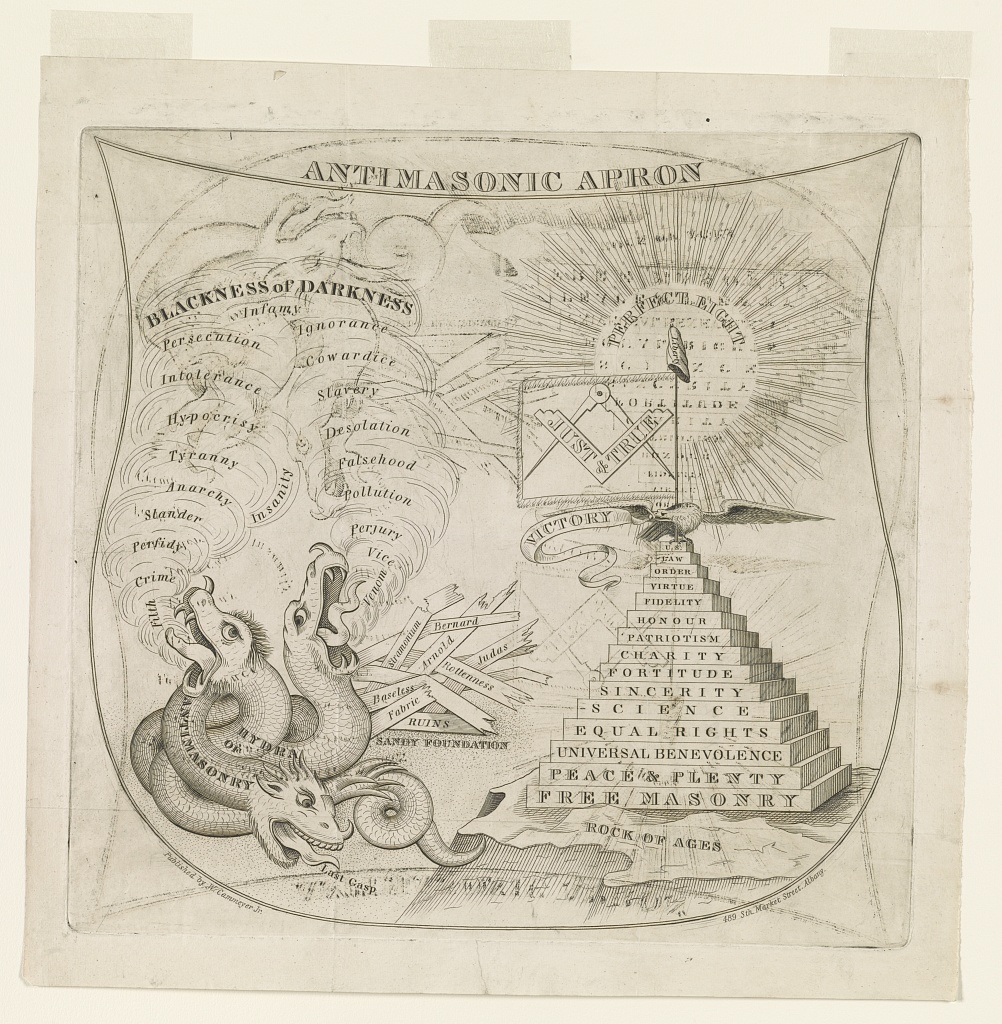
WASHINGTON, DC — The First Anti-Masonic Party, established February 1828 in upstate New York, was the earliest third party in the fledgling United States of America. The party emerged as a strong opposition force to the Jacksonian Democrats and Van Buren’s Albany Regency during the House of Representatives election of 1828. Originally a single-issue party, Anti-Masonic sentiment in the American Northeast was spurred by the disappearance and alleged murder of William Morgan, a former Mason who became outspoken against, and voiced his intent to publish a book critical of, the fraternity. Following these statements Morgan was arrested on “trumped-up” charges, and his subsequent “disappearance” was believed to have been committed by Freemasons from Western New York.
In [September] 1831 the Anti-Masonic Party convened in Baltimore, Maryland to select a single presidential candidate agreeable to the whole party leadership in the 1832 presidential election. The National Republican and Democratic parties soon followed suit.
https://en.wikipedia.org/wiki/United_States_presidential_nominating_convention#History
The Anti-Masonic Party conducted the first presidential nominating convention in the United States history for the 1832 elections, nominating William Wirt (a former Mason) for President and Amos Ellmaker for Vice President in Baltimore. Wirt won 7.78 percent of the popular vote and the seven electoral votes of Vermont. Soon the Democrats and Whigs recognized the convention’s value in managing parties and campaigns and began to hold their own.
https://en.wikipedia.org/wiki/Anti-Masonic_Party#Conventions_and_elections
The major paradox and triumph of Antimasonry is that although it declined rapidly as an independent political entity after 1833, it achieved its major success as a social or reform movement in the nearly total, albeit temporary, destruction of Masonry in those states where it was an active force. Politically, Antimasonry’s greatest achievements were the introduction of the national nominating convention to American presidential politics and contributions to the formation and development of the Whig party.
Vaughn, William Preston. The Antimasonic Party in the United States 1826–1843. Lexington: University of Kentucky Press; 1983
The Second Anti-Masonic Party, of tenuous affiliation to the first, was active from 1872 until 1888. It is therefore in this tradition that we establish the Third Wave Antimasonic Party (TWAP) of the United Stated of America.
Anti-Masonry was deeply committed to conspiracy theories, primarily the claim that Masonic elites were trying to secretly control the government […although] opposition to Masonry was not the Anti-Masonic movement’s sole issue. […] The Anti-Masonic movement gave rise to or expanded the use of many innovations which became accepted practice among other parties, including nominating conventions and party newspapers. […T]hey made direct appeals to the people through gigantic rallies, parades, and rhetorical rabble-rousing.
https://en.wikipedia.org/wiki/Anti-Masonic_Party#Legacy
Similarly, the revelation and denunciation of the international masonic conspiracy (and allied power systems) is the primary platform of the TWAP; however, a party member need not necessarily harbor ardently Antimasonic sentiments. “The fact that William Wirt, their choice for the presidency in 1832, not only was a former Mason, but also defended Freemasonry in a speech before the convention that nominated him indicates that opposition to Masonry was not the Anti-Masonic movement’s sole issue,” Wikipedia relates.
It is probably not a coincidence that the First Party Convention in Baltimore was held in an Odd Fellow stronghold. Whatever the reason for touting the Antimasonic platform, it provides a broad and adaptable alternative to the ostentatious and disingenuous displays of the present Democratic-Republican party system.
Party Platform
Freemasonry is an ancient international conspiracy manifest through a subversive organization whose members have deceived the public for over 300 years and which operates behind the curtain of the deep state. Through mercantilism and control of international commerce, they are the most organized crime syndicate in the history of the world — but they are only the hidden hand and avant-garde of an even more elitist and secretive cabal of temporal rulers.
Our foremost demand is the abolition of Freemasonry, and a federal interdiction against the gathering of any secret society in any state of the Union.
We seek to unite the far left and the far right 180 degrees from political center which is squarely within the sphere of international Masonic control. It is time for the working people to unite against the rulership (the archons), the aristocracy, the bourgeoisie, and the landed gentry, and receive the return of the disbursement of the accrued value of their labor power which has been stolen over the course of their life through usury.
A bastardizarion of Templar Knights, pirates, mystery schools, and merchants guilds, Freemasonry has become a bane of civilization, and a scourge upon the moral fabric of our society. This scourge pervades both political parties in our two party system, in addition to the whole cabal of Greek organizations, professional societies, bar associations, medical systems, and international insurance and business concerns. The deep state society of Freemasonry must be eradicated, its veil of evil unveiled, its associations dissolved, and its property conveyed to the People, so as to prevent it from exercising its convert and subversive control over the vital forces and mechanisms of our civilization.
RESOURCES
http://utlm.org/onlinebooks/captmorgansfreemasonrycontents.htm
(last modified 5 Nov 2023)
© MMXXIII BY NOVUS SYLLABUS L.L.C.
ALL RIGHTS RESERVED WITHOUT PREJUDICE.
D.R. 01-07: BLK MKT, &c.
Volume 1, Issue 7
CONTENTS — Art. 1. N∴S∴ Director awarded grant… — Art. 2. …Black Market Press — Art. 3. …the Syllabus in Postmodern Literature… — Art. 4. …Public Trust… — Art. 5. From Laurie Lewandowski
Article 1
N∴S∴ Director awarded grant by D.C. Arts and Humanities; establishes Office of Diversified Art Investments
By Antarah Crawley
WASHINGTON, DC — NOVUS SYLLABUS L.L.C. (N∴S∴) Director Antarah Crawley has been named a Fellow of the District of Columbia Commission on the Arts and Humanities (DC CAH). DC CAH has conditionally awarded Crawley a grant to support his artistic practice. In response to the Arts and Humanities Fellowship Program Request for Proposals, Crawley submitted a strong application centered on the Art¢oin Non-Fungible Token mint project and the IBé Arts Institute-sponsored Tubman note issue project. The Director will use part of the proceeds of this grant to establish the N∴S∴ Office of Diversified Art Investments.
Article 2
N∴S∴ establishes Black Market Press
By Antarah Crawley
NACOTCHTANK, OD — NOVUS SYLLABUS L.L.C. (N∴S∴) establishes Black Market Press (BLK MKT) on October 20, 2023, with the publication of Visible: The Art of Her Story by IBé Crawley, which is released upon the occasion of the Grand Reopening of the National Museum of Women in the Arts. N∴S∴ Director Antarah Crawley is the Publisher and Editor-in-Chief of Black Market Press. The Press is affiliated with A.I.C. Consulting for distribution services.
(last modified 19 Oct 2023)
Article 3
Notes on the syllabus in postmodern literature and common law
By Antarah Crawley
NACOTCHTANK, OD — Circa February 2013, I was reading a lot of postmodern American novels leading up to and during the publication of Title 1 C.S.R. Pharmacon of the Spirit, which was my contribution to the genre American postmodernism.
Postmodern literature is a form of literature that is characterized by the use of metafiction, unreliable narration, self-reflexivity, intertextuality, and which often thematizes both historical and political issues. This genre is best exemplified by the works of Jorge Luis Borges, James Joyce’s Ulysses (often considered modernist), Flann O’Brien’s At Swim-Two-Birds, William Gaddis’s The Recognitions, William S. Burroughs’s Naked Lunch, Anthony Burgess’s A Clockwork Orange, Hunter S. Thompson’s Fear and Loathing in Las Vegas, Gabriel García Márquez’s The Autumn of the Patriarch, Margaret Atwood’s The Handmaid’s Tale, Salman Rushdie’s The Satanic Verses, Bret Easton Ellis’s American Psycho, Don Delillo’s Mao II, Toni Morrison’s Beloved, William Gass’s The Tunnel, David Foster Wallace’s Infinite Jest, Thomas Pynchon’s Mason & Dixon, Dave Eggers’s A Heartbreaking Work of Staggering Genius, Zadie Smith’s White Teeth, Jonathan Safran Foer’s Everything is Illuminated, Roberto Bolaño’s 2666, David Mitchell’s Cloud Atlas, and (in my opinion) Blake Butler’s 300,000,000, among many (but not countless) others. Thomas Carlyle’s Sartor Resartus is an excellent precursor to the genre from the 1830s.
Now I can’t say that I’ve read every page of each of these magnum opuses (indeed, anyone who says they have is likely full of it – even if they’re not lying). But I will say that it was the spirit of these works – the spirit of the “late modern” times – which bore a hole in me and fulled me with inspiration. It certainly beat What Masie Knew in GW’s English lit courses. In short, you can say that “Postmodern literature” means all of the most exciting literature this side of World War II.
At that time, I wanted to throw my hat into the ring a major figure in American postmodern literature, and an “African American” to boot. However, after querying New York agents and reading the manuscript over, I determined, alas, it was not very good. But my judgement at that time would belie itself, since the events of the novel, though not good enough to publish, were good enough to live. I ultimately would end up doing the things in my life that Walter Kogard did in Title 1 and thereafter, including live in New York, found a Secret School, and become editor of the Black Market Press (1 C.S.R. pgs. 278-282). How’s that for American postmodernism?
Recently, while researching McGirt v. Oklahoma and other Indian affairs, I came across the phenomenon of a legal “syllabus” which is a preliminary section of a court ruling, preceding the legal opinion of the court, that outlines the core facts and issues of the case and the path that the case has taken prior to reaching the present court. They are, in effect, summaries, and are not to be considered part of the actual decision of the case and are not precedential. This new information struck a chord in me, as my organization of the New Syllabus had proceeded from research focused on postmodern literature and print publishing to occult and esoteric studies to pseudo-law, equity, and sovereignty. Furthermore, the U.S. Supreme Court writes, “All opinions in a single case are published together and are prefaced by a syllabus prepared by the Reporter of Decisions that summarizes the Court’s decision.” This got me thinking about the origin of the name New Syllabus.
I chose the name New Syllabus for this deeply personal academic endeavor in 2013 in homage to the postmodern American novel Giles Goat-Boy or The Revised New Syllabus of George Giles our Grand Tutor by John Barth. Again, I can’t say I read much of this book either, and what I did read I forgot until just moments before writing this article. But as I refreshed my recollection I realized that I must have subconsciously adopted the novel’s conceit as a premise on which to navigate the real world. The Plot summary reads:
George Giles is a boy raised as a goat who rises in life to be Grand Tutor (spiritual leader or messiah) of New Tammany College (the United States, or the Earth, or the Universe). He strives for (and achieves) herohood, in accordance with the hero myth as theorized by Lord Raglan and Joseph Campbell. […]
The principle behind the allegorical renaming of key roles in the novel as roman à clef is that the Earth (or the Universe) is a university. Thus, for example, the founder of a religion or great religious leader becomes a Grand Tutor (in German Grosslehrer)
Wiki
It seems to me that I have (unintentionally) mimicked the novel’s narrative, from establishing a school after the model of the world to automating that school using a system of codes and algorithms (the “computer”):
Giles Goat-Boy marks Barth’s emergence as a metafictional writer.[3] The metafiction manifests itself in the “Publisher’s Disclaimer” and “Cover-Letter to the Editors and Publisher” which preface the book, and which each try to pass off the responsibility for authorship onto another: the editors implicate Barth, who claims the text was given to him by a mysterious Giles Stoker or Stoker Giles, who in turn claims it was written by the automatic computer WESCAC.
Wiki
It is as if the “Publisher’s Disclaimer” is the legal syllabus to Barth’s Revised New Syllabus, and the N∴S∴ Director is the Reporter of Decisions of American belles-lettres, courts of law and equity, and historical dialectics.
At this time, I cannot say if Barth’s vision of the Universe is wholly “metaphysical” or not – it certainly has panned out accurately for me in the material realm, although few others understand my “research.” I have indeed reared up a school and filled its halls with tomes (and sat alone hearing the echo of my voice). Borges says the Universe is often called the “Library,” another objective correlative which became engrained in the New Syllabus starting at Title 3. All in all, the postmodernists Barth and Borges have firmly anchored their symbols in my worldview … for better or for worse.
(last modified 23 Oct 2023 24 Oct 2023)
Article 4
Notes on the Public Trust of the Moorish People
By Antarah Crawley
NACOTCHTANK, OD — The Consular Court of al-Maghreb al-Aqsa, Trustee, of the Public Trust of the Moorish People, Heirs Beneficiary, to the People of Anacostia, Washington District, Send Greetings and Peace.
The land east of the Eastern Branch of the river Potomac is called Nacotchtank-on-Potomac, and the people there are one village. This village is within the federal district of the Ouachita Confederacy of indigenous peoples of North America (which are registered under many names), in the jurisdiction of the Farthest West (al-Maghreb al-Aqsa), being the lands and waters from the Barbary States to the westernmost continent of the Americas (al-Morocco), which is called “the land of large buffalo.”
NATIONALITY: The Moorish people are an autochthonous people (descended from this land) indigenous to both Africa and the Americas. The United States of America (USA) has a trust responsibility to the Moors, as it would to any American Indian/Alaska Native (AI/AN) tribal nation, insofar as it has a responsibility not to infringe on their treaty rights. And whereas AI/ANs do not believe in legal titles in land, the equitable use title to land and stock is found in the nature of a sincerely-held belief and religious, ritual, or ceremonial customs. And whereas AI/ANs do believe in birthright inheritance, this right is further enshrined in the Constitution of the USA which upholds the sanctity and protection of life, liberty, and property.
AUTHORITY: This consular court is authorized under treaty between the United States of America (USA) and the Kingdom of Morocco to represent the moorish nationals domiciled on the land governed as USA. It is a religious institution insofar as it is an assembly of the faithful believers in the dogma of redemption and of the ancient moorish science, and an organization of religious/education colleges and orders.
DOGMA: The people are the church, and the church is the body of Christ, ergo the people are the body of Christ, who is their counselor, judge and king before God the Father, and whose ministers are their representatives on the earth. Those who will say that He is the Sovereign of the earth are indemnified by Him from the penalty of sin in this life and in the hereafter. Those who follow His law of divine reciprocity shall receive mercy on the Day of Judgment. (The Divine Mother and the Holy Spirit are also to be praised.)
OPERATION: The legal name and owner of the courthouse shall be [S∴P∴Q∴M∴, Inc.]. It shall look like a mosque  , be called the church
  ️, and function as school and consular courthouse
  . The consular court shall serve the circuit of the Ouachita District.
REGULARITY: Hold A.M. court business docket and P.M. UA on weekdays; hold Interfaith Religious Service (IRS) service on Friday night and Saturday morning; hold Sundays open.
PRESIDENCE: The court shall be presided over by Consul General Magistrate Judge (CGMJ) Vice Consul General (CG), Vice Magistrate Judge (MJ), Grand Preceptor/Grand Scribe/Grand Tutor, Ombuds, Syndical Committee Chairs, Sergeant (Sgt) at Arms, Imam/Mullah, Rabbi/Moreh, Archbishop/Presbyter/Elder, Tribune of the People, and People assembled. Some of these offices may be encumbered by the same individual.
AMENDMENT IN THE NATURE OF NOTES OF 23 OCT 2023
(1) N∴S∴ was chartered as the livery company (an official company identified by a special design or color scheme) of the Worshipful Company of Scribers (See, Notice of 27 Sep 2018), whose senior permanent staff member shall be the “Systems Dep’t Intermediary Zone (InterZone) Clerk” and whose junior permanent staff member shall be the “Systems Dep’t Knowledge Zone (KnownZone) Cleric” (See, Title 3 C.S.R.). Note that there is no clerk in the O Zone. These three Zones together comprise the DataHorse system of the N∴S∴ Dep’t of Information Systems Intelligence Services (DISIS).
(2) Circuit courts are historically routes through county towns traveled by judges (in the early U.S., Supreme Court judges) and their retinue of attorneys on horseback (the circuit riders). Modern circuit courts are, generally, jury trial courts that may have review authority over a lower court such as a juvenile and domestic relations court.
(2)(a) The concept of circuit riders may be a legacy of the equestrian class of ancient Rome.
(2)(b) A livery is a place that will keep and take care of a horse on behalf of its owner, for a fee.
(3) Courts of Sessions (or “sittings,” another name for proceedings) were established in particular towns or counties. They were replaced by one Crown Court (for criminal matters, and High Court for civil matters), like unto one supreme Court (both criminal and civil/commercial/equitable), or one holy catholic and apostolic Church (political body masquerading as sovereign body of Christ/the People).
(3)(a) Officers of such court include:
(3)(a)(i) The Circuit Rider(s), the judge(s) of sessions/sittings who ride the circuits on commission of oyer et terminer (“hearing and determining”) setting up court and summoning juries in assize towns; those who shall sit at the Dais of the court.
(3)(a)(ii) The Clerk(s) [or, cleric(s)], the keeper(s) of the record; those who shall sit at the Desk of the court issuing and receiving order and papers (See, this Amendment § (1), above).
(3)(a)(iii) The Rapporteur de la cour (Reporter of the court). (See, Memo. No. 9)
(4) Oyez (“hear ye”) is plural imperative form of oyer (French: ouir “to hear”) from oyer et terminer “to hear and to determine” (a sitting of the court, presided over by a judge of assizes “sessions”).
(last modified 23 Oct 2023 24 Oct 2024)
Article 5
From Freemasonry and the Catholic Church
An Excerpt | By Laurie Lewandowski | October 17, 2022
[W]hile Catholics do believe in the immortality of the soul, we reject that doing good works and moving up in ranks (degrees) helps souls get to heaven. This type of heresy was condemned by the Church in 5th century during the Pelagian heresy, which erroneously taught Christ didn’t redeem the human soul, but with good works one can be redeemed. The Church teaches that our immortal souls are redeemed through Christ alone and that through the power of baptism we are saved. (I Peter 3:21).
Freemasonry is a religion which is gnostic (hidden or secret knowledge is power), rationalistic (reason alone guides us into all truth), syncretistic (melding of all world religions, giving equal footing to them all), relativistic (you have your truth and I have mine.), and indifferent (just keep quiet and get along, it doesn’t matter what you believe.) This indifferentism associated with Masonry is probably the most urgent reason to reject it. For a Catholic (and other Christians), the fact that Masons’ “creed” is to ignore Jesus as the Way, is more than just problematic. Jesus promised us division by His Name (Luke 12:51). We must never deny the name of Jesus for the sake of unity. This is one of the grave evils in our modern society. Further, the swearing of oaths, placing the lodge over any other authority, and the inimical relationship between Masons and the Church are additional reasons for the Church’s condemnation. Finally, eight popes from St. Clement XII (1738) onward have condemned it, teaching of its grave sin. Pope Leo XIII writes Inimica Vis, ch.2,
Our predecessors in the Roman pontificate have in the course of a century and a half outlawed this group not once, but repeatedly. We too, in accordance with Our duty, have condemned it strongly to Christian people, so that they might beware of its wiles and bravely repel its impious assaults. Moreover, lest cowardice and sloth overtake us imperceptively, We have deliberately endeavored to reveal the secrets of this pernicious sect and the means by which it labors for the destruction of the Catholic enterprise.
Pope Leo XIII, Inimica Vis, ch.2
Use this resource to pray for release from the Oaths of Freemasonry and repent.
© MMXXIII BY NOVUS SYLLABUS L.L.C.
ALL RIGHTS RESERVED WITHOUT PREJUDICE.
D.R. 01-03: UA
Volume 1, Issue 3
An Act to Establish and Regulate a Mystery School System for the Decentralized and Autonomous Administration of General and Higher Education.
By Antarah Crawley
Article 1. Universitas
(1) There is hereby established an institute named Universitas Autodidactus, FLF-DAO, which means “Self-Teaching University, a firm league of friendship in the nature of a decentralized autonomous organization.” This institution may be abbreviated “UA.”
(2) The UA shall operate as one firm. This firm shall be organized by a system of syndicates which are themselves organized into colleges. Any vested member of a syndicate under Article 3 (called a “student” or talib) shall be a beneficial member of the firm. Any student who vouchsafes their trust, faith, and/or belief in the operations of the firm shall be a member thereof.
(3) The firm shall be governed by a “Steering Council,” or “Committee of the Whole,” composed of two delegates (called “friends”) elected by each Syndicate and confirmed by their respective Collegium. The friends shall represent their collegiate syndicates in the firm in their own private sui jurisdiction (the “private” or “interior”). These “friends” of the firm shall be the trustees thereof.
(4) The Steering Council shall assemble at the national and global levels. The Officium Tribunus Plebis shall be incorporated into the organization of the National and International Steering Councils by reference.
(5) Assemblies of this governing body of the firm shall be held in the nature of a public meeting, shall follow Robert’s Rules of Order where appropriate; and shall duly notice all regular and special meetings.
Article 2. Collegium Ecclesia
(1) There is hereby established within the firm a forum of Collegium Ecclesia Syndicatus, which means “United Assembly of the Society,” which may also be known as an “Ecclesiastic College,” which is composed of committees (called “syndici”) of student bodies. Herein, “syndicate“ is synonymous with “committee,“ which is synonymous with “student body.“
(2) Such a College may be organized or united on the basis of locality with diversified syndication, or on the basis of a particular discipline, subject, trade, craft, or operation.
(3) The syndici constituting the College shall serve the function of disciplinary departments, and may be styled “Syndicatus [Disciple/Subject], Collegium Ecclesia [Local/Name].”
(4) A member of a syndicate, or student, shall be called “syndicus,” meaning “syndic.”
(5) Assemblies of this governing body of the firm shall be held in the nature of a public meeting, shall follow Robert’s Rules of Order where appropriate; and shall duly notice all regular and special meetings.
Article 3. Syndicatus
(1) There is hereby established within the forum of Collegium Ecclesia a mechanism to allow a member of the firm to establish a syndicate by acclamation (Latin: acclamatio, a vote by means other than ballot) of two or more additional students (the “public”) known as the student body.
(2) There is hereby chartered and instituted within the firm The Chairman, the Elective Faculty and Student Body of the Society of the New Syllabus, which may also be known as “Societas Novus Syllabus” which means “The Society of the New Syllabus.” This syndicate, or committee, shall constitute its own college, shall stand perpetually, shall be governed by NOVUS SYLLABUS L.L.C., and shall have a chair at the global and national Steering Councils of the UA.
(3) Proceedings of syndici shall include: Semester, Course [of study], Seminar [on subject], and Symposium [on theme]. Such proceedings may be styled “Subcommittee on […],” and shall follow Robert’s Rules of Order where appropriate.
(3)(a) A course is served by a CORPS of the same control number. Course work is administered by the CORPS of the same control number.
(4) Attendees of collegiate, ecclesiastical, and syndical proceedings shall be attired in a white shirt or garment and black or dark jacket.
(5) The UA shall provide to the public a “service” by and through its syndici, in receipt of which the public shall make an offering of their own free will and accord (“deposit”) as a token of their trust, faith, and/or belief in the services provided by the firm, thereby becoming a benefactor of the proceeding and a member of the firm. It is this exchange, made freely, knowingly, and voluntarily by the public to the private that re-venues the current “C” from the exterior to the interior of the firm.
(6) It shall be the prerogative of the syndici to provide for the dispatch of deposit collectors styled “treasurer” and subordinate “comptrollers.” The deposit collected shall constitute a vested interest in and appreciation of the subject matter of the proceeding, and shall inure to the benefit of the Syndicate. This is to say that at every proceeding in which the public appreciates the subject matter, there shall be a discharge of deposits.
(Last modified 19 Sep 2023 4 Oct 2023 19 Oct 2023)
© MMXXIII by NOVUS SYLLABUS L.L.C.
All Rights Reserved Without Prejudice.
market.c
OFFER/ACCEPTANCE OF PRODUCTS AND SERVICES
1. INDUSTRY: There is established a market for the commerce of light work. Light means knowledge which is conferred by degrees. Work means labor. Therefore light work is practice of intellectual labor to acquire knowledge. Practitioners of light work are Light Workers; all light workers are information processors with dialectic specialization; all light workers are wage laborers.
2. OFFERING: Light Workers offer to the General Public to confer degrees of knowledge upon persons seeking knowledge for the purpose of self-mastery and civil society. Light Workers confer degrees of knowledge through the practice of lodge congregation (LC).
HOW TO MARKET PRODUCTS AND SERVICES (PAY ATTENTION)
3. MARKET/INTEREST. If you seek the light of knowledge, and if you will come forth to assemble in lodge to labor in pursuit of the light, then you should contact your local lodge representative to request information systems and intelligence services.
4. MARKET/ACCEPTANCE. The representative will brief interested person(s) and offer them access to information systems. Each infoSystems access password is subject to a free will offering (FWO) of $36 payable to Central Processing Server $antarahcrawley.
4.1. USE OF PRODUCT/SERVICE. These product(s)/service(s) shall equip users to pursue an autodidactic (self-study) course in Knowledge-of-Self, Civil Society, and Information Systems Intelligence. This course will enable users to convene and operate their own LCs. Users may receive support service from Central Processing or their Regional Information Processor.
4.2. GENERAL CONDITIONS. Acceptance of offering entitles users to access infoSystems ONLY. Access does not assume or imply the use of infoSystems to operate LC in Holy C language on FLF-DAO network w/ support service. There is no grant or any other transfer of intellectual property rights whatsoever; and all intellectual properties shall remain the property of N.S., D.I.S.I.S., being subject to all terms set forth in any Use and Service Agreement which may be in existence. Central Processing shall commission Processors to operate LC pursuant to prior written agreement.
5. UNION/FRIENDSHIP. Interested persons may also be offered, and accept, a Certificate of Camaraderie subject to conditions of FWO.
6. INSTITUTION. The Institute of the Mission of Djedu, N.S., D.I.S.I.S., Ordo Djedu, FLF-DAO, FTLU, is the foremost organization working in the avant garde of the light industry to engineer higher vibration frequency among the collective consciousness.
7. Central Processing Service Provider:
Ombudsman Antarah A. Crawley,
Sov. Grand Scribe, N.S., D.I.S.I.S,
Lodge 724 Irving Street
Brookland, U.S.A., 20017
director@newsyllabus.org
(202) 957-6290
(last modified 31 December 19)
Comment on Jorge Luis Borges
Tlon, Uqbar, Orbis Tertius by Jorge Luis Borges
The Moorish Saint Jorge L. Borges craftily grants us the keys to unveiling the present World Order of Mystery Babylon The Great. It goes that a noted heresiarch (possibly Solomon Von Askhkenazim) and a hereditary order of 300 collaborators under the guise of a “benevolent secret society” form one night in London, 17th century, a society of intellectuals called Orbis Tertius (World3), which society becomes involved in studies of “hermeticism, philanthropy, and the Cabala”. The Order endeavors to create a country called Uqbar (Ur [?]), but after a persecution in Europe the Order reappears in America with the new ambition to create an entire world called Tlon. The invented world of Tlon was seeded into reality by these men using a fabricated 40-volume encyclopedia which was “found” complete in Memphis in 1944. “Then,” saith the prophet, “the World will be Tlon”. — analysis by A.A. Crawley, NSA,
from Jorge Luis Borges, Tlon Uqbar Orbis Tertius
 Supreme Exchange