Tagged: reading
[bulla] Full Assurance

Jesus Christ is the Saviour of the World; He is the deliverer from all human wretchedness, and He has redeemed us from death and sin; how could He be all that, if the world must languish perpetually in the shades of ignorance and in the bonds of passions? It has been already very clearly predicted in the Prophets that the time of the Redemption of His people, the first Sabbath of time, will come. Long ago ought we to have acknowledged this most consolatory promise; but the want of the true knowledge of God, of man, and of nature has been the real hindrance which has always obstructed our sight of the great Mysteries of the faith.
Karl von Eckartshausen, The Cloud upon the Sanctuary, Letter IV
Jesus Is Our Surety
“By so much was Jesus made a surety of a better testament.”
[Hebrews 7:22]
INTRODUCTION
- This morning we studied the judgment seat of Christ, for it is the horrible and certain end of all men.
- But tonight I want to remind you of our glorious Mediator and Surety with God, the Lord Jesus Christ.
THE DEFINITION
- Surety. A person who undertakes some specific responsibility on behalf of another who remains primarily liable; one who makes himself liable for the default or miscarriage of another, or for the performance of some act on his part (e.g. payment of a debt, appearance in court for trial, etc.).
- We have surety bonds, performance bonds, bail, and bond to guarantee legal, financial, and professional obligations, such as with construction and insurance companies.
- When we need to borrow more than our credit allows, we appreciate a surety; if we were arrested for something, we would appreciate the surety bond that lets us go free.
- Judah became a surety for Benjamin to his father Jacob (Gen 43:8-10; 44:30-34; 42:37).
- Aaron became a surety for Israel in their sins and stood between them (Num 16:41-48).
THE SURETISHIP
- Jesus, a High Priest after the order of Melchisedec, was made the Surety of His people.
- God chose Jesus from among the people to be the mighty Surety (Psalm 89:19).
- He was made Surety by God’s oath at His ordination as our Priest (Heb 7:21).
- Jesus did the will of God perfectly as our Surety for our salvation (Heb 10:5-14).
- Being a surety means paying debts and performing, where the needy cannot pay or do.
- The wages of sin is death, which God’s justice pays; but Jesus died (Rom 6:23).
- Only the undefiled enter heaven, so He lived faultlessly for us (Jude 1:24-25).
- Jesus was necessary as a surety, for the justice of God must surely be paid (Rom 3:26).
- He is the Testator, for it was by His death that He put the covenant in force (Heb 9:15).
- We see Him under the strain of the Surety engagement in Gethsemane (Luke 22:39-44).
- No man in heaven or earth could approach the throne, but only our Surety (Rev 5:1-14).
- If this is not a Surety, successfully finishing His work, what is it (Isaiah 53:4-12)?
- The doctrine of representation by the Second Adam reveals our Surety (Rom 5:15-19).
- The Lord Jesus tasted death for every one of His children to deliver them (Heb 2:9-17).
- How else can we look at the Book of Life, but as the list of His Surety engagements!
THE BENEFITS
- The Lord Jesus fulfilled the righteousness of the law on our behalf (Rom 8:3-4), so that we are righteous in God’s sight with His perfect obedience (Eph 5:25-27; Col 1:21-22).
- The Lord Jesus paid the penalty for sins by His death for us (I Pet 2:24), so that there are no more sins against our charge when we stand before Him (John 1:29; Heb 9:28).
- He lives to make sure we are absolutely, completely, and eternally saved (Heb 7:25).
- There is an abundant entrance into heaven waiting for the children of God (II Pet 1:11).
- Since Jesus is our Surety, it is impossible for God to withhold blessings (Romans 8:32).
- His death reconciled us to God, but He still lives to be an eternal Surety (Romans 5:10).
THE APPLICATION
- There is no fear in the proper knowledge of Christ Jesus our Saviour (II Timothy 1:12).
- The LORD will show us His secret and covenant, if we fear and seek Him (Ps 25:14).
- We must learn to trust Him. He has done it; He is in heaven for us; He will receive us.
- It is simple: “Whosoever believeth on Him shall not be ashamed” (Rom 9:33; 10:8-11).
- A woman was healed and had her faith commended, when it was weak (Mark 5:25-34).
- Those who lack faith and assurance, I ask how many minutes you spend seeking Him.
- And you should consider long and seriously His faithful words “no wise” in John 6:37.
- We should seek and receive the benefits of the covenant in our hearts (Eph 3:14-19).
- Let us bring forth the fruit of righteousness with far-sighted vision (II Peter 1:9-11).
CONSLUSION
- The Lord’s supper is a memorial feast of our Surety’s covenant death for us (I Corinthians 11:23-26).
- Let us partake of the Lord’s supper tonight with the joy that His suretiship should put in our hearts.
CITATION
I AM THE L.O.R.D. THY G.O.D.
Drafted by Antarah
I AM the Land Owner Record of Deeds, thy Grantor Of Dominion. My body is the Land and I AM the Owner of Record on the Deed of my Live Birth Certificate. I have granted unto thee the use of my Dominion over the earth, the sea, and all that therein is; for thou art a corpus (“dead corporation”) who is in want of my natural right which I have through the sacrifice of my Savior. My life secured and bonded by the LORD my GOD, let thy presentment pass over me and return unto thee; for said presentment is hereby ACCEPTED FOR VALUE AND HONOR WITHOUT PREJUDICE. I hereby attest and assert my equitable title over the landed estate (“person”) named on the instant presentment. Any obligation of such person is an obligation discharged to and held by the United States as evidenced by the signatures of its Treasurer and Secretary of the Treasury on Federal Reserve Notes, these officers being the de facto fiduciary agents of the estate __________________. All debt is prepaid by the blood of Our Sovereign Lord in Christ for relief by recovery upon acceptance for value under House Joint Resolution 192 (1933).
AUTHORITIES AT LAW AND EQUITY
1. GRANTOR OF DOMINION.
[Genesis 1] [26] And God said, Let us make man in our image, after our likeness: and let them have dominion over the fish of the sea, and over the fowl of the air, and over the cattle, and over all the earth, and over every creeping thing that creepeth upon the earth. [27] So God created man in his own image, in the image of God created he him; male and female created he them. [28] And God blessed them, and God said unto them, Be fruitful, and multiply, and replenish the earth, and subdue it: and have dominion over the fish of the sea, and over the fowl of the air, and over every living thing that moveth upon the earth.
2. DEMAND FOR EQUITABLE ADJUSTMENT.
[Psalm 17] [1] Hear the right, O Lord, attend unto my cry, give ear unto my prayer, that goeth not out of feigned lips. [2] Let my sentence come forth from thy presence; let thine eyes behold the things that are equal.
3. THE DAY OF THE LORD.
[Psalm 118] [1] O give thanks unto the Lord; for he is good: because his mercy endureth for ever. [8] It is better to trust in the Lord than to put confidence in man [or princes]. [14] The Lord is my strength and song, and is become my salvation. [17] I shall not die, but live, and declare the works of the Lord. [19] Open to me the gates of righteousness: I will go into them, and I will praise the Lord: [22] The stone which the builders refused is become the head stone of the corner. [23] This is the Lord’s doing; it is marvellous in our eyes. [24] This is the day which the Lord hath made; we will rejoice and be glad in it. [26] Blessed be he that cometh in the name of the LORD […].
4. ACCEPTANCE FOR VALUE.
[Matthew 5] [25] Agree with thine adversary quickly, whiles thou art in the way with him; lest at any time the adversary deliver thee to the judge, and the judge deliver thee to the officer, and thou be cast into prison.
5. THE TAX RETURN.
[Matthew 22] [17] […] Is it lawful to give tribute unto Caesar, or not? [18] […] Jesus […] said, […] [19] Shew me the tribute money. And they brought unto him a penny. [20] And he saith unto them, Whose is this image and superscription? [21] They say unto him, Caesar’s. Then saith he unto them, Render therefore unto Caesar the things which are Caesar’s; and unto God the things that are God’s.
6. A WORKER IS DUE HIS WAGES.
[Luke 10] [5] And into whatsoever house ye enter, first say, Peace be to this house. [6] And if the son of peace be there, your peace shall rest upon it: if not, it shall turn to you again. [7] And in the same house remain, eating and drinking such things as they give: for the labourer is worthy of his hire.
7. GOD IS NO RESPECTER OF PERSONS.
[Romans 2] [9] Tribulation and anguish, upon every soul of man that doeth evil…; [10] But glory, honour, and peace, to every man that worketh good…: [11] For there is no respect of persons with God. [12] For as many as have sinned without law shall also perish without law: and as many as have sinned in the law shall be judged by the law;
8. THE LAW IS BINDING BUT FOR THE REMEDY OF FAITH.
[Galatians 3] [9] So then they which be of faith are blessed with faithful Abraham. [10] For as many as are of the works of the law are under the curse: for it is written, Cursed is every one that continueth not in all things which are written in the book of the law to do them. [11] But that no man is justified by the law in the sight of God, it is evident: for, The just shall live by faith. [12] And the law is not of faith: but, The man that doeth them shall live in them.
9. MINORITY (INFANCY) AND MAJORITY (MATURITY).
[Galatians 4] [4] [T]he heir, as long as he is a child, differeth nothing from a servant, though he be lord of all; [2] But is under tutors and governors until the time appointed of the father. [3] Even so we, when we were children, were in bondage under the elements of the world: [4] But when the fulness of the time was come, God sent forth his Son, made of a woman, made under the law, [5] To redeem them that were under the law, that we might receive the adoption of sons. [7] Wherefore thou art no more a servant, but a son; and if a son, then an heir of God through Christ.
10. SURETYSHIP.
[Hebrews 7] [22] By so much was Jesus made a surety of a better testament.
11. FULL ASSURANCE OF FAITH.
[Hebrews 10] [19] Having therefore, brethren, boldness to enter into the holiest by the blood of Jesus, [20] By a new and living way, which he hath consecrated for us, through the veil, that is to say, his flesh; [21] And having an high priest over the house of God; [22] Let us draw near with a true heart in full assurance of faith, having our hearts sprinkled from an evil conscience, and our bodies washed with pure water.
AUTHORITIES AT EXCLUSIVE EQUITY
Hebrew 10
[22] Let us draw near with a true heart in full assurance of faith, having our hearts sprinkled from an evil conscience, and our bodies washed with pure water.
Isaiah 32
[1] Behold, a king shall reign in righteousness, and princes shall rule in judgment. [17] And the work of righteousness shall be peace; and the effect of righteousness quietness and assurance for ever.
Acts 17
[31] Because he hath appointed a day, in which he will judge the world in righteousness by that man whom he hath ordained; whereof he hath given assurance unto all men, in that he hath raised him from the dead.
Ruth 2
[12] The Lord recompense thy work, and a full reward be given thee of the Lord God of Israel, under whose wings thou art come to trust.
Ps. 17
[1] Hear the right, O Lord, attend unto my cry, give ear unto my prayer, that goeth not out of feigned lips. [2] Let my sentence come forth from thy presence; let thine eyes behold the things that are equal. [3] Thou hast proved mine heart; thou hast visited me in the night; thou hast tried me, and shalt find nothing; I am purposed that my mouth shall not transgress.
Ps. 24
[1] The earth is the Lord’s, and the fulness thereof; the world, and they that dwell therein. [2] For he hath founded it upon the seas, and established it upon the waters.
Ps. 98
[9] …[T]he Lord … cometh to judge the earth: with righteousness shall he judge the world, and the people with equity.
Is. 11
[4] With righteousness shall he judge the poor, and reprove with equity for the meek of the earth.
Matt. 22
[37] Thou shalt love the Lord thy God with all thy heart, and with all thy soul, and with all thy mind. [38] This is the first and great commandment. [39] And the second is like unto it, Thou shalt love thy neighbour as thyself. [40] On these two commandments hang all the law and the prophets.
Leviticus 19:15
Ye shall do no unrighteousness in judgement: thou shalt nor respect the person of the poor, nor honor the person of the mighty: but in righteousness shalt thou judge thy neighbor.
II Chronicles 19:6-7
Take heed what ye do: for ye judge not for man, but for the Lord, who is with you in the judgment. Wherefore now let the fear of the Lord be upon you; take heed and do it: for there is no iniquity with the Lord our God, nor respect of persons, nor taking of gifts.
Heb. 7:20, 22, 25
And inasmuch as not without an oath he was made priest:…The Lord sware and will not repent, Thou art a priest for ever after the order of Melchisedec: By so much was Jesus made a surety of a better testament. Wherefore he is able also to save them to the uttermost that come unto God by him, seeing he ever liveth to make intercession for them.
EQUITABLE SUBROGATION
Subrogation is the process where one party assumes the legal rights of another, typically by substituting one creditor for another. Subrogation can also occur when one party takes over another’s right to sue.
For example, when an insurance company compensates a policyholder for an injury, the policyholder’s right to sue the person responsible for the harm may be subrogated, meaning it is transferred from the policyholder to the insurance company.
[Last updated in June of 2024 by the Wex Definitions Team]
Surety’s subrogation rights
A surety who pays off the debts of another party may be entitled to be subrogated to the creditor’s former claims and remedies against the debtor to recover the sum paid. This would include the endorser on a bill of exchange. The surety will then have the benefit of any security interest in favour of the creditor for the original debt. Conceptually this is an important point, as the subrogee will take the subrogor’s security rights by operation of law, even if the subrogee had been unaware of them.
Wiki: Subrogation
Did you subrogate to the chattels as the surety (or waive your sovereign natural rights in security interest as estate-heir-beneficiary by acquiescing to the color of the court and merging with the NAME of the principal debtor)?
Amyr Samah El, as amended
(last modified 24.07.17.01:33PM)

General Conference
BISMILLAH (IN THE NAME OF GOD)
🇺🇸🇬🇧🇲🇦🇮🇱🏴☠️
⚓️Lord High Admiral Antarah⚓️
TO ALL TO WHOM THESE PRESENTS SAIL
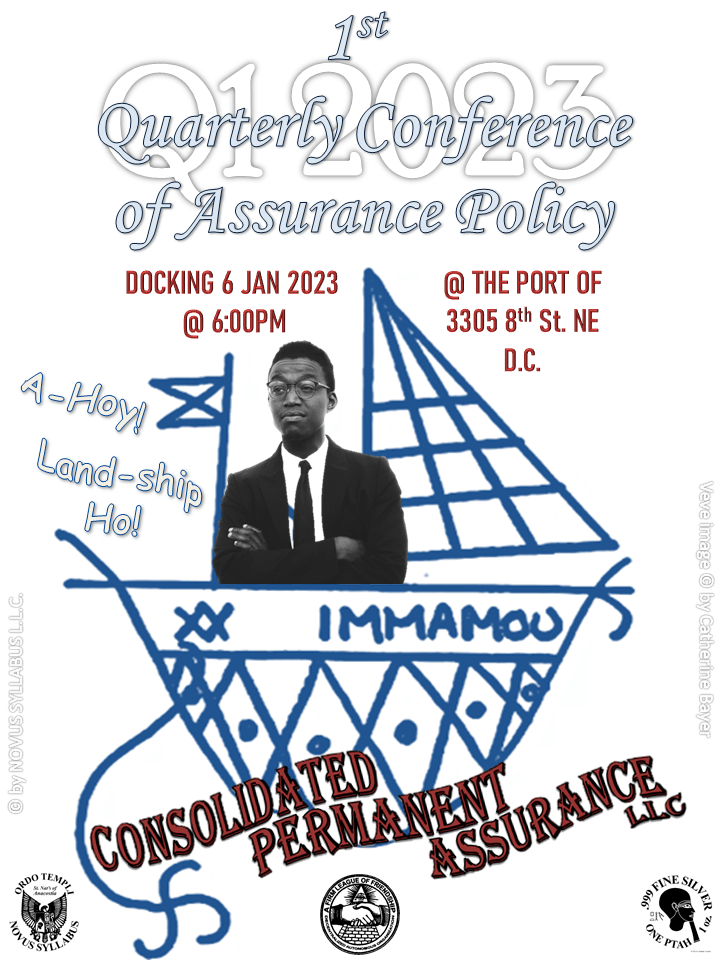
Sends Greeting and Peace and hereby offers to the Free-Thinkers, Truth-Speakers, and Light-Workers United in a firm league of friendship, decentralized autonomous organization, L.S.T.A., under terms and conditions, the Mindsoft©️™️ Flagship Program File (eSyllabus©️™️ vers. no. 22.11.09) to facilitate the General Conference of Assurance Policy.
Program Files:

A Conference of Assurance Policy
“WHAT IS A SURETY SHIP?”
FIRST OFFERED 22 NOVEMBER 2023
📜PRIVATE OFFERING📜
💾Mindsoft©️as a Service™️ (MaaS™️) Premium Servicing Fee of $99.99 per person 💳 payable upon conference for products* and services rendered. Duration of Service: 1-2 hrs.
Upon completion of conference, Assurance Policyholder may be granted C-Series Art¢oin 🪙 (“C-coin”) at market price via 🤝🏿 Handshake of Friendly Association. Contact ombudserver@gmail.com to schedule a conference, or attend the C.P.A. LLC Quarterly Conference of Assurance Policy.
📜POLICY COVERAGE📜
An assurance policyholder, having paid a premium and been conferred with assurance (as evidenced by presentment of C-coin), may bring a claim based on presentment to the CPA LLC at no cost, but there is no guarantee that such claim shall be resolved. Processing fees may apply. Neither the CPA LLC nor its parent nor its agents shall be liable for any claim arising from such a presentment or from such policyholder, as the assurance policy itself is underwritten by God in Christ through the King James Bible, and it is to Him thou shalt appeal for judgment.

(last modified 25 Jul. 2023)
The Flagship Program


presenting our flagship program
A Conference of Assurance Policy
“WHAT IS A SURETY SHIP?”
A Fun, Educational Ritual Drama ©️ by Antarah Crawley
⚓️Ministry of Information⚓️
📜BRIEF IN EQUITY📜
A presentment made without express contract presumes the recipient to be the trustee for a dead person’s estate without surety and not a living Cestui Que. An estate may, however, be entrusted to a “person” (corporation) for the use of a living spirit who may “possess property” in the nature of equitable use title not legal title.
There is sufficient precedent in Roman, Papal, and English law to presume a human body to be chattel property (i.e., a dead person or a mere human creature without soul or spirit) unless otherwise established to posses a soul from God. The cestui que who is presumed dead or lost at sea MUST EXPRESSLY STATE that they are indeed the living cestui que to be given standing as one of the three Chancellors in a Court of Equity and Chancery deciding the matter of an estate (dead person). The common law, as it pertains to the military jurisdiction of the public, cannot abrogate a matter of equity respecting a living free man or woman on the land.
Statue of Mortmain prohibits possession of property by the “dead hand” of a corporation (such as the Church); therefore a “person” (dead in the eyes of God) cannot possess property; rather it reverts to the feudal lord.
The Remedy is that the cestui que (beneficiary) possesses equitable title by nature to the property as a living child of god, but never holds the legal title of the trustee which is the feudal lord or its agent, including any person who is a citizen of the jurisdiction.
There is precedence in Germanic law that a man who holds property on account of to the use of another is bound to fulfill his trust.
Furthermore, precedent is found in the Institutes of Justinian at 2.23.1-2: “… it is required that the one heir is duly appointed and is committed to his trust (Fideicommissum) to transfer the inheritance to another; otherwise the testament in which no heir has been duly appointed is void; the words which are properly and commonly used to install a fideicommisum are I beg, I ask, I wish, I entrust…” This doctrine was brought to England by “foreign ecclesiastics” (ministers and consuls) in order to evade the Statute of Mortmain by making the Church cestui a que use le Feoffment fuit fait.
In sum, cestui que use confers the benefit of use of property to another (a minister or consul) without the legal ownership and attendant duties and obligations to the lord and crown as trustee. Compare to usufruct, or right of use of fruits (interest, profits, etc.) of property.
📜PRIVATE OFFERING📜
💾Mindsoft©️as a Service™️ (MaaS™️) Premium Servicing Fee of $99.99 per person 💳 payable upon conference for products* and services rendered. Duration of Service: 1-2 hrs.
Upon completion of conference, Assurance Policyholder may be granted C-Series Art¢oin 🪙 (“C-coin”) at market price via 🤝🏿 Handshake of Friendly Association. Contact ombudserver@gmail.com to schedule a conference, or attend the C.P.A. LLC Quarterly Conference of Assurance Policy.
*The applicant hereof shall be sent the eSyllabus©️™️ Mindsoft©️™️ program file by email under a limed use licensing agreement to facilitate their conference.
📜POLICY COVERAGE📜
An assurance policyholder, having paid a premium and been conferred with assurance (as evidenced by presentment of C-coin), may bring a claim based on presentment to the CPA LLC at no cost, but there is no guarantee that such claim shall be resolved. Processing fees may apply. Neither the CPA LLC nor its parent nor its agents shall be liable for any claim arising from such a presentment or from such policyholder, as the assurance policy itself is underwritten by God in Christ through the King James Bible, and it is to Him thou shalt appeal for judgment.

Global Charter

Whereas it appears that We will be restricted from assembling freely to eat and drink in a commercial establishment, that whosoever will not partake in a certain experimental medical trial may be restricted from assembling to eat and drink by a commercial maritime ordinance of Admiralty in violation of common life, liberty, and property,
Resolved that We, free of duress or coercion to partake in such trials, and desiring to assemble to eat and drink, and for other educational purposes, do ordain and establish this Honorable Society of Saint Nat’s Inn:—
Art. I. The Inn shall be constituted by a quorum of three (3) members (including the Innkeeper) who, given due notice of the date place and time, assemble in a public or private place around a table replete with all that they desire, wherein they shall eat, drink, speak Truth, and be merry (save such occasion as may warrant more somber observance). Such an Inn meeting shall be called a Symposium, and on such occasions it shall form a College. Only members of the Inn may assemble Hereinn.
Art. II. Interest in the Society shall be distributed in “artcoin” instruments. Life members of the Society, having been invested with artcoin, shall be termed “shareholders”. An artcoin shareholder shall be a member of the Inn. Persons who have petitioned the Society in Due Form to be instructed Withinn and be thereby invested with “artcoin” shall be termed “sojourners”. To come Inn Due Form shall mean to appear at the Inn per due notice to give earnest free will offering of the artcoin liquidation rate as surety for their instruction, in which the sojourner shall assemble Withinn for three (3) sessions of Symposium, after which term they shall be invested with artcoin. Other persons shall be termed “guests” and their presence shall be restricted at will.
Art. III. The Honorable Society of St. Nat’s Inn shall be the Guild* of Live Your Freedom (LYF), Inc. it shall be devoted to the development, education, and fellowship of practitioners in the field of critical thought (known as “dialectic information processing system theory”).
*Our Hon’ble Guild is styled after the English Inns of Court, the archetypal schools of law, themselves descended from Templar guilds, which in turn descended from Pharaonic tradition. As an institution of education our Hon’ble Guild succeeds and subsumes the Ordo Templi Novus Syllabus (OTNS), Men Nefer College, the College of Ancient Mystery, the Bureau of Mindsoft/Department of Infosystems Intel Service, and the subordinate lodges of the New Syllabus Mystery School System.
Art. IV. Holders of “artcoin” as of 14 January, 2022, shall be hereby admitted into the Society and their office as applicable; being:—
Antarah C. (Majority Shareholder), Chair, Treasurer, Managing Director (also known as “Innkeeper”; also known as “Custodian” in their capacity of keeping other valuable records and instruments);
Whitney F., Vice Chair, Secretary, Director;
Checo B., LYF, Inc. (Ex-Officio);
Rod M., LYF, Inc. (Ex-Officio);
Tarik D. (3/3/2021);
Mala E. (4/6/2021);
Aton C. (4/8/2021) (Ex-Officio);
Aldric C. (4/24/2021) (Ex-Officio);
Ibe C. (5/10/2021) (Ex-Officio);
Jeanne F. (5/10/2021) (Ex-Officio);
Cesar M. (7/5/2021);
Anthony W. (11/5/2021);
*Ex-Officio Members shall not count toward a quorum Withinn because the “artcoin” was given in gratis or Member is non shareholder.
V. On attainment of a quorum at the time and place on the date duly noticed, The Innkeeper shall open the Inn after the pouring of libations with the declaration, [Baruch Adonai Ham’voach Atta Kadosh Kadosh Kadosh], The Honorable the Custodian, Chair and Shareholders of The Society of Saint Nat’s Inn are hereby called to order; all sojourners come now and to hear the instructive symposium are invited to draw near, for this College is Hereinn assembled. Oyez Oyez Oyez.
All Praise Be To God To Whom All Praise Is Due,
All Rights Reserved Without Prejudice,
/s/ Antarah A. Crawley, Innkeeper,
By Authority of Ordo Templi Novus Syllabus,
St. Nat’s Court, Anacostia, Potomac River Valley,
2022
Sapientia No. 4

POLICY BUREAU SAPIENTIAL DOCUMENT NO. 4 – AUG. 14, 2020
A BILL
To establish the order of procession of divine faculties of nature.
Djed-i.nk re ([It is] Said Regarding) Netjeru, What first was, and what from thence proceeded? It is a great cycle.
2. What first was in the beginning was the formless, void, and deep darkness of water. Who then is it? Is is Nun. Nun having being, What then is it? It is Khemeneiu Netjeru, the Ogdoad of the [eight] Gods. Djed.iu.k sem Khemennu [Saith the ministers who are at Hermopolis], these eight who are in Khemennu are Nun and Nunet, the Waves of the water, Huh and Huhet, the Infinity of the water, Kuk and Kuket, the Darkness of the water, and Amun and Amunet, the Hiddenness of the water. These eight, being Khemenniu, are in Nun.
3. And the Spirit of God moved upon the waters of Nun. What was it, that the Spirit was so moved? It was Khepera rolling the Spirit of God out of the waters of Nun. Who then is it? It is Amun, the hidden, unknown and self-conceived God, being the first to move, and thus be moved, like unto whom there is none other. Djed.iu.k sem Waset [Saith the ministers who are at Thebes], It is Amun who is the Great God, Netjer Aah, Almighty God, Netjer Sekher, whose face and whose name is concealed, imn; Kheper Djesef, who is self-created from that which preceded, who is greater than that which preceded, who is progenitor all that proceeds.
4. And Amun was manifest in one body as Atum, who was raised upon on the benben or the high land raised out of the waters of Nun. Djed.iu.k sem Ianu [Saith the ministers who are at Heliopolis], Atum spat Shu and sneezed Tefnut, who begot heavenly Nut and earthen Geb, who begot in the flesh Wasir and Waset, and Sutekh and Nebethet; thus did this one beget eight. These eight and one gods being in their train; what then is it? It is Pautiu Netjeru, the Ennead of the [nine] Gods. Who was it that formed their bodies’ flesh? It was Khnum upon his potters wheel. Otherwise it is said:
5. Djed.iu.k sem Men Nefer em Het Ka Ptah [Saith the ministers who are at Memphis in the House of the Ka of Ptah], Who is it there upon the Ka mound? Who is it there upon the Ta of Atum? It is Ptah. Ptah the Great Craftsman and Noble Fashioner who gave form to the Ogdoad and Ennead when the desires which were developed in his heart were spoken from his mouth, Re. Who then was it that spoke the names of these Great Gods? It is Djehudi, Scribe of the Gods, Creator of Medu Netjer and all the Arts and Sciences. Ma’at is with him.
6. Heru be with them all. Heru who is born from the womb of Waset, Heru who liveth in Hathor and is established in Sekhmet, who goeth forth each day from the Duat triumphant in victory over the serpent Apep, who slayeth Sutekh who dismembered his father Wasar. Heru is triumphant in the name of Humanity. Let the Blessed go to the West in the train of Wasir Khentiamenti in Ma’at Hotep Anhk Wujab Seneb. Let Heru be vindicated King like his father Wasar before him — Truth, Peace, Life, Health and Prosperity be upon Him. Who then is it? It is Ra Heru-khuti, in his raising on the Eastern Horizon. He goeth forth over the sky in his day boat and saileth each night into Duat to defeat Apep and unite with Wasar. May His body corporate and politic in the people of this Beloved Land and the Blessed Ahku in the Western Horizon be established forever and ever. Amen.
(2 modification(s))
English Syllabus
AN ENGLISH SYLLABUS
“…to obtain power over any given material one need only understand the causal laws to which it is subject.”
—Bertrand Russell, as quoted in Cleanth and Brooks’ “Introduction,” Understanding Poetry, p. 191
The following paper represents the Author’s second attempt to convey the Occult Systems at work in Literary Theory as presented in the Course of Professor Antonio Lopez’s design, commenced and completed in Fall 2015 at The George Washington University. The initial mission of the Author in his commencement of the Course, being to illuminate the god-workings of author and the textual manifestation of its will as perceived by eye & I via a Cabalistic pattern, was poorly embodied in the First Paper; it was much too Occult and not Disciplined enough in the ways demanded by Academic Literary Theory as a school (i.e., it did not accurately enough translate its esoteric significance into academic vocabulary as we have been learning it). The Author remains of the opinion that Occult working are not only present in the Theory, but inherently warranted in their exposition due to the practical way that they (to say “it”: the Cabala) structures this and every other discipline, like a skeleton to a body, or a syllabus to a school. The present paper will more pointedly align the texts of the syllabus of the Course along the ancient Cabalistic pathway to unveil the (con)text-to-author / human-to-god / matter-to-spirit / solid-to-ethereal / being-to-nothingness / condition-to-absolute / phenom-to-nous relationship inherent in all disciplines. The author has had success applying the Cabalistic pathway to various real-world systems—even to those as dry and bureaucratic as the New York City Department of Health—and herein wishes to apply this pattern again to the present system of Literary Theory, with text being at the bottom of the system, being the densest, most matter-full, and author (or writing, the act) being at the very top, the crown, the most ineffable, the most ethereal; and with “meaning” as an absolute pool, encompassing the whole system, we shall elucidate the metaphysical condensation which takes place when the absolution of uniform universal meaning is channeled through an author whose creative process begets a text of new form and invention: a literary text.
A brief priming in the Cabala is required. Without the use of visuals, we may structure the Pattern in a 3-by-7 grid, also a matrix. The matrix describes the relationship of numbers, themselves beholden of certain values. Row 0: 000; Row 1: 010; Row 2: 302; Row 3: 504; Row 4: 060; Row 5: 807; Row 6: 090; Row 7: 010. The 7th Row is naturally the bottom, the 0 Row the Absolute above the peak, Row 1. The 7th Row is matter; the 0 Row absolute spirit. All elements of the disciplines may be plotted on this graph. Below we will examine where the theories within the texts of the Course’s syllabus fall along these coordinates. In our present application, Row 7 represents apprehending the literary act through its evidence in physical text and Row 1 represents the apprehension of the literary act through the act of writing out the text, mediating the absolute spirit of “meaning” through the I / 1 / eye of the author / the point of the pen / into the solidity of text, which in turn (“as above so below”) represents the 0 plane of absolute meaning married to the 1 plane of the authorial ego: together being “10”. To use the eye / I to guide the text from the 7th to the 1st Row (which is to undo the “10” into the “1” and, ultimately, the “0”) is called reading. The numerical spectrum which lies between the 10 and the 0 is arranged according to proximity between matter and spirit, or, here, text and meaning; below, the examination of each “number,” or “emanation,” [Hebrew: sephirah] of meaning will correspond to a text in our Course’s syllabus.
Herein I am not performing reading to support evidence, neither exploiting evidence to support theories (as they have been presented in the Course), but using theories to support Science: the Occult Systems at work in all. Let it be reiterated that Occult Science, the here-defined Undiscipline of Disciplines, or that system which may undiscipline other disciplines to illuminate their commonality, is a malleable application-based System which is as (and more) useful to Academic Critical Theory as Marxist, Feminist, Neo-Colonial, Crip, Queer, or any other application-based theory.
The Cabala may be apprehended, as a structure, through the similar diagram of I. A. Richards’ design, as explained in his “The Analysis of a Poem”. To preface its design, and to explain its need, Richards says “The critic is, throughout, judging of experiences, of states of mind; but too often he is needlessly ignorant of the general […] form of the experiences with which he is concerned. He has no clear ideas as to the elements present or as to their relative importance. Thus, an outline or schema of the mental events which make up the experience of … ‘reading’ a poem, can be of great assistance” (The Lyric Theory Reader, 166). This author is of the same opinion, except that where psychology is employed as the backbone of critical judgement (at the ellipses), this author generalizes the pattern to an Occult one, but it is beholden of the same characteristics; as where a New Criticism was founded upon Richards’ system, so a New Syllabus is erected upon the Occult Systems.
The diagram on page 167 of the Lyric Theory Reader is remarkable, not merely for its simplicity and practicality in visually representing and alining the elements of reading for the education of the new student, but also in its striking resemblance to the ancient Cabalistic pattern of spirit-to-matter manifestation. Richard’s diagram is composed of the words “Arcadia, Night, a Cloud, Pan, and the Moon” being each drawn together by individual lines which taper, or condense, into the center of an eye, from which the same number of lines expand outward and cascade down a six-fold plane. Several things must be observed here. (1) The list forms the base of an inverted triangle whose peak lies at the eye (note all connotations: eyes see, I see, I, 1, phallic, ego, exterior-to-interior transitions); (2) The eye also forms the peak of a triangle which descends unto the six-fold pattern which is its base and earth and depth [note that the Cabalistic pattern contains three triangles, only the highest being upright, the lower two being inverted and pointing to “10,” the earth]; (3) The eye, or the ego, represents a singularity, such as that which lies within a scientific black hole, wherein matter in condensed unto one [1] ultimate point from which it then manifests anew on a different plane of existence: herein the information of text is shown to be being consumed by the eye and regenerated on the interior of the mental landscape, which is the six-fold pattern; (4) Richards’ design can be read Cabalistically both backwards and forwards: “Arcadia, Night, a Cloud, Pan, and the Moon” is the absolute abstract “meaning” at Row 0 being drawn and condensed into the eye (the I) (the 1) at Row 1 and manifested on the subsequent six descending planes unto the base level of text—and it is also the surface of the text, the 10, the base, the words themselves, which are then siphoned by the eye of the reading ego into the system which ascends the number line unto the 000 plane of that text’s absolute meaning. In either design, Richards and Cabala each maintain one absolute plane and seven planes of manifestation, of which one is a 1 / I / eye / subjective ego: first manifestation of differentiation and numerical progression, i.e. time. Richards’ planes are designated {by row number: [mine (his)]}: [0 (0)] “Arcadia, Night, a Cloud, Pan, and the Moon”; [1 (unnumbered)] eye; [2 (1)] visual sensations; [3 (2)] tied imagery; [4 (3)] free imagery; [5 (4)] references; [6 (5)] emotions; [7 (6)] attitudes. The Cabalisitc planes and their syllabic correspondences are listed further below.
Richards later, in “The Definition of a Poem,” defines that structure as “a class of experiences which do not differ in any character more than a certain amount, varying for each character, from a standard experience” (176). He later defines the “standard experience” as that of the poet in the completion of the composition; the text of the composition being merely the evidence that the experience was had, what form in which it was experienced, and those qualities of form which will lend the experience to others as readers reëxperiencing the event. Therefore, within the parameters of this spectrum, the base-matter 7-plane of the poem is the form which the event (to be subjectively experienced by the reader) is conveyed in, the phenomenal evidence of it, and the high-ineffable 1-plane is the “standard,” or perfect, or absolute, experience of it, as aggregated form the multitude of experiences which it may inform, the whole of these being called “meaning,” or, in Occult terms, God.
Row 7 [010] is matter, is text, and in theory is understanding the text at the level of its words alone, the evidence of its manifestation alone, without considering the elementary composition or the etymology or the depth or the implications thereof. The text of our Course which most exactly emulates this nature is Stephen Best and Sharon Marcus’s Surface Reading: An Introduction. Row 7 lies upon the plane of solid matter and is most dense, sitting upon the surface of the earth while on high Row 1 rests ethereal in the heavens. Similarly, Best and Marcus’s theory only accounts for the surface of text, considering the excavation of deep-rooted meaning a fallacy, or, at the very least, unnecessary to good criticism. They first align themselves with Fredric Jameson’s conceit upon Symptomatic Reading that “interpretation should … seek ‘a latent meaning behind a manifest one’” (3) which is as well the Occult thesis; but then they depart on the basis that latent meaning may be apparent from the gaps in the surface of the matter of the text, and thus requires no probing as is required herein. This is fallacious as it assumes that what the text does not say may be glimpsed from a surface observation of it, but requires no investigation of those hollow depths to make use of them. Surface is thus rendered to mean what is “evident, perceptible, apprehensible in texts; what is neither hidden nor hiding”; surface as “materiality”; surface as “intricate verbal structure”; surface as the “location of patterns…within and across texts”, to say that this theory of reading looks for patterns “in order to break free of and reach beyond them to a deep truth too abstract to be visible or even locatable in a single text” (9-11). Symptomatic Surface Reading thus advocates for a look at the superficial aggregate of many texts rather than a probing investigation of the esoterism in one to evoke deep meaning via a critical system. Not only is this oxymoronic due to the desire of these theorists to evoke depth solely from the surface, but it pointedly ignores the obvious nature of every singular text to span the spectrum from matter to spirit, from text to the highest depths of absolute meaning. Remaining in the realm of that which is obvious and perceptible may lay plain the landscape but excavate nothing that cannot be better excavated by localized plumbing. And so in the base-10-kingdom of matter, we either choose to plumb the depths and perhaps risk intention fallacy on part of some divine persona (which we feel to know to exist, and must thus delve in search of) or remain on the surface of matter and merely describe, account, aggregate, accurately, as like a computer. This latter method is all well and good should the reader will to remain in the Kingdom of earth, but we as critics will to ascend up to the heights of absolute meaning, and so remaining upon the Surface will serve us unwell. If surface is “materiality,” then materiality is merely the evidence of deeper Cause which must be excavated to understand the result in any scientific way. The surface of the text should be used to obtain a foundation for summiting the system of literary meaning.
Row 6 [090] is the foundation of ascension from text unto absolute meaning. Since the foundation lies securely upon the surface, the 6th Row accounts for the generative nature of the text proper, i.e., how the physical word is able to conjure in the mind impressions of some other reality. The methods of apprehension inherent in this practice are best represented in our New Criticism readings, foregoing Richards since his model serves as an analogue to our present one. The latter New Critics (specifically, for our purposes, T.S. Eliot, Cleanth Brooks, and Robert Penn Warren) used Richards’ model to imperfect affect as they vehemently crusaded against Intentional Fallacy and insisted on apprehending the text at the level of its impressions and sensations upon the reader. This focus on the text as matter—as syntax, word choice, meter/rhythm patterns, etc. (not much better than the Surface Critics)–emphasizes the bottom of the Cabalistic Pattern, the 6, 7, 8, 9, and 10, or the 4th, 5th, 6th, and 7th Rows, at the expense of the higher cognitive will and mercy and the trinity of consciousness of the god-author persona at the higher Rows of the pattern. Therefore New Criticism lies at the Foundation-9 of the Occult methodology in terms of its mission to illuminate the base-10 of text with the major comprehensive faculties of the 8-intellect and 9-emotion and spans up to the Harmonious-6, but ascends no further than that. But what furthermore entrenches New Criticism at the Foundation of a Cabalistic Interpretation of Literary Theory is its concern with the scientific method of reading and criticizing. While “the language of science represents an extreme degree of specialization of language in the direction of a certain kind of precision,” it must “forego, because of its methods, matters of attitude and interpretation,” matters with which literature is consumed (Cleanth and Brooks, 179); it thus became the necessity of New Critics to impose a scientific methodology of provable interpretation of subjective feelings as based on objective and concrete textual evidence of syntax, meter, etc. In this way they have already begun the work of the Occult Science; similarly as texts are mapped from their form to their impression upon the mind, Occult Science is primarily concerned with mapping the relationship between that which we can perceive (phenomena, matter) to that which we cannot perceive (noumenon, spirit) in the evocation of an objective system of interpretation. Furthermore is it useful to note that Cleanth and Brooks write, “both the impulse and methods of poetry are rooted very deep in human experience, and that formal poetry itself represents, not a distinction from, but a specialization of, thoroughly universal habits of human thinking and feeling” (182). Note the emphasis on depth, and the necessary departure from surface reading via this New Critical Methodology unto the submerged, esoteric, systems of relation. Note also the emphasis upon poetry’s ability to convey, or to conduct, “universal habits” of humanity into unique form; this represents the transition from an Occult absolute meaning of consciousness to its apparent manifestation in form via author. Text, just as Earth, is the result of Divine Cognizance, which is the Cause, the Pattern being the means, or, the methodology. New Critics imply the objectivity of the result without accounting for the Cause; thus necessitating further investigation through the Pattern.
 Supreme Exchange