Tagged: TWAP
Commission 153
NACOTCHTANK’S
153d CORPS
“The Fighting 153d”
REGULAR MEETING
بيت مدرسة
בית מדרש
The Preceptory of
The 1st Ecclesiastic College at
Nacotchtank, Ouachita District
5th International Worker’s Association
& 3rd Wave Anti-Masonic Party (TWAP)
Curricular Operations Research & Publications Services (CORPS)
Division of the Political Bureau of Education (Politburo), FLF-DAO
The Governor of the Society of the New Syllabus (N∴S∴) at Nacotchtank-on-Potomac (Anacostia) District of Ouachita (Washington, District of Columbia), Furthest West (al-Maghreb al-Aqsa) To All To Whom These Presents Come, Sends Greeting and Peace:—
Know ye by these presents that there is a decentralized autonomous organization (DAO) of people, in the nature of firm league of friendship (FLF), which is engaged in the business of self-education, -operation, and -development (Autodidactus), and that this society (Universitas) is organized into associations (Collegia) constituted by assemblies (Ecclesia) committed to certain trades or subject matters (Syndici). These committees, or syndicates, may be constituted in the nature of a public or private meeting, sitting, session, hearing, congress, congregation of worshippers, or other deliberative or collective body having a shared interest (polity). The individual members, or units, of this DAO shall be working people — free thinkers, truth speakers, and light workers united (FTLU) by the collective consciousness and love of their neighbor. Any individual may rise through the ranks of the DAO by acclamation of their polity. Any unit of the DAO may order services from a known service provider, meaning a freely associated firm who is known to supply the DAO, in a client-server—request-response interface.
(b) And Furthermore, that there is hereby established an ecclesiastic college (meaning, assembly of a society) of the members of the DAO who are domiciled in this region, which shall sit and meet in Nacotchtank, and which is empowered to commission syndicates for various purposes.

Notes on Jurisdiction
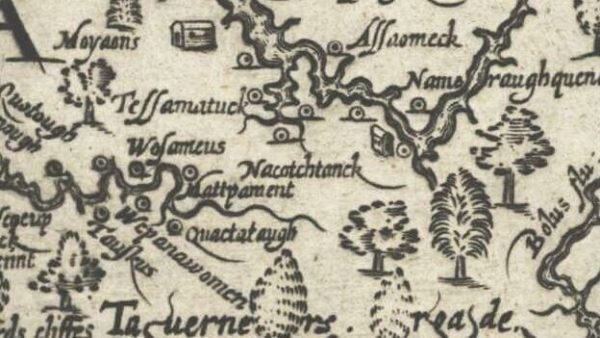
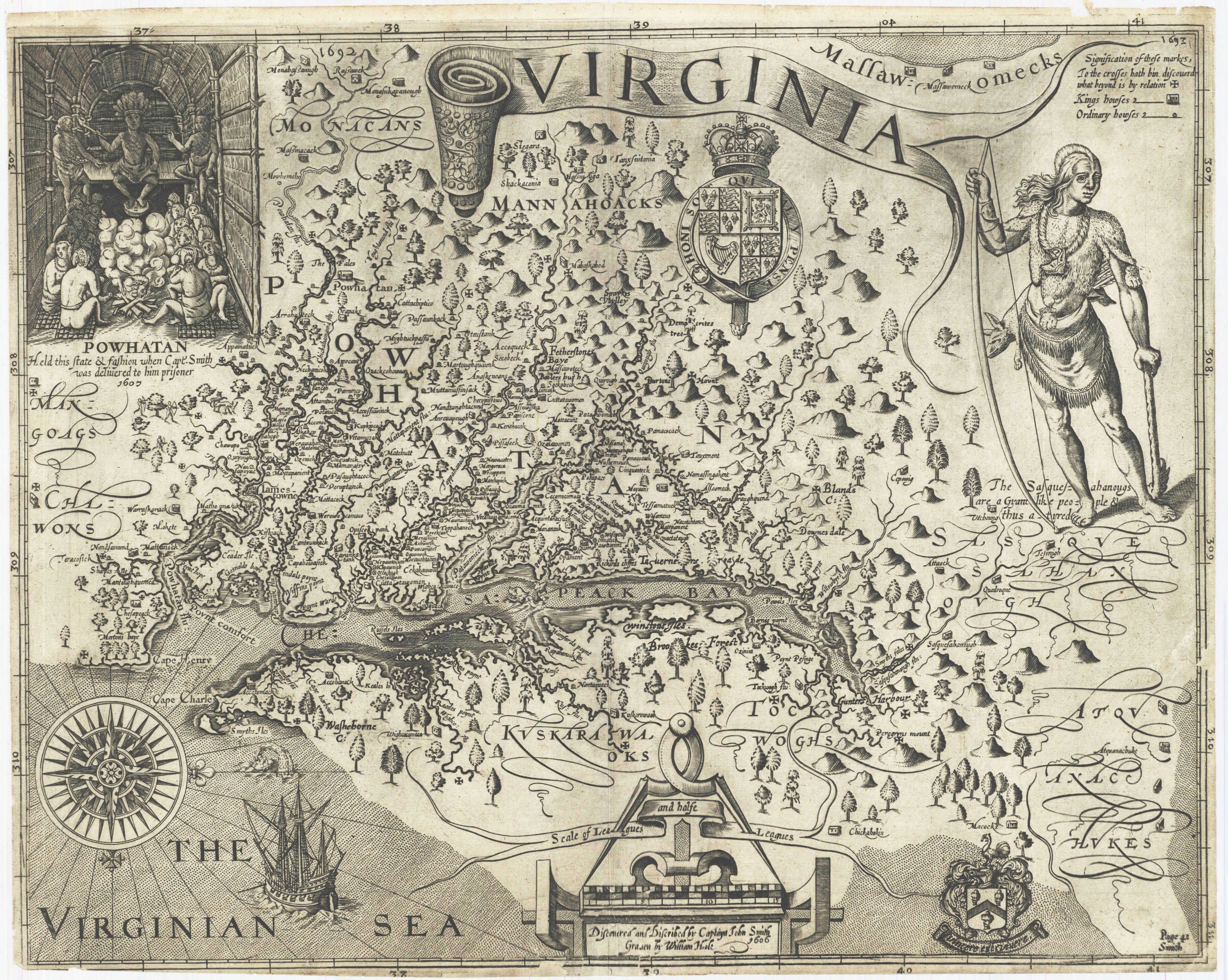
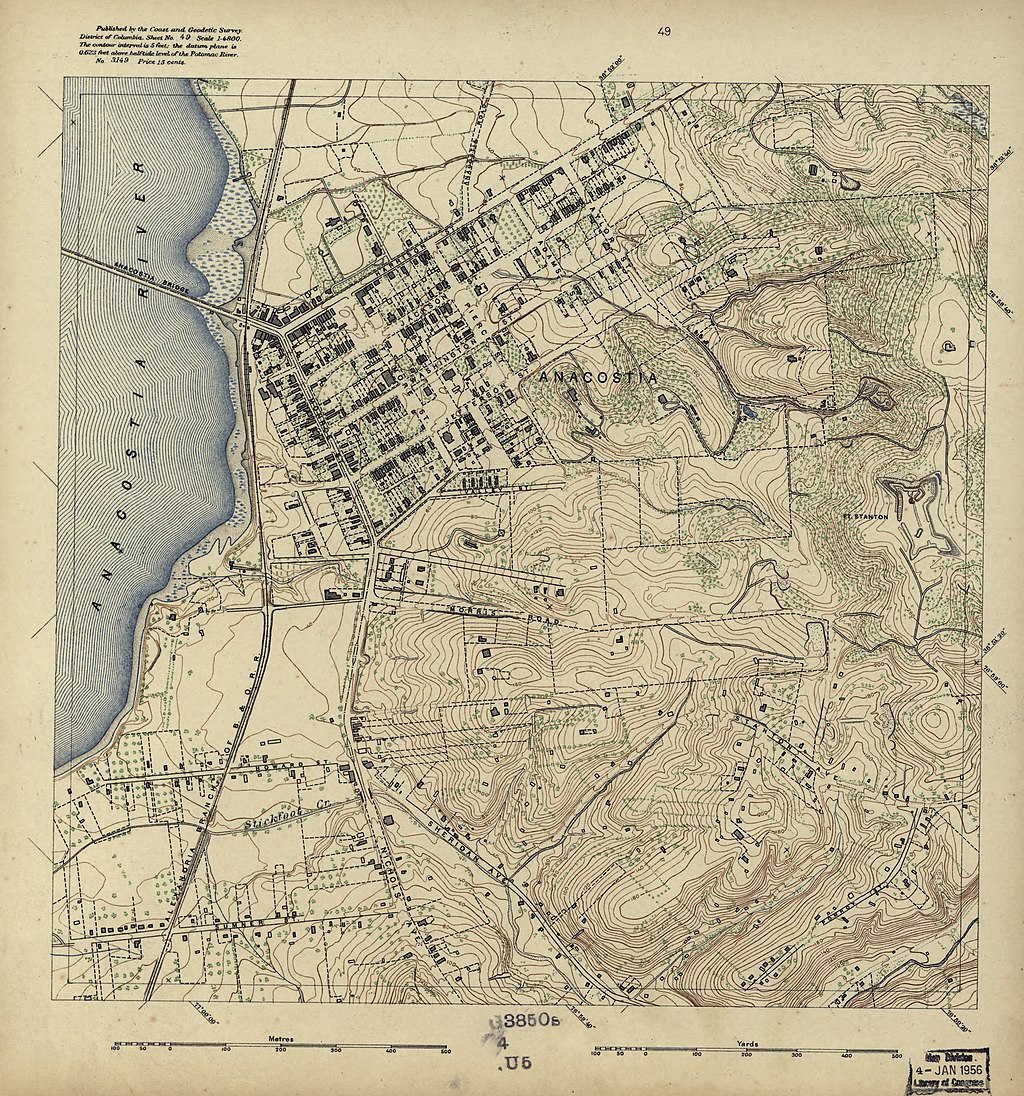
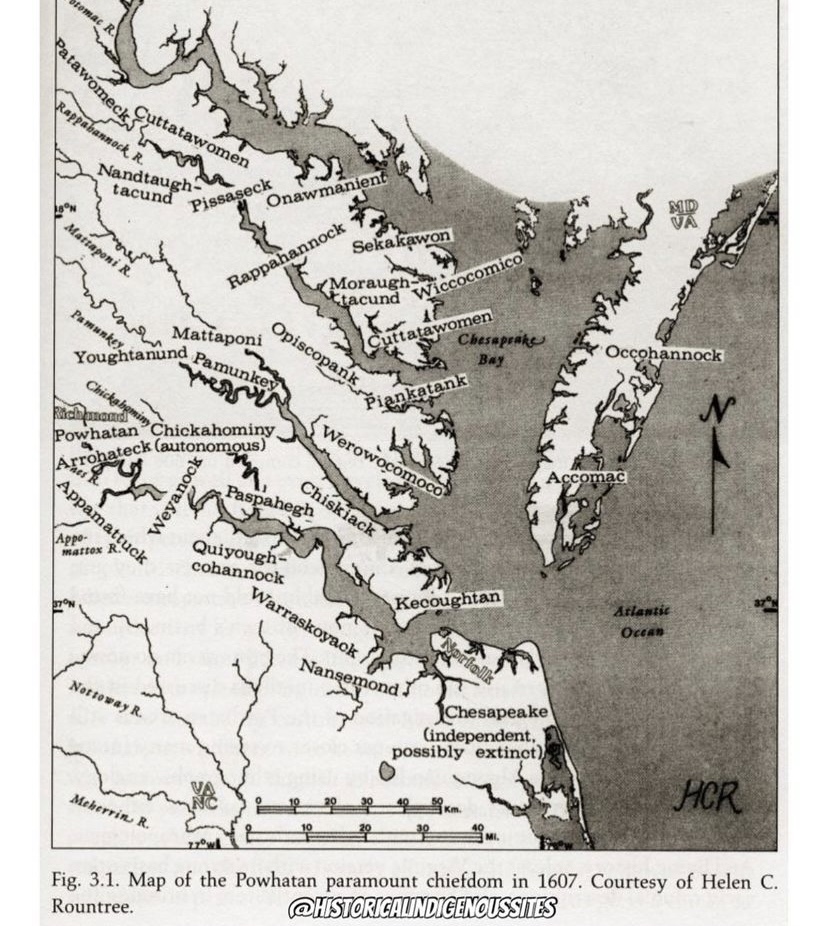
A famous, centuries-old map of the Chesapeake Bay region appears beautiful at first glance, but Anacostia Unmapped contributor John Johnson sees foreboding and destruction. The map, created by Capt. John Smith and first published in 1612, was heavily used by English settlers. It shows a Native American village, Nacotchtank, on the bank of a river. Variations on spelling and pronunciation eventually turned the name of the area — and the river — into Anacostia. The tribe is officially extinct, but a resident of Anacostia, Jason Anderson, tells Johnson about his deep links to it.
The village of Nacotchtank (from which the name Anacostia is derived) was the largest of the three American Indian villages located in the Washington area and is believed to have been a major trading center. The people of Nacotchtank, or Anacostans, were an Algonquian-speaking people that lived along the southeast side of the Anacostia River in the area between today’s Bolling Air Force Base and Anacostia Park, in the floodplain below the eastern-most section of today’s Fort Circle Parks. A second town, Nameroughquena, most likely stood on the Potomac’s west bank, opposite of what today is Theodore Roosevelt Island. Another village existed on a narrow bluff between today’s Chesapeake and Ohio Canal and MacArthur Boulevard in the northwest section of the city.
National Park Service (NPS), “Native Peoples of Washington, DC”
The Anacostans’ name is a Latin version of their original name, the Nacotchtanks. The name came from the Indian word “anaquashatanik,” which means “a town of traders.” They were known for trading throughout the Chesapeake area, even trading fur with the Iroquois of New York.
Museum officials [note] that the Anacostans are mentioned at an exhibit on Native Americans in the Chesapeake Bay area.
Ann McMullen, a supervisory museum curator, said exhibits are designed to “focus on living people and not on Anacostans who have been absorbed into other tribes.” She said the museum works with tribes in the Mid-Atlantic region, including the Pamunkeys and Piscataways, who are “descendants of people who were once here.”
Dana Hedgpeth. “A Native American tribe once called D.C. home. It’s had no living members for centuries: As the number of Anacostans dwindled, they merged with larger tribes in the region.” The Washington Post: Retropolis. November 22, 2018
CURRICULAR OPERATIONS RESEARCH AND PUBLICATION SERVICES
PROVIDED BY The Governor and Company of

A Freely Associated Service Provider, Fiscal Agent, & Member,
FTLU — CES — UA — FLF — DAO
An independent Political Bureau of Education (Politburo), Free Association of Independent Politburos (FAIP), Commissioned and Charted, General Ministry of Information, FTLU
(last modified 21 Nov. 2023; 2 Jan. 2024 when were stricken the words “The Preceptor & Student Body of the Consular Syndicate of” and replaced with “The Preceptory of”; 15 Feb. 2024 as to multiple changes.)
Nacotchtank lands recognized by DC government
By Antarah Crawley
WASHINGTON, DC — On Thursday, October 26, 2023, the District of Columbia (DC) Commission on the Arts and Humanities (CAH) held a regularly scheduled open public meeting via Webex which streamed via YouTube. The “October Full Commission Meeting” agenda which was circulated prior to the meeting included a certain item business:
“2. LAND ACKNOWLEDGEMENT | Recognizing the ancestral homelands of the Nacotchtank and Piscataway Peoples.”
As to this item of business, DC CAH Chairperson Reggie Van Lee remarked:
Every community owes its existence and vitality to generations from around the world who contributed their hopes, dreams, and energy to making the history that led to this moment. Some were brought here against their will, some were drawn to leave their distant homes in hope of a better life, and some have lived on this land for more generations than can be counted. Truth and acknowledgement are critical to building mutual respect and connection across all barriers of heritage and difference.
We begin this effort to acknowledge what has been buried by honoring the truth: we stand on the ancestral lands of the Nacotchtank and the Piscataway People[s]. We pay respect to their elders past and present. Please take a moment to consider the many legacies of violence, displacement, migration, and settlement that bring us together here today, and please join us in uncovering such truths in any and all public events and to use such truths to guide the legacy of this arts commission.
Reggie Van Lee, Chair, DC CAH
The laudable remarks of Chair Van Lee resonate like a monolithic bell from a mountaintop monastery throughout the diocese of N∴S∴ — they sound like they could have been written by the Director himself. Furthermore, the Director does not think it a coincidence that just earlier this month — right before the declaration of the Nacotchtank estate in Fides Publica Populi Mauretani (FPPM) — he was honored with a grant and Fellowship from this selfsame government agency.
The Director thinks it highly probable that ever since the deposit of Title 23 C.S.R. General Policy into the Library of the United Grand Lodge of England in September of 2018, the allies of the international masonic conspiracy have been monitoring the party of the N∴S∴ (which at that time was called the Moorish National Socialist Party); and perhaps they are attempting to incorporate the positions of the Third Wave Antimasonic Party platform in order to prevent a split in the Democratic party come 2024.
The Nacotchtank People, by and through its trustee N∴S∴, established the Public Trust of the Moorish People of Nacotchtank Village, Ouachita District, through the registered notice of 12 October 2023.
In other news, earlier that same day, the Third Wave Antimasonic Party Boss for Ouachita District, Antarah Crawley, met with President Joe Biden, Vice President Kamala Harris, and the Presidential Advisory Commission on Advancing Educational Equity, Excellence, and Economic Opportunity for Black Americans of the White House Initiative on Advancing Educational Equity, Excellence, and Economic Opportunity for Black Americans on the occasion of the swearing-in of the Commission by the Vice President in the Indian Treaty Room (former Navy Dep’t Library and most expensive room by sq. ft.) of the Eisenhower Executive Office Building.
Later that day, the Ouachita Party Boss attended a virtual “Free Masterclass” on Exclusive Equity Jurisprudence presented by Amyr Samah El of Matisse Academy which came on at 7:00 p.m. via Zoom. It was a very well-attended and informative session and the chat room was active with discussion (including much promotion of newsyllabus.org, the UA, and the TWAP). During the session, Party Boss Crawley declared the Matisse Academy a collegium of the Universitas Autodidactus, and Amyr Samah El the Preceptor of said collegium.
D.R. 01-09: TWAP
Volume 1, Issue 9
N∴S∴ establishes third wave of the Antimasonic Party in the United States
by Antarah Crawley
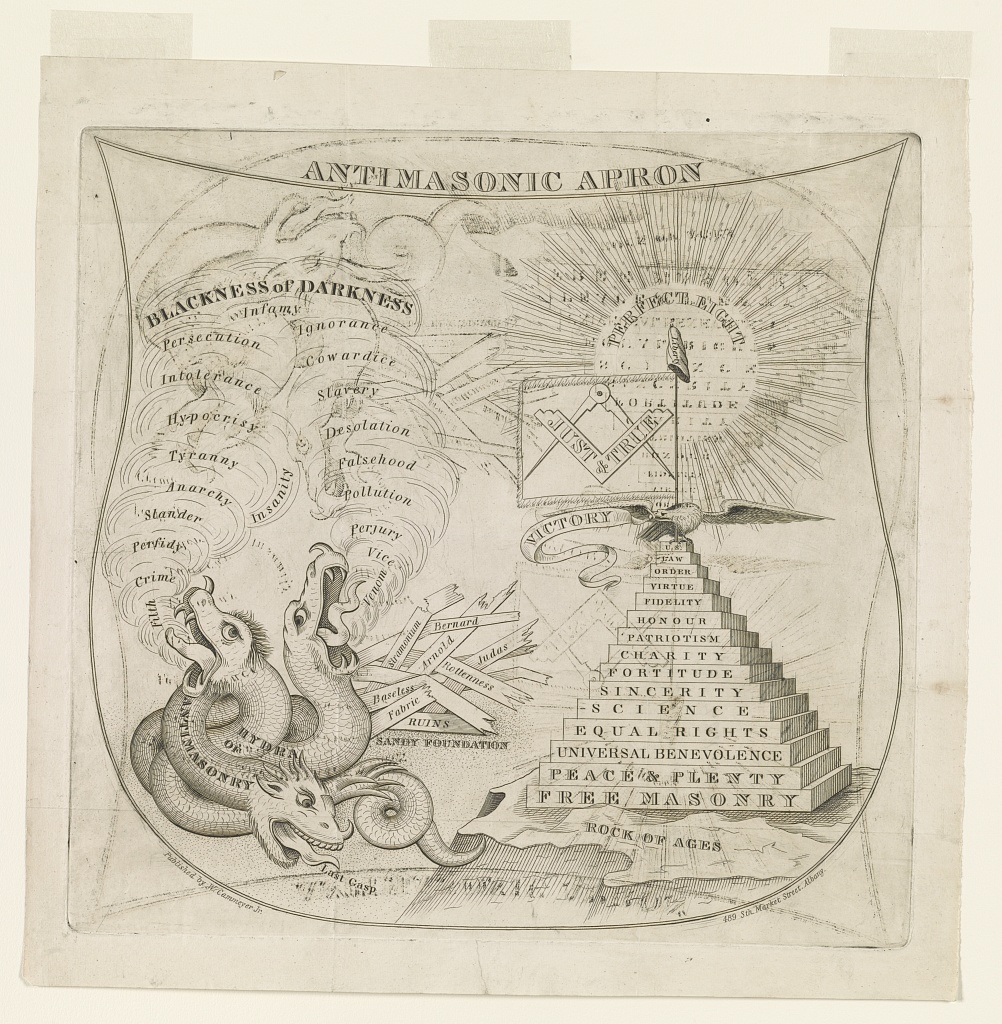
WASHINGTON, DC — The First Anti-Masonic Party, established February 1828 in upstate New York, was the earliest third party in the fledgling United States of America. The party emerged as a strong opposition force to the Jacksonian Democrats and Van Buren’s Albany Regency during the House of Representatives election of 1828. Originally a single-issue party, Anti-Masonic sentiment in the American Northeast was spurred by the disappearance and alleged murder of William Morgan, a former Mason who became outspoken against, and voiced his intent to publish a book critical of, the fraternity. Following these statements Morgan was arrested on “trumped-up” charges, and his subsequent “disappearance” was believed to have been committed by Freemasons from Western New York.
In [September] 1831 the Anti-Masonic Party convened in Baltimore, Maryland to select a single presidential candidate agreeable to the whole party leadership in the 1832 presidential election. The National Republican and Democratic parties soon followed suit.
https://en.wikipedia.org/wiki/United_States_presidential_nominating_convention#History
The Anti-Masonic Party conducted the first presidential nominating convention in the United States history for the 1832 elections, nominating William Wirt (a former Mason) for President and Amos Ellmaker for Vice President in Baltimore. Wirt won 7.78 percent of the popular vote and the seven electoral votes of Vermont. Soon the Democrats and Whigs recognized the convention’s value in managing parties and campaigns and began to hold their own.
https://en.wikipedia.org/wiki/Anti-Masonic_Party#Conventions_and_elections
The major paradox and triumph of Antimasonry is that although it declined rapidly as an independent political entity after 1833, it achieved its major success as a social or reform movement in the nearly total, albeit temporary, destruction of Masonry in those states where it was an active force. Politically, Antimasonry’s greatest achievements were the introduction of the national nominating convention to American presidential politics and contributions to the formation and development of the Whig party.
Vaughn, William Preston. The Antimasonic Party in the United States 1826–1843. Lexington: University of Kentucky Press; 1983
The Second Anti-Masonic Party, of tenuous affiliation to the first, was active from 1872 until 1888. It is therefore in this tradition that we establish the Third Wave Antimasonic Party (TWAP) of the United Stated of America.
Anti-Masonry was deeply committed to conspiracy theories, primarily the claim that Masonic elites were trying to secretly control the government […although] opposition to Masonry was not the Anti-Masonic movement’s sole issue. […] The Anti-Masonic movement gave rise to or expanded the use of many innovations which became accepted practice among other parties, including nominating conventions and party newspapers. […T]hey made direct appeals to the people through gigantic rallies, parades, and rhetorical rabble-rousing.
https://en.wikipedia.org/wiki/Anti-Masonic_Party#Legacy
Similarly, the revelation and denunciation of the international masonic conspiracy (and allied power systems) is the primary platform of the TWAP; however, a party member need not necessarily harbor ardently Antimasonic sentiments. “The fact that William Wirt, their choice for the presidency in 1832, not only was a former Mason, but also defended Freemasonry in a speech before the convention that nominated him indicates that opposition to Masonry was not the Anti-Masonic movement’s sole issue,” Wikipedia relates.
It is probably not a coincidence that the First Party Convention in Baltimore was held in an Odd Fellow stronghold. Whatever the reason for touting the Antimasonic platform, it provides a broad and adaptable alternative to the ostentatious and disingenuous displays of the present Democratic-Republican party system.
Party Platform
Freemasonry is an ancient international conspiracy manifest through a subversive organization whose members have deceived the public for over 300 years and which operates behind the curtain of the deep state. Through mercantilism and control of international commerce, they are the most organized crime syndicate in the history of the world — but they are only the hidden hand and avant-garde of an even more elitist and secretive cabal of temporal rulers.
Our foremost demand is the abolition of Freemasonry, and a federal interdiction against the gathering of any secret society in any state of the Union.
We seek to unite the far left and the far right 180 degrees from political center which is squarely within the sphere of international Masonic control. It is time for the working people to unite against the rulership (the archons), the aristocracy, the bourgeoisie, and the landed gentry, and receive the return of the disbursement of the accrued value of their labor power which has been stolen over the course of their life through usury.
A bastardizarion of Templar Knights, pirates, mystery schools, and merchants guilds, Freemasonry has become a bane of civilization, and a scourge upon the moral fabric of our society. This scourge pervades both political parties in our two party system, in addition to the whole cabal of Greek organizations, professional societies, bar associations, medical systems, and international insurance and business concerns. The deep state society of Freemasonry must be eradicated, its veil of evil unveiled, its associations dissolved, and its property conveyed to the People, so as to prevent it from exercising its convert and subversive control over the vital forces and mechanisms of our civilization.
RESOURCES
http://utlm.org/onlinebooks/captmorgansfreemasonrycontents.htm
(last modified 5 Nov 2023)
 Supreme Exchange