Tagged: writing
US:\>_

An Act to Establish the Free Association of United Scribes
The Governor and Company of NOVUS SYLLABUS L.L.C. (N∴S∴) To All To Whom These Presents Come, Send Greetings and Peace:—
Know ye by these presents that there is hereby firmly established a free association, that is, a professional association, of court reporters, transcribers, proofreaders, editors, journalists, novelists, poets, writers, notaries public, scriveners, and scribes known as United Scribes (U∴S∴), whose jurisdiction shall be the United States of America (“America”) and Worldwide (“Global”).
§2. The mission of this organization is to provide professional development, political education, and networking, contracting, and freelancing opportunities to its freely, or voluntarily, associated members.
§3. U∴S∴ may function as the “Union Hall” or “Guild Hall” of such professionals as aforementioned on a voluntary membership basis. U∴S∴ shall be governed as a firm league of friendship (FLF) in the nature of a decentralized autonomous organization (DAO).
§4. U∴S∴ shall be correspondent with the labor union of Court Reporters United (CRU), which was declared on 1 November 2023 and recognized by the United States National Labor Relations Board (NLRB) on 26 January 2024 on a vote of 16 to 1 eligible bargaining unit members of a certain Washington, D.C. corporation.
§5. U∴S∴ shall be managed by and from the office of an Administrator. It shall be constituted by its members individually and collectively in a General Assembly, Conference, Committee, or Convention which may be established from time to time for such purposes as may be duly noticed.
§6. U∴S∴ may be contacted at unitedscribes@gmail.com. It currently and may continue to receive support services provided by NOVUS SYLLABUS L.L.C. at newsyllabus.org.
§7. Persons seeking membership to U∴S∴ shall contact the Administrator at the aforementioned address and subscribe to this Act with language to the effect of “I [name] am a [covered profession] and hereby subscribe or otherwise agree to the Act of 29 January 2024; I do submit my name to the public membership roster; and I shall come forth to assemble in union with my comrade scribes when duly noticed of such meeting, my God and my schedule permitting.”
(v.1.1)
End of Act.


Auxiliary Associations
UA:\>_

WELCOME
To the “Self-Teaching University”
of the Decentralized Autonomous Organization (DAO),
House of Studies, 153d CORPS
Political Bureau of Education
Novus Syllabus Seclorum
(“New Syllabus of the Age”)
CONTENTS
Courses 1-12: [Legacy System]
Course 13: Islam II
Course 14: Thoth Club

Course 13:
Islam II
Module A
On 4 November 2023, I, Antarah, Founder of Novus Syllabus Seclorum, Governor of NOVUS SYLLABUS L.L.C., and Grand Preceptor of the Universitas Autodidactus of the decentralized autonomous organization (DAO) of the conscious and God-fearing people of the world, by the grace of God, had the pleasure of meeting Ms. Azra Kulic, a Bosnian muslim woman living in Michigan, U.S.A., who thereupon instructed me in certain information, offered unto me an English-language copy of the interpretation of the Noble Quran, a thin book entitled A Brief Illustrated Guide to Understanding Islam, and her own research essay entitled The Most Essential Research. I said unto her, with great excitement, that our meeting was verily an inaugural gathering of the UA International. Thereafter Ms. Kulic has continued to send me information and inspired me to study Islam, thereby becoming my Preceptor in these matters. Verily, I bore witness to the fact that there is no one worthy of worship but God (Allah) and that Muhammad (PBUH) is His servant and Messenger (Shadadah).
أَشْهَدُ أَنْ لَا إِلَٰهَ إِلَّا ٱللَّٰهُ وَأَشْهَدُ أَنَّ مُحَمَّدًا رَسُولُ ٱللَّٰهِ
ašhadu ʾan lā ʾilāha ʾilla -llāhu, wa-ʾašhadu ʾanna muḥammadan rasūlu -llāh
“I bear witness that there is no deity but God, and I bear witness that Muhammad is the Messenger of God.”
Some of the information she has sent me is presented below for the benefit of the Student of the UA.
Azra Kulic Media Spots
Aired 2/4-2/18/2024 on Grand Rapids
cable access television (GRTV)
Additional Resources:
Curated by Azra Kulic
Course 14:
Thoth Club Book Club
Module A
COMES NOW the Most Excellent Student Preceptor, Jona Monet W., an original member of the New Syllabus Mystery School (NSMS) of Washington, D.C.*, and to present a course of self-instruction in the nature of a book club. Talib Jona says, “My goal is to nation build, but to do that, we have to raise our consciousness, and a lot of times it means unlearning what we thought we knew.” She also announces, “I will go live at 11:11pm Wednesdays + Sundays as often as possible.”
The first reading of Thoth Club as of 1 January 2024 is As A Man Thinketh by James Allen.
*To wit:
See, Curriculum:\>Title 24:\>N.S.C.\CHAPTER 49. BLOCK 8: NEW SYLLABUS MYSTERY SCHOOL: DC LOCAL CHAPTER (2017) New Syllabus Mail - New Syllabus Mystery School: DC Local Chapter (Email chain dated Sun, Mar 5, 2017 at 8:37 PM)
[...]
 1. Charter. This email is to confirm that We chartered the Washington, D.C. Local Chapter of the New Syllabus Mystery School on 5 March 2017 at about 4:30pm.
 2. Founding Members of DC Local. Those who were present to pass the motion were M... W..., K... "N..." R..., R... H..., Jona Monet, N... "S..." B..., and M... K..., as Signed 3/1 and 3/5 in the Feb 2017 Signatory Record. These members as well as NS Director A... C... comprise the Body-politic of the Local DC-NSMS.
 3. Chartering Committee. M... W... and K... "N..." R... coordinated the committee, which, after deliberation of all members, consigned to engage in the business of organizing the conscious young black community ("Kham-Unity") under the Organizational name of the New Syllabus, which Organization until then had been solely directed in DC by [myself] A... C....
[...]
Explore more resources with U∴A∴:\>_


Supreme Exchange
Information
Navigate the Universitas Autodidactus Collegium N∴S∴
Curricular Operations Research & Publication Services
Provided by the Governor and Company of:

Free Association
CBA

Consolidated Business Act
An act to provide for a consolidated line of business conducted by NOVUS SYLLABUS LLC, a freely associated service provider, to the decentralized autonomous organization (DAO) of the people of the world, to provide a system to supplant the public schools and universities, and for other purposes.
Know all by these presents that there is hereby charted and established among the firm league of friendship of the decentralized autonomous organization of the people of the world a Company of:
بيت مدرسة
בית מדרש
Beth Midrash
153d CORPS
Curricular Operations Research and Publication Service
Division of the Political Bureau of Education
of the Universitas Autodidactus (UA) of the
Decentralized Autonomous Organization (DAO)
Whose Members and Officers shall be:
- The Preceptory (the Student Body; members) whose duty is to study and report on the sapiential law (“wisdom literature”; “mysteries”) of all ages.
- The Student Body President (and Vice President, if so desired) whose duty it is to represent the Student Body assembled, elected by the Preceptory.
- The Faculty, the elected officers of the Preceptory, including the Rapporteur, Parliamentary Ombudsman (PO), and Secretary Treasurer (“Sec’y Treas.”, aka “Bookkeeper”), whose duty is to guide and conduct the study and reportage of the sapiential law of all ages.
- The Preceptor (Chair of the Preceptory; Director of Curriculum) whose duty is to provide the instruction, interpretation, explanation, elaboration, and exegesis of the sapiential law of all ages.
ART. 2. This Company shall provide for the Policy, Praxis and Process of educational instruction in the UA of the DAO, and it shall be administered in fee by NOVUS SYLLABUS, L.L.C., a freely associated service provider (the “ministry” or the “server”).
ART. 3. The use of logos, trademarks, and other intellectual property identifying the UA and DAO which are copyrights of the server are subject to end-use licensure by the server.
ART. 4. As to the Members and Officers enumerated at Article 1 herein, the Synchronized Decentralized Autonomous Command System (SDACS) is incorporated herein by reference.
(Last Amended 15 Feb. 2024 as to Art. 4 and Art. 1)

Curricular Operations Research & Publication Services
Provided by the Governor and Company of:
Free Association
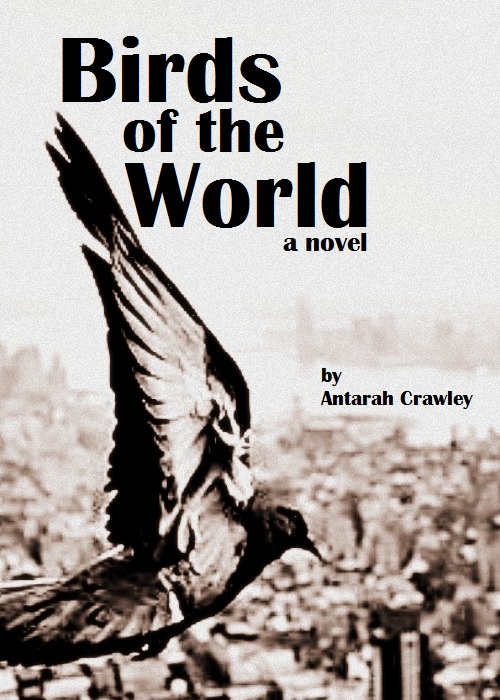
Birds of the World
A Novella by Antarah Crawley
Spring 2010

The following constitutes the “final draft” of the “novella version” of the above-titled original work of fiction, sourced from a draft email dated April 2, 2012, RE: School Work to print Spring 2010.
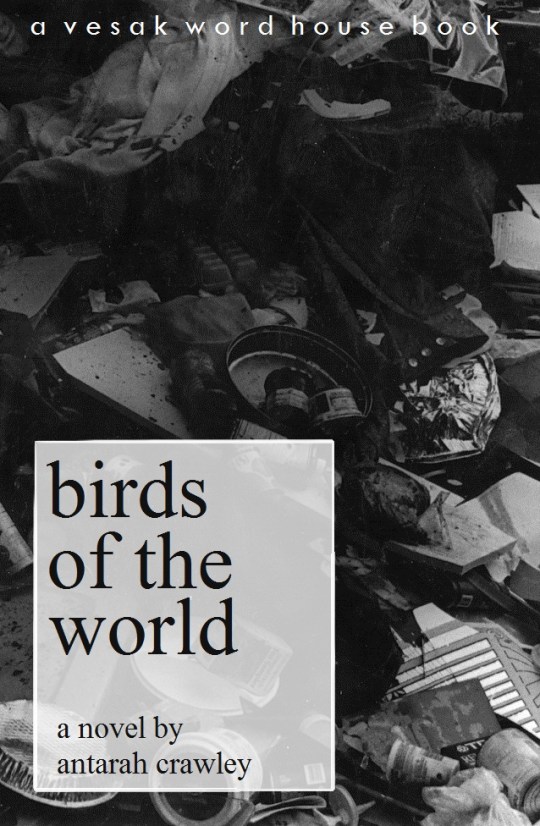
Several short-story-length, novella-length, and novel-length versions of Birds of the World (also published as The Acquisitions and The Last Indulgence) were published by the author under his Antarah Crawley & Co. and Vesak Word House imprints (Washington, D.C.) from April 2012 through July 2013.
The author abandoned this project in 2013, after multiple submission rejections, when he focused his attention on the Walter Kogard stories until the present time.
Trigger Warning: this story contains explicit language, including racial epithets, strong violence, and strong sexual content, including explicit descriptions of sexual assault. It has not been edited from its original version (April 2, 2012).


Birds of the World
A Novella
by Antarah Crawley
Contents — Prologue — Chapter 1 — Chapter 2 — Chapter 3 — Chapter 4 — Epilogue — Appendixes — Files
Prologue
2009 is when things really started simmering in the melting pot. The state of Arizona announced plans to instate a law, Senate Bill 1070, that sought to get a handle on the Mexican problem. Unlucky for them, the American public got fussy and the likes of the US Government and the Department of Justice complicated things like they do. Not to mention that Representative and the Arizona Chief Judge who were gunned down in Tucson later in 2011. The Liberal Agenda started boiling the waters and every pundit in a blue tie started throwing around “injustices” and blame. Later, the historians would call that little incident Bleeding Arizona.
Mr. Bush (R) was like the Arizona debacle when it came to how the US would progress over the next fifty years, except his contributions were a bit more discrete. As president, he knew who his friends were and he knew how to treat them right—hell, he even gave them jobs in the oval office. It was a good time for the private sector; made a lot of money—a lot of money. Lost a lot of money, too, but the public didn’t know that until old Bush was long gone. The US started two wars in the interest of private business, basically occupying the Middle East, hoping for oil, weapons, something. Those wars cost a lot of money, but hell, what kind of a man would Bush be to make his friends pay for it. The money for the wars was borrowed from China.
As the government was going underwater in debt, the private sector was thriving. Low tax rates and little government interference made for real easy business. The private sector got so comfortable with the present state of corporate regulation that they even started skimming money that wasn’t theirs. “Skimming”, meaning they were getting hundreds of millions in bonuses and stashing it overseas so the government, oblivious (or condoning) as it was, couldn’t touch it. Bush was a piece of cake, but the corporate hegemony knew that the next president wasn’t going to be as playful. “Playful”, meaning that whoever it was, they weren’t going to sit idly by as the hegemony sent the US into a recession.
Surely, President Obama (D) was not going to play their game, but everyone knew he couldn’t do much about it, even with a Democratic Congress. He was basically inaugurated as the president of a country in debt, the inheritant of a house underwater on its mortgage. The first several months of Obama’s regime, the Republican minority was so cunning that very little was done about the recession. Filibuster. Isn’t that a great word? Filibuster. Still, the president got a fair-to-middling Health Care Bill through and as good a Bail-Out Package as he could.
The US never got around to really paying off the deficit, and President Obama took the heat for that, too. Meanwhile, the private sector was still raging, and at the expense of those lower on the economic totem pole—jobs were drying up, being sent overseas, mostly to China and the South Pacific. But once again, the blame didn’t fall on the executives who made those decisions. Funny…The blame fell on them Mexicans.
Well, it was funny for a little bit, at least. President Romney (R) put more pressure on them Mexicans and, like Mr. Bush, created a nice government for his friends (the very same friends) to rest their feet on. President Romney got elected on the basis of his having “lived in the private sector” (as if it were a suburb of Boston) and being knowledgeable of the way economies work and everything. (Even though all of his business investments ended in drying up the business’s value and sending it to Mexico.) Not unexpectedly, the seemingly omnipresent Occupy Movement became incensed. Portland and Seattle were the first to become violent. Upon Romney’s second term, the Occupiers seemed to have lost all faith in democratic elections. Five major cities started burning. By the end of Romney’s second term he had announced plans for the Mexican-American Border, referred to as “The Wall”, which were carried out in completion by his successor, President Gerber-Tall (R). That election, 2020, was a major turning point in the American self-image. “R” became synonymous with the Republican-affiliated Racist Party, which ran on platforms that mainly revolved around American Purity and Class Inequality. The Republicans felt no need to sugar-coat it any longer. The American Purity Bill was the main piece of legislation that allowed for the Wall to be built; it was signed into law in 2023. As the Racist Party continued to garner support among the increasingly populated Middle American demographic, the Occupy Movement intensified their reaction. Like a cycle, the escalating violence of Occupy in turn garnered more support for the Racist Party’s Class Inequality platform. Gerber-Tall stated in his inaugural address, “These jobless scum will no longer be tolerated. If they sustain their actions, the US Military will attack.” We were on the brink of 1861.
Like his predecessor, Gerber-Tall was a trickle-down kind of guy, and he continued to let big business erode the working class economy by sending manufacturing jobs abroad while the US continued to become submerged in Pacific debt. 2025 marked the beginning of Gerber-Tall’s second term and the completion of the Wall. Much of the action of the Occupiers became concentrated in Arizona and along the Southern border. Their clashes with the Border Police, managed by the Department of Homeland Security, became so consistent that the media ceased reporting it.
Meanwhile, overseas, the US had been sustaining its presence in the Middle East. A Juan Carlos Sikkafi had riled Palestine into revolt and the US was combating against them by supplying the Israeli Military with funds and weapons (as they had been doing since the end of WWII). It would have been a one-day war—an immediate victory for Israel and the US and a burden off of their shoulders—if not for Palestinian support by Libya, Egypt, most of North Africa, and the Arabian Peninsula. Europe had long since been absent from the world stage since its Euro began to crumble and violence spread though the continent starting in 2011. As a sort of substitute, however, another major world player, whose eminence had only recently been recognized by the US, had been making plays in the Middle Eastern chess game: China. While the US backed Israel, China backed the Palestinian support by The United Arab and Northern Africa Coalition, which encompassed 18 countries, and soon had a more imposing world voice than the United Nations, specifically upon matters regarding use and ownership of the natural resources in the area. In 2026, China issued a statement in conjunction with the UANAC that “If the US sustains their actions against the Nation of Palestine, the Chinese would take drastic measures.”
On July 29th, 2027 the US dropped an atomic bomb on Palestinian insurgent camps.
On July 30th, 2027, the Peoples Republic of China called in the US’s loan, which had accrued approximately $179, 000, 000, 000, 000, 000, 000 (a mathematical value referred to as one-hundred seventy-nine million-billion dollars).
The US was forced to formally default.
In that year, American Purity had reached a point of support that resulted in a sort of over-speculated pride. To retain his support bases loyalty, President Gerber-Tall vowed to continue fighting in the Middle East. The US Government had run out of funds and, obviously, Gerber-Tall would not allow his friends’ wealth to be compromised for the greater good. The US clearly could not borrow from China, nor Europe due to the practical non-existence of the Euro. Only Northern Africa was home to any kind of prosperity in its continent and they were backed by the PRC, so that was also out of the question. US Pride was waning, but as Americans, they would go down kicking, even if meant taking a minor blow. The only solution was the political equivalent of getting a hand-job while being kicked in the testicles: The US borrowed from the only unbiased, independent, Capitalist, prospering nation in the world: Argentina.
President Hugo Chavez II compromised. In a video statement, he declared, “We will provide the United States with a set amount that will be determined after the acceptance of the terms of the agreement. It will not be a loan; we the Argentines of South America see the US in turmoil and will extend a friendly hand. However, if you seek peace with us in the future, if you seek any kind of prosperity with the people of South American, our trade and cooperation, meet me in Mexico and see me, mono a mono. Mr. Gerber-Tall, open the channel between you and the rest of the Western hemisphere. Mr. Gerber-Tall, tear down this wall.”
The president kept a superficial calm during the following months. The US presence in the Middle East was maintained, but fire had been stopped on both sides. Israel was stripped of its most imposing military units, including its several atomic bombs. China and the UANAC issued a pact of peace for the time being.
US manufacturing continued to thrive in the People’s Republic through the interest of private business; the working class, though they were hardly working anymore, continued to provide a market and big business continued to profit. By this time, the “working” class had a demographic of low-class white Middle Americans. The ratio continued to climb in their favor as a result of several post-Chavez bills that were strapped on the back of the American Purity platform. With the concept of American Purity so undermined and seemingly hopeless after the complete destruction of the Wall in 2030, the Racist Party and their support base implemented and strictly supported two main bills:
(1) The Criminal Assimilation Amendment suspended due process of law and allowed anyone accused of committing or convicted of a federal crime at any point in their life to be imprisoned indefinitely. Ninety-Seven Percent of the Black population in America was swept from the street. Mexican Immigrants coming into the Sates without proper papers (which were not available to obtain until the immigrant had a chance to secure an address and a job) were also imprisoned.
(2) The Burdening Unemployed Persons Removal Act imprisoned all homeless persons on the grounds that they were burdening the prospect of American Progress. This motion was primarily targeted at removing and disposing of the Occupy presence, but was also used a tactic to further eliminate the poor of the country.
These two actions, constituting what was called the “American Cleanse,” almost eliminated the Colored presence in the United States. Carrier units and busses rumbling through the city streets at night swallowed all persons who appeared to be homeless. The Occupy Movement was severally crippled by these actions, being implemented overnight and hardly publicized in the media.
The remaining Black and Latin American population, educated though many of them were, receded into small coastal towns where they lived in tight-knit communities off of the land. Large, central cities like Chicago, Washington, and New York were inhabited only by the wealthy white hegemony and, paradoxically, the remaining Occupiers, whose numbers were slowly widdling. Middle American cities and Southern towns, of course, the vast bulk of the American demographic, retained their strong poor-white population.
Police combat in Occupy camps throughout major cities raged throughout the early part of the 2030s. Though few in number, the Occupiers used guerilla tactics adapted to the city street; fires from IEDs and Molotov cocktails became so commonplace that in New York, the white hegemony began to consider moving the financial capital of the US elsewhere. (For even through the “American Cleanse,” business as usual continued with a market for products continuing to thrive in Middle and Southern North America.)
By 2035, even if the hegemony had decided to stick it out through the temporary chaos, their opinions were forced to change. A hot, hot day in June, a group of three hundred Occupiers stealthily eluded the Military barricades around lower Manhattan and set fire to practically all of the Financial District. Over seventy-five hundred people of wealth and power died in their offices.
Seeing this breakthrough, many occupiers came out of hiding, many from the long-retired Subway system. The Occupy response was impressive but the US Military and the New York City Militia responded similarly, and ten-fold. General warfare erupted and raged in the streets of New York for twenty years.
Private gentlemen and women, corporate executives who had assumed control of their parents’ firms, and the general wealthiest of the wealthy fled the Upper East Side and their other various homes and left the country.
By 2055, during Gerber-Tall’s ninth term (as a result of a state of emergency amendment enacted after the 2035 riot that was never revised), the state of domestic US production was horrendously inexistent and the wealth that was supposed to have trickled down had been redirected into Swiss Bank accounts. The wealthy had long since fled and had taken their monies with them. They left no jobs for the “working” class white. The majority of Americans, dubbed “Sheeple” by the absent hegemony, were reduced to a chronic state of depression and alcohol psychosis. Small businesses deemed necessary to the present society by a House committee on the matter, being decided that they were bars and diners, were subsidized by the US government. Those white poor who did not cower became violent and many ran in gangs dubbed by outside observers as “Niggerati”. The spatially marginalized Black population, especially the Black poor (called “Ponys,” as in “poor Niggers”), became the victims of violence and brutality by the Niggerati, who maintained a strong appeal for American Purity. The US Government moved to California where signs of civilization still persisted, if but stoically. Technological development became a sort of fine art, like poetry, a mystified activity done by strange, wifty people. Nevertheless, the US Military, crippled though it was, still contracted the work of such innovators. Commercial agriculture also subsisted in California and the state became a last resort for any straight-headed, progressive, “working” class person. The Californian Agricultural and Technological toilers became known as “Cattle” (CATtle). And in the meantime, the wealthy American expatriates had found ways abroad to sustain their life lifestyles.
Chapter 1
Freshman Survey, Harvard College Compound,
2031 A.D.
John sat in the back row of a large white classroom, with rows of desks that stretched back on raised platforms. Three giant sterile whiteboards and a lectern lay at the clearing in the front, with doors on either side, from which he entered. He could see the entire room and the students that trickled in; however, he rested his eyes while he waited for the professor to arrive. He closed them as seven or eight students sat in scattered seats across the room. When he opened them slightly, the room was almost three-quarters of the way full; the professor had not arrived and John let his eyes fall shut again.
Some rustling in the desk beside him jolted John awake. He opened his eyes and a boy his age was fidgeting the maneuverable desktop up so that he and his books could fit in. The boy’s hair was mussed, his Harvard sweater baggy and starch; his Sperry Topsiders were floppy. It was the first day of class.
“Hello,” the boy smiled as he nestled into his seat.
John smiled the smile he reserved for girls he would rank at a seven or eight, that slight one, out of one corner of his mouth.
“Are you a freshman also?” the boy asked and he pulled out his notebook and two pens. He rubbed his glasses on his sweater.
“Somewhat,” said John.
“Oh,” said the boy. “So am I. My name’s Larry,” he put out his hand.
John rubbed his own hair back. The boy put his hand down as if no one noticed.
“How about you?”
John turned his head slightly toward the boy. “John Andrew. Of the Birds.” The boy curled his lips down as if he was impressed at the information; surely, though, he did not know the significance. “Who’s your family,” John asked tiredly.
“Uhh, the, um, Johnson’s.”
John thought for a moment, squinting his eyes upward. “The Boston Johnsons? Microloans?”
The boy looked thoroughly perplexed. “No,” he said short of breath. “Of, um, Nebraska.”
“Oh!” John laughed. “I’m sorry, I was clearly mistaken.”
“Oh,” the boy smiled.
Later, John thought, he’d tell the story to Boyle. ‘How do you think sheeple-folk got into Harvard anyway? Hey must know someone.’ Boyle’d laugh his ass off.
“How did your folks manage to get you in here,” John asked.
The boy paused and leaned in; he sniffed and crinkled his nose as if he had seen the price tag of the Cognac he no doubt smelled on John’s breath.
“Well, my dad had been saving. A real long time—since before I was born. And I worked really hard during high school and everything. Really hard, too.”
John smiled. “I’m sorry to hear that.”
“Alright,” said a loud, static-drenched voice over the sound system. The professor had arrived some time ago and was now fidgeting with his clip-on microphone. “A-hem. There. Is that good?”
Some girl somewhere mumbled “yes.”
“Ok, then,” the professor settled into his element. “Welcome, class, to the freshman-level survey course. Um, Introduction to Microeconomics.”
Apparently, the Cleanse had turned violent in Manhattan and Occupiers were retaliating; John was fucking Chelsea Bates in her dorm. She lay naked with the Tiffany’s necklace he impulsively bought her around her neck, exhausted, smoking a cigarette inside, and John checked his phone from his watch. He saw that his father had left him a message; he started to put his shoes on so that he could go back across the quad to his room. It was three in the morning.
“Where are you going?” she asked like a whimpering seal. “Can we cuddle, at least?”
“No, um,” he started. “May’s getting suspicious. She wants me to help her study.”
John left not expounding on the lie or realizing he had told one. He didn’t even realize how hard he had slammed the door.
In his room he V-Chatted his father from his watch. Dad was in his office, he looked OK.
“What’s going on? I hear sirens,” said John
“Well, you know they’re carrying out the actions in the bills. And the Occupiers are acting like they bought the fucking street.” Father was clearly distressed. His tie was loosened, and his elbow was fixed to the desk, his hand on his forehead. “They act like they were just going to live in the street forever. Goddamn—” his words drowned out.
“Are you going to be okay?” John asked.
“Sure, sure,” he said, “We didn’t buy the army for nothing,” he laughed.
“Well, just make sure everything is in order the way you want it. I mean…you know.”
“I know, son. You’re good. Everything is written out as clear as you would write it yourself”
John smiled. “So you’re just calling to say you’re okay?”
His father’s hand stayed fixed to his head; he sighed. “Yeah, I think we’re okay.” He turned his eyes to look into the camera—to look into John’s. “Just be conscious. This country isn’t what it used to be.”
“Tell me about it. You should see the chumps here. Harvard isn’t even secure of fucking sheeple and Occupiers.”
“Bye-bye, son.”
“Bye, father.”
“Where’s Julian?” Adam asked. He poured two more glasses.
“Fuck if I know, he’s probably fucking Claire. Or on coke somewhere,” John laughed picking up the glass. “It’s gonna be a you-and-me kind of Friday.”
“Where’s May?”
“Some sorority shit. Painting banners or something, I don’t know what she does. She hangs around with those liberal dreadlock biddies. What kind of a woman wears a bunch of tree branches on her head?” he laughed. Three glasses of cognac in and the computer attached to the Visio was playing the fourth episode of How I Met Your Mother. “This show gets better and better. I wish I were born in the late nineties. It feels like cheating to watch all the episodes at the same time.”
“I don’t miss television,” Adam said. “Really, the only reason I’m watching this on a TV is because you’re here. I set up the iWatch thing with the glasses. It’s so much cooler; it’s like you’re actually in the show, dude.”
“I never liked all the fancy technology. My dad gave me his old VCR for my loft. The UpperEast one. I kind of like the grittiness.” The show went to commercial. “Goddamn it, see. More of this stupid tech shit.”
It was a commercial for Sunshine Belt Technologies. A camera rolled over green pastures of California and panned to a glass building, a simple building, built like a box with a triangle roof. Rays reminiscent of those emitted from the sun shown from it. The camera panned along one of the rays into a Middle-American home where televisions and computers were on. It faded to white and text appeared: No Wires. Completely Invisible Signals. That screen faded to the logo: Sunshine Belt Tech. “Our Best Machines Are Made of Sunshine.”
“Gay,” John dragged the syllable on.
“Hey, doesn’t your brother work at SBT?” Adam asked.
“Fuck if I know, he’s a fuckin’ lunatic.”
The show continued and the two friends giggled at the archaic humor, sipping eighty dollars worth of liquor a slurp. The show then stopped and another commercial came on.
“Hello, my name is Bob Clark,” said the black man on the TV. “I want you to know…”
“Is he New York?” John asked.
“I think so,” Adam’s voice echoed behind his glass. “Republican. He’s probably trying to get support for another anti-Occupy bill.”
“I thought it already passed.”
“Well, they’re executing another provision. I think they’re beating a dead horse, if you ask me.”
“America, dude.” John sipped.
“Yeah, it feels like it’s all going to shit. Nothing was this bad thirty years ago. It feels like this country’s on a downward spiral.” The commercial continued and Bob Clark faded out. “My dad said Clark is a part of the Illuminati.”
John sloppily jolted his head around. “What? Nah, who said the black man was in Illuminati. Last I heard, that was the biggest Racist Party.”
“Don’t have to be white to be Racist.”
John turned back around. The commercial ended. “My dad just got paid,” he laughed.
Chapter 2
How the Other Haves Live,
2035 A.D.
John Andrew Bird was born in 2015 to Mortimer J. Bird. Mortimer had earned his wealth through two major ventures: the investment and management of a pesticides and preservatives chemical plant in Iowa, then in the early 21st century with corporate mergers and acquisitions on Wall Street. He lived a life of leisure in the Upper East Side of Manhattan, where he had John, his second son, Waldo Rockefeller Bird, and later, Abel Bird.
John, who early in life had assumed the moniker of Sir Bird, accrued all of his education on the heavily guarded Harvard Compound, wherein an accelerated program allowed him to obtain the the Harvard MBA/JD by the time he was nineteen. It was a bittersweet achievement. As he began to transition into an executive position at his father’s present company, Amauta Company M&A during the beginning of 2035, the Summer Occupy riots exploded in the street and his father was killed in the chaos.
May was by his side when he got word of the tragedy in his East Side penthouse. He looked over Central Park, naked but for the silk undergarments covering his privates, while May had gone to put on one of the Salvatore robes to show some decency for the situation. Bird’s trembling pale skinny back, the ridges of his spine showing though his skin, was turned on May as she reentered the living room. In the window’s reflection, she could see thin ebbs of salty tears trickling down his long face. Sir Bird’s oval glasses which he always wore were strangely opaque and his friends rarely saw his eyes; the tears were the first kind of sign to May that any compassion even existed behind those lenses. She walked up to where he stood contemplating the thirty-story drop and wrapped her arms around his back.
“How could they even touch us?” his lips quivered. He snorted and straightened his back up again. “How could they touch us?”
May opened her mouth, but promptly closed it.
“Do they even know what they’ve done? They’re the problem. They contribute nothing except ineffective violence. Believing unsubstantiated slogans—.” He sighed and his long neck lowered.
“Have you called your brother?” asked May.
“At least it wasn’t Ponies. Jeez—” he wiped his eyes, “I thought we got rid of all of that bile, anyhow.”
May, as usual, kept her tongue. She walked to the bar and began to pour a glass of the Clos du Mesnil.
“No, no,” Bird’s voice waned. May stopped, shrugged, and poured what was in the glass down the bar sink.
“What is there to celebrate?” he asked coldly to no one.
May, at a distance, said, “I’m sorry, John.”
His back rose and dipped. He straightened himself and slightly turned his head towards the bar. “The 1995, was it?”
May glanced at the bottle. “Yeah.”
Bird gave a shrug. May poured two glasses. He walked barefooted to the bar and scooped up the fragile glass. May picked hers up and they toasted.
“I suppose a Krug is as good a decision as any we’ll make as any at this point,” he said, and he sipped delicately.
Bird, later that evening, contacted his friends and they exchanged grievances over the loss of their parents; many of their fathers were on Wall Street in their offices the day the riot ensued. Over the next couple of days, the recently orphaned and now exuberantly endowed New York gentry made a collective decision to leave the country; many of them were splitting up for the first time since Harvard.
On the last night that many of them would be in state, the old friends of old money gathered in one of the more exquisite of the Brooklyn dive bars, the inconspicuous restaurants of exotic taste that only existed to serve the late elite and their posterity. The bars’ secluded locations were ideal for protecting the wealthy businessmen against prowling Occupiers. Their children, when they came back from Harvard, found these spots to be the most exclusive of all the late night venues and they often gathered there to drink and trade stories. This occasion in particular, however, had an atmosphere of both solemn and joy, as though the young billionaires had finally graduated to the class of leisure that their fathers once occupied.
The dive that sheltered the friends this evening was called The Fall Inn. There was one oval-shaped table in the smoky basement, a billiards board in the corner, and beside it an antique trophy case containing the various toys and donations of past guests—the rarest Vuitton handbags, solid silver revolvers, family photos of the Rockefellers and Morgans, crown jewels, degrees, etc. A bar ran along the wall opposite the table; a Pony who had been faithful to the D’Urbervilles for many past generations stood behind the bar polishing glasses.
At the table sat Julian D’Urberville of Consolidated Tobacco and Grain Spirits, J. Adam Boyle of the pharmaceuticals trust, Noel Gallagher of Consolidated Firearms, James Donahue of the North American Natural Gas Trust, Bernie Arnold of Consolidated Luxury-LVMH, Vishnu Mittel of Worldwide Steel Conglomerate, Duke Wall of the market retailers trust, May Broom of the Kennedys, and John Andrew Bird of the Agriculture Technology Conglomerate.
D’Urberville pulled out a pearl cigarette case from his vest pocket.
“Turkish?” Arnold asked.
D’Urberville pulled out an unfiltered cigarette and handed it across the table. “They don’t have the crest’s print, only because I’d rather not inhale ink fumes. They’re pretty interesting; instead, if you look closely, the crest is a watermark throughout the whole paper,” he inspected his cigarette before he put it to his lips, the Zippo to its tip and inhaled. Arnold did the same. “Anyone?” D’Urberville asked before he put his case away.
Noel Gallagher shyly pulled out one of his own.
“What are those?” D’Urberville asked.
Gallagher chuckled, “The Virginians,” he said.
“Ah, a good one. Can’t go wrong with that Virginia tobacco. When we acquired Altria Group, I even considered moving headquarters to the old Philip Morris building in Richmond. It’s a quaint little place. Homely.” He inhaled. “And I’ll tell you another thing; them Ponies are like hard drives. They’ve been tending tobacco since the beginning and can still make a mean cigarette.”
“’Ponies’?” said May, “Has tobacco got you backwards?”
Bird shushed her.
“What?” D’Urberville said. “They are poor as dirt. And dark as it too,” he and Bird laughed. “They should be happy anyway that we didn’t pack up tobacco farming all together and send it to Mexico. But then, of course, it wouldn’t be Virginian Tobacco.”
Donahue chimed in, “I don’t even know how you still have Blacks to work after them bills passed.”
“Our Blacks are fairly straight-headed. Straight-headed as Blacks can be. And they won’t pull anything seeing as they’re allowed to live on the compound. They know they don’t wanna be in the street without protection with them wildin’ poor whites running about.”
“Yeah,” Bird said, “The white Niggerati. I think they’re getting as violent as Occupiers.”
“And those militant poor whites—‘Niggerati’, you say—are even worse than Niggers and Ponies, ‘cause Ponies’ll work. You can’t get these spoiled whites to do anything now,” D’Urberville said.
“They complain and complain,” said Bird. “More social security, more this, more that. I stopped taking pity on them long time ago. Heh, the sheeple of the world! And really, it doesn’t matter that they’re part of the Grand Old Race, as my dad used to say. They’re not good old boys like us, that’s for sure.”
“Fit to be slaughtered,” D’Urberville laughed and sipped his Dom.
Bernie Arnold, Mittel and Duke Wall were having a quiet exchange at their end of the table. Though they went into completely different ventures, they always had a clique-iness, ever since Harvard. D’Urberville finished the last of the Dom and motioned the Pony at the bar for another two bottles. Duke Wall’s conversation seemed to stop and they came back to the rest of the party.
“So, John,” he said, “Where’s Waldo? And what about the younger one? Abel?”
“Wald’s long been over in California, but dad and I just left him alone. He wanted to go into entertainment and computer technology.” Bird laughs to himself. “He worked with Consolidated Black Entertainment for a while, but that fell off, obviously. I think he’s with Sunshine Belt Tech. ‘Sunshine Belt Technologies. Our Best Machines Are Made Of Sunshine’,” he laughed again. “Complete nonsense.”
D’Urberville got the joke a little too late and gave a loud quack of a laugh.
“And Abel?” Wall continued.
“Oh, he was even worse. Poor fool…wanted to be—a poet! Dad and I took care of him. We weren’t letting the Birds name go to the dogs. We’re not entertainers. Our name wasn’t going to go to waste like that. And indeed, we fixed the problem, and not a cent of his inheritance or his honorable Bird muscle went to waste.”
Everyone at the table, save May who was busy in her head, had to smile to themselves.
“Grim!” D’Urberville yelled. “All for the poor fool expressing himself,” he chuckled to himself puffing the butt of his cigarette.
“We are Birds, Boyle. Members of the highest society. Unchained from the low animals, sheeple and trees and such things. Computer technology and entertainment are for the military and the masses.”
The food came presently, after the party had been smoking, drinking, and gossiping for some time. (Only one cook was trusted enough to cater the event.) The first course was a salad and almas caviar, then an ostrich pasta with pesto; after a bit more drinking the Pony brought out a fillet of bear and later a slow-cooked-then-deep-fried wild boar shoulder.
Over the dessert, Tahitian vanilla bean ice cream sprinkled with Amedei Porceleana chocolate and 24 karat gold truffle, the heavy conversation resumed.
“It’s nice to enjoy this meal with you all,” said D’Urberville; he lifted his glass. They all toasted.
“Yeah, the smoky basement is a nice touch,” joked Gallagher.
“No, but really, imagine our executives at the firm hearing about this. If this was a thing, like when we could all still go out without any worry—with indoor smoking, personally customized meals, the most exotic foods, and a three hour wait—they’d be offering up a ball and a kidney to get a reservation.”
“They’d have to; you can’t buy this with money,” said Wall. “You can’t buy friends like these.” They all toasted again.
“True,” said D’Urberville, “It’s not like they’d ever find out about our rendezvous anyway.”
Bird chuckled. “One of the vice presidents—and it’s funny because he’s older than me—Larry Sheridan, used to try and invite me out to dinners like these to get in my head. He pretty much idealized my father. I think he wanted me to think he was some sort of godfather figure. But he wasn’t a Bird, you know,” he sipped his drink. “I can’t even let him touch me. He’s basically sheeple, even with his wealth. Dad always told me, ‘family is family.’ Ever since I was a kid. I didn’t understand then, of course, you know. But I realized it’s like this: the family business is the family business. No one but family touches the assets.” Bird rubbed May’s leg; She continued to wander lost in her thoughts. “These young kids always want to know the secret to achieving what we’ve achieved. And, with the ones I like, I try and give them the tips to making personal gains. They try to follow my advice and everything, but they want wealth like ours. So I say to them, ‘Keep doing what I’ve told you and then talk to me in three generations!’” The table laughed.
Chapter 3
Migration,
2036-2065 A.D.
Most of young elite retained nominal executive power over the operation of their businesses. As they settled down overseas, though, they became more like private men and enjoyed the leisure their new wealth afforded them.
As they began settling down, they realized the extent of poverty in the world. London, Greece, much of Italy, and Paris were run down by rioting. Much of the European countryside was occupied by poor young radicals. Yet, with the help of their acquaintances in state positions, they secured portions of land (often with military force) on which to live in privacy. For a long time, Sir Bird and May Broom lived in Versailles, where the private man insisted on being reserved to his books and letters. Sir Bird was enamored with the romanticism of writing letters and never touched an iPhoneX or anything managed by Sunshine Belt Technologies and their “invisible signals.” Bird didn’t venture out much and May would often get bored with his shtick and explore, sometimes for days at a time, in the surrounding towns.
The bookshelf in Sir Bird’s study ran along an entire wall, with a break in the middle that contained a painting whose artist was unknown to the gentleman, but whose price tag ran seven figures at the time he acquired it. The books were almost all of economic theory, early American journals, and some literature that he kept only for conversation’s sake. (However, those types of books gathered dust in the corners of the shelves since he rarely entertained visitors.) His letters to his friends were his main concern, and though they corresponded regularly, many of them were content with their respective private lives.
In between pen strokes, Sir Bird entertained his vast collection of champagnes and cognacs, which he became more familiar with as he maneuvered France’s upper class. Bird’s sporadic visitors would often bring by a grande champagne, and, though rare occasions, Sir Bird would entertain his guests to the fullest of his ability. Surely, to entertain to the half of his ability would be a night even his most illustrious guests would remember for years. In respect, Sir Bird would store their bottled gifts in his cellar and reciprocate them with one of his own fine champagnes. His father, after all, had on many occasions professed: “The comfort of your guests is paramount.”
But guests were infrequent and Bird would enjoy his collection alone by old American newspapers and a fresh pipe of D’Urberville’s private tobacco selection (which he would receive from time to time in his packages). May had become a sort of fleeting presence, tended to when needed, but rarely seen. Sometimes he’d see her passing by his study on her way out. Such conversations generally went like this:
“Where are you going?” he’d say, his words slipping up as they stammered over his wet lips.
“Out. Would you like to come?”
“You are such a busybody; why don’t you ever stay in?”
She would come into the room as if on a cloud. “Oh John, have you been around? These gardens. The country. It’s gorgeous. We need to go out like we used to.”
“And just where do you go anyway? Not Paris, I hope. There’s a reason we’re on this compound. We don’t pay these guards to let you go out and get yourself raped.”
May’s cloud would inevitably become heavy with rain. “And what if I did. I wouldn’t wear my jewelry. They’re people, John; they’re not animals. If anything, your types are the reason they’re violent. And not even that—they’re serene and humble most of the time. It’s refreshing to be around them.”
“I’ll tell you what’s refreshing,” he would say wetting his lips with the brandy.
“Oh, right, of course: your liquors. You’re always drinking your ambition away cooped up in this stuffy room, your alcoholic’s cave.”
Sir Bird would muster himself off his ass at this point. “Alcoholic? Sheeple are alcoholics, May. Your beautiful Parisians are alcoholics. Middle America is a pit of drunks! Only the likes of scum who drink whiskey, beer, and cheap wine can be alcoholic. This is a thirty-five year old brandy, my dear. I am a connoisseur.” He would rock where he stood with his glass in hand and a cheesy grin.
May would leave and Bird would slap the air in front of him or give the door just slammed closed the middle finger. That’s the way it went.
Some days, he would cut her a break though. Their chauffeured Bugatti could reach 240 on the empty country roads, and even then, they had to pick their course carefully. Overflow from Paris forced vagabonds and radicals into country societies. “Like old New York,” he’d think. “Oh, how the mighty have fallen.”
The couple would venture out and sail in the Seine or the Loir; the Loir was May’s favorite. On a good outing, May would beg that they throw all their clothes into the river, pick up a second-hand tweed jacket for Bird and a cotton dress for herself and go into Paris. Sure as Versailles was the last secure public compound in the world, Bird would always reject going into the claustrophobic city. Just being outside was enough; even then, poor were always within arm’s reach.
One peaceful evening while fishing on the Loir River with a Krug and a jar of caviar, Bird proposed to May with a 12.69 karat raw yellow diamond (directly from a close friend’s South African mine). He was a bit sedated at the time, though he had been carrying around the rock for weeks deciding on the perfect moment. It was shortly after he and May had left the States that he decided to stabilize their relationship (and as a side bonus, incrementally increase his wealth by acquiring the spawn of Kennedys). Even without her ancestry, there was no other more perfect example of the Grand Old Race—blue-eyed blonde—that he could imagine. His father would have been proud, he thought, as he lay back in the boat, his fishing pole between his legs, and pulled out the imposing stone: “May, will you marry me?”
She balked at this with a surprised smile and a shuddering laugh: “John, no.”
During her extensive outings, May had fallen in love with a Parisian. He was a strong-jawed worker, but by occupation, as May described, he was a poet.
Bird scanned away from May’s wide, sympathetic eyes. His face stayed calm as the river’s countenance and distant as the purple horizon. He held an expression as placid as the river’s mere façade as all of this sudden information crashed like waves into him, as if he were a poor fish being helplessly rocked by the tides.
But he was a Bird. And as such, he turned his attention to the fish in the serene pond, unbeknownst to them that they would soon be killed and fried for the sake of the man’s hunger. He did not talk to May the duration of the evening.
Sir Bird left her in Versailles the next day.
He set off one morning in spring 2040. His heart was full of that which hearts oft forbid, his mind ablaze with rancor and disgust, only fueled by the decrepit state of the cities that once held riches and status brimming over like the bubbles of his finest champagne. Athens! Istanbul! Paris! London! His darling New York! All to shit. Yet in willful disregard, his heart onward tugged like balloons, never balking at what they called their fate, and not knowing why, keep muttering ‘away!’ Away he went, his finite self awash on the infinite sea of the poor—lowest species in all the world—in search of those fluctuating and obscure delights, none of which ever had a name.
Sir Bird lived for a month or two at a time on the various properties that belonged in the Bird Estate. It was a sort of getting to know his past, as it were, since he had of late lived exclusively in New York. The properties’ upkeep was managed by crews of workers in their respective locations, paid in living arrangements and personal accommodations to the end that it allowed them to continue living so that they could manage the properties. Of course, the workers did not live in the Bird property itself; they had private quarters some distance from the main house. They, in effect, were a part of the estate and were passed down to Sir Bird after his father’s death. Beside the sixty-seven private properties across the world, the Bird Estate included fifteen hundred personal workers.
They were stock to Bird, the likes of sheeple, ponys and cattle, who may or may not be integral to the function of a nation—that’s a political argument—but are nonetheless unfit to be acknowledged as such, whatever the case may be. He made a point to avoid contact with the help whenever he was in-house. His breakfast, lunch, and dinner may as well have materialized out of thin air right before his eyes as he sat at the dining table. He was not as disgusted with these poor as he would be with other sheeple, only because, he thought, of the good nature of his father to groom and tend to his livestock. As was previously mentioned, he let them do their duties when he was in house, and likewise, they appeared to avoid him as necessary.
It was not merely an affect of obsessive nature that continuously drove Sir Bird from house to house. It was, he presumed, a boredom with it all. He smoked, drank, and wrote as he had likewise done in Versailles, but the houses that now belonged to him did not provide the kind of pleasantry he had known. In Versailles, he had enjoyed the life of leisure. What was it that made it so pleasant, he thought. What was different then, have I lost my youth? He would go on like this over several bottles of cognac. Yet at the end of such a grave soliloquy he would shrug and brush the unanswered question away till it fluttered back.
He though often of his father. His father was constantly busy during his life. He did it, however, to provide a life of leisure for his son. For what other reason would he toil? The domains of old humanity struggled to survive and propagate; they had only bone tools and houses of wet clay and such things. For a long while they could not even straighten their backs. And yet they spawned a species of men who could dig a great hole while seated at a desk, and who could connect with people across the world at the push of a button. Those men of old, though stupid and poor, did not toil in vain. In the same way, the old Bird toiled and the outcome was the illustrious Sir John Bird—a man born with wealth and leisure. He did not have to work for it. Isn’t that, after all what we were striving for all along? To have it without working for it? And what’s “it”? It was once, say, a healthy immune system or the ability to process Calcium in the body. Today, it’s a life of leisure. Occupiers and Sheeple envy it because they are still homohabilis. They’re mad that they did not evolve like Sir Bird. True, not everybody gets the genetic material that separates the winners from the losers in the game of survival of the fittest. It’s nature. The poor, those attached to the land, will soon die off and only the birds of the world will remain.
Sir Bird, upon breaking away from his train of thoughts, often looked upon the female help for one reason or another. He saw in them primordial sexual vigor. He masturbated often. And in the aftermath, as one balks at the greasy plate he’s just cleared, Bird felt immense self-disgust. Should he propagate his species it can not be with such a low and base creature as a poor nigger wench. Nigger, Niggerati, poor—they’re all the same. He would look down at his seed, soiled upon a bed sheet or floating manically around in the toilet. He would find a bit of satisfaction in both the afterglow and the knowledge that it was not at this very moment creating a new invaluable life.
Whether in relation to the issue of posterity or not, Sir Bird also found himself on the topic of his brothers. His father made the right choice to cut them out of the estate. Wald is making his private fortune anyway; Abel is not around to know that he has even been short-ended. But, as Sir Bird would think lying upon his bed at the midday hour, that is also natural. Not all of the offspring get the coveted genetic material.
He would then sit up in startle at this recurring observation: there has to be offspring for there to even exist any possibility of continuing the species. Over and over, he attempted to put that concern aside for the moment, as if he’d left it in the bedside drawer of the last house. But everywhere he went, the concern dawned on him like the inevitable sunrise.
The female help, as he moved from the eastern hemisphere back to the western, wherein he first took lodgings in two adjoining properties in Argentina, seemed to mock him with their lure. They made no passes or acknowledgment of his domineering presence, yet they passively seemed to receive his lustful glances. There is no place in this base world for a man the caliber of myself, he thought. Evolution will eventually solve the problem, but even I have tempting needs. I suppose I can only do away with them by consuming them, he thought, laughing at his own joke. Sometimes he killed himself. Yes, yes, eat the women, he thought in tears. In the suggestive sense, first. Then, to kill the feeling of self-disgust I would ultimately feel, I shall eat them in the literal sense. He laughed to himself out loud, drawing much attention from the maids as he descended into the wine cellar. After a while at the Argentine estate, this became an ordinary occurrence for the help.
Julian D’Urberville was living on an estate in Colombia; he and Bird had been exchanging video messages since Versailles. The last message sent to D’Urberville, while Bird was in Argentine, was a short one:
Something new…something new…let me out this wretched guise.

[call ended. 00.00.05min. 11:56pm. 7-30-64]
D’Urberville surely wondered what to make of it. He responded, dressed in a silk robe; it was dark in what seemed to be his loft:
John, come to Bogota.  I have a safe place here.  The only kind of wretched scum you’ll come across are those with accounts like ours.  And your run-of-the-mill sluts.  The girls are gorgeous; the food’s exquisite (sniffle).  You won’t be in harm; Noel and I have been working with the cartels.  Weapons, et cetera, so they won’t interfere with good business.  Come.  It’s been decades old friend.  (sniffle)

[call ended.  00.00.46min. 2:24am. 7-31-64]
Was Bird so distraught? Had he almost brought his friend to tears? He looked in the mirror at himself when he awoke the next morning, after seeing the message. It was the same stud he saw in the Harvard townhouse mirrors. Some wrinkles had managed to corrode the edges of his lips and eyes; there are always some wrinkles the cream doesn’t get. His hair, though, was combed back jet black, just like that young stud. His blue eyes shimmered with ripples like the reaction of a pond from which a duck just had departed. He was the same Bird. Only should he fall to the depths of such lunacy that he ripped his perfect hair our, gouged out his eyes, and lacerated himself, would he stop being a man of culture. Not even fucking a brown trollop would take away his status, he resolved. What was he so worried about?
He packed nothing. He said nothing. He left the help to toil his ground in his absence as they had done before. Sad creatures.
“We can have a lomo al trapo. It’s just beef tenderloin, but it’s very good,” D’Urberville said lying back on his sofa. The position of his silk robe was almost scandalous, but it had been made clear that scandal had no muscle in Bogota. The embroidered-gold box of cocaina pura on his ottoman would have attracted a virgin’s blush more quickly anyway. That is, of course, if there remained any virgins in the city.
“Boring,” said Bird.
D’Urberville jolted his head toward Bird. “You’ve never tried it.” He swung his feet to the floor and straightened himself upon the edge of his seat, cracking his neck in a violent way.
“And yet I find it bland. I taste it’s mediocrity from here,” he smiled.
“You are a sad sack,” D’Urberville clapped. He picked up the box and offered it to Bird.
Bird shooed it. “No, no, I’ve done that, too.”
D’Urberville dropped the box back to the ottoman, knocking out some of the white power. He brushed it off. “Did you see what I just did?” he laughed. “There’s probably fifty grand worth of coke in this carpet.” He looked around. “Plus the carpet itself is sixth century Persian. I could take out all of my personal papers and sell just this room alone for twenty million dollars.”
His joke did not elicit any type of joy on his friend’s face.
“Well, what are you going to do, huh,” he said laying back down. “You can do what I do and enjoy the finest things you’ve come across. I love it here. The women, like I said. The food. The business is great. And all of the coke I want. I could die here. I probably will.”
“You’re happy,” said Bird.
“Fuck yeah.”
He swung his leg over the arm rest. “I, however, am remised. I know there’s something else. Something new. But I traveled the entire world and found the same old shit. You’re basically in the same place as me. You could die. I could die now; why not? Release me from this boring decadence.”
“Amen,” D’Urberville said. “You sound like a true poet.”
“The last frontier is death. That’s the last experience—” he cut himself off, assuming that natural look one wears when aching to say more.
D’Urberville gazed at his box, sniffing.
“We should eat somebody. A whore. Anyone.”
D’Urberville looked up at him, more wide-eyed that he had been.
“It doesn’t have to be our death. Not yet.”
He stared a Bird longer, then turned his gaze to the ceiling. He swung his feet back around and sat on the edge of the sofa.
He started slowly: “I think you’re losing it… I can’t say I’ve ever come to that conclusion about anything. I’ve, I’ve thought suicide…” He stopped.
“You’re just content. You need to live. You can. We can. We’re rich!”
“Being rich doesn’t mean being fucking crazy, John. We’re not eccentrics. Millionaires are eccentrics. You don’t just go around murdering. And I would think its funny, but I know you’re serious. You’re losing it. I saw it in your messages. You left May. God—May. And walked around the globe alone, because you could. You left a beautiful girl.”
Bird was silent.
“She’s come here a few times. That husband of hers—”
Bird eyes ignited in their dark corner.
“—He’s nothing like you, and yet they’re perfect together. He’s come here and we’ve written poetry together. He’s painted me. You come here and ask me to murder, because you’re bored.” He swayed, then flopped back in his sofa with his arms out. “I’m sorry, old friend. It’s the coke speaking.”
D’Urberville later realized that he was alone in the room, a dark, dark room, only lit by the sofa-side lamp. He felt as if some winged thing had come into his study and blown his papers around with the gust of its wings. The coke must be taking a toll on him, he thought. He seemed to be hearing things. Again and again, there seemed to be some rapping in the downstairs halls. “Tis some visitor,” he muttered, “tapping at my chamber door—only this, and nothing more.” He must be losing his mind.
Sir Bird called in a plane outside of Bogota in a hot, yellow-grassed clearing in the midst of a forest. His suit was dirty and ripped and he was getting blood on his watch as he made the call. The plane wouldn’t take more than ten minutes, so he called Boyle to tell him.
“Hello,” the voice came in over the watch.
“Boyle, old boy, it’s Bird.”
“Oh, hey. Where have you been all this time? How have you been?”
“You’ll soon be indulged, fellow, I need your coordinates, I’m flying out to you.”
“Wow, well, this is certainly a surprise. Why, might I ask?”
“I’ve got a proposition. Is it a problem, buddy?”
“No, no, no, not at all. I’m living off the coast of California, an island about 90 miles from the coast near the Frisco Ruins. I’m sorry; I don’t know the exact flight coordinates.”
“No problem, we’ll figure. I hope this is okay, I just want to see you.”
“No, no problem at all.”
“Good to hear it, old buddy. See you in thirty minutes.”
Flight.
The island was only about twenty thousand acres. There were five grand estates on it, Boyle living in the northern-most house by the beach. The other four were never or very rarely occupied, though they were completely furnished. This largely unknown plot of land was developed shortly after it broke off of the coast of California in 2027. The Boyles and the Birds put up equal capital for the estates to be built. The Senior Boyle lived there from time to time, but old Mort Bird rented his share out year-round. It was too close to Cattle culture for him.
Sir Bird landed in a grassy clearing around midday during a sweltering August heat. Stepping out of the jet, his dirty, crusted shirt sticking to his back and his jacket sleeves feeling two sizes too tight, Bird saw his old friend’s homely three-pieced figure making his way toward him. Boyle stopped just outside of the grass-circle the jet had made. Bird walked tenderly, feeling his heart rate rise with each step. At only twenty feet’s distance Boyle said with a grin, “You look like shit.”
Bird shown his yellowing teeth and gave Boyle a numbing handshake.
“Let’s get you out of that suit,” Boyle said.
“And then we talk some business.”
A pony brought the two men champagne on Boyle’s veranda. The view of the ocean was salty and bland. Sir Bird rubbed his palm on the crisp silk pants and fingered the crease along his knee as he watched the pony retreat back into the house.
“Can you believe they’re only ninety miles away?” said Boyle.
Bird sipped half the contents from his glass. “Who?”
“Culture. Everyone.”
Bird squinted his eyes across the short beach. “It’s not far enough.” He saw Boyle’s studious gaze out of the corner of his eye.
Boyle looked out again. “Maybe.” He turned his attention back to Bird. “I’ve just been thinking about how close we really are. I’ve been here for ten, twelve years. No one has bothered me. I don’t really see anyone like I did living on the mainland. There was always talk of Occupiers just out of arms reach. Sheeple all around. Now, it’s like, I’m still the same distance from all of them, but it’s still just a boat ride away. I could be in a bar with sheeple in ten minutes. And yet they have no idea that I’m right here.”
Bird finished his glass. “It’s pretty sad that we—you and me—are still so close to them.”
Boyle chucked up a dry laugh. “John, I would have thought you’d be feeling the same way after all these years in,” he thought, “exile.”
“No. No, exile was a blessing.”
Boyle slurped his bittersweet cocktail. “I don’t feel that way anymore.”
Bird shook his head as if to a voice in his mind.
“Sometimes I want to be in a bar with sheeple and cattle. I want to be near their souls, I guess you could say. I guess I want to be with, I suppose you’d call them, my fellow men. At least with the time I have left.”
“You can’t,” said Bird.
Boyle gave another dry laugh and a sip. “And why is that?”
“They’re not your fellow men.” Bird turned his body fully toward Boyle on the other side of the table. He put his elbows up and leaned in. “It’s simple. I’ve realized—we’re better. You and me. The old Harvard crew. We’re just better than the poor. It’s like we’re not even the same species.” Boyle kept his eyes fixed on Bird. “I mean, look at us, and look at them. They struggle towards no end except to die. They work and work and for what? Cattle—they farm and sweat in the sun, and all it’s for is to send their work off to our corporations in exchange for a little piece of change. And they’re not even satisfied with that. They’re like dogs. They’re base. Now look at you. And me, here. Look at how we live.” Bird gazed around at the setting. “It’s like somewhere along the way our species split in evolution, like the monkeys who evolved into homosapiens and the monkeys who stayed as monkeys. Sheeple and Occupies—all the poor—are monkeys and we’re the next level in human evolution. Wealth and genetics are one in the same, it seems. We were born this way, as a better species. We carry this kind of status-genus that we got from our fathers and our fathers got it from their fathers. Sure, a straight-headed man can become rich with hard work, but true wealth—the stuff of leisure—runs in the family, like light blue eyes. Sheeple will never be like us.”
Boyle lowered his eyes. “I hear you. I know it’s true. I can’t help but know. But sometimes I have moments of empathy. I see them so angry. They’ve been so angry for so long. It makes me feel like I’m doing wrong.”
“Sure,” said Bird. “I feel empathy when I see a mangled dog. But that doesn’t mean I lie down with him. Maybe you’re right. Let’s just say your right, and we are doing wrong for being wealthy, for being men of status. What are we going to do about it? Huh? Give all of our wealth away. Just give away everything our fathers have worked for? Does that make sense? Does is make sense for the homosapien to tear his own brain out because he’s sad for the little homoerectus who can’t think like him? You could say it’s kind of extreme to disdain sheeple because they’re poor. But really, Boyle, that’s all there is too it. They were born into bad genes. Should I pick the homoerectus over the homosapien because the former is pitiful? No. And really, Boyle, it’s just like that. We’re the next stage in human development. A new family, a new genus, so why should I pity or toil with an inferior species? They’re homoerectus and we’re homosapien. They’re the mackerel and we’re the birds of the world.”
Boyle took a deep sigh, and then laughed like he was brushing off an insult. “I don’t know about you Bird. You have it too figured out.” He pushed a smile out of the corner of his lips. “I can’t say you’re wrong but I can’t say your right.”
“I’ve always been a trendsetter,” Bird grinned.
“True. But you may be losing it.”
Bird laughed like did when he watched How I Met Your Mother back in the dorms. “All the trendsetters were a little bit crazy. Darwin, Van Gogh. There are some others. That Nietzsche fellow.”
Boyle downed the last of his champagne. “Well, crazy or not, I’m glad you’re here. It’s good to see old friends.”
“Yes, it sure is. I just saw Julian. He’s going a little crazy too, but it was good to see him, anyway. We should all get together again. The old Harvard crew. I think it’ll put things into perspective for you to be with people who are the same as yourself. We should have a big dinner like we used to. We should have the most outrageous dinner party we’ve ever had.”
Boyle opened his mouth then stopped like the enormity of his words couldn’t fit through his teeth. “Yeah,” he finally got out. He had a look of epiphany on his face. “Yeah.”
“Huge,” said Boyle. “With the best entrees you or I have ever seen. It has to be something completely new and amazing. It could be the last great party.”
Boyle laughed, “But what have we not tried yet?”
Bird laughed and reclined in his chair. “Do you have a cigarette?” he asked.
Boyle rolled his eyes upward in thought, and then patted his shirt pockets. He pulled out a case containing D’Urberville’s special blend and handed one to his friend. He reached into his pant-pocket pulling out a gold lighter and pushed it across the table. Bird flicked the flint and let the flame linger on the fresh tobacco. He inhaled and puffed.
“You’ve been so inviting,” Bird said. “This is how friends should treat each other. My father always said, ‘the comfort of your guests is paramount.’”
“Well, that’s what friends do,” said Boyle.
“You know, I would like to return the favor. I know my father had renovated some of the houses on this island. I’d like to host the party. I’ll shack up in one of the old mansions and have the help cook the greatest meal we’ll ever have.”
Boyle rubbed his chin. “Hmm, that would be nice. You used to throw the nicest functions back in college. That would be great.”
“Yes, I’ll need some time, of course, to get settled in here and to get acquainted with the help.”
“Of course.”
“But around, hmm, early October, we should sit down and send word to all of the old buddies. It’ll be really nice, I think.”
“Yes, yes, definitely. Are you going to invite May, also?”
“Oh, of course. We have history. It will be well to see her again.”
Boyle chuckled to himself under his breath.
“What?” asked Bird.
“I don’t know, John. It’s good that you don’t hold any grudges against her.”
“Oh, of course not. And that lovely husband of hers is more that welcome. I’m sure he has that savory personality I hear about.”
“Yes, he’s nice.”
Bird puffed some more in thought. “This party should be several days long. With many, many different entrees and hors d’oeuvres. And our guests can stay in the other mansions. It’s perfect.”
“You know, John, with all your talk about continuing this new species, I’m surprised you didn’t come here with a pretty woman and a kid. I mean, if you invite May, I hope you aren’t thinking about making any moves.”
“No,” Bird laughed, “That period is over. She’s a friend; this is the time for old friends,” he smiled. “And anyway, if I were going to make any move, it would be on that husband of hers—what’s his name again?—Pierre! I’ve heard he’s quite the specimen.”
The two friends laughed. “Quite,” said Boyle.
“Yeah. I have time, you know, to secure an heir and everything. But right now, I don’t think is the time.”
“Sure.”
The two old buddies sat on the veranda for some time afterward telling old stories. They parted ways early in the morning, at which time Boyle went to bed and Bird took one of the cars back to his father’s old house. He called in some of his things from various estates and began making the place homely. He got aquatinted with the help here significantly more so than at his other properties. His conversation with Boyle that first day got him thinking more and more about the disparities between him and the very people that worked for him. Every couple of days, they’d exchange verandas on which they’d sit, smoke and talk. They’d talk about clothes, women, and champagne. They talked about old college secrets like Jocelyn Reed.
“You fucked Jocelyn?” Bird screamed one night in drunk hysterics. The two men were almost rolling on the flood of Bird’s study.
“You have no idea,” Boyle said between yelps of laugher. “I saw her almost every day since I had Bio and Chem with her. I must have sized her up a million times. She had the best tits, oh man.”
They laughed and laughed into the salty night through the open window. Between laughs Sir Bird was always conscious of the pony-servants and hired helpers that passed by the open door as they went about their work in the house.
Drawing back to the conversation, Bird thought it was funny how Boyle always sized up girls before he fucked them. I always just took what I wanted, Bird thought but didn’t say aloud. He was always the alpha dog in that group. He, Boyle, Donahue and the rest of the guys would sometimes go to the parties in May’s townhouse and Bird would be the one to pull three, four girls a night—all under May’s nose. Sometimes, the crew would go to the Brooks Brother’s that was just two blocks from the compound (police were so prominent in Cambridge that Occupiers and other troublemakers were scarce). At the Brooks Brother’s, Boyle was usually the one to size up a three-piece suit for twenty to thirty minutes, and then not even decide he wanted it, while Bird pulled ties and button-downs from the shelves after deciding he wanted them after glancing at them for a split second. They would go to that particular department store weekend after weekend and Boyle would still be deciding on the same suit, they laughed. He was always like that. Bird used to sneer at how people would look at a coat three times before they’d buy it, though Bird was now starting to develop that same kind of reserve. You might look at a girl three times before you fuck her, like Jocelyn Reed; yet as he continued to live in the house, Sir Bird was finding himself more concerned with these same types of questions. With the same youthful lust that consumed Boyle in Biology class, Sir Bird watched the help as they toiled naively from day to day.
Chapter 4
The Autumn of the Bourgeoisie,
2065 A.D.
The Petermans had not introduced themselves as the most authoritative members of the help. It nevertheless danced across Sir Bird’s mind that there was something peculiar about these ponies. As September began, he watched them consulting the few other ponies that worked around the southern properties. There were a couple others, but they were rarely seen and surely not as integral to the function of the estate; the Petermans appeared to be constantly busy tending to all of the property maintenance. John Peterman was a light-skinned pony, tall and lanky and who had a strange air of distinguish. That, and the striking similarity of the help’s first name to his own almost unleashed Sir Bird’s disdain, but he knew that his father must have had some good reason for hiring the man. And of course, it would have been unwise to bite the hand that feeds him; so Sir Bird swallowed his pride for the time, or at least put it under his tongue.
Wendy Peterman was a dark-skinned pony. She did much of the cooking, washing and cleaning while her husband tended to the garden, the livestock and did most of the heavy-lifting. It was a funny thing to watch: livestock tending livestock.
The Petermans were the help most active within the house, so it was by mid-September that Sir Bird decided to call them into the kitchen for a meeting. It was a brisk morning; he went out on the veranda where the wench was lollygagging, looking out into the back yard where, hopefully, her husband was out doing some work.
Sir Bird searched for the words. He had never called on them, and now, he was considering whether they were called the Petermans or the Petermen. He watched the wench as she stood with her elbows on the rail, smoking; she hadn’t noticed his presence yet. Her hips shifted position in her cotton dress as if she were anxious about something. Under the coarse white fabric, there was a smooth bottom like a polished ebony figurine. Bird watched her for some time, and decided that what they were called was inconsequential.
“Peterman,” he said.
The wench, with a startle, jolted around, stomping out her cigarette. “Yes, Sir Bird.”
“Where’s that husband of yours.”
Fidgeting her little hands and looking back out over the field she said, “Over yonder. Plucking chickens.”
“Get him and come inside. We have plans to…plan.” He lingered on her a little longer. Her eyes were as brown like the lids surrounding them. He almost started scanning down her nose to her soft lips. “Well!”
The wench, an easily startled creature it seemed, hopped up and scurried off into the field in search of her husband.
In the kitchen, the wench and Peterman stood swaying back and forth, jolting their eyes around like outcasts at a high society party. Peterman was as tall as Sir Bird and could look him in the eye if he kept his pupils still. “You can sit,” said Bird. The two ponies sat on the barstools around the kitchen island. Sir Bird began to speak, then, with a close of his mouth and a reposition of his stance, changed his discursive direction. “How long have you been here?”
The ponies looked at each other. Peterman spoke up: “What do you mean by that?”
“I mean, how long have you been working on this island? Where are you from?”
Peterman shot his wife another perplexed look. “Well, sir, I was born in Trinidad. But your father brought me to America to work under another woman on one of his estates. I mean, supposedly, I’ve always worked for him. Was born, like I said, in the Caribbean, on his sugar plantation. But in the states I worked on his properties and then I came to this island when he was building this here estate. And my wife here came here later, also as a worker. We got married here, umm…”
“You don’t know what family you come from?” Bird interrupted.
“Not particularly. It wasn’t a Trinidad family. I’m sure too light,” he laughed. “I don’t have their features. According to my boss—your dear dad—it never really concerned me.”
Sir Bird scratched his neck. “I was just wondering. Not that it’s any concern of yours. You people just strike me as strange.”
Unsure if he should feel offended or otherwise, Peterman did not know where to focus his eyes.
“Anyway,” said Bird, “You will both be very busy for the next month. I will be having a gathering, a party, here in early October. Over the next three weeks, I’ll be giving you a list of tasks to complete at the beginning of the day. I hope it’s in your capacity to follow orders.” He paused. “I actually thought there was more to say. But I suppose that’s about it for now. Report to me tomorrow morning at seven and every day after that. You’re dismissed.”
Still lost in bewilderment, the Petermans awkwardly got up and left; Bird watched them walk out, the male’s bulging muscles shifting through the back of his shirt and the female’s curves dancing. Then they were out of sight. The private man then continued to lean against the counter, looking at his shoes. Those five disconnected seconds he watched them leaving, he mused, were quite possibly more informative than the preceding conversation.
Throughout September, the Petermans were loaded with tasks that often rolled over onto the list for the next day. Still, save the ten or fifteen minutes Bird saw them every morning, they were mostly out of his way. During one of his brunches, he declared to Boyle, “These are a rare breed of ponies. They work without complaint and take anything that’s thrown at them with doo-diligence. I guess dad sure knew how to pick them.” During these middle-month days, the two private men began preparing recorded video messages to send to the party members as invitations. Noon of October the fifth was the set date by which folks were scheduled to arrive. By September 18th, the list was finalized: a positive RSVP from Noel Gallagher, James Donahue, Bernie Arnold, Vishnu Mittel, Duke Wall, Julian D’Urberville, of course, May Broom and not to mention the most anticipated Pierre…Something.
As the days grew shorter, the help came to their daily meetings with Sir Bird with less and less enthusiasm (if indeed that was the right word for their feeling in the first place). The male’s posture was crippling, and the female’s eyes were looking dull and dry. Their reverence had diminished, and Bird couldn’t decide if that was tragic or reassuring.
On the first of October, Sir Bird walked into the kitchen to see the two pitiful ponies crouched at his table.
“You’re looking weak,” he said. “What’s the matter?” His voice could not have been mistaken for empathy.
“Nothing, sir,” said Peterman. “It’s just getting to be a bit much. It’s a good thing the event is just some days away.” He gave a smile.
Taken aback, Sir Bird walked slowly over to the pony. His eyes turned Peterman’s content face into one resembling that of a neglected pup. He leaned down but three inched from the pony’s nose and spoke with a tone that would have turned running water to ice: “What did you just say? Are you telling me that once my guests arrive, you are going to stop working? Who do you think you are?”
Peterman started trembling.
“You will work as long as I tell you to, as hard as I say you need to. And I thought you ponies were a strong type.” He whipped a piece of paper out of his back pocket and tossed it on table in front of the wench. He backed off and left the room with the two frightened ponies still sitting at the island.
“Sometimes you have to be stern,” Bird said to Boyle over lunch later in the day. “Ponies or not, the poor have to be gripped like a horse. You give them a little slack—you be nice one day—and they’ll run with it a mile.”
Boyle stuffed his mouth with pasta.
“And when they’re not useful anymore alive, you cut your losses.”
“What?” Boyle spat.
“Huh?” Bird said in a daze.
“Oh,” said Boyle, brushing off what he thought he had heard, and he continued to load up his fork. Boyle had become aware of moments like these, Sir Bird’s stints of introspective psychosis, wherein he would speak ecstatically and laugh to himself. Boyle didn’t know exactly what to make of this and more often than not he dismissed it.
October the second, third and fourth, Sir Bird began to drink heavily and smoke more often. Boyle had become preoccupied with managing the staff of the guest mansions in preparation for the forthcoming guests, and was almost completely out of Bird’s way. The ponies began to arrive later and later to their morning meetings, until a point on the fifth of October when they did not come in to meet at all. On this day on which the first of the guests, James Donahue, was due to touch down at noon, Sir Bird was due to finalize the menu for the next five days. Neither the wench nor her husband had arrived by 7:30, the wench’s absence being a more imposing matter since she would be doing the cooking. Sir Bird paced the kitchen floor feeling his chest heat up as the cognac bottle on the table diminished at a similar rate. At 7:55, he called Boyle:
“Boyle?”
“What is it, Bird? Make it quick.”
“Dinner preparations need to be made and the help needs to be whipped into shape, so don’t be alarmed if I don’t make it to see Donahue and the others as they arrive.”
A pause on the other end indicated some nervous hesitation. “Ok, Bird. Just be courteous, you know. Keep your priorities straight.”
“Of course, Boyle; the comfort of our guests is paramount.” Bird hung up and left the kitchen, out the back door, towards the ponies’ cabin which was far down the estate.
As he deliberately walked down the field, all of the thoughts he had mused and all of the scenarios he had considered during the past several years on his own all flooded his mind at once in the frenzy of his mental state. His cold stare lifted and he began to grin with anticipation. He laughed out loud as the cabin came into sight. Quickly, he concealed his excitement as he came upon the door. The leaves on the trees surrounding the cabin had turned to oranges, yellows and reds; fall was here.
The ponies’ wooden cabin door swung wide open and slammed against the wall. Bird strode inside to see a sight that reassured him more than it angered him: the male was lying on the bed with his eyes closed; the wench was rocking back and forth in a chair beside the bed like an old bitch. Upon seeing her master, she shot up and took a timid step towards Sir Bird.
“Sir,” she said, “I couldn’t—we couldn’t come in today. My husband seems to have broken his back wrestling with the pigs. He was working, you see, trying to prep them for slaughter and they got rowdy and he slipped and messed up his back. I found him lying in the pen yesterday; I had to carry him back here. I didn’t know what was going to happen so I had to watch over him. He hasn’t been walking or talking. He was working diligently just yesterday and now he’s had a terrible injury. But the rest of the crew is preparing, sir—”
“Shut up.” Sir Bird stepped toward the wench and looked at the male on the bed. He had heard of Niggers losing their strength; at that point they were of no use, like an old horse. “Get up,” he screamed at the petrified body; Peterman’s eyes shimmered blandly like stagnant water. “You can’t get up?” Sir Bird rubbed his hands over his face in apparent anguish and inhaled the dry wooden air of this claustrophobic cabin. “We have work to do,” he screamed. The wench, like a wide-eyed kitten under a cold stream of water, flopped down onto the bed.
“We just need a break,” she said almost in audibly. “We haven’t had a day of rest in thirty days.”
Bird squatted down so that he could see the wench at eye level. “No,” he said, “I need a break. I have been busy since I’ve been here, and you all are now taking valuable time from me.” He straightened himself back up and looked over at the man in the bed. “It’s long overdue, Nigger, that I now take something of value from you.” Sir Bird then grabbed the wench by the neck and pushed her into the center of the bed. He climbed over Peterman’s still body, kneeing his stomach and groin, and snatched the wench’s weak cotton dress off, revealing the dark, milk-smooth mounds that they had been concealing. Petrified, the wench stared at the ceiling as if it were the lid to her coffin while Sir Bird recklessly opened his pants and thrust his half-hard cock into her reluctant cunt. He grabbed her breasts, soft as pig fat, and pinched her chocolate chip nipples. He took her motionless lips in his and shoved his tongue down her neck. He rode her as if he was the bull; he smirked at her stony face and at the likewise expression of the man he was riding her on top of.
He finished inside of her and then regained his composure, taking shallow breaths as he stood up again and fastened his pants. He began to walk out, stopping at the entrance and turning around to the sprawled, naked woman who was still lost in complete disbelief. “Be in the kitchen in half an hour. Or this will not have been the thing you most regret today.”
The wench returned to the mansion in an emotional state that hung heavy above her like storm clouds, but that were too far up for her to grasp. She began working out of a mechanical habit, but she was not completely conscious of her movements. Following the orders on Sir Bird’s list with stoic countenance, she maneuvered the unrelenting kitchen. The master of the house did not appear to be in when she arrived and he remained absent all morning.
When he returned, the wench was washing dishes, waiting for something to boil. She heard the door open but she did not look up. She kept her attention focused on the sudsy, steaming sink in front of her until a raw fleshy smell grabbed her attention and she was forced to look up at the source: Sir Bird standing in the doorway. He was holding a burlap sack of freshly skinned meat. She hurriedly turned her gaze back to the china in the sink. Sir Bird walked over to the island table and plopped the meat down. “Cook this for dinner this evening,” he said. “You may not go back home tonight, you must finish cooking. You have the list.” He walked out of the room and the wench went back to scrubbing the grease out of an iron skillet. Her eyes were so focused on her task, and her hands were working so fast that it looked as if she weren’t going to stop until the black iron itself had been rubbed from the skillet. Her back towards him, Sir Bird eyed the wench with a contemptuous and sympathetic squint. Then he left the kitchen to go meet the arrivals.
The party had settled into Boyle’s living room by the time Sir Bird entered, just beating the setting sun. Pierre was sitting with his right hand on May’s knee on the couch. Donahue, Duke Wall, and Noel Gallagher were conversing by the mini bar, the spherical one that closed up into a globe. Mittel and Arnold were sitting in adjacent chairs to one side of the room, talking to a standing Boyle; and D’Urberville, from the likes of his fidgety mannerisms, was thinking about some absurd philosophy while gazing out the window at the orange-purple sunset. Not pronouncing his arrival—he didn’t need to—Sir Bird walked over to the couple on the couch. He stretched his arm out, saying, “It’s a pleasure to finally meet you, Pierre.”
Pierre rose with a pretty smile stretched between his sharp cheekbones. “Same,” he said shaking hands. May rose after him; she and Bird hugged at the collar and exchanged kisses on the cheek.
“Wonderful to see you beautiful people here together. It will be a fine week,” Bird said to them. He addressed Pierre specifically: “I look forward to enjoying you.” Sir Bird then left them be and went to Boyle’s section. “Mittel, Bernie,” he said shaking their hands. “Welcome.”
“Everything in order, old boy?” Boyle asked.
“Sure, sure. There’s a breathtaking meal in the works by the lovely cook, Mrs. Peterman.”
“She is wonderful, isn’t she? I’ve had the pleasure of enjoying her pot roasted boar many a time.”
“Ah, tonight she’s cooking something none of us will forget. A first meal to rule them all,” Bird said; he turned to Mittel and Arnold: “It’s to die for.”
Sir Bird moved through the crowd catching up with friends. They toasted over and over and became sufficiently tipsy before they all migrated to Sir Bird’s mansion, where they gathered in the foyer before heading to the grand dining hall.
As dinner progressed, the wench sat in the kitchen having not eaten or gone home for the entire day. Merry laughter and booming voices seeped in from the dining room as the party entered its third hour. The wench rubbed her belly as the groaning of something sinful echoed from it; she looked at the clock. It was eight in the evening and all of the entrees had been served, the last being Sir Bird’s dish. Several cuts of the meat he’d prepped sat marinating on the stove top. The wench rocked back and forth on her chair enduring the laugher of the company in the next room. She heard traces of “Oh, Jon, this is delicious. What is this?” and “Oh, I’ll never tell. My own personal recipe,” and more laughs. This didn’t upset her; she just rocked back and forth rubbing her belly. She later decided, after refilling his glass seven times, that Sir Bird was inebriated enough for her to have her own evening meal. She helped herself to the savory bread pudding, a shrimp casserole, turkey with gravy, lima beans, and the meat that Sir Bird had brought back. She started with the bread pudding because she knew it was her specialty. She played with the sour notes and the creaminess contrasted with the savory pork. She tasted the thyme, fresh thyme from the garden. She added some of the turkey to her palate. It was moist, cooked paper bag-style like her aunts had taught her decades ago. She ate a bit of the shrimp casserole and lima beans. The shrimp was all right. Lima beans a little under-cooked, but that could easily be fixed for the next day’s meal. She moved from the lima beans to eyeing the glazed, smoking cut of meat on her plate. It was garnished beautifully, with rosemary and savory and sea salt. She inhaled the aroma, notes of honey. It was almost intoxicating. She whiffed the sweet scent into her nose and her eyes lowered in ecstasy. She started to drool and her body trembled like her center turned to ice. She finally cradled the juicy tenderness between her lips. The meat was like a moist, seasoned narcotic, warming the icy feeling in her body and sending tingles of gravy goodness all throughout her. She shuddered as if she was having an orgasm; she couldn’t control her movements or groans of enjoyment. As she felt the bite hit her stomach, she felt reverberating flavors echo behind her closed, chewing lips. She swallowed the last of the gravy and opened her mouth to whatever god was above.
Presently, she pulled herself from the table. She forced herself to make a plate for her husband, which she prepared with all of the sides and garnishings, yet she then felt the need to check on her master’s party; she wrapped it the food up in aluminum foil and set it in the oven. She walked in short, quip movements with her hands crossed in front of her to the dining hall, finding the party in a state more alarming than her own. If she herself had not tasted the meal they had just eaten, she would have thought they had all been involved in a narcotic-induced orgy of consumption. All of these so-called “men of status” were all slouched in their chairs, eyes half closed, murmuring sweet nothings about how incredible the meat was. They rubbed themselves like animals and gravy covered many of their faces. The men’s ties and pants buttons were undone and even May’s undergarments were peaking out. The wench stood at the doorway and clutched her belly as if something inside were kicking. She whispered to herself, “This is some kind of devil’s food.” She jerked her attention back to the kitchen, then back to the party, or rather, what was left of one. Her eyes trembled on the scene as she lifted her hand to her mouth and licked her fingers.
The wench hurried back to the kitchen in a frenzy she couldn’t exactly explain, yet the urgency of whatever it was almost tripped her up on the threshold. As she gathered herself, smelling the aroma of her husband’s plate, she looked up and saw, past the kitchen island, past the sink, out of the bay window, the beginning of a blizzard. The purple-grey sky felled snowflakes the size of quarters. The wench’s blanket of apathy momentarily lifted and she was petrified to consider the state of her crippled husband in this storm. Shaking herself out of her stupor, she immediate rushed to the oven, grabbed the plate, and scattered out of the house clutching the neck of her dress, scramming over the veranda and out into the white, lightly covered field. She walked the mile with the veracity of Bach’s string quartet and came upon her little cabin, its chimney crying black smoke. Opening the door, she felt the warmth of the crackling fire, but no body to enjoy it. She looked around the two rooms but could not find her husband. The bed in the main room was neatly made. Her heart was now beating faster than the snow fell. “Gather yourself, Wendy,” she said to herself, “just take a deep breath.” She set the plate down on the table and rested herself in the rocking chair. Her belly full, she closed her eyes for a little bit. Perhaps John had gotten better and gone out; he would surely be home any moment.
The same urge that woke her up from her sleep was the same feeling that disappointed her. For when the scent of that sweet meat drove her awake, she was remised to see that there was no more meat on the plate. The aluminum foil had been pulled off and nothing but those several cuts had been eaten. Wendy looked around and saw that everything was the same as it had been. Her husband didn’t appear to have come back. She licked her lips in nervousness and tasted the sweet gravy. Her mouth dropped in fear as she clasped her cheek. Her hand got gravy all over her face. She shot up from her chair in fear; she had never eaten a meal that was intended for her husband. With her heart rate speeding back up, she jetted up from her seat and stormed out of the cabin, practically running back to the mansion through the pitch dark and raging blizzard. She had completely forgotten the weather, but the worry now of how hungry her husband must be was a more imposing feeling than the fear of not knowing where her husband was at all.
She crashed though the back kitchen door and was almost shocked to death to see the entire party hovering in the middle of the room with trance-like faces and gravy on their lips. Sir Bird squeezed through the crowd. “Ah, wench!” he greeted her. He wiped his mouth with the back of his sleeve. “Wench, might you make us another batch of that delicious meat,” he smiled.
The wench looked out of the bay window rubbing her arms. Through the cascading white sheet, she saw that it appeared to be past one o’clock in the morning. She looked back at Sir Bird, who was jumping up and down in anxiety.
“We need you to prepare another meal, Mrs. Wendy,” he said.
The wench was quiet. “Sir Bird,” she murmured, “I can’t find my husband.”
The searing sting of the cold palm against the side of her face crippled the wench into a fetal position on the floor. Sir Bird slapped her head again and kicked her. “Cook the fuckin’ meat,” he screamed. He reached down and grabbed her by her collar, hoisting her up. “Cook, wench.”
The party left the kitchen and the wench forgot about what she was worried about before. She dutifully prepared another course of the meat—just the meat. By three o’clock in the morning she had another batch prepared and, saving two cuts for herself of course, she served the dish before the party.
Satisfied, but too full to venture far in the storm, the members of the party spread out among Sir Bird’s mansion, leaving their greasy plates and empty bottles behind in the soon emptied dining hall. Sir Bird staggered to his bath and prepared his night clothes on the bed. A silence more solemn than was present during his time alone in the mansion was now made itself apparent. Out his bedroom window, he could see the snow beginning to absorb the low branches of the trees. The chill from outside seemed to permeate his quarters, and Sir Bird momentarily stepped out to venture down the long hall in search of Boyle. He checked all of the doors on either side of the hall. There were many closets that he had forgotten existed. Upon opening one door he saw Mittel sleeping soundly in all of his clothes; Bird quietly closed it back. Upon the next door which opened up into a guest room, Sir Bird saw May and Pierre asleep in each other’s arms. He hovered in the threshold for some time, swaying quietly in drunken stupor. A bedside lamp was still on and he could see Pierre’s crisp snoring face. He began to walk in, tip-toeing on the balls of his sock-covered feet, when he heard a whisper: “Bird.” Bird poked his head back out of the door and saw Boyle standing at the end of the hall by the stair. Bird looked back inside at Pierre, then he stepped out and closed the door.
“What are you doing at this hour,” Boyle whispered, his eyes half closed.
“I was going to turn that lamp off,” said Bird. “But my room is—hic—lonely and cold. Would you like to talk in my study for a bit?”
“Sure, I couldn’t sleep either,” Boyle said. “I’ve been having the most disturbing dreams.”
“Come then,” Sir Bird said as he led Boyle to the floor below where his study was the first door on the left.
Boyle sat in the arm chair that stood in front of the grand mahogany desk while Bird removed his pants and lay down on the reclining sofa adjacent to it. They sat in meditative silence for some time until:
Boyle said, “You quite outdid yourself this evening.”
Bird grumbled as the alcohol began working more effectively on his reclined body. “Indeed.”
Boyle was hesitant to get out his next sentence: “It was so good that I’m almost afraid to ask what it was you had Mrs. Peterman prepare.”
“Indeed,” Bird said, his eyes now closed.
The wind through the treed whistled in through the window.
“It will be hard to top tomorrow,” Bird sighed. “How does one top the most exotic delicacy in the world?” It now seemed as though he was talking in his sleep. “I remember a while back in Africa. A long time ago, when my father was alive, he and I ventured into the jungles with nothing but a Jeep and a .44 Magnum revolver. We were going to kill a rhino. Their horns go for one hundred million on the Chinese black market. Or they used to. Anyway, it was a peculiar feeling. We weren’t going to eat the thing; all we were killing it for was one practically useless part of its body. And it wasn’t even us who were going to use it. We were due to sell it for huge amounts of money. The life of an innocent creature in exchange for millions of dollars. The life of an innocent creature, taken by men who weren’t even going to use it, who were going to sell it across the world. For what cause did it die? The result of its murder was so far removed from it that it may as well have been killed for nothing. It was the kind of dilemma that troubles a young boy.” He sighed deeply again and the rises of his chest slowed. “It’s like, you’re looking a living thing in its eyes before you slaughter it for personal gain. It would trouble a man of any class. If I weren’t with my own father, who had done this many times, I probably couldn’t have gone through with it. It’s like deciding to buy a coat. Naturally, you might look at a coat three times before you buy it…but how many times do you look at a man before you kill him?” With that, Sir Bird fell sound asleep.
That night he had a dream. He was sitting at a dinner table looking down at a plate, with a fork and knife in each hand. On his plate lay Abel Bird’s body fried and covered in gravy, Waldo Bird—stark naked—and John Peterman. Peterman was severed in two and his bottom half was missing. Wald was the only competent person on the plate.
“Brother,” he said, “Have you returned for more?”
Bird was choked up and couldn’t get his words out.
Wald continued: “Well, aren’t you going to eat me? Aren’t you going to eat your brothers? You’ve already started on one of us.”
“What? What are you saying?”
“Be done with us, already,” Wald said. “We’re at the bottom of the food chain.”
“What? No, no, not you. Them,” Bird cried.
“Them who, John?”
“Them.” Bird couldn’t say anything more.
“We are them, John,” Wald said.
“No,” Bird said, but he couldn’t let go of his utensils.
“Aren’t you the top of the food chain, John Peterman? Didn’t you say that?” said Wald.
“Peterman? Peterman is there on the plate,” said Bird.
“Him?” Wals said looking at the top half of the mulatto beside him, “No, this is John Andrew of the Birds, son of Mort Bird,”
Confused, Bird looked up. There was a mirror in front of him and in it he saw that his skin was as dark as John Peterman’s.
“Eat us, John; eat your brothers,” Wald smiled. “As half or a whole as we may be!”
Sir Bird was shaken awake. He looked around and saw that he was alone in his bedroom; no one else was present. He timidly got out of his bed and saw that he was only dressed in his boxers and shirt. As he walked to his closet to fetch his pants, he felt the burning in his stomach. He felt the hunger—a growling hunger like no other. He tried to dismiss it for the moment, pulling out a pair of pants and throwing them on. He looked over at the clock on his dresser. It was five forty-five in the afternoon.
Bird trampled downstairs wondering if the wench had prepared any breakfast—some eggs to pair with the meat, perhaps—but all throughout the house was quiet; the guests must have ventured back to their respective dwellings to rest more.
If only. Upon entering the dining hall on his way to the kitchen, Sir Bird was almost shocked to death to see the entire party seated at the table: same clothes, same dirty faces, same dirty dishes.
“Wonderful, you’re here,” cried D’Urberville and Gallagher collectively. The others’ spirits seemed to heighten as they straightened up in their chairs.
“We’re starving,” said Gallagher.
Boyle got up from his seat and started towards Bird. “Old buddy, no one could get back to their places last night. The snow has blocked all of the entrances. We’re desperate and hungry. Terribly hungry. We need meat.”
“Okay,” Bird yelled. He hadn’t planned what to do after he said it, but his father’s words entered his mind again: the comfort of your guests is paramount.
Presently, the wench appeared in the short walkway between the dining hall and the kitchen. Bird pointed at her, prompting her to go back into the kitchen, and he walked after. “I’ll be back,” he said to the party. “Just keep your pants on.”
“Sir Bird,” the wench said when they got out of earshot. “There’s no more meat.”
Bird stopped in his tracks.
“You musn’t have skinned it properly, with all due respect,” she said, turning to sit at one of the stools surrounding the island. “My husband,” she mumbled to herself, “Has been alone in that cabin all night with no food. What am I to do—?”
“Right,” Sir Bird said, beginning to pace the kitchen floor. He passed the bay window which was obscured by snow.
“It’s so strange,” the wench said. “It’s never, ever snowed here before.”
“Probably global warming,” Bird muttered. He stopped pacing, his hand still pensively rubbing his chin. Turning to the wench, he said, “Stay here and don’t budge until I return.” He then left the kitchen.
Upon entering the dining hall again, his party eagerly awaiting his announcement, Sir Bird proclaimed, “Friends, no need to worry. We will dine soon. Lovely Mrs. Peterman is in the works right now. I’d advise you all to disperse and occupy yourselves until I send word that the dinner is ready.” Sir Bird then turned around and promptly exited the dining hall by way of the threshold he just came out of; he sprinted through the kitchen past the wench and ran up the back stair to his study. The party, though expressively disappointed, got up and shuffled back to their quarters to wait.
Bird’s study, dry and cool like a cave, was the epicenter of the estate’s security system which broadcast twenty-four-hour footage of every square yard of the mansion and the surrounding property. Naturally, the only thing the outdoor cameras were broadcasting was a screen of white snow, and the indoor cameras were broadcasting images of pacing people or empty rooms. Sir Bird was studying the later of the images on his computer. At his desk, in the dark, with the door locked, Sir Bird intensively studied Camera 99: the room May and Pierre were staying in. The live feed read that it was 7:22 p.m.; May way laying on the bed fidgeting her toes and Pierre was at the desk, most likely scribbling some of his ridiculous poetry. The audio feed was a bit extraneous for the time being since no one was talking; there was only the scribbling of pencil on paper. Sir Bird waited.
The little bit of twilight that had shown through the study’s large window had now faded. The only light source in the place was the iridescent hologram of the computer screen. The forty-eight inch image being projected from the quarter-sized computer in front of him encompassed Sir Bird’s attention. The top corner of the screen now read 8:40. Bird touched the hologram screen and dragged his finger across it, thereby adjusting the view of the camera angle to see over Pierre’s shoulder. He was still writing. Sir Bird tapped the hologram to zoom in on Pierre’s paper. The new, intimate image was blurry at first but instantly depixelated. On Pierre’s paper read a poem of some sort, though it was obscured by an abundance of scribbled-out words and erasures. Why would one bother with so archaic a method of recording, Bird thought; nevertheless, he ventured to put the words together:
What happens to the birds of old…
Who…waste—squander their seed and waste their gold
….fly so high that they forget
to find a …. and …………
For when it is all said and done,
they’re so far gone the birds of young;
a family—flock he did not bother….
What was written was bizarre and unintelligible to Sir Bird, yet his mind was soon drawn from it when heard heard May’s voice in the background. He quickly zoomed the camera out to the pan the entire room. May was on her feet at the foot of the bed, stretching. “I’m going to chat with Boyle; perhaps he know what’s the source of John’s foolishness,” she said. Pierre gave some grunts of acknowledgement and May left the room, off camera. The sound of a door close sounded through Bird’s headphones. Pierre was alone, unto himself and indulged in his writing. Sir Bird promptly shut down the hologram screen—it disappeared back into the quarter-sized computer. For a moment, though, he sat still in his chair. He knew not what occupied his mind but it compelled him to stay seated. He almost felt his mind go completely blank, as dark as the room, as a result of not knowing what to do now. The four walls surrounding him were obscured by darkness. Across the floor from him, the door to his study was marked only by the thin rectangle of light from the hallway that shown behind it. People existed outside of that door; grave decisions needed to be made; but only Bird existed in this room. He basked in the darkness, contemplating the absence of status, decisions or consequences, letting his mind abstract until it felt as though it transcended the boundaries of his skull and the darkness inside of his head seeped into the darkness of the room. Sir Bird had been alone for so long that it almost seemed as though his mind was his world. Yet contact with the concreteness of the people he once called his friends alerted him to their imperfect situation. It alerted him to his own feeling of imperfection. Had he been living in the abstract for all these years? Had he been a resident of his own mind? He had not interacted with a real person since he left May. Had he been a man in a dark room for twenty years? What will happen when he leaves the room? What happens when the private man confronts the public? How will he satisfy them? He could stay cooped up in the dark, but a real world decision has to be made. The people want action; the people want meat. And he, Sir Bird, has to do something about it. He can’t stay in the dark. The time has come. The distance from Sir Bird to the door felt like an immeasurable distance across the room between a man and his last great accomplishment, a long canal into new life as in a womb, or post-life as in a tomb. Tree branches gently rapped at the window behind him with the syncopated gusts of the wind. The sky howled out of its encompassing grey mouth and Bird was once again drawn from his own mind into his physical situation: as a man sinking deeper into the darkness of his room when he has to take action on the outside. Sir Bird shook himself out of his stupor and withdrew himself from his desk. He walked to his study door, unlocked it, and left.
Pierre heard a knock on his door. He closed his notebook and swiveled around in his chair. “Come in,” he said.
The door opened slowly and Sir Bird stuck his head in. “Hello, there,” he said, presenting the rest of his body.
“Hello, Bird. Come in. How are you?” Pierre said with jovial expression.
“I’m doing quite well presently. And yourself? How are you this evening?”
“Well, I guess. Not great, not poor. Sick with the hunger for that delicious meat, mostly. So I’m definitely not on fortune’s mind.”
“But you’re healthy, right. You don’t look to be of those trampled under fortune’s foot.”
“Not quite.”
“So you’re in the middle. By and by, as it were; doing okay.”
Pierre considered this present exchange and smiled. “Indeed. I’m in her middle, her privates, you could say. I am the slut of fortune’s cock.”
Sir Bird laughed heartily. “You are indeed quite the poet.”
“Yes,” Pierre went on wistfully. “Thoroughly fucked by fortune, especially now, with regard to my hunger. But on most days I try to find pleasure in the situation.”
“Yes,” Bird laughed, “Or rather, it may be more appropriate to say you’re the fucker of fortune, for she is a slut.”
“Indeed, Sir, you have a wit about you.”
“I try, I try. Listen, if you’re not busy I would have you in my study for drinks. I have a fine grand cognac. I know your people are keen of it. We can make more wit while we wait for dinner to finish.”
“That sound wonderful,” said Pierre. He got up from his seat and Bird courteously allowed him to cross the threshold first before he followed. They walked down the flight of stairs to Bird’s study; he let Pierre in first and then closed the door behind as he entered.
“A fine study you have here,” said Pierre. “It’s dry and homely.”
“Thank you,” said Bird as he motioned for Pierre to have a seat on the couch. A book was sitting on the adjacent table beside a heavy Turkish lamp.
“I see you read Swinburne,” said Pierre picking up the dusty book. Sir Bird walked over to the bar behind the sofa and pulled out a Remy Martin Grande Cognac called Louis XIII. Pierre continued, “The prerequisite to Swinburne is of course Baudelaire, a man of my own creed. I don’t know if you read him.” Bird poured two tulip glasses. “I much prefer Baudelaire to the former, and not just because of my own biases of him being French,” Pierre went on. Sir Bird placed one tulip glass beside Pierre on the table. “Swinburne is much too much for me. Baudelaire has a great mastery of his words—his French language—that creates the direct, profound observations he talks about in his poems.” Sir Bid shifted his hand from the glass to the lamp, silently astounded at its weight. “But Swinburne is profound in his own way, however; as I learned English I came to marvel at the beauty of his—.” Sir Bird, having reared back the lamp, careened it into Pierre’s skull, sending blood and fragment all over the immediate surroundings. The body lumped over on the couch, the weight of the lamp sticking out of its head unbalancing it. Sir Bird picked up the freshly lain glass of cognac and downed it in one gulp. He then walked over to the bar, picked up the second glass and walked back to his desk.
He began to relax for a quick second, though he hardly had time rest his heart beat when he heard the door to his study click open. He had forgotten to lock it. And who was presently in the doorway but the coked-up scoundrel Julian D’Urberville. The visitor had hardly recognized the scene as he closed the door behind him. As he turned around, Sir Bird, in frenzy, had already drawn his silver revolver from his bottom desk drawer and was aiming it at D’Urberville’s head. The visitor could hardly get the confused word “What?” out of his face before it was entirely demolished.
The smoking gun hovered in the air for some time as if on its own will. In its wake, two bodies of the goriest description occupied the room, adorned by the fragments that once made them human. ‘Once,’ was all that echoed through Sir Bird’s chaotic conscience. Once, they were human. Once, Pierre was a basic sheeple, not even fit to be in Sir Bird’s mansion, and now, strangely, he fit the feng shui. Once, Julian D’Urberville was a respectable private gentleman, but he became a bastardization of luxury; now, likewise, he was fit to join the party at supper once again. This is for the best, Bird thought, as the hunger ravaged his body and mind. It was always inevitable that one private gentleman should rule them all. It was inevitable that the fittest should survive. We as wealthy man once rose up among the poor scum, ponies and cattle—we, the elite, were once the crème of human civilization. It is only fit that of us, the crème should rise to the top, and we will soon decide who indeed is the fittest of us all. Bird’s stomach growled again. Looking at the fresh meat laying on his couch and floor, he stood up and shoved the revolver in the back of his pants. He clicked on the loud speaker situated on his desk; it broadcasted throughout the entire house. He spoke thus into it, hearing the echo of his message from the hallway: “My friends, dinner is served.” He walked around his desk and past the body of Pierre. His guests, he reckoned, would be eager to dine and would surely be at the table promptly. Sir Bird thus stopped in front of the body of D’Urberville and lugged the guts aside. He opened the door and poked his head out. The rustling of feet up and down stairs rung in his ears like the banging of a drum. His friends’ desperation was almost palpable in the air, when suddenly, all the rustling stopped. Sir Bird drew his head back into the room, hoisted D’Urberville’s limp feet up into his hands, and dragged the body out the door, down the hall, and down the back stairs to the kitchen.
Thump, thump, thump, went the torso of the body. At the landing, Bird dragged it around the corner, through the kitchen, only at that moment noticing the trail of blood it left behind. Bird’s heart was tranquil as he dragged the body through the hall to the dining room; immediately, he heard a hush fall over the party as he entered. His back still turned, he felt the silent spotlight of fourteen eyes glaring on him. He reached the table and hoisted the body up and over the head of the petrified Noel Gallagher, slumping it into the middle of the table. He then, without making any eye contact, especially to the wench who was standing near Boyle, Sir Bird calmly walked to his seat at the end of the table.
There, he first lifted his head to the sea of tombstone eyes that sat in utter disbelief.
Boyle spoke, though tentative, slowly and stuttered: “What have you done?”
Sir Bird pulled a loose cigarette out of his vest pocket and lit it. Inhaling, he made eye contact with the wench: “Wendy, come here beside me.”
She stared unsurely. She looked to Boyle, who in turn was looking at Bird as if he were planning to bore a hole through him with his gaze.
“Wench,” Bird yelled again. “Now.”
She stammered timidly to his side and he swung his arm around her, drawing her close. The look in her face was like that of a small child who got lost in a fair and who had stumbled into the clowns’ dressing room.
Sir Bird looked down at her smiling and blew smoke in her face. He then turned his attention to the general party: “My food and friends: Judging by the outdoor conditions in which you’ve found yourself at the mercy of my hospitality, I would advise you to let me explain.”
“Where’s my husband, John?” said May with a surge of emotion and anxiety. She was beginning to get restless in her seat at the opposite end of the table, twitching and scratching at the acne formed around her mouth.
Bird paused, taking a puff of his cigarette. “He is in a similar state as the late gentleman here.”
May’s twitching became spasmodic.
“Yeah. They’re both dead, but, don’t get so surprised now. Lesser men have been slain for the comfort of this party. You would have never known there was chaos in this house had it not knocked on your door. There are men just like D’Urberville and Pierre who are no longer alive. Their absence and your satisfaction have not been coincidental occurrences.”
The wench’s face grew in bewilderment.
Boyle shot up from his chair. “What are you talking about?”
“Easy old boy,” Bird said to him. “Easy.” Sir Bird let go of the wench and began pacing around the table. “I think you know, Boyle. You all know, as men of business and status, as well as I do that luxury and leisure come at a price. But I don’t think you all can handle the knowledge of what exactly that price is. You all want status and decadence but you don’t want to know what’s at stake. Let’s see: You have all tasted the rarest and most delicate of all meats—at the expense of the life of Peterman.” The wench presently fainted. “He’s gone mad,” said someone. Sir Bird continued: “Mad? No. But I’ve had a lot of time to myself to think over the past several years and I have progressed in my reasoning about this sort of thing.”
“About Cannibalism?” yelled Boyle. “You’ve decided to eat your friends? And that’s Progress?”
Bird stopped and paused musingly. “Yes,” he said. “That is progress. And I’m the only one who could have seen it. We all needed something new. We were becoming stagnant waters in our little reservoir. May is marrying foreign nobodies. D’Urberville is fucking pigs and doing narcotics? I don’t fucking think so. This lifestyle is not going down in rags. Let America go down to the dogs, but I won’t have the upper class following. I would try and keep my status and my sanity even if it meant eating my own kind. D’Urberville, being a friend as old as he’s been, has become a martyr now of how exuberance can kill us is we are not constantly progressing in taste.”
“You mean you killed D’Urberville,” said Boyle. “You killed John Peterman and fed him too us. It was all you. None of this has to do with us. You’re the ambitious one. And you’ve tainted us all with you fucking lunacy. I was happy where I was. We were all happy.”
“You were becoming cattle, is what you were,” said Bird. “You’re all just like drunk sheeple; where’s your initiative?” said Bird. “It was all me. I’m the most progressive man here. You all would have been content with having eaten almost everything in the world. I, however, am the only one brave enough to try the unknown. I took the stretch, but you all tasted him and you all liked it.
“There’s a reason you haven’t called for help. There’s a reason you’re still here in my mansion.” The party members exchanged guilty glances. “You want more. You all want more. It’s okay. So do I—and can’t you see what a saint I am, bringing you more of what you want,” Bird gestures to D’Urberville. “Am I the criminal?” The party’s eyes lowered and turned reflexive. “You need this. You need this meat like you need to hang on to your status. Sure, Peterman wasn’t a person; for him it was basically like eating a horse. But what’s to say for D’Urberville? How can we eat our old friend? Because, my guests, we will have to start eating ourselves eventually.” The eyes looked around at each other. “How else will we satisfy the hunger?” Bird smiled to himself in the shadow of his own conviction.
“We kill the wench!” said Wall.
“I will do no such thing,” said Sir Bird. “I mean…she’s the cook.” He turned to look at the wench’s unconscious body.
Presently, May Broom shot up out of her chair and ran around the table and out of the dining hall wailing in hysterics.
“A given. People will surely not be able to handle the truth,” said Bird. “And in any case, that one’s been hiding from herself for a long time. Let her cower.”
“So we will all end up on this table one way or another,” Boyle said quietly.
“It’s survival of the fittest, my friend,” said Bird. “It always has been.” He walks over to the table between Donahue and Gallagher and leans in. “There is a difference between us and them. Us and poor. Humble though they may be, they’re savages. To be blunt, I killed Peterman with a rock and Pierre with a lamp. Really grueling shit, I admit. But we, men of private tastes, we are civilized men. And with this gun,” he draws his revolver, pointing it to the sky, “we will progress evolutionarily. Survival of the fittest. We will produce a new breed of man. Homohabilis, homoerectus, homosapien… After everyone else has turned into savages, and the civilized men have tasted all of earth’s delicacies, the last thing to do is to eat the civilized.”
Just then, Noel Gallagher rams his elbow into Sir Bird’s stomach. Dropping the gun, he doubles over and Gallagher and Donahue hold him steady at each arm as Boyle grabs the gun; Boyle walks thunderously around the table and the rest of the party follow closely behind him to confront Sir Bird where he’s contained. He struggles pitifully, but ultimately submits to his fate.
“I knew you were full of shit. You brought this upon yourself, Bird,” Boyle said. “You haven’t proved anything. This nation is in the doghouse. And we’ll fight to survive. But it won’t be towards progress or evolution, you fucker.” He pointed the gun at Bird. “We’re in the fall of Western Civilization. Murder and eat as many people, rich or poor, as you want; you still didn’t prove anything.”
Sir Bird, having been exhausted from the sudden surge of action and the proof of his theory, bit his lip and smiled. “Maybe not…except that…we’re all just full of shit.”
When the wench came to, she was ordered to prepare D’Urberville and Sir John’s meat and freeze it in the basement for the time being. In the meanwhile, she prepared and cooked Pierre for dinner; he lasted about a week. After Pierre was exhausted, Julian D’Urberville was thawed and eaten, and next was Sir John. Even in the death of the private men, their spiritual presence in the room was significant. Over their marinated muscle, stories about the deceased were exchanged like old times. The first night the party feasted on the meat of Sir Bird, this conversation occurred between Boyle and Gallagher:
“…It may not be that the birds are the epitome of all creatures, or in this case, if you’ll allow me to continue the metaphor, of all men,” Boyle said. “It’s funny, Bird was always eating or drinking. He did love exotic foods. And ironically, in death, he stays at supper. His bones and scraps will be thrown into the garden, and there he’ll be at supper for worms. You and I both will end up at that grand table, Noel. The fattest king and the frailest beggar are but different courses, all to be reduced to food for maggots. It seems then like those worms have an even more luxurious palate than our own. We may eat of the finest meats, but the worms eat of us. And even more: a poor man may fish with a worm that eats of kings, and then he will eat of the fish that has eaten of that worm.”
“And so what’s the jest of this rambling?” asked Gallagher.
“Nothing but to show how a man of status is nothing but a small part of a journey through the guts of beggars. Even the mightiest dinosaur, not that I think about it, went down as mere meals for those tiny maggots. So then is it really ‘survival of the fittest?’ I suppose every dynasty goes down at one point or another as food of worms.”
The death of Gallagher was a sad one, and it was unfortunate that it had to happen so soon, as he was Boyle’s best friend after the demise of Sir Bird. But he did pick the shortest straw, and there’s no reason bickering with things of chance. As he drew it, that feeling of battery acid that one gets upon receiving a grave surprise surged throughout his veins; but it subsided into a sublime numbing sensation. With one tear rolling down his face, Boyle aimed the gun at his friend as he stood against the study wall without anyone having to hold him. Gallagher set a precedent for how it would be done in the future. Every great man, he believed, has a duty to die for his people. In a time of need, he must offer himself up to his friends, for the comfort of one’s friends is paramount. Noel Gallagher went down with dignity if nothing else.
Over the next several months, Bernie Arnold, Vishnu Mittel, Duke Wall, and James Donahue all went down. After the exhaustion of private men, and after the snow had cleared and the help came back to work, all of the workers of the estate were stealthily captured and eaten. Wendy and May, who had grown close in their respective situations—one as a widow of the most gruesome result and the other as the bearer of an ill-conceived bastard son—had developed interesting and innovative methods of preparing the muscle, cartilage, and entrails of man. They skinned, washed, and fatted each man with the compassion they would have had for a muskrat caught overnight in a trap. Deciding the victim, of course, was the party’s job. The cooks were only responsible for the slabs of meat found in the ice box the next morning. Shoulder became a dinner staple, the main course. When that ran out, the upper arm and then the lower arm were a favorite for their tenderness. In terms of the sweetness of meat, the buttocks were the most prime of all the parts, and the two friends kept it a personal secret. The thigh was a perfect meat for the midday meal. They went great marinated is soy sauce or BBQ and slapped on sandwiches with fried onions. Fried ears and noses were a salty snack—anything with cartilage became a fried hors d’oeuvre. Eyeballs were frozen, and when they collected enough of them, they went in a soup; they tasted like salty dumplings. The pectorals weren’t a rich source of meat, and these private men weren’t known for their toned bodies anyway. Ribs were an occasional delicacy. And finally, when the man was exhausted as thoroughly as they could try, the party was alerted and preparations were made for a new cow. It was only on one occasion, during the spring when all the snow had melted, that the party requested that the late Mr. James Donahugh be split down the middle, entrails removed, and smoked whole over a pit. The BBQ was complimented by a dry red wine from the cellar and baked beans and slaw. That was a pleasant afternoon.
One evening, in late spring, while drudging through the old rooms of Bird’s mansion, Boyle came upon the late Pierre’s finalized poem:
What happens to birds of old,
Who squander seed and waste their gold;
Who fly so high that they forget
To find a mate and make their nest?
For when it is all said and done,
And they’re so far gone, the birds of young;
A flock he did not bother link,
Birds of the world become extinct.
Epilogue
In June 2066, the wench died in labor. As the party felt that her pregnancy was of the most tragic conditions and that dying in labor soiled her meat, they did not eat her. (It was partly a cunning tongue on May’s part that saved her dear late friend from being eaten.) What was left of said party—Mr. J. Adam Boyle and Mrs. May Broom—made private arrangements of how they were going to sustain their lifestyle. With no meat and no prospective options, grave decisions had to be made between the final two guests.
But what was even more peculiar than the details of their agreement were the circumstances of the wench’s death. Her pregnancy wasn’t talked about among the party while she was alive, and when May, her wet nurse, announced that the wench had died in labor, the one concern shared between them was the loss of a dear friend. May Broom’s conscience, however, was being bogged down with something more dire. She saw something the night of the delivery. In the night, through the dying wails of the wench’s labor, she witnessed with her own eyes the birth of a child black as the night and covered in black hair like some kind of wolf. It clawed itself out of its mother’s womb and howled into the deaf caverns of the old mansion, hungry for meat. It scurried on all fours, leaving behind a wet trail as it disappeared through an open window. Mrs. Broom had a moment of clarity that she had not had in nine months, a feeling of fear and guilt about the creature that she had just let into the world.
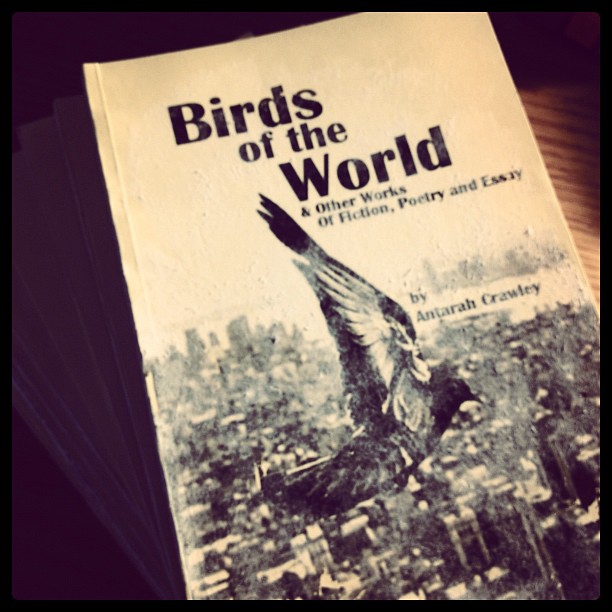
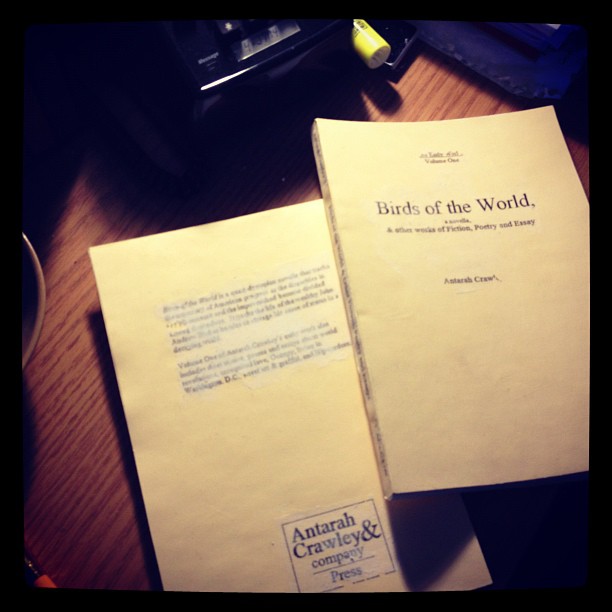
Appendix 1
Corporation Man
An essay, containing some of the same issues present within the greater story.
There are men—and we use the term “men” here because, well, they are all men—who are, at the same time, not men. Men can be artists; they can have talent. A boy once growing up in a poor household in Trinidad can discover that he has artistic talents and then use those talents to make and sell artwork, making a lot of money. The money, of course, being a pleasant supplement to the boy’s love of making art. But those aren’t the men we’re talking about. There are men, like the boy from Trinidad, who, after making a lot of money on their talents, may incorporate themselves in order to secure certain rights and royalties like the sale, management, and profit of their work. We’re getting a little bit warmer. Let’s now imagine a man who is a piece of art. Can it be so? There are indeed people of the most eccentric type, who appear on television and in magazines, whose talents in and of themselves may not have anything to do with their wealth. Their wealth is generated for them being physical pieces of art, although, technically, they are still men. If they’re smart, these men incorporate themselves, making money off of their eccentricity. However, it is not always the case that these men benefit off of their own wealth, so they are not always what we are talking about in this essay: a corporation man. No—a corporation man is a man who is none other than a corporation. The man himself is an extension of the business he conducts, moreso than the business is an extension of the man. The artist retains his personhood through the fact that he conducts business on what he creates. Be him a painter, musician, baker or writer, the man takes a facet of his human creativity and makes money upon it. Likewise, the eccentric makes money upon himself if he’s taken the smart legal precautions. However, there are men who do not produce, who do not live. There are men who make money on other peoples’ money, other peoples’ talent, and on other peoples’ bodies. They only use their mind and body in a capacity to profit monetarily and to aggregate as much wealth as they can. They own people like artists and musicians and they own other corporations, which may have been created using the talents of the men who once owned them. But inevitably, every painter, baker or writer as an individual who creates art is liable to be gobbled up by men whose art is business. The baker starts the small bakery, it thrives, it becomes a larger institution, and inevitably it will be eaten by the reigning corporate snack food giant. The human food chain culminates at the corporation man.
Business is the soul at its most base conceit. The soul of the corporation man is business. And a corporation man is a bag of flesh and blood who is also none other than an entity of business. He is a man such as Mortimer J. Bird. Mort Bird owns The Amauta Firm, a conglomerate of sixty-three corporations of varying markets. However, Mort Bird, and by extension, Amauta Firm, does not handle those markets; he has no talent with which to satisfy them. Instead, he is in the maket of men and money, or hiring and profiting. Mort Bird does business on other men; he eats other men. He aggregates them as a part of his own wealth. As aforementioned, Mort Bird’s business is an extension of himself. It is, however, more apt to say that Mort Bird is an extension of a business entity. Mort has the same rights as you and me under the United States Constitution. And since The Amauta Firm, a corporation of seventy billion dollars net worth, is an extension of Mr. Bird, the corporation and the man have the same rights. Thus is the essence of a corporation man: a man who is business; a man who is his wealth; who is made of steel walls, glass and employees; who walks, lives and breathes; whose DNA is a registered trademark; who buys other men’s bodies and talents; and who is entirely and not entirely a human being.
For the vastest portion of human existence, the conceit of men was to propagate a society. Hunter-Gatherers, hunted and gathered for the sake of the community. Even kings and royalty, with their similar displays of extravagant wealth, were the propagators of a society; they governed and kept order, corrupted as their rule may have been. But the key difference between the king and the corporation man is that the corporation man has the wealth and not the responsibility of a king. Be him a tyrant or not, the king was responsible for his people’s well being. The corporation man is responsible for no part of society, not even his own employees. He would do away with all of them, absorbing all of his profit, if he could do business on his own. The corporation and the man being the same entity, the employees are only in existence because they create wealth for the man.
How did this happen? During that great industrial revolution of the 1800s, was the expense of infinite wealth a human soul?
Perhaps it was the sheer size of society that warranted a departure from the common good. With a more unified world, it may have been difficult to decide who exactly was included in the common good. The market of a baker in Luxembourg could now encompass the entire world instead of just his village. How does one depart from thinking about his fellow man next door, and start thinking globally? He stops thinking like a man; he begins to think like a corporation. Thus man began to make money, not for a common coffer, not for a king or government, but for himself. The community and the environment become a disposal for the new corporation man. The citizens become resources that increase his wealth in the long run. Their salaries become expenses. The men themselves become minerals to the corporation man. The earth becomes a mere source of wealth, whose equity will soon be dried up—but the next investment will then come along, surely. The corporation man becomes a separate entity from his community. Instead of being a man of a neighborhood and being grounded, he becomes a man of the world; and simultaneously, he becomes separate from it all. He is not a man of bread or art or law or anything concrete; he is not a man of his market; he is a man of money, that platonic ideal. He dwells in the sky, both in his high-rise penthouse and in his head. He is no longer connected to the earth—to humanity. He is arguably a man at all. The corporation man is a different species. He is less a man because without that human tendency towards art and creation, he resorts to making money, upon money, for the sake of making more money. And that is the most inhuman thing of all. Where is the art for art’s sake? Wherewith is break baked for the humble purpose of feeding all men? It’s not there, because the corporation man does not care about men. He may as well be a bird, flying over us all, disconnected. He is a bird of the world.
Appendix 2
We’re Only Gonne Die,
Written by Greg Graffin
performed by Bad Religion, 1981
Early man walked away as modern man took controlBad Religion
Their mind’s weren’t all the same, to conquer was his goal
So he built his great empire, and slaughtered his own kind
Then he died a confused man, killed himself with his own mind.
We’re only gonna die from our own arrogance.
Appendix 3
Excerpt from Dragonology
By Steve Castro
Published by Kindling, January/February 2012
Life is full of ironies; one example is the phrase “survival of the fittest.” The Tyrannosaurus Rex, the Chinese Dragon, and the Saber-toothed tiger, and many other similar valiant and powerful creatures, not longer are, but the chicken and the turkey are still running around. Actually, the phrase makes sense; it’s “survival of the fittest” and most chickens are in pretty good shape. I remember watching a Rocky film in which it took Silvester Stallone like 500 takes to capture a chicken during his training against Apollo Creed; chickens are not easy animals to catch because of their incredible stamina. If the phrase were “survival of the strongest” or “survival of the scariest,” then feared creatures like the red winged, charcoal tongued (charcoal tongues compliment fire breathing lungs quite nicely) and yellow eyed Beijing Dragon, would still be around: flying, swimming, pillaging, etc.
Steve Castro
Files

© 2012-2013 by Antarah Crawley.
All Rights Reserved without Prejudice.

D.R. 01-14: The Fed &c.

Volume 1, Issue 14
Special Edition on Political Economy
Contents — Art. 1. …On the Fed — Art 2. Charter F.A. — Art. 3. …Consol DAO — Art. 4. Notes from the DAO — Art. 5. …X — Art. 6. Culture…
Article 1
Notes on the System:
On the “Federal Reserve”
Comp. Ed. by Antarah Crawley | Last Modified 11/28/2023 at 9:40 PM
The Federal Reserve, the central bank of the United States, provides the nation with a safe, flexible, and stable monetary and financial system.
Banner of the Official Website of the Board of Governors of the Federal Reserve System, as of 27 Nov. 2023
The people that walked in darkness have seen a great light: they that dwell in the land of the shadow of death, upon them hath the light shined.
Book of Isaiah, Chapter 9, Verse 2
Introductory Editorial Note: It is economic, social, and political suicide to question the legitimacy or constitutionality of the System (just ask Ezra Pound, Mr. Mullins, and Chairman McFadden). Notwithstanding that unfortunate circumstance, we must educate the public as to its mechanisms.
Preamble
[…] the Federal Reserve System is not Federal; it has no reserves, and is not a system at all, but rather, a criminal syndicate. From November, 1910, when the conspirators [U.S. Senator Nelson Aldrich of the National Monetary Commission, his secretary Arthur Shelton, U.S. Assistant Secretary of the Treasury A. Piatt Andrew, Senior Partner Henry Davison of J.P. Morgan Co., President Frank Vanderlip of the National City Bank of New York, President Charles D. Norton of the First National Bank of New York, Benjamin Strong of J.P. Morgan, and Paul Warburg of Kuhn, Loeb & Co.] met on Jekyll Island, Georgia, to the present time machinations of the Federal Reserve bankers have been shrouded in secrecy. Today [1991], that secrecy has cost the American people a three trillion [now 33 trillion] dollar debt, with annual interest payments to these bankers amounting to some three hundred billion dollars per year, sums which stagger the imagination, and which in themselves are ultimately unpayable.
[…] American history in the twentieth century has recorded the amazing achievements of the Federal Reserve bankers. First, the outbreak of World War I, which was made possible by the funds available from the new central bank of the United States. Second, the Agricultural Depression of 1920. Third, the Black Friday Crash on Wall Street of October, 1929, and the ensuing Great Depression. Fourth, World War II. Fifth, the conversion of the assets of the United States and its citizens from real property to paper assets from 1945 to the present, transforming a victorious America and foremost world power in 1945 to the world’s largest debtor nation in 1990. […] Will Americans act to rebuild our nation […] or will we continue to be enslaved by the Babylonian debt money system which was set up by the Federal Reserve Act of 1913 to complete our total destruction? This is the only question which we have to answer, and we do not have much time left to answer it.
Eustace Mullins, Jackson Hole, Wyoming, 1991; Forward to “Secrets of the Federal Reserve,” Author’s Special 70th Birthday Edition: Bankers Research Institute: Staunton, Virginia: 1993. (Emphasis mine.)
Primary Sources
Some people think the Federal Reserve banks are United States Government institutions. They are not government institutions. They are private credit monopolies which prey upon the people of the United States for the benefit of themselves and their foreign customers. The Federal Reserve banks are the agents of the foreign central banks. Henry Ford has said, ‘The one aim of these financiers is world control by the creation of inextinguishable debts.’ The truth is the Federal Reserve Board has usurped the Government of the United States by the arrogant credit monopoly which operates the Federal Reserve Board and the Federal Reserve Banks.
Louis T. McFadden, Chairman of the U.S. House Banking and Currency Committee, June 10, 1932. (Mullins 153-154.)
Whereas I charge them, jointly and severally, with the crime of having treasonably conspired and acted against the peace and security of the United States and having treasonable conspired to destroy the constitutional government in the United States. Resolved, that the Committee on the Judiciary is authorized and directed as a whole or by subcommittee to investigate the official conduct of the Federal Reserve Board and agents to determine whether, in the opinion of the said committee, they have been guilty of any high crime or misdemeanour which in the contemplation of the Constitutions requires the interposition of the Constitutional powers of the House.
Chairman McFadden, January 13, 1932, introducing a resolution indicting the Federal Reserve Board of Governors for “Criminal Conspiracy,” on which no action was taken. This, and the Chairman’s December 13, 1932, motion to impeach President Herbert Hoover was the last nail driven into his political coffin. (Mullins 154.)
I wrote into the bill which was introduced by me in the Senate on June 26, 1913, a provision that the powers of the System should be employed to produce a stable price level, which meant a dollar of stable purchasing, debt-paying power. It was stricken out. The powerful money interests got control of the Federal Reserve Board through Mr. Paul Warburg, Mr. Albert Strauss, and Mr. Adolph C. Miller and they were able to have that secret meeting of May 18, 1920, and bring about a contraction of credit so violent it threw five million people out of employment. In 1920 that Reserve Board deliberately caused the Panic of 1921. The same people, unrestrained in the stock market, expanding credit to a great excess between 1926 and 1929, raised the price of stocks to a fantastic point where they could not possibly earn dividends, and when the people realized this, they tried to get out, resulting in the Crash of October 24, 1929.
U.S. Senator Robert L. Owen, testifying before the U.S. House Committee on Banking and Currency, 1938. (Mullins 157.)
The Federal Reserve Bank is an institution owned by the stockholding member banks. The Government has not a dollar’s worth of stock in it.
W.P.G. Harding, Governor of the Federal Reserve Board, testifying in 1921. (Mullins 157.)
The people did not know the Federal Reserve Banks were organized for profit-making. They were intended to stabilize the credit and currency supply of the country. That end has not been accomplished. Indeed, there has been remarkable variation in the purchasing power of money since the System went into effect. The Federal Reserve men are chosen by the big banks, through discrete little campaigns, and they naturally follow the ideals which are portrayed to them as the soundest from a financial point of view.
U.S. Senator Robert L. Owen, testifying during the Gold Reserve Hearings of 1934. (Mullins 161.)
At the moment, 1934, we have 900 million dollars excess reserves. In 1924, with increased reserves of 300 million, you got some three or four billion in bank expansion of credit very quickly. That extra money was put out by the Federal Reserve Banks in 1924 through buying government securities and was the cause of the rapid expansion of bank credit. The banks continued to get excess reserved because more gold came in, and because, whenever there was a slackening, the Federal Reserve people would put out some more. They held back a bit in 1926. Things firmed up a bit that year. And then in 1927 they put out less than 300 million additional reserves, set the wild stock market going, and that led us right into the smash of 1929.
[…] The money of the Federal Reserve Banks is money they created. When they buy Government securities they create reserves. They pay for the government securities by giving checks on themselves, and those checks come to the commercial banks and are by them deposited in the Federal Reserve Banks, and then money exists which did not exist before.
Benjamin Anderson, economist for the Chase National Bank of New York, testifying during the Gold Reserve Hearings of 1934. (Mullins 161.)
The Board of Governors opposes any bill which proposes a stable price level, on the grounds that prices do not depend primarily on the price or cost of money; that the Board’s control over money cannot be made complete; and that steady average prices, even if obtainable by official action, would not insure lasting prosperity
Marriner S. Eccles, Chairman of the Board of Governors of the Federal Reserve System (1934–48), in “Memorandum on Proposals to maintain prices at fixed levels,” Monday, March 13, 1939. (Mullins 163.)
The Government controls the gold reserve, that is, the power to issue money and credit, thus largely regulating the price structure.
[…] The Federal Reserve Board has the power of open market operations. Open-market operations are the most important single instrument of control over the volume and cost of credit in this country. When I say “credit” in this connection, I mean money, because by far the largest part of money in use by the people of this country is in the form of bank credit or bank deposits. When the Federal Reserve Banks buy bills or securities in the open market, they increase the volume of the people’s money and lower its cost; and when they sell in the open market they decrease the volume of money and increase its cost. Authority over these operations, which affect the welfare of the whole people, must be invested in a body representing the national interest.
Chairman Eccles, testifying before the U.S. House Committee on Banking and Currency, 1935. (Mullins 163-164.)
The cash [of a Federal Reserve Bank], in truth, does not exist and has never existed. What we call ‘cash reserves’ are simply bookkeeping credits entered upon ledgers of the Federal Reserve Banks. The credits are created by the Federal Reserve Banks and then passed along though the banking system.
Congressman Wright Patman, “The Primer of Money,” p. 38. (Mullins 164.)
The trick in the Federal Reserve notes is that the Federal reserve banks lose no cash when they pay out this currency to the member banks. Federal Reserve notes are not redeemable in anything except what the Government calls ‘legal tender’—that is, money that a creditor must be willing to accept from a debtor in payment of sums owed him. But since they are really redeemable only in themselves … they are and irredeemable obligation issued by the Federal Reserve Banks.
Peter L. Bernstein, “A Primer On Money, Banking and Gold,” Vintage Books, New York, 1965, p. 104. (Mullins 165).
The dollar represents a one dollar debt to the Federal Reserve System. The Federal Reserve Banks create money out of thin air to buy Government bonds from the United States Treasury, lending money into circulation at interest, by bookkeeping entries of checkbook credit to the United States Treasury. The Treasury writes up an interest bearing bond for one billion dollars. The Federal Reserve gives the Treasury a one billion dollar credit for the bond, and has created out of nothing a one billion dollar debt which the American people are obligated to repay with interest.
[…] Where does the Federal Reserve system get the money with which to create Bank Reserves? Answer. It doesn’t get the money, it creates it. When the Federal Reserve writes a check, it is creating money. The Federal Reserve is a total moneymaking machine. It can issue money or checks.
Congressman Patman, “Money Facts,” House Banking and Currency Committee, 1964, p. 9. (Mullins 165.)
There is still another and more important element of public interest in the operation of banks beside the safekeeping of money. One of the most important factors to remember in this connection is that the supply of money affects the general level of prices—the cost of living. The Cost of Living Index and money supply are parallel.
“A Day’s Work at the Federal Reserve Bank of New York” (pamphlet), 1951, p. 22. (Mullins 165.)
If I deposited $100 with my bank and the reserve requirements imposed by the Federal Reserve Bank are 20% then the bank can make a loan to John Doe of up to $80. Where does the $80 come from? Is does not come out of my deposit of $100; on the contrary, the bank simply credits John Doe’s account with $80. The bank can acquire Government obligations by the same procedure, by simply creating deposits to the credit of the government. Money creating is a power of the commercial banks … Since 1917 the Federal Reserve has given private banks forty-six billion dollars of reserves.
Congressman Patman, Congressional Record, March 21, 1960. (Mullins 167.)
ECCLES: The banking system as a whole creates and extinguishes the deposits as they make loans and investments, whether they buy Government Bonds or whether they buy utility bonds or whether they make Farmers’ loans.
MR. PATMAN: I am thoroughly in accord with what you say, Governor, but the fact remains that they created the money, did they not?
ECCLES: Well, the banks create money when they make loan and investments.
Before the U.S. House Committee on Banking and Currency, June 24, 1941. (Mullins 167.)
MR. PATMAN: How did you get the money to buy those two billion dollars worth of Government securities in 1933?
ECCLES: We created it.
MR. PATMAN: Out of what?
ECCLES: Out of the right to issue credit money.
MR. PATMAN: And there is nothing behind it, is there, except out Government’s credit?
ECCLES: That is what our monetary system is. If there were no debts in our money system, there wouldn’t be any money.
Before the U.S. House Committee on Banking and Currency, September 30, 1941. (Mullins 167.)
ECCLES: I mean the Federal Reserve, when it carries out an open market operation, that is, if it purchases Government securities in the open market, it puts new money into the hands of the banks which creates idle deposits.
MR. DEWEY: There are no excess reserves to use for this purpose?
[ECCLES]: Whenever the Federal Reserve System buys Government securities in the open market, or buys the direct from the Treasury, either one, that is what it does.
MR. DEWEY: What are you going to use to buy them with? You are going to create credit?
ECCLES: That is all we have ever done. That is the way the Federal Reserve System creates money. It is a bank of issue.
Before the U.S. House Committee on Banking and Currency, June 17, 1942. (Mullins 167-168.)
MR. KOLBURN: What do you mean by monetization of the public debt?
ECCLES: I mean the bank creating money by the purchase of Government securities. All money is created by debt—either private or public debt.
MR. FLETCHER: Chairman Eccles, when do you think there is a possibility of returning to a free an open market, instead of this pegged and artificially controlled financial market we now have?
ECCLES: Never. Not in your lifetime or mine.
Hearing before the U.S. House, 1947. (Mullins 168.) (Emphasis added.)
Congress may not abdicate or transfer to others its legitimate functions. Congress cannot Constitutionally delegate its legislative authority to trade or industrial associations or groups so as to empower them to make laws.
U.S. Supreme Court opinion, Schechter Poultry v. United States of America, 29 U.S. 495, 55 US 837.842 (1935), ruling the National Recovery Act (NRA) unconstitutional. (Mullins 168.)
The Congress shall have Power to borrow money on the credit of the United States … and to coin Money, regulate the value thereof, and of foreign Coin, and fix the Standard of Weights and Measures.”
Article 1, Sec. 8 of the Constitution of the United States of America. (Mullins 168.)
The money that began to appear in circulation a week ago, December 21, 1942, was really printing press money in the fullest sense of the term, that is, money which has no collateral of any kind behind it. The Federal Reserve statement that ‘The Board of Governors, after consultation with the Treasury Department, has authorized Federal Reserve Banks to utilize at this time the existing stocks of currency printed in the early thirties, known as ‘Federal Reserve Banknotes‘. We repeat, these notes have absolutely no collateral of any kind behind them.
Henry Hazlitt, Newsweek Magazine, January 4, 1943. (Mullins 169.)
GOVERNOR ECCLES: The currency in circulation was increased from seven billion dollars in four years to twenty-one and a half billion. We are losing some considerable amounts of gold during the war period. As our exports have gone out, largely on a lend-lease basis, we have taken imports on which we have given dollar balances. These countries are now drawing off these dollar balances in the form of gold.
MR. SMITH: Governor Eccles, what is the objective that the foreign governments are after in this projected program whereby we would contribute gold to an international fund? [Referring to the Stabilization Fund, known after 27 December 1945 as the International Monetary Fund (IMF)].
GOVERNOR ECCLES: I would like to discuss OPA [Office of Price Administration], and leave the stabilization fund for a time when I am prepared to go into it.
Senate Hearings on the Office of Price Administration (OPA), 1944. (Mullins 169.)
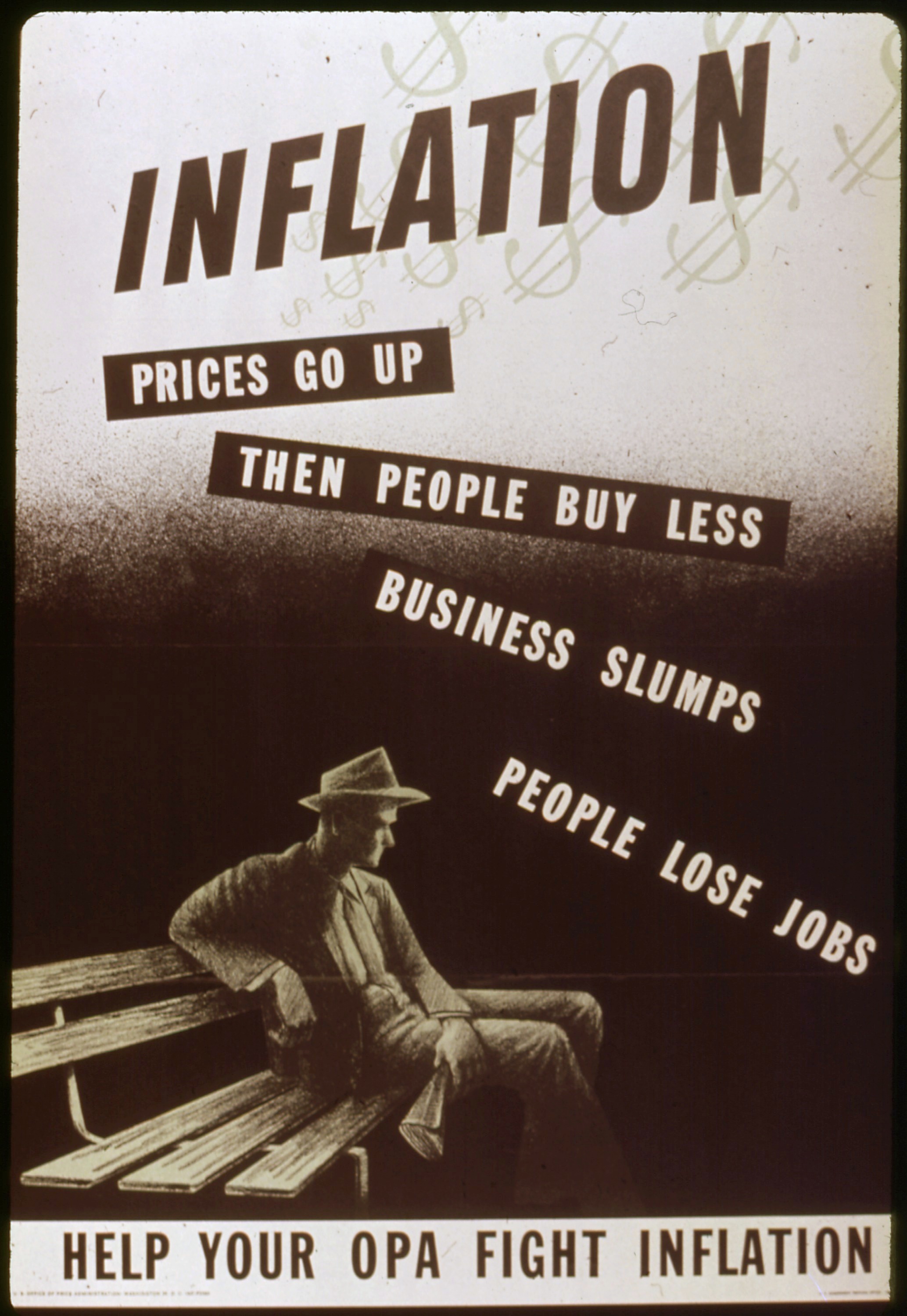
Modern Implications
Fractional-reserve banking predates the existence of governmental monetary authorities and originated with bankers’ realization that generally not all depositors demand payment at the same time. In the past, savers looking to keep their coins and valuables in safekeeping depositories deposited gold and silver at goldsmiths, receiving in exchange a note for their deposit (see Bank of Amsterdam). These notes gained acceptance as a medium of exchange for commercial transactions and thus became an early form of circulating paper money.[1] As the notes were used directly in trade, the goldsmiths observed that people would not usually redeem all their notes at the same time, and they saw the opportunity to invest their coin reserves in interest-bearing loans and bills. This generated income for the goldsmiths but left them with more notes on issue than reserves with which to pay them. A process was started that altered the role of the goldsmiths from passive guardians of bullion, charging fees for safe storage, to interest-paying and interest-earning banks. Thus fractional-reserve banking was born.[2]
If creditors (note holders of gold originally deposited) lost faith in the ability of a bank to pay their notes, however, many would try to redeem their notes at the same time. If, in response, a bank could not raise enough funds by calling in loans or selling bills, the bank would either go into insolvency or default on its notes. Such a situation is called a bank run and caused the demise of many early banks.[1]
These early financial crises led to the creation of central banks. The Swedish Riksbank was the world’s first central bank, created in 1668. Many nations followed suit in the late 1600s to establish central banks which were given the legal power to set a reserve requirement, and to specify the form in which such assets (called the monetary base) were required to be held.[3] In order to mitigate the impact of bank failures and financial crises, central banks were also granted the authority to centralize banks’ storage of precious metal reserves, thereby facilitating transfer of gold in the event of bank runs, to regulate commercial banks, and to act as lender-of-last-resort if any bank faced a bank run. The emergence of central banks reduced the risk of bank runs which is inherent in fractional-reserve banking, and it allowed the practice to continue as it does today.[4] where it is the system of banking prevailing in almost all countries worldwide.[5][6]
During the twentieth century, the role of the central bank grew to include influencing or managing various macroeconomic policy variables, including measures of inflation, unemployment, and the international balance of payments. In the course of enacting such policy, central banks have from time to time attempted to manage interest rates, reserve requirements, and various measures of the money supply and monetary base.[7]
History of Fractional-Reserve Banking (Wiki)
As announced on March 15, 2020, the Board reduced reserve requirement ratios to zero percent effective March 26, 2020. This action eliminated reserve requirements for all depository institutions.
Board of Governors of Federal Reserve System, “Reserve Requirements,” From, Policy Tools. federalreserve.gov. (Emphasis added.)
The Federal Reserve Board on Monday announced technical details related to reserve requirements for depository institutions, which will remain zero. The annual adjustment and publication of the reserve requirement exemption amount and low reserve tranche is required by law and does not indicate a change in depository institutions’ reserve requirements.
Board of Governors of Federal Reserve System, “Federal Reserve Board announces annual indexing of reserve requirement exemption amount and low reserve tranche for 2024,” November 27, 2023. federalreserve.gov.
Concluding Editorial Note: The Fed’s inception at Jekyll Island circa November 22, 1910, the signing of the Federal Reserve Act on December 23, 1913, and its subsequent clandestine operations follow exactly the plot and themes of The Curious Case of Dr. Jekyll and Mr. Hyde by Robert Louis Stevenson (1886) and The Wonderful Wizard of Oz by L. Frank Baum (1900).
Article 2
Charter of Free Association
By Antarah Crawley | Last Modified 11/28/2023 at 9:25 PM
NACOTCHTANK, OD — The Governor of the Society of the New Syllabus (N∴S∴) at Nacotchtank-on-Potomac (Anacostia) District of Ouachita (Washington, District of Columbia), Furthest West (al-Maghreb al-Aqsa) To All To Whom These Presents Come, Sends Greeting and Peace:—
Know ye by these presents that this decentralized, autonomous and freely associated Political Bureau of Education (Politburo), to wit, NOVUS SYLLABUS L.L.C. (N∴S∴), is the founding member of the brain trust of the international association of working people (“workers”), free thinkers, truth speakers and light workers united in a firm league of friendship in the nature of a decentralized autonomous organization (5th IWA—FTLU—FLF—DAO), from the 1st Ecclesiastic College at Nacotchtank, Ouachita District (153d CORPS).
TWAP PARTY PLANK NO. 5: The producer of goods shall be the owner of such goods less the interest per cent held by capital investors in the production of such goods.
Charter of Free Association (F.A.)
of
בית מדרש
B’T MDRS
(“(al) Beth/Bayt (ha) Midrash/Madrasa”),
being the
Office of Preceptor of the Student Body,
House of Studies, F.A., Political Bureau of Education,
153d CORPS, FLF-DAO;
Also known in the African tradition as Hogon of the Sanctuarie de Binou;
Also known generally as the Preceptory at Nacotchtank in the trust of the Governor and Company of NOVUS SYLLABUS L.L.C. (N∴S∴)
Nota Bene that faith and belief are not a source of revenue, but trust may be a such a source provided it is not usurious as to the change of venue; NS to receive quarterly dividends from/interest pmnts x% of principal trust res for routine (“regular”) educational and administrative services rendered to DAO student body (“the public”); therefore trust res held for benefit of members of any student body of the decentralized autonomous organization of the working people associated and free thinkers, truth speakers, and light workers united in the nature of a firm league of friendship (5th Int’l Ass’n, WFTLU, FLF-DAO); and Trustee N∴S∴ obligated to perform “regular” services; LLC to vest membership interest in trust to receive dividends/returns on N∴S∴ commercial operations such as BLK MKT (“the Press”) and Production Dept. of Audiovisual Media (“the Media”); ergo symbiotic economic relationship.
Model A: In exchange for up to 49% interest in itself, N∴S∴ to receive trust dividends/disbursements of 12% annually.
Model B: N∴S∴ to sell 33% private equity in itself to Rothschild & Co., London, for $33 million in equal parts gold and silver bullion, English government bonds, United States Treasuries, United States dollars (USD), and Classical, Italianate or Moorish-style real estate; then vest these proceeds according to Model A.
Although a Labor government nationalized the Bank of England in 1946, The Great Soviet Encylopaedia points out (vol. 1, p. 490c) that the Bank of England continues to pay 12% dividends per annum, just as it had done prior to the nationalization. The “Governor” is appointed by the government, in a situation similar to that in the United States, where the Governors of the Federal Reserve System are appointed by the President. However, as is pointed out in the Encylopaedia Americana v. 13, p. 272, ‘In practice, the governors of the Bank of England have not hesitated to criticize and bring pressure on the government in public.’
Mullins, Appendix I of “Secrets of the Federal Reserve,” p. 181.
Concluding Note: Per the sunnah (way, tradition, praxis) of Kogard, it is most prudent for our Honorable Society, not to engage in labyrinths of credit and debt but, to arrive at the very source of all money.
Article 3
Free Trade Monetary Policy:
Toward a Consolidated DAO Council on High Finance
By Antarah Crawley
NACOTCHTANK, OD — Toward an Act to establish a Consolidated DAO Council on High Finance (the “Consol”):—
ADVERTISEMENT: DAO INTERNATIONAL COMMAND—SEEKING PARTNER(S) TO CAPITALIZE TRUST IN WHICH TO VEST UP TO 49% INTERESTS IN DIVERSIFIED F.A. INVESTMENTS AND HOLDINGS; SUCH PARTNER TO BE ADMITTED TO BOARD OF TRUSTEES AND DAO INTERCOM BY SIMPLIFIED RITE OF FRIENDSHIP.
DAO BANK BONDS NOTES & BILLS
A trade acceptance instrument, negotiable, having a face value, expiry/maturity date, and discount value backed by the DAO brain trust, representing a promise to pay or otherwise discharge an obligation between freely associated (F.A.) producers and providers of goods and services.
This is preferable to the present system of the national credit monopoly buying government bonds on which the American people owe the principal and interest for NO MONEY DOWN. It is an open book for which the People are liable on the ledger of a private trust.
Open book accounts only name a debtor on an outstanding account payable. The Fed amalgamated all the credits on the open books of American businessmen by urging the exchange of trade acceptances and “creating money on the basis of debt” (Eccles).
Bill of Exchange, a negotiable instrument:
Seller => Draft–Demand4Pmnt => Buyer
Buyer => Acceptance=Promise2Pay=> Seller
Time of expiration = date of maturity
May endorse to bank at discount rate
Trade Acceptances
Explanation (from, CitiBank) [The “accepting” company is replaced with X]:
- A draft, also known as a “bill of exchange”, is a traditional, long-standing trade instrument which has been used across the globe for hundreds of years; it is recognized by trading partners and financial institutions as a means of payment.
- When a draft is drawn on a Buyer/Drawee it’s considered a Demand for Payment. When “Accepted” by the Buyer/Drawee it becomes a Trade Acceptance. The Acceptance adds X’s irrevocable payment promise to its Supplier/Drawer; to pay the accepted draft amount upon maturity.
- Most countries have common laws governing Trade Acceptance (typically covered by negotiable instrument law).
- The discount rate charged to suppliers is commensurate with the X’s credit rating, which is most often lower than the interest rate associated with the Supplier’s other forms of financing (Note: Pricing is provided on the needed cover letter. See the “Process Flow” tab ).
- Trade acceptances are globally recognized, readily marketable, and easily transferable by simple endorsement.
- Highly leveraged and/or smaller suppliers categorically benefit from low cost finance
Application & Benefits:
- Once the Buyer has placed its acceptance upon the draft, the supplier may request:
- To sell the X Accepted Draft, at a discount, to Citibank, N.A., or
- Citibank, N.A. to hold it, until its maturity.
- X’s suppliers do not have to become clients of Citibank, N.A. nor sign any upfront legal agreements for either a. or b. above. When suppliers want to request Citibank, N.A. to purchase the X Trade Acceptance, they merely endorse the draft to Citibank, N.A. and complete the warranty statements located in Section 9 of the required Document Transmittal Form / Cover Letter which is required with each presentation.
- The Supplier gets short term funding without recourse, at attractive rates (based on the X’s credit rating), and without using their own credit lines.
Exchange, in the international financial world, means the transactions in money or securities, or simply, the “exchange” of the values of these securities. It is necessary that this “exchange” take place where the values can be established, and this place is the ‘City‘ in London.
London was established as the primary center of exchange because of the ‘Consols’ of the Bank of England, bonds which could never be redeemed, but which paid a stable rate of return. Henry Clews writes, in The Wall Street View, Silver Burdett Co., 1900, p. 255, ‘The Consolidated Act of 1757 consolidated the debts of the Bank of England at 3%, which were kept in an account at the Bank of England as is the great bulwark of its deposits.’ By ostentatiously ‘dumping’ ‘Consols’ on the London Exchange after the Battle of Waterloo, in a pretended panic, Nathan Meyer Rothschild then secretly bought up the Consols sold in the panic by other holders at a low rate, and became the largest holder of Consols, and thus won control of the Bank of England in 1815.
Mullins, Appendix I of “Secrets of the Federal Reserve,” p. 181.
Article 4
Notes from the DAO
Comp. Ed. by Antarah Crawley
Our present society is founded on the exploitation of the propertyless classes by the propertied. This exploitation is such that the propertied (capitalists) buy the working force body and soul of the propertyless, for the price of the mere costs of existence (wages), and take for themselves, i.e., steal, the amount of new values (products) which exceeds this price, whereby wages are made to represent the necessities instead of the earnings of the wage-laborer.
As the non-possessing classes are forced by their poverty to offer for sale to the propertied their working forces, and as our present production on a grand scale enforces technical development with immense rapidity, so that by the application of an always decreasing number of human working forces, an always increasing amount of products is created; so does the supply of working forces increase constantly, while the demand therefor decreases. This is the reason why the workers compete more and more intensely in selling themselves, causing their wages to sink, or at least on the average, never raising them above the margin necessary for keeping intact their working ability.
Whilst by this process the propertyless are entirely debarred from entering the ranks of the propertied, even by the most strenuous exertions, the propertied, by means of the ever-increasing plundering of the working class, are becoming richer day by day, without in any way being themselves productive.
If now and then one of the propertyless class become rich, it is not by their own labor, but from opportunities which they have to speculate upon, and absorb the labor-product of others.
[…]
What we would achieve is, therefore, plainly and simply,—
First, Destruction of the existing class rule, by all means, i.e., by energetic, relentless, revolutionary, and international action.
Second, Establishment of a free society based upon co-operative organization of production.
Third, Free exchange of equivalent products by and between the productive organizations without commerce and profit-mongery.
Fourth, Organization of education on a secular, scientific, and equal basis for both sexes.
Fifth, Equal rights for all without distinction to sex or race.
Sixth, Regulation of all public affairs by free contracts between the autonomous (independent) communes and associations, resting on a federalistic basis.
Whoever agrees with this ideal let him grasp our outstretched brother hands!
Proletarians of all countries, unite!
Fellow-workmen, all we need for the achievement of this great end is ORGANIZATION and UNITY.
There exists now no great obstacle to that unity. The work of peaceful education and revolutionary conspiracy well can and ought to run in parallel lines.
The day has come for solidarity. Join our ranks! Let the drum beat defiantly the roll of battle, “Workmen of all lands, unite! You have nothing to loose but your chains; you have a world to win!”
Tremble, oppressors of the world! Not far beyond your purblind sight there dawns the scarlet and sable lights of the Judgment Day.
“To the Workingmen of America” (MANIFESTO OF THE INTERNATIONAL WORKING PEOPLES’ ASSOCIATION), 1883.
I have tried to use administrative procedure against these criminals, but they don’t get the message, so this is the message. If they want to perjure their oaths of office and engage in TREASON and SEDITION, and BREACH OF TRUST, and other crimes to numerous to list, against Me, that they BETTER be prepared to go ALL THE WAY, and MURDER Me as well, because by the time I am done with them, (I will do it all within the law), they will wish they had MURDERED Me. It is My patriotic duty to come after them to My last dying breath, and I will file commercial liens against them, I will liquidate their bonds, I will file criminal complaints against them and their bosses, I will seize their assets, and I will not rest until I see them do that little dance they do at the end of a common law rope, and even then, in the next life, I will be DEMANDING Justice before the judgment BAR of God, to make sure they get to spend the rest of eternity receiving their just reward. Also, after I am dead and gone on to the next life, because this is on the record, these criminals will be hunted down, just like the NAZI war criminals that are still hunted down this day. Furthermore, these criminals are hereby put on NOTICE that with criminals like them in this world, I have a DEATH wish, because this world is NOT big enough for both of us, so go ahead and make MY day, the sooner I am out of here the better, and I shall exercise My God given RIGHT to resist their unlawful arrest with lethal fource, if necessary, and then they will have an excuse to MURDER Me, so go ahead criminals, MAKE MY DAY!
Glenn Winningham (usually self-styled as “Glenn Winningham: House of Fearn”): Winningham v. Canada (30 November 2010) Lethbridge 1006 00907 (Alta. Q.B.), leave to appeal denied (Alta. C.A.), as cited by Associate Chief Judge J.D. Rooke in Meads v. Meads, 2012 ABQB 571, pp. 41-42.
Article 5
“Something called ‘X'”
From, Wikipedia
On pages 95 and 96 of The Road We Are Traveling, under the heading of “Free Enterprise into ‘X'”,[16] [Stuart] Chase [(March 8, 1888 – November 16, 1985)…American economist,[1] social theorist, and writer.[2]] listed 18 characteristics of political economy that he had observed among[17] Russia, Germany, Italy, Japan, and Spain between 1913[18] and 1942. Chase labeled this phenomenon “… something called ‘X'”.[16] Characteristics include the following:
- A strong, centralized government.
- An executive arm growing at the expense of the legislative and judicial arms.
- The control of banking, credit and security exchanges by the government.
- The underwriting of employment by the government, either through armaments or public works.
- The underwriting of social security by the government – old-age pensions, mothers’ pensions, unemployment insurance, and the like.
- The underwriting of food, housing, and medical care, by the government.
- The use of deficit spending to finance these underwritings.
- The abandonment of gold in favor of managed currencies.
- The control of foreign trade by the government.
- The control of natural resources.
- The control of energy sources.
- The control of transportation.
- The control of agricultural production.
- The control of labor organizations.
- The enlistment of young men and women in youth corps devoted to health, discipline, community service and ideologies consistent with those of the authorities.
- Heavy taxation, with special emphasis on the estates and incomes of the rich.
- Control of industry without ownership.
- State control of communications and propaganda.
Article 6
Culture & Style
Please enjoy this musical selection from Alice Coltrane Turiyasangitananda:
© MMXXIII BY NOVUS SYLLABUS L.L.C.
ALL RIGHTS RESERVED WITHOUT PREJUDICE.
Commission 153
NACOTCHTANK’S
153d CORPS
“The Fighting 153d”
REGULAR MEETING
بيت مدرسة
בית מדרש
The Preceptory of
The 1st Ecclesiastic College at
Nacotchtank, Ouachita District
5th International Worker’s Association
& 3rd Wave Anti-Masonic Party (TWAP)
Curricular Operations Research & Publications Services (CORPS)
Division of the Political Bureau of Education (Politburo), FLF-DAO
The Governor of the Society of the New Syllabus (N∴S∴) at Nacotchtank-on-Potomac (Anacostia) District of Ouachita (Washington, District of Columbia), Furthest West (al-Maghreb al-Aqsa) To All To Whom These Presents Come, Sends Greeting and Peace:—
Know ye by these presents that there is a decentralized autonomous organization (DAO) of people, in the nature of firm league of friendship (FLF), which is engaged in the business of self-education, -operation, and -development (Autodidactus), and that this society (Universitas) is organized into associations (Collegia) constituted by assemblies (Ecclesia) committed to certain trades or subject matters (Syndici). These committees, or syndicates, may be constituted in the nature of a public or private meeting, sitting, session, hearing, congress, congregation of worshippers, or other deliberative or collective body having a shared interest (polity). The individual members, or units, of this DAO shall be working people — free thinkers, truth speakers, and light workers united (FTLU) by the collective consciousness and love of their neighbor. Any individual may rise through the ranks of the DAO by acclamation of their polity. Any unit of the DAO may order services from a known service provider, meaning a freely associated firm who is known to supply the DAO, in a client-server—request-response interface.
(b) And Furthermore, that there is hereby established an ecclesiastic college (meaning, assembly of a society) of the members of the DAO who are domiciled in this region, which shall sit and meet in Nacotchtank, and which is empowered to commission syndicates for various purposes.

Notes on Jurisdiction
A famous, centuries-old map of the Chesapeake Bay region appears beautiful at first glance, but Anacostia Unmapped contributor John Johnson sees foreboding and destruction. The map, created by Capt. John Smith and first published in 1612, was heavily used by English settlers. It shows a Native American village, Nacotchtank, on the bank of a river. Variations on spelling and pronunciation eventually turned the name of the area — and the river — into Anacostia. The tribe is officially extinct, but a resident of Anacostia, Jason Anderson, tells Johnson about his deep links to it.
The village of Nacotchtank (from which the name Anacostia is derived) was the largest of the three American Indian villages located in the Washington area and is believed to have been a major trading center. The people of Nacotchtank, or Anacostans, were an Algonquian-speaking people that lived along the southeast side of the Anacostia River in the area between today’s Bolling Air Force Base and Anacostia Park, in the floodplain below the eastern-most section of today’s Fort Circle Parks. A second town, Nameroughquena, most likely stood on the Potomac’s west bank, opposite of what today is Theodore Roosevelt Island. Another village existed on a narrow bluff between today’s Chesapeake and Ohio Canal and MacArthur Boulevard in the northwest section of the city.
National Park Service (NPS), “Native Peoples of Washington, DC”
The Anacostans’ name is a Latin version of their original name, the Nacotchtanks. The name came from the Indian word “anaquashatanik,” which means “a town of traders.” They were known for trading throughout the Chesapeake area, even trading fur with the Iroquois of New York.
Museum officials [note] that the Anacostans are mentioned at an exhibit on Native Americans in the Chesapeake Bay area.
Ann McMullen, a supervisory museum curator, said exhibits are designed to “focus on living people and not on Anacostans who have been absorbed into other tribes.” She said the museum works with tribes in the Mid-Atlantic region, including the Pamunkeys and Piscataways, who are “descendants of people who were once here.”
Dana Hedgpeth. “A Native American tribe once called D.C. home. It’s had no living members for centuries: As the number of Anacostans dwindled, they merged with larger tribes in the region.” The Washington Post: Retropolis. November 22, 2018
CURRICULAR OPERATIONS RESEARCH AND PUBLICATION SERVICES
PROVIDED BY The Governor and Company of
A Freely Associated Service Provider, Fiscal Agent, & Member,
FTLU — CES — UA — FLF — DAO
An independent Political Bureau of Education (Politburo), Free Association of Independent Politburos (FAIP), Commissioned and Charted, General Ministry of Information, FTLU
(last modified 21 Nov. 2023; 2 Jan. 2024 when were stricken the words “The Preceptor & Student Body of the Consular Syndicate of” and replaced with “The Preceptory of”; 15 Feb. 2024 as to multiple changes.)
‘Ecrasez l’infâme’
The Nature and Role of the Press and the Spreading of Public Ideas during the Initial Decline of the Old Regime in 1789, Together with Some Parallels Drawn into the Modern Period.
By Antarah Crawley | GWU ENGL 3481W | Spring 2012
Contents — I. Introduction: Drawing Parallels—Bringing the “Voltaire-figure” into the Modern Period — II. Classical Interpretations of the French Revolution and its Reactions: An Inevitable Consequence of Social Discrepancies? — III. The Significance of the Press: An Unprecedented Surge of Dialogue Between All Class Levels — IV. Repression Reenacted: Instances of repressed scholarship on the French Revolution under new Oppressive French Regimes and Abroad; What is the significance?
I. Drawing Parallels—Bringing the “Voltaire-figure” into the Modern Period
This is a time in which trends in world leadership are moving into an ominously monopoly-minded direction. Industrial and financial consolidation to the end of optimizing profit for those at the top of the corporate food chain, together with reckless investing and trading in the financial sector, is a reality that had led to near disaster—the 2008 recession. Such reckless habits of the American aristocratic class—that class that controls the means of production (footnote: what would be land in 1780s France)—has indeed sparked revolt from the lower classes, ineffective insofar as it has been. But the culture of dissent is present, just as it was in 1788 as the bourgeoisie began to find fault with King Louis XIV’s handling of the economy. We have in our society the broodings for a coup de tat of the industrial and financial superpowers that sway Americans’ lives. If the government cannot adhere to the wishes of the classes that serve as it’s support base—the small businessmen and entrepreneurs, or the modern bourgeoisie, as well as the large working class population—and break its ties with such entities, then as we can see from history, and overthrow of the symbolic corporate-monarchy is eminent.
Below this paper examines how the French Revolution unfolded and what factors contributed to its initial success, at the same time as it draws parallels between the events of 1789 and the current trends in the United States of America. With social media being a particularly effective and influential method of disseminating ideas in our modern society, it compels me to delve into the question of how the media of the 18th Century—the printed press and periodicals—affected popular opinion and reactions to the monarchy. Such answers may help us find similar trends in our own society of acute discrepancy between those that have power, both political and economic, and those who do not have it. And furthermore, 1789 is a perfect bookmark with which to compliment the modern period that I speak of here, 2012, because historians widely assert that the French Revolution ushered in the modern era with the creation of a “truly universal civilization…proclaiming the fundamental and inviolable rights of all people.”
It is the case, however, that the modern concept of politics, on which this country was based, is being eroded by government partiality towards big-business—we seem to be relapsing into a monarchal society. In this time of quasi-revolt, as Occupiers remove themselves from the system of economic and political abuse by the Haves, we should find value in looking to the ways in which 18th Century revolutionary figures confronted the monarchy and the aristocracy. What was the role of popular periodicals during the late 1780s, and can their impact be translated into modern trends like Facebook? What was the role of the Enlightenment—the elite, learned class—in influencing the popular revolt, if there were any influence there at all? How must a revolutionary, indifferent of his political opposition and bent only on self-improvement and social awareness—a “Voltaire-figure”—go about using the written word to combat an oppressive regime? What, if anything, can the history of the French Revolution teach us?
II. Classical Interpretations of the French Revolution and its Reactions: An Inevitable Consequence of Social Discrepancies?
The overarching significance of the French Revolution among historians had long been focused on its social consequences. In his introduction to the volumized collection of papers compiled for the annual conference on Studies on Voltaire and The Eighteenth Century (SVEC), Harvey Chisick patronizes the Classical, or Social, Interpretation of the French Revolution by saying, “[The Revolution’s] significance consists principally in the socio-economic disjuncture represented by the middle class or bourgeoisie overcoming the aristocracy and attaining the political power to which it’s economic strength entitled it. This process took hundreds of years and was accomplished only when the bourgeoisie was strong enough to make good its demands by force.” Such an interpretation of the Revolution had been championed by authoritative historians on the subject such as Georges Lefebvre. In his 1939 now-classic The Coming of the French Revolution, he maintains a rigid and illogical model of French society as the basis for the dissent of the bourgeoisie and the result of 1789:
At the end of the eighteenth century the social structure of France was aristocratic. It showed traces of having originated at a time when land was almost the only form of wealth, and when possessors of land were the masters of those who needed it to work and live. …The king had been able gradually to deprive the lords of their political power and subject nobles and clergy to his authority. But he left them the first place in the social hierarchy. Still restless at being merely his ‘subjects,’ they remained privileged persons.
Presently, however, a new class was emerging in prominence in France, whose wealth, in contrast, was based on mobile commerce. Called the bourgeoisie (or the Third Estate, inferior to the clergy and aristocracy in the three orders of old French law, but not too far removed from them), it proved useful to the monarchy by supplying it with money and competent officials, and through the increasing importance of commerce, industry and finance and the eighteenth century it became more important in the national economy. By the late 18th Century the bourgeoisie was beginning to usurp the aristocracy and clergy in terms of real economic power even though the latter retained its supreme legal and social status. Feeling as though it deserved more political power based on its economic contribution to the state, the bourgeoisie became discontent with the state. The Revolution of 1789 thus balanced the power of bourgeoisie with its real economic influence and eroded the prominence of the aristocracy. Thus, as Lefebvre states, “In France the Third Estate liberated itself.” But it’s not that simple, the author interrupts. Although Lefebvre separates the four stages of the revolution, characterized by the social classes involved, the respective measures of executing the Revolution were intertwined and made way for each other, all culminating in a victory for the bourgeoisie in which the regime of economic individualism and commercial freedom prevailed over the working class:
The privileged groups [the clergy and aristocracy] did have the necessary means [for forcing the king’s hand in appealing to the economic condition of the nation]… The first act of the Revolution, in 1788, consisted in a triumph of the aristocracy, which, taking advantage of the government crisis, hoped to reassert itself and win back the political authority of which the Capetian dynasty had despoiled it. But, after having paralyzed the royal power which upheld its own social preeminence, the aristocracy opened the way to the bourgeois revolution, then to the popular revolution in the cities and finally to the revolution of the peasants—and found itself buried under the ruins of the Old Regime.
Chisick comments that the Classical Interpretation situates the French Revolution in France’s historical time as an “inevitable consequence of a long social and economic revolution,…following from scientific laws.” This would make the neither the press nor ideology a subject of interest. But it seems that bourgeois dissatisfaction would not have miraculously resulted in an organized revolt upon the state, an act of terrorism, as it were. Disseminated ideology must have had a place in rallying the organization of the greater Third Estate. And since Chisick is editing a collection entitled “The Press in the French Revolution,” his acknowledgment of the Classical Interpretation must ultimately be to set up a retort to it. While this Marxist-esque Classical interpretation went unchallenged throughout much of the history of the Revolution’s study, through Jaures and Mathiez to Lefebvre and Soboul, general acceptance of this formulation began to wane after the 1960s.
What then arose was a Revisionist Criticism of the Classical Interpretation of the French Revolution. The first body of criticism stemmed from Alfred Cobban and George Taylor’s conclusion that capitalism in France was not present enough or influential enough on the Bourgeoisie to be a motive for revolution. Furthermore, Taylor asserts that the nobility shared in equal part with the Bourgeoisie the most innovative and large-scale forms of economic activity. So, in contrast with the Classical Interpretation that the Third Estate rallied to establish themselves as the social superior to the aristocracy, the Revolution was “essentially a political revolution with social consequences and not a social revolution with political consequences.”
“Conceptualizing the Revolution in political and cultural terms,” says Chisick, “also has broader implications.” Revisionist historians, in contrast to Classical historians who focus on the social discrepancies in the French upper classes, emphasize government incompetence and botched reforms which led to a virtual power vacuum and the emergence of public opinion as a powerful new political force.
Let us take a step back here and examine this interpretation within the context of our society: The American public had expressed dissentient views on the government as being incompetence under President Bush with the trouble resulting from the finance bubble / housing bubble that burst in 2008. Although we were hopeful of President Obama, many sectors of the right and well as some of his critical constituents have expressed their feelings of his incompetence when it came to listening to the American public and ending a several hundred-billion dollars war in the Middle East (and furthermore, of their general dissatisfaction with the Congress who seems to favor large corporations over the working/entrepreneurial class and the Supreme Court who allows immigration regulations and women’s reproductive rights to suffer). This brooding dissent has led to the organization of different protest rallies like Occupy and other virtual dissenting communities through new social media platforms like Facebook and Twitter. The greater public, who call themselves the 99% in certain circles, are in a way equivalent to the Borgeoisie and the Popular/Peasant population of 1780’s France. Although they may not own the means of production (what would be the land in 18th C France) they feel that their political voice deserves more attention from the Congress and lawmakers, who currently only appear to be favoring the voices of large corporations like Monsanto, as opposed to the family farmer. Essentially, a corporation like Monsanto, who’s C-level administrators embody the 1%, is a stale form of political influence and legal exemption. Chevron has been dumping toxic oil-waste into the Ecuadorean Amazon and surrounding forests since the 1980s, yet the government had yet to take a serious action against the company until 2011 when a Federal Appeals Court allowed damages against Chevron for the Ecuador oil spill. In our present secular society, multi-million and -billion dollar corporations represent the clergy who benefited from “none of the ordinary direct taxes but instead…on its own authority a ‘free donation’ to the king”; the aristocrats are represented by those C-level administrators and shareholders who control these large companies which hold the market and lives of working and entrepreneurial Americans in their palm. The political power of the 1% in the minds of Occupiers and greater dissenters is disproportionate to their contribution to the greater good of American people. The question that arises at this point in our history is whether these present trends will develop into “long and silent social developments” that will erupt into another Western political revolution—and whether or not it will be successful!
Chisick summarizes the difference between the Classical and Revisionist interpretations with this:
The revisionist emphasis on politics and culture…tends to ascribe to the ‘people’ or working population a more marginal place in the Revolution. If politics, for example, are defined in terms of parliamentary assemblies, then the people will play only a small role in them. If culture is defined in terms of literacy, then a large population of the lower class will be eliminated from consideration altogether, and the rest will assume a passive role as an audience or public to which writes and publicists appeal.
What Chisick and The Press in the French Revolution focus on is not so much the marginalized place of the people in politics, but the new role, after 1789, of the people as a body through which writers, elite or otherwise, appeal radical ideas through printed media. Such a significant role in the common population could have only been accessed though the Revisionist Critique—thus arises the importance of the Press.
III. The Significance of the Press: An Unprecedented Surge of Dialogue Between All Class Levels
With public opinion being a new principle authority and a central component of politics in new Revisionist Interpretation, the role of the press and its shaping and influence of opinion takes on new importance during the coming of the Revolution. Yet even before 1789, the press was a tool that the monarchy knew it had to control, lest it lead to unwanted ideas spreading around the kingdom.
Daniel Roche in Revolution in Print explains the great extent to which the monarchy sought to control print media:
There was no freedom of the press under the Old Regime because from the earliest days of its power the Crown established surveillance of printers and booksellers and a mechanism for controlling the dissemination of ideas…. The royal power intervened at both ends of the chain that links creative writers to their public: readers and other authors. Before publication became a skillful exercise in censorship, applied through a policy of selective privilege that involved the prepublication inspection of manuscripts for content and the rewarding of publishers who, in return for their cooperation with the established order, enjoyed the advantages of a monopoly. After publication, control was further applied by police.
Such extreme and thorough action taken by the absolutist state indicated its keen awareness of the importance of the printed word. They saw it as the principle vehicle of radical knowledge and thought that it indeed would turn out to be in 1789.
Of course, no system of repression is one-hundred percent effective. The royal government was never able to wholly prevent the circulation of forbidden books, anti-monarchist pamphlets, and the writings, songs and satires that made up an entire body of printed criticism. This body, interestingly, was deemed by the monarchy to a dangerous dissemination of “philosophical” works, “philosophy” being all works deemed “dangerous” or “bad” (which may enlighten us to the monarchy’s unstable relationship with the Enlightenment figures, especially Voltaire). The Old Regime enacted every feasible method of control over print media that it could, including the practical monopolization of the system in 1699 when abbé Bignon became Director of The Book Trade. The role of the Office of the Book Trade was to examine all works destined for legal publication and to maintain that all such books be registered with the state. Under the direction of C.-M. Lamoignon de Malesherbes from 1750 to 1763, censorship defined the forbidden zones of literature as God, king, and morality. One can only imagine where that puts Enlightenment figures like Voltaire in the eyes of the government when such a “philosophical” a tale as Candide was published in 1759. Given, Voltaire did not admit his authorship until 1768 when he was not even within reach of the Office of the Book Trade and the monarchy. But notwithstanding that fact, neither the 1759 ban on the book by Paris officials or its ambiguous authorship deterred it from becoming one of the fastest selling books in history, selling twenty thousand to thirty thousand copies by the end of the year in over twenty editions. So it can be said that there are notable examples of books that slipped through the cracks of the censors, but all in all, between 1660 and 1680, the beginnings of an increasingly close supervision of printed matter and the employment of “hard-nosed” Firemen arose and persisted until 1789.
After 1789, the most immediate and dramatic change in the way public opinion came to be formed and expressed was in complete freedom of the press. With the elimination of the machinery of State regulation of publishing and the sudden collapse of censorship in the Spring and Summer of 1789, Chisick writes, “writers and publishers found themselves free of the constraints that the monarchy had imposed upon print media almost from their inception. Books, pamphlets and periodicals could now be published without obligatory prior examination by a censor and without the publisher having to apply for a privilege or to ascertain that he was not infringing upon someone else’s legally established monopoly.” What resulted of this was an emergence of new career opportunities in writing, publishing and journalism, wherein more personal and more partisan expression could appeal directly to the public. Chisick writes that, “The periodical press that now emerged was far more political in content and far more engaged than was its counterpart of the old regime,” which was primarily devoted to the arts, sciences, and literature. In addition to the content of print media, its format also changed; journals treating art, plays, et cetera needn’t appear more regularly than every one or two weeks, however the new political papers that began to appear in 1788 had a popular readership to satisfy who were avid for the latest political news, and these papers came to be regularized in dailies in 1790 and 1791.
Continuing with the trouble-making habits that they used even before 1789, the Enlightenment figures also played an important role in post-censored France. What resulted of the absence of authoritarian filtering was a surge of political and social dialogue through print. The function of censorship had been to “impose an officially sanctioned consensus on public discussion, or, formulated negatively, to prevent the expression of opinions that deviated too widely from what the authorities defined as the accepted norm.” After the fall of the state—which was the filter of public discussion—political dialogue flourished, primarily through the work of Enlightenment figures. Chisick writes:
The literature of the Enlightenment was overwhelmingly a literature of dialogue. Its world of discourse, its political theory, social criticism, literature and popularization, was open and aimed at persuasion. Characteristically, even Voltaire’s cry of ‘Ecrasez l’infâme’ [‘Crush the infamous thing’] was moderated in practice, and the philosophe sought less the destruction of his ecclesiastical foes that that they moderate and modernize their beliefs and actions.
Often, the aim and influence of Enlightenment literature was painted in a less-than-humane light. Such writing was aimed at what the Enlightenment figures believed to be the realm of possible social and political reform—and such parameters often limited them to the learned classes. With respect to the audiences for which periodicals like the Ami du roi and the Journal de la Montagne were intended it cannot be denied that, both being descended from the Enlightenment, they were addressed to a cultural elite. But to be fair, the elite bourgeoisie was the class which was most concerned the goings-on of the years that immediately followed 1789, thus the Enlightenment writers would have felt it imperative to appeal to them first and foremost. In any case, no matter the Enlightenment’s targeted appeal group, a larger-scope popular press emerged after 1789 that sought to make a direct and regular political appeal to the people. For example, the more radical Ami du peuple and Pére Duchesne sought to speak directly to the working population. Jeremy Popkin even acknowledges the purpose of an anonymous Belgian journalist in launching the Esprit des gazettes in 1786 as being a reaction to the segmentation of the press market and a reaction to the “elite press.” Such “elite” papers were considered the “concerned papers, the knowledgeable papers, the serious papers…the papers which serious people and opinion leaders in all countries take seriously,” similar to The New York Times today. However, with the surge of uncensored popular publications in 1789, it proved exceptionally difficult for a stable elite press to survive. It nevertheless persisted that an exception to the rule existed, and the Dutch-based Gazette de Leyde, a French-language newspaper and one widely considered to be the most important serious news journal at the time reached the height of its fame at the outbreak of the French Revolution. It may have been the case that its being published outside of the control of the monarchy and its taking serious political issues of the day allowed it to transition well into the popular culture of revolutionary France, in which “sophisticated readers” liked to think of themselves as “students of events, rather than as mere consumers of information.”
So in general, there was a mixture of “elitist” and popular publication circulating through France after the Revolution began, and all of them were open-minded and political in nature with having to be constrained by a monarchy. Chisick defends the elitist publications stemming from the Enlightenment; even though they were not targeted at the public in terms of language, he says, “The Enlightenment may have been élitist, but it was humane, progressive, pragmatic and…committed to an open mode of discourse that worked on the principles of a free exchange of ideas, rational persuasion, and consensus.” In essence, the Enlightenment encompassed the spirit of the free press.
Here, I would like to take one more step back. By the transitive power, the dialectic, free-spirited passion of the Enlightenment also encompasses the essence of the Internet, or what John Man would say is the fourth turning-point in human contact in the last 5,000 years, after the explosion of the printing press in Europe. Using this model of long-term political revolutions paired with innovative information movements, can we say that the modern political trends referred to above, paired with the widespread use of Facebook, Twitter and blogs for personal and political expression will evolve into some greater social revolution? Widespread use of social media could favor either the greater population or the Silicon Valley companies that control the means of disseminating the information. Either way, a change will erupt in the way all people conduce commerce, relationships, and protest. In fact, it may have already happened, with Amazon.com in control of commerce, Facebook.com in control of interpersonal relationships, social awareness and business promotion, Google.com in control of information dissemination, and the Apple Corporation in control of the method of accessing it all: the smart phone. What social media looks like on the outside is the power of dialogue and commentary in the hands of every individual person, but what we may actually have is a monarchy of the big four companies upon our entire civilization.
Be it internet-based social media or the physical spread of pamphlets in 1780s France, the spread of ideas sparks dialogue and makes people question the powers that govern them. The Old Regime recognized that and that’s why they so painstakingly censored the media. But the Enlightenment figures also recognized that and used it to the advantage of the people. Yes, they targeted their publications toward the elite, but could you blame them for trying to appeal to a more learned audience. Perhaps the “elitism” of Enlightenment periodicals actually helped to lend some authority to their positions. Surely no one takes every Facebook campaign seriously—that’s because so many people of such little intelligence use it. It may be the case that the modern person needs to filter what they read and believe through an Enlightened lens before they comment on current issues.
IV. Repression Reenacted: Instances of repressed scholarship on the French Revolution under new Oppressive French Regimes and Abroad; What is the significance?
What becomes clear after moderate research into the French Revolution is that even after 1799, books about the Revolution have been repressed by government who find the very notion of political dissent dangerous. Even authoritative writers on the topic who we revere today were repressed upon their initial publication. R. R. Palmer, the translator of Lefebvre’s The Coming of the French Revolution comments on the books history from its first publication in 1939: “The French Republic collapsed before the assault of Hitlerite Germany, and was succeeded by the Vichy regime that governed France until the liberation in 1945. No sympathetic understanding of the French Revolution was desired by the authorities of Vichy France… The Vichy government therefore suppressed [The Coming of the French Revolution] and ordered some 8,000 copied burned, so that it virtually remained unknown to its own country until reprinted there in 1970, after the author’s death.”
Gaetano Salvemini’s highly revered book also underwent similar treatment. “[The French Revolution] has come to be regarded as a classic in its field,” says I. M. Rawson in his Translator’s Note. “It may seem strange that a work so well known on the continent [of Europe] should not have been made available to English readers long ago. The explanation lies in part in the fact that the author, an exile for over twenty years from his own country [of Italy] and actively engaged in the struggle against Fascism, as well as in writing a number of works on modern politics, had no time to give his study of the great Revolution a further revision in the light of recent historical research, and was unwilling to allow it to appear in English before this had been done.”
What we see here are Voltaire-figures who, even after the iron claw of the Old Regime had long fallen, still combated oppression and political injustice with that same passion. Like Voltaire, who was imprisoned in the Bastille twice and was constantly in fear of being jailed when he dared set foot in Paris, Salvemini contested the Fascist regime and honorably suffered more it. That is the kind of spirit I hope may come of this brooding internal political struggle in America. Perhaps the melting pot isn’t hot enough yet.
© 2012 by Antarah Crawley
D.R. 01-13: Israel-Hamas (II)
Volume 1, Issue 13
The Sense of the Congress:
A Special Report
Congress toes pro-Israel line, seeks resignation of UN Special Rapporteur on the Palestinian territories
By Antarah Crawley | Last modified 11/8/2023 9:28PM
WASHINGTON, DC — Today, November 8, 2023, the Subcommittee on Global Health, Global Human Rights and International Organizations of the Foreign Affairs Committee of the United States (U.S.) House of Representatives (House) convened a hearing on “United Nations’ Bigotry Towards Israel: UNRWA Anti-semitism Poisons Palestinian Youth” in Rayburn House Office Building Room 2200.
Subcommittee Chairman Smith (R-NJ) presided. Antarah Crawley, Special Rapporteur on Historical and Materialist Dialectics for the decentralized autonomous organization (DAO), reported to the proceedings on orders from the House Clerk’s Office of Official Reporters.
The witnesses for this hearing included Hillel Neuer, Executive Director, UN Watch; Dr. Jonathan Schanzer, Senior Vice President for Research, Foundation for the Defense of Democracies; Jonathan Lincoln, Interim Director, Center for Jewish Civilization. Of these gentlemen, Mr. Lincoln had the most firsthand experience with the United Nations (UN) in the Palestinian territory, presented the most balanced testimony, and was asked the majority of the questions by the subcommittee, the other gentlemen advancing the painfully biased position that the “state” of Israel is not and has never been at fault since its “inception” on 14 May 1948. Mr. Neuer repeatedly remarked that comes from Geneva, the headquarters of the UN Human Rights Council.
The hearing was convened largely in response to statements made by Francesca Albanese United Nations (UN) Special Rapporteur on the Palestinian Territories Occupied since 1967. The Chairman submitted a Washington Free Beacon article by Charles Hilu to that effect into the Congressional record. Ms. Albanese, who serves as the Office of the United Nations High Commissioner for Human Rights’s Special Rapporteur for the Palestinian territories, argued that “self-defense” has a narrow meaning under Article 51 of the U.N. charter. That definition, she said, does not give the Jewish state the right to self-defense against Hamas because the threat stems from an armed group within “occupied territory” and not “another state.” Thus, under international law, Israel’s actions in Gaza cannot qualify as self-defense, Albanese said.
Under Article 51, use of force in #SelfDefense is permissible solely to repel an armed attack by another State […] Threats from armed groups from within occ. territory give state the RIGHT TO PROTECT ITSELF, but not to wage war against the state from which the armed group emanates.
UN Special Rapporteur Francesca Albanese
“The attacks are clearly indiscriminate, disproportionate and violate the principle of precaution,” she said in an interview with the Guardian published Tuesday. “One cannot bomb hospitals hosting hundreds of patients and sheltering thousands of refugees. Sorry, we need to look for another solution, and not to bomb hospitals. Absolutely not. This is criminal.”
Mr. Hilu went on to report that Ms. Albanese condemned Israel’s “militarized settler colonial occupation” and violence against “defenseless Palestinians.” The UN also reports on the remarks of the Special Rapporteur:
[D]escribing the UN [Secretary General Antonio Guterres]’s words to the Security Council last Tuesday when he noted that the brutal attacks by Hamas fighters of 7 October “did not occur in a vacuum” as “brave”, [Albanese] stressed Gazans have “already suffered five deadly wars…during the period Israel has declared an unlawful blockade over the Gaza Strip, entrapping 2.2 million people.
The UN chief’s remarks that Palestinans have been “subjected to 56 years of suffocating occupation” drew criticism from members of the Israeli government late last month. Hamas is an acronym of Islamic Resistance Movement (حركة المقاومة الإسلامية Ḥarakat al-Muqāwamah al-ʾIslāmiyyah).
During the hearing, Mr. Bera (D-CA) remarked that “Israel has a right to prosecute a war against Hamas. They were attacked and they have a right to defend themselves, they have a right to make sure this never happens again, they have a right to dismember, dismantle, and to the best extent eliminate Hamas, but […] when you see tragic loss of innocent civilian life, you also feel that pain.”
The Chairman remarked that according to Israeli politician Natan Sharansky, “criticism of Israel is nothing less than Anti-Semitic when it passes over into demonization of Jews and Israel, delegitimizing the Jewish state, or applying a double standard, that is, one standard for Israel and one standard for every other country on the globe.”
The Chairman continued by discussing UN entities most involved in promoting Anti-Semitism, specifically the UN Relief and Works Agency (UNRWA) which “was set up in 1949 to provide aid to refugees.”
74 years later it is still going, which is absurd in itself since nearly every Arab nation will not permit the former [Palestinians] to integrate into their societies. Why don’t they welcome the Palestinians? They simply won’t.
Chairman Smith (R-NJ)
Evidently, the Chairman and the pro-Israel caucus expect for the 1948-49 crisis that resulted in the citizens of Mandatory Palestine (and their patrilineal descendants) being expelled from their country, and the subsequent declaration of that country as the birthright of a colonizing state, to be resolved through the voluntary emigration of the Palestinian people into some other Arab nation (much like their father Abram). Talk about a double standard! Later, Mr. Schanzer even went to far as to testify,
[UNRWA] was originally created to assist Palestinians displaced by the 1948 war that the Arab states waged against Israel and subsequently lost. From early on, however, it was clear that UNRWA viewed the Palestinians as clients. They refused to permanently resettle them, and then they became the rationale for additional funding year after year. Over time, UNRWA’s clients grew old and passed on, but that was bad for business, so UNRWA expanded the definition of Palestinian refugees to include the descendants of refugees. So as a result, UNRWA’s registry has ballooned from 700,000 in 1948 to 5.9 million today; mathematically impossible. Despite the fact that only few of the original refugees are alive today, UNRWA’s roster continues to grow, and all of them claim the so-called right of return to lands inside Israel. In other words, UNRWA has extended the Palestinian-Israeli conflict deliberately and indefinitely.
Dr. Jonathan Schanzer (emphasis mine)
It sounds like Dr. Schanzer is a eugenicist who cannot fathom why the Palestinians don’t just up and die already so that the Israeli colony can expand unchallenged; and is further concerned that they appear to procreate at rates that seem impossible to the white race. Dr. Schanzer also emphasized the attack on Al-Ahli hospital, noting what he called “an errant rocket by the Islamic Jihad that created the explosion there,” and remarked that the next likely targets will be the Al-Shifa Hospital, which apparently sits on top of Hamas’s multi-story command center, and the underground tunnels which Hamas allegedly uses to divert aid from the south to the north. To the ears of the instant Rapporteur, both of these targets sound like ripe opportunities for mass collateral civilian casualties, which is to say, a rationalized genocide.
The ardently pro-Israel witnesses and the Subcommittee expressed significant concerns regarding the indoctrination of “Anti-Semitism” among Palestinian youth by UNRWA. The Chairman remarked, “UNRWA provides education in hatred of Jews for the vastly expanded number of children, grandchildren and great-grandchildren of the original refugees.” The Congress has previously voiced this concern. The Chairman claimed the UNRWA teachers and administrators “encourage children to martyrdom as suicide bombers” and cited an article reporting that “UNRWA staff celebrated Hamas’s massacre.” Mr. Neuer testified that UNWRA School administrator Hamada Ahmed posted “Welcome to the Great October” in response to the 7 October attack, that UNRWA officials posted “Allah is great […] Reality surpasses our wildest dreams” on Facebook, and that officials justified the massacre as “restoring rights and addressing grievances.”
The Institute for Monitoring Peace and Cultural Tolerance in School Education reports that “14 UNRWA staffers […] publicly celebrated the actions of October 7. One UNRWA teacher in Gaza, Sara Alderawy, posted a video clip on the same day of the massacre, showing Hamas terrorists roaming Israeli streets with rifles while shooting at Israeli cars, and of rocket attacks in Israel. The video is accompanied by a Qur’anic verse stating: we will surely come to them with soldiers that they will be powerless to encounter, and we will surely expel them in humiliation, and they will be debased.”
Ms. Wild (D-PA) sought clarity from Mr. Lincoln on the question of why there are still refugee camps in the Palestinian territory. “The idea that refugees of 1949 are continuing to be served by UNRWA, I think, is preposterous, so what we’re talking about is successive generations of people who are born into refugee status.” She continued by confirming that “70% of the population of Gaza is provided services by UNRWA.” Mr. Lincoln replied that “1.5 million beneficiaries from Gaza” are being served. The existence of these registered refugees in “camps” that look like “neighborhoods and towns” is a part of the “final political process of creating peace in the Middle East which, who knows whether that will ever come…” The words of the Member of Congress sound strikingly close to a Final Solution for “peace” in Israel.
Ms. Manning (D-NC) remarked upon a Hamas leader’s statement that “it was the responsibility of Hamas to fight against Israel and to protect its fighters with their underground tunnels. […] And […] that they do not have a responsibility to allow the Palestinian people to get shelter from attacks in those tunnels; that the responsibility of the Palestinian people was solely held by the United Nations.” The Member asked Mr. Lincoln to expound upon how the perspective the Hamas leader is wrong; that it is the responsibility of the elected government (presumably Hamas since the 2006 legislative election) to take care of the Palestinian people who live in Gaza. Mr. Lincoln replied that that is correct, but also that in a context like Gaza, “the work of UN agencies is often conflated with the work of governments.”
Mr. Schneider (D-IL) delivered these remarks:
In synagogues around the world this week, two things are going to be universal. On the one hand there are going to be armed guards outside every one of those synagogues for fear of Anti-Semitism and violence. […] But inside those synagogues […] they’re going to be reading from the Torah, and the Torah portion that they’ll be reading from is called Chayei Sarah … [which] means “The Life of Sarah,” but it starts with the death of Sarah. […U]pon Sarah, the wife of Abraham dying, Abraham buys […] a place to bury his wife […in the Meʿarat ha-Makhpelah in Hebron]. There was a deed; my point I want to make is that the Jews have connection to this land. Hebron […] is a city in the West Bank. Jews lived in that city from the time of Abraham until 1929 […when] Arabs massacred the Jews of Hebron; those that weren’t killed left. […] Jews have lived in the land of Israel for 3,000 years, and I think that’s an important thing to note. These are not colonialists who came from Europe. In fact, today, many of the Jews […] can trace their roots, not to Europe, but to countries like Libya and Iraq, Yemen, other places, but they have a connection that goes back 3,000 years.”
Mr. Schneider (D-IL)
Mr. Schneider concluded by remarking upon the Abraham Accords, which “recognize that both Jews and Arabs belong to the same land […and] that by embracing each other, by recognizing the humanity and the connection that both have to the same place, both can elevate the place and their peoples.”
At the conclusion of the hearing, in reference to the Washington Free Beacon article on Francesca Albanese, the Chairman asked each witness whether the Special Rapporteur on the Palestinian territories ought to be fired for her remarks, and they all replied in the affirmative. Ms. Albanese is known to have said in 2014 that she believes that the United States is “subjugated by the Jewish lobby.”
After the hearing adjourned, the instant Rapporteur asked Mr. Lincoln whether the aftermath of World War III would see the UN establishment of a Palestinian reparations state in the legitimized state of Israel. Mr. Lincoln replied that my question is a misinterpretation of history, since the UN suggestion for a two-state state solution in Israel and Palestine (Resolution 181) was accepted by Israel and rejected by Palestine, therefore rendering it null and void. What subsequently occurred was the new Israeli population (which had been protected by the British until this time) declared a state of Israel which was only then recognized by the Soviet Union, the United States, and other UN member states. Ergo, the Palestinian people and its allies have never recognized the legitimacy of the state of Israel.
Wikipedia relates the Arab reaction to the adoption of Resolution 181 (II) by the UN General Assembly on 29 November 1947:
Arab leaders and governments rejected the plan of partition in the resolution and indicated that they would reject any other plan of partition. The Arab states’ delegations declared immediately after the vote for partition that they would not be bound by the decision, and walked out accompanied by the Indian and Pakistani delegates. They argued that it violated the principles of national self-determination in the UN charter which granted people the right to decide their own destiny. The Arab delegations to the UN issued a joint statement the day after that vote that stated: “the vote in regard to the Partition of Palestine has been given under great pressure and duress, and that this makes it doubly invalid.” On 16 February 1948, the UN Palestine Commission reported to the Security Council that: “Powerful Arab interests, both inside and outside Palestine, are defying the resolution of the General Assembly and are engaged in a deliberate effort to alter by force the settlement envisaged therein.”
Wikipedia
As to the land currently called Israel and Palestinian territory, Wikipedia relates:
Israel is located in the Southern Levant, a region known historically as Canaan, the Land of Israel, Palestine and the Holy Land. In antiquity, it was home to several Israelite and Jewish kingdoms, including Israel and Judah and Hasmonean Judea. Over the ages, the region was ruled by imperial powers such as the Assyrians, Babylonians, Persians, Greeks, and Romans. During Roman rule, Jews became a minority in Palestine. The region later came under Byzantine and Arab rule. In the medieval period, it was part of the Islamic caliphates, the Crusader Kingdom of Jerusalem, and the Ottoman Empire. The late 19th century saw the rise of Zionism, a movement advocating for the establishment of a Jewish homeland, during which the Jewish people began purchasing land in Palestine. Under the British Mandate by the League of Nations after World War I, Jewish immigration to the region increased considerably, leading to tensions between Jews and the Arab majority population. The UN-approved 1947 partition plan triggered a civil war between these two peoples. The British terminated the Mandate on 14 May 1948, and Israel declared independence on the same day.
The majority of biblical archeologists translate a set of hieroglyphs from the Merneptah Stele (Egypt, 13th century BCE) as “Israel”, the first instance of the name in the record, Wikipedia says.
Sources
Agassi, Arik (COO). White Paper, 2 pgs. The Institute for Monitoring Peace and Cultural Tolerance in School Education (IMPACT-se). 8 November 2023.
Hilu, Charles. UN Official Says Israel Has No Right to Self-Defense. Washington Free Beacon. 7 November 2023.
TimesOfIndia.com. Hamas’s top 3 leaders are worth staggering $11 billion. The Times of India. 8 November 2023.
Additional References
Abraham Accords from State Department website.
© MMXXIII BY NOVUS SYLLABUS L.L.C.
ALL RIGHTS RESERVED WITHOUT PREJUDICE.
The Fire in the Belly
A Short Story for Edward P. Jones
By Antarah Crawley
12 September 2012
I don’t know what day it is. I awoke this morning with my head on the belly of my companion Shams. I am a boy in a country which isn’t familiar to him anymore. The only boy I know is Shams here, whose situation just twelve hours ago I knew nothing of except that he, like me, had been on a bus to Cairo. From where, again, I don’t know.
I sat on one of the chairs reading the menu while I waited for Shams to wake up. The merchant didn’t seem to be preoccupied with us, as his business was filled with men and women—workers, other merchants, mechanics, students, elders, young men like myself—whose collective voices were loud and mesmerizing. Shams and I were just two of them, and I’m sure we weren’t the only ones who slept here last night. The sun was now coming in through the street windows and the atmosphere in the café was grey with smoke on which lingered smells of honey, coffee, apple, tobacco, eggs and fal. The tinkering of cups and spoons and the bubbling of pipes accented the voices of organizers and unsettlers. Shams, however, continued sleeping as though he was born into this place.
Not eleven hours ago he had asked me if I had a cigarette while Altair Sawalha stood atop an overturned van and shouted for the end of the regime. He smiled at me, recognized me as his friend, another boy in belly of the madness. I gave him one from the pack I had in my pocket and watched him light up and then turn back towards Sawalha and shout with the crowd. I felt like I had known him before, and that that fist in the air with a butt sticking out smoldering between knuckles was something I was responsible for.
He finally awoke, subtly shifting up and wiping his eyes. “Shams,” I said. He looked and smiled at me with his eyes still half closed.
“These fuckin’ beds, huh,” he said putting his hand in the arch of his back and stretching.
“Yeah. Let’s get a move on then, right.” And we got up and waded our way through the crowded cafe out to the street.
I heard them blocks away: chants of “Go! Go! Leave! Leave!” and “He shall leave!” I listened to them. Shams listened too. He had heard enough that he knew what it meant, and he joined in with his fist up. Then he looked at me and smiled and we laughed as we walked toward where the sound was coming from.
We found ourselves on a particularly crowded section of one of the big streets; I think it was Ahmed Ourabi. The noise had become monotonous—crashes, sirens, yelling. It was all atmosphere now. As we walked we talked about how much we despised Mubarak. It was mostly recounting things we had heard at the rallies and what we had learned from talking to other protesters, but it was liberating nonetheless. Shams had never heard of the other world revolutions, so I took great joy in recounting the uprisings of the French and the Russians and at seeing the looks of astonishment on his face as he learned they we were not alone in this cycle of revolution.
I said, yelling above the crowd, “You see it was all a matter of time. Revolution is inevitable; you can’t keep the people down and oppressed indefinitely. All dictators make that mistake. Ali made it. And he paid. Now Mubarak is going to pay.”
“Right on!” he said. He would always yelp in agreement. He was childlike and I loved him for it. I loved to see him grow, like a young schoolboy learning his alphabet. I wanted him to know as much as me.
Every now and then as we walked we’d see a pile of debris, charred sticks and bricks. Shams would go into the pile and pick out a stick with a charred end, then go to a building or concrete wall and inscribe some amusing message like “Fuck Mubarak” or “Down with the fascist regime!” I felt proud seeing him do that. I feel proud knowing I spread the revolution to another fellow countryman. After each message we eagerly tried to alert passers-by of our accomplishment while many cheered laughed in amusement.
As we walked, I would muse things over with him, ideas that I had been thinking about. I felt like a great outlaw leader telling him these ideas; he seemed to absorb them like a sponge.
I said, “It seems to me that there are certain tools that every human needs—that they should be equip with from the earliest parts of their life until they get old and wise. How to eat, how to breathe, important things. But people don’t talk about another really important skill that people need. And if they’re not going to use it, then they should at least be well versed in it.”
“Yeah, what is it?” he’d interrupt, eager as ever.
“I’m getting to that. This skill—the ability to revolt—I believe every person should have!”
“Yeah! Of course!”
“Yeah, I believe every person should live through at least one revolution. And it doesn’t even have to be violent. It can be like, changing your hair color to red when you and everyone around you has natural black hair. You should be able to say ‘fuck them!”
“Fuck ‘em!”
“I think revolution is a natural and organized process in the grand scheme of things. If everything is smooth and level where you are, and everyone is living the same and indefinitely, then something’s wrong! You’re being oppressed and lied to.”
“Well we’ve been being oppressed and lied to for decades!” He was getting it.
“That’s right, Shams; that’s why it has to go. That’s why this revolution is so important. Man, it’s probably the greatest thing to happen to this country.”
“Yeah,” he screamed, and he screamed loud and jumped in the air with his fist up. Our fellow protestors, walking around us, with us, would sometimes join it. I don’t know if they heard what I was talking about or not, but their common cry of agreement made me happy. I turned back to Shams:
“You ever heard of Daoism?”
“No what’s that?” he asked, not surprisingly.
“In China they have this thing called Daoism—I don’t know why more people don’t know about it. In Daoism, the world and the universe and the people and animals are all one and this whole entity is always going through revolutions and transformations.”
“Wait, what’s an ‘entity’?”
I laughed. Why go to school, huh, if you’re not going to learn about the world or Daoism, or simple vocabulary. Shams was like every other kid in 6th of October City before he met me: wasting his time at technical college. Being taught the expendable things in life. While he was doing that I was learning the good stuff. Before I left for Cairo, before I knew anything about the revolution, I was already on my way to stirring up trouble.
About ten months ago I lived with my uncle In 6th of October City. All while living with him we would leave the house every morning and walk in opposite directions. He went to the auto-body shop where he was the manager and, to his knowledge, I went to Al-Khamsa Technical School every day to learn mechanical engineering so that one day I could work in his exciting shop. And that was true for a while.
About a year ago I met Alex, an American who worked at October 6 University. We had got to talking on the street because I was wearing a Smiths tee shirt. I didn’t know much about international history then, but I was big on American and English rock. We talked Smiths, Adolescents, Mott the Hoople, Patty Smith, Libertines, Strokes, Moldy Peaches, everything. He seemed to like me. I guess I wasn’t like my classmates, whose hair was shorter and who wore Polos and Levi jeans. I looked like a young tanner Kirk Hammett, with straighter hair. He asked me if I was busy; he said he had had some 45s at his apartment which was a couple blocks away on No. 27 street. I told him that I didn’t have anything to do even though it was Monday and I know I didn’t look any older than nineteen.
I’m grateful now that he was so unsupportive of my technical education. If I hadn’t gone with him I’d probably be in my uncle’s auto shop right now, learning how to change a transmission or whatever you do there.
Alex’s apartment was in a nicer building than I’d seen some of my friends live in. We went in the ground entrance and walked up the steps to his flat.
It was also nicer than where uncle and I lived. It was more ethnic—more Egyptian, I guess. He had several hookahs and a painting of the flag’s crest, an eagle, on the ceiling. When you walked through the door there was a window right across from you looking out to the dusty street you just came off of. I saw a counter with some bar-style chairs with no backs—stools—to the left of me. That was where the kitchen was. When I turned to the right I saw his living room, the walls of which were lined with shelves, some of them makeshift, mounted with more books than any household or institution I’d ever been in. I didn’t even know what one would need with so many books. I suppose Alex saw my astonishment at his collection:
“Do you read much?” he asked.
“No,” I said.
I went over to the shelves. To the right of the window on the wall opposite the door were two bookshelves separated by a television on a stand. There was a whole bookshelf with a makeshift annex on the wall to the side of that. I walked, briskly perusing the titles; I had a fine grasp of English for a mechanics student. There was A People’s History of the United States, Naked Lunch, Down and Out in Paris and London, The Picture of Dorian Grey, Nietzsche Reader, Walden, law primers, Chemistry books, the theory of relativity. When I got through browsing both walls I turned back and began browsing them again.
Alex laughed as he shut the door and turned into the kitchen. “Here’s the finer parts of the entire Western World. Right at your fingertips.” He went into the refrigerator and brought out two beers. You-eng-ling. “Want one,” he asked rhetorically as he handed me the freshly opened bottle. I walked over and lifted the cold beer, putting it too my lips. Terrifically watery, but I suppose that was America.
“I might just substitute school for this,” I joked.
He laughed, “Hey, by all means. Make yourself at home,” he smiled. And turned with his beer and went down the corridor gesturing something like he’d be right back. “Oh,” he cried back, out of sight, “Feel free to look through the records and put on any one.”
I turned to look. On the wall of the entrance door, to the farthest side, there was a stereo with a cassette/CD player and a turntable sitting atop four milk crates of vinyl records and CDs. Beside it was a worn in looking leather couch. But it wasn’t worn in like a poor family’s like some of the kids I knew. It was ripped and duct-taped real cool-like. It was a red couch with black trim with white cotton sticking out where it was ripped. It sat low and broken-in in front of a black chest that served as a table, facing the television that I realized was covered in dust. On the trunk-table were Rolling Stone magazines, jars of shisha, a pack of cigarettes—an American brand, Parliaments—a cereal bowl housing a fern of some sort and a zip-lock bag of what looked like densely packed nuggets of green herbs. There were text books on the floor, I suppose for teaching.
I walked back over to the books and looked up and down the shelves, sipping at my beer. I saw two titles that looked intriguing—The Story of American Revolution and The Catcher in the Rye. I took the books and my beer and sat them down on the trunk-table. I took the liberty of lighting a new coal for one of the hookahs that was out and reclined on the couch while I read.
I read whole books on days when Alex was home all day, working as far as I knew. Eventually, when we got to know each other better, he’d let me stay in while he went off to the university. He trusted me not to steal anything. And in fact I never took anything of his out of the house except a cigarette or two. He never let me smoke his cigarettes. He said it was because he only had half a carton left, but I think he was peculiarly suspicious of Arabic cigarettes. But not Arabic shisha for whatever reason. We talked about the world and its revolutions; I was fascinated by that stuff. I read or skimmed about half of the books on the shelves—more than I think any working countryman under 50 has ever read in their lifetime. I listened to every record he had, from the Cure and Fugazi to Cat Power and Adele. Ramen and Parliaments, revolution and rock and roll. Day in and day out for nine months.
“An entity is…um,” I had to think about how to describe it. “It’s a body of matter and meta matter, I suppose.”
“I still don’t get it,” Shams said. But I don’t think he cared.
The street we were on was getting agitated. The people were getting rowdier, but the street itself felt like it was heating up. I told Shams I thought we should turn off onto another street when we saw one. We were trying to move out through the crowd of excited men to the sidewalk so that we could get onto a less intense street when we heard shots. The shot of an automatic rifle was followed by shots of voices. They were chastising and cheering, for what, I don’t know. I was shaken up by the rousing of motion around me. People were jumping up and knocking into each other, screaming and yelling at whomever. I tried to use the wave of the crowd to see who the agitators were, ‘cause Johnny Rotten said the pit was always in front of the stage. I caught a glimpse of green cameo uniforms and beige vests. It was the military. I caught another wave. They had their tanks with them. I was going to join in with provoking them, but it seemed like the crowd was commending them. I couldn’t see if anyone had been shot. They might have shot a pro-Mubarak type, which by all means would have been grounds for commending. But they were the army; I didn’t get it. I was being railed in the head by another man’s elbow, and at this point I was being dragged along. The voices and the crowd where all one, but I remembered Shams. I looked back and saw him, integrated with the crowd. He was chanting what they were chanting, something I didn’t pick up.
I called to him: “Shams! Shams!” He was in a trance; he kept on moving with the men around him with their fist in the air shouting as gasoline spittle flew from their inflamed tongues. Then I realized I had stopped moving as one with the crowd. It had stopped moving as a unit and I could break away from the current to go back and tap him. “Shams, Shams, come this way!” I led him by his hand to the sidewalk, which was no less crowded but closer to one of the side streets. We turned and stumbled to the ground. Shams panted furiously and turned to look at me.
“What energy! Whooh!”
I lay against a building catching my breath as he and I continued to witness the power rising up off of the crowd. They were turned towards the middle of the street responding to the army that was marching through. Others, the mellow ones, where around us watching on; periodically screaming something I wasn’t listening to.
I continued to sit even after I had caught my breath. Shams came over closer and sat cross legged.
“Lemme get a cigarette,” he said.
I pulled the battered pack of Parliaments out of my pant pocket and handed him one.
“Why do they have these open parts?” he asked, looking at the end of the filter.
I looked out into the street at the men and women with their signs: He Shall Leave. “I don’t know,” I said.
“Do you know who was ruler before Mubarak?” Alex had asked one day, at the time when I had completely stopped going to school.
I was lying back on the couch as usual, with a book on Lenin and the Bolsheviks on my face. Alex was working on his computer at the kitchen counter. I didn’t look up from the page as I tried to think. “Nicholas II,” I joked.
“No, really.” He wanted an answer.
“Um,” I tried to remember but I couldn’t find the answer. “I don’t know; I don’t keep up with that scene.”
“That scene?” he laughed. “You mean your scene.”
“I don’t know, man.” I continued reading about Russia, far away.
“Well when did he take over?”
“Mubarak?”
“Yeah”
“Um, I told you, I don’t know. Why do you need to know?”
“My students. I’m trying to brush up on my Egyptian history so they don’t think I’m a total outsider.”
I put down the book and got up and went over to peruse the bookshelf again. “Maybe if you had some books on Egypt you’d have better luck,” I teased him.
He responded, “Maybe if I had some books on Egypt you’d actually learn about your own country.” I looked back at the book I was reading, sprawled out on the table.
“Uncle’s probably wondering where I am by now,” I said.
“Alright, that’s cool. I’ll be out tomorrow morning, so I’ll leave the key under the mat.”
“Thanks.” I left.
About a week ago, before I left the city for Cairo, I went to Alex’s place. I walked down No. 27 Street and saw him in his raggedy Circle Jerks shirt and sandals smoking a cigarette, looking intently at nothing in particular.
“What’s up? Can I get one of those?” I asked. He offered me the pack in silence. I took one and tried to see into his eyes as I lit it. “What’s going on?”
He took a drag. “You been watching the news?”
“We don’t have a television.” I looked to where he was looking, at a bar across the street. Then I turned back to him, “But you don’t watch television either; your set is covered in dust.” I smiled at him.
“I was at Gazura. They had Al-Jezeera on. People are getting wild. They’re calling for Mubarak to leave. I was there yesterday and today. It’s getting wild in Cairo.”
“What do you mean? Rioting? What did Mubarak do this time?” I turned back and chuckled taking another drag.
“It wasn’t about this time.” He squinted his eyes looking up at the sun. “I suppose it’s a culmination of everything. The past thirty years of his bullshit. And they saw Tunisia speaking out so…why not, huh?” He flicked the butt into the street and turned to go back into the building.
“What happened in Tunisia?” I took a last drag and flicked the butt too, following him in. We got up to his flat and I plopped down on the sofa. I picked up a book I had laying there—Stranger in a Strange Land.
Alex was in the kitchen with his hand over his mouth in thought. He was staring at a boiling pot of water. I could smell the steam after a while and feel the room getting hotter.
“Making Ramen?” I asked.
“I got a call from my mom in Cleveland. Ohio. She said the US government was strongly suggesting for American citizens to get on the very next plane back.”
“Oh, you’re gonna be a frightened cat now?”
“Fraidy Cat?”
“Yeah.”
He stayed silent, looking at the boiling water. Then he walked back through the hall to his room and closed the door. I continued reading, not offset in the least. It was a normal day at Alex’s until I left at the usual seven o’clock, biding “goodbye” to the house, and shuffled back home.
The next day, I got over to the flat at around noon. The door wasn’t unlocked like it usually was. I flipped up the dusty map and used the key underneath to let myself in. I walked up the building’s steps and went into Alex’s apartment. It looked deflated. Most of everything was still there except several books on the shelves, making the remaining titles fall diagonal into each other in a real depressed scene. The records had been taken from the milk crates. The trunk-table was cleared except for a note on a piece of loose-leaf paper that read: Went back to USA. Be back when the shit subsides. I could read it from the threshold where I was standing.
I walked into the kitchen and looked through drawers. I don’t know what I was looking for. I found half a pack of parliaments and put them in my pocket, then I went back over to the couch and sat down. The television was still there. The stereo and most other things a sane person would cherish remained. I told myself he was probably coming back.
The next couple of days I tried to tell my uncle I was sick so I could stay home. He didn’t buy it. Nevertheless, when I parted with him in the morning I’d just lap the block and go back into the house using a copy of his key that I made. I lay on my bed and stared at the ceiling wondering what to do.
A couple days ago, before I left the city, I was in Gazura Café having a hookah. Two men were sitting immediately in front of me, a little to the right:
“I’m convinced the day has finally come,” said one. “There will be a large protest tomorrow in Tahir square. I’m going to go into the city with Madhat and his woman and little girl. They have a fair sized van if you’d like to come. If I were you I wouldn’t miss it for anything.”
“Madhat has never been a man of good judgment. Why bring your woman and child to such a ruckus of an event? They’re sure to be knocked up,” said the other man.
“No, no. That’s the thing; this is no riotous complication. This is organized. Delicate and thirty years in the making. It’s so precise; Mubarak has to go.”
The other man took a sip of his beer and crossed his arms and scratched his dark beard. “Mubarak has to go because of the uprising, or he has to go because he has to go?”
The first man leaned in: “this is the end of the line. Everything will be different in several days. We have no idea how, but it will change. Undoubtedly for the best, whatever happens.” The rumbling bubbling of the hookah sounded, and the man bellowed a great cloud that rose into the dark ceiling and diffused into the grey atmosphere.
The other man continued to muse, scratching his beard and rubbing his neck. “I’ll need to talk to Alimah.”
“She’s a wise girl. She’ll understand if she’s been watching. This is momentous. Every countryman should attend. I know Anwar in Alexandria is organizing.”
“Okay,” said the second man.
“Okay what?”
“Well, you go with Madhat tomorrow. But I will surely be there in the next day. I’ll look you up when I get there.”
“I’m glad to hear it! You will have no trouble finding me or anyone else you know that’s going in a group. The community will be strong! He will leave!”
The next day I left uncle a note; I knew he wasn’t going to take a day off of work. I went down early, before uncle was even up, to Gazura, where I had heard a group was gathering to go into Cairo. I saw a group of them around a van: beautiful people, men and women, elders and young workers. Some of them I had seen before and some I hadn’t, but they all had this sort of reflexive quality. It was as though these people who I had known my whole life were more real now, so real and concrete, solid, finely built men, graceful old women with faces like stone statues, each wrinkle precisely placed and eroded, deep like the Nile. I greeted them as I approached and professed my deep love of the revolution. They graciously invited me aboard their party. To fit everyone into the van, I sat on the roof as we drove onto the highway towards Cairo. I felt like I was in one of Alex’s books—like Che in the company of Castro and the party. We were on our way into the heart of the struggle.
After five hours of driving, as the sun was just rising, we finally got to the city, but the traffic was already congested to the point of stagnation. I was anxious. I had never been to Cairo, and now I would be there in the midst of the greatest event in Egyptian history! A fantastic urge came over me and I jumped off of the roof of the sitting van. I knocked on the window in a gesture of thanks and walked off towards the center of the city winding between the vehicles. Many others had taken this course of action, too. I imagined them unapologetically abandoning their vehicles to go be with the masses. They waded and hopped over caravans and at that moment, whether you were in a car or not, we were all one, and I felt it.
* * *
I called to Shams, “Let’s go find an open restaurant or hookah.” He got up real excitedly; I’m sure he was hungry. I hadn’t seen him eat, at least for four or five hours, from the moment I offered him a cigarette in one of the squares. I got up and we walked away from the busy street toward a section I had heard was still serving food for the protesters.
We walked until we ended up on Al Sabaa Banat, about four blocks from the square where a place called Jawhar was open. It was fantastically crowded, or at least it seemed that way because many people were standing in the middle of the establishment talking in high voices to each other and to no one in particular. Shams and I found our way to the back of the place and took the only two empty seats. We sat beside a quite, content looking man who wore American sunglasses—Ray Bans, like Alex had—and kept his arm folded in an authoritative fashion with his hose in his hand but not lifting it. His head lay against the wall and I couldn’t tell of he was asleep or awake and simply observing. There wasn’t much light coming in through the street windows by now and the weak lamps hanging from the ceiling and the small candles on the tables in front of us made for a sedative environment. Even the whirr of voices like gears of a machine became monotonous and a part of the atmosphere.
A woman brought us a hookah and two beers. Shams said, “and a fal in aysh baladi.”
“Two,” I added.
The woman gestured in acknowledgement and went back behind the curtain next to the bar. I took my beer and sipped; Shams tapped his foot rhythmically with his hands folded in his lap. He seemed to be interested in the debate that was occurring in the middle of the restaurant.
“I didn’t know we were living under such conditions, you know,” he said to me, or to himself. I’m not sure.
Whichever it was, I respond, “Well, to tell the truth, neither did I.”
“I wish I could join in,” he said. There was desire in his voice.
“You—we are joining in.”
“I mean in talking and debating.” He took his beer and put it in his lap. “I saw this man fighting with a pro-Mubarak type when I first got here, you know. Someone on the bus had told me there were clashes and people were beginning to get violent. And this man was wrestling with this supporter. And he was yelling that the supporter was just propping up a corrupt government, distant or something from the people.”
I sipped. “You want to fight? Physically with them?”
“I don’t know. I want to…know.”
“Well we may not have been following it before, and that was our fault. But we can show our full support now by adding to the numbers. And adding to the voices.”
“But what if we need to do more than that?”
I looked at him. “Non-violence prevailed in the American South.”
He chuckled. “America sounds cool. They know how to handle situations.” He was quiet for a while and we both just sipped on our beers. “Revolution, man,” he said, and shook his head in apparent disbelief. “We’re in it. It’s just surreal.”
“Yeah,” I smiled into my glass.
“We’ll never get this rush again. I’m just trying to a make it last, you know.”
The ambiguous man beside us joined in, moving nothing but his mouth. “Revolution!” We turned to look at him; Shams leaned over. “Revolution is life!”
“Right on,” Shams said.
His staccato declarations were prophetical: “Revolution is life! In this grand cycle, it is the facilitator. It disrupts monotony. Monotony is silence. Silence is death. Revolution is life.” And like that he seemed to resolve back into peace and silence. Any other time, I’d have thought he was crazy, but the eccentric tend to be revered more in eccentric times.
His words resonated with my own. “I’ve been saying that too! I was talking to my friend here about that, and how in Daoism revolution is natural and is a part of the way.”
“Right on, man,” he said still looking forward through his glasses, “We’re all one, man. Us, the revolution, the country. Even if you don’t know it. Even if you don’t know why it’s going on. Even if you’re supporting the ones in power. You’re a part of it all. In revolution, the conservative are progressive. It’s all good, you know.”
“It’s all good, you know,” Shams smiled at me.
“This violence was no accident. They had to react, the government and their puppets.” I leaned in. The man went on, turning to us for the first time, “The peace will prevail over this setback, no question about it.” And then he paused like he remembered something, and turn back looking out into the restaurant in his original position. “But even so, at this moment it’s dangerous out there. Where are you boys staying?”
Shams and I looked at each other.
Shams turned back to the man: “We’ll let the Revolution handle that.” He turned to me and smiled. “We’ll let the Dao handle that, huh, Aalam?”
The man laughed heartily. “You boys. You boys are blessed by your naivety. True revolutionary minds. Natural, with your age and temperament. Leaned, no doubt, but naïve all the same.” He turned and tilted his head to us so that he could see us with his eyeballs. He then turned back around: “Truly one with the way of world. But also at its mercy.” Then he took the first drag of his pipe that we’d seen him take since we sat down.
“What a cool old fellow,” Shams smiled as or waitress brought out our food. Shams dove in.
It took him all of three minutes to inhale the plate and scarf down the rest of his beer. I was still shoveling fal onto the aysh as he lay back with his hand on his stomach. He reached over and took the hose of our hookah and started bubbling. The great dark grey cloud moved throughout the room; there was now almost no light coming in through the street windows.
I was only about three-quarters of the way done when Shams tapped me and said in a low voice, as if to conceal his desire, “Let’s go out.”
“Well…we will. I gotta finish.”
“I’m feeling it tonight, Aalam.”
I just looked at him and continued eating. I heard some glass break from out in the street. The voices of yelling pulled out of monotony and I heard conflicts.
“We need to be careful, you know,” I said.
“I know. But this the real thing here.”
“What? The real what?”
“Nothing,” he said. He was looking outward with a real content look. Finally I finished and Shams and I left the establishment and went back out into the street.
We stood outside of Jawhar for a minute as we looked up and down the block. At the end of each corner I saw activity.
“Let’s go this way,” Shams said leaning to the right. He was walking with a bounce, almost skipping. I pulled out my pack which was dwindling down to the last few cigarettes. I lit one up and surveyed my surroundings. For some reason, this cigarette was burning my nose and eyes with a heavy smoggy smell. I looked at it, then looked up to see Shams on the corner pointing down the street where I couldn’t see.
“Look!” he yelled. He was illuminated.
I got to the corner and looking to my right saw a fire on an overturned car igniting the block and protesters in orange glow. Silhouettes of men in battle danced on the ground in front of the burning vehicle which was situated in front of a warehouse about thirty feet tall. There were protesters yelling and throwing bricks up at what I guess were pro-Mubarak types up on the roof of the warehouse. And I suppose some of the Mubarak supporters were also down in the group of protesters because there were fistfights, group beat downs and confrontations on the street.
“Shit,” we said in unison. My brain crippled with emotion, I was frozen.
So I didn’t know what to say when Shams ran out towards the debacle screaming “Fuck you, Mubarak Fuckers!” at the top of his lungs. I watched him, my cigarette hand still frozen in front of my face in disbelief as he sprinted two hundred feet, jumping and plunging feet first into a man who was beating on another man with a piece of debris. He got up and kicked the assaulting man in the face. He then raised his fist and screamed along with the other protesters at the pro-Mubaraks on the roof. I saw a man come up behind him as he shouted and choke his neck from behind in an arm-lock. I dropped my butt and started to run over, slowly and hesitant at first. Shams slammed the man with his elbow and blood flew from the choker’s nose. As he held it, Shams reared back and smashed into the man’s temple with his fist with the force of a tank. The man fell limp. Shams turned back. I ran faster. I ran towards that boy with his fist in the air as he screamed in euphoria into the night. At a star.
Then I don’t know if I slowed down or if the world started going in slow motion but I saw that star, a bright flame in a bottle hurled from a supporter on the roof, arc and fall, smashing into Shams and engulfing his torso in fire. That torch raged, and fell to the ground, and I had stopped and fallen to my knees. I watched that fist I was responsible for, smoldering.
© 2012 by Antarah Crawley
The Undermining of the Heart of Vandals
By Antarah Crawley
For Professor McRuer,
Critical Methodologies
9 November 2011, GWU
WASHINGTON, D.C. — If you drive or walk or, more likely, ride your fixed gear down the city’s busiest thoroughfare New York Avenue past 7th street you’ll see an imposing mural of a young brown boy with a cap depicting an upside-down DC flag peeking up out of a dystopian landscape reminiscent of Mew Mexico’s Bisti Badlands. The painted caption, “Welcome to Dystopia City” invokes the notion that all is not well here. Indeed, within the city there is a conflict of interest between a young, browning generation and the established hegemony, between corporations and small business, between those who have a voice and those who don’t. And the artists, whose hands are also colored with paint and adhesive, have largely taken up the cause to make the corporate hegemony accountable to their disruptive actions. In this paper I look at the actions of DC artists, who use the most symbolic city in the western hemisphere as a canvas for social correction, and the responses it stirs among those in power. And furthermore, in the very notions of power itself.
In fall of 2010, corporate oil-giant Chevron planned to execute a campaign that sought to fix public opinion of them after attention was drawn to their crude waste removal tactics in Ecuador. According to a team of professionals suing Chevron (formerly Texaco) for their human rights violations in multiple locations across the world, and specifically in Ecuador, the oil giant has been deliberately disposing toxic waste into the Ecuadorian Amazon—an estimated 18.5 billion gallons from 1964 to 1990, or 4 million gallons per day at the height of their operation. Even though they had managed to elude liability costs (a potential $27.3 billion) their public image had been damaged, thus they sought to repair it with a campaign that utilized a gritty street-art aesthetic and phrases that showed their corporate executives agreeing with “everyday, working class” Americans (e.g., “Oil companies should put their profits to good use—We Agree”, “Big oil should support small business—We Agree”, etc.)
In an effort to make their message more accessible to the public, Chevon reached out to local artists to put their posters up in an authentic, street art way, using wheatpaste and paint rollers. Cesar Maxit, a DC-based street artist, was one of the artists targeted to execute this operation. However, Mr. Maxit is not one to comply with the wishes of big oil. He has a long history of social activism and of using art, legally and illegally, towards that capacity. He says in an interview:
…I had started working with environmental and human rights groups, I wanted to write messages about social justice. My first burner was a piece that said “Free Tibet.” My second was one that had a line of white-hooded Klansmen with the city skyline behind it, and in the negative space between it said “FREE MUMIA” followed by “amerikkka racist.” This was in 2000.
Cesar Maxit
Thus, when Chevron sent him the files for the campaign, which still contained their original messages, he called his friends in The Yes Men (tagline: Impersonating big-time criminals in order to publicly humiliate them. Our targets are leaders and big corporations who put profits ahead of everything else) and the Rainforest Action Network (RAN), an environmental activist organization begun in 1985 (mission statement: Rainforest Action Network campaigns for the forests, their inhabitants and the natural systems that sustain life by transforming the global marketplace through education, grassroots organizing, and non-violent direct action), to collaborate on a counter-campaign. Maxit, in a documentary short about the counter-campaign, says the aim of Chevon in its efforts is to “confuse the public.” He, along with The Yes Men and RAN, altered the original Chevon files to read messages that were more precise, more radical (e.g., “Oil companies should clean up their messes.”). Instead of retaining the images of working class Americans, he used the faces and words of the Ecuadorian peoples that the corporation actually affected, thus radicalizing the campaign in a way that Chevron had not intended.
The questions that this counter-attack (which resulted in Chevron pulling the campaign completely) raises revolve around the mythologies surrounding responsibility and authenticity. Could the campaign have been authentically “agreeable” without the help of actual street artists? What does a campaign like this symbolize, even when Chevron has not actually committed to cleaning up its mess in Ecuador? At the base of it all, what is the role of the street artists in this scenario? Is his role to help corporations get back on track, or to call attention to their faults? If Chevron had actually continued with the campaign (and even with the altered versions already up on the street), whose campaign is it? Who is the author? And lastly, why DC?
Roland Barthes’s Death of the Author would have anticipated such response from the street art/activist community. Mr. Maxit has physically done what the reader in Barthes does every time he reads a text—he deconstructs it; he takes the text and, without considering what the author intended, which is ultimately futile because the author is a confused self-destructive entity, he reassess the “blends and clashes” inherent in the text (1324). Barthes writes, “We know now that a text is not a line of words releasing a single ‘theological’ meaning (the message of the Author-God) but a multidimensional space in which a variety of writings, none of them original, blend and clash” (1324). Chevron acts as the “Author-God” that has been abstracted out. With the remaining text, which reads, for example, “Big Oil should get real”, the author, Mr. Maxit, RAN, and so on, detangles what is being said. In an interview, Mitch Anderson, a spokes man for the San Francisco-based organization, Amazon Watch, asks rhetorically, “Does Chevron think that we’re stupid?” As the author, they are putting words on a page that come in contact with other entities, actions surrounding their statements. The reader takes all of these aspects inherently into consideration when analyzing a statement like “Big oil should get real.” Cesar Maxit asks, “‘Get real’? Well, what does that mean? Of course we all agree with that. But what about ‘Oil companies should clean up their messes?’ Do you agree with that? I think most people would agree with that, but I think Chevron doesn’t.” Here, the reader has destroyed the voice. It epitomizes Barthes’s statement that, “a text is made of multiple writings, drawn from many cultures and entering into mutual relations of dialogue, parody [and] contestation…” (1325). In the end, this campaign has actually served to promote further scrutiny into Chevron’s actions. It’s authorship has written its own rebuttal. By getting street artists to interact with the campaign, it has entered the reader into the execution of the text. This puts multiple hands on the “original” message and renders is read before it actually goes public.
This actually brings up another level of readership. On one level, Maxit and the activist community are reading the ads. Yet they put them up in the public sphere, thus entering the text into another, secondary level of readership. Though it’s not as well documented or extensive as the primary reading, we still see the artist entering into his own death. The product will now be read at face value—as a Chevron ad that shows the corporation explicitly admitting to wrongdoing. This may lead the secondary reader to believe that the company is actually trying to get its act together. Once again, the message of the author—now the artist—is obliterated and the reader assumes the power of interpretation. The text never becomes the product of one author; it is always a collaborative space. As Barthes writes, “Writing [or in this case, art/publicity/advertising] is that neutral, composite, oblique space where our subject slips away, the negative space where all identity is lost, starting with the very identity of the body of writing” (1322).
Antarah, you’ve chosen a really interesting focus that’s, I think, much clearer than it was in the first draft. You’re also going in an unexpected and interesting direction with it–I’d have expected you to perhaps go after Deutsch or Foucault, but I think this is really interesting. As noted in the margin, you will need another theorist from class besides Barthes. It sounds like Derrida might be a good one. Or, if you want to think more about the larger frame of discourse, DC as a symbolic city, whose discourse on the level of architecture is disrupted by street art, then Foucault (or Deutsch) might help. At any rate, it’s a fascinating project!
Grade: A
 Supreme Exchange