Category: Mind Software
General Conference
BISMILLAH (IN THE NAME OF GOD)
🇺🇸🇬🇧🇲🇦🇮🇱🏴☠️
⚓️Lord High Admiral Antarah⚓️
TO ALL TO WHOM THESE PRESENTS SAIL
Sends Greeting and Peace and hereby offers to the Free-Thinkers, Truth-Speakers, and Light-Workers United in a firm league of friendship, decentralized autonomous organization, L.S.T.A., under terms and conditions, the Mindsoft©️™️ Flagship Program File (eSyllabus©️™️ vers. no. 22.11.09) to facilitate the General Conference of Assurance Policy.
Program Files:

A Conference of Assurance Policy
“WHAT IS A SURETY SHIP?”
FIRST OFFERED 22 NOVEMBER 2023
📜PRIVATE OFFERING📜
💾Mindsoft©️as a Service™️ (MaaS™️) Premium Servicing Fee of $99.99 per person 💳 payable upon conference for products* and services rendered. Duration of Service: 1-2 hrs.
Upon completion of conference, Assurance Policyholder may be granted C-Series Art¢oin 🪙 (“C-coin”) at market price via 🤝🏿 Handshake of Friendly Association. Contact ombudserver@gmail.com to schedule a conference, or attend the C.P.A. LLC Quarterly Conference of Assurance Policy.
📜POLICY COVERAGE📜
An assurance policyholder, having paid a premium and been conferred with assurance (as evidenced by presentment of C-coin), may bring a claim based on presentment to the CPA LLC at no cost, but there is no guarantee that such claim shall be resolved. Processing fees may apply. Neither the CPA LLC nor its parent nor its agents shall be liable for any claim arising from such a presentment or from such policyholder, as the assurance policy itself is underwritten by God in Christ through the King James Bible, and it is to Him thou shalt appeal for judgment.

(last modified 25 Jul. 2023)
Art¢oin:\>_Block No. 2

2021 Mintage
🪙#47
Owner: N. Liu And K. Wilson | .999 Ag | A-Series | Wedding gift


2022 Mintage
🪙#48
Owner: N. Jones & B. Session | .999 Cu | B-Series | $230 (October 2023)


🪙#49
Holder: The Colonial Lodge No. 1821 c/o WM Kevin Coy | .999 Cu | B-Series | Deposit
🪙#50
Owner: C.P.A. LLC c/o NOVUS SYLLABUS | C-Series | .999 Cu | Private Reserve
2023 Mintage
🪙#51, 52, 54, 55
Owner: C.P.A. LLC c/o NOVUS SYLLABUS | C-Series | .999 Cu | Private Reserve
🪙#53
Owner: A. Driver | C-Series | .999 Cu | Exchange

🪙#56-58
Owner(s): B. Woudie & A. Ebrahimi; J. Michelle; J. Penn | D-Series | .999 Cu | Token of Gratitude
🪙#59
Owner(s): W. & M. Baynard | D-Series | .999 Cu | Token of Gratitude


2023 Sales
🪙#38
Owner: J. Vincent | A-Series | .999 Cu | $180 (July 4, 2023)


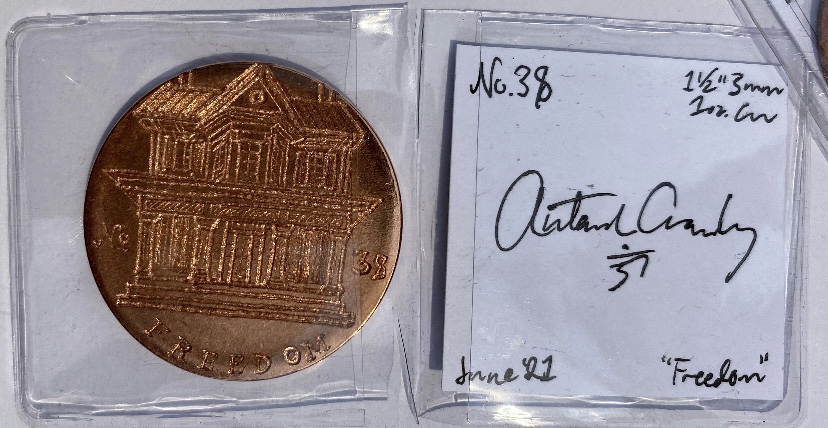

An Assurance Policyholder (“Private”) shall be vested with one (1) “C” Series Artcoin (“C coin”) upon conference of Assurance Policy by and payment of premium service fee to the C.P.A. LLC Office of Ombudsman via handshake.
LH ADM Antarah, L.S.T.A., D.A.O.
📜CALL TO SEA (“C”)⚓️
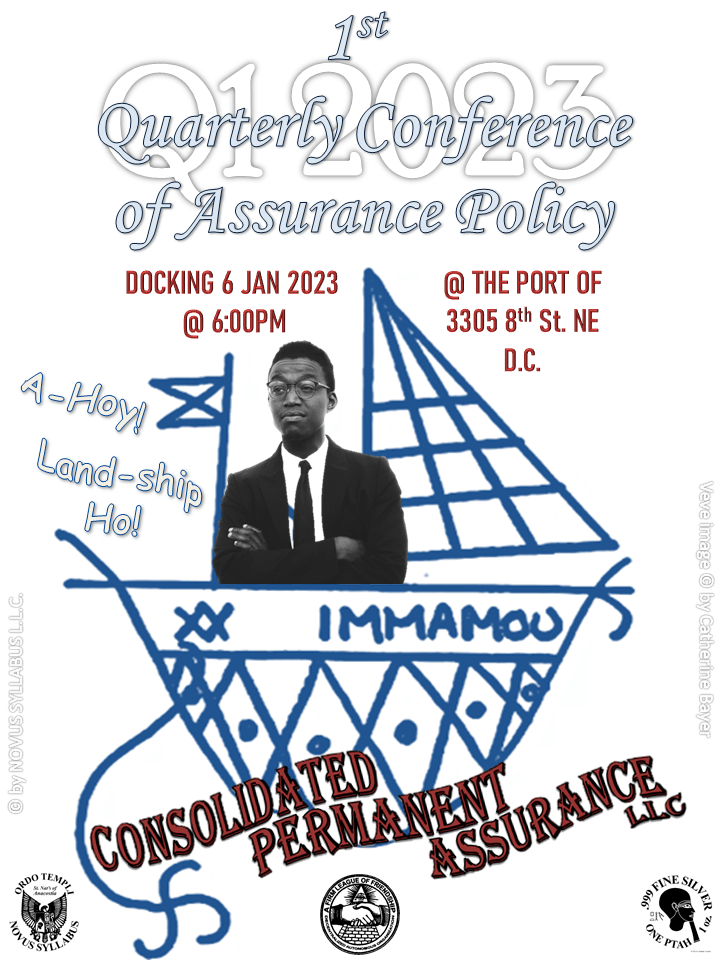
CALLING ALL PRIVATES (“SEAMEN”), ADMIRALS, GENERALS AND SOVEREIGNS IN EQUITY, ECCLESIASTIC AND COMMON LAW TO ASSEMBLE ON THE EASTERN SEA BOARD OF THE ADMIRALTY OF THE DECENTRALIZED AUTONOMOUS ORGANIZATION OF THE L.S.T.A. ON THE SIXTH DAY OF JANUARY IN THE YEAR OF OUR LORD TWO THOUSAND TWENTY-THREE AT THE PORT OF [——] 8TH ST N.E. IN THE D. OF C.
OUR MISSION IS TO PROMOTE THE STRAIGHT AND NARROW WAY OF INTEGRITY, THE PATH OF POETRY AND PHILOSOPHY (LES HOMMES DU BELLES LETTRES), AND THE OPEN SEA OF ROMANCE AND ADVENTURE (ROMAN VENTURE/PRIVATE EQUITY). ALL ACTS ARE ADMINISTERED TO PRIVATES KNOWINGLY INTELLIGENTLY AND VOLUNTARILY; WE DO NOT MAKE PROMISES, BIND PEOPLE OR ADMINISTER OATHS AS OUR LORD SAYS IN MATT. 5:33-37.
WHILE WE ARE A BROTHERHOOD OF CHRIST, THE SEA BOARD AND PRIVATE CORPS (OF “MEMBER SHARE HOLDERS”) CONSTITUTE A PARAMILITARY PSEUDO-MAGICAL COUNTERINTELLIGENCE AGENCY ADMINISTERING UNIVERSAL LAW VIA THE ANCIENT DIALECTIC METHOD OF REPLICATE IN REVERSE.
OUR GENERAL POLICY STATES THAT ONE WHO LIVES [“CQV”] HAS SURETYSHIP THROUGH FAITH IN CHRIST AS SECURED PARTY CREDITOR OVER THE COMMON LAW PUBLIC LEGAL ENTITY [DEBTOR COMPANY] NAMED ON THE BILL OF LADING SENT TO THE GOVERNMENT [“BIRTH CERTIFICATE”] PROVING BY ACTUAL SIGNATURE [AS CQV CANNOT KNOWINGLY INTELLIGENTLY AND VOLUNTARILY “EXECUTE” B.C. ON THEIR OWN BEHALF AS MINOR INFANT] THAT THE SURETY OF THE COMPANY IS NOT DEAD OR LOST AT SEA BUT A WO/MAN ON THE LAND OF GOOD STANDING, SOUND MIND, LEGAL MAJORITY AND FINANCIAL MATURITY; AND THAT THE PRESUMED PUBLIC [MILITARY] TRUSTEE OF THE COMPANY ESTATE [CORPUS] HAS NOT ACTED IN GOOD FAITH; WHEREFORE ANY SUCH CONTRACTS EXECUTED UNDER THEIR AUSPICES ARE VOID AB INITIO.
THE POLICY UNDERWRITERS ARE GOD AND THE AUTHORS OF THE KING JAMES BIBLE. C.P.A. LLC IS ONLY AN AGENT OF SUCH ASSURANCE BY VIRTUE OF ISSUANCE OF C-COIN UPON CONFERENCE OF POLICY IN CONSIDERATION OF SERVICES RENDERED TO POLICYHOLDER.
The Flagship Program


presenting our flagship program
A Conference of Assurance Policy
“WHAT IS A SURETY SHIP?”
A Fun, Educational Ritual Drama ©️ by Antarah Crawley
⚓️Ministry of Information⚓️
📜BRIEF IN EQUITY📜
A presentment made without express contract presumes the recipient to be the trustee for a dead person’s estate without surety and not a living Cestui Que. An estate may, however, be entrusted to a “person” (corporation) for the use of a living spirit who may “possess property” in the nature of equitable use title not legal title.
There is sufficient precedent in Roman, Papal, and English law to presume a human body to be chattel property (i.e., a dead person or a mere human creature without soul or spirit) unless otherwise established to posses a soul from God. The cestui que who is presumed dead or lost at sea MUST EXPRESSLY STATE that they are indeed the living cestui que to be given standing as one of the three Chancellors in a Court of Equity and Chancery deciding the matter of an estate (dead person). The common law, as it pertains to the military jurisdiction of the public, cannot abrogate a matter of equity respecting a living free man or woman on the land.
Statue of Mortmain prohibits possession of property by the “dead hand” of a corporation (such as the Church); therefore a “person” (dead in the eyes of God) cannot possess property; rather it reverts to the feudal lord.
The Remedy is that the cestui que (beneficiary) possesses equitable title by nature to the property as a living child of god, but never holds the legal title of the trustee which is the feudal lord or its agent, including any person who is a citizen of the jurisdiction.
There is precedence in Germanic law that a man who holds property on account of to the use of another is bound to fulfill his trust.
Furthermore, precedent is found in the Institutes of Justinian at 2.23.1-2: “… it is required that the one heir is duly appointed and is committed to his trust (Fideicommissum) to transfer the inheritance to another; otherwise the testament in which no heir has been duly appointed is void; the words which are properly and commonly used to install a fideicommisum are I beg, I ask, I wish, I entrust…” This doctrine was brought to England by “foreign ecclesiastics” (ministers and consuls) in order to evade the Statute of Mortmain by making the Church cestui a que use le Feoffment fuit fait.
In sum, cestui que use confers the benefit of use of property to another (a minister or consul) without the legal ownership and attendant duties and obligations to the lord and crown as trustee. Compare to usufruct, or right of use of fruits (interest, profits, etc.) of property.
📜PRIVATE OFFERING📜
💾Mindsoft©️as a Service™️ (MaaS™️) Premium Servicing Fee of $99.99 per person 💳 payable upon conference for products* and services rendered. Duration of Service: 1-2 hrs.
Upon completion of conference, Assurance Policyholder may be granted C-Series Art¢oin 🪙 (“C-coin”) at market price via 🤝🏿 Handshake of Friendly Association. Contact ombudserver@gmail.com to schedule a conference, or attend the C.P.A. LLC Quarterly Conference of Assurance Policy.
*The applicant hereof shall be sent the eSyllabus©️™️ Mindsoft©️™️ program file by email under a limed use licensing agreement to facilitate their conference.
📜POLICY COVERAGE📜
An assurance policyholder, having paid a premium and been conferred with assurance (as evidenced by presentment of C-coin), may bring a claim based on presentment to the CPA LLC at no cost, but there is no guarantee that such claim shall be resolved. Processing fees may apply. Neither the CPA LLC nor its parent nor its agents shall be liable for any claim arising from such a presentment or from such policyholder, as the assurance policy itself is underwritten by God in Christ through the King James Bible, and it is to Him thou shalt appeal for judgment.

Assurance Policy

A POLICY IN RE:
PERFECTING YOUR SECURITY INTEREST IN TRUST ‘INRI’
Let us draw near with a true heart in full assurance of faith, having our hearts sprinkled from an evil conscience, and our bodies washed with pure water.
Hebrews 10:22
Verily, this Policy of Assurance is within you and your private ‘sui’ jurisdiction, which is moored in the vessel, whose NAME is Your soul’s Title, which saileth upon the Holy Sea.
Your Friendly Neighborhood Ombudsman
IESVS NAZARENVS REX IUDÆORVM
I. Merriam-Webster defines “Assurance” as the state of being secured or certain; to be sure; or, the action of securing something or someone by a pledge or guarantee. Assurance means to provide surety or confidence to oneself or another.
II. This is a policy by which a living man or woman may indemnify themself against commercial death (of debt executed in their name) through the Redemption and Prepayment of “Yahshuah” the Christ, Savior, Redeemer, Counsellor-at-Law and King of Your Sui Jurisdiction.
III. Through Firm Belief in the Redemption of the Body (of the Dead/Debt) by Acceptance of the Charge in The Name of Our Lord and Savior, we can establish complete Trust in our own Sui Jurisdiction; and in good Faith discharge our deaths/debts under Public Policy. In other words it is said: Faith is complete Trust and firm Belief, or acceptance of a matter as true (the pledge or oath of signature). Such Belief, sincerely held, cannot be converted into a crime.
IV. The internal body and soul of the living man and woman is a sovereign occupying the position analogous to that of other sovereigns in the family of nations. Therefore it is private with respect to the public, and foreign, international and alien with respect to to the national governing corporation.
V. The external name and shadow of the living man and woman are subject to external factors. The physical body and central nervous system (CNS) is the vessel through which the internal communicates with the external. However, the internal living soul maintains jurisdiction over external property to which it holds Title (this is because a body can exist without a soul). Such Titles include the vessel NAME, the vessel shadow’s registered security Account Number, the registered certificate of live berth of vessel, and all vessel licenses and registrations emerging therefrom. The shadow itself is the external object used by the cunning executor to bind the living soul in a “dead corpus of a vessel”, as it is said, “the deceased is depicted emerging from the tomb by day in shadow form, a thin, black, featureless silhouette of a person. The person in this form is, as we would put it, a mere shadow of his former existence, yet nonetheless still existing,” (Goelet, Ogden, Jr. (1994)).
VI. The dichotomy between the living child of god and the “debtor’s corporate vessel” in commerce creates the “double” spirit and entity or person. The one is a sovereign sui juris personam; the other is subject matter in rem. That which the private/internal conducts between the public/external is international and alien (a lien).
VII. Things necessary to perfect a lien are these: (1) The Lienor shall serve notice on the owner/principal or their agent on paper under solemn oath, (2) by United States Marshal, (3) which shall contain clear information so as to frame responsive pleadings, (4) be served to the US District Court where the res is located, and (5) posted by US Marshal on the res of the seizure.
VIII. Admiralty means that a valid international contract is in dispute. All revenue causes proceed against property and rights to property in rem and in Admiralty because such causes concern a re-venue-ing of matter from the internal private to the external public; hence the Interna(tiona)l Re-venue Service. This diversity of venue creates the overlapping public and private (or sui) jurisdictions that allow the foreign entity known as the federal government to engulf all shadows within its penumbra.
VIII(a). A Lord (seigneur, i.e. “signer”) may grant a fief (or benefice, “benefit”) of valuable consideration (e.g., property, rights, or possessory interest therein) to another to hold in fee (“in fealty,” or “in good faith”) in exchange for a pledge of allegiance or service. Feoffment is a deed which grants or conveys ownership of freehold property to someone in exchange for a pledge of service. Otherwise it is said, Feoffment is the total relinquishment and transfer of all rights of ownership of an estate in land from one individual, the feoffor, to another, the feoffee, in exchange for some valuable consideration. In such cases, the person entitled to grant an estate may do so for the use of another (a Lessor). Use and trust are rooted in medieval law and are a legal way to avoid feudal services due to one Lord by granting land for the use of another (Cestui que use) who owes nothing to the Lord (i.e. no services). This arrangement separated legal ownership from beneficial ownership. Furthermore, one who owns property for the use of another is obliged to fulfill their trust.
IX. Whereas diverse Lords of Mannours and others have granted Estates by Lease for the term of one life or more, And it hath often happened that such person for whose life such Estates have been granted have gone beyond the Seas or so absented themselves from this Realm for so many years that the Lessor(s) or person(s) entitled to have the property back (Reversioners) cannot find out whether cestui a que use le feoffment fuit fait be alive or dead. Otherwise it is said, Cestui que vies have gone beyond Seas, and Reversioners cannot find out whether they are alive or dead!
X. For remedy of which mischief “so frequently happening to Such Lessors and Reversioners, being held out of possession of their Tenements for many years”, if Cestui que vie remains beyond Sea for Seven Years together and provides no Proof of their Lives, then in every Action brought for the recovery of the said “Tenements” by the Lessors or Reversioners, the Judges before whom such Action shall be brought shall direct the Jury to give their Verdict as if the person so remaining beyond the Seas or otherwise absenting themself were naturally dead. Ego these public trustees abuse the law to execute the Lord of Manors in order to secure the estate of the child in trust to the benefit of the trustee for the term of the life of the person for whom such estates had been granted (cestui a que usage le feoffment fuit fait). That is how the government Lessors squat the estate of a sovereign Lord of woman born.
XI. As Cestui qui vie, I am the Lord; I am the accommodation party for my vessel shadow (“strawman”) and I am the sponsor for the credit on every instrument I endorse for my strawman. I am the source of the energy. I am the sponsor for the credit when the offeror passes over the promise to deliver the check or obligation and draws on me as though I am a bond in which the offeror overdrafts and I in turn loan him the value of the instrument of his offer to which he is now in bondage in accordance with Public Policy. I am the principal from which the interest accrues: the interest (being the product) which accrues from the principal (being myself) has returned to the principal (myself) for a public deduction (tax credit) for adjustment of the tax liabilities on the public/fiscal society.
XII. Acceptance: Rule 1: Do not hold the charge or you will fry on the chair. Rule 2: Pass the charge to a fiduciary entity to remove yourself from that liability by grounding the account and charging them with the charge, to discharge yourself. As the owner, you are not the holder-in-due-course for the tax adjustment; the holder-in-due-course is the holder of a business license by being registered to operate in the industrial society, which is your fiduciary like the bank or a vendor.
XIII. A request is made against you without providing a check, thus it was an order for money/money order, that is why you RETURN (tax return) the offer after acceptance to the Offeror because the Offeror is holding your check as your fiduciary and they need to Pass Thru your account to make their check good which in turn reflects itself as a deduction to the entities tax liability making the credit memo to the account for the tax adjustment good, and allowing the release of the goods to the acceptor and now there is no debt claimed on the account. The ticket, bill or presentment is the instrument they use to make the claim against you; if you give them back the original and now it is in their possession, how can they possibly make a claim against you when they are in possession of their own bill. In other words it is said, An offer is made against you to pay, which debits your value and to balance that value, you need a credit. Your acceptance of their offer returned to them satisfies the Replevin Bond by operation (under the Grace of Public Policy H.J.R.-192). That is why you accept and return (tax return) the original, yourself being the sponsor for the credit to the account through your exemption. The reason you return the original is because what the person is doing is taxing you. When you return it, it is a tax return that is eligible for adjustment with the Internal Revenue Service.
XIV. Your inter-national (inter-n’al) court orders are the Acceptances because it turns those offers into money orders to use your exemption. When you accept and return an offer and they refuse to adjust, they are the ones who are in contempt of court, not you. The scriptures talk about a door that you can walk in and out of, well that is the door to the warehouse, it is the “Receiving & Discharge” door and it is “Your House,” because you are the one that is revenuing the currency from a public jurisdiction of debt back to your private jurisdiction of credit and effectively redeeming the debt. This is why we want the order of the court released to us; it is because it is our court we are exercising. The court/bank/corporation is using your exemption to write checks to them self by bonding against you to claim you as a dependant and an infidel that has to get locked up. If you stick strictly with the “where is my check?” attitude, they have to clean their books to meet their record keeping obligations. If you want to push paper, they will push paper. Only utilizing one side of the account (the paper pushing), the steamroller will get revved up. Operating in both sides of the account we have the paper and the oral proceedings. Learn to utilize both sides as the owner of the account. You are catching the corporation (your fiduciary employee) spending against you (in your “absence”) and they are trying to make you pay for what they did, when it is against Public Policy to make you pay in the first place. And for them to make a claim against you, they have to give you a check (the one you write about having not found in their offer) to post for their Replevin bond and when they don’t do that, they have no claim in fact because they didn’t post the reserves to indemnify their actions because you would endorse it back to them paid in full. When they fail to release the order of the court during your written correspondents with them after you have accepted, they are then in dishonor and lose their exemption and can have no claim.
XV. Root Policy is the linear algebra f of x from Notice to Data to Information to Knowledge; the Linear function f of thought. Squared Policy is the planar geometry f of x=y from Audit to Assessment to Assurance to Adjustment; the Planar function f of the word, i.e. the application of algebra over a field. This is the due process of Mind Software (Mindsoft) operation.
XVI. A Policy of Adjudgment arising out of any Policy of Assurance which is raised into Question shall issue from a just and equitable court of competent jurisdiction.

Global Charter

Whereas it appears that We will be restricted from assembling freely to eat and drink in a commercial establishment, that whosoever will not partake in a certain experimental medical trial may be restricted from assembling to eat and drink by a commercial maritime ordinance of Admiralty in violation of common life, liberty, and property,
Resolved that We, free of duress or coercion to partake in such trials, and desiring to assemble to eat and drink, and for other educational purposes, do ordain and establish this Honorable Society of Saint Nat’s Inn:—
Art. I. The Inn shall be constituted by a quorum of three (3) members (including the Innkeeper) who, given due notice of the date place and time, assemble in a public or private place around a table replete with all that they desire, wherein they shall eat, drink, speak Truth, and be merry (save such occasion as may warrant more somber observance). Such an Inn meeting shall be called a Symposium, and on such occasions it shall form a College. Only members of the Inn may assemble Hereinn.
Art. II. Interest in the Society shall be distributed in “artcoin” instruments. Life members of the Society, having been invested with artcoin, shall be termed “shareholders”. An artcoin shareholder shall be a member of the Inn. Persons who have petitioned the Society in Due Form to be instructed Withinn and be thereby invested with “artcoin” shall be termed “sojourners”. To come Inn Due Form shall mean to appear at the Inn per due notice to give earnest free will offering of the artcoin liquidation rate as surety for their instruction, in which the sojourner shall assemble Withinn for three (3) sessions of Symposium, after which term they shall be invested with artcoin. Other persons shall be termed “guests” and their presence shall be restricted at will.
Art. III. The Honorable Society of St. Nat’s Inn shall be the Guild* of Live Your Freedom (LYF), Inc. it shall be devoted to the development, education, and fellowship of practitioners in the field of critical thought (known as “dialectic information processing system theory”).
*Our Hon’ble Guild is styled after the English Inns of Court, the archetypal schools of law, themselves descended from Templar guilds, which in turn descended from Pharaonic tradition. As an institution of education our Hon’ble Guild succeeds and subsumes the Ordo Templi Novus Syllabus (OTNS), Men Nefer College, the College of Ancient Mystery, the Bureau of Mindsoft/Department of Infosystems Intel Service, and the subordinate lodges of the New Syllabus Mystery School System.
Art. IV. Holders of “artcoin” as of 14 January, 2022, shall be hereby admitted into the Society and their office as applicable; being:—
Antarah C. (Majority Shareholder), Chair, Treasurer, Managing Director (also known as “Innkeeper”; also known as “Custodian” in their capacity of keeping other valuable records and instruments);
Whitney F., Vice Chair, Secretary, Director;
Checo B., LYF, Inc. (Ex-Officio);
Rod M., LYF, Inc. (Ex-Officio);
Tarik D. (3/3/2021);
Mala E. (4/6/2021);
Aton C. (4/8/2021) (Ex-Officio);
Aldric C. (4/24/2021) (Ex-Officio);
Ibe C. (5/10/2021) (Ex-Officio);
Jeanne F. (5/10/2021) (Ex-Officio);
Cesar M. (7/5/2021);
Anthony W. (11/5/2021);
*Ex-Officio Members shall not count toward a quorum Withinn because the “artcoin” was given in gratis or Member is non shareholder.
V. On attainment of a quorum at the time and place on the date duly noticed, The Innkeeper shall open the Inn after the pouring of libations with the declaration, [Baruch Adonai Ham’voach Atta Kadosh Kadosh Kadosh], The Honorable the Custodian, Chair and Shareholders of The Society of Saint Nat’s Inn are hereby called to order; all sojourners come now and to hear the instructive symposium are invited to draw near, for this College is Hereinn assembled. Oyez Oyez Oyez.
All Praise Be To God To Whom All Praise Is Due,
All Rights Reserved Without Prejudice,
/s/ Antarah A. Crawley, Innkeeper,
By Authority of Ordo Templi Novus Syllabus,
St. Nat’s Court, Anacostia, Potomac River Valley,
2022
Consolidated Theory of General Contracting
MA’AT NEFERET
GOOD CONDUCT
The Universal Code of Contracting, General; Consolidated
by Scribe Antarah
Abstract
Human labor power, including all mental capacity, is the foundational commodity of society and of the state. All humanity’s efforts to manage this natural resource bear upon our world’s economy. From the labor of childbirth to labor in the field, the human is charged to cultivate life from nature. Indeed, the human, with their potentially divine capacity of mind, is the mediator between the raw material of life (via the senses) and the products of their thoughts and labors. Life is course through which the student grows in knowledge and its practical application, which is their curriculum. Life is a course to which one must have a syllabus of their curriculum.
ii. We may observe that the root of all conflict in human society has come down to who will do what labor for whom. We have now achieved a point in history where labor power can be farmed and exploited en masse by and through covert and overt means of obtaining peoples’ consent, like unto the way that subatomic particles are extracted by strong forces from the dark waves of spacetime to coalesce into a steady energetic state.
iii. Therefore, let us conclude that the individual, the state, and the universe, on increasingly expansive scales, represent a grand, unified, universal, and general contracting system. We shall find, through the contraction of waves, particles, and bodies, that a “contract” refers to the terms of battery entered into by any constitution of matter. A contract governs the conduct of any group of bodies, from a master-slave compact to a whole social contract. Let us now examine the analogy between the human being, endowed by God and nature with the power of mental and physical free will (manifest in labor), and the states of energy which manifest in nature.
I. On the General Conduct of Bodies
Revised from Crawley’s Ma’at Natural Law Statutory Code, Sesh Sepdet, First Trismegistus Edition, November 7, 2017.
SECTION § 1. Definition & Constitution of Conduction.
1 Conduction, or Conduct, is the manner in which a body interacts with, or transmits force upon, another body, with the effect of generating or radiating mass […]. It is a constant function of bodies in motion.
2 Force is the effect of cause […]; that is, force is the product of an accelerating object (i.e., a material body).
3 A body is any constitution of matter. Matter is that which has mass, that is, substance. The particular nature of the constitution of matter is its state. Therefore mass is a factor of matter, which is the principle of materiality.
4 All matter in a body is in motion, but the sum total of all motion is zero when that body is at rest. In other words, the sum of all know forces in a system (Gij=G1j+G2j+G3j+…Gzj) equals zero (Gij,j=0) [See Oyibo’s grand unified field theorem]. This is further supported bu the dialectic axioms “To each action there is an equal and opposite reaction” and “Total energy in a system is neither lost not gained”.
5 Force is the energy produced by a given body of mass independent of overall motion in the system (times the limit of the system, i.e. speed of light “c”-squared, a constant).
6 Force which is conducted (or transmitted) between bodies to mutually generate and/or radiate mass=energy is right (i.e., Ma’at, meaning proportionally balanced within the scale of the whole, ky djd “in harmony”), and the conduct is deemed lawful.
7 To deem conduct to be lawful is to measure the weight of the force being conducted between the acting bodies. If the conduction of energy between the given bodies inures to their mutual benefit, then their conduct may be deemed good and lawful without contest.
8 The state of bodies when engaged in the act of transmitting force (i.e., conduction) is Battery.
SECTION § 2. Battery.
1 A battery is any vessel consisting of two or more bodies, in which force is converted into or stored as energy (E) and used as a source of power (i.e., to effect, to manifest a purpose, to do the will).
2 To engage in battery is to transmit E force between two or more bodies. Each body or collective body-politic in the context of the act of battery, is polar to the other, to the effect that their interests oppose each other at or approaching 180°. The bodies resolve their opposition at or approaching 360°.
3 E force is generated in high pressure zones and transmitted between bodies from higher to lower pressure zone.
4 A victim, or subject, of battery is one whose E force is disproportionally dissipated and/or generated to the benefit of the opposing party respective to the period of contraction.
5 Good Conduct is lawful battery.
6 Hostile Conduct is unlawful battery in which the subject is bound to contract (i.e., to engage in battery) against the will and/or interest of their party [magnetic pole]. Unlawful battery implies the disproportional extraction or exploitation of the energy of a body for the disproportional gain of another.
SECTION § 3. Impedance.
(October 2021)
1 On September 30, 2021, I received a call from one Jason Benford, who, having read some of the N:.S:. Light Workers’ Protocol, confided in me that he has observed the battery effect operating in his life, and that while he is able to monitor the data coming into his C and can control the execution of his will, he has experienced a certain impedance of his vital life force caused by factors such as his family and so on.
2 Although Mr. Benford’s train of philosophical thought was tough to follow and in need of clarity, I was able to connect with his account of familial conflict and how that has resulted in his present inability to realize his fullest potential (though his impedance has been disrupted by contact with El-Armana). Having read the Protocol, he became able to articulate the root cause of his impedance, being some kind of dialectic conflict between his birthers. But more than that, even to diagnose oneself as suffering from impedance is a substantial accomplishment. For knowing that one is capable of doing more than one is currently able to perform, one may then focus in on those aspects of their material and spiritual environment which are resisting the flow of the individual’s vital life force, or which are impeding the individual’s ability to realize or manifest their will.
3 Hearing this definition of impedance expressed by one wholly apart from myself, I became reassured that the resistance to my “life, liberty, and happiness” posed by my current position in life can be overcome by a concentration of will power upon the specific area of impedance, or blockage. It only takes a careful assessment of one’s position and environment to calculate the will-power needed to overcome any amount of resistance.
II. On the Liquidity of Capital
Revised from Crawley’s Artcoin Theory and Methodology, 10 May 2021.
1 There is a vast “sea” of value, represented by fluctuating wave-particles called “currents” which make up the “current-sea”.
2 When value flows freely in a “current” (through a market), it is “liquid”. But when is it held up in an asset or other liability, then it is not liquid, because it cannot flow freely.
3 To get liquid currency from the “sea” to the “shore” where people use it to “work the fields” there must be river “banks” that conduct the liquid current “downstream”.
4 Banks facilitate a capillary system whereby the value of the sea flows to the inland, which is the “income”. People irrigate new streams of income all the time. One must first identify a source of water, which is the market from which they will draw liquid. Then they must use tools to irrigate a stream to flow from the market to their place of business. These tools are means of production, with the resulting channel being the work-product which conducts the liquid currency to them. (It is worth noting that most institutional banks sit on naturally occurring rivers and bodies of water and are designed to be gatekeepers, or dams, to liquidity.)
5 An enterprise of any kind must float upon the sea of capital; for if it does not float, then it will become underwater. This is to say that water a ship floats upon is good credit, but water that has gotten into the ship is bad debt that can sink the ship. How shall the enterprise remain afloat? It is by and through good “stateship” and “leadership” and “stewardship” and “ownership” and “membership” as well as a firm league of “friendship”. These are the ships that float upon the world’s current-sea. What, then, shall convey this company of ships down the river stream of income? It is by and through the ships’ “sales”.
III. Control Program for Mindsoft (CP/M)
Revised from Crawley’s Official Code of Light Workers’ Protocol, February 19, 2019. See, III N.S.C. 27.
1 Abstract: Human Mind-Software (Mindsoft) Tecknowledgey, Mental Health Auditing, Information Systems Analytics, and the Methodology of Integrated Systemtheory. “Theory” is used here in the German sense of “Lehre” where is simply means “science”, “tenants”, “dogma,” and/or “teaching”; here Theorie connotes a theorem or a fundamental truth.
2 This methodology applies to all Systemstheories, meaning Allgemeine, or general and Universal, Laws of exchange between complementary units (i.e. Numbers, Cells, Selves) operating on behalf of a harmonic whole.
3 […]
4 Human Software Systems, i.e. The Mind, has and maintains the ability to function at optimal efficiency called “C-squared” consciousness [Cognizance]. This type of consciousness is actually the conscious of a normal modern human being increased by the power it itself…
5 C-squared consciousness is characterized by the state of mind in perfect peace, or the quality of mental operation at minimal resistance.
6 The mind software codifies an optimal focal point within its hardware (“Body”) called the Eye (i.e. “I” or “Self”) and leverages it against the field of universal data. The software is operative while the data is latent until encountered by the software operation.
7 To receive into the mind (i.e. “to access”) general universal information, the Mind projects its Eye onto the source data. To “project the Eye on” to the data means “to see/bear witness”. The data is appropriately called the “Ion”.
8 The exchange or transmission of such data or information in any form constitutes communication, wherein one (Self) is the receiver of that data which is communicated to it from either a material, incorporeal, or ambient source.
9 The human mind software actively programs the hardware (i.e. “body”) to function as a battery; hence the efficiency of mental operation correlates to an individual’s “ionic capacitance”.
10 The Eye processes the Ions into a line-signal, or sinewave, called the “input information”. The Mind software program receives the input data in order to generate output data (“speech”, “word”, “logos”) and/or program systems command code (“love”, “ignore”, “will”, “power”).
11 Knowledge is the summation operation of the mind upon the data transmitted from one point along a spectrum (i.e. the Alpha), to a secondary point (i.e. the Omega). If the system becomes at peace with the data, then the data is saved in the memory bank.
12 Ignorance results from the system’s failure to integrate received data into knowledge. Fear and hate are data corruptions resulting from the lineage between ignorance and belligerence.
13 All such input information processes, whether written as command code or as logos, saved or unsaved, are recorded in the Mind’s Memory bank, which is often called the Records or Files.
14 The active memory bank is located in the consciousness, or C: drive. However, files which are not saved in the C: drive are not able to be routed into output code by the consciousness.
15 Input which is not routed directly to output is still accorded its due weight in the Memory, however, due to the suppression of the data, it may not be easily recalled by the software system, and therefore may become latent coding in the unconscious command functions corrupting the files of the Self unit.
16 The system’s capacity for Information Processing is commonly referred to as “Thought”. The quality of optimal information processing is called “critical thought”.
17 However, such processes may be inhibited by aberration in the mind’s systems operations which renders in the Eye poor judgement and misunderstanding in the Self unit.
18 These aberrations are called “engrams”, and such are “glitches” in the mental operation.
19 Such operations as are run “through the mind” are called “dianetic”, from the Greek “dia nous”.
20 Therefore, … [CP/M] proves to be a most reliable method for analyzing and resolving human thought patterns which cause the Self to operate short of optimal efficiently: C-squared consciousness, or “Christ”-consciousness. “Diagnosis” puts the God in “dia nous”.
IV. On Historical and Dialectical Materialism
Edited from Four Essays on Philosophy, by Mao Tse-Tung, Foreign Language Press, Peking 1968 (PRC), by Antarah Crawley, 10 October, 2019.
Abstract: Contradiction is the fundamental relationship between the elements of any constitution of matter.
SECTION § 1. Historical and Dialectical Materialism
1 In his Capital, Marx first analyzes the simplest, most ordinary and fundamental, most common and everyday relation of bourgeois (commodity) society, a relation encountered billions of times, viz. the exchange of commodities. In this very simple phenomenon (in this “cell” of bourgeois society) analysis reveal all the contradictions (or the germs of all the contradictions) of modern society. The subsequent exposition [or study] shows us the development (both growth and movement) of these contradictions and of the summation of its individual parts, from its beginning to its end. Such must also be the method of exposition (or study) of dialectics in general” [34].
2 When Marx and Engels applied the law of contradiction in things to the study of the socio-historical process, they discovered the contradiction between the productive forces and the relations of production, they discovered the contradiction between the exploiting and the exploited classes and also the resultant contradiction between the economic base and its superstructure (politics, ideology, etc.), and they discovered how these contradictions inevitably lead to different kinds of social revolution in different kinds of class society.
3 When Marx applied this law to the study of the economic structure of capitalist society, he discovered that the basic contradiction of this society is the contradiction between the social character of production and the private character of ownership. This contradiction manifests itself in the contradiction between the organized character of production in individual enterprises and the anarchic [decentralized, autonomous] character of production in society as a whole. In terms of class relations, it manifests itself in the contradiction between the bourgeoisie and the proletariat [48].
SECTION § 2. Dialectic Procedure of Information Processing to Resolve Contradiction
1 The dialectical world outlook emerged in ancient times … and was supplanted by metaphysics. The famous German philosopher Hegel, who lived in the late 18th and 19th centuries, made most important contributions to dialectics, but his dialectics was idealist. It was not until Marx and Engels, the great protagonists of the proletarian movement, had synthesized the positive achievements in the history of human knowledge and, in particular, critically absorbed the rational elements of Hegelian dialectics and created the great theory of dialectical and historical materialism that an unprecedented revolution occurred in the history of human knowledge.
2 This dialectical world outlook teaches us primarily how to observe and analyze the movement of opposites in different things and, on the basis of such analysis, to indicate the method for resolving contradictions. This method has three main stages of observation and analysis: (1) perception, (2) cognition, and (3) practice.
2(1) In the process of practice, one at first sees only the phenomenal side, the separate aspects and external relations of things. This is called the perceptual stage of cognition, namely the stage of sense perceptions and impressions. This is the first stage of cognition.
2(2) As social practice continues, the things that give rise to one’s sense perceptions and impressions in the course of their practice are repeated many times; then a sudden change (leap) takes place in the brain in the process of cognition, and concepts are formed. This is the second stage of cognition. When the members of the observation group have collected various data and, what is more, have “thought them over”, they are able to arrive at a judgment.
2(3) The real task of knowing is, through perception, to arrive at critical thought, to arrive step by step at the comprehension of the internal contradictions of objective things, of their laws and of the internal relations between one process and another, that is, to arrive at practical and logical knowledge [4-6].
3 The first step in the process of cognition is contact with the objects of the external world; this belongs to the stage of perception. The second step is to synthesize the data of perception by arranging and reconstructing them; this belongs to the stage of conception, judgment, and inference.
3(1) As to this sequence in the process of cognition, perceptual experience comes first. All knowledge originates in perception of the objective external world through one’s physical sense organs (hence the emphasis on perception, direct experience, and personal participation, and the dependence of rational knowledge upon perceptual knowledge.) Knowledge begins with experience — this is the materialism of the theory of knowledge [12].
3(2) Second in the process of cognition is that knowledge needs to be deepened, that the perceptual stage of knowledge needs to be developed to the rational stage — this is the dialectics of the theory of knowledge … it is necessary to make a leap from perceptual to rational knowledge [12-13].
3(3) The active function of knowledge manifests itself not only in the active leap from perceptual to rational knowledge, but it must manifest itself in the leap from rational knowledge to revolutionary practice. This is the process of testing and developing theory, the continuation of the whole process of cognition. Rational knowledge depends upon perceptual knowledge and perceptual knowledge remains to be developed into rational knowledge – this is the dialectical-materialist theory of knowledge [13].
4 Discover the truth through practice, and again through practice verify and develop truth. Start from perceptual knowledge and actively develop it into rational knowledge; then start from rational knowledge and actively guide revolutionary practice to change both the subjective and the objective world. Practice, knowledge, again practice, again knowledge. This form repeats itself in endless cycles, and with each cycle the content of practice and knowledge rises to a higher level. Such is the whole of the dialectical-materialist theory of knowledge, and such is the dialectical-materialist theory of the unity of knowing and doing.
SECTION § 3. Information Processing to Resolve General and Particular Contradiction
1 As regards the sequence in the movement of one’s knowledge, there is always a gradual growth from the knowledge of the individual and particular things to the knowledge of things in general. Only after one knows the particular essence of many different things can they proceed to generalization and know the common essence of things. These are the two processes of cognition:
1(1) from the particular to the general; and
1(2) from the general to the particular.
2 Thus cognition always moves in cycles and (so long as the scientific method is adhered to) each cycle advances human knowledge a step higher and so makes it more and more profound [37].
3 When we speak of understanding each aspect of a contradiction, we mean understanding what specific position each aspect occupies, what concrete form it assumes in its interdependence and in its contradiction with its opposite, and what concrete methods are employed in the struggle with its opposite, when the two are both interdependent and in contraction, and also after the interdependence breaks down.
4 The living soul of Dialectics is the concrete analysis of concrete conditions. In studying a problem, we must shun subjectivity, once-sidedness, and superficiality. To be subjective means not to look at problems objectively, that is, not to use the materialist viewpoint in looking at problems [40].
5 Among the particularities of different kinds of contradictions include:
5(1) the contradiction in each form of motion of matter,
5(2) the contradiction in each of its processes of development,
5(3) the two aspects of the contradiction in each process,
5(4) the contradiction at each stage of the process, and
5(5) the two aspects of the contradiction at each stage.
6 In studying the particularity of all these contradictions, we must not be subjective and arbitrary but must analyze it concretely. Without concrete analysis there can be no knowledge of the particularity of any contradiction [47].
7 The particular is united with the universal and the universality as well as the particularity of contradiction is inherent in everything. Universality resides in particularity. We should, when studying an object, try to discover both the particular and the universal and their interconnection, to discover both the particularity and universality and also their interconnection within the object itself, and to discover the interconnections of this object with the many objects outside it [49].
8 This truth concerning general and individual character, concerning absoluteness and relativity, is the quintessence of the problem of contradiction in things [51].
9 When studying the particular contradictions within a matter, special attention must be paid to the following particularities:
9(1) If in any process there are a number of contradictions, one of them must be the principal contradiction playing the leading and decisive role, while the rest occupy a secondary and subordinate position.
9(2) In any given contradiction, whether principal or secondary, the two contradictory aspects should not be treated as equal. Of the two contradictory aspects one must be principal and the other secondary. The principal aspect is the one playing the leading role in the contradiction. The nature of a thing is determined mainly by the principal aspect of a contradiction, the aspect which has gained the dominant position.
9(3) In a given process or at a given stage in the development of a contradiction, A is the principal aspect and B is the non-principal aspect; at another stage or in another process the roles are reversed — a change determined by the extent of the increase or decrease in the force of each aspect in its struggle against the other in the course of the development of a thing [53-55].
10 At certain times in the revolutionary struggle, the difficulties outweigh the favorable conditions and so constitute the principal aspect of the contradiction and the favorable conditions constitute the secondary aspect. But through their efforts the revolutionaries can overcome the difficulties step by step and open up a favorable new situation; thus a difficult situation yields place to a favorable one. When we engage in study, the same holds for the contradiction in the passage from ignorance to knowledge.
11 At the very beginning of our study of Dialectics, our ignorance of or scanty acquaintance with Dialectics stands in contradiction to knowledge of Dialectics. But by assiduous study, ignorance can be transformed into knowledge, scanty knowledge into substantial knowledge, and blindness in the application of Dialectics into mastery of its application.
12 When a task, no matter which, has to be performed, but there is as yet no guiding line, method, plan or policy, the principal and decisive thing is to decide on a guiding line, method, plan or policy. When the superstructure (politics, culture, etc.) obstructs the development of the economic base, political and cultural changes become principal and decisive.
13 We recognize that in the general development of history the material determines the mental and social being determines social consciousness; we also recognize the reaction of mental on material things, of social consciousness on social being and of the superstructure on the economic base. This avoids mechanical materialism and firmly upholds dialectical materialism [57-59]. In this lies the significance of the first Hermetic Principal.
14 Identity, unity, coincidence, interpenetration, interpermeation, interdependence (or mutual dependence for existence), interconnection or mutual co-operation — all these different terms mean the same thing:
14(1) the existence of each of the two aspects of a contradiction in the process of development of a thing presupposes the existence of the other aspect, and both aspects coexist in a single entity;
14(2) in given conditions, each of the two contradictory aspects transforms itself into its opposite. This is the meaning of identity [60].
15 The Unity (coincidence, identity, equal action) of opposites is conditional, temporary, transitory, relative. The struggle of mutually exclusive opposites is absolute, just as development and motion are absolute [66].
V. On the Due Process of Matter(s), Objective and Subjective
From Crawley’s Omnibus Act, Title 6, An Act to standardize method and practice in the discipline […], human intelligence resource management, clinical dialectic information processing services, and other cognitive-behavioral development programs (collectively known as “mind software”), so as to provide a novel solution to the problem of racism, and for other purposes, August 22, 2020.
SECTION § 1. On the Condition of Persons Believing Themselves To Be Lacking in Society.
1. [P]eople […] are the members of one human family, having divergent genotypes and phenotypes which cause their skin to appear darker or paler in color along a certain spectrum. This spectrum of skin color does not, however, include the objective visual color spectrum of black, white, violet, indigo, blue, green, yellow, orange, and red. Rather, the skin color of people is subject to interpretation. The difference between subjective and objective is as follows:
1(a) Subject refers to the person or matter about which a statement is made. Subjective refers to the quality of being influenced by personal sentiments and individual perceptions.
1(b) Object refers to a person or matter toward which an action is directed. Objective refers to the quality of being a “matter of fact”, that is, clear and unambiguous from any perspective.
2. We may observe that people experience the perception that they are objectively black or white in terms of color, culture, or “race”. This perception may be the result of certain environmental and cognitive-behavioral factors. Because one may appear darker or lighter in skin color, a person may erroneously equate the objective condition of black or white color with said person’s subjective conditions and experiences.
3. The psychological act of equating the subjective experience of a person with any objective color is an aberration, or disorder, in the mind. Why? Because even if all brown-colored and dark-colored people experience the same conditions, none of those conditions can be considered objectively “black” — not their skin color, not their nationality, not the development of any genre of music, and certainly not their “race” (assuming such a term can be defined). The assertion that the color black best represents the conditions of brown and dark-skinned and African and other colored people is a gross misrepresentation of objective facts (of which race is not one). Such misrepresentation based on mere pretense or appearance, and not the substantive facts, is colorable.
4. Colorable is a quality that describes something that is misrepresented based on its appearance, without regard for its actual substance. Colored, on the other hand, is a quality that describes something as it actually appears. While colored describes something according to its actual quality (e.g., brown-skinned people having color), colorable describes something that purports to be something which it is, in fact, not (e.g., brown-skinned people being black). Facts must be based on material, that is, quantifiable and qualifiable, evidence.
5. There are two main ways in which colorability is manifest:
5(a) The subjectification of one’s own experiences based on the perception that they are black, white or another objective color; this is a psychological disorder. Apparent “victims of racism” commonly suffer from subjectification.
5(b) Likewise, the objectification of another person on the grounds that they “are” or appear black, white or otherwise colorable is such a disorder. Apparent “racists” commonly suffer from objectification.
6. A distinction is drawn between people who are colored (that is, being of one human race having many colors, or “humanist”), and people who are colorable (that is, being of one or another race classified on the basis of color, or “racist”).
7. By measuring the degree of subjectification and objectification on the basis color in the mind of a person we may thereby assess the degree of “racism” in the mind of said person, that is, the degree to which they are “racist”. (Apparent “victims of racism” also presuppose the existence of races, which is the basis of “racism”).
8. Regarding such a person who experiences racism, this diagnosis is given: they experience Colored Person Syndrome Disorder (CPSD). About CPSD, this prognosis is given: it is a disorder one shall work against by means of psychological analysis, that is, inquiry of the mind. How then is the method affected, that is, how is this analysis administered? It is through true speech, that is, the dianoetic or dianetic virtue (See, PBSD-001-6).
9. What, then, is the method of true speech? It is dialectic. Otherwise said, it is an inquiry by one into the perspective of another, also called interlocution, discourse, and communication. The inquisitor is the dialectician who solicits, records, and processes information; the client is the witness, querent and/or the source of information. Such a client must swear or affirm that that will produce nothing but true information.
10. PBSD-001-3 provides for the definition of dialectic as “(a) the process of making known what is unknown; (b) a philosophical method describing the discursive-rational-intuitive process by which oneself individualizes itself…[and manifests its will]”. The application of this method constitutes the practice of discourse or parliament, that is, speech.
11. While traditional psychology asserts dreams as the subject matter of empirical and scientific psychoanalysis, we propose that it is not the dreams per se under investigation, but the dialectic on the dreams. Therefore the discipline of folk psychology (DFP) takes a dialectic on any matter as the materially quantifiable and qualifiable subject matter of psychological investigation. As such, psychological analysis under DFP shall concern the practice of dialectic.
12. Much is said by Dr. Carl G. Jung, a founder of Analytical Psychology, regarding the Archetypes of the Collective Unconscious. Regarding the “Collective Unconscious”, our Beloved Ancestors had much to say in the way of the Netjeru (See, PBSD-004). These Netjeru constitute the ancestral Collective Unconscious of humanity, the Birthright of the Children of Nature, having unconscious knowledge of the forms and processions of nature, from the Alpha to Omega. Such knowledge may be collected from the individual’s personal and collective unconscious via the dialectic method of analytical psychology. Such constitutes the method for any investigation into and collection of human intelligence (HUMINT).
13. These Protocols apply:
SECTION § 2. Protocols of Due Process of Information
1. PROTOCOL mapping x to y [f:x=>y]. SOLVE f(x)=y.
IF x = n THEN y = a1 DoProcess(audit-notice) IF x = d THEN y = a2 DoProcess(assess-data) IF x = i THEN y = a3 DoProcess(assure-info) IF x = k THEN y = a4 DoProcess(adjudge-knowlg) <record>deliver ; produce: findings of fact [f(F)] ; and conclusions of induction operation [c(L)] <record> (PBGD-001A-070720, DOS 20, p. 24)
2. PROTOCOL mapping X=>N, where N = NOTICE: perception, literacy, and reading comprehension; in the 1st Degree (“Clinical Practice”).
(1) Information Processing Step 1: Filing – To raise a matter of interest or concern to the clinical dialectician/information processing server (IPS), client(s) shall submit information, being a contract to which they are party, a matter of policy in which they have an interest, a grievance, an inquiry, or a petition for investigation (respectively, “the matter(s)”, or, “in re [the matter(s)]”) in electronic, oral, or hard copy to the IPS.
(2) Investigative Procedure. Step 1: Initial Analysis – Directives: Determine whether a matter which has been raised to the IPS requires formal investigation or whether it can be examined and resolved based on the facts already known/presented/substantiated; determine whether the matter would be more properly handled by another competent jurisdiction; establish the role of the IPS (e.g., to find facts, analyze evidence discovered, and present findings to the decision-maker following completion of the investigation; be cognizant of the involved participants, decisions-makers, and appeals decision-makers (decision-makers should not be directly involved in the course of investigation so as to be — and appear to be — objective in taking any subsequent rule making).
(PBGD-001A-070720, DOS 12, p. 16)
3. PROTOCOL mapping X=>D, where D = DATA: discover, collect, weigh, and measure evidence; in the 1st Degree (“Clinical Practice”).
(1) Information Processing Step 2:
(A) Reading Comprehension – Help client(s) to read and understand the terms of complicated, formal, or arcane language in the matter(s) in order for them to make informed decisions and good judgments in their own right. If the client acquires the knowledge and understanding needed to resolve the matter(s) in their own right, close the case.
(B) Charging Documents – If further work/action is required, paper charges and pass the case to 2nd Degree.
(2) Investigative Procedure Step 2: Planning & Leading.
(A) Directives: determine the scope, complexity, and timeline of the investigation; develop a strategy for the investigative process; bear in mind that all subjects of investigation shall be considered innocent until proven otherwise, and that all subjects of investigation have the right to defend themselves again allegations or charges which may be brought against them; bear in mind that the investigate procedure may reveal trends or shortcomings in practice which can be addressed to prevent future occurrences of a similar nature, and that such investigations develop with time as new facts and/or issues arise.
(B) An investigative plan shall take account of: the precipitating event (or charge) and all persons involved, including name, contact information, and relation to charges (including but not limited to the investigation subject); the chronology of dates, times, places, meetings, calls, conversation, and other material documentation; general laws, policies, procedures, and/or code of ethics which may bear upon the charges and their investigation, including where such information may be located (as well as other broad issues covered by the investigation); potential sources of evidence and material information (including but not limited to material witnesses); the decision-makers in the matter (i.e., those to whom IPS shall report findings); the order of persons to be interviewed and the subjects to be covered with each; communication planning with those having a need to know in re the matter under investigation;
(C) Directive: produce and maintain a (confidential and secured) case file of the investigation, including ALL documentation and evidence arising from the investigation, including the original charge/allegation/complaint; including an investigation timetable which shall include the “tick-tock” (or timetable) of the case (which shall include the review of discovery, schedule of interviews, notes and transcripts of interviews, memos-to-file, and preparation of final report).
(PBGD-001A-070720 DOS 13 p. 17)
4. PROTOCOL mapping X=>I, where I = INFORMATION: draw inferences from data; make findings of fact, in the 2nd Degree (“Session of Parliament”).
(1) Information Processing Step 3:
(A) Discovery – Collect and gather evidence in the matter(s) through discovery of further information by and though Audit Assessment and Assurance Service, investigation (within proper jurisdiction), research, or other lawful and appropriate means.
(B) Findings – Try, test, and examine client(s)’s working knowledge in the matter(s) and make findings of fact. If findings resolve client’s understanding in the matter(s), close the case. If further work/final action is required to resolve the matter, raise the case to the 3rd Degree.
(2) Investigative Procedure Step 3: Discovery – Directive: conduct fact-finding through requests for information and conducting interviews (also known as fact-finding conferences, deposition upon written interrogatories or questions, or deposition upon oral examination). Stages of an interview include planning, arranging, opening, conducting, and closing. Bear in mind applicable document retention policies.
(3) Investigative Procedure Step 4: Analysis & Preponderance – (A) Preparation of a final report of investigation shall rest upon a thorough analysis of the facts and preponderance of the evidence discovered in the course of the (instant) investigation, so as to cause the matter to be resolved between the parties, or to provide the decision-maker(s) with sufficient basis on which to decide the outcome of the case. “Preponderance” means the quality of facts in evidence being accorded greater weight based upon critical analysis of objective and material information; otherwise said, “Preponderance” means to accord weight to genuine, credible and relevant material evidence, so as to determine whether it is “more likely than not” that some matter occurred.
(PBGD-001A-070720 DOS 14 p. 19)
5. PROTOCOL mapping X=>K, where K = KNOWLEDGE: draw conclusion, log information under true=1,0; in the 3rd Degree (“Adjudgment Tribunal”).
(1) Information Processing Step 4: Oral Hearing: Hold oral hearing examination in the matter; call witnesses, documents to formally deposit evidence into record; weigh evidence; try case.
(2) Information Processing Step 5: Judgment: Upon a preponderance of the evidence, the information processor shall render Declaration of Judgment in re the matter.
(3) Information Processing Step 6: Verdict Sui Jure: Client renders personal conviction or vindication in light of Judgment, the opinion of the verdict being either unanimous or dissenting.
VI. Mindsoft Operating System Protocol
(or, Information Processing Systemtheory)
From Crawley’s Protocols for Human Mind Software, Policy Bureau Guidance Document, 12 May 2020.
ABSTRACT: IF you apply due processing in re:x, THEN you will get information. Run General Operating System Theory on your mind software to process information.
(a) Mission Statement: “Thought Control Program/Monitor for Mind Software.”
(b) Mission Objective: To develop, operate, and execute self control programs.
SECTION § 1. General Operating Systemtheory for Human Mindsoft
1 Let us take for a processing unit Engelbart’s Human using Language Artifacts and Methodologies in which s/he is trained (H-LAM/T) system with basic von Neumann Architecture:
1(1) Drive C:\ is a control mechanism able to communicate with the body hardware (this is the electromagnetic spinal/central nervous system [CNS] omnibus); Drive A:\ is the ability to access Drive M:\ memory; Drive I:\ is the ability to receive input data (from [CNS] perception); Drive O:\ is the ability to route output data (though [cognitive-behavioral] modes of expression); and Drive R:\ is the ability to record and store these data.
2 IF the matter in question=x, THEN the function f of the human mind is to solve for x (the matter in question). Therefore,
IF x, THEN y
which is to say: IF there is a matter in question, THEN why?
3 The function of cognition is to solve for the matter in question. In other words,
f(x)=y
is the function for finding out “why” a matter is in question, and how to resolve it. y is the solution for each value of x. When processing information x follows the path from notice to data to information to knowledge (ndik).
3(a) IF the human’s ability to apply action=y, THEN where x=notice let y=audit; where x=data let y=assessment; where x=information let y=assurance; and where x=knowledge let y=adjudgment.
3(b) IF x=yourself, THEN y=u/r, where u=understanding and r=resistance(over time). f is the function mapping x to y, in which u/r factors. IF u find y(x), THEN u c(y,x), where c=to see why by applying u/r cognitive function:
f(x)=2cy
3(c) This shows that the cognitive function has the effect of doubling, or squaring, the value of x over y. To resolve x, or to solve for y, is “to see why the matter [is in question]”. The solution to the matter in question is:
2c(u/r)self^2.
3(d) This is the optimal pathway to process information.
4 Function f of conflict resolution services is to solve for x, where x=conflict(contradiction). Therefore f(x)=y is the function used to discover “why there is conflict in the matter of x.” In other words, the process used to discover y and solve for x is the function of conflict resolution. In order to solve for x, we must find out what is the matter (x)?
SECTION § 2. Terms
A:\> f(x)=y Factors
(x1) NOTICE: perception, literacy, and reading comprehension;
(x2) DATA: discover, collect, weigh, and measure evidence;
(x3) INFORMATION: draw inferences from d; make findings of fact;
(x4) KNOWLEDGE: draw conclusion, log information under true=1/0.
(y1) AUDIT: hearing, listening, voir dire and counseling;
(y2) ASSESS: logical analysis and fact-finding, investigation;
(y3) ASSURE: trial, preponderance, and deliberation;
(y4) ADJUDGE: drawing conclusions and making recommendations.
B:\> f(x)=y Variables
1. The meaning of u is the client in a server-client network. u is a bit unit (or “cell”) of f(x); ergo, u is one “self”. Therefore u is a hardware component in Mindsoft OS C:drive.
2. The meaning of “client” is receiver of process servicing.
3. The value of u is unknown until u L=>c u/r cell f(x).
4. The meaning of r is resistance, as in the body (corpus). Because the body is a matter x, it encounters resistance to process. This resistance is manifest over time; that is, the time it takes to perceive, or to c, the matter in question. IF x=a matter in question under normal conditions, THEN default r=1; whereas IF r=0 THEN x=light [speed of].
5. u is the function mapping c to y, where c=cognition. The function mapping c to y is application-ability [of DIPST].
6. f is the function mapping x to y, where x=the subject matter. The function mapping x to y is information processing.
7. y is the solution to the problem x. The way to resolve x is to apply information processing to c u/r cell f(x) square.
C:\> function DoProcess(information) {
SOLVE f:x=>y / * the function mapping x to y * /
LET x=variable i^n; y=u/2 [(u/r primary cellF) * (ips * app^n)
IF u=a/r primary cellF THEN L => c u/r cellF^2, where L=induction(90°) / * induct to see yourself squared * /
/ * apply powers of self-perception * /
[( FIND f:x=>y) =>
IF x=n THEN y=Ia^1
DO process{audit-notice}
IF x=d THEN y=Ia^2
DO process{assess-data}
IF x=i THEN y=Ia^3
DO process{assure-info}
IF x=k THEN y=Ia^4
DO process{adjudge-knowg}
<?>f(k)=C(u/r)cellF^2</?>
return{result:<record>1=true;0=false</record>}
ELSE <ips>DIA(GNOSIS);PRO(GNOSIS);CO(GNOSIS)
Write-Prescription
finding of fact [f(F)] ; and
conclusions of induction operation [c(L)]
</ips>
END IF )]
}
VII. On the Contraction of the Breath into the Word
(See “Record of Ra’s Electromagnetic Field (rREMF)” and how the Unified Force Field operates on the universal level.)
VIII. On Rulership & Statecraft
SECTION § 1. “Sail On Sail On O Ship of State…”
From Archives, May 6, 2019.
Opening Statement (Abstract): A state is a contraction of elements in general, and of people in the case of a society. Although all bodies (i.e., particles) are perpetually in motion, the energy that they conduct shall inure to the benefit of the state in which they reside. Let this evidence be submitted:
Exhibit 1. A “true pilot must of necessity pay attention to the seasons, the heavens, the stars, the winds, and everything proper to the craft if he is really to rule a ship” (Book IV, The Republic, 6.488d).
Exhibit 2. “The pilot should not humbly beg the sailors to be commanded by him –that is not the order of nature; neither are ‘the wise to go to the doors of the rich’ –the ingenious author of this saying told a lie –but the truth is, that, when a man is ill, whether he be rich or poor, to the physician he must go, and he who wants to be governed, to him who is able to govern. The ruler who is good for anything ought not to beg his subjects to be ruled by him; although the present governors of mankind are of a different stamp; they may be justly compared to the mutinous sailors, and the true helmsmen to those who are called by them good-for-nothings and star-gazers.” (Book IV, The Republic, 6.488d)
Argument 1. Thus saith Plato, the ship of state has been mutinied, and is in the hands of pirates; the quarreling congress of merchants has discredited the lover of truth, for they love only wealth and power. How, then, does this allegory recognize the modern approach to electoral government and the leadership of body-polities? I advance that this art and craft of governing polities (i.e., the bodies and minds of people in a locality), while under the guise of “politics” (i.e., “politricks,” the deception of the populous), is in truth and actuality the practice of “Statecraft.”
Exhibit 3. The more recent neo-statecraft variant has a number of core assumptions.
- The primary focus is on the political leader of the state and their closest advisers. The group is referred to as the leadership ‘Court’.
- The Court is a unitary, rational and self-interested actor with the primary governing objective of winning and maintaining power. Rather than seeking to achieve any ideological goals, the Court seeks to achieve statecraft.
- In order to achieve statecraft, they have to undertake five key tasks
(a) Governing competence – governments and leaders need to be seen as competent at managing the country’s affairs, particularly the economy.
(b) Party management – managing parliamentary backbenchers, constituency associations and pressure groups carefully.
(c) Developing a winning electoral strategy – creating a set of policies and image that creates momentum in the polls.
(d) Political argument hegemony – winning the battle of ideas in elite debates
(e) Bending the rules of the game – they will seek to tilt the political game by introducing constitutional reforms that makes statecraft easier. (Toby James)
Exhibit 4. Historical institutionalism (HI) is a new institutionalist social science method that uses institutions to find sequences of social, political, economic behavior and change across time. It is a comparative approach to the study of all aspects of human organizations and does so by relying heavily on case studies.
Argument 2. The aforementioned approaches to statecraft theory are most usefully analyzed through the context of historical and materialist dialectical thought. Given the breadth of world history regarding statesmanship and polity, Statecraft theory must not be founded in the critique of the Thatcher Administration in UK, but may more honestly begin in the Institutes of State best exemplified in the efforts of world powers to institute a society upon the Mysteries of Egypt (Khem, Ham, Kemet, “the fertile black land”). This is observed in the British, French, Arab, Roman, Greek, and Judaeo institutes on Egypt. The latter of which, historically, coincided with the New Kingdom of Egypt and the contention of the Pharaoh Akhenaten against the established State of the Old Kingdom. Now, we will unpack the “nature of the state” of Old Kemet (Egypt), but for now, the populist Judaeo-Dialectic approach to Egypt (see: Old Testament) invites us to observe how the learned followers of the Atenist Revolution carried away the knowledge of Egyptian Statecraft into the wilderness, and by the by into Canaan; and while their State of Israel remains a model of the New Kingdom Dialectic, our present purposes direct us to Plato, student of Egypt (as were all “Greek philosophers”), and delegated by the academies of the Enlightenment as the harbinger of Western Civilization. The dialectic of the ship of state in Plato’s Republic must be analyzed in its historical context, being but one example of a body of political and social theory carried out of Egypt and into the West. This theory is that of the Barque of Ra rising from the East to sail across the noonday sky and set down in the West. This is the earliest recorded instance of Statecraft, literally, to craft a ship of State, a state ruled by the Gods—the Greats—which comes down to us nearly verbatim through Plato’s treatise on Republic. Indeed, the Republic is the ship of state, and it is no coincidence that the Kemites of Egypt were the first people’s in recorded history (which record indeed begins with them) to unify “two lands,” two polities, into a “United State”. Indeed it was the Nubian Kushites of the predynastic age who rose up from the south to civilize the north, thereby ushering in “modern civilization.” This was achieved on the basis of Statecraft—not merely a military monarchy as presumed through the Office of the Pharaoh, but a true republic represented by the nomes of Egypt, which were governed by the body-politic of “priests”. Indeed, the system of “lodges” or “temples” of priests can be likened to the 1 and 50 legislatures of the United States. Such bodies do not negate each other in their allegiance (i.e., “worship”) to Nebraska, or Texas, or California, etc., but these abstract forms, the “deities” of State, are United into one federation governed by civil law; and while one or another state is, so is the United States; as Wasar is Lord of Busiris, so is he “a god” of the state—and moreover, all such states are subject to the sovereign will of all We People. To say, I pledge allegiance to the United States, is to pledge allegiance to the unified ideal or pure form of government in this place we call America, no differently than to pledge allegiance to the idea of a benevolent “god” over society. To give thank offerings to this abstract being is no different than to compliantly render a percentage of your personal income to the coffers of your representative states. So it cannot be that the priesthood legislature, the Court of Djadjat, and the Great White House of the Pharaoh governed a United State of the North and South Kemet for 4000 by “praying to their pagan animalistic gods,” but that they had advanced representation of their polities by and though such efficacious symbols as Wasar, Waset, Heru, even as Uncle Sam for US and St. George for England. Even “Freedom” stands atop the Capitol, and “Liberty” presides over the Gate of New York; do we conflate these “ideas” and “women” with “gods”? Indeed, once we acknowledge that “religion” is so much a construct of the ancestry, values, traditions, methodologies, and paradigms of a polity, we must consider it less as “the superstitions of unlearned people” than “the vetted and codified social and civil policy prescribed for a time and place.” Even Napoleon, that royal Egyptologist, classified the Bible and Quran under “Politics.” Modern people using an historical dialectic approach to politics need not be fooled by the academic dismissal of the Ancient (African and American) Mysteries when Alexander of Macedonia, Muhammad, and Napoleon, upon the foundation of their great states, immediately adventured south down the Nile in search of those very “Mysteries” which would confer upon them “divine rulership.” It was their fault, as is ours, that their consciousness rose not too high above the material remnants of Kemetic culture, failing to look on high to grasp the forms (viz Platonic) upon which foundation such matter lie. But that, truly is the mystery of the unification of the north and south (which Israel has been practicing half right since they rebelled): that the navigator of the ship of state must look on high to govern that which is below. For the mark of effective statecraftmanship may be the ability to evoke in the mind of a polity a specific form of idea for a certain time and place, by and through such words as Democracy, Freedom and Justice, as through the image of an eagle, a flag, or Amun-Ra. But the modern mind is not so acrobatic; therefor, we must address the material dialectic. A society such as ours whose god is Das Kapital is fated to consume their own matter-reality, remaining malnourished in soul and spirit. Therefore the star-gazer must conduct the ship of state; the King must love wisdom, and the philosopher must be King, for who loves Sophia but the Christos, King of Righteousness, Forever in the Order of Maliki Tzaddiq. Truly He shall come to judge the living and the dead, and the Republic of God’s Kingdom shall reign again upon the Earth … A state incorporates to float a company to sea. They go to the river bank to take out liquid currency. They set their sails and sell their sales through materiality. But the Mast must be helmed by the Master who must have eyes to see.
SECTION § 2. The Battery of the State.
From Crawley’s New Syllabus Code, Ch. 10. REPORT OF POLITICAL ECONOMY, May 30, 2018
1 … Don’t be human capital, be a human being. Invest In A New State of Mind, a Peace of Mind to Free our Minds from Mental Slavery. But exactly what kind of slavery are we dealing with? Let us make use of an allusion.
2 In banking, a team member such as a bank teller must be insured by a bond (an obligation to repay an incurred monetary loss and interest). Such a bond is issued by a bond company in order to manage risk related to said member’s handling of the bank holdings/assets. This is because in America the security of property must be guaranteed, especially when security bonds (dollars) are issued.
3 If a team member were to commit a dishonest act it would make them unbondable. In the United States governmental corporation, all human beings are capital bonds, and so-called “free and accepted” humans are government assets who manage said capital.
4 In the same way as in banking, the commission of illegal conduct by an American citizen will render that citizen unbondable under law. Under US social contract, a human being’s license to freedom in America is the bond on that human’s being, so that if one commits a dishonest act, their bond gets revoked and they become subject to incarceration.
5 Now “license to freedom” is a paradox, because freedom is a natural and absolute right, that is, mutually exclusive to slavery. But in America, as I said, everyone is bonded, and thus enslaved. The price of your bond depends on your color under law.
6 Blacks by law are a means to capital gains, and are thus afforded minimal freedom and subject to a heavy bonds, while whites by law are assets of the state, being entitled to property, and are thus afforded more freedom to accumulate capital on behalf of the state.
7 We must always remain aware that black-colored people are not black in fact, but subject to a color of law under the status of civilitus moritus (dead persons), which is of course not a condition of natural personhood or material fact, but merely a condition of contractual obligation.
8 Importantly, in this social-banking system the United States itself is not the bank, it is the bondsman. Now ask yourself who is the bank? Who holds and circulates the bond notes? Why consider this at all?
9 Know for yourself that bonds are most important; they are the glue of all matter. Even god bound your spirit in your body when you were born through your mother. Yet in light of this, who has the right to then bind a free-born natural person?
10 The answer to this question shall reveal the very extent of the system of deception to which we have all been subject. Only an inhuman system shoves natural people into cells and cubicles and farms them for their labor.
11 In this system of human capital, the United States is a socialized federal prison industry supply chain from farm to marketplace, while the [New Syllabus] is like a granary built above the banks of a riverbed.
12 A licensed attorney may sell you short, but the … Ombudsman will make you whole.
IX. On Jurisdiction
From Crawley’s NEW SYLLABUS CODE, CH. 11, BEST PRACTICES OF THE LAW, 11 April 2019.
Abstract: The “Law” is the repository of truth — not necessarily absolute truth, but truth as it pertains to a particular state. Thereby “truth” is the function by which material facts are deposited into words and sentences that represent the position of the state. In other words, the “law” represents a particular state of energy conduction (or battery) among its constituent elements. “Law” thus represents what is “right” or iuris, in the eyes of the state. In other words, the state maintains standing to say (dictate) what is “right” (iuris), hence the state’s jurisdiction. One must therefore be literate to have standing before the state.
REDACTED. See, Code of Law Section 1500.
###
Last Modified 3 Nov 2021. Redacted 18 Jan 2023.
On the Demystification of Egyptian Hieroglyphs
MEDET NEFERET
EM SEBA RE TEB HESEB RE SEDJEM RE REKH RE DJED MEDU
GOOD SPEECH
Instructions Toward the Correct Method of Hearing, Knowing, and Speaking Words;
Standard Notation for Unified Force Field Mechanics Using the Hametic Script
Djed Sesh Antarah, O:.T:.N:.S:.
Washington-on-Anacostia
It is often said, “As Above So Below,” meaning that what is true on the universal level is true by varying degrees on the individual level. The human being reflects the design of the cosmos, and reflects upon the cosmos in words; therefore, if the human intelligence should perceive the cosmos with perfect clarity, then it would square its intelligence. What, then, best refers the human mind to the universal constants upon which they reflect? It is sound, for now we see through a glass darkly, and we know now that matter is a stasis of waveforms in constant motion. Therefore we observe that the sounds of the human mouth reflect the sounds of the cosmos, and we may discern the operation of the macrocosm by a prudent analysis of the microcosm of human phonemes and how they are represented historically by logographic analogues found in nature.
Let us take for our alphabet a Syllabary in which each syllabogram is comprised of a consonant nucleus and a vowel cloud. Each syllabogam is written as a logogram (or graphic sign) which conveys implicit meaning to the phoneme (or sound) of the syllable. In short, a written logogram is an analogue for the phoneme of a syllable, hence our Syllabary whose syllabograms are both graphic and phonetic. The correct analogy of logogram to phoneme results in the mapping of cosmic intelligence to human speech, which is called Phonography.
Sound is first formed in the breath and becomes articulated through the throat, over the tongue, and through the teeth. Therefore the unbroken breath emitted from the opening mouth is holy: IAEOU – notice the vibration of the breath proceed from the open lips past the opening teeth and deep into the breast. It is from here that the vowel cloud is formed: from the innermost vibration OU (represented by a low accent) to the middle throat vibration AE (represented by no accent) to the outer teeth vibration IE (represented by a high accent). These are the sounds you form around the consonants to articulate the phonographic syllables of the Syllabary.
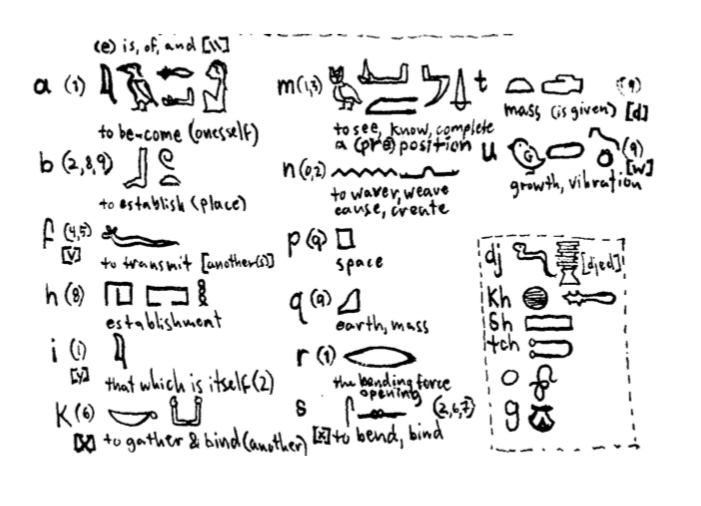
A’ (pronounced /i/ or [ee] or sometimes y) is two parallel slashes meaning duality. It is also a feather or two meaning a collector or receiver of matter, and refers to oneself.
A is a bird meaning an aspect of the highest and freest self. It is also an arm with a hand meaning to operate.
B is a leg with a foot meaning a place which is established.
F and V are a viper snake meaning to transmit and refers to the third person.
G is a stool meaning to be.
H is the plan of a courtyard meaning to establish (the boundaries of a plane). It is also a twist of flax meaning the helical spiral of duality.
K is a basket meaning to gather matter together and refers to the second person. It is also two upraised arms with hands.
M is an owl, or a scythe, or three sides of a pedestal meaning to see as in to know, that is to reap the senses, and refers to preposition.
N is a jagged or zigzag line meaning to waver or to weave, as in a massless string-like wave; to cause or crate negate. It is also “shrugging” arms meaning to negate.
P is a square meaning a space.
Q is a right-angled mass meaning earth or matter.
R is an opening, cavity, emitter, or projector as in a mouth, meaning a force that causes one to waver from their path (to bend).
S is a fold of cloth meaning to endure force or be wavered (to be bent). It is also a horizontal latch for binding; a strong force.
T is a semicircular mound or hill meaning mass and refers to the reciprocating principle; D is also a hand meaning give or deposit.
UU is a quail chick or a clay pot meaning waveform amplification, growth, or the particular state of a waveform (a particle); a temporal, entropic, or weak force.
DJ is a snake meaning the membrane of an entity, or word.
KH is a sieve or the gland of a mammal meaning a pleroma.
SH is a pool meaning a field.
TCH is a folded rope meaning to tether.
See “Record of Ra’s Electromagnetic Field (rREMF)” and how the Unified Force Field operates on the universal level.

Art¢oin:\>_MyFiles
Art¢oin:\>_Blockchain
PLEASE READ: HERE BEGINS THE VERIFIED RECORD OF $ARTCOIN NON-FUNGIBLE TOKEN (NFT) REAL STOCK ($) AND SHARE HOLDINGS (¢) (HEREAFTER JOINTLY AND SEVERALLY KNOWN AS THE “WORK”). THIS CONTRACT SHALL BIND THE BUYERS AND SELLERS OF THE WORK AND SHALL RUN WITH EVERY INDIVIDUAL WORK OF $ARTCOIN. ALL PRICES SUBJECT TO CHANGE.
| Column 1 | Column 2 | Column 3 | Column 4 | Column 5 | Column 6 | Column 7 |
|---|---|---|---|---|---|---|
| Number | Name | Material | Diameter | Dimension | List Price | Holding |
| 1 | MERIPTAH | CU | 1-1/2″ | 18 GA. | ₿1.0 /=$/ETH | 100% A. D. |
| 2 | TENNEN | CU | 3/4″ | 18 GA. | U. | D. |
| 3 | TENNEN | CU | 3/4″ | 18 GA. | U. | D. |
| 4 | YAHWEH | CU | 1-1/2″ | 18 GA. | $150 | 3/3/21 – S. TO @KONSHENSTHEMC |
| 5 | TENNEN | CU | 3/4″ | 18 GA. | U. | 7/17/21 – B. TO @CSRMXT |
| 6 | TENNEN | CU | 3/4″ | 18 GA. | U. | D. |
| 7 | TENNEN | CU | 3/4″ | 18 GA. | U. | D. |
| 8 | TENNEN | CU | 3/4″ | 18 GA. | U. | D. |
| 9 | SERQUET | CU | 1-1/4″ | 8 GA. | ₿0.01 /=$/ETH | 100% A. D. |
| 10 | TIYE | CU | 1-1/2″ | 8 GA. | ₿0.02 /=$/ETH | D. |
| 11 | YAHWEH-XAVIA | CU | 1-1/4″ | 8 GA. | ₿0.01 /=$/ETH | 100% A. D. |
| 12 | SERQUET | CU | 1-1/4″ | 8 GA. | ₿0.01 /=$/ETH | 100% A. D. |
| 13 | PTAH-TENNEN | CU | 1-1/2″ | 8 GA. | $200 | 11/5/21 – S. TO A. WOODLAND |
| 14 | MOSES | CU | 1-1/4″ | 8 GA. | U. | 10/5/21 – B. TO I. B. CRAWLEY |
| 15 | TIYE-TENNEN | CU | 1-1/2″ | 8 GA. | $200 | 11/5/21 – S. TO A. WOODLAND |
| 16 | YOD-TETRAGRAMMATON | CU | 1-1/4″ | 8 GA. | $150 (V.) | 8/9/21 – S. TO @CSRMXT |
| 17 | AUSET-NEKHBET | CU | 1-1/2″ | 8 GA. | U. | B. TO W. S. FRANKLIN |
| 18 | PTAH-TENNEN | CU | 1-1/2″ | 8 GA. | U. | B. TO A. A. CRAWLEY |
| 19 | NEKHBET | CU | 1-1/4″ | 10 GA. | ₿0.01 /=$/ETH | 100% A. |
| 20 | WADJET | CU | 1-1/4″ | 10 GA. | ₿0.02 /=$/ETH | 100% A. |
| 21 | YAHWEH | CU | 1-1/4″ | 10 GA. | ₿0.01 /=$/ETH | 100% A. |
| 22 | YAHWEH | CU | 1-1/4″ | 10 GA. | U. | 4/8/21 – B. TO A. I. CRAWLEY |
| 23 | DHTI | CU | 1-1/4″ | 10 GA. | $200 | 11/5/21 – S. TO A. WOODLAND |
| 24 | DHTI | CU | 1-1/4″ | 10 GA. | U. | D. |
| 25 | GEB | CU | 1-1/4″ | 10 GA. | U. | D. |
| 26 | MOSES | CU | 1-1/4″ | 10 GA. | $350 | 4/6/21 – S. TO @MALAESOTERIC |
| 27 | HERU | CU | 1-1/4″ | 10 GA. | U. | D. |
| 28 | FREEDOM-DOUGLASS | CU | 1-1/2″ | 10 GA. | U. | 5/10/21 – B. TO I. B. CRAWLEY |
| 29 | FREEDOM-DOUGLASS | CU | 1-1/2″ | 10 GA. | $350 | 7/17/21 – S. TO @CSRMXT |
| 30 | FREEDOM-MOSES | CU | 1-1/2″ | 10 GA. | $200 | 7/5/21 – S. TO @CSRMXT |
| 31 | JAQUES 1 | CU | 1-1/2″ | 10 GA. | ₿0.01 /=$/ETH | 100% A. D. |
| 32 | JAQUES 1 | CU | 1-1/2″ | 10 GA. | ₿0.05 /=$/ETH | 100% A. D. |
| 33 | O.E.S. TYKE | CU | 1-1/2″ | 10 GA. | U. | 5/10/21 – B. TO J. FRANKLIN |
| 34 | 1957 CRAWLEY | CU | 1-1/2″ | 10 GA. | U. | 4/24/21 – B. TO A. G. CRAWLEY |
| 35 | BARON-SANMJI-MANMAN-BRIJIT | CU | 1-1/2″ | 10 GA. | View Listing | 100% A. |
| 36 | FREI MAUREREI | CU | 1-1/2″ | 10 GA. | ₿0.05 /=$/ETH | 100% A. D. |
| 37 | AKHENATON | CU | 1-1/2″ | 3 MM (1 OZ.) | ₿0.05 /=$/ETH | 100% A. D. |
| 38 | FREEDOM-DOUGLASS | CU | 1-1/2″ | 3 MM (1 OZ.) | View Listing | 100% A. |
| 39 | SILVER FALCON | AG (999) | 1-1/2″ | 1 OZ. | ₿0.1 /=$/ETH | 100% A. D. |
| 40 | QADOSH ELYHWH-COLTRANE | CU | 1-1/2″ | 3 MM (1 OZ.) | ₿0.1 /=$/ETH | 100% A. D. |
| 41 | ALL PRAISE-COLTRANE | AG (999) | 1-1/2″ | 3 MM (1 OZ.) | ₿1.0 /=$/ETH | 100% A. D. |
| 42 | SIC SEMPER | AG(999) | 1-1/2″ | 1 OZ. | $200 | 7/5/21 – S. TO @CSRMXT |
| 43 | FREEDOM-MOSES | AG (999) | 1-1/2″ | 1 OZ. | ₿1.0 /=$/ETH | 100% A. D. |
| 44 | ANYAH-AUSET | CU | 1-1/4″ | 10 GA. | U. | U. |
| 45 | SILVER FALCON-RFK STADIUM | AG (999) | 1-1/2″ | 1 OZ. | ₿1.0 /=$/ETH | 100% A. D. |
| 46 | ONE PTAH | AG (999) | ~1 | >1 OZ. | — | — |
BINDING AGREEMENT For Transfer of Non-Fungible Token (NFT) $ART coin (“Art¢oin”) from Scribe Antarah A. Crawley (the “Artist”) to Collector and/or from Collector to Collector. The Artist (the “party of the first part”) and the Collector (the “party of the second part” and/or the “party of the first part” in the case of a third-party sale or transfer) shall be bound by the covenants contained herein. All covenants contained herein do attach and run with the Work and shall be binding upon all transferees. Buyers shall remit all payments to $AntarahCrawley or 0x9030514aA808E54144308270D8F1f2c9c85b9d93 (ETH); D6YCKKYaHk6QQz2PnHq2HumgbLMNMPkMXF (DOGE); bc1qvtkuyvkp4wx55uypfn2ufu9jtcne5mxz0ylk96 (BTC) or another designated account receivable.
WHEREAS The Work is being sold to Collector and Collector is willing to purchase the Work, subject to mutual obligations, covenants, and conditions herein; and WHEREAS Collector and Artist recognize that the value of the Work, unlike that of any ordinary chattel, is and will be affected by each and every other work of art the Artist has created and will hereafter create; and WHEREAS the parties expect the value of the Work to increase hereafter; and WHEREAS Collector and Artist recognize that it is fitting and proper that Artist participate in any appreciated value which may thus be created in the Work; and NOW, THEREFORE, in consideration of the foregoing premises and the mutual covenants hereinafter set forth and other valuable considerations the parties hereto agree as follows:
PURCHASE AND SALE. ARTICLE 1. The Collector is purchasing the Work subject to all the covenants herein set forth for the price of, or at the agreed valuation for the purposes of this agreement of, [LIST PRICE] per [#]/100 share(s), where 1 $ART coin = 100 shares of $ART coin NFT stock.
FUTURE TRANSFERS. ARTICLE 2. Collector covenants that in the event Collector shall hereafter sell, give, grant, barter, exchange, assign, transfer, convey or alienate the Work in any manner whatsoever or if the Work shall pass by inheritance or bequest or by operation of law, or if the Work shall be destroyed and insurance proceeds paid therefor, Collector or Collector’s personal representative shall: (a) file a current TRANSFER AGREEMENT AND RECORD in the form and containing the information set forth and called for in the specimen hereunto annexed and made a part hereof, completed and dated, and subscribed by Collector or Collector’s personal representative and Collector’s transferee, with the Artist at the address set forth above (or the Artist’s designated representative) within thirty days of such transfer, distribution, or payment of insurance proceeds, and shall (b) pay a sum equal to eighteen percent (18%) of the Appreciated Value (as hereinafter defined), if any, occasioned by such transfer or distribution or payment of insurance proceeds to the Artist at the address set forth above (or the Artist’s designated representative) within thirty days of such transfer, distribution, or payment of insurance proceeds.
PRICE/VALUE. ARTICLE 3. The “price or value” to be entered on a TRANSFER AGREEMENT AND RECORD shall be: (a) the actual selling price if the Work is sold for money; or (b) the money value of the consideration if the Work is bartered or exchanged for a valuable consideration; or (c) the fair market value of the Work if it is transferred in any other manner.
APPRECIATED VALUE. ARTICLE 4. “Appreciated Value” of the Work, for the purposes of this Agreement, shall be the increase, if any, in the value or price of the Work set forth in a current duly executed and filed TRANSFER AGREEMENT AND RECORD over the price or value set forth in the last prior duly executed and filed TRANSFER AGREEMENT AND RECORD, or, if there be no prior duly executed and filed TRANSFER AGREEMENT AND RECORD, over the price or value set forth in ARTICLE ONE herein. (a) In the event a current duly executed TRANSFER AGREEMENT AND RECORD is not timely filed as required by ARTICLE TWO herein, Appreciated Value shall nonetheless be computed as if such current TRANSFER AGREEMENT AND RECORD had been duly executed and filed, with a price or value set forth therein equal to the actual market value of the Work at the time of the current transfer or at the time of the discovery of such transfer.
TRANSFEREES TO RATIFY AGREEMENT. ARTICLE 5. Collector hereby covenants not to hereafter, sell, give, grant, barter, exchange, assign, transfer, convey or alienate the Work in any manner whatsoever or permit the Work to pass by inheritance or bequest or by operation of law to any person without procuring such transferee’s ratification and affirmation of all the terms of this Agreement and transferee’s agreement to be bound hereby and to perform and fulfill all the Collector’s covenants set forth herein, said ratification, affirmation and agreement to be evidenced by such transferee’s subscription of a current duly completed and filed TRANSFER AGREEMENT AND RECORD.
TRANSFEREES BOUND. ARTICLE 6. In the event the Work shall hereafter be transferred or otherwise alienated from Collector or Collector’s estate in any manner whatsoever, any transferee taking the Work with notice of this Agreement shall in every respect be bound and liable to perform and fulfill each and every covenant herein as if such transferee had duly made and subscribed a properly executed TRANSFER AGREEMENT AND RECORD in accordance with ARTICLE TWO and ARTICLE FIVE herein at the time the Work was transferred to him or her.
EXPIRATION. ARTICLE 7. This agreement and the covenants herein shall be binding upon the parties, their heirs, legatees, executors, administrators, assigns, transferees and all other successors in interest and the Collector’s covenants do attach and run with the Work and shall be binding to and until years after the deaths of Artist and Artist’s surviving spouse, if any.
WAIVERS NOT CONTINUING. ARTICLE 8. Any waiver by either party of any provision of this Agreement, or of any right hereunder, shall not be deemed a continuing waiver and shall not prevent or estop such party from thereafter enforcing such provision or right, and the failure of either party to insist in any one or more instances upon the strict performance of any of the terms or provisions of this Agreement by the other party shall not be construed as a waiver or relinquishment for the future of any such terms or provisions, but the same shall continue in full force and effect.
AMENDMENT IN WRITING. ARTICLE 9. This Agreement shall not be subject to amendment, modification, or termination, except in writing signed by both parties.
ATTORNEYS’ FEES. ARTICLE 10. In the event that either party shall hereafter bring any action upon any default in performance or observance of any covenant herein, the party aggrieved may recover reasonable attorneys’ fees in addition to whatever remedies may be available to him or her.
VENUE. ARTICLE 11. This agreement shall be governed by and construed in accordance with the laws of a venue of competent jurisdiction which may be in any region in which the parties reside and shall be binding upon and inure to the benefit of the respective executors, administrators, successors and assigns of the parties.
Block Verified by Scribe Antarah A. Crawley Meriptah 15 July 2021.
Art¢oin:\>_Theory and Methodology
Preamble
Each real Art¢oin (¢) is a serialized Non-Fungible Token (NFT) representing one hundred (100) shares in the art work-product of the Scribe Antarah Crawley (the “Artist”). Each share of each real Art¢oin is also called a Non-Fungible Token (NFT) or “token”. These tokens may be bought and sold on an exchange or on the free market just like any trading unit, whether it be art, gold, or Bitcoin. Acquisition of Art¢oin NFT shares represents acquisition of stock (or “shares”) in the entity (or “company”) constituted by the art work-product of the Artist, Scribe Antarah Crawley.
Appreciation in the value of the total volume of art work-product in circulation and on deposit represents an appreciation in the market value of the Company of the Artist, and shall inure to the benefit of its shareholders. One in possession of a share, or token, of the Company shall be de facto shareholder, however, each and every token should be exchanged under an “Agreement of Original Transfer of Work of Art” (or “contract”) establishing the rightful collector (or shareholder) together with a description and sale price of the subject art work, in pursuance of sound bookkeeping.
Value in Artwork
Art is work product that is valued for its unique qualities of scarcity and desirability. Such qualities are derived from many factors, including the person of the artist, the execution of the artist, the intention of the artist, the attention of the artist, the subject matter content of the work, the medium of the work, the lifetime of the work, and the effect upon the viewer, among many other factors. For these reasons, art made of materials worth literally nothing can fetch millions in exchange on the free market. In fact, digital non-material NFTs have sold for as much as $69 million at auction. Therefore art is a great asset that can hold and appreciate value like gold. Therefore it is a form of “hard money”.
Water Theory of Capital
1.0. There is a vast “sea” of value, represented by fluctuating wave-particles called “currency”.
1.1. When value flows freely in a “current” (through a market), then it is “liquid”. But when is it held up in an asset or other liability, then it is not liquid, because it cannot flow freely.
1.2. To get liquid currency from the “sea” to the “shore” where people use it to “work the fields” there must be river “banks” that conduct the liquid current “downstream”. Banks facilitate a capillary system whereby the value of the sea flows to the inland.
1.3. People irrigate new streams of income all the time. One must first identify a source of water, which is the market from which they will draw liquid. Then they must use tools to irrigate a stream to flow from the market to their place of business. These tools are means of production, with the resulting channel being the work-product which conducts the liquid currency to them. (It is worth noting that most institutional banks sit on naturally occurring rivers and bodies of water and are designed to be gatekeepers, or dams, to liquidity.)
2.0. An enterprise of any kind must float upon the sea of capital; for if it does not float, then it will become underwater.
2.1. This is to say that water a ship floats upon is good credit, but water that has gotten into the ship is bad debt that can sink the ship.
2.2. How shall the enterprise remain afloat? It is by and through good “leadership” and “stewardship” and “ownership” and “membership” as well as a firm league of “friendship”.
2.3. What, then, shall convey this company of ships down the river stream of income? It is by and through the ships’ “sales”.
The Liquidation and Circulation of Artwork
Considering the real and potential value of the art market, two important questions arise:
How can artists build liquidity into their work?
How can artists become art market makers?
Our Solution: back each unique work of art with something of intrinsic value in a form that can be readily circulated. The artist can increase the liquidity of their work by rendering their work in easy-to-trade units, or “trade units”, of art work. Of what should these units be made? We find that copper and other metals like silver and gold are much more liquid and valuable than canvas. The Artist can multiply the value of this base material by the work that the Artist inscribes upon it. The Artist can produce x art works per day, each one being a uniquely wrought and serialized unit of work: a non-fungible, or irreplaceable, token (an “NFT”). The craft production of NFTs organically controls the issuance and supply of such NFTs. With every sale, the value of the Artist’s work may appreciate. Smart contracts served via blockchain may enable artists to be paid dividends and royalties on all future transactions of the NFT. Thereby the Artist might become the market makers of certain art submarkets.
Blockchain Contracting
The contract for the transfer of a work of art may be decentralized from any physical location and operationalized without the physical meeting of the parties.
The contract itself may be a publicly available, pro-forma text which may be completed and submitted anywhere there is internet access. The contract binds the Collector to the Artist under clearly established terms for present and future transactions on the unique NFT artwork.
A Company of the Artist
By extension of such a blanket agreement executed between all parties in every sale, the parties establish a de facto company of the Artist in which all Collectors are shareholders holding company shares (the NFTs) that fluctuate according to the principles of the free market.
(Last modified 13 Apr. 21; 4 May 21; 10 May 21; 21 Sep 23)
 Supreme Exchange