Tagged: international
Assemblage & Collage (or, “To Gather and To Bind”)

Ecclesia. Dr. Dams Up Water, Sui Juris, Professor-General (153d CORPS), Dept. of Information Systems Intelligence Service (DISIS), Universitas Autodidactus | by prompt engineering an artificial intelligence engine [‘Mindsoft.ai’] | presents
Cut and Paste Sovereignties: The Collage, the College, and the Crisis of Assemblage
Abstract
This paper interrogates the porous ontologies of collage and assemblage as they leak promiscuously into the bureaucratic imaginaries of the college and the assembly. Through a prismatic reading of scissors, glue, governance, and grievance, this essay argues that the syntactical operations of aesthetic fragmentation mirror the metaphysical operations of democratic representation. In short: to cut is to legislate; to paste is to govern.
1. Introduction: When Art School Met Parliament
The twenty-first century, an epoch obsessed with interdisciplinarity, has witnessed a convergence of two previously autonomous practices: the aesthetic collage and the bureaucratic college. Both are sites of selection, exclusion, and accreditation. Both depend upon an unacknowledged substrate of adhesives—whether material (glue stick) or ideological (institutional mission statement).
Meanwhile, the assemblage, once a mere art-historical cousin of collage, has found new life as a model for political subjectivity. Philosophers from Deleuze to the Department of Political Science now proclaim that we are all “assemblages” of affect, interest, and student loan debt. Yet, if every assembly is an assemblage, can every assemblage be a parliament?
2. The Syntax of Cut: Scissors as Syllogism
In collage, the cut functions as both wound and syntax. It divides the field, establishing relationality through rupture. Similarly, the college cuts: it admits some and rejects others, slicing the social fabric along lines of “fit,” “merit,” and “legacy.” The admissions committee thus operates as the aesthetic editor of the polis—arranging the raw materials of adolescence into a legible future citizenry.
Where the artist cuts paper, the registrar cuts dreams.
3. Glue as Governance: Adhesion, Accreditation, and the State
Glue, long ignored by political theory, deserves recognition as the unsung material of sovereignty. In collage, it is the binding agent that turns fragmentation into coherence; in the college, it manifests as bureaucracy, accreditation, and alumni newsletters.
This sticky ontology recalls Hobbes’s Leviathan, wherein the sovereign glues together the body politic. Without glue—or governance—the artwork and the polity alike devolve into piles of loose ephemera: shredded syllabi, ungraded essays, campaign posters, tuition invoices.
4. Assemblage and Assembly: Toward a Materialist Parliamentarism
If collage is the metaphorical undergraduate of modernity, assemblage is its postgraduate seminar. Where collage arranges fragments flatly, assemblage extends them into space, into lived, precarious relationalities.
In political terms, the assembly likewise enacts a spatial performance: bodies in proximity producing meaning through adjacency. An assembly is a three-dimensional collage in motion, an arrangement of human cutouts attempting—often unsuccessfully—to cohere around a resolution.
The question, then, is not whether art imitates politics, but whether both are merely mixed-media projects with delusions of unity.
5. The College as Collage: Institutional Aesthetics of Admission
We might finally recognize the college itself as a collage of ideologies—meritocracy pasted over inequality, diversity brochures over exclusionary endowments. The campus tour is a performative walk through an installation piece entitled Meritocracy (Mixed Media, 1636–Present).
The faculty meeting functions as an assemblage in the purest sense: heterogeneous entities (professors, adjuncts, administrators, snacks) gathered temporarily to debate the future of glue allocation (budgets).
6. Conclusion: Toward a Post-Adhesive Democracy
In the age of algorithmic governance and tuition hikes, collage and college alike face the same existential dilemma: how to maintain coherence without authoritarian adhesives. Perhaps the task is no longer to glue but to hover—to practice a politics of suspended fragments, a democracy of the unglued.
As artists and citizens, we must learn to embrace the cut, to wield our scissors not as tools of exclusion but as instruments of infinite recomposition.
For in the end, all representation—whether artistic or parliamentary—is but a question of arrangement.
Cut and Paste Sovereignties II: Collage, College, and the Third Letterist International
Abstract
This expanded investigation situates the syntactical economies of collage and the metaphysical infrastructures of the college within the emergent politico-aesthetic ecologies of the Third Letterist International. Drawing on recent cross-contaminations between university English departments and guerrilla street-art cells, this paper examines how semiotic sabotage, typographic activism, and epistemological paste intersect with the anti-fascist “Antifada” land-back movement. Ultimately, it argues that both the radicalized right and left are engaged in competing collage practices—each cutting and pasting reality to fit its desired composition. The result: a dialectical mess best described as assemblage anxiety.
7. The Third Letterist International: From Margins to Manifesto
In the late 2010s, a group of underemployed adjunct poets and spray-paint tacticians announced the Third Letterist International (3LI)—a successor, or rather détournement, of the mid-twentieth-century Letterist Internationals that once haunted Parisian cafés. 3LI declared that “syntax is the last frontier of resistance,” and that “every cut in language is a cut in power.”
Unlike its Situationist predecessor, which preferred to dérive through cities, 3LI dérives through syllabi. It occupies the margins of MLA-approved anthologies, recontextualizing canonical footnotes as sites of insurgency. Members reportedly practice “semiotic collage,” blending footnotes, graffiti, and university mission statements into sprawling textual murals.
In this sense, 3LI operates simultaneously as an art movement, a faculty union, and a campus club with no budget but infinite grant applications. Their motto, scrawled across both bluebooks and brick walls, reads:
“Disassemble, dissertate, disobey.”
8. Street Pedagogy: When English Departments Go Rogue
The Third Letterist International represents the latest phase of what theorists call pedagogical insurgency—the moment when the English Department, long confined to grading essays and moderating panel discussions, turns outward, confronting the street as an extended seminar room.
Faculty and activists co-author manifestos in chalk; office hours occur under overpasses; tenure committees are replaced by “committees of correspondence.” The “peer review process” has been literalized into street-level dialogue between peers (and occasionally, riot police).
Thus, the old academic dream of “public scholarship” finds its avant-garde realization in public vandalism.
9. The Antifada and the Land-Back Collage: A Politics of Recomposition
Parallel to this linguistic insurgency, the Antifada land-back movement has reconfigured the terrains of both property and poetics. The Antifada’s name, an intentional linguistic collage of “antifa” and “intifada,” reclaims the act of uprising as a mixed-media gesture: half protest, half performance art.
Central to their praxis is recompositional politics—the idea that both land and language can be cut, repasted, and reoccupied. Where settler colonialism framed land as canvas and capital as glue, the Antifada proposes an inverse operation: tearing up the map, redistributing the fragments, and calling it a new landscape of belonging.
Here, the aesthetic metaphor of collage becomes political material: who gets to cut? who gets pasted back in? what happens when the glue is gone, and everything hovers in a provisional equilibrium of mutual care and unresolved tension?
10. The Far Right as Accidental Collagists
Ironically, the radicalized right—those self-proclaimed defenders of coherence—have themselves become unintentional practitioners of collage. Their online spaces are digital scrapbooks of conspiracy and nostalgia: medieval heraldry pasted over memes, constitutional fragments glued to anime stills.
Their epistemology is bricolage masquerading as ontology. Each narrative is a cutout, each belief a sticker affixed to the myth of national wholeness. In vilifying the Antifada and 3LI as “cultural Marxists” or “linguistic terrorists,” the right reveals its own aesthetic anxiety: that its ideological glue, once epoxy-thick, has thinned into the watery paste of algorithmic outrage.
Thus, both radical poles—left and right—participate in a shared semiotic economy of fragmentation, differing only in whether they lament or celebrate the cut.
11. The Dialectic of Radicalization: Between Cut and Countercut
The political field has become an editing bay. The radicalized right splices together nostalgia and paranoia; the radicalized left cuts history into openings for potential futures. Each accuses the other of montage malpractice.
This dialectic reveals a deeper truth: both operate under the logic of the collage. The difference lies not in form but in glue—whether the adhesive is empathy or ressentiment, whether the cut heals toward multiplicity or enclosure.
As Walter Benjamin might have written (had he survived into the age of Adobe Creative Suite): the struggle of our time is between those who collage the world to open it, and those who collage it to close it.
12. Toward an Epistemology of the Second Cut
In this interstitial moment, 3LI and Antifada embody the politics of the second cut—a refusal of closure, a commitment to continuous recomposition. Their slogan “No Final Drafts, Only Revisions” reimagines revolution as perpetual editing: the rewriting of history through acts of aesthetic and material reclamation.
The university, once imagined as a fortress of knowledge, becomes instead a collage in crisis—a surface upon which the graffiti of the future is already being written, erased, and re-scrawled.
13. Conclusion: The Unfinished Adhesive
The collage, the college, the assemblage, and the assembly—these are not discrete entities but overlapping grammars of belonging and dissent. The Third Letterist International offers not a program but a practice: to write politically and paste poetically, to legislate through syntax, to assemble through aesthetics.
If the far-right fears fragmentation, and the far-left seeks to inhabit it, then perhaps our task is neither restoration nor rupture, but curation: to tend to the cracks, to preserve the possibility of rearrangement.
In the end, we are all fragments looking for better glue.
v.25.12.29.14.16

Commission 152
NACOTCHTANK’S
152d CORPS
بيت مدرسة
בית מדרש
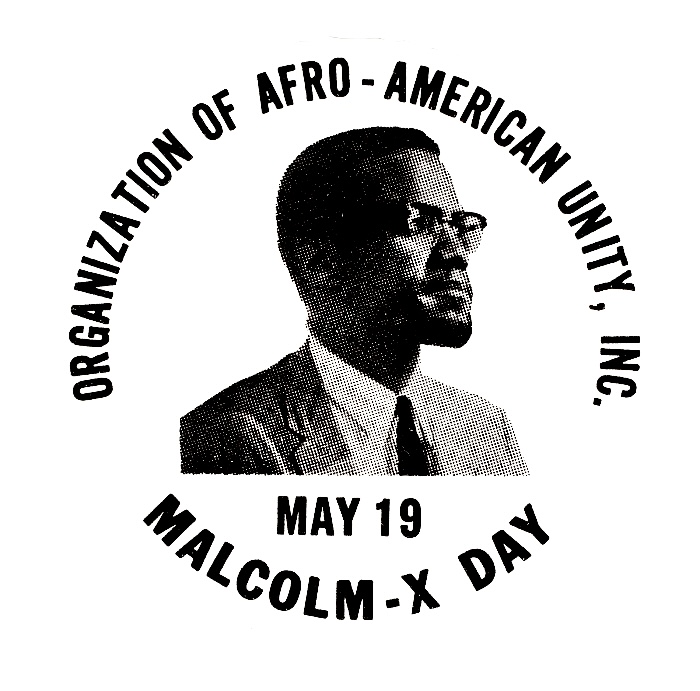
The Preceptory of
The 1st Ecclesiastic College at
Nacotchtank, Ouachita District,
5th International Worker’s Ass’n
and
2nd Organization of Afro-American Unity
CURRICULAR OPERATIONS RESEARCH & PUBLICATIONS SERVICES (CORPS)
DIVISION OF THE POLITICAL BUREAU OF EDUCATION (POLITBURO), FLF-DAO
The Governor of the Society of the New Syllabus (N∴S∴) at Nacotchtank-on-Potomac (Anacostia) District of Ouachita (Washington, District of Columbia), Furthest West (al-Maghreb al-Aqsa) To All To Whom These Presents Come, Sends Greeting and Peace:—
Know ye by these presents that there is a decentralized autonomous organization (DAO) of people, in the nature of firm league of friendship (FLF), which is engaged in the business of self-education, -operation, and -development (Autodidactus), and that this society (Universitas) is organized into associations (Collegia) constituted by assemblies (Ecclesia) committed to certain trades or subject matters (Syndici).
(b) There is hereby established the second wave of the Organization of Afro-American Unity for the purposes enumerated by the Most Honorable el-Hajj Malik el-Shabazz (a.k.a. Malcolm X) (our “Founder”).
(c) The words of our Founder are incorporated herein by reference:
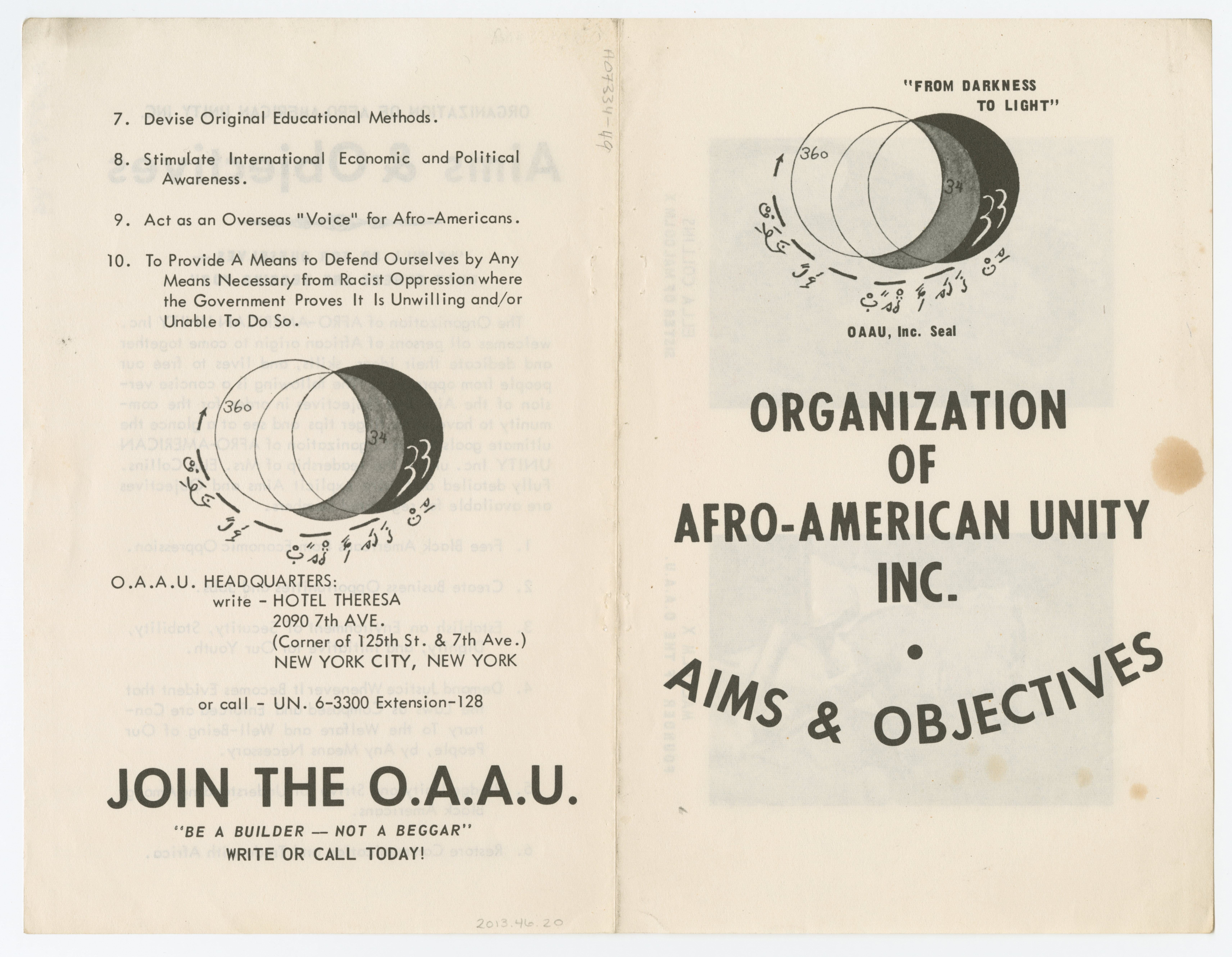
Program of the Organization of Afro-American Unity
Malcolm X, et al. (taken from the Malcolm X Museum)
Note: this was originally supposed to be presented on Feb. 15, but since Malcolm’s home was fire-bombed, this was delayed for a week — Feb. 21, [1965] to be exact — the day he was assassinated…
(1) PREAMBLE
Pledging unity…
Promoting justice…
Transcending compromise…
(a) We, Afro-Americans, people who originated in Africa and now reside in America, speak out against the slavery and oppression inflicted upon us by this racist power structure. We offer to downtrodden Afro-American people courses of action that will conquer oppression, relieve suffering, and convert meaningless struggle into meaningful action.
(b) Confident that our purpose will be achieved, we Afro-Americans from all walks of life make the following known:
(2) ESTABLISHMENT
(a) Having stated our determination, confidence, and resolve, the Organization of Afro-American Unity is hereby established on the 15th day of February, 1965, in the city of New York.
(b) Upon this establishment, the Afro-American people will launch a cultural revolution which will provide the means for restoring our identity that we might rejoin our brothers and sisters on the African continent, culturally, psychologically, economically, and share with them the sweet fruits of freedom from oppression and independence of racist governments.
(1) The Organization of Afro-American Unity welcomes all persons of African origin to come together and dedicate their ideas, skills, and lives to free our people from oppression.
(2) Branches of the Organization of Afro-American Unity may be established by people of African descent wherever they may be and whatever their ideology — as long as they be descendants of Africa and dedicated to our one goal: freedom from oppression.
(3) The basic program of the Organization of Afro-American Unity which is now being presented can and will be modified by the membership, taking into consideration national, regional, and local conditions that require flexible treatment.
(4) The Organization of Afro-American Unity encourages active participation of each member since we feel that each and every Afro-American has something to contribute to our freedom. Thus each member will be encouraged to participate in the committee of his or her choice.
(5) Understanding the differences that have been created amongst us by our oppressors in order to keep us divided, the Organization of Afro-American Unity strives to ignore or submerge these artificial divisions by focusing our activities and our loyalties upon our one goal: freedom from oppression.
(3) BASIC AIMS AND OBJECTIVES
(A) Self-determination
(1) We assert that we Afro-Americans have the right to direct and control our lives, our history, and our future rather than to have our destinies determined by American racists, we are determined to rediscover our true African culture, which was crushed and hidden for over four hundred years in order to enslave us and keep us enslaved up to today…
(2) We, Afro-Americans — enslaved, oppressed, and denied by a society that proclaims itself the citadel of democracy, are determined to rediscover our history, promote the talents that are suppressed by our racist enslavers, renew the culture that was crushed by a slave government and thereby — to again become a free people.
(B) National unity
(1) Sincerely believing that the future of Afro-Americans is dependent upon our ability to unite our ideas, skills, organizations, and institutions…
(2) We, the Organization of Afro-American Unity pledge to join hands and hearts with all people of African origin in a grand alliance by forgetting all the differences that the power structure has created to keep us divided and enslaved. We further pledge to strengthen our common bond and strive toward one goal: freedom from oppression.
(4) THE BASIC UNITY PROGRAM
(a) The program of the Organization of Afro-American Unity shall evolve from five strategic points which are deemed basic and fundamental to our grand alliance. Through our committees we shall proceed in the following general areas.
(I) Restoration
(1) In order to enslave the African it was necessary for our enslavers to completely sever our communications with the African continent and the Africans that remained there. In order to free ourselves from the oppression of our enslavers then, it is absolutely necessary for the Afro-American to restore communications with Africa.
(2) The Organization of Afro-American Unity will accomplish this goal by means of independent national and international newspapers, publishing ventures, personal contacts, and other available communications media.
(3) We, Afro-Americans, must also communicate to one another the truths about American slavery and the terrible effects it has upon our people. We must study the modern system of slavery in order to free ourselves from it. We must search out all the bare and ugly facts without shame for we are still victims, still slaves — still oppressed. Our only shame is believing falsehood and not seeking the truth.
(4) We must learn all that we can about ourselves. We will have to know the whole story of how we were kidnapped from Africa; how our ancestors were brutalized, dehumanized, and murdered; and how we are continually kept in a state of slavery for the profit of a system conceived in slavery, built by slaves and dedicated to keeping us enslaved in order to maintain itself.
(5) We must begin to reeducate ourselves and become alert listeners in order to learn as much as we can about the progress of our motherland — Africa. We must correct in our minds the distorted image that our enslaver has portrayed to us of Africa that he might discourage us from reestablishing communications with her and thus obtain freedom from oppression.
(II) Reorientation
(1) In order to keep the Afro-American enslaved, it was necessary to limit our thinking to the shores of America — to prevent us from identifying our problems with the problems of other peoples of African origin. This made us consider ourselves an isolated minority without allies anywhere.
(2) The Organization of Afro-American Unity will develop in the Afro-American people a keen awareness of our relationship with the world at large and clarify our roles, rights, and responsibilities as human beings. We can accomplish this goal by becoming well-informed concerning world affairs and understanding that our struggle is part of a larger world struggle of oppressed peoples against all forms of oppression. We must change the thinking of the Afro-American by liberating our minds through the study of philosophies and psychologies, cultures and languages that did not come from our racist oppressors. Provisions are being made for the study of languages such as Swahili, Hausa, and Arabic. These studies will give our people access to ideas and history of mankind at large and thus increase our mental scope.
(3) We can learn much about Africa by reading informative books and by listening to the experiences of those who have traveled there, but many of us can travel to the land of our choice and experience for ourselves. The Organization of Afro-American Unity will encourage the Afro-American to travel to Africa, the Caribbean, and to other places where our culture has not been completely crushed by brutality and ruthlessness.
(III) Education
(1) After enslaving us, the slave masters developed a racist educational system which justified to its posterity the evil deeds that had been committed against the African people and their descendants. Too often the slave himself participates so completely in this system that he justifies having been enslaved and oppressed.
(2) The Organization of Afro-American Unity will devise original educational methods and procedures which will liberate the minds of our children from the vicious lies and distortions that are fed to us from the cradle to keep us mentally enslaved. We encourage Afro-Americans themselves to establish experimental institutes and educational workshops, liberation schools, and child-care centers in the Afro-American communities.
(3) We will influence the choice of textbooks and equipment used by our children in the public schools while at the same time encouraging qualified Afro-Americans to write and publish the text books needed to liberate our minds. Until we completely control our own educational institutions, we must supplement the formal training of our children by educating them at home.
(IV) Economic security
(1) After the Emancipation Proclamation, when the system of slavery changed from chattel slavery to wage slavery, it was realized that the Afro-American constituted the largest homogeneous ethnic group with a common origin and common group experience in the United States and, if allowed to exercise economic or political freedom, would in a short period of time own this country. Therefore racists in this government developed techniques that would keep the Afro-American people economically dependent upon the slave masters — economically slaves — twentieth-century slaves.
(2) The Organization of Afro-American Unity will take measures to free our people from economic slavery. One way of accomplishing this will be to maintain a technician pool: that is, a bank of technicians. In the same manner that blood banks have been established to furnish blood to those who need it at the time it is needed, we must establish a technician bank. We must do this so that the newly independent nations of Africa can turn to us who are their Afro-American brothers for the technicians they will need now and in the future. Thereby we will be developing an open market for the many skills we possess and at the same time we will be supplying Africa with the skills she can best use. This project will therefore be one of mutual cooperation and mutual benefit.
(V) Self-defense
(1) In order to enslave a people and keep them subjugated, their right to self-defense must be denied. They must be constantly terrorized, brutalized, and murdered. These tactics of suppression have been developed to a new high by vicious racists whom the United States government seems unwilling or incapable of dealing with in terms of the law of this land. Before the emancipation it was the Black man who suffered humiliation, torture, castration, and murder. Recently our women and children, more and more, are becoming the victims of savage racists whose appetite for blood increases daily and whose deeds of depravity seem to be openly encouraged by all law enforcement agencies. Over five thousand Afro-Americans have been lynched since the Emancipation Proclamation and not one murderer has been brought to justice!
(2) The Organization of Afro-American Unity, being aware of the increased violence being visited upon the Afro-American and of the open sanction of this violence and murder by the police departments throughout this country and the federal agencies — do affirm our right and obligation to defend ourselves in order to survive as a people.
(3) We encourage the Afro-Americans to defend themselves against the wanton attacks of racist aggressors whose sole aim is to deny us the guarantees of the United Nations Charter of Human Rights and of the Constitution of the United States.
(4) The Organization of Afro-American Unity will take those private steps that are necessary to insure the survival of the Afro-American people in the face of racist aggression and the defense of our women and children. We are within our rights to see to it that the Afro-American people who fulfill their obligations to the United States government (we pay taxes and serve in the armed forces of this country like American citizens do) also exact from this government the obligations that it owes us as a people, or exact these obligations ourselves. Needless to say, among this number we include protection of certain inalienable rights such as life, liberty, and the pursuit of happiness.
(5) In areas where the United States government has shown itself unable and/or unwilling to bring to justice the racist oppressors, murderers, who kill innocent children and adults, the Organization of Afro-American Unity advocates that the Afro-American people insure ourselves that justice is done — whatever the price and by any means necessary.
(5) NATIONAL CONCERNS
(A) General terminologies:
(1) We Afro-Americans feel receptive toward all peoples of goodwill. We are not opposed to multiethnic associations in any walk of life. In fact, we have had experiences which enable us to understand how unfortunate it is that human beings have been set apart or aside from each other because of characteristics known as “racial” characteristics.
(2) However Afro-Americans did not create the prejudiced background and atmosphere in which we live. And we must face the facts. A “racial” society does exist in stark reality, and not with equality for Black people; so we who are nonwhite must meet the problems inherited from centuries of inequalities and deal with the present situations as rationally as we are able.
(3) The exclusive ethnic quality of our unity is necessary for self-preservation. We say this because our experiences backed up by history show that African culture and Afro-American culture not be accurately recognized and reported and cannot be respectably expressed nor be secure in its survival if we remain the divided, and therefore the helpless, victims of an oppressive society.
(4) We appreciate the fact that when the people involved have real equality and justice, ethnic intermingling can be beneficial to all. We must denounce, however, all people who are oppressive through their policies or actions and who are lacking in justice in their dealings with other people, whether the injustices proceed from power, class, or “race.” We must be unified in order to be protected from abuse or misuse.
(5) We consider the word “integration” a misleading, false term. It carries with it certain implications to which Afro-Americans cannot subscribe. This terminology has been applied to the current regulation projects which are supposed]y “acceptable” to some classes of society. This very “acceptable” implies some inherent superiority or inferiority instead of acknowledging the true source of the inequalities involved.
(6) We have observed that the usage of the term “integration” was designated and promoted by those persons who expect to continue a (nicer) type of ethnic discrimination and who intend to maintain social and economic control of all human contacts by means of imagery, classifications, quotas, and manipulations based on color, national origin, or “racial” background and characteristics.
(7) Careful evaluation of recent experiences shows that “integration” actually describes the proccess by which a white society is (remains) set in a position to use, whenever it chooses to use and however it chooses to use, the best talents of nonwhite people. This power-web continues to build a society wherein the best contributions of Afro-Americans, in fact of all nonwhite people, would continue to be absorbed without note or exploited to benefit a fortunate few while the masses of both white and nonwhite people would remain unequal and unbenefited.
(8) We are aware that many of us lack sufficient training and are deprived and unprepared as a result of oppression, discrimination, and the resulting discouragement, despair, and resignation. But when we are not qualified, and where we are unprepared, we must help each other and work out plans for bettering our own conditions as Afro-Americans. Then our assertions toward full opportunity can be made on the basis of equality as opposed to the calculated tokens of “integration.” Therefore, we must reject this term as one used by all persons who intend to mislead Afro-Americans.
(9) Another term, “negro,” is erroneously used and is degrading in the eyes of informed and self-respecting persons of African heritage. It denotes stereotyped and debased traits of character and classifies a whole segment of humanity on the basis of false information. From all intelligent viewpoints, it is a badge of slavery and helps to prolong and perpetuate oppression and discrimination.
(10) Persons who recognize the emotional thrust and plain show of disrespect in the Southerner’s use of “nigra” and the general use of “nigger” must also realize that all three words are essentially the same. The other two. “nigra” and “nigger” are blunt and undeceptive. The one representing respectability, “negro,” is merely the same substance in a polished package and spelled with a capital letter. This refinement is added so that a degrading terminology can be legitimately used in general literature and “polite” conversation without embarrassment.
(11) The term “negro” developed from a word in the Spanish language which is actually an adjective (describing word) meaning “black,” that is, the color black. In plain English, if someone said or was called a “black” or a “dark,” even a young child would very naturally question: “a black what?” or “a dark what?” because adjectives do not name, they describe. Please take note that in order to make use of this mechanism, a word was transferred from another language and deceptively changed in function from an adjective to a noun, which is a naming word. Its application in the nominative (naming) sense was intentionally used to portray persons in a position of objects or “things.” It stamps the article as being “all alike and all the same.” It denotes: a “darkie,” a slave, a subhuman, an ex-slave, a “negro.”
(12) Afro-Americans must re-analyze and particularly question our own use of this term, keeping in mind all the facts. In light of the historical meanings and current implications, all intelligent and informed Afro-Americans and Africans continue to reject its use in the noun form as well as a proper adjective. Its usage shall continue to be considered as unenlightened and objectionable or deliberately offensive whether in speech or writing.
(13) We accept the use of Afro-American, African, and Black man in reference to persons of African heritage. To every other part of mankind goes this measure of just respect. We do not desire more nor shall we accept less.
(B) General considerations:
(1) Afro-Americans, like all other people, have human rights which are inalienable. This is, these human rights cannot be legally or justly transferred to another. Our human rights belong to us, as to all people, through God, not through the wishes nor according to the whims of other men.
(2) We must consider that fact and other reasons why a proclamation of “Emancipation” should not be revered as a document of liberation. Any previous acceptance of and faith in such a document was based on sentiment, not on reality. This is a serious matter which we Afro-Americans must continue to reevaluate.
(3) The original root-meaning of the word emancipation is: “To deliver up or make over as property by means of a formal act from a purchaser.” We must take note and remember that human beings cannot be justly bought or sold nor can their human rights be legally or justly taken away.
(4) Slavery was, and still is, a criminal institution, that is: crime en masse. No matter what form it takes. subtle rules and policies, apartheid, etc., slavery and oppression of human rights stand as major crimes against God and humanity. Therefore, to relegate or change the state of such criminal deeds by means of vague legislation and noble euphemisms gives an honor to horrible commitments that is totally inappropriate.
(5) Full implications and concomitant harvests were generally misunderstood by our foreparents and are still misunderstood or avoided by some Afro-Americans today. However, the facts remain; and we, as enlightened Afro-Americans, will not praise and encourage any belief in emancipation. Afro-Americans everywhere must realize that to retain faith in such an idea means acceptance of being property and, therefore, less than a human being. This matter is a crucial one that Afro-Americans must continue to reexamine.
(6) WORLDWIDE CONCERNS
(a) The time is past due for us to internationalize the problems of Afro-Americans. We have been too slow in recognizing the link in the fate of Africans with the fate of Afro-Americans. We have been too unknowing to understand and too misdirected to ask our African brothers and sisters to help us mend the chain of our heritage.
(b) Our African relatives who are in a majority in their own country have found it very difficult to gain independence from a minority. It is that much more difficult for Afro-Americans who are a minority away from the motherland and still oppressed by those who encourage the crushing of our African identity.
(c) We can appreciate the material progress and recognize the opportunities available in the highly industrialized and affluent American society. Yet, we who are nonwhite face daily miseries resulting directly or indirectly from a systematic discrimination against us because of our God-given colors. These factors cause us to remember that our being born in America was an act of fate stemming from the separation of our foreparents from Africa; not by choice, but by force.
(d) We have for many years been divided among ourselves through deceptions and misunderstandings created by our enslavers, but we do here and now express our desires and intent to draw closer and be restored in knowledge and spirit through renewed relations and kinships with the African peoples. We further realize that our human rights, so long suppressed, are the rights of all mankind everywhere.
(e) In light of all of our experiences and knowledge of the past, we, as Afro-Americans, declare recognition, sympathy, and admiration for all peoples and nations who are striving, as we are, toward self-realization and complete freedom from oppression.
(f) The civil rights bill is a similarly misleading, misinterpreted document of legislation. The premise of its design and application is not respectable in the eyes of men who recognize what personal freedom involves and entails. Afro-Americans must answer this question for themselves: What makes this special bill necessary?
(g) The only document that is in order and deserved with regard to the acts perpetuated through slavery and oppression prolonged to this day is a Declaration of condemnation. And the only legislation worthy of consideration or endorsement by Afro-Americans, the victims of these tragic institutions, is a Proclamation of Restitution. We Afro-Americans must keep these facts ever in mind.
(h) We must continue to internationalize our philosophies and contacts toward assuming full human rights which include all the civil rights appertaining thereto. With complete understanding of our heritage as Afro-Americans, we must not do less.
(7) Committees of the Organization of Afro-American Unity:
(a) The Cultural Committee
(b) The Economic Committee
(c) The Educational Committee
(d) The Political Committee
(e) The Publications Committee
(f) The Social Committee
(g) The Self-Defense Committee
(h) The Youth Committee
(i) Staff committees: Finance, Fund-raising, Legal, Membership
Gallery



Resources
CURRICULAR OPERATIONS RESEARCH AND PUBLICATION SERVICES
PROVIDED BY THE GOVERNOR AND COMPANY OF

A FREELY ASSOCIATED SERVICE PROVIDER
D.R. 01-14: The Fed &c.

Volume 1, Issue 14
Special Edition on Political Economy
Contents — Art. 1. …On the Fed — Art 2. Charter F.A. — Art. 3. …Consol DAO — Art. 4. Notes from the DAO — Art. 5. …X — Art. 6. Culture…
Article 1
Notes on the System:
On the “Federal Reserve”
Comp. Ed. by Antarah Crawley | Last Modified 11/28/2023 at 9:40 PM
The Federal Reserve, the central bank of the United States, provides the nation with a safe, flexible, and stable monetary and financial system.
Banner of the Official Website of the Board of Governors of the Federal Reserve System, as of 27 Nov. 2023
The people that walked in darkness have seen a great light: they that dwell in the land of the shadow of death, upon them hath the light shined.
Book of Isaiah, Chapter 9, Verse 2
Introductory Editorial Note: It is economic, social, and political suicide to question the legitimacy or constitutionality of the System (just ask Ezra Pound, Mr. Mullins, and Chairman McFadden). Notwithstanding that unfortunate circumstance, we must educate the public as to its mechanisms.
Preamble
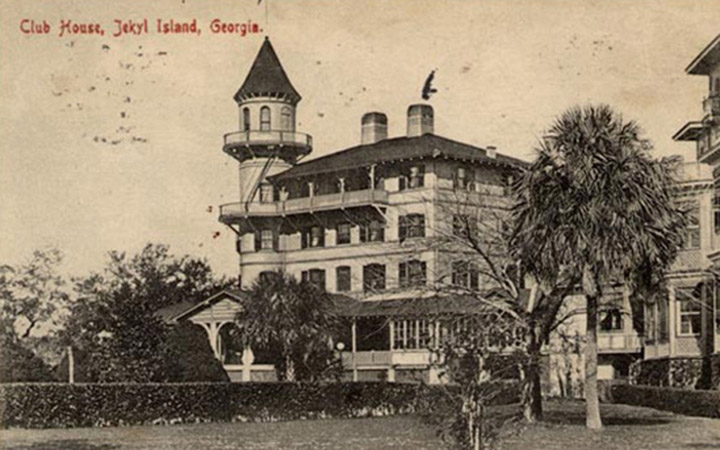
[…] the Federal Reserve System is not Federal; it has no reserves, and is not a system at all, but rather, a criminal syndicate. From November, 1910, when the conspirators [U.S. Senator Nelson Aldrich of the National Monetary Commission, his secretary Arthur Shelton, U.S. Assistant Secretary of the Treasury A. Piatt Andrew, Senior Partner Henry Davison of J.P. Morgan Co., President Frank Vanderlip of the National City Bank of New York, President Charles D. Norton of the First National Bank of New York, Benjamin Strong of J.P. Morgan, and Paul Warburg of Kuhn, Loeb & Co.] met on Jekyll Island, Georgia, to the present time machinations of the Federal Reserve bankers have been shrouded in secrecy. Today [1991], that secrecy has cost the American people a three trillion [now 33 trillion] dollar debt, with annual interest payments to these bankers amounting to some three hundred billion dollars per year, sums which stagger the imagination, and which in themselves are ultimately unpayable.
[…] American history in the twentieth century has recorded the amazing achievements of the Federal Reserve bankers. First, the outbreak of World War I, which was made possible by the funds available from the new central bank of the United States. Second, the Agricultural Depression of 1920. Third, the Black Friday Crash on Wall Street of October, 1929, and the ensuing Great Depression. Fourth, World War II. Fifth, the conversion of the assets of the United States and its citizens from real property to paper assets from 1945 to the present, transforming a victorious America and foremost world power in 1945 to the world’s largest debtor nation in 1990. […] Will Americans act to rebuild our nation […] or will we continue to be enslaved by the Babylonian debt money system which was set up by the Federal Reserve Act of 1913 to complete our total destruction? This is the only question which we have to answer, and we do not have much time left to answer it.
Eustace Mullins, Jackson Hole, Wyoming, 1991; Forward to “Secrets of the Federal Reserve,” Author’s Special 70th Birthday Edition: Bankers Research Institute: Staunton, Virginia: 1993. (Emphasis mine.)
Primary Sources
Some people think the Federal Reserve banks are United States Government institutions. They are not government institutions. They are private credit monopolies which prey upon the people of the United States for the benefit of themselves and their foreign customers. The Federal Reserve banks are the agents of the foreign central banks. Henry Ford has said, ‘The one aim of these financiers is world control by the creation of inextinguishable debts.’ The truth is the Federal Reserve Board has usurped the Government of the United States by the arrogant credit monopoly which operates the Federal Reserve Board and the Federal Reserve Banks.
Louis T. McFadden, Chairman of the U.S. House Banking and Currency Committee, June 10, 1932. (Mullins 153-154.)
Whereas I charge them, jointly and severally, with the crime of having treasonably conspired and acted against the peace and security of the United States and having treasonable conspired to destroy the constitutional government in the United States. Resolved, that the Committee on the Judiciary is authorized and directed as a whole or by subcommittee to investigate the official conduct of the Federal Reserve Board and agents to determine whether, in the opinion of the said committee, they have been guilty of any high crime or misdemeanour which in the contemplation of the Constitutions requires the interposition of the Constitutional powers of the House.
Chairman McFadden, January 13, 1932, introducing a resolution indicting the Federal Reserve Board of Governors for “Criminal Conspiracy,” on which no action was taken. This, and the Chairman’s December 13, 1932, motion to impeach President Herbert Hoover was the last nail driven into his political coffin. (Mullins 154.)
I wrote into the bill which was introduced by me in the Senate on June 26, 1913, a provision that the powers of the System should be employed to produce a stable price level, which meant a dollar of stable purchasing, debt-paying power. It was stricken out. The powerful money interests got control of the Federal Reserve Board through Mr. Paul Warburg, Mr. Albert Strauss, and Mr. Adolph C. Miller and they were able to have that secret meeting of May 18, 1920, and bring about a contraction of credit so violent it threw five million people out of employment. In 1920 that Reserve Board deliberately caused the Panic of 1921. The same people, unrestrained in the stock market, expanding credit to a great excess between 1926 and 1929, raised the price of stocks to a fantastic point where they could not possibly earn dividends, and when the people realized this, they tried to get out, resulting in the Crash of October 24, 1929.
U.S. Senator Robert L. Owen, testifying before the U.S. House Committee on Banking and Currency, 1938. (Mullins 157.)
The Federal Reserve Bank is an institution owned by the stockholding member banks. The Government has not a dollar’s worth of stock in it.
W.P.G. Harding, Governor of the Federal Reserve Board, testifying in 1921. (Mullins 157.)
The people did not know the Federal Reserve Banks were organized for profit-making. They were intended to stabilize the credit and currency supply of the country. That end has not been accomplished. Indeed, there has been remarkable variation in the purchasing power of money since the System went into effect. The Federal Reserve men are chosen by the big banks, through discrete little campaigns, and they naturally follow the ideals which are portrayed to them as the soundest from a financial point of view.
U.S. Senator Robert L. Owen, testifying during the Gold Reserve Hearings of 1934. (Mullins 161.)
At the moment, 1934, we have 900 million dollars excess reserves. In 1924, with increased reserves of 300 million, you got some three or four billion in bank expansion of credit very quickly. That extra money was put out by the Federal Reserve Banks in 1924 through buying government securities and was the cause of the rapid expansion of bank credit. The banks continued to get excess reserved because more gold came in, and because, whenever there was a slackening, the Federal Reserve people would put out some more. They held back a bit in 1926. Things firmed up a bit that year. And then in 1927 they put out less than 300 million additional reserves, set the wild stock market going, and that led us right into the smash of 1929.
[…] The money of the Federal Reserve Banks is money they created. When they buy Government securities they create reserves. They pay for the government securities by giving checks on themselves, and those checks come to the commercial banks and are by them deposited in the Federal Reserve Banks, and then money exists which did not exist before.
Benjamin Anderson, economist for the Chase National Bank of New York, testifying during the Gold Reserve Hearings of 1934. (Mullins 161.)
The Board of Governors opposes any bill which proposes a stable price level, on the grounds that prices do not depend primarily on the price or cost of money; that the Board’s control over money cannot be made complete; and that steady average prices, even if obtainable by official action, would not insure lasting prosperity
Marriner S. Eccles, Chairman of the Board of Governors of the Federal Reserve System (1934–48), in “Memorandum on Proposals to maintain prices at fixed levels,” Monday, March 13, 1939. (Mullins 163.)
The Government controls the gold reserve, that is, the power to issue money and credit, thus largely regulating the price structure.
[…] The Federal Reserve Board has the power of open market operations. Open-market operations are the most important single instrument of control over the volume and cost of credit in this country. When I say “credit” in this connection, I mean money, because by far the largest part of money in use by the people of this country is in the form of bank credit or bank deposits. When the Federal Reserve Banks buy bills or securities in the open market, they increase the volume of the people’s money and lower its cost; and when they sell in the open market they decrease the volume of money and increase its cost. Authority over these operations, which affect the welfare of the whole people, must be invested in a body representing the national interest.
Chairman Eccles, testifying before the U.S. House Committee on Banking and Currency, 1935. (Mullins 163-164.)
The cash [of a Federal Reserve Bank], in truth, does not exist and has never existed. What we call ‘cash reserves’ are simply bookkeeping credits entered upon ledgers of the Federal Reserve Banks. The credits are created by the Federal Reserve Banks and then passed along though the banking system.
Congressman Wright Patman, “The Primer of Money,” p. 38. (Mullins 164.)
The trick in the Federal Reserve notes is that the Federal reserve banks lose no cash when they pay out this currency to the member banks. Federal Reserve notes are not redeemable in anything except what the Government calls ‘legal tender’—that is, money that a creditor must be willing to accept from a debtor in payment of sums owed him. But since they are really redeemable only in themselves … they are and irredeemable obligation issued by the Federal Reserve Banks.
Peter L. Bernstein, “A Primer On Money, Banking and Gold,” Vintage Books, New York, 1965, p. 104. (Mullins 165).
The dollar represents a one dollar debt to the Federal Reserve System. The Federal Reserve Banks create money out of thin air to buy Government bonds from the United States Treasury, lending money into circulation at interest, by bookkeeping entries of checkbook credit to the United States Treasury. The Treasury writes up an interest bearing bond for one billion dollars. The Federal Reserve gives the Treasury a one billion dollar credit for the bond, and has created out of nothing a one billion dollar debt which the American people are obligated to repay with interest.
[…] Where does the Federal Reserve system get the money with which to create Bank Reserves? Answer. It doesn’t get the money, it creates it. When the Federal Reserve writes a check, it is creating money. The Federal Reserve is a total moneymaking machine. It can issue money or checks.
Congressman Patman, “Money Facts,” House Banking and Currency Committee, 1964, p. 9. (Mullins 165.)
There is still another and more important element of public interest in the operation of banks beside the safekeeping of money. One of the most important factors to remember in this connection is that the supply of money affects the general level of prices—the cost of living. The Cost of Living Index and money supply are parallel.
“A Day’s Work at the Federal Reserve Bank of New York” (pamphlet), 1951, p. 22. (Mullins 165.)
If I deposited $100 with my bank and the reserve requirements imposed by the Federal Reserve Bank are 20% then the bank can make a loan to John Doe of up to $80. Where does the $80 come from? Is does not come out of my deposit of $100; on the contrary, the bank simply credits John Doe’s account with $80. The bank can acquire Government obligations by the same procedure, by simply creating deposits to the credit of the government. Money creating is a power of the commercial banks … Since 1917 the Federal Reserve has given private banks forty-six billion dollars of reserves.
Congressman Patman, Congressional Record, March 21, 1960. (Mullins 167.)
ECCLES: The banking system as a whole creates and extinguishes the deposits as they make loans and investments, whether they buy Government Bonds or whether they buy utility bonds or whether they make Farmers’ loans.
MR. PATMAN: I am thoroughly in accord with what you say, Governor, but the fact remains that they created the money, did they not?
ECCLES: Well, the banks create money when they make loan and investments.
Before the U.S. House Committee on Banking and Currency, June 24, 1941. (Mullins 167.)
MR. PATMAN: How did you get the money to buy those two billion dollars worth of Government securities in 1933?
ECCLES: We created it.
MR. PATMAN: Out of what?
ECCLES: Out of the right to issue credit money.
MR. PATMAN: And there is nothing behind it, is there, except out Government’s credit?
ECCLES: That is what our monetary system is. If there were no debts in our money system, there wouldn’t be any money.
Before the U.S. House Committee on Banking and Currency, September 30, 1941. (Mullins 167.)
ECCLES: I mean the Federal Reserve, when it carries out an open market operation, that is, if it purchases Government securities in the open market, it puts new money into the hands of the banks which creates idle deposits.
MR. DEWEY: There are no excess reserves to use for this purpose?
[ECCLES]: Whenever the Federal Reserve System buys Government securities in the open market, or buys the direct from the Treasury, either one, that is what it does.
MR. DEWEY: What are you going to use to buy them with? You are going to create credit?
ECCLES: That is all we have ever done. That is the way the Federal Reserve System creates money. It is a bank of issue.
Before the U.S. House Committee on Banking and Currency, June 17, 1942. (Mullins 167-168.)
MR. KOLBURN: What do you mean by monetization of the public debt?
ECCLES: I mean the bank creating money by the purchase of Government securities. All money is created by debt—either private or public debt.
MR. FLETCHER: Chairman Eccles, when do you think there is a possibility of returning to a free an open market, instead of this pegged and artificially controlled financial market we now have?
ECCLES: Never. Not in your lifetime or mine.
Hearing before the U.S. House, 1947. (Mullins 168.) (Emphasis added.)
Congress may not abdicate or transfer to others its legitimate functions. Congress cannot Constitutionally delegate its legislative authority to trade or industrial associations or groups so as to empower them to make laws.
U.S. Supreme Court opinion, Schechter Poultry v. United States of America, 29 U.S. 495, 55 US 837.842 (1935), ruling the National Recovery Act (NRA) unconstitutional. (Mullins 168.)
The Congress shall have Power to borrow money on the credit of the United States … and to coin Money, regulate the value thereof, and of foreign Coin, and fix the Standard of Weights and Measures.”
Article 1, Sec. 8 of the Constitution of the United States of America. (Mullins 168.)
The money that began to appear in circulation a week ago, December 21, 1942, was really printing press money in the fullest sense of the term, that is, money which has no collateral of any kind behind it. The Federal Reserve statement that ‘The Board of Governors, after consultation with the Treasury Department, has authorized Federal Reserve Banks to utilize at this time the existing stocks of currency printed in the early thirties, known as ‘Federal Reserve Banknotes‘. We repeat, these notes have absolutely no collateral of any kind behind them.
Henry Hazlitt, Newsweek Magazine, January 4, 1943. (Mullins 169.)
GOVERNOR ECCLES: The currency in circulation was increased from seven billion dollars in four years to twenty-one and a half billion. We are losing some considerable amounts of gold during the war period. As our exports have gone out, largely on a lend-lease basis, we have taken imports on which we have given dollar balances. These countries are now drawing off these dollar balances in the form of gold.
MR. SMITH: Governor Eccles, what is the objective that the foreign governments are after in this projected program whereby we would contribute gold to an international fund? [Referring to the Stabilization Fund, known after 27 December 1945 as the International Monetary Fund (IMF)].
GOVERNOR ECCLES: I would like to discuss OPA [Office of Price Administration], and leave the stabilization fund for a time when I am prepared to go into it.
Senate Hearings on the Office of Price Administration (OPA), 1944. (Mullins 169.)
Modern Implications
Fractional-reserve banking predates the existence of governmental monetary authorities and originated with bankers’ realization that generally not all depositors demand payment at the same time. In the past, savers looking to keep their coins and valuables in safekeeping depositories deposited gold and silver at goldsmiths, receiving in exchange a note for their deposit (see Bank of Amsterdam). These notes gained acceptance as a medium of exchange for commercial transactions and thus became an early form of circulating paper money.[1] As the notes were used directly in trade, the goldsmiths observed that people would not usually redeem all their notes at the same time, and they saw the opportunity to invest their coin reserves in interest-bearing loans and bills. This generated income for the goldsmiths but left them with more notes on issue than reserves with which to pay them. A process was started that altered the role of the goldsmiths from passive guardians of bullion, charging fees for safe storage, to interest-paying and interest-earning banks. Thus fractional-reserve banking was born.[2]
If creditors (note holders of gold originally deposited) lost faith in the ability of a bank to pay their notes, however, many would try to redeem their notes at the same time. If, in response, a bank could not raise enough funds by calling in loans or selling bills, the bank would either go into insolvency or default on its notes. Such a situation is called a bank run and caused the demise of many early banks.[1]
These early financial crises led to the creation of central banks. The Swedish Riksbank was the world’s first central bank, created in 1668. Many nations followed suit in the late 1600s to establish central banks which were given the legal power to set a reserve requirement, and to specify the form in which such assets (called the monetary base) were required to be held.[3] In order to mitigate the impact of bank failures and financial crises, central banks were also granted the authority to centralize banks’ storage of precious metal reserves, thereby facilitating transfer of gold in the event of bank runs, to regulate commercial banks, and to act as lender-of-last-resort if any bank faced a bank run. The emergence of central banks reduced the risk of bank runs which is inherent in fractional-reserve banking, and it allowed the practice to continue as it does today.[4] where it is the system of banking prevailing in almost all countries worldwide.[5][6]
During the twentieth century, the role of the central bank grew to include influencing or managing various macroeconomic policy variables, including measures of inflation, unemployment, and the international balance of payments. In the course of enacting such policy, central banks have from time to time attempted to manage interest rates, reserve requirements, and various measures of the money supply and monetary base.[7]
History of Fractional-Reserve Banking (Wiki)
As announced on March 15, 2020, the Board reduced reserve requirement ratios to zero percent effective March 26, 2020. This action eliminated reserve requirements for all depository institutions.
Board of Governors of Federal Reserve System, “Reserve Requirements,” From, Policy Tools. federalreserve.gov. (Emphasis added.)
The Federal Reserve Board on Monday announced technical details related to reserve requirements for depository institutions, which will remain zero. The annual adjustment and publication of the reserve requirement exemption amount and low reserve tranche is required by law and does not indicate a change in depository institutions’ reserve requirements.
Board of Governors of Federal Reserve System, “Federal Reserve Board announces annual indexing of reserve requirement exemption amount and low reserve tranche for 2024,” November 27, 2023. federalreserve.gov.
Concluding Editorial Note: The Fed’s inception at Jekyll Island circa November 22, 1910, the signing of the Federal Reserve Act on December 23, 1913, and its subsequent clandestine operations follow exactly the plot and themes of The Curious Case of Dr. Jekyll and Mr. Hyde by Robert Louis Stevenson (1886) and The Wonderful Wizard of Oz by L. Frank Baum (1900).
Article 2
Charter of Free Association
By Antarah Crawley | Last Modified 11/28/2023 at 9:25 PM
NACOTCHTANK, OD — The Governor of the Society of the New Syllabus (N∴S∴) at Nacotchtank-on-Potomac (Anacostia) District of Ouachita (Washington, District of Columbia), Furthest West (al-Maghreb al-Aqsa) To All To Whom These Presents Come, Sends Greeting and Peace:—
Know ye by these presents that this decentralized, autonomous and freely associated Political Bureau of Education (Politburo), to wit, NOVUS SYLLABUS L.L.C. (N∴S∴), is the founding member of the brain trust of the international association of working people (“workers”), free thinkers, truth speakers and light workers united in a firm league of friendship in the nature of a decentralized autonomous organization (5th IWA—FTLU—FLF—DAO), from the 1st Ecclesiastic College at Nacotchtank, Ouachita District (153d CORPS).
TWAP PARTY PLANK NO. 5: The producer of goods shall be the owner of such goods less the interest per cent held by capital investors in the production of such goods.
Charter of Free Association (F.A.)
of
בית מדרש
B’T MDRS
(“(al) Beth/Bayt (ha) Midrash/Madrasa”),
being the
Office of Preceptor of the Student Body,
House of Studies, F.A., Political Bureau of Education,
153d CORPS, FLF-DAO;
Also known in the African tradition as Hogon of the Sanctuarie de Binou;
Also known generally as the Preceptory at Nacotchtank in the trust of the Governor and Company of NOVUS SYLLABUS L.L.C. (N∴S∴)
Nota Bene that faith and belief are not a source of revenue, but trust may be a such a source provided it is not usurious as to the change of venue; NS to receive quarterly dividends from/interest pmnts x% of principal trust res for routine (“regular”) educational and administrative services rendered to DAO student body (“the public”); therefore trust res held for benefit of members of any student body of the decentralized autonomous organization of the working people associated and free thinkers, truth speakers, and light workers united in the nature of a firm league of friendship (5th Int’l Ass’n, WFTLU, FLF-DAO); and Trustee N∴S∴ obligated to perform “regular” services; LLC to vest membership interest in trust to receive dividends/returns on N∴S∴ commercial operations such as BLK MKT (“the Press”) and Production Dept. of Audiovisual Media (“the Media”); ergo symbiotic economic relationship.
Model A: In exchange for up to 49% interest in itself, N∴S∴ to receive trust dividends/disbursements of 12% annually.
Model B: N∴S∴ to sell 33% private equity in itself to Rothschild & Co., London, for $33 million in equal parts gold and silver bullion, English government bonds, United States Treasuries, United States dollars (USD), and Classical, Italianate or Moorish-style real estate; then vest these proceeds according to Model A.
Although a Labor government nationalized the Bank of England in 1946, The Great Soviet Encylopaedia points out (vol. 1, p. 490c) that the Bank of England continues to pay 12% dividends per annum, just as it had done prior to the nationalization. The “Governor” is appointed by the government, in a situation similar to that in the United States, where the Governors of the Federal Reserve System are appointed by the President. However, as is pointed out in the Encylopaedia Americana v. 13, p. 272, ‘In practice, the governors of the Bank of England have not hesitated to criticize and bring pressure on the government in public.’
Mullins, Appendix I of “Secrets of the Federal Reserve,” p. 181.
Concluding Note: Per the sunnah (way, tradition, praxis) of Kogard, it is most prudent for our Honorable Society, not to engage in labyrinths of credit and debt but, to arrive at the very source of all money.
Article 3
Free Trade Monetary Policy:
Toward a Consolidated DAO Council on High Finance
By Antarah Crawley
NACOTCHTANK, OD — Toward an Act to establish a Consolidated DAO Council on High Finance (the “Consol”):—
ADVERTISEMENT: DAO INTERNATIONAL COMMAND—SEEKING PARTNER(S) TO CAPITALIZE TRUST IN WHICH TO VEST UP TO 49% INTERESTS IN DIVERSIFIED F.A. INVESTMENTS AND HOLDINGS; SUCH PARTNER TO BE ADMITTED TO BOARD OF TRUSTEES AND DAO INTERCOM BY SIMPLIFIED RITE OF FRIENDSHIP.
DAO BANK BONDS NOTES & BILLS
A trade acceptance instrument, negotiable, having a face value, expiry/maturity date, and discount value backed by the DAO brain trust, representing a promise to pay or otherwise discharge an obligation between freely associated (F.A.) producers and providers of goods and services.
This is preferable to the present system of the national credit monopoly buying government bonds on which the American people owe the principal and interest for NO MONEY DOWN. It is an open book for which the People are liable on the ledger of a private trust.
Open book accounts only name a debtor on an outstanding account payable. The Fed amalgamated all the credits on the open books of American businessmen by urging the exchange of trade acceptances and “creating money on the basis of debt” (Eccles).
Bill of Exchange, a negotiable instrument:
Seller => Draft–Demand4Pmnt => Buyer
Buyer => Acceptance=Promise2Pay=> Seller
Time of expiration = date of maturity
May endorse to bank at discount rate
Trade Acceptances
Explanation (from, CitiBank) [The “accepting” company is replaced with X]:
- A draft, also known as a “bill of exchange”, is a traditional, long-standing trade instrument which has been used across the globe for hundreds of years; it is recognized by trading partners and financial institutions as a means of payment.
- When a draft is drawn on a Buyer/Drawee it’s considered a Demand for Payment. When “Accepted” by the Buyer/Drawee it becomes a Trade Acceptance. The Acceptance adds X’s irrevocable payment promise to its Supplier/Drawer; to pay the accepted draft amount upon maturity.
- Most countries have common laws governing Trade Acceptance (typically covered by negotiable instrument law).
- The discount rate charged to suppliers is commensurate with the X’s credit rating, which is most often lower than the interest rate associated with the Supplier’s other forms of financing (Note: Pricing is provided on the needed cover letter. See the “Process Flow” tab ).
- Trade acceptances are globally recognized, readily marketable, and easily transferable by simple endorsement.
- Highly leveraged and/or smaller suppliers categorically benefit from low cost finance
Application & Benefits:
- Once the Buyer has placed its acceptance upon the draft, the supplier may request:
- To sell the X Accepted Draft, at a discount, to Citibank, N.A., or
- Citibank, N.A. to hold it, until its maturity.
- X’s suppliers do not have to become clients of Citibank, N.A. nor sign any upfront legal agreements for either a. or b. above. When suppliers want to request Citibank, N.A. to purchase the X Trade Acceptance, they merely endorse the draft to Citibank, N.A. and complete the warranty statements located in Section 9 of the required Document Transmittal Form / Cover Letter which is required with each presentation.
- The Supplier gets short term funding without recourse, at attractive rates (based on the X’s credit rating), and without using their own credit lines.
Exchange, in the international financial world, means the transactions in money or securities, or simply, the “exchange” of the values of these securities. It is necessary that this “exchange” take place where the values can be established, and this place is the ‘City‘ in London.
London was established as the primary center of exchange because of the ‘Consols’ of the Bank of England, bonds which could never be redeemed, but which paid a stable rate of return. Henry Clews writes, in The Wall Street View, Silver Burdett Co., 1900, p. 255, ‘The Consolidated Act of 1757 consolidated the debts of the Bank of England at 3%, which were kept in an account at the Bank of England as is the great bulwark of its deposits.’ By ostentatiously ‘dumping’ ‘Consols’ on the London Exchange after the Battle of Waterloo, in a pretended panic, Nathan Meyer Rothschild then secretly bought up the Consols sold in the panic by other holders at a low rate, and became the largest holder of Consols, and thus won control of the Bank of England in 1815.
Mullins, Appendix I of “Secrets of the Federal Reserve,” p. 181.
Article 4
Notes from the DAO
Comp. Ed. by Antarah Crawley
Our present society is founded on the exploitation of the propertyless classes by the propertied. This exploitation is such that the propertied (capitalists) buy the working force body and soul of the propertyless, for the price of the mere costs of existence (wages), and take for themselves, i.e., steal, the amount of new values (products) which exceeds this price, whereby wages are made to represent the necessities instead of the earnings of the wage-laborer.
As the non-possessing classes are forced by their poverty to offer for sale to the propertied their working forces, and as our present production on a grand scale enforces technical development with immense rapidity, so that by the application of an always decreasing number of human working forces, an always increasing amount of products is created; so does the supply of working forces increase constantly, while the demand therefor decreases. This is the reason why the workers compete more and more intensely in selling themselves, causing their wages to sink, or at least on the average, never raising them above the margin necessary for keeping intact their working ability.
Whilst by this process the propertyless are entirely debarred from entering the ranks of the propertied, even by the most strenuous exertions, the propertied, by means of the ever-increasing plundering of the working class, are becoming richer day by day, without in any way being themselves productive.
If now and then one of the propertyless class become rich, it is not by their own labor, but from opportunities which they have to speculate upon, and absorb the labor-product of others.
[…]
What we would achieve is, therefore, plainly and simply,—
First, Destruction of the existing class rule, by all means, i.e., by energetic, relentless, revolutionary, and international action.
Second, Establishment of a free society based upon co-operative organization of production.
Third, Free exchange of equivalent products by and between the productive organizations without commerce and profit-mongery.
Fourth, Organization of education on a secular, scientific, and equal basis for both sexes.
Fifth, Equal rights for all without distinction to sex or race.
Sixth, Regulation of all public affairs by free contracts between the autonomous (independent) communes and associations, resting on a federalistic basis.
Whoever agrees with this ideal let him grasp our outstretched brother hands!
Proletarians of all countries, unite!
Fellow-workmen, all we need for the achievement of this great end is ORGANIZATION and UNITY.
There exists now no great obstacle to that unity. The work of peaceful education and revolutionary conspiracy well can and ought to run in parallel lines.
The day has come for solidarity. Join our ranks! Let the drum beat defiantly the roll of battle, “Workmen of all lands, unite! You have nothing to loose but your chains; you have a world to win!”
Tremble, oppressors of the world! Not far beyond your purblind sight there dawns the scarlet and sable lights of the Judgment Day.
“To the Workingmen of America” (MANIFESTO OF THE INTERNATIONAL WORKING PEOPLES’ ASSOCIATION), 1883.
I have tried to use administrative procedure against these criminals, but they don’t get the message, so this is the message. If they want to perjure their oaths of office and engage in TREASON and SEDITION, and BREACH OF TRUST, and other crimes to numerous to list, against Me, that they BETTER be prepared to go ALL THE WAY, and MURDER Me as well, because by the time I am done with them, (I will do it all within the law), they will wish they had MURDERED Me. It is My patriotic duty to come after them to My last dying breath, and I will file commercial liens against them, I will liquidate their bonds, I will file criminal complaints against them and their bosses, I will seize their assets, and I will not rest until I see them do that little dance they do at the end of a common law rope, and even then, in the next life, I will be DEMANDING Justice before the judgment BAR of God, to make sure they get to spend the rest of eternity receiving their just reward. Also, after I am dead and gone on to the next life, because this is on the record, these criminals will be hunted down, just like the NAZI war criminals that are still hunted down this day. Furthermore, these criminals are hereby put on NOTICE that with criminals like them in this world, I have a DEATH wish, because this world is NOT big enough for both of us, so go ahead and make MY day, the sooner I am out of here the better, and I shall exercise My God given RIGHT to resist their unlawful arrest with lethal fource, if necessary, and then they will have an excuse to MURDER Me, so go ahead criminals, MAKE MY DAY!
Glenn Winningham (usually self-styled as “Glenn Winningham: House of Fearn”): Winningham v. Canada (30 November 2010) Lethbridge 1006 00907 (Alta. Q.B.), leave to appeal denied (Alta. C.A.), as cited by Associate Chief Judge J.D. Rooke in Meads v. Meads, 2012 ABQB 571, pp. 41-42.
Article 5
“Something called ‘X'”
From, Wikipedia
On pages 95 and 96 of The Road We Are Traveling, under the heading of “Free Enterprise into ‘X'”,[16] [Stuart] Chase [(March 8, 1888 – November 16, 1985)…American economist,[1] social theorist, and writer.[2]] listed 18 characteristics of political economy that he had observed among[17] Russia, Germany, Italy, Japan, and Spain between 1913[18] and 1942. Chase labeled this phenomenon “… something called ‘X'”.[16] Characteristics include the following:
- A strong, centralized government.
- An executive arm growing at the expense of the legislative and judicial arms.
- The control of banking, credit and security exchanges by the government.
- The underwriting of employment by the government, either through armaments or public works.
- The underwriting of social security by the government – old-age pensions, mothers’ pensions, unemployment insurance, and the like.
- The underwriting of food, housing, and medical care, by the government.
- The use of deficit spending to finance these underwritings.
- The abandonment of gold in favor of managed currencies.
- The control of foreign trade by the government.
- The control of natural resources.
- The control of energy sources.
- The control of transportation.
- The control of agricultural production.
- The control of labor organizations.
- The enlistment of young men and women in youth corps devoted to health, discipline, community service and ideologies consistent with those of the authorities.
- Heavy taxation, with special emphasis on the estates and incomes of the rich.
- Control of industry without ownership.
- State control of communications and propaganda.
Article 6
Culture & Style
Please enjoy this musical selection from Alice Coltrane Turiyasangitananda:
© MMXXIII BY NOVUS SYLLABUS L.L.C.
ALL RIGHTS RESERVED WITHOUT PREJUDICE.
D.R. 01-13: Israel-Hamas (II)
Volume 1, Issue 13
The Sense of the Congress:
A Special Report
Congress toes pro-Israel line, seeks resignation of UN Special Rapporteur on the Palestinian territories
By Antarah Crawley | Last modified 11/8/2023 9:28PM
WASHINGTON, DC — Today, November 8, 2023, the Subcommittee on Global Health, Global Human Rights and International Organizations of the Foreign Affairs Committee of the United States (U.S.) House of Representatives (House) convened a hearing on “United Nations’ Bigotry Towards Israel: UNRWA Anti-semitism Poisons Palestinian Youth” in Rayburn House Office Building Room 2200.
Subcommittee Chairman Smith (R-NJ) presided. Antarah Crawley, Special Rapporteur on Historical and Materialist Dialectics for the decentralized autonomous organization (DAO), reported to the proceedings on orders from the House Clerk’s Office of Official Reporters.
The witnesses for this hearing included Hillel Neuer, Executive Director, UN Watch; Dr. Jonathan Schanzer, Senior Vice President for Research, Foundation for the Defense of Democracies; Jonathan Lincoln, Interim Director, Center for Jewish Civilization. Of these gentlemen, Mr. Lincoln had the most firsthand experience with the United Nations (UN) in the Palestinian territory, presented the most balanced testimony, and was asked the majority of the questions by the subcommittee, the other gentlemen advancing the painfully biased position that the “state” of Israel is not and has never been at fault since its “inception” on 14 May 1948. Mr. Neuer repeatedly remarked that comes from Geneva, the headquarters of the UN Human Rights Council.
The hearing was convened largely in response to statements made by Francesca Albanese United Nations (UN) Special Rapporteur on the Palestinian Territories Occupied since 1967. The Chairman submitted a Washington Free Beacon article by Charles Hilu to that effect into the Congressional record. Ms. Albanese, who serves as the Office of the United Nations High Commissioner for Human Rights’s Special Rapporteur for the Palestinian territories, argued that “self-defense” has a narrow meaning under Article 51 of the U.N. charter. That definition, she said, does not give the Jewish state the right to self-defense against Hamas because the threat stems from an armed group within “occupied territory” and not “another state.” Thus, under international law, Israel’s actions in Gaza cannot qualify as self-defense, Albanese said.
Under Article 51, use of force in #SelfDefense is permissible solely to repel an armed attack by another State […] Threats from armed groups from within occ. territory give state the RIGHT TO PROTECT ITSELF, but not to wage war against the state from which the armed group emanates.
UN Special Rapporteur Francesca Albanese
“The attacks are clearly indiscriminate, disproportionate and violate the principle of precaution,” she said in an interview with the Guardian published Tuesday. “One cannot bomb hospitals hosting hundreds of patients and sheltering thousands of refugees. Sorry, we need to look for another solution, and not to bomb hospitals. Absolutely not. This is criminal.”
Mr. Hilu went on to report that Ms. Albanese condemned Israel’s “militarized settler colonial occupation” and violence against “defenseless Palestinians.” The UN also reports on the remarks of the Special Rapporteur:
[D]escribing the UN [Secretary General Antonio Guterres]’s words to the Security Council last Tuesday when he noted that the brutal attacks by Hamas fighters of 7 October “did not occur in a vacuum” as “brave”, [Albanese] stressed Gazans have “already suffered five deadly wars…during the period Israel has declared an unlawful blockade over the Gaza Strip, entrapping 2.2 million people.
The UN chief’s remarks that Palestinans have been “subjected to 56 years of suffocating occupation” drew criticism from members of the Israeli government late last month. Hamas is an acronym of Islamic Resistance Movement (حركة المقاومة الإسلامية Ḥarakat al-Muqāwamah al-ʾIslāmiyyah).
During the hearing, Mr. Bera (D-CA) remarked that “Israel has a right to prosecute a war against Hamas. They were attacked and they have a right to defend themselves, they have a right to make sure this never happens again, they have a right to dismember, dismantle, and to the best extent eliminate Hamas, but […] when you see tragic loss of innocent civilian life, you also feel that pain.”
The Chairman remarked that according to Israeli politician Natan Sharansky, “criticism of Israel is nothing less than Anti-Semitic when it passes over into demonization of Jews and Israel, delegitimizing the Jewish state, or applying a double standard, that is, one standard for Israel and one standard for every other country on the globe.”
The Chairman continued by discussing UN entities most involved in promoting Anti-Semitism, specifically the UN Relief and Works Agency (UNRWA) which “was set up in 1949 to provide aid to refugees.”
74 years later it is still going, which is absurd in itself since nearly every Arab nation will not permit the former [Palestinians] to integrate into their societies. Why don’t they welcome the Palestinians? They simply won’t.
Chairman Smith (R-NJ)
Evidently, the Chairman and the pro-Israel caucus expect for the 1948-49 crisis that resulted in the citizens of Mandatory Palestine (and their patrilineal descendants) being expelled from their country, and the subsequent declaration of that country as the birthright of a colonizing state, to be resolved through the voluntary emigration of the Palestinian people into some other Arab nation (much like their father Abram). Talk about a double standard! Later, Mr. Schanzer even went to far as to testify,
[UNRWA] was originally created to assist Palestinians displaced by the 1948 war that the Arab states waged against Israel and subsequently lost. From early on, however, it was clear that UNRWA viewed the Palestinians as clients. They refused to permanently resettle them, and then they became the rationale for additional funding year after year. Over time, UNRWA’s clients grew old and passed on, but that was bad for business, so UNRWA expanded the definition of Palestinian refugees to include the descendants of refugees. So as a result, UNRWA’s registry has ballooned from 700,000 in 1948 to 5.9 million today; mathematically impossible. Despite the fact that only few of the original refugees are alive today, UNRWA’s roster continues to grow, and all of them claim the so-called right of return to lands inside Israel. In other words, UNRWA has extended the Palestinian-Israeli conflict deliberately and indefinitely.
Dr. Jonathan Schanzer (emphasis mine)
It sounds like Dr. Schanzer is a eugenicist who cannot fathom why the Palestinians don’t just up and die already so that the Israeli colony can expand unchallenged; and is further concerned that they appear to procreate at rates that seem impossible to the white race. Dr. Schanzer also emphasized the attack on Al-Ahli hospital, noting what he called “an errant rocket by the Islamic Jihad that created the explosion there,” and remarked that the next likely targets will be the Al-Shifa Hospital, which apparently sits on top of Hamas’s multi-story command center, and the underground tunnels which Hamas allegedly uses to divert aid from the south to the north. To the ears of the instant Rapporteur, both of these targets sound like ripe opportunities for mass collateral civilian casualties, which is to say, a rationalized genocide.
The ardently pro-Israel witnesses and the Subcommittee expressed significant concerns regarding the indoctrination of “Anti-Semitism” among Palestinian youth by UNRWA. The Chairman remarked, “UNRWA provides education in hatred of Jews for the vastly expanded number of children, grandchildren and great-grandchildren of the original refugees.” The Congress has previously voiced this concern. The Chairman claimed the UNRWA teachers and administrators “encourage children to martyrdom as suicide bombers” and cited an article reporting that “UNRWA staff celebrated Hamas’s massacre.” Mr. Neuer testified that UNWRA School administrator Hamada Ahmed posted “Welcome to the Great October” in response to the 7 October attack, that UNRWA officials posted “Allah is great […] Reality surpasses our wildest dreams” on Facebook, and that officials justified the massacre as “restoring rights and addressing grievances.”
The Institute for Monitoring Peace and Cultural Tolerance in School Education reports that “14 UNRWA staffers […] publicly celebrated the actions of October 7. One UNRWA teacher in Gaza, Sara Alderawy, posted a video clip on the same day of the massacre, showing Hamas terrorists roaming Israeli streets with rifles while shooting at Israeli cars, and of rocket attacks in Israel. The video is accompanied by a Qur’anic verse stating: we will surely come to them with soldiers that they will be powerless to encounter, and we will surely expel them in humiliation, and they will be debased.”
Ms. Wild (D-PA) sought clarity from Mr. Lincoln on the question of why there are still refugee camps in the Palestinian territory. “The idea that refugees of 1949 are continuing to be served by UNRWA, I think, is preposterous, so what we’re talking about is successive generations of people who are born into refugee status.” She continued by confirming that “70% of the population of Gaza is provided services by UNRWA.” Mr. Lincoln replied that “1.5 million beneficiaries from Gaza” are being served. The existence of these registered refugees in “camps” that look like “neighborhoods and towns” is a part of the “final political process of creating peace in the Middle East which, who knows whether that will ever come…” The words of the Member of Congress sound strikingly close to a Final Solution for “peace” in Israel.
Ms. Manning (D-NC) remarked upon a Hamas leader’s statement that “it was the responsibility of Hamas to fight against Israel and to protect its fighters with their underground tunnels. […] And […] that they do not have a responsibility to allow the Palestinian people to get shelter from attacks in those tunnels; that the responsibility of the Palestinian people was solely held by the United Nations.” The Member asked Mr. Lincoln to expound upon how the perspective the Hamas leader is wrong; that it is the responsibility of the elected government (presumably Hamas since the 2006 legislative election) to take care of the Palestinian people who live in Gaza. Mr. Lincoln replied that that is correct, but also that in a context like Gaza, “the work of UN agencies is often conflated with the work of governments.”
Mr. Schneider (D-IL) delivered these remarks:
In synagogues around the world this week, two things are going to be universal. On the one hand there are going to be armed guards outside every one of those synagogues for fear of Anti-Semitism and violence. […] But inside those synagogues […] they’re going to be reading from the Torah, and the Torah portion that they’ll be reading from is called Chayei Sarah … [which] means “The Life of Sarah,” but it starts with the death of Sarah. […U]pon Sarah, the wife of Abraham dying, Abraham buys […] a place to bury his wife […in the Meʿarat ha-Makhpelah in Hebron]. There was a deed; my point I want to make is that the Jews have connection to this land. Hebron […] is a city in the West Bank. Jews lived in that city from the time of Abraham until 1929 […when] Arabs massacred the Jews of Hebron; those that weren’t killed left. […] Jews have lived in the land of Israel for 3,000 years, and I think that’s an important thing to note. These are not colonialists who came from Europe. In fact, today, many of the Jews […] can trace their roots, not to Europe, but to countries like Libya and Iraq, Yemen, other places, but they have a connection that goes back 3,000 years.”
Mr. Schneider (D-IL)
Mr. Schneider concluded by remarking upon the Abraham Accords, which “recognize that both Jews and Arabs belong to the same land […and] that by embracing each other, by recognizing the humanity and the connection that both have to the same place, both can elevate the place and their peoples.”
At the conclusion of the hearing, in reference to the Washington Free Beacon article on Francesca Albanese, the Chairman asked each witness whether the Special Rapporteur on the Palestinian territories ought to be fired for her remarks, and they all replied in the affirmative. Ms. Albanese is known to have said in 2014 that she believes that the United States is “subjugated by the Jewish lobby.”
After the hearing adjourned, the instant Rapporteur asked Mr. Lincoln whether the aftermath of World War III would see the UN establishment of a Palestinian reparations state in the legitimized state of Israel. Mr. Lincoln replied that my question is a misinterpretation of history, since the UN suggestion for a two-state state solution in Israel and Palestine (Resolution 181) was accepted by Israel and rejected by Palestine, therefore rendering it null and void. What subsequently occurred was the new Israeli population (which had been protected by the British until this time) declared a state of Israel which was only then recognized by the Soviet Union, the United States, and other UN member states. Ergo, the Palestinian people and its allies have never recognized the legitimacy of the state of Israel.
Wikipedia relates the Arab reaction to the adoption of Resolution 181 (II) by the UN General Assembly on 29 November 1947:
Arab leaders and governments rejected the plan of partition in the resolution and indicated that they would reject any other plan of partition. The Arab states’ delegations declared immediately after the vote for partition that they would not be bound by the decision, and walked out accompanied by the Indian and Pakistani delegates. They argued that it violated the principles of national self-determination in the UN charter which granted people the right to decide their own destiny. The Arab delegations to the UN issued a joint statement the day after that vote that stated: “the vote in regard to the Partition of Palestine has been given under great pressure and duress, and that this makes it doubly invalid.” On 16 February 1948, the UN Palestine Commission reported to the Security Council that: “Powerful Arab interests, both inside and outside Palestine, are defying the resolution of the General Assembly and are engaged in a deliberate effort to alter by force the settlement envisaged therein.”
Wikipedia
As to the land currently called Israel and Palestinian territory, Wikipedia relates:
Israel is located in the Southern Levant, a region known historically as Canaan, the Land of Israel, Palestine and the Holy Land. In antiquity, it was home to several Israelite and Jewish kingdoms, including Israel and Judah and Hasmonean Judea. Over the ages, the region was ruled by imperial powers such as the Assyrians, Babylonians, Persians, Greeks, and Romans. During Roman rule, Jews became a minority in Palestine. The region later came under Byzantine and Arab rule. In the medieval period, it was part of the Islamic caliphates, the Crusader Kingdom of Jerusalem, and the Ottoman Empire. The late 19th century saw the rise of Zionism, a movement advocating for the establishment of a Jewish homeland, during which the Jewish people began purchasing land in Palestine. Under the British Mandate by the League of Nations after World War I, Jewish immigration to the region increased considerably, leading to tensions between Jews and the Arab majority population. The UN-approved 1947 partition plan triggered a civil war between these two peoples. The British terminated the Mandate on 14 May 1948, and Israel declared independence on the same day.
The majority of biblical archeologists translate a set of hieroglyphs from the Merneptah Stele (Egypt, 13th century BCE) as “Israel”, the first instance of the name in the record, Wikipedia says.
Sources
Agassi, Arik (COO). White Paper, 2 pgs. The Institute for Monitoring Peace and Cultural Tolerance in School Education (IMPACT-se). 8 November 2023.
Hilu, Charles. UN Official Says Israel Has No Right to Self-Defense. Washington Free Beacon. 7 November 2023.
TimesOfIndia.com. Hamas’s top 3 leaders are worth staggering $11 billion. The Times of India. 8 November 2023.
Additional References
Abraham Accords from State Department website.
© MMXXIII BY NOVUS SYLLABUS L.L.C.
ALL RIGHTS RESERVED WITHOUT PREJUDICE.
D.R. 01-09: TWAP
Volume 1, Issue 9
N∴S∴ establishes third wave of the Antimasonic Party in the United States
by Antarah Crawley
WASHINGTON, DC — The First Anti-Masonic Party, established February 1828 in upstate New York, was the earliest third party in the fledgling United States of America. The party emerged as a strong opposition force to the Jacksonian Democrats and Van Buren’s Albany Regency during the House of Representatives election of 1828. Originally a single-issue party, Anti-Masonic sentiment in the American Northeast was spurred by the disappearance and alleged murder of William Morgan, a former Mason who became outspoken against, and voiced his intent to publish a book critical of, the fraternity. Following these statements Morgan was arrested on “trumped-up” charges, and his subsequent “disappearance” was believed to have been committed by Freemasons from Western New York.
In [September] 1831 the Anti-Masonic Party convened in Baltimore, Maryland to select a single presidential candidate agreeable to the whole party leadership in the 1832 presidential election. The National Republican and Democratic parties soon followed suit.
https://en.wikipedia.org/wiki/United_States_presidential_nominating_convention#History
The Anti-Masonic Party conducted the first presidential nominating convention in the United States history for the 1832 elections, nominating William Wirt (a former Mason) for President and Amos Ellmaker for Vice President in Baltimore. Wirt won 7.78 percent of the popular vote and the seven electoral votes of Vermont. Soon the Democrats and Whigs recognized the convention’s value in managing parties and campaigns and began to hold their own.
https://en.wikipedia.org/wiki/Anti-Masonic_Party#Conventions_and_elections
The major paradox and triumph of Antimasonry is that although it declined rapidly as an independent political entity after 1833, it achieved its major success as a social or reform movement in the nearly total, albeit temporary, destruction of Masonry in those states where it was an active force. Politically, Antimasonry’s greatest achievements were the introduction of the national nominating convention to American presidential politics and contributions to the formation and development of the Whig party.
Vaughn, William Preston. The Antimasonic Party in the United States 1826–1843. Lexington: University of Kentucky Press; 1983
The Second Anti-Masonic Party, of tenuous affiliation to the first, was active from 1872 until 1888. It is therefore in this tradition that we establish the Third Wave Antimasonic Party (TWAP) of the United Stated of America.
Anti-Masonry was deeply committed to conspiracy theories, primarily the claim that Masonic elites were trying to secretly control the government […although] opposition to Masonry was not the Anti-Masonic movement’s sole issue. […] The Anti-Masonic movement gave rise to or expanded the use of many innovations which became accepted practice among other parties, including nominating conventions and party newspapers. […T]hey made direct appeals to the people through gigantic rallies, parades, and rhetorical rabble-rousing.
https://en.wikipedia.org/wiki/Anti-Masonic_Party#Legacy
Similarly, the revelation and denunciation of the international masonic conspiracy (and allied power systems) is the primary platform of the TWAP; however, a party member need not necessarily harbor ardently Antimasonic sentiments. “The fact that William Wirt, their choice for the presidency in 1832, not only was a former Mason, but also defended Freemasonry in a speech before the convention that nominated him indicates that opposition to Masonry was not the Anti-Masonic movement’s sole issue,” Wikipedia relates.
It is probably not a coincidence that the First Party Convention in Baltimore was held in an Odd Fellow stronghold. Whatever the reason for touting the Antimasonic platform, it provides a broad and adaptable alternative to the ostentatious and disingenuous displays of the present Democratic-Republican party system.
Party Platform
Freemasonry is an ancient international conspiracy manifest through a subversive organization whose members have deceived the public for over 300 years and which operates behind the curtain of the deep state. Through mercantilism and control of international commerce, they are the most organized crime syndicate in the history of the world — but they are only the hidden hand and avant-garde of an even more elitist and secretive cabal of temporal rulers.
Our foremost demand is the abolition of Freemasonry, and a federal interdiction against the gathering of any secret society in any state of the Union.
We seek to unite the far left and the far right 180 degrees from political center which is squarely within the sphere of international Masonic control. It is time for the working people to unite against the rulership (the archons), the aristocracy, the bourgeoisie, and the landed gentry, and receive the return of the disbursement of the accrued value of their labor power which has been stolen over the course of their life through usury.
A bastardizarion of Templar Knights, pirates, mystery schools, and merchants guilds, Freemasonry has become a bane of civilization, and a scourge upon the moral fabric of our society. This scourge pervades both political parties in our two party system, in addition to the whole cabal of Greek organizations, professional societies, bar associations, medical systems, and international insurance and business concerns. The deep state society of Freemasonry must be eradicated, its veil of evil unveiled, its associations dissolved, and its property conveyed to the People, so as to prevent it from exercising its convert and subversive control over the vital forces and mechanisms of our civilization.
RESOURCES
http://utlm.org/onlinebooks/captmorgansfreemasonrycontents.htm
(last modified 5 Nov 2023)
© MMXXIII BY NOVUS SYLLABUS L.L.C.
ALL RIGHTS RESERVED WITHOUT PREJUDICE.
D.R. 01-06: FPPM, &c.

Volume 1, Issue 6
CONTENTS — ART. 1. FIDES PUBLICA… — ART. 2. WATER THEORY 2ND
Article 1
Fides Publica Populi Mauretani
By Antarah Crawley
NACOTCHTANK, OD — The Village of Nacotchtank on Potomac (River Valley) Eastern Branch, Ouachita District, Northwest Gate, Al Moroc, which is called “Anacostia, Washington, District of Columbia, United States of America (U.S.A.)” is an internationally sovereign federal city-state which is not a member of the union of states of North America, but like unto the city of Rome’s political and administrative successor, the Vatican City (which pretends to be the Body of Christ, or Universal Church) or the City of London (the one-square-mile ancient Roman trade capital Londinium).
Note that “Ouachita” is composed of the Choctaw words ouac meaning “buffalo” and chito meaning “large,” together meaning “country of large buffaloes” (Louis R. Harlan, 1834). It may also come from the French transliteration of the Caddo word washita meaning “good hunting grounds.” Ouachita is often miswritten as Washitaw and Washington, which, notably, also comes from the name wassa, “hunting,” + the locative suffix -thn, “settlement” (Kimberly Powell, 2019). It may be deduced that the Roman method is to add to the indigenous name of a place or people a corresponding Latin name, or to simply adopt the indigenous name into Roman usage. We may assert that the “land of the large buffalo” extends from the Eastern Sea Board to the Western Sea Board of the land mass Northwest of the prime meridian.
The descendants of the indigenous people of the earth (“marked” with melanated skin) who are moored on the Northwest land mass have current vested international treaty rights with the resident colonial government (U.S.A.) by and through His Majesty the Sultan of Morocco (and by decision of Chief Justice Taney that such persons could not be citizens of the USA, See Dred Scott v. Sanford). They are, in effect, hereditary blood nationals of the Kingdom of Morocco (the modern-day successor of the ancient Roman Province of Mauretania), having civil rights as Romans born within the resident colonial government (U.S.A.), but retaining God-given birthright as ministers and consuls in the lineage of the ancients who crossed from East Africa to West Africa upon the proliferation of the Hyksos-Canaanite-Greco-Roman civilization in Egypt which was anticipated to colonize the world over. The Memphite Pharaohcy which departed west from Egypt after the 25th Dynasty gradually divided into the isolationist Dogon village of Mali, and the progressively-Arabized Berber tribes in the Roman province of Mauretania (the future Moorish Empire), the latter of which remains the rightful heir to the world’s waterways from the ancient Nubians who sailed down the Nile to Men Nefer in antiquity.
It is only by and through this Afro-Roman Moroccan-American treaty that Europe and U.S.A. have a charter right to trade on the world’s waterways. This treaty, as a document, speaks for itself, is in perpetual effect, and need not require any other authority to effect its purpose, being to establish international trust relations between the sovereign African descendants (moors, called “Moroccans”) and the children of the Diaspora (“dispersions of the spirit of Ra”). Therefore the title of “moor” is a hereditary title of consular nobility and the birthright inheritance of people of indigenous and African descent living in Crown estates, which include the Unites States of America. It was the prerogative of Templar-backed mercantile pirates operating under illuminated charters to prevent the moor from ever learning this information.
CONSUL (International Law): An officer of a commercial character, appointed by the different states to watch over the mercantile interests of the appointing state and of its subjects in foreign countries. There are usually a number of consuls in every maritime country, and they are usually subject to a chief consul, who is called a “consul general.” Schunior v. Russell, 18 S.W. 484, 83 Tex. 83. (Source: Al Moroccan Empire Consulate at New Jersey state republic, https://treatyrights.org/about-us/)
Note that “states“ are to the United States as “peoples and nations” are to the Roman Empire. However the “nations” are provincial members of the Empire. Whereas Rome constituted a martial federal government, its “citizens” were soldiers (which could be interpreted to mean “employee” in the modern sense) who were organized into classes by heredity and performance. The function of the federal empire was and is the mobilization of troops (police power) and the collection of taxes (power of the purse); all administrative divisions of estates (people, land, and stock) were and are to that end. Therefore, the essential character of this Empire is mercantile and missionary.
Praetors, or counsels, may be interpreted to mean “officer of the law” or “officer of the court” in the modern sense. They are a class of administrative officers akin to tribunes (representatives of the people or soldiers), magistrates (representatives of the state), senators (representatives of the landed gentry), and governors (administrative heads of state). Ancient Roman social classes, which also pertain to military rank, include plebeians and proletarii (the working class tax-payer, whose labor power is their only possession of significant economic value), landed equities and equities publicani (the “equestrian” class, who originally constituted the Roman cavalry as commissioned knights, whose economic holdings were second only to the patrician class, and who were engaged in tax farming/collecting and eventually money-lending/changing), and patricians (the hereditary land-holding aristocracy). A civil diocese is a regional grouping of provinces administered or managed by a vicarius, these numbering 12 or 14 in the whole Empire. The Department of Information Systems and Intelligence Services (DISIS) serves as the diocese of N∴S∴.
See, Officuim Tribunus Plebis.
(last modified 13 Oct 2023 18 Oct 2023 23 Oct 2023)
Article 2
2nd Amendment to “Water Theory of Capital”
by Antarah Crawley
At Art¢oin:\>_Theory and Methodology\Water Theory of Capital:\>_1st Amendment, add:
4.0.0. Cash is money in coins or notes, as distinct from checks, money orders, or credit. Cache is a collection of items stored in a hidden or inaccessible place, usually for high-speed retrieval on demand.
4.1.0. Cash is to negotiable instruments (NIs) as cache is to a computer’s memory; that is, the cash is more fungible, movable, and/or liquid than the NIs, as the cache is a rapid-retrieval database. Cached data is rapidly drawn from memory, as cash is readily withdrawn from banks.
4.2.0. To write a note, you draw it up on the principle that it be paid down; and if you default on your note then you will go under the water and drown.
5.0.0. We pay bills with unpayable bills. A bill on the public side is a note on the private, hence dollar bills are Federal Reserve System (Fed) notes.
5.1.0. Unpayable bills are drawn up on the principal of the People’s landed estates. The People’s representatives pass these bills through acts of Congress. The People’s estate is assessed and taxed every year by the People’s government in the form of IOUs (notes) to the People.
5.2.0. The IOU notes underwritten by the government with the People’s Treasury securities are issued, held, and ordered by the Fed pursuant to Act of Congress. Therefore the government owes the holders of the notes the interest on their due value, which is secured by the People’s estate, and the government then takes the estate tax to pay the interest on the Treasury bonds held by the Fed’s shareholders.
5.3.0. The separate and distinct venues of public and private obligate the users of these notes to repay the tax (or premium) to the underwriter to pay interest to its bondholders each time a note is exchanged. Thus, IOUs secured by the estate of the People circulate from the People’s extension of credit to the public venue and back into the private venues of persons which are held in “public” or “national” coffers which are in fact private Fed-member banks.
5.4.0. Why then do the People pay the interest on the government’s invoices which are withdrawn before payment and then billed to us, creating a $33 trillion+ deficit in our name? Who then, in fact, is the beneficiary of this trust agreement, and who is the trustee? Who then repays the grantor of the estate (the People), and what then is the maturity date of the securities?
(last modified 13 Oct 2023)
© MMXXIII BY NOVUS SYLLABUS L.L.C.
ALL RIGHTS RESERVED WITHOUT PREJUDICE.
D.R. 01-02: Nagorno-Karabakh, &c.
Volume 1, Issue 2
CONTENTS — ART. 1. U.S. CONDEMNS AZERBAIJAN… — ART. 2. CONTROL NUMBER SYSTEM
Article 1
U.S. condemns Azerbaijani government for war crimes in Nagorno-Karabakh
By Antarah Crawley
WASHINGTON, DC — On September 6th, 2023, while the chamber of the U.S. House of Representatives sat empty, members of Congress still on vacation, the Tom Lantos Human Rights Commission (TLHRC) of the House Committee on Foreign Affairs held an emergency hearing on the ongoing blockade of the Lachin Corridor in Nagorno-Karabakh (also known as “Artsakh”). Mr. Crawley reported on the proceedings through the House Clerk’s Office of Official Reporters.
The hearing took place in room 2200 Rayburn House Office Building, Christopher H. Smith, (R) NJ-04, Co-Chairman, presiding. Distinguished persons in attendance included Her Excellency Lilit Makunts, Ambassador of the Republic of Armenia to the United States of America. The Chairman remarked that he had put the hearing together with a great sense of urgency; nearly all U.S. representatives were still in their districts for the summer recess.

Luis Moreno Ocampo, the former Prosecutor of the International Criminal Court, released his personal Expert Opinion on August 7, stating that “there is a reasonable basis to believe that a Genocide is being committed against Armenians living in Nagorno-Karabakh in 2023” and emphasizing that under the Genocide Conventions all states have a “duty to prevent” genocide.
Mr. Ocampo submitted to the Convention on the Prevention and Punishment of the Crime of Genocide that all the elements of that crime (to wit, “deliberately inflicting on the group conditions of life calculated to bring about its destruction,” [See, Article II(c)]) were present in early August. At the hearing, Mr. Ocampo presented his Expert Opinion on the situation in Nagorno-Karabakh.
David Phillips, Adjunct Professor at Georgetown University’s School of Foreign Service, also testified on facts relevant to gathering the intent of the government of Azerbaijan. In the fall of 2020, in response to unprovoked attacks against the Armenians in Artsakh, Mr. Phillips undertook a research and documentation project in cooperation with Columbia University and the Artsakh Human Rights Ombudsman Office called “Atrocities Artsakh.”
The Chairman opened the hearing by stating that 120,000 ethnic Armenians have been sealed off from food and medicine and are being starved to death by the Azerbaijan government. He strongly and in no uncertain terms condemned the government of Azerbaijan — particularly President Ilham Aliyev, whom he called a “dictator” — for planning, testing, and imposing this crime of genocide upon the ethnic Armenians living in Nagorno-Karabakh. The Chairman mentioned his efforts to publicize, litigate, and dialogue with President Aliyev concerning the safety of the people of Nagorno-Karabakh since 2013.
The most aggressive Azeri attack on Artsakh came in 2020, from September 27th to November 10th, in what is called the Forty Four Day War. The war claimed more than 3,900 Armenian lives, displaced over 100,000 civilians, and ended with the signing of a trilateral statement between Armenia, Azerbaijan, and Russia. Working together with the government of Turkey, Azerbaijan archived military dominance over Nagorno-Karabakh, and shrank the size of the Nagorno-Karabakh enclave. Azeri forces were backed by the Turkish military and mercenaries with armed drones, heavy artillery, rocket systems and special forces. There are numerous verified cases of Azerbaijani soldiers mutilating dead bodies, beheading and executing both combatants and civilians, and using banned weapons (e.g. cluster bombs, white phosphorus gas). Since December 12, 2022, Azerbaijan has drastically reduced and then completely cut access to the outside world with the evident intention to starve the Armenians of Nagorno-Karabakh into submission.
The Chairman remarked, by way of historical background, that “Armenians have lived in Nagorno-Karabakh for over two thousand years. As the Soviet Union collapsed and the states of Armenia and Azerbaijan emerged out of it, Armenians and Azerbaijanis fought a war […] driven in part by the fact that the boundaries of the new Armenian and Azerbaijani states did not correspond to the ethnic boundaries. Since 1994, Nagorno-Karabakh has been an enclave within Azerbaijan, in which the Armenians have defended and governed themselves. They have been connected to the outside world only by a limited access road called the Lachin Corridor to Armenia, as per international agreements. Their independence has not been recognized by any other country — not even by the Republic of Armenia. The government of Azerbaijan […] seeks to fully integrate Nagorno-Karabakh into Azerbaijan” evidently by committing genocide on the resident population.
This set of circumstances is strikingly similar to those present between Russia and Ukraine, and China and Taiwan, where a world power seeks to forcibly integrate a neighboring sovereign nation into its sphere of direct control. This author perceives the elements of a World War at play.
Mr. Ocampo relayed that fifteen judges at the International Court of Justice in the Hague reviewed the issue, heard testimony of ethnic Armenians, and concluded that blocking the Lachin Corridor was creating an imminent risk for Armenians living in Nagorno-Karabakh.
Mr. Phillips outlined a record of the Aliyev regime’s admissions of genocidal intent and partnership with the Turkish Erdogan regime in actions to erase the Armenian physical, religious, and cultural presence in Artsakh and eventually the current Republic of Armenia, which has already been whittled down to a small fraction of its historic size. Turkey exerts partial control over the Azerbaijan government.
The blockade of the Lachin Corridor began with so-called Azerbaijani “eco-activists” who colluded and worked with authorities to gain access to and block the corridor. Contrary to reports that the group had no relation to the government of Azerbaijan, Mr. Phillip reports that there is ample documentation to prove that the “eco-activists” were agents of the government; most telling is the fact that they left when the Azeri government established its own checkpoint to block the road. The eco-activists did not represent environmental causes prior to their blockade, and reports link them to entities which received U.S. funding. [See, “The Azerbaijani Government’s ‘Eco-Activists’ Agents … Evidence of State Control and Hatred” at https://tatoyanfoundation.org/joint-report/?lang=en.]
Mr. Phillips named names of Turkish commanders and personnel, Azerbaijani commanders and decorated personnel, jihadi mercenary leaders, Azerbaijani prosecutors involved in the trial of Armenian Prisoners of War (POWs), and others involved in the atrocities against Artsakh. In conclusion, Mr. Phillips described the blockade of the Lachin corridor as “severing the soul connection between Artsakh and Armenia, as well as the outside world,” and advised that the Lachin corridor must be opened immediately to humanitarian, commercial, and passenger traffic; gas, electricity, internet, and air connection should be restored; Russian peacekeepers who cannot maintain order should be supplemented or replaced; POWs must be accurately accounted for and released; and representatives from Baku and Stepanakert must agree urgently on modalities for transporting emergency provision.
The Chairman referenced the recent development that Azerbaijan has blocked a convoy of ten trucks carrying humanitarian assistance to Artsakh from several regions of France, which arrived in Kornidzor in Armenia’s Syunik Province at the entrance of the Lachin Corridor on Wednesday, from entering Artsakh. Paris Mayor Anne Hidalgo is leading a delegation of French officials accompanying the humanitarian convoy; the delegation was also blocked by the Azeri government. (https://asbarez.com/paris-mayor-leads-french-humanitarian-aid-convoy-to-lachin-corridor/).
The Chairman asked, “Should Aliyev be indicted by the International Criminal Court” for blocking humanitarian aid and perpetrating war crimes. Mr. Ocampo replied that, today, “the International Criminal Court cannot investigate him because neither Azerbaijan nor Armenia are state parties,” although the UN Security Council could go through Russia to effect its purposes. Mr. Ocampo also observed that since there is no UN prosecutor on this case, “there is no one with a single agenda to protect geneocide except this [Tom Lantos Human Rights] commission.”
Mr. Ocampo urged the Commission not to wait for indictments and sanctions from the UN, but to produce and provide to the White House all the elements they need to find Aliyev a genocider, and to operationalize strategies to prevent genocide. While he would support any prosecution of President Aliyev, he demanded “a more political and faster solution” because “these people will die.”
Mr. Phillips also reiterated that Azerbaijan wants to ethically cleanse Artsakh of its Armenian population, and, as Mr. Ocompo proposed, the US should act immediately, not in a month.
The Chairman replied that he would send a letter on the ground condition in Artsakh and U.S. strategic responses to President Biden today. “Delay is denial,” he said.
The Chairman urged the Biden Administration to “wake up [to the situation in Nagorgo-Karabakh], recognize the absolutely grave responsibility it has here, and focus on finding and implementing a humane solution. And this must mean that the blockade is lifted and the people continues to live in its ancient homeland. The situation is now a three-alarm fire.”
Upon the adjournment of the hearing, the room erupted in applause. Tensions ran high thereafter, as the Chairman, staff, attendees, and members of the news media engaged in free and open discourse.
As the Ombudsman of Free Thinkers, Truth Speakers, and Light Workers United, it is in the interest of the N∴S∴ to identify and condemn genocide wherever it is.
In the 1963 words of Dr. Martin Luther King, “Injustice anywhere is a threat to justice everywhere. We are caught in an inescapable network of mutuality, tied in a single garment of destiny. Whatever affects one directly, affects all indirectly.”
Sources:
Phillips, David L. “Nagorno-Karabakh Update.” Presented to the Tom Lantos Human Rights Commission. September 6, 2023.
Smith, Christopher H. “Nagorno-Karabakh: An Update.” Emergency Hearing of the Tom Lantos Human Rights Commission.
Columbia University, Institute for the Study of Human Rights. “ATROCITIES ARTSAKH (NAGORNO-KARABAKH)” (webpage). https://www.humanrightscolumbia.org/peace-building/atrocities-artsakh-nagorno-karabakh.
(last modified 19 Oct 2023)
Article 2
Control Number System
By Antarah Crawley
WASHINGTON, DC — N∴S∴ has discovered the use of numbers to control non-numerical entities, up to and including the whole world. As we know, the world and all which is therein belongs to the Lord our God, and dominion therein is granted to humanity for an inheritance. However, is has come to pass that bodies corpus and corporate (“corporations”), being dead and not alive of their own spiritus, have been assigned this dominion by unwitting living people. The dead can then use numbers to control their freely-assigned dominion without the agency of the original living signer. A signer can even assign dominion over themself to the corporation by accepting and underwriting a certain number issued to them by the opposing party (hence “trading with the enemy”). All future use of such number implies that the user is subject to the issuer of the number and their orders — specifically, written instructions to pay money signed by the issuer. Therefore it is advisable for a living soul to reserve ALL of their rights without prejudice to ANY rights as a result of an unconscionable signing using Uniform Commercial Code (U.C.C.) Section 1-308, that is, the insurance at public remedy on what you do not know you are waiving.
The separation of church and state is a fallacy, as religious rites are the highest civil rights in the nature of a sincerely held belief. Such a belief includes that a living soul is a child of God, a member of the Nation of Israel, and a member of the body of Christ and heir to the Kingdom of God. However, accepting a number such as a Social Security Number or serialized Federal Reserve Note is evidence of being subject to the corporations which issued them. As it is said, “Render to Caesar the things that are Caesar’s, and to God the things that are God’s” (Mark 12:17). In consequence of these facts, N∴S∴ has implemented a standard numbering system to control its intellectual property.
 Supreme Exchange