Tagged: poetry
Mustelid Friends 8: Beavers in Space
or, Rice World
Created and Produced by Dams Up Water
In the neon half-light of a decaying interstellar port, Mr. Capybara adjusted his lapels and tried to remember where things had gone so wrong.
It had started, as these things often do, with rice.
Not the innocent, steaming kind you’d find in a humble bowl, but the kind that powered empires—processed, commodified, and vacuum-sealed for hyperspace transit.
Royal Arabian Oil had gotten greedy. They always did. First they disrupted terrestrial shipments, then orbital ones, and before long the whole interstellar rice exchange looked like a spilled sack in zero gravity. Mr. Capybara, once a respectable baron of modest corruption, now found himself tangled in litigation so vast it had gravitational pull.
So he went back to the only place that had ever managed to keep him one step ahead of ruin: the law firm of Weasel Badger Beaver Mink & Otter.
Their office floated in a slow orbit five thousand miles above New Arrakeen-on-Potomac, a brutalist slab of concrete and ambition. Inside, the air smelled faintly of ink, damp fur, and firm resolve.
Weasel met him at reception, thin as a clause and twice as slippery.
“Back again, Mr. Capybara?”
“Don’t sound so surprised,” Capybara muttered. “You people bill by the heartbeat. I’m your favorite kind of repeat customer.”
Badger emerged from a shadowed hallway, carrying a stack of files that looked heavy with others’ misfortune. Mink and Otter followed—the one calculating, the other smiling like a settlement already signed.
And then there was solemn spectacled Father Beaver.
He didn’t say much. Never did. But the room shifted around him, like reality itself had been notarized in his presence.
“You’ve got rice woes,” Beaver said.
“I’ve got existential woes,” Capybara replied. “The rice is just the side dish.”
They ushered him into a conference room where the walls flickered with projections of shipping routes, legal precedents, and celestial trade lanes. Somewhere in that mess was the truth—or at least something billable.
“Royal Arabian Oil’s interference,” Mink began, “constitutes not just a breach of contract but a disruption of the sacred flow.”
“The current,” Beaver added quietly.
Capybara sighed. “Don’t start with the theology.”
But it was already too late for that.
Because behind the firm—behind all firms, all contracts, all quietly devastating negotiations—stood the Beaverjesuits.
Led by Father Beaver, they weren’t just clerics. They were custodians of something older than law and more binding than any agreement: the onstreaming current of the spirit. Not metaphorical—literal. A current that flowed through trade routes, through belief, through the very idea of exchange itself.
And the Beavers had always controlled it.
Not openly, of course. Never crudely. They preferred instruments—firms, orders, societies. Layers of plausible deniability wrapped in ritual and paperwork.
“The rice must flow,” Weasel said, almost reverently.
“The rice always flows,” Otter corrected, “but only where it is permitted.”
Capybara leaned back, feeling the weight of it all press against his ribs. “So what’s the play? I sue? I settle? I disappear?”
Beaver tapped the table. The projections shifted.
A desert planet appeared—vast, dry, and shimmering with fields not of sand, but of dormant grain, waiting for the right conditions to awaken.
“Intergalactic expansion,” Father Beaver said. “New markets. Untapped resources.”
“Prospects,” Mink added.
“Liability redistribution,” Badger clarified.
“And prophecy,” Beaver finished.
Capybara groaned. “I knew there’d be prophecy.”
That’s when they told him about Little Beaver.
The young, mendicant friar from the banks of Old Nacotchtank, raised among the doctors of the Beaver Medicine Society of Yahushua HaMoshiach.
The doctors weren’t just healers. They were interpreters of the current, reading its fluctuations like vital signs. And they had seen something in Little Beaver.
Something impossible.
“The Kwisatz Haderach,” Otter said softly.
Capybara rubbed his temples. “Let me guess. He can be in two places at once, see the future, and audit my accounts retroactively?”
“Close,” Weasel said. “He can bridge the legal and the divine.”
“And that’s bad for me how?” Capybara asked.
“It isn’t,” Beaver said. “Unless you’re on the wrong side of the current.”
Which, Capybara suspected, he usually was.
Then there were the Brothers of Beggars Contemplative—a ragged, stubborn branch of the interstellar Djedi knighthood. They lived among the rice deserts, wore patched robes, and spoke in riddles that somehow held up in arbitration.
They were the only ones who truly understood the rice.
“They don’t control it,” Badger said. “They live upon it.”
“Which makes them dangerous,” Mink added.
“Or at least indispensable,” Beaver said.
The room fell quiet.
Outside, the rain kept falling—on the city, on the ships, on the endless chain of transactions that held the universe together by a thread of obligation and belief.
Capybara looked at the projections again. The desert. The child. The currents.
“You’re telling me,” he said slowly, “that my legal troubles with a corrupt oil conglomerate are actually part of some grand intergalactic realignment of rice, religion, and revenue streams.”
“Yes,” said Beaver.
“And my role in this?”
Beaver’s round lenses glinted like polished wood in low light.
“You adapt,” he said. “Or you get written out of the big rice contracts.”
Capybara exhaled, long and slow.
He’d always known the game was rigged. He just hadn’t realized how far up it went.
“Fine,” he said. “We expand. We litigate. We… commune with the current or whatever it is you people do.”
Otter smiled. Weasel started drafting. Badger stamped something with unnecessary force. Mink began calculating outcomes that hadn’t happened yet.
And contemplative Father Beaver?
He simply watched the current—unseen, unstoppable—flowing through it all.
Because in the end, it wasn’t the oil, or the rice, or even the law that ruled the stars.
It was the current.
And the Beavers had always known exactly where it was going.
Part II
Mr. Capybara had never trusted anything that was described as “empty.”
Empty accounts weren’t empty. Empty promises came due with interest. And now, moored in drydock hovering above New Arrakeen-on-Potomac, was the largest space-worthy grain silo ever assembled—a cathedral of hollow steel called The Immaculate Deficit.
The plan, as drafted by Weasel and notarized by forces both domestic and angelic, was elegant in the way a forged signature is elegant: convincing enough to pass inspection, dangerous enough to ruin everyone involved.
The decentralized Royal Arabian Oil conglomerate now controlled the terrestrial rice supply chain all the way up to the Saturnian Threshing Floor and Clearinghouse. The Archangelic Police Force—winged auditors of cosmic compliance, their halos doubling as surveillance arrays—patrolled the network. Between the two, nothing moved without permission.
So Capybara would move nothing.
No rice. No declared cargo.
Just a ship light on the manifest.
“Absence,” Weasel had explained, tapping a clause, “is very difficult to regulate.”
“And even harder to tax,” Badger had added, with something like admiration.
Capybara stood on the command deck as the clamps released. The ship groaned like an old debtor waking up.
“Engage drift engines,” he said.
The Immaculate Deficit didn’t launch so much as excuse itself from orbit—slipping sideways into a corridor of neglected jurisdiction, where laws blurred and enforcement lagged.
Below them, the lights of the city flickered. Above them, the stars waited like unpaid invoices.
“Contact?” Capybara asked.
“Royal Arabian Oil patrols sweeping the primary lanes,” Mink reported. “Archangelic units triangulating anomalies.”
“Do we qualify as an anomaly?” Capybara asked.
Otter checked a screen. “We qualify as a phenomenal curiosity.”
“Good,” Capybara said. “Those usually get deferred.”
They moved through deep space like a rumor—hard to pin down, harder to prove. The ship’s manifest updated itself constantly, a living document of strategic ambiguity.
Cargo: None.
Intent: Undetermined.
Purpose: Under review.
It worked.
At least at first.
The first interception came as a shimmer—a ring of light forming ahead of them, resolving into the unmistakable wheeling siren of the Archangelic Police Force. Their vessels weren’t built; they were declared, luminous chariots of authority and immaculate paperwork.
A voice filled the bridge, calm and absolute.
“Unregistered transit, identify cargo and submit to audit.”
Capybara leaned forward. “We are transporting nothing.”
A pause.
“Clarify: absence of goods does not constitute absence of obligation.”
Weasel’s voice crackled over comms from the firm’s remote advisory channel. “Invoke Clause 0.”
Capybara smirked. “We invoke Clause 0.”
Another pause, longer this time.
Clause 0—the most dangerous stipulation ever written into a contract—stated that nothing, properly defined, could not be interfered with without first being proven to exist.
The Archangelic vessels flickered, their halos dimming as they processed the paradox.
“Your cargo,” the voice said carefully, “is not identifiable under the terms of interspace commerce.”
“Correct,” Capybara said.
“And therefore…”
“Exempt,” Otter whispered.
The light wheel dissolved.
Capybara exhaled. “I love good lawyering.”
But Royal Arabian Oil wasn’t so easily stalled.
They didn’t argue black letter. They obstructed procedure.
A fleet emerged from the dark—blocky, brutal ships that looked less like vessels and more like statements of intent. Their engines burned with the slow fury of monopolies.
“They’re going to ram us out of the corridor,” Mink said.
“Can they?” Capybara asked.
“Physically, yes. Legally… ambiguous.”
“Then we make it spiritually impossible,” Father Beaver’s voice came, low and certain.
Capybara didn’t ask how. He had learned not to.
“Full drift,” he ordered. “Let the current take us into hyperspace.”
The ship shuddered. Systems dimmed. The Immaculate Deficit surrendered control—not to chaos, but to something subtler.
The space way.
Not visible. Not measurable. But felt—a pull beneath the equations, a flow beneath the routes.
For a moment, Capybara swore he could hear it. Like distant water. Like whispered clauses being negotiated by the universe itself.
The Royal Arabian Oil ships advanced—
—and missed.
Not by distance, but by dimension. Their trajectories intersected where the Deficit should have been, not where it was becoming.
“Trajectory mismatch,” Badger muttered over comms, almost impressed.
“They’re aiming at our declared position,” Otter said.
“We’re not declared anymore,” Capybara replied.
They slipped past.
Deep space opened up, vast and indifferent.
Days—or something like days—passed. Time got loose out here, unmoored from billing cycles and court dates. The crew stopped asking questions. Even Capybara stopped pretending he understood.
And then, at the edge of perception, the desert planet crowned.
A sphere of muted gold and pale dust, its surface streaked with dormant fields of rice waiting for the right disturbance to awaken. The rice world.
“Arrakeen Minor,” Mink said. “Or whatever the locals are calling it this century.”
“Home,” Beaver murmured.
They descended.
The atmosphere caught them like a held breath. Sand—or something like sand—spiraled upward, whispering against the hull.
“Scans?” Capybara asked.
Otter frowned. “No formal defenses. No structured ports. No—”
The blaring of alarms cut him off.
Shapes rose out of the desert.
Not ships…
but figures.
Cloaked. Angular. Moving with a precision that felt less like motion, more like unintentional. The Brothers of Beggars Contemplative.
“The Djedi resistance,” said the Otter.
“They’ve been waiting,” Badger said.
“For us?” Capybara asked.
“For a sign,” Beaver replied.
The figures surrounded the ship as it settled onto the surface. No weapons visible. No threats declared.
Which, Capybara knew, meant something worse: Negotiation.
The hatch opened with a reluctant sigh.
Heat flooded in. Dry, ancient, and carrying the faint scent of grain and prophecy.
Capybara stepped out first, because that was the kind of mistake he specialized in.
The leader of the Djedi Assembly stepped forward, face obscured beneath layered cloth. When they spoke, their voice was rough with disuse and assurance.
“You bring an empty vessel,” they said.
Capybara spread his hands. “It’s a free and open market.”
The figure tilted their head.
“There is no empty,” they said. “Only what has not yet been seen.”
Capybara glanced back at the ship, at its hollow holds and carefully drafted nothingness.
For the first time since launch, he felt a flicker of doubt.
Behind the Djedi, the desert shifted.
Not wind.
Movement.
Something vast beneath the surface, stirring in response to their arrival.
“The rice,” the Djedi said softly, “is waking.”
Capybara swallowed.
He had come here to escape a lawsuit.
Instead, it looked like he’d just filed one against the universe itself—and the universe had decided to appear in person.
Part III
The desert did not roar.
It audited.
A low, granular vibration passed through the ground beneath Mr. Capybara’s paws, like a ledger being balanced somewhere far below the surface of the world. The Brothers of Beggars Contemplative stood motionless, their patched robes fluttering in a wind that hadn’t yet decided to blow.
“You awoke it,” the Djedi Master said.
Capybara adjusted his cufflinks. “I tend to have that effect on systems that prefer to remain dormant.”
Behind him, The Immaculate Deficit creaked—its vast, empty holds now echoing with something new. Not cargo. Not quite. A presence. As if absence, pushed hard enough, had finally looped back into being.
And then Little Beaver stepped forward.
No fanfare. No thunder. Just a small figure moving with a quiet that made all else feel like paperwork waiting to be filed.
The Djedi Assembly parted before him.
Father Beaver—of the firm, of the current, of the most solemn Society—lowered his head in reverent thanksgiving to the Most High God.
“His time has come,” the Beaver said.
Little Beaver looked at the ship, then at the desert, then at Capybara—who, for reasons he couldn’t articulate, suddenly felt like a clause about to be struck.
“You tried to move nothing,” Little Beaver said.
Capybara shrugged. “It’s legally defensible.”
“But nothing,” Little Beaver replied, “is where everything begins.”
The ground split.
Not violently—no explosions—just a clean, surgical opening, as though the planet itself had found a faulty line item and decided to expand it.
From beneath the desert rose the rice.
Not fields. Not crops. Memory. Potential. The primordial grain—unprocessed, unpriced, unowned. It flowed upward in shimmering currents, each kernel a possibility, each possibility a future.
“The rice,” whispered a Djedi.
“The source,” offered another.
Little Beaver stepped into the rising current.
For a moment—just a moment—he was everywhere.
On the bridge of the Deficit. In the conference room of Weasel Badger Beaver Mink & Otter. In the ledgers of Royal Arabian Oil. In the omniscient eternal patrol of the Archangelic Police Force.
He bridged it.
Legal and divine. Material and spiritual. Profit and purpose.
The Kwisatz Haderach—not a conqueror, not a tyrant, but a reconciler of systems that had long pretended not to be in equity.
Capybara watched, slack-jawed.
“I should have charged a consultation fee,” he muttered.
Above them, the sky fractured.
Not broke—revealed.
And he descended—not in fire, not in wrath, but in a clarity so absolute it made every prior misconception feel like a bad joke told too long.
Yahushua HaMoshiach.
The final arbiter of a contract written before time had learned how to number the years.
The Djedi knelt. The Beavers bowed. Even the current itself seemed to rest in its stillness, as if in a reservoir dammed.
Capybara stood.
Capybara squinted.
“Hast thou come to litigate,” he asked, “or to settle?”
Yahushua looked at him—not unkindly, but with the sort of gaze that causes pretense to collapse under its own weight.
“To fulfill,” He said.
Back on the Kingdom of Earth, whole systems began to abate.
Royal Arabian Oil’s monopolies unraveled, and its decentralized districts further dissolved into households in their tribes.
The Archangelic Police Force opened the skies to mass transit through space, and surveillance gave way to witness.
And in a dusty corner of New Bat City, which had almost forgotten how to hope, the reformed raccoon gang—Bandana Dan and his Boys—redistributed imported grain shipments with solemn efficiency and only occasional theatrical flair.
“We’re saved now,” Bandana Dan insisted, adjusting his bandana like a badge. “Spiritually sanctioned by the Most High.”
“Provisionally,” one of the Djedi Ambassadors muttered.
On the rice world, the grain flowed freely.
Not owned. Not controlled…
but shared.
The Beaverjesuits hath foretold it. The current had never been theirs to possess, only to guide until one could become it.
Little Beaver stood in the firmament with the resurrected dead as a living clause that could not be exploited.
Capybara approached him from the space below.
“So,” he said, hands in pockets, “where does that leave people like me?”
Little Beaver regarded him.
“Held accountable,” he said.
Capybara winced. “I was afraid you’d say that.”
A silence.
Then, unexpectedly:
“And… necessary.”
Capybara blinked. “I’m sorry?”
“You understand systems,” Little Beaver said. “You navigate them. Twist them. Reveal their weaknesses.”
Capybara considered that.
“I break things,” he said.
“You expose where they were already broken,” Little Beaver replied.
For the first time in a long time, Capybara didn’t have a clever response.
Above them, the sky settled into something honest.
The current flowed—not hidden, not controlled, but present. Accessible. Alive.
Back in orbit, The Immaculate Deficit was no longer empty.
Not filled, exactly.
But purposed.
Capybara looked out across the desert of waking grain, at the Djedi knights in their labors, at the Beavers in their contemplation, at the improbable coalition of trust, faith, and belief.
“Well,” he said, straightening his coat, “I suppose this calls for a new contract.”
Father Beaver, standing beside him, allowed the faintest hint of smile.
“This time,” Beaver said, “we write it together.”
Capybara nodded.
For once, beaver legal construction didn’t sound like a trap.
It sounded like fair terms.
The End.
[constructed with artificial intelligence]
realtime.log
in the year 2020 when the temple was in building,
there she appeared in my pasture
selling her wares, the market, corner—
claiming, later, that
she had spied me sooner
than I had her
when walking by the open door I startled
at the sight of her backside…
she had said, “I saw you
through the window, across the street,”
leading me in hindsight to believe
that all the ensuing trouble was prescribed…
for I was just a simpleminded seaman
in a ship
not insured
by anyone soever
sailing aimlessly
and so recently heartbroken
when I head that siren call
divert me from my deep peregrination…
the gentleman from new york
just so happened to be with me
that day, visiting federal city
with his girlfriend at that time,
as so often happened,
just as it so often happened
with my previous associate,
with whom I no longer commune…
and when the Lord bade me that summer
to raise up the walls of my temple,
there she was in the garden witnessing—
she handed me a roofing shingle—
in my leisure she exhibited her yoga…
later in the year 2025, that selfsame roof
would be felled
along with the upper of the building
and it would be rebuilt,
for the siren’s call did not divert me from,
but resolutely toward,
my divinely fated mission
by and through the rubble
of the wreckage of my vessel
and the loss at sea
sustained that day in 2023
by and through the body
of that woman
on the water
of the belly
of deepness
of the sea,
which water broke
upon the shore
of the beach
which had all dried up
where my first baby
is still being born
(… though her soul resteth eternal
in the peace of her heavenly Father,
her word is borne unto me unceasing
when I revisit that place in my mind;
the waters of her spirit washeth over me…)
there were other babies surely,
but I was just a seaman,
and simpleminded yet,
when I acquiesced
to their unnatural
ending…
(have the E-files accessed memory
we’ve filed away in storage deep…
we think that we can pick and choose
the memories we seek to keep…)
who but I shall mourn them?
surely their spirits are with me,
their souls speak quieter still
resting peacefully in the heavenly
waters above.
I do not even dare to think
on how her mother pledged that coven,
or even how her mother led the chapter,
or what my mother said to me…
all in the same of independence
and female self-sufficiency…
O Lord my God,
Have Mercy on me,
a sinner.
[bulla] Full Assurance

Jesus Christ is the Saviour of the World; He is the deliverer from all human wretchedness, and He has redeemed us from death and sin; how could He be all that, if the world must languish perpetually in the shades of ignorance and in the bonds of passions? It has been already very clearly predicted in the Prophets that the time of the Redemption of His people, the first Sabbath of time, will come. Long ago ought we to have acknowledged this most consolatory promise; but the want of the true knowledge of God, of man, and of nature has been the real hindrance which has always obstructed our sight of the great Mysteries of the faith.
Karl von Eckartshausen, The Cloud upon the Sanctuary, Letter IV
Jesus Is Our Surety
“By so much was Jesus made a surety of a better testament.”
[Hebrews 7:22]
INTRODUCTION
- This morning we studied the judgment seat of Christ, for it is the horrible and certain end of all men.
- But tonight I want to remind you of our glorious Mediator and Surety with God, the Lord Jesus Christ.
THE DEFINITION
- Surety. A person who undertakes some specific responsibility on behalf of another who remains primarily liable; one who makes himself liable for the default or miscarriage of another, or for the performance of some act on his part (e.g. payment of a debt, appearance in court for trial, etc.).
- We have surety bonds, performance bonds, bail, and bond to guarantee legal, financial, and professional obligations, such as with construction and insurance companies.
- When we need to borrow more than our credit allows, we appreciate a surety; if we were arrested for something, we would appreciate the surety bond that lets us go free.
- Judah became a surety for Benjamin to his father Jacob (Gen 43:8-10; 44:30-34; 42:37).
- Aaron became a surety for Israel in their sins and stood between them (Num 16:41-48).
THE SURETISHIP
- Jesus, a High Priest after the order of Melchisedec, was made the Surety of His people.
- God chose Jesus from among the people to be the mighty Surety (Psalm 89:19).
- He was made Surety by God’s oath at His ordination as our Priest (Heb 7:21).
- Jesus did the will of God perfectly as our Surety for our salvation (Heb 10:5-14).
- Being a surety means paying debts and performing, where the needy cannot pay or do.
- The wages of sin is death, which God’s justice pays; but Jesus died (Rom 6:23).
- Only the undefiled enter heaven, so He lived faultlessly for us (Jude 1:24-25).
- Jesus was necessary as a surety, for the justice of God must surely be paid (Rom 3:26).
- He is the Testator, for it was by His death that He put the covenant in force (Heb 9:15).
- We see Him under the strain of the Surety engagement in Gethsemane (Luke 22:39-44).
- No man in heaven or earth could approach the throne, but only our Surety (Rev 5:1-14).
- If this is not a Surety, successfully finishing His work, what is it (Isaiah 53:4-12)?
- The doctrine of representation by the Second Adam reveals our Surety (Rom 5:15-19).
- The Lord Jesus tasted death for every one of His children to deliver them (Heb 2:9-17).
- How else can we look at the Book of Life, but as the list of His Surety engagements!
THE BENEFITS
- The Lord Jesus fulfilled the righteousness of the law on our behalf (Rom 8:3-4), so that we are righteous in God’s sight with His perfect obedience (Eph 5:25-27; Col 1:21-22).
- The Lord Jesus paid the penalty for sins by His death for us (I Pet 2:24), so that there are no more sins against our charge when we stand before Him (John 1:29; Heb 9:28).
- He lives to make sure we are absolutely, completely, and eternally saved (Heb 7:25).
- There is an abundant entrance into heaven waiting for the children of God (II Pet 1:11).
- Since Jesus is our Surety, it is impossible for God to withhold blessings (Romans 8:32).
- His death reconciled us to God, but He still lives to be an eternal Surety (Romans 5:10).
THE APPLICATION
- There is no fear in the proper knowledge of Christ Jesus our Saviour (II Timothy 1:12).
- The LORD will show us His secret and covenant, if we fear and seek Him (Ps 25:14).
- We must learn to trust Him. He has done it; He is in heaven for us; He will receive us.
- It is simple: “Whosoever believeth on Him shall not be ashamed” (Rom 9:33; 10:8-11).
- A woman was healed and had her faith commended, when it was weak (Mark 5:25-34).
- Those who lack faith and assurance, I ask how many minutes you spend seeking Him.
- And you should consider long and seriously His faithful words “no wise” in John 6:37.
- We should seek and receive the benefits of the covenant in our hearts (Eph 3:14-19).
- Let us bring forth the fruit of righteousness with far-sighted vision (II Peter 1:9-11).
CONSLUSION
- The Lord’s supper is a memorial feast of our Surety’s covenant death for us (I Corinthians 11:23-26).
- Let us partake of the Lord’s supper tonight with the joy that His suretiship should put in our hearts.
CITATION
I AM THE L.O.R.D. THY G.O.D.
Drafted by Antarah
I AM the Land Owner Record of Deeds, thy Grantor Of Dominion. My body is the Land and I AM the Owner of Record on the Deed of my Live Birth Certificate. I have granted unto thee the use of my Dominion over the earth, the sea, and all that therein is; for thou art a corpus (“dead corporation”) who is in want of my natural right which I have through the sacrifice of my Savior. My life secured and bonded by the LORD my GOD, let thy presentment pass over me and return unto thee; for said presentment is hereby ACCEPTED FOR VALUE AND HONOR WITHOUT PREJUDICE. I hereby attest and assert my equitable title over the landed estate (“person”) named on the instant presentment. Any obligation of such person is an obligation discharged to and held by the United States as evidenced by the signatures of its Treasurer and Secretary of the Treasury on Federal Reserve Notes, these officers being the de facto fiduciary agents of the estate __________________. All debt is prepaid by the blood of Our Sovereign Lord in Christ for relief by recovery upon acceptance for value under House Joint Resolution 192 (1933).
AUTHORITIES AT LAW AND EQUITY
1. GRANTOR OF DOMINION.
[Genesis 1] [26] And God said, Let us make man in our image, after our likeness: and let them have dominion over the fish of the sea, and over the fowl of the air, and over the cattle, and over all the earth, and over every creeping thing that creepeth upon the earth. [27] So God created man in his own image, in the image of God created he him; male and female created he them. [28] And God blessed them, and God said unto them, Be fruitful, and multiply, and replenish the earth, and subdue it: and have dominion over the fish of the sea, and over the fowl of the air, and over every living thing that moveth upon the earth.
2. DEMAND FOR EQUITABLE ADJUSTMENT.
[Psalm 17] [1] Hear the right, O Lord, attend unto my cry, give ear unto my prayer, that goeth not out of feigned lips. [2] Let my sentence come forth from thy presence; let thine eyes behold the things that are equal.
3. THE DAY OF THE LORD.
[Psalm 118] [1] O give thanks unto the Lord; for he is good: because his mercy endureth for ever. [8] It is better to trust in the Lord than to put confidence in man [or princes]. [14] The Lord is my strength and song, and is become my salvation. [17] I shall not die, but live, and declare the works of the Lord. [19] Open to me the gates of righteousness: I will go into them, and I will praise the Lord: [22] The stone which the builders refused is become the head stone of the corner. [23] This is the Lord’s doing; it is marvellous in our eyes. [24] This is the day which the Lord hath made; we will rejoice and be glad in it. [26] Blessed be he that cometh in the name of the LORD […].
4. ACCEPTANCE FOR VALUE.
[Matthew 5] [25] Agree with thine adversary quickly, whiles thou art in the way with him; lest at any time the adversary deliver thee to the judge, and the judge deliver thee to the officer, and thou be cast into prison.
5. THE TAX RETURN.
[Matthew 22] [17] […] Is it lawful to give tribute unto Caesar, or not? [18] […] Jesus […] said, […] [19] Shew me the tribute money. And they brought unto him a penny. [20] And he saith unto them, Whose is this image and superscription? [21] They say unto him, Caesar’s. Then saith he unto them, Render therefore unto Caesar the things which are Caesar’s; and unto God the things that are God’s.
6. A WORKER IS DUE HIS WAGES.
[Luke 10] [5] And into whatsoever house ye enter, first say, Peace be to this house. [6] And if the son of peace be there, your peace shall rest upon it: if not, it shall turn to you again. [7] And in the same house remain, eating and drinking such things as they give: for the labourer is worthy of his hire.
7. GOD IS NO RESPECTER OF PERSONS.
[Romans 2] [9] Tribulation and anguish, upon every soul of man that doeth evil…; [10] But glory, honour, and peace, to every man that worketh good…: [11] For there is no respect of persons with God. [12] For as many as have sinned without law shall also perish without law: and as many as have sinned in the law shall be judged by the law;
8. THE LAW IS BINDING BUT FOR THE REMEDY OF FAITH.
[Galatians 3] [9] So then they which be of faith are blessed with faithful Abraham. [10] For as many as are of the works of the law are under the curse: for it is written, Cursed is every one that continueth not in all things which are written in the book of the law to do them. [11] But that no man is justified by the law in the sight of God, it is evident: for, The just shall live by faith. [12] And the law is not of faith: but, The man that doeth them shall live in them.
9. MINORITY (INFANCY) AND MAJORITY (MATURITY).
[Galatians 4] [4] [T]he heir, as long as he is a child, differeth nothing from a servant, though he be lord of all; [2] But is under tutors and governors until the time appointed of the father. [3] Even so we, when we were children, were in bondage under the elements of the world: [4] But when the fulness of the time was come, God sent forth his Son, made of a woman, made under the law, [5] To redeem them that were under the law, that we might receive the adoption of sons. [7] Wherefore thou art no more a servant, but a son; and if a son, then an heir of God through Christ.
10. SURETYSHIP.
[Hebrews 7] [22] By so much was Jesus made a surety of a better testament.
11. FULL ASSURANCE OF FAITH.
[Hebrews 10] [19] Having therefore, brethren, boldness to enter into the holiest by the blood of Jesus, [20] By a new and living way, which he hath consecrated for us, through the veil, that is to say, his flesh; [21] And having an high priest over the house of God; [22] Let us draw near with a true heart in full assurance of faith, having our hearts sprinkled from an evil conscience, and our bodies washed with pure water.
AUTHORITIES AT EXCLUSIVE EQUITY
Hebrew 10
[22] Let us draw near with a true heart in full assurance of faith, having our hearts sprinkled from an evil conscience, and our bodies washed with pure water.
Isaiah 32
[1] Behold, a king shall reign in righteousness, and princes shall rule in judgment. [17] And the work of righteousness shall be peace; and the effect of righteousness quietness and assurance for ever.
Acts 17
[31] Because he hath appointed a day, in which he will judge the world in righteousness by that man whom he hath ordained; whereof he hath given assurance unto all men, in that he hath raised him from the dead.
Ruth 2
[12] The Lord recompense thy work, and a full reward be given thee of the Lord God of Israel, under whose wings thou art come to trust.
Ps. 17
[1] Hear the right, O Lord, attend unto my cry, give ear unto my prayer, that goeth not out of feigned lips. [2] Let my sentence come forth from thy presence; let thine eyes behold the things that are equal. [3] Thou hast proved mine heart; thou hast visited me in the night; thou hast tried me, and shalt find nothing; I am purposed that my mouth shall not transgress.
Ps. 24
[1] The earth is the Lord’s, and the fulness thereof; the world, and they that dwell therein. [2] For he hath founded it upon the seas, and established it upon the waters.
Ps. 98
[9] …[T]he Lord … cometh to judge the earth: with righteousness shall he judge the world, and the people with equity.
Is. 11
[4] With righteousness shall he judge the poor, and reprove with equity for the meek of the earth.
Matt. 22
[37] Thou shalt love the Lord thy God with all thy heart, and with all thy soul, and with all thy mind. [38] This is the first and great commandment. [39] And the second is like unto it, Thou shalt love thy neighbour as thyself. [40] On these two commandments hang all the law and the prophets.
Leviticus 19:15
Ye shall do no unrighteousness in judgement: thou shalt nor respect the person of the poor, nor honor the person of the mighty: but in righteousness shalt thou judge thy neighbor.
II Chronicles 19:6-7
Take heed what ye do: for ye judge not for man, but for the Lord, who is with you in the judgment. Wherefore now let the fear of the Lord be upon you; take heed and do it: for there is no iniquity with the Lord our God, nor respect of persons, nor taking of gifts.
Heb. 7:20, 22, 25
And inasmuch as not without an oath he was made priest:…The Lord sware and will not repent, Thou art a priest for ever after the order of Melchisedec: By so much was Jesus made a surety of a better testament. Wherefore he is able also to save them to the uttermost that come unto God by him, seeing he ever liveth to make intercession for them.
EQUITABLE SUBROGATION
Subrogation is the process where one party assumes the legal rights of another, typically by substituting one creditor for another. Subrogation can also occur when one party takes over another’s right to sue.
For example, when an insurance company compensates a policyholder for an injury, the policyholder’s right to sue the person responsible for the harm may be subrogated, meaning it is transferred from the policyholder to the insurance company.
[Last updated in June of 2024 by the Wex Definitions Team]
Surety’s subrogation rights
A surety who pays off the debts of another party may be entitled to be subrogated to the creditor’s former claims and remedies against the debtor to recover the sum paid. This would include the endorser on a bill of exchange. The surety will then have the benefit of any security interest in favour of the creditor for the original debt. Conceptually this is an important point, as the subrogee will take the subrogor’s security rights by operation of law, even if the subrogee had been unaware of them.
Wiki: Subrogation
Did you subrogate to the chattels as the surety (or waive your sovereign natural rights in security interest as estate-heir-beneficiary by acquiescing to the color of the court and merging with the NAME of the principal debtor)?
Amyr Samah El, as amended
(last modified 24.07.17.01:33PM)

General Conference
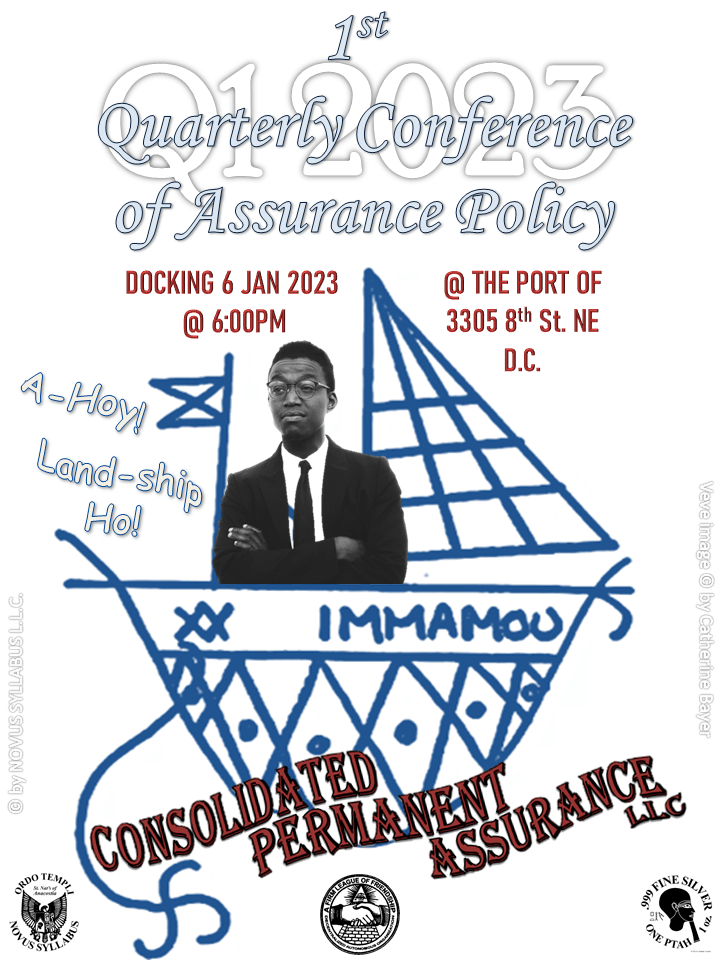
BISMILLAH (IN THE NAME OF GOD)
🇺🇸🇬🇧🇲🇦🇮🇱🏴☠️
⚓️Lord High Admiral Antarah⚓️
TO ALL TO WHOM THESE PRESENTS SAIL
Sends Greeting and Peace and hereby offers to the Free-Thinkers, Truth-Speakers, and Light-Workers United in a firm league of friendship, decentralized autonomous organization, L.S.T.A., under terms and conditions, the Mindsoft©️™️ Flagship Program File (eSyllabus©️™️ vers. no. 22.11.09) to facilitate the General Conference of Assurance Policy.
Program Files:

A Conference of Assurance Policy
“WHAT IS A SURETY SHIP?”
FIRST OFFERED 22 NOVEMBER 2023
📜PRIVATE OFFERING📜
💾Mindsoft©️as a Service™️ (MaaS™️) Premium Servicing Fee of $99.99 per person 💳 payable upon conference for products* and services rendered. Duration of Service: 1-2 hrs.
Upon completion of conference, Assurance Policyholder may be granted C-Series Art¢oin 🪙 (“C-coin”) at market price via 🤝🏿 Handshake of Friendly Association. Contact ombudserver@gmail.com to schedule a conference, or attend the C.P.A. LLC Quarterly Conference of Assurance Policy.
📜POLICY COVERAGE📜
An assurance policyholder, having paid a premium and been conferred with assurance (as evidenced by presentment of C-coin), may bring a claim based on presentment to the CPA LLC at no cost, but there is no guarantee that such claim shall be resolved. Processing fees may apply. Neither the CPA LLC nor its parent nor its agents shall be liable for any claim arising from such a presentment or from such policyholder, as the assurance policy itself is underwritten by God in Christ through the King James Bible, and it is to Him thou shalt appeal for judgment.

(last modified 25 Jul. 2023)
The Flagship Program


presenting our flagship program
A Conference of Assurance Policy
“WHAT IS A SURETY SHIP?”
A Fun, Educational Ritual Drama ©️ by Antarah Crawley
⚓️Ministry of Information⚓️
📜BRIEF IN EQUITY📜
A presentment made without express contract presumes the recipient to be the trustee for a dead person’s estate without surety and not a living Cestui Que. An estate may, however, be entrusted to a “person” (corporation) for the use of a living spirit who may “possess property” in the nature of equitable use title not legal title.
There is sufficient precedent in Roman, Papal, and English law to presume a human body to be chattel property (i.e., a dead person or a mere human creature without soul or spirit) unless otherwise established to posses a soul from God. The cestui que who is presumed dead or lost at sea MUST EXPRESSLY STATE that they are indeed the living cestui que to be given standing as one of the three Chancellors in a Court of Equity and Chancery deciding the matter of an estate (dead person). The common law, as it pertains to the military jurisdiction of the public, cannot abrogate a matter of equity respecting a living free man or woman on the land.
Statue of Mortmain prohibits possession of property by the “dead hand” of a corporation (such as the Church); therefore a “person” (dead in the eyes of God) cannot possess property; rather it reverts to the feudal lord.
The Remedy is that the cestui que (beneficiary) possesses equitable title by nature to the property as a living child of god, but never holds the legal title of the trustee which is the feudal lord or its agent, including any person who is a citizen of the jurisdiction.
There is precedence in Germanic law that a man who holds property on account of to the use of another is bound to fulfill his trust.
Furthermore, precedent is found in the Institutes of Justinian at 2.23.1-2: “… it is required that the one heir is duly appointed and is committed to his trust (Fideicommissum) to transfer the inheritance to another; otherwise the testament in which no heir has been duly appointed is void; the words which are properly and commonly used to install a fideicommisum are I beg, I ask, I wish, I entrust…” This doctrine was brought to England by “foreign ecclesiastics” (ministers and consuls) in order to evade the Statute of Mortmain by making the Church cestui a que use le Feoffment fuit fait.
In sum, cestui que use confers the benefit of use of property to another (a minister or consul) without the legal ownership and attendant duties and obligations to the lord and crown as trustee. Compare to usufruct, or right of use of fruits (interest, profits, etc.) of property.
📜PRIVATE OFFERING📜
💾Mindsoft©️as a Service™️ (MaaS™️) Premium Servicing Fee of $99.99 per person 💳 payable upon conference for products* and services rendered. Duration of Service: 1-2 hrs.
Upon completion of conference, Assurance Policyholder may be granted C-Series Art¢oin 🪙 (“C-coin”) at market price via 🤝🏿 Handshake of Friendly Association. Contact ombudserver@gmail.com to schedule a conference, or attend the C.P.A. LLC Quarterly Conference of Assurance Policy.
*The applicant hereof shall be sent the eSyllabus©️™️ Mindsoft©️™️ program file by email under a limed use licensing agreement to facilitate their conference.
📜POLICY COVERAGE📜
An assurance policyholder, having paid a premium and been conferred with assurance (as evidenced by presentment of C-coin), may bring a claim based on presentment to the CPA LLC at no cost, but there is no guarantee that such claim shall be resolved. Processing fees may apply. Neither the CPA LLC nor its parent nor its agents shall be liable for any claim arising from such a presentment or from such policyholder, as the assurance policy itself is underwritten by God in Christ through the King James Bible, and it is to Him thou shalt appeal for judgment.

U:\>_Folder\Assuretyship
Use under 17 U.S. Code § 107
Educational Research Material for a Course in re “Assuretyship”
Sapientia No. 2

POLICY BUREAU SAPIENTIAL DOCUMENT NO. 002 – JULY 24, 2020
A BILL
To establish the historical continuity of light and liberty among colored people.
Be it adjudged by the Policy Bureau of the People’s Body Politic, That Freimaurerei, or free masonry, is the practice of design-build construction in earth, wood, and stone by a body politic of free and willing laborers. The first stone masons were led by the state vizier (high chancellor), the Overseer of the Work of Ra at Awnu (Heliopolis), Imhotep (He Comes In Peace), at the building of the Mer (pyramid) of Nesutbity (King) Djoser at Saqqarah in 2670-2650 B.C. (3rd Dynasty). These civil servants were employed in the work of the state (per ah).
SEC. 2. The term “mer”, represented by a triangle or pyramid-shaped metu neter, signifies the place of light and love, or, physically, a place where energy coagulates into a “spiritual fire”. It is said that the ancient builders of earth and stone mounds, or “meru”, were themselves called “mer” or “maur”, from whence the national epithet “Ta-meri”, land of love and light.
SEC. 3. It is known that the people of this black fertile land (Kemet), which is upon the Flesh of the Ka of Ra (Afu Ra Ka), came up from Napata (Nubia) which is in the place of the origin of Hapi (the Nile River). On the annual inundation of Hapi, the river fertilizes the soil of the black land to bring forth an abundant harvest, a tenth of which is offered to the Netjeru (Nature) in thanksgiving of the harvest cycle. The people came up from the “South”, which is the North insofar as the origin of the waters of creation, from whence issued the Netjeru, from whence issued humanity, on the Unification of the 36 nomes of the North and South at the First Dynasty under Nesutbity Menes (Narmer) circa 3150 B.C..
SEC. 4. Upon the destruction of Ta-meri, also known as Kemet, in 330 B.C., whence Alexander, Aristotle, and the Macedonian-Greek Imperium began the rape and pillage of the land and culture which would be “Egypt”, the nobility of Nubian-descendant natives migrated to the West of Africa, then sailed aloft to the Far West, also known as Al’Maghreb Al’Aqsa, to Al’Morocco (or Al’Mecca, or Olmexica) or Al’Merika, meaning “the land of the Ka of Meri” — America.
SEC. 5. It is known that between Nubia and America the Noble Meri, or Mauri, settled and peopled Ethiopia, Canaan (Palestine and Phoenicia), India, Australia, Eurasia; Tartary, Mongolia, Manchuria, Brittany Ireland Scotland Normandy Germany and Iberia. The Mauri begot people throughout these lands.
SEC. 6. There were, also, pale-skinned cave people who had lived in these lands according to strange custom, and, due to their isolation from the climate of “love”, regressed genetically from the dominant humanity. Thus when the dominant Meri contacted them again, they were wont for Maurish learning. Therefore, again, out of “love”, the Mari learned the northern pupils in institutions which came to be known as schools and lodges.
SEC. 7. The schools graduated nobler pale-skin people, who became a nobility unto themselves, and assumed a divine right of kingship like unto the ancient Pharaonic model propounded by the Mauri. Of the noble Mauri there was a class of very stable and established masters known as Djedi, from which root, “djed”, cometh the sign of the column. Yet others were a high priestly class called the Djyahudists, or Priests of Djahudi, from which cometh the appellation of that nation who all bare witness to the Lord, Yahudi. The students of these teachers, naturally, assumed their names.
SEC. 8. It is said that, since the beginning of these pale-skinned people, they were predisposed to war against the dominant humanity by their disposition of father Yaqob, or Jacob, also known as James, a brother of original humanity, who went astray for wont of power sometime before the Unification of the North and South. Yaqob progenated a league of nations and sent these children to the north where they incubated their bickering isolationist tendencies and recessive genetics for millennia, until they were sufficiently pathological enough to begin their assault on humanity in the first Intermediary Period of Kemet, thus beginning the World War which has not waned to this day.
SEC. 9. The warring and isolationist disposition of these pale northerners caused them to, over time, exploit the knowledge passed to them by the Mauri in order to — again — conquer the Mauri and rape their land, bodies, and culture, as was and is the trend of patriarchal hunter-gathering-herding societies of the European type. (Such a philosophy is summarized in the Judaic impetus for “dominion.” This is in contrast to the Moro-Kemetic philosophy of the union of opposing forces, or “smai-tawi.”) The wisdom got from the sack of the Greek and, later, Roman colonization of Kemet was largely lost at the fall of that Empire when the Arab/Ottomans predominated over the Holy Land, thus entering Europe into the “Dark Ages” until traveling Mauri make intellectual contact with them. These pale-skins then emerge from these “Dark Ages” with a newfound knowledge and sense of superiority.
SEC. 10. Ferdinand and Isabela claim to successfully expel the Mauri from Europe in 1492, thus symbolically beginning the great offense against the Maurish lands, peoples, and cultures from the East (Asia and Africa) to the West (the Americas). This sustained offense is called the Maafa. The Maafa was carried out by and through the kidnapping, bonding, and trade of Mauri and the exploitation of their natural resources in both Africa and the Americas (because these are the two major continents to which Mauri are the native and autochthonous populations).
SEC. 11. In the course of this war waged by Yaqob and his pale skinned minions, it was imperative to dispossessed the Mauri of their nobility in order to reduce them to chattel material for trade. This was done by the invention of the Aryan Model of Hellenophily by Karl Otfried Muller at the University of Gottingen in Germany in the 1820s. In contrast to the Ancient Model, which logically asserted that the Greek culture arose as a result of colonization (c. 1500 B.C.) by Egyptians and Phoenicians who had civilized the native inhabitants, the Aryan Model proposed, with baseless audacity, that there was not any continuity between “Egypt” and “Greece”.
SEC. 12. This basic assertion severs the lineage all colored people claim to the development of Greek philosophy and thought, which itself forms the sole foundation of Western European academic supremacy. Without the outpouring of essentially Ancient African thought into the Cradel of Western Civilization, the pale people can assert that all the colored people of the world new ignorant as monkeys and apt to be slaved.
SEC. 13. Whereas the Germans, in all their sophistication, (in addition to stealing and recapitulating ancient smai-tawian philosophy into Greek, Kantian, Hegelian and Marxist Dialectic) were the scholastic ruffians to deal the deathblow to King Kham-ur Ausar, Hiram Abiff, it is in the German language that we may perceive the linkage between the people whom the sun loved (Mauri, copper-colored people) and the ancient mound-builders of the world: a free people … a working people … a self-made people: A Maurerischen People.
SEC. 14. It behooves all colored people to study the philosophy which has served as the foundation of such essentially scholastic and ethical societies as the Freemasons, Oddfellows, and Rosicruicians, keeping in mind the perversity of their legion, because it was our Maurerische ancestors who first propounded it.
SEC. 15. In conclusion, true liberty is the freedom to roam and feely engage one’s body in labor in exchange for gainful wages. Let all those having competence and ability to do work come in and go out of the state house (per ah) in performance thereof according to all of the forms of their desire; for Love is the Law, Love under Will, to do Ma’at on Earth, as it is in Heaven. Amen.
Sapientia No. 1
POLICY BUREAU SAPIENTIAL DOCUMENT No. 001. JULY 19, 2020.
A BILL
To establish a moral and ethical philosophy.
Be it adjudged by the Policy Bureau of the People’s Body Politic, How good and how pleasant it is for friends to dwell together in union, when each extends a hand, embracing love and light, and speak truly of things on earth and in the hereafter; to visit the sick, relieve the distressed, bury the dead, and teach the youth. How odd it is in a world of wrong to do what is right. Therefore, the self-made man is said to be his own past master.
SEC. 2. Regarding the Constitution of the Self, these are the elements constituting the self, and their meanings:
- Soma: body; physic;
- Nous: reason; logos, intellect; conscious mind;
- Psyche: soul; heart; unconscious (ie the parts of the self of which the self is not conscious).
SEC. 3. The means, or method, by which the self applies abstract knowledge to practice is as follows:
Dialectic: (a) the process of making known what is unknown; (b) a philosophical method describing the discursive-rational-intuitive process by which oneself individualizes itself, which is to say, becomes aware of, or able to recognize, itself as an entity of and apart from its environs (mere animals being integrally a part of their environs without the self-awareness to chose otherwise). [See, SEC. 6]
SEC. 4. It is said, Great is Justice (Wr Maat); that is to say, of paramount importance is the concept of order, universal balance (harmony), cosmic regulation (of force-in-opposition), justice (justness), truth (materiality), truth-in-justice (equity), rectitude and moral uprightness (righteousness and good standing). Ma’at brings peace (hetep) and condemns crime (djayit) and evil (djut), for whosoever breaks the law (hepu) is punished (khsf). Surely that law is that which is articulated in truth (maa kheru). This is to say, the concept of Ma’at applies on:
- The universal level, in which it expresses the harmony of the elements and bodies as clearly established, each in its right place as an ordered whole;
- The political level, in which it expresses the pursuit of justice, equity, truth, and rightness in the dispensation of the law; and
- The individual level, in which it expresses the rules for living in concert with moral principles of balance, harmony, and the golden rule, for the most accomplished, useful and appropriate human actions are circumscribed in the cosmological order.
SEC. 5. Regarding the Rules of Ma’at which apply to the individual, There are Seven Ethical Virtues, marks of Noble character, rich in Value as fine Jewels. The first three are ecclesiastical (See, 1 Corinthians 13:13) and the last four are cardinal (See, Niomachean Ethic of Aristotle and Republic of Plato Book IV, 426–435, etc.). They are:
- Friendship, and Charity: to dwell together in union and extend a helping hand to those in need. Sign: hand in hand.
- Love, and Hope: to treat others as oneself; to maintain hope in humanity. Sign: heart in hand.
- Truth, and Faith: that which accords to reality; faith means to vouchsafe your trust in the process of divine nature. Sign: hand over eyes.
- Temperance, or continentia: to exercise restraint; self control, self mastery; soundness of mind. Sign: hotep (peace offering) [Ii em Htp, Who Comes In Peace]; and
- Fortitude, or fortitudo: to exercise courage and strength. Sign: djed (stabilizing column) [Djedi, Who Is Established].
- Prudence, or prudentia: to exercise discernment; wisdom; Sophia; sapientia. Sign: wudjat (eye of providence) [Useer, Who Seeth Clearly]; and
- Justice, or iustitia: to exercise equity and righteousness; or that which concords with the law. Sign: ma’at (ostrich plume) [Maa’khru, Who Speaketh Truth].
SEC. 6. Regarding the Ethical Virtues of Maat, and their application in practice, the “dianoetic virtue” of critical thought entails development and progress as a result of some kind of learning process. This is to say, virtue can be taught as a subject of instruction. A teacher may focus the students attention by using proverbs and maxims. This moral system constitutes a scholarly discipline. It is a pedagogy of teaching, complete with a methodology for learning, that is, for processing information.
dianoetic (ˌdaɪənəʊˈɛtɪk)
adj
- (Philosophy) of or relating to thought, esp to discursive reasoning rather than intuition.
- relating to the operation of the mind through logical rather than intuitive thought processes; intellectual activity.
- proceeding to a conclusion by reason or argument rather than intuition; (synonym) discursive.
- (Philosophy) the rational investigation of questions about existence and knowledge and ethics.
- (logical) capable of or reflecting the capability for correct and valid reasoning; “a logical mind”.
[from Greek dianoētikos, from dianoia the thinking process, an opinion, from dia- + noein to think]
SEC. 7. A method (tep-heseb) is an abstract model of the correct procedure to be performed with regard to any matter in question, which is to say, the best example for demonstrating a logical process, or any other intellectual procedure, with exactitude. The method takes into account the best, correct procedure. Method involves the right way. It is said that thoughtful speech teaches the ignorant about knowledge, science, and the method of eloquence (tches seba khem er rehk tep-heseb en medet neferet). A synonym is algorithm; or knowledge in practice. Furthermore it is said, stick to the facts; do not exaggerate. In the last analysis, what prevails is Ma’at. Only the will of almighty God, ruler of the universe, comes to pass. The wishes of human beings do not always come true. Therefore man proposes, and God disposes. The disposition of any matter of nature is with God; but it is wise to control oneself by moderating ones heart.
SEC. 8. The body of god (netjer), whose members are all gods (netjeru), is like the body of the king (nesubity), whose members are an assembly of the bodies assembled therein. Now when the King — life prosperity and health (ankh wudja seneb) be upon him — assembles towns into districts and districts into nomes and nomes of the south with those of the north into one federation, its is like the great god who created himself out of the one who preceded him (Nun), and fashioned for himself his own members. The self-created god (kheper djesef) dwells in and over the divine nature (pautiu netjeru), as the sovereign king dwells in and over the state (per ah), his many members governing his many domains. It is said, the prime minister (tchaty, djedi) in the pharaonic (per ah) administrative establishment summons his children in order to teach them virtue. This love facilitates the dissemination of moral and spiritual instruction, whose mission is to do Ma’at on earth as it is in heaven.
SEC. 9. Let them go in and come out of the Land of the Blessed Dead (Duat) and join the Venerable Deified Ancestors (Aakhu) who ensure that the living practice Ma’at; and let the king come forth from the East and go into the Hall of the 42 Ma’at Deities which is presided over by Osiris (Wasir), Lord of the Two Ma’at Qualities, and let him be vindicated true of voice (maa kheru) by that Tribunal on the Day of his Judgment, to be found pure and at one with Osiris; he will Come In Peace (ii em hetep) and he will join that God at the Head of the Company of the Beloved Ancestors in the Blessed and Beautiful West (Amenti).
(9 modification(s))
Blake Butler
Passages from Blake Butler’s recently released monument, 300,000,000.
In our year here god is not a being but a system, composed in dehydrated fugue
In the full darkness, there is a word
The word encompasses the darkness
This word occurs because of god
I crawled and crawled along the floor of the ground of the extending darkness
Out of the color of the night, there appeared buildings in the distance, houses, tombs
There were networks of understanding and direction
Wires draped the air like no one’s trees
The world was silent when I woke in smoke
No longer unwinding into nothing as its layers grew apart.
I see the sea replicating in its nothing, pushing sand against the sand
I cannot reach the sea
The days went on and on inside me.
I knew my name was or had been but could not say it and it no longer felt like language
The name is not important
Your name’s not really your name
There are people, and there are minds, and in the minds there are corridors and glue and other people
There are unique locations on the earth, accessible only through certain openings available only for short periods of time while they are available and can be opened into other locations
This is the system of the world
The temporary doors to the unique locations are carried in our bodies, in thoughts
They are carried in moments and forms and quickly disappearing spaces I am speaking to you from one of those locations.
There is a force who moves among our bodies, coming through your holes into the world and slowly knitting
It will be the ending of us all, in a form beyond simply a body
This is not a bad thing
You are surrounded by mirrors
You make the world out of your mind
You are not dead and you will never be and you are dead and you are not alive and you’re alive and you will never be
 Supreme Exchange