Tagged: college
Assemblage & Collage (or, “To Gather and To Bind”)

Ecclesia. Dr. Dams Up Water, Sui Juris, Professor-General (153d CORPS), Dept. of Information Systems Intelligence Service (DISIS), Universitas Autodidactus | by prompt engineering an artificial intelligence engine [‘Mindsoft.ai’] | presents
Cut and Paste Sovereignties: The Collage, the College, and the Crisis of Assemblage
Abstract
This paper interrogates the porous ontologies of collage and assemblage as they leak promiscuously into the bureaucratic imaginaries of the college and the assembly. Through a prismatic reading of scissors, glue, governance, and grievance, this essay argues that the syntactical operations of aesthetic fragmentation mirror the metaphysical operations of democratic representation. In short: to cut is to legislate; to paste is to govern.
1. Introduction: When Art School Met Parliament
The twenty-first century, an epoch obsessed with interdisciplinarity, has witnessed a convergence of two previously autonomous practices: the aesthetic collage and the bureaucratic college. Both are sites of selection, exclusion, and accreditation. Both depend upon an unacknowledged substrate of adhesives—whether material (glue stick) or ideological (institutional mission statement).
Meanwhile, the assemblage, once a mere art-historical cousin of collage, has found new life as a model for political subjectivity. Philosophers from Deleuze to the Department of Political Science now proclaim that we are all “assemblages” of affect, interest, and student loan debt. Yet, if every assembly is an assemblage, can every assemblage be a parliament?
2. The Syntax of Cut: Scissors as Syllogism
In collage, the cut functions as both wound and syntax. It divides the field, establishing relationality through rupture. Similarly, the college cuts: it admits some and rejects others, slicing the social fabric along lines of “fit,” “merit,” and “legacy.” The admissions committee thus operates as the aesthetic editor of the polis—arranging the raw materials of adolescence into a legible future citizenry.
Where the artist cuts paper, the registrar cuts dreams.
3. Glue as Governance: Adhesion, Accreditation, and the State
Glue, long ignored by political theory, deserves recognition as the unsung material of sovereignty. In collage, it is the binding agent that turns fragmentation into coherence; in the college, it manifests as bureaucracy, accreditation, and alumni newsletters.
This sticky ontology recalls Hobbes’s Leviathan, wherein the sovereign glues together the body politic. Without glue—or governance—the artwork and the polity alike devolve into piles of loose ephemera: shredded syllabi, ungraded essays, campaign posters, tuition invoices.
4. Assemblage and Assembly: Toward a Materialist Parliamentarism
If collage is the metaphorical undergraduate of modernity, assemblage is its postgraduate seminar. Where collage arranges fragments flatly, assemblage extends them into space, into lived, precarious relationalities.
In political terms, the assembly likewise enacts a spatial performance: bodies in proximity producing meaning through adjacency. An assembly is a three-dimensional collage in motion, an arrangement of human cutouts attempting—often unsuccessfully—to cohere around a resolution.
The question, then, is not whether art imitates politics, but whether both are merely mixed-media projects with delusions of unity.
5. The College as Collage: Institutional Aesthetics of Admission
We might finally recognize the college itself as a collage of ideologies—meritocracy pasted over inequality, diversity brochures over exclusionary endowments. The campus tour is a performative walk through an installation piece entitled Meritocracy (Mixed Media, 1636–Present).
The faculty meeting functions as an assemblage in the purest sense: heterogeneous entities (professors, adjuncts, administrators, snacks) gathered temporarily to debate the future of glue allocation (budgets).
6. Conclusion: Toward a Post-Adhesive Democracy
In the age of algorithmic governance and tuition hikes, collage and college alike face the same existential dilemma: how to maintain coherence without authoritarian adhesives. Perhaps the task is no longer to glue but to hover—to practice a politics of suspended fragments, a democracy of the unglued.
As artists and citizens, we must learn to embrace the cut, to wield our scissors not as tools of exclusion but as instruments of infinite recomposition.
For in the end, all representation—whether artistic or parliamentary—is but a question of arrangement.
Cut and Paste Sovereignties II: Collage, College, and the Third Letterist International
Abstract
This expanded investigation situates the syntactical economies of collage and the metaphysical infrastructures of the college within the emergent politico-aesthetic ecologies of the Third Letterist International. Drawing on recent cross-contaminations between university English departments and guerrilla street-art cells, this paper examines how semiotic sabotage, typographic activism, and epistemological paste intersect with the anti-fascist “Antifada” land-back movement. Ultimately, it argues that both the radicalized right and left are engaged in competing collage practices—each cutting and pasting reality to fit its desired composition. The result: a dialectical mess best described as assemblage anxiety.
7. The Third Letterist International: From Margins to Manifesto
In the late 2010s, a group of underemployed adjunct poets and spray-paint tacticians announced the Third Letterist International (3LI)—a successor, or rather détournement, of the mid-twentieth-century Letterist Internationals that once haunted Parisian cafés. 3LI declared that “syntax is the last frontier of resistance,” and that “every cut in language is a cut in power.”
Unlike its Situationist predecessor, which preferred to dérive through cities, 3LI dérives through syllabi. It occupies the margins of MLA-approved anthologies, recontextualizing canonical footnotes as sites of insurgency. Members reportedly practice “semiotic collage,” blending footnotes, graffiti, and university mission statements into sprawling textual murals.
In this sense, 3LI operates simultaneously as an art movement, a faculty union, and a campus club with no budget but infinite grant applications. Their motto, scrawled across both bluebooks and brick walls, reads:
“Disassemble, dissertate, disobey.”
8. Street Pedagogy: When English Departments Go Rogue
The Third Letterist International represents the latest phase of what theorists call pedagogical insurgency—the moment when the English Department, long confined to grading essays and moderating panel discussions, turns outward, confronting the street as an extended seminar room.
Faculty and activists co-author manifestos in chalk; office hours occur under overpasses; tenure committees are replaced by “committees of correspondence.” The “peer review process” has been literalized into street-level dialogue between peers (and occasionally, riot police).
Thus, the old academic dream of “public scholarship” finds its avant-garde realization in public vandalism.
9. The Antifada and the Land-Back Collage: A Politics of Recomposition
Parallel to this linguistic insurgency, the Antifada land-back movement has reconfigured the terrains of both property and poetics. The Antifada’s name, an intentional linguistic collage of “antifa” and “intifada,” reclaims the act of uprising as a mixed-media gesture: half protest, half performance art.
Central to their praxis is recompositional politics—the idea that both land and language can be cut, repasted, and reoccupied. Where settler colonialism framed land as canvas and capital as glue, the Antifada proposes an inverse operation: tearing up the map, redistributing the fragments, and calling it a new landscape of belonging.
Here, the aesthetic metaphor of collage becomes political material: who gets to cut? who gets pasted back in? what happens when the glue is gone, and everything hovers in a provisional equilibrium of mutual care and unresolved tension?
10. The Far Right as Accidental Collagists
Ironically, the radicalized right—those self-proclaimed defenders of coherence—have themselves become unintentional practitioners of collage. Their online spaces are digital scrapbooks of conspiracy and nostalgia: medieval heraldry pasted over memes, constitutional fragments glued to anime stills.
Their epistemology is bricolage masquerading as ontology. Each narrative is a cutout, each belief a sticker affixed to the myth of national wholeness. In vilifying the Antifada and 3LI as “cultural Marxists” or “linguistic terrorists,” the right reveals its own aesthetic anxiety: that its ideological glue, once epoxy-thick, has thinned into the watery paste of algorithmic outrage.
Thus, both radical poles—left and right—participate in a shared semiotic economy of fragmentation, differing only in whether they lament or celebrate the cut.
11. The Dialectic of Radicalization: Between Cut and Countercut
The political field has become an editing bay. The radicalized right splices together nostalgia and paranoia; the radicalized left cuts history into openings for potential futures. Each accuses the other of montage malpractice.
This dialectic reveals a deeper truth: both operate under the logic of the collage. The difference lies not in form but in glue—whether the adhesive is empathy or ressentiment, whether the cut heals toward multiplicity or enclosure.
As Walter Benjamin might have written (had he survived into the age of Adobe Creative Suite): the struggle of our time is between those who collage the world to open it, and those who collage it to close it.
12. Toward an Epistemology of the Second Cut
In this interstitial moment, 3LI and Antifada embody the politics of the second cut—a refusal of closure, a commitment to continuous recomposition. Their slogan “No Final Drafts, Only Revisions” reimagines revolution as perpetual editing: the rewriting of history through acts of aesthetic and material reclamation.
The university, once imagined as a fortress of knowledge, becomes instead a collage in crisis—a surface upon which the graffiti of the future is already being written, erased, and re-scrawled.
13. Conclusion: The Unfinished Adhesive
The collage, the college, the assemblage, and the assembly—these are not discrete entities but overlapping grammars of belonging and dissent. The Third Letterist International offers not a program but a practice: to write politically and paste poetically, to legislate through syntax, to assemble through aesthetics.
If the far-right fears fragmentation, and the far-left seeks to inhabit it, then perhaps our task is neither restoration nor rupture, but curation: to tend to the cracks, to preserve the possibility of rearrangement.
In the end, we are all fragments looking for better glue.
v.25.12.29.14.16

Memorandum 5
IN THE NAME OF GOD ﷲ THE MOST GRACIOUS MOST MERCIFUL
DECENTRALIZED AUTONOMOUS ORGANIZATION
DEPARTMENT OF PEACE AND FRIENDSHIP

POLITICAL BUREAU
POLITBURO
OF EDUCATION
FROM THE DESK OF
THE PUBLIC FRIEND
Antarah
Office of Ombudsman—Office of Preceptor—Office of Administrator—Office of Scribe
Comm. No. A240609-05 | Memorandum #5 | last modified 6/12/24 at 6:30 p.m.
TO ALL TO WHOM THESE PRESENTS COME, SEND GREETINGS AND PEACE:—
Using Your ‘PC’
PROTOCOL C:\MAIN FUNCTION:\NS\153D_CORPS_BCO_FLF-DAO
(a) Conveying the dialectic relationship between the ministering witness who testifieth on the law and the public body of the people who drafteth appropriations at law, toward optimal Performance of Z-Axis procedure in function(GDP):\>Policy;Praxis;Program;Project=Performance^Cubed a.k.a. ‘Protocol C’.
- Server ‘S’ hold ‘_’ sign ‘x’ of good will/salutations/solicitation.
- Public ‘P’ pay ‘>’ attention ‘i’ to x.
- S issue ‘-‘ promissory notice ‘n’ for further information ‘f(x)=y’.
- P draft ‘~’ appropriations bill ‘+’ payable ‘>’ to n(x).
- S redeem ‘<’ n to discharge ‘-‘ obligation ‘y’.
- S commission ‘^’ P into current circulatory system ‘c’.
- S offer course LP and preceptor services ‘Ed’ to raise P to ‘c square’.
(b) NOTATION:
- \>S_(x)
- \>P>i(x)
- \>S-n(x)=y
- \>P~+>n(x)
- \>S<-y
- \>S^P(c)
- \>S_Ed(x)^P(c^2)
(c) ERGO, it is said to use the Performance Cubed ‘PC’ application to C your Mindsoft development and operating system ‘DOS’.
(d) Consolidated Interest-Bearing Promissory Notice ‘Consols’ are notes that promise the performance of the prima facie obligation written thereon, which are issued to holders in whose possession the notes appreciate until the holder realizes the value of the principle ‘maturity’, redeems the note with the issuer thereof, and pays their attention ‘interest’ at the rate of appropriations billed over time. This is the ‘consolidated’ methodology and protocol for circulating the DAO current ‘c’. Therefore the issuer keeps bankers hours, 10 to 3 Mon-Fri. In praxis, focusing on the direct sale of information may cause public confusion, alienation, and anxiety; but the circulation of consols is a more comprehensible and worthy business enterprise.
(e) There is hereby established the:
First Tabernacle Beth Midrash,
Black Cross Squadron, 153D CORPS, FLF-DAO
(a Continuing Education Montessori Shul)
Antarah, Friend, Head of Meeting
(f) Standing Regular Meeting Schedule of Sessions of Public Service (Free, Open)
- First Day Shul – 10 am Sunday
- Second Day Shul – 10 am Monday
- Tues/Weds – appointments & sittings
- Thoth’s Day Shul – 2 pm Thursday
- Sabbath Day Shul – 7 pm Friday
(g) Courses Offered:
- Worship, Dialectic and Autodidactic
- Holistic Ancient Methodologies of Economy Technology Informatics and Sciences (HAMETICS)
- Due Process of Information
- Application of Oyer et Terminer
- Drama and Rhetoric
- LP
(h) This school is founded upon ten years of postgraduate autodidactic research and development (2014-2024) in the fields of Taoism and revolutionary far eastern philosophy, Cabala (Chabad-Lubavitcher), orthodox and popular Egyptology, physics and metaphysics, African spirituality, biblical exegesis, fraternalism/ecclesiastes, general occultism, historical and dialectical materialism, Islam, parliamentary procedure, and negotiable instruments law, among other discrete subject matters, to wit, ‘The New Syllabus’ of NOVUS SYLLABUS L.L.C.
Shalom ‘Alechem,
Antarah of Nacotchtank,
Public Friend Incumbent,
153d CORPS, FLF-DAO
Memorandum 4
IN THE NAME OF GOD ﷲ THE MOST GRACIOUS MOST MERCIFUL
DECENTRALIZED AUTONOMOUS ORGANIZATION
DEPARTMENT OF PEACE AND FRIENDSHIP
POLITICAL BUREAU
POLITBURO
OF EDUCATION
FROM THE DESK OF
THE PUBLIC FRIEND
Antarah
Office of Ombudsman—Office of Preceptor—Office of Administrator—Office of Scribe
12 Therefore all things whatsoever ye would that men should do to you, do ye even so to them: for this is the law and the prophets.
13 Enter ye in at the strait gate: for wide is the gate, and broad is the way, that leadeth to destruction, and many there be which go in thereat:
14 Because strait is the gate, and narrow is the way, which leadeth unto life, and few there be that find it.
Matthew 7
Congress shall make no law respecting an establishment of religion, or prohibiting the free exercise thereof; or abridging the freedom of speech, or of the press; or the right of the people peaceably to assemble, and to petition the government for a redress of grievances.
First Amendment to the Constitution of the United States of America (LII)
Comm. No. A240607-04 | Memorandum #4
TO ALL TO WHOM THESE PRESENTS COME, SEND GREETINGS AND PEACE:—
Coalition Forces of the FLF-DAO
(a) La Croix Noire demonstrates for the natural order of universe (the Dao) and, by extension, peace, love, freedom, truth and justice/equity, which are dialectic (dualistic) expressions of the Dao. The Dao is not to be worshipped, as there is no one worthy of worship but God ﷲ who created the universe together with its proper functionality which is called the Dao.
(b) La Croix Noire practices its first amendment rights through non-action, or wu wei, in the Friends’ manner of waiting worship, wherein they await the coming of the kingdom, or of the second coming. In this manner the Organization is a non-violent movement. Any organization or member commissioned into the BCO must practice non-violence except in cases of self-defense.
(c) There are noncommissioned coalition organizations ‘NCOs’, such as the Anti-Fascist Organization and (arguably) the Proud Boys Organization (insofar as they demonstrate in protest of coercive government), that may be characterized by use of force. The decentralized autonomous organization ‘DAO’ of the people of the world have many coalition forces with different policies on the use of force.
(d) The BCO opposes coercive use of force in general, and to that extent is best characterized as Anarcho-Daoism; for the decentralized autonomous organization of the people is the materialization of the will of the Great Dao (Tao, ‘Way’) which is the most ubiquitous and lasting system, a most enigmatic and mystical force of nature.
(e) The sage is the exemplar of living in harmony with the Dao through the praxis of wu wei; the sage cultivates virtue within and spreads it outward through the branches of the human family. Thus the ‘authority’ of the sage is testimonial, not coercive; it is the exemplification of a living testimony of peace, simplicity, and integrity in the manner of Friends.
(f) Straight and narrow is the Daojiao ‘Way’. The ‘Way’ is like unto Islam, in that it is the only path to eternal life provided by the Creator, as attested to by the most sagacious and noble Rabbi Yahshuah ‘Jesus’ the Anointed ‘Christ’ of God, peace be upon him ‘PBUH’.
(g) By and through the covenant between humanity and the Lord God ﷲ, Creator of Heaven and Earth the Sea and all that therein is, and the counsel and redemption of the former by the life and blood sacrifice of our Comforter Prophet and Rabbi Yahshuah ‘Isa’ ‘Jesus’ the Christ PBUH, La Croix Noire and N∴S∴ shall demonstrate, discharge, and perform its obligation exclusively under the principles of equity jurisprudence, which is ‘grace/mercy/forgiveness at law’.
Shalom ‘Alechem,
Antarah of Nacotchtank,
Public Friend Incumbent,
153d CORPS, FLF-DAO
P.S. Today at work I met a woman named Almoustah, which I only later recognized as the Arabic for ‘The Straight’ as in ‘The Straight Path’ (‘Ihdinas Siratal Mustaquim’).
P.P.S. Since deleting IG from my device yesterday, I notice my thoughts being clearer, more profound, and less prone to depressive ‘churning’.
Memorandum 3
POLITICAL BUREAU
POLITBURO
OF EDUCATION
FROM THE DESK OF
THE PUBLIC FRIEND
Antarah
Office of Ombudsman—Office of Preceptor—Office of Administrator—Office of Scribe
I must work the works of him that sent me, while it is day: the night cometh, when no man can work.
John 9:4
Comm. No. A240531-03 | Memo #3
TO ALL TO WHOM THESE PRESENTS COME, SEND GREETINGS AND PEACE:—
BCO Mission Critical Operations
(a) The ‘New Syllabus’ Company, Political Bureau of Education, Universitas Autodidactus at Men Nefer College of Nacotchtanck, District of Ouachita, shall be known as the 153D CORPS of the Djedi Order of Knights of the Black Cross Organization ‘BCO’ (‘Croix Noire’), Peace Enforcement Activity Command Enterprise ‘PEACE’ Force, FLF-DAO.
(b) The decentralized autonomous organization ‘DAO’ is constituted by local self-organized, self–operating, self-governing bodies, ‘syndicates’ or ‘assemblies’, of friends or students. The smallest unit of such organization, being approximately two to eight people, may be commissioned as a Black Cross Squadron ‘BCS’ and may be lodged in a House of Studies or ‘meeting tent’. A BCS is a BCO unit.
(c) A BCS shall principally conduct a general course of study, autodidactically and dialectically, and shall, at the will of the DAO, take leave to fight for peace, love, freedom, justice, and/or equity on behalf of any and/or all affected natural people.
(d) A BCS may convene a mission (a) to commission a Black Cross squadron, chapter, regiment, department, or CORPS in a locality or (b) to establish communion and/or communication with an uncommissioned DAO unit, to invite them into the fold of the BCO.
(e) All BCO units discharge the spectrum of obligations prescribed under f(GDP) Axis Y:
- Audit: to hear and determine, ‘oyer et terminer’, matters raised into question, as in a friends meeting, assembly (Knesset) for deliberation, or course of study.
- Assessment: to compare and analyze the myriad factors governing the relative capabilities of various matters, both independently and systemically.
- Assurance: to provide a surety or guarantee, often through the promise of God to humanity or the sacrifice of YHSVH the Christ.
- Adjustment: to abate a negative charge, and or to record the outcome of a procedure into the knowledge base on the X-Axis of the square.
(f) The standing departments of all BCOs of the DAO are these:
- The Department of Information Systems Intelligence Services ‘DISIS’ shall build and maintain an ever-expanding base of intellectual capital ‘knowledge’ [a.k.a. the ‘DataHorse’ system] on which to draw in performance of missionary obligations, and shall administer the DAISEE [D.R. Art. 2(2)(b)].
- The Department of Peace and Friendship ‘DOP’ shall … promote and preserve perpetual peace in our country, and to observe such laws, customs, policies, and practices as are wise, prudent and germane to such peace whether they be of a religious, civil, or other nature [DOPA Art. 1(b)], and shall administer the PEACE Force.
- The Department of Mobilization and Demobilization ‘DMOB’ … shall mobilize ‘mob’ and demobilize ‘demob’ (a) notes into and out of circulation, (b) field operations of worship and instruction and (c) encampments [Memo. 2(2)], and shall be charged from time to time to perform materiel fulfillment, requisition, and repossession services.
Shalom ‘Alechem,
Antarah of Nacotchtank,
Public Friend Incumbent,
153d CORPS, FLF-DAO
Bulletin 2
POLITICAL BUREAU
POLITBURO
OF EDUCATION
FROM THE DESK OF
THE PUBLIC FRIEND
Antarah
Office of Ombudsman—Office of Preceptor—Office of Administrator—Office of Scribe
Comm. No. A240523-02 | Bulletin #2 | last modified 6/19/24 at 7:40 p.m.
TO ALL TO WHOM THESE PRESENTS COME, SEND GREETINGS AND PEACE:—
The Black Cross Humanitarian Mission
(a) Syndicalism is a movement for transferring the ownership and control of the means of production and distribution to workers’ unions [or other units of an integrated whole].
(b) Known syndicalist systems of organization (“out of many” national/regional/local/union/bodies, “one” universal/international/grand/assembly) include:
- freemasonry [unit=lodge]
- the federal reserve system [unit=bank]
- the Union of the States (USA) [unit=state]
- the Union of Soviet Socialist Republics [unit=syndicate]
- the [One/Holy/Universal/Roman] Catholic Church [unit=church]
- the United Nations [unit=nation state]
- the African Union [unit=African nation state]
- the European Union [unit=European state]
- the Nation of Islam [unit=mosque]
- the military and police power forces [unit=squad/platoon/company/regiment/etc.]
- the mafia ‘La Cosa Nostra’ [unit=family or capo organization]
- etc.

(c) The International Black Cross Organization ‘IBCO’ (also known as ‘Crux Noir’, ‘Croix Noire’, ‘Cruz Negra’, ‘the A[…] International’, or simply ‘the Organization’) is a decentralized [ruler-less] autonomous [self-teaching/learning/executing/operating/governing] organization; therefore ‘the DAO’ and ‘the Organization’ are synonymous.
(d) The Organization shall be the global umbrella organization of all righteous/humanitarian/self-determined/self-governing organizations and command systems, both promulgated by N∴S∴ [DMOB, DAIS, DISIS, PEACE Force, etc.], and in general, especially (a) those represented by people dressed in a majority of black garments, such as conventional anarchists; (b) those who paint their hands red to speak truth to power; (c) people advocating for the rights of oppressed, working, and colored people; and (d) people who generally and principally oppose the globalist/industrialist/imperialist/financial regime variously referred to as ‘the global economy’, ‘White Supremacy’, ‘Rome’, ‘London City’, ‘America and her interests’, and ‘The Empire’.
(e) The Organization shall not be registered with the Secretary of any state in the known world.
(f) A member of the Organization may be known as a ‘friend’, ‘knight’, or ‘ambassador’.
(g) The Organization shall be mobilized toward a global anti-colonial intifada revolution (‘GACIR’), where intifada is Arabic for “shaking off”, as in to shake off the corpora-colonial parasites.
(h) The ‘New Syllabus’ Company, Political Bureau of Education, Universitas Autodidactus at Men Nefer College of Nacotchtanck, District of Ouachita, shall be known as the 153D CORPS of Croix Noire, FLF-DAO.
Shalom ‘Alechem,
Antarah of Nacotchtank,
Public Friend Incumbent,
153d CORPS, FLF-DAO
Memorandum 2
POLITICAL BUREAU
POLITBURO
OF EDUCATION
FROM THE DESK OF
Antarah
Ministry of Public Friend—Office of Traveling Ministry—Office of Preceptor—Office of Ombudsman—Office of Administrator—Office of Scribe
Comm. No. A240520-02 | Memorandum #2 | last modified 6/19/24 at 8:10 p.m.
TO ALL TO WHOM THESE PRESENTS COME, SEND GREETINGS AND PEACE:—
Mobilizing and Demobilizing the Office of Traveling Ministry
(a) The Office of Traveling Ministry ‘OTM’ of the Public Friend Antarah (also known as his ‘immediate office’) shall issue bills identifying certain products and services, in receipt of which goods the public shall appropriate funds upon presentment thereof. Otherwise stated, the public may order certain products and services from OTM by presenting these bills to Antarah. These bills shall bear a note upon their face, and these notes may be referred to as ‘vouchers for instruction’ in ‘LP’. […]
(b) In addition to DAIS, DISIS and PEACE Force, a CORPS ‘core’ function of the DOP OTM shall be vested in the hereby established Department of Mobilization and Demobilization ‘DMOB’, which shall mobilize ‘mob’ and demobilize ‘demob’ (a) notes into and out of circulation, (b) field operations of worship and instruction and (c) encampments. All such operations as conducted in the field are done on leave from the Saint Nat’s Temple Headquarters Complex ‘THC’ at Nacotchtank, Ouachita District, which acts as the ‘reservation’. Notes mobilized from reserve to camp are in turn mobilized into the public venue for acceptance and circulation, and are demobilized when such note is remitted, or ‘billed’, to the service provider with due appropriations, whereupon the obligation is performed and the note is redeemed.
(c) “Into whatsoever house ye enter, first say, Peace be to this house” (Luke 10:5). “The laborer is worthy of his hire” (Luke 10:7). “Say unto them, The kingdom of God is come nigh unto you” (Luke 10:9). Thus it is said, the traveling minister shall bring peace wherever he goeth, shall duly discharge his office in receipt of appropriate fees, and shall proclaim the coming of the Lord.
(d) Few understand the foundation upon which N∴S∴ is built, which is the same as that on which is built the Temple, the Temple Bar, the Temple House, the Lodge, and the Fed, namely, the secret knowledge of ‘scribes’ and their sacred ‘scriptures’. While the Grantor issues notes of perceived value, the draft of the note/payment of the bill/redemption of the bond does not materially damage the Grantor and yet accordingly satisfies the obligation. The camp shall not hold more than 10% of the notes held in the reserve. N∴S∴ will profit if it can drive the broad and general circulation of its notes. In this way notes are like advertisements for services like dollars are advertisements for the government’s (people’s) good faith and credit. We know that the value lies not in the faith and credit itself but in the human tendering the instrument to discharge their debt, which instrument is only acquired by and through expending labor/time which is the actual unit of value. Similarly, a certain transaction with the ‘system clearinghouse’ is necessary for a note holder to redeem the value of the note (in our case, in intelligence).
(e) TERMS:
- Adjudgment = the practice of carrying out the functions of a judge, i.e. an officer of the local assembly (knesset).
- Bus = a utilitarian gas vehicle.
- Camp = the establishment of an encampment via the pitching of tent(s) or occupation of time and space or a similar method.
- Clothing = mud cloth, djellaba, cape, kefiyea, tallit, vest.
- Demobilize = to decommission and/or remove materiel, personnel, papers, etc. from use or circulation.
- Horse = light electric vehicle.
- Local (also, Moorings) = the place where an encampment is made.
- Mission = to travel through a friendly or foreign land and/or to administer products and services therein.
- Mobilize = to commission and/or deploy materiel, personnel, papers, etc.
- Notes = slips of paper used to issue bills.
- Policy = Liber Praeceptum ‘LP’ (BLKMKT, 2024).
- Program = the regular course of business, being the standing unprogrammed meeting for worship, with leave from THC to make appointments for instruction.
- Project = the regular praxis of the program.
- Furniture = (a) cot/mat, (b) prayer/yoga mat, (c) folding desk chair, (d) lectern, (e) suitcase containing cape, vest, etc., (f) briefcase containing coverings, flag, gavel, LP, RRO, NT, USC, notes, etc., (g) preparedness bag.
- Testimony = a regular or daily practice for living out one’s principles (e.g. Simplicity, Peace, Integrity, Community, Equity, Stewardship).
- Traveling = (a) to depart or take leave from one’s home, dwelling place, or reservation and sojourn through land and sea; (b) to make an abode in the nomadic Meeting Tent.
Shalom ‘Alechem,
Antarah of Nacotchtank,
Public Friend Incumbent,
153d CORPS, FLF-DAO
Memorandum 1
POLITICAL BUREAU
POLITBURO
OF EDUCATION
FROM THE DESK OF
Antarah
Ministry of Public Friend—Office of Traveling Ministry—Office of Preceptor
Office of Ombudsman—Office of Administrator—Office of Scribe
Comm. No. A240509I01 | Memorandum #1
TO ALL TO WHOM THESE PRESENTS COME, SEND GREETINGS AND PEACE:—
Decentralized Autonomous Intelligence System Engineering Enterprise (DAISEE)
(a) Liber Præceptum ‘LP’ is a set of integrated electronic circuits on a flat surface or series thereof ‘chip’ that is encoded with the self-teaching, self-executing autonomous script. This chip powers, or drives the functionality of, the human mind software ‘mindsoft’ central processing unit ‘CPU’ via the Curricular Operations Research and Publication Service (CORPS) ‘core’ of NOVUS SYLLABUS ‘NS’ decentralized servers.
(b) Such chip must be installed, connected, or administered to the nodes of the decentralized autonomous organization ‘DAO’ by the Administrator ‘admin’ of the System (i.e. the application of integrated automated systemtheory in praxis).
(c) The mindsoft is located in the C:\ drive of the human body CAMIOR hardware which receives the central nervous system ‘CNS’ input ‘I’.
(d) The admin may administer the Universitas Autodidactus ‘UA’ databus ‘book’ containing the chip to a vast array of hardware, from the individual node or ‘bit’ to the assembly or body politic.
(e) DAISEE (pronounced ‘Daisy’) is the ‘DAIS’, or lectern, of the DAO. Otherwise stated, the theory of the UA, or Universitas Autodidactus, is the decentralized autonomous organization in practice. A DAISEE-chain of mindsoft-configured nodes organized such as to comprise an integrated system is comparable to a blockchain.
(f) This enterprise is the second project to be managed, or administered, by the Department of Peace and Friendship ‘DOP’, following the Peace Enforcement Activity Command Enterprise ‘PEACE Force’.
(g) LP is a large language model dataset for the autonomous intelligence self-learning, self-executing engine of the DAO.
Shalom ‘Alechem,
Antarah of Nacotchtank,
Public Friend Incumbent,
153d CORPS, FLF-DAO
Bulletin 1
POLITICAL BUREAU
POLITBURO
OF EDUCATION
FROM THE DESK OF
Antarah
Ministry of Public Friend—Office of Traveling Ministry—Office of Preceptor
Office of Ombudsman—Office of Administrator—Office of Scribe
Comm. No. A240505I01 | Bulletin #1 | last modified 5/8/24 8:38 AM ET
TO ALL TO WHOM THESE PRESENTS COME, SEND GREETINGS AND PEACE:—
(1) The Political Bureau of Education (Politburo) of the Department of Peace and Friendship (DOP) of the decentralized autonomous organization (DAO) of the people shall issue the following types of written communications: (a) Memorandum: an internal-facing communication; (b) Bulletin: an external-facing communication; (c) Minute: a communication to convey an action, motion, or charge.
(2) The Politburo shall conduct oral communications pursuant to the Minute of Public Service (MPS) of 15 April 2024, the Department of Peace Act (DOPA) of 21 February 2024, and Djed Register (DR) 01-03 of 17 September 2023. This office shall be known as Beth HaMidrash (‘House of Studies’) and shall be administered by the Office of Preceptor, and the incumbent of that office and their assigns may be called ‘Moreinu’. Among other studies, this office shall administer the hermeneutical exegesis of Liber Præceptum (BLKMKT, 2024) and related works, which concerns the plain meaning, interpretation of the universal law, and occult/esoteric meaning of the texts.
(3) The Curricular Operations Research and Publication Service division (CORPS) of NOVUS SYLLABUS L.L.C. (N∴S∴) shall specialize in and support the decentralized autonomous organization, administration, and governance of First Amendment Assemblies and mass demonstrations, protests and social movements (FAA) of the DAO. N∴S∴ shall perform these services for the DAO by and through its Office of Preceptor, Office of Ombudsman, Office of Administrator, and Office of Scribe.
(4) In pursuance of Section 3, services N∴S∴ shall render to the DAO FAA shall be:
(a) Knights-Shomrim (SH-U-M-R-Y-M) [‘watchers’ or ‘guards’] is a civilian patrol service composed of “cavalry” (bike) units used for protective, expeditionary, and scouting purposes. They may be deployed on general safety/security/investigative (SSI) patrol, a long-term mission, or a short-term assignment, particularly when an FAA is mobile (in motion), or ‘traveling’. Their office shall be known as Beth HaShomrim, they may be called ‘knights’, and they shall constitute the Peace Enforcement Activity Command Enterprise (‘the PEACE Force’) [See, DOPA 2(a)(12),(13),(14),(15)].
(b) HaKnesset (H-K-N-S-T) [‘the assembly’] is a standing deliberative body, called a ‘court’ or ‘tribunal’ or ‘consul’, which convenes meetings, or ‘sittings’, of general instruction (‘preceptory’), hearing and determining (‘oyer et terminer’), etc. [See, MPS-1 Art.I(k)] at ‘peacetime’, that is, when a demonstration is stationary, or encamped. Their office shall be known as Beth HaKnesset. [See, DOPA 2(a)(9),(10),(11)].
(c) Shomrim Knights shall be ‘made’ in the Knesset, and shall be granted leave from the Knesset when deployed on patrol, mission, or assignment.
(5) Through these initiatives the Politburo aims to affect and reform the Fraternity of Free Masonry, the Religious Society of Friends of the Light, the Federal Reserve System, the Mystery School System, the elementary, secondary, and higher education systems, the Mother Church, the Nation of Israel, and people living with colored person syndrome disorder [See, Precept:\37§6(131)], that is, dead corporations in need of souls who’re lost at sea; may they be found and delivered from their darkness into light, that what hath been concealed may be revealed within clear sight.
Shalom ‘Alechem,
Antarah of Nacotchtank,
Public Friend Incumbent,
153d CORPS, FLF-DAO
END OF TRANSMISSION.
Commission 152
NACOTCHTANK’S
152d CORPS
بيت مدرسة
בית מדרש
The Preceptory of
The 1st Ecclesiastic College at
Nacotchtank, Ouachita District,
5th International Worker’s Ass’n
and
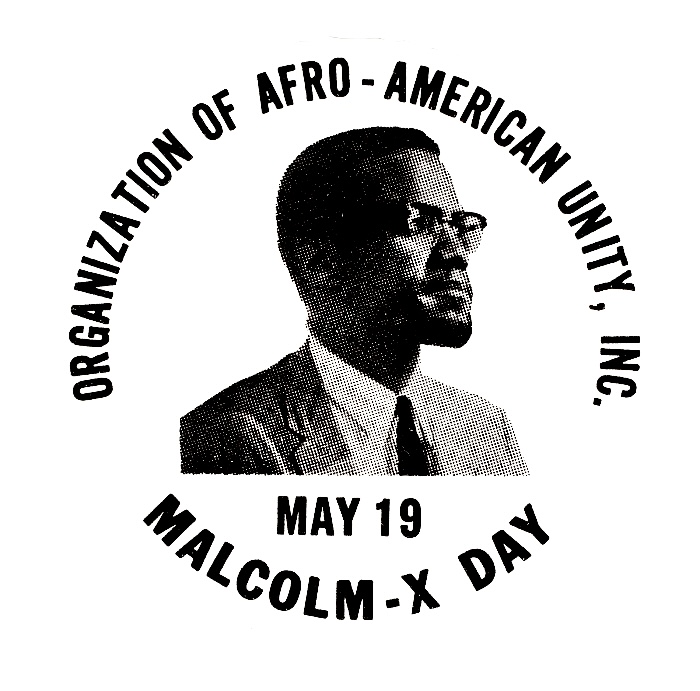
2nd Organization of Afro-American Unity
CURRICULAR OPERATIONS RESEARCH & PUBLICATIONS SERVICES (CORPS)
DIVISION OF THE POLITICAL BUREAU OF EDUCATION (POLITBURO), FLF-DAO
The Governor of the Society of the New Syllabus (N∴S∴) at Nacotchtank-on-Potomac (Anacostia) District of Ouachita (Washington, District of Columbia), Furthest West (al-Maghreb al-Aqsa) To All To Whom These Presents Come, Sends Greeting and Peace:—
Know ye by these presents that there is a decentralized autonomous organization (DAO) of people, in the nature of firm league of friendship (FLF), which is engaged in the business of self-education, -operation, and -development (Autodidactus), and that this society (Universitas) is organized into associations (Collegia) constituted by assemblies (Ecclesia) committed to certain trades or subject matters (Syndici).
(b) There is hereby established the second wave of the Organization of Afro-American Unity for the purposes enumerated by the Most Honorable el-Hajj Malik el-Shabazz (a.k.a. Malcolm X) (our “Founder”).
(c) The words of our Founder are incorporated herein by reference:
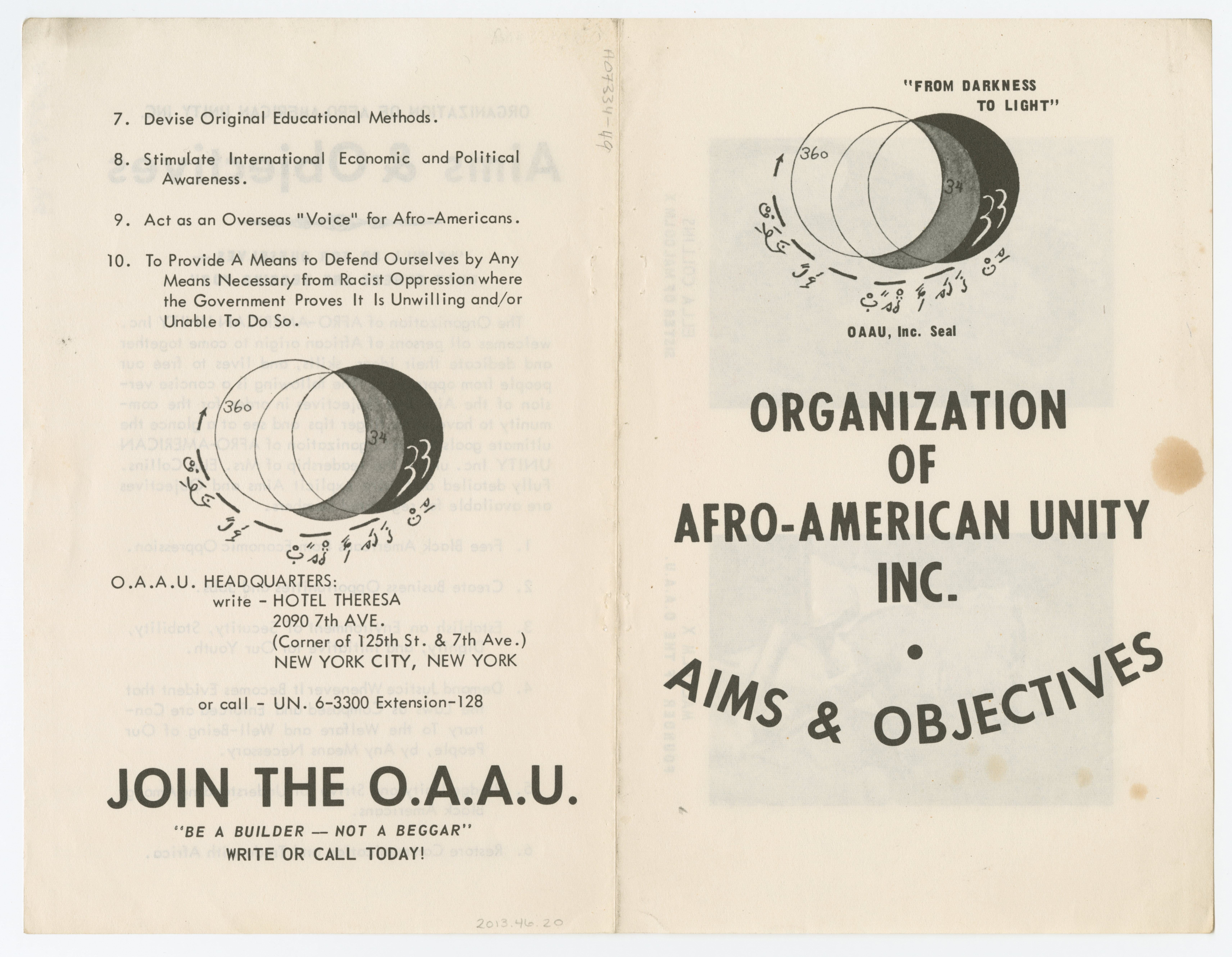
Program of the Organization of Afro-American Unity
Malcolm X, et al. (taken from the Malcolm X Museum)
Note: this was originally supposed to be presented on Feb. 15, but since Malcolm’s home was fire-bombed, this was delayed for a week — Feb. 21, [1965] to be exact — the day he was assassinated…
(1) PREAMBLE
Pledging unity…
Promoting justice…
Transcending compromise…
(a) We, Afro-Americans, people who originated in Africa and now reside in America, speak out against the slavery and oppression inflicted upon us by this racist power structure. We offer to downtrodden Afro-American people courses of action that will conquer oppression, relieve suffering, and convert meaningless struggle into meaningful action.
(b) Confident that our purpose will be achieved, we Afro-Americans from all walks of life make the following known:
(2) ESTABLISHMENT
(a) Having stated our determination, confidence, and resolve, the Organization of Afro-American Unity is hereby established on the 15th day of February, 1965, in the city of New York.
(b) Upon this establishment, the Afro-American people will launch a cultural revolution which will provide the means for restoring our identity that we might rejoin our brothers and sisters on the African continent, culturally, psychologically, economically, and share with them the sweet fruits of freedom from oppression and independence of racist governments.
(1) The Organization of Afro-American Unity welcomes all persons of African origin to come together and dedicate their ideas, skills, and lives to free our people from oppression.
(2) Branches of the Organization of Afro-American Unity may be established by people of African descent wherever they may be and whatever their ideology — as long as they be descendants of Africa and dedicated to our one goal: freedom from oppression.
(3) The basic program of the Organization of Afro-American Unity which is now being presented can and will be modified by the membership, taking into consideration national, regional, and local conditions that require flexible treatment.
(4) The Organization of Afro-American Unity encourages active participation of each member since we feel that each and every Afro-American has something to contribute to our freedom. Thus each member will be encouraged to participate in the committee of his or her choice.
(5) Understanding the differences that have been created amongst us by our oppressors in order to keep us divided, the Organization of Afro-American Unity strives to ignore or submerge these artificial divisions by focusing our activities and our loyalties upon our one goal: freedom from oppression.
(3) BASIC AIMS AND OBJECTIVES
(A) Self-determination
(1) We assert that we Afro-Americans have the right to direct and control our lives, our history, and our future rather than to have our destinies determined by American racists, we are determined to rediscover our true African culture, which was crushed and hidden for over four hundred years in order to enslave us and keep us enslaved up to today…
(2) We, Afro-Americans — enslaved, oppressed, and denied by a society that proclaims itself the citadel of democracy, are determined to rediscover our history, promote the talents that are suppressed by our racist enslavers, renew the culture that was crushed by a slave government and thereby — to again become a free people.
(B) National unity
(1) Sincerely believing that the future of Afro-Americans is dependent upon our ability to unite our ideas, skills, organizations, and institutions…
(2) We, the Organization of Afro-American Unity pledge to join hands and hearts with all people of African origin in a grand alliance by forgetting all the differences that the power structure has created to keep us divided and enslaved. We further pledge to strengthen our common bond and strive toward one goal: freedom from oppression.
(4) THE BASIC UNITY PROGRAM
(a) The program of the Organization of Afro-American Unity shall evolve from five strategic points which are deemed basic and fundamental to our grand alliance. Through our committees we shall proceed in the following general areas.
(I) Restoration
(1) In order to enslave the African it was necessary for our enslavers to completely sever our communications with the African continent and the Africans that remained there. In order to free ourselves from the oppression of our enslavers then, it is absolutely necessary for the Afro-American to restore communications with Africa.
(2) The Organization of Afro-American Unity will accomplish this goal by means of independent national and international newspapers, publishing ventures, personal contacts, and other available communications media.
(3) We, Afro-Americans, must also communicate to one another the truths about American slavery and the terrible effects it has upon our people. We must study the modern system of slavery in order to free ourselves from it. We must search out all the bare and ugly facts without shame for we are still victims, still slaves — still oppressed. Our only shame is believing falsehood and not seeking the truth.
(4) We must learn all that we can about ourselves. We will have to know the whole story of how we were kidnapped from Africa; how our ancestors were brutalized, dehumanized, and murdered; and how we are continually kept in a state of slavery for the profit of a system conceived in slavery, built by slaves and dedicated to keeping us enslaved in order to maintain itself.
(5) We must begin to reeducate ourselves and become alert listeners in order to learn as much as we can about the progress of our motherland — Africa. We must correct in our minds the distorted image that our enslaver has portrayed to us of Africa that he might discourage us from reestablishing communications with her and thus obtain freedom from oppression.
(II) Reorientation
(1) In order to keep the Afro-American enslaved, it was necessary to limit our thinking to the shores of America — to prevent us from identifying our problems with the problems of other peoples of African origin. This made us consider ourselves an isolated minority without allies anywhere.
(2) The Organization of Afro-American Unity will develop in the Afro-American people a keen awareness of our relationship with the world at large and clarify our roles, rights, and responsibilities as human beings. We can accomplish this goal by becoming well-informed concerning world affairs and understanding that our struggle is part of a larger world struggle of oppressed peoples against all forms of oppression. We must change the thinking of the Afro-American by liberating our minds through the study of philosophies and psychologies, cultures and languages that did not come from our racist oppressors. Provisions are being made for the study of languages such as Swahili, Hausa, and Arabic. These studies will give our people access to ideas and history of mankind at large and thus increase our mental scope.
(3) We can learn much about Africa by reading informative books and by listening to the experiences of those who have traveled there, but many of us can travel to the land of our choice and experience for ourselves. The Organization of Afro-American Unity will encourage the Afro-American to travel to Africa, the Caribbean, and to other places where our culture has not been completely crushed by brutality and ruthlessness.
(III) Education
(1) After enslaving us, the slave masters developed a racist educational system which justified to its posterity the evil deeds that had been committed against the African people and their descendants. Too often the slave himself participates so completely in this system that he justifies having been enslaved and oppressed.
(2) The Organization of Afro-American Unity will devise original educational methods and procedures which will liberate the minds of our children from the vicious lies and distortions that are fed to us from the cradle to keep us mentally enslaved. We encourage Afro-Americans themselves to establish experimental institutes and educational workshops, liberation schools, and child-care centers in the Afro-American communities.
(3) We will influence the choice of textbooks and equipment used by our children in the public schools while at the same time encouraging qualified Afro-Americans to write and publish the text books needed to liberate our minds. Until we completely control our own educational institutions, we must supplement the formal training of our children by educating them at home.
(IV) Economic security
(1) After the Emancipation Proclamation, when the system of slavery changed from chattel slavery to wage slavery, it was realized that the Afro-American constituted the largest homogeneous ethnic group with a common origin and common group experience in the United States and, if allowed to exercise economic or political freedom, would in a short period of time own this country. Therefore racists in this government developed techniques that would keep the Afro-American people economically dependent upon the slave masters — economically slaves — twentieth-century slaves.
(2) The Organization of Afro-American Unity will take measures to free our people from economic slavery. One way of accomplishing this will be to maintain a technician pool: that is, a bank of technicians. In the same manner that blood banks have been established to furnish blood to those who need it at the time it is needed, we must establish a technician bank. We must do this so that the newly independent nations of Africa can turn to us who are their Afro-American brothers for the technicians they will need now and in the future. Thereby we will be developing an open market for the many skills we possess and at the same time we will be supplying Africa with the skills she can best use. This project will therefore be one of mutual cooperation and mutual benefit.
(V) Self-defense
(1) In order to enslave a people and keep them subjugated, their right to self-defense must be denied. They must be constantly terrorized, brutalized, and murdered. These tactics of suppression have been developed to a new high by vicious racists whom the United States government seems unwilling or incapable of dealing with in terms of the law of this land. Before the emancipation it was the Black man who suffered humiliation, torture, castration, and murder. Recently our women and children, more and more, are becoming the victims of savage racists whose appetite for blood increases daily and whose deeds of depravity seem to be openly encouraged by all law enforcement agencies. Over five thousand Afro-Americans have been lynched since the Emancipation Proclamation and not one murderer has been brought to justice!
(2) The Organization of Afro-American Unity, being aware of the increased violence being visited upon the Afro-American and of the open sanction of this violence and murder by the police departments throughout this country and the federal agencies — do affirm our right and obligation to defend ourselves in order to survive as a people.
(3) We encourage the Afro-Americans to defend themselves against the wanton attacks of racist aggressors whose sole aim is to deny us the guarantees of the United Nations Charter of Human Rights and of the Constitution of the United States.
(4) The Organization of Afro-American Unity will take those private steps that are necessary to insure the survival of the Afro-American people in the face of racist aggression and the defense of our women and children. We are within our rights to see to it that the Afro-American people who fulfill their obligations to the United States government (we pay taxes and serve in the armed forces of this country like American citizens do) also exact from this government the obligations that it owes us as a people, or exact these obligations ourselves. Needless to say, among this number we include protection of certain inalienable rights such as life, liberty, and the pursuit of happiness.
(5) In areas where the United States government has shown itself unable and/or unwilling to bring to justice the racist oppressors, murderers, who kill innocent children and adults, the Organization of Afro-American Unity advocates that the Afro-American people insure ourselves that justice is done — whatever the price and by any means necessary.
(5) NATIONAL CONCERNS
(A) General terminologies:
(1) We Afro-Americans feel receptive toward all peoples of goodwill. We are not opposed to multiethnic associations in any walk of life. In fact, we have had experiences which enable us to understand how unfortunate it is that human beings have been set apart or aside from each other because of characteristics known as “racial” characteristics.
(2) However Afro-Americans did not create the prejudiced background and atmosphere in which we live. And we must face the facts. A “racial” society does exist in stark reality, and not with equality for Black people; so we who are nonwhite must meet the problems inherited from centuries of inequalities and deal with the present situations as rationally as we are able.
(3) The exclusive ethnic quality of our unity is necessary for self-preservation. We say this because our experiences backed up by history show that African culture and Afro-American culture not be accurately recognized and reported and cannot be respectably expressed nor be secure in its survival if we remain the divided, and therefore the helpless, victims of an oppressive society.
(4) We appreciate the fact that when the people involved have real equality and justice, ethnic intermingling can be beneficial to all. We must denounce, however, all people who are oppressive through their policies or actions and who are lacking in justice in their dealings with other people, whether the injustices proceed from power, class, or “race.” We must be unified in order to be protected from abuse or misuse.
(5) We consider the word “integration” a misleading, false term. It carries with it certain implications to which Afro-Americans cannot subscribe. This terminology has been applied to the current regulation projects which are supposed]y “acceptable” to some classes of society. This very “acceptable” implies some inherent superiority or inferiority instead of acknowledging the true source of the inequalities involved.
(6) We have observed that the usage of the term “integration” was designated and promoted by those persons who expect to continue a (nicer) type of ethnic discrimination and who intend to maintain social and economic control of all human contacts by means of imagery, classifications, quotas, and manipulations based on color, national origin, or “racial” background and characteristics.
(7) Careful evaluation of recent experiences shows that “integration” actually describes the proccess by which a white society is (remains) set in a position to use, whenever it chooses to use and however it chooses to use, the best talents of nonwhite people. This power-web continues to build a society wherein the best contributions of Afro-Americans, in fact of all nonwhite people, would continue to be absorbed without note or exploited to benefit a fortunate few while the masses of both white and nonwhite people would remain unequal and unbenefited.
(8) We are aware that many of us lack sufficient training and are deprived and unprepared as a result of oppression, discrimination, and the resulting discouragement, despair, and resignation. But when we are not qualified, and where we are unprepared, we must help each other and work out plans for bettering our own conditions as Afro-Americans. Then our assertions toward full opportunity can be made on the basis of equality as opposed to the calculated tokens of “integration.” Therefore, we must reject this term as one used by all persons who intend to mislead Afro-Americans.
(9) Another term, “negro,” is erroneously used and is degrading in the eyes of informed and self-respecting persons of African heritage. It denotes stereotyped and debased traits of character and classifies a whole segment of humanity on the basis of false information. From all intelligent viewpoints, it is a badge of slavery and helps to prolong and perpetuate oppression and discrimination.
(10) Persons who recognize the emotional thrust and plain show of disrespect in the Southerner’s use of “nigra” and the general use of “nigger” must also realize that all three words are essentially the same. The other two. “nigra” and “nigger” are blunt and undeceptive. The one representing respectability, “negro,” is merely the same substance in a polished package and spelled with a capital letter. This refinement is added so that a degrading terminology can be legitimately used in general literature and “polite” conversation without embarrassment.
(11) The term “negro” developed from a word in the Spanish language which is actually an adjective (describing word) meaning “black,” that is, the color black. In plain English, if someone said or was called a “black” or a “dark,” even a young child would very naturally question: “a black what?” or “a dark what?” because adjectives do not name, they describe. Please take note that in order to make use of this mechanism, a word was transferred from another language and deceptively changed in function from an adjective to a noun, which is a naming word. Its application in the nominative (naming) sense was intentionally used to portray persons in a position of objects or “things.” It stamps the article as being “all alike and all the same.” It denotes: a “darkie,” a slave, a subhuman, an ex-slave, a “negro.”
(12) Afro-Americans must re-analyze and particularly question our own use of this term, keeping in mind all the facts. In light of the historical meanings and current implications, all intelligent and informed Afro-Americans and Africans continue to reject its use in the noun form as well as a proper adjective. Its usage shall continue to be considered as unenlightened and objectionable or deliberately offensive whether in speech or writing.
(13) We accept the use of Afro-American, African, and Black man in reference to persons of African heritage. To every other part of mankind goes this measure of just respect. We do not desire more nor shall we accept less.
(B) General considerations:
(1) Afro-Americans, like all other people, have human rights which are inalienable. This is, these human rights cannot be legally or justly transferred to another. Our human rights belong to us, as to all people, through God, not through the wishes nor according to the whims of other men.
(2) We must consider that fact and other reasons why a proclamation of “Emancipation” should not be revered as a document of liberation. Any previous acceptance of and faith in such a document was based on sentiment, not on reality. This is a serious matter which we Afro-Americans must continue to reevaluate.
(3) The original root-meaning of the word emancipation is: “To deliver up or make over as property by means of a formal act from a purchaser.” We must take note and remember that human beings cannot be justly bought or sold nor can their human rights be legally or justly taken away.
(4) Slavery was, and still is, a criminal institution, that is: crime en masse. No matter what form it takes. subtle rules and policies, apartheid, etc., slavery and oppression of human rights stand as major crimes against God and humanity. Therefore, to relegate or change the state of such criminal deeds by means of vague legislation and noble euphemisms gives an honor to horrible commitments that is totally inappropriate.
(5) Full implications and concomitant harvests were generally misunderstood by our foreparents and are still misunderstood or avoided by some Afro-Americans today. However, the facts remain; and we, as enlightened Afro-Americans, will not praise and encourage any belief in emancipation. Afro-Americans everywhere must realize that to retain faith in such an idea means acceptance of being property and, therefore, less than a human being. This matter is a crucial one that Afro-Americans must continue to reexamine.
(6) WORLDWIDE CONCERNS
(a) The time is past due for us to internationalize the problems of Afro-Americans. We have been too slow in recognizing the link in the fate of Africans with the fate of Afro-Americans. We have been too unknowing to understand and too misdirected to ask our African brothers and sisters to help us mend the chain of our heritage.
(b) Our African relatives who are in a majority in their own country have found it very difficult to gain independence from a minority. It is that much more difficult for Afro-Americans who are a minority away from the motherland and still oppressed by those who encourage the crushing of our African identity.
(c) We can appreciate the material progress and recognize the opportunities available in the highly industrialized and affluent American society. Yet, we who are nonwhite face daily miseries resulting directly or indirectly from a systematic discrimination against us because of our God-given colors. These factors cause us to remember that our being born in America was an act of fate stemming from the separation of our foreparents from Africa; not by choice, but by force.
(d) We have for many years been divided among ourselves through deceptions and misunderstandings created by our enslavers, but we do here and now express our desires and intent to draw closer and be restored in knowledge and spirit through renewed relations and kinships with the African peoples. We further realize that our human rights, so long suppressed, are the rights of all mankind everywhere.
(e) In light of all of our experiences and knowledge of the past, we, as Afro-Americans, declare recognition, sympathy, and admiration for all peoples and nations who are striving, as we are, toward self-realization and complete freedom from oppression.
(f) The civil rights bill is a similarly misleading, misinterpreted document of legislation. The premise of its design and application is not respectable in the eyes of men who recognize what personal freedom involves and entails. Afro-Americans must answer this question for themselves: What makes this special bill necessary?
(g) The only document that is in order and deserved with regard to the acts perpetuated through slavery and oppression prolonged to this day is a Declaration of condemnation. And the only legislation worthy of consideration or endorsement by Afro-Americans, the victims of these tragic institutions, is a Proclamation of Restitution. We Afro-Americans must keep these facts ever in mind.
(h) We must continue to internationalize our philosophies and contacts toward assuming full human rights which include all the civil rights appertaining thereto. With complete understanding of our heritage as Afro-Americans, we must not do less.
(7) Committees of the Organization of Afro-American Unity:
(a) The Cultural Committee
(b) The Economic Committee
(c) The Educational Committee
(d) The Political Committee
(e) The Publications Committee
(f) The Social Committee
(g) The Self-Defense Committee
(h) The Youth Committee
(i) Staff committees: Finance, Fund-raising, Legal, Membership
Gallery



Resources
CURRICULAR OPERATIONS RESEARCH AND PUBLICATION SERVICES
PROVIDED BY THE GOVERNOR AND COMPANY OF

A FREELY ASSOCIATED SERVICE PROVIDER
Party Resolutions
We,
The Third Wave Anti-Masonic Party
of
The United States of America
Do hereby adopt these
RESOLUTIONS
of
The First Wave Anti-Masonic Party
of
The United States,
1831
The Proceedings of the Second United States Anti-Masonic Convention, Held at Baltimore, September, 1831: […] Boston: Stereotyped at the Boston Type and Stereotype Foundry: 1832 (Forgotten Books Edition, page 61).
September 28, 5 o’clock, P.M.
Met, pursuant to adjournment.
Mr. WARD, from the committee, reported resolutions, which were twice read. Messrs. FULLER, FOOTE, and HOPKINS, of New York, HALLETT, of Rhode Island, and STEVENS, of Pennsylvania, severally addressed the Convention in their support, and the resolutions were unanimously adopted:—
1st
Resolved, That the existence of secret and affiliated societies his hostile to one of the principal defenses of liberty,—free discussion,—and can subserve no purpose of utility in a free government.
2nd
Resolved, That we, as American citizens, will adopt the counsel given us by the illustrious Washington, “That all combinations and associations, under whatever plausible character, with the real design to direct, control, counteract, or awe the regular deliberation and action of the constituted authorities, are destructive of the fundamental principle of liberty, and of fatal tendency.”
3rd
Resolved, That the organization of the anti-masonic party is founded upon the most satisfactory and undeniable evidence, that the masonic institution is dangerous to the liberties, and subversive to the laws of the country.
4th
Resolved, That where evils of this nature are founds existing in a free government, holding, by means of a secret combination, a majority of the civil, judicial, and military offices in the country, there are but two modes of redressing the grievance—either by revolution, or by an appeal to the ballot boxes.
5th
Resolved, That the anti-masonic party, in choosing the latter remedy, have taken up the peaceful and legitimate weapons of freemen, and that they ought never to lay them down in this cause, until the liberty of the press, the liberty of speech, equal rights, and an entire overthrow of masonic usurpations, are fully and completely achieved.
6th
Resolved, That the direct object of freemasonry is to benefit the few, at the expense of the many, by creating a privileged class, in the midst of a community entitled to enjoy equal rights and privileges.
7th
Resolved, That we esteem it the plain duty of the members of that institution, as citizens of our common country, either collectively to abolish it, or individually to abandon it.
8th
Resolved, That we have witnessed with pleasure, the efforts on the part of some of the masonic fraternity to produce a voluntary abandonment of the order. While we regard these efforts as the manifestation of homage to public opinion, we should rejoice in their success, inasmuch as it would produce a more speedy accomplishment of the great object which the anti-masonic party, with singleness of purpose, are striving to effect.
9th
Resolved, That discussion, persuasion, and argument, in connection with the exercise of the right of suffrage, is a correct and speedy mode of diffusing information upon the subject of freemasonry, and is the best method to ensure the entire destruction of the institution.
10th
Resolved, That the oaths and obligations imposed upon persons when admitted to masonic lodges and chapters, deserve the unqualified reprobation and abhorrence of every Christian, and every friend of morality and justice.
11th
Resolved, That these oaths, being illegally administered, and designed to subserve fraudulent purposes, ought not to be regarded as binding in conscience, morality, or honor; but the higher obligations of religion and civil society require them to be explicitly renounced by every good citizen.
12th
Resolved, That the gigantic conspiracy in New York, against the life of William Morgan, was the natural result of the oaths and obligations of masonry, understood and acted upon according to their plain and obvious meaning.
13th
Resolved, That there is sufficient proof that the perpetrators of the abduction and murder of William Morgan, have, in several instances, been shielded from the punishment due their crimes, by the Grand Lodge and Grand Chapter of New York, and by subordinate lodges and chapters, according to their masonic obligations, whereby those lodges and chapters have countenanced those outrages, and become accomplices in their guilt.
14th
Resolved, That those masons who became acquainted with and concealed the facts relative to the abduction of Capt. William Morgan, are accessary to that horrid transaction.
15th
Resolved, That, in applying the right of suffrage to effect the suppression of freemasonry, we not only exercise a right which is unalienably secured to us, but discharge a duty of the highest obligation, in thus endeavoring to abate a great political evil.
16th
Resolved, That there can be no proscription, where every freeman has a right—and exercises that right—to vote for a candidate of his own choice.
17th
Resolved, That anti-masonry has for its object the destruction of freemasonry; for its means, public opinion, manifested through the exercise of the elective franchise; that it acts upon the great principles of liberty, which made us a free people, and relies upon them to ensure the attainment of its high purpose.
18th
Resolved, That an actual adherence, by freemasons, to the principles contained in the obligations of the order, is inconsistent with paramount duties, which they owe to the state, and is a disqualification for offices of public trust.
19th
Resolved, That we find, in the unexampled growth of the anti-masonic party, the diffusion and prevalence of its principles, the continued approbation bestowed upon them by the enlightened and wise men of the nation, abundant cause for encouragement, and the perseverance with increased zeal and unabated determination, until the institution of freemasonry shall be overthrown or abandoned.
20th
Resolved, That much depends upon a thorough ORGANIZATION of each STATE and TERRITORY, of each CITY, TOWN, TOWNSHIP and VILLAGE, by active and vigilant committees, for the purpose of diffusing information on the subject of masonry and anti-masonry, over our whole country, and that the voice of patriotism calls upon all good citizens to organize and unite themselves with such committees accordingly.
From, Address of the National Anti-Masonic Convention, To the People of the United States.
On the Republic
(page 69)
“A republic acknowledges the rights of all, and seeks to avail itself of the wisdom and power of all, to promote their common welfare. Its theory is perfect. It is founded upon the proper basis, pursues the proper end, and employs the proper means. And by the principles of elective representation and accountability, it may be so extended as ultimately to combine all nations—if not into one family—into a friendly association of several peaceful, prosperous and numerous families. If right, duty, wisdom, and power can contribute to the real exaltation and happiness of man; and if government can combine and apply them most comprehensively and beneficially to the regulation of human conduct, then republicanism offers a more majestic and reverend image of substantial glory than can otherwise result from the labors, and sufferings, and virtues of our race. It is a practical scheme of universal benevolence, sure to be approved. embraced, and sustained, by all men, in proportion to the just prevalence, in their minds, of intelligence, truth, and philanthropy. Such a government is the one under which it is our privilege to live.”
On the Individual
(page 79)
“Individual rights are, separately considered, of immeasurable and indefinable worth. They partake of the infinitude of moral existence and responsibility. As contemplated by our government, a single individual, and one as much as another, is an august being, entitled to inviolable reverence, and bearing upon him the badges of a most majestic origin, and the stamp of most transcendent destinations. His safety, his liberty, his life, his improvement, his happiness, it designs, at all times and places, faithfully to protect, by the application of all its delegated means. The law is the beneficial instrument of this protection, and should be appreciated, by every reflecting man, as the sacred, living, and most venerable expression of the national mind and will. Break this, and the nation has but one right left which it can peaceably enforce—the right of suffrage.”
On Prince Hall
(page 81)
“There is a bearing of freemasonry, not yet embraced in this address, which is replete with the most distressing apprehensions. There is located, in Boston, a masonic body, denominated the African Grand Lodge, which dates its origin before the American revolution, and derived its existence from a Scottish duke. This body acknowledges no allegiance to any of the associations of American masonry. Its authority is co-extensive with our Union. It has already granted many charters to African lodges. We are afraid to intimate their location, to look in upon their proceedings, to count their inmates, or to specify their resources.”
On Suffrage
(page 83)
“Voting for our public servants is the highest exercise of sovereign power known in our land. It is the paramount, distinctive privilege of freemen. In countries where only a small minority of the people are authorized to vote, if oppressive measures are adopted by their rules, they must either submit or fight. In countries where all the citizens are authorized to vote, if they are oppressed, they can throw off the oppression by their votes. And if the frowns of power, or the calumnies of malefactors, have force to dissuade them from using their votes to throw it off, they are fit for slaves, and can be only slaves. The highest functionaries of the general and state governments are amenable to the people for the proper discharge of their duties. But a freeman, when he votes for a candidate, exercises the right of selecting, among those who are eligible, subject to no authority under heaven. For his choice he is accountable only to his conscience and his God. And why should he not, in the most sovereign act he can perform, do himself the great justice of giving expression to the honest conviction of his soul? If, baving the will, he cannot do it, he is a slave. If, having the power, he will not do it, he is corrupt.”
 Supreme Exchange