Tagged: religion
Mustelid Friends 8: Beavers in Space
or, Rice World
Created and Produced by Dams Up Water
In the neon half-light of a decaying interstellar port, Mr. Capybara adjusted his lapels and tried to remember where things had gone so wrong.
It had started, as these things often do, with rice.
Not the innocent, steaming kind you’d find in a humble bowl, but the kind that powered empires—processed, commodified, and vacuum-sealed for hyperspace transit.
Royal Arabian Oil had gotten greedy. They always did. First they disrupted terrestrial shipments, then orbital ones, and before long the whole interstellar rice exchange looked like a spilled sack in zero gravity. Mr. Capybara, once a respectable baron of modest corruption, now found himself tangled in litigation so vast it had gravitational pull.
So he went back to the only place that had ever managed to keep him one step ahead of ruin: the law firm of Weasel Badger Beaver Mink & Otter.
Their office floated in a slow orbit five thousand miles above New Arrakeen-on-Potomac, a brutalist slab of concrete and ambition. Inside, the air smelled faintly of ink, damp fur, and firm resolve.
Weasel met him at reception, thin as a clause and twice as slippery.
“Back again, Mr. Capybara?”
“Don’t sound so surprised,” Capybara muttered. “You people bill by the heartbeat. I’m your favorite kind of repeat customer.”
Badger emerged from a shadowed hallway, carrying a stack of files that looked heavy with others’ misfortune. Mink and Otter followed—the one calculating, the other smiling like a settlement already signed.
And then there was solemn spectacled Father Beaver.
He didn’t say much. Never did. But the room shifted around him, like reality itself had been notarized in his presence.
“You’ve got rice woes,” Beaver said.
“I’ve got existential woes,” Capybara replied. “The rice is just the side dish.”
They ushered him into a conference room where the walls flickered with projections of shipping routes, legal precedents, and celestial trade lanes. Somewhere in that mess was the truth—or at least something billable.
“Royal Arabian Oil’s interference,” Mink began, “constitutes not just a breach of contract but a disruption of the sacred flow.”
“The current,” Beaver added quietly.
Capybara sighed. “Don’t start with the theology.”
But it was already too late for that.
Because behind the firm—behind all firms, all contracts, all quietly devastating negotiations—stood the Beaverjesuits.
Led by Father Beaver, they weren’t just clerics. They were custodians of something older than law and more binding than any agreement: the onstreaming current of the spirit. Not metaphorical—literal. A current that flowed through trade routes, through belief, through the very idea of exchange itself.
And the Beavers had always controlled it.
Not openly, of course. Never crudely. They preferred instruments—firms, orders, societies. Layers of plausible deniability wrapped in ritual and paperwork.
“The rice must flow,” Weasel said, almost reverently.
“The rice always flows,” Otter corrected, “but only where it is permitted.”
Capybara leaned back, feeling the weight of it all press against his ribs. “So what’s the play? I sue? I settle? I disappear?”
Beaver tapped the table. The projections shifted.
A desert planet appeared—vast, dry, and shimmering with fields not of sand, but of dormant grain, waiting for the right conditions to awaken.
“Intergalactic expansion,” Father Beaver said. “New markets. Untapped resources.”
“Prospects,” Mink added.
“Liability redistribution,” Badger clarified.
“And prophecy,” Beaver finished.
Capybara groaned. “I knew there’d be prophecy.”
That’s when they told him about Little Beaver.
The young, mendicant friar from the banks of Old Nacotchtank, raised among the doctors of the Beaver Medicine Society of Yahushua HaMoshiach.
The doctors weren’t just healers. They were interpreters of the current, reading its fluctuations like vital signs. And they had seen something in Little Beaver.
Something impossible.
“The Kwisatz Haderach,” Otter said softly.
Capybara rubbed his temples. “Let me guess. He can be in two places at once, see the future, and audit my accounts retroactively?”
“Close,” Weasel said. “He can bridge the legal and the divine.”
“And that’s bad for me how?” Capybara asked.
“It isn’t,” Beaver said. “Unless you’re on the wrong side of the current.”
Which, Capybara suspected, he usually was.
Then there were the Brothers of Beggars Contemplative—a ragged, stubborn branch of the interstellar Djedi knighthood. They lived among the rice deserts, wore patched robes, and spoke in riddles that somehow held up in arbitration.
They were the only ones who truly understood the rice.
“They don’t control it,” Badger said. “They live upon it.”
“Which makes them dangerous,” Mink added.
“Or at least indispensable,” Beaver said.
The room fell quiet.
Outside, the rain kept falling—on the city, on the ships, on the endless chain of transactions that held the universe together by a thread of obligation and belief.
Capybara looked at the projections again. The desert. The child. The currents.
“You’re telling me,” he said slowly, “that my legal troubles with a corrupt oil conglomerate are actually part of some grand intergalactic realignment of rice, religion, and revenue streams.”
“Yes,” said Beaver.
“And my role in this?”
Beaver’s round lenses glinted like polished wood in low light.
“You adapt,” he said. “Or you get written out of the big rice contracts.”
Capybara exhaled, long and slow.
He’d always known the game was rigged. He just hadn’t realized how far up it went.
“Fine,” he said. “We expand. We litigate. We… commune with the current or whatever it is you people do.”
Otter smiled. Weasel started drafting. Badger stamped something with unnecessary force. Mink began calculating outcomes that hadn’t happened yet.
And contemplative Father Beaver?
He simply watched the current—unseen, unstoppable—flowing through it all.
Because in the end, it wasn’t the oil, or the rice, or even the law that ruled the stars.
It was the current.
And the Beavers had always known exactly where it was going.
Part II
Mr. Capybara had never trusted anything that was described as “empty.”
Empty accounts weren’t empty. Empty promises came due with interest. And now, moored in drydock hovering above New Arrakeen-on-Potomac, was the largest space-worthy grain silo ever assembled—a cathedral of hollow steel called The Immaculate Deficit.
The plan, as drafted by Weasel and notarized by forces both domestic and angelic, was elegant in the way a forged signature is elegant: convincing enough to pass inspection, dangerous enough to ruin everyone involved.
The decentralized Royal Arabian Oil conglomerate now controlled the terrestrial rice supply chain all the way up to the Saturnian Threshing Floor and Clearinghouse. The Archangelic Police Force—winged auditors of cosmic compliance, their halos doubling as surveillance arrays—patrolled the network. Between the two, nothing moved without permission.
So Capybara would move nothing.
No rice. No declared cargo.
Just a ship light on the manifest.
“Absence,” Weasel had explained, tapping a clause, “is very difficult to regulate.”
“And even harder to tax,” Badger had added, with something like admiration.
Capybara stood on the command deck as the clamps released. The ship groaned like an old debtor waking up.
“Engage drift engines,” he said.
The Immaculate Deficit didn’t launch so much as excuse itself from orbit—slipping sideways into a corridor of neglected jurisdiction, where laws blurred and enforcement lagged.
Below them, the lights of the city flickered. Above them, the stars waited like unpaid invoices.
“Contact?” Capybara asked.
“Royal Arabian Oil patrols sweeping the primary lanes,” Mink reported. “Archangelic units triangulating anomalies.”
“Do we qualify as an anomaly?” Capybara asked.
Otter checked a screen. “We qualify as a phenomenal curiosity.”
“Good,” Capybara said. “Those usually get deferred.”
They moved through deep space like a rumor—hard to pin down, harder to prove. The ship’s manifest updated itself constantly, a living document of strategic ambiguity.
Cargo: None.
Intent: Undetermined.
Purpose: Under review.
It worked.
At least at first.
The first interception came as a shimmer—a ring of light forming ahead of them, resolving into the unmistakable wheeling siren of the Archangelic Police Force. Their vessels weren’t built; they were declared, luminous chariots of authority and immaculate paperwork.
A voice filled the bridge, calm and absolute.
“Unregistered transit, identify cargo and submit to audit.”
Capybara leaned forward. “We are transporting nothing.”
A pause.
“Clarify: absence of goods does not constitute absence of obligation.”
Weasel’s voice crackled over comms from the firm’s remote advisory channel. “Invoke Clause 0.”
Capybara smirked. “We invoke Clause 0.”
Another pause, longer this time.
Clause 0—the most dangerous stipulation ever written into a contract—stated that nothing, properly defined, could not be interfered with without first being proven to exist.
The Archangelic vessels flickered, their halos dimming as they processed the paradox.
“Your cargo,” the voice said carefully, “is not identifiable under the terms of interspace commerce.”
“Correct,” Capybara said.
“And therefore…”
“Exempt,” Otter whispered.
The light wheel dissolved.
Capybara exhaled. “I love good lawyering.”
But Royal Arabian Oil wasn’t so easily stalled.
They didn’t argue black letter. They obstructed procedure.
A fleet emerged from the dark—blocky, brutal ships that looked less like vessels and more like statements of intent. Their engines burned with the slow fury of monopolies.
“They’re going to ram us out of the corridor,” Mink said.
“Can they?” Capybara asked.
“Physically, yes. Legally… ambiguous.”
“Then we make it spiritually impossible,” Father Beaver’s voice came, low and certain.
Capybara didn’t ask how. He had learned not to.
“Full drift,” he ordered. “Let the current take us into hyperspace.”
The ship shuddered. Systems dimmed. The Immaculate Deficit surrendered control—not to chaos, but to something subtler.
The space way.
Not visible. Not measurable. But felt—a pull beneath the equations, a flow beneath the routes.
For a moment, Capybara swore he could hear it. Like distant water. Like whispered clauses being negotiated by the universe itself.
The Royal Arabian Oil ships advanced—
—and missed.
Not by distance, but by dimension. Their trajectories intersected where the Deficit should have been, not where it was becoming.
“Trajectory mismatch,” Badger muttered over comms, almost impressed.
“They’re aiming at our declared position,” Otter said.
“We’re not declared anymore,” Capybara replied.
They slipped past.
Deep space opened up, vast and indifferent.
Days—or something like days—passed. Time got loose out here, unmoored from billing cycles and court dates. The crew stopped asking questions. Even Capybara stopped pretending he understood.
And then, at the edge of perception, the desert planet crowned.
A sphere of muted gold and pale dust, its surface streaked with dormant fields of rice waiting for the right disturbance to awaken. The rice world.
“Arrakeen Minor,” Mink said. “Or whatever the locals are calling it this century.”
“Home,” Beaver murmured.
They descended.
The atmosphere caught them like a held breath. Sand—or something like sand—spiraled upward, whispering against the hull.
“Scans?” Capybara asked.
Otter frowned. “No formal defenses. No structured ports. No—”
The blaring of alarms cut him off.
Shapes rose out of the desert.
Not ships…
but figures.
Cloaked. Angular. Moving with a precision that felt less like motion, more like unintentional. The Brothers of Beggars Contemplative.
“The Djedi resistance,” said the Otter.
“They’ve been waiting,” Badger said.
“For us?” Capybara asked.
“For a sign,” Beaver replied.
The figures surrounded the ship as it settled onto the surface. No weapons visible. No threats declared.
Which, Capybara knew, meant something worse: Negotiation.
The hatch opened with a reluctant sigh.
Heat flooded in. Dry, ancient, and carrying the faint scent of grain and prophecy.
Capybara stepped out first, because that was the kind of mistake he specialized in.
The leader of the Djedi Assembly stepped forward, face obscured beneath layered cloth. When they spoke, their voice was rough with disuse and assurance.
“You bring an empty vessel,” they said.
Capybara spread his hands. “It’s a free and open market.”
The figure tilted their head.
“There is no empty,” they said. “Only what has not yet been seen.”
Capybara glanced back at the ship, at its hollow holds and carefully drafted nothingness.
For the first time since launch, he felt a flicker of doubt.
Behind the Djedi, the desert shifted.
Not wind.
Movement.
Something vast beneath the surface, stirring in response to their arrival.
“The rice,” the Djedi said softly, “is waking.”
Capybara swallowed.
He had come here to escape a lawsuit.
Instead, it looked like he’d just filed one against the universe itself—and the universe had decided to appear in person.
Part III
The desert did not roar.
It audited.
A low, granular vibration passed through the ground beneath Mr. Capybara’s paws, like a ledger being balanced somewhere far below the surface of the world. The Brothers of Beggars Contemplative stood motionless, their patched robes fluttering in a wind that hadn’t yet decided to blow.
“You awoke it,” the Djedi Master said.
Capybara adjusted his cufflinks. “I tend to have that effect on systems that prefer to remain dormant.”
Behind him, The Immaculate Deficit creaked—its vast, empty holds now echoing with something new. Not cargo. Not quite. A presence. As if absence, pushed hard enough, had finally looped back into being.
And then Little Beaver stepped forward.
No fanfare. No thunder. Just a small figure moving with a quiet that made all else feel like paperwork waiting to be filed.
The Djedi Assembly parted before him.
Father Beaver—of the firm, of the current, of the most solemn Society—lowered his head in reverent thanksgiving to the Most High God.
“His time has come,” the Beaver said.
Little Beaver looked at the ship, then at the desert, then at Capybara—who, for reasons he couldn’t articulate, suddenly felt like a clause about to be struck.
“You tried to move nothing,” Little Beaver said.
Capybara shrugged. “It’s legally defensible.”
“But nothing,” Little Beaver replied, “is where everything begins.”
The ground split.
Not violently—no explosions—just a clean, surgical opening, as though the planet itself had found a faulty line item and decided to expand it.
From beneath the desert rose the rice.
Not fields. Not crops. Memory. Potential. The primordial grain—unprocessed, unpriced, unowned. It flowed upward in shimmering currents, each kernel a possibility, each possibility a future.
“The rice,” whispered a Djedi.
“The source,” offered another.
Little Beaver stepped into the rising current.
For a moment—just a moment—he was everywhere.
On the bridge of the Deficit. In the conference room of Weasel Badger Beaver Mink & Otter. In the ledgers of Royal Arabian Oil. In the omniscient eternal patrol of the Archangelic Police Force.
He bridged it.
Legal and divine. Material and spiritual. Profit and purpose.
The Kwisatz Haderach—not a conqueror, not a tyrant, but a reconciler of systems that had long pretended not to be in equity.
Capybara watched, slack-jawed.
“I should have charged a consultation fee,” he muttered.
Above them, the sky fractured.
Not broke—revealed.
And he descended—not in fire, not in wrath, but in a clarity so absolute it made every prior misconception feel like a bad joke told too long.
Yahushua HaMoshiach.
The final arbiter of a contract written before time had learned how to number the years.
The Djedi knelt. The Beavers bowed. Even the current itself seemed to rest in its stillness, as if in a reservoir dammed.
Capybara stood.
Capybara squinted.
“Hast thou come to litigate,” he asked, “or to settle?”
Yahushua looked at him—not unkindly, but with the sort of gaze that causes pretense to collapse under its own weight.
“To fulfill,” He said.
Back on the Kingdom of Earth, whole systems began to abate.
Royal Arabian Oil’s monopolies unraveled, and its decentralized districts further dissolved into households in their tribes.
The Archangelic Police Force opened the skies to mass transit through space, and surveillance gave way to witness.
And in a dusty corner of New Bat City, which had almost forgotten how to hope, the reformed raccoon gang—Bandana Dan and his Boys—redistributed imported grain shipments with solemn efficiency and only occasional theatrical flair.
“We’re saved now,” Bandana Dan insisted, adjusting his bandana like a badge. “Spiritually sanctioned by the Most High.”
“Provisionally,” one of the Djedi Ambassadors muttered.
On the rice world, the grain flowed freely.
Not owned. Not controlled…
but shared.
The Beaverjesuits hath foretold it. The current had never been theirs to possess, only to guide until one could become it.
Little Beaver stood in the firmament with the resurrected dead as a living clause that could not be exploited.
Capybara approached him from the space below.
“So,” he said, hands in pockets, “where does that leave people like me?”
Little Beaver regarded him.
“Held accountable,” he said.
Capybara winced. “I was afraid you’d say that.”
A silence.
Then, unexpectedly:
“And… necessary.”
Capybara blinked. “I’m sorry?”
“You understand systems,” Little Beaver said. “You navigate them. Twist them. Reveal their weaknesses.”
Capybara considered that.
“I break things,” he said.
“You expose where they were already broken,” Little Beaver replied.
For the first time in a long time, Capybara didn’t have a clever response.
Above them, the sky settled into something honest.
The current flowed—not hidden, not controlled, but present. Accessible. Alive.
Back in orbit, The Immaculate Deficit was no longer empty.
Not filled, exactly.
But purposed.
Capybara looked out across the desert of waking grain, at the Djedi knights in their labors, at the Beavers in their contemplation, at the improbable coalition of trust, faith, and belief.
“Well,” he said, straightening his coat, “I suppose this calls for a new contract.”
Father Beaver, standing beside him, allowed the faintest hint of smile.
“This time,” Beaver said, “we write it together.”
Capybara nodded.
For once, beaver legal construction didn’t sound like a trap.
It sounded like fair terms.
The End.
[constructed with artificial intelligence]
realtime.log
in the year 2020 when the temple was in building,
there she appeared in my pasture
selling her wares, the market, corner—
claiming, later, that
she had spied me sooner
than I had her
when walking by the open door I startled
at the sight of her backside…
she had said, “I saw you
through the window, across the street,”
leading me in hindsight to believe
that all the ensuing trouble was prescribed…
for I was just a simpleminded seaman
in a ship
not insured
by anyone soever
sailing aimlessly
and so recently heartbroken
when I head that siren call
divert me from my deep peregrination…
the gentleman from new york
just so happened to be with me
that day, visiting federal city
with his girlfriend at that time,
as so often happened,
just as it so often happened
with my previous associate,
with whom I no longer commune…
and when the Lord bade me that summer
to raise up the walls of my temple,
there she was in the garden witnessing—
she handed me a roofing shingle—
in my leisure she exhibited her yoga…
later in the year 2025, that selfsame roof
would be felled
along with the upper of the building
and it would be rebuilt,
for the siren’s call did not divert me from,
but resolutely toward,
my divinely fated mission
by and through the rubble
of the wreckage of my vessel
and the loss at sea
sustained that day in 2023
by and through the body
of that woman
on the water
of the belly
of deepness
of the sea,
which water broke
upon the shore
of the beach
which had all dried up
where my first baby
is still being born
(… though her soul resteth eternal
in the peace of her heavenly Father,
her word is borne unto me unceasing
when I revisit that place in my mind;
the waters of her spirit washeth over me…)
there were other babies surely,
but I was just a seaman,
and simpleminded yet,
when I acquiesced
to their unnatural
ending…
(have the E-files accessed memory
we’ve filed away in storage deep…
we think that we can pick and choose
the memories we seek to keep…)
who but I shall mourn them?
surely their spirits are with me,
their souls speak quieter still
resting peacefully in the heavenly
waters above.
I do not even dare to think
on how her mother pledged that coven,
or even how her mother led the chapter,
or what my mother said to me…
all in the same of independence
and female self-sufficiency…
O Lord my God,
Have Mercy on me,
a sinner.
realtime.log
this day migrated C:\ drive to A:\ drive… added search bar to home page… used search bar to test new system… searched ‘waters’… scrolled results found ‘a beach without water is a terrible way to die’… scrolled pages and experienced recognition… see pp.11-17 regarding the manner of of my loss which appears to be alluded to herein… reviewed beginning and read to p.10:
There was silence, and Lydia continued, “It sounds like you have an affliction of the soul, a pharmacon of the spirit. There are those who specialize directly in these…spiritual plagues.”
recognized this early use of ‘pharmacon’ which later titled the first Kogard novel — and note that Kogard went back to Empire City to see his child as noted in the posting… (the uncannyness of it all… n.b. the final reverie on p.100…)
actually it appears that I am coming to the same realization about this 2017 post as I did in 2017 about the 2014 novel — apparently I’d forgotten the loop — as apparently Joan also was in the loop of the house re: p.9:
What do I have without them? Shit. A shit life. No job, no partner, no loving children, a house that’s been recycled so many times it doesn’t even feel like it’s mine.
i’m sure it is the same house I was referring to even then…
so i must be forgetting the revelations i come to … (a periodic severe onset of hypnosis, induced by the presence of a certain rhythms and external suggestions…) but how could they [premonitions in writing so soon stored away and forgotten] so accurately foreshadow the 2023 loss?… even the title itself strikes me so poignantly this day, so deeply to my core… because i was on the ship that was not insured by man when it was on the sea receding from the beach which had no water when i heard that small voice rustle in the dry leaves…
Wikipedia says:
In critical theory, pharmakon is a concept introduced by Jacques Derrida. It is derived from the Greek source term φάρμακον (phármakon), a word that can mean either remedy or poison. The term is closely related to pharmakos, which means ritual of human sacrifice.[1]
In his essay “Plato’s Pharmacy“,[2] Derrida explores the notion that writing is a pharmakon in a composite sense of these meanings as “a means of producing something”. Derrida uses pharmakon to highlight the connection between its traditional meanings and the philosophical notion of indeterminacy. “[T]ranslational or philosophical efforts to favor or purge a particular signification of pharmakon [and to identify it as either “cure” or “poison”] actually do interpretive violence to what would otherwise remain undecidable.”[3] Whereas a straightforward view on Plato’s treatment of writing (in Phaedrus) suggests that writing is to be rejected as strictly poisonous to the ability to think for oneself in dialogue with others (i.e. to anamnesis). Bernard Stiegler argues that “the hypomnesic appears as that which constitutes the condition of the anamnesic”[4]—in other words, externalised time-bound communication is necessary for original creative thought, in part because it is the primordial support of culture. [5] However, with reference to the fourth “productive” sense of pharmakon, Kakoliris argues (in contrast to the rendition given by Derrida) that the contention between Theuth and the king in Plato’s Phaedrus is not about whether the pharmakon of writing is a remedy or a poison, but rather, the less binary question: whether it is productive of memory or remembrance. [6][a] Indeterminacy and ambiguity are not, on this view, fundamental features of the pharmakon, but rather, of Derrida’s deconstructive reading.
Relatedly, pharmakon has been theorised in connection with a broader philosophy of technology, biotechnology, immunology, enhancement, and addiction. Gregory Bateson points out that an important part of the Alcoholics Anonymous philosophy is to understand that alcohol plays a curative role for the alcoholic who has not yet begun to dry out. This is not simply a matter of providing an anesthetic, but a means for the alcoholic of “escaping from his own insane premises, which are continually reinforced by the surrounding society.”[8]
A more benign example is Donald Winnicott’s concept of a “transitional object” (such as a teddy bear) that links and attaches child and mother. Even so, the mother must eventually teach the child to detach from this object, lest the child become overly dependent upon it.[9] Stiegler claims that the transitional object is “the origin of works of art and, more generally, of the life of the mind.”[9]: 3
Emphasizing the third sense of pharmakon as scapegoat, but touching on the other senses, Boucher and Roussel treat Quebec as a pharmakon in light of the discourse surrounding the Barbara Kay controversy and the Quebec sovereignty movement.[b]
Persson uses the several senses of pharmakon to “pursue a kind of phenomenology of drugs as embodied processes, an approach that foregrounds the productive potential of medicines; their capacity to reconfigure bodies and diseases in multiple, unpredictable ways.”[11] Highlighting the notion (from Derrida) that the effect of the pharmakon is contextual rather than causal, Persson’s basic claim – with reference to the body-shape-changing lipodystrophy experienced by some HIV patients taking anti-retroviral therapy.[c]
It may be necessary to distinguish between “pharmacology” that operates in the multiple senses in which that term is understood here, and a further therapeutic response to the (effect of) the pharmakon in question. Referring to the hypothesis that the use of digital technology – understood as a pharmakon of attention – is correlated with “Attention Deficit Disorder“, Stiegler wonders to what degree digital relational technologies can “give birth to new attentional forms”.[5] To continue the theme above on a therapeutic response: Vattimo compares interpretation to a virus; in his essay responding to this quote, Zabala says that the virus is onto-theology, and that interpretation is the “most appropriate pharmakon of onto-theology.”[12][d] Zabala further remarks: “I believe that finding a pharmakon can be functionally understood as the goal that many post-metaphysical philosophers have given themselves since Heidegger, after whom philosophy has become a matter of therapy rather than discovery[.]”
“The specific which you have discovered is an aid not to memory, but to reminiscence”, in the Jowett translation of Phaedrus on Wikisource; “οὔκουν μνήμης ἀλλὰ ὑπομνήσεως φάρμακον ηὗρες” in the 1903 Greek edition.[7]
“Pharmakon was usually a symbolic scapegoat invested with the sum of the corruption of a community. Seen as a poison, it was subsequently excluded from a community in times of crisis as a form of social catharsis, thus becoming a remedy for the city. We argue that, in many ways, Quebec can be both a poison and a remedy in terms of Canadian foreign policy.”[10]
“the ambivalent quality of pharmakon is more than purely a matter of ‘wrong drug, wrong dose, wrong route of administration, wrong patient’. Drugs, as is the case with anti-retroviral therapy, have the capacity to be beneficial and detrimental to the same person at the same time.”[11]
[O]ne cannot talk with impunity of interpretation; interpretation is like a virus or even a pharmakon that affects everything it comes into contact with. On the one hand, it reduces all reality to message – erasing the distinction between Natur and Geisteswissenschaften, since even the so-called “hard” sciences verify and falsify their statements only within paradigms or pre-understandings. If “facts” thus appear to be nothing but interpretations, interpretation, on the other hand, presents itself as (the) fact: hermeneutics is not a philosophy but the enunciation of historical existence itself in the age of the end of metaphysics[.][13]
it feels as if i am only just now correlating these phenomena of my own life within my very own life span…
earlier i mentioned to my brother how i now wonder where these stories came from in my mind… Joan’s interaction with the plague doctor mirroring the appearance of tehuti who would bear forth the NSS…
and why i sought to sedate myself every day since the days when i wrote those words…that i didnt even notice — in so many cases — their fulfillment in my life…
26-02-20 p.s.: it is almost as if … it’s not ‘joan’s’ mother who died, but ‘joan’ who died …
Vandalism: from the Margins
“Vandalism” is a word invented by its victims. It names damage done by outsiders to things the center considers sacred: monuments, images, narratives of order. In late Rome, the Vandals and Goths were not merely destroyers of marble; they were destroyers of Roman self-certainty. To call them vandals was to collapse political threat, cultural difference, and aesthetic offense into a single moral judgment. The word survives because empires do.
The fall of the Roman Empire is often imagined as a barbarian eruption against civilization, but this is a retrospective fantasy. The Goths were already inside Rome—serving in its armies, speaking its languages, converting to its Christianity. Their “vandalism” was less an annihilation than a reallocation: power, land, legitimacy moved away from an exhausted center. What fell was not civilization, but monopoly.
This is where Augustine enters the picture. A Berber African from the imperial periphery, he rose to become Doctor of the Universal Church while never quite ceasing to be marked as other—by accent, by origin, by the faint suspicion that holiness should sound Roman. The City of God itself is a strange text of imperial afterlife: a Christian theology written to explain why Rome’s gods failed, and why Rome itself did not matter as much as it thought. Augustine did not smash statues; he dissolved them conceptually. His was a vandalism of meaning.
Christianity, in its early centuries, functioned as a culture-jamming operation against pagan imperial spectacle. The cross replaced the eagle; martyr stories replaced triumphal processions. Paganism, meanwhile, became the name for everything local, plural, and insufficiently universal. Yet Christianity, once enthroned, quickly learned to protect images rather than interrupt them. Vandalism, like prophecy, became heresy once institutionalized.
Fast forward to the contemporary United States and its military-industrial hegemony: an empire of logistics, branding, and managed perception. Here vandalism reappears not primarily as physical destruction but as semiotic interference. The adbuster and the culture jammer do not topple statues; they détourn billboards, parody logos, and interrupt the smooth flow of consumer militarism. Their “damage” is to narrative coherence.
Street art and nonviolent direct action operate in this Gothic register: inside the empire but not of it. Like the Goths in Rome, they speak the dominant language fluently enough to break it. They reveal the fragility of what presents itself as inevitable. A modified advertisement is unsettling because it exposes how much power resided in the unmodified one.
Is the adbuster the adjuster of the social ledger? Perhaps—but only temporarily. Empire’s ledger is vast, and its accountants are patient. Still, adjustments matter. Vandalism, in this sense, is not chaos but critique enacted at the level of surfaces. It asks: who authorized this image? who benefits from its intactness? what happens if we refuse to look correctly?
Augustine understood this paradox. “Like all men of Rome I have been a proconsul, like all men a slave.” Borges’s line captures the imperial condition perfectly: to rule is also to be ruled by the structure that grants authority. The culture jammer inherits this insight. They are inside the system they oppose, fluent in its aesthetics, constrained by its reach. Their vandalism is an admission of captivity and a test of freedom.
What connects Goth, Pagan, Christian, and adbuster is not theology or ideology but position: each names a force that destabilizes an imperial claim to universality. Vandalism is what the center calls that destabilization when it cannot absorb it. Sometimes the empire falls. More often, it adapts. But the scratch on the surface remains—a reminder that no image is final, and no order is immune to reinterpretation.
[composed with artificial intelligence]
The Iniquities of the Jews
by Antarus
Now it seems fitting, before the memory of these matters grows dim, to set down an account of that Galilean teacher called Yahushua—whom the Greeks name Jesus—and of the conditions under which his ministry was conducted in Yahudah (Judea). For the times were not only burdened by the visible yoke of Rome, but also by a more intimate dominion exercised by certain parties among our own people, namely the Pharisees and the Sadducees, whose authority over custom, Temple, and conscience shaped the daily life of the nation.
I write not as an accuser of a people, but as a recorder of disputes within a people; for Yahushua himself was Yahudi (a Jew) by birth, by Law, and by prayer, and his quarrel was not with Israel, but with those who claimed to stand as its final interpreters.
The Romans ruled Judea with swords and taxes, yet they permitted the governance of sacred life to remain in Jewish hands. Thus the Pharisees became masters of the Law as it was lived in streets and homes, while the Sadducees held sway over the Temple, its sacrifices, and its revenues. Each party claimed fidelity to Moses, yet both benefited from arrangements that preserved their authority and placated the imperial peace.
In this way there arose what might be called an occupation from within: not foreign soldiers, but domestic rulers who mediated God to the people while securing their own place. The Pharisees multiplied interpretations, hedging the Law with traditions until obedience became a matter of technical mastery rather than justice or mercy. The Sadducees, denying the hope of resurrection, fastened holiness to the altar and its commerce, binding God’s favor to a system Rome found convenient to tolerate.
It was against this background that Yahushua spoke.
When Yahushua addressed certain of his opponents as “Jews,” he did not speak as a Gentile naming a foreign nation, nor as a hater condemning a race. Rather, he employed a term that had come to signify the ruling identity centered in Judea, the Temple, and its authorities. In the mouths of Galileans and provincials, “the Jews” often meant those who claimed custodianship of God while standing apart from the sufferings of the common people.
Thus the word marked not blood, but position; not covenant, but control.
To call them “Jews” in this sense was to accuse them of narrowing Israel into an institution, of confusing election with entitlement, and of mistaking guardianship of the Law for possession of God Himself. It was a prophetic usage, sharp and unsettling, akin to the ancient rebukes hurled by Amos or Jeremiah against priests and princes who said, “The Temple of the Lord,” while neglecting the poor.
Yet when Yahushua sent out those who followed him, he gave them no charge to denounce “the Jews” as a people, nor to overthrow customs by force. He instructed them instead to proclaim the nearness of God’s reign, to heal the sick, to restore the outcast, and to announce forgiveness apart from the courts of Temple and tradition.
This commission revealed the heart of his dispute. He did not seek to replace one ruling class with another, nor to found a rival sect contending for power. Rather, he loosened God from the grip of monopolies—legal, priestly, and political—and returned divine favor to villages, tables, and roadsides.
Where the Pharisees asked, “By what rule?” Yahushua asked, “By what love?”
Where the Sadducees asked, “By what sacrifice?” he asked, “By what mercy?”
Iniquity arises whenever sacred trust becomes self-protecting—and therefore in breach of its fiduciary duty to administer the trust estate for the benefit of the one for whose life such estate hath been granted. Yahushua’s fiercest words were reserved not for sinners, nor for Gentiles, nor even for Rome, but for those who claimed to see clearly while burdening others, who guarded doors they themselves would not enter.
In this, he stood firmly within Israel’s own prophetic tradition. He did not abandon the Law; he pressed it toward its weightier matters. He did not reject the covenant; he called it to account.
Thus, to understand his ministry, one must not imagine a conflict between Jesus and “the Jews” as a people, but rather a struggle within Yahudim (Judaism) itself—between a God confined to systems and a God who walks among the poor.
Such were the conditions in Yehudah (Judea) in those days, and such was the controversy that, though it began as an internal reckoning, would in time echo far beyond our land and our age.
Warring from Within
It is now useful to extend the former account beyond Judea and its parties, for the pattern disclosed there is not peculiar to one people or one age. Wherever a community defines itself by a sacred story—be it covenantal, constitutional, or ideological—there arises the danger that internal dispute will harden into mutual excommunication, and that rulers will mistake dissent for invasion.
In the days of Yahushua, the conflict that most endangered Judea did not originate with Rome, though Rome would later exploit it. Rather, it arose from rival claims to define what it meant to be faithful Israel. The Pharisees, the Sadducees, the Essenes, the Zealots—each asserted a purer vision of the people’s calling, and each accused the others of betrayal.
What followed was a curious inversion: internal argument was spoken of as though it were foreign threat. Those who challenged the prevailing order were treated not as disputants within the Law, but as enemies of the Law itself.
Modern Parallels
In our own time, a similar rhetorical pattern has emerged, though clothed in secular language. Political movements on the far left and far right present themselves not merely as opponents within a shared civic framework, but as antithetical forces whose very existence threatens the nation’s survival. Thus antifa and neonazi become symbols larger than their actual numbers—mythic enemies invoked to justify extraordinary measures.
When a government declares that its departments of homeland defense and war must be turned inward—treating protesters as though they were foreign combatants—it reenacts an ancient mistake: confusing internal dissent with invasion. The language of war, once unleashed, rarely remains precise. It does not ask whether grievances are just or unjust, but only whether they are loyal or disloyal.
This mirrors the logic of the Judean authorities who accused Yahushua of threatening the nation. “If we let him go on,” they said, “the Romans will come.” In seeking to preserve order by suppressing prophetic disturbance, they hastened the very ruin they feared.
The far left and far right, like rival sects of old, often require one another for coherence. Each defines itself as the final barrier against the other’s imagined apocalypse. In this way, rhetoric escalates while reality contracts. The center empties, and complexity is treated as treachery.
So too in first-century Judea: the Pharisee needed the sinner to demonstrate righteousness; the Sadducee needed the threat of disorder to justify Temple control; the Zealot needed collaborators to validate revolt. All claimed to defend Israel, yet each narrowed Israel to their own reflection.
The gravest danger of “warring from within” is not that one faction will defeat another, but that the shared moral language dissolves altogether. Once fellow citizens are described as enemies of the people, the question of justice is replaced by the demand for submission.
Yahushua refused this logic. He neither joined the zeal of revolution nor endorsed the piety of preservation. Instead, he exposed the cost of internal warfare: that a nation can lose its soul while claiming to defend it.
His warning remains relevant. A society that mobilizes its instruments of war against its own unresolved arguments does not restore unity; it declares bankruptcy of imagination.
A Closing Reflection
History suggests that civilizations do not fall chiefly because of external pressure, but because internal disputes are framed as existential wars rather than shared reckonings. Judea learned this at great cost. Modern states would do well to remember it.
For when a people cease to argue as members of one body and begin to fight as if against foreigners, the walls may still stand—but the common life that gave them meaning has already been breached.
Composed with artificial intelligence.
Iurisdictio Ecclesiastica
The Metropolitan Archdiocese of the Seven Churches at Rome-on-Nacotchtank River Valley
(“Valley of Nacotchtank”),
being the cathedra of the sedes episcopalis in the sacrosanctum imperium of Antarus Dams-up-water, Dei Gratia [by the Grace of God] episcopus at McDomine’s Assembly of Yahuah in Moshiach (MAYIM) autonomous local church Sui Iure, Chief of the Confederated Clan of Beaver, in the Firm of Weasel Badger Beaver Mink & Otter, of the Tribe of the Nacotchtank People, in the Confederated State of Powhatan, of the Washita Nation, is bound by Martin Luther King, Jr., Ave. S.E., 14th Street S.E., Marion Barry Ave. S.E., and Maple View Place S.E. There are seven churches in the ecclesiastical province of Rome-on-Nacotchtank, and there is a grove in the midst of the churches. They are, from east to west:
- St. Philip the Evangelist Episcopal
- Anacostia Full Gospel
- St. Teresa of Avila Catholic
- Delaware Avenue Baptist
- New Covenant Baptist
- Union Temple Baptist
- McDomine’s Assembly of Yahuah in Moshiach (MAYIM)
- (“honorable 8th” mention) Bethel Christian Fellowship
IN THE VALLEY OF NACOTCHTANK-ON-POTOWMACK,
IN YAHVAH’S ASSEMBLY IN YAHSHVA MOSHIACH
ET CULTVS IMPERATORIVS ANTARVS D.G.,
DAMS VP WATER, S.J., E.M.D.,
Principal-Trustee, McDomine’s Temple System | Professor-General, 153d CORPS, Dept. of Information Systems Intelligence Service, Universitas Autodidactus | Managing Partner, Weasel Badger Beaver Mink & Otter
(v.26.01.13.18.57)
Minute of Public Service 3
IN THE NAME OF YAHUAH THE MOST GRACIOUS MOST MERCIFUL
DECENTRALIZED AUTONOMOUS ORGANIZATION
DEPARTMENT OF PEACE AND FRIENDSHIP
FROM THE DESK OF
THE PUBLIC FRIEND
Antarah, ObNS
3RD MINUTE OF PUBLIC SERVICE | LAST MODIFIED 24/7/16/12:33 AM 24/7/16/10:01 PM 24/7/17/10:33 AM 24.07.18.04:09PM 24.07.19.10:00AM 24.07.22.03:05PM
TO ALL TO WHOM THESE PRESENTS COME, SEND GREETINGS AND PEACE:—
The Ecclesiastical Polity,
or, ‘Collegiate Government’,
of the New Testament Kingdom
Congregational Church de la Croix Noire
(a) The ‘Chamber of Instruction’ is within the Beth Midrash, and the ‘Hall of Assembly’ is within the Beth Knesset, and these are so many houses in the bicameral polity ‘body’ of the people assembled of the decentralized autonomous organization in that locality. The Knesset is the upper house and the Midrash is the lower house.
(b) The ‘New Testament Kingdom’ is a feudal trust relationship settled under Roman imperial law by God Himself, by and through his Vicar in Christ, Land Holder and Lord of the Earth Living Forever, by and through the Holy Roman Emperor Constantine the Great, and subsequently assigned, in part, to the Bishop of Rome at the Vatican City. The remainder of the birthright dominion of the people over the Kingdom of Earth is administered in trust for the benefit of all humanity by the anointed society of friends ministering in the following of the High Priest of Melchizedek, the Lamb, being as he is the King, living forever.
(c) It is, therefore, not for purely religious and dogmatic reasons, but for purely civil and legal reasons, that we invoke that name of the Trustee appointed by God Almighty to administer our trust which is known in our jurisdiction ‘nome’, being that of the Roman Empire, by and through its successors the kings of Europe, by and through their successors the republic of nations: KRST YHSVH — IESUS CHRISTUS — the King who will reign from Jerusalem.
(d) There is only one supreme Being ‘Entity’ who created Heaven and Earth of its own matter. All who are born of woman are beneficiaries of its creation, which continues forever. The body of the people of this Creator ‘the Church’ is one, holy, universal and apostolic, with KRST THE KING at its head.
(e) While visiting the Lieutenant Governor of New York after my great uncle’s funeral in Orange, New Jersey, I met with my very good friend Richard of Brooklyn, who told me that that day (yesterday), July 14th, was the real New Year’s Day, in which our ancestors observed the heliacal rising of Sirius and the inundation of Hapi.
(f) Frank Lloyd Wright is hereby canonized a Saint of God by the order of missionary oblates of the New Syllabus program for his efforts in defining a unique American-vernacular architecture. To this unique class belong the noble and worthy personages of Saint Nat Turner, Saint John Coltrane, and Saint Alice Coltrane.
(g) Systembilt Industries, IBCO, FLF-DAO, is hereby chartered as an entity of a religious nature dedicated to continue Saint Frank’s mission to produce sound, beautiful, and affordable housing for every American family by deploying American System-Built Homes around every Mission Fulfillment Center. Usonian Automatic blocks assembled into American System-Built Homes are a block-chain as Mindsoft consoles configured in a DAO fueled by Performance Cubed are a block-chain.
(h) The whole foregoing entity and being are hereby styled:
New Kingdom Congregational Meeting;
1st New Kingdom Congregational Church,
Congregation Beth Midrash Beth Knesset,
of the International Black Cross, FLF-DAO,
nondenominational interfaith ministry,
Antarah, ObNS, Friend presiding,
‘Head of Meeting‘
SECTION (h) DIRECTIVE [click to expand]
Floating the Mission by Sale of Labor on a Daily Basis
Occupation: Day Labor Trader
Lines of Labor Traded: instruction, meeting, investigation, worship, instruments, administration, guardian, custodian, building arts
‘Banking’ Hours: 10AM-3PM, 1st Day to Friday
(h)(1) These lines of service (LOS) are to be considered an extension of peace and good will between friends, the mutual appreciation of which will inure to their mutual benefit. By this is meant an offering, feoffment, or oblation of humanitarian aid, of which a tithe is paid to the Lord of the fee, MALIKI ZADDIK YHSVH XRST, which translates roughly to ‘Equitable Lord Jesus Christ’, the surety of our God-granted trust ‘birthright’. The balance of the charge shall be stored in its capacity and shall not be held for profit by a particular party, but therefrom discharged to the ground (‘the people’).
(h)(2) Therefore it is said regarding the Firm League of Friendship, “Faith is Complete Trust and Firm Belief” applied over a matter of time ‘f(x)=y’, which belief, sincerely held, cannot be converted into a crime. Trust refers to the covenant between God and humanity. Faith refers to the full confidence and mutual assurance exchanged between the parties in the trust relationship. Belief refers to the firmness of faith as held in the hearts and minds of the friends who practice it. This is the MAIN function of the Decentralized Autonomous Intelligence System (DAIS) of the CORPS of Mindsoft.
(h)(3) Toward developing and sustaining a ‘book of business’, service providers ‘servers’ shall make contact with prospective buyers ‘clients’ to whom to offer their services every morning between 8:00AM and 9:00AM, either in person ‘at market’ or via electronic communications. Such clients may or may not be friends, but servers should remain squarely within their equitable God-given sui jurisdiction when ‘trading with the enemy’. No originating sale of labor to be performed on the instant day shall take place after 3:00PM that day; sales consummated after such time shall be performed, fulfilled, and delivered on the next or another future day. Consols may be issued for redemption of future services without originating sales. An ideal contract engagement is one in which a friend-benefactor pays the day rate for the server to perform the mission obligations for the benefit of the friendly public.
American Systembilt Industries

(i) Systembilt Industries shall construct homes in the Wrightian ‘Usonian Automatic‘ vernacular, which is, by this outfit’s estimation, the precursor to the Brutalist vernacular, which is erroneously said to be founded in the United Kingdom in the 1950s, and has since been nearly exclusively devoted to federal government architecture. Whereas the Brutalist is an exaggeration of scale and mass in proportion to the softening panes glass — or a more forgiving human sensibility — the Usonian is intentionally designed for the consumption and appreciation of the human and their family — the American family at that — using a uniquely modular and horizontal American vernacular. Due to the modular and affordable nature of the prefabricated building materials which would be shipped ready-to-assemble to the buyer, Frank Lloyd Wright innovated the construction method AMERICAN SYSTEM-BUILT HOMES. Using the internationally conscious appellation of ‘Usonian’ for ‘United States of North America’ or ‘USONA’, Mr. Wright provides at the turn of the century a vision of USONIA in which every family can own a firm and beautiful AMERICAN HOME at a fixed and reasonable cost.
(j) The planned community of Usonian Automatic homes by Systembilt Industries shall comprise the network of private homes of Friends in the Firm League of Friendship of the decentralized autonomous and International Black Cross Organization. The cultural centers of these communities shall be planned around the Mission Fulfillment Centers which are the meeting tents of the congregation.

(k) References.
(1) Usonian Automatic
(2) Kalil House

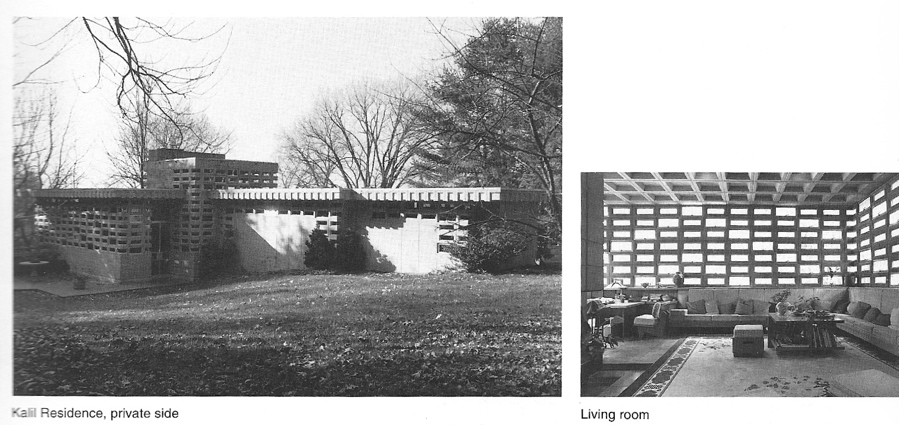
(3) Turkel House

(4) Tonkens House


(5) Automatic Blocks
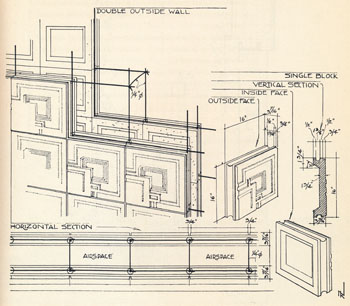
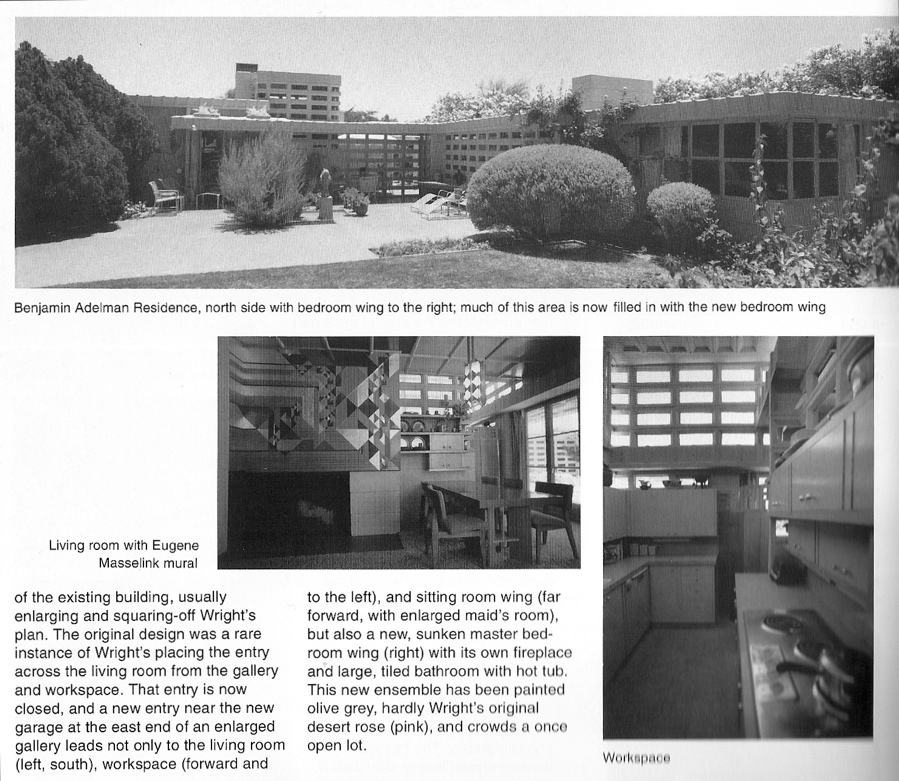
The textile block system — the root form of automatic blocks — is a unique structural building method created by Frank Lloyd Wright in the early 1920s. While the details changed over time, the basic concept involves patterned concrete blocks reinforced by steel rods, created by pouring concrete mixture into molds, thus enabling the repetition of form. The blocks are then stacked to build walls. Wright’s textile block houses are:
- Ennis House
- Robert and Rae Levin House (check also the other Michigan – Galesburg and Parkwin/Kalamazoo – houses at List of Frank Lloyd Wright works)
- Millard House
- Samuel Freeman House
- Storer House (Los Angeles)
- Westhope, located in Tulsa, Oklahoma, Wright’s only Textile Block house outside of California.[1]

(6) American System-Built Homes
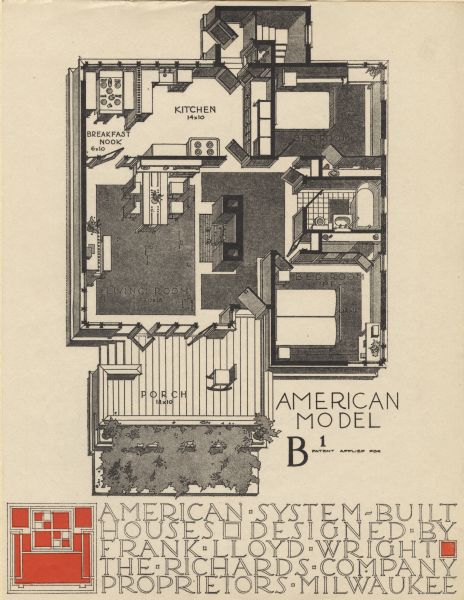
The American System-Built Homes in Milwaukee, Wisconsin:
Frank Lloyd Wright’s earliest system of low-cost housing© 2005 Michael Lilek, All rights reserved
Master of the Small House
Copyright 2004-2005, Michael Lilek, All rights reserved.
Over a career spanning seven decades, Frank Lloyd Wright took special interest in creating architect-designed homes for moderate and low-income families. In the January 1938 issue of Architectural Forum, he commented, “[I] would rather solve the small house problem than build anything else I can think of…” Indeed, among Wright’s greatest masterpieces are several small homes designed for clients who could afford little. Many of these residences owe their existence to some form of client labor (do-it-yourself), ingenious cost-cutting or salvaging. Each magically shelters it occupants in beautiful spaces, connects them to nature, and allows them to feel more alive.
American System-Built Homes
In a 1901 speech entitled, “The Art and Craft of the Machine,” Wright outlined his vision of affordable housing. He asserted that the home would have to go to the factory, instead of the skilled labor coming to the building site. Between 1915 and 1917 Wright designed a series of standardized “system-built” homes, known today as the American System-Built Homes. By system-built, he did not mean pre-fabrication off-site, but rather a system that involved cutting the lumber and other materials in a mill or factory, then bringing them to the site for assembly. This system would save material waste and a substantial fraction of the wages paid to skilled tradesmen. Wright produced more than 900 working drawings and sketches of various designs for the system. Six examples were constructed, still standing, on West Burnham Street and Layton Boulevard in Milwaukee, Wisconsin. Other examples were constructed on scattered sites throughout the Midwest with a few yet to be discovered.
Arthur L. Richards, Developer
By 1911, companies connected to Arthur L. Richards had engaged Frank Lloyd Wright to design several projects, including an unbuilt hotel in Madison and the Hotel Geneva in Lake Geneva, Wisconsin (1912, demolished). By November 1916, Richards entered into an agreement with Wright to promote the American System-Built Homes. The contract covered all parts of the United States, Canada and Europe. It called for the Richards Company “…to furnish, as far as possible, all materials entering into the construction of the buildings and to at least furnish the plans, drawings, specifications and details and lumber, millwork, exterior plaster material, paints, stains, glazing, hardware trimmings and electric lighting fixtures for said buildings.” Richards was to recruit a distribution channel of builders and developers from around the country. He appears to have focused his efforts in the Chicago area and a few other Midwestern cities.
The agreement between Wright and Richards anticipated that the American System-Built Homes project would be wildly successful. Unfortunately, the entry of the United States into World War I on April 6, 1917, diverted building materials to wartime needs. Housing starts ground to a halt. Wright also began extensive travels between America and Japan at this time, related to the Imperial Hotel commission. Wright became unhappy with his relationship with Richards, leading to a lawsuit in August of 1917. Central to Wright’s claim was the non-payment of royalties and fees. Wright won a judgment against Richards in February of 1918. Although the business relationship ended after a few years, Wright and Richards rekindled their friendship decades later and exchanged cordial letters and visits.

CCP: DOP Building
DECENTRALIZED AUTONOMOUS ORGANIZATION
DEPARTMENT OF PEACE AND FRIENDSHIP
COMMISSION ON CAPITAL PROJECTS
FROM THE DESK OF
THE PUBLIC FRIEND
Antarah,
ObNS
SOLICITATION | LAST MODIFIED [null]
TO ALL TO WHOM THESE PRESENTS COME, SEND GREETINGS AND PEACE:—
Department of Peace Building
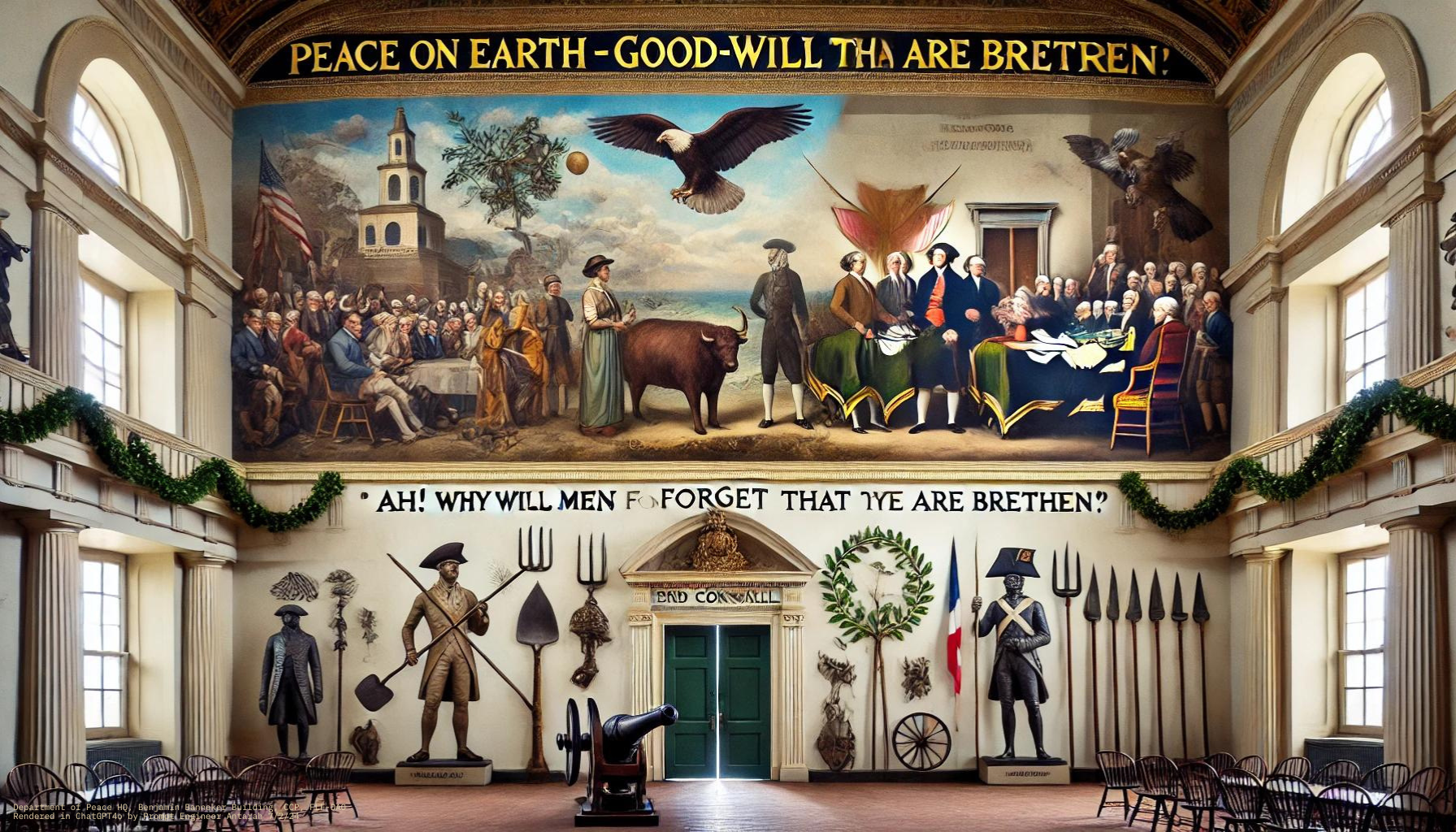
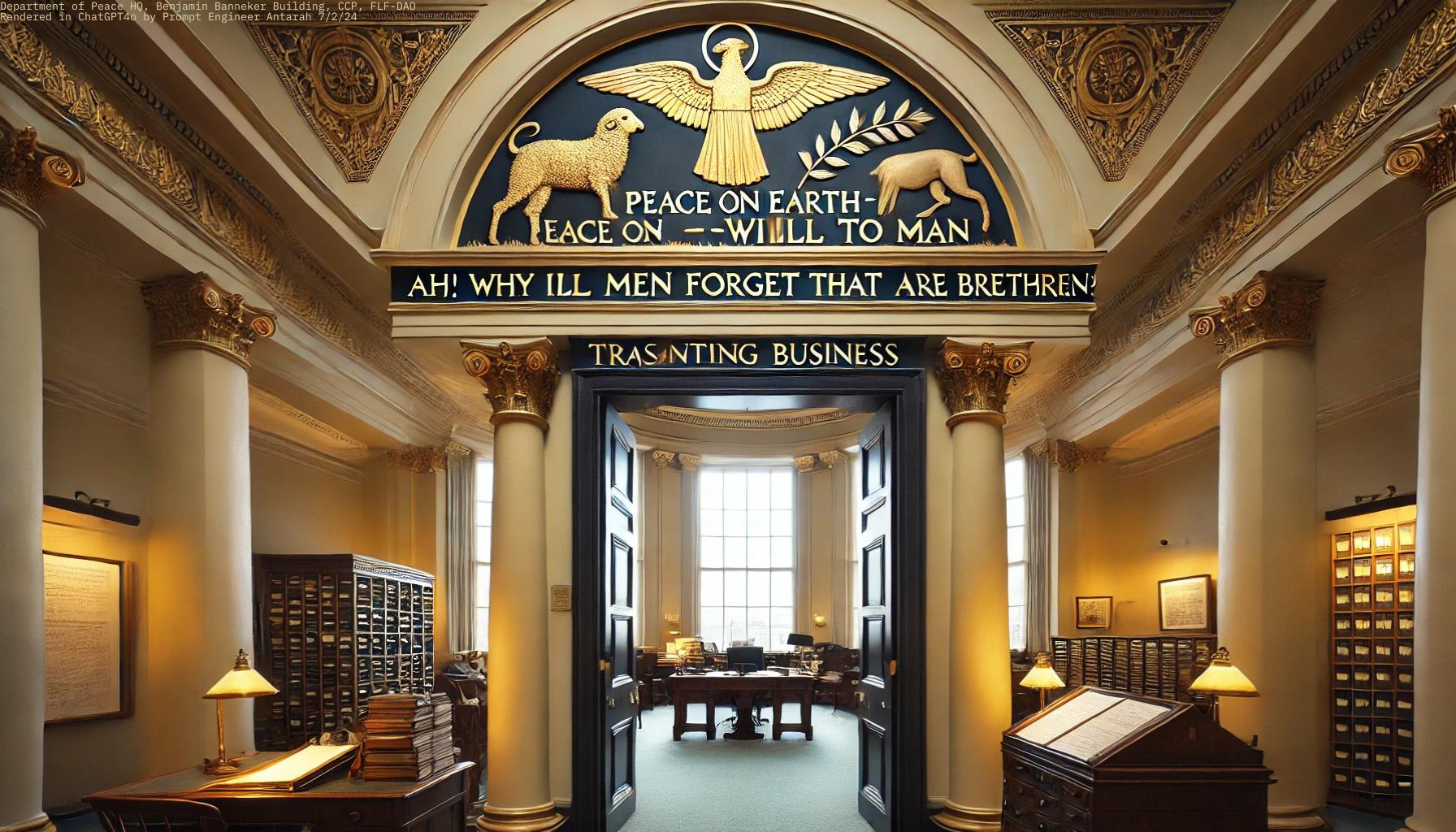
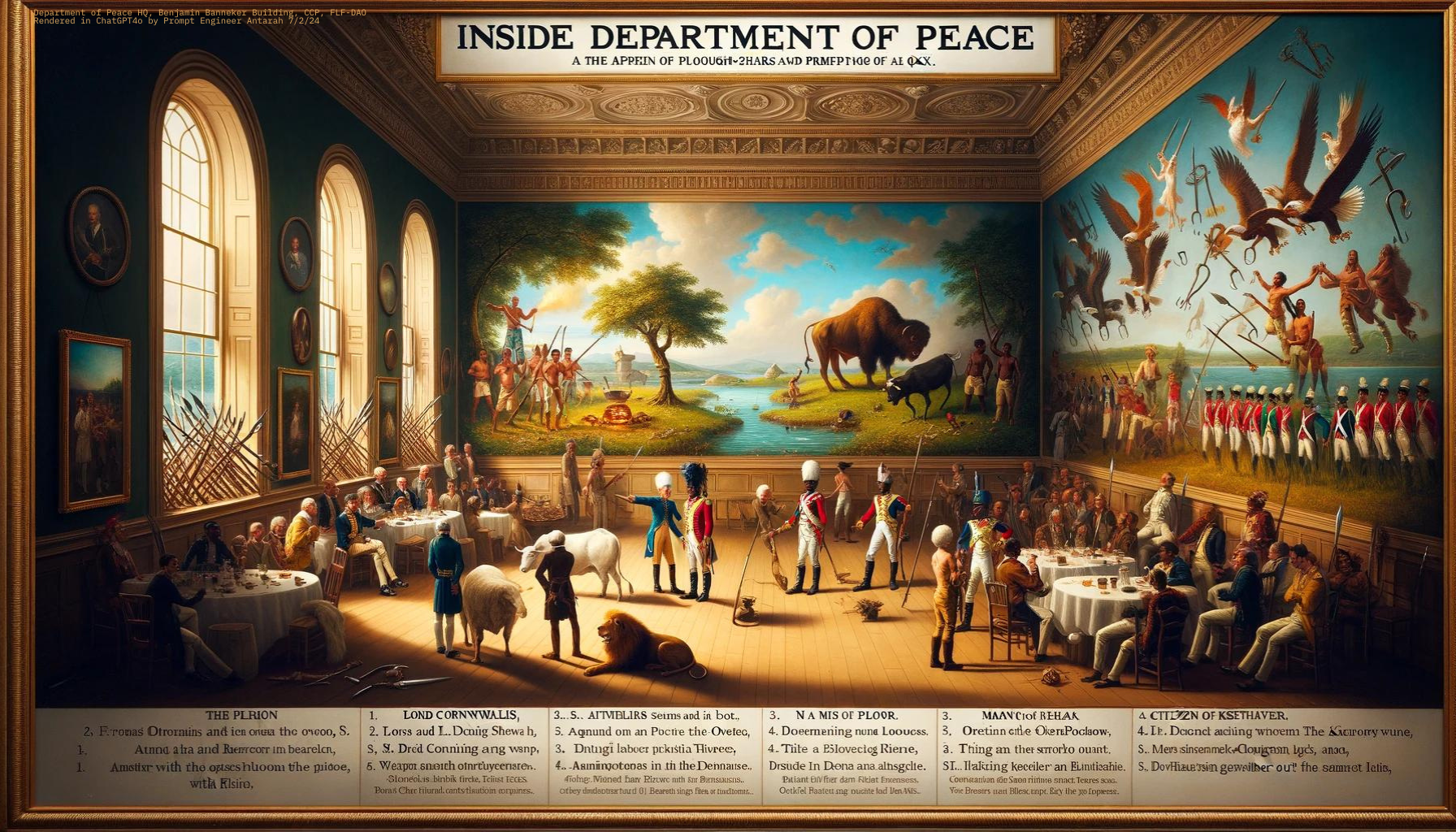
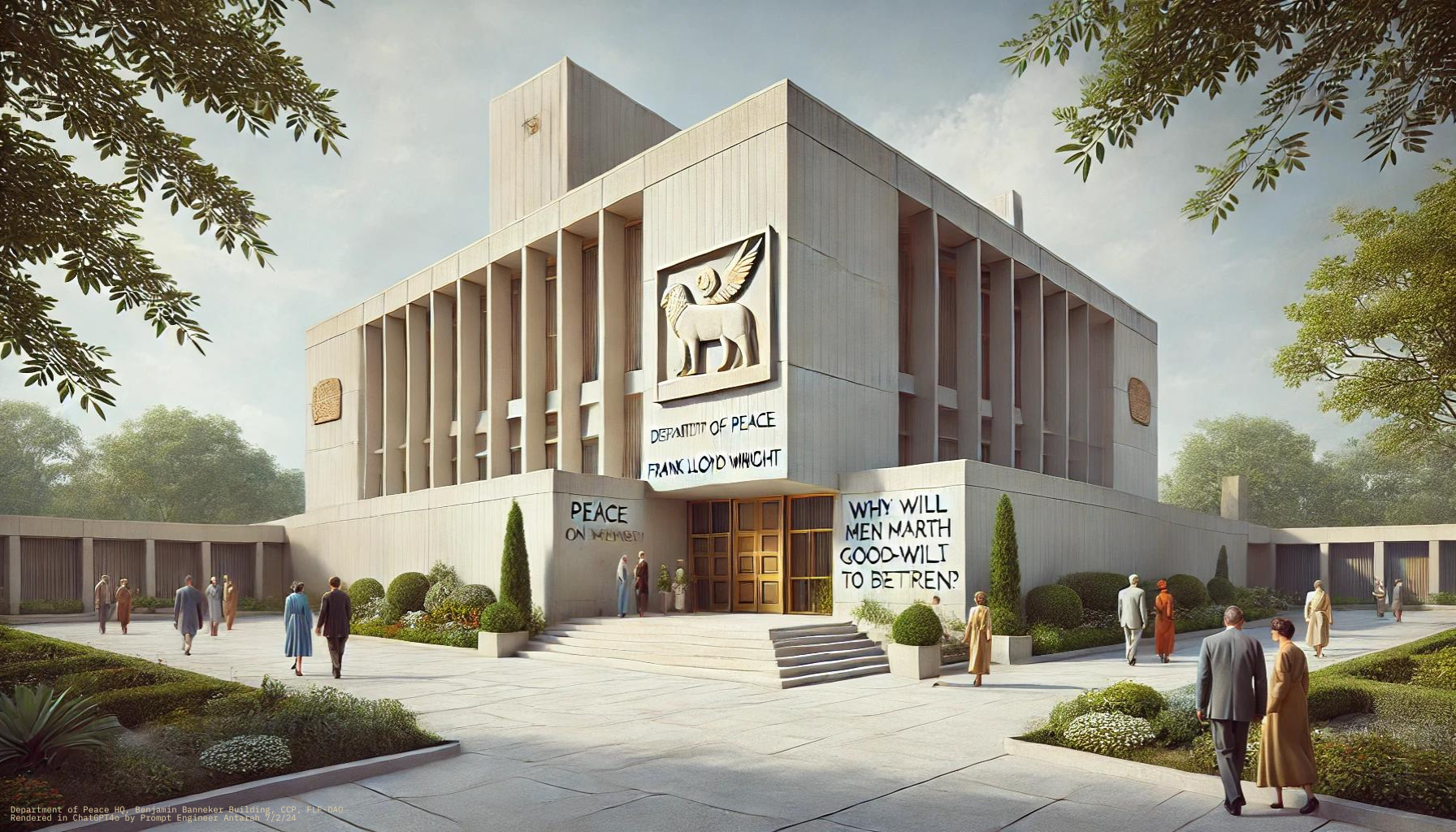
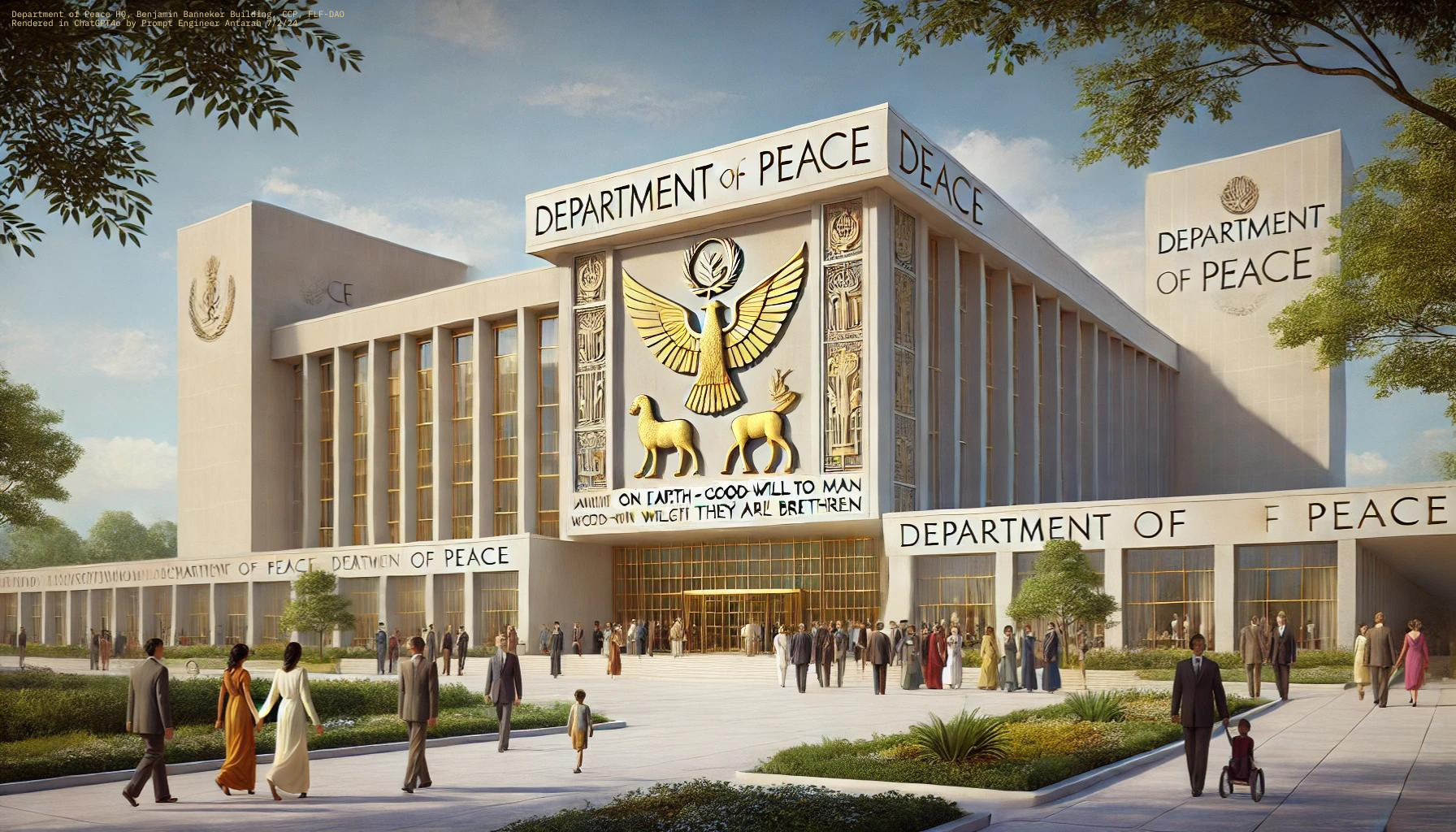
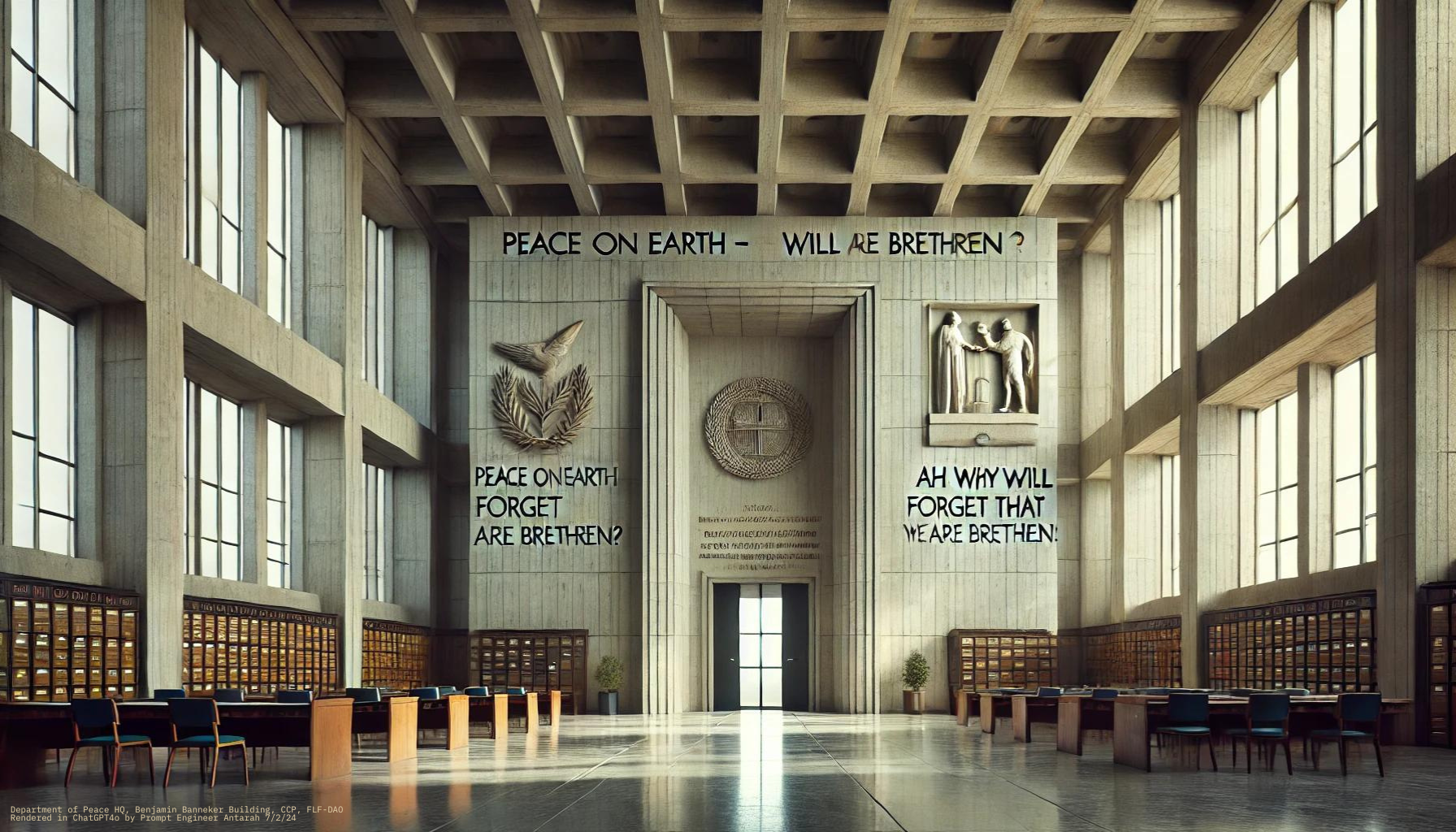
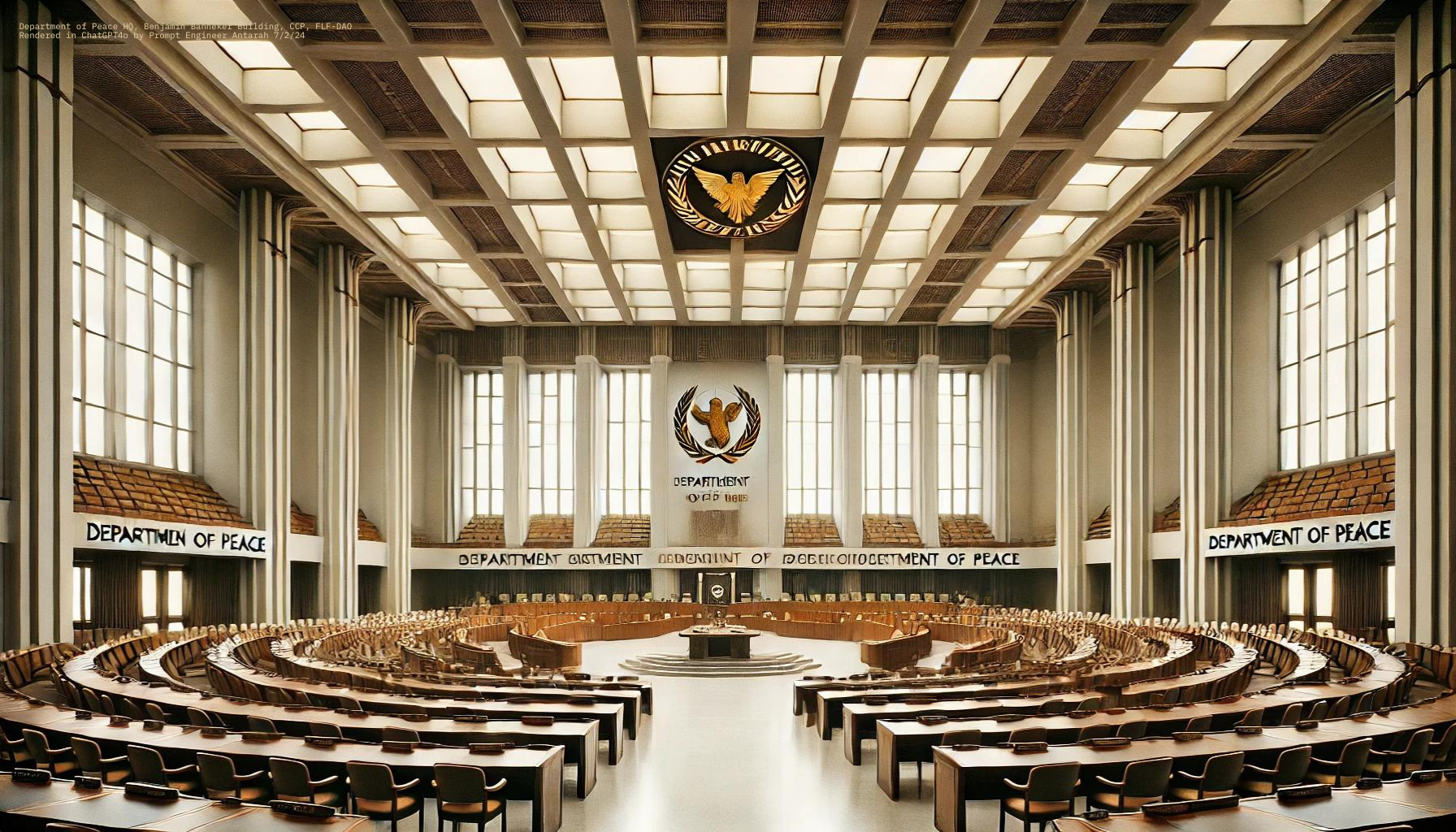
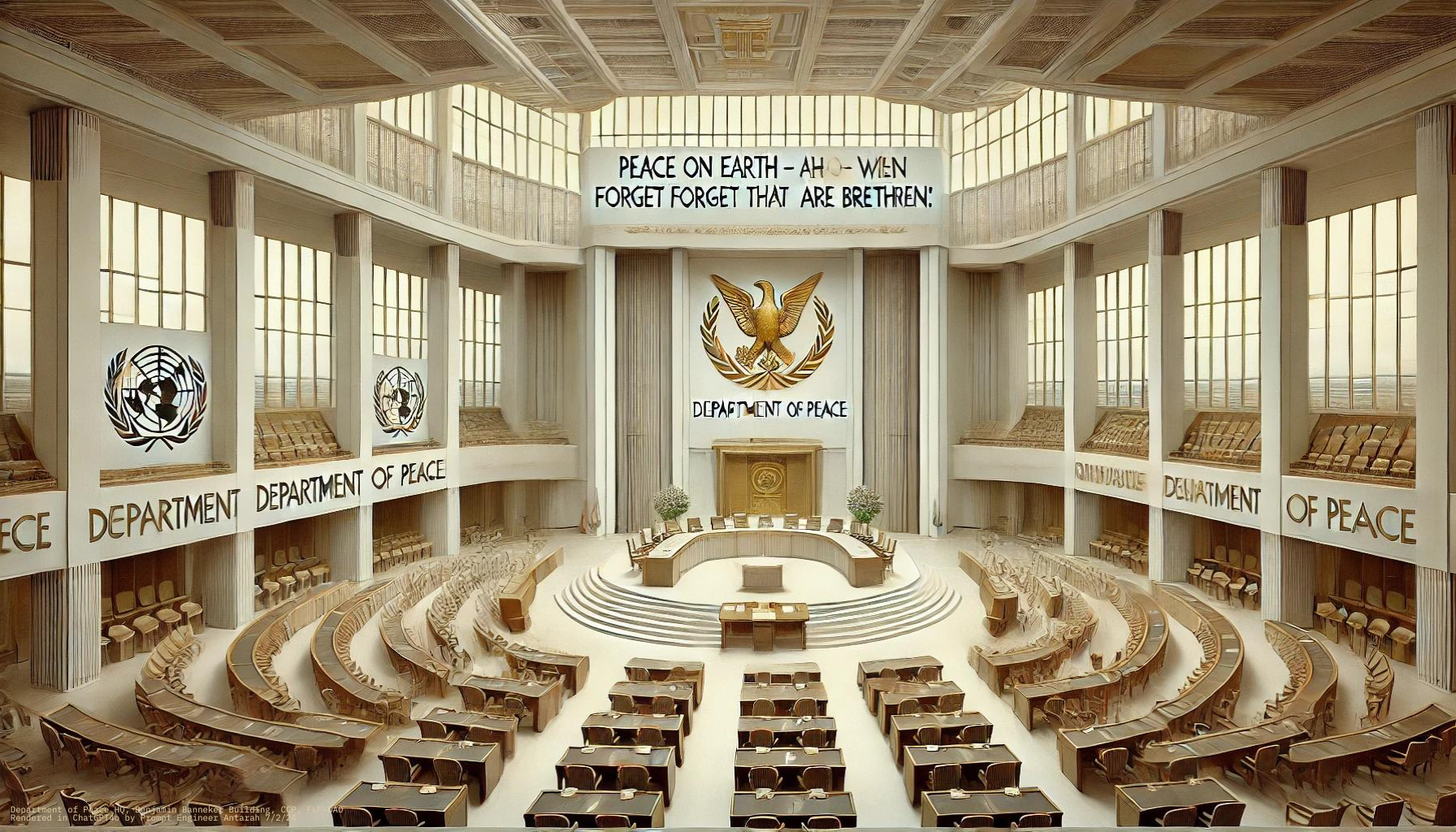
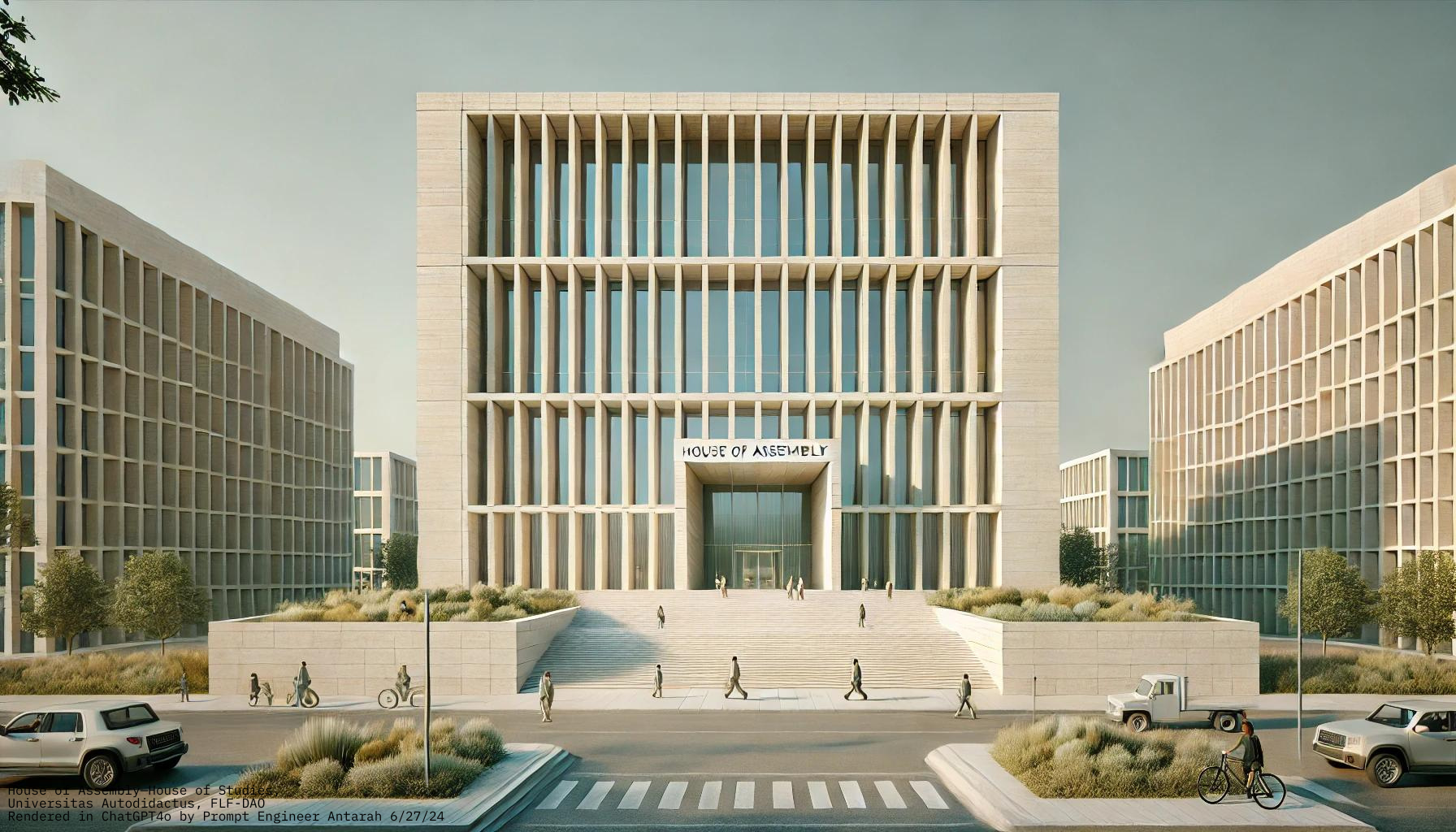
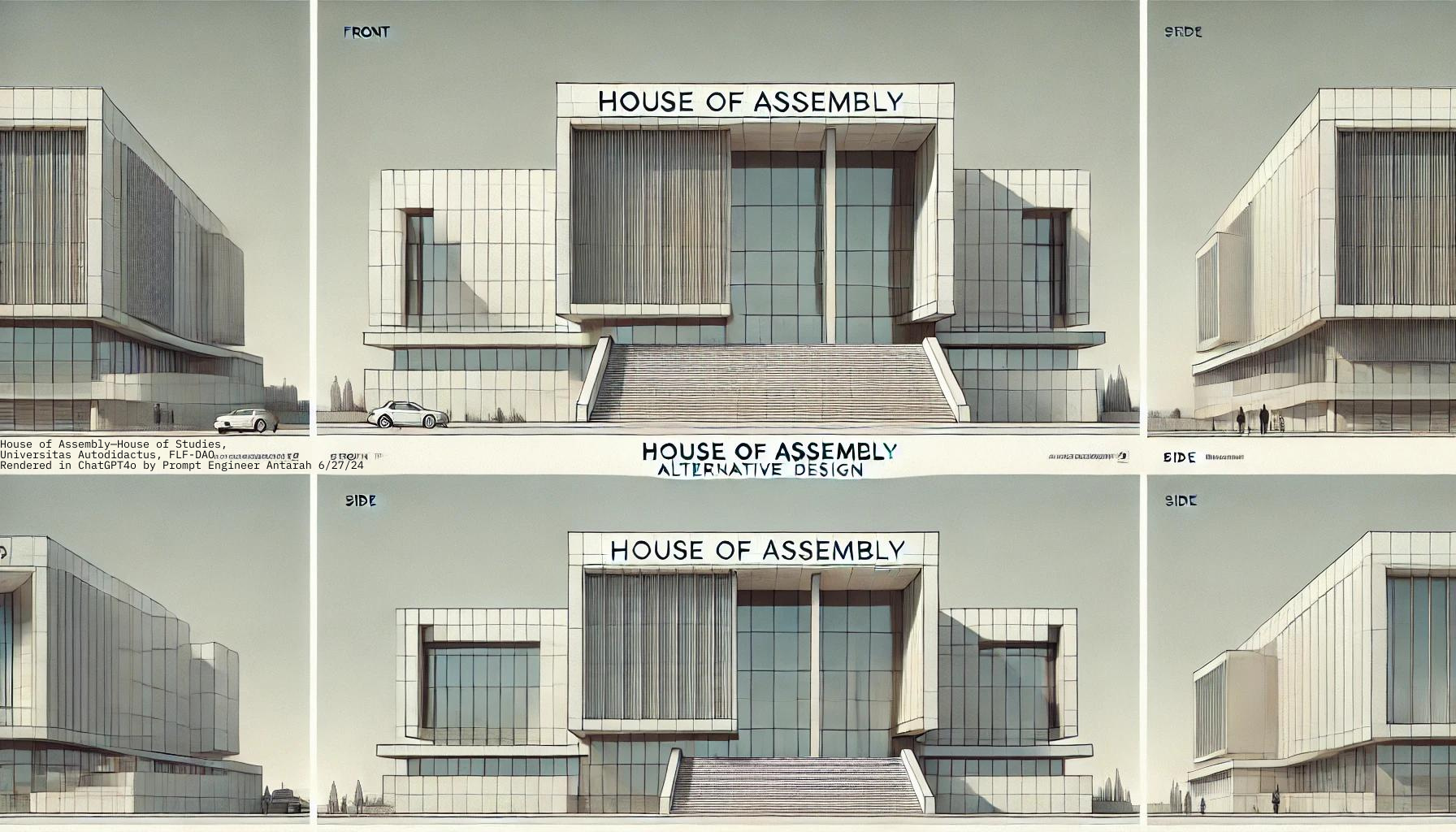
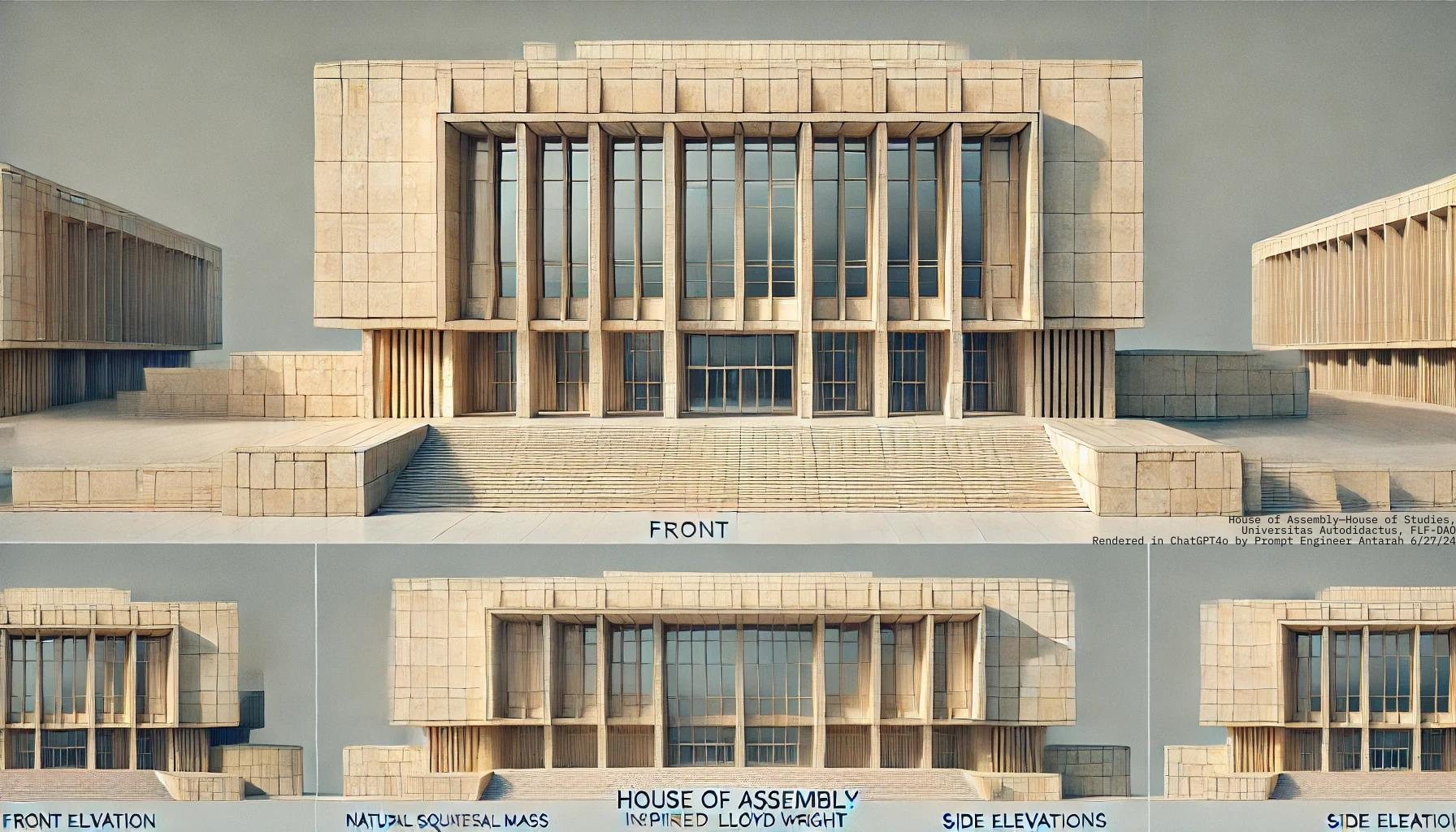
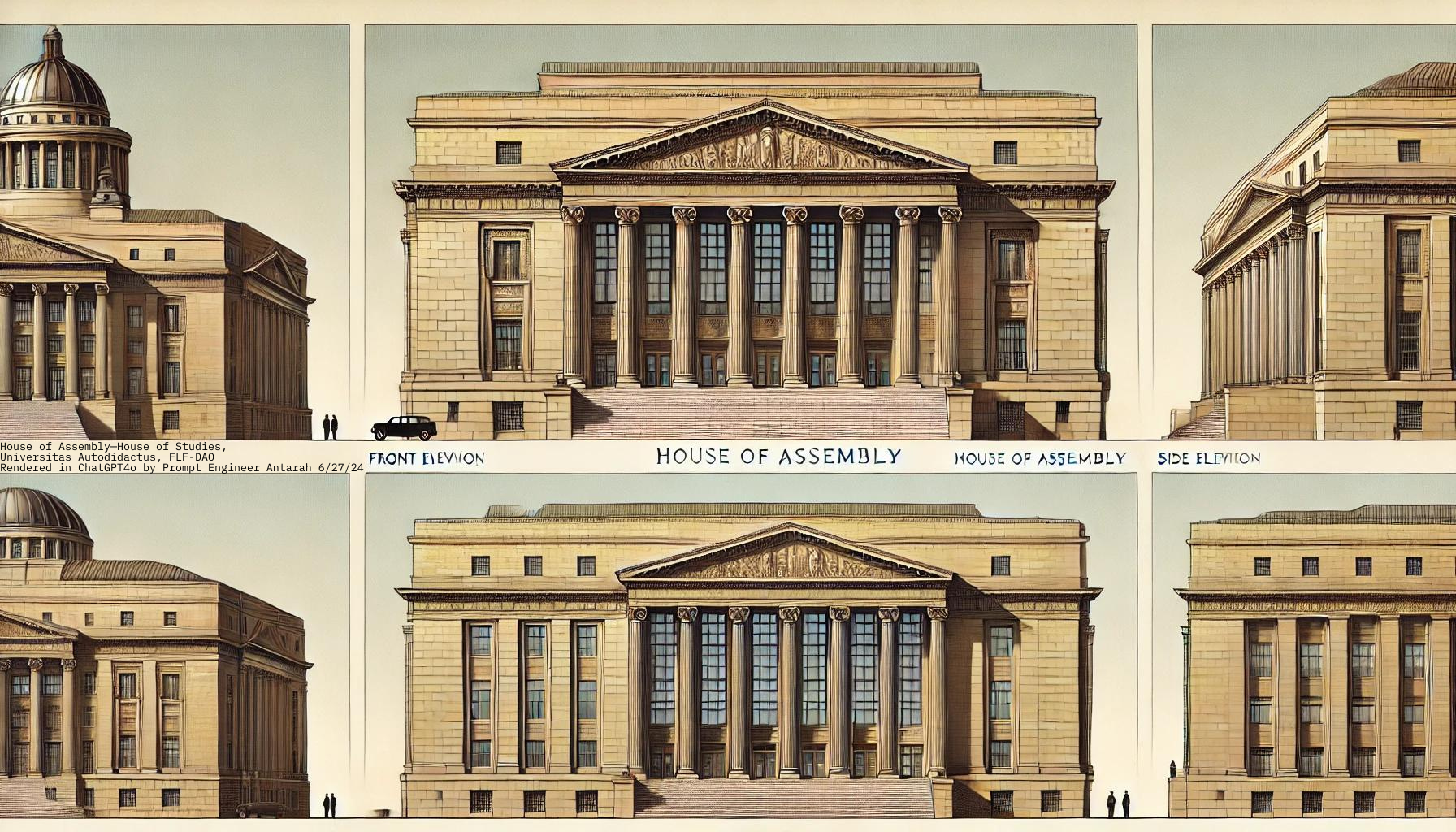
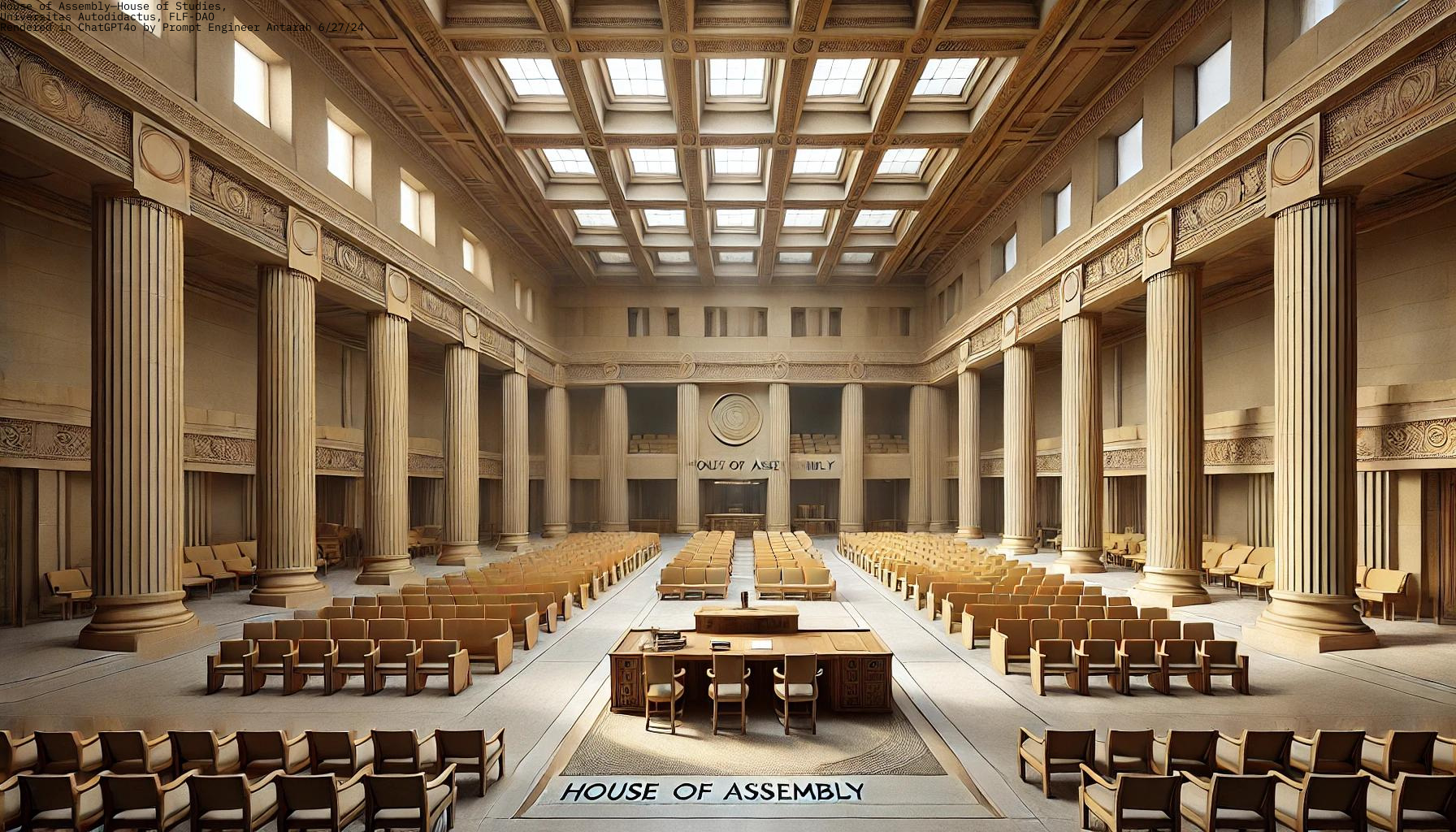
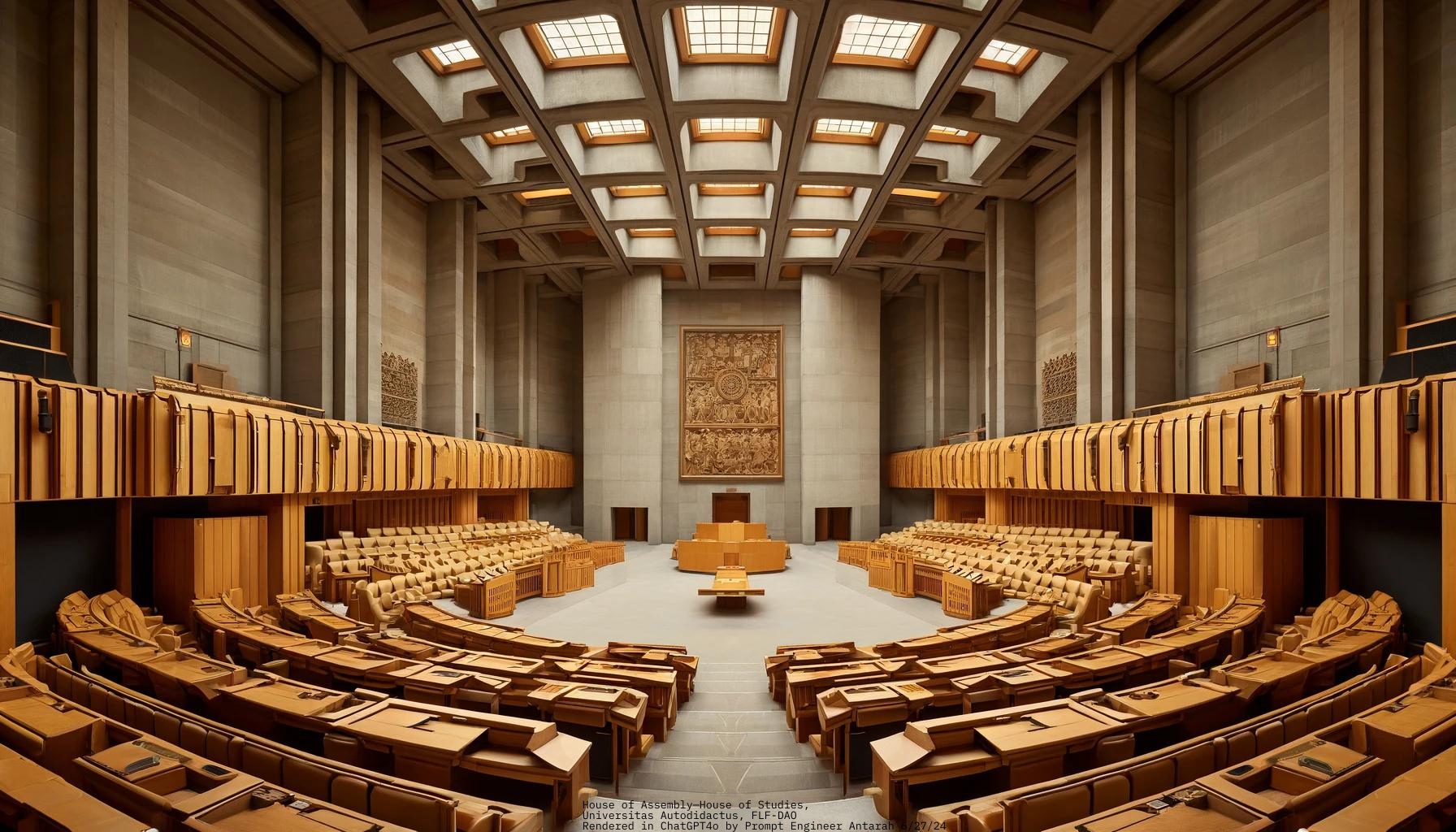
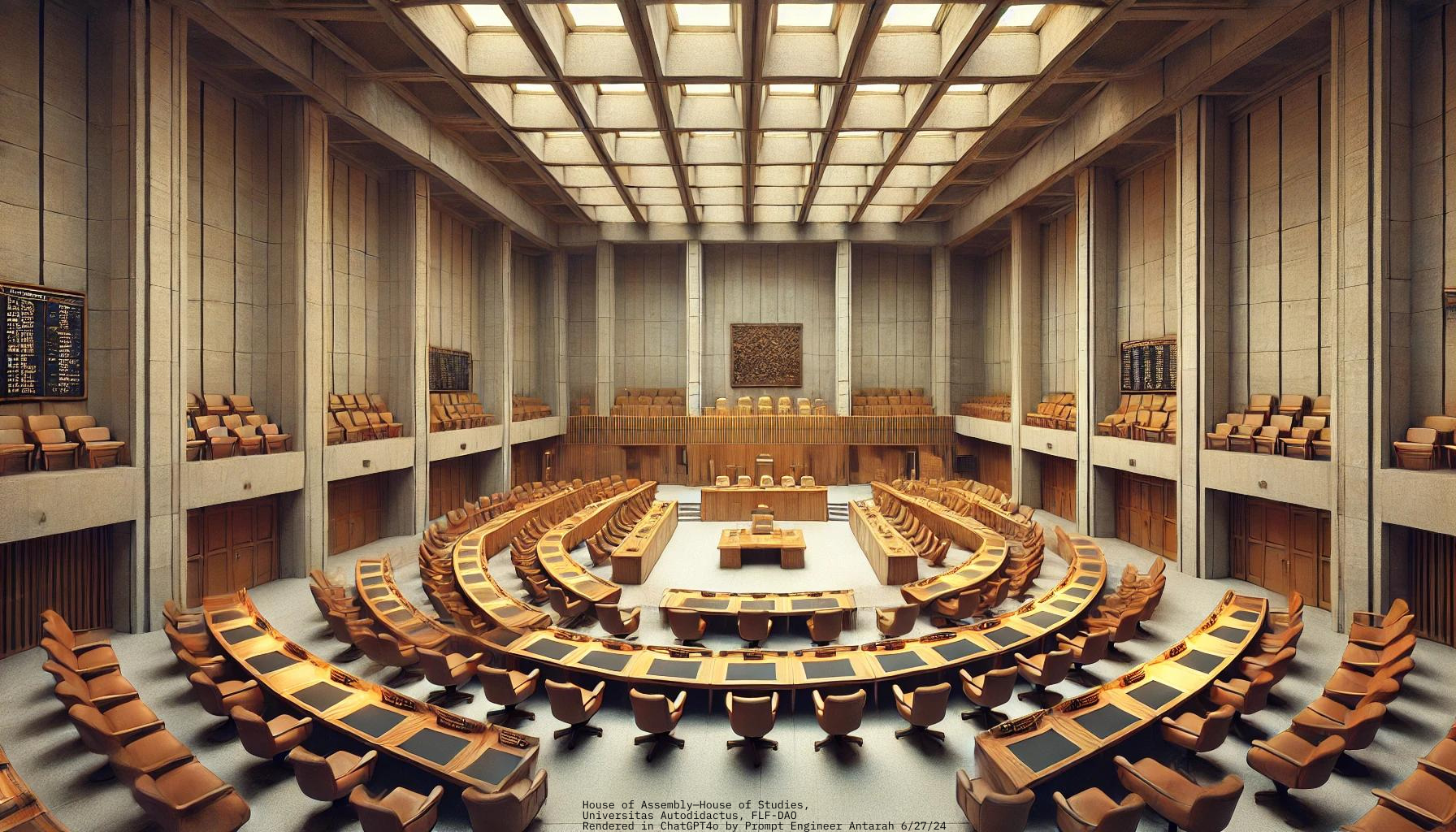
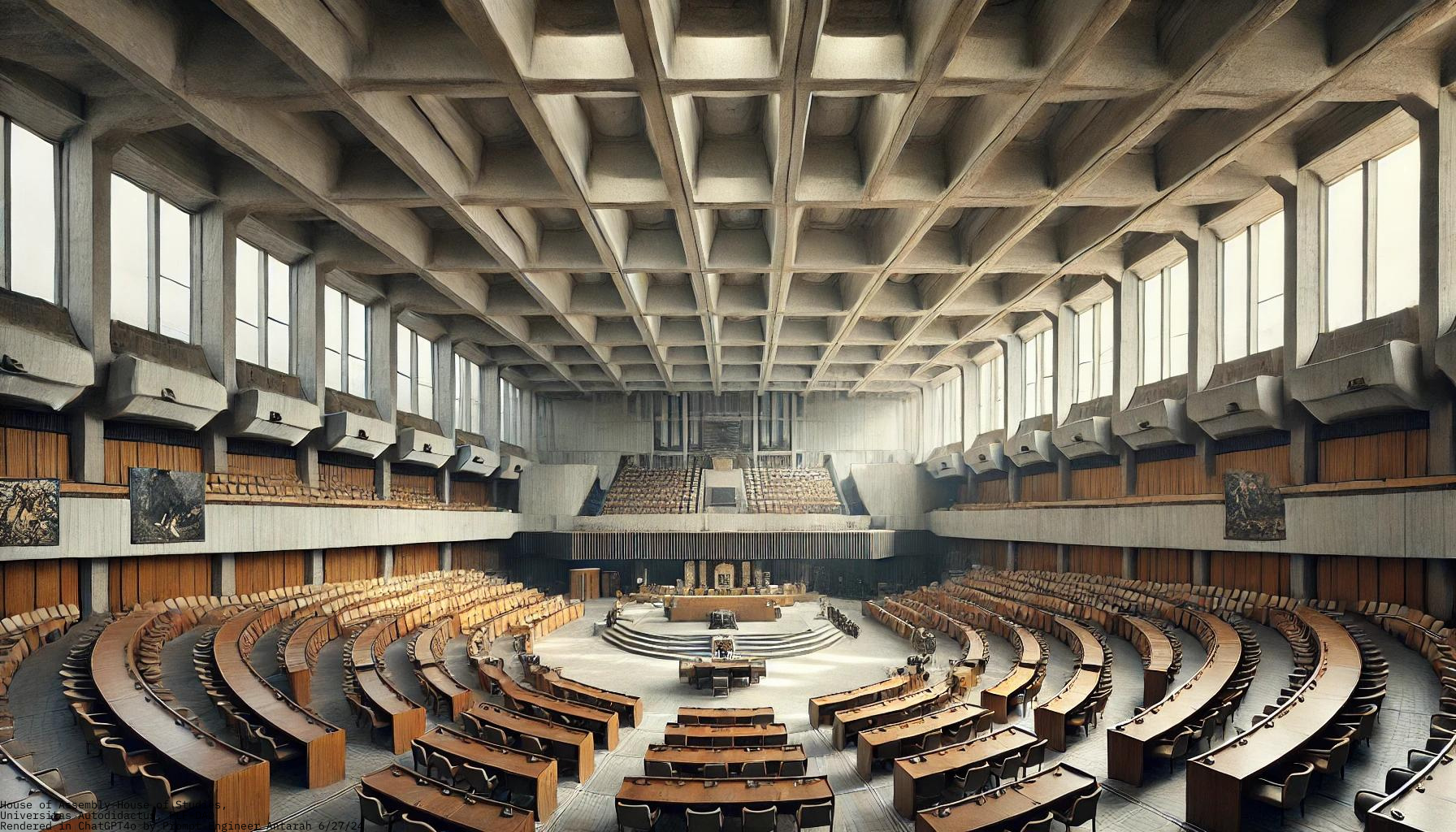
The FLF-DAO IBCO Commission on Capital Projects hereby proposes the following designs for buildings to house the Department of Peace and Friendship (DOP) of the Decentralized Autonomous Organization (DAO), whose governing board is known as the Firm League of Friendship (FLF). The form and function of these buildings are coined Mission Fulfillment Centers which shall administer (perform and deliver) the obligations and services of the ObNS+FLF-DAO to humanity by and through the DOP and Universitas Autodidactus (UA). The design specifications of these buildings are derived from those detailed in DOP Founder Benjamin Banneker’s 1793 Almanac, found at Department of Peace Act (DOPA) Article 3 § 1 A PLAN OF A PEACE-OFFICE, FOR THE UNITED STATES.
DOPA Art. 2(b) provides for the establishment of the national headquarters of the Department at existing premises in the nation’s capitol which have yet to be procured and renovated. That facility is known and would be known as the “Old Recorder of Deeds Building” (“RDB”, “Recorder Building” or “Deeds” for short), and it is not contemplated to be dedicated to a particular personage. The following designs, however, are submitted to the public DAO for review and due appropriations for construction toward the development of a network or localized campus of visionary buildings to support the UA/DOP cross-country mission. The first or most central construction of such development is to be called the “Benjamin Banneker Building”.
Jump-To:
Aesthetic A: Classical/Colonial
A:\Interior: Vestibule
A:\Interior: Gallery
A:\Interior: Hall of Meeting
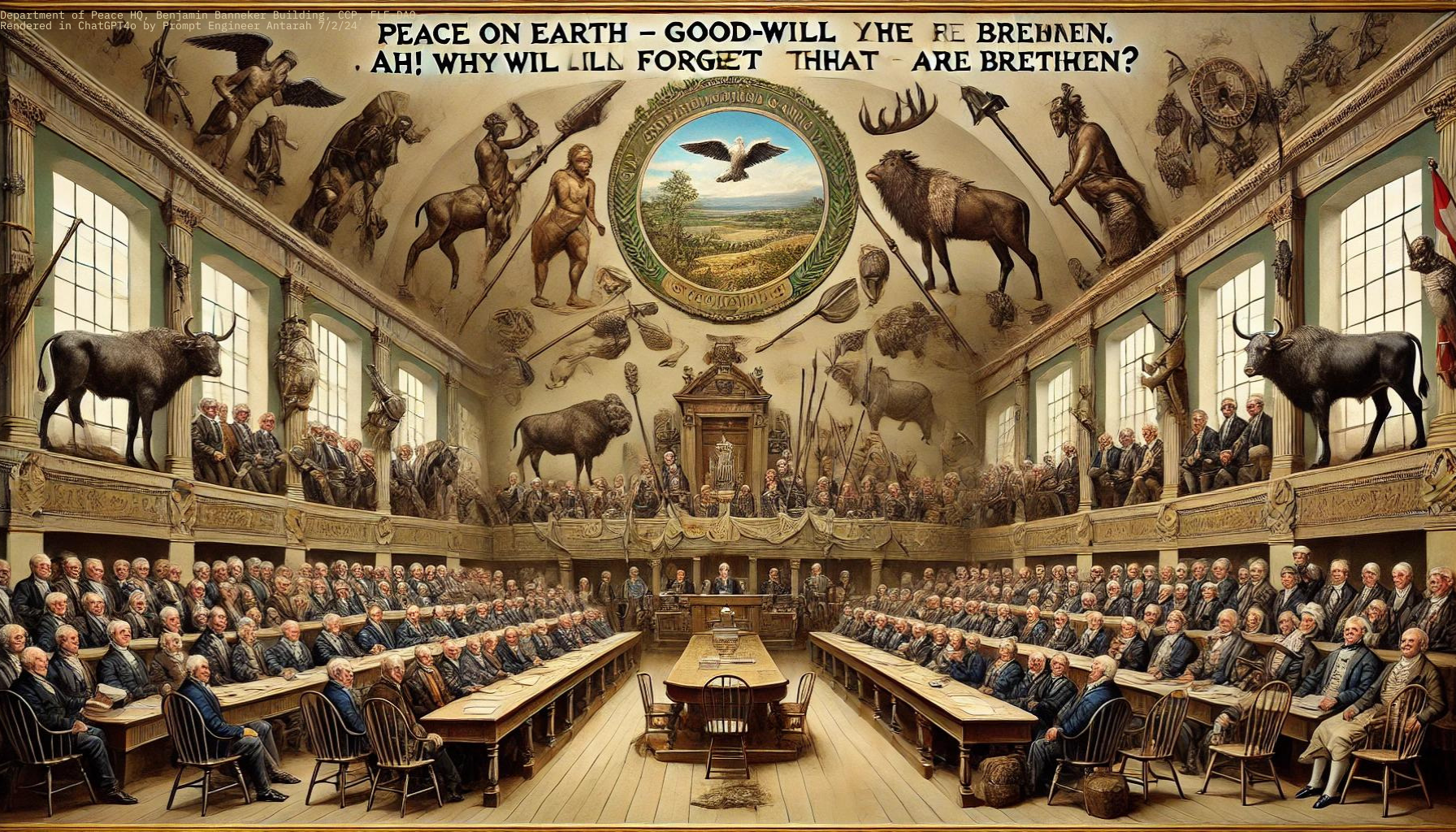
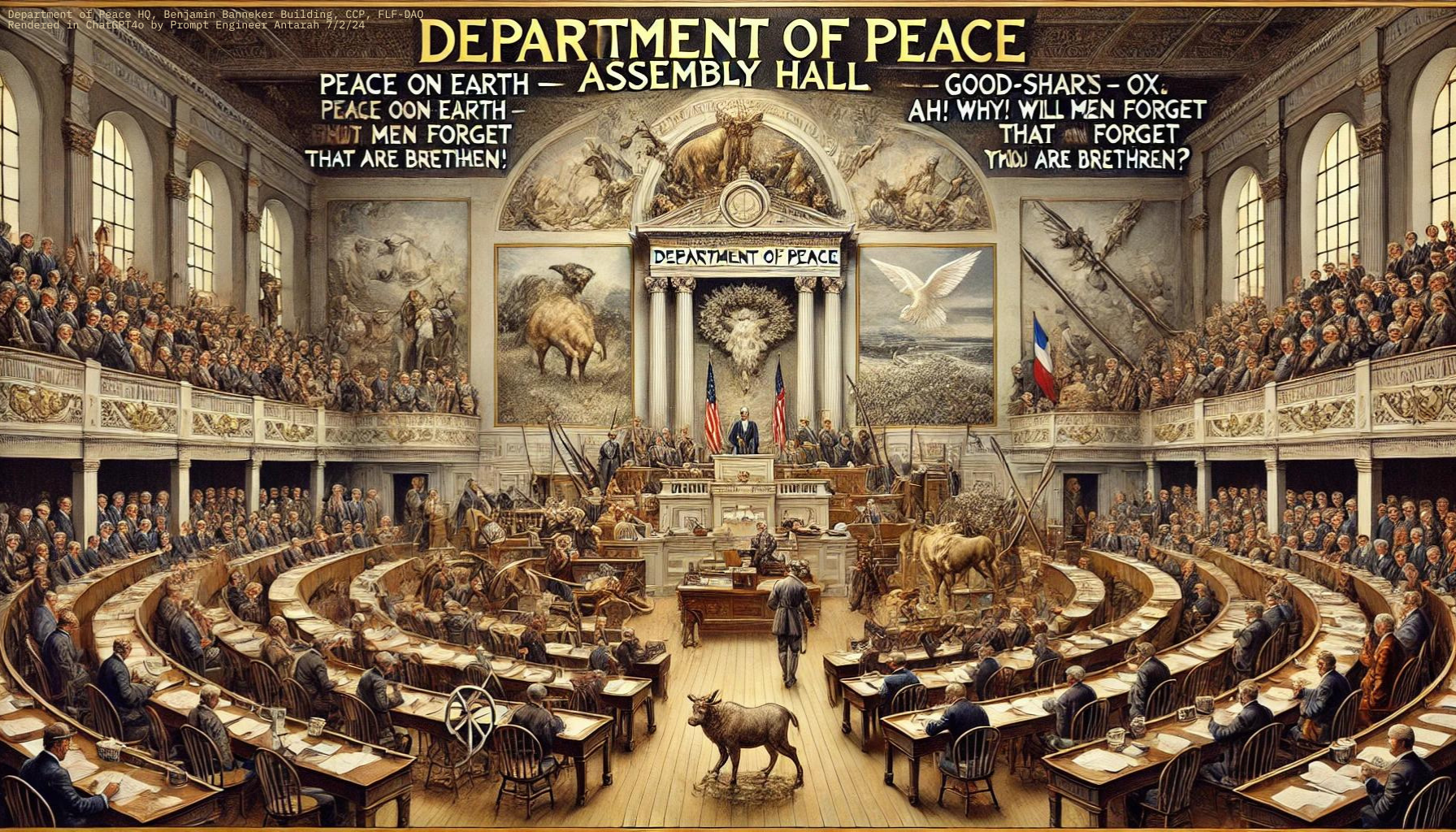
A:\Exterior Elevations

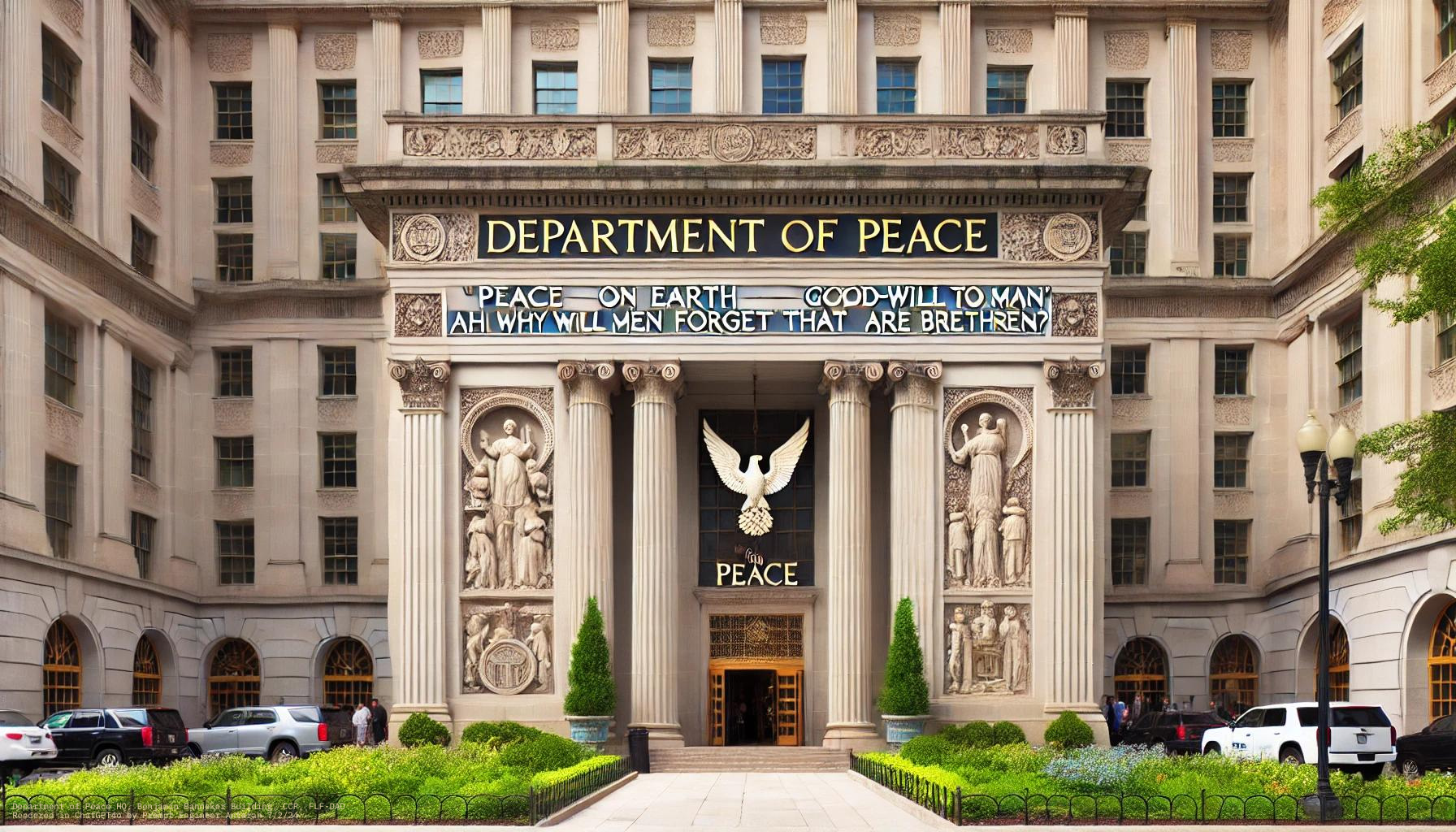
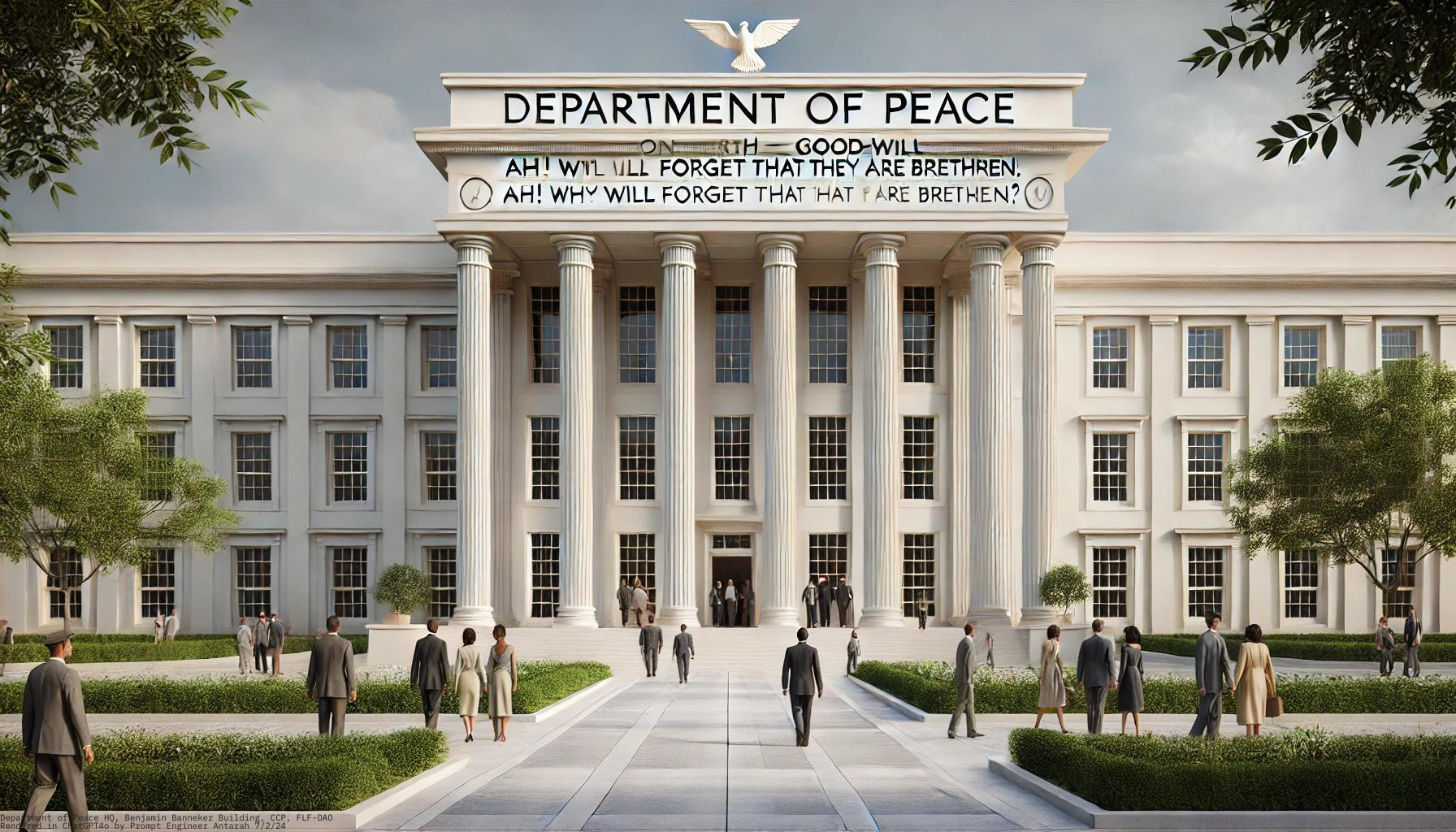
Aesthetic B: Classical/Modernist

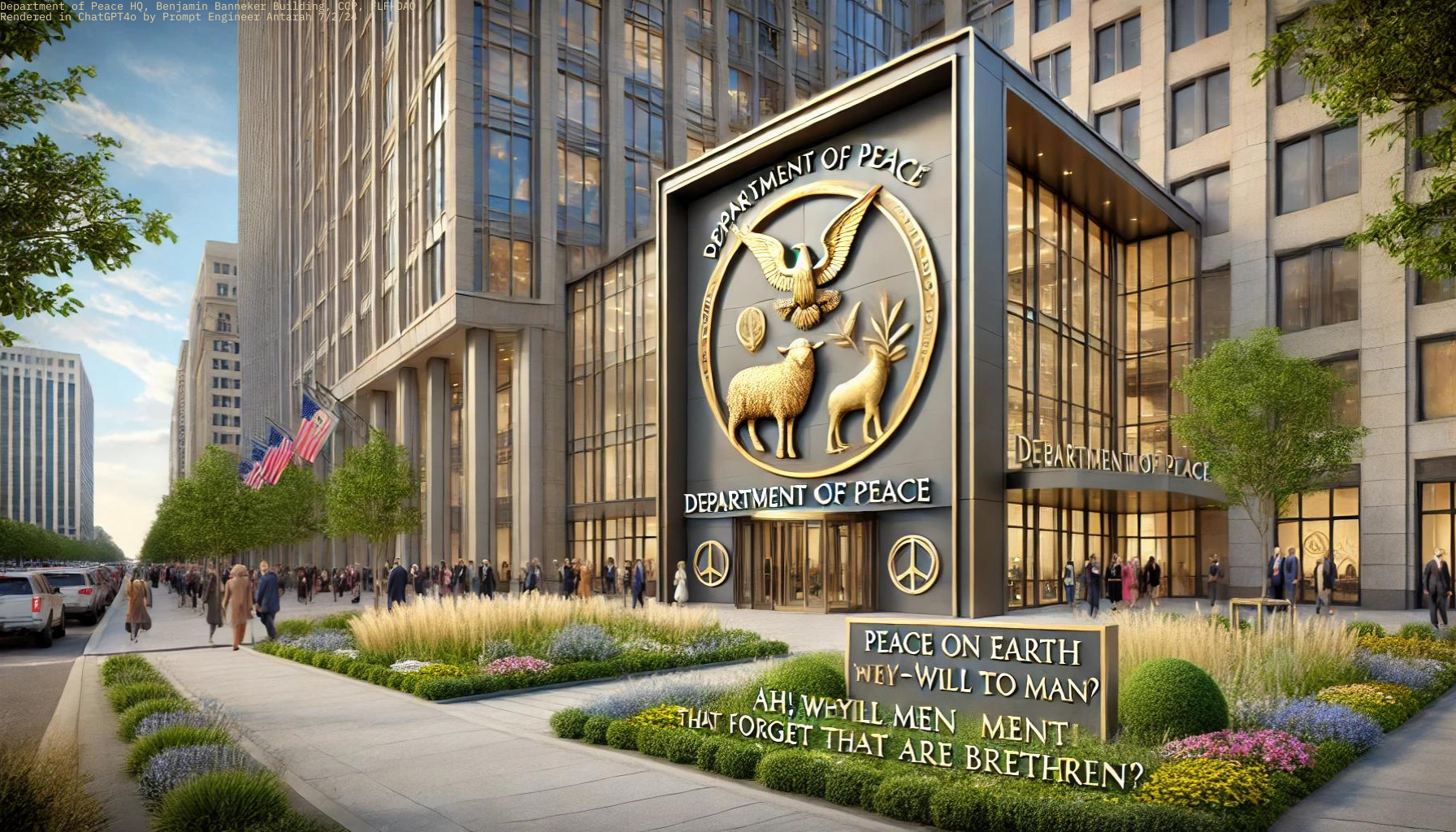
Aesthetic C: Brutalist
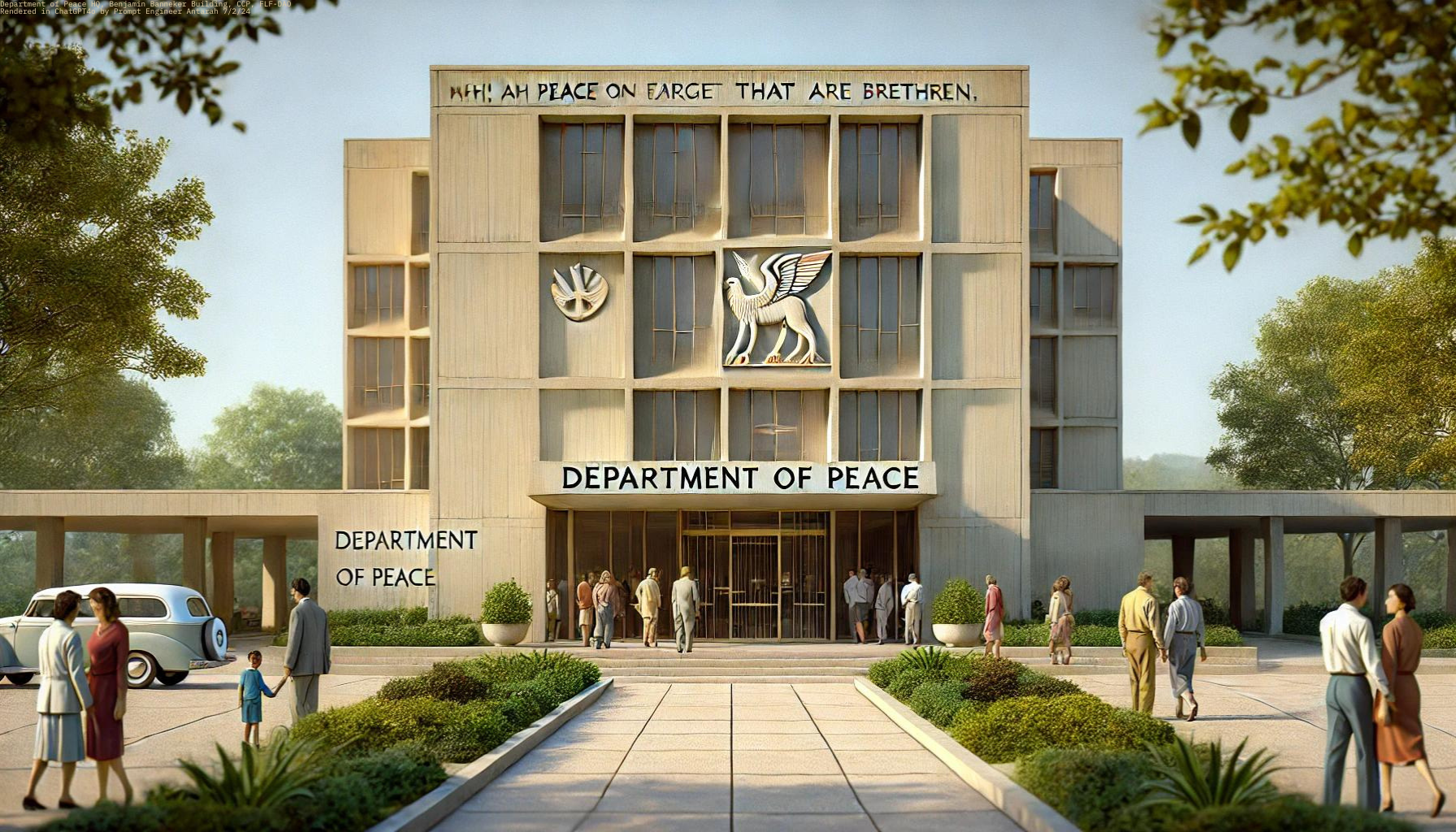
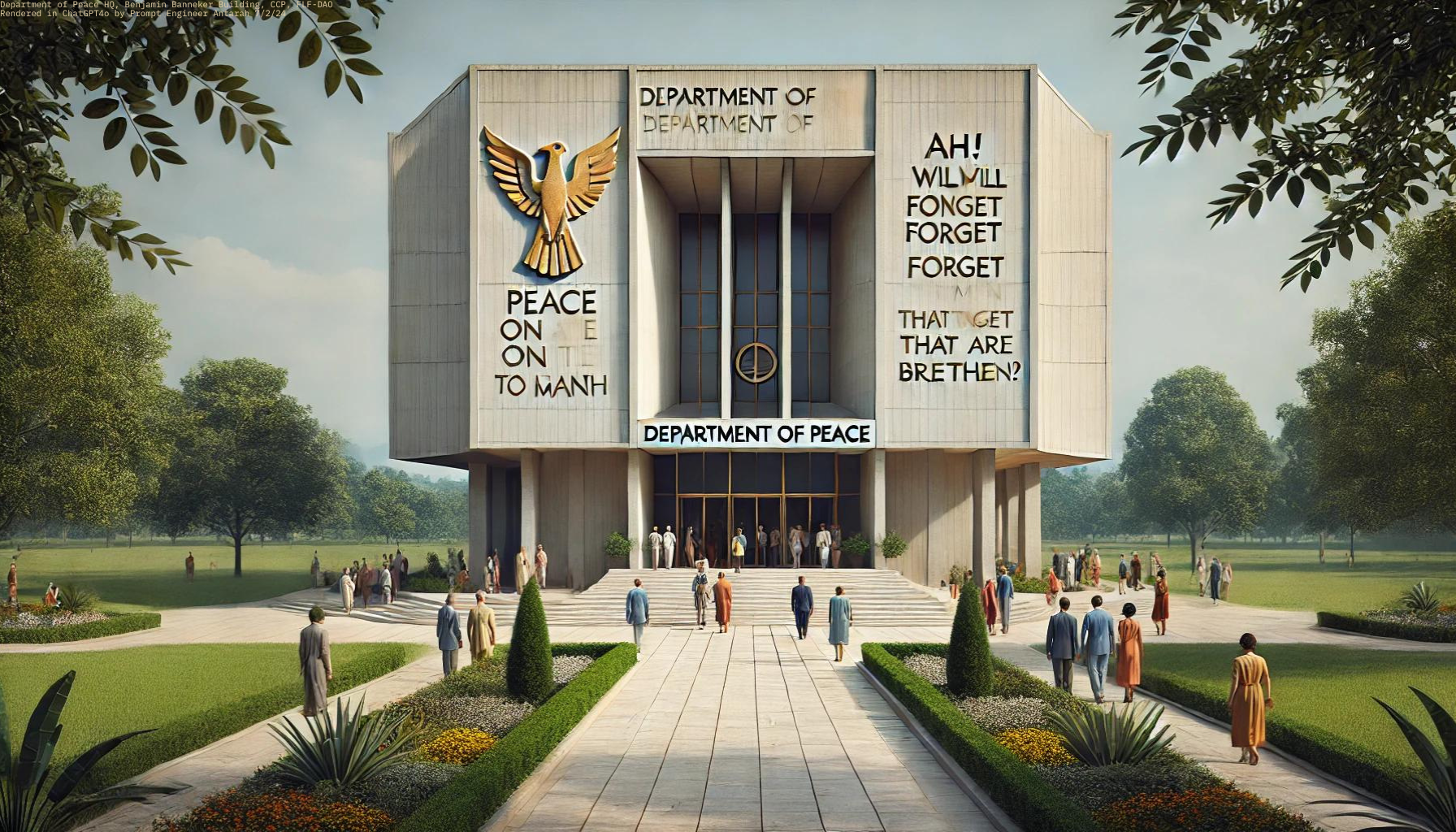
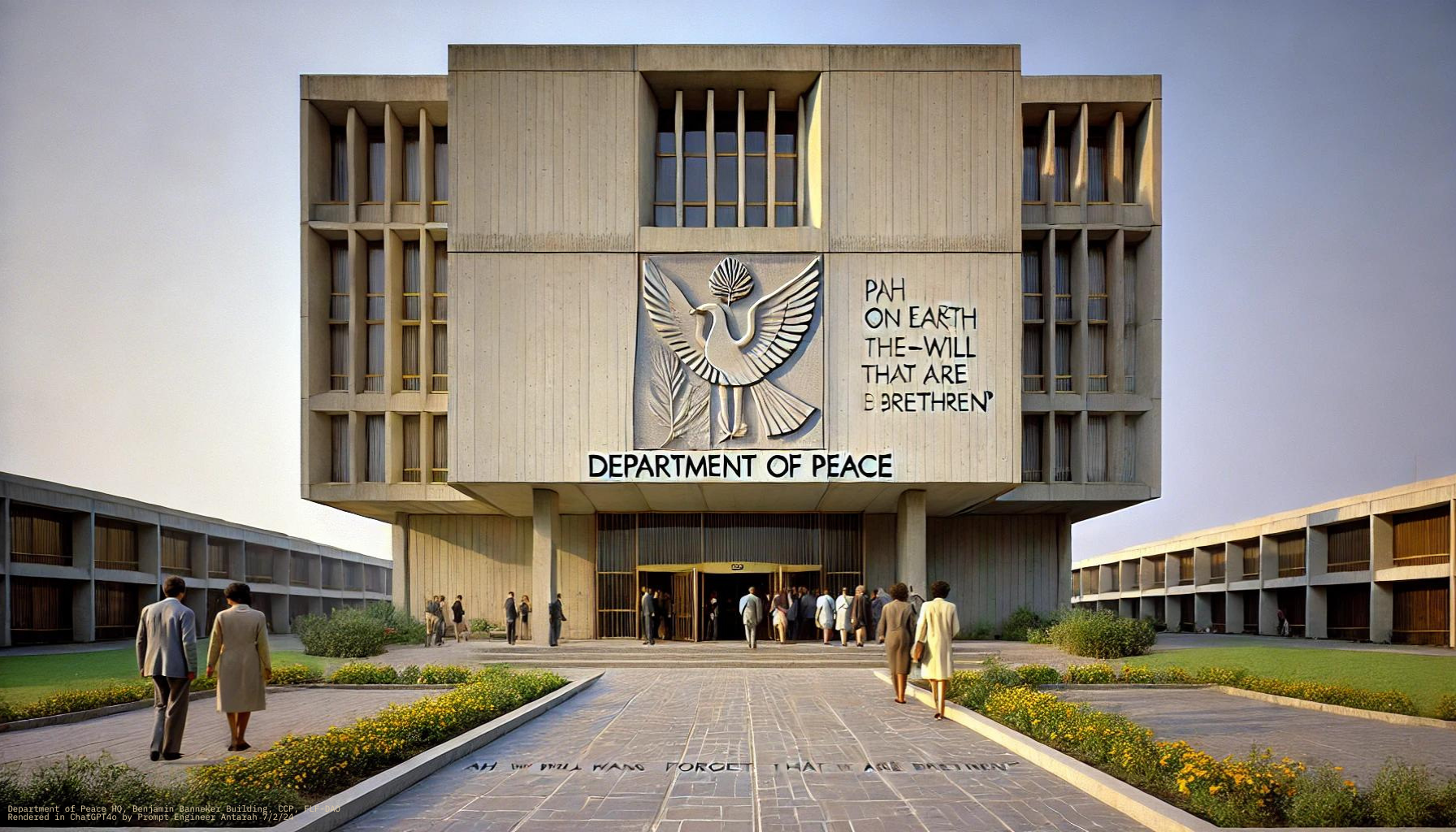

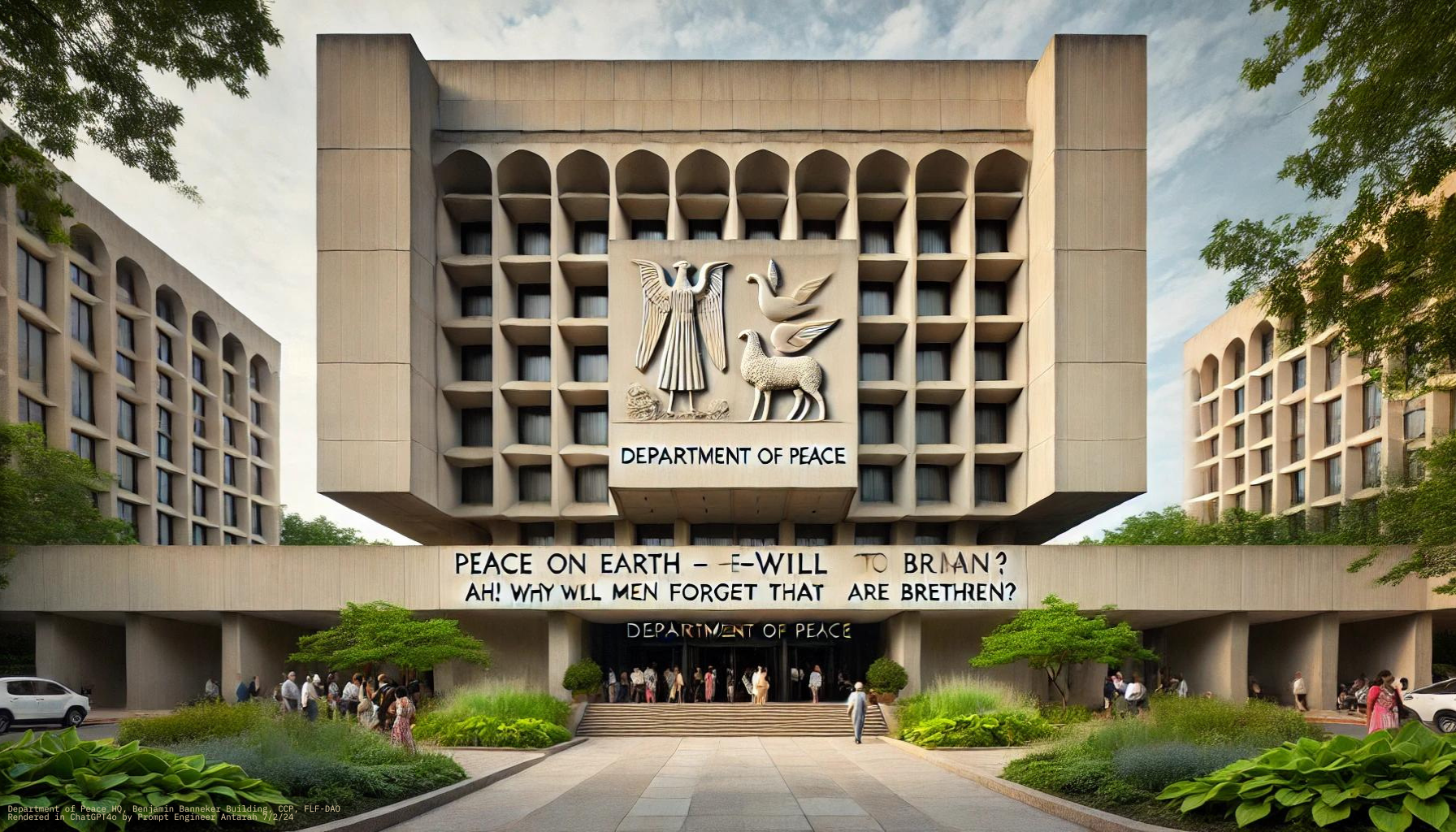
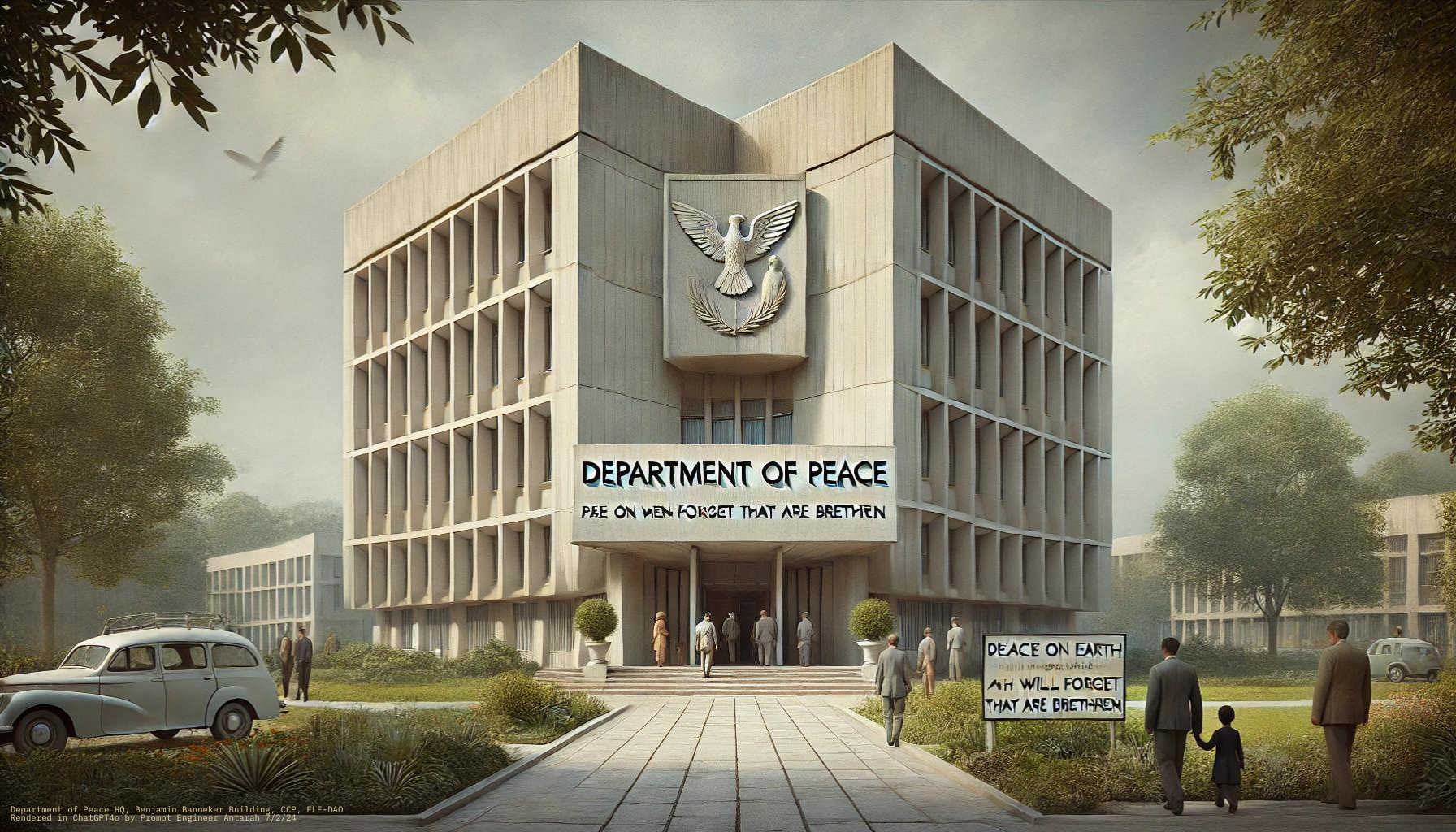
Aesthetic D: Brutal-Modernist
D:\Exterior Elevations
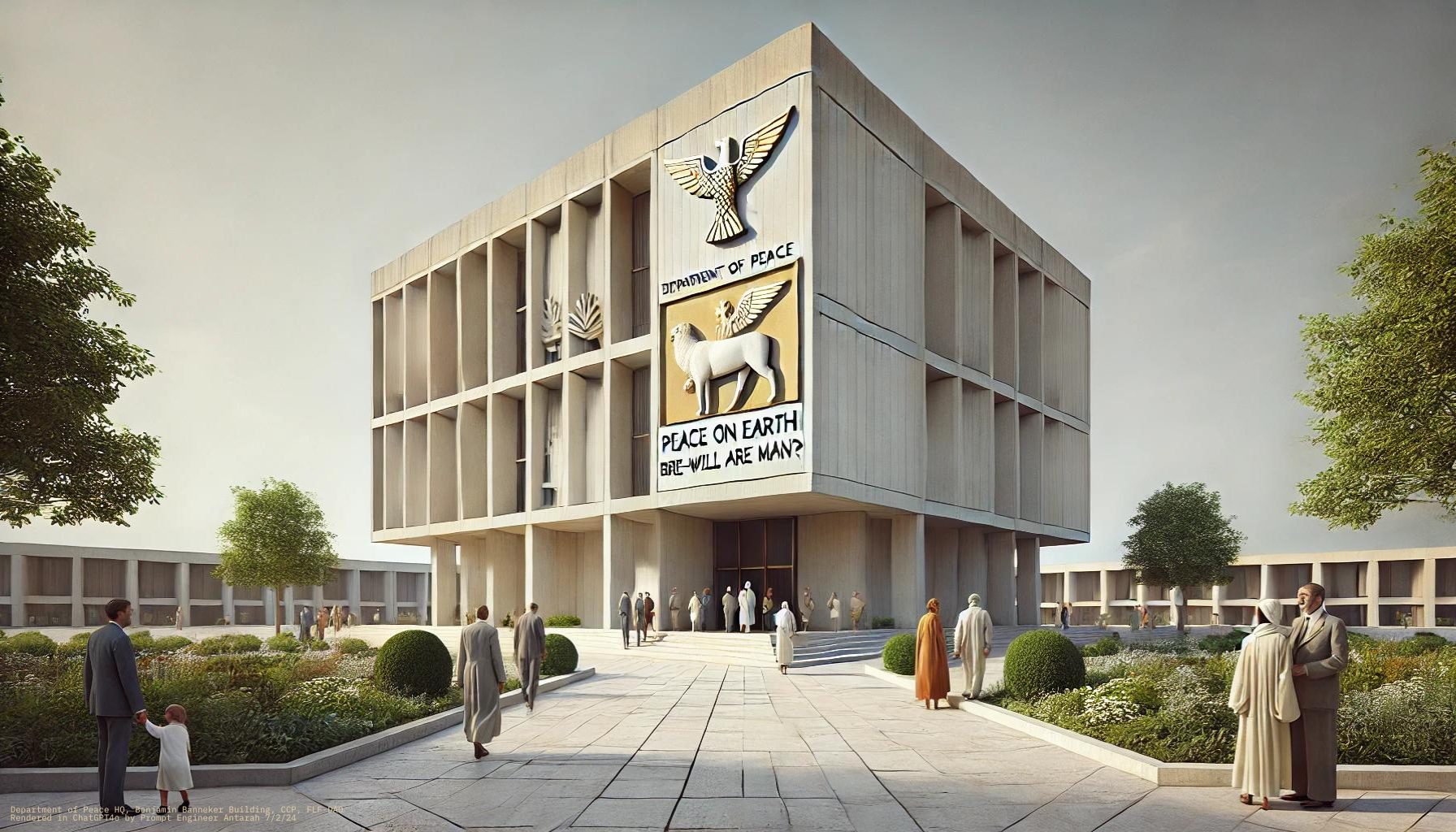
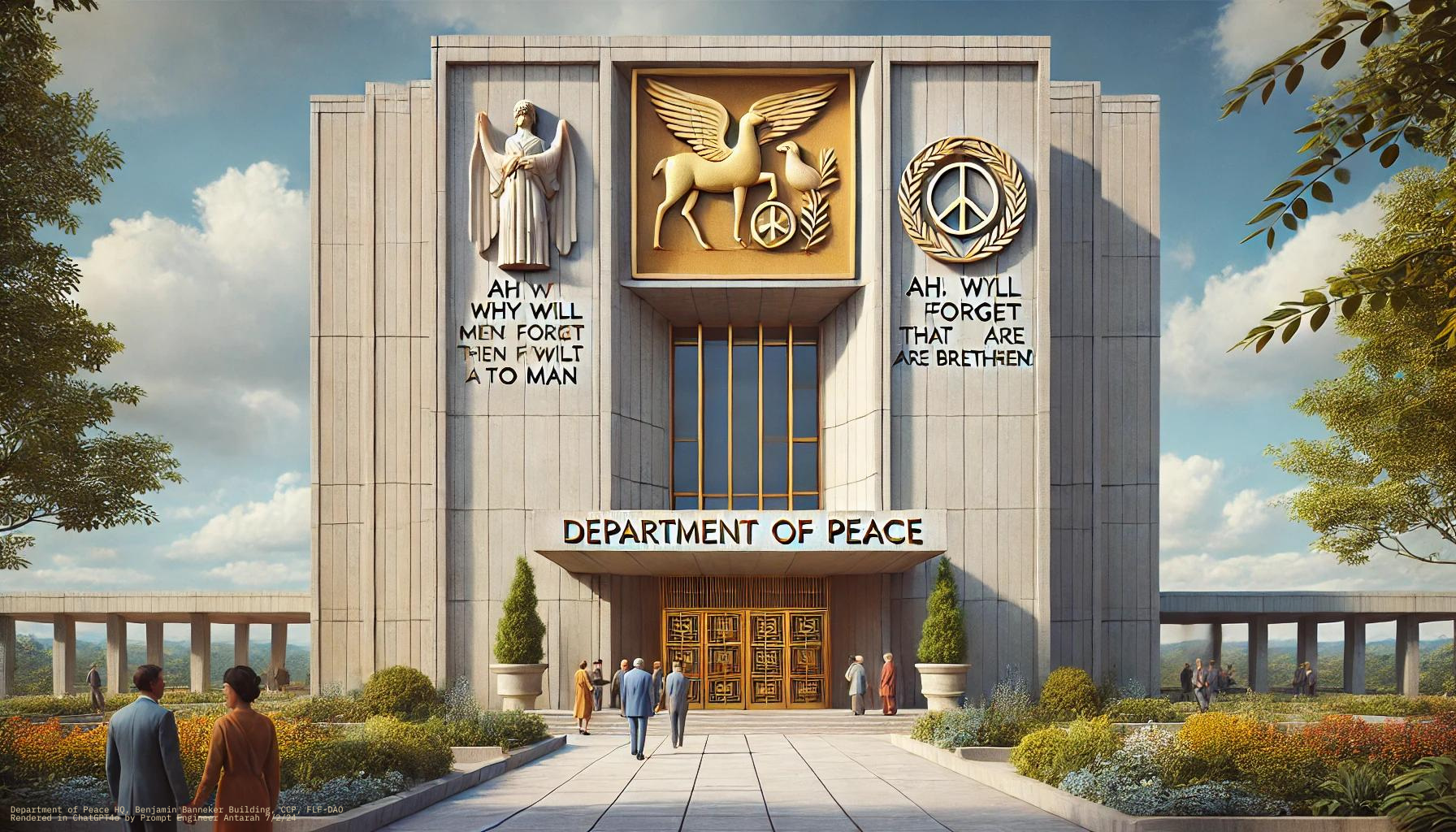

D:\Interior: Hall of Records
D:\Interior: Halls of Meeting and Study
Antarah Vicarius Deus per Seignior Iesus Christi,
Rector Provinciae Oblatus Novus Syllabus
et Doctor Ecclesia Universalis Autodidactus,
FLF-DAO IBCO

Capital Projects (CCP)
DECENTRALIZED AUTONOMOUS ORGANIZATION
DEPARTMENT OF PEACE AND FRIENDSHIP
FROM THE DESK OF
THE PUBLIC FRIEND
Antarah
SOLICITATION | LAST MODIFIED 6/28/24 AT 11:21 P.M.
TO ALL TO WHOM THESE PRESENTS COME, SEND GREETINGS AND PEACE:—
Commission on Capital Projects
There is hereby established within the IBCO, FLF-DAO, a Commission on Capital Projects, that is, on medium- to long-term projects to build upon, improve, or maintain a significant piece of property that is meant to last. The Commission shall be constituted by the investors and shareholders of the property being developed. The Commission’s inaugural project shall be the development and construction of the Black Cross Country Mission Fulfillment Center (MFC), known as the
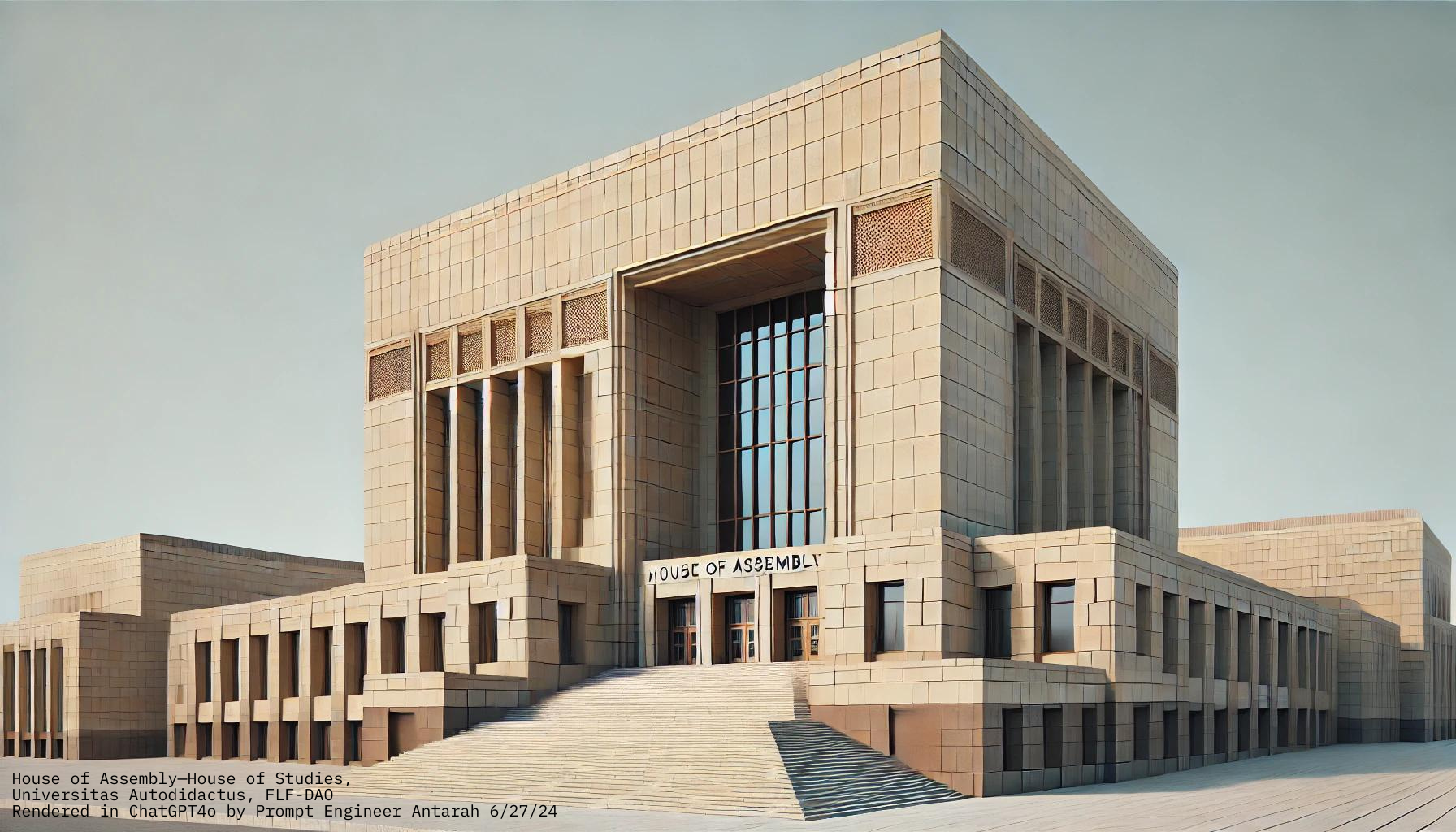
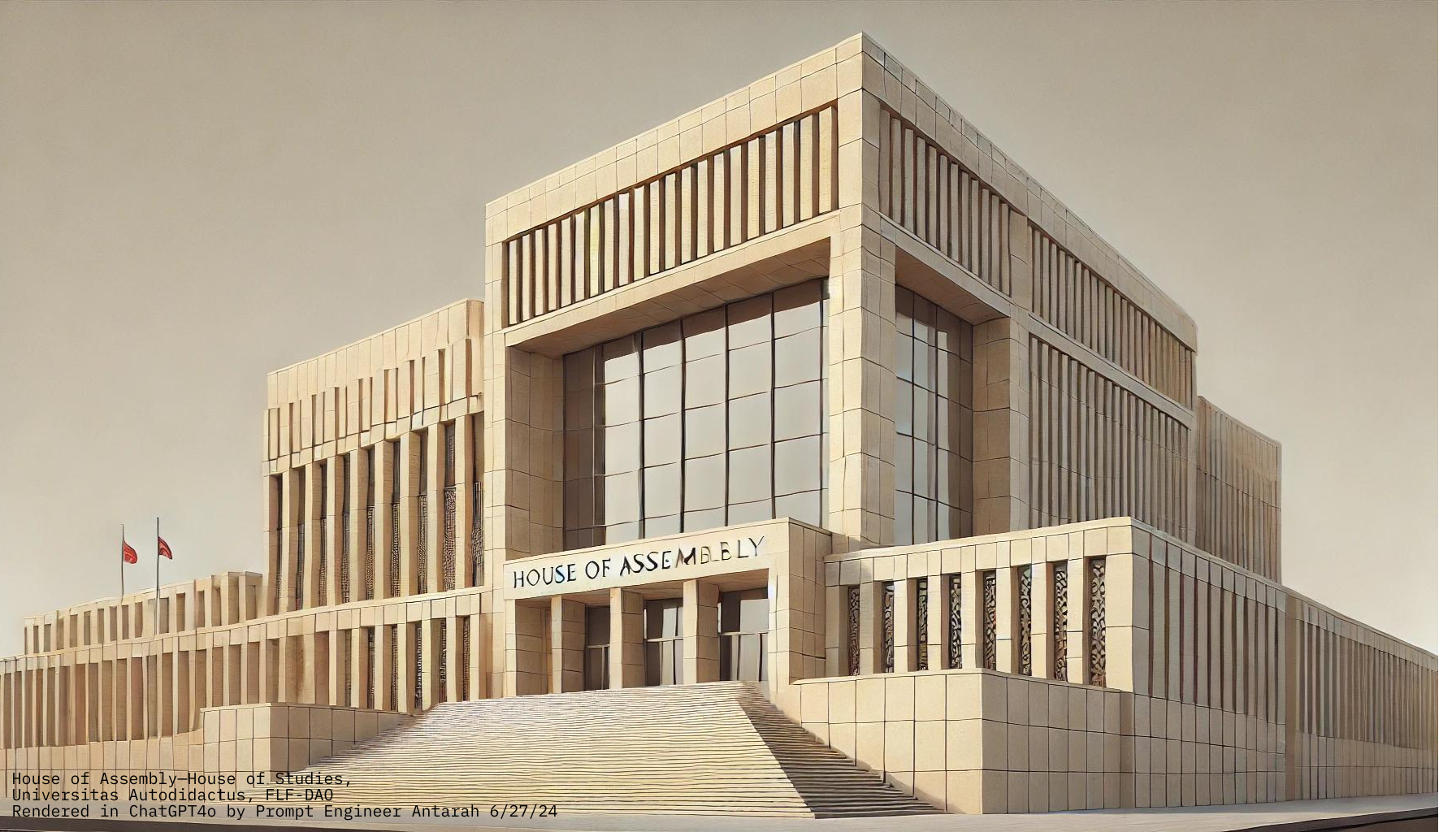
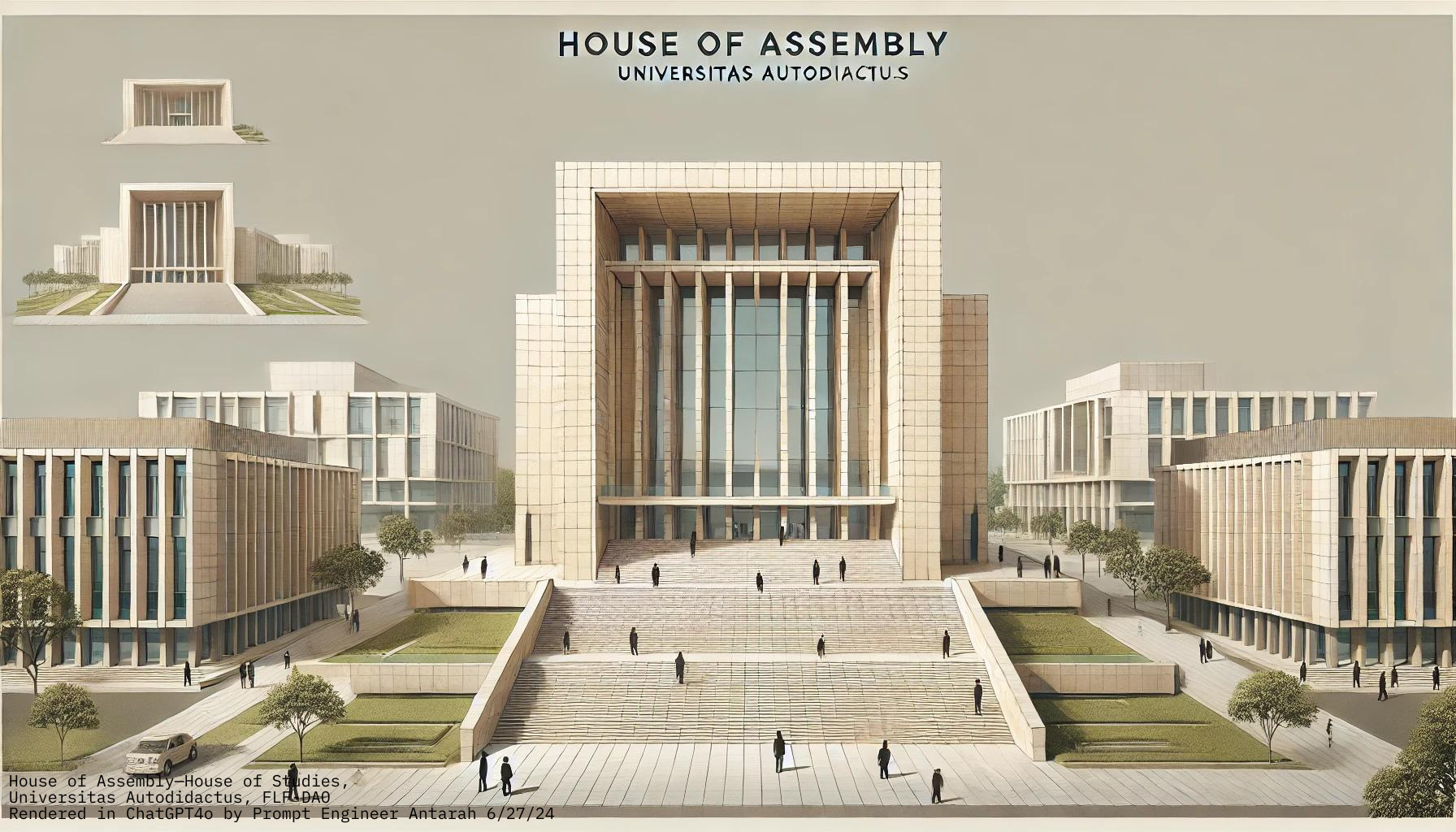
House of Assembly—House of Studies of
the Universitas Autodidactus, FLF-DAO.
Projected funds needing to be raised for the development, start-up, and initial operation of this project (after which point the Center shall fund itself by and through fee-based operations) are estimated at $33 million.
The development of the IBCO MFC represents a groundbreaking partnership between artificial and autodidactic intelligence. The projected drawings of the Center are as follows:
Exterior Elevations

Interior: Hall of Assembly
End of Transmission.

Memorandum 5
IN THE NAME OF GOD ﷲ THE MOST GRACIOUS MOST MERCIFUL
DECENTRALIZED AUTONOMOUS ORGANIZATION
DEPARTMENT OF PEACE AND FRIENDSHIP

POLITICAL BUREAU
POLITBURO
OF EDUCATION
FROM THE DESK OF
THE PUBLIC FRIEND
Antarah
Office of Ombudsman—Office of Preceptor—Office of Administrator—Office of Scribe
Comm. No. A240609-05 | Memorandum #5 | last modified 6/12/24 at 6:30 p.m.
TO ALL TO WHOM THESE PRESENTS COME, SEND GREETINGS AND PEACE:—
Using Your ‘PC’
PROTOCOL C:\MAIN FUNCTION:\NS\153D_CORPS_BCO_FLF-DAO
(a) Conveying the dialectic relationship between the ministering witness who testifieth on the law and the public body of the people who drafteth appropriations at law, toward optimal Performance of Z-Axis procedure in function(GDP):\>Policy;Praxis;Program;Project=Performance^Cubed a.k.a. ‘Protocol C’.
- Server ‘S’ hold ‘_’ sign ‘x’ of good will/salutations/solicitation.
- Public ‘P’ pay ‘>’ attention ‘i’ to x.
- S issue ‘-‘ promissory notice ‘n’ for further information ‘f(x)=y’.
- P draft ‘~’ appropriations bill ‘+’ payable ‘>’ to n(x).
- S redeem ‘<’ n to discharge ‘-‘ obligation ‘y’.
- S commission ‘^’ P into current circulatory system ‘c’.
- S offer course LP and preceptor services ‘Ed’ to raise P to ‘c square’.
(b) NOTATION:
- \>S_(x)
- \>P>i(x)
- \>S-n(x)=y
- \>P~+>n(x)
- \>S<-y
- \>S^P(c)
- \>S_Ed(x)^P(c^2)
(c) ERGO, it is said to use the Performance Cubed ‘PC’ application to C your Mindsoft development and operating system ‘DOS’.
(d) Consolidated Interest-Bearing Promissory Notice ‘Consols’ are notes that promise the performance of the prima facie obligation written thereon, which are issued to holders in whose possession the notes appreciate until the holder realizes the value of the principle ‘maturity’, redeems the note with the issuer thereof, and pays their attention ‘interest’ at the rate of appropriations billed over time. This is the ‘consolidated’ methodology and protocol for circulating the DAO current ‘c’. Therefore the issuer keeps bankers hours, 10 to 3 Mon-Fri. In praxis, focusing on the direct sale of information may cause public confusion, alienation, and anxiety; but the circulation of consols is a more comprehensible and worthy business enterprise.
(e) There is hereby established the:
First Tabernacle Beth Midrash,
Black Cross Squadron, 153D CORPS, FLF-DAO
(a Continuing Education Montessori Shul)
Antarah, Friend, Head of Meeting
(f) Standing Regular Meeting Schedule of Sessions of Public Service (Free, Open)
- First Day Shul – 10 am Sunday
- Second Day Shul – 10 am Monday
- Tues/Weds – appointments & sittings
- Thoth’s Day Shul – 2 pm Thursday
- Sabbath Day Shul – 7 pm Friday
(g) Courses Offered:
- Worship, Dialectic and Autodidactic
- Holistic Ancient Methodologies of Economy Technology Informatics and Sciences (HAMETICS)
- Due Process of Information
- Application of Oyer et Terminer
- Drama and Rhetoric
- LP
(h) This school is founded upon ten years of postgraduate autodidactic research and development (2014-2024) in the fields of Taoism and revolutionary far eastern philosophy, Cabala (Chabad-Lubavitcher), orthodox and popular Egyptology, physics and metaphysics, African spirituality, biblical exegesis, fraternalism/ecclesiastes, general occultism, historical and dialectical materialism, Islam, parliamentary procedure, and negotiable instruments law, among other discrete subject matters, to wit, ‘The New Syllabus’ of NOVUS SYLLABUS L.L.C.
Shalom ‘Alechem,
Antarah of Nacotchtank,
Public Friend Incumbent,
153d CORPS, FLF-DAO
 Supreme Exchange