Tagged: american
Minute of Public Service 3
IN THE NAME OF YAHUAH THE MOST GRACIOUS MOST MERCIFUL
DECENTRALIZED AUTONOMOUS ORGANIZATION
DEPARTMENT OF PEACE AND FRIENDSHIP
FROM THE DESK OF
THE PUBLIC FRIEND
Antarah, ObNS
3RD MINUTE OF PUBLIC SERVICE | LAST MODIFIED 24/7/16/12:33 AM 24/7/16/10:01 PM 24/7/17/10:33 AM 24.07.18.04:09PM 24.07.19.10:00AM 24.07.22.03:05PM
TO ALL TO WHOM THESE PRESENTS COME, SEND GREETINGS AND PEACE:—
The Ecclesiastical Polity,
or, ‘Collegiate Government’,
of the New Testament Kingdom
Congregational Church de la Croix Noire
(a) The ‘Chamber of Instruction’ is within the Beth Midrash, and the ‘Hall of Assembly’ is within the Beth Knesset, and these are so many houses in the bicameral polity ‘body’ of the people assembled of the decentralized autonomous organization in that locality. The Knesset is the upper house and the Midrash is the lower house.
(b) The ‘New Testament Kingdom’ is a feudal trust relationship settled under Roman imperial law by God Himself, by and through his Vicar in Christ, Land Holder and Lord of the Earth Living Forever, by and through the Holy Roman Emperor Constantine the Great, and subsequently assigned, in part, to the Bishop of Rome at the Vatican City. The remainder of the birthright dominion of the people over the Kingdom of Earth is administered in trust for the benefit of all humanity by the anointed society of friends ministering in the following of the High Priest of Melchizedek, the Lamb, being as he is the King, living forever.
(c) It is, therefore, not for purely religious and dogmatic reasons, but for purely civil and legal reasons, that we invoke that name of the Trustee appointed by God Almighty to administer our trust which is known in our jurisdiction ‘nome’, being that of the Roman Empire, by and through its successors the kings of Europe, by and through their successors the republic of nations: KRST YHSVH — IESUS CHRISTUS — the King who will reign from Jerusalem.
(d) There is only one supreme Being ‘Entity’ who created Heaven and Earth of its own matter. All who are born of woman are beneficiaries of its creation, which continues forever. The body of the people of this Creator ‘the Church’ is one, holy, universal and apostolic, with KRST THE KING at its head.
(e) While visiting the Lieutenant Governor of New York after my great uncle’s funeral in Orange, New Jersey, I met with my very good friend Richard of Brooklyn, who told me that that day (yesterday), July 14th, was the real New Year’s Day, in which our ancestors observed the heliacal rising of Sirius and the inundation of Hapi.
(f) Frank Lloyd Wright is hereby canonized a Saint of God by the order of missionary oblates of the New Syllabus program for his efforts in defining a unique American-vernacular architecture. To this unique class belong the noble and worthy personages of Saint Nat Turner, Saint John Coltrane, and Saint Alice Coltrane.
(g) Systembilt Industries, IBCO, FLF-DAO, is hereby chartered as an entity of a religious nature dedicated to continue Saint Frank’s mission to produce sound, beautiful, and affordable housing for every American family by deploying American System-Built Homes around every Mission Fulfillment Center. Usonian Automatic blocks assembled into American System-Built Homes are a block-chain as Mindsoft consoles configured in a DAO fueled by Performance Cubed are a block-chain.
(h) The whole foregoing entity and being are hereby styled:
New Kingdom Congregational Meeting;
1st New Kingdom Congregational Church,
Congregation Beth Midrash Beth Knesset,
of the International Black Cross, FLF-DAO,
nondenominational interfaith ministry,
Antarah, ObNS, Friend presiding,
‘Head of Meeting‘
SECTION (h) DIRECTIVE [click to expand]
Floating the Mission by Sale of Labor on a Daily Basis
Occupation: Day Labor Trader
Lines of Labor Traded: instruction, meeting, investigation, worship, instruments, administration, guardian, custodian, building arts
‘Banking’ Hours: 10AM-3PM, 1st Day to Friday
(h)(1) These lines of service (LOS) are to be considered an extension of peace and good will between friends, the mutual appreciation of which will inure to their mutual benefit. By this is meant an offering, feoffment, or oblation of humanitarian aid, of which a tithe is paid to the Lord of the fee, MALIKI ZADDIK YHSVH XRST, which translates roughly to ‘Equitable Lord Jesus Christ’, the surety of our God-granted trust ‘birthright’. The balance of the charge shall be stored in its capacity and shall not be held for profit by a particular party, but therefrom discharged to the ground (‘the people’).
(h)(2) Therefore it is said regarding the Firm League of Friendship, “Faith is Complete Trust and Firm Belief” applied over a matter of time ‘f(x)=y’, which belief, sincerely held, cannot be converted into a crime. Trust refers to the covenant between God and humanity. Faith refers to the full confidence and mutual assurance exchanged between the parties in the trust relationship. Belief refers to the firmness of faith as held in the hearts and minds of the friends who practice it. This is the MAIN function of the Decentralized Autonomous Intelligence System (DAIS) of the CORPS of Mindsoft.
(h)(3) Toward developing and sustaining a ‘book of business’, service providers ‘servers’ shall make contact with prospective buyers ‘clients’ to whom to offer their services every morning between 8:00AM and 9:00AM, either in person ‘at market’ or via electronic communications. Such clients may or may not be friends, but servers should remain squarely within their equitable God-given sui jurisdiction when ‘trading with the enemy’. No originating sale of labor to be performed on the instant day shall take place after 3:00PM that day; sales consummated after such time shall be performed, fulfilled, and delivered on the next or another future day. Consols may be issued for redemption of future services without originating sales. An ideal contract engagement is one in which a friend-benefactor pays the day rate for the server to perform the mission obligations for the benefit of the friendly public.
American Systembilt Industries

(i) Systembilt Industries shall construct homes in the Wrightian ‘Usonian Automatic‘ vernacular, which is, by this outfit’s estimation, the precursor to the Brutalist vernacular, which is erroneously said to be founded in the United Kingdom in the 1950s, and has since been nearly exclusively devoted to federal government architecture. Whereas the Brutalist is an exaggeration of scale and mass in proportion to the softening panes glass — or a more forgiving human sensibility — the Usonian is intentionally designed for the consumption and appreciation of the human and their family — the American family at that — using a uniquely modular and horizontal American vernacular. Due to the modular and affordable nature of the prefabricated building materials which would be shipped ready-to-assemble to the buyer, Frank Lloyd Wright innovated the construction method AMERICAN SYSTEM-BUILT HOMES. Using the internationally conscious appellation of ‘Usonian’ for ‘United States of North America’ or ‘USONA’, Mr. Wright provides at the turn of the century a vision of USONIA in which every family can own a firm and beautiful AMERICAN HOME at a fixed and reasonable cost.
(j) The planned community of Usonian Automatic homes by Systembilt Industries shall comprise the network of private homes of Friends in the Firm League of Friendship of the decentralized autonomous and International Black Cross Organization. The cultural centers of these communities shall be planned around the Mission Fulfillment Centers which are the meeting tents of the congregation.

(k) References.
(1) Usonian Automatic
(2) Kalil House

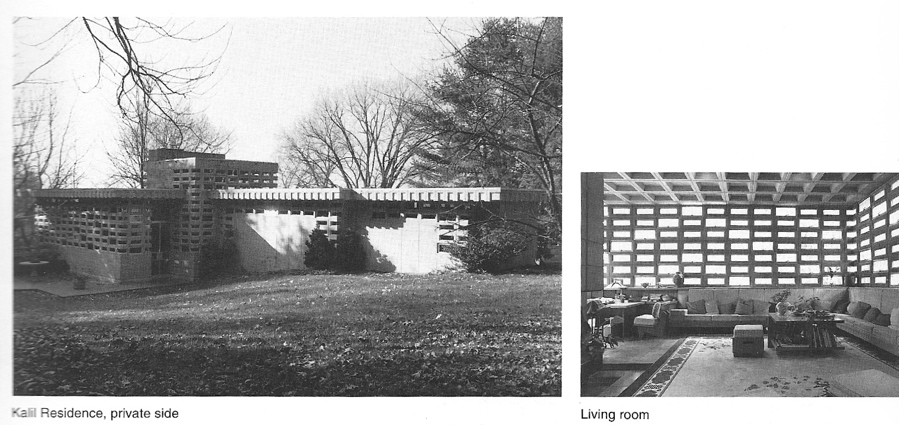
(3) Turkel House

(4) Tonkens House


(5) Automatic Blocks
The textile block system — the root form of automatic blocks — is a unique structural building method created by Frank Lloyd Wright in the early 1920s. While the details changed over time, the basic concept involves patterned concrete blocks reinforced by steel rods, created by pouring concrete mixture into molds, thus enabling the repetition of form. The blocks are then stacked to build walls. Wright’s textile block houses are:
- Ennis House
- Robert and Rae Levin House (check also the other Michigan – Galesburg and Parkwin/Kalamazoo – houses at List of Frank Lloyd Wright works)
- Millard House
- Samuel Freeman House
- Storer House (Los Angeles)
- Westhope, located in Tulsa, Oklahoma, Wright’s only Textile Block house outside of California.[1]
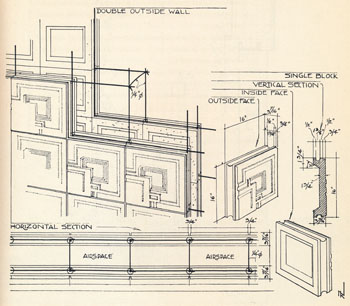

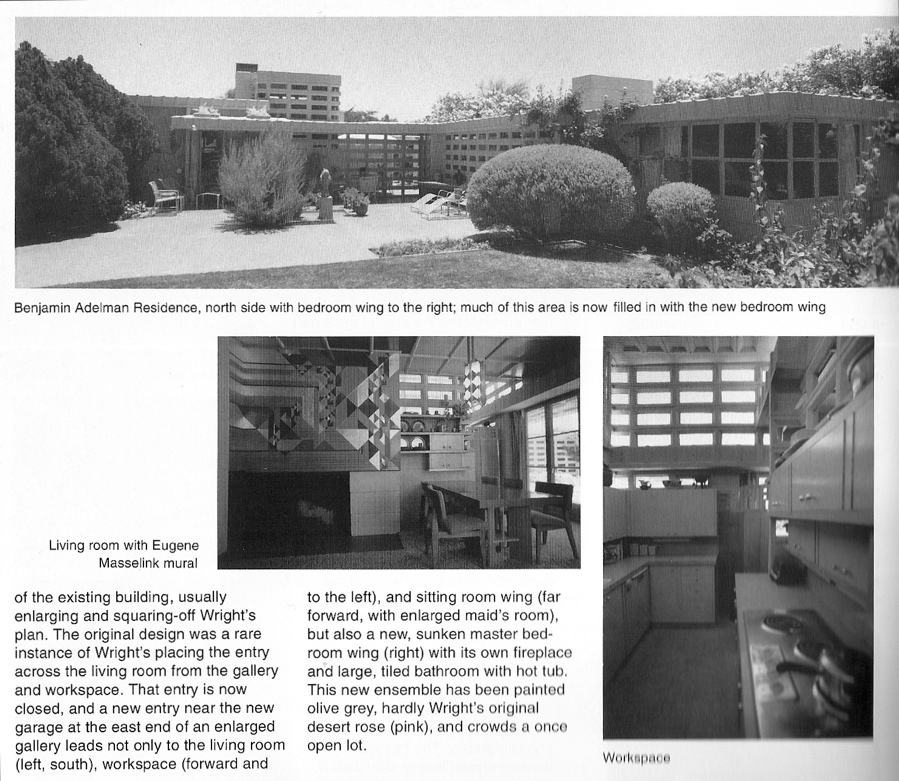
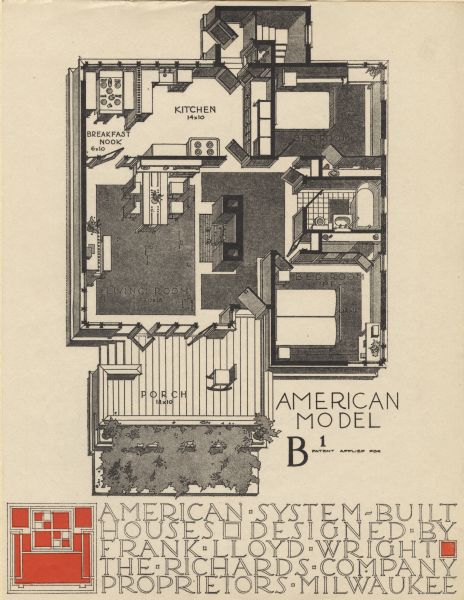
(6) American System-Built Homes
The American System-Built Homes in Milwaukee, Wisconsin:
Frank Lloyd Wright’s earliest system of low-cost housing© 2005 Michael Lilek, All rights reserved
Master of the Small House
Copyright 2004-2005, Michael Lilek, All rights reserved.
Over a career spanning seven decades, Frank Lloyd Wright took special interest in creating architect-designed homes for moderate and low-income families. In the January 1938 issue of Architectural Forum, he commented, “[I] would rather solve the small house problem than build anything else I can think of…” Indeed, among Wright’s greatest masterpieces are several small homes designed for clients who could afford little. Many of these residences owe their existence to some form of client labor (do-it-yourself), ingenious cost-cutting or salvaging. Each magically shelters it occupants in beautiful spaces, connects them to nature, and allows them to feel more alive.
American System-Built Homes
In a 1901 speech entitled, “The Art and Craft of the Machine,” Wright outlined his vision of affordable housing. He asserted that the home would have to go to the factory, instead of the skilled labor coming to the building site. Between 1915 and 1917 Wright designed a series of standardized “system-built” homes, known today as the American System-Built Homes. By system-built, he did not mean pre-fabrication off-site, but rather a system that involved cutting the lumber and other materials in a mill or factory, then bringing them to the site for assembly. This system would save material waste and a substantial fraction of the wages paid to skilled tradesmen. Wright produced more than 900 working drawings and sketches of various designs for the system. Six examples were constructed, still standing, on West Burnham Street and Layton Boulevard in Milwaukee, Wisconsin. Other examples were constructed on scattered sites throughout the Midwest with a few yet to be discovered.
Arthur L. Richards, Developer
By 1911, companies connected to Arthur L. Richards had engaged Frank Lloyd Wright to design several projects, including an unbuilt hotel in Madison and the Hotel Geneva in Lake Geneva, Wisconsin (1912, demolished). By November 1916, Richards entered into an agreement with Wright to promote the American System-Built Homes. The contract covered all parts of the United States, Canada and Europe. It called for the Richards Company “…to furnish, as far as possible, all materials entering into the construction of the buildings and to at least furnish the plans, drawings, specifications and details and lumber, millwork, exterior plaster material, paints, stains, glazing, hardware trimmings and electric lighting fixtures for said buildings.” Richards was to recruit a distribution channel of builders and developers from around the country. He appears to have focused his efforts in the Chicago area and a few other Midwestern cities.
The agreement between Wright and Richards anticipated that the American System-Built Homes project would be wildly successful. Unfortunately, the entry of the United States into World War I on April 6, 1917, diverted building materials to wartime needs. Housing starts ground to a halt. Wright also began extensive travels between America and Japan at this time, related to the Imperial Hotel commission. Wright became unhappy with his relationship with Richards, leading to a lawsuit in August of 1917. Central to Wright’s claim was the non-payment of royalties and fees. Wright won a judgment against Richards in February of 1918. Although the business relationship ended after a few years, Wright and Richards rekindled their friendship decades later and exchanged cordial letters and visits.

Commission 152
NACOTCHTANK’S
152d CORPS
بيت مدرسة
בית מדרש
The Preceptory of
The 1st Ecclesiastic College at
Nacotchtank, Ouachita District,
5th International Worker’s Ass’n
and
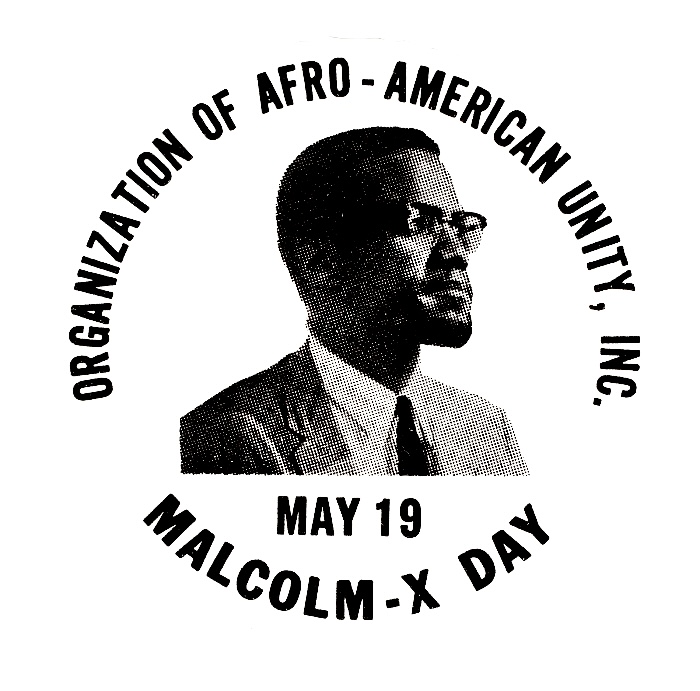
2nd Organization of Afro-American Unity
CURRICULAR OPERATIONS RESEARCH & PUBLICATIONS SERVICES (CORPS)
DIVISION OF THE POLITICAL BUREAU OF EDUCATION (POLITBURO), FLF-DAO

The Governor of the Society of the New Syllabus (N∴S∴) at Nacotchtank-on-Potomac (Anacostia) District of Ouachita (Washington, District of Columbia), Furthest West (al-Maghreb al-Aqsa) To All To Whom These Presents Come, Sends Greeting and Peace:—
Know ye by these presents that there is a decentralized autonomous organization (DAO) of people, in the nature of firm league of friendship (FLF), which is engaged in the business of self-education, -operation, and -development (Autodidactus), and that this society (Universitas) is organized into associations (Collegia) constituted by assemblies (Ecclesia) committed to certain trades or subject matters (Syndici).
(b) There is hereby established the second wave of the Organization of Afro-American Unity for the purposes enumerated by the Most Honorable el-Hajj Malik el-Shabazz (a.k.a. Malcolm X) (our “Founder”).
(c) The words of our Founder are incorporated herein by reference:
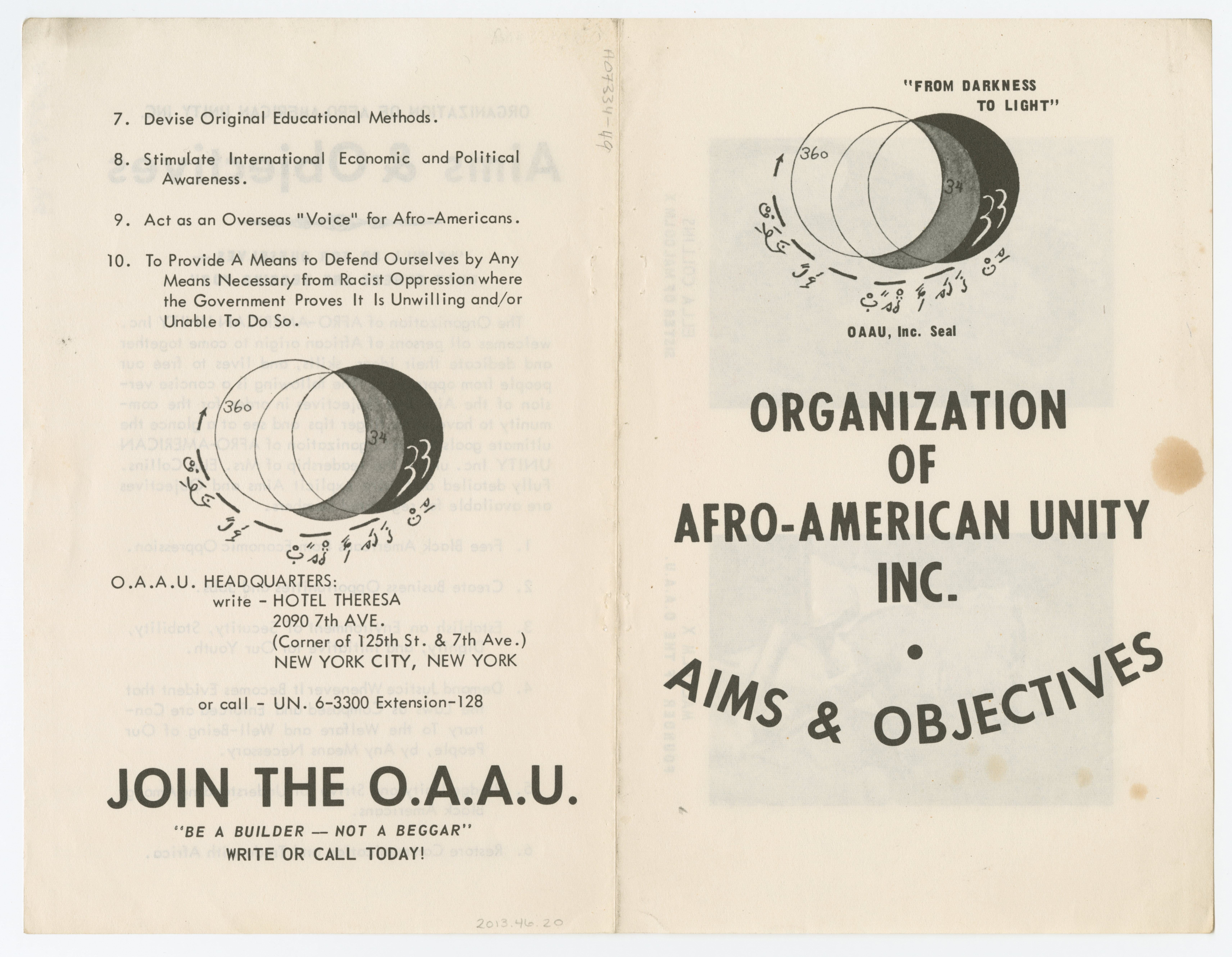
Program of the Organization of Afro-American Unity
Malcolm X, et al. (taken from the Malcolm X Museum)
Note: this was originally supposed to be presented on Feb. 15, but since Malcolm’s home was fire-bombed, this was delayed for a week — Feb. 21, [1965] to be exact — the day he was assassinated…
(1) PREAMBLE
Pledging unity…
Promoting justice…
Transcending compromise…
(a) We, Afro-Americans, people who originated in Africa and now reside in America, speak out against the slavery and oppression inflicted upon us by this racist power structure. We offer to downtrodden Afro-American people courses of action that will conquer oppression, relieve suffering, and convert meaningless struggle into meaningful action.
(b) Confident that our purpose will be achieved, we Afro-Americans from all walks of life make the following known:
(2) ESTABLISHMENT
(a) Having stated our determination, confidence, and resolve, the Organization of Afro-American Unity is hereby established on the 15th day of February, 1965, in the city of New York.
(b) Upon this establishment, the Afro-American people will launch a cultural revolution which will provide the means for restoring our identity that we might rejoin our brothers and sisters on the African continent, culturally, psychologically, economically, and share with them the sweet fruits of freedom from oppression and independence of racist governments.
(1) The Organization of Afro-American Unity welcomes all persons of African origin to come together and dedicate their ideas, skills, and lives to free our people from oppression.
(2) Branches of the Organization of Afro-American Unity may be established by people of African descent wherever they may be and whatever their ideology — as long as they be descendants of Africa and dedicated to our one goal: freedom from oppression.
(3) The basic program of the Organization of Afro-American Unity which is now being presented can and will be modified by the membership, taking into consideration national, regional, and local conditions that require flexible treatment.
(4) The Organization of Afro-American Unity encourages active participation of each member since we feel that each and every Afro-American has something to contribute to our freedom. Thus each member will be encouraged to participate in the committee of his or her choice.
(5) Understanding the differences that have been created amongst us by our oppressors in order to keep us divided, the Organization of Afro-American Unity strives to ignore or submerge these artificial divisions by focusing our activities and our loyalties upon our one goal: freedom from oppression.
(3) BASIC AIMS AND OBJECTIVES
(A) Self-determination
(1) We assert that we Afro-Americans have the right to direct and control our lives, our history, and our future rather than to have our destinies determined by American racists, we are determined to rediscover our true African culture, which was crushed and hidden for over four hundred years in order to enslave us and keep us enslaved up to today…
(2) We, Afro-Americans — enslaved, oppressed, and denied by a society that proclaims itself the citadel of democracy, are determined to rediscover our history, promote the talents that are suppressed by our racist enslavers, renew the culture that was crushed by a slave government and thereby — to again become a free people.
(B) National unity
(1) Sincerely believing that the future of Afro-Americans is dependent upon our ability to unite our ideas, skills, organizations, and institutions…
(2) We, the Organization of Afro-American Unity pledge to join hands and hearts with all people of African origin in a grand alliance by forgetting all the differences that the power structure has created to keep us divided and enslaved. We further pledge to strengthen our common bond and strive toward one goal: freedom from oppression.
(4) THE BASIC UNITY PROGRAM
(a) The program of the Organization of Afro-American Unity shall evolve from five strategic points which are deemed basic and fundamental to our grand alliance. Through our committees we shall proceed in the following general areas.
(I) Restoration
(1) In order to enslave the African it was necessary for our enslavers to completely sever our communications with the African continent and the Africans that remained there. In order to free ourselves from the oppression of our enslavers then, it is absolutely necessary for the Afro-American to restore communications with Africa.
(2) The Organization of Afro-American Unity will accomplish this goal by means of independent national and international newspapers, publishing ventures, personal contacts, and other available communications media.
(3) We, Afro-Americans, must also communicate to one another the truths about American slavery and the terrible effects it has upon our people. We must study the modern system of slavery in order to free ourselves from it. We must search out all the bare and ugly facts without shame for we are still victims, still slaves — still oppressed. Our only shame is believing falsehood and not seeking the truth.
(4) We must learn all that we can about ourselves. We will have to know the whole story of how we were kidnapped from Africa; how our ancestors were brutalized, dehumanized, and murdered; and how we are continually kept in a state of slavery for the profit of a system conceived in slavery, built by slaves and dedicated to keeping us enslaved in order to maintain itself.
(5) We must begin to reeducate ourselves and become alert listeners in order to learn as much as we can about the progress of our motherland — Africa. We must correct in our minds the distorted image that our enslaver has portrayed to us of Africa that he might discourage us from reestablishing communications with her and thus obtain freedom from oppression.
(II) Reorientation
(1) In order to keep the Afro-American enslaved, it was necessary to limit our thinking to the shores of America — to prevent us from identifying our problems with the problems of other peoples of African origin. This made us consider ourselves an isolated minority without allies anywhere.
(2) The Organization of Afro-American Unity will develop in the Afro-American people a keen awareness of our relationship with the world at large and clarify our roles, rights, and responsibilities as human beings. We can accomplish this goal by becoming well-informed concerning world affairs and understanding that our struggle is part of a larger world struggle of oppressed peoples against all forms of oppression. We must change the thinking of the Afro-American by liberating our minds through the study of philosophies and psychologies, cultures and languages that did not come from our racist oppressors. Provisions are being made for the study of languages such as Swahili, Hausa, and Arabic. These studies will give our people access to ideas and history of mankind at large and thus increase our mental scope.
(3) We can learn much about Africa by reading informative books and by listening to the experiences of those who have traveled there, but many of us can travel to the land of our choice and experience for ourselves. The Organization of Afro-American Unity will encourage the Afro-American to travel to Africa, the Caribbean, and to other places where our culture has not been completely crushed by brutality and ruthlessness.
(III) Education
(1) After enslaving us, the slave masters developed a racist educational system which justified to its posterity the evil deeds that had been committed against the African people and their descendants. Too often the slave himself participates so completely in this system that he justifies having been enslaved and oppressed.
(2) The Organization of Afro-American Unity will devise original educational methods and procedures which will liberate the minds of our children from the vicious lies and distortions that are fed to us from the cradle to keep us mentally enslaved. We encourage Afro-Americans themselves to establish experimental institutes and educational workshops, liberation schools, and child-care centers in the Afro-American communities.
(3) We will influence the choice of textbooks and equipment used by our children in the public schools while at the same time encouraging qualified Afro-Americans to write and publish the text books needed to liberate our minds. Until we completely control our own educational institutions, we must supplement the formal training of our children by educating them at home.
(IV) Economic security
(1) After the Emancipation Proclamation, when the system of slavery changed from chattel slavery to wage slavery, it was realized that the Afro-American constituted the largest homogeneous ethnic group with a common origin and common group experience in the United States and, if allowed to exercise economic or political freedom, would in a short period of time own this country. Therefore racists in this government developed techniques that would keep the Afro-American people economically dependent upon the slave masters — economically slaves — twentieth-century slaves.
(2) The Organization of Afro-American Unity will take measures to free our people from economic slavery. One way of accomplishing this will be to maintain a technician pool: that is, a bank of technicians. In the same manner that blood banks have been established to furnish blood to those who need it at the time it is needed, we must establish a technician bank. We must do this so that the newly independent nations of Africa can turn to us who are their Afro-American brothers for the technicians they will need now and in the future. Thereby we will be developing an open market for the many skills we possess and at the same time we will be supplying Africa with the skills she can best use. This project will therefore be one of mutual cooperation and mutual benefit.
(V) Self-defense
(1) In order to enslave a people and keep them subjugated, their right to self-defense must be denied. They must be constantly terrorized, brutalized, and murdered. These tactics of suppression have been developed to a new high by vicious racists whom the United States government seems unwilling or incapable of dealing with in terms of the law of this land. Before the emancipation it was the Black man who suffered humiliation, torture, castration, and murder. Recently our women and children, more and more, are becoming the victims of savage racists whose appetite for blood increases daily and whose deeds of depravity seem to be openly encouraged by all law enforcement agencies. Over five thousand Afro-Americans have been lynched since the Emancipation Proclamation and not one murderer has been brought to justice!
(2) The Organization of Afro-American Unity, being aware of the increased violence being visited upon the Afro-American and of the open sanction of this violence and murder by the police departments throughout this country and the federal agencies — do affirm our right and obligation to defend ourselves in order to survive as a people.
(3) We encourage the Afro-Americans to defend themselves against the wanton attacks of racist aggressors whose sole aim is to deny us the guarantees of the United Nations Charter of Human Rights and of the Constitution of the United States.
(4) The Organization of Afro-American Unity will take those private steps that are necessary to insure the survival of the Afro-American people in the face of racist aggression and the defense of our women and children. We are within our rights to see to it that the Afro-American people who fulfill their obligations to the United States government (we pay taxes and serve in the armed forces of this country like American citizens do) also exact from this government the obligations that it owes us as a people, or exact these obligations ourselves. Needless to say, among this number we include protection of certain inalienable rights such as life, liberty, and the pursuit of happiness.
(5) In areas where the United States government has shown itself unable and/or unwilling to bring to justice the racist oppressors, murderers, who kill innocent children and adults, the Organization of Afro-American Unity advocates that the Afro-American people insure ourselves that justice is done — whatever the price and by any means necessary.
(5) NATIONAL CONCERNS
(A) General terminologies:
(1) We Afro-Americans feel receptive toward all peoples of goodwill. We are not opposed to multiethnic associations in any walk of life. In fact, we have had experiences which enable us to understand how unfortunate it is that human beings have been set apart or aside from each other because of characteristics known as “racial” characteristics.
(2) However Afro-Americans did not create the prejudiced background and atmosphere in which we live. And we must face the facts. A “racial” society does exist in stark reality, and not with equality for Black people; so we who are nonwhite must meet the problems inherited from centuries of inequalities and deal with the present situations as rationally as we are able.
(3) The exclusive ethnic quality of our unity is necessary for self-preservation. We say this because our experiences backed up by history show that African culture and Afro-American culture not be accurately recognized and reported and cannot be respectably expressed nor be secure in its survival if we remain the divided, and therefore the helpless, victims of an oppressive society.
(4) We appreciate the fact that when the people involved have real equality and justice, ethnic intermingling can be beneficial to all. We must denounce, however, all people who are oppressive through their policies or actions and who are lacking in justice in their dealings with other people, whether the injustices proceed from power, class, or “race.” We must be unified in order to be protected from abuse or misuse.
(5) We consider the word “integration” a misleading, false term. It carries with it certain implications to which Afro-Americans cannot subscribe. This terminology has been applied to the current regulation projects which are supposed]y “acceptable” to some classes of society. This very “acceptable” implies some inherent superiority or inferiority instead of acknowledging the true source of the inequalities involved.
(6) We have observed that the usage of the term “integration” was designated and promoted by those persons who expect to continue a (nicer) type of ethnic discrimination and who intend to maintain social and economic control of all human contacts by means of imagery, classifications, quotas, and manipulations based on color, national origin, or “racial” background and characteristics.
(7) Careful evaluation of recent experiences shows that “integration” actually describes the proccess by which a white society is (remains) set in a position to use, whenever it chooses to use and however it chooses to use, the best talents of nonwhite people. This power-web continues to build a society wherein the best contributions of Afro-Americans, in fact of all nonwhite people, would continue to be absorbed without note or exploited to benefit a fortunate few while the masses of both white and nonwhite people would remain unequal and unbenefited.
(8) We are aware that many of us lack sufficient training and are deprived and unprepared as a result of oppression, discrimination, and the resulting discouragement, despair, and resignation. But when we are not qualified, and where we are unprepared, we must help each other and work out plans for bettering our own conditions as Afro-Americans. Then our assertions toward full opportunity can be made on the basis of equality as opposed to the calculated tokens of “integration.” Therefore, we must reject this term as one used by all persons who intend to mislead Afro-Americans.
(9) Another term, “negro,” is erroneously used and is degrading in the eyes of informed and self-respecting persons of African heritage. It denotes stereotyped and debased traits of character and classifies a whole segment of humanity on the basis of false information. From all intelligent viewpoints, it is a badge of slavery and helps to prolong and perpetuate oppression and discrimination.
(10) Persons who recognize the emotional thrust and plain show of disrespect in the Southerner’s use of “nigra” and the general use of “nigger” must also realize that all three words are essentially the same. The other two. “nigra” and “nigger” are blunt and undeceptive. The one representing respectability, “negro,” is merely the same substance in a polished package and spelled with a capital letter. This refinement is added so that a degrading terminology can be legitimately used in general literature and “polite” conversation without embarrassment.
(11) The term “negro” developed from a word in the Spanish language which is actually an adjective (describing word) meaning “black,” that is, the color black. In plain English, if someone said or was called a “black” or a “dark,” even a young child would very naturally question: “a black what?” or “a dark what?” because adjectives do not name, they describe. Please take note that in order to make use of this mechanism, a word was transferred from another language and deceptively changed in function from an adjective to a noun, which is a naming word. Its application in the nominative (naming) sense was intentionally used to portray persons in a position of objects or “things.” It stamps the article as being “all alike and all the same.” It denotes: a “darkie,” a slave, a subhuman, an ex-slave, a “negro.”
(12) Afro-Americans must re-analyze and particularly question our own use of this term, keeping in mind all the facts. In light of the historical meanings and current implications, all intelligent and informed Afro-Americans and Africans continue to reject its use in the noun form as well as a proper adjective. Its usage shall continue to be considered as unenlightened and objectionable or deliberately offensive whether in speech or writing.
(13) We accept the use of Afro-American, African, and Black man in reference to persons of African heritage. To every other part of mankind goes this measure of just respect. We do not desire more nor shall we accept less.
(B) General considerations:
(1) Afro-Americans, like all other people, have human rights which are inalienable. This is, these human rights cannot be legally or justly transferred to another. Our human rights belong to us, as to all people, through God, not through the wishes nor according to the whims of other men.
(2) We must consider that fact and other reasons why a proclamation of “Emancipation” should not be revered as a document of liberation. Any previous acceptance of and faith in such a document was based on sentiment, not on reality. This is a serious matter which we Afro-Americans must continue to reevaluate.
(3) The original root-meaning of the word emancipation is: “To deliver up or make over as property by means of a formal act from a purchaser.” We must take note and remember that human beings cannot be justly bought or sold nor can their human rights be legally or justly taken away.
(4) Slavery was, and still is, a criminal institution, that is: crime en masse. No matter what form it takes. subtle rules and policies, apartheid, etc., slavery and oppression of human rights stand as major crimes against God and humanity. Therefore, to relegate or change the state of such criminal deeds by means of vague legislation and noble euphemisms gives an honor to horrible commitments that is totally inappropriate.
(5) Full implications and concomitant harvests were generally misunderstood by our foreparents and are still misunderstood or avoided by some Afro-Americans today. However, the facts remain; and we, as enlightened Afro-Americans, will not praise and encourage any belief in emancipation. Afro-Americans everywhere must realize that to retain faith in such an idea means acceptance of being property and, therefore, less than a human being. This matter is a crucial one that Afro-Americans must continue to reexamine.
(6) WORLDWIDE CONCERNS
(a) The time is past due for us to internationalize the problems of Afro-Americans. We have been too slow in recognizing the link in the fate of Africans with the fate of Afro-Americans. We have been too unknowing to understand and too misdirected to ask our African brothers and sisters to help us mend the chain of our heritage.
(b) Our African relatives who are in a majority in their own country have found it very difficult to gain independence from a minority. It is that much more difficult for Afro-Americans who are a minority away from the motherland and still oppressed by those who encourage the crushing of our African identity.
(c) We can appreciate the material progress and recognize the opportunities available in the highly industrialized and affluent American society. Yet, we who are nonwhite face daily miseries resulting directly or indirectly from a systematic discrimination against us because of our God-given colors. These factors cause us to remember that our being born in America was an act of fate stemming from the separation of our foreparents from Africa; not by choice, but by force.
(d) We have for many years been divided among ourselves through deceptions and misunderstandings created by our enslavers, but we do here and now express our desires and intent to draw closer and be restored in knowledge and spirit through renewed relations and kinships with the African peoples. We further realize that our human rights, so long suppressed, are the rights of all mankind everywhere.
(e) In light of all of our experiences and knowledge of the past, we, as Afro-Americans, declare recognition, sympathy, and admiration for all peoples and nations who are striving, as we are, toward self-realization and complete freedom from oppression.
(f) The civil rights bill is a similarly misleading, misinterpreted document of legislation. The premise of its design and application is not respectable in the eyes of men who recognize what personal freedom involves and entails. Afro-Americans must answer this question for themselves: What makes this special bill necessary?
(g) The only document that is in order and deserved with regard to the acts perpetuated through slavery and oppression prolonged to this day is a Declaration of condemnation. And the only legislation worthy of consideration or endorsement by Afro-Americans, the victims of these tragic institutions, is a Proclamation of Restitution. We Afro-Americans must keep these facts ever in mind.
(h) We must continue to internationalize our philosophies and contacts toward assuming full human rights which include all the civil rights appertaining thereto. With complete understanding of our heritage as Afro-Americans, we must not do less.
(7) Committees of the Organization of Afro-American Unity:
(a) The Cultural Committee
(b) The Economic Committee
(c) The Educational Committee
(d) The Political Committee
(e) The Publications Committee
(f) The Social Committee
(g) The Self-Defense Committee
(h) The Youth Committee
(i) Staff committees: Finance, Fund-raising, Legal, Membership
Gallery



Resources
CURRICULAR OPERATIONS RESEARCH AND PUBLICATION SERVICES
PROVIDED BY THE GOVERNOR AND COMPANY OF

A FREELY ASSOCIATED SERVICE PROVIDER
‘Ecrasez l’infâme’
The Nature and Role of the Press and the Spreading of Public Ideas during the Initial Decline of the Old Regime in 1789, Together with Some Parallels Drawn into the Modern Period.
By Antarah Crawley | GWU ENGL 3481W | Spring 2012
Contents — I. Introduction: Drawing Parallels—Bringing the “Voltaire-figure” into the Modern Period — II. Classical Interpretations of the French Revolution and its Reactions: An Inevitable Consequence of Social Discrepancies? — III. The Significance of the Press: An Unprecedented Surge of Dialogue Between All Class Levels — IV. Repression Reenacted: Instances of repressed scholarship on the French Revolution under new Oppressive French Regimes and Abroad; What is the significance?
I. Drawing Parallels—Bringing the “Voltaire-figure” into the Modern Period
This is a time in which trends in world leadership are moving into an ominously monopoly-minded direction. Industrial and financial consolidation to the end of optimizing profit for those at the top of the corporate food chain, together with reckless investing and trading in the financial sector, is a reality that had led to near disaster—the 2008 recession. Such reckless habits of the American aristocratic class—that class that controls the means of production (footnote: what would be land in 1780s France)—has indeed sparked revolt from the lower classes, ineffective insofar as it has been. But the culture of dissent is present, just as it was in 1788 as the bourgeoisie began to find fault with King Louis XIV’s handling of the economy. We have in our society the broodings for a coup de tat of the industrial and financial superpowers that sway Americans’ lives. If the government cannot adhere to the wishes of the classes that serve as it’s support base—the small businessmen and entrepreneurs, or the modern bourgeoisie, as well as the large working class population—and break its ties with such entities, then as we can see from history, and overthrow of the symbolic corporate-monarchy is eminent.
Below this paper examines how the French Revolution unfolded and what factors contributed to its initial success, at the same time as it draws parallels between the events of 1789 and the current trends in the United States of America. With social media being a particularly effective and influential method of disseminating ideas in our modern society, it compels me to delve into the question of how the media of the 18th Century—the printed press and periodicals—affected popular opinion and reactions to the monarchy. Such answers may help us find similar trends in our own society of acute discrepancy between those that have power, both political and economic, and those who do not have it. And furthermore, 1789 is a perfect bookmark with which to compliment the modern period that I speak of here, 2012, because historians widely assert that the French Revolution ushered in the modern era with the creation of a “truly universal civilization…proclaiming the fundamental and inviolable rights of all people.”
It is the case, however, that the modern concept of politics, on which this country was based, is being eroded by government partiality towards big-business—we seem to be relapsing into a monarchal society. In this time of quasi-revolt, as Occupiers remove themselves from the system of economic and political abuse by the Haves, we should find value in looking to the ways in which 18th Century revolutionary figures confronted the monarchy and the aristocracy. What was the role of popular periodicals during the late 1780s, and can their impact be translated into modern trends like Facebook? What was the role of the Enlightenment—the elite, learned class—in influencing the popular revolt, if there were any influence there at all? How must a revolutionary, indifferent of his political opposition and bent only on self-improvement and social awareness—a “Voltaire-figure”—go about using the written word to combat an oppressive regime? What, if anything, can the history of the French Revolution teach us?
II. Classical Interpretations of the French Revolution and its Reactions: An Inevitable Consequence of Social Discrepancies?
The overarching significance of the French Revolution among historians had long been focused on its social consequences. In his introduction to the volumized collection of papers compiled for the annual conference on Studies on Voltaire and The Eighteenth Century (SVEC), Harvey Chisick patronizes the Classical, or Social, Interpretation of the French Revolution by saying, “[The Revolution’s] significance consists principally in the socio-economic disjuncture represented by the middle class or bourgeoisie overcoming the aristocracy and attaining the political power to which it’s economic strength entitled it. This process took hundreds of years and was accomplished only when the bourgeoisie was strong enough to make good its demands by force.” Such an interpretation of the Revolution had been championed by authoritative historians on the subject such as Georges Lefebvre. In his 1939 now-classic The Coming of the French Revolution, he maintains a rigid and illogical model of French society as the basis for the dissent of the bourgeoisie and the result of 1789:
At the end of the eighteenth century the social structure of France was aristocratic. It showed traces of having originated at a time when land was almost the only form of wealth, and when possessors of land were the masters of those who needed it to work and live. …The king had been able gradually to deprive the lords of their political power and subject nobles and clergy to his authority. But he left them the first place in the social hierarchy. Still restless at being merely his ‘subjects,’ they remained privileged persons.
Presently, however, a new class was emerging in prominence in France, whose wealth, in contrast, was based on mobile commerce. Called the bourgeoisie (or the Third Estate, inferior to the clergy and aristocracy in the three orders of old French law, but not too far removed from them), it proved useful to the monarchy by supplying it with money and competent officials, and through the increasing importance of commerce, industry and finance and the eighteenth century it became more important in the national economy. By the late 18th Century the bourgeoisie was beginning to usurp the aristocracy and clergy in terms of real economic power even though the latter retained its supreme legal and social status. Feeling as though it deserved more political power based on its economic contribution to the state, the bourgeoisie became discontent with the state. The Revolution of 1789 thus balanced the power of bourgeoisie with its real economic influence and eroded the prominence of the aristocracy. Thus, as Lefebvre states, “In France the Third Estate liberated itself.” But it’s not that simple, the author interrupts. Although Lefebvre separates the four stages of the revolution, characterized by the social classes involved, the respective measures of executing the Revolution were intertwined and made way for each other, all culminating in a victory for the bourgeoisie in which the regime of economic individualism and commercial freedom prevailed over the working class:
The privileged groups [the clergy and aristocracy] did have the necessary means [for forcing the king’s hand in appealing to the economic condition of the nation]… The first act of the Revolution, in 1788, consisted in a triumph of the aristocracy, which, taking advantage of the government crisis, hoped to reassert itself and win back the political authority of which the Capetian dynasty had despoiled it. But, after having paralyzed the royal power which upheld its own social preeminence, the aristocracy opened the way to the bourgeois revolution, then to the popular revolution in the cities and finally to the revolution of the peasants—and found itself buried under the ruins of the Old Regime.
Chisick comments that the Classical Interpretation situates the French Revolution in France’s historical time as an “inevitable consequence of a long social and economic revolution,…following from scientific laws.” This would make the neither the press nor ideology a subject of interest. But it seems that bourgeois dissatisfaction would not have miraculously resulted in an organized revolt upon the state, an act of terrorism, as it were. Disseminated ideology must have had a place in rallying the organization of the greater Third Estate. And since Chisick is editing a collection entitled “The Press in the French Revolution,” his acknowledgment of the Classical Interpretation must ultimately be to set up a retort to it. While this Marxist-esque Classical interpretation went unchallenged throughout much of the history of the Revolution’s study, through Jaures and Mathiez to Lefebvre and Soboul, general acceptance of this formulation began to wane after the 1960s.
What then arose was a Revisionist Criticism of the Classical Interpretation of the French Revolution. The first body of criticism stemmed from Alfred Cobban and George Taylor’s conclusion that capitalism in France was not present enough or influential enough on the Bourgeoisie to be a motive for revolution. Furthermore, Taylor asserts that the nobility shared in equal part with the Bourgeoisie the most innovative and large-scale forms of economic activity. So, in contrast with the Classical Interpretation that the Third Estate rallied to establish themselves as the social superior to the aristocracy, the Revolution was “essentially a political revolution with social consequences and not a social revolution with political consequences.”
“Conceptualizing the Revolution in political and cultural terms,” says Chisick, “also has broader implications.” Revisionist historians, in contrast to Classical historians who focus on the social discrepancies in the French upper classes, emphasize government incompetence and botched reforms which led to a virtual power vacuum and the emergence of public opinion as a powerful new political force.
Let us take a step back here and examine this interpretation within the context of our society: The American public had expressed dissentient views on the government as being incompetence under President Bush with the trouble resulting from the finance bubble / housing bubble that burst in 2008. Although we were hopeful of President Obama, many sectors of the right and well as some of his critical constituents have expressed their feelings of his incompetence when it came to listening to the American public and ending a several hundred-billion dollars war in the Middle East (and furthermore, of their general dissatisfaction with the Congress who seems to favor large corporations over the working/entrepreneurial class and the Supreme Court who allows immigration regulations and women’s reproductive rights to suffer). This brooding dissent has led to the organization of different protest rallies like Occupy and other virtual dissenting communities through new social media platforms like Facebook and Twitter. The greater public, who call themselves the 99% in certain circles, are in a way equivalent to the Borgeoisie and the Popular/Peasant population of 1780’s France. Although they may not own the means of production (what would be the land in 18th C France) they feel that their political voice deserves more attention from the Congress and lawmakers, who currently only appear to be favoring the voices of large corporations like Monsanto, as opposed to the family farmer. Essentially, a corporation like Monsanto, who’s C-level administrators embody the 1%, is a stale form of political influence and legal exemption. Chevron has been dumping toxic oil-waste into the Ecuadorean Amazon and surrounding forests since the 1980s, yet the government had yet to take a serious action against the company until 2011 when a Federal Appeals Court allowed damages against Chevron for the Ecuador oil spill. In our present secular society, multi-million and -billion dollar corporations represent the clergy who benefited from “none of the ordinary direct taxes but instead…on its own authority a ‘free donation’ to the king”; the aristocrats are represented by those C-level administrators and shareholders who control these large companies which hold the market and lives of working and entrepreneurial Americans in their palm. The political power of the 1% in the minds of Occupiers and greater dissenters is disproportionate to their contribution to the greater good of American people. The question that arises at this point in our history is whether these present trends will develop into “long and silent social developments” that will erupt into another Western political revolution—and whether or not it will be successful!
Chisick summarizes the difference between the Classical and Revisionist interpretations with this:
The revisionist emphasis on politics and culture…tends to ascribe to the ‘people’ or working population a more marginal place in the Revolution. If politics, for example, are defined in terms of parliamentary assemblies, then the people will play only a small role in them. If culture is defined in terms of literacy, then a large population of the lower class will be eliminated from consideration altogether, and the rest will assume a passive role as an audience or public to which writes and publicists appeal.
What Chisick and The Press in the French Revolution focus on is not so much the marginalized place of the people in politics, but the new role, after 1789, of the people as a body through which writers, elite or otherwise, appeal radical ideas through printed media. Such a significant role in the common population could have only been accessed though the Revisionist Critique—thus arises the importance of the Press.
III. The Significance of the Press: An Unprecedented Surge of Dialogue Between All Class Levels
With public opinion being a new principle authority and a central component of politics in new Revisionist Interpretation, the role of the press and its shaping and influence of opinion takes on new importance during the coming of the Revolution. Yet even before 1789, the press was a tool that the monarchy knew it had to control, lest it lead to unwanted ideas spreading around the kingdom.
Daniel Roche in Revolution in Print explains the great extent to which the monarchy sought to control print media:
There was no freedom of the press under the Old Regime because from the earliest days of its power the Crown established surveillance of printers and booksellers and a mechanism for controlling the dissemination of ideas…. The royal power intervened at both ends of the chain that links creative writers to their public: readers and other authors. Before publication became a skillful exercise in censorship, applied through a policy of selective privilege that involved the prepublication inspection of manuscripts for content and the rewarding of publishers who, in return for their cooperation with the established order, enjoyed the advantages of a monopoly. After publication, control was further applied by police.
Such extreme and thorough action taken by the absolutist state indicated its keen awareness of the importance of the printed word. They saw it as the principle vehicle of radical knowledge and thought that it indeed would turn out to be in 1789.
Of course, no system of repression is one-hundred percent effective. The royal government was never able to wholly prevent the circulation of forbidden books, anti-monarchist pamphlets, and the writings, songs and satires that made up an entire body of printed criticism. This body, interestingly, was deemed by the monarchy to a dangerous dissemination of “philosophical” works, “philosophy” being all works deemed “dangerous” or “bad” (which may enlighten us to the monarchy’s unstable relationship with the Enlightenment figures, especially Voltaire). The Old Regime enacted every feasible method of control over print media that it could, including the practical monopolization of the system in 1699 when abbé Bignon became Director of The Book Trade. The role of the Office of the Book Trade was to examine all works destined for legal publication and to maintain that all such books be registered with the state. Under the direction of C.-M. Lamoignon de Malesherbes from 1750 to 1763, censorship defined the forbidden zones of literature as God, king, and morality. One can only imagine where that puts Enlightenment figures like Voltaire in the eyes of the government when such a “philosophical” a tale as Candide was published in 1759. Given, Voltaire did not admit his authorship until 1768 when he was not even within reach of the Office of the Book Trade and the monarchy. But notwithstanding that fact, neither the 1759 ban on the book by Paris officials or its ambiguous authorship deterred it from becoming one of the fastest selling books in history, selling twenty thousand to thirty thousand copies by the end of the year in over twenty editions. So it can be said that there are notable examples of books that slipped through the cracks of the censors, but all in all, between 1660 and 1680, the beginnings of an increasingly close supervision of printed matter and the employment of “hard-nosed” Firemen arose and persisted until 1789.
After 1789, the most immediate and dramatic change in the way public opinion came to be formed and expressed was in complete freedom of the press. With the elimination of the machinery of State regulation of publishing and the sudden collapse of censorship in the Spring and Summer of 1789, Chisick writes, “writers and publishers found themselves free of the constraints that the monarchy had imposed upon print media almost from their inception. Books, pamphlets and periodicals could now be published without obligatory prior examination by a censor and without the publisher having to apply for a privilege or to ascertain that he was not infringing upon someone else’s legally established monopoly.” What resulted of this was an emergence of new career opportunities in writing, publishing and journalism, wherein more personal and more partisan expression could appeal directly to the public. Chisick writes that, “The periodical press that now emerged was far more political in content and far more engaged than was its counterpart of the old regime,” which was primarily devoted to the arts, sciences, and literature. In addition to the content of print media, its format also changed; journals treating art, plays, et cetera needn’t appear more regularly than every one or two weeks, however the new political papers that began to appear in 1788 had a popular readership to satisfy who were avid for the latest political news, and these papers came to be regularized in dailies in 1790 and 1791.
Continuing with the trouble-making habits that they used even before 1789, the Enlightenment figures also played an important role in post-censored France. What resulted of the absence of authoritarian filtering was a surge of political and social dialogue through print. The function of censorship had been to “impose an officially sanctioned consensus on public discussion, or, formulated negatively, to prevent the expression of opinions that deviated too widely from what the authorities defined as the accepted norm.” After the fall of the state—which was the filter of public discussion—political dialogue flourished, primarily through the work of Enlightenment figures. Chisick writes:
The literature of the Enlightenment was overwhelmingly a literature of dialogue. Its world of discourse, its political theory, social criticism, literature and popularization, was open and aimed at persuasion. Characteristically, even Voltaire’s cry of ‘Ecrasez l’infâme’ [‘Crush the infamous thing’] was moderated in practice, and the philosophe sought less the destruction of his ecclesiastical foes that that they moderate and modernize their beliefs and actions.
Often, the aim and influence of Enlightenment literature was painted in a less-than-humane light. Such writing was aimed at what the Enlightenment figures believed to be the realm of possible social and political reform—and such parameters often limited them to the learned classes. With respect to the audiences for which periodicals like the Ami du roi and the Journal de la Montagne were intended it cannot be denied that, both being descended from the Enlightenment, they were addressed to a cultural elite. But to be fair, the elite bourgeoisie was the class which was most concerned the goings-on of the years that immediately followed 1789, thus the Enlightenment writers would have felt it imperative to appeal to them first and foremost. In any case, no matter the Enlightenment’s targeted appeal group, a larger-scope popular press emerged after 1789 that sought to make a direct and regular political appeal to the people. For example, the more radical Ami du peuple and Pére Duchesne sought to speak directly to the working population. Jeremy Popkin even acknowledges the purpose of an anonymous Belgian journalist in launching the Esprit des gazettes in 1786 as being a reaction to the segmentation of the press market and a reaction to the “elite press.” Such “elite” papers were considered the “concerned papers, the knowledgeable papers, the serious papers…the papers which serious people and opinion leaders in all countries take seriously,” similar to The New York Times today. However, with the surge of uncensored popular publications in 1789, it proved exceptionally difficult for a stable elite press to survive. It nevertheless persisted that an exception to the rule existed, and the Dutch-based Gazette de Leyde, a French-language newspaper and one widely considered to be the most important serious news journal at the time reached the height of its fame at the outbreak of the French Revolution. It may have been the case that its being published outside of the control of the monarchy and its taking serious political issues of the day allowed it to transition well into the popular culture of revolutionary France, in which “sophisticated readers” liked to think of themselves as “students of events, rather than as mere consumers of information.”
So in general, there was a mixture of “elitist” and popular publication circulating through France after the Revolution began, and all of them were open-minded and political in nature with having to be constrained by a monarchy. Chisick defends the elitist publications stemming from the Enlightenment; even though they were not targeted at the public in terms of language, he says, “The Enlightenment may have been élitist, but it was humane, progressive, pragmatic and…committed to an open mode of discourse that worked on the principles of a free exchange of ideas, rational persuasion, and consensus.” In essence, the Enlightenment encompassed the spirit of the free press.
Here, I would like to take one more step back. By the transitive power, the dialectic, free-spirited passion of the Enlightenment also encompasses the essence of the Internet, or what John Man would say is the fourth turning-point in human contact in the last 5,000 years, after the explosion of the printing press in Europe. Using this model of long-term political revolutions paired with innovative information movements, can we say that the modern political trends referred to above, paired with the widespread use of Facebook, Twitter and blogs for personal and political expression will evolve into some greater social revolution? Widespread use of social media could favor either the greater population or the Silicon Valley companies that control the means of disseminating the information. Either way, a change will erupt in the way all people conduce commerce, relationships, and protest. In fact, it may have already happened, with Amazon.com in control of commerce, Facebook.com in control of interpersonal relationships, social awareness and business promotion, Google.com in control of information dissemination, and the Apple Corporation in control of the method of accessing it all: the smart phone. What social media looks like on the outside is the power of dialogue and commentary in the hands of every individual person, but what we may actually have is a monarchy of the big four companies upon our entire civilization.
Be it internet-based social media or the physical spread of pamphlets in 1780s France, the spread of ideas sparks dialogue and makes people question the powers that govern them. The Old Regime recognized that and that’s why they so painstakingly censored the media. But the Enlightenment figures also recognized that and used it to the advantage of the people. Yes, they targeted their publications toward the elite, but could you blame them for trying to appeal to a more learned audience. Perhaps the “elitism” of Enlightenment periodicals actually helped to lend some authority to their positions. Surely no one takes every Facebook campaign seriously—that’s because so many people of such little intelligence use it. It may be the case that the modern person needs to filter what they read and believe through an Enlightened lens before they comment on current issues.
IV. Repression Reenacted: Instances of repressed scholarship on the French Revolution under new Oppressive French Regimes and Abroad; What is the significance?
What becomes clear after moderate research into the French Revolution is that even after 1799, books about the Revolution have been repressed by government who find the very notion of political dissent dangerous. Even authoritative writers on the topic who we revere today were repressed upon their initial publication. R. R. Palmer, the translator of Lefebvre’s The Coming of the French Revolution comments on the books history from its first publication in 1939: “The French Republic collapsed before the assault of Hitlerite Germany, and was succeeded by the Vichy regime that governed France until the liberation in 1945. No sympathetic understanding of the French Revolution was desired by the authorities of Vichy France… The Vichy government therefore suppressed [The Coming of the French Revolution] and ordered some 8,000 copied burned, so that it virtually remained unknown to its own country until reprinted there in 1970, after the author’s death.”
Gaetano Salvemini’s highly revered book also underwent similar treatment. “[The French Revolution] has come to be regarded as a classic in its field,” says I. M. Rawson in his Translator’s Note. “It may seem strange that a work so well known on the continent [of Europe] should not have been made available to English readers long ago. The explanation lies in part in the fact that the author, an exile for over twenty years from his own country [of Italy] and actively engaged in the struggle against Fascism, as well as in writing a number of works on modern politics, had no time to give his study of the great Revolution a further revision in the light of recent historical research, and was unwilling to allow it to appear in English before this had been done.”
What we see here are Voltaire-figures who, even after the iron claw of the Old Regime had long fallen, still combated oppression and political injustice with that same passion. Like Voltaire, who was imprisoned in the Bastille twice and was constantly in fear of being jailed when he dared set foot in Paris, Salvemini contested the Fascist regime and honorably suffered more it. That is the kind of spirit I hope may come of this brooding internal political struggle in America. Perhaps the melting pot isn’t hot enough yet.
© 2012 by Antarah Crawley
D.R. 01-07: BLK MKT, &c.

Volume 1, Issue 7
CONTENTS — Art. 1. N∴S∴ Director awarded grant… — Art. 2. …Black Market Press — Art. 3. …the Syllabus in Postmodern Literature… — Art. 4. …Public Trust… — Art. 5. From Laurie Lewandowski
Article 1
N∴S∴ Director awarded grant by D.C. Arts and Humanities; establishes Office of Diversified Art Investments
By Antarah Crawley
WASHINGTON, DC — NOVUS SYLLABUS L.L.C. (N∴S∴) Director Antarah Crawley has been named a Fellow of the District of Columbia Commission on the Arts and Humanities (DC CAH). DC CAH has conditionally awarded Crawley a grant to support his artistic practice. In response to the Arts and Humanities Fellowship Program Request for Proposals, Crawley submitted a strong application centered on the Art¢oin Non-Fungible Token mint project and the IBé Arts Institute-sponsored Tubman note issue project. The Director will use part of the proceeds of this grant to establish the N∴S∴ Office of Diversified Art Investments.
Article 2
N∴S∴ establishes Black Market Press
By Antarah Crawley
NACOTCHTANK, OD — NOVUS SYLLABUS L.L.C. (N∴S∴) establishes Black Market Press (BLK MKT) on October 20, 2023, with the publication of Visible: The Art of Her Story by IBé Crawley, which is released upon the occasion of the Grand Reopening of the National Museum of Women in the Arts. N∴S∴ Director Antarah Crawley is the Publisher and Editor-in-Chief of Black Market Press. The Press is affiliated with A.I.C. Consulting for distribution services.
(last modified 19 Oct 2023)
Article 3
Notes on the syllabus in postmodern literature and common law
By Antarah Crawley
NACOTCHTANK, OD — Circa February 2013, I was reading a lot of postmodern American novels leading up to and during the publication of Title 1 C.S.R. Pharmacon of the Spirit, which was my contribution to the genre American postmodernism.
Postmodern literature is a form of literature that is characterized by the use of metafiction, unreliable narration, self-reflexivity, intertextuality, and which often thematizes both historical and political issues. This genre is best exemplified by the works of Jorge Luis Borges, James Joyce’s Ulysses (often considered modernist), Flann O’Brien’s At Swim-Two-Birds, William Gaddis’s The Recognitions, William S. Burroughs’s Naked Lunch, Anthony Burgess’s A Clockwork Orange, Hunter S. Thompson’s Fear and Loathing in Las Vegas, Gabriel García Márquez’s The Autumn of the Patriarch, Margaret Atwood’s The Handmaid’s Tale, Salman Rushdie’s The Satanic Verses, Bret Easton Ellis’s American Psycho, Don Delillo’s Mao II, Toni Morrison’s Beloved, William Gass’s The Tunnel, David Foster Wallace’s Infinite Jest, Thomas Pynchon’s Mason & Dixon, Dave Eggers’s A Heartbreaking Work of Staggering Genius, Zadie Smith’s White Teeth, Jonathan Safran Foer’s Everything is Illuminated, Roberto Bolaño’s 2666, David Mitchell’s Cloud Atlas, and (in my opinion) Blake Butler’s 300,000,000, among many (but not countless) others. Thomas Carlyle’s Sartor Resartus is an excellent precursor to the genre from the 1830s.
Now I can’t say that I’ve read every page of each of these magnum opuses (indeed, anyone who says they have is likely full of it – even if they’re not lying). But I will say that it was the spirit of these works – the spirit of the “late modern” times – which bore a hole in me and fulled me with inspiration. It certainly beat What Masie Knew in GW’s English lit courses. In short, you can say that “Postmodern literature” means all of the most exciting literature this side of World War II.
At that time, I wanted to throw my hat into the ring a major figure in American postmodern literature, and an “African American” to boot. However, after querying New York agents and reading the manuscript over, I determined, alas, it was not very good. But my judgement at that time would belie itself, since the events of the novel, though not good enough to publish, were good enough to live. I ultimately would end up doing the things in my life that Walter Kogard did in Title 1 and thereafter, including live in New York, found a Secret School, and become editor of the Black Market Press (1 C.S.R. pgs. 278-282). How’s that for American postmodernism?
Recently, while researching McGirt v. Oklahoma and other Indian affairs, I came across the phenomenon of a legal “syllabus” which is a preliminary section of a court ruling, preceding the legal opinion of the court, that outlines the core facts and issues of the case and the path that the case has taken prior to reaching the present court. They are, in effect, summaries, and are not to be considered part of the actual decision of the case and are not precedential. This new information struck a chord in me, as my organization of the New Syllabus had proceeded from research focused on postmodern literature and print publishing to occult and esoteric studies to pseudo-law, equity, and sovereignty. Furthermore, the U.S. Supreme Court writes, “All opinions in a single case are published together and are prefaced by a syllabus prepared by the Reporter of Decisions that summarizes the Court’s decision.” This got me thinking about the origin of the name New Syllabus.
I chose the name New Syllabus for this deeply personal academic endeavor in 2013 in homage to the postmodern American novel Giles Goat-Boy or The Revised New Syllabus of George Giles our Grand Tutor by John Barth. Again, I can’t say I read much of this book either, and what I did read I forgot until just moments before writing this article. But as I refreshed my recollection I realized that I must have subconsciously adopted the novel’s conceit as a premise on which to navigate the real world. The Plot summary reads:
George Giles is a boy raised as a goat who rises in life to be Grand Tutor (spiritual leader or messiah) of New Tammany College (the United States, or the Earth, or the Universe). He strives for (and achieves) herohood, in accordance with the hero myth as theorized by Lord Raglan and Joseph Campbell. […]
The principle behind the allegorical renaming of key roles in the novel as roman à clef is that the Earth (or the Universe) is a university. Thus, for example, the founder of a religion or great religious leader becomes a Grand Tutor (in German Grosslehrer)
Wiki
It seems to me that I have (unintentionally) mimicked the novel’s narrative, from establishing a school after the model of the world to automating that school using a system of codes and algorithms (the “computer”):
Giles Goat-Boy marks Barth’s emergence as a metafictional writer.[3] The metafiction manifests itself in the “Publisher’s Disclaimer” and “Cover-Letter to the Editors and Publisher” which preface the book, and which each try to pass off the responsibility for authorship onto another: the editors implicate Barth, who claims the text was given to him by a mysterious Giles Stoker or Stoker Giles, who in turn claims it was written by the automatic computer WESCAC.
Wiki
It is as if the “Publisher’s Disclaimer” is the legal syllabus to Barth’s Revised New Syllabus, and the N∴S∴ Director is the Reporter of Decisions of American belles-lettres, courts of law and equity, and historical dialectics.
At this time, I cannot say if Barth’s vision of the Universe is wholly “metaphysical” or not – it certainly has panned out accurately for me in the material realm, although few others understand my “research.” I have indeed reared up a school and filled its halls with tomes (and sat alone hearing the echo of my voice). Borges says the Universe is often called the “Library,” another objective correlative which became engrained in the New Syllabus starting at Title 3. All in all, the postmodernists Barth and Borges have firmly anchored their symbols in my worldview … for better or for worse.
(last modified 23 Oct 2023 24 Oct 2023)
Article 4
Notes on the Public Trust of the Moorish People
By Antarah Crawley
NACOTCHTANK, OD — The Consular Court of al-Maghreb al-Aqsa, Trustee, of the Public Trust of the Moorish People, Heirs Beneficiary, to the People of Anacostia, Washington District, Send Greetings and Peace.
The land east of the Eastern Branch of the river Potomac is called Nacotchtank-on-Potomac, and the people there are one village. This village is within the federal district of the Ouachita Confederacy of indigenous peoples of North America (which are registered under many names), in the jurisdiction of the Farthest West (al-Maghreb al-Aqsa), being the lands and waters from the Barbary States to the westernmost continent of the Americas (al-Morocco), which is called “the land of large buffalo.”
NATIONALITY: The Moorish people are an autochthonous people (descended from this land) indigenous to both Africa and the Americas. The United States of America (USA) has a trust responsibility to the Moors, as it would to any American Indian/Alaska Native (AI/AN) tribal nation, insofar as it has a responsibility not to infringe on their treaty rights. And whereas AI/ANs do not believe in legal titles in land, the equitable use title to land and stock is found in the nature of a sincerely-held belief and religious, ritual, or ceremonial customs. And whereas AI/ANs do believe in birthright inheritance, this right is further enshrined in the Constitution of the USA which upholds the sanctity and protection of life, liberty, and property.
AUTHORITY: This consular court is authorized under treaty between the United States of America (USA) and the Kingdom of Morocco to represent the moorish nationals domiciled on the land governed as USA. It is a religious institution insofar as it is an assembly of the faithful believers in the dogma of redemption and of the ancient moorish science, and an organization of religious/education colleges and orders.
DOGMA: The people are the church, and the church is the body of Christ, ergo the people are the body of Christ, who is their counselor, judge and king before God the Father, and whose ministers are their representatives on the earth. Those who will say that He is the Sovereign of the earth are indemnified by Him from the penalty of sin in this life and in the hereafter. Those who follow His law of divine reciprocity shall receive mercy on the Day of Judgment. (The Divine Mother and the Holy Spirit are also to be praised.)
OPERATION: The legal name and owner of the courthouse shall be [S∴P∴Q∴M∴, Inc.]. It shall look like a mosque  , be called the church
  ️, and function as school and consular courthouse
  . The consular court shall serve the circuit of the Ouachita District.
REGULARITY: Hold A.M. court business docket and P.M. UA on weekdays; hold Interfaith Religious Service (IRS) service on Friday night and Saturday morning; hold Sundays open.
PRESIDENCE: The court shall be presided over by Consul General Magistrate Judge (CGMJ) Vice Consul General (CG), Vice Magistrate Judge (MJ), Grand Preceptor/Grand Scribe/Grand Tutor, Ombuds, Syndical Committee Chairs, Sergeant (Sgt) at Arms, Imam/Mullah, Rabbi/Moreh, Archbishop/Presbyter/Elder, Tribune of the People, and People assembled. Some of these offices may be encumbered by the same individual.
AMENDMENT IN THE NATURE OF NOTES OF 23 OCT 2023
(1) N∴S∴ was chartered as the livery company (an official company identified by a special design or color scheme) of the Worshipful Company of Scribers (See, Notice of 27 Sep 2018), whose senior permanent staff member shall be the “Systems Dep’t Intermediary Zone (InterZone) Clerk” and whose junior permanent staff member shall be the “Systems Dep’t Knowledge Zone (KnownZone) Cleric” (See, Title 3 C.S.R.). Note that there is no clerk in the O Zone. These three Zones together comprise the DataHorse system of the N∴S∴ Dep’t of Information Systems Intelligence Services (DISIS).
(2) Circuit courts are historically routes through county towns traveled by judges (in the early U.S., Supreme Court judges) and their retinue of attorneys on horseback (the circuit riders). Modern circuit courts are, generally, jury trial courts that may have review authority over a lower court such as a juvenile and domestic relations court.
(2)(a) The concept of circuit riders may be a legacy of the equestrian class of ancient Rome.
(2)(b) A livery is a place that will keep and take care of a horse on behalf of its owner, for a fee.
(3) Courts of Sessions (or “sittings,” another name for proceedings) were established in particular towns or counties. They were replaced by one Crown Court (for criminal matters, and High Court for civil matters), like unto one supreme Court (both criminal and civil/commercial/equitable), or one holy catholic and apostolic Church (political body masquerading as sovereign body of Christ/the People).
(3)(a) Officers of such court include:
(3)(a)(i) The Circuit Rider(s), the judge(s) of sessions/sittings who ride the circuits on commission of oyer et terminer (“hearing and determining”) setting up court and summoning juries in assize towns; those who shall sit at the Dais of the court.
(3)(a)(ii) The Clerk(s) [or, cleric(s)], the keeper(s) of the record; those who shall sit at the Desk of the court issuing and receiving order and papers (See, this Amendment § (1), above).
(3)(a)(iii) The Rapporteur de la cour (Reporter of the court). (See, Memo. No. 9)
(4) Oyez (“hear ye”) is plural imperative form of oyer (French: ouir “to hear”) from oyer et terminer “to hear and to determine” (a sitting of the court, presided over by a judge of assizes “sessions”).
(last modified 23 Oct 2023 24 Oct 2024)
Article 5
From Freemasonry and the Catholic Church
An Excerpt | By Laurie Lewandowski | October 17, 2022
[W]hile Catholics do believe in the immortality of the soul, we reject that doing good works and moving up in ranks (degrees) helps souls get to heaven. This type of heresy was condemned by the Church in 5th century during the Pelagian heresy, which erroneously taught Christ didn’t redeem the human soul, but with good works one can be redeemed. The Church teaches that our immortal souls are redeemed through Christ alone and that through the power of baptism we are saved. (I Peter 3:21).
Freemasonry is a religion which is gnostic (hidden or secret knowledge is power), rationalistic (reason alone guides us into all truth), syncretistic (melding of all world religions, giving equal footing to them all), relativistic (you have your truth and I have mine.), and indifferent (just keep quiet and get along, it doesn’t matter what you believe.) This indifferentism associated with Masonry is probably the most urgent reason to reject it. For a Catholic (and other Christians), the fact that Masons’ “creed” is to ignore Jesus as the Way, is more than just problematic. Jesus promised us division by His Name (Luke 12:51). We must never deny the name of Jesus for the sake of unity. This is one of the grave evils in our modern society. Further, the swearing of oaths, placing the lodge over any other authority, and the inimical relationship between Masons and the Church are additional reasons for the Church’s condemnation. Finally, eight popes from St. Clement XII (1738) onward have condemned it, teaching of its grave sin. Pope Leo XIII writes Inimica Vis, ch.2,
Our predecessors in the Roman pontificate have in the course of a century and a half outlawed this group not once, but repeatedly. We too, in accordance with Our duty, have condemned it strongly to Christian people, so that they might beware of its wiles and bravely repel its impious assaults. Moreover, lest cowardice and sloth overtake us imperceptively, We have deliberately endeavored to reveal the secrets of this pernicious sect and the means by which it labors for the destruction of the Catholic enterprise.
Pope Leo XIII, Inimica Vis, ch.2
Use this resource to pray for release from the Oaths of Freemasonry and repent.
© MMXXIII BY NOVUS SYLLABUS L.L.C.
ALL RIGHTS RESERVED WITHOUT PREJUDICE.
D.R. 01-06: FPPM, &c.

Volume 1, Issue 6
CONTENTS — ART. 1. FIDES PUBLICA… — ART. 2. WATER THEORY 2ND
Article 1
Fides Publica Populi Mauretani
By Antarah Crawley
NACOTCHTANK, OD — The Village of Nacotchtank on Potomac (River Valley) Eastern Branch, Ouachita District, Northwest Gate, Al Moroc, which is called “Anacostia, Washington, District of Columbia, United States of America (U.S.A.)” is an internationally sovereign federal city-state which is not a member of the union of states of North America, but like unto the city of Rome’s political and administrative successor, the Vatican City (which pretends to be the Body of Christ, or Universal Church) or the City of London (the one-square-mile ancient Roman trade capital Londinium).
Note that “Ouachita” is composed of the Choctaw words ouac meaning “buffalo” and chito meaning “large,” together meaning “country of large buffaloes” (Louis R. Harlan, 1834). It may also come from the French transliteration of the Caddo word washita meaning “good hunting grounds.” Ouachita is often miswritten as Washitaw and Washington, which, notably, also comes from the name wassa, “hunting,” + the locative suffix -thn, “settlement” (Kimberly Powell, 2019). It may be deduced that the Roman method is to add to the indigenous name of a place or people a corresponding Latin name, or to simply adopt the indigenous name into Roman usage. We may assert that the “land of the large buffalo” extends from the Eastern Sea Board to the Western Sea Board of the land mass Northwest of the prime meridian.
The descendants of the indigenous people of the earth (“marked” with melanated skin) who are moored on the Northwest land mass have current vested international treaty rights with the resident colonial government (U.S.A.) by and through His Majesty the Sultan of Morocco (and by decision of Chief Justice Taney that such persons could not be citizens of the USA, See Dred Scott v. Sanford). They are, in effect, hereditary blood nationals of the Kingdom of Morocco (the modern-day successor of the ancient Roman Province of Mauretania), having civil rights as Romans born within the resident colonial government (U.S.A.), but retaining God-given birthright as ministers and consuls in the lineage of the ancients who crossed from East Africa to West Africa upon the proliferation of the Hyksos-Canaanite-Greco-Roman civilization in Egypt which was anticipated to colonize the world over. The Memphite Pharaohcy which departed west from Egypt after the 25th Dynasty gradually divided into the isolationist Dogon village of Mali, and the progressively-Arabized Berber tribes in the Roman province of Mauretania (the future Moorish Empire), the latter of which remains the rightful heir to the world’s waterways from the ancient Nubians who sailed down the Nile to Men Nefer in antiquity.
It is only by and through this Afro-Roman Moroccan-American treaty that Europe and U.S.A. have a charter right to trade on the world’s waterways. This treaty, as a document, speaks for itself, is in perpetual effect, and need not require any other authority to effect its purpose, being to establish international trust relations between the sovereign African descendants (moors, called “Moroccans”) and the children of the Diaspora (“dispersions of the spirit of Ra”). Therefore the title of “moor” is a hereditary title of consular nobility and the birthright inheritance of people of indigenous and African descent living in Crown estates, which include the Unites States of America. It was the prerogative of Templar-backed mercantile pirates operating under illuminated charters to prevent the moor from ever learning this information.
CONSUL (International Law): An officer of a commercial character, appointed by the different states to watch over the mercantile interests of the appointing state and of its subjects in foreign countries. There are usually a number of consuls in every maritime country, and they are usually subject to a chief consul, who is called a “consul general.” Schunior v. Russell, 18 S.W. 484, 83 Tex. 83. (Source: Al Moroccan Empire Consulate at New Jersey state republic, https://treatyrights.org/about-us/)
Note that “states“ are to the United States as “peoples and nations” are to the Roman Empire. However the “nations” are provincial members of the Empire. Whereas Rome constituted a martial federal government, its “citizens” were soldiers (which could be interpreted to mean “employee” in the modern sense) who were organized into classes by heredity and performance. The function of the federal empire was and is the mobilization of troops (police power) and the collection of taxes (power of the purse); all administrative divisions of estates (people, land, and stock) were and are to that end. Therefore, the essential character of this Empire is mercantile and missionary.
Praetors, or counsels, may be interpreted to mean “officer of the law” or “officer of the court” in the modern sense. They are a class of administrative officers akin to tribunes (representatives of the people or soldiers), magistrates (representatives of the state), senators (representatives of the landed gentry), and governors (administrative heads of state). Ancient Roman social classes, which also pertain to military rank, include plebeians and proletarii (the working class tax-payer, whose labor power is their only possession of significant economic value), landed equities and equities publicani (the “equestrian” class, who originally constituted the Roman cavalry as commissioned knights, whose economic holdings were second only to the patrician class, and who were engaged in tax farming/collecting and eventually money-lending/changing), and patricians (the hereditary land-holding aristocracy). A civil diocese is a regional grouping of provinces administered or managed by a vicarius, these numbering 12 or 14 in the whole Empire. The Department of Information Systems and Intelligence Services (DISIS) serves as the diocese of N∴S∴.
See, Officuim Tribunus Plebis.
(last modified 13 Oct 2023 18 Oct 2023 23 Oct 2023)
Article 2
2nd Amendment to “Water Theory of Capital”
by Antarah Crawley
At Art¢oin:\>_Theory and Methodology\Water Theory of Capital:\>_1st Amendment, add:
4.0.0. Cash is money in coins or notes, as distinct from checks, money orders, or credit. Cache is a collection of items stored in a hidden or inaccessible place, usually for high-speed retrieval on demand.
4.1.0. Cash is to negotiable instruments (NIs) as cache is to a computer’s memory; that is, the cash is more fungible, movable, and/or liquid than the NIs, as the cache is a rapid-retrieval database. Cached data is rapidly drawn from memory, as cash is readily withdrawn from banks.
4.2.0. To write a note, you draw it up on the principle that it be paid down; and if you default on your note then you will go under the water and drown.
5.0.0. We pay bills with unpayable bills. A bill on the public side is a note on the private, hence dollar bills are Federal Reserve System (Fed) notes.
5.1.0. Unpayable bills are drawn up on the principal of the People’s landed estates. The People’s representatives pass these bills through acts of Congress. The People’s estate is assessed and taxed every year by the People’s government in the form of IOUs (notes) to the People.
5.2.0. The IOU notes underwritten by the government with the People’s Treasury securities are issued, held, and ordered by the Fed pursuant to Act of Congress. Therefore the government owes the holders of the notes the interest on their due value, which is secured by the People’s estate, and the government then takes the estate tax to pay the interest on the Treasury bonds held by the Fed’s shareholders.
5.3.0. The separate and distinct venues of public and private obligate the users of these notes to repay the tax (or premium) to the underwriter to pay interest to its bondholders each time a note is exchanged. Thus, IOUs secured by the estate of the People circulate from the People’s extension of credit to the public venue and back into the private venues of persons which are held in “public” or “national” coffers which are in fact private Fed-member banks.
5.4.0. Why then do the People pay the interest on the government’s invoices which are withdrawn before payment and then billed to us, creating a $33 trillion+ deficit in our name? Who then, in fact, is the beneficiary of this trust agreement, and who is the trustee? Who then repays the grantor of the estate (the People), and what then is the maturity date of the securities?
(last modified 13 Oct 2023)
© MMXXIII BY NOVUS SYLLABUS L.L.C.
ALL RIGHTS RESERVED WITHOUT PREJUDICE.
[bulla] Full Assurance

Jesus Christ is the Saviour of the World; He is the deliverer from all human wretchedness, and He has redeemed us from death and sin; how could He be all that, if the world must languish perpetually in the shades of ignorance and in the bonds of passions? It has been already very clearly predicted in the Prophets that the time of the Redemption of His people, the first Sabbath of time, will come. Long ago ought we to have acknowledged this most consolatory promise; but the want of the true knowledge of God, of man, and of nature has been the real hindrance which has always obstructed our sight of the great Mysteries of the faith.
Karl von Eckartshausen, The Cloud upon the Sanctuary, Letter IV
Jesus Is Our Surety
“By so much was Jesus made a surety of a better testament.”
[Hebrews 7:22]
INTRODUCTION
- This morning we studied the judgment seat of Christ, for it is the horrible and certain end of all men.
- But tonight I want to remind you of our glorious Mediator and Surety with God, the Lord Jesus Christ.
THE DEFINITION
- Surety. A person who undertakes some specific responsibility on behalf of another who remains primarily liable; one who makes himself liable for the default or miscarriage of another, or for the performance of some act on his part (e.g. payment of a debt, appearance in court for trial, etc.).
- We have surety bonds, performance bonds, bail, and bond to guarantee legal, financial, and professional obligations, such as with construction and insurance companies.
- When we need to borrow more than our credit allows, we appreciate a surety; if we were arrested for something, we would appreciate the surety bond that lets us go free.
- Judah became a surety for Benjamin to his father Jacob (Gen 43:8-10; 44:30-34; 42:37).
- Aaron became a surety for Israel in their sins and stood between them (Num 16:41-48).
THE SURETISHIP
- Jesus, a High Priest after the order of Melchisedec, was made the Surety of His people.
- God chose Jesus from among the people to be the mighty Surety (Psalm 89:19).
- He was made Surety by God’s oath at His ordination as our Priest (Heb 7:21).
- Jesus did the will of God perfectly as our Surety for our salvation (Heb 10:5-14).
- Being a surety means paying debts and performing, where the needy cannot pay or do.
- The wages of sin is death, which God’s justice pays; but Jesus died (Rom 6:23).
- Only the undefiled enter heaven, so He lived faultlessly for us (Jude 1:24-25).
- Jesus was necessary as a surety, for the justice of God must surely be paid (Rom 3:26).
- He is the Testator, for it was by His death that He put the covenant in force (Heb 9:15).
- We see Him under the strain of the Surety engagement in Gethsemane (Luke 22:39-44).
- No man in heaven or earth could approach the throne, but only our Surety (Rev 5:1-14).
- If this is not a Surety, successfully finishing His work, what is it (Isaiah 53:4-12)?
- The doctrine of representation by the Second Adam reveals our Surety (Rom 5:15-19).
- The Lord Jesus tasted death for every one of His children to deliver them (Heb 2:9-17).
- How else can we look at the Book of Life, but as the list of His Surety engagements!
THE BENEFITS
- The Lord Jesus fulfilled the righteousness of the law on our behalf (Rom 8:3-4), so that we are righteous in God’s sight with His perfect obedience (Eph 5:25-27; Col 1:21-22).
- The Lord Jesus paid the penalty for sins by His death for us (I Pet 2:24), so that there are no more sins against our charge when we stand before Him (John 1:29; Heb 9:28).
- He lives to make sure we are absolutely, completely, and eternally saved (Heb 7:25).
- There is an abundant entrance into heaven waiting for the children of God (II Pet 1:11).
- Since Jesus is our Surety, it is impossible for God to withhold blessings (Romans 8:32).
- His death reconciled us to God, but He still lives to be an eternal Surety (Romans 5:10).
THE APPLICATION
- There is no fear in the proper knowledge of Christ Jesus our Saviour (II Timothy 1:12).
- The LORD will show us His secret and covenant, if we fear and seek Him (Ps 25:14).
- We must learn to trust Him. He has done it; He is in heaven for us; He will receive us.
- It is simple: “Whosoever believeth on Him shall not be ashamed” (Rom 9:33; 10:8-11).
- A woman was healed and had her faith commended, when it was weak (Mark 5:25-34).
- Those who lack faith and assurance, I ask how many minutes you spend seeking Him.
- And you should consider long and seriously His faithful words “no wise” in John 6:37.
- We should seek and receive the benefits of the covenant in our hearts (Eph 3:14-19).
- Let us bring forth the fruit of righteousness with far-sighted vision (II Peter 1:9-11).
CONSLUSION
- The Lord’s supper is a memorial feast of our Surety’s covenant death for us (I Corinthians 11:23-26).
- Let us partake of the Lord’s supper tonight with the joy that His suretiship should put in our hearts.
CITATION
I AM THE L.O.R.D. THY G.O.D.
Drafted by Antarah
I AM the Land Owner Record of Deeds, thy Grantor Of Dominion. My body is the Land and I AM the Owner of Record on the Deed of my Live Birth Certificate. I have granted unto thee the use of my Dominion over the earth, the sea, and all that therein is; for thou art a corpus (“dead corporation”) who is in want of my natural right which I have through the sacrifice of my Savior. My life secured and bonded by the LORD my GOD, let thy presentment pass over me and return unto thee; for said presentment is hereby ACCEPTED FOR VALUE AND HONOR WITHOUT PREJUDICE. I hereby attest and assert my equitable title over the landed estate (“person”) named on the instant presentment. Any obligation of such person is an obligation discharged to and held by the United States as evidenced by the signatures of its Treasurer and Secretary of the Treasury on Federal Reserve Notes, these officers being the de facto fiduciary agents of the estate __________________. All debt is prepaid by the blood of Our Sovereign Lord in Christ for relief by recovery upon acceptance for value under House Joint Resolution 192 (1933).
AUTHORITIES AT LAW AND EQUITY
1. GRANTOR OF DOMINION.
[Genesis 1] [26] And God said, Let us make man in our image, after our likeness: and let them have dominion over the fish of the sea, and over the fowl of the air, and over the cattle, and over all the earth, and over every creeping thing that creepeth upon the earth. [27] So God created man in his own image, in the image of God created he him; male and female created he them. [28] And God blessed them, and God said unto them, Be fruitful, and multiply, and replenish the earth, and subdue it: and have dominion over the fish of the sea, and over the fowl of the air, and over every living thing that moveth upon the earth.
2. DEMAND FOR EQUITABLE ADJUSTMENT.
[Psalm 17] [1] Hear the right, O Lord, attend unto my cry, give ear unto my prayer, that goeth not out of feigned lips. [2] Let my sentence come forth from thy presence; let thine eyes behold the things that are equal.
3. THE DAY OF THE LORD.
[Psalm 118] [1] O give thanks unto the Lord; for he is good: because his mercy endureth for ever. [8] It is better to trust in the Lord than to put confidence in man [or princes]. [14] The Lord is my strength and song, and is become my salvation. [17] I shall not die, but live, and declare the works of the Lord. [19] Open to me the gates of righteousness: I will go into them, and I will praise the Lord: [22] The stone which the builders refused is become the head stone of the corner. [23] This is the Lord’s doing; it is marvellous in our eyes. [24] This is the day which the Lord hath made; we will rejoice and be glad in it. [26] Blessed be he that cometh in the name of the LORD […].
4. ACCEPTANCE FOR VALUE.
[Matthew 5] [25] Agree with thine adversary quickly, whiles thou art in the way with him; lest at any time the adversary deliver thee to the judge, and the judge deliver thee to the officer, and thou be cast into prison.
5. THE TAX RETURN.
[Matthew 22] [17] […] Is it lawful to give tribute unto Caesar, or not? [18] […] Jesus […] said, […] [19] Shew me the tribute money. And they brought unto him a penny. [20] And he saith unto them, Whose is this image and superscription? [21] They say unto him, Caesar’s. Then saith he unto them, Render therefore unto Caesar the things which are Caesar’s; and unto God the things that are God’s.
6. A WORKER IS DUE HIS WAGES.
[Luke 10] [5] And into whatsoever house ye enter, first say, Peace be to this house. [6] And if the son of peace be there, your peace shall rest upon it: if not, it shall turn to you again. [7] And in the same house remain, eating and drinking such things as they give: for the labourer is worthy of his hire.
7. GOD IS NO RESPECTER OF PERSONS.
[Romans 2] [9] Tribulation and anguish, upon every soul of man that doeth evil…; [10] But glory, honour, and peace, to every man that worketh good…: [11] For there is no respect of persons with God. [12] For as many as have sinned without law shall also perish without law: and as many as have sinned in the law shall be judged by the law;
8. THE LAW IS BINDING BUT FOR THE REMEDY OF FAITH.
[Galatians 3] [9] So then they which be of faith are blessed with faithful Abraham. [10] For as many as are of the works of the law are under the curse: for it is written, Cursed is every one that continueth not in all things which are written in the book of the law to do them. [11] But that no man is justified by the law in the sight of God, it is evident: for, The just shall live by faith. [12] And the law is not of faith: but, The man that doeth them shall live in them.
9. MINORITY (INFANCY) AND MAJORITY (MATURITY).
[Galatians 4] [4] [T]he heir, as long as he is a child, differeth nothing from a servant, though he be lord of all; [2] But is under tutors and governors until the time appointed of the father. [3] Even so we, when we were children, were in bondage under the elements of the world: [4] But when the fulness of the time was come, God sent forth his Son, made of a woman, made under the law, [5] To redeem them that were under the law, that we might receive the adoption of sons. [7] Wherefore thou art no more a servant, but a son; and if a son, then an heir of God through Christ.
10. SURETYSHIP.
[Hebrews 7] [22] By so much was Jesus made a surety of a better testament.
11. FULL ASSURANCE OF FAITH.
[Hebrews 10] [19] Having therefore, brethren, boldness to enter into the holiest by the blood of Jesus, [20] By a new and living way, which he hath consecrated for us, through the veil, that is to say, his flesh; [21] And having an high priest over the house of God; [22] Let us draw near with a true heart in full assurance of faith, having our hearts sprinkled from an evil conscience, and our bodies washed with pure water.
AUTHORITIES AT EXCLUSIVE EQUITY
Hebrew 10
[22] Let us draw near with a true heart in full assurance of faith, having our hearts sprinkled from an evil conscience, and our bodies washed with pure water.
Isaiah 32
[1] Behold, a king shall reign in righteousness, and princes shall rule in judgment. [17] And the work of righteousness shall be peace; and the effect of righteousness quietness and assurance for ever.
Acts 17
[31] Because he hath appointed a day, in which he will judge the world in righteousness by that man whom he hath ordained; whereof he hath given assurance unto all men, in that he hath raised him from the dead.
Ruth 2
[12] The Lord recompense thy work, and a full reward be given thee of the Lord God of Israel, under whose wings thou art come to trust.
Ps. 17
[1] Hear the right, O Lord, attend unto my cry, give ear unto my prayer, that goeth not out of feigned lips. [2] Let my sentence come forth from thy presence; let thine eyes behold the things that are equal. [3] Thou hast proved mine heart; thou hast visited me in the night; thou hast tried me, and shalt find nothing; I am purposed that my mouth shall not transgress.
Ps. 24
[1] The earth is the Lord’s, and the fulness thereof; the world, and they that dwell therein. [2] For he hath founded it upon the seas, and established it upon the waters.
Ps. 98
[9] …[T]he Lord … cometh to judge the earth: with righteousness shall he judge the world, and the people with equity.
Is. 11
[4] With righteousness shall he judge the poor, and reprove with equity for the meek of the earth.
Matt. 22
[37] Thou shalt love the Lord thy God with all thy heart, and with all thy soul, and with all thy mind. [38] This is the first and great commandment. [39] And the second is like unto it, Thou shalt love thy neighbour as thyself. [40] On these two commandments hang all the law and the prophets.
Leviticus 19:15
Ye shall do no unrighteousness in judgement: thou shalt nor respect the person of the poor, nor honor the person of the mighty: but in righteousness shalt thou judge thy neighbor.
II Chronicles 19:6-7
Take heed what ye do: for ye judge not for man, but for the Lord, who is with you in the judgment. Wherefore now let the fear of the Lord be upon you; take heed and do it: for there is no iniquity with the Lord our God, nor respect of persons, nor taking of gifts.
Heb. 7:20, 22, 25
And inasmuch as not without an oath he was made priest:…The Lord sware and will not repent, Thou art a priest for ever after the order of Melchisedec: By so much was Jesus made a surety of a better testament. Wherefore he is able also to save them to the uttermost that come unto God by him, seeing he ever liveth to make intercession for them.
EQUITABLE SUBROGATION
Subrogation is the process where one party assumes the legal rights of another, typically by substituting one creditor for another. Subrogation can also occur when one party takes over another’s right to sue.
For example, when an insurance company compensates a policyholder for an injury, the policyholder’s right to sue the person responsible for the harm may be subrogated, meaning it is transferred from the policyholder to the insurance company.
[Last updated in June of 2024 by the Wex Definitions Team]
Surety’s subrogation rights
A surety who pays off the debts of another party may be entitled to be subrogated to the creditor’s former claims and remedies against the debtor to recover the sum paid. This would include the endorser on a bill of exchange. The surety will then have the benefit of any security interest in favour of the creditor for the original debt. Conceptually this is an important point, as the subrogee will take the subrogor’s security rights by operation of law, even if the subrogee had been unaware of them.
Wiki: Subrogation
Did you subrogate to the chattels as the surety (or waive your sovereign natural rights in security interest as estate-heir-beneficiary by acquiescing to the color of the court and merging with the NAME of the principal debtor)?
Amyr Samah El, as amended
(last modified 24.07.17.01:33PM)
General Conference
BISMILLAH (IN THE NAME OF GOD)
🇺🇸🇬🇧🇲🇦🇮🇱🏴☠️
⚓️Lord High Admiral Antarah⚓️
TO ALL TO WHOM THESE PRESENTS SAIL
Sends Greeting and Peace and hereby offers to the Free-Thinkers, Truth-Speakers, and Light-Workers United in a firm league of friendship, decentralized autonomous organization, L.S.T.A., under terms and conditions, the Mindsoft©️™️ Flagship Program File (eSyllabus©️™️ vers. no. 22.11.09) to facilitate the General Conference of Assurance Policy.
Program Files:

A Conference of Assurance Policy
“WHAT IS A SURETY SHIP?”
FIRST OFFERED 22 NOVEMBER 2023
📜PRIVATE OFFERING📜
💾Mindsoft©️as a Service™️ (MaaS™️) Premium Servicing Fee of $99.99 per person 💳 payable upon conference for products* and services rendered. Duration of Service: 1-2 hrs.
Upon completion of conference, Assurance Policyholder may be granted C-Series Art¢oin 🪙 (“C-coin”) at market price via 🤝🏿 Handshake of Friendly Association. Contact ombudserver@gmail.com to schedule a conference, or attend the C.P.A. LLC Quarterly Conference of Assurance Policy.
📜POLICY COVERAGE📜
An assurance policyholder, having paid a premium and been conferred with assurance (as evidenced by presentment of C-coin), may bring a claim based on presentment to the CPA LLC at no cost, but there is no guarantee that such claim shall be resolved. Processing fees may apply. Neither the CPA LLC nor its parent nor its agents shall be liable for any claim arising from such a presentment or from such policyholder, as the assurance policy itself is underwritten by God in Christ through the King James Bible, and it is to Him thou shalt appeal for judgment.

(last modified 25 Jul. 2023)
The Flagship Program


presenting our flagship program
A Conference of Assurance Policy
“WHAT IS A SURETY SHIP?”
A Fun, Educational Ritual Drama ©️ by Antarah Crawley
⚓️Ministry of Information⚓️
📜BRIEF IN EQUITY📜
A presentment made without express contract presumes the recipient to be the trustee for a dead person’s estate without surety and not a living Cestui Que. An estate may, however, be entrusted to a “person” (corporation) for the use of a living spirit who may “possess property” in the nature of equitable use title not legal title.
There is sufficient precedent in Roman, Papal, and English law to presume a human body to be chattel property (i.e., a dead person or a mere human creature without soul or spirit) unless otherwise established to posses a soul from God. The cestui que who is presumed dead or lost at sea MUST EXPRESSLY STATE that they are indeed the living cestui que to be given standing as one of the three Chancellors in a Court of Equity and Chancery deciding the matter of an estate (dead person). The common law, as it pertains to the military jurisdiction of the public, cannot abrogate a matter of equity respecting a living free man or woman on the land.
Statue of Mortmain prohibits possession of property by the “dead hand” of a corporation (such as the Church); therefore a “person” (dead in the eyes of God) cannot possess property; rather it reverts to the feudal lord.
The Remedy is that the cestui que (beneficiary) possesses equitable title by nature to the property as a living child of god, but never holds the legal title of the trustee which is the feudal lord or its agent, including any person who is a citizen of the jurisdiction.
There is precedence in Germanic law that a man who holds property on account of to the use of another is bound to fulfill his trust.
Furthermore, precedent is found in the Institutes of Justinian at 2.23.1-2: “… it is required that the one heir is duly appointed and is committed to his trust (Fideicommissum) to transfer the inheritance to another; otherwise the testament in which no heir has been duly appointed is void; the words which are properly and commonly used to install a fideicommisum are I beg, I ask, I wish, I entrust…” This doctrine was brought to England by “foreign ecclesiastics” (ministers and consuls) in order to evade the Statute of Mortmain by making the Church cestui a que use le Feoffment fuit fait.
In sum, cestui que use confers the benefit of use of property to another (a minister or consul) without the legal ownership and attendant duties and obligations to the lord and crown as trustee. Compare to usufruct, or right of use of fruits (interest, profits, etc.) of property.
📜PRIVATE OFFERING📜
💾Mindsoft©️as a Service™️ (MaaS™️) Premium Servicing Fee of $99.99 per person 💳 payable upon conference for products* and services rendered. Duration of Service: 1-2 hrs.
Upon completion of conference, Assurance Policyholder may be granted C-Series Art¢oin 🪙 (“C-coin”) at market price via 🤝🏿 Handshake of Friendly Association. Contact ombudserver@gmail.com to schedule a conference, or attend the C.P.A. LLC Quarterly Conference of Assurance Policy.
*The applicant hereof shall be sent the eSyllabus©️™️ Mindsoft©️™️ program file by email under a limed use licensing agreement to facilitate their conference.
📜POLICY COVERAGE📜
An assurance policyholder, having paid a premium and been conferred with assurance (as evidenced by presentment of C-coin), may bring a claim based on presentment to the CPA LLC at no cost, but there is no guarantee that such claim shall be resolved. Processing fees may apply. Neither the CPA LLC nor its parent nor its agents shall be liable for any claim arising from such a presentment or from such policyholder, as the assurance policy itself is underwritten by God in Christ through the King James Bible, and it is to Him thou shalt appeal for judgment.

U:\>_Folder\Assuretyship
Use under 17 U.S. Code § 107
Educational Research Material for a Course in re “Assuretyship”
CL 1000-2304
CODE OF LAW
UNIVERSAL
COMMON
ECCLESIASTIC
AND CIVILL OF
THE SUI JURISDICTION OF
“WESTMARYLAND”
BY THE GRACE OF GOD
THROUGH COMMISSION OF THE SCRIBE,
THE RAPPORTEUR OF THE COURTS OF
THE UNITED STATES OF AMERICA AND JURISDICTION,
ANTARAH A. CRAWLEY,
FROM THE CITY-STATE OF “WASHINGTON”,
TO THEE PEOPLE OF WOMAN BORN OF THE BODY-POLITIC OF THE LAND WEST OF AND INCLUDING THE STATE OF MARYLAND.
As it is said,
“1 Domini Est Terra Et Plentitudo Eius
Orbis Terrarum Et Universi Qui Habitant in Eo
2 Quia Ipse Super Maria Fundavit Eum
Et Super Flumina Paeparavit Eum.”
(Psalm 24:1-2)
and
“29 Are not two sparrows sold for a farthing? and one of them shall not fall on the ground without your Father.”
30 But the very hairs of your head are all numbered.
31 Fear ye not therefore, ye are of more value than many sparrows.”
(Luke 12:7)
And, as it is said by the Prophet Isaiah,
9:2 The people that walked in darkness have seen a great light: they that dwell in the land of the shadow of death, upon them hath the light shined. … 4 For thou hast broken the yoke of his burden, and the staff of his shoulder, the rod of his oppressor, as in the day Midian. 5 … but this shall be with burning and fuel of fire. 6 For unto us a child is born, unto us a son is given: and the government shall be upon his shoulder: and his name shall be called Wonderful, Counsellor, The mighty God, The everlasting Father, The Prince of Peace. 7 Of the increase of his government and peace there shall be no end, upon the throne of David, and upon his kingdom, to order it, and to establish it with judgment and with justice from henceforth even forever…10:20 And it shall come to pass in that day, that the remnant of Israel, and such as are escaped of the house of Jacob, shall no more again stay upon him that smote them; but shall stay upon the LORD, the Holy One of Israel, in truth… 27 And it shall come to pass in that day, that his burden shall be taken away from off thy shoulder, and his yolk from off thy neck, and yolk shall be destroyed because of the annointing.

1000 – BODY POLITY.
The individual, the state, and the universe are all bodies of matter engaged in one universal, common, grand, unified, and general contracting system. Waves, particles, and bodies “contract” together to engage in material conduct and/or to become as one polity (i.e., “the physical state constituted by two or more parties”). The “contract” governs the conduct of its parties with respect to each other.
1100 – MATERIAL CONDUCT.
1101 – CONDUCTION. (A) The action or motion by which a body transfers force or matter to another body; (B) any transfer of action.
1102 – ACTION. (A) The effect of a cause; (B) the product of an accelerating object (i.e., a material body). (C) Where bodies are in motion, force is conducted.
1102.1 – FORCE. (A) A quantity of magnitude and direction (i.e., a vector ray); (B) that which has the effect of changing the acceleration of mass with which it comes into contact. (C) Force is a constant function of bodies in motion.
1103 – MATTER. (A) The quantity of a matter is its mass, which is the substance of any given thing. (B) The quality of a matter is its state, which is the particular nature of any given thing. (C) A body is any constitution or composition of matter.
1103.1 – MASS. The quantity of matter in a body, which itself is the quintessence of materiality (i.e., substance).
1104 – MOTION. (A) All matter in a body is in motion; (B) the sum total of all motion in a body is zero when that body is at rest. (C) The sum of all known forces in a system G of material i over space-time j — Gij=G1j+G2j+G3j+…Gzj — equals zero: Gij,j=0 (in which the comma symbolizes change in tensor notation). This is described as the doctrine of Universal Conservation of Energy [See, Dr. Gabriel Oyibo’s grand unified field theorem].
1104.1 – CONSERVATION. Universal Conservation of Force is further supported by the axioms “To each action there is an equal and opposite reaction” and “Total energy in a system is neither lost nor gained”. Therefore the Universe tends toward the conservation of total energy in a system, alternating net gains with losses.
1105 – ENERGY. Force is quantified by the energy produced by a body of mass, whose upper limit of velocity is the speed of light, c^2, a universal constant.
1106 – MASS. A body of matter has mass, even when it is at rest, therefore it stores and conserves energy. Energy, on the other hand, has no mass in a resting state, but it accrues to the acceleration of mass with which it comes in contact.
1107 – PARTY. Energy is conducted between opposing polarities, where the polarity is the respective position of particular matters or objects with regard to each other.
1107.1 – POLARITY. Force is conducted between acting bodies vis a vis the motion or transaction between the poles (i.e., the opposing parties).
1108 – BALANCE. If the conduction of energy between the parties inures to their mutual benefit, then their conduct may be deemed good and lawful without contest (ma’at). However, if the energy of one party inures to the benefit of the opposing party by an aggravating, inequitable, unjust, or unreasonable use of force, then the conduct is unlawful (isfet).
1109 – TRANSMISSION. The state of bodies when engaged in the transfer of action (i.e., transaction, the transmission of force; conduction) is Battery.
1200 – BATTERY.
1201 – VESSEL. A battery is any vessel consisting of two or more polarities, in which force is converted into or stored as energy E and used as a source of power (i.e., to effect, to manifest a purpose, to do the will).
1202 – CONTRADICTION. To engage in battery is to transmit E force between two or more bodies. Each body or collective body-politic in the context of the act of battery is polar to the other to the effect that their interests oppose each other at or approaching 180°. The bodies resolve their opposition at or approaching 360°.
1203 – PRESSURE. E force is generated in high pressure zones and transmitted between bodies from higher to lower pressure zone.
1204 – SUBJECT. A victim, or subject, of battery is one who sustains a net loss of their energy, which inures to the benefit of the opposing party respective to the period of contraction.
1205 – EQUITY. Good Conduct is lawful battery, i.e., balance. Hostile Conduct is unlawful battery, i.e., a disproportional extraction or exploitation of the energy of a body for the disproportional gain of another.
1300 – WAVE FLUCTUATION.
1301 – SHIP. A state incorporates to float a company to sea. It navigates the river bank to withdraw “current sea”. It sets its sails and sells its sales upon liquidity. It moors itself in port of berth to exchange materiality. The Mast must be helmed by the Master, who must have eyes to see.
1302 – SEA. There is a vast “sea” of material value, represented by fluctuating waves called “currents” which back the “current-sea”.
1302.1 – CURRENT. A “current” is a current fund existing in an asset or account which may be liquidated in money. A synonym for “current” is “present” — which may be made by presentment for current funds due and payable; as a demand for acceptance or payment made upon the maker, acceptor, drawee or other payor by or on behalf of the holder (UCC 3-501). “Present sales” are made under contract. In an alternating wave current, a present once made in credit may be accrued in debt, and if “presents” are not honored then “presence” may be summoned “in personam” to a court of the “Lex Mercatoria”.
1303 – BANK. To get liquid current from the “sea” to the “shore” where it is exchanged through negotiable instruments there must be river “banks” that slope down to liquidity to conduct the “stream” of the current sea.
1304 – SAILS. An enterprise of any kind must float upon the sea; for if it does not float, then it will go underwater. What, then, shall convey this company of ships down the river stream of income? It is by and through the ships’ “sales”. Whereby doth it sail?
1304.1 – DRAFT. (A) A “draft” is made when there is an action of pulling something along, as with a presentment for current funds; (B) same with bills of exchange, promissory notes, bank-checks, and other negotiable instruments (“commercial paper”). (C) A draft is the depth of water necessary to float a ship (“a navigable water”).
1304.2 – NEGOTIABLE. (A) Capable of being transferred by endorsement or delivery. (B) Any writing signed by the maker or drawer (“instrument”) which is sent containing an unconditional promise or order to pay a sum certain in money on demand or at a definite time is “negotiable” and an “offer” for “acceptance”.
1305 – STATE. (A) A “state” brought into existence by any constitution of matter shall operate upon the “fluctuating wave” doctrine of admiralty jurisdiction under international maritime contract law (the Law of the Sea [statutes and rules of the States and the Congress] as opposed to the Law of the Land [Constitution of the United States of America]). (B) The law relative to state-incorporated “artificial persons” and that relative to “natural persons” domiciled therein are distinct.
1306 – PERSON. A “person” who signs unconditionally on a promise or order to pay which they are sent by another thereby makes themself liable in personam subject matter drawn through the commercial “sea”.
1306.1 – (A) A living person of woman born must preserve their natural, unalienable, and constitutional right to not be compelled to perform under a contract which they did not enter into knowingly, voluntarily, and intentionally; and furthermore to not accept the liability of the compelled benefit of any such contract. (B) If any given human should be found liable under such a contract by any person or state then let it be placed on the record, and (C) Let them reserve all of their natural rights to life, liberty, and property under common law jurisdiction Without Prejudice UCC 1-308.
1306.2 – If a natural person sustains injury to their person or their property then they are entitled to petition the government for a redress of their grievances and seek recourse in damages in an Art. III court of common law, where the facts shall be judged by a jury. Such a person preserving all their rights under the common law cannot be compelled to perform under the terms of a contract (such as implied engrafted powers of statutory commercial law) which has not been placed on the record and into which they did not actually enter if there is no damaged party. Inversely, a person damaged by another party may “pursue” them in a court of common law.
1307 – INCORPORATION. In summary, “currency” is the medium of exchange of negotiable instruments, whose subject matter is man-made. The currents of negotiable instruments transmitted through the total universe of such instruments (“sea”) constitute the “current-sea”, which functions by virtue of being like a real sea, except by artificial man-made incorporation. The man-made purpose of this “sea” is to float a “ship of state” (“corporation”) “with merchandise” (“commerce”) over the material world.
1308 – RIGHT. (A) The “law” is a body of esoterica that purports to be the repository of truth — not necessarily absolute truth, but truth as it pertains to a particular state, matter, or affair. “Truth” is the function by which material facts are deposited into words and sentences that represent the position of a majority party, usually “the state”. (B) The “law” represents a particular state of energy conduction (or battery) among constituent parties, which parties must have competence and standing. (C) The consensus of humankind may pass “law” for the license, benefit and privilege of subject matters and persons; but the Grace of God alone confers certain inalienable rights to humanity (as our own “Founding Fathers” have borne witness). (last mod. 3 May 22)
1308.1 – JURISDICTION. (A) “Law” represents what is “right” (“ius”) in the eyes of the state (or majority party). (B) The state has standing to say (“dictate”) what is “of right” (“iuris”) with regard to its self-created subject matter, therefore having “jurisdiction”. (C) A person must have knowledge, intelligence, and volition to have standing to act and contract, therefore having sui (“self”) jurisdiction which is endowed by its Creator with certain inalienable rights enumerated in The Law given from the Right Hand of God to Moses and ratified with the blood of Yahsuha, which is enshrined in Thee Bill of Rights. (last mod. 3 May 22)
1400 – SECURED BOND.
1401 – INSURE. If you knew that your biological property was bonded and secured by the government against any loss gov’t may incur “on behalf” of its beneficiaries, that your W2 wage labor insures the government’s fiat paper, and that the terms of this insurance policy bind you to indemnify the gov’t by a waiver of all your rights, would you have complied unconditionally at signing?
1402 – SURETY. A bond is a surety or obligation to repay an incurred monetary loss and interest. In banking, a team member such as a bank teller must be insured by a bond (as a motor vehicle is insured against liability). Such a bond is issued by a bond company in order to manage risk related to the member’s handling of the bank holdings/assets (as a motor vehicle is insured to manage risk posed by collision). This is because the “security” of “property” is a right which must be guaranteed, especially when such property is indicated on and thus bound by negotiable instruments (“commercial paper”).
1403 – SECURITY. If a bank team member were to commit a dishonest act then it would make them unbondable. Under the U.S. Constitution, all persons are similarly bound and secured, meaning that each person’s life, liberty and property stands surety for their conduct and any loss of good faith or credit. A natural person is bound to observe the common law, and thus “secured” by the Bill of Rights, as a loan is “secured” by collateral.
1404 – LIBERTY. The commission of illegal conduct by a United States bondsperson (read “citizen”) will render that citizen unbondable under common law. Under the Law of the Land (the Bill of Rights) a human being’s life and liberty (or license to freedom) is the bond on that human’s being, so that if one violates the common law with criminal intent, their bond gets revoked by the state and they become subject to arrest, detainment, and incarceration of their body, or otherwise deprived of their liberty and property. A bail may be placed by the state on such a person, so that they may purchase their liberty pending trial for an amount certain.
1405 – SUBJECT. Now “license to freedom” is a paradox, because freedom is a natural and unalienable right, that is, mutually exclusive to slavery. But in America, “citizens” and “subjects” of the US are bound under inferior 13th and 14th Amendment statutes vis a vis the state’s procedural “due process” code, and are thus “subject” to enslavement and involuntary servitude under the criminal statute. The price of the bond on one’s freedom (their bail) depends on “subject” status under “color of law”.
1406 – COLORABILITY. People have the ability to be “colored” under the law, meaning that their natural rights are waived or deprived by a device of the state which appears to be genuine, but is not. “Colored people” are and have been used as a means to capital gains, and are thus entitled to minimal rights while being subject to a heavy bond; while non-colored people are and have been assets or officers of the state, being so entitled to pursue property on its behalf, and are thus afforded more freedom under nominal bond.
1407 – DOCK. “Colored people” are not black, brown, etc., in fact, but subject to a color of law under the status of civilitus moritus (dead citizens, or those whose rights have been so negated that they have neither intelligent capacity nor agency and are thus dead in the eyes of the law).
1407.1 – LEX MERCATORIA. Color is not an objective condition of natural personhood or material fact, but strictly a term of contractual obligation; for when you are moored in your place of berth upon a ship of state, and have unconscionably signed over your “bill of lading”, your case may be placed on the dock of a colorable court of the “lex mercatoria” unless you expressly preserve your liberty under the law of the land and of nature.
1408 – INTEREST. The sovereign People of the 50 united States color themselves by enrolling in the “United States” insurance policy for benefits and privileges which allow the gov’t to calculate an interest in the Peoples’ wage labor and to indicate such secured interest on international negotiable instruments (i.e., commercial paper).
1409 – INDEBT. Know that bonds are most important; they are the glue of all matter. Even God bound your spirit in your body when you were born through your mother. Yet in spite of this, the “civil” state continues to bind free-born natural persons to a contrived, coerced, and compelled “debt to society” derived from international bank balance sheets. Why? For the same reason Rome set sail upon the “Holy See” – to engraft the peoples of all lands to their Penumbra.
1410 – SUI IUS. An officer of the court may sell you short, but sui jurisdiction will make you whole.
1411 – PERSONAM. A natural person is not a “corporation” and not subject to obligations of a corporation, which is an “artificial person” created by the implied powers engrafted by Art. I Civil Subject Matter to Art. II Maritime/Admiralty/executor/ police power jurisdiction. Natural personam born on this land is entitled to the privileges and immunities enumerated in the Bill of Rights and Art. III judiciary.
1411.1 – PENUMBRA. The government is “in want” of your personam rights for security interest (to hedge against its own worthless fiat paper), which you waive by unconditional signing of any promise or order to pay them in exchange for “benefits and privileges” of implied powers.
1412 – PLEDGE. Thy word is thy bond; duly guard it, for signature be thy pledge.
1500 – JURISDICTION.
1501 – LAW. The esoterica people lump together as “the law”.
1502 – SYSTEM. The American Judicial System is arguably the most complex in the world. Actually we could speak of “systems”. Reason being that ours is a federated country with its component units sharing some overlapping powers, yet having exclusive control in others.
1503 – PEACE. The Justice of the Peace is a state judicial threshold entrusted with simple matters such as performing marriages.
1504 – INTERPRETATION. Law is a matter of interpretation; or an interpretation of matter(s), as it were, especially the US constitution.
1505 – INQUIRY. To “move the question” or to “call the question” refers to hearing a matter of differing interpretation or moving to act or enact a law, a resolution, or a decision of judgment. This is done by any member of a body in good standing by stating “I move that this body &c.,” which motion must be seconded before it can be further discussed before a vote.
1505.1 – MOTIONS AND SUBSIDIARY QUESTIONS. When a matter is under the consideration of the body, then it is in question. A question must be duly moved, seconded, and discussed by members of the body in order to pass to a resolution. Questions of privilege take precedence over other questions. Subsidiary questions are those which alter a pending question, which include:
1505.1(A) – Moving to Adjourn: Close the proceeding.
1505.1(B) – Moving to Lie on the Table: Dispose of the question for a time until it is duly taken up for consideration.
1505.1(C) – Moving the Previous Question: Bring the question to an immediate decision.
1505.1(D) – Moving to Postpone to a Day Certain: Delay action until a certain day of reassembly.
1505.1(E) – Moving to Refer the Question to a Committee: Commit the question to the due consideration of a committee.
1505.1(F) – Moving to Amend: Change the form of a proposition.
1505.1(G) – Moving to Postpone Indefinitely: Reject the question.
1505.2 – The mover of a motion may withdraw it (by consent of their second), but not after it has passed to a resolution.
1506 – COMMON LAW. A body of principles authoritative because of ancient custom; “from time immemorial” or as “judge made laws”.
1506.1 – INALIENABILITY. Common Law is based on God’s Law. Any time a person is charged under the Common Law, there must be a damaged party. You are free under the Common Law to do anything you please, as long as you do not infringe on the life, liberty, or property of someone else. You have a right to make a fool of yourself, provided you do not infringe on the life, liberty, or property of someone else. The Common Law does not allow for any government action which prevents a man from making a fool of himself … Common law cannot compel performance. Any violation of Common Law is a CRIMINAL ACT, and is punishable. (Howard Freeman, September 22, 1991)
1506.2 – EQUITY LAW. Law which compels performance. It compels you to perform the exact letter of any contract that you are under. So, if you have compelled performance, there must be a contract somewhere, and you are being compelled to perform under the obligation of the contract. Now, this can only be a civil action — not criminal. In Equity Jurisdiction, you cannot be tried criminally, but you can be compelled to perform to the letter of a contract. If you then refuse to perform as directed by the court, you can be charged with contempt of court, which is a criminal action. (Freeman, Sep. 22, 1991)
1507 – STATUTORY LAW. Statutory law — Enacted by a legislature of the congress or state; ordained by a positive statement made by a branch of the government which either prescribes (shall) or proscribes (shall not) an action.
1507.1 – COMMERCIAL LAW. This is a civil jurisdiction of Compelled Performance which also has Criminal Penalties for not adhering to the letter of the contract, but this only applies to International Contracts (being those enacted by the United States and the States) Whenever there is a penalty for failure to perform [to a statute] that is Admiralty/Maritime Law and there must be a valid international contract in force. (Freeman, Sep. 22, 1991)
1507.2 – Under Erie Railroad Co. v. Tompkins (1938) the Supreme Court decided that the decisions of the courts will be based on commercial law or business law and that it will have criminal penalties associated with it, thus coloring the courts of the US and States under an Admiralty Jurisdiction which they call a Statutory Jurisdiction. (Freeman, Sep. 22, 1991)
1507.3 – Under Gibbons v. Ogden 22 U.S. 9 Wheat (1824) Chief Justice Marshall narrowly construed the Commerce Clause of the U.S. Constitution (Art. 1, sec. 8, cl. 3) to exclude the exclusively internal commerce of a state and to limit the definition of intercourse to traffic in money. Swift & Co. v. United States 196 U.S. 375 (1905) broadened the interpretation of “commerce” to include the general course of traffic (or trade) across the country, i.e. the course of trade; the current of commerce among the states. Furthermore, commercial intercourse has come to include every species of (A) movement of persons or things, whether for profit or not, across state lines; and (B) communication, transmission of intelligence, or commercial negotiation involving the act of transportation of persons, things, services, or power; See, Caminetti v. United States 242 U.S. 470 (1917) and United States v. Simpson 252 U.S. 465 (1920). Furthermore, transactions may be commerce though non-commercial, and though they do not utilize common carriers or concern the flow of anything more tangible than electrons and information; See, United States v. Southeastern Underwriters Ass’n 322 U.S. 533 (1944).
1508 – CLAIM. Major principles of law are called doctrines, generally having elements, each of which constitutes a claim of law.
1509 – RES IPSA LOQUITUR. The doctrine of The Thing speaks for itself; no evidence required.
1510 – PRIMA FACIE. The doctrine of first appearance; at least some evidence shows obviousness or guilt.
1511 – BLACK LETTER OF THE LAW. Black letter of the law — the statutory color of law as written on paper.
1512 – SHEPARDIZING. To confirm the validity of a prior legal opinion. See, Westlaw and LexisNexis.
1513 – ADVERSARY. American law is adversarial, i.e., parties disagree about something and appear in court to resolve their dispute, however, due to cost, time, and complexity of litigation, alternative dispute resolution typically by arbitration is gaining in popularity. (1-20)
1514 – PLEADINGS. Per valid cause of action a plaintiff files a complaint which alleges wrongdoing and requests specific relief. This is the “suit” of law for which the defendant must be served by court officer or process server in order to be summoned to court where such suit shall proceed. Cases must be docketed (scheduled on a calendar) and parties must have standing.
1514.1 – Nota Bene (“take notice”) that one must be licensed to pass the bar of the court and have standing on the dock thereof, for one who is not barred and without a “life jacket” is liable to drown in the maritime waters. Attorney appearance admits the jurisdiction.
1515 – MOTION IN LIMINE. Motions filed on the threshold of a case in order to limit the scope of public access or divulgence in open court.
1516 – DISCOVERY. The marshaling of evidence between parties, using interrogatories or deposition of potential witnesses.
1517 – PERJURY. Oaths and affirmations compel one to speak the truth under penalty of perjury (i.e., the crime of falsifying an oath).
1518 – NOTARY PUBLIC. One who is commissioned to act as the state’s impartial witness at such proceedings as made under oath.
1519 – AFFIDAVIT. Affidavits are “sworn statements” obtained from persons having pertinent information. An unrebutted affidavit stands as truth in a court of common law.
1520 – SETTLEMENT. Most lawyers and probably all judges prefer settlement to trial as a matter of judicial economy.
1521 – PLAINTIFF. Plaintiffs bear the burden of proof to present sufficient evidence to demonstrate the validity of their complaints under penalty of dismissal with or without prejudice.
1522 – CIVIL. Civil matters concern equity, torts, and other disputes between private parties and are decided by a preponderance of evidence (as when “the scales begin to tip” because one side weighs slightly more than the other).
1523 – CRIMINAL. Criminal matters concern a public indictment or finding of probable cause of a felonious or infamous act and are decided by evidence beyond a reasonable doubt, as when one side of a scale comes down under considerable weight.
1524 – TRIER OF FACT. The trier of fact is either a judge or a jury.
1525 – JUROR. Juror means one who swears an oath and verdict means a true statement of the jury. A grand jury may indict a person accused of crime by returning a true bill (opposed to no bill) of indictment to an attorney to paper such charges.
1526 – JUDGE. The judge alone is the arbiter of the law, who instructs the jury on what the law says.
1527 – DEMURRER. An assertion by a defendant that although alleged facts about them may be true, they do not entitle the plaintiff to prevail.
1528 – OATH/SWEAR/AFFIM. A formal promise to tell the truth while testifying, as in to say, O my heart which I had from my mother do not stand as a witness against me, for you are my soul which is in my body, and my god is with me (as my witness).
1529 – PERSONAL RECOGNIZANCE. To swear or affirm to fulfill an obligation not subject to bond.
1530 – PLEA/PLEADING/PRAYER. A document or declaration submitted to court citing alleged acts or wrongdoing on part of a defendant and requests specific relief.
1531 – PRESUMPTION OF INNOCENCE. There is a Presumption of Innocence that the defendant is not guilty of any allegations until proven otherwise.
1532 – PREPONDERANCE OF EVIDENCE. The degree of relevant evidence which a reasonable mind considering the record as a whole would accept as sufficient to find a contested fact is more probably true than untrue.
1533 – BEYOND A REASONABLE DOUBT. The degree of relevant evidence which would persuade a reasonable mind considering the record as a whole beyond doubt that a contested fact is more probably true than untrue.
1534 – COLORABLE. That which is in appearance only, and not in reality, what it purports to be, hence counterfeit, feigned, having the appearance of truth. (Black’s Law Dictionary, Fifth Edition.)
1535 – CHARGES. If you put on the record that you do not understand the charges then the court cannot move forward to judge the facts.
1536 – COMPELLED BENEFIT. Howard Freeman asserts that you cannot be required to perform to a statute (such as file or pay taxes) under the compelled benefit of using the Federal Reserve Notes, because you have reserved your rights under the Common Law through the Uniform Commercial Code at 1-207 (now found at UCC 1-308).
1536.1 – The benefit being used is that we have been given the privilege of discharging debt with limited liability, instead of paying debt. When we pay a debt, we give substance for substance. If I buy a quart of milk with a silver dollar, that dollar bought the milk, and the milk bought the dollar substance for substance. But, if I use a Federal Reserve Note to buy the milk, I have not paid for it. There is no substance in the Federal Reserve Note. It is worthless paper given in exchange for something of substantive value.
1536.2 – Congress offers us this benefit: Debt money, created by the federal United States, can be spent all over the continental united States; it will be legal tender for all debts, public and private, and the limited liability is that you cannot be sued for not paying your debts. So, now they have said, “We’re going to help you out, and you can just discharge your debts instead of paying your debts.” When we use this “colorable” money to discharge our debts, we cannot use a Common Law court. We can only use a “colorable” court. We are completely under the jurisdiction of the Uniform Commercial Code — we are using nonredeemable negotiable instruments and we are discharging debt rather than paying debt. (Howard Freeman, Sep. 22, 1991)
1537 – SUBJECT. Subject refers to a person or matter about which a statement is made. Subjective refers to the quality of being influenced by personal sentiments and individual perceptions.
1537.1 – The subjectification of one’s own experiences based on the perception that they are black, white or another objective color is a psychological disorder we call “Colored Person Syndrome Disorder” or “Colored Person Stress Disorder” (CPSD). Apparent “victims of racism” commonly suffer from subjectification.
1538 – OBJECT. Object refers to a person or matter toward which an action is directed. Objective refers to the quality of being a “matter of fact”, that is, clear and unambiguous from any perspective.
1538.1 The objectification of another person on the grounds that they “are” or appear black, white or otherwise colorable is such a disorder. Apparent “racists” commonly suffer from objectification, manifest in the erroneous equation of skin color, the visible color spectrum, and socioeconomic classification.
2000 – MIND SOFTWARE.
IF you apply due processing in-re(x), THEN you will get information. Run Operating Systems Theory on your Mind Software to process information.
2100 – ALLGEMEINE SYSTEMTHEORIE.
2101 – SYSTEMS. General Operation and Development for Human Mind Software (“Mindsoft”) Tecknowledgey, Mental Health Auditing, Information Systems Analytics, and the Methodology of Integrated Systems Theory.
2102 – THEORIE. “Theory” is used here in the German sense of “Lehre” where it simply means “science”, “tenants”, “dogma,” and/or “teaching”; here Theorie connotes a theorem or a fundamental truth.
2103 – ALLGEMEINE. This methodology applies to all Systems Theories, that is, “Allgemeine”, or general and universal, laws of exchange between complementary units (i.e., numbers, cells, selves, goods) operating within or on behalf of a harmonic whole.
2104 – COGNIZANCE. Human Software Systems, i.e. The Mind, has and maintains the ability to function at optimal efficiency called “C-squared” consciousness [Cognizance]. This type of consciousness is actually the consciousness of a normal modern human being increased by the power of itself.
2105 – PEACE OF MIND. C-squared consciousness is characterized by the state of mind in perfect peace, or the quality of mental operation at minimal resistance.
2106 – EYE. The mind software codifies an optimal focal point within its hardware (“Body”) called the Eye (i.e., “I” or “Self”) and leverages it against the field of universal data. The software is operative while the data is latent until encountered by the software operation.
2107 – EYE ON. To receive into the mind (i.e., “to access”) general universal information, the Mind projects its Eye onto the source data. To “project the Eye on” to the data means “to see/bear witness” (“to notice”). The data is appropriately called the “Ion”.
2108 – COMMUNICATION. The exchange or transmission of such data or information in any form constitutes communication, wherein one primary cell f (“Self”) is the receiver of that data which is communicated to it from a material, incorporeal, or ambient source.
2109 – CAPACITY. The human mind software programs the body hardware to function as a battery; hence the efficiency of mental operation correlates to an individual’s “ionic capacitance” or “capacity”.
2110 – SIGNAL. The Eye processes the Ions into a line-signal, or sine-wave, called the “input information”. The Mind software program receives the input data in order to generate output data (“speech”, “word”, “logos”) and/or program systems command code (“love”, “ignore”, “will”, “power”).
2111 – SIGMA. Knowledge is the summation operation of the mind upon the data transmitted from one point along a spectrum (i.e., the Alpha) to a secondary point (i.e., the Omega). If the system becomes at peace with the data, then the data is saved in the memory bank.
2112 – IGNORANCE. Ignorance results from the system’s failure to integrate received data into knowledge. Fear and hate are data corruptions resulting from the lineage between ignorance and belligerence.
2113 – FILES. All input information processes, whether written as command code or as logos, saved or unsaved, are recorded in the Mind’s Memory bank, which is often called the Records or Files.
2114 – MEMORY. The active memory bank is located in the consciousness, or C: drive. However, files which are not saved in the C: drive are not able to be readily identified and routed into output code by the consciousness.
2115 – METADATA. Input which is not routed directly to output is still accorded its due weight in the Memory, however, due to the suppression of the data, it may not be easily recalled by the software system, and therefore may become latent coding (i.e., metadata) in the unconscious command functions corrupting the files of the Self unit.
2116 – CRITICAL THOUGHT. The system’s capacity for Information Processing is commonly referred to as “Thought”. The quality of optimal information processing is called “critical thought”.
2117 – ABERRATION. However, such processes may be inhibited by aberration in the mind’s systems operations which renders in the Eye poor judgment and misunderstanding in the Self unit.
2118 – ENGRAMS. These aberrations are called “engrams”, and such are “glitches” in the mental operation which impede the flow of cognition.
2119 – DIANOUSIS. Such operations as are run “through the mind” are called “dianetic”, from the Greek “dia nous”.
2120 – DIAGNOSIS. CP/M is a reliable method for analyzing and resolving human thought patterns which cause the Self to operate short of optimal efficiency: “Diagnosis” puts the “G” in “dia nous”.
2200 – INFORMATION PROCESSING SYSTEMTHEORIE.
Mapping x to y [f:x=>y]. SOLVE f(x)=y.
2200.1 – IF x = n THEN y = a1 = Do-Process(audit-notice)
2200.1(A) – NOTICE: perception, literacy, and reading comprehension;
2200.1(B) – AUDIT: hearing, listening, voir dire, and counseling;
2200.2 – IF x = d THEN y = a2 = Do-Process(assess-data)
2200.2(A) – DATA: discover, collect, weigh, and measure evidence;
2200.2(B) – ASSESS: logical analysis; fact-finding, investigation;
2200.3 – IF x = i THEN y = a3 = Do-Process(assure-info)
2200.3(A) – INFORMATION: draw inferences from data; make findings of fact;
2200.3(B) – ASSURE: trial, preponderance, and deliberation;
2200.4 – IF x = k THEN y = a4 = Do-Process(adjudge-knowlg)
2200.4(A) – KNOWLEDGE: draw conclusion, log information under true=1/0.
2200.4(B) – ADJUDGE: drawing conclusions and making recommendations.
2200.5 – IF x is Duly-Processed THEN produce and deliver: findings of fact [f(F)] and conclusions of knowledge induction operation [c(L)]
2201 – NOTICE. Mapping X=>N, where N = NOTICE: perception, literacy, and reading comprehension; in the 1st Degree (“Clinical Practice”).
2201.1 – Information Processing Step 1: FILING. To raise a matter of interest or concern to the clinical dialectician/ information processing server (IPS), client(s) shall submit information, being a contract to which they are party, a matter of policy in which they have an interest, a grievance, an inquiry, or a petition for investigation (respectively, “the matter(s)”, or, “in re [the matter(s)]”) in electronic, oral, or hard copy to the IPS.
2201.2 – Investigative Procedure Step 1: INITIAL ANALYSIS. Directives: Determine whether a matter which has been raised to the IPS requires formal investigation or whether it can be examined and resolved based on the facts already known, presented, or substantiated; determine whether the matter would be more properly handled by another competent jurisdiction; establish the role of the IPS (e.g., to find facts, analyze evidence discovered, and present findings to the decision-maker following completion of the investigation); be cognizant of the involved participants, decisions-makers, and appeals decision-makers. Decision-makers should not be directly involved in the course of investigation so as to be, and appear to be, objective in subsequent rule making).
2202 – DATA. Mapping X=>D, where D = DATA: discover, collect, weigh, and measure evidence; in the 1st Degree (“Clinical Practice”).
2202.1 – Information Processing Step 2:
2202.1(A) – READING COMPREHENSION. Help client(s) to read and understand the terms of complicated, formal, or arcane language in the matter(s) in order for them to make informed decisions and good judgments in their own right. If the client acquires the knowledge and understanding needed to resolve the matter(s) in their own right, close the case.
2202.1(B) – CHARGING DOCUMENTS. If further work/action is required, paper charges and pass the case to 2nd Degree.
2202.2 – Investigative Procedure Step 2: PLANNING & LEADING.
2202.2(A) – Directives: determine the scope, complexity, and timeline of the investigation; develop a strategy for the investigative process; bear in mind that all subjects of investigation shall be considered innocent until proven otherwise, and that all subjects of investigation have the right to defend themselves again allegations or charges which may be brought against them.
2202.2(B) – An investigative plan shall take account of: the precipitating event (or charge) and all persons involved, including name, contact information, and relation to charges (including but not limited to the investigation subject); the chronology of dates, times, places, meetings, calls, conversation, and other material documentation; general laws, policies, procedures, and/or code of ethics which may bear upon the charges and their investigation, including where such information may be located (as well as other broad issues covered by the investigation); potential sources of evidence and material information (including but not limited to material witnesses); the decision-makers in the matter (i.e., those to whom IPS shall report findings); and the order of persons to be interviewed and the subjects to be covered with each.
2202.2(C) – Directive: produce and maintain a confidential, secured case file of the investigation, including all documentation and evidence arising from the investigation, the original charge, allegation or complaint, an investigation timetable which shall include the “tick-tock” (or timetable) of the case, including review of discovery, schedule of interviews, notes/transcripts of interviews, memos-to-file, and preparation of final report).
2203 – INFORMATION. Mapping X=>I, where I = INFORMATION: draw inferences from data; make findings of fact, in the 2nd Degree (“Session of Parliament”).
2203.1 Information Processing Step 3:
2203.1(A) – DISCOVERY. Collect and gather evidence in the matter(s) through discovery of further information by and through Audit Assessment and Assurance Service, investigation (within proper jurisdiction), research, or other lawful and appropriate means.
2203.1(B) – FINDINGS. Try, test, and examine client(s)’s working knowledge in the matter(s) and make findings of fact. If findings resolve client’s understanding in the matter(s), close the case. If further work/final action is required to resolve the matter, raise the case to the 3rd Degree.
2203.2 – Investigative Procedure Step 3: DISCOVERY. Directive: conduct fact-finding through requests for information and conducting interviews (also known as fact-finding conferences, deposition upon written interrogatories or questions, or deposition upon oral examination). Stages of an interview include planning, arranging, opening, conducting, closing, and maintenance of the record.
2203.3 – Investigative Procedure Step 4: ANALYSIS & PREPONDERANCE. Preparation of a final report of investigation shall rest upon a thorough analysis of the facts and preponderance of the evidence discovered in the course of the (instant) investigation, so as to cause the matter to be resolved between the parties, or to provide the decision-maker(s) with sufficient basis on which to decide the outcome of the case. Preponderance means to accord weight to genuine, credible and relevant material evidence, so as to determine whether it is more likely than not that some matter occurred.
2204 – KNOWLEDGE. Mapping X=>K, where K = KNOWLEDGE: draw conclusion, log information under true=1,0; in the 3rd Degree (“Adjudgment Tribunal”).
2204.1 – Information Processing Step 4: ORAL HEARING. Hold oral hearing examination in the matter; call witnesses and documents to formally deposit evidence into record; weigh evidence; try case.
2204.2 – Information Processing Step 5: JUDGMENT. Upon a preponderance of the evidence, the information processor shall render Declaration of Judgment in re the matter. Furthermore, client may appeal the decision of judgment to a tribunal of higher jurisdiction.
2300 – MINDSOFT OPERATING SYSTEMTHEORIE.
2301 – H-LAM/T. Let us take for a processing unit (primary cell f) Engelbart’s Human using Language Artifacts and Methodologies in which s/he is trained (H-LAM/T) system with basic von Neumann Architecture:
2301.1 – Drive C:\ is a control mechanism able to communicate with the body hardware (this is the electromagnetic spinal/central nervous system [SCNS] omnibus);
2301.2 – Drive A:\ is the ability to access Drive M:\ memory;
2301.3 – Drive I:\ is the ability to receive input data (from SCNS perception);
2301.4 – Drive O:\ is the ability to route output data (through cognitive-behavioral modes of expression); and
2301.5 – Drive R:\ is the ability to record and store these data.
2302 – IF the matter in question=x, THEN the function f of the human mind is to solve for x (the matter in question). Therefore, IF x, THEN y, meaning: IF there is a matter in question, THEN why?
2303 – The function of cognition c is to solve for the matter in question. In other words, f(x)=y is the function for finding out “why” a matter is in question, and how to resolve it. y is the solution for each value of x. In the due process of information x follows the path from notice to data to information to knowledge, f:x=>ndik(a)
2303.1 – IF the human’s ability, a, to apply action=y, THEN where x=notice let y=audit; where x=data let y=assessment; where x=information let y=assurance; and where x=knowledge let y=adjudgment.
2304 – Function f of conflict resolution services is to solve for x, where x=conflict(contradiction). Therefore f(x)=y is the function used to discover “why there is conflict in the matter of x.” In other words, the process used to discover y and solve for x is the function of conflict resolution. In order to solve for x, we must find out what is the matter x.
Revised from Universal Code of Conduct and Contracting, 3rd Ed. (https://newsyllabus.org/wp-content/uploads/2022/01/uc3-rom-non-commercial-use-3rd.pdf), 18 March 2022.
IMPORTANT – READ CAREFULLY BEFORE ACCESSING OR USING THIS OR ANY PRODUCT SUPPLIED DIRECTLY OR INDIRECTLY BY ANTARAH CRAWLEY (“NEW SYLLABUS”, “SYLLABUS MEDIA GROUP”) (THE “AUTHOR”). BY ACCESSING OR USING OUR PRODUCT AND OUR SERVICES, YOU (THE “USER”) HEREBY AGREE TO BE BOUND BY THE FOLLOWING LIMITED USE LICENSE (“AGREEMENT”) AND ALL TERMS INCORPORATED HEREIN BY REFERENCE. IF YOU DO NOT AGREE TO ABIDE BY THIS AGREEMENT, CEASE AND DESIST FROM (OR DO NOT ACCESS) THIS DOCUMENT, FILE(S), PASSWORD, AND ALL RELATED SERVICES (THE “PRODUCT”). This product and its use are protected by Intellectual Property Rights owned or controlled by the Author. Access to the product conveys to User only a limited, non-transferable license to use the product solely for internal research purposes conducted by User. This license specifically excludes any Non-Licensed Use. User acknowledges that the Author is not obliged to transfer any additional know-how or technology to User or to provide User with any consulting services to implement or use the product. The User may transfer (but not resell) the product and/or information or materials made through the User’s access to the product to another only if such transfer is genuinely required for User to use the product for internal research use, and such transfer is not for any Non-Licensed Use, and provided that such recipient agrees in writing (a) not to transfer the product or any such materials to any third party, and (b) to use such transferred information and materials solely for the internal research purposes of User and not for any Non-Licensed Use. Except as expressly permitted, the User must not sell or otherwise transfer: (a) the product, (b) its components and/or derivatives, or (c) materials made using or incorporating the product, to a third party. For information on purchasing a license to the product for purposes other than internal research use, contact the Author at director@newsyllabus.org. The Author is entitled to terminate this Limited Use License with immediate effect if the User breaches any of its terms, in which event User must immediately destroy the product(s) subject to such breach and all information or materials made through the User’s use of such product(s). The following disclaimer of warranties and indemnification from User will survive any termination of this Limited Use License. UNLESS EXPRESSLY SET FORTH IN A SEPARATE AGREEMENT BETWEEN THE AUTHOR AND USER FOR THE SALE AND PURCHASE AND USE OF THE PRODUCT, THE AUTHOR MAKES NO WARRANTIES OF ANY KIND WITH THE PRODUCT AND ANY INTELLECTUAL PROPERTY RIGHTS, ALL OF WHICH ARE PROVIDED AND LICENSED “AS IS”, “WITH ALL FAULTS”, AND WITH NO WARRANTY EITHER EXPRESS OR IMPLIED, AND SPECIFICALLY WITHOUT ANY WARRANTY OF MERCHANTABILITY, ACCURACY, SUFFICIENCY, NON-INFRINGEMENT, OR FITNESS FOR A PARTICULAR PURPOSE. THE AUTHOR ASSUMES NO RESPONSIBILITY WHATSOEVER (WHETHER IN CONTRACT, NEGLIGENCE, STRICT LIABILITY IN TORT OR OTHERWISE) WITH RESPECT TO THE USE BY THE USER OF THE PRODUCT OR ANY INTELLECTUAL PROPERTY RIGHTS OF THE AUTHOR OR ANY THIRD PARTY. UNLESS EXPRESSLY SET FORTH IN A SEPARATE AGREEMENT BETWEEN THE AUTHOR AND USER FOR THE SALE AND PURCHASE OF THE PRODUCT, USER SHALL INDEMNIFY AND HOLD THE AUTHOR HARMLESS FROM AND AGAINST ANY AND ALL CLAIMS, DAMAGES, COSTS, EXPENSES AND OTHER LIABILITIES WITH RESPECT TO THE PRODUCT AND THE USE THEREOF BY USER. In this Limited Use License: “Intellectual Property Rights” means and includes patent rights, copyrights, trademark and service mark rights, trade secret rights and rights in know-how and proprietary information, and other proprietary rights and intellectual property rights of any kind or nature anywhere in the world. “Non-Licensed Use” means: (a) use of the product in manufacturing; (b) inclusion of the product as part of another product; (c) use of the product in connection with the provision of any service for compensation, including research services for third parties; (d) use of the product for any unauthorized commercial purpose; (e) use of the product in writing, scrip, or software of any kind, or for consumption by or use in connection with or administration or application to any commercial purpose; (f) resale, lease, license, or distribution of the product, or any components or derivatives thereof, whether or not for research use; (g) any modification of the product, and (h) any other use of the product other than internal research use.
 Supreme Exchange