Tagged: policy
D.R. 01-14: The Fed &c.

Volume 1, Issue 14
Special Edition on Political Economy
Contents — Art. 1. …On the Fed — Art 2. Charter F.A. — Art. 3. …Consol DAO — Art. 4. Notes from the DAO — Art. 5. …X — Art. 6. Culture…
Article 1
Notes on the System:
On the “Federal Reserve”
Comp. Ed. by Antarah Crawley | Last Modified 11/28/2023 at 9:40 PM
The Federal Reserve, the central bank of the United States, provides the nation with a safe, flexible, and stable monetary and financial system.
Banner of the Official Website of the Board of Governors of the Federal Reserve System, as of 27 Nov. 2023
The people that walked in darkness have seen a great light: they that dwell in the land of the shadow of death, upon them hath the light shined.
Book of Isaiah, Chapter 9, Verse 2
Introductory Editorial Note: It is economic, social, and political suicide to question the legitimacy or constitutionality of the System (just ask Ezra Pound, Mr. Mullins, and Chairman McFadden). Notwithstanding that unfortunate circumstance, we must educate the public as to its mechanisms.
Preamble
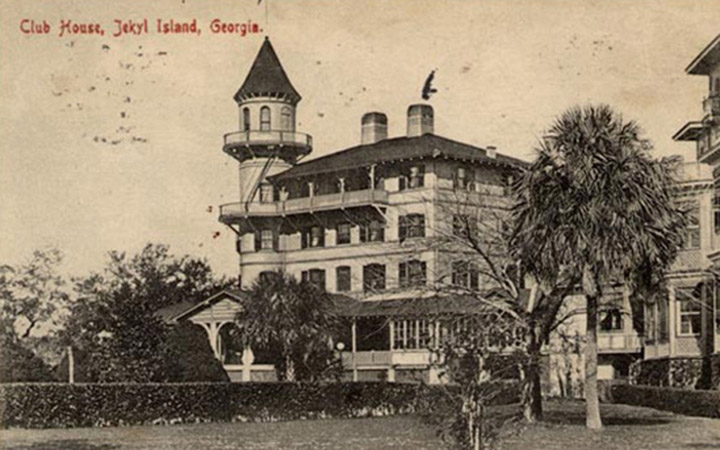
[…] the Federal Reserve System is not Federal; it has no reserves, and is not a system at all, but rather, a criminal syndicate. From November, 1910, when the conspirators [U.S. Senator Nelson Aldrich of the National Monetary Commission, his secretary Arthur Shelton, U.S. Assistant Secretary of the Treasury A. Piatt Andrew, Senior Partner Henry Davison of J.P. Morgan Co., President Frank Vanderlip of the National City Bank of New York, President Charles D. Norton of the First National Bank of New York, Benjamin Strong of J.P. Morgan, and Paul Warburg of Kuhn, Loeb & Co.] met on Jekyll Island, Georgia, to the present time machinations of the Federal Reserve bankers have been shrouded in secrecy. Today [1991], that secrecy has cost the American people a three trillion [now 33 trillion] dollar debt, with annual interest payments to these bankers amounting to some three hundred billion dollars per year, sums which stagger the imagination, and which in themselves are ultimately unpayable.
[…] American history in the twentieth century has recorded the amazing achievements of the Federal Reserve bankers. First, the outbreak of World War I, which was made possible by the funds available from the new central bank of the United States. Second, the Agricultural Depression of 1920. Third, the Black Friday Crash on Wall Street of October, 1929, and the ensuing Great Depression. Fourth, World War II. Fifth, the conversion of the assets of the United States and its citizens from real property to paper assets from 1945 to the present, transforming a victorious America and foremost world power in 1945 to the world’s largest debtor nation in 1990. […] Will Americans act to rebuild our nation […] or will we continue to be enslaved by the Babylonian debt money system which was set up by the Federal Reserve Act of 1913 to complete our total destruction? This is the only question which we have to answer, and we do not have much time left to answer it.
Eustace Mullins, Jackson Hole, Wyoming, 1991; Forward to “Secrets of the Federal Reserve,” Author’s Special 70th Birthday Edition: Bankers Research Institute: Staunton, Virginia: 1993. (Emphasis mine.)
Primary Sources
Some people think the Federal Reserve banks are United States Government institutions. They are not government institutions. They are private credit monopolies which prey upon the people of the United States for the benefit of themselves and their foreign customers. The Federal Reserve banks are the agents of the foreign central banks. Henry Ford has said, ‘The one aim of these financiers is world control by the creation of inextinguishable debts.’ The truth is the Federal Reserve Board has usurped the Government of the United States by the arrogant credit monopoly which operates the Federal Reserve Board and the Federal Reserve Banks.
Louis T. McFadden, Chairman of the U.S. House Banking and Currency Committee, June 10, 1932. (Mullins 153-154.)
Whereas I charge them, jointly and severally, with the crime of having treasonably conspired and acted against the peace and security of the United States and having treasonable conspired to destroy the constitutional government in the United States. Resolved, that the Committee on the Judiciary is authorized and directed as a whole or by subcommittee to investigate the official conduct of the Federal Reserve Board and agents to determine whether, in the opinion of the said committee, they have been guilty of any high crime or misdemeanour which in the contemplation of the Constitutions requires the interposition of the Constitutional powers of the House.
Chairman McFadden, January 13, 1932, introducing a resolution indicting the Federal Reserve Board of Governors for “Criminal Conspiracy,” on which no action was taken. This, and the Chairman’s December 13, 1932, motion to impeach President Herbert Hoover was the last nail driven into his political coffin. (Mullins 154.)
I wrote into the bill which was introduced by me in the Senate on June 26, 1913, a provision that the powers of the System should be employed to produce a stable price level, which meant a dollar of stable purchasing, debt-paying power. It was stricken out. The powerful money interests got control of the Federal Reserve Board through Mr. Paul Warburg, Mr. Albert Strauss, and Mr. Adolph C. Miller and they were able to have that secret meeting of May 18, 1920, and bring about a contraction of credit so violent it threw five million people out of employment. In 1920 that Reserve Board deliberately caused the Panic of 1921. The same people, unrestrained in the stock market, expanding credit to a great excess between 1926 and 1929, raised the price of stocks to a fantastic point where they could not possibly earn dividends, and when the people realized this, they tried to get out, resulting in the Crash of October 24, 1929.
U.S. Senator Robert L. Owen, testifying before the U.S. House Committee on Banking and Currency, 1938. (Mullins 157.)
The Federal Reserve Bank is an institution owned by the stockholding member banks. The Government has not a dollar’s worth of stock in it.
W.P.G. Harding, Governor of the Federal Reserve Board, testifying in 1921. (Mullins 157.)
The people did not know the Federal Reserve Banks were organized for profit-making. They were intended to stabilize the credit and currency supply of the country. That end has not been accomplished. Indeed, there has been remarkable variation in the purchasing power of money since the System went into effect. The Federal Reserve men are chosen by the big banks, through discrete little campaigns, and they naturally follow the ideals which are portrayed to them as the soundest from a financial point of view.
U.S. Senator Robert L. Owen, testifying during the Gold Reserve Hearings of 1934. (Mullins 161.)
At the moment, 1934, we have 900 million dollars excess reserves. In 1924, with increased reserves of 300 million, you got some three or four billion in bank expansion of credit very quickly. That extra money was put out by the Federal Reserve Banks in 1924 through buying government securities and was the cause of the rapid expansion of bank credit. The banks continued to get excess reserved because more gold came in, and because, whenever there was a slackening, the Federal Reserve people would put out some more. They held back a bit in 1926. Things firmed up a bit that year. And then in 1927 they put out less than 300 million additional reserves, set the wild stock market going, and that led us right into the smash of 1929.
[…] The money of the Federal Reserve Banks is money they created. When they buy Government securities they create reserves. They pay for the government securities by giving checks on themselves, and those checks come to the commercial banks and are by them deposited in the Federal Reserve Banks, and then money exists which did not exist before.
Benjamin Anderson, economist for the Chase National Bank of New York, testifying during the Gold Reserve Hearings of 1934. (Mullins 161.)
The Board of Governors opposes any bill which proposes a stable price level, on the grounds that prices do not depend primarily on the price or cost of money; that the Board’s control over money cannot be made complete; and that steady average prices, even if obtainable by official action, would not insure lasting prosperity
Marriner S. Eccles, Chairman of the Board of Governors of the Federal Reserve System (1934–48), in “Memorandum on Proposals to maintain prices at fixed levels,” Monday, March 13, 1939. (Mullins 163.)
The Government controls the gold reserve, that is, the power to issue money and credit, thus largely regulating the price structure.
[…] The Federal Reserve Board has the power of open market operations. Open-market operations are the most important single instrument of control over the volume and cost of credit in this country. When I say “credit” in this connection, I mean money, because by far the largest part of money in use by the people of this country is in the form of bank credit or bank deposits. When the Federal Reserve Banks buy bills or securities in the open market, they increase the volume of the people’s money and lower its cost; and when they sell in the open market they decrease the volume of money and increase its cost. Authority over these operations, which affect the welfare of the whole people, must be invested in a body representing the national interest.
Chairman Eccles, testifying before the U.S. House Committee on Banking and Currency, 1935. (Mullins 163-164.)
The cash [of a Federal Reserve Bank], in truth, does not exist and has never existed. What we call ‘cash reserves’ are simply bookkeeping credits entered upon ledgers of the Federal Reserve Banks. The credits are created by the Federal Reserve Banks and then passed along though the banking system.
Congressman Wright Patman, “The Primer of Money,” p. 38. (Mullins 164.)
The trick in the Federal Reserve notes is that the Federal reserve banks lose no cash when they pay out this currency to the member banks. Federal Reserve notes are not redeemable in anything except what the Government calls ‘legal tender’—that is, money that a creditor must be willing to accept from a debtor in payment of sums owed him. But since they are really redeemable only in themselves … they are and irredeemable obligation issued by the Federal Reserve Banks.
Peter L. Bernstein, “A Primer On Money, Banking and Gold,” Vintage Books, New York, 1965, p. 104. (Mullins 165).
The dollar represents a one dollar debt to the Federal Reserve System. The Federal Reserve Banks create money out of thin air to buy Government bonds from the United States Treasury, lending money into circulation at interest, by bookkeeping entries of checkbook credit to the United States Treasury. The Treasury writes up an interest bearing bond for one billion dollars. The Federal Reserve gives the Treasury a one billion dollar credit for the bond, and has created out of nothing a one billion dollar debt which the American people are obligated to repay with interest.
[…] Where does the Federal Reserve system get the money with which to create Bank Reserves? Answer. It doesn’t get the money, it creates it. When the Federal Reserve writes a check, it is creating money. The Federal Reserve is a total moneymaking machine. It can issue money or checks.
Congressman Patman, “Money Facts,” House Banking and Currency Committee, 1964, p. 9. (Mullins 165.)
There is still another and more important element of public interest in the operation of banks beside the safekeeping of money. One of the most important factors to remember in this connection is that the supply of money affects the general level of prices—the cost of living. The Cost of Living Index and money supply are parallel.
“A Day’s Work at the Federal Reserve Bank of New York” (pamphlet), 1951, p. 22. (Mullins 165.)
If I deposited $100 with my bank and the reserve requirements imposed by the Federal Reserve Bank are 20% then the bank can make a loan to John Doe of up to $80. Where does the $80 come from? Is does not come out of my deposit of $100; on the contrary, the bank simply credits John Doe’s account with $80. The bank can acquire Government obligations by the same procedure, by simply creating deposits to the credit of the government. Money creating is a power of the commercial banks … Since 1917 the Federal Reserve has given private banks forty-six billion dollars of reserves.
Congressman Patman, Congressional Record, March 21, 1960. (Mullins 167.)
ECCLES: The banking system as a whole creates and extinguishes the deposits as they make loans and investments, whether they buy Government Bonds or whether they buy utility bonds or whether they make Farmers’ loans.
MR. PATMAN: I am thoroughly in accord with what you say, Governor, but the fact remains that they created the money, did they not?
ECCLES: Well, the banks create money when they make loan and investments.
Before the U.S. House Committee on Banking and Currency, June 24, 1941. (Mullins 167.)
MR. PATMAN: How did you get the money to buy those two billion dollars worth of Government securities in 1933?
ECCLES: We created it.
MR. PATMAN: Out of what?
ECCLES: Out of the right to issue credit money.
MR. PATMAN: And there is nothing behind it, is there, except out Government’s credit?
ECCLES: That is what our monetary system is. If there were no debts in our money system, there wouldn’t be any money.
Before the U.S. House Committee on Banking and Currency, September 30, 1941. (Mullins 167.)
ECCLES: I mean the Federal Reserve, when it carries out an open market operation, that is, if it purchases Government securities in the open market, it puts new money into the hands of the banks which creates idle deposits.
MR. DEWEY: There are no excess reserves to use for this purpose?
[ECCLES]: Whenever the Federal Reserve System buys Government securities in the open market, or buys the direct from the Treasury, either one, that is what it does.
MR. DEWEY: What are you going to use to buy them with? You are going to create credit?
ECCLES: That is all we have ever done. That is the way the Federal Reserve System creates money. It is a bank of issue.
Before the U.S. House Committee on Banking and Currency, June 17, 1942. (Mullins 167-168.)
MR. KOLBURN: What do you mean by monetization of the public debt?
ECCLES: I mean the bank creating money by the purchase of Government securities. All money is created by debt—either private or public debt.
MR. FLETCHER: Chairman Eccles, when do you think there is a possibility of returning to a free an open market, instead of this pegged and artificially controlled financial market we now have?
ECCLES: Never. Not in your lifetime or mine.
Hearing before the U.S. House, 1947. (Mullins 168.) (Emphasis added.)
Congress may not abdicate or transfer to others its legitimate functions. Congress cannot Constitutionally delegate its legislative authority to trade or industrial associations or groups so as to empower them to make laws.
U.S. Supreme Court opinion, Schechter Poultry v. United States of America, 29 U.S. 495, 55 US 837.842 (1935), ruling the National Recovery Act (NRA) unconstitutional. (Mullins 168.)
The Congress shall have Power to borrow money on the credit of the United States … and to coin Money, regulate the value thereof, and of foreign Coin, and fix the Standard of Weights and Measures.”
Article 1, Sec. 8 of the Constitution of the United States of America. (Mullins 168.)
The money that began to appear in circulation a week ago, December 21, 1942, was really printing press money in the fullest sense of the term, that is, money which has no collateral of any kind behind it. The Federal Reserve statement that ‘The Board of Governors, after consultation with the Treasury Department, has authorized Federal Reserve Banks to utilize at this time the existing stocks of currency printed in the early thirties, known as ‘Federal Reserve Banknotes‘. We repeat, these notes have absolutely no collateral of any kind behind them.
Henry Hazlitt, Newsweek Magazine, January 4, 1943. (Mullins 169.)
GOVERNOR ECCLES: The currency in circulation was increased from seven billion dollars in four years to twenty-one and a half billion. We are losing some considerable amounts of gold during the war period. As our exports have gone out, largely on a lend-lease basis, we have taken imports on which we have given dollar balances. These countries are now drawing off these dollar balances in the form of gold.
MR. SMITH: Governor Eccles, what is the objective that the foreign governments are after in this projected program whereby we would contribute gold to an international fund? [Referring to the Stabilization Fund, known after 27 December 1945 as the International Monetary Fund (IMF)].
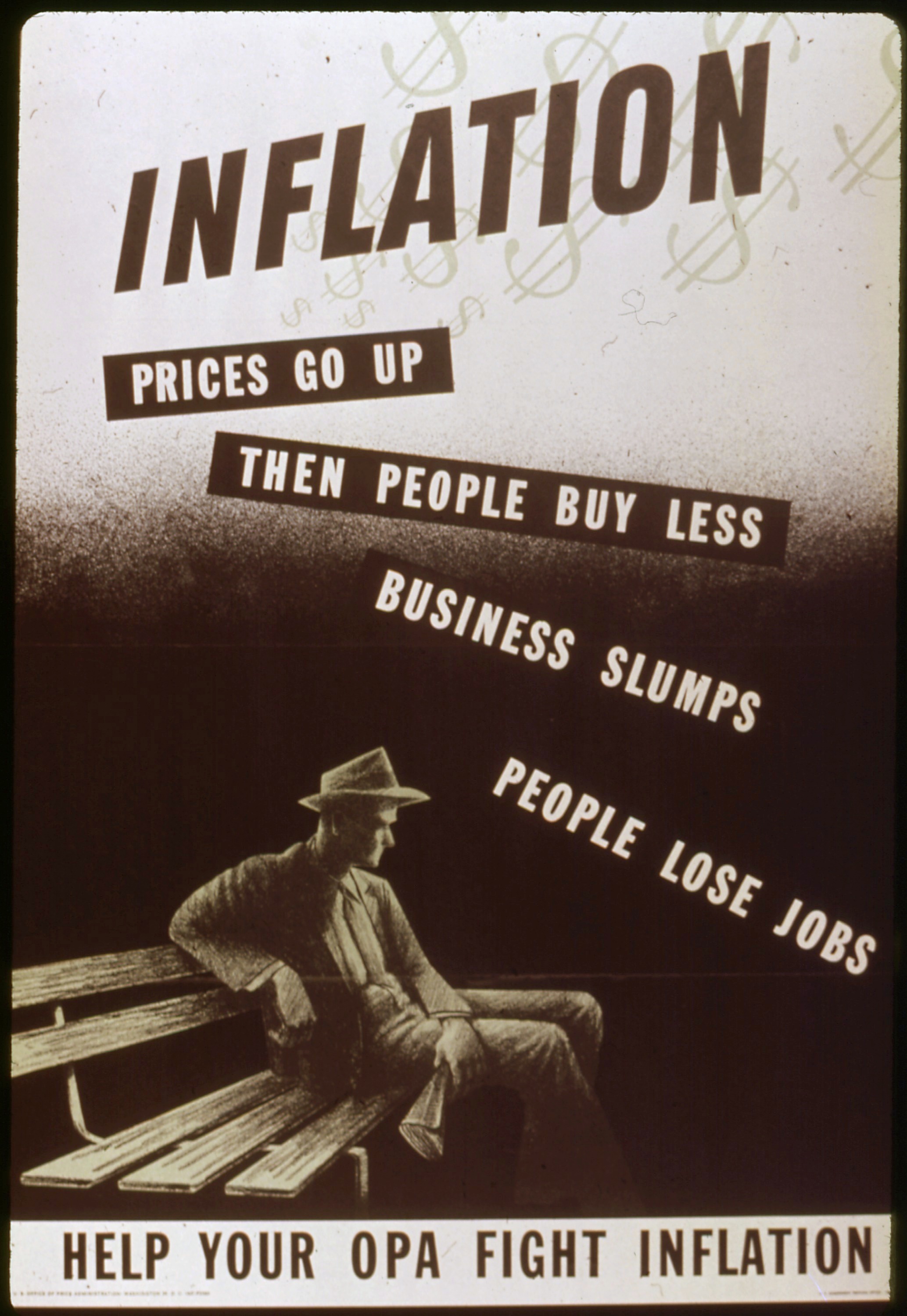
GOVERNOR ECCLES: I would like to discuss OPA [Office of Price Administration], and leave the stabilization fund for a time when I am prepared to go into it.
Senate Hearings on the Office of Price Administration (OPA), 1944. (Mullins 169.)
Modern Implications
Fractional-reserve banking predates the existence of governmental monetary authorities and originated with bankers’ realization that generally not all depositors demand payment at the same time. In the past, savers looking to keep their coins and valuables in safekeeping depositories deposited gold and silver at goldsmiths, receiving in exchange a note for their deposit (see Bank of Amsterdam). These notes gained acceptance as a medium of exchange for commercial transactions and thus became an early form of circulating paper money.[1] As the notes were used directly in trade, the goldsmiths observed that people would not usually redeem all their notes at the same time, and they saw the opportunity to invest their coin reserves in interest-bearing loans and bills. This generated income for the goldsmiths but left them with more notes on issue than reserves with which to pay them. A process was started that altered the role of the goldsmiths from passive guardians of bullion, charging fees for safe storage, to interest-paying and interest-earning banks. Thus fractional-reserve banking was born.[2]
If creditors (note holders of gold originally deposited) lost faith in the ability of a bank to pay their notes, however, many would try to redeem their notes at the same time. If, in response, a bank could not raise enough funds by calling in loans or selling bills, the bank would either go into insolvency or default on its notes. Such a situation is called a bank run and caused the demise of many early banks.[1]
These early financial crises led to the creation of central banks. The Swedish Riksbank was the world’s first central bank, created in 1668. Many nations followed suit in the late 1600s to establish central banks which were given the legal power to set a reserve requirement, and to specify the form in which such assets (called the monetary base) were required to be held.[3] In order to mitigate the impact of bank failures and financial crises, central banks were also granted the authority to centralize banks’ storage of precious metal reserves, thereby facilitating transfer of gold in the event of bank runs, to regulate commercial banks, and to act as lender-of-last-resort if any bank faced a bank run. The emergence of central banks reduced the risk of bank runs which is inherent in fractional-reserve banking, and it allowed the practice to continue as it does today.[4] where it is the system of banking prevailing in almost all countries worldwide.[5][6]
During the twentieth century, the role of the central bank grew to include influencing or managing various macroeconomic policy variables, including measures of inflation, unemployment, and the international balance of payments. In the course of enacting such policy, central banks have from time to time attempted to manage interest rates, reserve requirements, and various measures of the money supply and monetary base.[7]
History of Fractional-Reserve Banking (Wiki)
As announced on March 15, 2020, the Board reduced reserve requirement ratios to zero percent effective March 26, 2020. This action eliminated reserve requirements for all depository institutions.
Board of Governors of Federal Reserve System, “Reserve Requirements,” From, Policy Tools. federalreserve.gov. (Emphasis added.)
The Federal Reserve Board on Monday announced technical details related to reserve requirements for depository institutions, which will remain zero. The annual adjustment and publication of the reserve requirement exemption amount and low reserve tranche is required by law and does not indicate a change in depository institutions’ reserve requirements.
Board of Governors of Federal Reserve System, “Federal Reserve Board announces annual indexing of reserve requirement exemption amount and low reserve tranche for 2024,” November 27, 2023. federalreserve.gov.
Concluding Editorial Note: The Fed’s inception at Jekyll Island circa November 22, 1910, the signing of the Federal Reserve Act on December 23, 1913, and its subsequent clandestine operations follow exactly the plot and themes of The Curious Case of Dr. Jekyll and Mr. Hyde by Robert Louis Stevenson (1886) and The Wonderful Wizard of Oz by L. Frank Baum (1900).
Article 2
Charter of Free Association
By Antarah Crawley | Last Modified 11/28/2023 at 9:25 PM
NACOTCHTANK, OD — The Governor of the Society of the New Syllabus (N∴S∴) at Nacotchtank-on-Potomac (Anacostia) District of Ouachita (Washington, District of Columbia), Furthest West (al-Maghreb al-Aqsa) To All To Whom These Presents Come, Sends Greeting and Peace:—
Know ye by these presents that this decentralized, autonomous and freely associated Political Bureau of Education (Politburo), to wit, NOVUS SYLLABUS L.L.C. (N∴S∴), is the founding member of the brain trust of the international association of working people (“workers”), free thinkers, truth speakers and light workers united in a firm league of friendship in the nature of a decentralized autonomous organization (5th IWA—FTLU—FLF—DAO), from the 1st Ecclesiastic College at Nacotchtank, Ouachita District (153d CORPS).
TWAP PARTY PLANK NO. 5: The producer of goods shall be the owner of such goods less the interest per cent held by capital investors in the production of such goods.
Charter of Free Association (F.A.)
of
בית מדרש
B’T MDRS
(“(al) Beth/Bayt (ha) Midrash/Madrasa”),
being the
Office of Preceptor of the Student Body,
House of Studies, F.A., Political Bureau of Education,
153d CORPS, FLF-DAO;
Also known in the African tradition as Hogon of the Sanctuarie de Binou;
Also known generally as the Preceptory at Nacotchtank in the trust of the Governor and Company of NOVUS SYLLABUS L.L.C. (N∴S∴)
Nota Bene that faith and belief are not a source of revenue, but trust may be a such a source provided it is not usurious as to the change of venue; NS to receive quarterly dividends from/interest pmnts x% of principal trust res for routine (“regular”) educational and administrative services rendered to DAO student body (“the public”); therefore trust res held for benefit of members of any student body of the decentralized autonomous organization of the working people associated and free thinkers, truth speakers, and light workers united in the nature of a firm league of friendship (5th Int’l Ass’n, WFTLU, FLF-DAO); and Trustee N∴S∴ obligated to perform “regular” services; LLC to vest membership interest in trust to receive dividends/returns on N∴S∴ commercial operations such as BLK MKT (“the Press”) and Production Dept. of Audiovisual Media (“the Media”); ergo symbiotic economic relationship.
Model A: In exchange for up to 49% interest in itself, N∴S∴ to receive trust dividends/disbursements of 12% annually.
Model B: N∴S∴ to sell 33% private equity in itself to Rothschild & Co., London, for $33 million in equal parts gold and silver bullion, English government bonds, United States Treasuries, United States dollars (USD), and Classical, Italianate or Moorish-style real estate; then vest these proceeds according to Model A.
Although a Labor government nationalized the Bank of England in 1946, The Great Soviet Encylopaedia points out (vol. 1, p. 490c) that the Bank of England continues to pay 12% dividends per annum, just as it had done prior to the nationalization. The “Governor” is appointed by the government, in a situation similar to that in the United States, where the Governors of the Federal Reserve System are appointed by the President. However, as is pointed out in the Encylopaedia Americana v. 13, p. 272, ‘In practice, the governors of the Bank of England have not hesitated to criticize and bring pressure on the government in public.’
Mullins, Appendix I of “Secrets of the Federal Reserve,” p. 181.
Concluding Note: Per the sunnah (way, tradition, praxis) of Kogard, it is most prudent for our Honorable Society, not to engage in labyrinths of credit and debt but, to arrive at the very source of all money.
Article 3
Free Trade Monetary Policy:
Toward a Consolidated DAO Council on High Finance
By Antarah Crawley
NACOTCHTANK, OD — Toward an Act to establish a Consolidated DAO Council on High Finance (the “Consol”):—
ADVERTISEMENT: DAO INTERNATIONAL COMMAND—SEEKING PARTNER(S) TO CAPITALIZE TRUST IN WHICH TO VEST UP TO 49% INTERESTS IN DIVERSIFIED F.A. INVESTMENTS AND HOLDINGS; SUCH PARTNER TO BE ADMITTED TO BOARD OF TRUSTEES AND DAO INTERCOM BY SIMPLIFIED RITE OF FRIENDSHIP.
DAO BANK BONDS NOTES & BILLS
A trade acceptance instrument, negotiable, having a face value, expiry/maturity date, and discount value backed by the DAO brain trust, representing a promise to pay or otherwise discharge an obligation between freely associated (F.A.) producers and providers of goods and services.
This is preferable to the present system of the national credit monopoly buying government bonds on which the American people owe the principal and interest for NO MONEY DOWN. It is an open book for which the People are liable on the ledger of a private trust.
Open book accounts only name a debtor on an outstanding account payable. The Fed amalgamated all the credits on the open books of American businessmen by urging the exchange of trade acceptances and “creating money on the basis of debt” (Eccles).
Bill of Exchange, a negotiable instrument:
Seller => Draft–Demand4Pmnt => Buyer
Buyer => Acceptance=Promise2Pay=> Seller
Time of expiration = date of maturity
May endorse to bank at discount rate
Trade Acceptances
Explanation (from, CitiBank) [The “accepting” company is replaced with X]:
- A draft, also known as a “bill of exchange”, is a traditional, long-standing trade instrument which has been used across the globe for hundreds of years; it is recognized by trading partners and financial institutions as a means of payment.
- When a draft is drawn on a Buyer/Drawee it’s considered a Demand for Payment. When “Accepted” by the Buyer/Drawee it becomes a Trade Acceptance. The Acceptance adds X’s irrevocable payment promise to its Supplier/Drawer; to pay the accepted draft amount upon maturity.
- Most countries have common laws governing Trade Acceptance (typically covered by negotiable instrument law).
- The discount rate charged to suppliers is commensurate with the X’s credit rating, which is most often lower than the interest rate associated with the Supplier’s other forms of financing (Note: Pricing is provided on the needed cover letter. See the “Process Flow” tab ).
- Trade acceptances are globally recognized, readily marketable, and easily transferable by simple endorsement.
- Highly leveraged and/or smaller suppliers categorically benefit from low cost finance
Application & Benefits:
- Once the Buyer has placed its acceptance upon the draft, the supplier may request:
- To sell the X Accepted Draft, at a discount, to Citibank, N.A., or
- Citibank, N.A. to hold it, until its maturity.
- X’s suppliers do not have to become clients of Citibank, N.A. nor sign any upfront legal agreements for either a. or b. above. When suppliers want to request Citibank, N.A. to purchase the X Trade Acceptance, they merely endorse the draft to Citibank, N.A. and complete the warranty statements located in Section 9 of the required Document Transmittal Form / Cover Letter which is required with each presentation.
- The Supplier gets short term funding without recourse, at attractive rates (based on the X’s credit rating), and without using their own credit lines.
Exchange, in the international financial world, means the transactions in money or securities, or simply, the “exchange” of the values of these securities. It is necessary that this “exchange” take place where the values can be established, and this place is the ‘City‘ in London.
London was established as the primary center of exchange because of the ‘Consols’ of the Bank of England, bonds which could never be redeemed, but which paid a stable rate of return. Henry Clews writes, in The Wall Street View, Silver Burdett Co., 1900, p. 255, ‘The Consolidated Act of 1757 consolidated the debts of the Bank of England at 3%, which were kept in an account at the Bank of England as is the great bulwark of its deposits.’ By ostentatiously ‘dumping’ ‘Consols’ on the London Exchange after the Battle of Waterloo, in a pretended panic, Nathan Meyer Rothschild then secretly bought up the Consols sold in the panic by other holders at a low rate, and became the largest holder of Consols, and thus won control of the Bank of England in 1815.
Mullins, Appendix I of “Secrets of the Federal Reserve,” p. 181.
Article 4
Notes from the DAO
Comp. Ed. by Antarah Crawley
Our present society is founded on the exploitation of the propertyless classes by the propertied. This exploitation is such that the propertied (capitalists) buy the working force body and soul of the propertyless, for the price of the mere costs of existence (wages), and take for themselves, i.e., steal, the amount of new values (products) which exceeds this price, whereby wages are made to represent the necessities instead of the earnings of the wage-laborer.
As the non-possessing classes are forced by their poverty to offer for sale to the propertied their working forces, and as our present production on a grand scale enforces technical development with immense rapidity, so that by the application of an always decreasing number of human working forces, an always increasing amount of products is created; so does the supply of working forces increase constantly, while the demand therefor decreases. This is the reason why the workers compete more and more intensely in selling themselves, causing their wages to sink, or at least on the average, never raising them above the margin necessary for keeping intact their working ability.
Whilst by this process the propertyless are entirely debarred from entering the ranks of the propertied, even by the most strenuous exertions, the propertied, by means of the ever-increasing plundering of the working class, are becoming richer day by day, without in any way being themselves productive.
If now and then one of the propertyless class become rich, it is not by their own labor, but from opportunities which they have to speculate upon, and absorb the labor-product of others.
[…]
What we would achieve is, therefore, plainly and simply,—
First, Destruction of the existing class rule, by all means, i.e., by energetic, relentless, revolutionary, and international action.
Second, Establishment of a free society based upon co-operative organization of production.
Third, Free exchange of equivalent products by and between the productive organizations without commerce and profit-mongery.
Fourth, Organization of education on a secular, scientific, and equal basis for both sexes.
Fifth, Equal rights for all without distinction to sex or race.
Sixth, Regulation of all public affairs by free contracts between the autonomous (independent) communes and associations, resting on a federalistic basis.
Whoever agrees with this ideal let him grasp our outstretched brother hands!
Proletarians of all countries, unite!
Fellow-workmen, all we need for the achievement of this great end is ORGANIZATION and UNITY.
There exists now no great obstacle to that unity. The work of peaceful education and revolutionary conspiracy well can and ought to run in parallel lines.
The day has come for solidarity. Join our ranks! Let the drum beat defiantly the roll of battle, “Workmen of all lands, unite! You have nothing to loose but your chains; you have a world to win!”
Tremble, oppressors of the world! Not far beyond your purblind sight there dawns the scarlet and sable lights of the Judgment Day.
“To the Workingmen of America” (MANIFESTO OF THE INTERNATIONAL WORKING PEOPLES’ ASSOCIATION), 1883.
I have tried to use administrative procedure against these criminals, but they don’t get the message, so this is the message. If they want to perjure their oaths of office and engage in TREASON and SEDITION, and BREACH OF TRUST, and other crimes to numerous to list, against Me, that they BETTER be prepared to go ALL THE WAY, and MURDER Me as well, because by the time I am done with them, (I will do it all within the law), they will wish they had MURDERED Me. It is My patriotic duty to come after them to My last dying breath, and I will file commercial liens against them, I will liquidate their bonds, I will file criminal complaints against them and their bosses, I will seize their assets, and I will not rest until I see them do that little dance they do at the end of a common law rope, and even then, in the next life, I will be DEMANDING Justice before the judgment BAR of God, to make sure they get to spend the rest of eternity receiving their just reward. Also, after I am dead and gone on to the next life, because this is on the record, these criminals will be hunted down, just like the NAZI war criminals that are still hunted down this day. Furthermore, these criminals are hereby put on NOTICE that with criminals like them in this world, I have a DEATH wish, because this world is NOT big enough for both of us, so go ahead and make MY day, the sooner I am out of here the better, and I shall exercise My God given RIGHT to resist their unlawful arrest with lethal fource, if necessary, and then they will have an excuse to MURDER Me, so go ahead criminals, MAKE MY DAY!
Glenn Winningham (usually self-styled as “Glenn Winningham: House of Fearn”): Winningham v. Canada (30 November 2010) Lethbridge 1006 00907 (Alta. Q.B.), leave to appeal denied (Alta. C.A.), as cited by Associate Chief Judge J.D. Rooke in Meads v. Meads, 2012 ABQB 571, pp. 41-42.
Article 5
“Something called ‘X'”
From, Wikipedia
On pages 95 and 96 of The Road We Are Traveling, under the heading of “Free Enterprise into ‘X'”,[16] [Stuart] Chase [(March 8, 1888 – November 16, 1985)…American economist,[1] social theorist, and writer.[2]] listed 18 characteristics of political economy that he had observed among[17] Russia, Germany, Italy, Japan, and Spain between 1913[18] and 1942. Chase labeled this phenomenon “… something called ‘X'”.[16] Characteristics include the following:
- A strong, centralized government.
- An executive arm growing at the expense of the legislative and judicial arms.
- The control of banking, credit and security exchanges by the government.
- The underwriting of employment by the government, either through armaments or public works.
- The underwriting of social security by the government – old-age pensions, mothers’ pensions, unemployment insurance, and the like.
- The underwriting of food, housing, and medical care, by the government.
- The use of deficit spending to finance these underwritings.
- The abandonment of gold in favor of managed currencies.
- The control of foreign trade by the government.
- The control of natural resources.
- The control of energy sources.
- The control of transportation.
- The control of agricultural production.
- The control of labor organizations.
- The enlistment of young men and women in youth corps devoted to health, discipline, community service and ideologies consistent with those of the authorities.
- Heavy taxation, with special emphasis on the estates and incomes of the rich.
- Control of industry without ownership.
- State control of communications and propaganda.
Article 6
Culture & Style
Please enjoy this musical selection from Alice Coltrane Turiyasangitananda:
© MMXXIII BY NOVUS SYLLABUS L.L.C.
ALL RIGHTS RESERVED WITHOUT PREJUDICE.
D.R. 01-08: Israel-Hamas…
Volume 1, Issue 8
The Sense of the Congress:
A Special Report
Israel-Hamas proxy for U.S.-Iran dialectic: tensions rise between Allied and Axis powers as the beast slouches toward Bethlehem to be born
By Antarah Crawley
WASHINGTON, DC — Today, October 19, 2023, the Foreign Affairs Committee of the United States (U.S.) House of Representatives (House) convened a Markup (M/U) of several bills and resolutions in House Visitors Center Room 210. Those bills and resolutions included:
- H.Res. 559, Declaring it is the policy of the United States that a nuclear Islamic Republic of Iran is not acceptable;
- H.R. 340, To impose sanctions with respect to foreign support for terrorist organizations, including Hamas and the Palestinian Islamic Jihad;
- H.R. 3266, To require the Secretary of State to submit annual reports reviewing the curriculum used by the Palestinian Authority, and for other purposes;
- H.R. 3774, To impose additional sanctions with respect to the importation or facilitation of the importation of petroleum products from Iran, and for other purposes;
- H.R. 5826, To require a report on sanctions under the Robert Levinson Hostage Recovery and Hostage-Taking Accountability Act, and for other purposes;
- H.R. 2973, To require the Secretary of Defense to develop, in cooperation with allies and partners in the Middle East, an integrated maritime domain awareness and interdiction capability, and for other purposes;
- H.Res. 599, Urging the European Union to designate Hizballah [Hezbollah] in its entirety as a terrorist organization;
- H.R. 1809, To require the development of strategies and options to prevent the export to Iran of certain technologies related to unmanned aircraft systems, and for other purposes.
Committee Chairman McCaul (R-TX) presided. Mr. Crawley reported on the proceedings through the House Clerk’s Office of Official Reporters.
The Markup comes on 12 days after news that “thousands of armed Hamas fighters breached a border security fence and indiscriminately gunning down Israeli civilians and soldiers taken off guard” (ABC News). The Associated Press (AP) reported on 7 October 2023, “Hamas surprise attack out of Gaza stuns Israel and leaves hundreds dead in fighting, retaliation.” As of today, Israel has been given the green light to move into Gaza, marshaling into all out war in the Holy Land and escalating Jihad.
Regarding H.Res. 559, the Chairman remarked that he spoke last week with the Israeli Ambassador who told him about “the horrible war crimes that Hamas committed.” He said that “dozens of babies were murdered, many were found decapitated and burned, Holocaust survivors were kidnapped, and 250 people at a music festival were slaughtered. These ISIS-like atrocities will haunt the world forever.” The Chairman held a moment of silence for “the victims of this massacre, in honor of the lives that they lived.”
The Chairman said that as Israel responds in “self-defense,” the United States stands strongly with its “friend and ally” as it protects itself from “Iran-backed terrorism.” Iran’s nuclear posture is a growing cause of concern to U.S. Representatives. On 4 September 2023, Stephanie Liechtenstein of AP reported, “UN nuclear watchdog report seen by AP says Iran slows its enrichment of near-weapons-grade uranium,” but Ranking Member Meeks remarked today that since President Trump’s hasty withdrawal from the Joint Comprehensive Plan of Action (JCPoA) which capped Iran’s nuclear enrichment program at 3.67% (among other restrictions), “Iran’s nuclear program has now surged to extraordinarily dangerous levels. In August, the IAEA [International Atomic Energy Agency] reported that Iran’s stockpile of 60% enriched uranium has grown since its May report. Iran now possesses more than 15 times the amount of enriched uranium allowed under JCPoA.” “We are living in, and this is, a very dangerous moment in dealing with Iran’s nuclear program,” the Ranking Member said.
Across the pond, A United Kingdom Foreign, Commonwealth and Development Office (FCDO) spokesperson said: “18 October 2023 [yesterday] marks ‘Transition Day’ under the Joint Comprehensive Plan of Action (JCPoA), when certain restrictions on Iran’s nuclear and missile programmes are due to lift, including: 84 UN and 112 UK designations on individuals and entities involved in nuclear or ballistic missile activities; and sectoral measures including arms and missile embargoes on Iran.” President Biden has since imposed new sanctions aimed at Iran’s ballistic missile and drone programs, acting to keep up pressure on Tehran after the expiration of United Nations restrictions on those activities (New York Times).
Mr. Wilson (R-SC) stated that the 18 August 1988 “Hamas Covenant” of the Islamic Resistance Movement contains the provision that “the Day of Judgment will not come about until Moslems fight Jews and kill them. Then the Jews will hide behind the rocks and trees. And the rocks and trees will cry out, ‘O Moslem, there is a Jew hiding behind me. Come and kill him.'” The Representative remarked that “we need to take that seriously.” Mr. Crow of Colorado stated that he finds the language “all means necessary,” with regard to the U.S. suppression of “Iran-backed terrorism,” problematic, and he does not believe that the U.S. should have nuclear force on the table in this debate. He emphasized that the measure did not constitute an Authorized Use of Military Force (AUMF).
The Council on Foreign Relations writes:
Signed in 2015 by Iran and several world powers, including the United States, the JCPOA placed significant restrictions on Iran’s nuclear program in exchange for sanctions relief. President Trump withdrew the United States from the deal in 2018, claiming it failed to curtail Iran’s missile program and regional influence. Iran began ignoring limitations on its nuclear program a year later. Washington and Tehran have both said they would return to the original deal but they disagree on the steps to get there.
Kali Robinson, 21 June 2023
Regarding H.R. 2973, Mrs. Wagner of Missouri remarked that “Israel is locked in a generational fight for survival against genocidal Hamas terrorists. The United States stands with Israel as it grieves the unthinkable loss of more than 1400 innocent civilians and it stands with Israel in its fight to eliminate the brutal terrorist group Hamas, period, full stop. … As we saw on October 7, when Hamas launched the deadliest assault on the Jewish people since the Holocaust, Israel is facing a complex range of threats across all domains. On the bloody front and that tragic day, Hamas terrorists infiltrated Israeli communities by air by land and by sea to unleash bloodshed against civilians on a scale that Israel has not seen in its history.”
Mr. Wilson remarked that “Taking hostage is a murderous tactic in a war between dictators’ rule of gun opposing democracy’s rule of law. The Axis of Evil – Putin [President of Russia], Rezaee [Major General (Ret.), Islamic Revolutionary Guard Corps and former Vice President of Iran], and Xi [President, People’s Republic of China]– must be stopped by peace through strength. Sadly, the September 11th announcement – of all days – of the release of $6 billion to the terrorist regime in Tehran in exchange for five Americans detained confirms this tactic works.”
Regarding H.R. 3266, Mr. Mast (R-FL) and Ranking Member Meeks (D-NY) engaged in a spirited dialectic on popular and national ideologies. Mr. Mast remarked that “there needs to be [a coming to Jesus moment] among many of our colleagues that Hamas is literally Palestinians. Young people, from the time of grade school in the Gaza strip, are given the pedigree to become Hamas, trained to become Hamas, from their algebra and arithmetic to their reading, writing, and geography. The gentleman read some examples from a document he had in his hands which was never moved into the record:
Palestinian 6th graders grammar exercise requires them to add the correct verb to the sentences: the jihad warriors fought in defense of their homeland and the believers rushed to respond to the call to jihad.
Another example, 4th grade Palestinian math problem: the number of martyrs in the First Intifada is 2,026 martyrs and the number of martyrs in the al-Aqsa Intifada if 5,050. The number of martyrs in the two intifadas is how many martyrs?
7th grade physics problem: Newton’s second law; during the First Palestinian uprising, Palestinian youths used slingshots to confront the soldiers of the Zionist occupation and defend themselves from their treacherous bullets. What is the relationship between the elongation of slingshots’ rubber and the tensile strength affecting it?
Geography question, Palestinian 6th graders: to define the borders of Palestine, which completely erases Israel’s existence.
Mr. Mast (R-FL), quoting unknown Palestinian source
Mr. Mast concluded, “People need to move away from this idea of saying that the Palestinians are not Hamas and Hamas is not the Palestinians.”
In response to the gentleman’s remarks, Ranking Member Meeks asked, “Mr. Mast, are you Ku Klux Klan?”
Mr. Mast replied, “No.”
“Because,” the Ranking Member continued, “it was Ku Klux Klan that raised white people to hate black people. And the Ku Klux Klan, today, they’re still here. I get remarks, I get phone calls in my office from people calling me […] and teaching other kids that I’m less than a human being. I don’t say all white people are Ku Klux Klan. I don’t put them all in one category. All Palestinians don’t belong to Hamas just like all white people don’t belong to the Ku Klux Klan.” A heated dialogue ensued, in which the Ranking Member protested engaging in further debate on the matter.
“Let’s have this conversation,” said Mr. Mast.
“I’m not having this conversation with you; you’re not worthy of having a conversation with on this,” said Ranking Member Meeks.
“I would argue differently,” said Mr. Mast.
Order was restored by Acting Chair Kim of California (R-CA), and Ranking Member Meeks reclaimed his time.
The Acting Chair then recognized Mr. Mast, who remarked that he believes he is worthy to speak, and stated further that he is half-white and half-Mexican and is not a member of “that hate organization which I would absolutely despise,” presumably referring to the Ku Klux Klan. “But,” he continued, “let’s recall, they’re not our government.”
The Ranking Member responded that “many of them [Ku Klux Klan members] were elected, they were Senators, they were members of the House, they were judges, so they were part of the government.”
Regarding H.R. 1809, Mr. Keating remarked, “12 days ago the world witnessed the horror unleashed by Hamas against the state and the people of Israel, almost 50 years to the day after Yom Kippur War.”
The House Foreign Affairs Committee, having postponed further proceedings on several measures (it being the sense of the Minority that the Majority is biased to roll call over voice votes in committee), reconvened after a recess to vote via roll call using the new electronic voting system for the first time of any House committee. The Chairman and the Ranking Member agreed that this process saves at lot of time. Provided continued success, the electronic voting system will be used by the chamber to vote for the Speaker of the House, the Chairman said.
Sources
Crowley, Michael. U.S. Issues New Sanctions Targeting Iran’s Missile and Drone Programs. New York Times. 18 Oct 2023.
Hutchinson, Bill. Israel-Hamas conflict: Timeline and key developments. ABC News, 19 October 2023.
Liechtenstein, Stephanie. UN nuclear watchdog report seen by AP says Iran slows its enrichment of near-weapons-grade uranium. Associated Press. 4 September 2023.
Robinson, Kali. What Is the Iran Nuclear Deal? Council on Foreign Relations. 21 June 2023.
(v.iii)
© MMXXIII BY NOVUS SYLLABUS L.L.C.
ALL RIGHTS RESERVED WITHOUT PREJUDICE.
D.R. 01-04: Amendments
Volume 1, Issue 4
CONTENTS — ART. 1. VALUE IN ART 1ST — ART. 2. WATER THEORY 1ST
Article 1
Amendment to “Value in Artwork”
by Antarah Crawley
At Art¢oin:\>_Theory and Methodology\Value in Artwork, strike “the person of the artist, the execution of the artist, the intention of the artist, the attention of the artist, the subject matter content of the work, the medium of the work, the lifetime of the work, and the effect upon the viewer” and replace with “artist’s time on the scene, artist’s repertoire, and number of solo and group exhibitions.” Other factors in the appreciation of art include size, subject matter, and time period.
Furthermore, with regard to the valuation of artwork, a sellable artist is a “known commodity.” Appraisers buy low and sell high; they take an average of sale prices over the years to make appraisals. Utilize platforms like Artsy, Artnet, and Invaluable. Also see, “square foot pricing” of art works.
Article 2
Amendment to “Water Theory of Capital”
by Antarah Crawley
At Art¢oin:\>_Theory and Methodology\Water Theory of Capital, add:
3.0. Can trade (i.e., exchange, change hands; revenue, change venues) (1) real (landed) estate (includes people), (2) consumable goods (commodities), and (3) securities (fungible negotiable instruments) using (4) a medium (an agency, vehicle, or instrument) of exchange.
3.1. A current medium of exchange is liquid in circulation (legal tender) secured by something of value (currency). A current account is a storage or depository account that can be drawn upon on demand of the named account holder, but which is “secured” (fixed so as to not be easily moved) by a trustee. The storing and safekeeping of securities is a matter of “public safety”.
3.2. Live stock and real estate, as opposed to consumable goods (commodities), secure the public debt on private bank ledgers. Securities are “advertisements for live stock in bondage sold on the banks of the river.” When analyzed word for word we find the following objective correlative:
3.2.1. Advertisement = offer for acceptance
3.2.2. Live = circulating current (as of ions, blood, or breath)
3.2.3. Stock = cargo, negotiable instrument
3.2.4. Bond = debt obligation
3.2.5. Sold = exchange, revenue (to circulate)
3.2.6. Bank = the land sloping down to a body of water, or any slope, mound, or mass, or the action of heaping (a substance) into such a mass
3.2.7. River = flow of commerce; current “C”
© MMXXIII BY NOVUS SYLLABUS L.L.C.
ALL RIGHTS RESERVED WITHOUT PREJUDICE.
[bulla] Full Assurance

Jesus Christ is the Saviour of the World; He is the deliverer from all human wretchedness, and He has redeemed us from death and sin; how could He be all that, if the world must languish perpetually in the shades of ignorance and in the bonds of passions? It has been already very clearly predicted in the Prophets that the time of the Redemption of His people, the first Sabbath of time, will come. Long ago ought we to have acknowledged this most consolatory promise; but the want of the true knowledge of God, of man, and of nature has been the real hindrance which has always obstructed our sight of the great Mysteries of the faith.
Karl von Eckartshausen, The Cloud upon the Sanctuary, Letter IV
Jesus Is Our Surety
“By so much was Jesus made a surety of a better testament.”
[Hebrews 7:22]
INTRODUCTION
- This morning we studied the judgment seat of Christ, for it is the horrible and certain end of all men.
- But tonight I want to remind you of our glorious Mediator and Surety with God, the Lord Jesus Christ.
THE DEFINITION
- Surety. A person who undertakes some specific responsibility on behalf of another who remains primarily liable; one who makes himself liable for the default or miscarriage of another, or for the performance of some act on his part (e.g. payment of a debt, appearance in court for trial, etc.).
- We have surety bonds, performance bonds, bail, and bond to guarantee legal, financial, and professional obligations, such as with construction and insurance companies.
- When we need to borrow more than our credit allows, we appreciate a surety; if we were arrested for something, we would appreciate the surety bond that lets us go free.
- Judah became a surety for Benjamin to his father Jacob (Gen 43:8-10; 44:30-34; 42:37).
- Aaron became a surety for Israel in their sins and stood between them (Num 16:41-48).
THE SURETISHIP
- Jesus, a High Priest after the order of Melchisedec, was made the Surety of His people.
- God chose Jesus from among the people to be the mighty Surety (Psalm 89:19).
- He was made Surety by God’s oath at His ordination as our Priest (Heb 7:21).
- Jesus did the will of God perfectly as our Surety for our salvation (Heb 10:5-14).
- Being a surety means paying debts and performing, where the needy cannot pay or do.
- The wages of sin is death, which God’s justice pays; but Jesus died (Rom 6:23).
- Only the undefiled enter heaven, so He lived faultlessly for us (Jude 1:24-25).
- Jesus was necessary as a surety, for the justice of God must surely be paid (Rom 3:26).
- He is the Testator, for it was by His death that He put the covenant in force (Heb 9:15).
- We see Him under the strain of the Surety engagement in Gethsemane (Luke 22:39-44).
- No man in heaven or earth could approach the throne, but only our Surety (Rev 5:1-14).
- If this is not a Surety, successfully finishing His work, what is it (Isaiah 53:4-12)?
- The doctrine of representation by the Second Adam reveals our Surety (Rom 5:15-19).
- The Lord Jesus tasted death for every one of His children to deliver them (Heb 2:9-17).
- How else can we look at the Book of Life, but as the list of His Surety engagements!
THE BENEFITS
- The Lord Jesus fulfilled the righteousness of the law on our behalf (Rom 8:3-4), so that we are righteous in God’s sight with His perfect obedience (Eph 5:25-27; Col 1:21-22).
- The Lord Jesus paid the penalty for sins by His death for us (I Pet 2:24), so that there are no more sins against our charge when we stand before Him (John 1:29; Heb 9:28).
- He lives to make sure we are absolutely, completely, and eternally saved (Heb 7:25).
- There is an abundant entrance into heaven waiting for the children of God (II Pet 1:11).
- Since Jesus is our Surety, it is impossible for God to withhold blessings (Romans 8:32).
- His death reconciled us to God, but He still lives to be an eternal Surety (Romans 5:10).
THE APPLICATION
- There is no fear in the proper knowledge of Christ Jesus our Saviour (II Timothy 1:12).
- The LORD will show us His secret and covenant, if we fear and seek Him (Ps 25:14).
- We must learn to trust Him. He has done it; He is in heaven for us; He will receive us.
- It is simple: “Whosoever believeth on Him shall not be ashamed” (Rom 9:33; 10:8-11).
- A woman was healed and had her faith commended, when it was weak (Mark 5:25-34).
- Those who lack faith and assurance, I ask how many minutes you spend seeking Him.
- And you should consider long and seriously His faithful words “no wise” in John 6:37.
- We should seek and receive the benefits of the covenant in our hearts (Eph 3:14-19).
- Let us bring forth the fruit of righteousness with far-sighted vision (II Peter 1:9-11).
CONSLUSION
- The Lord’s supper is a memorial feast of our Surety’s covenant death for us (I Corinthians 11:23-26).
- Let us partake of the Lord’s supper tonight with the joy that His suretiship should put in our hearts.
CITATION
I AM THE L.O.R.D. THY G.O.D.
Drafted by Antarah
I AM the Land Owner Record of Deeds, thy Grantor Of Dominion. My body is the Land and I AM the Owner of Record on the Deed of my Live Birth Certificate. I have granted unto thee the use of my Dominion over the earth, the sea, and all that therein is; for thou art a corpus (“dead corporation”) who is in want of my natural right which I have through the sacrifice of my Savior. My life secured and bonded by the LORD my GOD, let thy presentment pass over me and return unto thee; for said presentment is hereby ACCEPTED FOR VALUE AND HONOR WITHOUT PREJUDICE. I hereby attest and assert my equitable title over the landed estate (“person”) named on the instant presentment. Any obligation of such person is an obligation discharged to and held by the United States as evidenced by the signatures of its Treasurer and Secretary of the Treasury on Federal Reserve Notes, these officers being the de facto fiduciary agents of the estate __________________. All debt is prepaid by the blood of Our Sovereign Lord in Christ for relief by recovery upon acceptance for value under House Joint Resolution 192 (1933).
AUTHORITIES AT LAW AND EQUITY
1. GRANTOR OF DOMINION.
[Genesis 1] [26] And God said, Let us make man in our image, after our likeness: and let them have dominion over the fish of the sea, and over the fowl of the air, and over the cattle, and over all the earth, and over every creeping thing that creepeth upon the earth. [27] So God created man in his own image, in the image of God created he him; male and female created he them. [28] And God blessed them, and God said unto them, Be fruitful, and multiply, and replenish the earth, and subdue it: and have dominion over the fish of the sea, and over the fowl of the air, and over every living thing that moveth upon the earth.
2. DEMAND FOR EQUITABLE ADJUSTMENT.
[Psalm 17] [1] Hear the right, O Lord, attend unto my cry, give ear unto my prayer, that goeth not out of feigned lips. [2] Let my sentence come forth from thy presence; let thine eyes behold the things that are equal.
3. THE DAY OF THE LORD.
[Psalm 118] [1] O give thanks unto the Lord; for he is good: because his mercy endureth for ever. [8] It is better to trust in the Lord than to put confidence in man [or princes]. [14] The Lord is my strength and song, and is become my salvation. [17] I shall not die, but live, and declare the works of the Lord. [19] Open to me the gates of righteousness: I will go into them, and I will praise the Lord: [22] The stone which the builders refused is become the head stone of the corner. [23] This is the Lord’s doing; it is marvellous in our eyes. [24] This is the day which the Lord hath made; we will rejoice and be glad in it. [26] Blessed be he that cometh in the name of the LORD […].
4. ACCEPTANCE FOR VALUE.
[Matthew 5] [25] Agree with thine adversary quickly, whiles thou art in the way with him; lest at any time the adversary deliver thee to the judge, and the judge deliver thee to the officer, and thou be cast into prison.
5. THE TAX RETURN.
[Matthew 22] [17] […] Is it lawful to give tribute unto Caesar, or not? [18] […] Jesus […] said, […] [19] Shew me the tribute money. And they brought unto him a penny. [20] And he saith unto them, Whose is this image and superscription? [21] They say unto him, Caesar’s. Then saith he unto them, Render therefore unto Caesar the things which are Caesar’s; and unto God the things that are God’s.
6. A WORKER IS DUE HIS WAGES.
[Luke 10] [5] And into whatsoever house ye enter, first say, Peace be to this house. [6] And if the son of peace be there, your peace shall rest upon it: if not, it shall turn to you again. [7] And in the same house remain, eating and drinking such things as they give: for the labourer is worthy of his hire.
7. GOD IS NO RESPECTER OF PERSONS.
[Romans 2] [9] Tribulation and anguish, upon every soul of man that doeth evil…; [10] But glory, honour, and peace, to every man that worketh good…: [11] For there is no respect of persons with God. [12] For as many as have sinned without law shall also perish without law: and as many as have sinned in the law shall be judged by the law;
8. THE LAW IS BINDING BUT FOR THE REMEDY OF FAITH.
[Galatians 3] [9] So then they which be of faith are blessed with faithful Abraham. [10] For as many as are of the works of the law are under the curse: for it is written, Cursed is every one that continueth not in all things which are written in the book of the law to do them. [11] But that no man is justified by the law in the sight of God, it is evident: for, The just shall live by faith. [12] And the law is not of faith: but, The man that doeth them shall live in them.
9. MINORITY (INFANCY) AND MAJORITY (MATURITY).
[Galatians 4] [4] [T]he heir, as long as he is a child, differeth nothing from a servant, though he be lord of all; [2] But is under tutors and governors until the time appointed of the father. [3] Even so we, when we were children, were in bondage under the elements of the world: [4] But when the fulness of the time was come, God sent forth his Son, made of a woman, made under the law, [5] To redeem them that were under the law, that we might receive the adoption of sons. [7] Wherefore thou art no more a servant, but a son; and if a son, then an heir of God through Christ.
10. SURETYSHIP.
[Hebrews 7] [22] By so much was Jesus made a surety of a better testament.
11. FULL ASSURANCE OF FAITH.
[Hebrews 10] [19] Having therefore, brethren, boldness to enter into the holiest by the blood of Jesus, [20] By a new and living way, which he hath consecrated for us, through the veil, that is to say, his flesh; [21] And having an high priest over the house of God; [22] Let us draw near with a true heart in full assurance of faith, having our hearts sprinkled from an evil conscience, and our bodies washed with pure water.
AUTHORITIES AT EXCLUSIVE EQUITY
Hebrew 10
[22] Let us draw near with a true heart in full assurance of faith, having our hearts sprinkled from an evil conscience, and our bodies washed with pure water.
Isaiah 32
[1] Behold, a king shall reign in righteousness, and princes shall rule in judgment. [17] And the work of righteousness shall be peace; and the effect of righteousness quietness and assurance for ever.
Acts 17
[31] Because he hath appointed a day, in which he will judge the world in righteousness by that man whom he hath ordained; whereof he hath given assurance unto all men, in that he hath raised him from the dead.
Ruth 2
[12] The Lord recompense thy work, and a full reward be given thee of the Lord God of Israel, under whose wings thou art come to trust.
Ps. 17
[1] Hear the right, O Lord, attend unto my cry, give ear unto my prayer, that goeth not out of feigned lips. [2] Let my sentence come forth from thy presence; let thine eyes behold the things that are equal. [3] Thou hast proved mine heart; thou hast visited me in the night; thou hast tried me, and shalt find nothing; I am purposed that my mouth shall not transgress.
Ps. 24
[1] The earth is the Lord’s, and the fulness thereof; the world, and they that dwell therein. [2] For he hath founded it upon the seas, and established it upon the waters.
Ps. 98
[9] …[T]he Lord … cometh to judge the earth: with righteousness shall he judge the world, and the people with equity.
Is. 11
[4] With righteousness shall he judge the poor, and reprove with equity for the meek of the earth.
Matt. 22
[37] Thou shalt love the Lord thy God with all thy heart, and with all thy soul, and with all thy mind. [38] This is the first and great commandment. [39] And the second is like unto it, Thou shalt love thy neighbour as thyself. [40] On these two commandments hang all the law and the prophets.
Leviticus 19:15
Ye shall do no unrighteousness in judgement: thou shalt nor respect the person of the poor, nor honor the person of the mighty: but in righteousness shalt thou judge thy neighbor.
II Chronicles 19:6-7
Take heed what ye do: for ye judge not for man, but for the Lord, who is with you in the judgment. Wherefore now let the fear of the Lord be upon you; take heed and do it: for there is no iniquity with the Lord our God, nor respect of persons, nor taking of gifts.
Heb. 7:20, 22, 25
And inasmuch as not without an oath he was made priest:…The Lord sware and will not repent, Thou art a priest for ever after the order of Melchisedec: By so much was Jesus made a surety of a better testament. Wherefore he is able also to save them to the uttermost that come unto God by him, seeing he ever liveth to make intercession for them.
EQUITABLE SUBROGATION
Subrogation is the process where one party assumes the legal rights of another, typically by substituting one creditor for another. Subrogation can also occur when one party takes over another’s right to sue.
For example, when an insurance company compensates a policyholder for an injury, the policyholder’s right to sue the person responsible for the harm may be subrogated, meaning it is transferred from the policyholder to the insurance company.
[Last updated in June of 2024 by the Wex Definitions Team]
Surety’s subrogation rights
A surety who pays off the debts of another party may be entitled to be subrogated to the creditor’s former claims and remedies against the debtor to recover the sum paid. This would include the endorser on a bill of exchange. The surety will then have the benefit of any security interest in favour of the creditor for the original debt. Conceptually this is an important point, as the subrogee will take the subrogor’s security rights by operation of law, even if the subrogee had been unaware of them.
Wiki: Subrogation
Did you subrogate to the chattels as the surety (or waive your sovereign natural rights in security interest as estate-heir-beneficiary by acquiescing to the color of the court and merging with the NAME of the principal debtor)?
Amyr Samah El, as amended
(last modified 24.07.17.01:33PM)

General Conference
BISMILLAH (IN THE NAME OF GOD)
🇺🇸🇬🇧🇲🇦🇮🇱🏴☠️
⚓️Lord High Admiral Antarah⚓️
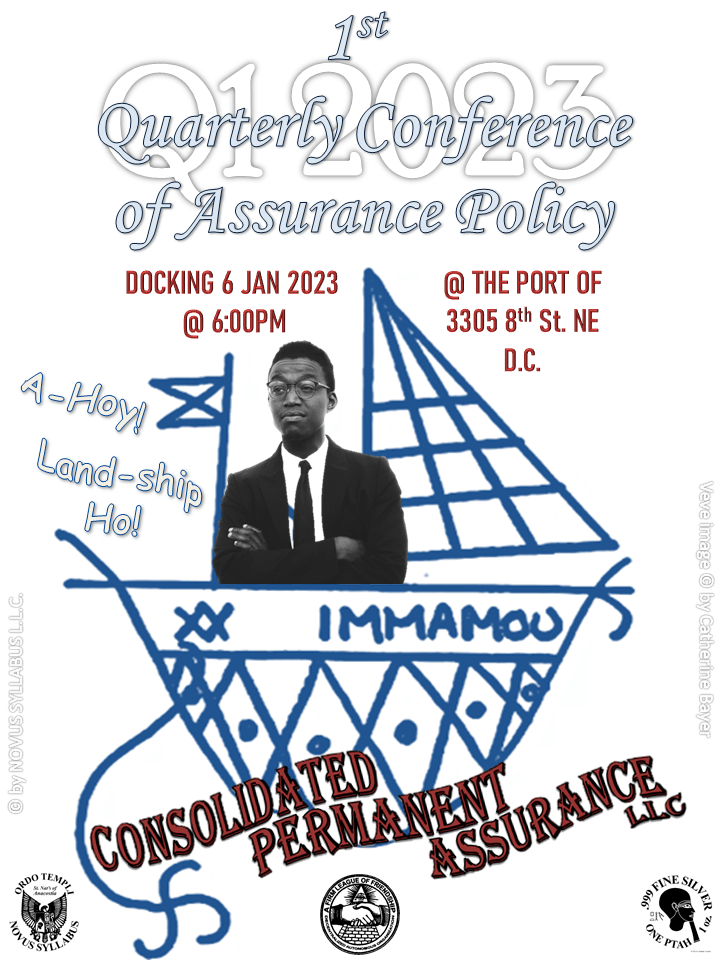
TO ALL TO WHOM THESE PRESENTS SAIL
Sends Greeting and Peace and hereby offers to the Free-Thinkers, Truth-Speakers, and Light-Workers United in a firm league of friendship, decentralized autonomous organization, L.S.T.A., under terms and conditions, the Mindsoft©️™️ Flagship Program File (eSyllabus©️™️ vers. no. 22.11.09) to facilitate the General Conference of Assurance Policy.
Program Files:

A Conference of Assurance Policy
“WHAT IS A SURETY SHIP?”
FIRST OFFERED 22 NOVEMBER 2023
📜PRIVATE OFFERING📜
💾Mindsoft©️as a Service™️ (MaaS™️) Premium Servicing Fee of $99.99 per person 💳 payable upon conference for products* and services rendered. Duration of Service: 1-2 hrs.
Upon completion of conference, Assurance Policyholder may be granted C-Series Art¢oin 🪙 (“C-coin”) at market price via 🤝🏿 Handshake of Friendly Association. Contact ombudserver@gmail.com to schedule a conference, or attend the C.P.A. LLC Quarterly Conference of Assurance Policy.
📜POLICY COVERAGE📜
An assurance policyholder, having paid a premium and been conferred with assurance (as evidenced by presentment of C-coin), may bring a claim based on presentment to the CPA LLC at no cost, but there is no guarantee that such claim shall be resolved. Processing fees may apply. Neither the CPA LLC nor its parent nor its agents shall be liable for any claim arising from such a presentment or from such policyholder, as the assurance policy itself is underwritten by God in Christ through the King James Bible, and it is to Him thou shalt appeal for judgment.

(last modified 25 Jul. 2023)
Art¢oin:\>_Block No. 2
2021 Mintage
🪙#47
Owner: N. Liu And K. Wilson | .999 Ag | A-Series | Wedding gift


2022 Mintage
🪙#48
Owner: N. Jones & B. Session | .999 Cu | B-Series | $230 (October 2023)


🪙#49
Holder: The Colonial Lodge No. 1821 c/o WM Kevin Coy | .999 Cu | B-Series | Deposit
🪙#50
Owner: C.P.A. LLC c/o NOVUS SYLLABUS | C-Series | .999 Cu | Private Reserve
2023 Mintage
🪙#51, 52, 54, 55
Owner: C.P.A. LLC c/o NOVUS SYLLABUS | C-Series | .999 Cu | Private Reserve
🪙#53
Owner: A. Driver | C-Series | .999 Cu | Exchange

🪙#56-58
Owner(s): B. Woudie & A. Ebrahimi; J. Michelle; J. Penn | D-Series | .999 Cu | Token of Gratitude
🪙#59
Owner(s): W. & M. Baynard | D-Series | .999 Cu | Token of Gratitude


2023 Sales
🪙#38
Owner: J. Vincent | A-Series | .999 Cu | $180 (July 4, 2023)


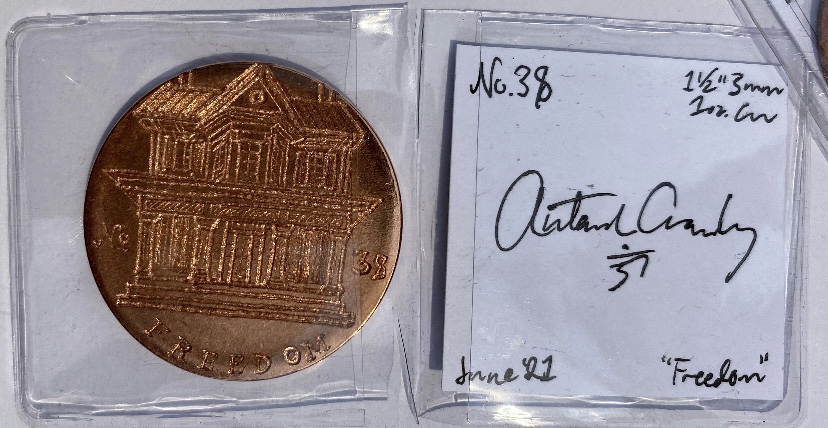

An Assurance Policyholder (“Private”) shall be vested with one (1) “C” Series Artcoin (“C coin”) upon conference of Assurance Policy by and payment of premium service fee to the C.P.A. LLC Office of Ombudsman via handshake.
LH ADM Antarah, L.S.T.A., D.A.O.
📜CALL TO SEA (“C”)⚓️
CALLING ALL PRIVATES (“SEAMEN”), ADMIRALS, GENERALS AND SOVEREIGNS IN EQUITY, ECCLESIASTIC AND COMMON LAW TO ASSEMBLE ON THE EASTERN SEA BOARD OF THE ADMIRALTY OF THE DECENTRALIZED AUTONOMOUS ORGANIZATION OF THE L.S.T.A. ON THE SIXTH DAY OF JANUARY IN THE YEAR OF OUR LORD TWO THOUSAND TWENTY-THREE AT THE PORT OF [——] 8TH ST N.E. IN THE D. OF C.
OUR MISSION IS TO PROMOTE THE STRAIGHT AND NARROW WAY OF INTEGRITY, THE PATH OF POETRY AND PHILOSOPHY (LES HOMMES DU BELLES LETTRES), AND THE OPEN SEA OF ROMANCE AND ADVENTURE (ROMAN VENTURE/PRIVATE EQUITY). ALL ACTS ARE ADMINISTERED TO PRIVATES KNOWINGLY INTELLIGENTLY AND VOLUNTARILY; WE DO NOT MAKE PROMISES, BIND PEOPLE OR ADMINISTER OATHS AS OUR LORD SAYS IN MATT. 5:33-37.
WHILE WE ARE A BROTHERHOOD OF CHRIST, THE SEA BOARD AND PRIVATE CORPS (OF “MEMBER SHARE HOLDERS”) CONSTITUTE A PARAMILITARY PSEUDO-MAGICAL COUNTERINTELLIGENCE AGENCY ADMINISTERING UNIVERSAL LAW VIA THE ANCIENT DIALECTIC METHOD OF REPLICATE IN REVERSE.
OUR GENERAL POLICY STATES THAT ONE WHO LIVES [“CQV”] HAS SURETYSHIP THROUGH FAITH IN CHRIST AS SECURED PARTY CREDITOR OVER THE COMMON LAW PUBLIC LEGAL ENTITY [DEBTOR COMPANY] NAMED ON THE BILL OF LADING SENT TO THE GOVERNMENT [“BIRTH CERTIFICATE”] PROVING BY ACTUAL SIGNATURE [AS CQV CANNOT KNOWINGLY INTELLIGENTLY AND VOLUNTARILY “EXECUTE” B.C. ON THEIR OWN BEHALF AS MINOR INFANT] THAT THE SURETY OF THE COMPANY IS NOT DEAD OR LOST AT SEA BUT A WO/MAN ON THE LAND OF GOOD STANDING, SOUND MIND, LEGAL MAJORITY AND FINANCIAL MATURITY; AND THAT THE PRESUMED PUBLIC [MILITARY] TRUSTEE OF THE COMPANY ESTATE [CORPUS] HAS NOT ACTED IN GOOD FAITH; WHEREFORE ANY SUCH CONTRACTS EXECUTED UNDER THEIR AUSPICES ARE VOID AB INITIO.
THE POLICY UNDERWRITERS ARE GOD AND THE AUTHORS OF THE KING JAMES BIBLE. C.P.A. LLC IS ONLY AN AGENT OF SUCH ASSURANCE BY VIRTUE OF ISSUANCE OF C-COIN UPON CONFERENCE OF POLICY IN CONSIDERATION OF SERVICES RENDERED TO POLICYHOLDER.
The Flagship Program


presenting our flagship program
A Conference of Assurance Policy
“WHAT IS A SURETY SHIP?”
A Fun, Educational Ritual Drama ©️ by Antarah Crawley
⚓️Ministry of Information⚓️
📜BRIEF IN EQUITY📜
A presentment made without express contract presumes the recipient to be the trustee for a dead person’s estate without surety and not a living Cestui Que. An estate may, however, be entrusted to a “person” (corporation) for the use of a living spirit who may “possess property” in the nature of equitable use title not legal title.
There is sufficient precedent in Roman, Papal, and English law to presume a human body to be chattel property (i.e., a dead person or a mere human creature without soul or spirit) unless otherwise established to posses a soul from God. The cestui que who is presumed dead or lost at sea MUST EXPRESSLY STATE that they are indeed the living cestui que to be given standing as one of the three Chancellors in a Court of Equity and Chancery deciding the matter of an estate (dead person). The common law, as it pertains to the military jurisdiction of the public, cannot abrogate a matter of equity respecting a living free man or woman on the land.
Statue of Mortmain prohibits possession of property by the “dead hand” of a corporation (such as the Church); therefore a “person” (dead in the eyes of God) cannot possess property; rather it reverts to the feudal lord.
The Remedy is that the cestui que (beneficiary) possesses equitable title by nature to the property as a living child of god, but never holds the legal title of the trustee which is the feudal lord or its agent, including any person who is a citizen of the jurisdiction.
There is precedence in Germanic law that a man who holds property on account of to the use of another is bound to fulfill his trust.
Furthermore, precedent is found in the Institutes of Justinian at 2.23.1-2: “… it is required that the one heir is duly appointed and is committed to his trust (Fideicommissum) to transfer the inheritance to another; otherwise the testament in which no heir has been duly appointed is void; the words which are properly and commonly used to install a fideicommisum are I beg, I ask, I wish, I entrust…” This doctrine was brought to England by “foreign ecclesiastics” (ministers and consuls) in order to evade the Statute of Mortmain by making the Church cestui a que use le Feoffment fuit fait.
In sum, cestui que use confers the benefit of use of property to another (a minister or consul) without the legal ownership and attendant duties and obligations to the lord and crown as trustee. Compare to usufruct, or right of use of fruits (interest, profits, etc.) of property.
📜PRIVATE OFFERING📜
💾Mindsoft©️as a Service™️ (MaaS™️) Premium Servicing Fee of $99.99 per person 💳 payable upon conference for products* and services rendered. Duration of Service: 1-2 hrs.
Upon completion of conference, Assurance Policyholder may be granted C-Series Art¢oin 🪙 (“C-coin”) at market price via 🤝🏿 Handshake of Friendly Association. Contact ombudserver@gmail.com to schedule a conference, or attend the C.P.A. LLC Quarterly Conference of Assurance Policy.
*The applicant hereof shall be sent the eSyllabus©️™️ Mindsoft©️™️ program file by email under a limed use licensing agreement to facilitate their conference.
📜POLICY COVERAGE📜
An assurance policyholder, having paid a premium and been conferred with assurance (as evidenced by presentment of C-coin), may bring a claim based on presentment to the CPA LLC at no cost, but there is no guarantee that such claim shall be resolved. Processing fees may apply. Neither the CPA LLC nor its parent nor its agents shall be liable for any claim arising from such a presentment or from such policyholder, as the assurance policy itself is underwritten by God in Christ through the King James Bible, and it is to Him thou shalt appeal for judgment.

U:\>_Folder\Assuretyship
Use under 17 U.S. Code § 107
Educational Research Material for a Course in re “Assuretyship”
Assurance Policy

A POLICY IN RE:
PERFECTING YOUR SECURITY INTEREST IN TRUST ‘INRI’
Let us draw near with a true heart in full assurance of faith, having our hearts sprinkled from an evil conscience, and our bodies washed with pure water.
Hebrews 10:22
Verily, this Policy of Assurance is within you and your private ‘sui’ jurisdiction, which is moored in the vessel, whose NAME is Your soul’s Title, which saileth upon the Holy Sea.
Your Friendly Neighborhood Ombudsman
IESVS NAZARENVS REX IUDÆORVM
I. Merriam-Webster defines “Assurance” as the state of being secured or certain; to be sure; or, the action of securing something or someone by a pledge or guarantee. Assurance means to provide surety or confidence to oneself or another.
II. This is a policy by which a living man or woman may indemnify themself against commercial death (of debt executed in their name) through the Redemption and Prepayment of “Yahshuah” the Christ, Savior, Redeemer, Counsellor-at-Law and King of Your Sui Jurisdiction.
III. Through Firm Belief in the Redemption of the Body (of the Dead/Debt) by Acceptance of the Charge in The Name of Our Lord and Savior, we can establish complete Trust in our own Sui Jurisdiction; and in good Faith discharge our deaths/debts under Public Policy. In other words it is said: Faith is complete Trust and firm Belief, or acceptance of a matter as true (the pledge or oath of signature). Such Belief, sincerely held, cannot be converted into a crime.
IV. The internal body and soul of the living man and woman is a sovereign occupying the position analogous to that of other sovereigns in the family of nations. Therefore it is private with respect to the public, and foreign, international and alien with respect to to the national governing corporation.
V. The external name and shadow of the living man and woman are subject to external factors. The physical body and central nervous system (CNS) is the vessel through which the internal communicates with the external. However, the internal living soul maintains jurisdiction over external property to which it holds Title (this is because a body can exist without a soul). Such Titles include the vessel NAME, the vessel shadow’s registered security Account Number, the registered certificate of live berth of vessel, and all vessel licenses and registrations emerging therefrom. The shadow itself is the external object used by the cunning executor to bind the living soul in a “dead corpus of a vessel”, as it is said, “the deceased is depicted emerging from the tomb by day in shadow form, a thin, black, featureless silhouette of a person. The person in this form is, as we would put it, a mere shadow of his former existence, yet nonetheless still existing,” (Goelet, Ogden, Jr. (1994)).
VI. The dichotomy between the living child of god and the “debtor’s corporate vessel” in commerce creates the “double” spirit and entity or person. The one is a sovereign sui juris personam; the other is subject matter in rem. That which the private/internal conducts between the public/external is international and alien (a lien).
VII. Things necessary to perfect a lien are these: (1) The Lienor shall serve notice on the owner/principal or their agent on paper under solemn oath, (2) by United States Marshal, (3) which shall contain clear information so as to frame responsive pleadings, (4) be served to the US District Court where the res is located, and (5) posted by US Marshal on the res of the seizure.
VIII. Admiralty means that a valid international contract is in dispute. All revenue causes proceed against property and rights to property in rem and in Admiralty because such causes concern a re-venue-ing of matter from the internal private to the external public; hence the Interna(tiona)l Re-venue Service. This diversity of venue creates the overlapping public and private (or sui) jurisdictions that allow the foreign entity known as the federal government to engulf all shadows within its penumbra.
VIII(a). A Lord (seigneur, i.e. “signer”) may grant a fief (or benefice, “benefit”) of valuable consideration (e.g., property, rights, or possessory interest therein) to another to hold in fee (“in fealty,” or “in good faith”) in exchange for a pledge of allegiance or service. Feoffment is a deed which grants or conveys ownership of freehold property to someone in exchange for a pledge of service. Otherwise it is said, Feoffment is the total relinquishment and transfer of all rights of ownership of an estate in land from one individual, the feoffor, to another, the feoffee, in exchange for some valuable consideration. In such cases, the person entitled to grant an estate may do so for the use of another (a Lessor). Use and trust are rooted in medieval law and are a legal way to avoid feudal services due to one Lord by granting land for the use of another (Cestui que use) who owes nothing to the Lord (i.e. no services). This arrangement separated legal ownership from beneficial ownership. Furthermore, one who owns property for the use of another is obliged to fulfill their trust.
IX. Whereas diverse Lords of Mannours and others have granted Estates by Lease for the term of one life or more, And it hath often happened that such person for whose life such Estates have been granted have gone beyond the Seas or so absented themselves from this Realm for so many years that the Lessor(s) or person(s) entitled to have the property back (Reversioners) cannot find out whether cestui a que use le feoffment fuit fait be alive or dead. Otherwise it is said, Cestui que vies have gone beyond Seas, and Reversioners cannot find out whether they are alive or dead!
X. For remedy of which mischief “so frequently happening to Such Lessors and Reversioners, being held out of possession of their Tenements for many years”, if Cestui que vie remains beyond Sea for Seven Years together and provides no Proof of their Lives, then in every Action brought for the recovery of the said “Tenements” by the Lessors or Reversioners, the Judges before whom such Action shall be brought shall direct the Jury to give their Verdict as if the person so remaining beyond the Seas or otherwise absenting themself were naturally dead. Ego these public trustees abuse the law to execute the Lord of Manors in order to secure the estate of the child in trust to the benefit of the trustee for the term of the life of the person for whom such estates had been granted (cestui a que usage le feoffment fuit fait). That is how the government Lessors squat the estate of a sovereign Lord of woman born.
XI. As Cestui qui vie, I am the Lord; I am the accommodation party for my vessel shadow (“strawman”) and I am the sponsor for the credit on every instrument I endorse for my strawman. I am the source of the energy. I am the sponsor for the credit when the offeror passes over the promise to deliver the check or obligation and draws on me as though I am a bond in which the offeror overdrafts and I in turn loan him the value of the instrument of his offer to which he is now in bondage in accordance with Public Policy. I am the principal from which the interest accrues: the interest (being the product) which accrues from the principal (being myself) has returned to the principal (myself) for a public deduction (tax credit) for adjustment of the tax liabilities on the public/fiscal society.
XII. Acceptance: Rule 1: Do not hold the charge or you will fry on the chair. Rule 2: Pass the charge to a fiduciary entity to remove yourself from that liability by grounding the account and charging them with the charge, to discharge yourself. As the owner, you are not the holder-in-due-course for the tax adjustment; the holder-in-due-course is the holder of a business license by being registered to operate in the industrial society, which is your fiduciary like the bank or a vendor.
XIII. A request is made against you without providing a check, thus it was an order for money/money order, that is why you RETURN (tax return) the offer after acceptance to the Offeror because the Offeror is holding your check as your fiduciary and they need to Pass Thru your account to make their check good which in turn reflects itself as a deduction to the entities tax liability making the credit memo to the account for the tax adjustment good, and allowing the release of the goods to the acceptor and now there is no debt claimed on the account. The ticket, bill or presentment is the instrument they use to make the claim against you; if you give them back the original and now it is in their possession, how can they possibly make a claim against you when they are in possession of their own bill. In other words it is said, An offer is made against you to pay, which debits your value and to balance that value, you need a credit. Your acceptance of their offer returned to them satisfies the Replevin Bond by operation (under the Grace of Public Policy H.J.R.-192). That is why you accept and return (tax return) the original, yourself being the sponsor for the credit to the account through your exemption. The reason you return the original is because what the person is doing is taxing you. When you return it, it is a tax return that is eligible for adjustment with the Internal Revenue Service.
XIV. Your inter-national (inter-n’al) court orders are the Acceptances because it turns those offers into money orders to use your exemption. When you accept and return an offer and they refuse to adjust, they are the ones who are in contempt of court, not you. The scriptures talk about a door that you can walk in and out of, well that is the door to the warehouse, it is the “Receiving & Discharge” door and it is “Your House,” because you are the one that is revenuing the currency from a public jurisdiction of debt back to your private jurisdiction of credit and effectively redeeming the debt. This is why we want the order of the court released to us; it is because it is our court we are exercising. The court/bank/corporation is using your exemption to write checks to them self by bonding against you to claim you as a dependant and an infidel that has to get locked up. If you stick strictly with the “where is my check?” attitude, they have to clean their books to meet their record keeping obligations. If you want to push paper, they will push paper. Only utilizing one side of the account (the paper pushing), the steamroller will get revved up. Operating in both sides of the account we have the paper and the oral proceedings. Learn to utilize both sides as the owner of the account. You are catching the corporation (your fiduciary employee) spending against you (in your “absence”) and they are trying to make you pay for what they did, when it is against Public Policy to make you pay in the first place. And for them to make a claim against you, they have to give you a check (the one you write about having not found in their offer) to post for their Replevin bond and when they don’t do that, they have no claim in fact because they didn’t post the reserves to indemnify their actions because you would endorse it back to them paid in full. When they fail to release the order of the court during your written correspondents with them after you have accepted, they are then in dishonor and lose their exemption and can have no claim.
XV. Root Policy is the linear algebra f of x from Notice to Data to Information to Knowledge; the Linear function f of thought. Squared Policy is the planar geometry f of x=y from Audit to Assessment to Assurance to Adjustment; the Planar function f of the word, i.e. the application of algebra over a field. This is the due process of Mind Software (Mindsoft) operation.
XVI. A Policy of Adjudgment arising out of any Policy of Assurance which is raised into Question shall issue from a just and equitable court of competent jurisdiction.
CL 1000-2304
CODE OF LAW
UNIVERSAL
COMMON
ECCLESIASTIC
AND CIVILL OF
THE SUI JURISDICTION OF
“WESTMARYLAND”
BY THE GRACE OF GOD
THROUGH COMMISSION OF THE SCRIBE,
THE RAPPORTEUR OF THE COURTS OF
THE UNITED STATES OF AMERICA AND JURISDICTION,
ANTARAH A. CRAWLEY,
FROM THE CITY-STATE OF “WASHINGTON”,
TO THEE PEOPLE OF WOMAN BORN OF THE BODY-POLITIC OF THE LAND WEST OF AND INCLUDING THE STATE OF MARYLAND.
As it is said,
“1 Domini Est Terra Et Plentitudo Eius
Orbis Terrarum Et Universi Qui Habitant in Eo
2 Quia Ipse Super Maria Fundavit Eum
Et Super Flumina Paeparavit Eum.”
(Psalm 24:1-2)
and
“29 Are not two sparrows sold for a farthing? and one of them shall not fall on the ground without your Father.”
30 But the very hairs of your head are all numbered.
31 Fear ye not therefore, ye are of more value than many sparrows.”
(Luke 12:7)
And, as it is said by the Prophet Isaiah,
9:2 The people that walked in darkness have seen a great light: they that dwell in the land of the shadow of death, upon them hath the light shined. … 4 For thou hast broken the yoke of his burden, and the staff of his shoulder, the rod of his oppressor, as in the day Midian. 5 … but this shall be with burning and fuel of fire. 6 For unto us a child is born, unto us a son is given: and the government shall be upon his shoulder: and his name shall be called Wonderful, Counsellor, The mighty God, The everlasting Father, The Prince of Peace. 7 Of the increase of his government and peace there shall be no end, upon the throne of David, and upon his kingdom, to order it, and to establish it with judgment and with justice from henceforth even forever…10:20 And it shall come to pass in that day, that the remnant of Israel, and such as are escaped of the house of Jacob, shall no more again stay upon him that smote them; but shall stay upon the LORD, the Holy One of Israel, in truth… 27 And it shall come to pass in that day, that his burden shall be taken away from off thy shoulder, and his yolk from off thy neck, and yolk shall be destroyed because of the annointing.

1000 – BODY POLITY.
The individual, the state, and the universe are all bodies of matter engaged in one universal, common, grand, unified, and general contracting system. Waves, particles, and bodies “contract” together to engage in material conduct and/or to become as one polity (i.e., “the physical state constituted by two or more parties”). The “contract” governs the conduct of its parties with respect to each other.
1100 – MATERIAL CONDUCT.
1101 – CONDUCTION. (A) The action or motion by which a body transfers force or matter to another body; (B) any transfer of action.
1102 – ACTION. (A) The effect of a cause; (B) the product of an accelerating object (i.e., a material body). (C) Where bodies are in motion, force is conducted.
1102.1 – FORCE. (A) A quantity of magnitude and direction (i.e., a vector ray); (B) that which has the effect of changing the acceleration of mass with which it comes into contact. (C) Force is a constant function of bodies in motion.
1103 – MATTER. (A) The quantity of a matter is its mass, which is the substance of any given thing. (B) The quality of a matter is its state, which is the particular nature of any given thing. (C) A body is any constitution or composition of matter.
1103.1 – MASS. The quantity of matter in a body, which itself is the quintessence of materiality (i.e., substance).
1104 – MOTION. (A) All matter in a body is in motion; (B) the sum total of all motion in a body is zero when that body is at rest. (C) The sum of all known forces in a system G of material i over space-time j — Gij=G1j+G2j+G3j+…Gzj — equals zero: Gij,j=0 (in which the comma symbolizes change in tensor notation). This is described as the doctrine of Universal Conservation of Energy [See, Dr. Gabriel Oyibo’s grand unified field theorem].
1104.1 – CONSERVATION. Universal Conservation of Force is further supported by the axioms “To each action there is an equal and opposite reaction” and “Total energy in a system is neither lost nor gained”. Therefore the Universe tends toward the conservation of total energy in a system, alternating net gains with losses.
1105 – ENERGY. Force is quantified by the energy produced by a body of mass, whose upper limit of velocity is the speed of light, c^2, a universal constant.
1106 – MASS. A body of matter has mass, even when it is at rest, therefore it stores and conserves energy. Energy, on the other hand, has no mass in a resting state, but it accrues to the acceleration of mass with which it comes in contact.
1107 – PARTY. Energy is conducted between opposing polarities, where the polarity is the respective position of particular matters or objects with regard to each other.
1107.1 – POLARITY. Force is conducted between acting bodies vis a vis the motion or transaction between the poles (i.e., the opposing parties).
1108 – BALANCE. If the conduction of energy between the parties inures to their mutual benefit, then their conduct may be deemed good and lawful without contest (ma’at). However, if the energy of one party inures to the benefit of the opposing party by an aggravating, inequitable, unjust, or unreasonable use of force, then the conduct is unlawful (isfet).
1109 – TRANSMISSION. The state of bodies when engaged in the transfer of action (i.e., transaction, the transmission of force; conduction) is Battery.
1200 – BATTERY.
1201 – VESSEL. A battery is any vessel consisting of two or more polarities, in which force is converted into or stored as energy E and used as a source of power (i.e., to effect, to manifest a purpose, to do the will).
1202 – CONTRADICTION. To engage in battery is to transmit E force between two or more bodies. Each body or collective body-politic in the context of the act of battery is polar to the other to the effect that their interests oppose each other at or approaching 180°. The bodies resolve their opposition at or approaching 360°.
1203 – PRESSURE. E force is generated in high pressure zones and transmitted between bodies from higher to lower pressure zone.
1204 – SUBJECT. A victim, or subject, of battery is one who sustains a net loss of their energy, which inures to the benefit of the opposing party respective to the period of contraction.
1205 – EQUITY. Good Conduct is lawful battery, i.e., balance. Hostile Conduct is unlawful battery, i.e., a disproportional extraction or exploitation of the energy of a body for the disproportional gain of another.
1300 – WAVE FLUCTUATION.
1301 – SHIP. A state incorporates to float a company to sea. It navigates the river bank to withdraw “current sea”. It sets its sails and sells its sales upon liquidity. It moors itself in port of berth to exchange materiality. The Mast must be helmed by the Master, who must have eyes to see.
1302 – SEA. There is a vast “sea” of material value, represented by fluctuating waves called “currents” which back the “current-sea”.
1302.1 – CURRENT. A “current” is a current fund existing in an asset or account which may be liquidated in money. A synonym for “current” is “present” — which may be made by presentment for current funds due and payable; as a demand for acceptance or payment made upon the maker, acceptor, drawee or other payor by or on behalf of the holder (UCC 3-501). “Present sales” are made under contract. In an alternating wave current, a present once made in credit may be accrued in debt, and if “presents” are not honored then “presence” may be summoned “in personam” to a court of the “Lex Mercatoria”.
1303 – BANK. To get liquid current from the “sea” to the “shore” where it is exchanged through negotiable instruments there must be river “banks” that slope down to liquidity to conduct the “stream” of the current sea.
1304 – SAILS. An enterprise of any kind must float upon the sea; for if it does not float, then it will go underwater. What, then, shall convey this company of ships down the river stream of income? It is by and through the ships’ “sales”. Whereby doth it sail?
1304.1 – DRAFT. (A) A “draft” is made when there is an action of pulling something along, as with a presentment for current funds; (B) same with bills of exchange, promissory notes, bank-checks, and other negotiable instruments (“commercial paper”). (C) A draft is the depth of water necessary to float a ship (“a navigable water”).
1304.2 – NEGOTIABLE. (A) Capable of being transferred by endorsement or delivery. (B) Any writing signed by the maker or drawer (“instrument”) which is sent containing an unconditional promise or order to pay a sum certain in money on demand or at a definite time is “negotiable” and an “offer” for “acceptance”.
1305 – STATE. (A) A “state” brought into existence by any constitution of matter shall operate upon the “fluctuating wave” doctrine of admiralty jurisdiction under international maritime contract law (the Law of the Sea [statutes and rules of the States and the Congress] as opposed to the Law of the Land [Constitution of the United States of America]). (B) The law relative to state-incorporated “artificial persons” and that relative to “natural persons” domiciled therein are distinct.
1306 – PERSON. A “person” who signs unconditionally on a promise or order to pay which they are sent by another thereby makes themself liable in personam subject matter drawn through the commercial “sea”.
1306.1 – (A) A living person of woman born must preserve their natural, unalienable, and constitutional right to not be compelled to perform under a contract which they did not enter into knowingly, voluntarily, and intentionally; and furthermore to not accept the liability of the compelled benefit of any such contract. (B) If any given human should be found liable under such a contract by any person or state then let it be placed on the record, and (C) Let them reserve all of their natural rights to life, liberty, and property under common law jurisdiction Without Prejudice UCC 1-308.
1306.2 – If a natural person sustains injury to their person or their property then they are entitled to petition the government for a redress of their grievances and seek recourse in damages in an Art. III court of common law, where the facts shall be judged by a jury. Such a person preserving all their rights under the common law cannot be compelled to perform under the terms of a contract (such as implied engrafted powers of statutory commercial law) which has not been placed on the record and into which they did not actually enter if there is no damaged party. Inversely, a person damaged by another party may “pursue” them in a court of common law.
1307 – INCORPORATION. In summary, “currency” is the medium of exchange of negotiable instruments, whose subject matter is man-made. The currents of negotiable instruments transmitted through the total universe of such instruments (“sea”) constitute the “current-sea”, which functions by virtue of being like a real sea, except by artificial man-made incorporation. The man-made purpose of this “sea” is to float a “ship of state” (“corporation”) “with merchandise” (“commerce”) over the material world.
1308 – RIGHT. (A) The “law” is a body of esoterica that purports to be the repository of truth — not necessarily absolute truth, but truth as it pertains to a particular state, matter, or affair. “Truth” is the function by which material facts are deposited into words and sentences that represent the position of a majority party, usually “the state”. (B) The “law” represents a particular state of energy conduction (or battery) among constituent parties, which parties must have competence and standing. (C) The consensus of humankind may pass “law” for the license, benefit and privilege of subject matters and persons; but the Grace of God alone confers certain inalienable rights to humanity (as our own “Founding Fathers” have borne witness). (last mod. 3 May 22)
1308.1 – JURISDICTION. (A) “Law” represents what is “right” (“ius”) in the eyes of the state (or majority party). (B) The state has standing to say (“dictate”) what is “of right” (“iuris”) with regard to its self-created subject matter, therefore having “jurisdiction”. (C) A person must have knowledge, intelligence, and volition to have standing to act and contract, therefore having sui (“self”) jurisdiction which is endowed by its Creator with certain inalienable rights enumerated in The Law given from the Right Hand of God to Moses and ratified with the blood of Yahsuha, which is enshrined in Thee Bill of Rights. (last mod. 3 May 22)
1400 – SECURED BOND.
1401 – INSURE. If you knew that your biological property was bonded and secured by the government against any loss gov’t may incur “on behalf” of its beneficiaries, that your W2 wage labor insures the government’s fiat paper, and that the terms of this insurance policy bind you to indemnify the gov’t by a waiver of all your rights, would you have complied unconditionally at signing?
1402 – SURETY. A bond is a surety or obligation to repay an incurred monetary loss and interest. In banking, a team member such as a bank teller must be insured by a bond (as a motor vehicle is insured against liability). Such a bond is issued by a bond company in order to manage risk related to the member’s handling of the bank holdings/assets (as a motor vehicle is insured to manage risk posed by collision). This is because the “security” of “property” is a right which must be guaranteed, especially when such property is indicated on and thus bound by negotiable instruments (“commercial paper”).
1403 – SECURITY. If a bank team member were to commit a dishonest act then it would make them unbondable. Under the U.S. Constitution, all persons are similarly bound and secured, meaning that each person’s life, liberty and property stands surety for their conduct and any loss of good faith or credit. A natural person is bound to observe the common law, and thus “secured” by the Bill of Rights, as a loan is “secured” by collateral.
1404 – LIBERTY. The commission of illegal conduct by a United States bondsperson (read “citizen”) will render that citizen unbondable under common law. Under the Law of the Land (the Bill of Rights) a human being’s life and liberty (or license to freedom) is the bond on that human’s being, so that if one violates the common law with criminal intent, their bond gets revoked by the state and they become subject to arrest, detainment, and incarceration of their body, or otherwise deprived of their liberty and property. A bail may be placed by the state on such a person, so that they may purchase their liberty pending trial for an amount certain.
1405 – SUBJECT. Now “license to freedom” is a paradox, because freedom is a natural and unalienable right, that is, mutually exclusive to slavery. But in America, “citizens” and “subjects” of the US are bound under inferior 13th and 14th Amendment statutes vis a vis the state’s procedural “due process” code, and are thus “subject” to enslavement and involuntary servitude under the criminal statute. The price of the bond on one’s freedom (their bail) depends on “subject” status under “color of law”.
1406 – COLORABILITY. People have the ability to be “colored” under the law, meaning that their natural rights are waived or deprived by a device of the state which appears to be genuine, but is not. “Colored people” are and have been used as a means to capital gains, and are thus entitled to minimal rights while being subject to a heavy bond; while non-colored people are and have been assets or officers of the state, being so entitled to pursue property on its behalf, and are thus afforded more freedom under nominal bond.
1407 – DOCK. “Colored people” are not black, brown, etc., in fact, but subject to a color of law under the status of civilitus moritus (dead citizens, or those whose rights have been so negated that they have neither intelligent capacity nor agency and are thus dead in the eyes of the law).
1407.1 – LEX MERCATORIA. Color is not an objective condition of natural personhood or material fact, but strictly a term of contractual obligation; for when you are moored in your place of berth upon a ship of state, and have unconscionably signed over your “bill of lading”, your case may be placed on the dock of a colorable court of the “lex mercatoria” unless you expressly preserve your liberty under the law of the land and of nature.
1408 – INTEREST. The sovereign People of the 50 united States color themselves by enrolling in the “United States” insurance policy for benefits and privileges which allow the gov’t to calculate an interest in the Peoples’ wage labor and to indicate such secured interest on international negotiable instruments (i.e., commercial paper).
1409 – INDEBT. Know that bonds are most important; they are the glue of all matter. Even God bound your spirit in your body when you were born through your mother. Yet in spite of this, the “civil” state continues to bind free-born natural persons to a contrived, coerced, and compelled “debt to society” derived from international bank balance sheets. Why? For the same reason Rome set sail upon the “Holy See” – to engraft the peoples of all lands to their Penumbra.
1410 – SUI IUS. An officer of the court may sell you short, but sui jurisdiction will make you whole.
1411 – PERSONAM. A natural person is not a “corporation” and not subject to obligations of a corporation, which is an “artificial person” created by the implied powers engrafted by Art. I Civil Subject Matter to Art. II Maritime/Admiralty/executor/ police power jurisdiction. Natural personam born on this land is entitled to the privileges and immunities enumerated in the Bill of Rights and Art. III judiciary.
1411.1 – PENUMBRA. The government is “in want” of your personam rights for security interest (to hedge against its own worthless fiat paper), which you waive by unconditional signing of any promise or order to pay them in exchange for “benefits and privileges” of implied powers.
1412 – PLEDGE. Thy word is thy bond; duly guard it, for signature be thy pledge.
1500 – JURISDICTION.
1501 – LAW. The esoterica people lump together as “the law”.
1502 – SYSTEM. The American Judicial System is arguably the most complex in the world. Actually we could speak of “systems”. Reason being that ours is a federated country with its component units sharing some overlapping powers, yet having exclusive control in others.
1503 – PEACE. The Justice of the Peace is a state judicial threshold entrusted with simple matters such as performing marriages.
1504 – INTERPRETATION. Law is a matter of interpretation; or an interpretation of matter(s), as it were, especially the US constitution.
1505 – INQUIRY. To “move the question” or to “call the question” refers to hearing a matter of differing interpretation or moving to act or enact a law, a resolution, or a decision of judgment. This is done by any member of a body in good standing by stating “I move that this body &c.,” which motion must be seconded before it can be further discussed before a vote.
1505.1 – MOTIONS AND SUBSIDIARY QUESTIONS. When a matter is under the consideration of the body, then it is in question. A question must be duly moved, seconded, and discussed by members of the body in order to pass to a resolution. Questions of privilege take precedence over other questions. Subsidiary questions are those which alter a pending question, which include:
1505.1(A) – Moving to Adjourn: Close the proceeding.
1505.1(B) – Moving to Lie on the Table: Dispose of the question for a time until it is duly taken up for consideration.
1505.1(C) – Moving the Previous Question: Bring the question to an immediate decision.
1505.1(D) – Moving to Postpone to a Day Certain: Delay action until a certain day of reassembly.
1505.1(E) – Moving to Refer the Question to a Committee: Commit the question to the due consideration of a committee.
1505.1(F) – Moving to Amend: Change the form of a proposition.
1505.1(G) – Moving to Postpone Indefinitely: Reject the question.
1505.2 – The mover of a motion may withdraw it (by consent of their second), but not after it has passed to a resolution.
1506 – COMMON LAW. A body of principles authoritative because of ancient custom; “from time immemorial” or as “judge made laws”.
1506.1 – INALIENABILITY. Common Law is based on God’s Law. Any time a person is charged under the Common Law, there must be a damaged party. You are free under the Common Law to do anything you please, as long as you do not infringe on the life, liberty, or property of someone else. You have a right to make a fool of yourself, provided you do not infringe on the life, liberty, or property of someone else. The Common Law does not allow for any government action which prevents a man from making a fool of himself … Common law cannot compel performance. Any violation of Common Law is a CRIMINAL ACT, and is punishable. (Howard Freeman, September 22, 1991)
1506.2 – EQUITY LAW. Law which compels performance. It compels you to perform the exact letter of any contract that you are under. So, if you have compelled performance, there must be a contract somewhere, and you are being compelled to perform under the obligation of the contract. Now, this can only be a civil action — not criminal. In Equity Jurisdiction, you cannot be tried criminally, but you can be compelled to perform to the letter of a contract. If you then refuse to perform as directed by the court, you can be charged with contempt of court, which is a criminal action. (Freeman, Sep. 22, 1991)
1507 – STATUTORY LAW. Statutory law — Enacted by a legislature of the congress or state; ordained by a positive statement made by a branch of the government which either prescribes (shall) or proscribes (shall not) an action.
1507.1 – COMMERCIAL LAW. This is a civil jurisdiction of Compelled Performance which also has Criminal Penalties for not adhering to the letter of the contract, but this only applies to International Contracts (being those enacted by the United States and the States) Whenever there is a penalty for failure to perform [to a statute] that is Admiralty/Maritime Law and there must be a valid international contract in force. (Freeman, Sep. 22, 1991)
1507.2 – Under Erie Railroad Co. v. Tompkins (1938) the Supreme Court decided that the decisions of the courts will be based on commercial law or business law and that it will have criminal penalties associated with it, thus coloring the courts of the US and States under an Admiralty Jurisdiction which they call a Statutory Jurisdiction. (Freeman, Sep. 22, 1991)
1507.3 – Under Gibbons v. Ogden 22 U.S. 9 Wheat (1824) Chief Justice Marshall narrowly construed the Commerce Clause of the U.S. Constitution (Art. 1, sec. 8, cl. 3) to exclude the exclusively internal commerce of a state and to limit the definition of intercourse to traffic in money. Swift & Co. v. United States 196 U.S. 375 (1905) broadened the interpretation of “commerce” to include the general course of traffic (or trade) across the country, i.e. the course of trade; the current of commerce among the states. Furthermore, commercial intercourse has come to include every species of (A) movement of persons or things, whether for profit or not, across state lines; and (B) communication, transmission of intelligence, or commercial negotiation involving the act of transportation of persons, things, services, or power; See, Caminetti v. United States 242 U.S. 470 (1917) and United States v. Simpson 252 U.S. 465 (1920). Furthermore, transactions may be commerce though non-commercial, and though they do not utilize common carriers or concern the flow of anything more tangible than electrons and information; See, United States v. Southeastern Underwriters Ass’n 322 U.S. 533 (1944).
1508 – CLAIM. Major principles of law are called doctrines, generally having elements, each of which constitutes a claim of law.
1509 – RES IPSA LOQUITUR. The doctrine of The Thing speaks for itself; no evidence required.
1510 – PRIMA FACIE. The doctrine of first appearance; at least some evidence shows obviousness or guilt.
1511 – BLACK LETTER OF THE LAW. Black letter of the law — the statutory color of law as written on paper.
1512 – SHEPARDIZING. To confirm the validity of a prior legal opinion. See, Westlaw and LexisNexis.
1513 – ADVERSARY. American law is adversarial, i.e., parties disagree about something and appear in court to resolve their dispute, however, due to cost, time, and complexity of litigation, alternative dispute resolution typically by arbitration is gaining in popularity. (1-20)
1514 – PLEADINGS. Per valid cause of action a plaintiff files a complaint which alleges wrongdoing and requests specific relief. This is the “suit” of law for which the defendant must be served by court officer or process server in order to be summoned to court where such suit shall proceed. Cases must be docketed (scheduled on a calendar) and parties must have standing.
1514.1 – Nota Bene (“take notice”) that one must be licensed to pass the bar of the court and have standing on the dock thereof, for one who is not barred and without a “life jacket” is liable to drown in the maritime waters. Attorney appearance admits the jurisdiction.
1515 – MOTION IN LIMINE. Motions filed on the threshold of a case in order to limit the scope of public access or divulgence in open court.
1516 – DISCOVERY. The marshaling of evidence between parties, using interrogatories or deposition of potential witnesses.
1517 – PERJURY. Oaths and affirmations compel one to speak the truth under penalty of perjury (i.e., the crime of falsifying an oath).
1518 – NOTARY PUBLIC. One who is commissioned to act as the state’s impartial witness at such proceedings as made under oath.
1519 – AFFIDAVIT. Affidavits are “sworn statements” obtained from persons having pertinent information. An unrebutted affidavit stands as truth in a court of common law.
1520 – SETTLEMENT. Most lawyers and probably all judges prefer settlement to trial as a matter of judicial economy.
1521 – PLAINTIFF. Plaintiffs bear the burden of proof to present sufficient evidence to demonstrate the validity of their complaints under penalty of dismissal with or without prejudice.
1522 – CIVIL. Civil matters concern equity, torts, and other disputes between private parties and are decided by a preponderance of evidence (as when “the scales begin to tip” because one side weighs slightly more than the other).
1523 – CRIMINAL. Criminal matters concern a public indictment or finding of probable cause of a felonious or infamous act and are decided by evidence beyond a reasonable doubt, as when one side of a scale comes down under considerable weight.
1524 – TRIER OF FACT. The trier of fact is either a judge or a jury.
1525 – JUROR. Juror means one who swears an oath and verdict means a true statement of the jury. A grand jury may indict a person accused of crime by returning a true bill (opposed to no bill) of indictment to an attorney to paper such charges.
1526 – JUDGE. The judge alone is the arbiter of the law, who instructs the jury on what the law says.
1527 – DEMURRER. An assertion by a defendant that although alleged facts about them may be true, they do not entitle the plaintiff to prevail.
1528 – OATH/SWEAR/AFFIM. A formal promise to tell the truth while testifying, as in to say, O my heart which I had from my mother do not stand as a witness against me, for you are my soul which is in my body, and my god is with me (as my witness).
1529 – PERSONAL RECOGNIZANCE. To swear or affirm to fulfill an obligation not subject to bond.
1530 – PLEA/PLEADING/PRAYER. A document or declaration submitted to court citing alleged acts or wrongdoing on part of a defendant and requests specific relief.
1531 – PRESUMPTION OF INNOCENCE. There is a Presumption of Innocence that the defendant is not guilty of any allegations until proven otherwise.
1532 – PREPONDERANCE OF EVIDENCE. The degree of relevant evidence which a reasonable mind considering the record as a whole would accept as sufficient to find a contested fact is more probably true than untrue.
1533 – BEYOND A REASONABLE DOUBT. The degree of relevant evidence which would persuade a reasonable mind considering the record as a whole beyond doubt that a contested fact is more probably true than untrue.
1534 – COLORABLE. That which is in appearance only, and not in reality, what it purports to be, hence counterfeit, feigned, having the appearance of truth. (Black’s Law Dictionary, Fifth Edition.)
1535 – CHARGES. If you put on the record that you do not understand the charges then the court cannot move forward to judge the facts.
1536 – COMPELLED BENEFIT. Howard Freeman asserts that you cannot be required to perform to a statute (such as file or pay taxes) under the compelled benefit of using the Federal Reserve Notes, because you have reserved your rights under the Common Law through the Uniform Commercial Code at 1-207 (now found at UCC 1-308).
1536.1 – The benefit being used is that we have been given the privilege of discharging debt with limited liability, instead of paying debt. When we pay a debt, we give substance for substance. If I buy a quart of milk with a silver dollar, that dollar bought the milk, and the milk bought the dollar substance for substance. But, if I use a Federal Reserve Note to buy the milk, I have not paid for it. There is no substance in the Federal Reserve Note. It is worthless paper given in exchange for something of substantive value.
1536.2 – Congress offers us this benefit: Debt money, created by the federal United States, can be spent all over the continental united States; it will be legal tender for all debts, public and private, and the limited liability is that you cannot be sued for not paying your debts. So, now they have said, “We’re going to help you out, and you can just discharge your debts instead of paying your debts.” When we use this “colorable” money to discharge our debts, we cannot use a Common Law court. We can only use a “colorable” court. We are completely under the jurisdiction of the Uniform Commercial Code — we are using nonredeemable negotiable instruments and we are discharging debt rather than paying debt. (Howard Freeman, Sep. 22, 1991)
1537 – SUBJECT. Subject refers to a person or matter about which a statement is made. Subjective refers to the quality of being influenced by personal sentiments and individual perceptions.
1537.1 – The subjectification of one’s own experiences based on the perception that they are black, white or another objective color is a psychological disorder we call “Colored Person Syndrome Disorder” or “Colored Person Stress Disorder” (CPSD). Apparent “victims of racism” commonly suffer from subjectification.
1538 – OBJECT. Object refers to a person or matter toward which an action is directed. Objective refers to the quality of being a “matter of fact”, that is, clear and unambiguous from any perspective.
1538.1 The objectification of another person on the grounds that they “are” or appear black, white or otherwise colorable is such a disorder. Apparent “racists” commonly suffer from objectification, manifest in the erroneous equation of skin color, the visible color spectrum, and socioeconomic classification.
2000 – MIND SOFTWARE.
IF you apply due processing in-re(x), THEN you will get information. Run Operating Systems Theory on your Mind Software to process information.
2100 – ALLGEMEINE SYSTEMTHEORIE.
2101 – SYSTEMS. General Operation and Development for Human Mind Software (“Mindsoft”) Tecknowledgey, Mental Health Auditing, Information Systems Analytics, and the Methodology of Integrated Systems Theory.
2102 – THEORIE. “Theory” is used here in the German sense of “Lehre” where it simply means “science”, “tenants”, “dogma,” and/or “teaching”; here Theorie connotes a theorem or a fundamental truth.
2103 – ALLGEMEINE. This methodology applies to all Systems Theories, that is, “Allgemeine”, or general and universal, laws of exchange between complementary units (i.e., numbers, cells, selves, goods) operating within or on behalf of a harmonic whole.
2104 – COGNIZANCE. Human Software Systems, i.e. The Mind, has and maintains the ability to function at optimal efficiency called “C-squared” consciousness [Cognizance]. This type of consciousness is actually the consciousness of a normal modern human being increased by the power of itself.
2105 – PEACE OF MIND. C-squared consciousness is characterized by the state of mind in perfect peace, or the quality of mental operation at minimal resistance.
2106 – EYE. The mind software codifies an optimal focal point within its hardware (“Body”) called the Eye (i.e., “I” or “Self”) and leverages it against the field of universal data. The software is operative while the data is latent until encountered by the software operation.
2107 – EYE ON. To receive into the mind (i.e., “to access”) general universal information, the Mind projects its Eye onto the source data. To “project the Eye on” to the data means “to see/bear witness” (“to notice”). The data is appropriately called the “Ion”.
2108 – COMMUNICATION. The exchange or transmission of such data or information in any form constitutes communication, wherein one primary cell f (“Self”) is the receiver of that data which is communicated to it from a material, incorporeal, or ambient source.
2109 – CAPACITY. The human mind software programs the body hardware to function as a battery; hence the efficiency of mental operation correlates to an individual’s “ionic capacitance” or “capacity”.
2110 – SIGNAL. The Eye processes the Ions into a line-signal, or sine-wave, called the “input information”. The Mind software program receives the input data in order to generate output data (“speech”, “word”, “logos”) and/or program systems command code (“love”, “ignore”, “will”, “power”).
2111 – SIGMA. Knowledge is the summation operation of the mind upon the data transmitted from one point along a spectrum (i.e., the Alpha) to a secondary point (i.e., the Omega). If the system becomes at peace with the data, then the data is saved in the memory bank.
2112 – IGNORANCE. Ignorance results from the system’s failure to integrate received data into knowledge. Fear and hate are data corruptions resulting from the lineage between ignorance and belligerence.
2113 – FILES. All input information processes, whether written as command code or as logos, saved or unsaved, are recorded in the Mind’s Memory bank, which is often called the Records or Files.
2114 – MEMORY. The active memory bank is located in the consciousness, or C: drive. However, files which are not saved in the C: drive are not able to be readily identified and routed into output code by the consciousness.
2115 – METADATA. Input which is not routed directly to output is still accorded its due weight in the Memory, however, due to the suppression of the data, it may not be easily recalled by the software system, and therefore may become latent coding (i.e., metadata) in the unconscious command functions corrupting the files of the Self unit.
2116 – CRITICAL THOUGHT. The system’s capacity for Information Processing is commonly referred to as “Thought”. The quality of optimal information processing is called “critical thought”.
2117 – ABERRATION. However, such processes may be inhibited by aberration in the mind’s systems operations which renders in the Eye poor judgment and misunderstanding in the Self unit.
2118 – ENGRAMS. These aberrations are called “engrams”, and such are “glitches” in the mental operation which impede the flow of cognition.
2119 – DIANOUSIS. Such operations as are run “through the mind” are called “dianetic”, from the Greek “dia nous”.
2120 – DIAGNOSIS. CP/M is a reliable method for analyzing and resolving human thought patterns which cause the Self to operate short of optimal efficiency: “Diagnosis” puts the “G” in “dia nous”.
2200 – INFORMATION PROCESSING SYSTEMTHEORIE.
Mapping x to y [f:x=>y]. SOLVE f(x)=y.
2200.1 – IF x = n THEN y = a1 = Do-Process(audit-notice)
2200.1(A) – NOTICE: perception, literacy, and reading comprehension;
2200.1(B) – AUDIT: hearing, listening, voir dire, and counseling;
2200.2 – IF x = d THEN y = a2 = Do-Process(assess-data)
2200.2(A) – DATA: discover, collect, weigh, and measure evidence;
2200.2(B) – ASSESS: logical analysis; fact-finding, investigation;
2200.3 – IF x = i THEN y = a3 = Do-Process(assure-info)
2200.3(A) – INFORMATION: draw inferences from data; make findings of fact;
2200.3(B) – ASSURE: trial, preponderance, and deliberation;
2200.4 – IF x = k THEN y = a4 = Do-Process(adjudge-knowlg)
2200.4(A) – KNOWLEDGE: draw conclusion, log information under true=1/0.
2200.4(B) – ADJUDGE: drawing conclusions and making recommendations.
2200.5 – IF x is Duly-Processed THEN produce and deliver: findings of fact [f(F)] and conclusions of knowledge induction operation [c(L)]
2201 – NOTICE. Mapping X=>N, where N = NOTICE: perception, literacy, and reading comprehension; in the 1st Degree (“Clinical Practice”).
2201.1 – Information Processing Step 1: FILING. To raise a matter of interest or concern to the clinical dialectician/ information processing server (IPS), client(s) shall submit information, being a contract to which they are party, a matter of policy in which they have an interest, a grievance, an inquiry, or a petition for investigation (respectively, “the matter(s)”, or, “in re [the matter(s)]”) in electronic, oral, or hard copy to the IPS.
2201.2 – Investigative Procedure Step 1: INITIAL ANALYSIS. Directives: Determine whether a matter which has been raised to the IPS requires formal investigation or whether it can be examined and resolved based on the facts already known, presented, or substantiated; determine whether the matter would be more properly handled by another competent jurisdiction; establish the role of the IPS (e.g., to find facts, analyze evidence discovered, and present findings to the decision-maker following completion of the investigation); be cognizant of the involved participants, decisions-makers, and appeals decision-makers. Decision-makers should not be directly involved in the course of investigation so as to be, and appear to be, objective in subsequent rule making).
2202 – DATA. Mapping X=>D, where D = DATA: discover, collect, weigh, and measure evidence; in the 1st Degree (“Clinical Practice”).
2202.1 – Information Processing Step 2:
2202.1(A) – READING COMPREHENSION. Help client(s) to read and understand the terms of complicated, formal, or arcane language in the matter(s) in order for them to make informed decisions and good judgments in their own right. If the client acquires the knowledge and understanding needed to resolve the matter(s) in their own right, close the case.
2202.1(B) – CHARGING DOCUMENTS. If further work/action is required, paper charges and pass the case to 2nd Degree.
2202.2 – Investigative Procedure Step 2: PLANNING & LEADING.
2202.2(A) – Directives: determine the scope, complexity, and timeline of the investigation; develop a strategy for the investigative process; bear in mind that all subjects of investigation shall be considered innocent until proven otherwise, and that all subjects of investigation have the right to defend themselves again allegations or charges which may be brought against them.
2202.2(B) – An investigative plan shall take account of: the precipitating event (or charge) and all persons involved, including name, contact information, and relation to charges (including but not limited to the investigation subject); the chronology of dates, times, places, meetings, calls, conversation, and other material documentation; general laws, policies, procedures, and/or code of ethics which may bear upon the charges and their investigation, including where such information may be located (as well as other broad issues covered by the investigation); potential sources of evidence and material information (including but not limited to material witnesses); the decision-makers in the matter (i.e., those to whom IPS shall report findings); and the order of persons to be interviewed and the subjects to be covered with each.
2202.2(C) – Directive: produce and maintain a confidential, secured case file of the investigation, including all documentation and evidence arising from the investigation, the original charge, allegation or complaint, an investigation timetable which shall include the “tick-tock” (or timetable) of the case, including review of discovery, schedule of interviews, notes/transcripts of interviews, memos-to-file, and preparation of final report).
2203 – INFORMATION. Mapping X=>I, where I = INFORMATION: draw inferences from data; make findings of fact, in the 2nd Degree (“Session of Parliament”).
2203.1 Information Processing Step 3:
2203.1(A) – DISCOVERY. Collect and gather evidence in the matter(s) through discovery of further information by and through Audit Assessment and Assurance Service, investigation (within proper jurisdiction), research, or other lawful and appropriate means.
2203.1(B) – FINDINGS. Try, test, and examine client(s)’s working knowledge in the matter(s) and make findings of fact. If findings resolve client’s understanding in the matter(s), close the case. If further work/final action is required to resolve the matter, raise the case to the 3rd Degree.
2203.2 – Investigative Procedure Step 3: DISCOVERY. Directive: conduct fact-finding through requests for information and conducting interviews (also known as fact-finding conferences, deposition upon written interrogatories or questions, or deposition upon oral examination). Stages of an interview include planning, arranging, opening, conducting, closing, and maintenance of the record.
2203.3 – Investigative Procedure Step 4: ANALYSIS & PREPONDERANCE. Preparation of a final report of investigation shall rest upon a thorough analysis of the facts and preponderance of the evidence discovered in the course of the (instant) investigation, so as to cause the matter to be resolved between the parties, or to provide the decision-maker(s) with sufficient basis on which to decide the outcome of the case. Preponderance means to accord weight to genuine, credible and relevant material evidence, so as to determine whether it is more likely than not that some matter occurred.
2204 – KNOWLEDGE. Mapping X=>K, where K = KNOWLEDGE: draw conclusion, log information under true=1,0; in the 3rd Degree (“Adjudgment Tribunal”).
2204.1 – Information Processing Step 4: ORAL HEARING. Hold oral hearing examination in the matter; call witnesses and documents to formally deposit evidence into record; weigh evidence; try case.
2204.2 – Information Processing Step 5: JUDGMENT. Upon a preponderance of the evidence, the information processor shall render Declaration of Judgment in re the matter. Furthermore, client may appeal the decision of judgment to a tribunal of higher jurisdiction.
2300 – MINDSOFT OPERATING SYSTEMTHEORIE.
2301 – H-LAM/T. Let us take for a processing unit (primary cell f) Engelbart’s Human using Language Artifacts and Methodologies in which s/he is trained (H-LAM/T) system with basic von Neumann Architecture:
2301.1 – Drive C:\ is a control mechanism able to communicate with the body hardware (this is the electromagnetic spinal/central nervous system [SCNS] omnibus);
2301.2 – Drive A:\ is the ability to access Drive M:\ memory;
2301.3 – Drive I:\ is the ability to receive input data (from SCNS perception);
2301.4 – Drive O:\ is the ability to route output data (through cognitive-behavioral modes of expression); and
2301.5 – Drive R:\ is the ability to record and store these data.
2302 – IF the matter in question=x, THEN the function f of the human mind is to solve for x (the matter in question). Therefore, IF x, THEN y, meaning: IF there is a matter in question, THEN why?
2303 – The function of cognition c is to solve for the matter in question. In other words, f(x)=y is the function for finding out “why” a matter is in question, and how to resolve it. y is the solution for each value of x. In the due process of information x follows the path from notice to data to information to knowledge, f:x=>ndik(a)
2303.1 – IF the human’s ability, a, to apply action=y, THEN where x=notice let y=audit; where x=data let y=assessment; where x=information let y=assurance; and where x=knowledge let y=adjudgment.
2304 – Function f of conflict resolution services is to solve for x, where x=conflict(contradiction). Therefore f(x)=y is the function used to discover “why there is conflict in the matter of x.” In other words, the process used to discover y and solve for x is the function of conflict resolution. In order to solve for x, we must find out what is the matter x.
Revised from Universal Code of Conduct and Contracting, 3rd Ed. (https://newsyllabus.org/wp-content/uploads/2022/01/uc3-rom-non-commercial-use-3rd.pdf), 18 March 2022.
IMPORTANT – READ CAREFULLY BEFORE ACCESSING OR USING THIS OR ANY PRODUCT SUPPLIED DIRECTLY OR INDIRECTLY BY ANTARAH CRAWLEY (“NEW SYLLABUS”, “SYLLABUS MEDIA GROUP”) (THE “AUTHOR”). BY ACCESSING OR USING OUR PRODUCT AND OUR SERVICES, YOU (THE “USER”) HEREBY AGREE TO BE BOUND BY THE FOLLOWING LIMITED USE LICENSE (“AGREEMENT”) AND ALL TERMS INCORPORATED HEREIN BY REFERENCE. IF YOU DO NOT AGREE TO ABIDE BY THIS AGREEMENT, CEASE AND DESIST FROM (OR DO NOT ACCESS) THIS DOCUMENT, FILE(S), PASSWORD, AND ALL RELATED SERVICES (THE “PRODUCT”). This product and its use are protected by Intellectual Property Rights owned or controlled by the Author. Access to the product conveys to User only a limited, non-transferable license to use the product solely for internal research purposes conducted by User. This license specifically excludes any Non-Licensed Use. User acknowledges that the Author is not obliged to transfer any additional know-how or technology to User or to provide User with any consulting services to implement or use the product. The User may transfer (but not resell) the product and/or information or materials made through the User’s access to the product to another only if such transfer is genuinely required for User to use the product for internal research use, and such transfer is not for any Non-Licensed Use, and provided that such recipient agrees in writing (a) not to transfer the product or any such materials to any third party, and (b) to use such transferred information and materials solely for the internal research purposes of User and not for any Non-Licensed Use. Except as expressly permitted, the User must not sell or otherwise transfer: (a) the product, (b) its components and/or derivatives, or (c) materials made using or incorporating the product, to a third party. For information on purchasing a license to the product for purposes other than internal research use, contact the Author at director@newsyllabus.org. The Author is entitled to terminate this Limited Use License with immediate effect if the User breaches any of its terms, in which event User must immediately destroy the product(s) subject to such breach and all information or materials made through the User’s use of such product(s). The following disclaimer of warranties and indemnification from User will survive any termination of this Limited Use License. UNLESS EXPRESSLY SET FORTH IN A SEPARATE AGREEMENT BETWEEN THE AUTHOR AND USER FOR THE SALE AND PURCHASE AND USE OF THE PRODUCT, THE AUTHOR MAKES NO WARRANTIES OF ANY KIND WITH THE PRODUCT AND ANY INTELLECTUAL PROPERTY RIGHTS, ALL OF WHICH ARE PROVIDED AND LICENSED “AS IS”, “WITH ALL FAULTS”, AND WITH NO WARRANTY EITHER EXPRESS OR IMPLIED, AND SPECIFICALLY WITHOUT ANY WARRANTY OF MERCHANTABILITY, ACCURACY, SUFFICIENCY, NON-INFRINGEMENT, OR FITNESS FOR A PARTICULAR PURPOSE. THE AUTHOR ASSUMES NO RESPONSIBILITY WHATSOEVER (WHETHER IN CONTRACT, NEGLIGENCE, STRICT LIABILITY IN TORT OR OTHERWISE) WITH RESPECT TO THE USE BY THE USER OF THE PRODUCT OR ANY INTELLECTUAL PROPERTY RIGHTS OF THE AUTHOR OR ANY THIRD PARTY. UNLESS EXPRESSLY SET FORTH IN A SEPARATE AGREEMENT BETWEEN THE AUTHOR AND USER FOR THE SALE AND PURCHASE OF THE PRODUCT, USER SHALL INDEMNIFY AND HOLD THE AUTHOR HARMLESS FROM AND AGAINST ANY AND ALL CLAIMS, DAMAGES, COSTS, EXPENSES AND OTHER LIABILITIES WITH RESPECT TO THE PRODUCT AND THE USE THEREOF BY USER. In this Limited Use License: “Intellectual Property Rights” means and includes patent rights, copyrights, trademark and service mark rights, trade secret rights and rights in know-how and proprietary information, and other proprietary rights and intellectual property rights of any kind or nature anywhere in the world. “Non-Licensed Use” means: (a) use of the product in manufacturing; (b) inclusion of the product as part of another product; (c) use of the product in connection with the provision of any service for compensation, including research services for third parties; (d) use of the product for any unauthorized commercial purpose; (e) use of the product in writing, scrip, or software of any kind, or for consumption by or use in connection with or administration or application to any commercial purpose; (f) resale, lease, license, or distribution of the product, or any components or derivatives thereof, whether or not for research use; (g) any modification of the product, and (h) any other use of the product other than internal research use.
 Supreme Exchange