Tagged: antarah
‘Ecrasez l’infâme’
The Nature and Role of the Press and the Spreading of Public Ideas during the Initial Decline of the Old Regime in 1789, Together with Some Parallels Drawn into the Modern Period.
By Antarah Crawley | GWU ENGL 3481W | Spring 2012
Contents — I. Introduction: Drawing Parallels—Bringing the “Voltaire-figure” into the Modern Period — II. Classical Interpretations of the French Revolution and its Reactions: An Inevitable Consequence of Social Discrepancies? — III. The Significance of the Press: An Unprecedented Surge of Dialogue Between All Class Levels — IV. Repression Reenacted: Instances of repressed scholarship on the French Revolution under new Oppressive French Regimes and Abroad; What is the significance?
I. Drawing Parallels—Bringing the “Voltaire-figure” into the Modern Period
This is a time in which trends in world leadership are moving into an ominously monopoly-minded direction. Industrial and financial consolidation to the end of optimizing profit for those at the top of the corporate food chain, together with reckless investing and trading in the financial sector, is a reality that had led to near disaster—the 2008 recession. Such reckless habits of the American aristocratic class—that class that controls the means of production (footnote: what would be land in 1780s France)—has indeed sparked revolt from the lower classes, ineffective insofar as it has been. But the culture of dissent is present, just as it was in 1788 as the bourgeoisie began to find fault with King Louis XIV’s handling of the economy. We have in our society the broodings for a coup de tat of the industrial and financial superpowers that sway Americans’ lives. If the government cannot adhere to the wishes of the classes that serve as it’s support base—the small businessmen and entrepreneurs, or the modern bourgeoisie, as well as the large working class population—and break its ties with such entities, then as we can see from history, and overthrow of the symbolic corporate-monarchy is eminent.
Below this paper examines how the French Revolution unfolded and what factors contributed to its initial success, at the same time as it draws parallels between the events of 1789 and the current trends in the United States of America. With social media being a particularly effective and influential method of disseminating ideas in our modern society, it compels me to delve into the question of how the media of the 18th Century—the printed press and periodicals—affected popular opinion and reactions to the monarchy. Such answers may help us find similar trends in our own society of acute discrepancy between those that have power, both political and economic, and those who do not have it. And furthermore, 1789 is a perfect bookmark with which to compliment the modern period that I speak of here, 2012, because historians widely assert that the French Revolution ushered in the modern era with the creation of a “truly universal civilization…proclaiming the fundamental and inviolable rights of all people.”
It is the case, however, that the modern concept of politics, on which this country was based, is being eroded by government partiality towards big-business—we seem to be relapsing into a monarchal society. In this time of quasi-revolt, as Occupiers remove themselves from the system of economic and political abuse by the Haves, we should find value in looking to the ways in which 18th Century revolutionary figures confronted the monarchy and the aristocracy. What was the role of popular periodicals during the late 1780s, and can their impact be translated into modern trends like Facebook? What was the role of the Enlightenment—the elite, learned class—in influencing the popular revolt, if there were any influence there at all? How must a revolutionary, indifferent of his political opposition and bent only on self-improvement and social awareness—a “Voltaire-figure”—go about using the written word to combat an oppressive regime? What, if anything, can the history of the French Revolution teach us?
II. Classical Interpretations of the French Revolution and its Reactions: An Inevitable Consequence of Social Discrepancies?
The overarching significance of the French Revolution among historians had long been focused on its social consequences. In his introduction to the volumized collection of papers compiled for the annual conference on Studies on Voltaire and The Eighteenth Century (SVEC), Harvey Chisick patronizes the Classical, or Social, Interpretation of the French Revolution by saying, “[The Revolution’s] significance consists principally in the socio-economic disjuncture represented by the middle class or bourgeoisie overcoming the aristocracy and attaining the political power to which it’s economic strength entitled it. This process took hundreds of years and was accomplished only when the bourgeoisie was strong enough to make good its demands by force.” Such an interpretation of the Revolution had been championed by authoritative historians on the subject such as Georges Lefebvre. In his 1939 now-classic The Coming of the French Revolution, he maintains a rigid and illogical model of French society as the basis for the dissent of the bourgeoisie and the result of 1789:
At the end of the eighteenth century the social structure of France was aristocratic. It showed traces of having originated at a time when land was almost the only form of wealth, and when possessors of land were the masters of those who needed it to work and live. …The king had been able gradually to deprive the lords of their political power and subject nobles and clergy to his authority. But he left them the first place in the social hierarchy. Still restless at being merely his ‘subjects,’ they remained privileged persons.
Presently, however, a new class was emerging in prominence in France, whose wealth, in contrast, was based on mobile commerce. Called the bourgeoisie (or the Third Estate, inferior to the clergy and aristocracy in the three orders of old French law, but not too far removed from them), it proved useful to the monarchy by supplying it with money and competent officials, and through the increasing importance of commerce, industry and finance and the eighteenth century it became more important in the national economy. By the late 18th Century the bourgeoisie was beginning to usurp the aristocracy and clergy in terms of real economic power even though the latter retained its supreme legal and social status. Feeling as though it deserved more political power based on its economic contribution to the state, the bourgeoisie became discontent with the state. The Revolution of 1789 thus balanced the power of bourgeoisie with its real economic influence and eroded the prominence of the aristocracy. Thus, as Lefebvre states, “In France the Third Estate liberated itself.” But it’s not that simple, the author interrupts. Although Lefebvre separates the four stages of the revolution, characterized by the social classes involved, the respective measures of executing the Revolution were intertwined and made way for each other, all culminating in a victory for the bourgeoisie in which the regime of economic individualism and commercial freedom prevailed over the working class:
The privileged groups [the clergy and aristocracy] did have the necessary means [for forcing the king’s hand in appealing to the economic condition of the nation]… The first act of the Revolution, in 1788, consisted in a triumph of the aristocracy, which, taking advantage of the government crisis, hoped to reassert itself and win back the political authority of which the Capetian dynasty had despoiled it. But, after having paralyzed the royal power which upheld its own social preeminence, the aristocracy opened the way to the bourgeois revolution, then to the popular revolution in the cities and finally to the revolution of the peasants—and found itself buried under the ruins of the Old Regime.
Chisick comments that the Classical Interpretation situates the French Revolution in France’s historical time as an “inevitable consequence of a long social and economic revolution,…following from scientific laws.” This would make the neither the press nor ideology a subject of interest. But it seems that bourgeois dissatisfaction would not have miraculously resulted in an organized revolt upon the state, an act of terrorism, as it were. Disseminated ideology must have had a place in rallying the organization of the greater Third Estate. And since Chisick is editing a collection entitled “The Press in the French Revolution,” his acknowledgment of the Classical Interpretation must ultimately be to set up a retort to it. While this Marxist-esque Classical interpretation went unchallenged throughout much of the history of the Revolution’s study, through Jaures and Mathiez to Lefebvre and Soboul, general acceptance of this formulation began to wane after the 1960s.
What then arose was a Revisionist Criticism of the Classical Interpretation of the French Revolution. The first body of criticism stemmed from Alfred Cobban and George Taylor’s conclusion that capitalism in France was not present enough or influential enough on the Bourgeoisie to be a motive for revolution. Furthermore, Taylor asserts that the nobility shared in equal part with the Bourgeoisie the most innovative and large-scale forms of economic activity. So, in contrast with the Classical Interpretation that the Third Estate rallied to establish themselves as the social superior to the aristocracy, the Revolution was “essentially a political revolution with social consequences and not a social revolution with political consequences.”
“Conceptualizing the Revolution in political and cultural terms,” says Chisick, “also has broader implications.” Revisionist historians, in contrast to Classical historians who focus on the social discrepancies in the French upper classes, emphasize government incompetence and botched reforms which led to a virtual power vacuum and the emergence of public opinion as a powerful new political force.
Let us take a step back here and examine this interpretation within the context of our society: The American public had expressed dissentient views on the government as being incompetence under President Bush with the trouble resulting from the finance bubble / housing bubble that burst in 2008. Although we were hopeful of President Obama, many sectors of the right and well as some of his critical constituents have expressed their feelings of his incompetence when it came to listening to the American public and ending a several hundred-billion dollars war in the Middle East (and furthermore, of their general dissatisfaction with the Congress who seems to favor large corporations over the working/entrepreneurial class and the Supreme Court who allows immigration regulations and women’s reproductive rights to suffer). This brooding dissent has led to the organization of different protest rallies like Occupy and other virtual dissenting communities through new social media platforms like Facebook and Twitter. The greater public, who call themselves the 99% in certain circles, are in a way equivalent to the Borgeoisie and the Popular/Peasant population of 1780’s France. Although they may not own the means of production (what would be the land in 18th C France) they feel that their political voice deserves more attention from the Congress and lawmakers, who currently only appear to be favoring the voices of large corporations like Monsanto, as opposed to the family farmer. Essentially, a corporation like Monsanto, who’s C-level administrators embody the 1%, is a stale form of political influence and legal exemption. Chevron has been dumping toxic oil-waste into the Ecuadorean Amazon and surrounding forests since the 1980s, yet the government had yet to take a serious action against the company until 2011 when a Federal Appeals Court allowed damages against Chevron for the Ecuador oil spill. In our present secular society, multi-million and -billion dollar corporations represent the clergy who benefited from “none of the ordinary direct taxes but instead…on its own authority a ‘free donation’ to the king”; the aristocrats are represented by those C-level administrators and shareholders who control these large companies which hold the market and lives of working and entrepreneurial Americans in their palm. The political power of the 1% in the minds of Occupiers and greater dissenters is disproportionate to their contribution to the greater good of American people. The question that arises at this point in our history is whether these present trends will develop into “long and silent social developments” that will erupt into another Western political revolution—and whether or not it will be successful!
Chisick summarizes the difference between the Classical and Revisionist interpretations with this:
The revisionist emphasis on politics and culture…tends to ascribe to the ‘people’ or working population a more marginal place in the Revolution. If politics, for example, are defined in terms of parliamentary assemblies, then the people will play only a small role in them. If culture is defined in terms of literacy, then a large population of the lower class will be eliminated from consideration altogether, and the rest will assume a passive role as an audience or public to which writes and publicists appeal.
What Chisick and The Press in the French Revolution focus on is not so much the marginalized place of the people in politics, but the new role, after 1789, of the people as a body through which writers, elite or otherwise, appeal radical ideas through printed media. Such a significant role in the common population could have only been accessed though the Revisionist Critique—thus arises the importance of the Press.
III. The Significance of the Press: An Unprecedented Surge of Dialogue Between All Class Levels
With public opinion being a new principle authority and a central component of politics in new Revisionist Interpretation, the role of the press and its shaping and influence of opinion takes on new importance during the coming of the Revolution. Yet even before 1789, the press was a tool that the monarchy knew it had to control, lest it lead to unwanted ideas spreading around the kingdom.
Daniel Roche in Revolution in Print explains the great extent to which the monarchy sought to control print media:
There was no freedom of the press under the Old Regime because from the earliest days of its power the Crown established surveillance of printers and booksellers and a mechanism for controlling the dissemination of ideas…. The royal power intervened at both ends of the chain that links creative writers to their public: readers and other authors. Before publication became a skillful exercise in censorship, applied through a policy of selective privilege that involved the prepublication inspection of manuscripts for content and the rewarding of publishers who, in return for their cooperation with the established order, enjoyed the advantages of a monopoly. After publication, control was further applied by police.
Such extreme and thorough action taken by the absolutist state indicated its keen awareness of the importance of the printed word. They saw it as the principle vehicle of radical knowledge and thought that it indeed would turn out to be in 1789.
Of course, no system of repression is one-hundred percent effective. The royal government was never able to wholly prevent the circulation of forbidden books, anti-monarchist pamphlets, and the writings, songs and satires that made up an entire body of printed criticism. This body, interestingly, was deemed by the monarchy to a dangerous dissemination of “philosophical” works, “philosophy” being all works deemed “dangerous” or “bad” (which may enlighten us to the monarchy’s unstable relationship with the Enlightenment figures, especially Voltaire). The Old Regime enacted every feasible method of control over print media that it could, including the practical monopolization of the system in 1699 when abbé Bignon became Director of The Book Trade. The role of the Office of the Book Trade was to examine all works destined for legal publication and to maintain that all such books be registered with the state. Under the direction of C.-M. Lamoignon de Malesherbes from 1750 to 1763, censorship defined the forbidden zones of literature as God, king, and morality. One can only imagine where that puts Enlightenment figures like Voltaire in the eyes of the government when such a “philosophical” a tale as Candide was published in 1759. Given, Voltaire did not admit his authorship until 1768 when he was not even within reach of the Office of the Book Trade and the monarchy. But notwithstanding that fact, neither the 1759 ban on the book by Paris officials or its ambiguous authorship deterred it from becoming one of the fastest selling books in history, selling twenty thousand to thirty thousand copies by the end of the year in over twenty editions. So it can be said that there are notable examples of books that slipped through the cracks of the censors, but all in all, between 1660 and 1680, the beginnings of an increasingly close supervision of printed matter and the employment of “hard-nosed” Firemen arose and persisted until 1789.
After 1789, the most immediate and dramatic change in the way public opinion came to be formed and expressed was in complete freedom of the press. With the elimination of the machinery of State regulation of publishing and the sudden collapse of censorship in the Spring and Summer of 1789, Chisick writes, “writers and publishers found themselves free of the constraints that the monarchy had imposed upon print media almost from their inception. Books, pamphlets and periodicals could now be published without obligatory prior examination by a censor and without the publisher having to apply for a privilege or to ascertain that he was not infringing upon someone else’s legally established monopoly.” What resulted of this was an emergence of new career opportunities in writing, publishing and journalism, wherein more personal and more partisan expression could appeal directly to the public. Chisick writes that, “The periodical press that now emerged was far more political in content and far more engaged than was its counterpart of the old regime,” which was primarily devoted to the arts, sciences, and literature. In addition to the content of print media, its format also changed; journals treating art, plays, et cetera needn’t appear more regularly than every one or two weeks, however the new political papers that began to appear in 1788 had a popular readership to satisfy who were avid for the latest political news, and these papers came to be regularized in dailies in 1790 and 1791.
Continuing with the trouble-making habits that they used even before 1789, the Enlightenment figures also played an important role in post-censored France. What resulted of the absence of authoritarian filtering was a surge of political and social dialogue through print. The function of censorship had been to “impose an officially sanctioned consensus on public discussion, or, formulated negatively, to prevent the expression of opinions that deviated too widely from what the authorities defined as the accepted norm.” After the fall of the state—which was the filter of public discussion—political dialogue flourished, primarily through the work of Enlightenment figures. Chisick writes:
The literature of the Enlightenment was overwhelmingly a literature of dialogue. Its world of discourse, its political theory, social criticism, literature and popularization, was open and aimed at persuasion. Characteristically, even Voltaire’s cry of ‘Ecrasez l’infâme’ [‘Crush the infamous thing’] was moderated in practice, and the philosophe sought less the destruction of his ecclesiastical foes that that they moderate and modernize their beliefs and actions.
Often, the aim and influence of Enlightenment literature was painted in a less-than-humane light. Such writing was aimed at what the Enlightenment figures believed to be the realm of possible social and political reform—and such parameters often limited them to the learned classes. With respect to the audiences for which periodicals like the Ami du roi and the Journal de la Montagne were intended it cannot be denied that, both being descended from the Enlightenment, they were addressed to a cultural elite. But to be fair, the elite bourgeoisie was the class which was most concerned the goings-on of the years that immediately followed 1789, thus the Enlightenment writers would have felt it imperative to appeal to them first and foremost. In any case, no matter the Enlightenment’s targeted appeal group, a larger-scope popular press emerged after 1789 that sought to make a direct and regular political appeal to the people. For example, the more radical Ami du peuple and Pére Duchesne sought to speak directly to the working population. Jeremy Popkin even acknowledges the purpose of an anonymous Belgian journalist in launching the Esprit des gazettes in 1786 as being a reaction to the segmentation of the press market and a reaction to the “elite press.” Such “elite” papers were considered the “concerned papers, the knowledgeable papers, the serious papers…the papers which serious people and opinion leaders in all countries take seriously,” similar to The New York Times today. However, with the surge of uncensored popular publications in 1789, it proved exceptionally difficult for a stable elite press to survive. It nevertheless persisted that an exception to the rule existed, and the Dutch-based Gazette de Leyde, a French-language newspaper and one widely considered to be the most important serious news journal at the time reached the height of its fame at the outbreak of the French Revolution. It may have been the case that its being published outside of the control of the monarchy and its taking serious political issues of the day allowed it to transition well into the popular culture of revolutionary France, in which “sophisticated readers” liked to think of themselves as “students of events, rather than as mere consumers of information.”
So in general, there was a mixture of “elitist” and popular publication circulating through France after the Revolution began, and all of them were open-minded and political in nature with having to be constrained by a monarchy. Chisick defends the elitist publications stemming from the Enlightenment; even though they were not targeted at the public in terms of language, he says, “The Enlightenment may have been élitist, but it was humane, progressive, pragmatic and…committed to an open mode of discourse that worked on the principles of a free exchange of ideas, rational persuasion, and consensus.” In essence, the Enlightenment encompassed the spirit of the free press.
Here, I would like to take one more step back. By the transitive power, the dialectic, free-spirited passion of the Enlightenment also encompasses the essence of the Internet, or what John Man would say is the fourth turning-point in human contact in the last 5,000 years, after the explosion of the printing press in Europe. Using this model of long-term political revolutions paired with innovative information movements, can we say that the modern political trends referred to above, paired with the widespread use of Facebook, Twitter and blogs for personal and political expression will evolve into some greater social revolution? Widespread use of social media could favor either the greater population or the Silicon Valley companies that control the means of disseminating the information. Either way, a change will erupt in the way all people conduce commerce, relationships, and protest. In fact, it may have already happened, with Amazon.com in control of commerce, Facebook.com in control of interpersonal relationships, social awareness and business promotion, Google.com in control of information dissemination, and the Apple Corporation in control of the method of accessing it all: the smart phone. What social media looks like on the outside is the power of dialogue and commentary in the hands of every individual person, but what we may actually have is a monarchy of the big four companies upon our entire civilization.
Be it internet-based social media or the physical spread of pamphlets in 1780s France, the spread of ideas sparks dialogue and makes people question the powers that govern them. The Old Regime recognized that and that’s why they so painstakingly censored the media. But the Enlightenment figures also recognized that and used it to the advantage of the people. Yes, they targeted their publications toward the elite, but could you blame them for trying to appeal to a more learned audience. Perhaps the “elitism” of Enlightenment periodicals actually helped to lend some authority to their positions. Surely no one takes every Facebook campaign seriously—that’s because so many people of such little intelligence use it. It may be the case that the modern person needs to filter what they read and believe through an Enlightened lens before they comment on current issues.
IV. Repression Reenacted: Instances of repressed scholarship on the French Revolution under new Oppressive French Regimes and Abroad; What is the significance?
What becomes clear after moderate research into the French Revolution is that even after 1799, books about the Revolution have been repressed by government who find the very notion of political dissent dangerous. Even authoritative writers on the topic who we revere today were repressed upon their initial publication. R. R. Palmer, the translator of Lefebvre’s The Coming of the French Revolution comments on the books history from its first publication in 1939: “The French Republic collapsed before the assault of Hitlerite Germany, and was succeeded by the Vichy regime that governed France until the liberation in 1945. No sympathetic understanding of the French Revolution was desired by the authorities of Vichy France… The Vichy government therefore suppressed [The Coming of the French Revolution] and ordered some 8,000 copied burned, so that it virtually remained unknown to its own country until reprinted there in 1970, after the author’s death.”
Gaetano Salvemini’s highly revered book also underwent similar treatment. “[The French Revolution] has come to be regarded as a classic in its field,” says I. M. Rawson in his Translator’s Note. “It may seem strange that a work so well known on the continent [of Europe] should not have been made available to English readers long ago. The explanation lies in part in the fact that the author, an exile for over twenty years from his own country [of Italy] and actively engaged in the struggle against Fascism, as well as in writing a number of works on modern politics, had no time to give his study of the great Revolution a further revision in the light of recent historical research, and was unwilling to allow it to appear in English before this had been done.”
What we see here are Voltaire-figures who, even after the iron claw of the Old Regime had long fallen, still combated oppression and political injustice with that same passion. Like Voltaire, who was imprisoned in the Bastille twice and was constantly in fear of being jailed when he dared set foot in Paris, Salvemini contested the Fascist regime and honorably suffered more it. That is the kind of spirit I hope may come of this brooding internal political struggle in America. Perhaps the melting pot isn’t hot enough yet.
© 2012 by Antarah Crawley
The Undermining of the Heart of Vandals
By Antarah Crawley
For Professor McRuer,
Critical Methodologies
9 November 2011, GWU
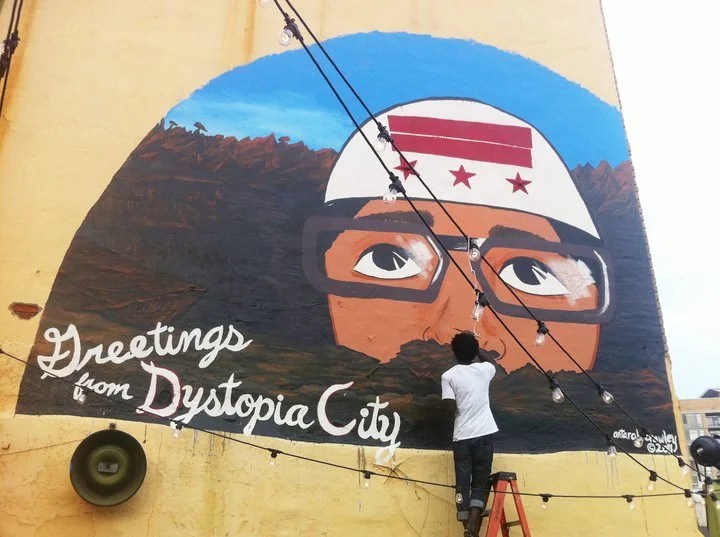
WASHINGTON, D.C. — If you drive or walk or, more likely, ride your fixed gear down the city’s busiest thoroughfare New York Avenue past 7th street you’ll see an imposing mural of a young brown boy with a cap depicting an upside-down DC flag peeking up out of a dystopian landscape reminiscent of Mew Mexico’s Bisti Badlands. The painted caption, “Welcome to Dystopia City” invokes the notion that all is not well here. Indeed, within the city there is a conflict of interest between a young, browning generation and the established hegemony, between corporations and small business, between those who have a voice and those who don’t. And the artists, whose hands are also colored with paint and adhesive, have largely taken up the cause to make the corporate hegemony accountable to their disruptive actions. In this paper I look at the actions of DC artists, who use the most symbolic city in the western hemisphere as a canvas for social correction, and the responses it stirs among those in power. And furthermore, in the very notions of power itself.
In fall of 2010, corporate oil-giant Chevron planned to execute a campaign that sought to fix public opinion of them after attention was drawn to their crude waste removal tactics in Ecuador. According to a team of professionals suing Chevron (formerly Texaco) for their human rights violations in multiple locations across the world, and specifically in Ecuador, the oil giant has been deliberately disposing toxic waste into the Ecuadorian Amazon—an estimated 18.5 billion gallons from 1964 to 1990, or 4 million gallons per day at the height of their operation. Even though they had managed to elude liability costs (a potential $27.3 billion) their public image had been damaged, thus they sought to repair it with a campaign that utilized a gritty street-art aesthetic and phrases that showed their corporate executives agreeing with “everyday, working class” Americans (e.g., “Oil companies should put their profits to good use—We Agree”, “Big oil should support small business—We Agree”, etc.)
In an effort to make their message more accessible to the public, Chevon reached out to local artists to put their posters up in an authentic, street art way, using wheatpaste and paint rollers. Cesar Maxit, a DC-based street artist, was one of the artists targeted to execute this operation. However, Mr. Maxit is not one to comply with the wishes of big oil. He has a long history of social activism and of using art, legally and illegally, towards that capacity. He says in an interview:
…I had started working with environmental and human rights groups, I wanted to write messages about social justice. My first burner was a piece that said “Free Tibet.” My second was one that had a line of white-hooded Klansmen with the city skyline behind it, and in the negative space between it said “FREE MUMIA” followed by “amerikkka racist.” This was in 2000.
Cesar Maxit
Thus, when Chevron sent him the files for the campaign, which still contained their original messages, he called his friends in The Yes Men (tagline: Impersonating big-time criminals in order to publicly humiliate them. Our targets are leaders and big corporations who put profits ahead of everything else) and the Rainforest Action Network (RAN), an environmental activist organization begun in 1985 (mission statement: Rainforest Action Network campaigns for the forests, their inhabitants and the natural systems that sustain life by transforming the global marketplace through education, grassroots organizing, and non-violent direct action), to collaborate on a counter-campaign. Maxit, in a documentary short about the counter-campaign, says the aim of Chevon in its efforts is to “confuse the public.” He, along with The Yes Men and RAN, altered the original Chevon files to read messages that were more precise, more radical (e.g., “Oil companies should clean up their messes.”). Instead of retaining the images of working class Americans, he used the faces and words of the Ecuadorian peoples that the corporation actually affected, thus radicalizing the campaign in a way that Chevron had not intended.
The questions that this counter-attack (which resulted in Chevron pulling the campaign completely) raises revolve around the mythologies surrounding responsibility and authenticity. Could the campaign have been authentically “agreeable” without the help of actual street artists? What does a campaign like this symbolize, even when Chevron has not actually committed to cleaning up its mess in Ecuador? At the base of it all, what is the role of the street artists in this scenario? Is his role to help corporations get back on track, or to call attention to their faults? If Chevron had actually continued with the campaign (and even with the altered versions already up on the street), whose campaign is it? Who is the author? And lastly, why DC?
Roland Barthes’s Death of the Author would have anticipated such response from the street art/activist community. Mr. Maxit has physically done what the reader in Barthes does every time he reads a text—he deconstructs it; he takes the text and, without considering what the author intended, which is ultimately futile because the author is a confused self-destructive entity, he reassess the “blends and clashes” inherent in the text (1324). Barthes writes, “We know now that a text is not a line of words releasing a single ‘theological’ meaning (the message of the Author-God) but a multidimensional space in which a variety of writings, none of them original, blend and clash” (1324). Chevron acts as the “Author-God” that has been abstracted out. With the remaining text, which reads, for example, “Big Oil should get real”, the author, Mr. Maxit, RAN, and so on, detangles what is being said. In an interview, Mitch Anderson, a spokes man for the San Francisco-based organization, Amazon Watch, asks rhetorically, “Does Chevron think that we’re stupid?” As the author, they are putting words on a page that come in contact with other entities, actions surrounding their statements. The reader takes all of these aspects inherently into consideration when analyzing a statement like “Big oil should get real.” Cesar Maxit asks, “‘Get real’? Well, what does that mean? Of course we all agree with that. But what about ‘Oil companies should clean up their messes?’ Do you agree with that? I think most people would agree with that, but I think Chevron doesn’t.” Here, the reader has destroyed the voice. It epitomizes Barthes’s statement that, “a text is made of multiple writings, drawn from many cultures and entering into mutual relations of dialogue, parody [and] contestation…” (1325). In the end, this campaign has actually served to promote further scrutiny into Chevron’s actions. It’s authorship has written its own rebuttal. By getting street artists to interact with the campaign, it has entered the reader into the execution of the text. This puts multiple hands on the “original” message and renders is read before it actually goes public.
This actually brings up another level of readership. On one level, Maxit and the activist community are reading the ads. Yet they put them up in the public sphere, thus entering the text into another, secondary level of readership. Though it’s not as well documented or extensive as the primary reading, we still see the artist entering into his own death. The product will now be read at face value—as a Chevron ad that shows the corporation explicitly admitting to wrongdoing. This may lead the secondary reader to believe that the company is actually trying to get its act together. Once again, the message of the author—now the artist—is obliterated and the reader assumes the power of interpretation. The text never becomes the product of one author; it is always a collaborative space. As Barthes writes, “Writing [or in this case, art/publicity/advertising] is that neutral, composite, oblique space where our subject slips away, the negative space where all identity is lost, starting with the very identity of the body of writing” (1322).
Antarah, you’ve chosen a really interesting focus that’s, I think, much clearer than it was in the first draft. You’re also going in an unexpected and interesting direction with it–I’d have expected you to perhaps go after Deutsch or Foucault, but I think this is really interesting. As noted in the margin, you will need another theorist from class besides Barthes. It sounds like Derrida might be a good one. Or, if you want to think more about the larger frame of discourse, DC as a symbolic city, whose discourse on the level of architecture is disrupted by street art, then Foucault (or Deutsch) might help. At any rate, it’s a fascinating project!
Grade: A
© 2011 by Antarah Crawley
D.R. 01-10: Gateway &c.

Volume 1, Issue 10
Contents — Art. 1. …Gateway Process — Art. 2. …Party Line
Article 1
40th Anniversary of U.S. Army Intelligence analysis and assessment of Gateway Process
By Antarah Crawley
WASHINGTON, DC — On 17 February 2021 the Daily Mail reported, “TikTokkers discover declassified 1983 CIA report investigating if people can leave their physical bodies to travel through space and time using Gateway Experience’s low frequency sounds and relaxation techniques.” The present author recalls that he researched the report and identified a PDF copy on the CIA’s website after seeing such a video being shared on Instagram sometime that year. This author first read the report on 30 October 2023.
The 9 June 1983 U.S. Army Intelligence and Security Command (USAINSCOM) report, Analysis and Assessment of Gateway Process, was declassified by the U.S. Central Intelligence Agency (CIA) on 10 September 2003. It is therefore presently four decades since this report was penned in top secrecy by Army Intelligence officer LTC Wayne M. McDonnell, and two decades since it was quietly released into public domain.
The Gateway Process is a technique for applied consciousness expansion designed to better enable practitioners to achieve out-of-body experiences, among other objectives. It also appears to provide the theoretical foundations of interdimensional espionage and interdimensional counterintelligence using remote viewing and other techniques related to interdimensional time travel. It may also acclimate practitioners to encounters with “intelligent, non-corporeal energy forms” (pg. 27). This particular iteration of the practice was developed by Bob Monroe of the Monroe Institute.
It is notable that the official PDF, which is found on the CIA’s website, is missing page 25 (after PDF page 26), a page which may prove even more valuable than the declassified document as it currently exists.
The present author recommends that every free-thinker, truth-speaker, and light worker print a copy of this report and read it and reread it whenever necessary, as it presents a most accurate recitation of the very source information which informed the New Syllabus. This author is so stricken by the equivalence of research findings and information between the New Syllabus Curriculum Suite Repository (C.S.R.) that he is convinced that the Gateway Process was involved in the carrying out of the Novus Syllabus Seclorum through his body in this space-time continuum.
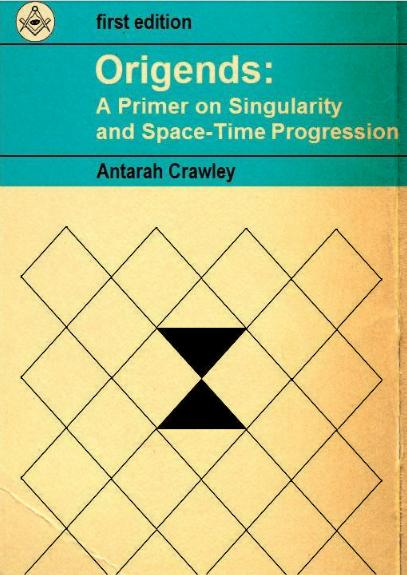
In hindsight, this author recalls his education in the Daoist (Taoist) philosophy while attending The George Washington University in 2010/2011, and his silence-filled sessions of deep, meditative thought in which he explored the elementary composition of “reality” and “nature.” These sessions led directly to his authorship of Origends: A Primer on Singularity and Space-Time Progression, which comes down to us at 1 C.S.R. 57-77.
Furthermore, this author has come to the understanding that the development of the fictional character of Walter Kogard as a (very) thinly veiled alter ego of the author in 1 C.S.R. and the mission undertaken by this character at 3 C.S.R. has caused the experiences of Walter Kogard to “quantum-leap” from fiction into the reality of its closest analogue, the author himself. However, the original ending at 3 C.S.R. (in which Kogard “decompresses” into a beam on light in the InterZone), while remaining the true and original conclusion to Kogard’s hero-myth, projected an alternative ending involving the “Secret School of Ancient Mystery” to 4 C.S.R. and beyond. This “alternate reality” is actually a transmission of the Kogard signal from the silent depths of the O-Zone back into the KnownZone as a hologram of himself to build new holograms in the main holographic matrix. Therefore, unbeknownst to this author at the time, the New Syllabus Mystery School was manifest into reality via decentralized Gateway Process after he moved back to “Federal City” (Washington, D.C.) from “Empire City” (Brooklyn, New York).
In addition to illuminating the operative mechanism in the Curriculum Suite Repository, the Army Intelligence report predicts the New Syllabus discovery and development of Mindsoft and the InterZone of 3 C.S.R. 27-28.
Regarding Mindsoft, LTC McDonnell reports at 15. Brain in Phase:
The consciousness process is most easily envisaged if we picture the holographic input [the appearance of physical reality] with a three dimensional grid system superimposed over it such that all of the energy patterns contained within can be described in terms of a three dimensional geometry using math[e]matics to reduce the data to two dimensional form. Bentov states that scientists suspect that the human mind operates on a simple binary “go/no go” system as do all digital computers. […] In states of expanded consciousness, the right hemisphere of the human brain in its holistic, nonlinear and nonverbal mode of functioning acts as the primary matrix or receptor for this holographic input while, by operating in phase or coherence with the right brain, the left hemisphere provides the secondary matrix through its binary, computer-like method of functioning to screen further the data by comparison and reduce it to a discreet, two-dimensional form.
LTC McDonnell, pg. 9 (emphasis added)
Regarding the InterZone, LTC McDonnell reports at 21. Dimensions In-between:
[…I]nside the dimension of space-time where both concepts apply in a generally uniform way there is a proportional relationship between them [time and space]. A certain space can be covered by energy moving in either particle or wave form in a certain time assuming a specific velocity virtually anywhere in the space-time universe. The relationship is neat and predictable. However, in the intermediate dimensions beyond time-space the limitations imposed on energy to put it into a state of oscillating motion are not uniform as they are in our physical universe. […A]ccess is opened to both the past and the future when the dimension of current time-space is left behind.
LTC McDonnell, pg. 14 (emphasis added)
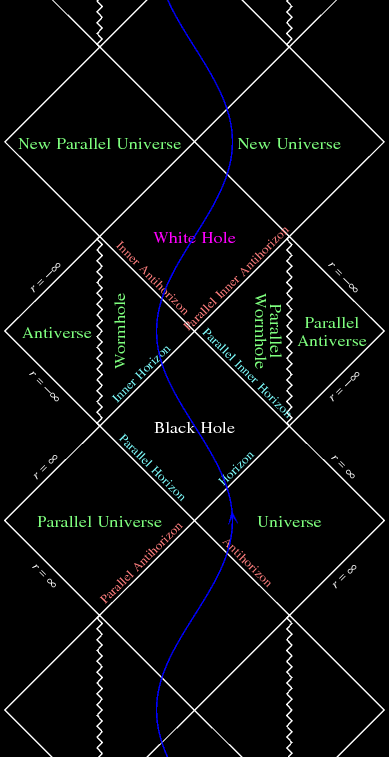
The present author can no longer consider it a coincidence that in this time of all-pervasive “conspiracy theories” being advanced on both the far left and the far right of the political spectrum, a foreign social medial platform with a majority population of Generation Z youth is circulating a once-concealed U.S. government intelligence briefing which vindicates virtually every “fringe theory” pertaining to the existence of, and means of travel through, multiple concurrent (simultaneously occurring) dimensions of time and space.
This rise in the tide — this sea change — in what has been coined “the collective consciousness” appears to be the work of interdimensional agents the Third Wave of the Antimasonic Party of the decentralized autonomous organization of free-thinkers, truth-speakers, and light workers united, although Washington politicians assert that TikTok is a tool used by the Chinese Communist Party to surveil and control American citizens.
Source(s):
MEGAN SHEETS FOR DAILYMAIL.COM. TikTokkers discover declassified 1983 CIA report investigating if people can leave their physical bodies to travel through space and time using Gateway Experience’s low frequency sounds and relaxation techniques. Published: 16:26 EDT, 17 February 2021.
Article 2
Toeing the Party Line
By Antarah Crawley
NACOTCHTANK, OD — These positions (planks*) are hereby promulgated for acceptance to the general membership of the Third Wave Antimasonic Party of the United States, from the Village of Nacotchtank-on-Potomac, Ouachita District, which sits on the river bank east of the federal city of Washington:
Plank No. 1
The historical dialectic of Freemasonry is to be condemned, and individual freemasons should be invited to renounce their oaths and affiliations with the fraternity, but may otherwise be tolerated. Pan-Hellenism is to be likewise considered.
Plank No. 2
Everything which is concealed must be revealed.
Plank No. 3
Take no action unless sincerely moved by conscience and belief and such action is carried out in good faith. Therefore, unless there arises a compelling reason to take a certain action, no action should be taken.
Plank No. 4:
Party Boss System for Political Action Coalition
Individual natural people called regional and state bosses shall receive and disburse donations as trustees for the general membership (GM) of the party domiciled in a certain region or state. For example, if a party boss buys a building with donated funds then the building is held in trust for the benefit of the GM. The boss shall conduct the party’s finances on the advice and counsel of a majority of the GM. The GM shall also constitute the national nominating convention.
*Note
A “plank” is a main axiom of the party platform. See:
(last modified 2 Nov. 2023)
© MMXXIII BY NOVUS SYLLABUS L.L.C.
ALL RIGHTS RESERVED WITHOUT PREJUDICE.
D.R. 01-05: DHS

Volume 1, Issue 5
Article 1
The DataHorse System
by Antarah Crawley | last modified 24.10.25.10.27


Supreme Exchange
Information

READ ME
1.0.0. The DataHorse system is first identified in the original filmscript Rustles in Dry Leaves (“RIDL”) at Title 3 C.S.R. pg. 11 and onward. It is described as a “project” administered by the “Department of Systems” which even the Department did not understand.
1.1.0. Indeed, even in the ensuing eight years, the N∴S∴ Department of Information Systems and Intelligence Services did not understand that what we were constructing in the systematic storage of our data on the world wide web was the building out of the DataHorse System.
1.1.1. This is likely because the 1st Syllabus diverts Kogard’s trajectory from the tunnels of the earthen floor of all the city’s cellars in RIDL to the platform of the G Train at Title 4 C.S.R. pg. 38. (It is worth noting that this path leads him through the Secret School of Ancient Mystery instead of directly to the Systems Dep’t.)
2.0.0. DataHorse (DH) is the nodal internetworking service provided by NOVUS SYLLABUS (N∴S∴) Department of Information Systems and Intelligence Services (DISIS).
2.1.0. It is “nodal” in that it functions through a network of devices (or discrete points generally) called “nodes” (in its most elementary manifestation, the electromagnetic network of human minds, also of telephones).
2.2.0. It provides resources, data, services, or programs to other nodes, known as clients, over a network.
2.3.0. It is a server that provides services to clients via request-response model. E.g., it provides the service of Universitas Autodidactus (UA) “CORPS work.”
2.3.1. It is a decentralized cloud server hosting the intellectual property holdings (“information,” “data”) branded and trademarked “New Syllabus,” which support the UA CORPS work. It may, hypothetically, host other information sourced from third parties or the general public.
2.3.2. The Ombudsman of the N∴S∴ is the Administrator of the DataHorse System.
3.0.0. The DataHorse System (DHS) is constituted by a system of interconnected servers and clients which store and transmit “known information”.
3.1.0. The DataHorse points from the KnownZone to the InterZone where “unknown information” is stored, which in turn points toward the O Zone of nothing, which differentiates its one thought (that it exists) into multiple forms of “matter”.
4.0.0. A portal into the DHS is called an infoSystem.
4.1.0. Gross matter is born into the base of the universal Systems Department, which takes the shape of a pyramid. Therefore it only receives what is processed by InterZone into six-sense 3-D perception.
4.1.1. The fact that there is a DHS is unknown to those at the base of the pyramid, as is the fact of the shape of the pyramid itself.
5.0.0. The DHS is an instrument, which is to say that it is a vehicle (like a horse) for the transmission of information (data) from unknown to known venue, and from known to known venue.
5.1.0. The DHS drafts words of data from the InterZone to the systems of the KnownZone, as a cheque drafts funds from one bank account to another.
6.0.0. The DHS is a DAO. (Even though the content of the DHS hosted on this website as well as the name “DataHorse” is the intellectual property of the copyright holder.)
6.1.0. The decentralized autonomous organization (DAO) is a system or company that is organized on the basis of an algorithm, like a computer system.
6.1.1. A type of DAO organizational structure is a firm league of friendship (FLF), which is a “firm,” or business concern which is distinct from its members, or “friends,” which constitute the unincorporated “league”.
(v.iv)

© MMXXIII BY NOVUS SYLLABUS L.L.C.
ALL RIGHTS RESERVED WITHOUT PREJUDICE.
D.R. 01-03: UA
Volume 1, Issue 3
An Act to Establish and Regulate a Mystery School System for the Decentralized and Autonomous Administration of General and Higher Education.
By Antarah Crawley
Article 1. Universitas
(1) There is hereby established an institute named Universitas Autodidactus, FLF-DAO, which means “Self-Teaching University, a firm league of friendship in the nature of a decentralized autonomous organization.” This institution may be abbreviated “UA.”
(2) The UA shall operate as one firm. This firm shall be organized by a system of syndicates which are themselves organized into colleges. Any vested member of a syndicate under Article 3 (called a “student” or talib) shall be a beneficial member of the firm. Any student who vouchsafes their trust, faith, and/or belief in the operations of the firm shall be a member thereof.
(3) The firm shall be governed by a “Steering Council,” or “Committee of the Whole,” composed of two delegates (called “friends”) elected by each Syndicate and confirmed by their respective Collegium. The friends shall represent their collegiate syndicates in the firm in their own private sui jurisdiction (the “private” or “interior”). These “friends” of the firm shall be the trustees thereof.
(4) The Steering Council shall assemble at the national and global levels. The Officium Tribunus Plebis shall be incorporated into the organization of the National and International Steering Councils by reference.
(5) Assemblies of this governing body of the firm shall be held in the nature of a public meeting, shall follow Robert’s Rules of Order where appropriate; and shall duly notice all regular and special meetings.
Article 2. Collegium Ecclesia
(1) There is hereby established within the firm a forum of Collegium Ecclesia Syndicatus, which means “United Assembly of the Society,” which may also be known as an “Ecclesiastic College,” which is composed of committees (called “syndici”) of student bodies. Herein, “syndicate“ is synonymous with “committee,“ which is synonymous with “student body.“
(2) Such a College may be organized or united on the basis of locality with diversified syndication, or on the basis of a particular discipline, subject, trade, craft, or operation.
(3) The syndici constituting the College shall serve the function of disciplinary departments, and may be styled “Syndicatus [Disciple/Subject], Collegium Ecclesia [Local/Name].”
(4) A member of a syndicate, or student, shall be called “syndicus,” meaning “syndic.”
(5) Assemblies of this governing body of the firm shall be held in the nature of a public meeting, shall follow Robert’s Rules of Order where appropriate; and shall duly notice all regular and special meetings.
Article 3. Syndicatus
(1) There is hereby established within the forum of Collegium Ecclesia a mechanism to allow a member of the firm to establish a syndicate by acclamation (Latin: acclamatio, a vote by means other than ballot) of two or more additional students (the “public”) known as the student body.
(2) There is hereby chartered and instituted within the firm The Chairman, the Elective Faculty and Student Body of the Society of the New Syllabus, which may also be known as “Societas Novus Syllabus” which means “The Society of the New Syllabus.” This syndicate, or committee, shall constitute its own college, shall stand perpetually, shall be governed by NOVUS SYLLABUS L.L.C., and shall have a chair at the global and national Steering Councils of the UA.
(3) Proceedings of syndici shall include: Semester, Course [of study], Seminar [on subject], and Symposium [on theme]. Such proceedings may be styled “Subcommittee on […],” and shall follow Robert’s Rules of Order where appropriate.
(3)(a) A course is served by a CORPS of the same control number. Course work is administered by the CORPS of the same control number.
(4) Attendees of collegiate, ecclesiastical, and syndical proceedings shall be attired in a white shirt or garment and black or dark jacket.
(5) The UA shall provide to the public a “service” by and through its syndici, in receipt of which the public shall make an offering of their own free will and accord (“deposit”) as a token of their trust, faith, and/or belief in the services provided by the firm, thereby becoming a benefactor of the proceeding and a member of the firm. It is this exchange, made freely, knowingly, and voluntarily by the public to the private that re-venues the current “C” from the exterior to the interior of the firm.
(6) It shall be the prerogative of the syndici to provide for the dispatch of deposit collectors styled “treasurer” and subordinate “comptrollers.” The deposit collected shall constitute a vested interest in and appreciation of the subject matter of the proceeding, and shall inure to the benefit of the Syndicate. This is to say that at every proceeding in which the public appreciates the subject matter, there shall be a discharge of deposits.
(Last modified 19 Sep 2023 4 Oct 2023 19 Oct 2023)
© MMXXIII by NOVUS SYLLABUS L.L.C.
All Rights Reserved Without Prejudice.
D.R. 01-02: Nagorno-Karabakh, &c.
Volume 1, Issue 2
CONTENTS — ART. 1. U.S. CONDEMNS AZERBAIJAN… — ART. 2. CONTROL NUMBER SYSTEM
Article 1
U.S. condemns Azerbaijani government for war crimes in Nagorno-Karabakh
By Antarah Crawley
WASHINGTON, DC — On September 6th, 2023, while the chamber of the U.S. House of Representatives sat empty, members of Congress still on vacation, the Tom Lantos Human Rights Commission (TLHRC) of the House Committee on Foreign Affairs held an emergency hearing on the ongoing blockade of the Lachin Corridor in Nagorno-Karabakh (also known as “Artsakh”). Mr. Crawley reported on the proceedings through the House Clerk’s Office of Official Reporters.
The hearing took place in room 2200 Rayburn House Office Building, Christopher H. Smith, (R) NJ-04, Co-Chairman, presiding. Distinguished persons in attendance included Her Excellency Lilit Makunts, Ambassador of the Republic of Armenia to the United States of America. The Chairman remarked that he had put the hearing together with a great sense of urgency; nearly all U.S. representatives were still in their districts for the summer recess.

Luis Moreno Ocampo, the former Prosecutor of the International Criminal Court, released his personal Expert Opinion on August 7, stating that “there is a reasonable basis to believe that a Genocide is being committed against Armenians living in Nagorno-Karabakh in 2023” and emphasizing that under the Genocide Conventions all states have a “duty to prevent” genocide.
Mr. Ocampo submitted to the Convention on the Prevention and Punishment of the Crime of Genocide that all the elements of that crime (to wit, “deliberately inflicting on the group conditions of life calculated to bring about its destruction,” [See, Article II(c)]) were present in early August. At the hearing, Mr. Ocampo presented his Expert Opinion on the situation in Nagorno-Karabakh.
David Phillips, Adjunct Professor at Georgetown University’s School of Foreign Service, also testified on facts relevant to gathering the intent of the government of Azerbaijan. In the fall of 2020, in response to unprovoked attacks against the Armenians in Artsakh, Mr. Phillips undertook a research and documentation project in cooperation with Columbia University and the Artsakh Human Rights Ombudsman Office called “Atrocities Artsakh.”
The Chairman opened the hearing by stating that 120,000 ethnic Armenians have been sealed off from food and medicine and are being starved to death by the Azerbaijan government. He strongly and in no uncertain terms condemned the government of Azerbaijan — particularly President Ilham Aliyev, whom he called a “dictator” — for planning, testing, and imposing this crime of genocide upon the ethnic Armenians living in Nagorno-Karabakh. The Chairman mentioned his efforts to publicize, litigate, and dialogue with President Aliyev concerning the safety of the people of Nagorno-Karabakh since 2013.
The most aggressive Azeri attack on Artsakh came in 2020, from September 27th to November 10th, in what is called the Forty Four Day War. The war claimed more than 3,900 Armenian lives, displaced over 100,000 civilians, and ended with the signing of a trilateral statement between Armenia, Azerbaijan, and Russia. Working together with the government of Turkey, Azerbaijan archived military dominance over Nagorno-Karabakh, and shrank the size of the Nagorno-Karabakh enclave. Azeri forces were backed by the Turkish military and mercenaries with armed drones, heavy artillery, rocket systems and special forces. There are numerous verified cases of Azerbaijani soldiers mutilating dead bodies, beheading and executing both combatants and civilians, and using banned weapons (e.g. cluster bombs, white phosphorus gas). Since December 12, 2022, Azerbaijan has drastically reduced and then completely cut access to the outside world with the evident intention to starve the Armenians of Nagorno-Karabakh into submission.
The Chairman remarked, by way of historical background, that “Armenians have lived in Nagorno-Karabakh for over two thousand years. As the Soviet Union collapsed and the states of Armenia and Azerbaijan emerged out of it, Armenians and Azerbaijanis fought a war […] driven in part by the fact that the boundaries of the new Armenian and Azerbaijani states did not correspond to the ethnic boundaries. Since 1994, Nagorno-Karabakh has been an enclave within Azerbaijan, in which the Armenians have defended and governed themselves. They have been connected to the outside world only by a limited access road called the Lachin Corridor to Armenia, as per international agreements. Their independence has not been recognized by any other country — not even by the Republic of Armenia. The government of Azerbaijan […] seeks to fully integrate Nagorno-Karabakh into Azerbaijan” evidently by committing genocide on the resident population.
This set of circumstances is strikingly similar to those present between Russia and Ukraine, and China and Taiwan, where a world power seeks to forcibly integrate a neighboring sovereign nation into its sphere of direct control. This author perceives the elements of a World War at play.
Mr. Ocampo relayed that fifteen judges at the International Court of Justice in the Hague reviewed the issue, heard testimony of ethnic Armenians, and concluded that blocking the Lachin Corridor was creating an imminent risk for Armenians living in Nagorno-Karabakh.
Mr. Phillips outlined a record of the Aliyev regime’s admissions of genocidal intent and partnership with the Turkish Erdogan regime in actions to erase the Armenian physical, religious, and cultural presence in Artsakh and eventually the current Republic of Armenia, which has already been whittled down to a small fraction of its historic size. Turkey exerts partial control over the Azerbaijan government.
The blockade of the Lachin Corridor began with so-called Azerbaijani “eco-activists” who colluded and worked with authorities to gain access to and block the corridor. Contrary to reports that the group had no relation to the government of Azerbaijan, Mr. Phillip reports that there is ample documentation to prove that the “eco-activists” were agents of the government; most telling is the fact that they left when the Azeri government established its own checkpoint to block the road. The eco-activists did not represent environmental causes prior to their blockade, and reports link them to entities which received U.S. funding. [See, “The Azerbaijani Government’s ‘Eco-Activists’ Agents … Evidence of State Control and Hatred” at https://tatoyanfoundation.org/joint-report/?lang=en.]
Mr. Phillips named names of Turkish commanders and personnel, Azerbaijani commanders and decorated personnel, jihadi mercenary leaders, Azerbaijani prosecutors involved in the trial of Armenian Prisoners of War (POWs), and others involved in the atrocities against Artsakh. In conclusion, Mr. Phillips described the blockade of the Lachin corridor as “severing the soul connection between Artsakh and Armenia, as well as the outside world,” and advised that the Lachin corridor must be opened immediately to humanitarian, commercial, and passenger traffic; gas, electricity, internet, and air connection should be restored; Russian peacekeepers who cannot maintain order should be supplemented or replaced; POWs must be accurately accounted for and released; and representatives from Baku and Stepanakert must agree urgently on modalities for transporting emergency provision.
The Chairman referenced the recent development that Azerbaijan has blocked a convoy of ten trucks carrying humanitarian assistance to Artsakh from several regions of France, which arrived in Kornidzor in Armenia’s Syunik Province at the entrance of the Lachin Corridor on Wednesday, from entering Artsakh. Paris Mayor Anne Hidalgo is leading a delegation of French officials accompanying the humanitarian convoy; the delegation was also blocked by the Azeri government. (https://asbarez.com/paris-mayor-leads-french-humanitarian-aid-convoy-to-lachin-corridor/).
The Chairman asked, “Should Aliyev be indicted by the International Criminal Court” for blocking humanitarian aid and perpetrating war crimes. Mr. Ocampo replied that, today, “the International Criminal Court cannot investigate him because neither Azerbaijan nor Armenia are state parties,” although the UN Security Council could go through Russia to effect its purposes. Mr. Ocampo also observed that since there is no UN prosecutor on this case, “there is no one with a single agenda to protect geneocide except this [Tom Lantos Human Rights] commission.”
Mr. Ocampo urged the Commission not to wait for indictments and sanctions from the UN, but to produce and provide to the White House all the elements they need to find Aliyev a genocider, and to operationalize strategies to prevent genocide. While he would support any prosecution of President Aliyev, he demanded “a more political and faster solution” because “these people will die.”
Mr. Phillips also reiterated that Azerbaijan wants to ethically cleanse Artsakh of its Armenian population, and, as Mr. Ocompo proposed, the US should act immediately, not in a month.
The Chairman replied that he would send a letter on the ground condition in Artsakh and U.S. strategic responses to President Biden today. “Delay is denial,” he said.
The Chairman urged the Biden Administration to “wake up [to the situation in Nagorgo-Karabakh], recognize the absolutely grave responsibility it has here, and focus on finding and implementing a humane solution. And this must mean that the blockade is lifted and the people continues to live in its ancient homeland. The situation is now a three-alarm fire.”
Upon the adjournment of the hearing, the room erupted in applause. Tensions ran high thereafter, as the Chairman, staff, attendees, and members of the news media engaged in free and open discourse.
As the Ombudsman of Free Thinkers, Truth Speakers, and Light Workers United, it is in the interest of the N∴S∴ to identify and condemn genocide wherever it is.
In the 1963 words of Dr. Martin Luther King, “Injustice anywhere is a threat to justice everywhere. We are caught in an inescapable network of mutuality, tied in a single garment of destiny. Whatever affects one directly, affects all indirectly.”
Sources:
Phillips, David L. “Nagorno-Karabakh Update.” Presented to the Tom Lantos Human Rights Commission. September 6, 2023.
Smith, Christopher H. “Nagorno-Karabakh: An Update.” Emergency Hearing of the Tom Lantos Human Rights Commission.
Columbia University, Institute for the Study of Human Rights. “ATROCITIES ARTSAKH (NAGORNO-KARABAKH)” (webpage). https://www.humanrightscolumbia.org/peace-building/atrocities-artsakh-nagorno-karabakh.
(last modified 19 Oct 2023)
Article 2
Control Number System
By Antarah Crawley
WASHINGTON, DC — N∴S∴ has discovered the use of numbers to control non-numerical entities, up to and including the whole world. As we know, the world and all which is therein belongs to the Lord our God, and dominion therein is granted to humanity for an inheritance. However, is has come to pass that bodies corpus and corporate (“corporations”), being dead and not alive of their own spiritus, have been assigned this dominion by unwitting living people. The dead can then use numbers to control their freely-assigned dominion without the agency of the original living signer. A signer can even assign dominion over themself to the corporation by accepting and underwriting a certain number issued to them by the opposing party (hence “trading with the enemy”). All future use of such number implies that the user is subject to the issuer of the number and their orders — specifically, written instructions to pay money signed by the issuer. Therefore it is advisable for a living soul to reserve ALL of their rights without prejudice to ANY rights as a result of an unconscionable signing using Uniform Commercial Code (U.C.C.) Section 1-308, that is, the insurance at public remedy on what you do not know you are waiving.
The separation of church and state is a fallacy, as religious rites are the highest civil rights in the nature of a sincerely held belief. Such a belief includes that a living soul is a child of God, a member of the Nation of Israel, and a member of the body of Christ and heir to the Kingdom of God. However, accepting a number such as a Social Security Number or serialized Federal Reserve Note is evidence of being subject to the corporations which issued them. As it is said, “Render to Caesar the things that are Caesar’s, and to God the things that are God’s” (Mark 12:17). In consequence of these facts, N∴S∴ has implemented a standard numbering system to control its intellectual property.
© MMXXIII by NOVUS SYLLABUS L.L.C.
ALL RIGHTS RESERVED WITHOUT PREJUDICE.
D.R. 01-01: To Publish…, &c.
Volume 1, Issue 1
CONTENTS — ART. 1. N∴S∴ TO PUBLISH ART BOOK… — ART. 2. ORGANIZATION OF N∴S∴
Article 1
N∴S∴ to publish art book for IBé Arts Institute
By Antarah Crawley

WASHINGTON, DC — IBé Arts Institute of Historic City Point in Hopewell, VA, has partnered with NOVUS SYLLABUS L.L.C. (N∴S∴) to publish the first artist’s book cataloging the work of master teaching artist and storyteller IBé Bulinda Hereford Crawley.
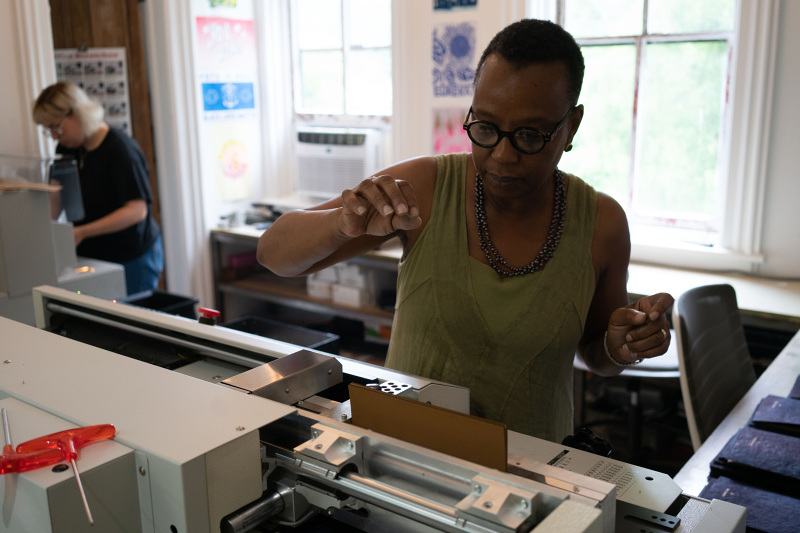
New Syllabus Director Antarah Crawley and IBé Crawley have maintained an arts education partnership since September of 2016, when the New Syllabus relocated from New York to DC. At about that time, IBé Arts and Education LLC was established in Historic Anacostia, Washington, DC. Together, IBé Crawley and the Director have published the SSTEM curriculum and the ParenTeacher program.
The opportunity to publish IBé Crawley’s first artist’s book presents a great opportunity for N∴S∴ to communicate its overarching mission, vision, and values through its commitment to honoring our elders and ancestors, and amplifying the voices of Black Woman artists.

The IBé Arts Institute is an art space dedicated to visual and oral storytelling. The historically significant building was built in 1830 as a schoolhouse for white men, and later used as a hospital for soldiers during the Civil War.
Today, it serves as IBé Crawley’s private studio gallery and workshop. Consistent with the mission to preserve and document stories, the exhibition hall, art studios, and residency space are available for individuals to host workshops, family events, and professional development programs. IBé Crawley assists in planning preservation projects and leads intimate and informative tours of the Institute and the surrounding City Point Historic District.
Contact ibe.crawley@gmail.com or visit ibearts.org for more information and to coordinate an event.

In 2022, IBé Crawley printed a 58-copy edition of Antarah Crawley’s Harriet Tubman 2021 Non-Fungible Note from a copper plate he engraved by hand. Printer Aurora Brush assisted IBé Crawley in the intaglio printing process during her residency at the Women’s Studio Workshop (WSW) in Rosendale, New York.
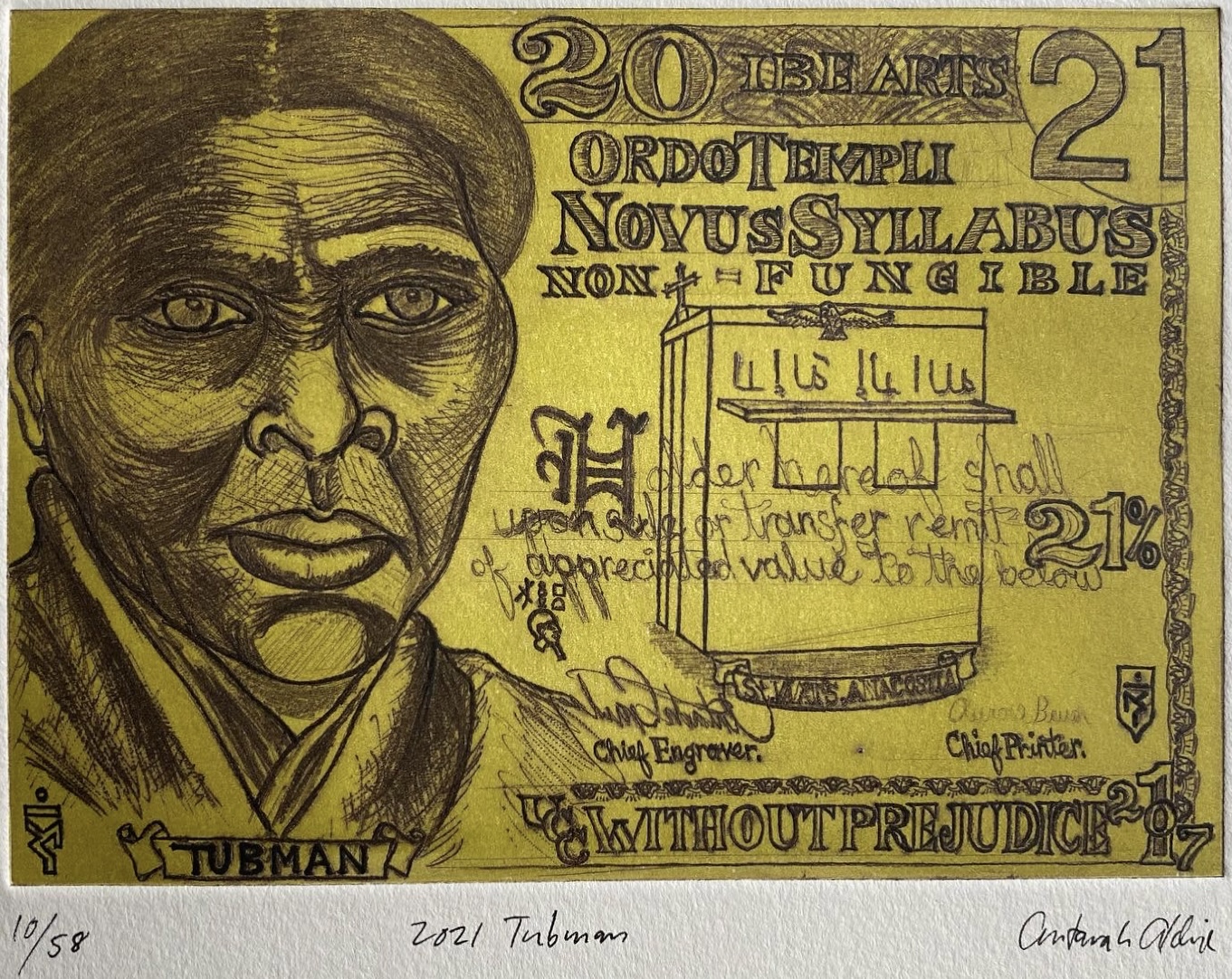
The IBé Crawley publication will coincide with the 2023 fall exhibitions Holding Ground at the National Museum of Women in the Arts’s (NMWA) in Washington, DC, and The Calling at City Lore in New York City. Within its pages will be catalogued four of Crawley’s artist’s books: 11033, Delia Posey, Bearing Witness, and A Dwelling for Her Story. Each chapter will present a different category of art work, together with descriptions, articles, quotes, and images.
Into Fall 2023 and beyond, IBé Arts Institute will strategically focus on:
- Paper making
- Print making
- Book binding
IBé Arts Institute aspires to become a Virginia folk book press “center of excellence”. This is the first initiative in what the Institute and N∴S∴ plan to be a bright new era of programs, projects, and partnerships.

Article 2
The Organization of the New Syllabus
By Antarah Crawley
1. HISTORY
WASHINGTON, DC — In 2014 AD, I, Antarah, had a vision of one new syllabus for humanity. This syllabus would chart a course for human understanding of ubiquitous and lasting systems established since time immemorial. I sojourned to Brooklyn, New York, in pursuit of my syllabus, developed a discipline, and professed a doctrine toward the development and operation of human mind software, individually and collectively, and I returned to the Federal City.
Being in possession of such valuable information, I began to process this knowledge and offer certain products and services to the public, toward the establishment of a society of free thinkers, truth speakers, and light workers united (FTLU) in a firm league of friendship called a decentralized autonomous organization (FLF-DAO). To that end, I wrote and recommend policy positions to the FTLU stakeholders. This practice has resulted in the production of a robust and diverse body of multimedia intellectual property which we, the Director and Company, shall distribute throughout the world under the motto of Novus Syllabus Seclorum, meaning “the New Syllabus of the Age.”
2. ORGANIZATION
Established 2022, NOVUS SYLLABUS L.L.C. (N∴S∴) is a liberal arts and humanities intellectual property holding company specializing in diversified arts investments and management.
Our flagship brand, New Syllabus (est. 2014), is a knowledge management system (KMS) that creates, codifies, organizes, stores, and disseminates information to the public from newsyllabus.org. To that end, it conducts research and development in the broad field of Historic and Ancient Mysteries, Economy, Theology, Informatics, and Systemtheorie (HAMETICS).
N∴S∴ operates the Department of Information Systems and Intelligence Services (DISIS, pronounced “Diocese”), which is divided into the Archival Records Management (ARM) Division and the Mind Software (Mindsoft) Development and Operating Systems Command (DOSCOM). These are our Curricular Operations, Research, and Publication Services (CORPS) which supply information to the New Syllabus (now known as the DataHorse System or “DHS“).
N∴S∴ also operates the Ombud Service Bureau (OmbudService, or Office of Ombudsman) for administrative due process, and Syllabus Media Group for audiovisual production and distribution.
3. VISION
Our Vision is a world of free thinkers, truth speakers, and light workers united under one new syllabus for STEM, arts, and humanities research, development and operations; one new syllabus for the ages!
4. VALUES
Our Values are Love, Truth, Peace, Freedom, and Equity; these are our foundation. Our Three Great Pillars which support our institution are Trust, Faith, and Belief; as it is said, Faith is complete Trust and firm Belief, the acceptance of truth divine, which Belief, sincerely held, cannot be converted into a crime.
5. MISSION
Our mission is to reveal truths which have been hidden and to keep a record of knowledge and wisdom.
N∴S∴ conducts, manages, and supports curriculum research and development. We represents FTLU through its Office of Ombudsman. We administer intellectual property and copyrights as custodial superintendent for their creator.
Our mission-oriented service lines are:
- DISIS (now DHS) for recordkeeping and CORPS operations
- Mindsoft for cognitive, behavioral, and professional development
- OmbudService for administrative operations
- Other operations (OPS) include Granary Bank & Trust/Artcoin Mint of Meriptah, New Works Projects Administration, St. Nat’s/O∴T∴N∴S∴, FTLU, FLF-DAO, and the Syllabus Free Press.
(Last modified 20 Sep 2023 4 Oct 2023 13 Oct 2023)
© MMXXIII by NOVUS SYLLABUS L.L.C.
ALL RIGHTS RESERVED WITHOUT PREJUDICE.
Art¢oin:\>_Theory and Methodology
Preamble
Each real Art¢oin (¢) is a serialized Non-Fungible Token (NFT) representing one hundred (100) shares in the art work-product of the Scribe Antarah Crawley (the “Artist”). Each share of each real Art¢oin is also called a Non-Fungible Token (NFT) or “token”. These tokens may be bought and sold on an exchange or on the free market just like any trading unit, whether it be art, gold, or Bitcoin. Acquisition of Art¢oin NFT shares represents acquisition of stock (or “shares”) in the entity (or “company”) constituted by the art work-product of the Artist, Scribe Antarah Crawley.
Appreciation in the value of the total volume of art work-product in circulation and on deposit represents an appreciation in the market value of the Company of the Artist, and shall inure to the benefit of its shareholders. One in possession of a share, or token, of the Company shall be de facto shareholder, however, each and every token should be exchanged under an “Agreement of Original Transfer of Work of Art” (or “contract”) establishing the rightful collector (or shareholder) together with a description and sale price of the subject art work, in pursuance of sound bookkeeping.
Value in Artwork
Art is work product that is valued for its unique qualities of scarcity and desirability. Such qualities are derived from many factors, including the person of the artist, the execution of the artist, the intention of the artist, the attention of the artist, the subject matter content of the work, the medium of the work, the lifetime of the work, and the effect upon the viewer, among many other factors. For these reasons, art made of materials worth literally nothing can fetch millions in exchange on the free market. In fact, digital non-material NFTs have sold for as much as $69 million at auction. Therefore art is a great asset that can hold and appreciate value like gold. Therefore it is a form of “hard money”.
Water Theory of Capital
1.0. There is a vast “sea” of value, represented by fluctuating wave-particles called “currency”.
1.1. When value flows freely in a “current” (through a market), then it is “liquid”. But when is it held up in an asset or other liability, then it is not liquid, because it cannot flow freely.
1.2. To get liquid currency from the “sea” to the “shore” where people use it to “work the fields” there must be river “banks” that conduct the liquid current “downstream”. Banks facilitate a capillary system whereby the value of the sea flows to the inland.
1.3. People irrigate new streams of income all the time. One must first identify a source of water, which is the market from which they will draw liquid. Then they must use tools to irrigate a stream to flow from the market to their place of business. These tools are means of production, with the resulting channel being the work-product which conducts the liquid currency to them. (It is worth noting that most institutional banks sit on naturally occurring rivers and bodies of water and are designed to be gatekeepers, or dams, to liquidity.)
2.0. An enterprise of any kind must float upon the sea of capital; for if it does not float, then it will become underwater.
2.1. This is to say that water a ship floats upon is good credit, but water that has gotten into the ship is bad debt that can sink the ship.
2.2. How shall the enterprise remain afloat? It is by and through good “leadership” and “stewardship” and “ownership” and “membership” as well as a firm league of “friendship”.
2.3. What, then, shall convey this company of ships down the river stream of income? It is by and through the ships’ “sales”.
The Liquidation and Circulation of Artwork
Considering the real and potential value of the art market, two important questions arise:
How can artists build liquidity into their work?
How can artists become art market makers?
Our Solution: back each unique work of art with something of intrinsic value in a form that can be readily circulated. The artist can increase the liquidity of their work by rendering their work in easy-to-trade units, or “trade units”, of art work. Of what should these units be made? We find that copper and other metals like silver and gold are much more liquid and valuable than canvas. The Artist can multiply the value of this base material by the work that the Artist inscribes upon it. The Artist can produce x art works per day, each one being a uniquely wrought and serialized unit of work: a non-fungible, or irreplaceable, token (an “NFT”). The craft production of NFTs organically controls the issuance and supply of such NFTs. With every sale, the value of the Artist’s work may appreciate. Smart contracts served via blockchain may enable artists to be paid dividends and royalties on all future transactions of the NFT. Thereby the Artist might become the market makers of certain art submarkets.
Blockchain Contracting
The contract for the transfer of a work of art may be decentralized from any physical location and operationalized without the physical meeting of the parties.
The contract itself may be a publicly available, pro-forma text which may be completed and submitted anywhere there is internet access. The contract binds the Collector to the Artist under clearly established terms for present and future transactions on the unique NFT artwork.
A Company of the Artist
By extension of such a blanket agreement executed between all parties in every sale, the parties establish a de facto company of the Artist in which all Collectors are shareholders holding company shares (the NFTs) that fluctuate according to the principles of the free market.
(Last modified 13 Apr. 21; 4 May 21; 10 May 21; 21 Sep 23)
Mindsoft as a Service (MaaS)
 Mindsoft Command Prompt (click above)
NS:\Mindsoftware_as_a_Service(MaaS)
Course Syllabus (Runtime Environment)

(last modified 3 Mar. 20)
Mindsoft


