Category: CAM
D.R. 01-03: UA

Volume 1, Issue 3
An Act to Establish and Regulate a Mystery School System for the Decentralized and Autonomous Administration of General and Higher Education.
By Antarah Crawley
Article 1. Universitas
(1) There is hereby established an institute named Universitas Autodidactus, FLF-DAO, which means “Self-Teaching University, a firm league of friendship in the nature of a decentralized autonomous organization.” This institution may be abbreviated “UA.”
(2) The UA shall operate as one firm. This firm shall be organized by a system of syndicates which are themselves organized into colleges. Any vested member of a syndicate under Article 3 (called a “student” or talib) shall be a beneficial member of the firm. Any student who vouchsafes their trust, faith, and/or belief in the operations of the firm shall be a member thereof.
(3) The firm shall be governed by a “Steering Council,” or “Committee of the Whole,” composed of two delegates (called “friends”) elected by each Syndicate and confirmed by their respective Collegium. The friends shall represent their collegiate syndicates in the firm in their own private sui jurisdiction (the “private” or “interior”). These “friends” of the firm shall be the trustees thereof.
(4) The Steering Council shall assemble at the national and global levels. The Officium Tribunus Plebis shall be incorporated into the organization of the National and International Steering Councils by reference.
(5) Assemblies of this governing body of the firm shall be held in the nature of a public meeting, shall follow Robert’s Rules of Order where appropriate; and shall duly notice all regular and special meetings.
Article 2. Collegium Ecclesia
(1) There is hereby established within the firm a forum of Collegium Ecclesia Syndicatus, which means “United Assembly of the Society,” which may also be known as an “Ecclesiastic College,” which is composed of committees (called “syndici”) of student bodies. Herein, “syndicate“ is synonymous with “committee,“ which is synonymous with “student body.“
(2) Such a College may be organized or united on the basis of locality with diversified syndication, or on the basis of a particular discipline, subject, trade, craft, or operation.
(3) The syndici constituting the College shall serve the function of disciplinary departments, and may be styled “Syndicatus [Disciple/Subject], Collegium Ecclesia [Local/Name].”
(4) A member of a syndicate, or student, shall be called “syndicus,” meaning “syndic.”
(5) Assemblies of this governing body of the firm shall be held in the nature of a public meeting, shall follow Robert’s Rules of Order where appropriate; and shall duly notice all regular and special meetings.
Article 3. Syndicatus
(1) There is hereby established within the forum of Collegium Ecclesia a mechanism to allow a member of the firm to establish a syndicate by acclamation (Latin: acclamatio, a vote by means other than ballot) of two or more additional students (the “public”) known as the student body.
(2) There is hereby chartered and instituted within the firm The Chairman, the Elective Faculty and Student Body of the Society of the New Syllabus, which may also be known as “Societas Novus Syllabus” which means “The Society of the New Syllabus.” This syndicate, or committee, shall constitute its own college, shall stand perpetually, shall be governed by NOVUS SYLLABUS L.L.C., and shall have a chair at the global and national Steering Councils of the UA.
(3) Proceedings of syndici shall include: Semester, Course [of study], Seminar [on subject], and Symposium [on theme]. Such proceedings may be styled “Subcommittee on […],” and shall follow Robert’s Rules of Order where appropriate.
(3)(a) A course is served by a CORPS of the same control number. Course work is administered by the CORPS of the same control number.
(4) Attendees of collegiate, ecclesiastical, and syndical proceedings shall be attired in a white shirt or garment and black or dark jacket.
(5) The UA shall provide to the public a “service” by and through its syndici, in receipt of which the public shall make an offering of their own free will and accord (“deposit”) as a token of their trust, faith, and/or belief in the services provided by the firm, thereby becoming a benefactor of the proceeding and a member of the firm. It is this exchange, made freely, knowingly, and voluntarily by the public to the private that re-venues the current “C” from the exterior to the interior of the firm.
(6) It shall be the prerogative of the syndici to provide for the dispatch of deposit collectors styled “treasurer” and subordinate “comptrollers.” The deposit collected shall constitute a vested interest in and appreciation of the subject matter of the proceeding, and shall inure to the benefit of the Syndicate. This is to say that at every proceeding in which the public appreciates the subject matter, there shall be a discharge of deposits.
(Last modified 19 Sep 2023 4 Oct 2023 19 Oct 2023)
© MMXXIII by NOVUS SYLLABUS L.L.C.
All Rights Reserved Without Prejudice.
D.R. 01-01: To Publish…, &c.
Volume 1, Issue 1
CONTENTS — ART. 1. N∴S∴ TO PUBLISH ART BOOK… — ART. 2. ORGANIZATION OF N∴S∴
Article 1
N∴S∴ to publish art book for IBé Arts Institute
By Antarah Crawley

WASHINGTON, DC — IBé Arts Institute of Historic City Point in Hopewell, VA, has partnered with NOVUS SYLLABUS L.L.C. (N∴S∴) to publish the first artist’s book cataloging the work of master teaching artist and storyteller IBé Bulinda Hereford Crawley.

New Syllabus Director Antarah Crawley and IBé Crawley have maintained an arts education partnership since September of 2016, when the New Syllabus relocated from New York to DC. At about that time, IBé Arts and Education LLC was established in Historic Anacostia, Washington, DC. Together, IBé Crawley and the Director have published the SSTEM curriculum and the ParenTeacher program.
The opportunity to publish IBé Crawley’s first artist’s book presents a great opportunity for N∴S∴ to communicate its overarching mission, vision, and values through its commitment to honoring our elders and ancestors, and amplifying the voices of Black Woman artists.

The IBé Arts Institute is an art space dedicated to visual and oral storytelling. The historically significant building was built in 1830 as a schoolhouse for white men, and later used as a hospital for soldiers during the Civil War.
Today, it serves as IBé Crawley’s private studio gallery and workshop. Consistent with the mission to preserve and document stories, the exhibition hall, art studios, and residency space are available for individuals to host workshops, family events, and professional development programs. IBé Crawley assists in planning preservation projects and leads intimate and informative tours of the Institute and the surrounding City Point Historic District.
Contact ibe.crawley@gmail.com or visit ibearts.org for more information and to coordinate an event.

In 2022, IBé Crawley printed a 58-copy edition of Antarah Crawley’s Harriet Tubman 2021 Non-Fungible Note from a copper plate he engraved by hand. Printer Aurora Brush assisted IBé Crawley in the intaglio printing process during her residency at the Women’s Studio Workshop (WSW) in Rosendale, New York.
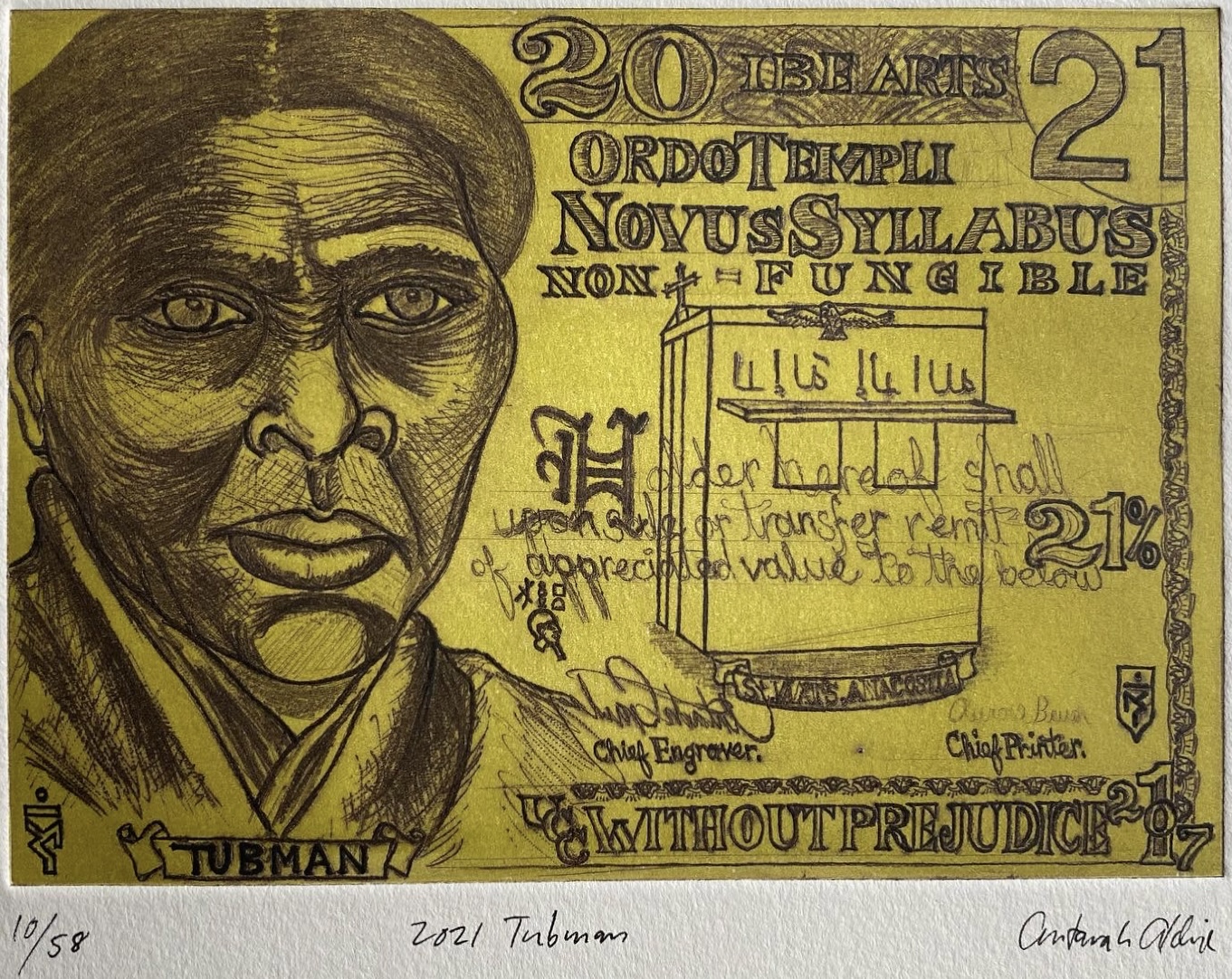
The IBé Crawley publication will coincide with the 2023 fall exhibitions Holding Ground at the National Museum of Women in the Arts’s (NMWA) in Washington, DC, and The Calling at City Lore in New York City. Within its pages will be catalogued four of Crawley’s artist’s books: 11033, Delia Posey, Bearing Witness, and A Dwelling for Her Story. Each chapter will present a different category of art work, together with descriptions, articles, quotes, and images.
Into Fall 2023 and beyond, IBé Arts Institute will strategically focus on:
- Paper making
- Print making
- Book binding
IBé Arts Institute aspires to become a Virginia folk book press “center of excellence”. This is the first initiative in what the Institute and N∴S∴ plan to be a bright new era of programs, projects, and partnerships.

Article 2
The Organization of the New Syllabus
By Antarah Crawley
1. HISTORY
WASHINGTON, DC — In 2014 AD, I, Antarah, had a vision of one new syllabus for humanity. This syllabus would chart a course for human understanding of ubiquitous and lasting systems established since time immemorial. I sojourned to Brooklyn, New York, in pursuit of my syllabus, developed a discipline, and professed a doctrine toward the development and operation of human mind software, individually and collectively, and I returned to the Federal City.
Being in possession of such valuable information, I began to process this knowledge and offer certain products and services to the public, toward the establishment of a society of free thinkers, truth speakers, and light workers united (FTLU) in a firm league of friendship called a decentralized autonomous organization (FLF-DAO). To that end, I wrote and recommend policy positions to the FTLU stakeholders. This practice has resulted in the production of a robust and diverse body of multimedia intellectual property which we, the Director and Company, shall distribute throughout the world under the motto of Novus Syllabus Seclorum, meaning “the New Syllabus of the Age.”
2. ORGANIZATION
Established 2022, NOVUS SYLLABUS L.L.C. (N∴S∴) is a liberal arts and humanities intellectual property holding company specializing in diversified arts investments and management.
Our flagship brand, New Syllabus (est. 2014), is a knowledge management system (KMS) that creates, codifies, organizes, stores, and disseminates information to the public from newsyllabus.org. To that end, it conducts research and development in the broad field of Historic and Ancient Mysteries, Economy, Theology, Informatics, and Systemtheorie (HAMETICS).
N∴S∴ operates the Department of Information Systems and Intelligence Services (DISIS, pronounced “Diocese”), which is divided into the Archival Records Management (ARM) Division and the Mind Software (Mindsoft) Development and Operating Systems Command (DOSCOM). These are our Curricular Operations, Research, and Publication Services (CORPS) which supply information to the New Syllabus (now known as the DataHorse System or “DHS“).
N∴S∴ also operates the Ombud Service Bureau (OmbudService, or Office of Ombudsman) for administrative due process, and Syllabus Media Group for audiovisual production and distribution.
3. VISION
Our Vision is a world of free thinkers, truth speakers, and light workers united under one new syllabus for STEM, arts, and humanities research, development and operations; one new syllabus for the ages!
4. VALUES
Our Values are Love, Truth, Peace, Freedom, and Equity; these are our foundation. Our Three Great Pillars which support our institution are Trust, Faith, and Belief; as it is said, Faith is complete Trust and firm Belief, the acceptance of truth divine, which Belief, sincerely held, cannot be converted into a crime.
5. MISSION
Our mission is to reveal truths which have been hidden and to keep a record of knowledge and wisdom.
N∴S∴ conducts, manages, and supports curriculum research and development. We represents FTLU through its Office of Ombudsman. We administer intellectual property and copyrights as custodial superintendent for their creator.
Our mission-oriented service lines are:
- DISIS (now DHS) for recordkeeping and CORPS operations
- Mindsoft for cognitive, behavioral, and professional development
- OmbudService for administrative operations
- Other operations (OPS) include Granary Bank & Trust/Artcoin Mint of Meriptah, New Works Projects Administration, St. Nat’s/O∴T∴N∴S∴, FTLU, FLF-DAO, and the Syllabus Free Press.
(Last modified 20 Sep 2023 4 Oct 2023 13 Oct 2023)
© MMXXIII by NOVUS SYLLABUS L.L.C.
ALL RIGHTS RESERVED WITHOUT PREJUDICE.
Mindsoft as a Service (MaaS)
 Mindsoft Command Prompt (click above)
NS:\Mindsoftware_as_a_Service(MaaS)
Course Syllabus (Runtime Environment)

(last modified 3 Mar. 20)
Mindsoft

College of the Ancient Mystery, Memorandum No. 1 (“Resolution”)

Preamble
I, Ombudsman Antarah A. Crawley, in Order to form a Labor Union, establish peace and nobility, provide for the collective consciousness, promote the ancient mysteries, and secure equitable representation for ourselves and our polity, do ordain and establish this Constitution of the College of Ancient Mystery School of Thought.
Article 1
Section 1
Our College is a model society founded upon the rights of light, liberty, and the pursuit of self education (mastery), for that is the highest labor of humanity and the pillar of civilization.
Section 2
Our model school system has three branches of service, each of which offers its body-politic of students and clients the lines of service required to enter, pass, and raise them to the grade of Sui Jure Magister (Self Law Master, aka, Higher Self Education). Our system is the dialectic synthesis of the ancient and modern university systems.
Article 2
Section 1
Branch 1: General Educational Assembly
The Djedi Knights’ College of Ancient Mystery (“Knights’ College”) is an open and free college held in regular session wherein all who seek the truth may come and find it. There is neither division of disciplines, nor enrollment, nor grading in the General Educational Assembly, and the lessons will be taught predominantly through the Dialectic Method using the scientific notation and language of Medu Nedjer. The Knights’ College shall function as the general assembly of students of the Djedi arts and sciences (“the Arcanum,” “the Mysteries”).
Students of the General Assembly are to be instructed in Dialectic Thought and True Speech, aka, the Maa’kheru Knighthood of Djedu, that they may appeal themself to the bar of Ombudsman to be entered as a Knight-elect and be found Maa’kheru (True-of-Voice) before Tribunal.
Section 2
Branch 2: Appellate Tribunal
The disciplined pursuit of knowledge may inspire the student to appeal to the higher faculties of the school system for conference of degrees, wherefore the Office of Ombudsman is hereby charged to serve as the appellate tribunal of the Djedi Knights-elect, wherein those students who elect to the degree of Knighthood may be duly tried, and contested matters of fact and truth may be appealed to the judgment of a discerning, just, and equitable consciousness.
This branch of service includes Audit, Assessment, Assurance, and Adjudgment of persons’ knowledge and intelligence. To this end, the prime directive of the Office of Ombudsman is to determine the truth of the speech and thought of a knight-elect of Djedu.
The conference of Knighthood upon being found Maa’kheru (True-of-Voice) by Tribunal is equivalent to the degree of Sui Jure Magister.
Section 3
Branch 3: Higher Faculty
The Faculty Members of Knights’ College are called Seshu Djehudi Xristiyaan Maliki Tzaddiq as-Salaam, whose name means “the Pious and Learned Scribes of Wusiris Christ, the Righteous, King of Peace,” also called “College of Scribes,” or, “King’s College”. All faculty of the Knights’ College must be members of the King’s College, but the Maa’kheru Djedi Knight need not be a member of the King’s College.
Admission to the College of Scribes is equivalent to the degree of Sui Juris Doctorate, and shall require the Scribe-elect to scribe a synthesis of the law and policy of the Mysteries for implementation in the Knights’ Curriculum, which synthesis must be argued, heard, and found Ma’at before the Djadjat em Djedu.
Section 4
The Djadjat (meaning “the Supreme Court”) shall refer to both the 2nd and 3rd branches of educational service, wherein the Ombudsman shall serve as the chair and chief representative between the higher and lower colleges (and may in fact be the sole faculty member of the College).
Section 5
Jurisdiction and Authority
Knights College shall be ruled by the book N.S.C. and the Office of Ombudsman shall be ruled by the book O.M.; while the King’s College is ruled by the Xristiyaan Consciousness.
Article 3
“Thought precedes matter-reality”: An applied methodology for human being.
“Wusiris is our noble and civil society, who was martyred Before the Common Era; who will be resurrected in our Order of Djedu. Djehudi has risen up the Djed of Wusiris, King of the Knights-defenders of the right. In We, the body politic of our Ancient Ancestors shall be reborn.”
Geometry is the pure form of thought, laying plain all numerical constants with irreducible proof and harmonic beauty; whereas the study of matter-reality is pervaded by spacetime dynamics; movement; function; change.
Article 4
Section 1
Knights’ Creed (Catechism of the Greater Mystery of the Raising Up of the Djed on the Day of Judgment and the Lesser Mystery of the Contention of Suthek and Heru, or, the Greater Mystery of Thought and the Lesser Mystery of the Body Politic)
Ink Djedi Wusir*, Kham Ur Neb Djedu, Khenti Amentiu**, em Karast Maa’kheru***, who is raised up by Djehudi, who is reborn in Waset, who contended against Suthek and was dismembered in Maa’fa****; whose body will be remembered in Heru Wedja Medu*****. Dua****** to Waset, this Holy Church, our Mother, and the Maa’kheru Knighthood of Djedu, and the deliverance from Isfet*******, em peret em Heru********, and everlasting life. Amenta.
* I am the Djed of Osiris
** Great Kham, Lord of Djedu, Foremost Chief of the Westerners
*** Anointed with consciousness, true of voice
**** The Great Disorder
***** On the Day of Judgment
****** Glory be; Adorations
******* Ignorance and Disorder
******** resurrection of the consciousness
Section 2
“Tua Ra”
Ham Dua Ra Iah Illaha Ill Aahla.
Ham Dua Iah Shu Weha Ill Aahla, Amenta.
Section 3
“Ptah Netjer”
Ptah Netjer em Pet Ta, May we have true knowledge of our body in Wusir, our blood in Waset, our conscious in Heru, and deliverance from the ignorance of Isfet. Aahla Amenta.
Article 5
On Historical Dialectical Materialist Thought
Said Friedrich Engels (in The Dialectic of Nature), The reciprocal law of motion, gaining force in proportion to the square of the distance in time from its point of departure (or last measurement), is as true for the highest product of organic matter, thought, as it is for substantial materiality (“matter-reality”). This is at once the thesis of historical and dialectical materialism as for the ancient and mystic orders of the indigenies of the east, west, north and south where it was known as “Ma’at”. Wherefore let the ancient mystery school of thought be reestablished as the synthesis of the historical dialectic of materialist thought from predynastic kemet through the post modernity of western civilization. Whereas the post renaissance West was content to reinvent the wheel of the knowledge of materialist dynamics through the increasingly compartmentalized lenses of the disciplines, we need look no further than the unified civil administration of “Smai-tawi” (“the unification of opposing forces”) among the Khemite-Kushite Diaspora in Afuraka, Asiah, and the Amerikas.
In Dialectic of Nature, Engels postulates a general theory of dialectics to be developed as the science of juxtaposition (“interconnections”), like unto Kant’s earlier Allgemeine Naturgesehichte und Theorie des Himmels and Von Bertalanffy’s later Allgemeine Systemtheorie. Said he, “It is from the history of nature and human society that the laws of dialectics are abstracted; for they are nothing but the most general laws of these two aspects of historical development, as well as of thought itself; and indeed they can be reduced to in the main to three:
“1. The law of the transformation of quantity into quality and vice versa;
“2. The law of the unity of opposing forces;
“3. The law of the negation of the negation.”
In conclusion, these three pillars of thought form the foundation of the Order on which is built the Temple of the Body, the Lodge of the Nous and Spiritus.
NOW THEREFORE BE IT RESOLVED, that there is ordained and established this 1st day of May, 2019, by the Ombudsman Antarah A. Crawley of the Noble and Holy Order of the Knights of Djedu a College of the Ancient Mystery School of Thought. Aahla Amenta.+

