Tagged: school
D.R. 01-04: Amendments

Volume 1, Issue 4
CONTENTS — ART. 1. VALUE IN ART 1ST — ART. 2. WATER THEORY 1ST
Article 1
Amendment to “Value in Artwork”
by Antarah Crawley
At Art¢oin:\>_Theory and Methodology\Value in Artwork, strike “the person of the artist, the execution of the artist, the intention of the artist, the attention of the artist, the subject matter content of the work, the medium of the work, the lifetime of the work, and the effect upon the viewer” and replace with “artist’s time on the scene, artist’s repertoire, and number of solo and group exhibitions.” Other factors in the appreciation of art include size, subject matter, and time period.
Furthermore, with regard to the valuation of artwork, a sellable artist is a “known commodity.” Appraisers buy low and sell high; they take an average of sale prices over the years to make appraisals. Utilize platforms like Artsy, Artnet, and Invaluable. Also see, “square foot pricing” of art works.
Article 2
Amendment to “Water Theory of Capital”
by Antarah Crawley
At Art¢oin:\>_Theory and Methodology\Water Theory of Capital, add:
3.0. Can trade (i.e., exchange, change hands; revenue, change venues) (1) real (landed) estate (includes people), (2) consumable goods (commodities), and (3) securities (fungible negotiable instruments) using (4) a medium (an agency, vehicle, or instrument) of exchange.
3.1. A current medium of exchange is liquid in circulation (legal tender) secured by something of value (currency). A current account is a storage or depository account that can be drawn upon on demand of the named account holder, but which is “secured” (fixed so as to not be easily moved) by a trustee. The storing and safekeeping of securities is a matter of “public safety”.
3.2. Live stock and real estate, as opposed to consumable goods (commodities), secure the public debt on private bank ledgers. Securities are “advertisements for live stock in bondage sold on the banks of the river.” When analyzed word for word we find the following objective correlative:
3.2.1. Advertisement = offer for acceptance
3.2.2. Live = circulating current (as of ions, blood, or breath)
3.2.3. Stock = cargo, negotiable instrument
3.2.4. Bond = debt obligation
3.2.5. Sold = exchange, revenue (to circulate)
3.2.6. Bank = the land sloping down to a body of water, or any slope, mound, or mass, or the action of heaping (a substance) into such a mass
3.2.7. River = flow of commerce; current “C”
© MMXXIII BY NOVUS SYLLABUS L.L.C.
ALL RIGHTS RESERVED WITHOUT PREJUDICE.
D.R. 01-03: UA
Volume 1, Issue 3
An Act to Establish and Regulate a Mystery School System for the Decentralized and Autonomous Administration of General and Higher Education.
By Antarah Crawley
Article 1. Universitas
(1) There is hereby established an institute named Universitas Autodidactus, FLF-DAO, which means “Self-Teaching University, a firm league of friendship in the nature of a decentralized autonomous organization.” This institution may be abbreviated “UA.”
(2) The UA shall operate as one firm. This firm shall be organized by a system of syndicates which are themselves organized into colleges. Any vested member of a syndicate under Article 3 (called a “student” or talib) shall be a beneficial member of the firm. Any student who vouchsafes their trust, faith, and/or belief in the operations of the firm shall be a member thereof.
(3) The firm shall be governed by a “Steering Council,” or “Committee of the Whole,” composed of two delegates (called “friends”) elected by each Syndicate and confirmed by their respective Collegium. The friends shall represent their collegiate syndicates in the firm in their own private sui jurisdiction (the “private” or “interior”). These “friends” of the firm shall be the trustees thereof.
(4) The Steering Council shall assemble at the national and global levels. The Officium Tribunus Plebis shall be incorporated into the organization of the National and International Steering Councils by reference.
(5) Assemblies of this governing body of the firm shall be held in the nature of a public meeting, shall follow Robert’s Rules of Order where appropriate; and shall duly notice all regular and special meetings.
Article 2. Collegium Ecclesia
(1) There is hereby established within the firm a forum of Collegium Ecclesia Syndicatus, which means “United Assembly of the Society,” which may also be known as an “Ecclesiastic College,” which is composed of committees (called “syndici”) of student bodies. Herein, “syndicate“ is synonymous with “committee,“ which is synonymous with “student body.“
(2) Such a College may be organized or united on the basis of locality with diversified syndication, or on the basis of a particular discipline, subject, trade, craft, or operation.
(3) The syndici constituting the College shall serve the function of disciplinary departments, and may be styled “Syndicatus [Disciple/Subject], Collegium Ecclesia [Local/Name].”
(4) A member of a syndicate, or student, shall be called “syndicus,” meaning “syndic.”
(5) Assemblies of this governing body of the firm shall be held in the nature of a public meeting, shall follow Robert’s Rules of Order where appropriate; and shall duly notice all regular and special meetings.
Article 3. Syndicatus
(1) There is hereby established within the forum of Collegium Ecclesia a mechanism to allow a member of the firm to establish a syndicate by acclamation (Latin: acclamatio, a vote by means other than ballot) of two or more additional students (the “public”) known as the student body.
(2) There is hereby chartered and instituted within the firm The Chairman, the Elective Faculty and Student Body of the Society of the New Syllabus, which may also be known as “Societas Novus Syllabus” which means “The Society of the New Syllabus.” This syndicate, or committee, shall constitute its own college, shall stand perpetually, shall be governed by NOVUS SYLLABUS L.L.C., and shall have a chair at the global and national Steering Councils of the UA.
(3) Proceedings of syndici shall include: Semester, Course [of study], Seminar [on subject], and Symposium [on theme]. Such proceedings may be styled “Subcommittee on […],” and shall follow Robert’s Rules of Order where appropriate.
(3)(a) A course is served by a CORPS of the same control number. Course work is administered by the CORPS of the same control number.
(4) Attendees of collegiate, ecclesiastical, and syndical proceedings shall be attired in a white shirt or garment and black or dark jacket.
(5) The UA shall provide to the public a “service” by and through its syndici, in receipt of which the public shall make an offering of their own free will and accord (“deposit”) as a token of their trust, faith, and/or belief in the services provided by the firm, thereby becoming a benefactor of the proceeding and a member of the firm. It is this exchange, made freely, knowingly, and voluntarily by the public to the private that re-venues the current “C” from the exterior to the interior of the firm.
(6) It shall be the prerogative of the syndici to provide for the dispatch of deposit collectors styled “treasurer” and subordinate “comptrollers.” The deposit collected shall constitute a vested interest in and appreciation of the subject matter of the proceeding, and shall inure to the benefit of the Syndicate. This is to say that at every proceeding in which the public appreciates the subject matter, there shall be a discharge of deposits.
(Last modified 19 Sep 2023 4 Oct 2023 19 Oct 2023)
© MMXXIII by NOVUS SYLLABUS L.L.C.
All Rights Reserved Without Prejudice.
D.R. 01-02: Nagorno-Karabakh, &c.
Volume 1, Issue 2
CONTENTS — ART. 1. U.S. CONDEMNS AZERBAIJAN… — ART. 2. CONTROL NUMBER SYSTEM
Article 1
U.S. condemns Azerbaijani government for war crimes in Nagorno-Karabakh
By Antarah Crawley
WASHINGTON, DC — On September 6th, 2023, while the chamber of the U.S. House of Representatives sat empty, members of Congress still on vacation, the Tom Lantos Human Rights Commission (TLHRC) of the House Committee on Foreign Affairs held an emergency hearing on the ongoing blockade of the Lachin Corridor in Nagorno-Karabakh (also known as “Artsakh”). Mr. Crawley reported on the proceedings through the House Clerk’s Office of Official Reporters.
The hearing took place in room 2200 Rayburn House Office Building, Christopher H. Smith, (R) NJ-04, Co-Chairman, presiding. Distinguished persons in attendance included Her Excellency Lilit Makunts, Ambassador of the Republic of Armenia to the United States of America. The Chairman remarked that he had put the hearing together with a great sense of urgency; nearly all U.S. representatives were still in their districts for the summer recess.

Luis Moreno Ocampo, the former Prosecutor of the International Criminal Court, released his personal Expert Opinion on August 7, stating that “there is a reasonable basis to believe that a Genocide is being committed against Armenians living in Nagorno-Karabakh in 2023” and emphasizing that under the Genocide Conventions all states have a “duty to prevent” genocide.
Mr. Ocampo submitted to the Convention on the Prevention and Punishment of the Crime of Genocide that all the elements of that crime (to wit, “deliberately inflicting on the group conditions of life calculated to bring about its destruction,” [See, Article II(c)]) were present in early August. At the hearing, Mr. Ocampo presented his Expert Opinion on the situation in Nagorno-Karabakh.
David Phillips, Adjunct Professor at Georgetown University’s School of Foreign Service, also testified on facts relevant to gathering the intent of the government of Azerbaijan. In the fall of 2020, in response to unprovoked attacks against the Armenians in Artsakh, Mr. Phillips undertook a research and documentation project in cooperation with Columbia University and the Artsakh Human Rights Ombudsman Office called “Atrocities Artsakh.”
The Chairman opened the hearing by stating that 120,000 ethnic Armenians have been sealed off from food and medicine and are being starved to death by the Azerbaijan government. He strongly and in no uncertain terms condemned the government of Azerbaijan — particularly President Ilham Aliyev, whom he called a “dictator” — for planning, testing, and imposing this crime of genocide upon the ethnic Armenians living in Nagorno-Karabakh. The Chairman mentioned his efforts to publicize, litigate, and dialogue with President Aliyev concerning the safety of the people of Nagorno-Karabakh since 2013.
The most aggressive Azeri attack on Artsakh came in 2020, from September 27th to November 10th, in what is called the Forty Four Day War. The war claimed more than 3,900 Armenian lives, displaced over 100,000 civilians, and ended with the signing of a trilateral statement between Armenia, Azerbaijan, and Russia. Working together with the government of Turkey, Azerbaijan archived military dominance over Nagorno-Karabakh, and shrank the size of the Nagorno-Karabakh enclave. Azeri forces were backed by the Turkish military and mercenaries with armed drones, heavy artillery, rocket systems and special forces. There are numerous verified cases of Azerbaijani soldiers mutilating dead bodies, beheading and executing both combatants and civilians, and using banned weapons (e.g. cluster bombs, white phosphorus gas). Since December 12, 2022, Azerbaijan has drastically reduced and then completely cut access to the outside world with the evident intention to starve the Armenians of Nagorno-Karabakh into submission.
The Chairman remarked, by way of historical background, that “Armenians have lived in Nagorno-Karabakh for over two thousand years. As the Soviet Union collapsed and the states of Armenia and Azerbaijan emerged out of it, Armenians and Azerbaijanis fought a war […] driven in part by the fact that the boundaries of the new Armenian and Azerbaijani states did not correspond to the ethnic boundaries. Since 1994, Nagorno-Karabakh has been an enclave within Azerbaijan, in which the Armenians have defended and governed themselves. They have been connected to the outside world only by a limited access road called the Lachin Corridor to Armenia, as per international agreements. Their independence has not been recognized by any other country — not even by the Republic of Armenia. The government of Azerbaijan […] seeks to fully integrate Nagorno-Karabakh into Azerbaijan” evidently by committing genocide on the resident population.
This set of circumstances is strikingly similar to those present between Russia and Ukraine, and China and Taiwan, where a world power seeks to forcibly integrate a neighboring sovereign nation into its sphere of direct control. This author perceives the elements of a World War at play.
Mr. Ocampo relayed that fifteen judges at the International Court of Justice in the Hague reviewed the issue, heard testimony of ethnic Armenians, and concluded that blocking the Lachin Corridor was creating an imminent risk for Armenians living in Nagorno-Karabakh.
Mr. Phillips outlined a record of the Aliyev regime’s admissions of genocidal intent and partnership with the Turkish Erdogan regime in actions to erase the Armenian physical, religious, and cultural presence in Artsakh and eventually the current Republic of Armenia, which has already been whittled down to a small fraction of its historic size. Turkey exerts partial control over the Azerbaijan government.
The blockade of the Lachin Corridor began with so-called Azerbaijani “eco-activists” who colluded and worked with authorities to gain access to and block the corridor. Contrary to reports that the group had no relation to the government of Azerbaijan, Mr. Phillip reports that there is ample documentation to prove that the “eco-activists” were agents of the government; most telling is the fact that they left when the Azeri government established its own checkpoint to block the road. The eco-activists did not represent environmental causes prior to their blockade, and reports link them to entities which received U.S. funding. [See, “The Azerbaijani Government’s ‘Eco-Activists’ Agents … Evidence of State Control and Hatred” at https://tatoyanfoundation.org/joint-report/?lang=en.]
Mr. Phillips named names of Turkish commanders and personnel, Azerbaijani commanders and decorated personnel, jihadi mercenary leaders, Azerbaijani prosecutors involved in the trial of Armenian Prisoners of War (POWs), and others involved in the atrocities against Artsakh. In conclusion, Mr. Phillips described the blockade of the Lachin corridor as “severing the soul connection between Artsakh and Armenia, as well as the outside world,” and advised that the Lachin corridor must be opened immediately to humanitarian, commercial, and passenger traffic; gas, electricity, internet, and air connection should be restored; Russian peacekeepers who cannot maintain order should be supplemented or replaced; POWs must be accurately accounted for and released; and representatives from Baku and Stepanakert must agree urgently on modalities for transporting emergency provision.
The Chairman referenced the recent development that Azerbaijan has blocked a convoy of ten trucks carrying humanitarian assistance to Artsakh from several regions of France, which arrived in Kornidzor in Armenia’s Syunik Province at the entrance of the Lachin Corridor on Wednesday, from entering Artsakh. Paris Mayor Anne Hidalgo is leading a delegation of French officials accompanying the humanitarian convoy; the delegation was also blocked by the Azeri government. (https://asbarez.com/paris-mayor-leads-french-humanitarian-aid-convoy-to-lachin-corridor/).
The Chairman asked, “Should Aliyev be indicted by the International Criminal Court” for blocking humanitarian aid and perpetrating war crimes. Mr. Ocampo replied that, today, “the International Criminal Court cannot investigate him because neither Azerbaijan nor Armenia are state parties,” although the UN Security Council could go through Russia to effect its purposes. Mr. Ocampo also observed that since there is no UN prosecutor on this case, “there is no one with a single agenda to protect geneocide except this [Tom Lantos Human Rights] commission.”
Mr. Ocampo urged the Commission not to wait for indictments and sanctions from the UN, but to produce and provide to the White House all the elements they need to find Aliyev a genocider, and to operationalize strategies to prevent genocide. While he would support any prosecution of President Aliyev, he demanded “a more political and faster solution” because “these people will die.”
Mr. Phillips also reiterated that Azerbaijan wants to ethically cleanse Artsakh of its Armenian population, and, as Mr. Ocompo proposed, the US should act immediately, not in a month.
The Chairman replied that he would send a letter on the ground condition in Artsakh and U.S. strategic responses to President Biden today. “Delay is denial,” he said.
The Chairman urged the Biden Administration to “wake up [to the situation in Nagorgo-Karabakh], recognize the absolutely grave responsibility it has here, and focus on finding and implementing a humane solution. And this must mean that the blockade is lifted and the people continues to live in its ancient homeland. The situation is now a three-alarm fire.”
Upon the adjournment of the hearing, the room erupted in applause. Tensions ran high thereafter, as the Chairman, staff, attendees, and members of the news media engaged in free and open discourse.
As the Ombudsman of Free Thinkers, Truth Speakers, and Light Workers United, it is in the interest of the N∴S∴ to identify and condemn genocide wherever it is.
In the 1963 words of Dr. Martin Luther King, “Injustice anywhere is a threat to justice everywhere. We are caught in an inescapable network of mutuality, tied in a single garment of destiny. Whatever affects one directly, affects all indirectly.”
Sources:
Phillips, David L. “Nagorno-Karabakh Update.” Presented to the Tom Lantos Human Rights Commission. September 6, 2023.
Smith, Christopher H. “Nagorno-Karabakh: An Update.” Emergency Hearing of the Tom Lantos Human Rights Commission.
Columbia University, Institute for the Study of Human Rights. “ATROCITIES ARTSAKH (NAGORNO-KARABAKH)” (webpage). https://www.humanrightscolumbia.org/peace-building/atrocities-artsakh-nagorno-karabakh.
(last modified 19 Oct 2023)
Article 2
Control Number System
By Antarah Crawley
WASHINGTON, DC — N∴S∴ has discovered the use of numbers to control non-numerical entities, up to and including the whole world. As we know, the world and all which is therein belongs to the Lord our God, and dominion therein is granted to humanity for an inheritance. However, is has come to pass that bodies corpus and corporate (“corporations”), being dead and not alive of their own spiritus, have been assigned this dominion by unwitting living people. The dead can then use numbers to control their freely-assigned dominion without the agency of the original living signer. A signer can even assign dominion over themself to the corporation by accepting and underwriting a certain number issued to them by the opposing party (hence “trading with the enemy”). All future use of such number implies that the user is subject to the issuer of the number and their orders — specifically, written instructions to pay money signed by the issuer. Therefore it is advisable for a living soul to reserve ALL of their rights without prejudice to ANY rights as a result of an unconscionable signing using Uniform Commercial Code (U.C.C.) Section 1-308, that is, the insurance at public remedy on what you do not know you are waiving.
The separation of church and state is a fallacy, as religious rites are the highest civil rights in the nature of a sincerely held belief. Such a belief includes that a living soul is a child of God, a member of the Nation of Israel, and a member of the body of Christ and heir to the Kingdom of God. However, accepting a number such as a Social Security Number or serialized Federal Reserve Note is evidence of being subject to the corporations which issued them. As it is said, “Render to Caesar the things that are Caesar’s, and to God the things that are God’s” (Mark 12:17). In consequence of these facts, N∴S∴ has implemented a standard numbering system to control its intellectual property.
© MMXXIII by NOVUS SYLLABUS L.L.C.
ALL RIGHTS RESERVED WITHOUT PREJUDICE.
D.R. 01-01: To Publish…, &c.
Volume 1, Issue 1
CONTENTS — ART. 1. N∴S∴ TO PUBLISH ART BOOK… — ART. 2. ORGANIZATION OF N∴S∴
Article 1
N∴S∴ to publish art book for IBé Arts Institute
By Antarah Crawley

WASHINGTON, DC — IBé Arts Institute of Historic City Point in Hopewell, VA, has partnered with NOVUS SYLLABUS L.L.C. (N∴S∴) to publish the first artist’s book cataloging the work of master teaching artist and storyteller IBé Bulinda Hereford Crawley.

New Syllabus Director Antarah Crawley and IBé Crawley have maintained an arts education partnership since September of 2016, when the New Syllabus relocated from New York to DC. At about that time, IBé Arts and Education LLC was established in Historic Anacostia, Washington, DC. Together, IBé Crawley and the Director have published the SSTEM curriculum and the ParenTeacher program.
The opportunity to publish IBé Crawley’s first artist’s book presents a great opportunity for N∴S∴ to communicate its overarching mission, vision, and values through its commitment to honoring our elders and ancestors, and amplifying the voices of Black Woman artists.

The IBé Arts Institute is an art space dedicated to visual and oral storytelling. The historically significant building was built in 1830 as a schoolhouse for white men, and later used as a hospital for soldiers during the Civil War.
Today, it serves as IBé Crawley’s private studio gallery and workshop. Consistent with the mission to preserve and document stories, the exhibition hall, art studios, and residency space are available for individuals to host workshops, family events, and professional development programs. IBé Crawley assists in planning preservation projects and leads intimate and informative tours of the Institute and the surrounding City Point Historic District.
Contact ibe.crawley@gmail.com or visit ibearts.org for more information and to coordinate an event.

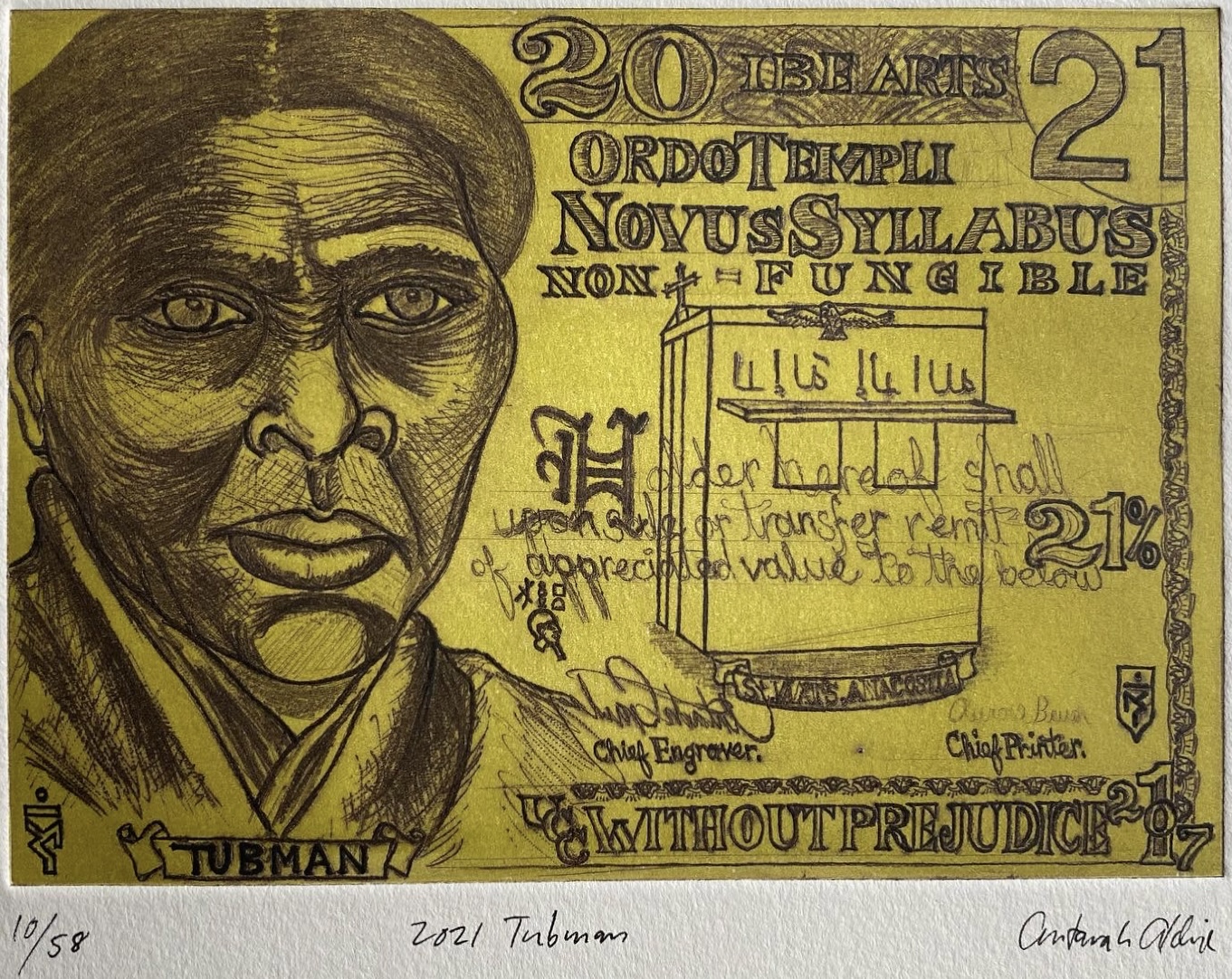
In 2022, IBé Crawley printed a 58-copy edition of Antarah Crawley’s Harriet Tubman 2021 Non-Fungible Note from a copper plate he engraved by hand. Printer Aurora Brush assisted IBé Crawley in the intaglio printing process during her residency at the Women’s Studio Workshop (WSW) in Rosendale, New York.
The IBé Crawley publication will coincide with the 2023 fall exhibitions Holding Ground at the National Museum of Women in the Arts’s (NMWA) in Washington, DC, and The Calling at City Lore in New York City. Within its pages will be catalogued four of Crawley’s artist’s books: 11033, Delia Posey, Bearing Witness, and A Dwelling for Her Story. Each chapter will present a different category of art work, together with descriptions, articles, quotes, and images.
Into Fall 2023 and beyond, IBé Arts Institute will strategically focus on:
- Paper making
- Print making
- Book binding
IBé Arts Institute aspires to become a Virginia folk book press “center of excellence”. This is the first initiative in what the Institute and N∴S∴ plan to be a bright new era of programs, projects, and partnerships.

Article 2
The Organization of the New Syllabus
By Antarah Crawley
1. HISTORY
WASHINGTON, DC — In 2014 AD, I, Antarah, had a vision of one new syllabus for humanity. This syllabus would chart a course for human understanding of ubiquitous and lasting systems established since time immemorial. I sojourned to Brooklyn, New York, in pursuit of my syllabus, developed a discipline, and professed a doctrine toward the development and operation of human mind software, individually and collectively, and I returned to the Federal City.
Being in possession of such valuable information, I began to process this knowledge and offer certain products and services to the public, toward the establishment of a society of free thinkers, truth speakers, and light workers united (FTLU) in a firm league of friendship called a decentralized autonomous organization (FLF-DAO). To that end, I wrote and recommend policy positions to the FTLU stakeholders. This practice has resulted in the production of a robust and diverse body of multimedia intellectual property which we, the Director and Company, shall distribute throughout the world under the motto of Novus Syllabus Seclorum, meaning “the New Syllabus of the Age.”
2. ORGANIZATION
Established 2022, NOVUS SYLLABUS L.L.C. (N∴S∴) is a liberal arts and humanities intellectual property holding company specializing in diversified arts investments and management.
Our flagship brand, New Syllabus (est. 2014), is a knowledge management system (KMS) that creates, codifies, organizes, stores, and disseminates information to the public from newsyllabus.org. To that end, it conducts research and development in the broad field of Historic and Ancient Mysteries, Economy, Theology, Informatics, and Systemtheorie (HAMETICS).
N∴S∴ operates the Department of Information Systems and Intelligence Services (DISIS, pronounced “Diocese”), which is divided into the Archival Records Management (ARM) Division and the Mind Software (Mindsoft) Development and Operating Systems Command (DOSCOM). These are our Curricular Operations, Research, and Publication Services (CORPS) which supply information to the New Syllabus (now known as the DataHorse System or “DHS“).
N∴S∴ also operates the Ombud Service Bureau (OmbudService, or Office of Ombudsman) for administrative due process, and Syllabus Media Group for audiovisual production and distribution.
3. VISION
Our Vision is a world of free thinkers, truth speakers, and light workers united under one new syllabus for STEM, arts, and humanities research, development and operations; one new syllabus for the ages!
4. VALUES
Our Values are Love, Truth, Peace, Freedom, and Equity; these are our foundation. Our Three Great Pillars which support our institution are Trust, Faith, and Belief; as it is said, Faith is complete Trust and firm Belief, the acceptance of truth divine, which Belief, sincerely held, cannot be converted into a crime.
5. MISSION
Our mission is to reveal truths which have been hidden and to keep a record of knowledge and wisdom.
N∴S∴ conducts, manages, and supports curriculum research and development. We represents FTLU through its Office of Ombudsman. We administer intellectual property and copyrights as custodial superintendent for their creator.
Our mission-oriented service lines are:
- DISIS (now DHS) for recordkeeping and CORPS operations
- Mindsoft for cognitive, behavioral, and professional development
- OmbudService for administrative operations
- Other operations (OPS) include Granary Bank & Trust/Artcoin Mint of Meriptah, New Works Projects Administration, St. Nat’s/O∴T∴N∴S∴, FTLU, FLF-DAO, and the Syllabus Free Press.
(Last modified 20 Sep 2023 4 Oct 2023 13 Oct 2023)
© MMXXIII by NOVUS SYLLABUS L.L.C.
ALL RIGHTS RESERVED WITHOUT PREJUDICE.
Mindsoft as a Service (MaaS)
 Mindsoft Command Prompt (click above)
NS:\Mindsoftware_as_a_Service(MaaS)
Course Syllabus (Runtime Environment)

(last modified 3 Mar. 20)
Mindsoft

College of the Ancient Mystery, Memorandum No. 1 (“Resolution”)

Preamble
I, Ombudsman Antarah A. Crawley, in Order to form a Labor Union, establish peace and nobility, provide for the collective consciousness, promote the ancient mysteries, and secure equitable representation for ourselves and our polity, do ordain and establish this Constitution of the College of Ancient Mystery School of Thought.
Article 1
Section 1
Our College is a model society founded upon the rights of light, liberty, and the pursuit of self education (mastery), for that is the highest labor of humanity and the pillar of civilization.
Section 2
Our model school system has three branches of service, each of which offers its body-politic of students and clients the lines of service required to enter, pass, and raise them to the grade of Sui Jure Magister (Self Law Master, aka, Higher Self Education). Our system is the dialectic synthesis of the ancient and modern university systems.
Article 2
Section 1
Branch 1: General Educational Assembly
The Djedi Knights’ College of Ancient Mystery (“Knights’ College”) is an open and free college held in regular session wherein all who seek the truth may come and find it. There is neither division of disciplines, nor enrollment, nor grading in the General Educational Assembly, and the lessons will be taught predominantly through the Dialectic Method using the scientific notation and language of Medu Nedjer. The Knights’ College shall function as the general assembly of students of the Djedi arts and sciences (“the Arcanum,” “the Mysteries”).
Students of the General Assembly are to be instructed in Dialectic Thought and True Speech, aka, the Maa’kheru Knighthood of Djedu, that they may appeal themself to the bar of Ombudsman to be entered as a Knight-elect and be found Maa’kheru (True-of-Voice) before Tribunal.
Section 2
Branch 2: Appellate Tribunal
The disciplined pursuit of knowledge may inspire the student to appeal to the higher faculties of the school system for conference of degrees, wherefore the Office of Ombudsman is hereby charged to serve as the appellate tribunal of the Djedi Knights-elect, wherein those students who elect to the degree of Knighthood may be duly tried, and contested matters of fact and truth may be appealed to the judgment of a discerning, just, and equitable consciousness.
This branch of service includes Audit, Assessment, Assurance, and Adjudgment of persons’ knowledge and intelligence. To this end, the prime directive of the Office of Ombudsman is to determine the truth of the speech and thought of a knight-elect of Djedu.
The conference of Knighthood upon being found Maa’kheru (True-of-Voice) by Tribunal is equivalent to the degree of Sui Jure Magister.
Section 3
Branch 3: Higher Faculty
The Faculty Members of Knights’ College are called Seshu Djehudi Xristiyaan Maliki Tzaddiq as-Salaam, whose name means “the Pious and Learned Scribes of Wusiris Christ, the Righteous, King of Peace,” also called “College of Scribes,” or, “King’s College”. All faculty of the Knights’ College must be members of the King’s College, but the Maa’kheru Djedi Knight need not be a member of the King’s College.
Admission to the College of Scribes is equivalent to the degree of Sui Juris Doctorate, and shall require the Scribe-elect to scribe a synthesis of the law and policy of the Mysteries for implementation in the Knights’ Curriculum, which synthesis must be argued, heard, and found Ma’at before the Djadjat em Djedu.
Section 4
The Djadjat (meaning “the Supreme Court”) shall refer to both the 2nd and 3rd branches of educational service, wherein the Ombudsman shall serve as the chair and chief representative between the higher and lower colleges (and may in fact be the sole faculty member of the College).
Section 5
Jurisdiction and Authority
Knights College shall be ruled by the book N.S.C. and the Office of Ombudsman shall be ruled by the book O.M.; while the King’s College is ruled by the Xristiyaan Consciousness.
Article 3
“Thought precedes matter-reality”: An applied methodology for human being.
“Wusiris is our noble and civil society, who was martyred Before the Common Era; who will be resurrected in our Order of Djedu. Djehudi has risen up the Djed of Wusiris, King of the Knights-defenders of the right. In We, the body politic of our Ancient Ancestors shall be reborn.”
Geometry is the pure form of thought, laying plain all numerical constants with irreducible proof and harmonic beauty; whereas the study of matter-reality is pervaded by spacetime dynamics; movement; function; change.
Article 4
Section 1
Knights’ Creed (Catechism of the Greater Mystery of the Raising Up of the Djed on the Day of Judgment and the Lesser Mystery of the Contention of Suthek and Heru, or, the Greater Mystery of Thought and the Lesser Mystery of the Body Politic)
Ink Djedi Wusir*, Kham Ur Neb Djedu, Khenti Amentiu**, em Karast Maa’kheru***, who is raised up by Djehudi, who is reborn in Waset, who contended against Suthek and was dismembered in Maa’fa****; whose body will be remembered in Heru Wedja Medu*****. Dua****** to Waset, this Holy Church, our Mother, and the Maa’kheru Knighthood of Djedu, and the deliverance from Isfet*******, em peret em Heru********, and everlasting life. Amenta.
* I am the Djed of Osiris
** Great Kham, Lord of Djedu, Foremost Chief of the Westerners
*** Anointed with consciousness, true of voice
**** The Great Disorder
***** On the Day of Judgment
****** Glory be; Adorations
******* Ignorance and Disorder
******** resurrection of the consciousness
Section 2
“Tua Ra”
Ham Dua Ra Iah Illaha Ill Aahla.
Ham Dua Iah Shu Weha Ill Aahla, Amenta.
Section 3
“Ptah Netjer”
Ptah Netjer em Pet Ta, May we have true knowledge of our body in Wusir, our blood in Waset, our conscious in Heru, and deliverance from the ignorance of Isfet. Aahla Amenta.
Article 5
On Historical Dialectical Materialist Thought
Said Friedrich Engels (in The Dialectic of Nature), The reciprocal law of motion, gaining force in proportion to the square of the distance in time from its point of departure (or last measurement), is as true for the highest product of organic matter, thought, as it is for substantial materiality (“matter-reality”). This is at once the thesis of historical and dialectical materialism as for the ancient and mystic orders of the indigenies of the east, west, north and south where it was known as “Ma’at”. Wherefore let the ancient mystery school of thought be reestablished as the synthesis of the historical dialectic of materialist thought from predynastic kemet through the post modernity of western civilization. Whereas the post renaissance West was content to reinvent the wheel of the knowledge of materialist dynamics through the increasingly compartmentalized lenses of the disciplines, we need look no further than the unified civil administration of “Smai-tawi” (“the unification of opposing forces”) among the Khemite-Kushite Diaspora in Afuraka, Asiah, and the Amerikas.
In Dialectic of Nature, Engels postulates a general theory of dialectics to be developed as the science of juxtaposition (“interconnections”), like unto Kant’s earlier Allgemeine Naturgesehichte und Theorie des Himmels and Von Bertalanffy’s later Allgemeine Systemtheorie. Said he, “It is from the history of nature and human society that the laws of dialectics are abstracted; for they are nothing but the most general laws of these two aspects of historical development, as well as of thought itself; and indeed they can be reduced to in the main to three:
“1. The law of the transformation of quantity into quality and vice versa;
“2. The law of the unity of opposing forces;
“3. The law of the negation of the negation.”
In conclusion, these three pillars of thought form the foundation of the Order on which is built the Temple of the Body, the Lodge of the Nous and Spiritus.
NOW THEREFORE BE IT RESOLVED, that there is ordained and established this 1st day of May, 2019, by the Ombudsman Antarah A. Crawley of the Noble and Holy Order of the Knights of Djedu a College of the Ancient Mystery School of Thought. Aahla Amenta.+

